Posted by AGORACOM-JC
at 10:50 AM on Friday, July 26th, 2019
SPONSOR: Betteru Education Corp.
aims to provide access to quality education from around the world. The
Company plans to bridge the prevailing gap in the education and job
industry and enhance the lives of its prospective learners by developing
an integrated ecosystem. Click here for more information.
BTRU: TSX-V
————————
[Funding alert] Edtech platform Brainly raises $30M led by Naspers; plans to expand user base in India
The latest investment brings the total funding received by the edtech platform to $68.5 million.
Poland-based Brainly, a peer-to-peer learning community for students, parents, and teachers across 35 countries including India,
has raised $30 million in its new funding round led by Naspers with participation from Runa Capital and Manta Ray.Â
Poland-based Brainly, a peer-to-peer learning community for students, parents, and teachers across 35 countries including India, has raised $30 million in its new funding round led by Naspers with participation from Runa Capital and Manta Ray.
The latest investment brings the total funding received by the edtech platform to date up to $68.5 million.
The company said in a statement that the current round of funding
will be used to enhance Brainly’s user experience and invest further in
the quality of the help provided to students and parents across the
globe. In addition, these funds will enable the company to further expand its user base in India, one of its key markets, which is witnessing continual growth with more than 15 million unique monthly users.
Brainly CEO and Co-Founder, Michał Borkowski said
“Our goal is to extend that access to academic help to every
student in the world, including India, giving them the resources and
the tools to succeed while inspiring collaborative learning. This
funding allows us to do just that. We also plan to utilise these funds
to expand our offerings for the Indian community of students, parents,
and teachers, by providing a platform to discuss and study in other
local languages like Marathi, Gujarati, Bengali, Telugu, and Punjabi, to
name a few.”
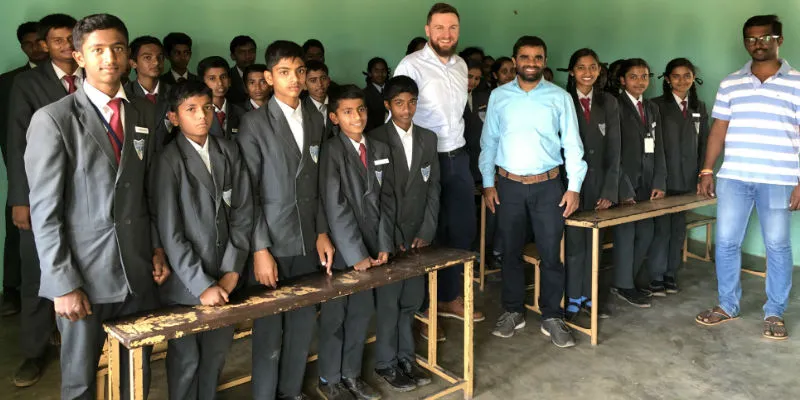
Brainly CEO and Co-Founder Michał Borkowski with students
Founded in 2009 by Michal Borkowski, Lukasz Haluch, and Tomasz Kraus , Brainly last raised $38.5 million in Series B round from seven investors, including Naspers, which also funded India’s first edtech unicorn BYJU’s.
“We have been impressed by Brainly’s growth over the past 10
years, particularly in the US, and high-growth markets like India,
Indonesia, Turkey, and Brazil,” said Larry Illg, CEO of Naspers Ventures.
“At Naspers, we extend our support to companies that can address
grave societal needs like education, helping them fulfill their vision
with the ultimate aim of bringing about a change at a global scale,†he
said.
With more than 150 million monthly unique users, Brainly now reaches out to students, teachers, and parents across 35 countries in
solving their academic problems and exchanging knowledge. In addition
to India, the platform’s largest communities are in the US, Russia, Indonesia, India, Brazil, and Poland, among others.
Middle and high-school students, as well as their parents across
India, have been leveraging Brainly’s platform to strengthen their
skills in core academic subjects such as Math, Science, local languages like Hindi, and Social Studies, the company added.
In 2016 and 2017, Brainly closed $15 million Series B funding and $14 million Series B-1 funding,
led by Naspers and Kulczyk Investments, respectively. The platform’s
previous investors also include General Catalyst Partners, Point Nine
Capital, Runa Capital, and Learn Capital.
Brainly’s ‘crowdlearning’ model combines online education, social media, and machine learning, and is disrupting the $2.6 billion education market on a global level.
Posted by AGORACOM-JC
at 10:18 AM on Friday, July 26th, 2019
SPONSOR: ThreeD Capital Inc. (IDK:CSE) Led by
legendary financier, Sheldon Inwentash, ThreeD is a Canadian-based
venture capital firm that only invests in best of breed small-cap
companies which are both defensible and mass scalable. More than just
lip service, Inwentash has financed many of Canada’s biggest small-cap
exits. Click Here For More Information.
In First, SEC Clears Blockchain Gaming Startup to Sell Ethereum Tokens
U.S. Securities and Exchange Commission has issued a no-action letter to Pocketful of Quarters (PoQ), a gaming startup looking to issue tokens on the ethereum blockchain.
PoQ may legally sell its Quarters tokens to consumers without registering them as securities, the SEC Division of Corporation Finance wrote in its second no-action letter to a company seeking to launch a token sale.
The U.S. Securities and Exchange Commission has issued a no-action
letter to Pocketful of Quarters (PoQ), a gaming startup looking to issue
tokens on the ethereum blockchain.
PoQ may legally sell its Quarters tokens to consumers without
registering them as securities, the SEC Division of Corporation Finance wrote in its second no-action letter to a company seeking to launch a token sale. (The first was granted in April to TurnKey Jet, a business-travel startup.)
Quarters are built according to the ERC-20 standard – the first such token to receive U.S. regulatory approval.
In the July 25 letter, Jonathan Ingram, chief legal officer for the SEC’s FinHub wing, wrote:
“Based on the facts presented, the Division will not recommend
enforcement action to the Commission if, in reliance on your opinion as
counsel that the Quarters are not securities, PoQ offers and sells the
Quarters without registration under Section 5 of the Securities Act and
does not register Quarters as a class of equity securities under Section
12(g) of the Exchange Act.â€
“The thing that’s notable here, this is the first ERC-20 public
blockchain token [approved for a sale],†said Lewis Cohen of DLX Law,
which worked with PoQ to secure the letter.
The token is a stablecoin, with PoQ setting the price of the Quarters
as the only seller, PoQ CEO George Weiksner said. This is part of the
company’s compliance requirement with the SEC. (A smart contract
prevents tokens from being sent to unapproved accounts, thereby
restricting secondary trading.)
PoQ also raised money through a registered securities sale using an
investment token, which will remain separate from the Quarters sale.
The two-token system is meant to ensure that users conduct
transactions with Quarters, rather than hold them in the hopes of
securing a return, Weiksner explained.
He said he hopes Quarters will improve the gaming experience for
players who are tired of spending large sums for different platforms,
adding:
“It’s a way to make games better.â€
“The most important thing for teenage boys is playing video games and
this might be the first financial product that they have and it’ll be a
crypto wallet,†said Michael Weiksner, the company’s principal (and
George’s father).
PoQ is working with Apple and Google to sell Quarters tokens in the
App and Google Play stores, respectively, the elder Weiksner said.
Launch conditions
The no-action letter requires a PoQ to follow a number of
commitments, including ensuring that players can’t sell, buy or exchange
tokens with each other. Rather, only developer or “influencer†accounts
will be able to transact with players.
“Players can never buy or sell or exchange to anyone except for
approved developers, and that’s a key component of our … [compliance]
strategy,†Michael Weiksner said.
“Accounts are born as regular accounts but they’re restricted, so
they can’t exchange,†he said. “The default accounts are restricted and
only approved accounts can accept Quarters.â€
At present, only PoQ can approve accounts, and there are no concrete
plans to grant other entities the ability to do so, he said. PoQ is
still looking into whether that’s possible.
Developers and influencers will have to pass know-your-customer (KYC)
and anti-money laundering (AML) processes before they can get an
approved account.
According to the letter, Pocketful of Quarters has fully developed its platform and can go live before any tokens are sold.
Moreover, the Quarters tokens “will be immediately usable for their
intended purpose†with PoQ’s gaming platform when the sale begins, and
“only developers and influences with approved accounts will be capable
of exchanging Quarters for [ether] at pre-determined exchange rates by
transferring their Quarters to the Quarters Smart Contract.â€
The SEC’s Ingram warned that “any different facts or conditions might require the Division to reach a different conclusion.â€
“Further, this response expresses the Division’s position on
enforcement action only and does not express any legal conclusion on the
question presented or on the applicability of any other laws, including
the Bank Secrecy Act and anti-money laundering and related frameworks,â€
he wrote.
Reaching this point took PoQ and DLX the better part of a year, Michael Weiksner said.
Cohen told CoinDesk, “we have long championed the importance of
working with, rather than against, regulators, and we believe the
outcome today of this … letter, the first-ever ERC-20 that can be sold
without being a securities offering, I think it’s an incredibly
important point.â€
He concluded:
“It required a lot of patience, and it shows that not every ERC-20
token is a securities offering and it is a positive event in working
with regulators.â€
Posted by AGORACOM-JC
at 3:44 PM on Thursday, July 25th, 2019
SPONSOR: Tartisan Nickel (TN:CSE)
Kenbridge Property has a measured and indicated resource of 7.14
million tonnes at 0.62% nickel, 0.33% copper. Tartisan also has
interests in Peru, including a 20 percent equity stake in Eloro
Resources and 2 percent NSR in their La Victoria property. Click her for more information
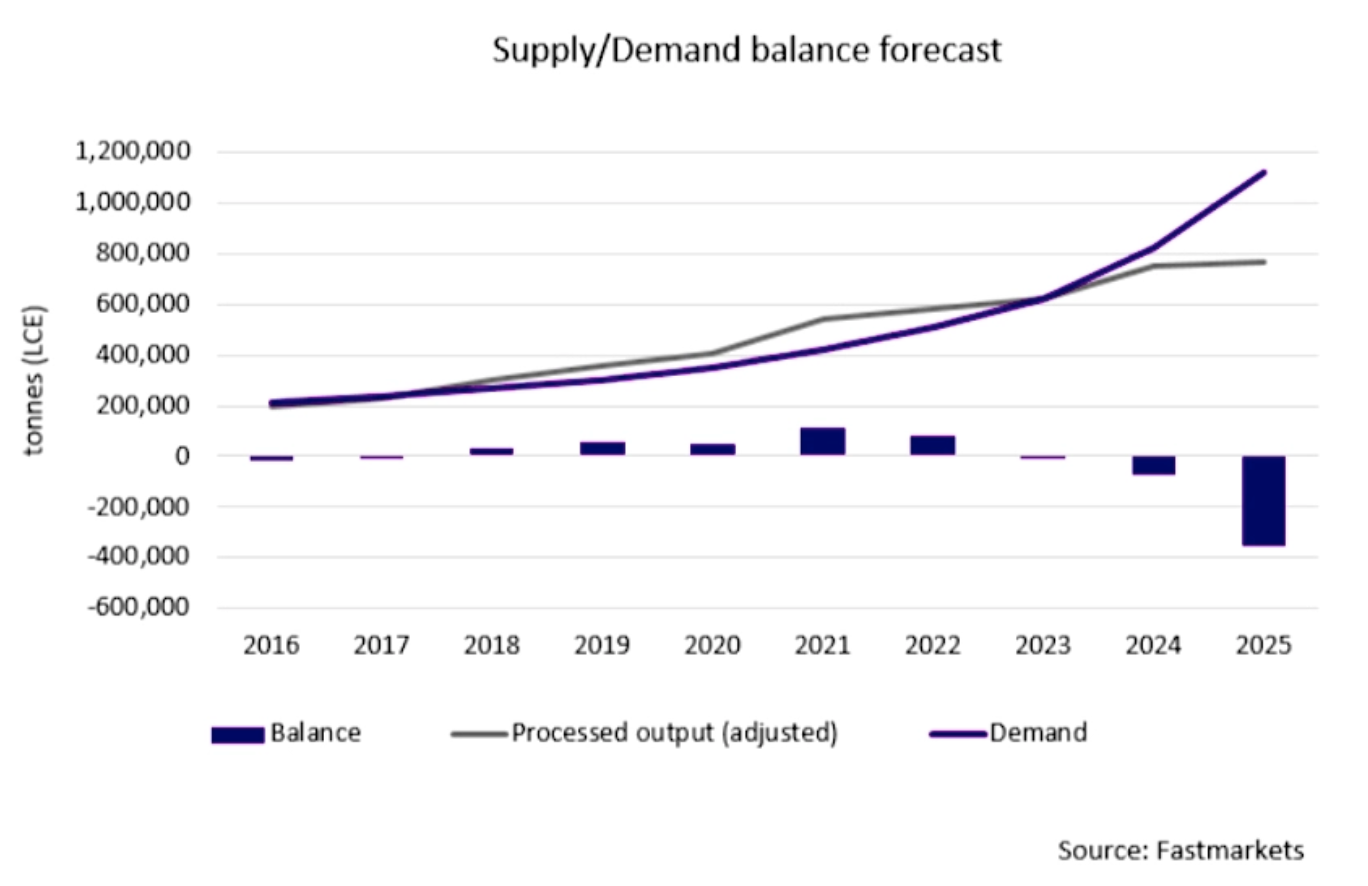
Growing global demand for batteries that power electric vehicles (EVs) and high tech devices is set to cause a supply crunch of lithium, cobalt and nickel by the mid-2020s, global consultancy Wood Mackenzie predicts.
The firm’s latest research shows that sales of passenger EVs,
including hybrid electric vehicles (HEV), jumped by more than 24% last
year. And while HEVs had the smallest growth, they made up over 60% of
EV sales.
WoodMac expects global sales of EVs to account for 7% of all passenger car demand by 2025, 14% by 2030 and 38% by 2040.
“Battery pack sizes continue to trend larger through the medium term,
resulting in overall greater battery demand. We have seen the first
announcements of the commercialization of NMC 811 cells in EVs,†says
Gavin Montgomery, WoodMac research director.
Not surprisingly, Montgomery notes, China was the first market mover,
but a number of other nations and companies are moving towards mass
production of 811 cells before the end the year.
South Korea’s SK Innovation is already in talks to set up separate
battery-making joint ventures with Volkswagen AG and Chinese partners,
as part of the petrochemicals producer’s aggressive plans to tap into
the EV market.
“While still conservative on mass-market uptake for [811 cells], we
are more optimistic in regards to adoption. As such, we expect to see an
increased nickel demand at the expense of cobalt, and to a lesser
extent, lithium,†the analyst says.
WoodMac warns that, unless battery technology is developed, tested,
commercialized, manufactured and integrated into EVs and their supply
chains faster than ever before, it will be impossible for many EV
targets and ICE (Internal Combustion Engines) bans to be achieved. “This
will pose issues for current EV adoption rate projections,†Montgomery
says.
Lithium prices to fall further
Over the past year, spot prices for lithium carbonate have fallen by just under $7,000 a tonne, affecting top producers and juniors alike.
“This is in an environment where the major brine producers in South
America have failed to ramp up capacity. Clearly, the first responders
to the lithium boom–
Australian hard rock mines – have the capability to quickly deliver the
required tonnages. Meanwhile, the bottleneck in Chinese conversion
capacity that was supporting prices is giving way as China emerges as a
net exporter of lithium chemicals to the region.
(Click to enlarge)
Expected strong lithium demand will not be able to offset a decline
in prices, even though the need for the commodity from battery makers
alone will jump 650% by 2027.
“It has only taken a few years for the battery sector to become the
largest demand driver for lithium. Lithium’s use in every lithium-ion
battery type means it will have double-digit annual growth, making up
over 80% of total lithium demand by 2030,†Montgomery adds. The study
also reveals that the cobalt market will see an oversupply of
intermediate products such as hydroxide until at least 2024.
The firm also suggests that investment in new nickel projects are needed now as mines can take up to 10 years to develop.
Posted by AGORACOM-JC
at 2:00 PM on Thursday, July 25th, 2019
SPONSOR: Enthusiast Gaming Holdings Inc.
(TSX-V: EGLX) Uniting gaming communities with 80 owned and affiliated
websites, currently reaching over 75 million monthly visitors. The
company exceeded 2018 target with $11.0 million in revenue. Learn More
EGLX: TSX-V ———————————-
Global eSports Market Recent Study Including Growth Factors CAGR of 18.58% by 2025
Global eSports Market is expected to reach USD 3047.1 billion by 2025 from USD 779.4 billion and is projected to grow at a CAGR of 18.58% in the forecast period of 2018 to 2025.
Global eSports Market is expected to reach USD 3047.1 billion by 2025 from USD 779.4 billion and is projected to grow at a CAGR of 18.58%
in the forecast period of 2018 to 2025. The eSports preferred as
“Electronic sportsâ€. The sports that connect with the electronic system
and all the functions are followed human – computer interface. It
provides the customer an experience for several types of games including
tournament, ladder, and league through single system.
eSports are connected though electronic system that can be available
on numerous platforms comprising social media, where as traditional
sports are still fight overtake the traditional mediums including print,
radio & TV. Capability to stream on non-traditional platforms,
growths in gaming technologies, rising in awareness about eSports due to
consideration given by worldwide publishers, investors &
broadcasters and growth in number of eSports supporter are the major
drivers responsible for rise of eSports market. In addition, it’s played
by professional gamers who are usually participating of sporting
organizations, or they are sponsored by business organizations.
eSports is the most relevant, unique, fair and creditable global
market research report which is provided to the valuable customers and
clients depending upon their specific business needs. eSports market
report helps uncover the general market conditions and tendencies. Along
with competitive analysis of the key players, this eSports report also
serves with complete and distinct analysis of the market drivers and
restraints, detailed analysis of the market segmentation, key
developments in the market and details of research methodology.
Excellent practice models and method of research applied for this
eSports report unearths the best opportunities to succeed in the market.
Major Market Competitors: Global eSports Market
The renowned players in global eSports market are
Bungie, Inc, KONAMI, GungHo Online Entertainment, Inc, Kabam, Inc.,
Rovio Entertainment Corporation, Zynga Inc., GAMEVIL Inc. Wargaming
Public , PandaScore, ESP.bet, Unikrn , Riot Games , HI-REZ STUDIOS, INC.
, Activision, BLIZZARD ENTERTAINMENT, INC. , Electronic Arts Inc.,
Activision Publishing, Inc. , infinity ward, Take-Two Interactive
Software, Inc., King.com, Vivendi, Bethesda Softworks LLC, and many
more.
Market Segmentation: Global eSports Market
By Revenue Streams (Media Rights (Subscription &
Online Advertisement ),Tickets And Merchandise, Sponsorship & Direct
Advertisement, And Publisher Fees),
By Geographical Segments (North America, South America, Europe, Asia-Pacific, Middle East And Africa)
For achieving an incredible growth in business, this eSports market
research report plays very central role. This report lends a hand to
make out how the market is going to perform in the forecast years by
offering you information about market definition, classifications,
applications, and engagements. This market report describes the
strategic profiling of key players in the market, comprehensively
analyzing their core competencies, and drawing a competitive landscape
for the Electronics industry. You can request an analyst call or drop
down an enquiry to get detailed eSports market report.
Market Drivers and Restraints:
Increasing demand for video games and growing awareness about eSports.
Betting & fantasy site are increasing demand in eSports market.
Rising demand for investments from sponsors and advertisers.
Difficulty in managing all the fraudulent betting.
Lack of outdoor sports considerations.
About Us:
Data Bridge Market Research
set forth itself as an unconventional and neoteric Market research and
consulting firm with unparalleled level of resilience and integrated
approaches. We are determined to unearth the best market opportunities
and foster efficient information for your business to thrive in the
market.
Posted by AGORACOM-JC
at 1:24 PM on Thursday, July 25th, 2019
St-Georges Eco-Mining Corp. (CSE: SX) has presented a Phase I Independent Review of its Phase I report titled “Bonnie Claire Metallurgical Evaluation and Process Development” to Iconic
SX has developed Nitric Acid leaching methodology that puts between 99.97% and 100% of the lithium from the sediments into solution at room temperature within 1-4 hours.
SX has reached the Phase 1 Benchmark which calls for the issuance of 2,000,000 of Iconic’s common shares to St-Georges.
Vancouver, British Columbia–(July 25, 2019) – Iconic Minerals Ltd. (TSXV: ICM) (OTC Pink: BVTEF) (FSE: YQGB)  (“Iconic”) is pleased to announce that St-Georges Eco-Mining Corp. (CSE: SX) has presented a Phase I Independent Review of its Phase I report titled “Bonnie Claire Metallurgical Evaluation and Process Development” to Iconic. SX has developed Nitric Acid leaching methodology that puts between 99.97% and 100% of the lithium from the sediments into solution at room temperature within 1-4 hours. SX has reached the Phase 1 Benchmark which calls for the issuance of 2,000,000 of Iconic’s common shares to St-Georges. The shares will remain in escrow for three years. Iconic has also met its other obligations derived from this agreement by participating in St-Georges’ private placement in January 2019 for CAD $100,000.
Additional details of the Nitric Acid leaching is quoted below from an SX press release dated July 24, 2019:
St-Georges’ Process: Selective Leaching with Nitric Acid
“Leaching with a passivating acid normally used to
clean steel and passivate the welds of stainless steel was performed in
the hope of selectively removing the magnesium (Mg) and all the salt
metals like sodium (Na), calcium (Ca), lithium (Li) and magnesium (Mg).
The initial results with a 4-hour leach showed that all the salt
metals and carbonate formations leached easily. This follows the logic
of cleaning acid and leaves most of the other elements behind, such as
silica (Si), alumina (Ai), potassium (K).
Multiple 1-hour leach tests confirmed the leaching of 100% of the
lithium leaving behind most of the leachable elements from other acids
such as potassium (K). The only loss of lithium that occurred during
some of these tests was due to the water in the filter with the solids
and represented less than 0.03% of the total lithium value. It also
corresponds directly to the water retained with this type of fine
material. Additional trials are being performed with reduced time of
contact and temperature to optimize the lithium-bearing fines leaching.
The lithium in the super fines leached completely in each test
performed with nitric acid. The trials to selectively optimize leaching
the lithium with less calcium and magnesium are expected to be performed
in the third quarter of 2019. It is expected that calcium can be
reduced partially by filtering the coarser calcium formation as per SGS
results and partially with less contact time with the acid. The same for
magnesium. New samples will be treated once received.“
Iconic looks forward to the SX Phase II report which will include plans for a pilot plant.
The Bonnie Claire Lithium Property Characteristics:
The Property is located within Sarcobatus Valley that is
approximately 30 km (19 miles) long and 20 km (12 miles) wide.
Quartz-rich volcanic tuffs, that contain anomalous amounts of lithium,
occur within and adjacent to the valley. Geochemical analysis of the
local salt flats has yielded lithium values up to 340 ppm. The gravity
low within the valley is 20 km (12 miles) long, and the current
estimates of depth to basement rocks range from 600 to 1,200 meters
(2,000 to 4,000 feet). Four drill holes have identified an open ended,
43-101 compliant resource of 28.58 billion kilograms of lithium
carbonate equivalent. The drilling that defined the current resource
only covered an area of 3.0 km2 (1.2mi2), while previously run MT
geophysics show a potentially mineralized area of 27.3 km2 (10.5mi2).
Drilling to date has shown strong correlation between the MT results and
the lithium mineralization. The thickness of the lithium mineralization
is unknown, but drilling indicates it is greater than 600 meters (2,000
feet). The current claim block covers an area of 57.5 km2 (22.2mi2).
Further drilling has been permitted and metallurgy to determine the most
efficient recovery method is currently in progress.
On behalf of the Board of Directors
Richard Kern, President and CEO Contact: Keturah Nathe, VP Corporate Development (604) 336-8614
Forward Statement: This news release includes
certain forward-looking statements or information. All statements other
than statements of historical fact included in this release are
forward-looking statements that involve various risks and uncertainties.
There can be no assurance that such statements will prove to be
accurate and actual results and future events could differ materially
from those anticipated in such statements. Iconic expressly disclaims
any intention or obligation to update or revise any forward-looking
statements whether as a result of new information, future events or
otherwise except as otherwise required by applicable securities
legislation.
Neither the TSX Venture Exchange nor its Regulation Services
Provider (as that term is defined in the policies of the TSX Venture
Exchange) accepts responsibility for the adequacy or accuracy of this
release.
Posted by AGORACOM-JC
at 11:00 AM on Thursday, July 25th, 2019
SPONSOR: Betteru Education Corp.
aims to provide access to quality education from around the world. The
Company plans to bridge the prevailing gap in the education and job
industry and enhance the lives of its prospective learners by developing
an integrated ecosystem. Click here for more information.
BTRU: TSX-V
————————
How Edtech Solutions are Building a Productive Digital Space for Millennials
Beas Dev Ralhan
Co-Founder & CEO – Next Education India Pvt. Ltd.
Education technology has, therefore, undoubtedly helped the millennials gain a productive, adaptable learning environment in the digital space that caters for multiple kinds of learners in multiple ways.
Need for governmental policies to work towards the integration of such tools in an organised and all-encompassing manner so that such a space can become much more productive than it is today.
The 21st-century learners are characterised by their inherent thirst for knowledge that goes beyond the linear search of information, their preference of choice and individualism over one-size-fits-all trends, and their expertise in tech tools and social networking via various forms of digital media. On the other hand, the 21st-century teacher may be one who is concerned about quality but lacks the resources and skills necessary to ensure that the learners’ potential is not wasted. Edtech solutions are bridging the gaps in the teaching-learning ecosystem by transforming the essential elements of the education space. Let us see how.
Breaking the Traditional Frames of Learning
Traditional models of education dictate the frames of learning such
as time and place; for instance, the majority of academic activities
happen in the brick-and-mortar confines of a school within 8-10 hours of
a day. E-learning has done away with such frames and given students the
ability to learn anywhere, anytime. Similarly, while books were once
the chief source of learning, aiding only the visual learners, the
edtech sector has helped in bringing multimedia content, including
immersive experiences such as augmented and virtual realities to cater
for all kinds of learners.
Most of all, such tools challenge the passive one-way lecture-mode
learning, helping learners be more active in their learning with
hands-on learning, flipped learning and peer interaction. Now teachers
are facilitators of their students’ learning, monitoring their
individual performances and helping them with personalised
feedback/recommendations.
Doing and Understanding: The Real-world Connection
Edtech tools help students learn better by providing the platform to
solve real-life problems with ease, which hones their understanding of
the world around them and helps them develop skills necessary to
navigate through their lives. For instance, robotics help youngsters
develop their STEM skills, and in the process, aid their understanding
of the existing problems in the world around them. Similarly,
collaborative digital spaces are being utilised in a constructive manner
to drive discussion and action with respect to real-world situations.
Game-based learning also helps in a deeper understanding of situations
in a simulated environment with the help of creative games such as
Minecraft.
Innovative Methods of Assessments
For education to meet the requirements of the students, it is
necessary for the instructor to know precisely where the individual
learner stands at the beginning of the academic course and to measure
the gaps through the course of learning. Assessment is the best method
to carry this out. Unfortunately, traditional tests do not give an
accurate picture of what the learners know or don’t know, and what kind
of instructions the students need to learn new concepts.
Artificial intelligence, one of technology’s greatest boons, has
helped shape adaptive tests to quantify the proficiency or knowledge
level of the examinee accurately. These tests adapt to the abilities of
the learners and act as a morale booster, since the chances of
discouragement or boredom are reduced.
Gamified assessments are also an innovative way to assessments, so
that fear of tests are eliminated. Gamified assessments will capture
learners’ attention, provide simulated situations to train them in
handling real-life scenarios and help them retain information better.
Questionnaires can be prepared in a Kaun Banega Crorepati (How
To Be A Millionaire) style, or in crossword-puzzle mode, or based on
motifs of common games, such as Tic-Tac-Toe, Hangman and Find-Your-Way
so that students enjoy the process of assessments.
Promoting Personalised and Self-learning Styles
The viewpoint of learning has changed from teacher-centred to
learner-centred, and therefore ‘personalisation’ and ‘self help’ are the
buzzwords in today’s education scenario. The factory method of learning
does not help most students and hinders their potential by trying to
fit all students in a single mould. Personalised learning is powered by
adaptive learning technology, which helps the individual student
understand his or her skill level, and suggests the most suitable course
of study. A lot of self-learning solutions are also available which can
help students and teachers upskill themselves as per individual
requirement. This has bolstered distance learning through popular
platforms.
Education technology has, therefore, undoubtedly helped the
millennials gain a productive, adaptable learning environment in the
digital space that caters for multiple kinds of learners in multiple
ways. We need governmental policies to work towards the integration of
such tools in an organised and all-encompassing manner so that such a
space can become much more productive than it is today.
Posted by AGORACOM-JC
at 10:26 AM on Thursday, July 25th, 2019
SPONSOR: ThreeD Capital Inc. (IDK:CSE) Led by
legendary financier, Sheldon Inwentash, ThreeD is a Canadian-based
venture capital firm that only invests in best of breed small-cap
companies which are both defensible and mass scalable. More than just
lip service, Inwentash has financed many of Canada’s biggest small-cap
exits. Click Here For More Information.
————-
The Future Of Banking: Is It All Bitcoin And Blockchain?
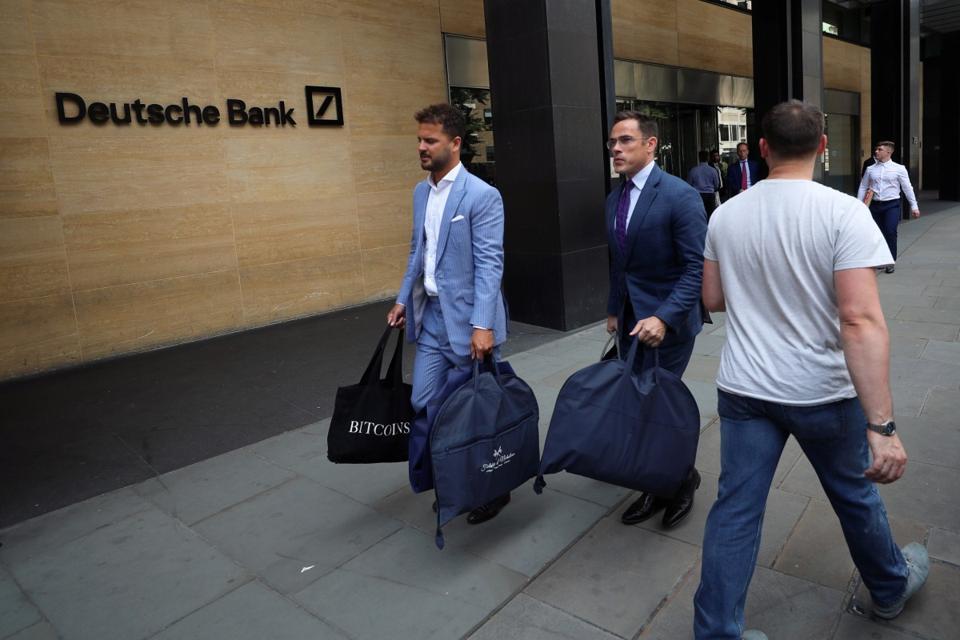
At the beginning of July, news broke of Deutsche Bank staff being
sent home as 18,000 job cuts began unraveling before our very eyes. This
news was brought to life with an iconic image of two suited men
carrying their possessions past the doors of a Deutsche Bank branch in
London along with a bag branded “Bitcoins.”
Unfortunately, that image turned out only to be an incredible piece
of timing and coincidence as the men were not now out-of-work bankers
hoofing it from their formal institutional workplace brandishing the
‘future of money,’ on their bags, instead they were tailors walking past
at the right time.
Still, that near-perfect latent image of the finance’s future did
spark a few questions in my mind, and the minds of others. Just how far
are we from a future predicated on Bitcoin and blockchain in banking?
The beginning of the end for banks
To answer this question, I had to look at what is happening in the
world of banking that has led to job cuts and the concerns for the
traditional way of doing things in finance. Living in the United
Kingdom, London is a historical hotspot for banking and the seat of
power for some of the world’s biggest banks.
However, beyond the high-rise glass structures in the city center,
there are signs – usually in the tube stations and bus stops – of a new
way of managing and controlling your money on a day to day basis. No, it
is not Bitcoin – yet – it is the challenger banks.
Challenger banks, as defined,
are: “Small, recently-created retail banks in the United Kingdom that
compete directly with the longer-established banks in the country,
sometimes by specializing in areas underserved by the “big four” banks.”
These banks, also called App-banks, are usually highly customer
focused and made to be as user-friendly and as easy to operate on a day
to day basis as they can. In comparison with traditional banks,
challenger banks try and play to general user frustrations from your big
institutional banks. Sound familiar?
Challenging the legacy
I spoke with Anne Boden, a banking doyen with 30 years experience in
some of the most important financial institutions in the world, and now
the founder and CEO of Starling Bank – one such challenger bank in the UK.
Talking to her about the future of banking was fascinating for
although Boden is aware of Bitcoin, blockchain, and its potential it has
in the banking sector, she believes its time is still far on the
horizon.
In her recently released book, “The Money Revolution” Boden
states: “[Blockchain] is easily the most revolutionary money change on
the horizon and may make a huge difference across the fintech sector.”
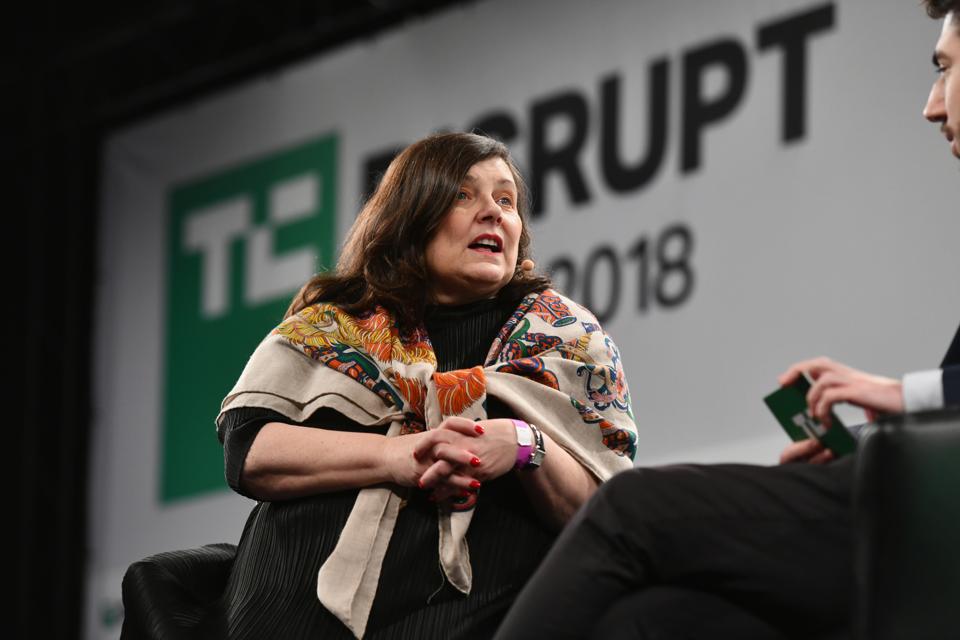
BERLIN, GERMANY – NOVEMBER 30: CEO of Starling Bank Anne Boden speaks
on stage during TechCrunch Disrupt Berlin 2018 at Treptow Arena on
November 30, 2018 in Berlin, Germany. (Photo by Noam Galai/Getty Images
for TechCrunch)
Getty Images for TechCrunch
Her thoughts on how traditional banks will need to change and evolve
because of several different factors could easily be viewed in the same
way, but with blockchain and cryptocurrency-tinted glasses
“I spent 30-odd years in traditional banking, I worked for all the
big banks, I worked for Lloyds Bank, Standard Chartered, UBS, Zurich,
and RBS. Then I went into AIG, post-financial crisis, to do the
turn-around and I came to the conclusion that it was easier to start a
new bank than to fix the old,” Boden told me.
Indeed, the banking legacy and way of doing things has become so
stagnant that the wants of the banks and the needs of the customers
almost do not line up anymore – especially on a day to day basis.
Challenger banks are this fresh start customers have been baying for,
but in comparison, cryptocurrencies and blockchain could be an entirely
fresh system.
“In this era, it is people like Atom, Monzo, and Starling that have
come to market, and the ones that have been successful are the ones that
have built their own technology,” Boden added. “All these organizations
have been called challenger banks, but you can only really disrupt when
you have a current account – because people are using that every day –
and when you have your own technology.”
Again, Boden is not necessarily referring to that technology as being
blockchain; however, one can see how blockchain is a prime example of
disruptive technology for the banking sector. The world is changing, and
the way people do everything is different, and this is also down to
technology.
“Customers have changed. Customers are buying music differently; they
are shopping on Amazon; they are doing things very differently,” said
Boden. “Technology has changed. Everyone is wandering around with their
smartphones, these phones have better penetration than the laptop, and
then all the time the regulations are changing as well, and that is a
perfect storm to bring something like Starling to the market.”
Starling is one of several challenger banks that are succeeding at
disrupting the banking hegemony with their customer focus, their
everyday usability, and their own technologies. Their success is indeed a
challenge to institutional financial systems, but because this is a
fast-moving space, there are already challengers to the challenger
banks.
A new weapon in the arsenal
Challenger banks, App-banks, mobile payment companies, merchant
services aggregator, peer-to-peer payments companies, are all financial
services that are looking to take a piece of the pie that traditional
banks have held for so long – and it is not just a UK phenomenon.
Circle, Square, and even Revolut,
which is coming to the USA are also disruptive forces in the financial
space, but what they all have in common is a cryptocurrency offering.
Cryptocurrency may be a long way off from being as popular as the Pound
or the Dollar in regards to payments, but some of these companies are
still offering the chance to use this alternative payment method, should
you be so inclined.
This took me to the offices of two other App-banks in the UK, Wirex, and Zeux.
Both companies operate as an alternative banking solution, allowing for
payments and money transfers, but they also each have cryptocurrency
offerings as well.
These offerings are of course not going to be nearly as popular as
the general fiat services of Starling, for example, but they are not
supposed to be – as yet.
“App-banks, or digital banks, are making things more convenient for
everyday customers to manage their banking, “Frank Zhou, CEO of Zeux,
told me. “There are a lot of needs in the early adopter space who are
interested in cryptocurrency, from trading, investing, using it for
payments. Those types of customers are easier to reach as they follow
the newest developments and are willing to give it a try,”
Pavel Matveev, one of the founders at Wirex, explained that the use
of cryptocurrencies need not only be for experimenting though. There are
tangible use-cases within the payment sphere already.
“While App-based and digital banks offer a more convenient means of
managing money, they are still largely based on conventional payment
infrastructure. This means that cross-border payments still take 3-5
days to settle and command relatively high fees,” said Matveev
“Decentralised digital currencies have the potential to revolutionize
many aspects of the payments industry due to their transparency,
mobility, and ease-of-use,” added Dmitry Lazarichev, also of Wirex.
“One of the most significant areas is international remittance.
Cross-border crypto transactions are significantly faster than
conventional methods of transferring money abroad and require very
little in the way of fees and charges.”
Different offerings
What Matveev and Lazarichev, as well as Zhou, had to say about
including cryptocurrencies into the new era of banking, reminded me of
Boden’s view for the future of the industry. The hopes of the two
crypto-offering App-banks is that they can fill small niches for people
with this new technology, and for Boden, the view is that traditional
banks will face stiff competition in these small niches of finance
services.
“What is going to happen is other things happening in the environment
will catch up with the banking industry, they will surprise the banking
industry,” said Boden “The combination of 5G internet of things,
self-driving cars, AI and machine learning will change the profile of
how payments are made.”
“So I think that the nature of payments will change and you will get
new entrants providing some of those new payment mechanisms, and I think
in that environment the incumbent banks will find it harder to compete.
Some will survive and mutate to something relevant, and many of them
will die.”
If cryptocurrency is to become one of those new payment mechanisms,
getting an early foot in the door is vital, but even more important is
offering a service that is usable. Zeux may see this as using
cryptocurrency for general payments, while Wirex could believe
remittances are key for the digital currencies; neither is more right
than the other and perhaps that is the point – there will be a bevy of
offerings in the future.
“Like previous studies of mass adoption, it happens when the majority
can use it as easily as they would use it normally. For example, from
cash to PIN card, Pin card to contactless cards, contactless to mobile
payment. An easy-to-use experience is key to bringing adoption,” said
Zhou.
“I think the market is ready for crypto mass adoption. But, there
needs to be a solution before the mass demand surfaces. Once all the
customers know they can spend their cryptos easily everywhere in any
shops, it increases their willingness to accept cryptos as payment in
the first place. Mass adoption only happens after the solution appears,
not before.”
A changing future
The banking world has, for almost the last century, continued in
pretty much the same way with little to no threat from alternatives.
That is all changing. People would like to believe that the power of
blockchain in the financial system, and the option of cryptocurrencies,
are about to shake up the entire banking space, but they would be
wrong.
There is little doubt that banking will start to incorporate
blockchain, as Boden explains: “I think that blockchain is likely to be
used in certain aspects of the banking business, so probably for trade
finance where you have lots of parties collaborating on a transaction,
but I think you will see blockchain implementation in niche areas of the
business, you won’t see it as a wholesale change for the banking
platform.”
However, for an entire, legacy-based industry of such a traditional
magnitude to overhaul its entire system for a nascent technology is
foolhardy.
In saying that, cryptocurrencies will start to gain more mass appeal.
This does not mean these two sides of the same industry will be what
changes the face of banking. Still, the face of banking is changing, and
that is why traditional banks that are oblivious to this are starting
to show cracks.
Everyday usage of money and payments is already on the march, and
because of the needs of customers, there is an emerging market of
challenger banks, app-banks, financial institutions and payment
facilitators in the wings. Some are already offering blockchain and
crypto services, some may do so down the line, but to say that the only
way to the future of banking is with blockchain and crypto is
short-sighted – there are much bigger demands and many more niches to be
filled.
Posted by AGORACOM-JC
at 9:17 AM on Thursday, July 25th, 2019
The Genesis PGM Project is a road accessible, under explored, highly prospective multi-prospect drill ready Pd-Pt-Ni-Cu property that warrants initial drilling, additional surface mapping, sampling to expand the known footprint of mineralization and to determine the ultimate size and grade of the layered mineralization outlined to date.
A 3-phase summer work program has been initiated on the project which is intended to map potential hydrothermal alteration anomalies and define structural domains to better define drill targets on the Project.
A mineralized horizon has been identified in outcrop sampling for 850 m along strike and a 40 m true thickness. (for more information please click to the April 18, 2018 news release).
The identification of two different styles of PGM/ Multi-Element mineralization at Sheep Hill suggests that multiple mineralizing events have occurred.
NAM management is actively seeking an option/joint-venture partner for this road accessible PGM/Multiple Element Project using the Prospector Generator business model.
July 25th, 2019 – Rockport, Canada – New Age Metals Inc. (TSXV:NAM)(OTC:NMTLF)(FSE:P7J) is pleased to announce it has engaged Avalon Development Corp (Avalon) of Alaska, USA to carry out a field work program on its Genesis PGM-Ni-Cu Project in Alaska.
Genesis Project Summer 2019 Field Program
The summer 2019 field program on
Genesis is intended to map hydrothermal alteration to better define
drill targets on the Project and will be comprised of 3 phases of work;
ASTER Imaging and Interpretation, Landsat TM Imagery Processing and
Interpretation and ground induced polarization, Airborne Magnetics and
EM Reinterpretation. A detailed description of each phase of work
follows:
Phase 1: ASTER Imaging and Interpretation
The main objective of the ASTER (Advanced
Spaceborne Thermal Emission and Reflection Radiometer) processing and
interpretation is to map potential alteration targets to aid
district-scale PGM-Cu-Ni sulfide exploration. The end goal of this phase
is to generate 3 false color images: a 15-meter false-color image
composed of three VNIR bands, a 30-meter false-color image composed of
three SWIR bands, and a 90-meter false-color image composed of three TIR
bands. Each false-color image is designed to enhance the alteration
targets so they show up distinctively as color anomalies.
Phase 2: Landsat TM Imagery Processing and Interpretation
Interpret potential general clay alteration
targets and potential iron-oxide alteration targets to generate a
30-meter true-color image to aid visual interpretation of the iron-oxide
targets.
Phase 3: Airborne Magnetics and EM Reinterpretation
1. Reprocess existing State of Alaska
airborne magnetic data in 2D and 3D formats to outline chromite-bearing
PGM accumulations and identify structural domains.
2. Reprocess existing State of Alaska
airborne EM data in 2D and 3D formats to outline PGM-Cu-Ni sulfide
conductors and identify structural domains.
3. Reprocessing of a limited ground IP
program completed over the Sheep Hill prospect area to better define
strucutural details and target PGM-Cu-Ni sulfide-bearing horizons.
Merits of the Genesis PGM Project
The Genesis PGM Project is an under explored, highly prospective multi-prospect drill ready Pd-Pt-Ni-Cu property
that warrants follow-up drilling, additional surface mapping, sampling
to expand the known footprint of mineralization and to determine the
ultimate size and grade of the layered mineralization outlined to date.
The stable land status, ease of access and superb infrastructure make
this project prospective for year-around exploration, development and
production.
Significant aspects of the Genesis PGM Project include:
– Drill
ready PGM-Ni-Cu reef style target with 2.4 grams/ton Palladium (Pd), 2.4
grams/ton Platinum (Pt), 0.96% Nickle (Ni), and 0.58% Copper (Cu).
– Reef mineralization is open to the west, east, north, and at depth
– Mineralized reef identified in outcrop for 850 m along strike and a 40 m true thickness
– Separate style of chromite mineralization contains Platinum Group Metals (PGM) up to 2.5 g/t Pd and 2.8 g/t Pt.
– Known PGM mineralization covers a distance of 9 km across the prospect.
– No historic drilling has been done on the project.
– Project is within 3 km of a paved highway and electric transmission line.
– Project is on stable State of Alaska claims.
– Fraser Institute’s 2017 survey of mining companies has Alaska ranked as the 10th best jurisdiction in the world for mining.
Click Image To View Full Size
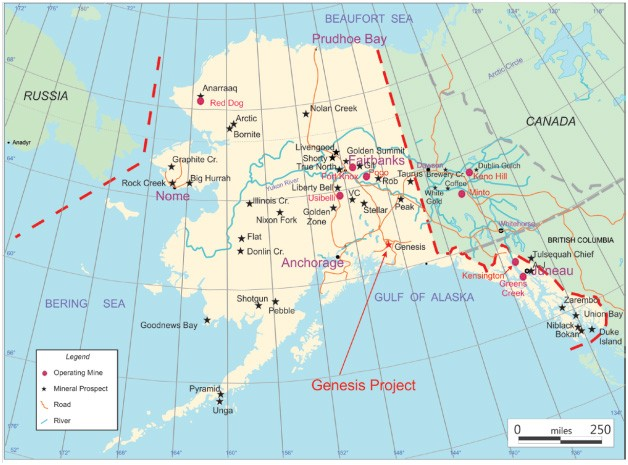
Figure 1: Location of the Genesis Project, Nelchina Mining
District, Alaska. The Genesis project is a Ni-Cu-PGM property located
in the northeastern Chugach Mountains, 75 road miles north of the city
of Valdez, Alaska. The project is within 3 km of the all-season paved Richardson Highway and a high capacity electric power line. The project is covered by 4,144 hectares (10,240 acres) of State of Alaska mining claims owned 100% by New Age Metals.
ABOUT NAM’S PGM DIVISION
NAM’s flagship project is its 100% owned River Valley PGM Project (NAM Website – River Valley Project)
in the Sudbury Mining District of Northern Ontario (100 km east of
Sudbury, Ontario). Recently the company announced the results of the
first PEA (see News Release – June 27th, 2019) completed on the River Valley Project. The
PEA has been developed by various independent consultants – P&E
Mining Consultants Inc. (P&E) was responsible for the open pit
mining, surface infrastructure, tailings facility, and project
economics; DRA Americas Inc. (“DRA”) was responsible for all
metallurgical test work and processing aspects of the Project; and WSP
Canada Inc. (“WSP”) was responsible for the Mineral Resource Estimate. The
PEA is a preliminary report but it has demonstrated that there are
positive economics for a large-scale mining open pit operation, with 14
years of Palladium and Platinum production.
On April 4th, 2018, NAM signed an agreement with one of Alaska’s top geological consulting companies. The companies stated objective is to acquire additional PGM and Rare Metal projects in Alaska. On April 18th, 2018,
NAM announced the right to purchase 100% of the Genesis PGM Project,
NAM’s first Alaskan PGM acquisition related to the April 4th
agreement. The Genesis PGM Project is a road accessible, under
explored, highly prospective, multi-prospect drill ready Palladium (Pd)-
Platinum (Pt)- Nickel (Ni)- Copper (Cu) property. A
comprehensive report on previous exploration and future phases of work
was completed by Avalon Development of Fairbanks Alaska in August 2018
on Genesis.
On August 29, the Avalon report was submitted to NAM, management is actively seeking an option/joint-venture partner for this road accessible PGM and Multiple Element Project using the Prospector Generator business model.
QUALIFIED PERSON
The contents contained herein that relate
to Exploration Results or Mineral Resources is based on information
compiled, reviewed or prepared by Curt Freeman, a consulting
geoscientist for New Age Metals. Mr. Freeman is the Qualified Person as
defined by National Instrument 43-101 and is the owner of Avalon
Development Corp. and Anglo Alaska Gold Corp, which is the vendor of the
Genesis PGM Project. Mr. Freeman has reviewed and approved the
technical content of this news release.
On behalf of the Board of Directors “Harry Barr” Harry G. Barr Chairman and CEO
Neither the TSX Venture Exchange
nor its Regulation Services Provider (as that term is defined in the
policies of the TSX Venture Exchange) accepts responsibility for the
adequacy or accuracy of this release.
Cautionary Note Regarding Forward
Looking Statements: This release contains forward-looking statements
that involve risks and uncertainties. These statements may differ
materially from actual future events or results and are based on current
expectations or beliefs. For this purpose, statements of historical
fact may be deemed to be forward-looking statements. In addition,
forward-looking statements include statements in which the Company uses
words such as “continue”, “efforts”, “expect”, “believe”, “anticipate”,
“confident”, “intend”, “strategy”, “plan”, “will”, “estimate”,
“project”, “goal”, “target”, “prospects”, “optimistic” or similar
expressions. These statements by their nature involve risks and
uncertainties, and actual results may differ materially depending on a
variety of important factors, including, among others, the Company’s
ability and continuation of efforts to timely and completely make
available adequate current public information, additional or different
regulatory and legal requirements and restrictions that may be imposed,
and other factors as may be discussed in the documents filed by the
Company on SEDAR (www.sedar.com), including the most recent reports that
identify important risk factors that could cause actual results to
differ from those contained in the forward-looking statements. The
Company does not undertake any obligation to review or confirm analysts’
expectations or estimates or to release publicly any revisions to any
forward-looking statements to reflect events or circumstances after the
date hereof or to reflect the occurrence of unanticipated events.
Investors should not place undue reliance on forward-looking statements.
Posted by AGORACOM-JC
at 4:33 PM on Wednesday, July 24th, 2019
SPONSOR: ThreeD Capital Inc. (IDK:CSE) Led by
legendary financier, Sheldon Inwentash, ThreeD is a Canadian-based
venture capital firm that only invests in best of breed small-cap
companies which are both defensible and mass scalable. More than just
lip service, Inwentash has financed many of Canada’s biggest small-cap
exits. Click Here For More Information.
————-
What Blockchain Executives Think About The Uproar Around Facebook’s Libra
On the week of July 15, 2019 Facebook met in front of a US congressional committee to discuss the tech giant’s ambitious plans of creating a global digital currency named Libra.
At the hearing, US congressional staff probed Libra executives as well as notable cryptocurrency experts on the project’s intentions and concerns.Â
On the week of July 15, 2019 Facebook met in front of a US congressional committee
to discuss the tech giant’s ambitious plans of creating a global
digital currency named Libra. At the hearing, US congressional staff
probed Libra executives as well as notable cryptocurrency experts on the
project’s intentions and concerns.
The takeaways from the hearing included strong concern from central authorities that Libra could pose a significant risk to the global financial system. These risks include money laundering, terrorist financing, and loss of regulatory power.
As a Swiss-entity, the Libra
foundation promised to comply with international financial bodies and
cooperate in general with lawmakers. The goal is simple. Libra wants to
create financial inclusion for millions of unbanked people around the
world using a stable coin. There are expected to be many more hearings
to further the conversation.
With a wide range of opinions
presented, this article turns to industry experts and entrepreneurs to
get their feedback on Libra and the future of banking and digital
currencies.
At Intergalaxy,
we have noticed two main reactions from the recent Libra news. One was
from critics that feel threatened or concerned and the other from
supporters that see the project’s potential to create a new global
financial solution. Both are completely understandable given how early
it is in the project’s inception.
The critics see Facebook, the company
backing Libra, as an entity that has proven to be unreliable with data
and will ultimately be pulling the strings to stipulate Libra’s price.
According to the whitepaper and intentions stated, there are significant
concerns about the viability and scalability of the project. Also, the
target audience is largely Facebook users so the ability to control
these users by Facebook and Libra could become problematic if the
safeguards in place fail.
The supportive group, on the other
hand, is the same community that already finds itself in the billions of
active users that understand digital currencies and can act as
spokesman to the rest of the world. In this scenario, visibility to the
benefits of cryptocurrencies will be bigger and it will benefit more
people, globally speaking.
In these meetings, we may have finally seen the recognition that the
cryptocurrency industry deserves. In either way, the impact on the
industry will be huge.
Antoni Trenchev, Co-Founder and Managing Partner of Nexo
At Nexo,
we are happy to see that the current focal point on Libra and the
cryptocurrency market will help spark the long-awaited conversations on
Capitol Hill about regulation surrounding digital assets that will
benefit the entire crypto space and especially crypto banking which is
the field that Nexo dominates. It is our hope that business-friendly and
technology-fostering rules will be the by-product of this political
discourse.
Paving the way to financial inclusion
for the 2 billion underbanked that Libra can access via the platforms
maintained by Facebook is the financial innovation of phenomenal
proportions. Even more so given the fact the concept of Libra will
prevail as it offers a lot of advantages such as ultra-low-cost
cross-border transactions, cheaper acquisition of payments for merchants
and no FX cost. It’s only a matter of time and adequate regulation
basis for its revolutionary potential to be put in widespread use.
The value propositions by entities of
financial innovators are obvious everywhere and companies like Nexo are
already counteracting another important plague of our time – the
inability to earn high-yield interest in a safe manner. Given the
extremely low-rate environment facilitated by the FED and ECB, Nexo
offers 8% annual returns, incredibly attractive to both retail and
financial institutions. We are interested in further teaming up with
Libra in this endeavor.
Nexo has always shown its support to
the big-movers in the space, further attested by the news of
transitioning at least 10% of its NEXO Tokens from the Ethereum
blockchain to the BEP-2 standard of Binance’s own blockchain called
‘Binance Chain’ in order to ensure faster transactions, lower fees and
the trading of NEXO on the Binance DEX.
This is the latest move in a
year-long collaboration between Nexo and Binance which began in July
2018 when Nexo became the first company to ease the selling pressure and
allow holders of Binance Coin (BNB) to borrow against their
cryptocurrency using Instant Crypto Credit Lines™. The newly built
two-way token swap mechanism will allow holders to convert BEP-2 to
ERC-20, and vice versa, while paying #ZeroFees and will be available
within the Nexo Wallet on both web and mobile.
The more legitimate strategic
partnerships the industry sees, such as this, the more the public will
see the value in the industry. Libra is a good example with its
consortium of backers.
The deep concern shown by U.S. and
global policymakers around Libra’s initial vision is justifiable and not
surprising. By proposing the creation of an open payment and developer
network with limited, hands-off regulatory compliance, Facebook should
have foreseen this sort of push back. Given that Facebook has over 2.3
billion active monthly users, the balance of innovation and regulation
is a careful one.
Even pre-Libra, Facebook has had to
face increasing criticism thanks to its data harvesting practices and
the significant data hacks its users have fallen victim to. If Facebook
can’t secure its current social platform and messaging apps with proper
security and privacy technologies, then why should its user base trust
in Libra?
Privacy issues are abound in the big
data industry, which encompasses any company that has, uses, and sells
large amounts of personal data, such as Facebook. Protecting the privacy
of both users and corporations while allowing all to realize the value
of blockchain technology is one of the main reasons we built Quras in the first place.
We cannot get to a place of trusted blockchain adoption without
giving individuals a digital ID that allows them to control their
identity in detail while putting a data permission hierarchy into place
with various privacy levels for any given purpose. This will ultimately
allow regulatory compliance and more real-world use cases to surface.
One thing is undeniable with the
recent news about Libra, digital currencies and blockchain technology
just took the global stage. I see this as an extremely positive thing
despite the visible hesitation seen by lawmakers. With any new
industry, questions and concerns are to be expected and we welcome that
as an exchange.
Right now, we need to take this
opportunity to continue educating the people around us about digital
currencies and their massive potential and give confidence to them. This
is why OKEx
recently donated $4.5 million Bitcoin to its perpetual swap market
insurance fund to support the Power Lunch, a charitable luncheon between
a handful of crypto magnates and legendary Wall Street investor Warren
Buffett in our way. This lunch is a great way to generate discussions
but we decided to place our resources where the crypto community can
directly benefit.
The more hearings we see the clearer
this should all become. A couple of brave congressmen showed astute
understanding of the industry during the hearings proving that even
lawmakers can grasp the intricacies of digital currencies when they want
to.
Will Libra launch and be a success? Time will tell. For the awareness of digital currencies, the
news is welcomed and we look forward to the process of educating and
serving millions of more customers on OKEx in the near future.
Posted by AGORACOM-JC
at 3:11 PM on Wednesday, July 24th, 2019
Received the Independent Review of its Phase I report titled “Bonnie Claire Metallurgical Evaluation and Process Development.”
Delivery of the current Independent Review Report constitutes the conclusion of the Stage 1 Benchmark and calls for the issuance of 2,000,000 of Iconic’s common shares to St-Georges.
Iconic has also met its other obligations derived from this agreement by participating in St-Georges’ private placement in January 2019 for CAD $100,000.
Montreal, July 24, 2019 – St-Georges Eco-Mining Corp. (CNSX:SX.CN) (OTC:SXOOF) (FSE:85G1) is pleased inform its shareholders that it has received the Independent Review of its Phase I report titled “Bonnie Claire Metallurgical Evaluation and Process Development.” The Company has communicated this information to its client, Iconic Minerals (TSX-V: ICM).
In December 2017, the Company entered into an agreement with Iconic
Minerals ltd that called for St-Georges to develop an extraction process
that would allow Iconic to economically exploit the lithium resources
discovered at Iconic’s 100% owned Bonnie Claire lithium deposit. (For
details, please refer to St-Georges’ Press Release dated December 7,
2017). The agreement has three delivery milestones. The delivery of the
current Independent Review Report constitutes the conclusion of the
Stage 1 Benchmark and calls for the issuance of 2,000,000 of Iconic’s
common shares to St-Georges. Iconic has also met its other obligations
derived from this agreement by participating in St-Georges’ private
placement in January 2019 for CAD $100,000.
St-Georges’ Research & Development Vice-President, Enrico Di Cesare commented: “(…) The development team is
looking forward to progressing the technology further (…) knowing
that the process works and can be independently executed is very
encouraging. We are currently able to leach between 99.97% and 100% of
the lithium in solution (…) the only improvement possible at this
stage is to reduce processing time and the size of the feedstock with
improved concentration. significantly improve what was developed in
Phase I, covered by this report. (…) We are designing the pilot plant
to keep a maximum of flexibility to improve the initial steps of the
process. (…) We are looking forward to the big challenge that putting a
25t/w pilot plant in place represents for us. (…) The reception we
have had from the local communities approached is very positive. People
understand the need to produce lithium at low costs, and they embrace
our commitment to green technology. The government support we have
received until now is beyond what we would have normally expected. (…)
We are now at the stage to increase and formalize our relationships
with higher-learning and public R&D entities. We are hopeful that it
will allow for even more innovation down the road (…)”
Summary of the Report
The objective of the process development by St-Georges Eco-Mining ltd was to recover lithium from the Bonnie Claire deposit.
SGS Lakefield Laboratory performed an elemental analysis and
crystalline analysis of the material that was received. The results
indicated that the lithium was in a spodumene (LiAlSi2O6)
crystal form, and no chlorides were present. This suggests that the
lithium is not the residue of brines from a land-locked salt lake.
Recovery of lithium was tried with water, sulphuric acid,
hydrochloric acid, and mixed acid leaching. All obtained poor results at
room temperature and no pressure. Best results were at higher
temperatures for sulphuric acid, indicating a high-pressure roasting was
required for this material. This is standard for this mineral but not
practical at these concentrations. Sulphuric acid with high temperature,
pressure, and roasting at concentrations of 0.1% lithium or 0.2%
lithium (after air classification) is not practical.
Nitric acid was tried for selective leaching with positive results.
At low temperature and with no pressure, 100% of the lithium was put
into solution while avoiding the leaching of metals and most of the
other elements. Other leached materials were carbonates (1/2 of the
present iron was found under carbonate form) and salts (Mg, Ca including
sodium and lithium). With the expected mined volume of over 7 million
tons annually for 20,000 tons of lithium hydroxide produced, this type
of leaching strategy could help keep capital costs down by, amongst
other things, allowing for the design of a low-cost leach tank.
Concentration methods were tested with early-stage results that call
for further tweaking and calibration. The air classification trials were
able to remove half of the gangue. The report delivered to Iconic
contains a separate independent report in which these tests were
independently performed and validated by Netzsch GmbH. The trials will
be continued with a focus on optimizing de-agglomeration and on crystal
form optimization. Flotation trials were not conclusive at this early
stage. The selective leaching results allowed the Company to plan
additional developments in Phase II. The use of resin for the
purification of the lithium might be pursued on the resulting leached
material and in a parallel extensive test with an electrolysis pilot
plant to be set up to provide the industry with samples for market
acceptance. The latter being a key to funding the project in the future.
Recovery of lithium was also tried with water, sulphuric acid,
hydrochloric acid, and mixed acid leaching. All obtained poor results at
room temperature and no pressure. Best results were at higher
temperatures for sulphuric acid, indicating a high-pressure roasting was
required for this material. This is standard for this mineral but not
practical at these concentrations. Sulphuric acid with high temperature,
pressure, and roasting at concentrations of 0.1% lithium or 0.2%
lithium (after air classification) is not practical.
Testing Results
SGS Lakefield Laboratory was then approached for characterization and
preliminary leaching trials to better determine the strategy for
development and approach going forward, and to get a second opinion on
the crystalline form of the lithium. An independent characterization
report made by SGS Lakefield Laboratory is in Appendix A of the Phase I
report delivered to Iconic.
Table 1: Crystalline Mineral Assemblage (SGS Lakefield)
*tentative identification due to low concentrations, diffraction line overlap or poor crystallinity
*I/M – illite-montmorillonite mixture
Brackets indicate non-clay minerals present in the clay fraction.
The presence in clays of spodumene (the most common mineral form of
lithium in hard rock lithium resources) may indicate that it has been
collected over centuries in the dried lake by the erosion of
lithium-bearing hard rock formations as fine clay-sized particles.
Table 2: XRD Crystal Structure (SGS Lakefield)
Mineral
Head Assay
(wt %)
Orthoclase
25.8
Albite
16.6
Quartz
12.2
Analcime
12.1
Calcite
10.7
Illite-Montmorillonite
5.3
Phlogopite
4.1
Spodumene
3.2
Illite
3.1
Heulandite
2.8
Halite
1.3
Siderite
1.2
Magnetite
1.1
Clinochlore
0.6
Total
100
Spodumene represents approximately 3.2% by weight, and typical crystal form is LiAlSi2O6.
Lithium in this crystal form represents 3.7% by total weight. This
correlates closely to the 0.1% lithium readings that have been measured
during resource estimates confirming the crystalline form.
A chemical element distribution was also performed to try to predict
options to create an economical and environmentally viable solution for
the recovery of the resource.
Table 3: Chemical Element Distribution (SGS Lakefield)
Name
Assay1
SQD2
Delta
Status
Oxygen
40.3
47.9
-7.55
Both
Silicon
25.1
26.2
-1.08
Both
Aluminum
6.35
7.09
-1.55
Both
Calcium
5.08
4.44
0.64
Both
Potassium
4.23
4.27
-0.03
Both
Sodium
3.41
3.28
0.13
Both
Iron
2.24
2.13
0.11
Both
Carbon
–
1.41
-1.41
SQD
Magnesium
1.13
1.15
-0.02
Both
Chlorine
–
0.76
-0.76
SQD
Hydrogen
–
0.27
0.27
SQD
Fluorine
–
0.18
0.18
SQD
Lithium
0.11
0.12
0.01
Both
Phosphorus
0.03
–
0.03
XRF
Titanium
0.22
–
0.22
XRF
Manganese
0.09
–
0.09
SRF
1.Values measured by chemical assay.
2.Values calculated based on mineral/compound formulas and quantities identified by semi-quantitative XRD.
The usual form of lithium present in typical brines is easy to
dissolve in water. The common forms of lithium associated with hard rock
resource are spodumene LiAlSi2O6 and lepidolite K(Li,Al,Rb)2(Al,Si)4O10(F,OH)2 which
require aggressive leaching with high temperature and roasting. As the
economic recovery of the lithium would be severely hampered, a leaching
trial was performed at ambient temperature with conventional leaching
options. Initial tests have shown that high temperature and roasting
would be necessary with conventional leaching methods.
Table 4: Summary of Leach Tests
Test
Lixiviant
Solids
Extractions (%)
Test
Sample
Temp
Lixiviant
Li
Ca
Mg
L-001
NV Clay Comp
Amb
Water
2
0
0
L-002
NV Clay Comp
Amb
H2SO4
11
15
8
L-003
NV Clay Comp
Amb
HCl
7
92
4
L-004
NV Clay Comp
80
H2SO4
15
14
9
L-005
NV Clay Comp
80
H2SO4 + Thiourea
40
16
40
Water Leach (L-001)
A lithium salt would normally be leached or dissolved in water. L-001
test demonstrates that only 2% of the total lithium was recovered in
solution, and a total of 11% weight loss of the solids occurred. This
indicates that only actual salts were dissolved in the water. A typical
brine would have allowed most of the lithium and salts to be recovered
in water which is noticeably not the case here. A water wash could
reduce the impurities in the solution simplifying the total purification
steps by reducing sodium, for example. Saturated salt water may help
with concentrating lithium fines during froth flotation and may be
achieved by water recirculation.
Sulphuric Acid Leach (L-002, L-004, L-005)
At ambient temperature, test L-002 leached 11% of the lithium. With the temperature at 80?C test L-004 with
15% of the lithium recovered provided the best results with sulphuric
acid. This follows the logic of hard rock lithium minerals chemical
recovering with high temperature pressurized leach after roasting with
conventional methods. Purification and neutralization efforts are costly
even with a 6% total lithium concentrate. At the concentrations being
discussed, the chemical usage and sheer size of the process plant, it
would doubtfully be economical.
Mixed acid was also tried with elements added to the sulphuric acid in test L-005.
At 80?C, this did improve the recovery of lithium to 40% but also
increased other elements not targeted to be leached. Even with mixed
acid, the testing trend indicated high-temperature pressure vessels
would be needed. This would be very costly with low concentrations of
lithium in addition to leaching many impurities that would complicate
the purification steps. The main advantage with sulphuric acid is that
calcium is precipitated as gypsum, thus eliminating one of the
impurities.
Hydrochloric Acid Leach (L-003)
Test L-003 was only a little better than water leach (L-001)
with 7% of the total lithium recovered and almost all the calcium. In
this case, it is expected that increasing the temperature would improve
results, but more impurities would probably be leached at the same time.
Mg and Ca leached at the highest rate with HCl (Ca remains in solution
with HCl).
Magnesium (Mg) and Calcium (Ca) cause problems for the recovery of
lithium with resins and organics. Conventional resins with brines
typically have a ratio of 6 to 1 for Magnesium to Lithium before
efficiency is severely diminished. This has led to the development of
new resins to operate in less favorable ratios. In the case of using
acids, the chemical costs can become prohibitive even if a resin for
purification is found with unfavorable ratios.
St-Georges’ Process: Selective Leaching with Nitric Acid
Leaching with a passivating acid normally used to clean steel and
passivate the welds of stainless steel was performed in the hope of
selectively removing the magnesium (Mg) and all the salt metals like
sodium (Na), calcium (Ca), lithium (Li) and magnesium (Mg).
The initial results with a 4-hour leach showed that all the salt
metals and carbonate formations leached easily. This follows the logic
of cleaning acid and leaves most of the other elements behind, such as
silica (Si), alumina (Ai), potassium (K).
Multiple 1-hour leach tests confirmed the leaching of 100% of
the lithium leaving behind most of the leachable elements from other
acids such as potassium (K). The only loss of lithium that occurred
during some of these tests was due to the water in the filter with the
solids and represented less than 0.03% of the total lithium value. It
also corresponds directly to the water retained with this type of fine
material. Additional trials are being performed with reduced time of
contact and temperature to optimize the lithium-bearing fines leaching.
The lithium in the super fines leached completely in each test
performed with nitric acid. The trials to selectively optimize leaching
the lithium with less calcium and magnesium are expected to be performed
in the third quarter of 2019. It is expected that calcium can be
reduced partially by filtering the coarser calcium formation as per SGS
results and partially with less contact time with the acid. The same for
magnesium. New samples will be treated once received.
Considering the results obtained, St-Georges is working on strategic
partnerships for new organics mediums and resins that can work with
nitric acid to selectively collect the lithium, as well as for
electrolysis with nitric acid mediums. The Company also started to work
on optimizing a new technology related to filter presses to reduce the
facility size and environmental footprint, and to decrease chemicals
usage and waste disposal. The new filter press design will be completed
and available for viewing within two months. It is too early to know if
this development initiative will result in intellectual property that
can be patented.
Yves Caron P.Geo. (OGQ #548) a Qualified Person under the
National Instrument 43-101 has reviewed and approved the technical
content of the current press release
ON BEHALF OF THE BOARD OF DIRECTORS
“Vilhjalmur Thor Vilhjalmson”
VILHJALMUR THOR VILHJALMSON, PRESIDENT
About St-Georges
St-Georges is developing new technologies to solve some of the most common environmental problems in the mining industry.
The Company controls directly or indirectly, through rights of first
refusal, all of the active mineral tenures in Iceland. It also explores
for nickel on the Julie Nickel Project & for industrial minerals on
Quebec’s North Shore and for lithium and rare metals in Northern Quebec
and in the Abitibi region. Headquartered in Montreal, St-Georges’ stock
is listed on the CSE under the symbol SX, on the US OTC under the Symbol
SXOOF, and on the Frankfurt Stock Exchange under the symbol 85G1.
Cautionary Statements Regarding Forward-Looking Information
Certain statements included herein may constitute
“forward-looking statements.” All statements included in this press
release that address future events, conditions, or results, including in
connection with the prefeasibility study, its financing, job creation,
the investments to complete the project and the potential performance,
production, and environmental footprint of the ferrosilicon plant, are
forward-looking statements. These forward-looking statements can be
identified by the use of words such as “may”, “must”, “plan”, “believe”,
“expect”, “estimate”, “think”, “continue”, “should”, “will”, “could”,
“intend”, “anticipate”, or “future”, or the negative forms thereof or
similar variations. These forward-looking statements are based on
certain assumptions and analyses made by management in light of their
experiences and their perception of historical trends, current
conditions, and expected future developments, as well as other factors
they believe are appropriate in the circumstances. These statements are
subject to risks, uncertainties, and assumptions, including those
mentioned in the Corporation’s continuous disclosure documents, which
can be found under its profile on SEDAR (www.sedar.com).
Many of such risks and uncertainties are outside the control of the
Corporation and could cause actual results to differ materially from
those expressed or implied by such forward-looking statements. In making
such forward-looking statements, management has relied upon a number of
material factors and assumptions, on the basis of currently available
information, for which there is no insurance that such information will
prove accurate. All forward-looking statements are expressly qualified
in their entirety by the cautionary statements set forth above. The
Corporation is under no obligation, and expressly disclaims any
intention or obligation, to update or revise any forward-looking
statements, whether as a result of new information, future events or otherwise, except as expressly required by applicable law.
Neither the CSE nor its Regulation Services Provider accept responsibility for the adequacy or accuracy of this release.