Posted by AGORACOM
at 12:20 PM on Friday, March 1st, 2019
Acquired the Golden Trust Property through staking
1 kilometer north of the Valentine Lake Gold Camp of Marathon Gold Corp.
Golden Trust Property covers an area of 2,400 hectares in a relatively under-explored area of the central Newfoundland gold belt
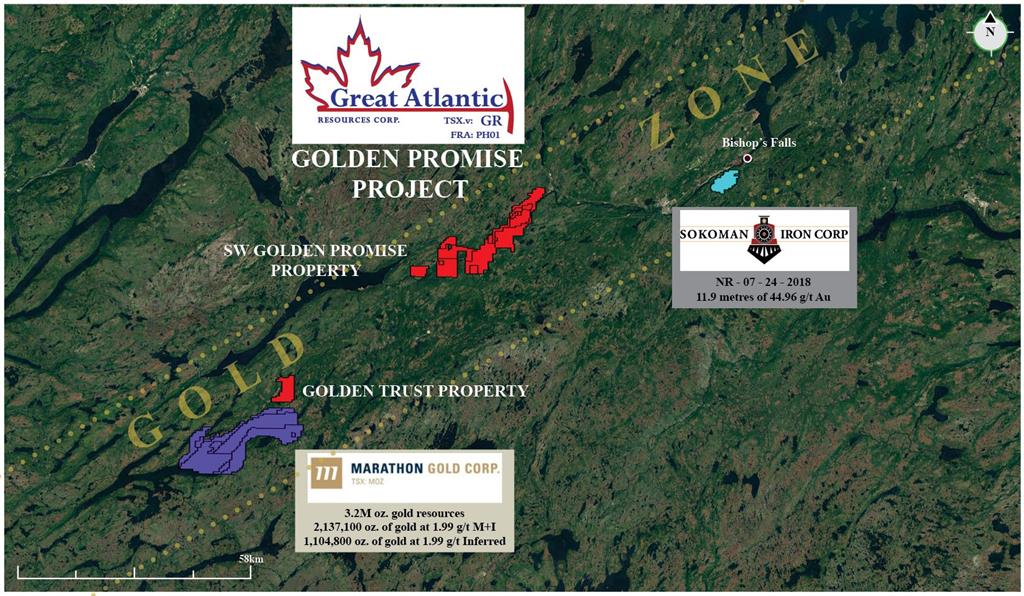
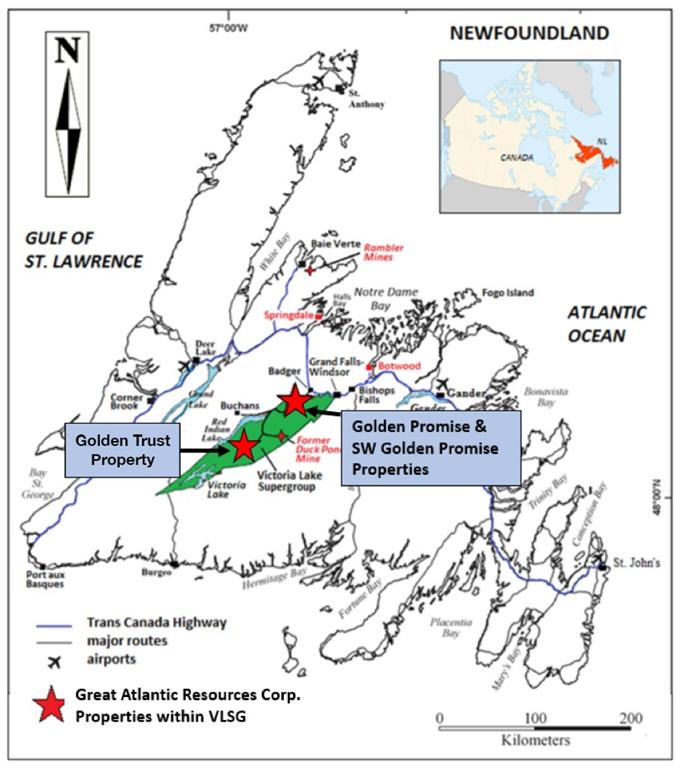
VANCOUVER, BC / ACCESSWIRE / March 1, 2019 / GREAT ATLANTIC RESOURCES CORP. (TSXV:GR) (the “Company” or “Great Atlantic”) is pleased to announce it has acquired, through staking, the Golden Trust Property, located in the central Newfoundland gold belt and 1 kilometer north of the Valentine Lake Gold Camp of Marathon Gold Corp. has acquired, through staking, the Golden Trust Property (TSXV:MOZ). The Golden Trust Property covers an area of 2,400 hectares in a relatively under-explored area of the central Newfoundland gold belt. Key points for the Golden Trust Property include:
Located
1 km north of the Valentine Lake Gold Camp of Marathon Gold Corp.,
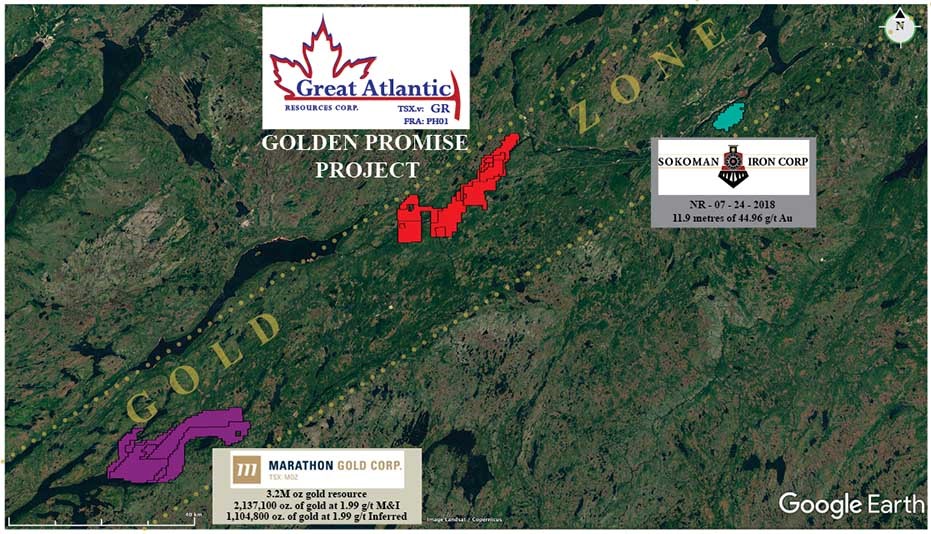
approximately 44 km southwest of Great Atlantic’s Golden Promise
Property and approximately 31 km southwest of the Duck Pond VMS deposit.
Within
the prospective Victoria Lake Supergroup which hosts numerous
epigenetic gold & volcanogenic massive sulfide occurrences
(including Duck Pond VMS deposit).
Within
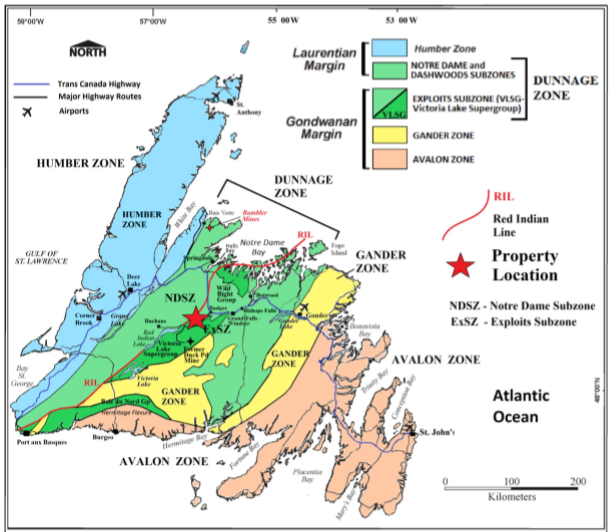
the Exploits Subzone of the Dunnage Zone and east of the Red Indian
Line (RIL), a major (Appalachian-scale) collisional boundary, and suture
zone.
Government till samples (2008) returned elevated to anomalous values for gold in various regions of the Golden Trust Property.
The
Golden Trust Property occurs within an under-explored area of the
Newfoundland central gold belt. Company management have been unable to
locate any reports of historic diamond drilling within the property.
Till geochemical sampling conducted by the Newfoundland Department of
Natural Resources in 2008 included a small number of wide-spaced samples
within the Golden Trust Property. Samples from various regions of the
property returned elevated to anomalous values for gold including in the
5-9 parts per billion range.
The southern boundary of the
property is located 1 kilometer north of the northeast region of the
Valentine Lake Gold Camp of Marathon Gold Corp. (TSXV:MOZ).
As reported on Marathon’s website, the Valentine Lake Gold Camp
currently hosts four near-surface, mainly pit-shell constrained,
deposits with measured and indicated resources totaling 2,691,400 oz. of
gold at 1.85 g/t gold and inferred resources totalling 1,531,600 oz. of
gold at 1.77 g/t. The Golden Trust Property is located approximately 44
kilometers southwest of Great Atlantic’s Golden Promise Gold Property
which hosts multiple gold bearing quartz vein systems.
The
Company’s Golden Trust and Golden Promise Properties and the Valentine
Lake Gold Camp of Marathon Gold Corp. all occur within the Exploits
Subzone of the Dunnage Zone. The Red Indian Line (RIL), a major
(Appalachian-scale) collisional boundary, and suture zone, forms the
western boundary of the Exploits Subzone.
The Golden Trust
Property occurs within the Victoria Lake Supergroup (VLSG), a
volcano-sedimentary terrane within the Exploits Subzone. The VLSG hosts
numerous volcanogenic massive sulfide (VMS) and epigenetic gold
occurrences. The most significant of the VMS deposits within the VLSG is
the Duck Pond deposit (zinc, lead, copper, silver and gold), located
approximately 31 kilometers northeast of the Golden Trust Property.
Readers
are warned that mineralization at the Valentine Lake Gold Camp, Golden
Promise Property, Duck Pond Deposit and elsewhere within the Exploits
Subzone and VLSG is not necessarily indicative of mineralization within
the Golden Trust Property.
David Martin, P.Geo., a Qualified
Person as defined by NI 43-101 and VP Exploration for Great Atlantic, is
responsible for the technical information contained in this News
Release.
About Great Atlantic Resources Corp.: Great
Atlantic Resources Corp. is a Canadian exploration company focused on
the discovery and development of mineral assets in the resource-rich and
sovereign risk-free realm of Atlantic Canada, one of the number one
mining regions of the world. Great Atlantic is currently surging forward
building the company utilizing a Project Generation model, with a
special focus on the most critical elements on the planet that are
prominent in Atlantic Canada, Antimony, Tungsten and Gold.
On Behalf of the board of directors
“Christopher R Anderson”
Mr. Christopher R. Anderson “Always be positive, strive for solutions, and never give up” President CEO Director 604-488-3900 – Dir
Posted by AGORACOM
at 9:57 AM on Wednesday, February 27th, 2019
Received all analytical results from the 2018 exploration program at its Golden Promise Property, located in the central Newfoundland gold belt
The results identified additional exploration targets where no prior drilling has taken place
VANCOUVER, BC / ACCESSWIRE / February 27, 2019 / GREAT ATLANTIC RESOURCES CORP. (TSXV.GR) (the “Company” or “Great Atlantic”) is pleased to announce it has received all analytical results from the 2018 exploration program at its Golden Promise Property, located in the central Newfoundland gold belt, the results identifying additional exploration targets. The 2018 soil and rock analytical results confirm gold soil anomalies +/- rock samples anomalous in gold in at least three additional target areas in under-explored regions of the property. The Company’s main focus on the property remains the Jaclyn Zone where multiple gold bearing quartz vein systems occur. Gold bearing veins and gold bearing quartz vein boulders occur in other regions of the property.
Anomalous 2018 rock and soil samples were concentrated in three new targets areas:
Southwest
region: Anomalous soil samples along two reconnaissance soil lines, up
to 77 ppb gold (News Release of September 27, 2018). All 11 samples
along one 570- meter long line returned anomalous gold values. Rock
samples within the soil anomaly retuned anomalous gold values including
1.04 g/t gold.
East-Central region:
Anomalous soil samples (up to 39 ppb gold) & rock float samples (up
to 136 ppb gold) along a reconnaissance traverse.
West-Central
region: Anomalous soil samples (up to 41 ppb) following up in an area
of 2017 soil anomalies (212 and 236 ppb gold).
No previous drilling in the new target areas.
The
2018 program was reconnaissance in nature consisting of prospecting and
soil / rock geochemical sampling in multiple under-explored regions of
the Golden Promise Property. Multiple gold soil anomalies were
identified in the southwest, west-central and east-central regions of
the property, thereby adding to the number of gold targets within the
property. Rock grab samples from float in the east-central and southwest
regions of the property returned anomalous values for gold, the high
value being 1.04 g/t gold.
Soil sample analytical results from the
southwest region of the Golden Promise Property were reported in the
Company’s News Release of September 27, 2018. The
results include anomalous gold in soil samples from a new target area in
this southwest region. The majority of soil samples from two
reconnaissance lines in this target area returned anomalous values for
gold (up to 77 parts per billion (ppb) gold) including all 11 samples
from one approximately 570-meter long line. Nine of the 2018 rock grab
samples (float and outcrop) from this anomalous zone returned anomalous
gold values, the high value being a boulder sample with quartz veins
returning 1.04 g/t gold.This anomalous zone is
approximately 4 kilometers northeast of the Linda / Snow White gold
bearing vein which is located within the southwest region of the
property. Reported historic highlights for the Linda / Snow White vein
include a 232 g/t gold grab sample, 29.7 g/t gold over 0.5 meters in a
channel sample and 19.5 g/t gold over 1.15 meters during diamond
drilling (core length).
Quartz boulder in new southwest target area
The
2018 program confirmed an area of gold soil anomalies in the
west-central region of the property. Initial reconnaissance soil
sampling by the Company in this region during 2017 identified gold
anomalies (including samples returning 212 and 236 ppb gold). Soil
sampling in this area was continued during 2018 along 2 north-south
lines. Six of seven soil samples from an approximately 300-meter long
section of one line returned anomalous values for gold in the 8-41 ppb
gold range, confirming this new target area. This zone of gold soil
anomalies is located approximately 1 kilometer northwest of the gold
bearing Shawn’s Shot quartz vein. A 0.32-meter long chip sample
collected by the Company across the Shawn’s Shot vein in 2017 returned
48.2 g/t gold (News Release of August 28, 2017).
The 2018 program
established a new gold target area in the east-central region of the
property. Prospecting and soil sampling were conducted along one
east-west reconnaissance line in this region. Approximately 25% of the
soil samples along an approximately 2-kilometer section of this line
returned anomalous values for gold (6-39 ppb gold). Rock samples from
quartz boulders in this region returned anomalous values for gold (up to
136 ppb gold). The target area is approximately 2.2 kilometers
south-southwest of the gold bearing Jaclyn Main Zone. The Jaclyn Main
Zone has been the primary focus of historic gold exploration on the
property.
The Company recently reported a National Instrument
43-101mineral resource estimate for the Jaclyn Main Zone, located in the
northern region of the property (News Release of December 6, 2018; and
Sedar-filed National Instrument 43-101 Technical Report on the Golden
Promise Property, Central Newfoundland (revised), dated December 4, 2018
by Mr. Greg Z. Mosher, M.Sc. App., P.Geo., and Mr. Larry Pilgrim,
B.Sc., P.Geo.). The reported inferred mineral resource estimate for the
Jaclyn Main Zone is as follows:
Resource
Cutoff Au g/t
Au Cap g/t
Au Uncap g/t
Tonnes
Au Ounces Capped
Au Ounces Uncapped
Total
1.1
9.3
10.4
357,500
106,400
119,900
Pit-Constrained
0.6
11.4
14.1
157,300
57,800
71,200
Underground
1.5
7.5
7.6
200,200
48,600
48,700
Mineral Resources are not Mineral Reserves and do not have demonstrated economic viability.
There is no certainty that all or any part of the Mineral Resources estimated will be converted into Mineral Reserves.
Mineral
resource tonnage and contained metal have been rounded to reflect the
accuracy of the estimate, and numbers may not add due to rounding.
Mineral resource tonnage and grades are reported as undiluted.
Contained Au ounces are in-situ and do not include recovery losses
The
Jaclyn Main Zone is part of the Jaclyn Zone. At least 5 gold bearing
quartz vein systems are reported at the Jaclyn Zone, including the
Jaclyn Main Zone, Jaclyn North Zone, Jaclyn South Zone, Jaclyn East Zone
and Jaclyn West Zone. Much of the reported historical exploration
within the property has been focused on the Jaclyn Zone with the
majority of historic drill holes (2002-2010) at the Jaclyn Main Zone.
Other gold bearing veins within the property include Shawn’s Shot, Linda
/ Snow White and at the Gabbro Occurrence. High grade quartz boulders
are reported within the property including at the Jaclyn Zone and
Branden and Justin’s Hope boulder occurrences.
The property is
located within the Exploits Subzone of the Newfoundland Dunnage Zone.
Within the Exploits Subzone, the property lies along the
north-northwestern fringe of the Victoria Lake Supergroup (VLSG), a
volcano-sedimentary terrane. The northwestern margin of the Golden
Promise Property occurs proximal to, and, in part, contiguous with a
major (Appalachian-scale) collisional boundary, and suture zone, known
as the Red Indian Line (RIL). The RIL forms the western boundary of the
Exploits Subzone. Recent significant gold discoveries in this region of
the Exploits Subzone include those of Sokoman Iron Corp. (TSXV.SIC) at the Moosehead Project and Marathon Gold Corp. (TSXV.MOZ) at the Valentine Lake Gold Camp.
Sokoman Iron Corp. (TSXV.SIC) recently
announced a high-grade gold discovery on its Moosehead Property,
located approximately 40 kilometers east-northeast of the Golden Promise
Property. The discovery was made during the 2018 diamond drilling
program. A drill intersection of 44.96 g/t gold over 11.90 meters core
length was reported including a 1.35 meters core length quartz vein
intersection of 385.85 g/t gold (Sokoman Iron Corp. News Release of July
24, 2018). The Valentine Lake Gold Camp of Marathon Gold Corp. (TSXV.MOZ) is
located approximately 55 kilometers southwest of the Golden Promise
Property. As reported on Marathon’s website, the Valentine Lake Gold
Camp currently hosts four near-surface, mainly pit-shell constrained,
deposits with measured and indicated resources totaling 2,691,400 oz. of
gold at 1.85 g/t gold and inferred resources totalling 1,531,600 oz. of
gold at 1.77 g/t. Readers are warned that mineralization at the
Moosehead Property and Valentine Lake Gold Camp is not necessarily
indicative of mineralization on the Golden Promise Property.
As
reported in the National Instrument 43-101 Technical Report on the
Golden Promise Property, Central Newfoundland (revised), dated December
4, 2018 by Mr. Greg Z. Mosher, M.Sc. App., P.Geo., and Mr. Larry
Pilgrim, B.Sc., P.Geo., the Jaclyn Main Zone was modelled as a single
quartz vein that strikes east-west and dips steeply to the south.
Modelled vein thickness was based on true thickness derived from quartz
vein intercepts. The estimate is based on 220 assays that were
composited to 135 one-meter long composites. A bulk density of 2.7 g/cm3
was used. Blocks in the model measured 15 meters east-west, 1-meter
north-south and 10 meters vertically. The block model was not rotated.
Grades were interpolated using inverse-distance squared (ID2) weighting
and a search ellipse that measured 100 meters along strike, two meters
across strike and 50 meters vertically. Grades were interpolated based
on a minimum of two and a maximum of 10 composites with a maximum of one
composite per hole so the grade of each block is based on at least two
drillholes thereby demonstrating continuity of mineralization. For the
capped mineral resource estimate, all assays that exceed 65 g/t gold
were capped at 65 g/t gold. All resources were classified as Inferred
because of the relatively wide spacing of drill holes through most of
the zone.
Because part of the vein is near surface the resource
estimate was constrained by a conceptual open pit to demonstrate
reasonable prospects of eventual economic extraction. Generic mining
costs of US$2.50/tonne and processing costs of US$25.00/tonne were used
together with a gold price of US$1,300/ounce. A conceptual pit slope of
45° was assumed with no allowance for mining loss or dilution. Based on
the combined hypothetical mining and processing costs and the assumed
price of gold, a pit-constrained cutoff grade of 0.6 g/t was adopted.
For the underground portion of the resource a cutoff of 1.5 g/t was
assumed. The cutoff grade for the total resource is the weighted average
of the pit-constrained and underground cutoff grades.
The
2018 rock and soil samples were analyzed by Eastern Analytical Ltd. in
Springdale, NL for gold by Fire Assay and for 34 elements by ICP. A
qualified person managed and conducted the 2018 exploration program.
Readers
are warned that historical records referred to in this News Release
have been examined but not verified by a Qualified Person. Further work
is required to verify that historical records referred to in this News
Release are accurate.
David Martin, P.Geo., a Qualified Person as
defined by NI 43-101 and VP Exploration for Great Atlantic, is
responsible for the technical information contained in this News
Release.
About Great Atlantic Resources Corp.: Great
Atlantic Resources Corp. is a Canadian exploration company focused on
the discovery and development of mineral assets in the resource-rich and
sovereign risk-free realm of Atlantic Canada, one of the number one
mining regions of the world. Great Atlantic is currently surging forward
building the company utilizing a Project Generation model, with a
special focus on the most critical elements on the planet that are
prominent in Atlantic Canada, Antimony, Tungsten and Gold. On Behalf of the board of directors
“Christopher R Anderson“
Mr. Christopher R. Anderson “Always be positive, strive for solutions, and never give up” President CEO Director 604-488-3900 – Dir
Posted by AGORACOM
at 7:50 AM on Wednesday, February 27th, 2019
Completed 71 diamond drill holes on the C.O.D vein.
High-grade intersections include 107.5 g/t gold and 880 g/t silver over 6.90 meters core length and 129 g/t gold and 1,154 g/t silver over 7.28 meter core length (News Releases of January 11 & 18, 2019).
Mining.com lists GGX drill intercept #7th best worldwide to date for 2019
Extended the C.O.D vein 160 m to the southwest by means of drilling
Completed 19 diamond drill holes on the Everest vein
VANCOUVER, BC / ACCESSWIRE / Feb 27, 2019 / GGX Gold Corp. (TSX-v: GGX), (OTCQB: GGXXF), (FRA: 3SR2) (the “Company” or “GGX“)
is pleased to recap highlights of the 2018 exploration season on the
Gold Drop Property located in Southern British Columbia. The program
focused on the C.O.D vein, located in the Gold Drop Southwest Zone.
During the drilling program the company also conducted mechanical
trenching on numerous targets.
Completed 71
diamond drill holes on the C.O.D vein. High-grade intersections include
107.5 g/t gold and 880 g/t silver over 6.90 meters core length and 129
g/t gold and 1,154 g/t silver over 7.28 meter core length (News Releases
of January 11 & 18, 2019).
Mining.com lists GGX drill intercept #7th best worldwide to date for 2019
Extended the C.O.D vein 160 m to the southwest by means of drilling
Completed 19 diamond drill holes on the Everest vein
Discovered the southern extension of the Gold Drop vein by means of mechanical trenching
Completed 30 m of trenching on the Silent Friend Vein
Completed thorough trenching program in the C.O.D North region of the property
Picture: First C.O.D Vein discovery and sample, May 2017
The
Gold Drop Property covers 5,628 hectares of geologically prospective
ground in the well-mineralized Greenwood District, and hosts 8 or more
known low-sulfide, gold-bearing veins or vein systems. These historical
showings have had limited modern exploration. Recently, the Greenwood
area has had a renewed interest by major and junior companies exploring
precious and base metals in the district.
The
2018 diamond drill program carried out by the Company focused on the
C.O.D vein. The vein was first identified to be a target of interest in
the spring of 2017. Following initial sampling of the vein the Company
conducted mechanical trenching and drilling. The results of the 2017
program were encouraging and the Company launched a winter drill program
in 2018. The program followed up on the 2017 drilling. The Company
completed additional diamond drilling during the fall of 2018,
completing a series of exploration holes south of the C.O.D trench. Here
the holes intercepted the vein, successfully extending the vein by 160
meters.
During
2018 a total of 71 diamond drill holes were completed on the C.O.D vein
structure and 19 diamond drill holes were completed on the Everest vein
for a total of 5,616 meters of drilling. The highlights of the program
are COD18-67 that intersected 129 grams per tonne (g/t) gold and 1,154
g/t silver over 7.28 meters core length and COD18-70 which intersected
107.5 g/t gold and 880 g/t silver over 6.90 meters core length. The
highlights of the drilling are listed in the following table.
Hole ID
Interval Length
Gold (gpt)
Silver (gpt)
Te (gpt)
COD17-14
16.03
4.59
38.64
COD18-3
2.1
14.62
150.2
102
COD18-26
1.4
10.3
1.09
0.24
COD18-32
1.51
3.67
67.2
30.4
COD18-33
2.98
8.65
47.6
37.3
COD18-34
3.41
6.16
72.4
31
COD18-37
3.95
8.23
67.36
38.53
COD18-45
2.05
50.15
375
COD18-46
1.47
54.9
379
COD18-49
1.47
9.52
118
72.2
COD18-54
1.66
7.6
60.2
34.1
COD18-61
1.38
5.29
32.4
31.4
COD18-63
1.17
28
424.7
150.4
COD18-67
7.28
129.11
1,154.90
COD18-68
2.76
8.77
85.4
56.3
COD18-69
7.46
5.76
67.9
61.2
COD18-70
6.9
107.5
880
Note:
Due to some tellurium drill core analyses being greater than the upper
analytical limit of 500 g/t the weighted average value for tellurium
could not be calculated for some intervals.
The
2018 trenching program was completed on targets located during the 2017
soil geochemical sampling program. The most significant discovery
during the trenching is the southern extension of the historic Gold Drop
Vein. Historic production from the Gold Drop Vein System is reported to
be 335 tonnes mined during 1926-1988 (mainly during 1933-1941) with
5,020 grams of gold (14.99 g/t gold) and 35,894 grams of silver (107.1
g/t silver) recovered. Grab samples collected from this vein during 2018
assayed up to 3.37 g/t gold and 43.9 g/t silver.
The
company completed a thorough trenching program in the C.O.D North area.
This area is located approximately 600m to the north of the C.O.D
drilling worksite. Here the company conducted trenching on targets
identified during the 2017 soil geochemical sampling program.
Several
quartz vein outcroppings were located and sampled in the trenches. The
highlights include grab sample 112753 of rusty quartz vein that assayed
15.45 g/t gold, 159 g/t silver and 114.5 g/t tellurium; and sample
112759, a chip sample across a 40 centimeter wide northeast-southwest
striking sub-vertical quartz vein, that assayed 21.7 g/t gold, 216 g/t
silver and 149 g/t tellurium. The table below outlines the chip sample
assays obtained.
Sample ID
Sample type
Au (ppm)
Ag (ppm)
Te (ppm)
112751
30 cm chip
1.43
12.8
10.2
112752
40 cm chip
4.26
26.8
18.25
112753
Area grab
15.45
159
114.5
112754
Area grab
1.38
9.23
5.98
112755
Area grab
6.52
17.65
14.25
112756
30 cm chip
5.07
39.5
29.2
112757
30 cm chip
1.38
10.1
6.27
112758
Area grab
4.75
20.9
12.65
112759
40 cm chip
21.7
216
149
112761
Area grab
1.58
11.85
9.08
The
Company is very pleased with the results obtained during the 2018
season. Plans are being finalized for 2019 and everyone at GGX is
excited for the 2019 field season!
David Martin, P.Geo., a
Qualified Person as defined by NI 43-101, is responsible for the
technical information contained in this News Release.
To view the Original News release with pictures please go to the website or contact the company.
Posted by AGORACOM
at 9:59 AM on Thursday, February 21st, 2019
Test work for potential application as a partial cement replacement material recently initiated at the University of B.C.
Test work is being carried out as part of the Company’s market development strategy with the goal of utilizing the tailings as a partial cement replacement
Early results show promise and if successful would reduce tailings disposal costs and create a potential by-product revenue stream.
Thunder Bay, Ontario–(Newsfile Corp. – February 21, 2019) – ZEN Graphene Solutions Ltd. (TSXV: ZEN) (“ZEN” or the “Company“)
is pleased to provide an update on the Albany Graphite Project tailings
test work for potential application as a partial cement replacement
material recently initiated at the University of British
Columbia-Okanagan Campus (“UBC-O”). (Please see the Company’s news release dated December 17, 2018)
This
test work is being carried out as part of the Company’s market
development strategy with the goal of utilizing the tailings as a
partial cement replacement. Early results show promise and if successful
would reduce tailings disposal costs and create a potential by-product
revenue stream. In addition, ZEN will also be initiating new research
test work where Albany graphene will be added to project tailings
material to potentially create an innovative new enhanced cement
material and concrete that could have higher strength, faster curing
time and increased durability as well as significant environmental
benefits through reduced CO2 emissions.
The research work is being conducted by Dr. Ahmad Rteil at UBC-O where
ZEN’s tailings material was successfully tested as a partial cement
replacement. Dr. Rteil replaced 10 and 20 percent of a cement mixture
with ZEN’s tailings material and after 28 days, the results showed the
10% replacement had a compressive strength rating of 46.1 MPa, less than
a 2% difference from the control at 47 MPa. The 20% replacement had a
compressive strength rating of 37.9 MPa, about 20% difference with the
control sample.
These results are significant as currently most
of the concrete used by the construction industry (e.g. for low and
mid-rise buildings, bridge decks, foundations, etc.) has a compressive
strength requirement ranging between 20 MPa and 40 MPa. These highly
encouraging initial and unoptimized results show significant promise for
ZEN to push forward with further development work. The Company now
plans further tests that will optimize the use of Albany Graphite
tailings as a partial cement replacement including the potential of
adding ZEN graphene to the tailings material.
Dr. Rteil stated,
“These results are very promising. Partially replacing cement with
tailings materials could have a significant financial and environmental
impact on the concrete industry by being able to deliver a better
product while reducing its carbon footprint.”
About ZEN Graphene Solutions Ltd.
ZEN
Graphene Solutions Ltd. is an emerging graphene technology solutions
company with a focus on development of the unique Albany Graphite
Project as a precursor graphene material product opportunity and product
market development. The Albany Graphite Project provides the company
with a competitive advantage in the potential graphene market as
independent labs in Japan, UK, Israel, USA and Canada have demonstrated
that ZEN’s Albany Graphite/Naturally PureTM easily converts (exfoliates)
to graphene, using a variety of simple mechanical and chemical methods.
To find out more on ZEN Graphene Solutions Ltd., please visit our website at www.ZENGraphene.com . A copy of this news release and all material documents in respect of the Company may be obtained on ZEN’s SEDAR profile at www.sedar.ca.
Posted by AGORACOM
at 9:59 AM on Thursday, February 21st, 2019
Commenced a diamond drilling and sampling program on its advanced stage St-Onge-Wollastonite Deposit
The program will consist of 23 holes and an estimated 1850 meters of drilling in total.
The drill program data will allow the Company to move forward with its plans to begin quarry the permitting process
VANCOUVER, BC / ACCESSWIRE / February 21, 2019 / VERTICAL EXPLORATION INC. (TSX-V: VERT) (“Vertical” or “the Company”) is pleased to announce that it has commenced a diamond drilling and sampling program on its advanced stage St-Onge-Wollastonite Deposit located approximately 90 kilometres Northwest of the city of Saguenay, in St-Onge township, in the Saguenay-Lac-St-Jean region of Quebec, Canada.
The
program will consist of 23 holes and an estimated 1850 meters of
drilling in total. Assay samples will be taken from the NQ Core and
split in half on site, with one half being sent to COREM’s lab
facilities in Quebec City and the other half being retained for future
reference at Vertical’s fully secured facilities in Saguenay Quebec. A
strict quality assurance/quality control (QA/QC) program will be applied
to all samples, including mineralized certified samples, blank samples
and duplicate sample for each batch of 15 samples taken.
The
drilling program will provide Vertical with important mineral data that
will allow the Company to further update its NI 43-101 Technical report
and aggressively move forward with its plans to begin quarry permitting
process on its St-Onge-Wollastonite Deposit. Drilling results will be
announced when received.
The diamond drilling program will be supervised by Jean-Paul Barrette, P.Geo from the Company’s geological team.
ABOUT VERTICAL EXPLORATION
Vertical
Exploration’s mission is to identify, acquire, and advance high
potential mining prospects located in North America for the benefit of
its stakeholders. The Company’s flagship St-Onge Wollastonite property
is located in the Lac-Saint-Jean area in the Province of Quebec.
ON BEHALF OF THE BOARD _________________________________ Peter P. Swistak, President
FOR FURTHER INFORMATION PLEASE CONTACT: Telephone: 1-604-683-3995 Toll Free: 1-888-945-4770
Posted by AGORACOM
at 8:55 AM on Thursday, February 21st, 2019
The recently completed drilling in phase 2 identified a series of 30 epithermal veins
Approximately 1000m to the northeast, the SG3 Target area, is a structural intersection mapped and sampled by the geological survey of Mexico which is a feeder system type target.
Now that we have established that there is a large cluster of epithermal veins at Tabasquena, we are also eager to explore for feeder system type targets. Our plan to drill deeper into the vein system to look for the boiling point in our epithermal veins
About Advance Gold Corp. (TSXV: AAX)
Advance Gold is a TSX-V listed junior exploration company focused on
acquiring and exploring mineral properties containing precious metals.
The Company acquired a 100% interest in the Tabasquena Silver Mine in
Zacatecas, Mexico in 2017, and the Venaditas project, also in Zacatecas
state, in April, 2018.
The Tabasquena project is located near the Milagros silver mine near
the city of Ojocaliente, Mexico. Benefits at Tabasquena include road
access to the claims, power to the claims, a 100-metre underground shaft
and underground workings, plus it is a fully permitted mine.
FULL DISCLOSURE: Advance Gold is an advertising client of AGORA Internet Relations Corp.
For further information, please contact: Allan Barry Laboucan, President and CEO Phone: (604) 505-4753 Email: [email protected]
Posted by AGORACOM
at 10:08 AM on Wednesday, February 20th, 2019
Acquired the Southwest Golden Promise Property, covering an area of 1000 hectares, is centered approximately 4 kilometers west of the southern-most region of the Company’s Golden Promise Property
Historic (2008) approximately 260-meter long northeast-southwest gold soil anomaly trend including one reported sample of 7,667 ppb gold (7.6 g/t gold).
Historic (2008) approximately 260-meter long northeast-southwest gold soil anomaly trend including one reported sample of 7,667 ppb gold (7.6 g/t gold).
VANCOUVER, BC / ACCESSWIRE / February 20, 2019 / GREAT ATLANTIC RESOURCES CORP. (TSXV.GR) (the ”Company” or ”Great Atlantic”) is pleased to announce it has acquired, through staking, the Southwest Golden Promise Property, located in the central Newfoundland gold belt. The property, covering an area of 1000 hectares, is centered approximately 4 kilometers west of the southern-most region of the Company’s Golden Promise Property. The Southwest Golden Promise Property covers gold soil anomalies (up to 7.6 g/t) and reported gold-bearing quartz float (up to 6.7 g/t).
Highlights for the Southwest Golden Promise Property include:
Historic
(2008) approximately 260-meter long northeast-southwest gold soil
anomaly trend including one reported sample of 7,667 ppb gold (7.6 g/t
gold).
Reported visible gold in historic panned soil samples.
Within the Exploits Sub-Zone adjacent to and along the southeast margin of the Red Indian Line, a major (Appalachian-scale) collisional boundary, and suture zone.
The
primary target within the Southwest Golden Promise Property is an
approximately 260-meter long northeast-southwest trending zone of
historic gold soil anomalies. Multiple 2008 soil samples within this
trend are reported to have returned anomalous values for gold including
eight samples in the 36-82 ppb gold range. Two quartz float samples
collected during 2009 within this anomalous zone were reported to 6.78
g/t and 2.44 g/t gold. Panned soil samples at two of three sites within
this anomalous zone were reported to yield gold flakes.
Great
Atlantic’s Golden Promise Property is located east and northeast of the
Southwest Golden Promise Property. The Golden Promise Property remains
the Company’s focus in the central Newfoundland gold belt. The Golden
Promise Property hosts multiple gold bearing quartz veins, the most
advanced being the Jaclyn Main Zone. The Company recently announced a
mineral resource estimate for the Jaclyn Main Zone (see the Company’s
News Release of December 6, 2018). A gold bearing vein referred to as
Linda / Snow White vein occurs in the southwest region of the Golden
Promise Property. Reported historic surface samples at the Linda /Snow
White vein include grab samples of 105 and 232 g/t gold and a channel
sample of 29.7 g/t gold over 0.5 meters. The best reported historic
drill hole intersection (2006) at the Linda / Snow White vein was 19.5
g/t gold over 1.15 meters (core length).
Similar to the Company’s
Golden Promise Property, the Southwest Golden Promise Property is
located within the Exploits Subzone of the Newfoundland Dunnage Zone.
Within the Exploits Subzone, both properties lie along the
north-northwestern fringe of the Victoria Lake Supergroup (VLSG), a
volcano-sedimentary terrane. The northwestern margin of both properties
occurs proximal to, and, in part, contiguous with a major
(Appalachian-scale) collisional boundary, and suture zone, known as the
Red Indian Line (RIL). The RIL forms the western boundary of the
Exploits Subzone. Recent significant gold discoveries in this region of
the Exploits Subzone include those of Sokoman Iron Corp. (TSXV.SIC) at the Moosehead Project and Marathon Gold Corp. (TSXV.MOZ) at the Valentine Lake Gold Camp.
Sokoman Iron Corp. (TSXV.SIC) recently
announced a high-grade gold discovery on its Moosehead Property,
located approximately 40 kilometers east-northeast of the Golden Promise
Property. The discovery was made during the 2018 diamond drilling
program. A drill intersection of 44.96 g/t gold over 11.90 meters core
length was reported including a 1.35 meters core length quartz vein
intersection of 385.85 g/t gold (Sokoman Iron Corp. News Release of July
24, 2018). The Valentine Lake Gold Camp of Marathon Gold Corp. (TSXV.MOZ) is
located approximately 55 kilometers southwest of the Golden Promise
Property. As reported on Marathon’s website, the Valentine Lake Gold
Camp currently hosts four near-surface, mainly pit-shell constrained,
deposits with measured and indicated resources totaling 2,691,400 oz. of
gold at 1.85 g/t gold and inferred resources totalling 1,531,600 oz. of
gold at 1.77 g/t. Readers are warned that mineralization at the
Moosehead Property and Valentine Lake Gold Camp is not necessarily
indicative of mineralization on the Golden Promise Property.
Readers
are warned that historical records referred to in this News Release
have been examined but not verified by a Qualified Person. Further work
is required to verify that historical records referred to in this News
Release are accurate.
David Martin, P.Geo., a Qualified Person as
defined by NI 43-101 and VP Exploration for Great Atlantic, is
responsible for the technical information contained in this News
Release.
About Great Atlantic Resources Corp.: Great
Atlantic Resources Corp. is a Canadian exploration company focused on
the discovery and development of mineral assets in the resource-rich and
sovereign risk-free realm of Atlantic Canada, one of the number one
mining regions of the world. Great Atlantic is currently surging forward
building the company utilizing a Project Generation model, with a
special focus on the most critical elements on the planet that are
prominent in Atlantic Canada, Antimony, Tungsten and Gold.
On Behalf of the board of directors
”Christopher R Anderson”
Mr. Christopher R. Anderson “Always be positive, strive for solutions, and never give up” President CEO Director 604-488-3900 – Dir
Posted by AGORACOM
at 8:26 AM on Tuesday, February 5th, 2019
Includes 2.86g/t gold in soils
In addition, over 1,000 soil samples with gold concentrations greater than the 90th percentile are considered anomalous and require detailed follow up.
LAB controls 57 km strike length of stratigraphy prospective for gold in the Florence Lake Greenstone Belt.
Detailed soil grids were placed over anomalous gold-in-soil targets with favorable geology and structure to develop specific targets for follow up leading to drilling
VANCOUVER,
British Columbia, Feb. 05, 2019 (GLOBE NEWSWIRE) — Labrador Gold
Corp. (TSX-V: LAB) (“Labrador Gold†or the “Companyâ€) is pleased to
announce results from detailed gold exploration of its Hopedale project
in Labrador. The company controls a 57 kilometre strike length of
stratigraphy prospective for gold in the Florence Lake Greenstone Belt.
The exploration program at Hopedale followed up on successful results of
2017 work that outlined regional scale gold in soil and lake sediment
anomalies along the length of the belt and included detailed soil
sampling, geological mapping, rock sampling and prospecting.
Detailed
soil grids were placed over anomalous gold-in-soil targets with
favorable geology and structure to develop specific targets for follow
up leading to drilling. A total of 10,594 soil samples were taken on 12
grids at a 100m line spacing and 25m sample spacing along the length of
the belt. Assays of the samples returned gold values from below
detection (<5ppb) to 2,860 ppb. Thirty-four samples returned values
greater than 100ppb Au, with five of these samples grading greater than
1,000 ppb Au (1g/t). In addition, over 1,000 soil samples with gold
concentrations greater than the 90th percentile are
considered anomalous and require detailed follow up. Arsenic values
range from less than detection to the upper limit of 10,000 ppm with 90
samples assaying greater than 1,000 ppm. Antimony values ranged between
0.05 and 171.5 ppm with eight samples assaying greater than 100 ppm.
Elevated
gold values were found in samples from all 12 grids although the
highest concentrations of samples with anomalous gold are found in the
Thurber Dog, Jasmine and Misery grids (See news release dated November
2, for initial results from the Misery and Jasmine grids). Anomalous
gold is typically found along the contacts (often sheared) between
ultramafic rocks and adjacent mafic, meta-sedimentary or felsic
meta-volcanic rocks. In addition, elevated gold concentrations may be
associated with specific structures such as a jog in stratigraphy in the
northern Thurber Dog grid, a fold nose in the south of the Jasmine grid
and an interpreted shear zone running through the Misery grid. These
structures are commonly associated with sites of gold mineralization in
greenstone belts elsewhere in the world.
Arsenic
concentrations are highest along a 4km north-south trend in the Jasmine
Grid where massive arsenopyrite was found. Antimony appears to be
elevated along interpreted structure, often forming elongate anomalies
parallel to such structures as seen on the Misery and Schist Lake grids.
“The
latest results of detailed soil sampling at Hopedale continues to turn
up gold values above 0.1g/t possibly related to near surface gold
mineralization, said Roger Moss, President and Chief Executive Officer
of Labrador Gold. “Our growing understanding of the geology and
structure of the greenstone belt will allow us to focus on the most
prospective areas during the coming field season which should be an
exciting one for Labrador Gold.â€
“With all the
soils from last season now in, we can clearly see nicely defined linear
gold trends, some over a kilometer in length, to follow up next field
season,†said Shawn Ryan, Technical Adviser to Labrador Gold. “We are
now compiling all the data gathered from the past 2 field seasons which
includes over 11,000 soils, 400 + rocks, geological and structural
mapping. This will be interpreted using the recent Geological Survey of
Canada airborne magnetic survey flown last year, along with the
historical magnetic surveys in the area. A detailed target
Interpretation map will be completed in the next three weeks which will
help rank anomalies for our Phase Three Summer 2019 follow up program.â€
The
company also announces that its major shareholder, Plethora Precious
Metals Fund (‘Plethoraâ€) has exercised 3,125,000 warrants. Plethora now
holds 9,750,000 shares of the company representing 17.45% of the issued
and outstanding shares. We appreciate the continued support of Plethora
and their confidence in the exploration strategy of our technical team.
Plethora’s principal, Douwe Van Hees, is not a related party of the
Company.
All samples were dried in the field
before being shipped to the Bureau Veritas preparation laboratory in
Timmins, Ontario, with analyses completed at the Vancouver laboratory.
Samples were analyzed for gold and another 36 elements by ICP-MS
(inductively coupled plasma-mass spectrometry) following an aqua regia
digestion. The company routinely submits blanks, field duplicates and
certified reference standards with batches of samples to monitor the
quality of the analyses.
Roger Moss, PhD., P.Geo., is the qualified person responsible for all technical information in this release.
The
company gratefully acknowledges the Newfoundland and Labrador Ministry
of Natural Resources’ Junior Exploration Assistance (JEA) Program for
its financial support for exploration of the Hopedale property.
About Labrador Gold:
Labrador
Gold is a Canadian based mineral exploration company focused on the
acquisition and exploration of prospective gold projects in the
Americas. In 2017 Labrador Gold signed a Letter of Intent under which
the Company has the option to acquire 100% of the 896 square kilometre
(km2) Ashuanipi property in northwest Labrador and the Hopedale (458 km2) property in eastern Labrador.
The
Hopedale property covers much of the Hunt River and Florence Lake
greenstone belts that stretch over 80 km. The belts are typical of
greenstone belts around the world but have been underexplored by
comparison. Initial work by Labrador Gold during 2017 show gold
anomalies in soils and lake sediments over a 3 kilometre section of the
northern portion of the Florence Lake greenstone belt in the vicinity of
the known Thurber Dog gold showing where grab samples assayed up to
7.8g/t gold. In addition, anomalous gold in soil and lake sediment
samples occur over approximately 40 kilometres along the southern
section of the greenstone belt (see news release dated January 25th 2018 for more details). Labrador Gold now controls approximately 57km strike length of the Florence Lake Greenstone Belt.
The
Ashuanipi gold project is located just 35 km from the historical iron
ore mining community of Schefferville, which is linked by rail to the
port of Sept Iles, Quebec in the south. The claim blocks cover large
lake sediment gold anomalies that, with the exception of local
prospecting, have not seen a systematic modern day exploration program.
Results of the 2017 reconnaissance exploration program following up the
lake sediment anomalies show gold anomalies in soils and lake sediments
over a 15 kilometre long by 2 to 6 kilometre wide north-south trend and
over a 14 kilometre long by 2 to 4 kilometre wide east-west trend. The
anomalies appear to be broadly associated with magnetic highs and do not
show any correlation with specific rock types on a regional scale (see
news release dated January 18th 2018). This suggests a
possible structural control on the localization of the gold anomalies.
Historical work 30 km north on the Quebec side led to gold intersections
of up to 2.23 grams per tonne (g/t) Au over 19.55 metres (not true
width) (Source: IOS Services Geoscientifiques, 2012, Exploration and
geological reconnaissance work in the Goodwood River Area, Sheffor
Project, Summer Field Season 2011). Gold in both areas appears to be
associated with similar rock types.
The Company has 56,264,022 common shares issued and outstanding and trades on the TSX Venture Exchange under the symbol LAB.
Posted by AGORACOM
at 9:17 AM on Friday, February 1st, 2019
JV partner Tudor Gold announced the designation of a new gold zone at Treaty Creek which has been named “Goldstorm”
The mineralization encountered to the northeast of Copper Belle has different characteristics, configuration and geometry.
“Goldstorm is a much larger system than Copper Belle at 300m wide and extends vertically for over 700m
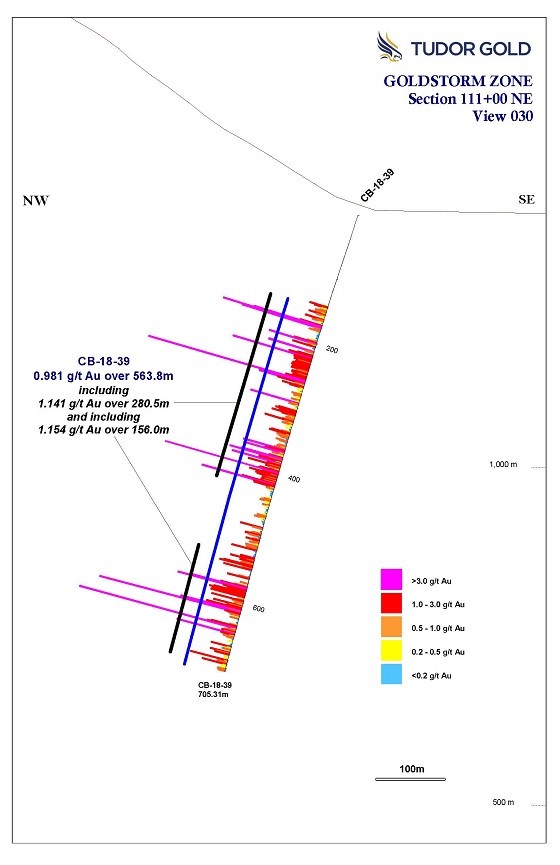
Gold appears to be continuing towards the northeast and southeast and clearly becomes stronger in the northernmost hole, CB18-39 which returned 563.8 meters of 0.981 grams per tonne gold
Cardston, Alberta–(Newsfile Corp. – February 1, 2019) – American Creek Resources Ltd.
(TSXV: AMK) (“the Corporation”) today reports that JV partner Tudor
Gold announced the designation of a new gold zone at Treaty Creek which
has been named “Goldstorm”. It was previously thought that gold
mineralization identified by drilling northeast of the Copper Belle Zone
was simply a northeast extension of that same zone, but after
evaluating drill hole data from holes completed in 2016, 2017 and 2018,
it appears that the mineralization encountered to the northeast of
Copper Belle has different characteristics, configuration and geometry.
While it is unclear whether the zones are genetically linked, these
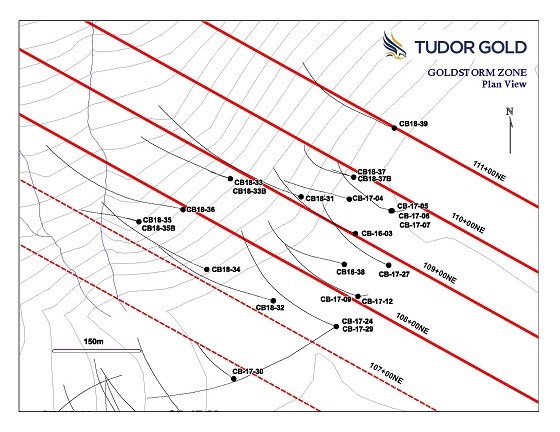
zones are physically separate. The surface drill hole location map at
the end of this news release shows the location of both gold zones.
Tudor
Gold Exploration Manager, Ken Konkin explains: “Goldstorm is a much
larger system than Copper Belle, it is at least 300m wide and extends
vertically for over 700m. The zone has been traced for approximately 500
meters along a northeastern azimuth. Gold mineralization appears to be
continuing towards the northeast and southeast and clearly becomes
stronger in the northernmost hole, CB18-39 which returned 563.8 meters
of 0.981 grams per tonne gold. The upper portion of CB18-39 averaged
1.141 gpt gold over 280.5 meters and a lower zone in the same hole
averaged 1.154 grams per tonne gold over 156 meters. This hole bottomed
in mineralization and we will look at the option of re-entering the hole
this year in attempts to extend the mineralization deeper. But the
primary focus will be to extend the Goldstorm Zone along strike to the
northeast and to the southeast as well.
Over the coming months,
we hope to gain a better understanding of aspects that control gold
mineralization. Re-examination of drill hole information has revealed
the presence of a northwest dipping thrust fault that appears to define
the upper contact of the Goldstorm system. The relationship of this
fault to the formation of the mineral zone is an aspect of further
study, as are the various styles of sulphide mineralization,
silicification and alteration. Compilation and evaluation of this data
will help in planning for the drilling campaign to be undertaken in the
up-coming exploration season.”
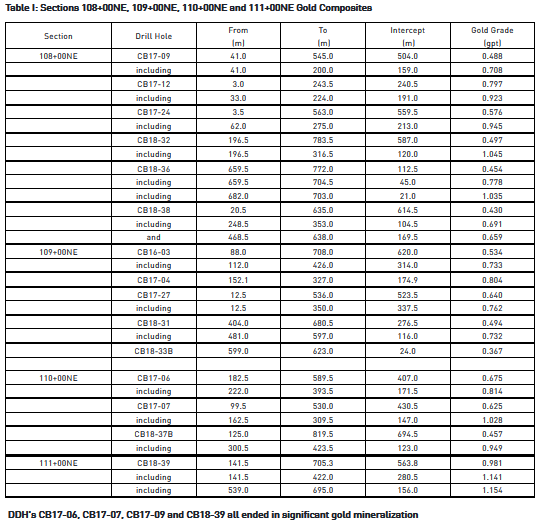
The following table gives gold
composite values over broad intervals from four drill hole sections that
cut the Goldstorm Zone, incorporating results from diamond drill holes
completed during 2016, 2017 and 2018. Low-grade gold mineralization
occurs as a broad envelope which contains a horizon of stronger gold
mineralization in the upper portion of the system. Furthermore, the
drill hole sections demonstrate what appears to be the presence of a
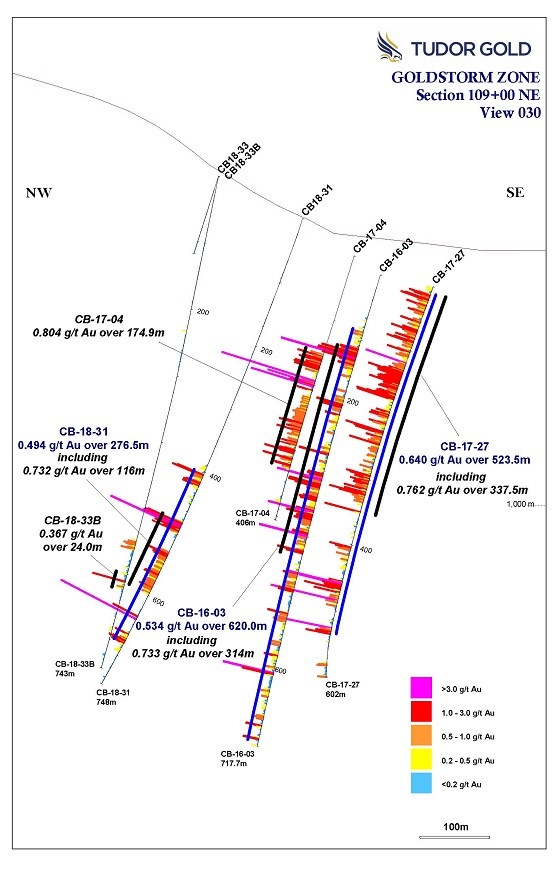
second, lower gold horizon. The corresponding sections 108+00 NE, 109+00
NE, 110+00 NE and 111+00 NE are displayed at the end of this news
release.
Table I: Sections 108+00NE, 109+00NE, 110+00NE and 111+00NE Gold Composites
* All assay values are uncut and intervals reflect drilled intercept lengths. * True widths of the mineralization have not been determined.
QA/QC
In
2016 and 2017, drill core samples were prepared and analyzed at
Activation Laboratories Ltd. in Kamloops, BC. In 2018, drill core
samples were prepared ALS Global’s Preparation Laboratory in Terrace, BC
and assayed at ALS Global’s Geochemical Laboratory in North Vancouver,
BC. Analytical accuracy and precision are monitored by the submission of
blanks, certified standards and duplicate samples inserted at regular
intervals into the sample stream by Tudor Gold personnel. Activation
Laboratories and ALS Global Laboratories quality systems comply with the
requirements for the International Standards ISO 17025: 2005.
QP
The
Qualified Person for this new release for the purposes of National
Instrument 43-101 is the Company’s Exploration Manager, Ken Konkin,
P.Geo. He has read and approved the scientific and technical information
that forms the basis for the disclosure contained in this news release.
Treaty Creek Joint Venture
The
Treaty Creek Project is a joint venture between Tudor Gold, Teuton
Resources Corp., and American Creek. Tudor is the operator and holds a
60% interest with both American Creek and Teuton each holding respective
20% carried interests in the property (fully carried until a production
notice is given).
For more information about Treaty Creek click here.
About American Creek
American
Creek is a mineral exploration company with a strong portfolio of gold
and silver properties in British Columbia. Three of those properties are
located in the prolific “Golden Triangle”; the Treaty Creek and
Electrum joint venture projects with Tudor Gold/Walter Storm as well as
the 100% owned past producing Dunwell Mine.
The Corporation recently completed a preliminary exploration program, including 2,000 meters of drilling, on its 100% owned Gold Hill project located in the Wild Horse River watershed of SE British Columbia. Assay results are pending.
The
Corporation also holds the Austruck-Bonanza, Ample Goldmax, Silver
Side, and Glitter King properties located in other prospective areas of
the province.
For further information please contact Kelvin Burton at: Phone: 403 752-4040 or Email: [email protected]. Information relating to the Corporation is available on its website at www.americancreek.com
Neither
the TSX Venture Exchange nor its Regulation Services Provider (as that
term is defined in the policies of the TSX Venture Exchange) accepts
responsibility for the adequacy or accuracy of this release.
Cautionary Statements regarding Forward-Looking Information
Certain
statements contained in this press release constitute forward-looking
information. These statements relate to future events or future
performance. The use of any of the words “could”, “intend”, “expect”,
“believe”, “will”, “projected”, “estimated” and similar expressions and
statements relating to matters that are not historical facts are
intended to identify forward-looking information and are based on the
Corporation’s current belief or assumptions as to the outcome and timing
of such future events. Actual future results may differ materially.
All
statements including, without limitation, statements relating to the
Goldstorm Zone as well as any other future plans, objectives or
expectations of the Corporation are forward-looking statements that
involve various risks and uncertainties. There can be no assurance that
such statements will prove to be accurate and actual results and future
events could differ materially from those anticipated in such
statements. Important factors that could cause actual results to differ
materially from the Corporation’s plans or expectations include risks
relating to the actual results of current exploration activities,
fluctuating gold prices, possibility of equipment breakdowns and delays,
exploration cost overruns, availability of capital and financing,
general economic, market or business conditions, regulatory changes,
timeliness of government or regulatory approvals and other risks
detailed herein and from time to time in the filings made by the
Corporation with securities regulators. The Corporation expressly
disclaims any intention or obligation to update or revise any
forward-looking statements whether as a result of new information,
future events or otherwise except as otherwise required by applicable
securities legislation.
Tags: #CopperBelle, #Discovery, #Tudor, gold, Seabridge Posted in American Creek Resources Ltd. | Comments Off on American Creek Reports That JV Partner Tudor Gold Confirmed the Presence of a Substantial New Gold Zone at the Treaty Creek Project, Golden Triangle $AMK.ca $TUE.ca $SEA.ca
Posted by AGORACOM
at 9:56 AM on Wednesday, January 23rd, 2019
Applied for a diamond drilling permit for the Company’s Golden Promise Jaclyn Main Zone (JMZ) and Jaclyn North Zone (JNZ)
In-fill drilling in west half of JMZ within conceptual pit-constrained area.
Explore along projected strike east of JNZ in area of high-grade quartz boulders (boulder samples of 163, 208 and 332 g/t gold
VANCOUVER, BC / ACCESSWIRE / January 23, 2019 / GREAT ATLANTIC RESOURCES CORP. (TSXV.GR) (the “Company” or “Great Atlantic”)
is pleased to announce it has applied for a diamond drilling permit for
the Company’s Golden Promise Gold Property, located in the central
Newfoundland gold belt. The application is for up to 50 drill holes (up
to 6,500 meters) in the northern half of the property at the Jaclyn
Zone, specifically at the Jaclyn Main Zone (JMZ) and Jaclyn North Zone
(JNZ). Pending approval of the drilling permit and financing, the
Company plans to begin drilling during spring 2019, with the following
focus:
In-fill drilling in west half of JMZ within conceptual pit-constrained area.
Both shallow and deeper drilling in central-east region of JMZ.
Provide data for up-dated JMZ mineral resource estimate, engineering studies and studies of mineralizing controls.
Explore
along projected strike east of JNZ in area of high-grade quartz
boulders (boulder samples of 163, 208 and 332 g/t gold – News Release of
August 31, 2017).
The Company recently reported a
National Instrument 43-101 mineral resource estimate for the JMZ (News
Release of December 6, 2018; and Sedar-filed National Instrument 43-101
Technical Report on the Golden Promise Property, Central Newfoundland
(revised), dated December 4, 2018 by Mr. Greg Z. Mosher, M.Sc. App.,
P.Geo., and Mr. Larry Pilgrim, B.Sc., P.Geo.). The reported inferred
mineral resource estimate for the JMZ is as follows:
Resource
Cutoff Au g/t
Au Cap g/t
Au Uncap g/t
Tonnes
Au Ounces Capped
Au Ounces Uncapped
Total
1.1
9.3
10.4
357,500
106,400
119,900
Pit-Constrained
0.6
11.4
14.1
157,300
57,800
71,200
Underground
1.5
7.5
7.6
200,200
48,600
48,700
Mineral Resources are not Mineral Reserves and do not have demonstrated economic viability.
There is no certainty that all or any part of the Mineral Resources estimated will be converted into Mineral Reserves.
Mineral
resource tonnage and contained metal have been rounded to reflect the
accuracy of the estimate, and numbers may not add due to rounding.
Mineral resource tonnage and grades are reported as undiluted.
Contained Au ounces are in-situ and do not include recovery losses
The
majority of 2019 planned diamond drill holes at the Golden Promise
Property will be in-fill drill holes in the west section of the JMZ in
the conceptual pit-constrained area. Some drilling is planned for the
central-east section of the JMZ. Historic drilling in this part of the
JMZ is less concentrated versus the west section. Planned drilling in
the central-east section of the JMZ will include near-surface drilling
to test continuation of gold mineralization to near-surface, and some
deeper holes. The drilling program will provide data for an up-dated JMZ
mineral resource estimate, engineering studies and studies of
mineralizing controls. Up to nine drill holes are planned testing
continuation of the JNZ east along projected strike. The Company
conducted trenching during 2017 along the projected east strike of the
JNZ. The trenching generally failed to reach bedrock due to thick
glacial till. However gold bearing quartz vein boulders were excavated
from multiple trenches, with some boulder samples returning high grade
gold (including 163.99, 208.51 and 332.67 g/t gold: News Release of
August 31, 2017). A qualified person managed the 2017 trenching program
and sampling and verified the analytical data.
The Golden Promise
Property hosts multiple gold bearing quartz veins and is located in a
region of recent significant gold discoveries. The property is located
within the Exploits Subzone of the Newfoundland Dunnage Zone. Within the
Exploits Subzone, the property lies along the north-northwestern fringe
of the Victoria Lake Supergroup (VLSG), a volcano-sedimentary terrane.
The northwestern margin of the Golden Promise Property occurs proximal
to, and, in part, contiguous with a major (Appalachian-scale)
collisional boundary, and suture zone, known as the Red Indian Line
(RIL). The RIL forms the western boundary of the Exploits Subzone.
Recent significant gold discoveries in this region of the Exploits
Subzone include those of Sokoman Iron Corp. (TSXV.SIC) at the Moosehead Project and Marathon Gold Corp. (TSXV.MOZ) at the Valentine Lake Gold Camp.
Sokoman Iron Corp. (TSXV.SIC) recently
announced a high-grade gold discovery on its Moosehead Property,
located approximately 40 kilometers east-northeast of the Golden Promise
Property. The discovery was made during the 2018 diamond drilling
program. A drill intersection of 44.96 g/t gold over 11.90 meters core
length was reported including a 1.35 meters core length quartz vein
intersection of 385.85 g/t gold (Sokoman Iron Corp. News Release of July
24, 2018). The Valentine Lake Gold Camp of Marathon Gold Corp. (TSXV.MOZ) is
located approximately 55 kilometers southwest of the Golden Promise
Property. As reported on Marathon’s website, the Valentine Lake Gold
Camp currently hosts four near-surface, mainly pit-shell constrained,
deposits with measured and indicated resources totaling 2,691,400 oz. of
gold at 1.85 g/t gold and inferred resources totalling 1,531,600 oz. of
gold at 1.77 g/t. Readers are warned that mineralization at the
Moosehead Property and Valentine Lake Gold Camp is not necessarily
indicative of mineralization on the Golden Promise Property.
High-grade
gold is reported in quartz veins and quartz vein boulders within the
Golden Promise Property. Gold bearing quartz veins are reported in
multiple areas of the property, including at least 5 gold bearing quartz
vein systems reported in the Jaclyn Zone. Much of the reported
historical exploration within the property has been focused on the
Jaclyn Zone with gold bearing vein systems reported at the JMZ, JNZ,
Jaclyn South Zone, Jaclyn East Zone and Jaclyn West Zone. The majority
of historic drilling (2002-2010) was conducted at the JMZ. Gold bearing
veins and gold bearing float are reported in other regions of the
property. These include the Linda/Snow White vein in the southern region
and the Shawn’s Shot vein in the central region of the property.
As
reported in the National Instrument 43-101 Technical Report on the
Golden Promise Property, Central Newfoundland (revised), dated December
4, 2018 by Mr. Greg Z. Mosher, M.Sc. App., P.Geo., and Mr. Larry
Pilgrim, B.Sc., P.Geo., the JMZ was modelled as a single quartz vein
that strikes east-west and dips steeply to the south. Modelled vein
thickness was based on true thickness derived from quartz vein
intercepts. The estimate is based on 220 assays that were composited to
135 one-meter long composites. A bulk density of 2.7 g/cm3 was used.
Blocks in the model measured 15 meters east-west, 1-meter north-south
and 10 meters vertically. The block model was not rotated. Grades were
interpolated using inverse-distance squared (ID2) weighting and a search
ellipse that measured 100 meters along strike, two meters across strike
and 50 meters vertically. Grades were interpolated based on a minimum
of two and a maximum of 10 composites with a maximum of one composite
per hole so the grade of each block is based on at least two drillholes
thereby demonstrating continuity of mineralization. For the capped
mineral resource estimate, all assays that exceed 65 g/t gold were
capped at 65 g/t gold. All resources were classified as Inferred because
of the relatively wide spacing of drill holes through most of the zone.
Because
part of the vein is near surface the resource estimate was constrained
by a conceptual open pit to demonstrate reasonable prospects of eventual
economic extraction. Generic mining costs of US$2.50/tonne and
processing costs of US$25.00/tonne were used together with a gold price
of US$1,300/ounce. A conceptual pit slope of 45° was assumed with no
allowance for mining loss or dilution. Based on the combined
hypothetical mining and processing costs and the assumed price of gold, a
pit-constrained cutoff grade of 0.6 g/t was adopted. For the
underground portion of the resource a cutoff of 1.5 g/t was assumed. The
cutoff grade for the total resource is the weighted average of the
pit-constrained and underground cutoff grades.
Jaclyn Main Zone Total Inferred Mineral Resource Estimate
Resource
Cutoff Au g/t
Au Cap g/t
Au Uncap g/t
Tonnes
Au Ounces Capped
Au Ounces Uncapped
Total
1.1
9.3
10.4
357,500
106,400
119,900
Pit-Constrained
0.6
11.4
14.1
157,300
57,800
71,200
Underground
1.5
7.5
7.6
200,200
48,600
48,700
Mineral Resources are not Mineral Reserves and do not have demonstrated economic viability.
There is no certainty that all or any part of the Mineral Resources estimated will be converted into Mineral Reserves.
Mineral
resource tonnage and contained metal have been rounded to reflect the
accuracy of the estimate, and numbers may not add due to rounding.
Mineral resource tonnage and grades are reported as undiluted.
Contained Au ounces are in-situ and do not include recovery losses
David
Martin, P.Geo., a Qualified Person as defined by NI 43-101 and VP
Exploration for Great Atlantic, is responsible for the technical
information contained in this News Release.
About Great Atlantic Resources Corp.: Great
Atlantic Resources Corp. is a Canadian exploration company focused on
the discovery and development of mineral assets in the resource-rich and
sovereign risk-free realm of Atlantic Canada, one of the number one
mining regions of the world. Great Atlantic is currently surging forward
building the company utilizing a Project Generation model, with a
special focus on the most critical elements on the planet that are
prominent in Atlantic Canada, Antimony, Tungsten and Gold. On Behalf of the board of directors
“Christopher R Anderson“
Mr. Christopher R. Anderson “Always be positive, strive for solutions, and never give up” President CEO Director 604-488-3900 – Dir