Agoracom Blog Home

Posts Tagged ‘#Discovery’

LABRADOR GOLD $LAB.ca – On the Path to Discovery in Labrador $RIO.ca $WHM.ca $SIC.ca

Posted by AGORACOM at 8:02 AM on Monday, April 22nd, 2019
https://s3.amazonaws.com/s3.agoracom.com/public/companies/logos/564640/hub/Small-Logo-Labrador-GOLD.jpg
  • Two field programs in Labrador over 2 seasons 26,000 soil samples, 1,547 lake sediment samples and 728 rock samples over area that covered 1,701 square kilometres,
  • Narrowed exploration focus to the two most prospective properties having identified regional scale gold anomalies on both
  • Ashuanipi: anomalies identified a 15 kilometre long by 2 to 6 kilometre wide north-south trend and a second 14 kilometre long by 2 to 4 kilometre wide east-west trend.
  • Hopedale project successfully identified gold mineralization over a three km segment of the northern Florence Lake greenstone belt known as Thurber Dog.
  • Gold anomalies also occurred along the entire 40km length of the southern Florence Lake greenstone belt.
  • Summer 2019 – Evaluate multiple compelling targets and undertake the first drilling for gold on either property.

March 28, 2019

It has been less than two years since I met Shawn Ryan and launched Labrador Gold and yet we have accomplished so much in that short time. We raised over $5 million, and in the process attracted investors such as Mr. Rob McEwen, Chairman and Chief Owner of McEwen Mining Inc., Plethora Precious Metals Fund, RyanWood principals Shawn Ryan and Cathy Wood, as well as friends and associates of management. We completed two field programs in Labrador, taking over 26,000 soil samples, 1,547 lake sediment samples and 728 rock samples. Following the first program we narrowed our focus to the two most prospective properties having identified regional scale gold anomalies on both. This year we will evaluate multiple compelling targets and undertake the first drilling to be carried out for gold on either property.

Both Shawn and I started in the mining industry when companies still did grassroots, reconnaissance scale exploration as a matter of course. We routinely used stream sediment sampling, soil sampling, till sampling and prospecting over large properties to continuously narrow down the search to the most prospective areas. Done correctly, it is an unbiased means of rapidly assessing the exploration potential of a region and it works. Shawn used soil sampling as the primary means for discovering gold deposits in the Yukon that add up to over 7.5 million ounces. I was part of team that used soil sampling to find the Navachab gold deposit in Namibia, which still had resources of 3.9 million ounces in 2014 following 15 years of production. Based on these successes it made sense to apply the same method to the Labrador properties.

Labrador Gold is the first company to take such a systematic approach to gold exploration in Labrador. Shawn used publicly available data, including mineral occurrences and assays of lake sediments, soil samples, and rock samples to stake three properties that covered 1,701 square kilometres, an area just smaller than the Indian Ocean island of Mauritius. We started narrowing the area down in 2017 with regional scale soil and lake sediment sampling and limited prospecting. The results were encouraging.

Two of the properties, Hopedale and Ashuanipi, showed significant gold anomalies in both soils and lake sediments with values up to 2.1g/t in the soil samples. At Ashuanipi the anomalies identified a 15 kilometre long by 2 to 6 kilometre wide north-south trend and a second 14 kilometre long by 2 to 4 kilometre wide east-west trend. The anomalies are broadly associated with magnetic highs and do not show any correlation with specific rock types suggesting a structural control on the localization of the gold anomalies. As a result of the successful program we added claims to the northern claim block in both Labrador and Quebec to cover potential extensions of the anomalies.

Gold in soil anomalies at the Hopedale project successfully picked up known gold mineralization over a three km segment of the northern Florence Lake greenstone belt known as Thurber Dog indicating that the technique works in Labrador. What was particularly exciting was that gold anomalies also occurred along the entire 40km length of the southern Florence Lake greenstone belt. This belt has many characteristics of greenstone belts elsewhere in the world including major crustal scale structures, greenschist facies metamorphism, the presence of felsic porphyries and granitic intrusions and similar volcanic rocks. In terms of size, it is intermediate between the Kirkland Lake and Timmins gold camps of Ontario. Such greenstone belts are prolific hosts of gold elsewhere in the world. As such, and based on our results so far, it is quite possible that future exploration may result in the discovery of one or more gold deposits at Florence Lake. In terms of exploration maturity, Florence Lake is at the stage the Timmins camp was over a hundred years ago.

Encouraged by the success of our 2017 field work, we planned a follow up program of detailed soil sampling on grids with lines spaced at 100 metres and sample intervals of 25 metres along the lines. This would allow better resolution of potential gold mineralization highlighted by the samples. At Ashuanipi, we took 7,475 soil samples on 18 grids across the Ashuanipi north claim block and along 61 reconnaissance soil lines over the claims staked in 2018. Results of analyses showed significant gold anomalies in all but two of the 18 grids and confirmed the 15km north-south anomalous trend with values up to 8,970 ppb Au (8.97g/t) and 67 samples containing more than 100 ppb (0.1g/t) Au. These results suggest a robust mineralized system that is regional in extent with elevated values indicating potential sites of near surface gold mineralization.

At Hopedale, we took more than 10,000 soil samples on 12 grids along the length of the Florence Lake greenstone belt covering anomalous gold-in-soil targets with favorable geology and structure. Results showed 34 samples with values greater than 100 ppb (0.1g/t) Au, with five of these samples grading greater than 1,000 ppb (1g/t) Au. Elevated gold values were found in samples from all 12 grids. The highest concentrations of samples with anomalous gold are found in the Thurber Dog, Jasmine and Misery grids. The anomalies extend along strike for 5km at Thurber Dog and 1.8km at Misery. Rock samples collected during mapping and prospecting showed 80 samples with values greater than 0.1 g/t gold including 17 samples that assayed greater than 1 g/t gold with a high of 11.4 g/t gold in a select grab sample from a quartz vein with pyrite and arsenopyrite mineralization.

Our first two field seasons using systematic sampling to narrow down areas of potential gold mineralization have been a success. Three areas were identified for further follow up on each of the Hopedale and Ashuanipi properties. Compilation and interpretation of all data including new aeromagnetic data, will refine these areas to ensure efficient, targeted assessment of their potential in the field. Initial follow up will include detailed mapping and rock sampling of each area. Once we receive the assays we expect to begin a drilling program on the most prospective targets in late summer.

The significant decline in discovery rates worldwide over the past decade calls for a more disciplined approach to exploration with longer term thinking. We have embraced this idea with our work in Labrador over the past two years and with the support of our shareholders have made big strides towards discovery. Based on our results to date I have a feeling that the 2019 field season will be an exciting one. I hope you will join us for the ride.

Maps and images from the Hopedale and Ashuanipi properties can be found at: https://www.labradorgold.com/projects/

Follow us on Twitter: @LabGoldCorp

Roger Moss

President and CEO

Labrador Gold Corp.

416-704-8291


CLIENT FEATURE: $LAB Stichting Depositary Plethora Precious Metals Fund Owns 17.45% in Labrador Gold Corp. $RIO $MOZ.ca $FEX.ca

Posted by AGORACOM at 3:14 PM on Friday, April 12th, 2019
https://s3.amazonaws.com/s3.agoracom.com/public/companies/logos/564640/hub/Small-Logo-Labrador-GOLD.jpg
  • Sichting Depositary Plethora Precious Metals Fund acquired 3,125,000 common shares of Labrador Gold Corp. at $0.13 per share
  • Plethora acquired the Shares by exercising its common share purchase warrants in the Company for CDN$406,250
  • Plethora originally acquired the Warrants from the Company pursuant to a private placement that closed on February 2, 2017.
  • Prior to Exercise, Plethora owned or controlled 6,625,000 Shares, representing 12.56% of the Company’s issued and outstanding Shares
  • Following Exercise, Plethora owns or controls 9,750,000 shares or 17.45% of the Company

LAB Agoracom Hub

FULL DISCLOSURE: Labrador Gold is an advertising client of AGORA Internet Relations Corp.

Client Feature: GGX Gold 2019 Diamond Drilling Program on the Gold Drop Property $GGX.ca $APH.ca $TUE.ca $GOM.ca $TYE.ca $NNZ.ca $GTT.ca $AOT.ca $MTB.ca

Posted by AGORACOM at 9:56 AM on Monday, April 1st, 2019
https://s3.amazonaws.com/s3.agoracom.com/public/companies/logos/564602/hub/ggx_large.png
  • In early April the spring drilling program will focus on the COD vein located in the Gold Drop Southwest Zone
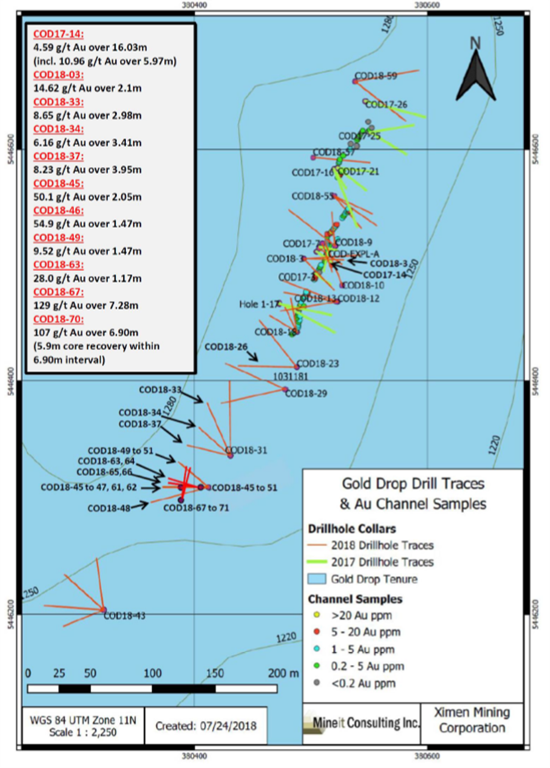
  • 2018 drilling discovered COD18-67: 129 g/t gold, 1,154 g/t silver & 823 g/t tellurium over 7.28 meters core length.
    COD18-70: 107 g/t gold, 880 g/t silver & 640 g/t tellurium over 6.90 meters core length.
https://www.accesswire.com/users/newswire/images//03202019GGX2.png

FULL DISCLOSURE: GGX Gold is an advertising client of AGORA Internet Relations Corp.

CLIENT FEATURE: $GR.ca Great Atlantic’s Keymet Base Metal Property Proving Success Comes through Drilling $SIC.ca $MOZ.ca

Posted by AGORACOM at 8:15 AM on Monday, April 1st, 2019
https://s3.amazonaws.com/s3.agoracom.com/public/companies/logos/564603/hub/GREATATLANTIC_LOGO_TESTER-e1480712241913.jpg
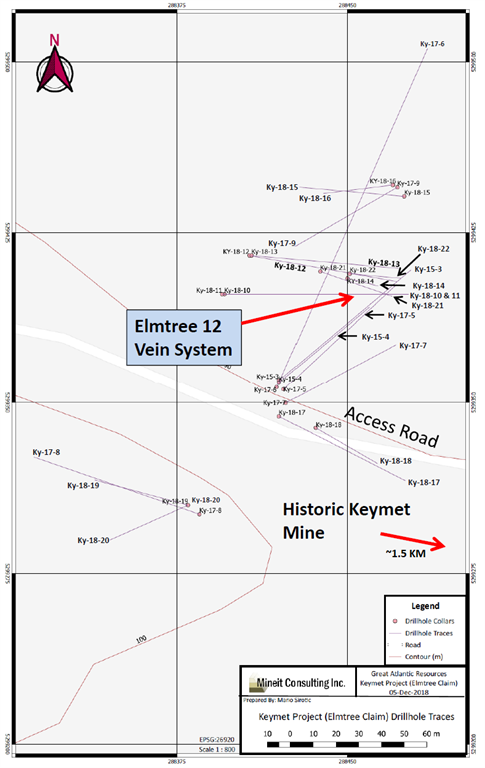
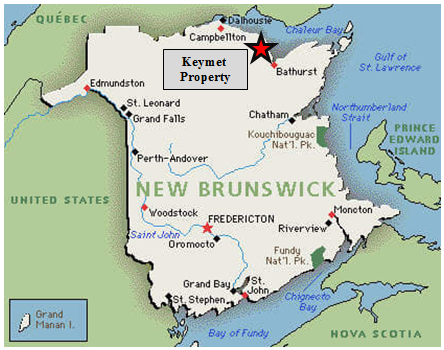
  • Drilling occurred in northwest region of the property, 1.5 km NW of the historic Keymet Mine.
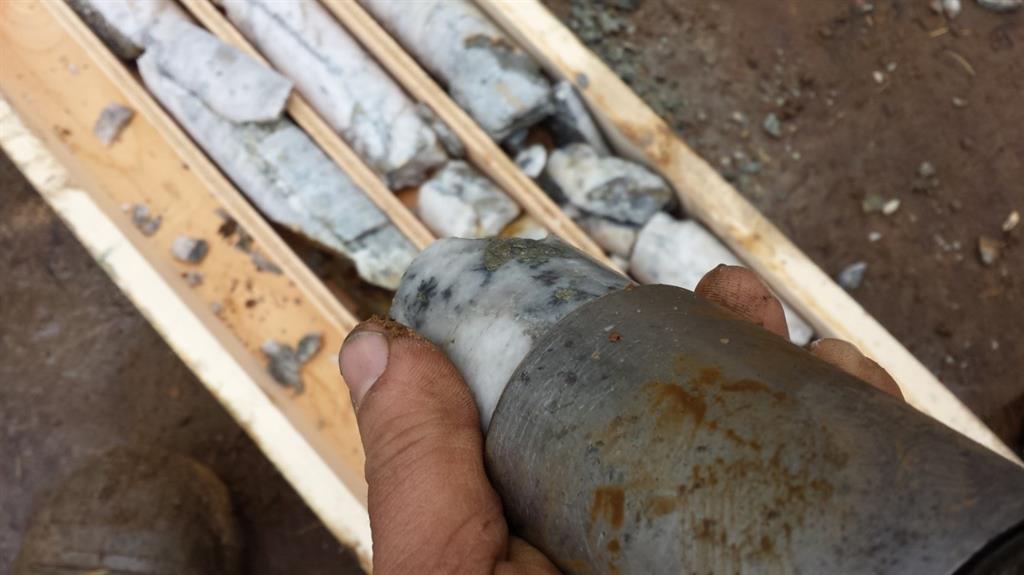
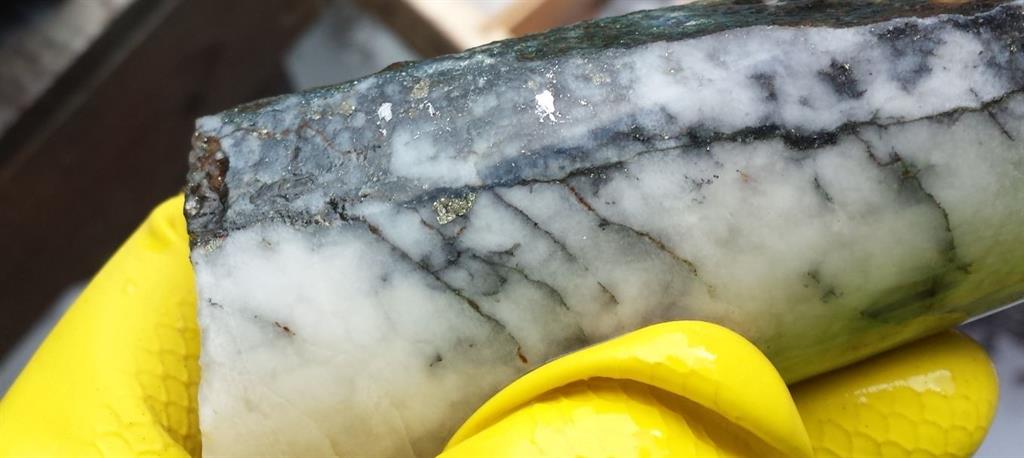
  • Ky-18-14: 7.89% zinc equivalent over 34.3 meters (From 46.20 m to 80.50 m)
  • Elmtree 12 vein: System traced to approximately 145 meters depth, open at depth
  • Elmtree 12 vein: Strike length of approximately 110 meters and open along strike
  • The Company’s focus since acquiring the Keymet Property is the area of reported polymetallic veins with most work in the area of the Elmtree 12 copper-lead-zinc-silver bearing vein system.
  • At least seven vein occurrences with lead, zinc and +/- copper, silver and gold are reported in this region of the property in addition to the polymetallic veins reported at the historic Keymet Mine
https://www.accesswire.com/users/newswire/images/532984/01182019GR3.png
https://www.accesswire.com/users/newswire/images/532984/01182019GR5.png

FULL DISCLOSURE: Great Atlantic is an advertising client of AGORA Internet Relations Corp

Advance Gold $AAX.ca and Acacia Mining Receive New Licenses for West Kenya Joint Venture $MGG.ca $SIL.ca $FA.ca $LON

Posted by AGORACOM at 10:40 AM on Thursday, March 28th, 2019
https://s3.amazonaws.com/s3.agoracom.com/public/companies/logos/564631/hub/advance-gold-large.png
  • 3 prospecting licenses have been issued for the three claims that comprise the Advane Gold – Acacia Mining JV
  • Two of the claims are located on either side of Acacia Mining’s 100% owned ground on the Liranda corridor.
  • Acacia’s 100% owned ground Owns a resource estimate of 1.2 million ounces of gold with an average grade of 12.6 g/t.
  • Claim PL/2018/0211 has seen past drilling that returned a highlight hole of 6 metres of 30.9 g/t gold, April 18/2016

Vancouver, British Columbia–(Newsfile Corp. – March 28, 2019) – Advance Gold Corp. (TSXV: AAX) (“Advance Gold” or “the Company”) is pleased to announce that new prospecting licenses have been issued for the three claims (PL/2018/0210, PL/2018/0211 and PL/2018/0212) that make up the West Kenya, Advance Gold – Acacia Mining joint venture. Two of the claims are located on either side of Acacia Mining’s 100% owned ground on the Liranda corridor.

On Acacia’s 100% owned ground a resource estimate (from the Isulu Shoot) was announced in February 2018, consisting of 1.2 million ounces of gold with an average grade of 12.6 g/t. The Isulu Shoot zone is contiguous to Advance Gold’s license PL/2018/0211 and PL/2018/0210. Mineralization hosted on Acacia’s property is not necessarily indicative of the mineralization hosted on the properties that make up the Advance-Acacia joint venture. In addition, claim PL/2018/0211 has seen past drilling that returned a highlight hole of 6 metres of 30.9 g/t gold, see April 18/2016 news release.

The joint venture is owned 85.37% by Acacia and 14.63% by Advance Gold. If during the joint venture either party decides to sell their interest, the other party has a first right of refusal on any offering price. If Advance Gold is diluted down to a 10% interest (approximately $1.7 million in exploration to dilute), then its interest converts to a 3% uncapped net smelter royalty (NSR). In the event that Advance Gold is diluted to a NSR, Acacia Mining has no first rights of refusal and the NSR can be sold directly to any interested party.

Allan Barry Laboucan, President and CEO of Advance Gold Corp. commented: “Management is delighted with the new licenses for our strategically located claims in Kenya that have been recently re-issued. The joint venture claims have seen high-grade gold intersections in past drilling, and are located on the Liranda corridor on either side of Acacia Mining’s high-grade gold resource at their Isulu Shoot. Based on the past work at the joint venture claims, including drilling, geophysics, and surface sampling, the potential of the project is clear and why an Acacia Mining sized company is our partner. Acacia Mining is 64% owned by Barrick Gold Corporation, so it is fair to say from Barrick’s public statements about deposit size, that they are looking for more than 1.2 million ounces. A logical move by Acacia Mining will be to drill more extensively on the joint venture ground so as to enhance Acacia Mining’s known resource. Now that we have the new licenses, Advance Gold will evaluate its options to participate in further exploration, or be diluted down to a NSR. We are also considering the option to sell our interest as we feel that it is an attractive asset for gold miners, streamers and royalty companies that are hard pressed to put their cash to work as there aren’t a lot of high-grade gold projects to choose from.”

About the Liranda Corridor Claims

The Liranda Corridor is found on the map below (from the Acacia Mining corporate presentation Feb. 2019) and it has been the focus of Acacia’s exploration in western Kenya.

On Acacia Mining’s 100% owned ground, they have an inferred resource of 1.2 million ounces at 12.1 g/t gold. The entire resource is on the Isulu Shoot and can be seen in the upper right corner of the map and is highlighted in red. The Isulu Shoot occurs in the same structures that extend onto the Advance Gold-Acacia Mining joint venture ground.

Past drilling on the joint venture ground, has returned some of the highest reported grades from the Liranda corridor. Including highlight drill intersections of 6 metres of 30.9 g/t gold (drillhole – KDAC0152), see April 18/2016 news release.

Acacia Mining has determined the scope of the resource on their 100% ground. It is clear from the geological setting, the structural trends and past drilling on the joint venture ground that it is a prime target area to enhance the Acacia Mining resource.

Cannot view this image? Visit: https://orders.newsfilecorp.com/files/5492/43731_47b4a7fc0410cac4_002.jpg


Figure 1
To view an enhanced version of Figure 1, please visit:
https://orders.newsfilecorp.com/files/5492/43731_47b4a7fc0410cac4_002full.jpg

Julio Pinto Linares is a QP, Doctor in Geological Sciences with specialty in Economic Geology and Qualified Professional No. 01365 by MMSA., for Advance Gold and is the qualified person as defined by National Instrument 43-101 responsible for the accuracy of technical information contained in this news release.

Other News

The company would like to report the retirement of Jim Gillis. He will be stepping down as the Chairman of the Board and director and will be replaced by current director Bradley Newell.

The board of directors would like to thank Jim Gillis for his many years of guidance and wish him all the best in his retirement.

In addition to Bradley Newell being a director that has been helping guide the company, he is also the largest individual shareholder.

About Advance Gold Corp. (TSXV: AAX)

Advance Gold is a TSX-V listed junior exploration company focused on acquiring and exploring mineral properties containing precious metals. The Company acquired a 100% interest in the Tabasquena Silver Mine in Zacatecas, Mexico in 2017, and the Venaditas project, also in Zacatecas state, in April, 2018.

The Tabasquena project is located near the Milagros silver mine near the city of Ojocaliente, Mexico. Benefits at Tabasquena include road access to the claims, power to the claims, a 100-metre underground shaft and underground workings,plus it is a fully permitted mine.

Venaditas is well located adjacent to Teck’s San Nicholas mine, a VMS deposit, and it is approximately 11km to the east of the Tabasquena project, along a paved road.

In addition, Advance Gold holds a 14.63% interest on strategic claims in the Liranda Corridor in Kenya, East Africa. The remaining 85.37% of the Kakamega project is held by Acacia Mining (63% owned by Barrick Gold Corporation).

For further information, please contact:
Allan Barry Laboucan,
President and CEO
Phone: (604) 505-4753
Email: [email protected]
Corporate website: www.advancegold.ca

LOMIKO $LMR.ca Completes Drilling to Expand La Loutre High-Grade Refractory Zone and Reports Wide Intercepts of Graphite in Multiple Drill Holes $DNI.ca

Posted by AGORACOM at 12:36 PM on Tuesday, March 19th, 2019
  • Completd a 21-hole diamond drilling program on the Refractory Zone of the La Loutre graphite property
  • Focus of the program was to expand a discovery announced March 7, 2017, and reviewed March 7, 2019 containing high grade intercepts of 7.74% Cg over 135.60 metres, including 16.81% Cgr over 44.10 metres from hole LL-16-001.
  • Two different intersections in hole LL-16-002 reporting 17.08% Cg over 22.30 metres and 14.80% Cg over 15.10 metres

Vancouver, B.C and Montreal, Que, March 19, 2019 (GLOBE NEWSWIRE) — Lomiko Metals Inc. (TSX-V: LMR, LMRMF, FSE: DH8C,  and Quebec Precious Metals Corporation (TSX-V: CJC, FSE: YXEN, OTC-BB: CJCFF) are pleased to announce the completion of a 21-hole diamond drilling program on the Refractory Zone of the La Loutre graphite property (the  “Property”).

“Our exploration team reports graphitic zones in multiple drill holes.”, stated A. Paul Gill, CEO of Lomiko Metals Inc. “It is very encouraging to visually observe intercepts of graphitic material. We look forward to receiving assays in three weeks and then advancing the high-grade Refractory Zone to resource estimation stage.”

The focus of the program was to expand a discovery announced March 7, 2017, and reviewed March 7, 2019 containing high grade intercepts of 7.74% Cg over 135.60 metres including 16.81% Cgr over 44.10 metres from hole LL-16-001, two different intersections in hole LL-16-002 reporting 17.08% Cg over 22.30 metres and 14.80% Cg over 15.10 metres, and 110.80 metres of 14.56% Cg in hole LL-16-003, and the 28.5 metres of 16.53% Cg and 21.5 metres of 11.53% Cg reported on January 6, 2016 and 9,0% over 90.75 metres reported on September 24th 2015 from the Refractory Zone.

The area of mineralization appears to be 200 metres wide and now has a current strike length of approximately 900 metres in the west-southwest to east-northeast direction and is open in both directions. 

The table below shows the drilling results from LL-16-001 to LL-16-010.  A drill hole location map can be found under the heading Quicklinks: Drill Map which includes 2015 and 2016 results and highlights. 

Table of 2016 drill results – LL-16-001 to LL-16-010 from Refractory Zone:

Hole #From (m)To (m)Length* (m)Cg %**
LL-16-0013.90139.50135.607.74
Incl.3.9048.0044.1016.81
Incl.135.00138.003.0014.85
LL-16-0023.9026.2022.3017.08
Incl.113.9129.0015.1014.80
LL-16-00330.20141.00110.8014.56
LL-16-004No significant values
LL-16-00555.8057.401.6013.35
LL-16-0654.00141.0085.007.67
Incl.109.50141.0031.5013.09
LL-16-00752.50115.8063.308.51
Incl.69.0085.5016.5015.75
LL-16-008109.50121.5012.003.91
LL-16-009No significant values
LL-16-01031.2045.0013.804.14
72.00147.0075.004.60

* True widths of the graphitic material are estimated to range from 80% to 95% of the down-hole length along the drill core.

** These results have been previously disclosed

The Property consists of contiguous claim blocks totaling approximately 28.67 km2 situated approximately 53 km east of Imerys’ Carbon and Graphite operation, formerly known as the Timcal Graphite Mine, North America’s only operating graphite mine, and located 117 km northwest of Montreal. 

Jean-Sebastien Lavallée (OGQ #773), Geologist, is a shareholder of both companies, VP Exploration of Quebec Precious Metals and a Qualified Person under NI  43-101, has reviewed and approved the technical content of this release.

For more information on Lomiko Metals, review the website at www.lomiko.com, contact A. Paul Gill at 604-729-5312 or email: [email protected].

On Behalf of the Board,

“A. Paul Gill”

Chief Executive Officer

Lomiko Metals Inc. (TSX-V: LMR)
6047295312
[email protected]

$GGX.ca GGX Gold Drill Core Samples Return up to 3,860 G/T Tellurium at the C.O.D. Vein Southern British Columbia $APH.ca $TUE.ca $GOM.ca $TYE.ca $NNZ.ca $GTT.ca $AOT.ca $MTB.ca

Posted by AGORACOM at 8:31 AM on Monday, March 18th, 2019
https://s3.amazonaws.com/s3.agoracom.com/public/companies/logos/564602/hub/ggx_large.png
  • Holes COD18-67 and COD18-70 re-analyzed for exceeding the upper 500 (g/t) analytical limit for tellurium
  • New analytical results confirm high grade tellurium within the high-grade gold and silver intersections.
  • COD18-67, (7.28 meters core length) graded 823.4 g/t tellurium
  • COD18-70, (6.90 meters core length) graded 640.5 g/t Tellurium

VANCOUVER, BC / ACCESSWIRE / March 18, 2019 / GGX Gold Corp. (TSX-V: GGX), (OTCQB: GGXXF), (FRA: 3SR2) (the “Company” or “GGX“) is pleased to announce it has received tellurium analytical results for select drill core samples from the Fall 2018 diamond drill program at the Gold Drop Property, located in southern British Columbia. The Fall 2018 drill program was conducted at the C.O.D. Vein, located in the Gold Drop Southwest Zone. The tellurium results are re-analyses of drill core samples from drill holes COD18-67 and COD18-70 which initially exceeded the upper 500 grams per tonne (g/t) analytical limit for tellurium. The re-analyses confirm high-grade tellurium for these drill holes, being associated with high-grade gold and silver (gold and silver results reported in News Releases of January 11 and 18, 2019):

  • COD18-67: 129 g/t gold, 1154 g/t silver & 823 g/t tellurium over 7.28-meter core length
  • COD18-70: 107 g/t gold, 880 g/t silver & 640 g/t tellurium over 6.90-meter core length

The 2018 Fall diamond drill program tested the COD vein. The program followed up on results from previous 2018 diamond drilling at the southern extension of the COD vein. The highlights of the 2018 Fall drill program are drill hole COD18-67 which intersected 129.1 g/t gold and 1,154 g/t silver over 7.28 meters core length and drill hole COD18-70 which intersected 107.5 g/t gold and 880 g/t silver over 6.90 meters core length (News Releases of January 11and 18, 2019). Both holes were drilled slightly northeast from the same site (COD18-67 at a 50-degree dip and COD-18-70 at a 54-degree dip) to intersect the northwest trending COD Vein at a shallower angle, the objective to test the continuity of the quartz veining and mineralization.

Fourteen drill core samples from the high-grade gold and silver intersections of drill holes COD18-67 and COD18-70 returned greater than the upper analytical limit of 500 g/t for tellurium during initial analysis (four acid ICP-MS analysis by ALS Canada Ltd. in North Vancouver). As a result, the tellurium weighted average grades for these intersections could not be determined from initial analyses. ALS Canada Ltd. recently re-analyzed these 14 samples for tellurium by four acid ICP-AES. These new analytical results confirm high grade tellurium within the high-grade gold and silver intersections. For drill hole COD18-67, the near-surface interval of 23.19-30.47m (7.28 meters core length) graded 823.4 g/t tellurium. For drill hole COD18-70, the near-surface interval of 22.57-29.47m (6.90 meters core length) graded 640.5 g/t Tellurium. The 14 drill samples are listed as follows (core length):

Hole No. From (m) To (m) Length (m) Te (G/T) Sample No.
COD18-67 23.58 23.95 0.37 880 V108489
COD18-67 24.50 25.10 0.60 560 V108491
COD18-67 25.10 25.50 0.40 770 V108492
COD18-67 25.50 26.06 0.56 900 V108493
COD18-67 26.06 26.34 0.28 930 V108494
COD18-67 26.34 26.72 0.38 2,250 V108495
COD18-67 26.72 27.10 0.38 3,860 V108496
COD18-67 27.10 27.63 0.53 1,550 V108497
COD18-67 29.70 30.04 0.34 1,090 V108503
COD18-67 30.04 30.47 0.43 710 V108504
COD18-70 22.57 22.95 0.38 690 V108537
COD18-70 23.30 23.75 0.45 3,340 V108539
COD18-70 23.75 24.15 0.40 2,960 V108541
COD18-70 26.19 26.98 0.79 830 V108544

Intersections for 2017 and 2018 diamond drill holes at the C.O.D. vein include the following (please refer to the Company’s website for News Releases announcing these results):

Hole ID Interval Length (m) Gold (gpt) Silver (gpt) Te (gpt)
COD17-14 16.03 4.59 38.64
COD18-3 2.1 14.62 150.2 102
COD18-26 1.4 10.3 1.09 0.24
COD18-32 1.51 3.67 67.2 30.4
COD18-33 2.98 8.65 47.6 37.3
COD18-34 3.41 6.16 72.4 31
COD18-37 3.95 8.23 67.36 38.53
COD18-45 2.05 50.15 375
COD18-46 1.47 54.9 379
COD18-49 1.47 9.52 118 72.2
COD18-54 1.66 7.6 60.2 34.1
COD18-61 1.38 5.29 32.4 31.4
COD18-63 1.17 28 424.7 150.4
COD18-67 7.28 129.1 1,154.90 823
COD18-68 2.76 8.77 85.4 56.3
COD18-69 7.46 5.76 67.9 61.2
COD18-70 6.9 107.5 880 640

Tellurium remains as one of the rarest elements on earth. Tellurium production has been a by-product of copper and gold mining. The production is limited, estimated to being on the order of 800 metric tonnes per year. According to the USGS total production for 2007 was 107 Mtonnes.

Up to recently, the sole use of tellurium has been alloying of other metals to increase the machinability of copper or to decrease the corrosive action of sulfuric acid on lead.

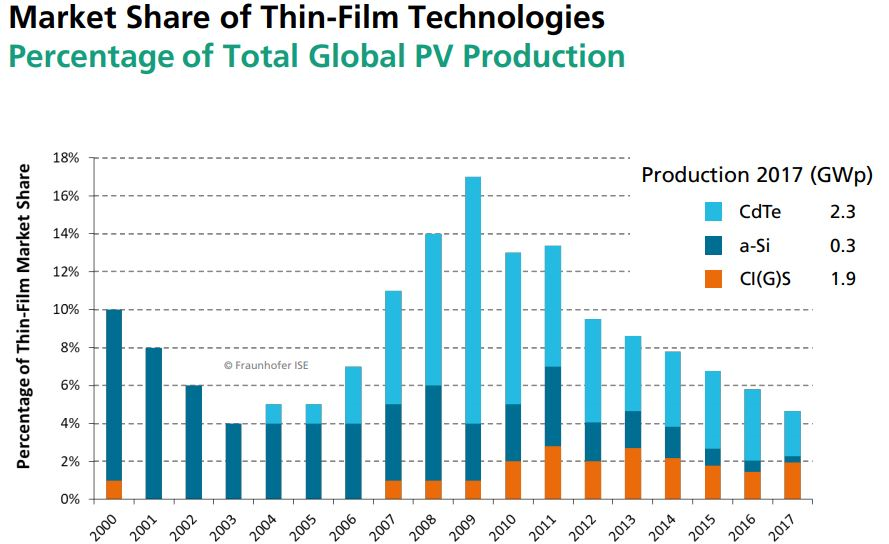
The most significant modern use of tellurium is the Cadmium-telluride (Cd-Te) photovoltaic solar cells. These solar cells are the forefront of solar power. One gigawatt (GW) of Cd-Te, at current efficiencies, would require approximately 93 metric tons of tellurium. These cells have the smallest carbon footprint and the shortest energy payback time of all solar cells. The efficiency of technology is constantly improving and the Cd-Te now takes up 5.1% of worldwide PV production.

PHOTOVOLTAICS REPORT, Freiburg, 27 August 2018

In the C.O.D vein system the tellurium occurs as a soft silver-grey telluride mineral. The telluride mineral is a Silver-Tellurium-Gold alloy speculated to be sylvanite. Whenever this mineral is observed in the drill core the interval has elevated silver, gold and tellurium values.

David Martin, P.Geo., a Qualified Person as defined by NI 43-101 and consultant for GGX Gold Corp., is responsible for the technical information contained in this News Release.

To view the Original News release with pictures please go to the website or contact the Company.

On Behalf of the Board of Directors,
Barry Brown, Director
604-488-3900

[email protected]

Investor Relations: Mr. Jack Singh, 604-488-3900 [email protected]

Labrador Gold $LAB.ca Announces Gold in Rock Samples From its Hopedale Project $RIO $MOZ.ca $FEX.ca

Posted by AGORACOM at 8:34 AM on Wednesday, March 13th, 2019
https://s3.amazonaws.com/s3.agoracom.com/public/companies/logos/564640/hub/Small-Logo-Labrador-GOLD.jpg

  • Labrador Gold controls 57 kilometre a strike length of stratigraphy prospective for gold in the Florence Lake Greenstone Belt. Hopedale Project
  • Exploration program at Hopedale followed up on successful results of 2017 work that outlined regional scale gold in soil and lake sediment anomalies
  • Of these samples, 80 assayed greater than 0.1 g/t gold including 17 samples that assayed greater than 1 g/t gold.

VANCOUVER, British Columbia, March 13, 2019 (GLOBE NEWSWIRE) — Labrador Gold Corp. (TSX-V: LAB) (“Labrador Gold” or the “Company”) is pleased to announce assay results for rock samples from its Hopedale project in Labrador. The company controls a 57 kilometre strike length of stratigraphy prospective for gold in the Florence Lake Greenstone Belt. The exploration program at Hopedale followed up on successful results of 2017 work that outlined regional scale gold in soil and lake sediment anomalies along the length of the belt and included detailed soil sampling, geological mapping, rock sampling and prospecting.

A total of 588 rock samples were taken along the length of the Florence Lake Greenstone Belt during the regional prospecting and mapping program. Of these samples, 80 assayed greater than 0.1 g/t gold including 17 samples that assayed greater than 1 g/t gold. Results of the assays ranged from below the detection limit of 0.05 g/t to 11.4 g/t gold in a grab sample from a quartz vein with pyrite and arsenopyrite. Additional highlights include channel samples of 2.77 g/t gold over 2.1 metres and 2.37 g/t gold over 2 metres. Highlights of gold assays of grab samples include 4.55g/t gold from quartz porphyry and 2.52g/t and 2.46g/t gold from quartz veins that were altered or contained sulphide. Complete highlights of the program are shown in the table below.

Sample IDAreaSample Type*LengthAu g/tDescription
1685504 to 506Thurber DogChannel3.50.47Quartz veins in Quartz porphyry
1685506Thurber Dogincluding10.86Quartz Porphyry
1685509 to 510Thurber DogChannel20.91Felsic volcanic
1685509Thurber Dogincluding11.27Quartz vein
1685555 to 556Thurber NorthChannel22.36Quartz Porphyry
1685556Thurber NorthIncluding12.73Quartz Porphyry
1685566Thurber NorthChannel0.50.92Ferruginous quartz vein
1685589Thurber NorthChannel0.560.48Quartz vein with iron Carbonate
1685613Thurber SouthChannel1.20.65Carbonate altered mafic volcanic
1685632 to 633Thurber SouthChannel2.12.77Chlorite altered Mafic volcanic with quartz veins
1685632Thurber Southincluding1.23.99Quartz vein with Fe oxide
1693835Thurber DogGrabn/a1.01Quartz vein with Arsenopyrite
1685854ShirleyGrabn/a1.09Phyllite with arsenopyrite
1690808Thurber DogGrabn/a1.45Felsic volcanic/Quartz Porphyry
1692276Thurber SouthGrabn/a1.64Quartz Vein
1692279Thurber SouthGrabn/a1.74Quartz Vein
1693836Thurber NorthGrabn/a1.84Silicified ultramafic with quartz veining and arsenopyrite
1685851ShirleyGrabn/a2.46Quartz-carbonate vein with pyrite
1692283Thurber SouthGrabn/a2.52Quartz vein with iron carbonate
1656525Thurber NorthGrabn/a4.55Quartz porphyry
1693833Thurber DogGrabn/a11.40Quartz vein with pyrite and arsenopyrite

*Note that grab samples are select samples and are not necessarily representative of gold mineralization found on the property.

While rock samples containing anomalous gold are found in many parts of the greenstone belt, most of the samples above 0.1g/t gold occur in the Jasmine/Shirley and Thurber Dog areas of the belt. At Jasmine/Shirley, the gold mineralization is associated with altered mafic volcanic rocks and phyllite that contain varying amounts of arsenopyrite from disseminated grains to veins of massive arsenopyrite. The highest-grade rocks in the area are from quartz veins with iron carbonate alteration.

At Thurber Dog, gold mineralization is associated primarily with altered porphyritic felsic volcanic rocks and quartz veins around the Thurber Dog occurrence and in the Thurber North area. At Thurber South the mineralization is associated with intensely carbonate altered ultramafic and mafic volcanic rocks and associated quartz veins. The mineralized rocks typically contain disseminated pyrite and, more rarely arsenopyrite.

“The results of our prospecting at Hopedale are very encouraging, especially since this was our first systematic rock sampling of the greenstone belt.” said Roger Moss, President and Chief Executive Officer of Labrador Gold. “Over 13% of the samples taken along the length of the belt returned results of more than 0.1 g/t gold and will be followed up in detail. In addition, significantly anomalous gold mineralization previously identified over a three kilometre strike length in the Thurber Dog portion of the belt continues to show excellent potential.”

All samples were shipped to the Bureau Veritas preparation laboratory in Timmins, Ontario, where they were crushed and split and a 500g sub sample pulverized to 200 mesh. Pulps were sent to the Vancouver laboratory for assay. Samples of 30g were analyzed for gold by fire assay with an atomic absorption finish and another 15g sample for 36 elements by ultratrace ICP-MS (inductively coupled plasma-mass spectrometry) following an aqua regia digestion. Overlimit samples (greater than 10g/t Au) are re-assayed using fire assay with a gravimetric finish. In addition to the QA-QC conducted by the laboratory, the Company routinely submits blanks, field duplicates and certified reference standards with batches of samples to monitor the quality of the analyses.

Roger Moss, PhD., P.Geo., is the qualified person responsible for all technical information in this release.

The company gratefully acknowledges the Newfoundland and Labrador Ministry of Natural Resources’ Junior Exploration Assistance (JEA) Program for its financial support for exploration of the Hopedale property.

About Labrador Gold:

Labrador Gold is a Canadian based mineral exploration company focused on the acquisition and exploration of prospective gold projects in the Americas. In 2017 Labrador Gold signed a Letter of Intent under which the Company has the option to acquire 100% of the 896 square kilometre (km2) Ashuanipi property in northwest Labrador and the Hopedale (458 km2) property in eastern Labrador.

The Hopedale property covers much of the Hunt River and Florence Lake greenstone belts that stretch over 80 km. The belts are typical of greenstone belts around the world but have been underexplored by comparison. Initial work by Labrador Gold during 2017 show gold anomalies in soils and lake sediments over a 3 kilometre section of the northern portion of the Florence Lake greenstone belt in the vicinity of the known Thurber Dog gold showing where grab samples assayed up to 7.8g/t gold. In addition, anomalous gold in soil and lake sediment samples occur over approximately 40 kilometres along the southern section of the greenstone belt (see news release dated January 25th 2018 for more details). Labrador Gold now controls approximately 57km strike length of the Florence Lake Greenstone Belt.

The Ashuanipi gold project is located just 35 km from the historical iron ore mining community of Schefferville, which is linked by rail to the port of Sept Iles, Quebec in the south. The claim blocks cover large lake sediment gold anomalies that, with the exception of local prospecting, have not seen a systematic modern day exploration program. Results of the 2017 reconnaissance exploration program following up the lake sediment anomalies show gold anomalies in soils and lake sediments over a 15 kilometre long by 2 to 6 kilometre wide north-south trend and over a 14 kilometre long by 2 to 4 kilometre wide east-west trend. The anomalies appear to be broadly associated with magnetic highs and do not show any correlation with specific rock types on a regional scale (see news release dated January 18th 2018). This suggests a possible structural control on the localization of the gold anomalies. Historical work 30 km north on the Quebec side led to gold intersections of up to 2.23 grams per tonne (g/t) Au over 19.55 metres (not true width) (Source: IOS Services Geoscientifiques, 2012, Exploration and geological reconnaissance work in the Goodwood River Area, Sheffor Project, Summer Field Season 2011). Gold in both areas appears to be associated with similar rock types.

The Company has 56,264,022 common shares issued and outstanding and trades on the TSX Venture Exchange under the symbol LAB.

For more information please contact:

Roger Moss, President and CEOTel: 416-704-8291

Or visit our website at: www.labradorgold.com

@LabGoldCorp

GGX Gold Requests Tellurium Re-Analysis of Select 2018 High Grade Drill Core Samples at the C.O.D. Vein – Southern British Columbia $APH.ca $TUE.ca $GOM.ca $TYE.ca $NNZ.ca $GTT.ca $AOT.ca $MTB.ca

Posted by AGORACOM at 8:18 AM on Thursday, March 7th, 2019
https://s3.amazonaws.com/s3.agoracom.com/public/companies/logos/564602/hub/ggx_large.png
  • Requested tellurium re-analysis of select drill core samples from the Fall 2018 diamond drill program at the Gold Drop Property, located in southern British Columbia
  • Multiple drill core samples from drill holes COD18-67 and COD18-70 exceeded the upper 500 grams per tonne (g/t) analytical limit for tellurium.
  • The 2018 Fall diamond drill program tested the COD vein. The program followed up on results from previous 2018 diamond drilling at the southern extension of the COD vein. The highlights of the 2018 Fall drill program are drill hole COD18-67 which intersected 129 g/t gold and 1,154 g/t silver over 7.28 meters core length and drill hole COD18-70 which intersected 107.5 g/t gold and 880 g/t silver over 6.90 m

VANCOUVER, BC / ACCESSWIRE / March 7, 2019 / GGX Gold Corp. (TSX-v: GGX), (OTCQB: GGXXF), (FRA: 3SR2) (the “Company” or “GGX“) is pleased to announce it has requested tellurium re-analysis of select drill core samples from the Fall 2018 diamond drill program at the Gold Drop Property, located in southern British Columbia. The Fall 2018 drill program was conducted at the C.O.D. Vein, located in the Gold Drop Southwest Zone. Multiple drill core samples from drill holes COD18-67 and COD18-70 exceeded the upper 500 grams per tonne (g/t) analytical limit for tellurium. These samples returned high grade values for gold and silver. These samples will be re-analyzed to determine tellurium grades. Highlights from the Fall 2018 drill program include (News Releases of January 11 and 18, 2019):

  • COD18-67: 129 g/t gold & 1154 g/t silver over 7.28-meter core length
  • COD18-70: 107 g/t gold & 880 g/t silver over 6.90-meter core length


(To view the full-size image, please click here)

The 2018 Fall diamond drill program tested the COD vein. The program followed up on results from previous 2018 diamond drilling at the southern extension of the COD vein. The highlights of the 2018 Fall drill program are drill hole COD18-67 which intersected 129 g/t gold and 1,154 g/t silver over 7.28 meters core length and drill hole COD18-70 which intersected 107.5 g/t gold and 880 g/t silver over 6.90 meters core length (News Releases of January 11 and 18, 2019). Intersections for 2017 and 2018 diamond drill holes at the C.O.D. vein include the following (please refer to the Company’s website for News Releases announcing these results):

Hole ID Interval Length Gold (gpt) Silver (gpt) Te (gpt)
COD17-14 16.03 4.59 38.64
COD18-3 2.1 14.62 150.2 102
COD18-26 1.4 10.3 1.09 0.24
COD18-32 1.51 3.67 67.2 30.4
COD18-33 2.98 8.65 47.6 37.3
COD18-34 3.41 6.16 72.4 31
COD18-37 3.95 8.23 67.36 38.53
COD18-45 2.05 50.15 375
COD18-46 1.47 54.9 379
COD18-49 1.47 9.52 118 72.2
COD18-54 1.66 7.6 60.2 34.1
COD18-61 1.38 5.29 32.4 31.4
COD18-63 1.17 28 424.7 150.4
COD18-67 7.28 129.11 1,154.90
COD18-68 2.76 8.77 85.4 56.3
COD18-69 7.46 5.76 67.9 61.2
COD18-70 6.9 107.5 880

Fourteen drill core samples from the high-grade gold and silver intersections of drill holes COD-18-67 and COD-18-70 returned greater than the upper analytical limit of 500 g/t for tellurium during initial analysis (four acid ICP-MS analysis by ALS Canada Ltd. in North Vancouver). As a result, the tellurium weighted average grade for these intersections could not be determined. The Company has requested ALS Canada Ltd. to re-analyze these samples for tellurium.


(To view the full-size image, please click here)


(To view the full-size image, please click here)

Tellurium (Te) remains as one of the rarest elements on earth. Tellurium production has been a by-product of copper and gold mining. The production is limited, estimated to being on the order of 800 metric tonnes per year. According to the USGS total production for 2007 was 107 Mtonnes.

Up to recently, the sole use of tellurium has been alloying of other metals to increase the machinability of copper or to decrease the corrosive action of sulfuric acid on lead.

The most significant modern use of tellurium is the Cadmium-telluride (Cd-Te) photovoltaic solar cells. These solar cells are the forefront of solar power. One gigawatt (GW) of Cd-Te, at current efficiencies, would require approximately 93 metric tons of tellurium. These cells have the smallest carbon footprint and the shortest energy payback time of all solar cells. The efficiency of technology is constantly improving and the Cd-Te now takes up 5.1% of worldwide PV production.


PHOTOVOLTAICS REPORT, Freiburg, 27 August 2018 (To view the full-size image, please click here)

In the C.O.D vein system the tellurium occurs as a soft silver-grey telluride mineral. The telluride mineral is a Silver-Tellurium-Gold alloy speculated to be sylvanite. Whenever this mineral is observed in the drill core the interval has elevated silver, gold and tellurium values.

David Martin, P.Geo., a Qualified Person as defined by NI 43-101, is responsible for the technical information contained in this News Release.

To view the Original News release with pictures please go to the website or contact the Company.

On Behalf of the Board of Directors,
Barry Brown, Director
604-488-3900
[email protected]

CLIENT FEATURE: Advance Gold Discovery Hole at Tabasquena of 1.7m of 9.64g/t Gold $SIL.ca $SIL.ca $FA.ca

Posted by AGORACOM at 1:39 PM on Tuesday, March 5th, 2019
https://s3.amazonaws.com/s3.agoracom.com/public/companies/logos/564631/hub/advance-gold-large.png

Advance Gold has Identified up to 30 Epithermal veins through the first 2 stages of drilling.

  • AGT-02 Tabasquena intersected 19m of core and is discovery hole of 1.7m of 9.64g/t gold in first 10 metres assayed.
  • La Chiquita – 4.70m Intersection from (109.25 to 113.95) in AGT-04
  • AGT-04 Intersected new Vein Yaki for 0.8m, crosscutting La Chiquita vein for 4.70m,the Tabasquena vein for 10 metres in the oxide zone & the La Nina vein for 11m (129-140m depth)

Phase 3 Drilling

  • In the first two phases of drilling, Advance discovered a cluster of epithermal veins, all but a few of them blind, which suggests this drilling intersected the top of the epithermal vein system.
  • The results from the 2 phases of drilling returned significant gold mineralization (see Press Releases November 1, 2018 and November 6, 2018)
  • A key focus of the phase 3 drilling will be to drill deeper and target the boiling zone of the epithermal vein system. The cluster of veins dip toward a fault which is considered a key structural feature.
  • A proposed hole will start from the east side of the fault, drill west, to then go through the cluster of veins to catch them at the boiling zone.