Agoracom Blog Home

Posts Tagged ‘gold’

Labrador Gold $LAB.ca Announces Gold in Rock Samples From its Hopedale Project $RIO $MOZ.ca $FEX.ca

Posted by AGORACOM at 8:34 AM on Wednesday, March 13th, 2019
https://s3.amazonaws.com/s3.agoracom.com/public/companies/logos/564640/hub/Small-Logo-Labrador-GOLD.jpg

  • Labrador Gold controls 57 kilometre a strike length of stratigraphy prospective for gold in the Florence Lake Greenstone Belt. Hopedale Project
  • Exploration program at Hopedale followed up on successful results of 2017 work that outlined regional scale gold in soil and lake sediment anomalies
  • Of these samples, 80 assayed greater than 0.1 g/t gold including 17 samples that assayed greater than 1 g/t gold.

VANCOUVER, British Columbia, March 13, 2019 (GLOBE NEWSWIRE) — Labrador Gold Corp. (TSX-V: LAB) (“Labrador Gold” or the “Company”) is pleased to announce assay results for rock samples from its Hopedale project in Labrador. The company controls a 57 kilometre strike length of stratigraphy prospective for gold in the Florence Lake Greenstone Belt. The exploration program at Hopedale followed up on successful results of 2017 work that outlined regional scale gold in soil and lake sediment anomalies along the length of the belt and included detailed soil sampling, geological mapping, rock sampling and prospecting.

A total of 588 rock samples were taken along the length of the Florence Lake Greenstone Belt during the regional prospecting and mapping program. Of these samples, 80 assayed greater than 0.1 g/t gold including 17 samples that assayed greater than 1 g/t gold. Results of the assays ranged from below the detection limit of 0.05 g/t to 11.4 g/t gold in a grab sample from a quartz vein with pyrite and arsenopyrite. Additional highlights include channel samples of 2.77 g/t gold over 2.1 metres and 2.37 g/t gold over 2 metres. Highlights of gold assays of grab samples include 4.55g/t gold from quartz porphyry and 2.52g/t and 2.46g/t gold from quartz veins that were altered or contained sulphide. Complete highlights of the program are shown in the table below.

Sample IDAreaSample Type*LengthAu g/tDescription
1685504 to 506Thurber DogChannel3.50.47Quartz veins in Quartz porphyry
1685506Thurber Dogincluding10.86Quartz Porphyry
1685509 to 510Thurber DogChannel20.91Felsic volcanic
1685509Thurber Dogincluding11.27Quartz vein
1685555 to 556Thurber NorthChannel22.36Quartz Porphyry
1685556Thurber NorthIncluding12.73Quartz Porphyry
1685566Thurber NorthChannel0.50.92Ferruginous quartz vein
1685589Thurber NorthChannel0.560.48Quartz vein with iron Carbonate
1685613Thurber SouthChannel1.20.65Carbonate altered mafic volcanic
1685632 to 633Thurber SouthChannel2.12.77Chlorite altered Mafic volcanic with quartz veins
1685632Thurber Southincluding1.23.99Quartz vein with Fe oxide
1693835Thurber DogGrabn/a1.01Quartz vein with Arsenopyrite
1685854ShirleyGrabn/a1.09Phyllite with arsenopyrite
1690808Thurber DogGrabn/a1.45Felsic volcanic/Quartz Porphyry
1692276Thurber SouthGrabn/a1.64Quartz Vein
1692279Thurber SouthGrabn/a1.74Quartz Vein
1693836Thurber NorthGrabn/a1.84Silicified ultramafic with quartz veining and arsenopyrite
1685851ShirleyGrabn/a2.46Quartz-carbonate vein with pyrite
1692283Thurber SouthGrabn/a2.52Quartz vein with iron carbonate
1656525Thurber NorthGrabn/a4.55Quartz porphyry
1693833Thurber DogGrabn/a11.40Quartz vein with pyrite and arsenopyrite

*Note that grab samples are select samples and are not necessarily representative of gold mineralization found on the property.

While rock samples containing anomalous gold are found in many parts of the greenstone belt, most of the samples above 0.1g/t gold occur in the Jasmine/Shirley and Thurber Dog areas of the belt. At Jasmine/Shirley, the gold mineralization is associated with altered mafic volcanic rocks and phyllite that contain varying amounts of arsenopyrite from disseminated grains to veins of massive arsenopyrite. The highest-grade rocks in the area are from quartz veins with iron carbonate alteration.

At Thurber Dog, gold mineralization is associated primarily with altered porphyritic felsic volcanic rocks and quartz veins around the Thurber Dog occurrence and in the Thurber North area. At Thurber South the mineralization is associated with intensely carbonate altered ultramafic and mafic volcanic rocks and associated quartz veins. The mineralized rocks typically contain disseminated pyrite and, more rarely arsenopyrite.

“The results of our prospecting at Hopedale are very encouraging, especially since this was our first systematic rock sampling of the greenstone belt.” said Roger Moss, President and Chief Executive Officer of Labrador Gold. “Over 13% of the samples taken along the length of the belt returned results of more than 0.1 g/t gold and will be followed up in detail. In addition, significantly anomalous gold mineralization previously identified over a three kilometre strike length in the Thurber Dog portion of the belt continues to show excellent potential.”

All samples were shipped to the Bureau Veritas preparation laboratory in Timmins, Ontario, where they were crushed and split and a 500g sub sample pulverized to 200 mesh. Pulps were sent to the Vancouver laboratory for assay. Samples of 30g were analyzed for gold by fire assay with an atomic absorption finish and another 15g sample for 36 elements by ultratrace ICP-MS (inductively coupled plasma-mass spectrometry) following an aqua regia digestion. Overlimit samples (greater than 10g/t Au) are re-assayed using fire assay with a gravimetric finish. In addition to the QA-QC conducted by the laboratory, the Company routinely submits blanks, field duplicates and certified reference standards with batches of samples to monitor the quality of the analyses.

Roger Moss, PhD., P.Geo., is the qualified person responsible for all technical information in this release.

The company gratefully acknowledges the Newfoundland and Labrador Ministry of Natural Resources’ Junior Exploration Assistance (JEA) Program for its financial support for exploration of the Hopedale property.

About Labrador Gold:

Labrador Gold is a Canadian based mineral exploration company focused on the acquisition and exploration of prospective gold projects in the Americas. In 2017 Labrador Gold signed a Letter of Intent under which the Company has the option to acquire 100% of the 896 square kilometre (km2) Ashuanipi property in northwest Labrador and the Hopedale (458 km2) property in eastern Labrador.

The Hopedale property covers much of the Hunt River and Florence Lake greenstone belts that stretch over 80 km. The belts are typical of greenstone belts around the world but have been underexplored by comparison. Initial work by Labrador Gold during 2017 show gold anomalies in soils and lake sediments over a 3 kilometre section of the northern portion of the Florence Lake greenstone belt in the vicinity of the known Thurber Dog gold showing where grab samples assayed up to 7.8g/t gold. In addition, anomalous gold in soil and lake sediment samples occur over approximately 40 kilometres along the southern section of the greenstone belt (see news release dated January 25th 2018 for more details). Labrador Gold now controls approximately 57km strike length of the Florence Lake Greenstone Belt.

The Ashuanipi gold project is located just 35 km from the historical iron ore mining community of Schefferville, which is linked by rail to the port of Sept Iles, Quebec in the south. The claim blocks cover large lake sediment gold anomalies that, with the exception of local prospecting, have not seen a systematic modern day exploration program. Results of the 2017 reconnaissance exploration program following up the lake sediment anomalies show gold anomalies in soils and lake sediments over a 15 kilometre long by 2 to 6 kilometre wide north-south trend and over a 14 kilometre long by 2 to 4 kilometre wide east-west trend. The anomalies appear to be broadly associated with magnetic highs and do not show any correlation with specific rock types on a regional scale (see news release dated January 18th 2018). This suggests a possible structural control on the localization of the gold anomalies. Historical work 30 km north on the Quebec side led to gold intersections of up to 2.23 grams per tonne (g/t) Au over 19.55 metres (not true width) (Source: IOS Services Geoscientifiques, 2012, Exploration and geological reconnaissance work in the Goodwood River Area, Sheffor Project, Summer Field Season 2011). Gold in both areas appears to be associated with similar rock types.

The Company has 56,264,022 common shares issued and outstanding and trades on the TSX Venture Exchange under the symbol LAB.

For more information please contact:

Roger Moss, President and CEOTel: 416-704-8291

Or visit our website at: www.labradorgold.com

@LabGoldCorp

CLIENT FEATURE: $LAB Stichting Depositary Plethora Precious Metals Fund Owns 17.45% in Labrador Gold Corp. $RIO $MOZ.ca $FEX.ca

Posted by AGORACOM at 2:11 PM on Monday, March 11th, 2019
https://s3.amazonaws.com/s3.agoracom.com/public/companies/logos/564640/hub/Small-Logo-Labrador-GOLD.jpg
  • Stichting Depositary Plethora Precious Metals Fund acquired 3,125,000 common shares of Labrador Gold Corp. at $0.13 per Share.
  • Plethora acquired the Shares by exercising its common share purchase warrants in the Company for CDN$406,250 
  • Plethora originally acquired the Warrants from the Company pursuant to a private placement that closed on February 2, 2017.
  • Prior to Exercise, Plethora owned or controlled 6,625,000 Shares, representing 12.56% of the Company’s issued and outstanding Shares
  • Following Exercise, Plethora owns or controls 9,750,000 shares or 17.45% of the Company

LAB Agoracom Hub

FULL DISCLOSURE: Labrador Gold is an advertising client of AGORA Internet Relations Corp.

GGX Gold Requests Tellurium Re-Analysis of Select 2018 High Grade Drill Core Samples at the C.O.D. Vein – Southern British Columbia $APH.ca $TUE.ca $GOM.ca $TYE.ca $NNZ.ca $GTT.ca $AOT.ca $MTB.ca

Posted by AGORACOM at 8:18 AM on Thursday, March 7th, 2019
https://s3.amazonaws.com/s3.agoracom.com/public/companies/logos/564602/hub/ggx_large.png
  • Requested tellurium re-analysis of select drill core samples from the Fall 2018 diamond drill program at the Gold Drop Property, located in southern British Columbia
  • Multiple drill core samples from drill holes COD18-67 and COD18-70 exceeded the upper 500 grams per tonne (g/t) analytical limit for tellurium.
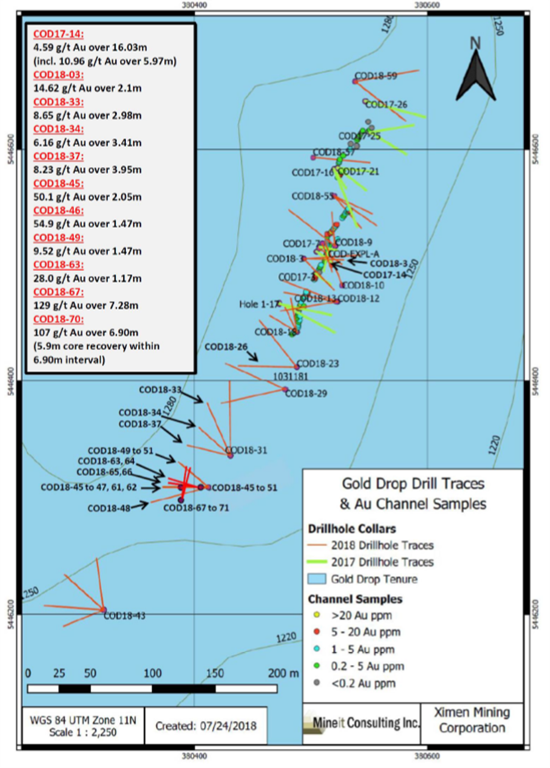
  • The 2018 Fall diamond drill program tested the COD vein. The program followed up on results from previous 2018 diamond drilling at the southern extension of the COD vein. The highlights of the 2018 Fall drill program are drill hole COD18-67 which intersected 129 g/t gold and 1,154 g/t silver over 7.28 meters core length and drill hole COD18-70 which intersected 107.5 g/t gold and 880 g/t silver over 6.90 m

VANCOUVER, BC / ACCESSWIRE / March 7, 2019 / GGX Gold Corp. (TSX-v: GGX), (OTCQB: GGXXF), (FRA: 3SR2) (the “Company” or “GGX“) is pleased to announce it has requested tellurium re-analysis of select drill core samples from the Fall 2018 diamond drill program at the Gold Drop Property, located in southern British Columbia. The Fall 2018 drill program was conducted at the C.O.D. Vein, located in the Gold Drop Southwest Zone. Multiple drill core samples from drill holes COD18-67 and COD18-70 exceeded the upper 500 grams per tonne (g/t) analytical limit for tellurium. These samples returned high grade values for gold and silver. These samples will be re-analyzed to determine tellurium grades. Highlights from the Fall 2018 drill program include (News Releases of January 11 and 18, 2019):

  • COD18-67: 129 g/t gold & 1154 g/t silver over 7.28-meter core length
  • COD18-70: 107 g/t gold & 880 g/t silver over 6.90-meter core length


(To view the full-size image, please click here)

The 2018 Fall diamond drill program tested the COD vein. The program followed up on results from previous 2018 diamond drilling at the southern extension of the COD vein. The highlights of the 2018 Fall drill program are drill hole COD18-67 which intersected 129 g/t gold and 1,154 g/t silver over 7.28 meters core length and drill hole COD18-70 which intersected 107.5 g/t gold and 880 g/t silver over 6.90 meters core length (News Releases of January 11 and 18, 2019). Intersections for 2017 and 2018 diamond drill holes at the C.O.D. vein include the following (please refer to the Company’s website for News Releases announcing these results):

Hole ID Interval Length Gold (gpt) Silver (gpt) Te (gpt)
COD17-14 16.03 4.59 38.64
COD18-3 2.1 14.62 150.2 102
COD18-26 1.4 10.3 1.09 0.24
COD18-32 1.51 3.67 67.2 30.4
COD18-33 2.98 8.65 47.6 37.3
COD18-34 3.41 6.16 72.4 31
COD18-37 3.95 8.23 67.36 38.53
COD18-45 2.05 50.15 375
COD18-46 1.47 54.9 379
COD18-49 1.47 9.52 118 72.2
COD18-54 1.66 7.6 60.2 34.1
COD18-61 1.38 5.29 32.4 31.4
COD18-63 1.17 28 424.7 150.4
COD18-67 7.28 129.11 1,154.90
COD18-68 2.76 8.77 85.4 56.3
COD18-69 7.46 5.76 67.9 61.2
COD18-70 6.9 107.5 880

Fourteen drill core samples from the high-grade gold and silver intersections of drill holes COD-18-67 and COD-18-70 returned greater than the upper analytical limit of 500 g/t for tellurium during initial analysis (four acid ICP-MS analysis by ALS Canada Ltd. in North Vancouver). As a result, the tellurium weighted average grade for these intersections could not be determined. The Company has requested ALS Canada Ltd. to re-analyze these samples for tellurium.


(To view the full-size image, please click here)


(To view the full-size image, please click here)

Tellurium (Te) remains as one of the rarest elements on earth. Tellurium production has been a by-product of copper and gold mining. The production is limited, estimated to being on the order of 800 metric tonnes per year. According to the USGS total production for 2007 was 107 Mtonnes.

Up to recently, the sole use of tellurium has been alloying of other metals to increase the machinability of copper or to decrease the corrosive action of sulfuric acid on lead.

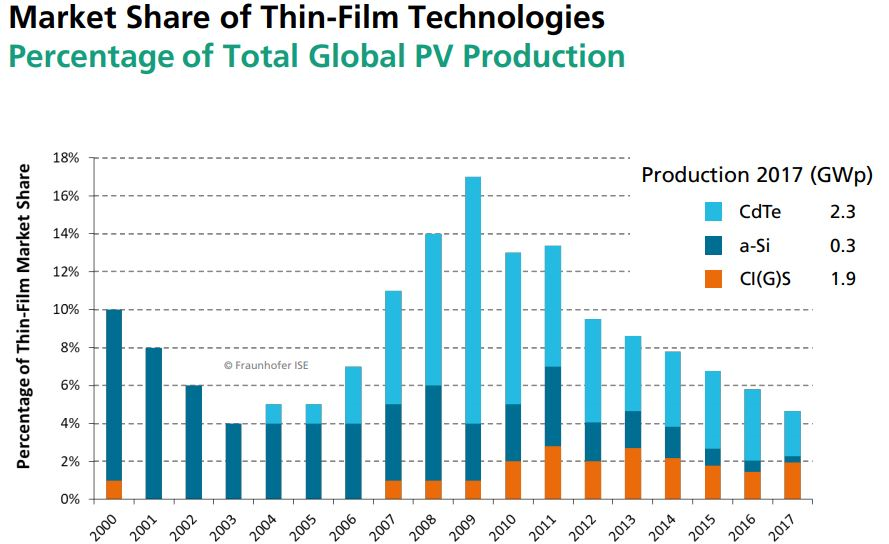
The most significant modern use of tellurium is the Cadmium-telluride (Cd-Te) photovoltaic solar cells. These solar cells are the forefront of solar power. One gigawatt (GW) of Cd-Te, at current efficiencies, would require approximately 93 metric tons of tellurium. These cells have the smallest carbon footprint and the shortest energy payback time of all solar cells. The efficiency of technology is constantly improving and the Cd-Te now takes up 5.1% of worldwide PV production.


PHOTOVOLTAICS REPORT, Freiburg, 27 August 2018 (To view the full-size image, please click here)

In the C.O.D vein system the tellurium occurs as a soft silver-grey telluride mineral. The telluride mineral is a Silver-Tellurium-Gold alloy speculated to be sylvanite. Whenever this mineral is observed in the drill core the interval has elevated silver, gold and tellurium values.

David Martin, P.Geo., a Qualified Person as defined by NI 43-101, is responsible for the technical information contained in this News Release.

To view the Original News release with pictures please go to the website or contact the Company.

On Behalf of the Board of Directors,
Barry Brown, Director
604-488-3900
[email protected]

CLIENT FEATURE: Advance Gold Discovery Hole at Tabasquena of 1.7m of 9.64g/t Gold $SIL.ca $SIL.ca $FA.ca

Posted by AGORACOM at 1:39 PM on Tuesday, March 5th, 2019
https://s3.amazonaws.com/s3.agoracom.com/public/companies/logos/564631/hub/advance-gold-large.png

Advance Gold has Identified up to 30 Epithermal veins through the first 2 stages of drilling.

  • AGT-02 Tabasquena intersected 19m of core and is discovery hole of 1.7m of 9.64g/t gold in first 10 metres assayed.
  • La Chiquita – 4.70m Intersection from (109.25 to 113.95) in AGT-04
  • AGT-04 Intersected new Vein Yaki for 0.8m, crosscutting La Chiquita vein for 4.70m,the Tabasquena vein for 10 metres in the oxide zone & the La Nina vein for 11m (129-140m depth)

Phase 3 Drilling

  • In the first two phases of drilling, Advance discovered a cluster of epithermal veins, all but a few of them blind, which suggests this drilling intersected the top of the epithermal vein system.
  • The results from the 2 phases of drilling returned significant gold mineralization (see Press Releases November 1, 2018 and November 6, 2018)
  • A key focus of the phase 3 drilling will be to drill deeper and target the boiling zone of the epithermal vein system. The cluster of veins dip toward a fault which is considered a key structural feature.
  • A proposed hole will start from the east side of the fault, drill west, to then go through the cluster of veins to catch them at the boiling zone.

NOTICE: Iconic Minerals $ICM.ca $BVTEF Featured On Fox Business Network – Sunday March 3, 2019 $LI.ca $MGG.ca $PAC.ca $CYP.ca $NEV.ca $SX.ca

Posted by AGORACOM-JC at 2:03 PM on Saturday, March 2nd, 2019

 
NOTICE: Iconic Minerals – Fox Business Network – Sunday March, 3, 2019

The Company would like to give notice to its shareholders that the Company’s CEO (Richard Kern) will be featured on national Fox Business Network on Sunday, March 3, 2019 at 10:37 PM Eastern, 9:37 PM Central, 8:37 PM Mountain and 7:37 PM Pacific Time

In this five minute segment, Richard Kern will be providing comments on the lithium industry while onsite in Nevada, at the Bonnie Claire property.

Please keep in mind that the allotted time slot may not be exact, and the segment could air within an hour of the above scheduled times.

On Behalf of the Iconic Team

Great Atlantic $GR.ca Acquires Golden Trust Property 1 Km North of Valentine Lake Gold Camp of Marathon Gold in Central Newfoundland Gold Belt $SIC.ca $MOZ.ca

Posted by AGORACOM at 12:20 PM on Friday, March 1st, 2019
  • Acquired the Golden Trust Property through staking
  • 1 kilometer north of the Valentine Lake Gold Camp of Marathon Gold Corp.
  • Golden Trust Property covers an area of 2,400 hectares in a relatively under-explored area of the central Newfoundland gold belt

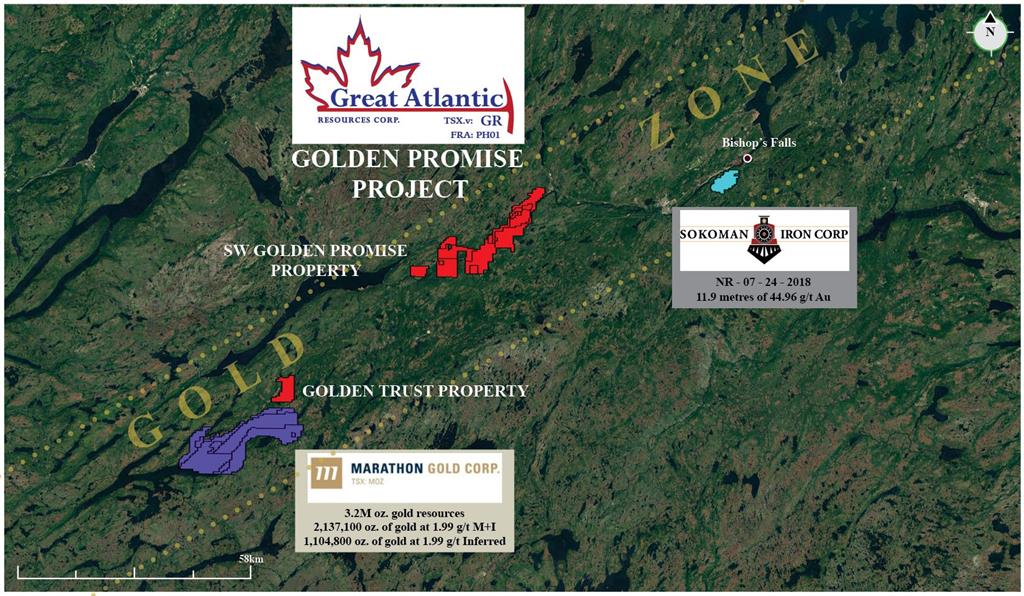
VANCOUVER, BC / ACCESSWIRE / March 1, 2019 / GREAT ATLANTIC RESOURCES CORP. (TSXV:GR) (the “Company” or “Great Atlantic”) is pleased to announce it has acquired, through staking, the Golden Trust Property, located in the central Newfoundland gold belt and 1 kilometer north of the Valentine Lake Gold Camp of Marathon Gold Corp. has acquired, through staking, the Golden Trust Property (TSXV:MOZ). The Golden Trust Property covers an area of 2,400 hectares in a relatively under-explored area of the central Newfoundland gold belt. Key points for the Golden Trust Property include:

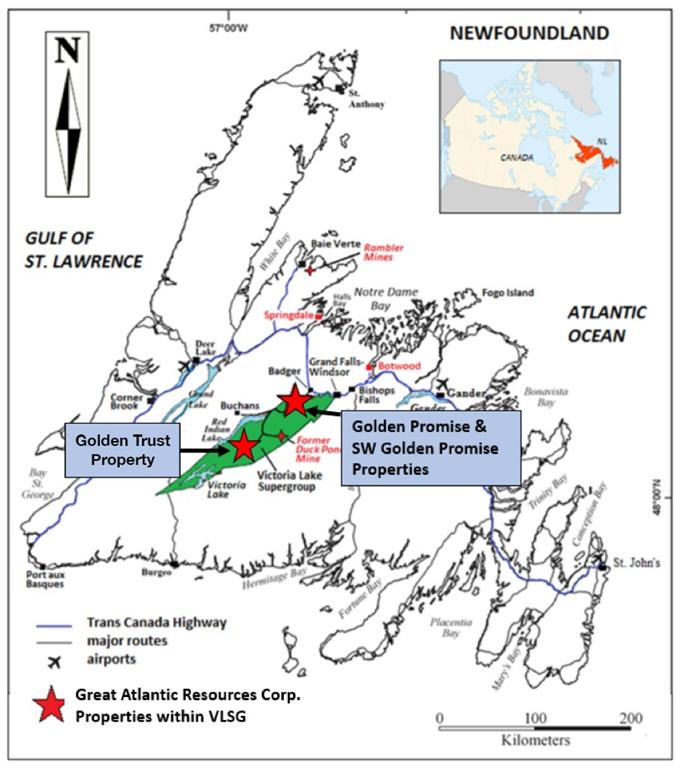
  • Located 1 km north of the Valentine Lake Gold Camp of Marathon Gold Corp., approximately 44 km southwest of Great Atlantic’s Golden Promise Property and approximately 31 km southwest of the Duck Pond VMS deposit.
  • Within the prospective Victoria Lake Supergroup which hosts numerous epigenetic gold & volcanogenic massive sulfide occurrences (including Duck Pond VMS deposit).
  • Within the Exploits Subzone of the Dunnage Zone and east of the Red Indian Line (RIL), a major (Appalachian-scale) collisional boundary, and suture zone.
  • Government till samples (2008) returned elevated to anomalous values for gold in various regions of the Golden Trust Property.


(To view the full-size image, please click here)

The Golden Trust Property occurs within an under-explored area of the Newfoundland central gold belt. Company management have been unable to locate any reports of historic diamond drilling within the property. Till geochemical sampling conducted by the Newfoundland Department of Natural Resources in 2008 included a small number of wide-spaced samples within the Golden Trust Property. Samples from various regions of the property returned elevated to anomalous values for gold including in the 5-9 parts per billion range.

The southern boundary of the property is located 1 kilometer north of the northeast region of the Valentine Lake Gold Camp of Marathon Gold Corp. (TSXV:MOZ). As reported on Marathon’s website, the Valentine Lake Gold Camp currently hosts four near-surface, mainly pit-shell constrained, deposits with measured and indicated resources totaling 2,691,400 oz. of gold at 1.85 g/t gold and inferred resources totalling 1,531,600 oz. of gold at 1.77 g/t. The Golden Trust Property is located approximately 44 kilometers southwest of Great Atlantic’s Golden Promise Gold Property which hosts multiple gold bearing quartz vein systems.

The Company’s Golden Trust and Golden Promise Properties and the Valentine Lake Gold Camp of Marathon Gold Corp. all occur within the Exploits Subzone of the Dunnage Zone. The Red Indian Line (RIL), a major (Appalachian-scale) collisional boundary, and suture zone, forms the western boundary of the Exploits Subzone.

The Golden Trust Property occurs within the Victoria Lake Supergroup (VLSG), a volcano-sedimentary terrane within the Exploits Subzone. The VLSG hosts numerous volcanogenic massive sulfide (VMS) and epigenetic gold occurrences. The most significant of the VMS deposits within the VLSG is the Duck Pond deposit (zinc, lead, copper, silver and gold), located approximately 31 kilometers northeast of the Golden Trust Property.


(To view the full-size image, please click here)

Readers are warned that mineralization at the Valentine Lake Gold Camp, Golden Promise Property, Duck Pond Deposit and elsewhere within the Exploits Subzone and VLSG is not necessarily indicative of mineralization within the Golden Trust Property.

David Martin, P.Geo., a Qualified Person as defined by NI 43-101 and VP Exploration for Great Atlantic, is responsible for the technical information contained in this News Release.

About Great Atlantic Resources Corp.: Great Atlantic Resources Corp. is a Canadian exploration company focused on the discovery and development of mineral assets in the resource-rich and sovereign risk-free realm of Atlantic Canada, one of the number one mining regions of the world. Great Atlantic is currently surging forward building the company utilizing a Project Generation model, with a special focus on the most critical elements on the planet that are prominent in Atlantic Canada, Antimony, Tungsten and Gold.

On Behalf of the board of directors

“Christopher R Anderson”

Mr. Christopher R. Anderson “Always be positive, strive for solutions, and never give up”
President CEO Director
604-488-3900 – Dir

Investor Relations:
Please call 604-488-3900

$AAX.ca Advance Gold Closes Private Placement and Prepares for Phase 3 Drilling $MGG.ca $SIL.ca $FA.ca

Posted by AGORACOM at 1:30 PM on Thursday, February 28th, 2019
https://s3.amazonaws.com/s3.agoracom.com/public/companies/logos/564631/hub/advance-gold-large.png
  • Issued 5,691,539 Units, each Unit consisting of 1 common share and 1 common share purchase warrant, each warrant being exercisable at $0.08 for 24 months
  • Proceeds from the financing will be used to fund the phase 3 drilling at the Tabasquena project near Ojocaliente, Mexico
  • A key focus of the phase 3 drilling will be to drill deeper and target the boiling zone of the epithermal vein system

Vancouver, British Columbia–(Newsfile Corp. – February 28, 2019) – Advance Gold Corp. (TSXV: AAX) (“Advance Gold” or “the Company”) is pleased to announce that it has closed its previously announced private placement financing (see February 5, 2019 and February 22, 2019 news releases). The Company has issued 5,691,539 Units, each Unit consisting of 1 common share and 1 common share purchase warrant, each warrant being exercisable at $0.08 for 24 months, for gross proceeds of $369,950. Proceeds from the financing will be used to fund the phase 3 drilling at the Tabasquena project near Ojocaliente, Mexico and for general corporate purposes.

All securities issued pursuant to the financing will be subject to a 4 month hold. Finders’ fees have been paid to certain finders in accordance with TSX Venture Exchange policies.

The private placement was effected with 1 insider of the Company subscribing for a total of $75,000, that portion of the Financing a “related party transaction” as such term is defined under Multilateral Instrument 61-101 – Protection of Minority Security Holders in Special Transactions (“MI 61-101”). The Company is relying on exemptions from the formal valuation and minority approval requirements set out in MI 61-101. The Company is exempt from the formal valuation requirement of MI 61-101 under sections 5.5(a) and (b) of MI 61-101 in respect of the transaction as the fair market value of the transaction, insofar as it involves the interested party, is not more than 25% of the Company’s market capitalization. Additionally, the Company is exempt from minority shareholder approval under sections 5.7(1)(a) and (b) of MI 61-101 as, in addition to the foregoing, (i) neither the fair market value of the Units nor the consideration received in respect thereof from interested party exceeds $2,500,000, (ii) the Company has one or more independent directors who are not employees of the Company, and (iii) all of the independent directors have approved the transaction. Material change reports were not filed 21 days prior to the closing of the financing because insider participation had not been established at the time the financing was announced.

Upcoming Drilling

In the first two phases of drilling, Advance discovered a cluster of epithermal veins, all but a few of them blind, which suggests this drilling intersected the top of the epithermal vein system. The results from the 2 phases of drilling returned significant gold mineralization (see Press Releases November 1, 2018 and November 6, 2018).

A key focus of the phase 3 drilling will be to drill deeper and target the boiling zone of the epithermal vein system. The cluster of veins dip toward a fault which is considered a key structural feature. A proposed hole will start from the east side of the fault, drill west, to then go through the cluster of veins to catch them at the boiling zone.

The other key focus will be to drill a few shallow holes near a 12 metre intersection of the Tabasquena vein in the oxides. This vein in the oxides is much wider than the historical 2-4 metre mining width utilized by former operator Penoles, which was across 2-4 metres. This intersection was a 125 metre step out to the north of the old mine workings and is approximately 75 metres along strike from the 100 metre deep shaft and headframe. Advance has mining equipment and the Tabasquena project is fully permitted for mining.

Allan Barry Laboucan, President and CEO of Advance Gold Corp. commented: “Our team is very excited to get started on our phase 3 drilling program at the Tabasquena project. We are in the final stages of planning our two pronged approach to drilling, and will provide more details as we begin drilling shortly.

“Past historical mining by Penoles in the oxides had reported high-grade silver, we have stepped out from their underground workings and found a much wider intersection of the Tabasquena vein of 12 metres in the oxides. The shallow holes will help us understand the near surface potential. There are plenty of streaming and royalty companies looking for near term production projects to invest in, yet a small group to choose from. Our timing to test the near surface potential is very good.

“Our deep hole will test the depth potential of the cluster of epithermal veins we have hit in the first 2 phases of drilling. Zonation of grade along the vertical and horizontal is common in epithermal vein systems, our deeper hole will help us understand down to the boiling zone of the system.”

Julio Pinto Linares is a QP, Doctor in Geological Sciences with specialty in Economic Geology and Qualified Professional No. 01365 by MMSA., for Advance Gold and is the qualified person as defined by National Instrument 43-101 responsible for the accuracy of technical information contained in this news release.

About Advance Gold Corp. (TSXV: AAX)

Advance Gold is a TSX-V listed junior exploration company focused on acquiring and exploring mineral properties containing precious metals. The Company acquired a 100% interest in the Tabasquena Silver Mine in Zacatecas, Mexico in 2017, and the Venaditas project, also in Zacatecas state, in April, 2018.

The Tabasquena project is located near the Milagros silver mine near the city of Ojocaliente, Mexico. Benefits at Tabasquena include road access to the claims, power to the claims, a 100-metre underground shaft and underground workings, plus it is a fully permitted mine.

Venaditas is well located adjacent to Teck’s San Nicholas mine, a VMS deposit, and it is approximately 11km to the east of the Tabasquena project, along a paved road.

In addition, Advance Gold holds a 14.53% interest on strategic claims in the Liranda Corridor in Kenya, East Africa. The remaining 85.47% of the Kakamega project is held by Acacia Mining (63% owned by Barrick Gold).

For further information, please contact:

Allan Barry Laboucan,
President and CEO
Phone: (604) 505-4753
Email: [email protected]

CLIENT FEATURE: Great Atlantic’s Keymet Base Metal Property Proving Success Comes through Drilling $MOZ.ca $SIC.ca

Posted by AGORACOM at 10:20 AM on Thursday, February 28th, 2019
https://s3.amazonaws.com/s3.agoracom.com/public/companies/logos/564603/hub/GREATATLANTIC_LOGO_TESTER-e1480712241913.jpg
https://tpc.googlesyndication.com/simgad/5752379710820707897
  • Drilling occurred in northwest region of the property, 1.5 km NW of the historic Keymet Mine.
  • Ky-18-14: 7.89% zinc equivalent over 34.3 meters (From 46.20 m to 80.50 m)
  • Elmtree 12 vein: System traced to approximately 145 meters depth, open at depth
  • Elmtree 12 vein: Strike length of approximately 110 meters and open along strike
  • The Company’s focus since acquiring the Keymet Property is the area of reported polymetallic veins with most work in the area of the Elmtree 12 copper-lead-zinc-silver bearing vein system.
  • At least seven vein occurrences with lead, zinc and +/- copper, silver and gold are reported in this region of the property in addition to the polymetallic veins reported at the historic Keymet Mine
https://www.accesswire.com/users/newswire/images/532984/01182019GR3.png

FULL DISCLOSURE: Great Atlantic is an advertising client of AGORA Internet Relations Corp

Monarch Gold Intersects 61.20 g/t Au Over 2.6 Metres, Including 265.00 g/t Au Over 0.6 Metres, at its McKenzie Break Gold Project $GDX.ca $ECR.ca $MZZ.ca $QMX.ca $IMG.ca $IAG $MUX

Posted by AGORACOM-JC at 8:50 AM on Thursday, February 28th, 2019
  • Initial drilling expands the high-grade gold potential of the McKenzie Break deposit and intersects new structures at depth
  • Highlights of initial results on the 13,945-metre 2018 diamond drilling program:
    – Hole MK-18-196: 61.20 g/t Au over 2.6 metres, incl. 265.00 g/t Au over 0.6 metres
    – Hole MK-18-183: 24.70 g/t Au over 0.6 metres
    – Hole MK-18-180: 19.80 g/t Au over 0.4 metres
    – Hole MK-18-195: 9.44 g/t Au over 2.0 metres, incl. 18.50 g/t Au over 1.0 metre

MONTREAL, Feb. 28, 2019 - MONARCH GOLD CORPORATION (“Monarch” or the “Corporation”) (TSX: MQR) (OTCMKTS: MRQRF) (FRANKFURT: MR7) is pleased to report the first assay results from the 2018 diamond drilling program at its wholly owned McKenzie Break gold project 25 kilometres north of Val-d’Or, near Monarchs’ Camflo and Beacon mills. The program started in September 2018 and ended in December 2018, with a total of 13,945 metres drilled in 61 holes. The purpose of the program was to explore below the known lenses and on the periphery of the multi-vein Green and Orange zones. Assays have been received for the first 21 holes totalling 4,424 metres of core (see table below for assay results).

“This first set of results attests to McKenzie Break’s solid exploration and high-grade potential, and already extends the deposit laterally and at depth,” said Jean-Marc Lacoste, President and Chief Executive Officer of Monarch. “Previous work on the property was mainly limited to the Green and Orange zones, which nonetheless enabled us to outline an indicated and inferred resource of over 165,000 ounces of gold (see press release dated June 14, 2018). Our aim going forward is to increase that resource.”

Hole MK-18-196 returned 61.20 g/t Au over 2.6 metres, including 265.00 g/t Au over 0.6 metres, at 260 metres below surface. This hole lies 110 metres west of a historic hole that returned 3.56 g/t Au over 1.1 metres, and 75 metres southeast of hole MK-18-195, which yielded 1.84 g/t Au over 1.0 metre. The intersections from holes MK-18-196 and MK-18-195 are on the same horizon, thereby potentially representing a new lens at depth.

Hole MK-18-183, drilled northwest of the proposed open pit, returned 24.70 g/t Au over 0.6 metres from a depth of 60 metres. Along with other holes drilled during the 2018 program, this positive result indicates the potential to extend the open pit towards the northwest.

Hole MK-18-180 returned a grade of 19.80 g/t Au over 0.4 metres from 90 metres below surface to the northeast of the Green Zone. This result extends the main Green Zone lens approximately 50 metres towards the northeast and will increase the underground mining resource in this area.

Hole MK-18-195 returned 9.44 g/t Au over 2.0 metres, including 18.50 g/t Au over 1.0 metre. This intersection is 195 metres below surface and represents a new lens below the main Orange Zone lens. The intersection lies approximately 80 metres northeast of the Orange Zone sector, with the nearest hole returning anomalous values 75 metres farther east. If connected, these results could enlarge the lens and extend it to the northeast.

Initial drill results for the McKenzie Break property:

Hole Length From To Width* Grade Au
number (m) (m) (m) (m) (g/t)
MK-18-179 176 5.9 6.6 0.7 7.30
149.2 150.0 0.8 8.13
MK-18-180 174 89.4 89.8 0.4 19.80
170.0 171.0 1.0 7.60
MK-18-181 201 175.7 176.7 1.0 1.99
MK-18-182 180 22.8 24.6 1.8 5.27
MK-18-183 180 34.2 38.5 4.3 3.73
Including 37.5 38.5 1.0 7.43
52.1 52.7 0.6 24.70
105.8 106.4 0.6 12.95
MK-18-184 174 58.3 59.4 1.1 2.90
148.6 149.6 1.0 6.83
MK-18-185 186 90.6 91.6 1.0 7.46
100.7 101.45 0.75 10.75
MK-18-186 177 64.0 66.0 2.0 2.68
MK-18-187 174 84.0 88.8 4.8 3.91
MK-18-188 177 6.9 9.3 2.4 3.08
9.2 20.2 1.0 3.46
131.7 132.5 0.8 2.18
MK-18-189 177 11.0 12.0 1.0 2.00
MK-18-190 201 17.6 18.8 1.2 4.87
25.8 27.8 2.0 2.70
39.8 41.0 1.2 3.46
MK-18-191 252 45.5 46.5 1.0 2.26
166.0 179.0 13.0 0.39
MK-18-192 276 89.7 91.9 2.2 6.78
190.0 194.0 4.0 0.68
223.0 226.5 3.5 1.18
MK-18-193 234 130.0 131.1 1.1 8.90
209.0 212.2 3.2 1.76
MK-18-194 234 15.0 16.0 1.0 6.67
111.7 112.7 1.0 2.13
MK-18-195 276 193.0 195.0 2.0 9.44
Including 194.0 195.0 1.0 18.50
MK-18-196 300 254.8 257.4 2.6 61.20
Including 255.7 256.3 0.6 265.00
293.8 296.0 2.2 1.88
MK-18-197 201 177.6 178.8 1.2 1.68
MK-18-198 198 62.5 63.7 1.2 0.18
MK-18-199 276 260.9 262.0 1.1 4.24

*The width shown is the core length. True width is estimated to be 90-100% of the core length.

McKenzie Break is a high-grade, multiple-narrow-vein gold deposit hosted in the dioritic Pascalis batholith and underlain by porphyritic diorite and mafic and felsic volcanic rocks. On June 14, 2018, the Corporation reported an NI 43-101 pit-constrained resource of 48,133 ounces in the Indicated category and 14,897 ounces in the Inferred category on the property, as well as an underground resource of 53,448 ounces in the Indicated category and 49,130 ounces in the Inferred category, for a total of 165,608 ounces of gold (Source: NI 43-101 Technical Report on the McKenzie Break Project, April 17, 2018, Alain-Jean Beauregard, P.Geo., and Daniel Gaudreault, Eng., of Geologica Groupe-Conseil Inc., and Christian D’Amours, P.Geo., of GeoPointCom Inc.).

Sampling normally consists of sawing the core into equal halves along its main axis and shipping one of the halves to the ALS Minerals laboratory in Val-d’Or, Quebec for assaying. The samples are crushed, pulverized and assayed by fire assay, with atomic absorption finish. Results exceeding 3.0 g/t Au are re-assayed using the gravity method, and samples containing visible gold grains are assayed using the metallic sieve method. Monarch uses a comprehensive QA/QC protocol, including the insertion of standards, blanks and duplicates.

The technical and scientific content of this press release has been reviewed and approved by Ronald G. Leber, P.Geo., the Corporation’s qualified person under National Instrument 43-101.

ABOUT MONARCH GOLD CORPORATION

Monarch Gold Corporation (TSX: MQR) is an emerging gold mining company focused on pursuing growth through its large portfolio of high-quality projects in the Abitibi mining camp in Quebec, Canada. The Corporation currently owns close to 300 km² of gold properties (see map), including the Wasamac deposit (measured and indicated resource of 2.6 million ounces of gold), the Beaufor Mine, the Croinor Gold (see video), McKenzie Break and Swanson advanced projects and the Camflo and Beacon mills, as well as other promising exploration projects. It also offers custom milling services out of its 1,600 tonne-per-day Camflo mill.

Forward-Looking Statements
The forward-looking statements in this press release involve known and unknown risks, uncertainties and other factors that may cause Monarch’s actual results, performance and achievements to be materially different from the results, performance or achievements expressed or implied therein. Neither TSX nor its Regulation Services Provider (as that term is defined in the policies of the TSX accepts responsibility for the adequacy or accuracy of this press release.

View original content to download multimedia:http://www.prnewswire.com/news-releases/monarch-gold-intersects-61-20-gt-au-over-2-6-metres-including-265-00-gt-au-over-0-6-metres-at-its-mckenzie-break-gold-project-300804145.html

SOURCE Monarch Gold Corporation

$GR.ca Great Atlantic Identifies Additional Gold Targets on the Golden Promise Project, Central Newfoundland $SIC.ca $MOZ.ca

Posted by AGORACOM at 9:57 AM on Wednesday, February 27th, 2019
  • Received all analytical results from the 2018 exploration program at its Golden Promise Property, located in the central Newfoundland gold belt
  • The results identified additional exploration targets where no prior drilling has taken place

VANCOUVER, BC / ACCESSWIRE / February 27, 2019 / GREAT ATLANTIC RESOURCES CORP. (TSXV.GR) (the “Company” or “Great Atlantic”) is pleased to announce it has received all analytical results from the 2018 exploration program at its Golden Promise Property, located in the central Newfoundland gold belt, the results identifying additional exploration targets. The 2018 soil and rock analytical results confirm gold soil anomalies +/- rock samples anomalous in gold in at least three additional target areas in under-explored regions of the property. The Company’s main focus on the property remains the Jaclyn Zone where multiple gold bearing quartz vein systems occur. Gold bearing veins and gold bearing quartz vein boulders occur in other regions of the property.

Anomalous 2018 rock and soil samples were concentrated in three new targets areas:

  • Southwest region: Anomalous soil samples along two reconnaissance soil lines, up to 77 ppb gold (News Release of September 27, 2018). All 11 samples along one 570- meter long line returned anomalous gold values. Rock samples within the soil anomaly retuned anomalous gold values including 1.04 g/t gold.
  • East-Central region: Anomalous soil samples (up to 39 ppb gold) & rock float samples (up to 136 ppb gold) along a reconnaissance traverse.
  • West-Central region: Anomalous soil samples (up to 41 ppb) following up in an area of 2017 soil anomalies (212 and 236 ppb gold).
  • No previous drilling in the new target areas.

The 2018 program was reconnaissance in nature consisting of prospecting and soil / rock geochemical sampling in multiple under-explored regions of the Golden Promise Property. Multiple gold soil anomalies were identified in the southwest, west-central and east-central regions of the property, thereby adding to the number of gold targets within the property. Rock grab samples from float in the east-central and southwest regions of the property returned anomalous values for gold, the high value being 1.04 g/t gold.

Soil sample analytical results from the southwest region of the Golden Promise Property were reported in the Company’s News Release of September 27, 2018. The results include anomalous gold in soil samples from a new target area in this southwest region. The majority of soil samples from two reconnaissance lines in this target area returned anomalous values for gold (up to 77 parts per billion (ppb) gold) including all 11 samples from one approximately 570-meter long line. Nine of the 2018 rock grab samples (float and outcrop) from this anomalous zone returned anomalous gold values, the high value being a boulder sample with quartz veins returning 1.04 g/t gold.This anomalous zone is approximately 4 kilometers northeast of the Linda / Snow White gold bearing vein which is located within the southwest region of the property. Reported historic highlights for the Linda / Snow White vein include a 232 g/t gold grab sample, 29.7 g/t gold over 0.5 meters in a channel sample and 19.5 g/t gold over 1.15 meters during diamond drilling (core length).

Quartz boulder in new southwest target area

The 2018 program confirmed an area of gold soil anomalies in the west-central region of the property. Initial reconnaissance soil sampling by the Company in this region during 2017 identified gold anomalies (including samples returning 212 and 236 ppb gold). Soil sampling in this area was continued during 2018 along 2 north-south lines. Six of seven soil samples from an approximately 300-meter long section of one line returned anomalous values for gold in the 8-41 ppb gold range, confirming this new target area. This zone of gold soil anomalies is located approximately 1 kilometer northwest of the gold bearing Shawn’s Shot quartz vein. A 0.32-meter long chip sample collected by the Company across the Shawn’s Shot vein in 2017 returned 48.2 g/t gold (News Release of August 28, 2017).

The 2018 program established a new gold target area in the east-central region of the property. Prospecting and soil sampling were conducted along one east-west reconnaissance line in this region. Approximately 25% of the soil samples along an approximately 2-kilometer section of this line returned anomalous values for gold (6-39 ppb gold). Rock samples from quartz boulders in this region returned anomalous values for gold (up to 136 ppb gold). The target area is approximately 2.2 kilometers south-southwest of the gold bearing Jaclyn Main Zone. The Jaclyn Main Zone has been the primary focus of historic gold exploration on the property.

The Company recently reported a National Instrument 43-101mineral resource estimate for the Jaclyn Main Zone, located in the northern region of the property (News Release of December 6, 2018; and Sedar-filed National Instrument 43-101 Technical Report on the Golden Promise Property, Central Newfoundland (revised), dated December 4, 2018 by Mr. Greg Z. Mosher, M.Sc. App., P.Geo., and Mr. Larry Pilgrim, B.Sc., P.Geo.). The reported inferred mineral resource estimate for the Jaclyn Main Zone is as follows:

Resource Cutoff Au g/t Au Cap g/t Au Uncap g/t Tonnes Au Ounces
Capped
Au Ounces Uncapped
Total 1.1 9.3 10.4 357,500 106,400 119,900
Pit-Constrained 0.6 11.4 14.1 157,300 57,800 71,200
Underground 1.5 7.5 7.6 200,200 48,600 48,700

Mineral Resources are not Mineral Reserves and do not have demonstrated economic viability.

There is no certainty that all or any part of the Mineral Resources estimated will be converted into Mineral Reserves.

Mineral resource tonnage and contained metal have been rounded to reflect the accuracy of the estimate, and numbers may not add due to rounding.

Mineral resource tonnage and grades are reported as undiluted.

Contained Au ounces are in-situ and do not include recovery losses

The Jaclyn Main Zone is part of the Jaclyn Zone. At least 5 gold bearing quartz vein systems are reported at the Jaclyn Zone, including the Jaclyn Main Zone, Jaclyn North Zone, Jaclyn South Zone, Jaclyn East Zone and Jaclyn West Zone. Much of the reported historical exploration within the property has been focused on the Jaclyn Zone with the majority of historic drill holes (2002-2010) at the Jaclyn Main Zone. Other gold bearing veins within the property include Shawn’s Shot, Linda / Snow White and at the Gabbro Occurrence. High grade quartz boulders are reported within the property including at the Jaclyn Zone and Branden and Justin’s Hope boulder occurrences.

The property is located within the Exploits Subzone of the Newfoundland Dunnage Zone. Within the Exploits Subzone, the property lies along the north-northwestern fringe of the Victoria Lake Supergroup (VLSG), a volcano-sedimentary terrane. The northwestern margin of the Golden Promise Property occurs proximal to, and, in part, contiguous with a major (Appalachian-scale) collisional boundary, and suture zone, known as the Red Indian Line (RIL). The RIL forms the western boundary of the Exploits Subzone. Recent significant gold discoveries in this region of the Exploits Subzone include those of Sokoman Iron Corp. (TSXV.SIC) at the Moosehead Project and Marathon Gold Corp. (TSXV.MOZ) at the Valentine Lake Gold Camp.

Sokoman Iron Corp. (TSXV.SIC) recently announced a high-grade gold discovery on its Moosehead Property, located approximately 40 kilometers east-northeast of the Golden Promise Property. The discovery was made during the 2018 diamond drilling program. A drill intersection of 44.96 g/t gold over 11.90 meters core length was reported including a 1.35 meters core length quartz vein intersection of 385.85 g/t gold (Sokoman Iron Corp. News Release of July 24, 2018). The Valentine Lake Gold Camp of Marathon Gold Corp. (TSXV.MOZ) is located approximately 55 kilometers southwest of the Golden Promise Property. As reported on Marathon’s website, the Valentine Lake Gold Camp currently hosts four near-surface, mainly pit-shell constrained, deposits with measured and indicated resources totaling 2,691,400 oz. of gold at 1.85 g/t gold and inferred resources totalling 1,531,600 oz. of gold at 1.77 g/t. Readers are warned that mineralization at the Moosehead Property and Valentine Lake Gold Camp is not necessarily indicative of mineralization on the Golden Promise Property.

As reported in the National Instrument 43-101 Technical Report on the Golden Promise Property, Central Newfoundland (revised), dated December 4, 2018 by Mr. Greg Z. Mosher, M.Sc. App., P.Geo., and Mr. Larry Pilgrim, B.Sc., P.Geo., the Jaclyn Main Zone was modelled as a single quartz vein that strikes east-west and dips steeply to the south. Modelled vein thickness was based on true thickness derived from quartz vein intercepts. The estimate is based on 220 assays that were composited to 135 one-meter long composites. A bulk density of 2.7 g/cm3 was used. Blocks in the model measured 15 meters east-west, 1-meter north-south and 10 meters vertically. The block model was not rotated. Grades were interpolated using inverse-distance squared (ID2) weighting and a search ellipse that measured 100 meters along strike, two meters across strike and 50 meters vertically. Grades were interpolated based on a minimum of two and a maximum of 10 composites with a maximum of one composite per hole so the grade of each block is based on at least two drillholes thereby demonstrating continuity of mineralization. For the capped mineral resource estimate, all assays that exceed 65 g/t gold were capped at 65 g/t gold. All resources were classified as Inferred because of the relatively wide spacing of drill holes through most of the zone.

Because part of the vein is near surface the resource estimate was constrained by a conceptual open pit to demonstrate reasonable prospects of eventual economic extraction. Generic mining costs of US$2.50/tonne and processing costs of US$25.00/tonne were used together with a gold price of US$1,300/ounce. A conceptual pit slope of 45° was assumed with no allowance for mining loss or dilution. Based on the combined hypothetical mining and processing costs and the assumed price of gold, a pit-constrained cutoff grade of 0.6 g/t was adopted. For the underground portion of the resource a cutoff of 1.5 g/t was assumed. The cutoff grade for the total resource is the weighted average of the pit-constrained and underground cutoff grades.

The 2018 rock and soil samples were analyzed by Eastern Analytical Ltd. in Springdale, NL for gold by Fire Assay and for 34 elements by ICP. A qualified person managed and conducted the 2018 exploration program.

Readers are warned that historical records referred to in this News Release have been examined but not verified by a Qualified Person. Further work is required to verify that historical records referred to in this News Release are accurate.

David Martin, P.Geo., a Qualified Person as defined by NI 43-101 and VP Exploration for Great Atlantic, is responsible for the technical information contained in this News Release.

About Great Atlantic Resources Corp.: Great Atlantic Resources Corp. is a Canadian exploration company focused on the discovery and development of mineral assets in the resource-rich and sovereign risk-free realm of Atlantic Canada, one of the number one mining regions of the world. Great Atlantic is currently surging forward building the company utilizing a Project Generation model, with a special focus on the most critical elements on the planet that are prominent in Atlantic Canada, Antimony, Tungsten and Gold.
On Behalf of the board of directors

“Christopher R Anderson

Mr. Christopher R. Anderson “Always be positive, strive for solutions, and never give up”
President CEO Director
604-488-3900 – Dir