Agoracom Blog Home

Posts Tagged ‘#Mine’

Gratomic $GRAT.ca Samsung Developing Graphene Battery $SRG.ca $NGC.ca $LLG.ca $GPH.ca $NOU.ca

Posted by AGORACOM at 2:40 PM on Wednesday, August 21st, 2019

SPONSOR: Gratomic Inc. (TSX-V: GRAT) Advanced materials company focused on mine to market commercialization of graphite products, most notably high value graphene based components for a range of mass market products. Collaborating with Perpetuus, Gratomic will use Aukam graphite to manufacture graphene products for commercialization on an industrial scale. For More Info Click Here

  • Smartphones and portable electronic devices are omnipresent in the world we live in today. We rely heavily on these gadgets to complete a wide range of daily tasks from simple reminders and calendar events to more complex assignments and applications as powerful business tools.
  • At some point in the day, we will find ourselves rushing around a room searching for a plug or USB socket as a cable dangles from our hands because the lithium-ion batteries that currently power our devices still only hold a limited charge.

However, frustrations such as this could soon be a thing of the past. According to the reliable tech-tipster Evan Blass, Samsung is gearing up to a 2021 launch of their usually hotly anticipated Galaxy series to come equipped with a more efficient longer-lasting graphene battery.

On Monday, Evan Blass tweeted, “Samsung is hoping to have at least one handset either next year or in 2021, I’m told, which will feature a graphene battery instead.”

Capable of a full charge in under a half-hour, they still need to raise capacities while lowering costs.

Evan Blass

Graphene batteries are believed to be the optimal solution and alternative to the current generation of lithium-ion batteries on the market. With higher electrical and heat conductivity compared to lithium-ion solutions, graphene is also superior due to its lightweight, flexible and durable qualities. For these reasons, we can begin to understand why graphene has been hailed as a ‘wonder material’.

So, what would be the benefits of using the material graphene as an alternative to lithium-ion in battery packs?

Slimline solutions: having already discussed how graphene is lightweight, we should also consider that when you stack 3 million layers of this material, it only amounts to 1 mm of thickness. This could mean that manufacturers can place small high-capacity batteries in devices to reduce the overall size of the device for compactness or enhance other capabilities and overall performance.

Faster charging times: this increases the battery endurance compared to lithium-ion batteries as the conductivity capabilities of graphene offers little to no resistance to the flow of electrons.

Reduced thermal output: because of its ability to dissipate heat much more effectively, graphene can reduce the operating temperature of smart devices. This means better performance and safety when charging or operating the device for complex tasks or gaming.

These may be of particular interest to a company like Samsung who have previously been affected by battery issues, particularly concerning the overheating issues of the Note7 back in 2016. This led to Samsung implementing an eight-point inspection process for batteries as well as stepping up its research into battery technology, making significant progress in recent years.

We need only look back to 2017 when Samsung revealed its researchers developed a “graphene ball” material capable of five times faster-charging speeds than standard lithium-ion batteries. Coupled with Blass’s latest claims, it is plausible to expect that we will see graphene batteries go mainstream within the next couple of years.

With products likely restricted to select smartphones and smart devices initially, we can also anticipate further developments on other applications for graphene in the coming years. For example, Tesla are showing interest in metal-air batteries which utilize a graphene rod as a cathode. These types of battery can increase battery efficiency up to five times at just one-third of the cost and because of the greater abundance of carbon, compared to a rare metal like lithium, manufacturers will continue to research its potential as they have been trying to implement the use of graphene as a material in about everything since its discovery in 2004.

So, it would suffice to say that graphene batteries are definitely set to be a game-changer and put an end to panicked searches for a place to charge devices or carrying around multiple charging packs to get through a busy day.

SOURCE: https://www.azonano.com/news.aspx?newsID=36942

CLIENT FEATURE: Gratomic $GRAT.ca Developing Conductive Inks and Pastes from Aukam Graphite Mine $SRG.ca $NGC.ca $LLG.ca $GPH.ca $NOU.ca

Posted by AGORACOM at 1:40 PM on Monday, August 19th, 2019
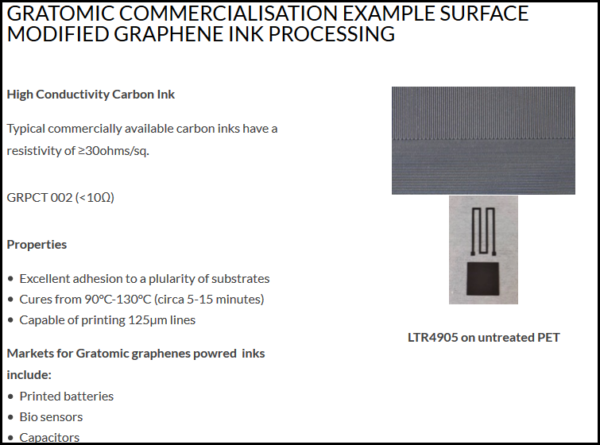
  • Launches Gratink, conductive inks and pastes
  • The inks and pastes (to the best of the Company’s knowledge) are amongst the most conductive carbon inks and pastes currently available within the global market place.
  • The Gratink product is formulated specifically to meet the needs of the printed flexible electronics and EMI shielding markets
  • The Gratink and paste applications based on surface modified nano graphene “enablers” offer a product for market penetration into the information technology sector that is now an important aspect of our everyday life.  

About Gratomic Inc.

Gratomic is an advanced material company focused on mine to market commercialization of graphite products, most notably high-value graphene-based components for a range of mass market products.

Gratomic Hub on Agoracom

FULL DISCLOSURE: Gratomic is an advertising client of AGORA Internet Relations Corp.

Gratomic $GRAT.ca – University of Illinois Team Finds that Defects in Graphene Membranes may Improve Biomolecule Transport $SRG.ca $NGC.ca $LLG.ca $GPH.ca $NOU.ca

Posted by AGORACOM at 3:58 PM on Monday, August 12th, 2019

SPONSOR: Gratomic Inc. (TSX-V: GRAT) Advanced Materials company focused on mine to market commercialization of graphite products, most notably high value graphene based components for a range of mass market products. Collaborating with Perpetuus, Gratomic will use Aukam graphite to manufacture graphene products for commercialization on an industrial scale. Click Here for More Info

  • Nanopore membranes have generated interest in biomedical research because they help researchers investigate individual molecules – atom by atom – by pulling them through pores for physical and chemical characterization
  • Researchers have not yet produced a membrane with spiral defects in the laboratory, but that task may be easier than trying to rid a graphene membrane of the current molecule-immobilizing step defects

Researchers at the University of Illinois examined how tiny defects in graphene membranes, formed during fabrication, could be used to improve molecule transport. They found that the defects make a big difference in how molecules move along a membrane surface. Instead of trying to fix these flaws, the team set out to use them to help direct molecules into the membrane pores.

Nanopore membranes have generated interest in biomedical research because they help researchers investigate individual molecules – atom by atom – by pulling them through pores for physical and chemical characterization. This technology could ultimately lead to devices that can quickly sequence DNA, RNA or proteins.

In 2014, University of Illinois physics professor Aleksei Aksimentiev and graduate student Manish Shankla demonstrated a graphene membrane that controlled a molecule’s movement through a nanopore by means of electrical charge. They discovered that once the molecules are on the surface of the membrane, it is very difficult to get them to shuffle into the membrane’s pores because molecules like to adhere to the surface.

While on sabbatical at Delft University of Technology in the Netherlands, Aksimentiev found that DNA tends to accumulate and stick along the edges of fabrication-formed defects that occur as linear steps spanning across the membrane’s surface. The Illinois team’s goal was to find a way to use these flaws to direct the stuck molecules into the nanopores, as a principle that can also apply to the delivery, sorting and analysis of biomolecules.

To refine and confirm their observations, the researchers used the Blue Waters supercomputer at the National Center for Supercomputing Applications at Illinois and the XSEDE supercomputer to model the system and molecule movement scenarios at the atomic level.

“Molecular dynamics simulations let us watch what is happening while simultaneously measuring how much force is required to get the molecule to clear a step,” Aksimentiev said. “We were surprised to find that it takes less force to move a molecule down a step than up. Although it may seem intuitive that gravity would make stepping down easier, it is not the case here because gravity is negligible at the nanoscale, and the force required to move up or down should be the same.”

Aksimentiev said team members originally thought they could use concentric defect patterns that form around the pores to force the molecules down, but their simulations showed the molecules congregating along the edges of the steps. That is when it dawned on them: A defect with edges that spiral into a pore, combined with an applied directional force, would give the molecule no other option than to go into the pore – kind of like a drain.

“This way, we can drop molecules anywhere on the membrane covered with these spiral structures and then pull the molecules into a pore,” he said.

The researchers have not yet produced a membrane with spiral defects in the laboratory, but that task may be easier than trying to rid a graphene membrane of the current molecule-immobilizing step defects, they said.

“When manufactured at scale, defect-guided capture may potentially increase the DNA capture throughput by several orders of magnitude, compared with current technology,” Shankla said.

“After a long development process, we are excited to see this principle used in a variety of other materials and applications such as delivery of individual molecules to reaction chambers for experiments,” the researchers said.Source: Nature NanotechnologyEurekalert

Source: Nature Nanotechnology

Gratomic $GRAT.ca – A Quantum Phenomenon Highlights the Limits of Graphene Electronics $SRG.ca $NGC.ca $LLG.ca $GPH.ca $NOU.ca

Posted by AGORACOM at 12:11 PM on Monday, July 29th, 2019

Gratomic Inc. (TSX-V: GRAT) Advanced Materials company focused on mine to market commercialization of graphite products, most notably high value graphene based components for a range of mass market products. Collaborating with Perpetuus, Gratomic will use Aukam graphite to manufacture graphene products for commercialization on an industrial scale.

  • A quantum phenomenon that tests the limits of graphene’s use in electricity has been discovered by a research team from The University of Manchester, The University of Nottingham and The University of Loughborough.
https://www.scitecheuropa.eu/wp-content/uploads/2019/07/graphene-1-696x392.jpg

The research addressed how electrons in graphene scatter off the vibrating carbon atoms in the hexagonal crystal lattice. The researchers applied a magnetic field perpendicular to the atomically thin sheet of graphene. This magnetic field forced the current-carrying electrons to move in a closed circular orbit.

There is only one way for an electron from pure graphene to escape this orbit, this is by bouncing off a “phonon” in a scattering event. These phonons are particle-like bundles of energy and momentum. By warming graphene crystals for a very low temperature, researchers discovered they can generate these phonons.

Once the research team triggered the phonon scattering event, they passed a small electrical current through the sheet of graphene in order to measure the precise amount of energy and momentum that can be transferred between and electron and a phonon during the event.

What happens during these scatter events?

The researchers discovered that there are two types of phonon scatter. The first being named transverse acoustic (TA) phonons. TA phonons force the carbon atoms to vibrate perpendicular to the direction of phonon propagation and wave motions, such motion can be likened to the way waves flow on the surface of water.

The second type of phonon scatter is longitudinal acoustic (LA). LA phonons stimulate the carbon atoms to vibrate back and forth along the direction of the phonon and the wave motion, which motion is comparable to the motion sound waves make through the air.

By assessing these events, researchers have found a very accurate way to measure the speed of both types of phonons. Such measurements have indicated that the TA phonon scattering events dominate over LA phonon scattering.

Laurence Eaves and Roshan Krishna Kumar, co-authors of the work, said “We were pleasantly surprised to find such prominent magnetophonon oscillations appearing in graphene. We were also puzzled why people had not seen them before, considering the extensive amount of literature on quantum transport in graphene.”

Mark Greenaway, from Loughborough University, worked on the theory of this effect said: “This result is extremely exciting – it opens a new route to probe the properties of phonons in two-dimensional crystals and their heterostructures. This will allow us to better understand electron-phonon interactions in these promising materials, understanding which is vital to develop them for use in new devices and applications.”

SOURCE: https://www.scitecheuropa.eu/a-quantum-phenomenon-highlights-the-limits-of-graphene-electronics/96360/

Gratomic $GRAT.ca – Graphene Goes Mainstream $SRG.ca $NGC.ca $LLG.ca $GPH.ca $NOU.ca

Posted by AGORACOM at 3:18 PM on Wednesday, July 24th, 2019
https://s3.amazonaws.com/s3.agoracom.com/public/companies/logos/564608/hub/Gratomic_large_new.jpg

SPONSOR: Gratomic Inc. (TSX-V: GRAT) Advanced materials company focused on mine to market commercialization of graphite products, most notably high value graphene based components for a range of mass market products. Collaborating with Perpetuus, Gratomic will use Aukam graphite to manufacture graphene products for commercialization on an industrial scale. For More Info Click Here

https://www.news.ucsb.edu/sites/default/files/styles/article_horizontal/public/images/2019/banerjee%20graphene%20highway.jpg?itok=ZQAwuNu7
Kaustav Banerjee’s lab overcomes a stubborn obstacle to wide-scale deployment of graphene in the semiconductor industry

Ever since graphene, the flexible, two-dimensional form of graphite (think a 1-atom-thick sheet of pencil lead), was discovered in 2004, researchers around the world have been working to develop commercially scalable applications for this high-performance material.

Graphene is 100 to 300 times stronger than steel and has a maximum electrical current density orders of magnitude greater than that of copper, making it the strongest, thinnest and, by far, the most reliable electrically conductive material on the planet. It is, therefore, an extremely promising material for interconnects, the fundamental components that connect billions of transistors on microchips in computers and other electronic devices in the modern world.

For over two decades, interconnects have been made of copper, but that metal encounters fundamental physical limitations as electrical components that incorporate it shrink to the nanoscale. “As you reduce the dimensions of copper wires, their resistivity shoots up,” said Kaustav Banerjee, a professor in the Department of Electrical and Computer Engineering. “Resistivity is a material property that is not supposed to change, but at the nanoscale, all properties change.”

As the resistivity increases, copper wires generate more heat, reducing their current-carrying capacity. It’s a problem that poses a fundamental threat to the $500 billion semiconductor industry. Graphene has the potential to solve that and other issues. One major obstacle, though, is designing graphene micro-components that can be manufactured on-chip, on a large scale, in a commercial foundry.

“Whatever the component, be it inductors, interconnects, antennas or anything else you want to do with graphene, industry will move forward with it only if you find a way to synthesize graphene directly onto silicon wafers,” Banerjee said. He explained that all manufacturing processes related to the transistors, which are made first, are referred to as the ‘front end.’ To synthesize something at the back-end — that is, after the transistors are fabricated — you face a tight thermal budget that cannot exceed a temperature of about 500 degrees Celsius. If the silicon wafer gets too hot during the back-end processes employed to fabricate the interconnects, other elements that are already on the chip may get damaged, or some impurities may start diffusing, changing the characteristics of the transistors.

Now, after a decade-long quest to achieve graphene interconnects, Banerjee’s lab has developed a method to implement high-conductivity, nanometer-scale doped multilayer graphene (DMG) interconnects that are compatible with high-volume manufacturing of integrated circuits. A paper describing the novel process was named one of the top papers at the 2018 IEEE International Electron Devices Meeting (IEDM),  from more than 230 that were accepted for oral presentations. It also was one of only two papers included in the first annual “IEDM Highlights” section of an issue of the journal Nature Electronics.

Banerjee first proposed the idea of using doped multi-layer graphene at the 2008 IEDM conference and has been working on it ever since. In February 2017 he led the experimental realization of the idea by Chemical Vapor Deposition (CVD) of multilayer graphene at a high temperature, subsequently transferring it to a silicon chip, then patterning the multilayer graphene, followed by doping. Electrical characterization of the conductivity of DMG interconnects down to a width of 20 nanometers established the efficacy of the idea that was proposed in 2008. However, the process was not “CMOS-compatible” (the standard industrial-scale process for making integrated circuits), since the temperature of CVD processes far exceed the thermal budget of back-end processes.

To overcome this bottleneck, Banerjee’s team developed a unique pressure-assisted solid-phase diffusion method for directly synthesizing a large area of high-quality multilayer graphene on a typical dielectric substrate used in the back-end CMOS process. Solid-phase diffusion, well known in the field of metallurgy and often used to form alloys, involves applying pressure and temperature to two different materials that are in close contact so that they diffuse into each other.

Banerjee’s group employed the technique in a novel way. They began by depositing solid-phase carbon in the form of graphite powder onto a deposited layer of nickel metal of optimized thickness. Then they applied heat (300 degrees Celsius) and nominal pressure to the graphite powder to help break down the graphite. The high diffusivity of carbon in nickel allows it to pass rapidly through the metal film.

How much carbon flows through the nickel depends on its thickness and the number of grains it holds. “Grains” refer to the fact that deposited nickel is not a single-crystal metal, but rather a polycrystalline metal, meaning it has areas where two single-crystalline regions meet each other without being perfectly aligned. These areas are called grain boundaries, and external particles — in this case, the carbon atoms — easily diffuse through them. The carbon atoms then recombine on the other surface of the nickel closer to the dielectric substrate, forming multiple graphene layers.

Banerjee’s group is able to control the process conditions to produce graphene of optimal thickness. “For interconnect applications, we know how many layers of graphene are needed,” said Junkai Jiang, a Ph.D. candidate in Banerjee’s lab and lead author of the 2018 IEDM paper. “So we optimized the nickel thickness and other process parameters to obtain precisely the number of graphene layers we want at the dielectric surface. “Subsequently, we simply remove the nickel by etching so that what’s left is only very high-quality graphene — virtually the same quality as graphene grown by CVD at very high temperatures,” he continued. “Because our process involves relatively low temperatures that pose no threat to the other fabricated elements on the chip, including the transistors, we can make the interconnects right on top of them.”

UCSB has filed a provisional patent on the process, which overcomes the obstacles that, until now, have prevented graphene from replacing copper. Bottom line: graphene interconnects help to create faster, smaller, lighter, more flexible, more reliable and more cost-effective integrated circuits. Banerjee is currently in talks with industry partners interested in potentially licensing this CMOS-compatible graphene synthesis technology, which could pave the way for what would be the first 2D material to enter the mainstream semiconductor industry.

Support for the research has come from various sources over the years, including the National Science Foundation, the National Institute of Standards and Technology, Semiconductor Research Corporation, and currently, the U.S. Army Research Office and the University of California Research Initiatives.

Source: https://www.news.ucsb.edu/2019/019563/graphene-goes-mainstream

CLIENT FEATURE: Advance Gold $AAX.ca Owns 15% of Kakamega JV attached to Barrick Takeover Offer for Acacia Mining $ANG.jo $ABX.ca $NGT.ca

Posted by AGORACOM at 7:30 PM on Tuesday, July 16th, 2019
  • Barrick Gold Corporation’s offer for Acacia Mining PLC under review by Independent Mining Consultants
  • Arguing Acacia is worth 38% more than Barrick’s offer
  • The takeover offer and its effect on the Kakamega joint venture project between Acacia and Advance Gold are not yet understood
  • The Kakamega joint venture project is owned 85.37% by Acacia and 14.63% by Advance Gold
  • New licenses for the joint venture project were issued and exploration program is underway post rainy season

Kakamega – The Rosterman Mine

Acacia Exploration Kenya Ltd. (“Acacia”) has 85.47% equity in the Kakamega Project, which comprises the Rosterman, Burkura, and Sigalagala Projects in Kenya, East Africa.

Rosterman SL267: The most northerly of the three licences hosts the historic Rosterman mine, which is reported to have produced in excess of 250,000oz Au at average grade in excess of 13g/t. Click Click here for map

Bukura SL265 and Sigalagala SL266: The southern licences host numerous significant historical colonial mines and areas of active artisanal mining. Click here for map

About Advance Gold Corp. (TSXV: AAX)

Advance Gold is a TSX-V listed junior exploration company focused on acquiring and exploring mineral properties containing precious metals. The Company acquired a 100% interest in the Tabasquena Silver Mine in and the Venaditas project in Zacatecas state. Advance Gold also holds a 14.63% interest in the Kakamega project held by Acacia Mining (63% owned by Barrick Gold Corporation)

Advance Gold Hub on Agoracom

FULL DISCLOSURE: Advance Gold is an advertising client of AGORA Internet Relations Corp.

CLIENT FEATURE: Gratomic’s Definitive Graphite Concentrate Sales Agreement a Precursor to Commercialization $GRAT.ca $SRG.ca $NGC.ca $LLG.ca $GPH.ca $NOU.ca

Posted by AGORACOM at 10:38 AM on Wednesday, July 10th, 2019

Gratomic is a leader in the mining and commercialization of graphite products

  • The global tire market acknowledges that employing graphenes within tire treads, walls and the inner linings can make tires lighter, provide better grip and reduce rolling resistance to an extent that is not possible with existing tire compounds
  • Key to the ability for Gratomic to establish the first mass-market Mine to Graphene to Tire, is the production of large quantities of graphenes nano surface modified to enhance tire performance
  • Gratomic is developing and commercializing its Graphene Processing capacity in Wales through its partnership with Perpetuus carbon technologies.
  • Soft launching Gratomic Fuel Efficient Tire in the summer.
  • Gratomic has recently prepared an additional 2 tonnes of Graphite concentrate which it will be shipping to wales in the coming days for converting into high quality Graphenes targeted for the use and development of several high value Graphene applications.

About Gratomic Inc.

Gratomic is an advanced material company focused on mine to market commercialization of graphite products, most notably high-value graphene-based components for a range of mass market products.

Gratomic Hub on Agoracom

FULL DISCLOSURE: Gratomic is an advertising client of AGORA Internet Relations Corp.

CLIENT FEATURE: Gratomic – Creating the Graphene Tire Market with GUET $GRAT.ca $SRG.ca $NGC.ca $LLG.ca $GPH.ca $NOU.ca

Posted by AGORACOM at 3:55 PM on Wednesday, July 3rd, 2019
  • Gratomic aims to penetrate the tire market with GUET: Graphene Ultra Fuel Efficient Tires
  • The global tire market acknowledges that employing graphenes within tire treads, walls and the inner linings can make tires lighter, provide better grip and reduce rolling resistance to an extent that is not possible with existing tire compounds
  • Key to the ability for Gratomic to establish the first mass-market Mine to Graphene to Tire, is the production of large quantities of graphenes nano surface modified to enhance tire performance
  • Gratomic is developing and commercializing its Graphene Processing capacity in Wales through its partnership with Perpetuus carbon technologies.
  • Soft launching Gratomic Fuel Efficient Tire this summer.
  • Gratomic also prepared an additional 2 tonnes of Graphite concentrate for Wales for convert into high quality Graphenes targeted for the use and development of several high value Graphene applications.

Gratomic Hub on Agoracom

FULL DISCLOSURE: Gratomic is an advertising client of AGORA Internet Relations Corp.

CLIENT FEATURE: Gratomic’s Graphene Sales Agreement a Precursor to Commercialization $GRAT.ca $SRG.ca $NGC.ca $LLG.ca $GPH.ca $NOU.ca

Posted by AGORACOM at 9:45 AM on Monday, June 24th, 2019
https://s3.amazonaws.com/s3.agoracom.com/public/companies/logos/564608/hub/Gratomic_large_new.jpg
Gratomic is a leader in the mining and commercialization of graphite products
  • The global tire market acknowledges that employing graphenes within tire treads, walls and the inner linings can make tires lighter, provide better grip and reduce rolling resistance to an extent that is not possible with existing tire compounds
  • Key to the ability for Gratomic to establish the first mass-market Mine to Graphene to Tire, is the production of large quantities of graphenes nano surface modified to enhance tire performance
  • Gratomic is developing and commercializing its Graphene Processing capacity in Wales through its partnership with Perpetuus carbon technologies.
  • Soft launching Gratomic Fuel Efficient Tire in the summer.
  • Gratomic has recently prepared an additional 2 tonnes of Graphite concentrate which it will be shipping to wales in the coming days for converting into high quality Graphenes targeted for the use and development of several high value Graphene applications.
https://i.ibb.co/tDdGRFG/GRAT.jpg
https://i.ibb.co/xjyfvZt/Grat2.jpg

About Gratomic Inc.

Gratomic is an advanced material company focused on mine to market commercialization of graphite products, most notably high-value graphene-based components for a range of mass market products.

Gratomic Hub on Agoracom

FULL DISCLOSURE: Gratomic is an advertising client of AGORA Internet Relations Corp.

CLIENT FEATURE: Gratomic – Creating the Graphene Tire Market GUET $GRAT.ca $SRG.ca $NGC.ca $LLG.ca $GPH.ca $NOU.ca

Posted by AGORACOM at 9:00 PM on Friday, June 14th, 2019
https://s3.amazonaws.com/s3.agoracom.com/public/companies/logos/564608/hub/Gratomic_large_new.jpg
Gratomic is a leader in the mining and commercialization of graphite products
  • Gratomic aims to penetrate the tire market with GUET: Graphene Ultra Fuel Efficient Tires
  • The global tire market acknowledges that employing graphenes within tire treads, walls and the inner linings can make tires lighter, provide better grip and reduce rolling resistance to an extent that is not possible with existing tire compounds
  • Key to the ability for Gratomic to establish the first mass-market Mine to Graphene to Tire, is the production of large quantities of graphenes nano surface modified to enhance tire performance
  • Gratomic is developing and commercializing its Graphene Processing capacity in Wales through its partnership with Perpetuus carbon technologies.
  • Soft launching Gratomic Fuel Efficient Tire this summer.
  • Gratomic also prepared an additional 2 tonnes of Graphite concentrate for Wales for convert into high quality Graphenes targeted for the use and development of several high value Graphene applications.

Gratomic Hub on Agoracom

FULL DISCLOSURE: Gratomic is an advertising client of AGORA Internet Relations Corp.