Agoracom Blog Home

Posts Tagged ‘#smallcapstocks’

AGORACOM Goes Beyond The Press Release With SGX Resources To Discuss August 28th Assay Results

Posted by AGORACOM-JC at 3:18 PM on Friday, August 30th, 2013

Guest: Dale Ginn, CEO and President

Company: SGX Resources (SXR.V)

Project Location: Timmins, Ontario

Recent News: Wednesday, Aug. 28

Hosts:   Allan Barry, AGORACOM Chief Market Commentator

George Tsiolis, AGORACOM Founder

HIGHLIGHTS:

  • Very good intersections of high-grade gold, near surface, expanded the Tully Deposit,
  • Tully deposit is one of the few undeveloped, near-surface, high-grade gold deposits in North America.
  • Project is well located close to existing mills and roads.
  • SGX Resources Identified By AGORACOM As A Market Leader For Actively Progressing During TSX Venture Hardship


Pacific Potash Corp to Merge With Cowley Mining Plc to Become Largest Publicly Listed Land Holder in the Amazon Potash Basin

Posted by AGORACOM-JC at 5:00 PM on Tuesday, August 27th, 2013

Pacific Potash Corp to Merge With Cowley Mining Plc to Become Largest Publicly Listed Land Holder in the Amazon Potash Basin

Highlights

  • Combined entity to become the largest publicly listed land rights holder in the Amazon Potash Basin
  • Cowley’s land holdings could potentially host expansive potash deposits based on historical data and based on recent discoveries found within the basin.
  •  Part of Cowley’s landholdings are immediately adjacent to Brazil Potash (inferred resource of 381Mt @ 31.2% KCl based on the latest corporate presentation given by Ercosplan and NI 43-101 compliant) and Petrobras deposits, Fazendinha and Arari – *cautionary note* Non Compliant by NI 43-101.

Corporate Website / Hub On AGORACOM

———–

Pacific Potash Corp to Merge With Cowley Mining Plc to Become Largest Publicly Listed Land Holder in the Amazon Potash Basin

Vancouver, British Columbia – August 27 th, 2013 – Pacific Potash Corporation (TSX-V: PP; OTCQX: PPOTF; FSE: P9P, “Pacific Potash”, “the Company”) is pleased to announce that on August 27, 2013, it has entered into an agreement in principal to merge (the “Transaction”) with Cowley Mining Plc (“Cowley”). If completed, the merger will effectively make Pacific Potash the holder of the second largest land holdings in the Amazonas Potash Basin and similar in size to, the land separately controlled by Petrobras and Brazil Potash.

The parties also intend to raise up to $12 million in equity financing for the merged entity to be completed upon closing of the Transaction.

Highlights

-Cowley’s land holdings could potentially host expansive potash deposits based on historical data and based on recent discoveries found within the basin.

-Part of Cowley’s landholdings are immediately adjacent to Brazil Potash (inferred resource of 381Mt @ 31.2% KCl based on the latest corporate presentation given by Ercosplan and NI 43-101 compliant) and Petrobras deposits, Fazendinha and Arari – *cautionary note* Fazendinha and Arari deposits estimates were presented as reports to the Mineral authority in Brazil and based on 29 and 23 drill holes respectively, a qualified person has not done sufficient work to classify the historical estimate as current mineral resources and the issuer is not treating the historical estimate as current mineral resources as defined by NI 43-101.

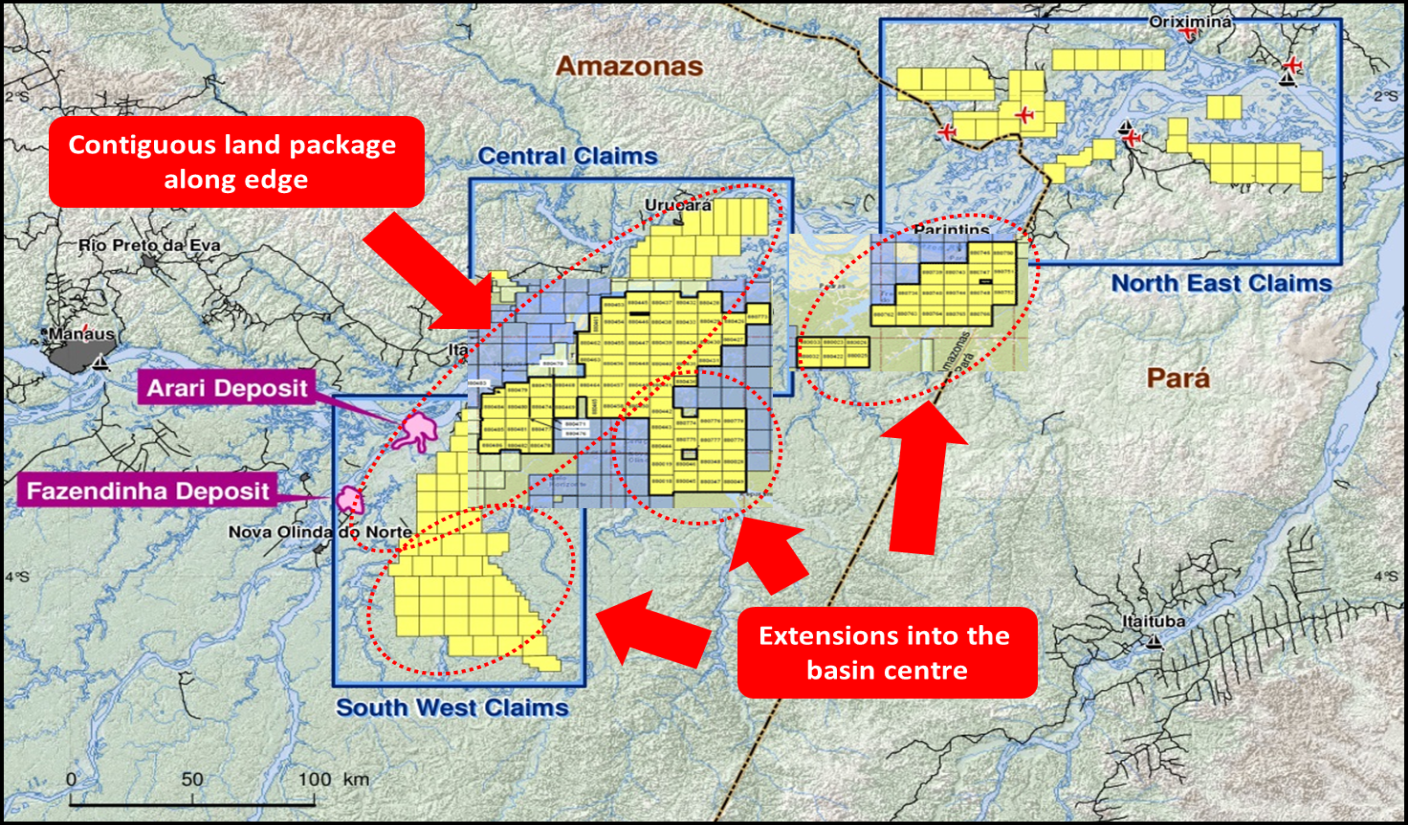
-Combined entity to become the largest publicly listed land rights holder in the Amazon Potash Basin (see map below).

-Brazil is the 3 rd largest potash consumer globally – consuming 8.1Mt in 2012 and expected to grow to 13-14Mt by 2020 – but is dependent on imports by over 90% of annual demand, whereas domestic supply could offer a transportation cost advantage.
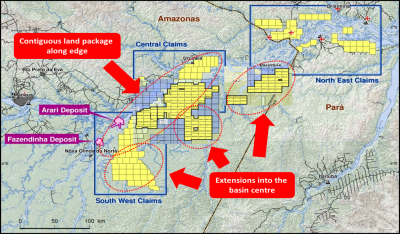

Click Image To View Full Size

Cowley is a widely-held, unquoted junior exploration company headquartered in the Isle of Man with corporate offices in Brasilia, Brazil, and London, UK. No shareholder holds a controlling interest in Cowley.

Cowley is focused on the exploration and development of three potash exploration claim blocks in the states of Amazon and Para, Northern Brazil, East of Manaus. Cowley holds approximately 929,000 hectares extending over the Amazonas Potash Basin including areas adjacent to proven Petrobras and Brazil Potash deposits. According to Cowley’s unaudited financial information for the financial year ended December 12, 2012, Cowley had a cash position of approximately US$675,000, with a net asset value of approximately US$1.18 million. Its major liabilities consisted of a loan facility and convertible notes in the aggregate amount of approximately US$1.4 million.

Cowley’s license areas are subject to historic work consisting of 31 wells and 2,095km of 2D seismic, focused on Oil & Gas exploration, which resulted in a strong potential for the development of potash deposit as the ones already identified within the basin. *cautionary note* there is no certainty further exploration will lead to the development of deposits similar to the Petrobras and Brazil Potash deposits.

Advantages of Merger

The combined entity (“the Merge-Co”) following the completion of the merger transaction will have the following main value drivers:

-The Merge-Co will have the 2 nd largest land holdings in the basin (1,725,041 hectares) similar to the land packages separately held by Petrobras and Brazil Potash.

-The Merge-Co’s management and advisory team will have over 300 years of combined mineral exploration and mining experience, primarily with expertise in potash primarily located in the Amazon Basin.

-The financial assets of the companies will be combined. In addition, the resulting company will have better access to sources of funding in the capital markets particularly in Europe, Asia, North America and Brazil.

-The merger will reduce competition in the basin and leave two major active players–Brazil Potash and Pacific Potash.

-Merge-Co will benefit from economies of scale ensuring that administration, operations and other costs will be streamlined.

-Joint management is anticipating commencing drilling in September as previously planned by Pacific Potash’s exploration team.

-As a result of combined resources, the merger will greatly enhance our ability to complete the major six well drill program presently budgeted to cost $10 million.

Mr. Balbir Johal, Executive Co-Chairman and Director of Pacific Potash said “The Merger will make the new company stronger and better. That is the greater value for all stakeholders. Together with Cowley, we will have a stronger exploration team in Brazil, connections to greater sources of finance capital in Asia, Europe, North America and Brazil and a common vision to build an extraordinary company.”

Mr. Oliver Polcher of Cowley Mining Plc stated “Cowley considers the planned combination with Pacific Potash to be consistent with our mission to build a first-class potash project in Brazil. We believe that by combining our expertise, adding to each other’s global reach and consolidating our land packages in the Amazonas Potash Basin we may create a stronger value proposition for investors and ultimately deliver returns for all stakeholders involved.”

Transaction Summary

The Transaction is expected to be effected by way of a plan of arrangement, share offer exchange or other arrangement, whereby the shareholders of Cowley (the “Cowley Shareholders”) will exchange their shares for common shares in Pacific Potash on the basis that will result in the Cowley Shareholders owning 37.5% of the issued and outstanding common shares of Pacific Potash upon completion of the Transaction. As such, the effective rate of exchange is expected to be approximately 0.2267 Pacific Potash share for each Cowley share. Each party will be responsible for their own cost with respect to this Transaction.

Pacific Potash currently has an issued and outstanding share capital of 109,400,396 common shares. As a result, following the completion of the Transaction, the Company would have 175,040,634 common shares issued and outstanding.

The parties to the Transaction are at arm’s length. Following the completion of the Transaction, which cannot close until the required shareholder and Exchange approvals are obtained, it is anticipated that Pacific Potash will continue to be a Tier 2 mining issuer on the Exchange.

Given the intended concurrent Fundraising, as noted below, the Transaction will constitute a Reverse Takeover under the policies of the Exchange.

For the purposes of Rule 2.5(a) of the City Code on Takeovers and Mergers (“the Code”), in relation to the Transaction Pacific Potash reserves the right to vary the form and/or mix of the consideration and, with the recommendation or agreement of the Cowley board, the share exchange ratio.

In accordance with Rule 2.6(a) of the Code, Pacific Potash must, by not later than 5.00pm on September 24, 2013 either announce a firm intention to make an offer for Cowley in accordance with Rule 2.7 of the Code or announce that there is no intention to make an offer for Cowley, in which case the announcement will be treated as a statement to which Rule 2.8 of the Code applies. This deadline will only be extended with the consent of the Panel in accordance with Rule 2.6(c) of the Code.

Pre-Conditions to the Transaction

A firm intention to make an offer under Rule 2.7 of the Code is conditional on the satisfaction or waiver of mutual due diligence and execution of a definitive merger implementation agreement. This announcement is not an announcement of a firm intention to make an offer under rule 2.7 of the Code and there can be no certainty that an offer will be made even if these pre-conditions are satisfied or waived.

Fundraising for Merge-Co

Pacific Potash and Cowley also intend to carry out a fundraising by way of private placement for Merge-Co, to close upon completion of the Transaction (the “Fundraising”). The Fundraising would only be subject to regulatory approval. This would aim to raise up to $12,000,000 in gross proceeds by the issuance of 120 million units at $0.10 per unit. Each unit would consist of one common share of Merge-Co and one half of one Merge-Co common share purchase warrant. Each full Merge-Co common share purchase warrant would entitle the holder to purchase a further Merge-Co common share at a price of $0.17 for a term of 12 months from closing of the Fundraising. The proceeds of the Fundraising would be used to fund the exploration and development of potash exploration property in the states of Amazon and Para, Northern Brazil, East of Manaus and for general working capital following the completion of the Transaction. Subject to regulatory approval, it is anticipated that certain finders’ fees will be paid in relation to the Fundraising. All the securities to be issued in the financing will be subject to a four month hold period. Assuming the Fundraising is fully subscribed, Merge-Co would have 295,040,634 common shares issued and outstanding.

If no Cowley Shareholders participate in the Fundraising, the aggregate percentage holding of issued and outstanding common shares of Merge-Co held by Cowley Shareholders upon completion of the Transaction would reduce from 37.5% to 22.2% (or 18.5% if all the common share purchase warrants above were exercised). The effective rate of exchange on completion of the Transaction would remain as approximately 0.2267 Pacific Potash share for each Cowley share, although Cowley Shareholders would be diluted by approximately 40.7% (or approximately 50.7% if all the common share purchase warrants were exercised).

Pacific Potash will be applying for an exemption from the sponsorship requirement pursuant to the policies of the Exchange.

For the purposes of Rule 2.5(a) of the Code, Pacific Potash reserves the right to vary the terms of the Fundraising with the recommendation or agreement of the Cowley board .

This announcement is being made with the agreement of Cowley.

Proposed Changes to Management and Directors

It is anticipated that the board of directors of Pacific Potash following the completion of the Transaction will be comprised of five individuals, four of which shall be nominated by Pacific Potash and one of which shall be nominated by Cowley Mining Plc.

The President & CEO of Cowley, Oliver Polcher will become CEO and a Director of the combined company. Andre Costa will move from his current CEO role to Chief Operating Officer and Chief Geologist. Tao Liu and Balbir Johal will remain as Executive Co-Chairmen and Directors.

Oliver Polcher has 18 years of business building and investment banking experience with a successful track record in corporate leadership positions, deal making and fund raising, of which he has spent the last 6 years in the Natural Resources Industry.

Since early 2011 he has been the President & CEO of privately-held Cowley Mining Plc. Before he was the CEO and Director of privately-held metals trading company Metalcorp Group with revenues of over US$300m in metals trading, secondary aluminium smelting and exploration projects in South Africa (manganese), Namibia (manganese) and Guinea (bauxite).

Previously, Oliver spent 7 years in investment banking with Deutsche Bank, JP Morgan and Schroders as well as co-founding Inquam Ltd., a privately-held technology investment fund with approx. US$500 million in equity.

About Cowley Mining Plc

Cowley is a privately-owned junior exploration company registered on the Isle of Man with corporate offices in Brasilia, Brazil, and London, UK. The Company is focused on the exploration and development of three potash exploration claim blocks in the states of Amazon and Para, Northern Brazil, East of Manaus. Cowley holds approx. 929,000 hectares extending over the Amazonas Potash Basin including areas adjacent to proven Petrobras deposits, Fazendinha and Arari.

About Pacific Potash Corporation

Pacific Potash Corporation trades on the TSX Venture Exchange under the symbol: PP, as well on the OTCQX under the symbol: PPOTF and on the Frankfurt Stock Exchange under P9P. Pacific Potash is engaged in the exploration and development of the Amazonas Basin Project and the surrounding potash claims targeting the Middle Amazonas Potash Basin, currently the host to multiple new exploration campaigns for potash. The Company also is exploring the Provost Potash Property and the surrounding potash claims targeting the prolific Prairie Evaporite Formation, which is host to multiple conventional and solution potash mines.

Investors are cautioned that, except as disclosed in the disclosure document to be prepared in connection with the Transaction, any information released or received with respect to the reverse takeover may not be accurate or complete and should not be relied upon. Trading in the securities of Pacific should be considered highly speculative. Trading in the common shares of Pacific will remain halted pending further filings with the Exchange. Additional information will be provided in subsequent news releases and prior to any resumption in trading.

The Exchange has in no way passed upon the merits of the proposed transaction and has neither approved nor disapproved the contents of this press release.

We seek safe harbour.

On behalf of the Board,

Pacific Potash Corporation

Balbir Johal, LL.B

Executive Co-Chairman & Director

For further information, please visit our website at www.pacificpotash.com or contact our V.P of Corporate Communications, Mike Blady:

Mike Blady

Office: 604.895.7446

Email: [email protected]

Andre Costa, P.Geo, CEO & President of Pacific Potash Corp and qualified person for the purposes of NI 43-101, has reviewed and approved the preparation of the technical information in this news release.

Neither the TSX Venture Exchange nor its Regulation Services Provider (as that term is defined in the policies of the TSX Venture Exchange) accepts responsibility for the adequacy or accuracy of this release.

Caution concerning forward-looking information
This press release contains “forward-looking information” and “forward-looking statements” within the meaning of applicable securities laws. This information and statements address future activities, events, plans, developments and projections. All statements, other than statements of historical fact, constitute forward-looking statements or forward-looking information. Such forward-looking information and statements are frequently identified by words such as “may,” “will,” “should,” “anticipate,” “plan,” “expect,” “believe,” “estimate,” “intend” and similar terminology, and reflect assumptions, estimates, opinions and analysis made by management of Pacific Potash in light of its experience, current conditions, expectations of future developments and other factors which it believes to be reasonable and relevant. Forward-looking information and statements involve known and unknown risks and uncertainties that may cause Pacific Potash’s actual results, performance and achievements to differ materially from those expressed or implied by the forward-looking information and statements and accordingly, undue reliance should not be placed thereon.
Risks and uncertainties that may cause actual results to vary include but are not limited to the availability of financing; fluctuations in commodity prices; changes to and compliance with applicable laws and regulations, including environmental laws and obtaining requisite permits; political, economic and other risks; as well as other risks and uncertainties which are more fully described in our annual and quarterly Management’s Discussion and Analysis and in other filings made by us with Canadian securities regulatory authorities and available at www.sedar.com . Pacific Potash disclaims any obligation to update or revise any forward-looking information or statements except as may be required.

In accordance with Rule 2.10 of the Code, Pacific Potash confirms that, as at the close of business on 20 August 2013, it had 109,400,396 ordinary shares in issue. The International Securities Identification Number for the ordinary shares is CA 694781105 6.

Under Rule 8.3(a) of the Code, any person who is interested in 1% or more of any class of relevant securities of an offeree company or of any paper offeror (being any offeror other than an offeror in respect of which it has been announced that its offer is, or is likely to be, solely in cash) must make an Opening Position Disclosure following the commencement of the offer period and, if later, following the announcement in which any paper offeror is first identified. An Opening Position Disclosure must contain details of the person’s interests and short positions in, and rights to subscribe for, any relevant securities of each of (i) the offeree company and (ii) any paper offeror(s). An Opening Position Disclosure by a person to whom Rule 8.3(a) applies must be made by no later than 3.30 pm (London time) on the 10th business day following the commencement of the offer period and, if appropriate, by no later than 3.30 pm (London time) on the 10th business day following the announcement in which any paper offeror is first identified. Relevant persons who deal in the relevant securities of the offeree company or of a paper offeror prior to the deadline for making an Opening Position Disclosure must instead make a Dealing Disclosure.

Under Rule 8.3(b) of the Code, any person who is, or becomes, interested in 1% or more of any class of relevant securities of the offeree company or of any paper offeror must make a Dealing Disclosure if the person deals in any relevant securities of the offeree company or of any paper offeror. A Dealing Disclosure must contain details of the dealing concerned and of the person’s interests and short positions in, and rights to subscribe for, any relevant securities of each of (i) the offeree company and (ii) any paper offeror, save to the extent that these details have previously been disclosed under Rule 8. A Dealing Disclosure by a person to whom Rule 8.3(b) applies must be made by no later than 3.30 pm (London time) on the business day following the date of the relevant dealing.

If two or more persons act together pursuant to an agreement or understanding, whether formal or informal, to acquire or control an interest in relevant securities of an offeree company or a paper offeror, they will be deemed to be a single person for the purpose of Rule 8.3.

Opening Position Disclosures must also be made by the offeree company and by any offeror and Dealing Disclosures must also be made by the offeree company, by any offeror and by any persons acting in concert with any of them (see Rules 8.1, 8.2 and 8.4).

Details of the offeree and offeror companies in respect of whose relevant securities Opening Position Disclosures and Dealing Disclosures must be made can be found in the Disclosure Table on the Takeover Panel’s website at www.thetakeoverpanel.org.uk, including details of the number of relevant securities in issue, when the offer period commenced and when any offeror was first identified. You should contact the Panel’s Market Surveillance Unit on +44 (0)20 7638 0129 if you are in any doubt as to whether you are required to make an Opening Position Disclosure or a Dealing Disclosure.

A copy of this announcement will be available on Pacific Potash’s website at www.pacificpotash.com. The content of the website referred to in this announcement is not incorporated into and does not form part of this announcement.

AGORACOM Founder, George Tsiolis and Chief Market Commentator Allan Barry Labouchan Go Beyond The Press Release With Rick Mark, Chairman and CEO Of North American Nickel

Posted by AGORACOM-JC at 5:25 PM on Friday, August 23rd, 2013

AGORACOM Founder, George Tsiolis and Chief Market Commentator Allan Barry Labouchan Go Beyond The Press Release With Rick Mark, Chairman and CEO Of North American Nickel (NAN:TSXV) To Discuss:

  • Today’s Press Release That Generated 4.12 million shares traded and 45.95% Appreciation In NAN
  • What Does “Significant Near Solid To Solid Sulphide Mineralization” Really Mean?
  • Historical Significance Of The Deepest And Most Significant Sulphide Mineralization To Date
  • The Theory Behind The Zone Being Open At Depth
  • The Importance Of Having A Billion Dollar Resource Fund As A 30% Owner
  • What Is Next For North American Nickel

Watch This In Depth Video Shot Only Minutes After The Close Of Today’s Trading Via Satellite

Focus Graphite Reports Lac Knife Pilot Flotation Plant Tests Yield Large Flake Graphite Concentrate (+ 80 mesh) Grading 98.3% Carbon

Posted by AGORACOM-JC at 9:11 AM on Wednesday, August 21st, 2013

OTTAWA, ONTARIO–(Aug. 21, 2013) – Focus Graphite Inc. (TSX VENTURE:FMS)(OTCQX:FCSMF)(FRANKFURT:FKC) (“Focus” or the “Company”) is very pleased to report pilot plant test results from its flagship Lac Knife high grade flake graphite project located in the Grenville Geological Province of northeastern Québec. This work was performed as part of the ongoing Lac Knife concentrator flowsheet design process. The graphite concentrates generated from the pilot flotation plant will be subjected to further purification tests as part of ongoing metallurgical studies.

Highlights:

  • The average grade of the coarse size fraction (+ 80 mesh) was 98.3% Total Carbon* (“Ct”) compared with 97.4% Ct in the Phase 2 Locked Cycle Tests** (“LCTs”)
  • The average grade of the medium size fraction, less than 80 mesh and greater than 150 mesh in size, was 98.2% Ct compared with 97.4% Ct in the Phase 2 LCTs
  • The average grade of the size fraction greater than 200 mesh was 98.0% Ct compared with 97.2% Ct in the Phase 2 LCTs
  • The average carbon content of the pilot plant campaign was 96.6% Ct compared to 96.4% Ct reported in the Company’s July 9, 2013 press release on the final results of the Phase II LCTs. It is important to note that these results were achieved despite the fact that the less than 200 mesh fraction was not subjected to another cleaning circuit in the pilot plant run as was done in the LCTs, meaning the carbon content of the overall sample would likely have been even higher.
  • These results indicate that all three concentrate size fractions may be easier and more cost effective to beneficiate into technology grade graphite due to the high grade carbon content obtained from the pilot plant testing. Higher concentrate grades translates into reduced levels of impurities that have to be removed in the thermal or hydrometallurgical purification processes.
*All carbon analyses were performed by SGS Canada Inc. (“SGS”) and are reported as total carbon (“Ct”). The analytical methods that were used to determine the metallurgical results included total carbon analysis by Leco on the final concentrates. The lower grade tailings products were analyzed by the graphitic carbon (“Cgr”) method to discount the organic carbon and carbonate carbon in the samples.

The fact that the medium and large graphite flakes could be upgraded to purity levels ranging between 98% Ct and 98.3% Ct by flotation suggests that the impurities are attached to the surface of the graphite flakes in the flotation concentrate and have the potential to be upgraded even further, to purity levels required by battery grade graphite manufacturers. The objective of the pilot plant testing was to produce the highest quality large flake graphite concentrate.

The pilot plant metallurgical testing was completed by SGS on a 23.3 tonne composite of drill core samples collected from the massive, semi-massive and low grade mineralization zones of the Lac Knife graphite deposit. The average total carbon (Ct*) head grade of the bulk sample was lower than the deposit average grade at 11.8% Ct in order to be able to increase the amount of mineralized material available for pilot plant testing at that time. Even with the lower head grade the metallurgical results were excellent confirming the robustness of the concentrator flowsheet design.

Overall, the graphite concentrate recovery decreased slightly from 92.5% in the Phase 2 LCTs to 91.0% in the pilot plant tests, while the amount of large flake graphite concentrate greater than 80 mesh recovered in the pilot plant test was 33.5% by weight compared with 42.5% in the LCTs. The decrease in large graphite flake recovery is attributable to the decision to employ aggressive polishing techniques that successfully improved the quality and increased the carbon content of the large flake graphite concentrate during the pilot plant tests. The assumption that the aggressive polishing conditions led to a breakage and/or folding of the graphite flakes is supported by the fact that the medium sized flake concentrate recovery with a size range of less than 80 mesh and greater than 150 mesh, increased to 29.8% from 21.2% in the LCTs.

** A locked cycle test (LCT) is a repetitive batch flotation test conducted to assess flow sheet design. It is the preferred method for arriving at a metallurgical projection from laboratory testing. In a LCT the intermediate products are incorporated in the following cycles, thus simulating a continuous flotation circuit on a laboratory scale.

Focus President and CEO Gary Economo said: “The pilot plant test results confirm once more the overall quality of our flake graphite resource at Lac Knife; a level of excellence that helps to further de-risk the project. More importantly, the results indicate that all of Lac Knife’s future production holds the potential for purification to premium-priced technology-grade graphite.

“Lac Knife,” he added, “provides the foundation for our mine-to-market to value-added technology business strategy. We anticipate no impediments to the successful execution of our mining and related corporate objectives.”

Dr. Joseph Doninger, Director of Manufacturing and Technology for Focus Graphite, stated: “The +98% Ct purity level and high recoveries achieved on the greater than 200 mesh flake size of graphite during the pilot plant tests confirm the robustness of the Lac Knife concentrator flowsheet design developed by SGS Inc. in the Phase I & II LCTs conducted in 2012 and 2013.”

About SGS Metallurgical Services (Lakefield)

SGS Canada Inc. (“SGS”) is recognized as a world leader in the development of concentrator flowsheet design and pilot plant testing programs. SGS’ Metallurgical Services division was founded over half a century ago. Its metallurgists, hydro-metallurgists and chemical engineers are experienced in all the major physical and chemical separation processes utilized in the recovery of metals and minerals contained in resource properties around the world.

The information pertaining to the metallurgical test program completed by SGS that is presented in this news release has been reviewed and approved by Mr. Oliver Peters, M.Sc., P.Eng, MBA, SGS Canada Inc. Consulting Metallurgist. Mr. Peters has extensive experience in the development of metallurgical processes and has managed the majority of the graphite testing programs conducted at SGS in recent years.

This news release has been reviewed by Mr. Jeff Hussey, P.Geo (Québec), VP-Project Development for Focus Graphite and a Qualified Person under NI 43-101 guidelines.

About Focus Graphite

Focus Graphite Inc. is an emerging mid-tier junior mining development company, a technology solutions supplier and a business innovator. Focus is the owner of the Lac Knife graphite deposit located in the Côte-Nord region of northeastern Québec. The Lac Knife project hosts a NI 43-101 compliant Indicated Mineral Resource Estimate of 4.9 million tonnes grading 15.8% graphitic carbon (Cgr) as crystalline graphite with an additional Inferred Mineral Resource Estimate of 3.0 Mt grading 15.6% Cgr of crystalline graphite. Focus’ goal is to assume an industry leadership position by becoming a low-cost producer of technology-grade graphite. On October 29th, 2012 the Company released the results of a Preliminary Economic Assessment (“PEA”) of the Lac Knife Project which demonstrated that the project has an excellent potential to become a graphite producer. As a technology-oriented enterprise with a view to building long-term, sustainable shareholder value, Focus also invests in the development of graphene applications and patents through Grafoid Inc.

Forward Looking Statements – Disclaimer

This news release may contain forward looking statements, being statements which are not historical facts, and discussions of future plans and objectives. There can be no assurance that such statements will prove accurate. Such statements are necessarily based upon a number of estimates and assumptions that are subject to numerous risks and uncertainties that could cause actual results and future events to differ materially from those anticipated or projected. Important factors that could cause actual results to differ materially from the Company’s expectations are in our documents filed from time to time with the TSX Venture Exchange and provincial securities regulators, most of which are available at www.sedar.com Focus Graphite disclaims any intention or obligation to revise or update such statements.

Neither TSX Venture Exchange nor its Regulation Services Provider (as that term is defined in the policies of the TSX Venture Exchange) accepts responsibility for the adequacy or accuracy of this release.

Contact Information

Big North Graphite Completes Its First Graphite Sale

Posted by AGORACOM-JC at 11:31 AM on Thursday, August 15th, 2013

Vancouver, B.C., August 15, 2013 – BIG NORTH GRAPHITE CORP. (TSX-V: NRT) (the ” Company ” or ” Big North “), announces that it has completed its first graphite sale. The Company recently sold 200 tons of amorphous graphite, mined from the Company’s Nuevo San Pedro mine and additional feed mines located in Sonora Mexico, to a customer within Mexico. The graphite sold was a mine run, semi-processed product, consisting of a 3/4 inch minus size, yielding an average grade of 68% Cg. The mined graphite was processed at Big North’s processing facility located near the town of La Colorada, Mexico.

The Company commenced test mining at the Nuevo San Pedro project in May of this year and in July announced that it had mined, shipped and stockpiled 160 tons of graphite, leading to the sale of product this month.

Big North President Spiro Kletas stated, “Our goal has always been to become one of the first junior graphite companies to capture some of the market by making graphite sales and earning revenue for our shareholders. Today is a monumental day for Big North and our shareholders. We were able to sell the graphite in our inventory as soon as it was available for purchase. Further, we were able to sell this graphite as mine run. This initial sale demonstrates the significant demand for amorphous graphite and the fact that we are one of a few companies focusing not only on mining, but selling amorphous graphite, gives Big North a distinct advantage. As amorphous graphite is the largest segment of the natural graphite market by tonnage, our goal now is to grow our amorphous graphite mining and sales business for our shareholders.”

Amorphous Graphite

In 2012, approximately 1.1 million tonnes of natural graphite was produced worldwide. Of that, amorphous graphite represented 55% of the world’s graphite production, thus making it the largest segment of the natural graphite market. Further 89% of the world’s amorphous graphite supply comes from China. Mexico is currently the only source of North American amorphous graphite production, with none currently coming from the US and Canada. Russia used to supply amorphous graphite but the mine has since closed. (Source: Simon Moores, Industrial Minerals)

Amorphous graphite is one of the higher quality forms of carbon. Technically known in the market as micro-crystalline, the crystal structure is similar to that of flake graphite but on a smaller scale. The only higher quality forms of carbon are flake, vein and diamond.

The major use for amorphous graphite is in steel production. It is the material of choice by steelmakers around the world to use as a recarburizer. Amorphous graphite is also the only mainstream dry lubricant in the world and is therefore used in many industrial processes from railroads to a wide range of industrial manufacturing.

Amorphous graphite is also used in brake linings, gaskets and clutch materials. Foundry facing mold wash uses amorphous or fine-flake graphite in a water-based paint to coat the mold, thereby allowing ease of separation of the casted object from the mold after the metal has cooled.

Big North, through its Mexican subsidiary Grafito la Barranca SA de CV, holds a 100% interest in the Aki Wiki concession and has a 50/50 joint venture on the Nuevo San Pedro Project. Both concessions are located in the San Jose de Moradillas region, a region that has produced graphite for more than 100 years. San Jose de Moradillas is located approximately 45 kilometers southeast of the city of Hermosillo, Mexico.

About Big North Graphite Corp.

Big North is a graphite development and exploration company focused on select projects in Mexico and Canada. The Company recently acquired 3 past producing amorphous graphite mines in Sonora, Mexico and is working towards accelerating the restart of the Nuevo San Pedro amorphous graphite mine. Big North is currently in the Test Mining phase at Nuevo San Pedro.

Recently, Big North announced that the Company had started the assembly of a processing plant that will be used for crushing, screening, sizing and drying of graphite to the specifications of future customers. Further, the Company has commenced a strategy of buying unprocessed amorphous graphite from local miners who do not possess the ability to process or ship to end users. Big North also owns high priority, large flake graphite exploration projects in Ontario and Quebec, Canada.

For further information please contact Spiro Kletas at (604) 629-8220.

ON BEHALF OF THE BOARD

(signed) ” Spiro Kletas ”
Spiro Kletas
President and Chief Executive Officer

Neither the TSX Venture Exchange nor its Regulation Services Provider (as that term is defined in the policies of the TSX Venture Exchange) accepts responsibility for the adequacy or accuracy of this release.

The Company has not established mineral resources and has not completed a valid mining study (as defined by NI 43-101) to support its production decision at the Nuevo San Pedro Mine. Historically, a production decision under these circumstances results in much higher economic or technical risk. Furthermore, without a pre-feasibility or feasibility study and a graphite reserve, there can be no assurance that operations at Nuevo San Pedro will be profitable.

Except for historical information contained herein, this news release contains forward-looking statements that involve risks and uncertainties. Actual results may differ materially. Except as required pursuant to applicable securities laws, the Company will not update these forward-looking statements to reflect events or circumstances after the date hereof. More detailed information about potential factors that could affect financial results is included in the documents filed from time to time with the Canadian securities regulatory authorities by the Company.

BREAKING…Pacific Potash Corporation Halted, Pending News

Posted by AGORACOM-JC at 10:08 AM on Thursday, August 15th, 2013

Pacific Potash Corporation Halted, Pending News

Amazonas Potash Basin

  • The Brazilian Government plans to reduce Brazil’s reliance on potash imports from 91% to 60% over the next 5 years
  • Soils in Brazil are deficient in potassium and require potash to remain productive
  • The Amazonas potash basin is similar in geology and dimension to the Saskatchewan potash basin in Canada
  • Recently signed non-binding Memorandum of Understanding with CapitalAsia Investment Holdings Group sets out the initial terms and conditions for entering into a formal off-take agreement at such time as Pacific Potash’s Amazonas Potash Property goes into commercial production.

Corporate website / Hub On AGORACOM

Q&A: Eric Sprott on gold and why it’s heading to $2,400 in a year

Posted by AGORACOM-JC at 8:38 AM on Thursday, August 15th, 2013

Last week at Inside the Market, we invited you to submit questions for Eric Sprott. We received over 100 questions.

We posed a selection of these to Mr. Sprott this week and present the questions and answers below. As you’ll read, the CEO of Sprott Asset Management is only becoming more entrenched in his bullish views, calling for a $2,400 (U.S.) gold price within a year. And he sees nothing short of “explosive” gains in junior mining stocks. Thanks to all for participating.

Are we near the bottom of the decline in gold and what timeframe do you see for its appreciation to reach the old highs and possibly push through to new highs? Craig

Craig, I firmly believe that we reached the bottom on June 28th and that gold should double from that bottom within the next 12 months. So by next summer, I think that the price of gold will have made new highs and stand around $2,400 per ounce.

What is your view on the junior mining and exploration space? What has to occur in the mining sector to see a turn-around in the junior space? Anonymous

Given my outlook on gold prices, this sector will be explosive. The continuation of the gold bull market will lead the junior gold mining stocks higher by many hundreds of per cents, just like it did during the 2008 recovery. By the way, since hitting the bottom on June 28, gold has rebounded by 12 per cent while gold miners have gone up by about 25 per cent.

Hello Mr. Sprott, I think your analysis of what is happening with fiat currency is bang on. I am wondering how do you think the U.S. Government can ever get out of this catch-22 they are in with their debt? If they let the interest rate rise by stopping QE (quantitative easing) then they will pay more interest on their debt. If the pay more interest on their debt, they will have a bigger deficit. Will they print money until the reset button is pressed? When? What will that mean for the average Joe? Kyle Brown

Mr. Brown, you are exactly right, and this is why I think that the Fed will remain accommodative for a very long period of time. However, the official debt is only the tip of the iceberg and, as we discussed in the most recent Markets at a Glance, longer-term benefits such as social security and medical care will have to be cut as well. The promises made by governments are too generous and cannot be kept. Not just for the average Joe but for everyone, I think we should expect less from the government and prepare to fend more for ourselves. Money printing can hide financial problems for a while, but it can’t provide tangible services to citizens.

Why do you think the bullion banks have so consistently shorted the gold market? Were one or more, in your view, acting as agents for the Fed to prevent gold from being seen as a secure store of value and a preferred alternative to the U.S. dollar? Do you have conclusive evidence to back your opinion? Derek White

Mr. White, there is strong evidence that Central Banks have surreptitiously colluded with bullion banks (see our Sprott Thoughts article on the topic here) and sold their gold in the market. This is further evidenced by recent comments at the Bank of England and the ridiculously long delays to repatriate German gold from the U.S. Furthermore, I would refer you to the Gold Anti-trust Action Committee website, which discusses those issues at length, and our Markets at a Glance article series “Do Western Central Banks Have Any Gold Left???”. (Part 3 can be seen here.)

Some prominent analysts claim that the Commitment of Traders reports from the U.S. CFTC are giving very bullish signals concerning the future direction of gold and silver prices. Do you agree– and why or why not? Andrew

Yes, I agree with this analysis and further details can be found in my recent article here. Basically, we have seen a complete reversal of the situation in the futures market: commercial dealers covering their shorts, speculators selling (going short), and most importantly, COMEX inventories declining. The most important part of the equation is the covering of shorts by commercial dealers. That means they are no longer supplying (paper) gold to the market, which was depressing the price.

The price of gold appears to be set by the enormous volume of transactions in the paper gold market, which dwarf the physical. This price mechanism seems to have survived various significant events of almost physical default this year – Dutch bank settlements, German gold recovery from the US, and India’s domestic restrictions on gold investments. What therefore could possibly change this equation and cause (and allow) the real physical supply-demand reality to start driving price as classical economics dictates it must? Simon Lester

Mr. Lester, I think that you are absolutely correct in your analysis; daily paper volumes are many times larger than annual mine production. I believe that the return to fundamentals driving gold prices will be triggered by a shortage of physical gold and ultimately, a failure to deliver. We already see signs of physical gold shortages, as evidenced by the negative Gold Forward Offered Rates (GOFO) rates, record low physical inventories and backwardation in the futures market. A full discussion can be read in the articles linked to above.

Why have your funds performed so poorly and why may you think that will change? Andrew

I have always believed that I am right and that markets are wrong, but throughout the years, I have had to endure situations like this. It happened in 1998 and 2008, but my funds have always rebounded. In due course, the markets will realize their failure. After this short pause, the gold bull market will continue and those that have been patient will be rewarded.

Whenever the Fed hints at tapering, gold takes a hit (as does the stock market in general). At some point, the Fed will have to taper as this bond purchasing cannot go on forever. Won’t gold get crushed at that point in time? Anonymous

The Fed may or may not taper; I am in the disbeliever camp. As for gold, I happen to believe that the Western central banks, which have suppressed the price of gold, won’t be able to do so for long.

How do you see the selling of paper gold and silver in the West and the aggressive purchasing of physical precious metals by the East resolving itself and what time frame would you give for some kind of resolution of this contradictory behaviour to occur? Dave

We have already seen some manifestations of this (see our article here). Recently, the China Gold Association announced that gold consumption increased 54 per cent in the first half of 2013 (to 706.36 tonnes). As mentioned in previous answers, a shortage of physical gold will ultimately correct this discrepancy.

What if you are wrong in your case for gold to go up dramatically? What if gold falls below $1,000 dollars this year and 800 next? Would you change your investment strategy? Richard Wiklo

Then I would need to admit that the timing was wrong, but we stand by our in-house analysis. We believe that the price is suppressed and, based on our work, I am not changing my investment strategy.

Gold producers are once again hedging their production. Does that mean that we are about to see a replay of a long period of depressed prices similar to what we saw when Barrick had massive hedging programs in the 1990’s? Chuck

I sure hope not, as you would imagine. Barrick paid a huge price for hedging. I can’t predict what producers will do but those that hedge will be penalized in the market. I hope that they won’t.

The Western central bankers allegedly have 18,000 tonnes of gold. [10,000 Europe, $8,000 USA], the Bank of England sold off 1,300 tonnes of gold in recent months [7 per cent of Western civilization’s gold]. What’s to stop them from using the rest of their gold to keep the price down for years to come? Jeff Spakowsky

Mr. Spakowsky, I believe that this is unlikely since I doubt that Western Central Banks have any gold left.

Good day sir. Do you believe there will be a major shake-up and consolidation among the junior gold producers who are “borderline price-point producers” and will not survive the current prolonged downturn in the gold market? Jamie Dillon

Mr. Dillon, it is an opportune time for intermediate and senior producers to be buyers of precious metals companies at those depressed valuations. With my expectations of a short-term turnaround in gold prices, there will be a high survival rate.

Source: http://www.theglobeandmail.com/globe-investor/inside-the-market/qa-eric-sprott-on-gold-and-why-its-heading-to-2400-in-1-year/article13765335/

While Potash Market in Shock, Focus on Explorers with Brazilian Advantage

Posted by AGORACOM-JC at 9:52 AM on Monday, August 12th, 2013

Aug 12, 2013 — “Pacific Potash Corp. – Ready to Drill, Set to Discover, Going Up Matchless”

Rockstone Research Ltd. comments on the recent developments in the potash market and initiated coverage on Pacific Potash Corp. (tsx.v:PP). The full analysis can be viewed as a PDF using this link:

http://www.rockstone-research.de/research/RockstoneResearch-PacificPotashCorp08092013e.pdf

Excerpt:

Over the next decade, Brazil is expected to become an agricultural super power making it one of the largest users of potash fertilizers on the planet. While potash consumption seems to have peaked in India and China as currently declining, the opposite is true in Brazil with a potash consumption showing steady long-term growth potential. It is forecasted that Brazil becomes the biggest importer of potash globally by the year 2020.

Over the last 15 years, the total value of Brazil’s crop rose from $23 billion to $126 billion and it is estimated to increase a further 40% between 2010 and 2019. Additional data by SOBER suggests substantial increases of agricultural production for commodities that consume most of the potash. Brazil owns 30% of the world’s arable farmland and it is projected that the country will have the world’s fastest growing agribusiness economy over the next 50-100 years.

Brazil has 500 million hectares of potentially arable land of which 100 million are currently under cultivation. This compares with the United States’ 350 million, Russia’s 300 million, and China’s 200 million if they used every hectare available. Brazil imports more than 90% of its potash requirements with imports mainly from Saskatchewan and the Ural region incurring total delivered transport and import costs into Brazil of around $90 per ton. The Brazilian government is not sitting around waiting for this, as it has made it a goal to financially back domestic projects in order for the country to become fertilizer independent. The Brazilian government has decided to use all powers to become potash-independet in the next decades. This will put the exploration and development of Brazilian potash desposit on the fast-track.

Pacific Potash is an early entrant into a brand new world-class potash basin that has the potential to rival or surpass some of the great producing basins worldwide. What makes this even more exciting is the fact that being located in the middle of the new breadbasket of the world gives the company a unique Brazilian advantage:

Low-cost production, world’s fastest growing agro economy, almost zero domestic production and potentially billions in logistical cost advantage. http://www.rockstone-research.de/research/RockstoneResearch-PacificPotashCorp08092013e.pdf

Please read the disclaimer within the report.

Rockstone Research Ltd.

Analyst: Stephan Bogner (Dipl. Kfm., FH)

http://www.rockstone-research.com/

http://www.accesswire.com/img.ashx?id=406756

AGORACOM CEO Interview Leadership Series – Gary Monaghan, UC Resources

Posted by AGORACOM-JC at 12:01 PM on Wednesday, August 7th, 2013

George and Allan go via Satellite with silver producer UC Resources and its CEO, Gary Monaghan, to discuss:

  • Bucking The Trend … Leadership Principals of UC Resources
  • Why “Standing Still” Is A Death Sentence For TSX Venture Companies
  • How Problem Solving Is Always A Necessary Function Of Progress
  • The Current State Of UC Resources Production
  • When UC Resources Expects To Hit 200t/day In Production
  • The State Of Silver

BREAKING…Virtutone Networks Generates Record Breaking Revenue of $3.7M for July 2013

Posted by AGORACOM-JC at 11:02 AM on Thursday, August 1st, 2013


Virtutone Networks Generates Record Breaking Revenue of $3.7M for July 2013


Watch Our Recent Interview

Company Highlights

  • $2.8 million in revenue last year
  • $3.7 million in revenue for July 2013
  • $2.2 million in revenue for June 2013
  • Ranked #1 fastest growing ICT company in Canada 2012
  • “Next 50 ICT Companies” in Canada Branham 2013

Corporate Website / Hub On AGORACOM