Agoracom Blog Home

Posts Tagged ‘stocks’

North Bud Farms Inc. $NBUD.ca – From cannabis edibles to plant proteins: 2019 food trends $ACB $WEED.ca $HIP.ca

Posted by AGORACOM-JC at 2:39 PM on Wednesday, February 13th, 2019

SPONSOR: North Bud Farms Inc. (NBUD:CSE) Sustainable low cost, high quality cannabinoid production and procurement focusing on both bio-pharmaceutical development and Cannabinoid Infused Products. Click Here For More Information

NBUD: CSE

—————

From cannabis edibles to plant proteins: 2019 food trends

  • Cannabis will soon be a major driver in the food and beverage category.
  • This year should see edible products incorporated into Bill C-45 (the Cannabis Act), opening up opportunities for health foods and supplements, snack foods, packaged meals, restaurants and tourism.

(MENAFN – The Conversation) Food continues to find its way into the consciousness of Canadians.

It’s in our news feed, on our television screens and, more and more, part of our day-to-day conversations. The challenge is to separate the fact from the fiction, the ephemeral from the soon-to-be everyday. The University of Guelph’s newest Food Focus Trends Report highlights six key trends likely to be front and centre this year.

Flexitarians on the rise

While vegans and vegetarians get all the attention, the flexitarians are rapidly growing in number — and in clout. A flexitarian is someone who is eating less meat rather than giving it up entirely.

Almost 85 per cent of Canadians claim to eat at least one vegetarian meal per month, with nearly 50 per cent saying they do so at least once a week. Despite only seven to eight per cent of Canadians identifying as vegetarian or vegan, the conscious consumption of flexitarians will likely have a profound impact on the quantity and types of meat we eat as well as spurring the growth of protein alternatives.

By choosing to eat less meat, consumers are likely to indulge in more premium cuts while sacrificing staples like ground beef.

Plant-based proteins are also sure to grow in popularity, as are those from previously taboo sources, such as insects. Canada’s new Food Guide also recommends an increased focus on plant-based foods.

Read more: In defence of Canada’s Food Guide

Should Canada’s meat industry be concerned? Possibly, but increased international demand should keep overall prices in our country steady for the foreseeable future and population growth here will also continue to increase the total demand for meat.

Easing fears about gene-editing

If comic books and horror movies have taught the average Canadian anything, it’s that nothing good ever comes from playing with genes.

Unfortunately, fiction can sometimes be more believable than facts. When it comes to agriculture, gene editing increases yields, develops tolerances to things like drought or pests, removes allergens (to make gluten-free wheat, for example) and enhances nutritional quality.

The Canadian government approved the sale of genetically modified golden rice that’s fortified with Vitamin A. It’s an example of a GM food that directly benefits consumers. Josep Folta/Flickr

And the biggest benefit may be for the world’s poor. Basically, gene editing is doing what animal and plant breeders have been doing for hundreds and hundreds of years, only in a way that’s much faster, much cheaper and much more specific.

The only challenge? Reducing unfounded fears and communicating the incredible potential of genetically modified crops and foods in a way that Canadians can fully embrace.

Protecting our pollinators

In recent years, the humble bee has gone from picnic pest to cause célèbre. The decline of bee populations and its potential impact on food resources has Canadians rallying in support. And with good reason — a third of the world’s crops rely on pollinators .

A third of the world’s crops need pollinators like bees. But some of them also require pesticides that are harmful to bees. Jenna Lee/Unsplash

In Canada, the contribution of bees to crops like apples, blueberries and canola has been estimated at over $5 billion.

So shouldn’t we all be behind the bee? It’s not that simple.

While they are essential for some crops, other crops rely on methods of pest control that are associated with the decline of pollinators.

As we’ve seen with the neonicotinoids debate, striking a delicate balance between the needs of farmers and the protection of pollinators is an ongoing challenge and a goal that will not be easily achieved.

Read more: Why it’s time to curb widespread use of neonicotinoid pesticides

Canada is high on cannabis edibles

Cannabis will soon be a major driver in the food and beverage category. This year should see edible products incorporated into Bill C-45 (the Cannabis Act), opening up opportunities for health foods and supplements, snack foods, packaged meals, restaurants and tourism.

A recent Deloitte report found that 58 per cent of current Canadian cannabis users intend to consume edibles once they’re legalized.

Most Canadian cannabis users say they intend to consume edibles once they’re legal. Shutterstock

But these highs do have some potential lows — work will need to be done to ensure proper dosing and to prevent unintended secondary consumption by children and pets.

As well, the path to market for cannabis products in Canada goes through three different pieces of legislation: the Cannabis Act, the Controlled Drugs and Substances Act and the Food and Drugs Act.

Read more: How to keep your pets safe from marijuana poisoning

In addition, products for medical consumers must also meet the Access to Cannabis for Medical Purposes Regulations that are included in the Controlled Drugs and Substances Act. But with the total market estimated at more than $7 billion (on par with Canada’s wine industry), the future is nonetheless bright for cannabis companies.

Prospering in a time of protectionism

The whirlwind of trade deals and disputes in the past few years has left many Canadians reeling. While there has been much hand-wringing over inter-provincial barriers, NAFTA/USMCA and new agreements with Europe and the Pacific Rim, freer trade in food has actually provided Canadian farmers with markets that are hungry for our products.

Plus, Canadian consumers have benefited and now enjoy a wider range of affordable food products.

The one downside? Our regulated dairy industry, along with other supply managed commodities, has ceded nearly 10 per cent of its market through recent trade deals.

Read more: In defence of Canada’s dairy farmers

This will not only be painful for the dairy sector, but it isn’t likely to result in lower prices for Canadians — although we will probably see a broader array of cheeses and other dairy products. Overall, though, trade has been good for Canada and will continue to be for the foreseeable future.

Growing divide between food & farms

Farms may feed people, but they have very little to do with the price you pay for food.

A farmer is seen on his Nova Scotia farm in 2014 with some of his laying hens. THE CANADIAN PRESS/Andrew Vaughan

Fluctuating prices of agricultural commodities like corn, wheat or soybeans often fuel news stories but the reality is the increases in food prices Canadians have seen over the years have been relatively consistent.

Put simply, food and farm prices are not the same and the relationship between the two continues to weaken. Today, the farmers’ share of the food dollar is around 20 per cent — higher for less processed foods (nearly 50 per cent for eggs) and lower for more processed foods (two per cent for corn, which is used as a sweetener in manufactured food products).

While the effect of low commodity prices may be felt in farming regions and associated industries, it has little impact on Canadians when they’re checking off their grocery lists — and that isn’t expected to change in 2019.

Source: https://menafn.com/1098111116/From-cannabis-edibles-to-plant-proteins-2019-food-trends

BetterU Education Corp. $BTRU.ca – #AI in India’s educational sector #edtech

Posted by AGORACOM-JC at 12:52 PM on Tuesday, February 12th, 2019
SPONSOR:  Betteru Education Corp. Connecting global leading educators to the mass population of India. BetterU Education has ability to reach 100 MILLION potential learners each week. Click here for more information.
BTRU: TSX-V

————————

AI in India’s educational sector

by Samaya Dharmaraj

The Ministry Human Resource Department, in a press release, said that several national tech universities in the country have set up AI centres for education and research and development.

These universities include the Indian Institutes of Technology in Kharagpur and Madras and the Indian Institute of Information Technology Design and Manufacturing in Kancheepuram.

Also involved are the National Institute of Technology in Silchar and the National Institute of Technology in Bhopal.

Their centres will offer courses related to AI, for example, in deep learning foundations and applications, reinforcement learning, probabilistic reasoning, predictive and prescriptive data analytics, system identification, physical cybersecurity, and digital image processing.

India’s acts and statutes that govern these institutions allow them to freely collaborate with institutions and universities across the world for academic and research.

In this year’s interim budget (2019-20), the government allocated IN ₹93,848 crores (approximately US $13.15 billion) to the education sector, which is 3.3 percent of the total budget expenditure.

Although there is no clear budgetary allocation plan, a part of the finance will go toward implementing AI courses in schools. The Minister of Corporate Affairs said that the government plans for a National Programme on Artificial Intelligence, which will be catalysed by the establishment of the National Centre on Artificial Intelligence as a hub, along with other Centres of Excellence (CoE).

He said nine priority areas have been identified. Also, a national AI portal will be developed soon.

According to a document released by India’s Policy Commission (the National Institution for Transforming India– NITI Aayog) titled the National Strategy for AI, AI can potentially solve for quality and access issues observed in the education sector.

The potential use cases include augmenting and enhancing the learning experience through personalised learning, automating and expediting administrative tasks, and predicting the need for student intervention to reduce dropouts or recommend vocational training.

It said that an effective education sector can transform a country through the development of human resources and increased productivity.

Particularly in the context of emerging countries, the level of education and literacy of the population plays an important role in its development and the overall transition to an advanced economy.

In India, this is amplified because of its large youth population. Estimates indicate that currently over half the population of the country is below the age of 25. As the adoption of digital means of gathering data increases, it is important that these methods are effectively leveraged to deliver improved education and teaching, the document said.

Albeit slowly, the rate of adoption of technology in education is improving. It is estimated that schools globally spent nearly U $160 billion on education technology, or ‘EdTech’, in 2016, and forecast spending to grow 17 percent annually through 2020.

Private investment in educational technology, broadly defined as the use of computers or other technology to enhance teaching, grew 32 percent annually from 2011 through 2015, rising to US $4.5 billion globally.

The document said that the adoption of new technologies is still lacking, however, often attributed to the unwillingness of teachers and students.

A recent survey found that the lack of technology adoption in schools can be largely attributed to the absence of teacher training.

While 83 percent of the teachers surveyed use computers, it was primarily limited to audio and visual display or student practice. Only about 41 percent use technology for tracking student data and only 27 percent for participating in forums.

Another study found that trained teachers are more likely to use technology in the classroom. 88 percent of trained teachers reported making use of available computers as compared to only 53 percent of untrained teachers.

It said that AI has the potential to bring about changes in the sector by supplementing pedagogy and establishing systems to inform and support decision making across stakeholders and administrative levels. However, the implementation of AI must be preceded by efforts to digitise records of teacher performance, student performance, and curriculum.

Source: https://www.opengovasia.com/ai-in-indias-educational-sector/

CLIENT FEATURE: Tartisan Nickel $TN.ca Kenbridge Property Hosts M&I Resource of 7.14 Million Tonnes at 0.62% Nickel, 0.33% Copper

Posted by AGORACOM-JC at 11:17 AM on Tuesday, February 12th, 2019

Investment Highlights

  • Kenbridge property has a measured and indicated resource of 7.14 million tonnes at 0.62% nickel, 0.33% copper
  • 17.5 (21.8 fully diluted) percent equity stake in Eloro Resources and 2 percent NSR in their La Victoria property

Kenbridge Ni Project (ON, Canada)

  • Advanced  stage  deposit  remains open  in  three  directions,  is  equipped with a 623m  deep  shaft  and  has  never  been  mined. 
  • Preliminary  Economic Assessment completed and updated returned robust project 
    economics and operating costs including  a  NPV  of  C$253M  and  cash costs of US$3.47/lb of nickel net of  
    copper credits.
  • Plans for Kenbridge include updating PEA, advancing the project through to feasibility and exploring the open mineralization at depth

FULL DISCLOSURE: Tartisan Nickel Corp. is an advertising client of AGORA Internet Relations Corp.

HPQ-Silicon Resources $HPQ.ca – Solar shines brightest for renewables-keen investors

Posted by AGORACOM-JC at 9:33 AM on Tuesday, February 12th, 2019

SPONSOR: Exclusive global partnership puts HPQ-Silicon Resources in a position to turn Quartz project into lowest cost supplier to solar industry. Click here to learn more

HPQ: TSX-V

Solar shines brightest for renewables-keen investors

  • Institutional investors surveyed by the Octopus Group have ranked grid-scale solar power as their top deployment target, amid plans to inject US$210 billion in the broader renewable sector within five years.
  • A poll of 100 names published by the firm on Monday found 43% of those managing a portfolio of renewables were invested in solar, ahead of firms invested in onshore and offshore wind (28% each), hydropower (27%) and waste-to-energy and biomass (an aggregate 24%).

By José Rojo Martín

Institutional investors ranked uncertainty with energy prices as a top obstacle (Source: Karnakata Tata)

Institutional investors surveyed by the Octopus Group have ranked grid-scale solar power as their top deployment target, amid plans to inject US$210 billion in the broader renewable sector within five years.

A poll of 100 names published by the firm on Monday found 43% of those managing a portfolio of renewables were invested in solar, ahead of firms invested in onshore and offshore wind (28% each), hydropower (27%) and waste-to-energy and biomass (an aggregate 24%).

Of the respondents – a mix including pension funds, insurers and banks with US$6.8 trillion in combined assets under management – Australians (63%) were keenest on solar, followed by EMEA (58%), Asian (45%) and UK firms (29%).

The industry was the most sought-after also among firms currently not invested in renewables, although some appeared sceptical. Some 58% of those managing a renewables-free portfolio claimed to be considering solar plays, while 21% were not contemplating it and another 21% felt unsure.

Five years to unlock US$210 billion

Even as they singled out grid-scale solar as their top target, the polled investors promised to scale up allocations to all forms of renewables, with US$210 billion set to be deployed within five years.

Private banks appeared the most ambitious, sharing plans for renewables to represent 9.7% of their portfolios over the period. They were followed by strategic investors (8.9%) and pension funds (7.8%), while high-net-worth individuals and family offices (5.5%) and insurers (4.7%) were the most reluctant.  

The Octopus survey evidenced the renewables momentum won’t be challenge-free, though. Energy price uncertainty, liquidity challenges and skills shortages ranked as the top concerns for the polled investors, although costs and regulatory barriers were also seen as obstacles.

Europe before its subsidy-free hour

The Solar Finance and Investment conference held in London in late January identified investors as the key enablers of subsidy-free solar in Europe. Corporate PPAs and other emerging arrangements are easing – although not fully dispelling – investors’ unease around merchant risks and potentially low returns, it was argued.

The Octopus poll placed the continent as the most in-demand destination for renewables investors. Of the top 10 countries and region, only Australia (seventh) and Japan (10th) were non-European.

The survey produced a finding likely to be welcomed by subsidy-free players. Almost one-in-two institutional investors piling into clean energy worldwide was driven by stable cash flows (a driver for 48%) and attractive risk-adjusted returns (40%); only diversification and ESG considerations placed higher.

Source: https://www.pv-tech.org/news/solar-shines-brightest-for-renewables-keen-investors

ThreeD Capital Inc. $IDK.ca Acquires Securities of GoldSpot Discoveries Corp. $NSM.ca $PEEK.ca $CKR.ca $ZC.ca $PNP.ca $VQS.ca $NXJ.ca $KXS.ca $PFM.ca $HIVE.ca $BLOC.ca $CODE.ca

Posted by AGORACOM-JC at 12:34 PM on Monday, February 11th, 2019
  • Announce that it has acquired ownership and control of an aggregate of 10,883,764 common shares of GoldSpot Discoveries Corp. on February 8, 2019. 
  • The Subject Shares represented approximately 11.5% of all issued and outstanding common shares of the Company as of February 9, 2019 immediately following the transaction described above.

TORONTO, Feb. 11, 2019 — ThreeD Capital Inc. (“ThreeD” or “the Acquirer”) (CSE:IDK), a Canadian-based venture capital firm focused on investments in promising, early stage companies and ICOs with disruptive capabilities, is pleased to announce that it has acquired ownership and control of an aggregate of 10,883,764 common shares (the “Subject Shares”) of GoldSpot Discoveries Corp. (the “Company”) on February 8, 2019.  The Subject Shares represented approximately 11.5% of all issued and outstanding common shares of the Company as of February 9, 2019 immediately following the transaction described above. Neither the Acquirer nor any of its joint actors otherwise own any securities of the Company.

The Subject Shares were acquired pursuant to a business combination transaction of which the security holders of GoldSpot Discoveries Inc. completed a reverse takeover of the Company (formerly Duckworth Capital Corp.) and not through the facilities of any stock exchange.  The Subject Shares were acquired in connection with the transaction are subject to a Tier 1 Value Escrow Agreement as required by the TSX Venture Exchange (the “TSXV”).  The Subject Shares shall be released in accordance with such escrow agreement as follows: 25% release on the date of the TSXV bulletin approving the transaction; 25% released six months after the date of the bulletin; 25% released twelve months after the date of the bulletin; and 25% released eighteen months after the date of the bulletin. The common shares of the Company are expected to resume trading on the TSXV under the symbol “SPOT” at a date to be approved by the TSXV and announced by the Company.

The holdings of securities of the Company by ThreeD are managed for investment purposes, and ThreeD could increase or decrease its investments in the Company at any time, or continue to maintain its current investment position, depending on market conditions or any other relevant factor.

The trade was effected in reliance upon the exemption contained in Section 2.3 of National Instrument 45-106 on the basis that ThreeD is an “accredited investor” as defined herein.  A copy of the applicable securities report filed in connection with the matters set forth above may be obtained by contacting the Company at 69 Yonge St., Suite 1010, Toronto, ON, M5E 1K3, Attention: Denis Laviolette, President and CEO (tel: 641-992-9837).

About ThreeD Capital Inc.

ThreeD is a publicly-traded Canadian-based venture capital firm focused on opportunistic investments in companies in the Junior Resources, Artificial Intelligence and Blockchain sectors.  ThreeD seeks to invest in early stage, promising companies and ICOs where it may be the lead investor and can additionally provide investees with advisory services, mentoring and access to the Company’s ecosystem.

For further information:
Gerry Feldman, CPA, CA
Chief Financial Officer and Corporate Secretary
[email protected]
Phone: 416-941-8900 ext 106

CLIENT FEATURE: Star Navigation $SNA.CA Real-Time Flight Tracking and Monitoring Technology

Posted by AGORACOM-JC at 10:52 AM on Monday, February 11th, 2019

RECENT HIGHLIGHTS

SIGNED A COOPERATION AGREEMENT FOR THE EMERGENCY MEDICAL SERVICES MARKETS

  • Will enable them to provide real-time monitoring of patients while in transit on the ground or in the air.
  • CHUSJ is one of the top 10 mother-child hospitals in the World, with over 3500 births a year.
  • Has over 1500 nurses, over 500 Doctors and over 200 researchers on staff.

COMPLETED SALE OF FIVE STAR-A.D.S SYSTEMS TO ALMASRIA UNIVERSAL AIRLINES

  • Announced that AlMasria Universal Airlines of Egypt has decided to proceed with the installation and activation of the STAR-A.D.S.® System across all five (5) of its current aircraft fleet, which includes A-320, A-321, A330 and B737 aircraft.

BOMBARDER JOINT RESEARCH AND DEVELOPMENT PROGRAM

  • Joint research and development program with Bombardier and other industrials and universities of Canada is progressing very positively.
  • The STAR-A.D.S. ® system which is at the heart of the program, after having been validated and extensively used by the aircraft manufacturer, has now been transferred to another flight test vehicle to complete the flight testing and the data collection.

EMERGENCY MEDICAL SERVICES APPLICATIONS

  • Star’s Land System Aided Medical Monitoring system for ground ambulance applications has undergone a series of demonstrations by a care organization in North America.
  • Its airborne parent system, the In-Flight System Aided Medical Monitoring system (STAR-ISAMM™â€), has now been demonstrated to several stakeholders of the commercial and civil air ambulance market.

CHECK OUT OUR RECENT INTERVIEW

FULL DISCLOSURE: Star Navigation Systems Group Ltd. is an advertising client of AGORA Internet Relations Corp.

This #AI Company Is the Future of #Gold Exploration $IDK.ca

Posted by AGORACOM-JC at 8:53 AM on Monday, February 11th, 2019

February 8, 2019

Press Release: U.S. Global Investors Announces Quarterly Results Webcast

By Frank Holmes
CEO and Chief Investment Officer
U.S. Global Investors

Gold mining is one of the very oldest human occupations. The earliest known underground gold mine, in what is now the country of Georgia, dates back at least 5,000 years, when people were just starting to develop written language.

Over the centuries, a number of innovations have emerged that disrupted and forever changed how we explore and mine for gold and other metals. Think dynamite, or the steam engine.

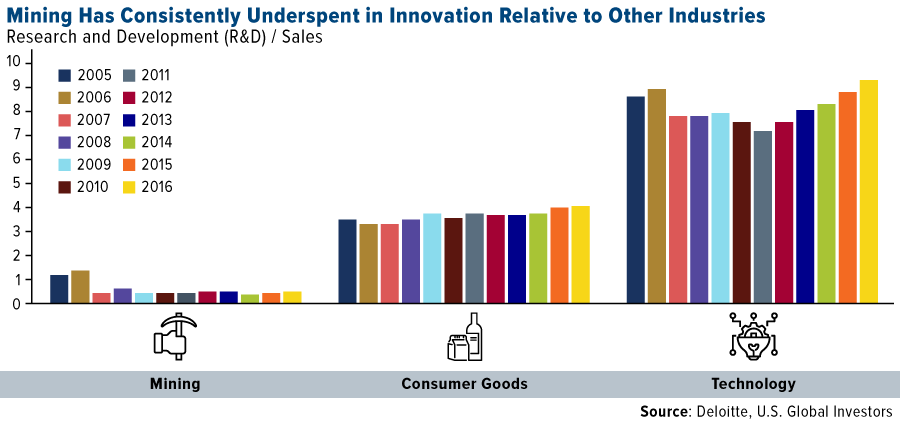
Lately, however, innovation has slowed. Mining companies are in cost-cutting mode, and many producers have favored generating short-term cash flow, often to the detriment of longer-term value. In last year’s “Tracking the Trends” report, Deloitte analysts observed that “miners from 50 years ago would find little has changed if they entered today’s mines, a situation that certainly doesn’t hold true in other industries.”


click to enlarge

Consider the earth-shattering change that’s taken place in oil and gas over the past two decades. Fracking and horizontal drilling have completely revolutionized how we extract resources from the ground, making hard-to-reach oil and natural gas accessible for the first time.

No equivalent technology exists in precious metals. Some companies are now using cutting-edge technology like blockchain to improve supply chain efficiency and transparency, but to date there’s no “gold fracking” method. As a result, metal ore grades are decreasing, and large-scale gold discoveries are becoming fewer and farther between.

One company thinks it has the formula to reverse this trend. I think it could be sitting on a gold mine, pun fully intended.

Meet Goldspot Discoveries

“Some people call it ‘peak gold,’ but I tend to think of it more as ‘peak discovery,’” says Denis Laviolette, the brains behind Goldspot Discoveries, a first-of-its-kind quant shop that aims to use artificial intelligence (AI) and machine learning to revolutionize the mineral exploration business.

A geologist by trade, Denis conceived of Goldspot while serving as a mining analyst with investment banking firm Pinetree Capital. His vision, as he described it to me, was to disrupt mineral exploration as profoundly as Amazon disrupted retail and Uber the taxi business.

“We have more data at our fingertips than ever before, yet new discoveries have been on the decline despite ever increasing exploration spending on data collection,” Denis continues. “We believe Goldpsot can change that. Harnessing a mountain’s worth of historic and current global mining data, AI can identify patterns necessary to fingerprint geophysical, geochemical, lithological and structural traits that correlate to mineralization. Advances in AI, cloud computing, open source algorithms, machine learning and other technologies have made it possible for us to aggregate all this data and accurately target where the best spots to explore are.”

Hence the name Goldspot—though I should point out that Denis considers the Montreal-based company “commodity agnostic,” meaning it collects and aggregates data for all metals, including base metals, not just gold.

Moneyball for Mining

Denis has the record to back up his extraordinary claims. In 2016, Goldspot took second place in the Integra Gold Rush Challenge, a competition with as many as 4,600 worldwide applicants. After consolidating more than 30 years of historical mining and exploration data into a 3D geological model, the company was able to identify several target zones with the highest potential for gold mineralization in Nevada’s Jerritt Canyon district, among several others.

Goldspot’s targeting approach was a complete success. New zones were discovered by AI, validating the company’s models of finding patterns in the data that humans alone couldn’t have seen.

The exercise stands as an example of what can be unlocked when machine learning is applied to geoscience.

“When I first entered the field, geologists were still using pen and paper, and I’m not even that old,” Denis says. “We were paying for all this data, but no one was really doing anything with it.”

Denis’ quant approach to discovery reminds me a lot of Billy Beane, the former general manager of the Oakland A’s and subject of the 2003 bestseller and 2011 film Moneyball. Beane was among the first in sports to pick players, many of them overlooked and undervalued, based on quantitative analysis. His strategy worked better than anyone anticipated.

Although the A’s had one of the lowest combined salaries in Major League Baseball—only the Washington Nationals and Tampa Bay Rays had lower salaries—the team finished the 2002 season first in the American League West.

Similarly, Goldspot seeks to help mining companies cut some of the costs and risks associated with discovering high-quality deposits—something it’s managed to do for a number of its clients and partners, including Hochschild Mining, McEwen Mining and Yamana Gold.

And speaking of teams, Denis has assembled an impressive roster of PhDs and experts in geology, physics, data science and other fields.

But Wait, There’s More…

The company, not yet three years old, does more than assist in exploration. It also invests in and acquires royalties from exploration companies, similar to the business model practiced by successful firms such as Franco-Nevada, Wheaton Precious Minerals, Royal Gold and others.>

The difference, though, is that Goldspot has developed an AI-powered screening platform to identify the very best and potentially most profitable investment opportunities.

For this, Goldspot has also received accolades. It was one of only five finalists in Goldcorp’s 2017 #DisruptMining challenge, for “revolutionizing the investment decision model by using the Goldspot Algorithm to stake acreage, acquire projects and royalties, and invest in public vehicles to create a portfolio of assets with the greatest reward to risk ratio.”

I’ll certainly have more to say about Goldspot in the coming weeks. For now, I’m excited to share with you that the company is scheduled to begin trading on the TSX Venture Exchange early next week. The future belongs to those that can mine data and harness the power of AI, and I’m convinced that what Denis and his partners have created fits that bill. Congratulations, and the best of luck to Denis Laviolette and Goldspot Discoveries!

ThreeD Capital Inc. $IDK.ca – #Ripple Adds 11 New University #Blockchain Research Initiative Partners To Fund Research And Education

Posted by AGORACOM-JC at 9:07 AM on Friday, February 8th, 2019

SPONSOR: ThreeD Capital Inc. (IDK:CSE) Led by legendary financier, Sheldon Inwentash, ThreeD is a Canadian-based venture capital firm that only invests in best of breed small-cap companies which are both defensible and mass scalable. More than just lip service, Inwentash has financed many of Canada’s biggest small-cap exits. Click Here For More Information.

Idk large
——————-

Ripple Adds 11 New University Blockchain Research Initiative Partners To Fund Research And Education

  • Ripple, one of the most mature companies in the blockchain space, is currently helping lead development for blockchain-focused academia and research
  • Blockchain based global settlements network launched its University Blockchain Research Initiative (UBRI) in June of last year to accelerate academic research, technical development and innovation in the blockchain, cryptocurrency and digital payments space

Rachel Wolfson Contributor 

Ripple, one of the most mature companies in the blockchain space, is currently helping lead development for blockchain-focused academia and research.

The blockchain based global settlements network launched its University Blockchain Research Initiative (UBRI) in June of last year to accelerate academic research, technical development and innovation in the blockchain, cryptocurrency and digital payments space. Ripple has committed over $50 million in funding, subject matter expertise and technical resources to UBRI’s first wave of university partners, which includes 17 prestigious institutions from around the world.

Announced today, Ripple has added 11 new universities to the UBRI program. The company is now supporting a total of 29 partners to accelerate academic research.

The new institutions include:

  • Carnegie Mellon University
  • Cornell University
  • Duke University
  • Georgetown University
  • University of Kansas
  • University of Michigan
  • Morgan State University
  • National University of Singapore
  • Northeastern University
  • University of Sao Paulo
  • Institute for Fintech Research, Tsinghua University

These programs, driven by the university partners, are poised to prepare the next generation of engineers, business leaders, entrepreneurs and other professionals to apply these technologies in practice. This should  increase positive awareness of the transformative impact that blockchain technology will have across all industries, while giving back to the community as part of an ongoing philanthropic effort.

We launched UBRI back in June of 2018 to provide support for 17 different universities around the world to help progress their study of blockchain technology, cryptography, digital assets and fintech. Blockchain is an incredibly transformational technology and helping advance the best minds in the world, who are already showing interest in this field, is sure to benefit the entire ecosystem. We’ve added 11 new universities this time around and now have 29 schools involved with the program. Expanding the ecosystem to a more global, diversified network of UBRI partners will only continue to enrich these projects,” said Eric van Miltenburg, SVP of Global Operations at Ripple.

Funding from Ripple’s UBRI program is intended to support a variety of efforts, across different educational sectors spanning from law, finance, engineering, business and other fields. The support aims to help universities develop curricula, expand or launch courses, host conferences and award scholarships to faculty and students pursuing work in blockchain, cryptocurrency, digital payments and related topics.

We are placing full faith in these universities, knowing that the students and faculty are the most capable individuals in the field. Therefore, it’s under their discretion to deploy the funds in ways they see fit to help advance the study of blockchain research. There are also a variety of factors that go into choosing which schools we partner with. We are working with institutions that have already shown an interest and commitment to blockchain. We want to help accelerate what is already a spark by turning that into a flame to help these schools move forward,” explained Miltenburg.

Fostering Innovation Through Academia

While Ripple’s UBRI program has only been up and running for less than a year, all of the partner institutions are already showing signs of progress, demonstrating Ripple’s goal to foster innovation in the broad blockchain space.

For example, the partnership with the University of California, Berkeley has resulted in cross-departmental collaboration, as several schools within the university expanded relevant course-offerings, funded research projects and supported student-led activities and events, including an upcoming blockchain UI/UX hackathon.

According to Laura Tyson, Faculty Director of the Institute for Business and Social Impact at the Haas School of Business at U.C. Berkeley, the university has awarded seven faculty research grants and eight research proposals from students through the UBRI program funding.

We are excited by the momentum that the Ripple UBRI Partnership has fostered at Berkeley Haas and throughout U.C. Berkeley in the development of blockchain, digital payments and cryptocurrency-related research and innovation, said Tyson.  In December, we awarded the first round of Ripple-funded faculty and student blockchain, digital payments and cryptocurrency-focused research grants. Also, we are sponsoring numerous student-led activities this semester, including partnering with Blockchain at Berkeley to host a blockchain/fintech industry Spring speaker series at Haas.”

The University of Texas at Austin is another institution that is part of Ripple’s UBRI program. According to Professor Cesare Fracassi who leads the UBRI presence at University of Texas at Austin and serves as the director of the university’s blockchain initiative, the funding from Ripple has allowed U.T. Austin to initiate three important objectives.

First, UBRI has allowed us to provide funding to faculty and Ph.D. students that are interested in researching blockchain technology. Secondly, it has let us increase our curriculum on blockchain, enabling students to learn more through specific classes. Finally, the funding has allowed us to conduct important research that lets us act as a connector for companies, journalists and others outside of the university that are interested in this sector. We are making progress in each of these objectives and have held several events to highlight the research done by our faculty on blockchain. Additionally, we have put out a call for proposals for people who need funding for blockchain-related research and have developed three classes focused entirely on this sector from both a technical and business perspective,” said Professor Fracassi.

From a student perspective, the UBRI program has helped greatly in terms of conducting professional research in this space.

“The donation provided through UBRI has allowed students at U.T. Austin to learn about blockchain technology at an accelerating rate. By funding initiatives such as the Texas Blockchain undergraduate group, graduate courses, and on-campus validators, I believe U.T. is quickly becoming a powerhouse in the blockchain space,” said Alan Orwick, a computer science student at U.T. Austin who also serves as the president of Texas Blockchain.

According to Miltenburg of Ripple, students in particular have benefited from this program, as the funding from UBRI has helped accelerate their research.

“One of the common themes across all the schools we’ve spoken with is that the demand coming from students far outweigh the ability for the faculty administration to meet that demand. There is no surprise that both the students and faculty at these schools are very excited about UBRI.”

At Duke University and Georgetown University, UBRI will support expanding curriculum and teaching, research and technical projects and collaboration across disciplines. Internationally, the University of Sao Paulo is receiving funding for a blockchain innovation program, which will serve as an interdisciplinary forum across its schools of engineering, law, mathematics and economics and business administration.

A Powerful Network Effect

In addition to the progress being made on campuses throughout the world, a powerful network effect has been created through UBRI that is not only spanning across specific college campuses, but also within each partner institution.

There is really a growing interest in blockchain, cryptocurrency and digital payment systems among the best students and faculty in the world. I think that this will continue to flourish, as there is a real interest in this broad space and the application of this technology to solve major social challenges. Moreover, the students and faculty conducting work in this area are creating a powerful network effect in terms of learning and research, both on the Berkeley campus and across the campuses that Ripple has funded. For example, people are now able to identify others working on something similar to what they are researching, which they might not have known otherwise. There is real opportunity here to foster innovation and forward leading research through this network effect,” explained Tyson from U.C. Berkeley.

Tyson believes the real question to consider now is how to ensure that this research continues. Fortunately, Ripple’s UBRI program appears to be the answer.

An individual company can only do so much. Yet the idea of taking funding and supporting a whole research network across universities spanning over five continents is a way to foster development that could be of great interest not only to Ripple, but also to the entire sector and the world, said Tyson. I really believe in Ripple’s message of advancing research to foster innovation for this very important set of new technologies. What a great mission.”

You can follow Rachel Wolfson on Twitter and LinkedIn to stay up to date on the latest cryptocurrency happenings.

Source: https://www.forbes.com/sites/rachelwolfson/2019/02/07/ripple-adds-11-new-university-blockchain-research-initiative-partners-to-fund-research-and-education/#7011459b6727

Good Life Networks $GOOD.ca – How #Blockchain Integration Will Evolve #Programmatic RTB for Smart TV $TTD $RUBI $AT.ca $TRMR $FUEL

Posted by AGORACOM-JC at 4:23 PM on Thursday, February 7th, 2019
SPONSOR: Good Life Networks (GOOD:TSX-V) Video advertising is the future! Company’s A.I. makes 80,000 calculations / second, targeting 750 million users to deliver higher prices and volume. Company announced combined trailing 12 month revenue at just over $40 Million, $7.9M EBITDA, $3 Million net income. Click here for more information.
GOOD: TSX-V

—————————

How Blockchain Integration Will Evolve Programmatic RTB for Smart TV

  • Programmatic RTB(Real-time bidding) is set to become a leading method for advertising on Smart TV.
  • The global Smart TV market, according to Grand View Research, was valued at $145 billion in 2017,
  • Is anticipated to grow at a CAGR of 9.5% during the forecast period and reach $292.55 billion by 2025.

Alex Bornyakov, founder of Adtelligent, talks about how the growth of blockchain will help in the transformation of programmatic advertising through RTB for Smart TV.

The programmatic advertising industry is rife with issues, including fraud, manipulation of data, low traffic quality, and lack of transparency of the bidding process. Despite these issues, programmatic RTB(Real-time bidding) is set to become a leading method for advertising on Smart TV. The global Smart TV market, according to Grand View Research, was valued at $145 billion in 2017, is anticipated to grow at a CAGR of 9.5% during the forecast period and reach $292.55 billion by 2025.

I, along with other leaders in the digital advertising space, believe that blockchain integration has the potential to satisfy the market demand for transparency and reinstate trust in programmatic advertising. This will be achieved by creating a new blockchain-based RTB protocol for Smart TV that propels industry growth, meets required thresholds for transaction speeds, and fights fraud through irrefutable smart contracts.

Big potential for industry growth

Programmatic and RTB have had a tremendous impact on the web, becoming the most popular and widely-used types of digital display advertising in the USA and the UK in 2015. In the US alone, $27.47 billion was spent on programmatic digital display advertising just last year.

Programmatic RTB for Smart TV has the potential to scale into an increasingly valuable ad channel. 32% of TV buyers today own Smart TVs, totalling 1 billion devices worldwide. Yet, this form of advertising has several new roadblocks when it comes to growth. One such example is the current low availability of premium inventory. Publishers today have to adapt quickly to the latest media buying trend if they want to remain on board.

Blockchain removes intermediaries, meaning that brands and content owners can directly transact with one another. Content owners, as a result, are faced with fewer restrictions and will be able to attract with smaller and niche brands of all shapes and sizes. Due to the nature of P2P transactions through blockchain and less funds going to middlemen, brands will have the opportunity to place targeted advertisements at lower costs than ever before. With all transactions recorded on an irrefutable ledger, blockchain ensures marketing budgets are used effectively, another compelling impetus to advertise and for industry growth.

A need for speed

One of the central issues with executing blockchain RTB for Smart TV today is transaction speed. A system does not yet exist that allows large enough volumes. This inhibits the potential for advertisers.

What’s needed is a new protocol that can handle sending sufficient volumes of data to the blockchain.. With transaction volumes up to speed, brands will be able to optimize their costs, better target clients, and choose the time and amount of advertising scrolling at suitable prices. In turn, enabling brands to not only pay for the number of scrolls, but also the displayed duration which cannot be done today. As an example, this approach would allow advertising at a time when a television is being viewed across many devices, increasing audience coverage and the overall effectiveness of advertising.

Enforcing safeguards to fight fraud

Trust is eroding in the ecosystem for a number of reasons. For one, ad fraud is alive and well across OTT channels, typically in the format of masking n techniques that go undetected. In fact, Pixalate, the first MRC accredited vendor of detecting and filtering invalid traffic in OTT, reported that global OTT fraud rates average 19% and that Marketers may lose $10 billion annually in OTT ad spend by 2020.

Due to the aforementioned issues, advertisers are demanding transparency from partners to ensure fair value. Blockchain integration would allow brands to control pricing and manipulation of data, ensure transparency of the bidding process, target users at the right time through access to user data via blockchain smart contracts.

Today, there are a few major players working to make RTB for Smart TV a reality.

In September 2017, The Interactive Advertising Bureau (IAB) Technology Lab announced version 3.0 of their OpenRTB framework which was, “evolving to handle new kinds of programmatic buying and selling, such as header bidding, content sales, product recommendations, Smart TV, or perhaps even products.” It was the biggest revision to the protocol in seven years and has recently been rolled out in beta, with mass adoption projected for 2019.

Such innovative types of the business models which combine B2B marketplaces and blockchain technology has created a new system that allows accumulating a large volume of events, and after that sends this data to blockchain in one package. In other words, it’s not necessary for B2B advertising marketplace to save each transaction from RTB to the blockchain due to the fact that customers of such type of platforms will use an independent verification accounting system that will be able to benefit from internal RTB. Not all data will be saved into blockchain, but only critical resulting events such as division of profits among participants.

Integrating blockchain technology into the RTB system for Smart TV shows promise for growth of the advertisement industry and the elimination of fraud and lack of transparency. By eliminating intermediaries and introducing smart contracts to the platform, brands large and small have more opportunity to be profitable and are granted access to accurate analytics and data.

Source; https://www.martechadvisor.com/articles/ads/how-blockchain-integration-will-evolve-programmatic-rtb-for-smart-tv/

New Age Metals Inc. $NAM.ca – Honda secures battery supply contract for about 1 million electric vehicles with CATL $LIC.ca $LIX.ca

Posted by AGORACOM-JC at 4:50 PM on Wednesday, February 6th, 2019

SPONSOR: New Age Metals Inc. (TSX-V: NAM) The company’s new Lithium Division has already made significant acquisitions in Canada and the USA. The company also owns one of North America’s largest primary platinum group metals deposit in Sudbury, Canada. Learn More.

NAM: TSX-V

———————

Honda secures battery supply contract for about 1 million electric vehicles with CATL

Fred Lambert Feb. 6th 2019 12:25 pm ET @FredericLambert

  • Honda hasn’t been one of the most active automakers when it comes to electrification, but it is now making some big moves,
  • securing a battery cell supply contract for about 1 million electric vehicles with CATL, one of the largest battery manufacturers in the world.

Yesterday in Tokyo, Contemporary Amperex Technology Co., Ltd. (CATL) and Honda signed “a cooperation agreement to formally cooperate to develop electric vehicles for the future market.”

The two companies had already been working together.

Last year, it was reported that Honda is working on an affordable all-electric Fit-based car with CATL for a global release.

Naosumi Tada, head of CATL’s Japanese subsidiary, commented:

“Customer-centered is the philosophy that CATL has always insisted on. We hope that we can establish more efficient communication channels, more timely response mechanisms, and establish a closer relationship for further cooperation. Honda and CATL have been worked closely on advanced and reliable battery solutions for Honda’s future electric vehicle applications. In the future, we will support Honda not only in China, Japan, but also to create world-leading electric vehicles that serves global consumers.”

Now as part of the new agreement, CATL is guaranteeing Honda a supply of “about 56 GWh of lithium-ion EV batteries before 2027.”

Based on an average battery pack size of 55 kWh, it would be enough batteries to produce about 1 million electric vehicles.

When it comes to all-electric vehicles, Honda doesn’t have much going on right now, but they plan to change that starting at the end of this year with their first new standalone all-electric vehicle.

As for CATL, it is rapidly becoming an important player in the EV space.

CATL is primarily using LiFePo and NCM chemistries in prismatic cell formats and their batteries have been mostly going to electric bus production and plug-in hybrids. But they have been expanding their reach lately and announced several new battery factories to support major automakers.

They signed a supply contract with SAAB successor National Electric Vehicle Sweden (NEVS) in order to enable the production of hundreds of thousands of all-electric cars per year.

BMW also signed a $1 billion battery supply contract with them to support their future EV production.

Electrek’s Take

It may sound like a lot, but the way I read the statement, it sounds like 56 GWh through 2027, which means an average of 7 GWh secured per year over the next 8 years.

That’s not really a lot.

Tesla is already consuming at a rate of over 25 GWh of battery cells per year for its vehicles and it is expected to rapidly increase over the next few years.

Therefore, it’s a big investment for Honda relative to what they have been doing in the space before, but it’s not really aggressive compared to other players in the space.

Hopefully, we see them securing more contracts to support more ambitious EV programs.

Source: https://electrek.co/2019/02/06/honda-catl-battery-supply-1-million-electric-vehicles/