Posted by AGORACOM-JC
at 7:03 AM on Thursday, May 23rd, 2019
Further to the letter of intent with Worm Castings Farms Inc. Company signed a definitive agreement to complete the acquisition
Under the terms of the Worm Castings Transaction, Bougainville will provide total consideration of 10 million common shares of Bougainville at a deemed price of CAD$0.12 and a cash payment of USD$350,000 in return for 70% of Worm Castings profits.
VANCOUVER, British Columbia, May 23, 2019 — BOUGAINVILLE VENTURES INC. (“Bougainville” or the “Company”) (CSE: BOG) (8BV-FF:Frankfurt Stock Exchange) is pleased to announce that further to the letter of intent (“LOIâ€) with Worm Castings Farms Inc. (“Worm Castingsâ€) announced in the Company news release dated October 29, 2018 the Company signed a definitive agreement to complete the acquisition of Worm Castings (“the Worm Castings Transactionâ€). Worm Castings is the sole owner of an Oregon State Hemp production and processing license, issued by the Oregon State Regulatory approval board, for total consideration consisting of 10 million common shares of Bougainville at a deemed price of CAD$0.12 per share and a cash payment of USD$350,000.
TERMS OF THE TRANSACTION
Under the terms of the Worm Castings Transaction, Bougainville will
provide total consideration of 10 million common shares of Bougainville
at a deemed price of CAD$0.12 and a cash payment of USD$350,000 in
return for 70% of Worm Castings profits.
Subject to completion of the Worm Castings Transaction the board of
directors of Bougainville Director’s will approve the Company to deliver
the final outstanding payment of $USD120,000 to Worm Castings which
will complete the USD$350,000 deposit, which will satisfy Bougainville’s
obligation under the Worm Castings Transaction. Bougainville plans to
invest up to USD$1,000,000 to expand the capacity of Worm Castings in
agriculture, associated infrastructure, and working capital.
Bougainville has secured the services of the Worm Castings founders for a
period of a minimum of five years to aid with the anticipated expansion
of the business in Oregon and the rest of the United States.
President & CEO, Andy Jagpal Comments:
“This acquisition of Worm Casting is a means to further our strategy
of providing large quantities of high-quality CBD extracts. The Worm
Casting Transaction provides Bougainville with a vertically-integrated
and licensed cultivator. In addition to having 10 acres worth of
industrial hemp ready for processing, they possess a premium high
quality cloned feminized hemp plants with 10-15% CBD and 0.3% THC
resulting in maximized CBD oil content within each plant.â€
PRIVATE PLACEMENT FINANCING
Bougainville is also pleased to announce that it has arranged a
private placement (the “Private Placementâ€) of units (each a “Unitâ€) at a
price of $0.12 per Unit basis for gross proceeds of up to $500,000.
Each unit is comprised of one common shares (each a “Shareâ€) of the
Company and one common share purchase warrant (each a “Warrantâ€). Each
Warrant entitles the holder to purchase one additional common share
(each “Warrant Shareâ€) of the Company at an exercise price of $0.25 per
Warrant Share for a term that is 24 months from the date of closing of
the Private Placement.
The Company wishes to correct an error in its news release dated May
1, 2019 in which the Company announced the closing of an oversubscribed
private placement for which 3,166,666 Units were issued at a price of
$0.06 per Unit for $190,000 in gross proceeds (the “Closed Private
Placementâ€). The Closed Private Placement resulted in the issuance of
3,316,666 Units of the Company at a price of $0.06 per Unit for $199,000
in gross proceeds
About Bougainville Ventures, Inc.
Bougainville provides cannabis infrastructure and seed-to-sale
services to I-502 tenant-growers leasing greenhouse facilities space and
providing fully built-out, turnkey solutions and ancillary services
including processing, cannabis expertise and marketing and sales
resources. Greenhouse canopies provide a 50% saving in cultivation cost.
Bougainville has 10,000 square feet of space being prepared for
production in Oroville, Washington state. Bougainville possesses
sufficient land for two more pods of the same size.
For further information, please contact the IR department at [email protected] or by phone at 1-888-395-6399.
FORWARD LOOKING STATEMENTS: This news release
contains certain forward-looking statements within the meaning of
Canadian securities laws. Forward-looking statements are based on the
expectations and opinions of the Company’s management on the date the
statements are made. The assumptions used in the preparation of such
statements, although considered reasonable at the time of preparation,
may prove to be imprecise and, as such, undue reliance should not be
placed on forward-looking statements. The Company expressly disclaims
any intention or obligation to update or revise any forward-looking
statements whether as a result of new information, future events or
otherwise. No regulatory authority has approved or disapproved the
information contained in this news release.
Posted by AGORACOM-JC
at 2:39 PM on Wednesday, May 22nd, 2019
SPONSOR: Esports Entertainment
$GMBL Esports audience is 350M, growing to 590M, Esports wagering is
projected at $23 BILLION by 2020. The company has launched VIE.gg
esports betting platform and has accelerated affiliate marketing
agreements with 190 Esports teams. Click here for more information
GMBL: OTCQB
———————–
Understanding the esports ecosystem
Broadcasters aren’t the only demographic trying to figure out what impact esports might have on their industry: based on a number of very well attended sessions at the recent SportsPro Live event in London, professional sport is too
Esports is emerging as an exciting new market bringing together
players from the broadcasting, gaming and sports industries, writes Ian
Volans.
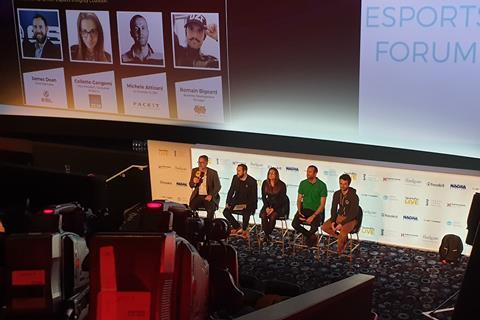
L-R, Esports integrity commissioner (moderator) Ian Smith; ESL UK CEO
James Dean; New York Excelsior OWL VP of consumer products Collette
Gangemi; FACE IT co-founder & CBO Michele Attisani; Riot Games
business development manager Romain Bigeard.
Broadcasters aren’t the only demographic trying to figure out what
impact esports might have on their industry: based on a number of very
well attended sessions at the recent SportsPro Live event in London,
professional sport is too.
For the benefit of novices, speakers agreed that the term “esportsâ€
is not entirely useful. Introducing a panel discussion on where the
esports and gaming business is heading, Ian Smith Integrity Commissioner
at the Esports Integrity Coalition described the term as a slightly
misleading umbrella term covering a variety of games that are lumped
together in the same way that the Olympics lumps together 26 or 28
different sports. “Just like the Olympics, we have the 100m men’s final
at one end watched by 1.2 billion people and we have synchronized
swimming at the other end watched by 12 people. Esports is exactly like
that,†said Smith.
Smith placed Counter-Strike Global Offensive (CS: GO), League of Legends and Defense of the Ancients 2 (Dota2) at the Usain Bolt end of the esports spectrum, with Overwatch and Rainbow 6 being in a second tier not too far behind while other games such as Starcraft,
which was massive until a few years ago, are in decline. Each game has
its own characteristics, attracting its own community. It’s the
engagement of these communities which is of interest to professional
sporting bodies, and a potential competitor for the attention of
broadcasters’ viewers.
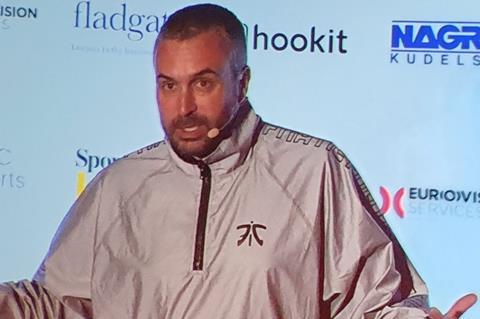
In a keynote, Wouter Slijffers, CEO of Fnatic said he felt
“professional gaming†is a more intuitive description. Fnatic owns ten
professional teams across the globe, including a League of Legends team which won the world championship in 2011 and was runner up in 2018
Wouter Slijffers is CEO of Fnatic, owner of ten pro esports games worldwide
Slijffers suggested that the estimated esports audience of 1.8
billion represented a quarter of world population or 40% of the online
population. The sector is projected to be worth US$1.1 billion in 2019
rising to US$1.8 billion in 2022, a very healthy compound annual growth
rate of 22%. The excitement about esports rests on adage that “there’s
money in eyeballs.â€
Media rights market There are four key
stakeholder groups at the core of the esports ecosystem: the publishers
who develop and release the games; platforms that facilitate the
broadcast of games to audiences worldwide; organisers of live events
that are filling arenas with increasing regularity; and pro teams.
Associations are emerging as the maturing ecosystem recognizes a need
for governance structures. For example, World esports Association
(WESA) is an open and inclusive organization that aims to
professionalize esports in areas such as player representation,
standardized regulations, revenue shares for teams as well as
establishing predictable schedules for fans, players, organizers and
broadcasters. The Esports Integrity Coalition is a not-for profit
members’ association that works with esports stakeholders to protect the
integrity of competition, investigate all forms of cheating including
match manipulation and doping and impose sanctions on offenders.
Slijffers outlined the increasingly diverse revenue streams that help
fund professional esports teams. Sponsorship and partnerships are key
with brands keen to tap into esports for content-led campaigns. To
support this, Fnatic has an in-house content studio and offers talent
services. Having protected its trademarks in key markets worldwide, fans
are monetized through merchandising – Fnatic has its own global e-shop
and opened Bunkr, the world’s first esports concept store, in London’s
Shoreditch tech district in 2016.
A media rights market is beginning to develop but Slijffers said that
it was “yet to be proven†how teams would share revenues with the
leagues who were doing the deals. Twitch has paid $90 million for
exclusive streaming rights for the Overwatch League for two years but BAMTech’s $350 million six-year deal reported in December 2016 for exclusive rights to stream League of Legends unraveled before it started. In May 2018, ESPN+ stepped in with a replacement deal of undisclosed value.
Sponsorship and partnerships are key with brands keen to tap into esports for content-led campaigns.
One area which highlights the similarities between sport and esports
and the cultural differences between North America and Europe is in
commercial relationship between leagues and teams. Depending on the
game, open leagues and tournaments are more common in Europe while the
model in North American is more often closed franchise,
publisher-controlled, leagues.
Romain Bigeard, business development manager at Riot Games, was one
of the SportsPro Live panelists. Riot Games released debut title League of Legends in 2009 and it has gone on to become one of the most played computer games and a driver of the esports phenomenon.
Bigeard’s career started in the open leagues with promotion and
relegation in Europe. One of the downsides of the European approach was
that because of the short esport business life cycle – six to nine
months – a team could get relegated three months into a sponsorship
deal. When he moved to America, he realized that the franchise system
gave teams – the “weak-link in the overall ecosystem†– time to
negotiate and activate sponsorship deals that work for partner brands.
Michele Attisani, co-founder of FACEIT, agrees with Bigeard: “From a
commercial standpoint, and from a business standpoint, I think a
franchise is brilliant because it gives the ability to invest for the
long term.†FACEIT is a global online esports platform with 12 million
users playing more than 15 million game sessions each month. Key
objectives in developing the platform were to make it as social as
possible in order to build communities around the games they support and
to integrate Twitch, YouTube. The company has also branched into
hosting major live events such as the FACEIT CS:GO Major which
sold-out the Wembley Arena in September 2018 and was broadcast live on
Sky Sports’ website, YouTube and Facebook channels.
With more money coming in, Attisani says that with the approach adopted by Riot with League of Legends and Blizzard with the Overwatch League
there is greater stability for the teams, the players, the brands and
the leagues. However, he cautions that the long-term consequences of the
model are not fully understood. Stability comes at a cost: at the time
of the ESPN+ deal, Bloomberg reported that League of Legends teams were paying between $10 million and $13 million for franchises.
The FACEIT founder firmly believes that esports success depends on
having a strong and very engaged competitive community and large fan
bases for the games. “You need to make sure that as you build a
franchise you also maintain the overall health of the ecosystem for the
game.â€
Open ecosystem James Dean is CEO of the UK
subsidiary of Turtle Entertainment GmBH, owner and operator of the ESL
brand which runs a number of esports platforms, national and
international pro leagues and produces and broadcasts gaming events live
and globally. He warns that it is easy to lose sight of the fact that
all games publishers are some sort of commercial entity and that unlike
die-hard football fans who are unlikely to abandon their club, esports
fans can quite easily move away from one game to another. Dean believes
that an open ecosystem below community-based franchises is the best
combination to sustain an aspirational path for talent from lower
levels. “We have to encourage the talent, but you need the commercial
infrastructure to sustain the business model,†he said.
ESL created the World esports Association (WESA) to create an
alternative structure capable of giving players that aspirational path
to the top, but with sustainability. ESL’s CS-GO Pro League will be run under the auspices of WESA in 2019.
Collette Gangemi, VP of consumer products and merchandising for New York Excelsior, a pro team in the Atlantic Division of the Overwatch League
team, owns a community-based franchise in New York City. She observes
that having the IP rights combined with the ability to create fandom and
a community is hugely important and gives confidence for investment.
“We’re New York and will continue to invest in franchise-based models:
first with the Overwatch League and with others launching very soon.â€
There is growing interest in esports among traditional sports: for
example, FACEIT has been working with NHL. Attisani says the NHL Gaming
World Championship which enters second year in 2019 has been
“phenomenal†in revitalising the NHL brand and its relevance to younger
audiences.
2018 was the second year of Formula 1’s involvement in esports, and
the first year of official teams: nine out of ten of the F1 teams
participated. A total of 66,000 entered the four qualifying rounds and
the final was watched live by 1.2 million on TV and a further 3.2
million on a dedicated livestream. The competition generated 100 million
social media impressions and 20 million online views of F1 esports
content. For F1, esports creates “material fan engagement and commercial
opportunities.â€
Soccer has also jumped on the bandwagon: FIFA has revamped its FIFA eWorld Cup for 2019 with qualification through EA Sports FIFA19 Global Series. While in England, the ePremier League 2019 final was broadcast live on Sky Sports in March.
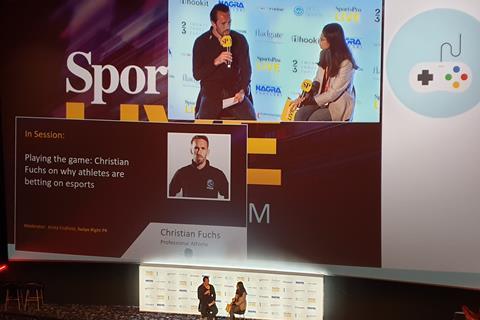
Leicester City footballer Christian Fuchs owns a pro esports team and
is planning to build a dedicated esports arena in New York City
Christian Fuchs, a member of the 2015-16 Leicester City squad that
famously disrupted the oligopoly that has dominated the English Premier
League, has set-up his own pro team – #NoFuchsGiven – that competes in FIFA19
tournaments. Fuchs told delegates at SportsPro Live that he has bought a
36-acre sports complex in New York and is planning to build a dedicated
thousand-seater esports arena which will be the biggest in the city.
For digitally native younger demographics there is little doubt that
esports is a rival to both broadcast and traditional sports. Only time
will tell how the three sectors will learn to co-exist.
Posted by AGORACOM-JC
at 12:10 PM on Wednesday, May 22nd, 2019
SPONSOR: North Bud Farms Inc. (NBUD:CSE) Sustainable low cost, high
quality cannabinoid production and procurement focusing on both
bio-pharmaceutical development and Cannabinoid Infused Products. Learn More.
How does a business persuade its clients to purchase their product
when marijuana is easily accessible in the market? The ideal approach
lies under the art of marketing, and for some organizations, that
implies an emphasis on wellbeing. That is why some brands are
approaching towards healthier CBD infused edible products, for example, Gluten free edibles.
Much healthier options in the market specifically target the audience
that are health conscious. Additionally, people have started taking
health more serious than ever. To inspire these people and use the
influence on getting more profit, professionals in the market have to
advocate health and wellness in their companies.
CBD edible trends in Los Angeles
Los Angeles is probably the biggest promoter of cannabis in the
planet. In addition to that, it is the world capital of restricting
diets. Many wellbeing focused brands implant marijuana into the dietary
prevailing fashions, which touch base with the tides.
There are options to buy, such as gluten free edibles and cannabis
infused tea. Companies are also incorporating cannabis with ginseng to
guarantee calm.
CBD edibles are getting popular in restaurants
The specific compounds in cannabis have benefits of their own. THC
comes with terrific medical benefits when it comes to alleviate pain and
treat different diseases. On the other hand, CBD plays a role in the
overall promotion of good health. This concept has hit the restaurants
and cafes. Now every now and then, you will see a CBD infused label on
their menus. With its property to provide benefits without altering the
mental and emotional state with euphoria, it is getting even more
popular in the restaurant industry.
The potential market goal for cannabis is to bring it for health
promoting purposes. CBD infused product users will notice a general
uplift in their creativity levels, perseverance and tolerance, self awareness and mood. It will also ultimately make people more conscious of their surroundings and make them more empathetic and open.
Many brands have been instilling scientific researches and putting
them into use by making specific products that address certain issues.
These health issues include anxiety, chronic pain and insomnia as well
as other health problems.
Future of CBD edibles
Currently in the United States, over a thousand brands are claiming
to be the best in the market. However, it is still not a time to decide
which brand stands the best. the number of national level US brands are
very limited in the present times. At this point, there is no data or
clue addressing the main method of cannabis consumption once the
substance gets legal at the federal scale.
The central goal of the industry at this point is to erase
misconceptions and create a sense of awareness in the people regarding
its benefits. For this thing to occur, all health brands relating to
cannabis will play an integral role in the market. Products like Gluten
free CBD edibles do not only hint the variety of the products but also
points towards the importance of CBD edibles health wise.
Tags: Cannabis, CSE, Hemp, Marijuana, stocks, tsx, tsx-v, weed Posted in North Bud Farms Inc | Comments Off on North Bud Farms Inc. $NBUD.ca – Role of CBD Edibles In Boosting Cannabis Industry $WEED.ca $CGC $ACB $APH $CRON.ca $HEXO.ca $TRST.ca $OGI.ca
Posted by AGORACOM-JC
at 10:41 AM on Wednesday, May 22nd, 2019
SPONSOR: ThreeD Capital Inc. (IDK:CSE) Led by
legendary financier, Sheldon Inwentash, ThreeD is a Canadian-based
venture capital firm that only invests in best of breed small-cap
companies which are both defensible and mass scalable. More than just
lip service, Inwentash has financed many of Canada’s biggest small-cap
exits. Click Here For More Information.
These and many other insights are from Deloitte’s 2019 Global Blockchain Survey: Blockchain gets down to business.
Based on interviews with 1,386 senior executives in twelve nations
(Brazil, Canada, China, Germany, Hong Kong, Israel, Luxembourg,
Singapore, Switzerland, United Arab Emirates, United Kingdom, and the
United States), 53% of whom say blockchain technology has become a
critical priority for their organizations in 2019. Please see page 2 of
the study for a methodology. The study is available for download here (PDF, 52 pp., no opt-in).
Blockchain is gaining trust in the enterprise by succeeding at
pragmatic, well-defined pilots that show the potential to scale into
production. Deloitte found financial services leads blockchain adoption
today with adoption accelerating in technology, life sciences, media,
telecommunications, and government. Key insights from the survey include
the following:
53% of senior executives say blockchain has become a critical
priority for their organization this year, 10% higher than last year.
Deloitte found that senior executives are gaining more experience and
insights into blockchain’s potential contributions and pitfalls as more
use cases are evaluated, piloted, and moved to production. The following
graphic compares blockchain’s relevance between 2018 and 2019.
Source: Deloitte’s 2019 Global Blockchain Survey: Blockchain gets down to business.
86% of senior executives interviewed believe that blockchain
technology is broadly scalable and will eventually achieve mainstream
adoption. The majority of senior executives (83%) believes
there is a compelling business case for blockchain. 81% are planning to
use blockchain to replace their system of record, which reflects a shift
in mindset away from relying entirely on legacy systems. A growing
number of senior executives also believe blockchain is overhyped (43% in
2019, up from 39% in 2018).
Source: Deloitte’s 2019 Global Blockchain Survey: Blockchain gets down to business.
Blockchain’s three greatest organizational barriers include
implementation (which includes replacing or adapting existing legacy
systems), regulatory issues, and potential security threats.
Additional barriers include lack of in-house capabilities, uncertain
Return on Investment (ROI), concerns over the sensitivity of the
information, and the lack of a compelling application of the technology.
The following are the respondents’ responses to the question, What are your organization or project’s barriers, if any, to increase adoption and scale in blockchain technology?
Source: Deloitte’s 2019 Global Blockchain Survey: Blockchain gets down to business.
73% of enterprise leaders in China are prioritizing blockchain
as one of their top five strategic priorities, the most in the ten
nations surveyed. The Chinese government’s Ministry of Industry
and Information Technology cited blockchain as a key driver of economic
development in a recent economic analysis. The Chinese government sees
product traceability, copyright protection, and smart contracts as
examples of blockchain’s potential to strengthen China’s global
technology direction. “China, more than anywhere else in the world, will use blockchain strategically instead of tactically,†says Paul Sin, consulting partner, Deloitte Advisory (Hong Kong) Ltd., and leader of Deloitte’s Asia-Pacific blockchain lab. “More projects are driven by top management who use blockchain as a strategic weapon rather than a productivity tool.†The following is a comparison of countries’ differing attitudes about blockchain along with several metrics.
Source: Deloitte’s 2019 Global Blockchain Survey: Blockchain gets down to business.
18% of enterprises are planning to spend $10M or more on
blockchain initiatives this year, and 23% will spend between $5M to
$10M. Senior executives based in each of the twelve nations
included in Deloitte’s survey are predicting wide variations in
blockchain investment levels. Luxembourg, Switzerland, and Germany are
the home nations of enterprises planning to invest $10M or more in
blockchain technologies in the next twelve months.
Source: Deloitte’s 2019 Global Blockchain Survey: Blockchain gets down to business.
Blockchain use cases are proliferating today, with data
validation (43%), data access/sharing (40%), and identity protection
(39%) being the most popular. Enterprises are piloting
blockchain to improve payments, achieve track and trace accuracy
throughout their supply chains, and evaluating the digital currency
aspects of the technology. It’s important to note that 87% of
enterprises first start evaluating blockchain due to its innate
strengths for enabling completely automated or touchless business
processes. 86% of enterprises are evaluating and piloting blockchain to
achieve the goals enabling new business models and revenue streams.
Please click on the graphic to expand for easier reading.
Source: Deloitte’s 2019 Global Blockchain Survey: Blockchain gets down to business.
For the majority of enterprises actively piloting and promoting
blockchain into production, success is defined by greater process
efficiency first. 55% of enterprises define blockchain success
by the process efficiencies they can accomplish first, followed by cost
saving (51%) and risk reduction (50%). Deloitte also found blockchain is
proving to be an effective platform for revenue generation, enabling
new business models and customer acquisition.
Source: Deloitte’s 2019 Global Blockchain Survey: Blockchain gets down to business.
Louis Columbus is an enterprise software strategist with expertise in
analytics, cloud computing, CPQ, Customer Relationship Management
(CRM), e-commerce and Enterprise Resource Planning (ERP).
Posted by AGORACOM-JC
at 8:18 AM on Wednesday, May 22nd, 2019
Invited by Global Partnership Family Offices to present to the UK investment community at International Deal Gateway in London today, May 22, 2019.
Vancouver, British Columbia–(May 22, 2019) – Good Life Networks Inc. (TSXV: GOOD) (FSE: 4G5) (“GLN“, or the “Company“), a Vancouver-based programmatic advertising technology company, is pleased to announce that it has been invited by Global Partnership Family Offices (“GPFO”) to present to the UK investment community at International Deal Gateway in London today, May 22, 2019.
Jesse Dylan, CEO of GLN commented, “After our
successful TSX presentation last month to the Toronto investment
community, I’m thrilled to be one of only 10 companies in the world to
be invited to this event in London. I’m looking forward to expanding
GLN’s reach globally by introducing our company’s success story to the
European investment community.”
About International Deal Gateway
International Deal Gateway is a digital marketplace for entrepreneurs
and deal makers that facilitates direct, peer-to-peer transactions on a
secure blockchain platform. Access to Deal Gateway gives members the
power to discover deals and opportunities that could not be found
through their usual networks.
About Global Partnership Family Offices
GPFO is a definitive source of information, unbiased advice and
thought leading research and education to family office executives,
wealth owners, family members and their close advisors worldwide.
The GLN Story
GLN’s patent pending technology is the engine that sits between
advertisers and publishers. A highlight of GLN’s tech is that it does
not collect PII (Personal Identifiable Information). Built for cross
device video advertising: Mobile, In-App, Desktop and CTV (Connected
Television) the GLN Programmatic Video Advertising Platform has among
the lowest fraud rates of similar vendors in the industry. Advertisers
make more money by reaching their target audience more effectively. GLN
makes money by retaining a percentage of the advertiser’s fee.
GLN is headquartered in Vancouver, Canada with offices in Newport
Beach and Santa Monica California, New York and UK and trades on the
TSXV under the stock symbol “GOOD” and The Frankfurt Stock Exchange
under the stock symbol 4G5. For further information on the Company,
visit www.glninc.ca
Neither the TSX Venture Exchange nor its Regulation Services
Provider (as that term is defined in the policies of the TSX Venture
Exchange) accepts responsibility for the adequacy or accuracy of this
release.
Forward Looking Statements:
Forward-looking statements relate to future events or future
performance and reflect the expectations or beliefs regarding future
events of management of GLN. This information and these statements,
referred to herein as “forwardâ€looking statements”, are not historical
facts, are made as of the date of this news release and include without
limitation, statements regarding discussions of future plans, estimates
and forecasts and statements as to management’s expectations and
intentions with respect to the Company’s performance and business
strategy. These statements generally can be identified by use of
forward-looking words such as “may”, “will”, “expect”, “estimate”,
“anticipate”, “intends”, “believe” or “continue” or the negative thereof
or similar variations.
These forwardâ€looking statements involve numerous risks and
uncertainties and actual results might differ materially from results
suggested in any forward-looking statements. Important factors that may
cause actual results to vary include without limitation, risks relating
to the Digital Marketing Industry and general economic conditions or
conditions in the financial markets.
GLN does not assume any obligation to update the forward-looking
statements, or to update the reasons why actual results could differ
from those reflected in the forward-looking statements, unless and until
required by applicable securities laws. Additional information
identifying risks and uncertainties is contained in GLN’s filings with
the Canadian securities regulators, which filings are available at www.sedar.com.
Posted by AGORACOM-JC
at 8:15 AM on Wednesday, May 22nd, 2019
Fastest growing North American gaming network achieved through organic growth, acquisitions, and strategic partnerships
Diverse platform of gaming sites and YouTube channels provides unique advertising solutions
Scaling rapidly to own the largest piece of industry market share
TORONTO, May 22, 2019 – Enthusiast Gaming Holdings Inc. (TSXV: EGLX) (OTCQB: EGHIF), (“Enthusiast†or the “Companyâ€), the largest publicly traded video game media and esports company in North America, is excited to announce that its network of video game enthusiasts has grown to 150 million total monthly visitors(1). Enthusiast’s platform is the fastest growing gaming network in North America(2) and includes owned and operated gaming related websites and a network of YouTube channels.
Monthly visitors across the network has doubled since Enthusiast
completed its going public transaction in October 2018 and has grown
from two million monthly visitors since 2015. The increase validates the
rapid growth of the gaming industry and further positions Enthusiast as
a leader in the space. The significant growth and size of Enthusiast’s
network has provided the Company with a number of different revenue
streams, including direct sales, revenue sharing and subscription models
that diversifies the business and supports continued future growth.
Through its aggressive acquisition and organic growth strategy,
Enthusiast has been able to scale and grow its business quickly, in an
attempt to gain significant market share within the gaming industry.
Enthusiast has seen consistent monthly organic growth across its
network, with more visitors engaging with its content rich gaming
properties. As an early industry leader, Enthusiast has built a solid
framework to take advantage of future growth opportunities and
capitalize on the overall sector growth in the coming years.
Menashe Kestenbaum, CEO of Enthusiast commented, “Our
consistent growth further validates our business model, as we continue
to outperform visitor growth month over month. Our team continues
providing innovative, rich content which attracts dedicated gamers. This
content allows us to deepen our reach both vertically and horizontally
across a number of sub-sectors within the gaming industry.†Kestenbaum continued, “In
a relatively short period of time, we have managed to amass a network
of over 150 million monthly visitors and now major brands are taking
notice. In addition to our core revenue generating verticals of content,
advertising, and events, the size of our network has provided a number
of different revenue opportunities, that we believe will add
sustainable, long-term value to our network moving forward.â€
Founded in 2014, Enthusiast Gaming is the largest vertically
integrated video game company and has the fastest-growing online
community of video gamers. Through the Company’s organic and acquisition
strategy, it has amassed a platform of over 150 million monthly
visitors across its network of websites and YouTube channels. Enthusiast
also owns and operates Canada’s largest gaming expo, Enthusiast Gaming
Live Expo, EGLX, (eglx.ca) with approximately 55,000 people attending in 2018. For more information on the Company, visit www.enthusiastgaming.com.
Source: Google Analytics, April 2019
Source: Comscore Media Metrix Multi-Platform, Dec 2017-Dec 2018, US
CONTACT INFORMATION:
Investor Relations: Julia Becker Head of Investor Relations & Marketing [email protected] (604) 785.0850
This news release contains certain statements that may constitute
forward-looking information under applicable securities laws. All
statements, other than those of historical fact, which address
activities, events, outcomes, results, developments, performance or
achievements that Enthusiast anticipates or expects may or will occur in
the future (in whole or in part) should be considered forward-looking
information. Such information may involve, but is not limited to,
comments with respect to strategies, expectations, planned operations
and future actions of the Company. Often, but not always,
forward-looking information can be identified by the use of words such
as “plans”, “expects”, “is expected”, “budget”, “scheduled”,
“estimates”, “forecasts”, “intends”, “anticipates”, or “believes” or
variations (including negative variations) of such words and phrases, or
statements formed in the future tense or indicating that certain
actions, events or results “may”, “could”, “would”, “might” or “will”
(or other variations of the forgoing) be taken, occur, be achieved, or
come to pass. Forward-looking information is based on currently
available competitive, financial and economic data and operating plans,
strategies or beliefs as of the date of this news release, but involve
known and unknown risks, uncertainties, assumptions and other factors
that may cause the actual results, performance or achievements of
Enthusiast to be materially different from any future results,
performance or achievements expressed or implied by the forward-looking
information. Such factors may be based on information currently
available to Enthusiast, including information obtained from third-party
industry analysts and other third-party sources, and are based on
management’s current expectations or beliefs regarding future growth,
results of operations, future capital (including the amount, nature and
sources of funding thereof) and expenditures. Any and all
forward-looking information contained in this press release is expressly
qualified by this cautionary statement. Trading in the securities of
the Company should be considered highly speculative.
Neither the TSX Venture Exchange nor its Regulation Services
Provider (as that term is defined in the policies of the TSX Venture
Exchange) accepts responsibility for the adequacy or accuracy of this
release. The securities of the Corporation have not been and will not be
registered under the United States Securities Act of 1933, as amended
and may not be offered or sold in the United States absent registration
or an applicable exemption from the registration requirement. This press
release shall not constitute an offer to sell or the solicitation of an
offer to buy nor shall there be any sale of the securities in any
jurisdiction in which such offer, solicitation or sale would be
unlawful.
Posted by AGORACOM-JC
at 5:39 PM on Tuesday, May 21st, 2019
AGORACOM Engagement Metrics Beat Benchmarks By 402%*
AGORACOM Cashless Marketing and Awareness Program Is 100% Compliant
We are very proud to announce AGORACOM achieved another major milestone on February 28, 2019, when we surpassed 600 Million page views (90% AGORACOM / 10% Twitter) from 7.7 Million investors that visited 55.2 Million times.
These milestones are significant because they continue to demonstrate that AGORACOM is the primary home for serious small cap investors that want to discover their next great small cap investment. That is because on AGORACOM, we don’t talk about large-caps or general economic news. Investors come to AGORACOM for just one thing – small cap stocks.
AGORACOM ENGAGEMENT BEATS FINANCE BENCHMARKS BY 402%
AGORACOM small cap investors don’t just flip through pages, they invest a significant amount of time reading, studying and researching our small cap stocks like yours. …. And they do it far more than everywhere else.
In a recent survey of 275 finance sites, LittleData determined the average number of pages read per visit was 2.4. The average number of pages read on AGORACOM are 9.67, which is 402% higher than the benchmark.
Moreover, LittleData determined anything greater than 5.7 pages per visit represents the best 10% of Finance sites. At 9.67 pages per visit and 170% higher, it is fair to say AGORACOM is in elite status for engagement.
Finally, the average visitor to AGORACOM stays for an average of 8mins 32secs To put this into perspective, the average visitor to the Wall Street Journal stays for an average of 3 mins 18secs, putting AGORACOM 257% higher.
WHY IS THIS IMPORTANT TO SMALL CAP COMPANIES?
We attribute this significant amount of research time to our philosophy of Quality over Quantity. We don’t allow profanity, bickering and nonsense found on other sites. We believe that driving away the crazies attracts smarter investors – and the numbers tell us we’re right.
DON’T SPEND $1 … OUR CASHLESS & COMPLIANT PROGRAM IS THE SOLUTION
Your cash is still invaluable and needed for operations, so how do you start raising awareness without breaking the bank?
The AGORACOM Cashless, Shares For Services Program is fully compliant under TSX Venture Policy 4.3 and has already been pre-approved by the CSE. Highlights include:
Shares are issued pro-rataover your 12 month contract;
The number of shares issued is determined by your share price at each issuance. As your share price increases, the number of shares issued decreases;
Each issuance comes with customary 4-month hold periods. As such, AGORACOM is a shareholder for at least 16 months;
$0 in cash gets you the full firepower of AGORACOM
CALL ME TODAY AND GO LIVE WITH YOUR PROGRAM IN 10 DAYS
Our massive audience + cashless and compliant program is a win-win. Just ask any of the 20 companies that are using the program today
Posted by AGORACOM-JC
at 4:29 PM on Tuesday, May 21st, 2019
SPONSOR: Esports Entertainment
$GMBL Esports audience is 350M, growing to 590M, Esports wagering is
projected at $23 BILLION by 2020. The company has launched VIE.gg
esports betting platform and has accelerated affiliate marketing
agreements with 190 Esports teams. Click here for more information
GMBL: OTCQB
———————–
Which tournaments attract the most esports bettors?
As competitive gaming evolves, as too has the rise in esports betting.
Though the exact value of esports’ betting handle is difficult to pinpoint
There’s a reason to believe it has now surpassed $1 billion based off Business Insider’s evaluation last year.
As
competitive gaming evolves, as too has the rise in esports betting.
Though the exact value of esports’ betting handle is difficult to
pinpoint, there’s a reason to believe it has now surpassed $1 billion
based off Business Insider’s evaluation last year.
Each
esport boasts its own unique community, ecosystem and infrastructure;
despite there being several competitive gaming communities in existence,
only a handful of them are fit to be a bookmaker’s product.
Though
the consistency exhibited in esports such as the Overwatch League or
NBA 2K League is a big motivator for bookies to offer spreads on them,
there are a number of key tournaments that trump the rest when it comes
to attracting significant volumes of bettors to risk. In this report,
we’ll detail the leading tournaments that you’ll want to keep an eye on
if you want to be involved in esports betting.
The International
Since 2011, The International, also referred to as TI,
has brought forth the best esports has to offer in terms of size,
viewership and of course, prize money. The annual tournament organised
by Valve assembles 16 of the toughest contenders in Dota 2
from direct invites, regional qualifiers and those who amass enough
Dota Pro Circuit (DPC) points through the competitive season.
Aside
from establishing itself as the pinnacle of Dota 2 championships, The
International’s reverence is bolstered heavily by the lofty prize amount
raised each year. Dota 2 developers, Valve, contributes $1.6 million as
a base amount for The International’s tournament winnings which are
then passed off to the community to raise through crowdfunding; by
dedicating a portion of Battle Pass sales to the total prize pool.
The International has seen a year-over-year growth since its inception – last year’s TI8 amassed a whopping $25,532,177 ($20,035,099).
This year’s The International has already garnered over $12 million
just two weeks into its fundraising period, with the tournament poised
to kick off on August 15 at the Mercedes-Benz Arena in Shanghai.
League of Legends World Championship
Photo courtesy: Riot Gamesp
Riot Games’ League of Legends is by far the most played game in the world at the moment; the most recent report from Riot confirmed in 2016 the game boasted 100 million monthly players,
which we can only assume has grown based off the lofty increase in
tournament viewership over the subsequent years. When it comes to
League, there is one event that stands well above the rest on the yearly
calendar – the League of Legends World Championship also referred to as Worlds.
The
World Championship is the annual culmination of the competitive season
organised by Riot Games, currently coming up on the ninth event in the
tournament’s history this November. Worlds brings together the 24 best
League of Legends teams to clash over a month-long period for the game’s
most prestigious title as well as the Summoner’s Cup which weighs in at 32kg.
The
prestige, popularity and length of the World Championship make it a hot
product for bookmakers to feature spreads on. Last year’s Worlds was
just barely shy of 100 million unique viewers, orbiting similar statistics to that of the Super Bowl – and where there are viewers, there are punters. Legal Sports Report’s overview of the esports betting market in 2018 illustrated League of Legends accounts for 38% of the total handle.
If
you’re looking to place a wager on League of Legends, it’s a safe bet
to assume any bookmaker that carries esports will offer lines on this
game. As exemplified by eSportbetting.eu’s guide to betting on League, the catalogue of sportsbooks that support the game is quite extensive – including major US fantasy sports contest provider, DraftKings.
CS:GO Major Championships
Photo courtesy: HLTV
Counter-Strike
is one of the oldest and most prosperous esports today. Valve’s
first-person shooter has truly withstood the test of time in our current
esports panorama with a bustling ecosystem supported by tournament
organisers, online platforms and big sponsors.
Counter-Strike’s
large player base across a number of divisions makes for a seemingly
infinite amount of offerings from bookmakers; the aforementioned study
by Legal Sports Report estimates CS:GO is responsible for 29% of the betting handle, only second to League of Legends.
Though, when it comes to betting on Counter-Strike, Valve’s CS:GO Major Championship
series is the choice event for punters. Since 2013, CS:GO Majors have
furnished the most enthralling narratives and display of CS the game can
generate; the format of the Major builds off the last by incorporating
teams who can go deep enough in the previous tournament and spans across
roughly three weeks.
The
volume of matches between high-profile teams ramps up the number of
bets placed on CS while bookmakers often capitalise on Majors by
offering exclusives and specials linked to the tournament.
Recap
While there are several other tournaments such as the Overwatch League Season Finals and Call of Duty World League Championships
that are able to congregate a number of bettors to wager, those
mentioned above three are by far the market leaders. If you do decide to
get involved in esports betting, Esports Insider reminds you to bet
responsibly!
Education in India has improved dramatically over the last three
decades. Schools have become accessible to most children; both student
enrollment and attendance are at the highest level.
The RTE Act guarantees a quality education to a wider range of
students than ever before. However, challenges in teaching and learning
outcomes across all regional, cultural and socioeconomic subsets prevent
us from harnessing the true potential of vast human resource and keep
the country educationally backward.
One of the biggest concerns is to make the present generation
learners future-ready. India is relatively young as a nation with around
28 million youth population being added every year. In 2020, the
average age of an Indian is expected to be 29 years, while it will be 37
for China and 48 for Japan.
However, India’s high youth population won’t be of help to the economy if universal education is not achieved all over India.
Improving education is a critical area of investment and can be a game changer to achieve sustained economic growth by tap into its young workforce. The weak foundation in primary education derails the lives, careers, and productivity of millions of our citizens. With 65 per cent of the population residing in rural India, education in rural belt truly deserves much more attention.
Annual Status of Education Report (ASER) shows that even though the
number of rural students attending schools is rising, but more than half
of the students in fifth grade are unable to read a second grade text
book and are not able to solve simple mathematical problems. Not only
this, the level of math and reading is further declining. Some of the
major problems that plague the rural education system in India are
related to both quality and access of teaching learning facilities and
basic infrastructure. While dearth of teachers, teacher absenteeism and
poor quality of teaching are directly affecting the learning outcomes,
poor and inadequate infrastructural facilities in terms of classrooms
and benches, blackboards, playgrounds, toilets, water, etc, also hamper
the delivery of quality education and make the school unattractive to a
child.
The foundation to turn India into a strong nation has to be laid down
at primary and rural levels and so the quality of education right from
the beginning should be excellent. A complete reform in education system
is required which should start from policies which promote talent in
teaching system. Teachers are the backbone of education.
All efforts should be made to hire the best teachers, keep them
engaged and motivated, reduce their absenteeism by making them more
accountable and provide regular in-service training and capacity
building to upgrade their skills. To improve the student’s attendance
in the schools, especially in villages, the school curriculum should
involve extracurricular activities and fun-learning exercises. Education
and text books should be made interesting. Textbooks related to their
culture, their traditions and values should also be there so as to
create their interest in studies.
The reasons behind so many drop-outs in spite of free education should be found out as this is a hurdle on the road to progress. Sensitizing
parents to make them understand the importance of education would
certainly be helpful. This can be done through skits, street plays and
holding meetings with the parents on a quarterly basis to make a student
excel in his life. Emphasis should be given to educating a girl.
Though girl education has improved in our country a lot has to be done in this sector. In
this digital era when technology is touching every aspect of society
and changing it dramatically, rural education can also greatly benefit
from appropriate use of technology. Smart Classrooms which facilitate
online teaching create extended classrooms for interactions and
discussions. An expanded option is to record classroom courses in a real
time and use it for teaching the students who cannot attend the
classes. Rural education needs e-learning technologies. Apart from this,
audio and video conferencing should be made part of the education
system in rural India.
Teachers at the schools are not well equipped with the gadgets. So
teachers should be given printers, laptops, for giving notes and notices
to the students. By using technology the problem of unqualified
teachers can also be solved. Dropout rates have reduced to a great
extent wherever digital and computer-aided education has been introduced
in rural schools.
Several initiatives in public private partnerships are playing
significant role in making rural India tech savvy and in providing
better education. These efforts have given positive results. We have to
take proper remedial measures with a sense of urgency and create better
learning environments for rural children so that they are able to
participate in nation building process and reap the full potential of
our demographic divided.
Authored article by Dr Neelam Gupta President and CEO AROH Foundation
Posted by AGORACOM-JC
at 10:37 AM on Tuesday, May 21st, 2019
SPONSOR: Tartisan Nickel (TN:CSE)Â Kenbridge Property has a measured and indicated resource of 7.14 million tonnes at 0.62% nickel, 0.33% copper. Tartisan also has interests in Peru, including a 20 percent equity stake in Eloro Resources and 2 percent NSR in their La Victoria property. Click her for more information
Right now, many cannot see the forest for the trees. By that I mean the big picture for EVs and EV metals demand.
What percentage of buyers do you think will buy an electric car by
end 2022 if it is cheaper to buy, cheaper to run, and cheaper to
maintain?
What if 50% of buyers want to buy an electric car in 2022, and 75% by 2025.
In a recent British survey, 71% of British car buyers said they are considering an electric car as their next vehicle.
In this article, my goal is to remind investors that the electric
vehicle [EV] and EV metal miners (lithium, cobalt, graphite, nickel)
opportunity is a long-term event. By this I mean the next decade or two.
If as I have forecast electric cars continue to gain in popularity,
then the demand boom for EVs and the EV metal miners will be
unprecedented in history and we will see an EV metals super-cycle over
the next decade or two.
Right now, many cannot see the forest for the trees
In the world of electric vehicle metals (particularly the key battery
metals lithium, cobalt, graphite and nickel) market participants
continually focus on what will happen this year, and what will stock
prices do in the next 1 year. The problem here is that short-term market
events can mean we sell down our stocks at the worst possible time when
the market is negative and we forget to see the big picture.
Take the lithium and cobalt markets the past year. Concerns of
oversupply have caused large sell-offs in the lithium and cobalt miners.
Retail investors have fled the market. Does this really make sense when
we look at the big picture over the next decade?
The big picture for EVs and EV metals over the next decade or two
Investors should focus on what lies ahead in the next decade or two. For example:
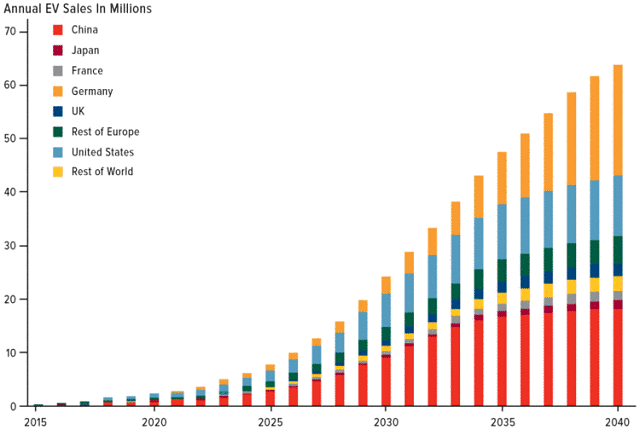
According to Bloomberg, we can expect EV sales to increase (from 2017 levels of 1.1%) 10x by 2025, 27x by 2030, 50x by 2040.
CNBC reported that JP Morgan forecasts “electric cars would take 35 percent of the global market by 2025 and 48 percent by 2030.”
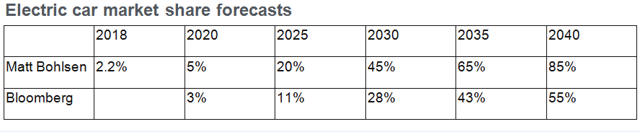
The chart below compares my electric car penetration forecast to Bloomberg’s forecast.
Bloomberg forecasts annual electric vehicle sales – 30m by 2030, 60m by 2040
Do these forecasts sound realistic or possible? Only readers can decide for themselves.
My view remains that by end 2022, an electric car will start to
become cheaper than a conventional Internal Combustion Engine [ICE] car
(assuming zero subsidies). This is based on lithium-ion battery prices
falling ~16% pa, which has been the case the past decade. With 76
lithium-ion battery megafactories to be in production by about 2028
(~45 in production now) this looks highly realistic as scale and fierce
competition take effect.
My model forecasts a 60kWh battery will sell for less than an ICE engine system by end 2022 (earlier for a 50kWh battery)
Source: My Model
My forecast above states by end 2022, a 60kWh lithium-ion battery
will sell for US$5,300 which is less than the cost of a standard car’s
engine system (includes the engine, exhaust, transmission, petrol tank,
etc.).
If the above forecast is correct, it will mean a consumer by end 2022 can buy an electric car cheaper than a comparable ICE car. Furthermore, the electric car will have up to 10x cheaper running costs (electricity vs. gasoline) and up to 10x cheaper maintenance costs.
Once this happens, who would buy an ICE car if they are happy with a range of at least 208 miles or 335 kms (Tesla (TSLA) Model S 2012 model range).
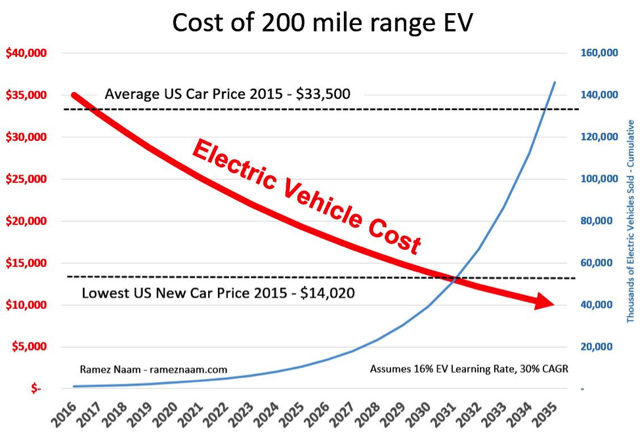
The chart below shows by ~2017/18, an electric car can sell cheaper
than the average US conventional car, and by ~2031, an electric car can
be cheaper than the lowest priced new US conventional car. In 2018,
Reuters reported
in ‘VW plans to sell electric Tesla rival for less than $23,000:
source’ “Volkswagen intends to sell electric cars for less than 20,000
euros ($22,836).”
Electric car selling prices are forecast to fall rapidly as battery costs fall
What percentage of buyers do you think will buy an electric car by
end 2022 if it is cheaper to buy, cheaper to run, and cheaper to
maintain than a comparable ICE car?
Added to the above headline the electric car will have better acceleration and be more trendy than an ICE car.
Given the above, it would seem quite clear to me that most people if
given the option will choose an electric car post 2022. Certainly, by
2025, when an electric car is even cheaper it would seem almost everyone
will want one.
If again the above assumptions are correct, then electric car
penetration rates will be way higher than my forecasts above. For
example, my end 2022 forecast is at 10%, and end 2025 is at 20%. The
real demand could in fact be 3-5x higher than my forecasts, and higher
than Bloomberg’s forecasts. Perhaps JP Morgan’s forecasts of 35% by 2025 (and 48% by 2030) will be a better guide.
Nearly 75% of car buyers are considering an electric car as their
next vehicle. Sales of electric and hybrid cars will overtake petrol and
diesel by 2030, report claims. Searches for alternative fuel vehicles
on Auto Trader up by 40% in 2018. The British public’s appetite for electric vehicles
is growing significantly, according to a new report published by Auto
Trader. Almost three quarters (71%) of car owners said they’d consider
buying an electric vehicle as their next car, which is a huge leap from the 25% who answered positively when asked the same question in 2017.
What if 50% of buyers want to buy an electric car post 2022, and 75% by 2025
Clearly, if we get to levels above 50% by 2022, the electric car industry would probably not be able to meet this demand.
For example, the lithium demand to meet 50% electric car penetration
rates by end 2022 would be ~2.6mtpa. This would be almost 10x the level
of lithium demand from 2018. Similar problems would occur with the other
EV metals as well as the battery and electric car producers.
In other words, we could very well see a period post 2022 until
perhaps 2030 where people will be on waiting lists to get an electric
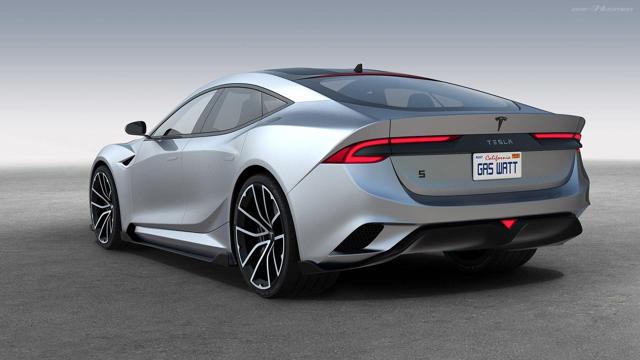
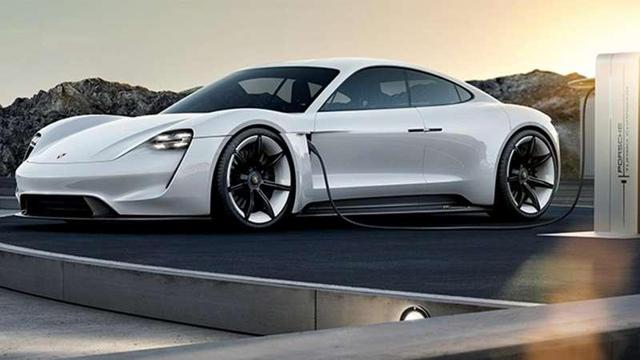
car. Similar to the ~400,000 list for the Tesla Model 3, but several magnitudes higher. Even the expensive Porsche Taycan (OTCPK:POAHY) already has a 20,000 waiting list.
The car companies and 76 megafactories confirm the boom is coming
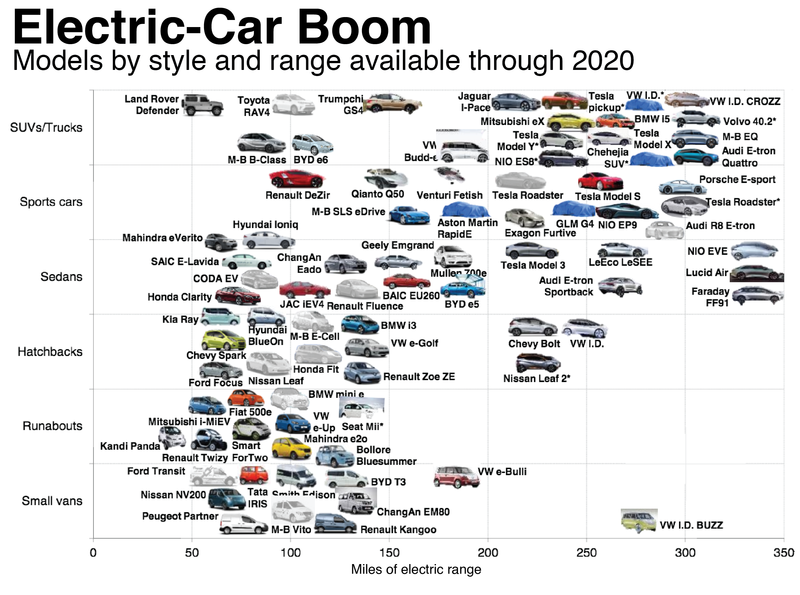
BNEF forecasts by 2020 there will be over 289 different models of
electric cars across the spectrum. Added to this will be electrification
across the entire transport sector (limited for planes) and widespread
adoption of energy storage (home, office, utility).
My purpose in this article is to encourage investors to think outside
the box, or to have a clearer view of the big picture. Demand levels of
50% electric cars by end 2022 once an electric car is cheaper to
buy/run/maintain would seem very logical.
Should this occur, then we will see an EV metals super-cycle. Waiting
lists for electric cars will become normal, battery shortages the norm,
and very strong EV metal prices a reality.
While 2018 and early 2019 have been bleak for the EV metal miner
stocks, I would encourage investors to think beyond 2019, and towards
2022 which is less than 3 years away. The quality EV metal miners that
are very oversold today may look like absolute bargains tomorrow.
I suggest to investors that 2019 is very likely the “calm before the storm of demand” for the EV metal miners.