10% of
all the Silver ever produced on earth came within a 100km diameter of its past
producing Tabasquena Mine.
What
makes Advance Gold even more exciting is the fact they’ve found just as much
gold as silver since they started drilling Tabasquena over the past couple of
years.
After
discovering a cluster of epithermal veins in the “first layer of their
cake”, CEO Allan Barry Laboucan thinks he’ll find the massive source in the
second layer…. Because that’s where mines all around him have found their
source.
Watch
this great interview with him to find out why you should be circling Labour Day
on your calendar.
Posted by AGORACOM-JC
at 12:05 PM on Wednesday, August 7th, 2019
SPONSOR: Enthusiast Gaming Holdings Inc. (TSX-V: EGLX) Uniting gaming communities with 80 owned and affiliated websites, currently reaching over 75 million monthly visitors. The company exceeded 2018 target with $11.0 million in revenue. Learn More
EGLX: TSX-V
Esports Are Beginning to Eclipse Traditional Sports
More young people are dreaming of becoming professional gamers than professional athletes
In British Columbia and beyond, esports are booming. Many universities are forming esports teams for games like Overwatch, League of Legends, Rocket League, Counter-Strike, and Dota 2 to compete in collegiate leagues around the world.
by Alex Rodriguez
In 2018, esports had a total audience size of 380 million, and esports research firm Newzoo predicts that that number will increase to 557 million by 2021.
As a result, an increasing number of large brands will sponsor events and tournaments, which has lead Newszoo to believe that esports will reach a market value of $1.7 billion USD by 2021, overtaking the revenue generated by rugby.
If you think that sounds like a lot of money, this year Fortnight will become the first game to offer a prize pool of $39 million for the Fortnight
World Cup in July. With prize pools growing so large, it’s easy to see
why gaming as a whole is flourishing. Instead of simply playing for fun,
people are now seeing gaming as a possible investment in skills that
could win you prizes.
The grand opening of the Gaming Stadium
in Richmond on June 28 was a milestone for esports in British Columbia.
With its construction came the creation of Canada’s first dedicated
esports gaming stadium.
They host competitive events most
days of the week for various video games that either individuals or
teams can sign up for. All of their events are broadcasted on Twitch—the
leading live streaming platform for gamers and esports events—using
great production quality. The Gaming Stadium is sure to cultivate new
talent in the community as the local population will be able to go there
to practice, socialize, and get a sense of what being an esports player
feels like.
In 2018, esports had a total audience size of 380 million,
and esports research firm Newzoo predicts that that number will
increase to 557 million by 2021. As a result, an increasing number of
large brands will sponsor events and tournaments, which has lead Newszoo
to believe that esports will reach a market value of $1.7 billion USD by 2021,
overtaking the revenue generated by rugby. They also predict that, with
the help of esports, the global games market will generate over $180
billion USD.
As the life of a professional gamer
continues to look more and more lucrative, it may eventually become more
common for parents to push their children towards becoming a digital
athlete than it is to involve them in traditional sports.
Posted by AGORACOM-JC
at 11:09 AM on Wednesday, August 7th, 2019
SPONSOR: North Bud Farms Inc. (NBUD:CSE) Sustainable low cost, high quality cannabinoid production and procurement focusing on both bio-pharmaceutical development and Cannabinoid Infused Products. Learn More.
NBUD: CSE
Drink Makers Seek to Include CBD and Cannabis Beverage Alternatives
According to data compiled by Fior Markets, the global cannabis beverages market is expected to reach USD 4.56 Billion by 2025 while exhibiting a CAGR of 16.8% during the forecast period from 2018 to 2025.
In particular, edibles are more abundant in regions where recreational cannabis is legal. On the other hand, the cannabis-infused beverage industry is experiencing significant strength because of large beverage corporations entering into the marketspace.
NEW YORK, Aug. 7, 2019 — As the cannabis industry continues to develop, savvy consumers and businesses are creating innovative new ways to ingest cannabis. Due to widespread stereotypes, many imagine cannabis users relying on hastily rolled joints. However, as the legal industry continues to accelerate, new products are constantly emerging. For instance, in legal markets such as Colorado or California, extracts and concentrates have become increasingly popular because of their potency and immediate effects. Specifically, Colorado has witnessed its extract and concentrate sales eclipse its flower sales in recent years. And while extracts and concentrates are widely popular, other vendors have incorporated cannabis into edibles and beverages.
In particular, edibles are more abundant in regions where
recreational cannabis is legal. On the other hand, the cannabis-infused
beverage industry is experiencing significant strength because of large
beverage corporations entering into the marketspace. Notably, big
alcohol has set its sights on the cannabis market because of its
declining primary revenue drivers. As a result, many companies are
adding cannabis-infused beverages to their product lines in order to
combat lower sales numbers that are a result of the declining alcohol
consumption levels. However, to note, most companies are predominantly
only adding CBD, or cannabidiol, to their beverages because of
regulatory restrictions on THC.
Moreover, companies are marketing CBD-infused beverages as health and
wellness products rather than recreational or relaxation products. And
while the infused beverage market is already experiencing a surge in
momentum in legal regions, it’s expansion into new territories is
expected to spur its growth. According to data compiled by Fior Markets,
the global cannabis beverages market is expected to reach USD 4.56 Billion by 2025 while exhibiting a CAGR of 16.8% during the forecast period from 2018 to 2025.
Tags: Cannabis, CBD, CSE, Hemp, Marijuana, otc, stocks, tsx, tsx-v, weed Posted in North Bud Farms Inc | Comments Off on North Bud Farms Inc. $NBUD.ca – Drink Makers Seek to Include #CBD and #Cannabis Beverage Alternatives $WEED.ca $CGC $ACB $APH $CRON.ca $HEXO.ca $TRST.ca $OGI.ca
Posted by AGORACOM-JC
at 10:13 AM on Wednesday, August 7th, 2019
SPONSOR: Betteru Education Corp.
aims to provide access to quality education from around the world. The
Company plans to bridge the prevailing gap in the education and job
industry and enhance the lives of its prospective learners by developing
an integrated ecosystem. Click here for more information.
BTRU: TSX-V
India’s Education Policy Updates After 30 Years: 4 Experts Share What It Really Means
On 31 May 2019, the Ministry of Human Resource Development (MHRD) released a draft of the National Education Policy (NEP).
This is the ï¬rst update to India’s education policy in nearly 30 years, and there has been plenty of debate on the recommendations, and it was open to the public for feedback and suggestions till July 31.
Central Square Foundation’s (CSF) monthly newsletter The EDge asked
eminent names from the education sector to share their thoughts on some
key aspects of the policy.
1. Ashish Dhawan, Founder and Chairman, Central Square Foundation
What is your initial response to the draft NEP? If implemented, how do you see the impact of the policy on our education system?
The draft NEP was a long time coming, but it has made some bold and
welcome recommendations to shift the focus of the education system
towards quality, and improving student learning outcomes. It takes a
long-term view in terms of the emphasis on flexibility and skills to
ensure that our children are equipped for a rapidly changing job
scenario.
When I read it, my immediate thought was that we now have a policy document, even though it’s a draft, that explicitly recognizes that we are currently in a severe learning crisis, and that this crisis starts in the early years. This is significant. If we were to focus and get this one thing right, i.e., ensure all children have foundational literacy and numeracy skills, this in itself would have a tremendous impact on the education system.
What are some of the key steps the government can take for
the successful implementation of the policy? How can the policy
translate into real action?
The challenge is that current state capacity to deliver quality
education is weak, and we do not have the resources to focus on so many
things at the same time. My one advice to the government would be that
they should almost ruthlessly prioritise–they should first focus on
ensuring that all children achieve foundational literacy and numeracy,
and then phase in other priorities, as needed.
Separately, I think it’s important to remember that implementation
rests with states. The centre’s role is primarily one of catalysing
demand for critical reforms with the states, setting broader policy
goals, providing funding to states, and so on. The centre cannot be too
prescriptive in terms of ‘how’ states need to implement. In fact, it
needs to give states the autonomy to choose the most cost-effective
pathways, while maintaining accountability for the right outcomes. The
centre should also think about enabling states to develop 3-5 year
plans, and not annual plans.
What, according to you, are the big misses of the draft NEP, if any?
One of the key concerns with the draft education policy is that like
many other policies, it may be attempting to do too much. As a system,
we first need to focus on getting the basics right–ensure that all our
children achieve foundational literacy and numeracy by class 3. Without
this prioritisation, the system will continue to grapple with multiple
competing priorities.
We cannot hope to achieve foundational learning for all our children
if we don’t measure it correctly. Therefore, one of the biggest areas of
reform in this regard, which is not adequately addressed by the policy
in its current form, is the need to ensure independent and reliable
learning data to measure early grade learning outcomes.
While the NEP does call out regular adaptive assessments, there is a
need to have a large-scale, independent, household-based,
government-backed assessment, which measures outcomes for children
attending public and private schools. This survey must be housed in and
administered by an autonomous institution, which is at arm’s length from
the delivery ministry, ensuring there is no conflict of interest. This
learning data is critical for the government to meaningfully hold the
system accountable and keep us honest.
Read CSF’s full interview with Ashish Dhawan, here.
2. Geeta Gandhi Kingdon, Professor, University College London and President, City Montessori School, Lucknow
The NEP refers to the creation of an independent agency to
gather and analyse data for the education system. What are crucial data
gaps on private schools that the government should strive to fill?
There is hardly any data on private schools
because they are rarely included in studies or surveys done by the
government. It is as if private school students belong to another
country. For example, the National Achievement Survey (NAS) is conducted
only in government and aided schools and excludes private unaided
schools. We need more information about private schools to get a fuller
picture of the education sector.
What do you think of the proposition to separate regulation,
provision, and policy-making in the NEP? How do overlapping interests
between these functions presently impact private schools?
The idea of separating roles is very good, because if the government
performs all the roles–funder, provider, regulator, policy maker,
assessor–it leads to many conflicts of interest. However, the NEP does
not go far enough because it does not separate funding and provision–the
government is both the funder and producer of education, i.e., it runs
schools itself.
The NEP does not consider public funding for privately produced
education (public-private partnerships). It is a myth that in
educationally developed countries, all schools are state-run. Actually,
they are only publicly funded, not publicly run. This is an important
distinction that many in government are unaware of.
In India, there is an entrenched belief that the government shouldn’t
just fund education, it must also produce it (i.e., run the
schools)–even when it has struggled to deliver quality. Our main focus
should be to ensure that all elementary education is publicly funded, so
that parents do not have to pay to send their children to school. But
the operation of the schools could be in private hands if they are
deemed to be more efficient, i.e., to deliver better child outcomes at
lower costs.
The NEP has also proposed the establishment of an independent State
School Regulatory Authority (SSRA) for each state, to handle all aspects
of school regulation and accreditation. It recommends reducing the
burden of over-regulation on private schools, and regulating public and
private schools within the same framework/benchmarks. These are welcome
proposals. Much depends, however, on how the SSRA will operate. Will it
subject public schools to accountability pressures? Will government
schools go through a process of recognition like private schools? And
will they also be closed down if they do not comply with the norms of
the RTE Act? The NEP doesn’t clarify this, leaving open the possibility
of the continuation of non-accountable public schools and resultant poor
learning outcomes.
Read CSF’s full interview with Geeta Gandhi Kingdon, here.
3. Rukmini Banerji, CEO, Pratham Education Foundation
The draft NEP includes pre-primary education as part of the
‘foundational stage’ (ages 3-8) and strongly recommends that this stage
must be a continuum. Do you agree? How should we approach this?
I welcome the strong focus on the early years. Building strong
foundations in the early years allows children to ‘leap forward’. The
widespread phenomena of ‘falling behind’ that we see today, happens
because the right things are not done at the right time.
The draft policy states that children in the 3-8 year age group
should receive a flexible, “play-based, activity-based, and
discovery-based†education. However, it is fair to say that the
educational establishment in India, including the government bodies at
the central, state, and district levels have little or no experience
with the preschool age group.
Pre-primary classes are often part of primary schools in the private
sector and much of the student intake happens in lower or upper
kindergarten. However, research studies show that most activities in
these institutions in the early age group are ‘school-like’ and do not
provide the flexible, play-based, and developmentally appropriate
activities that are suited for supporting the development of young
minds. So, despite several years of preschool education, such children
are still not ‘ready’ for class 1.
At the same time, the Integrated Child Development Services (ICDS)
system run by the Ministry of Women & Child Development (MWCD) is
typically overwhelmed by responsibilities in health, immunisation, and
nutrition. So, in the anganwadis, early childhood stimulation or
development has not received the high priority it needs.
Bringing these two ministries together, all the way from the centre
to the states, districts, and villages, will be a huge and challenging
task, but one that is certainly worth undertaking. Clear financial
calculations will be needed to support this convergence exercise in a
sustained way.
One of the objectives the draft NEP states is that every
child in grade 5 and beyond should achieve foundational literacy and
numeracy – can you talk about some of the specifics with regard to the
pedagogical and curricular changes that will be needed to achieve this
goal?
According to ASER data, only about 50 percent of class five children
are able to read in class 2 (or higher). The other half is spread across
several reading levels, starting from not being able to recognise
letters to just about coping with simple sentences. This is one of the
biggest challenges in primary schools, the wide dispersion of learning
levels. The teacher’s daily dilemma is to figure out what to teach and
to whom. To complete the curriculum guided by grade-level textbooks,
teachers usually choose to focus on the ‘top of the class’, leaving
others to catch up on their own. Even the RTE Act prescribes that
teachers “must complete entire curriculum within specified timeâ€.
The draft NEP highlights several causes for the learning crisis,
including the lack of school readiness, but it doesn’t address the
negative consequences of overambitious curricula or the common practice
of teaching to the top of the class. The real challenge is, therefore,
to schedule ‘catch-up’ routines into the regular school schedule. Given
the size, depth, and magnitude of the ‘catch-up’ required, we will need a
persistent and high-priority effort for at least five years or more.
The alignment of key elements of the school system such as teacher
training, teaching-learning material, ongoing teacher support,
mentoring-monitoring, assessment, and course correction towards
achieving stated goals is critical. Perhaps this alignment for
foundational learning will now be possible, given the overarching
direction of the new policy.
Read CSF’s full interview with Rukmini Banerji, here.
4. Sridhar Rajagopalan, President and Chief Learning Officer, Educational Initiatives
The draft NEP calls for the appropriate integration of technology
into all levels of education. What is your initial response to the
draft in terms of how it envisions the role of technology in education?
The draft policy mentions India’s unique leadership in the technology
space and acknowledges that the right policy and implementation can
help India become a global leader in EdTech. Overall, the policy seems
to have its heart in the right place, yet many challenges plague the
successful implementation of EdTech in our country.
For example, one of the most common issues with all EdTech projects
is the disproportionate focus on hardware as compared to the software or
content.
One big miss. without a doubt, is that it fails to recognise the role
of the private, for-profit players and their international experience.
It would have been useful to look into what has been tried already in
EdTech and the challenges those efforts faced. While the collective goal
should be to strengthen state resources and capacities and help curate
high-quality open resources, there should be an effort to learn from the
for-profit EdTech players and view them as providers of co-existing and
complementing solutions.
Again, for implementation of suggestions made in the policy,
do you think we have adequate infrastructure and capacity in our schools
and state systems? What could be the challenges in creating that
infrastructure and capacity?
The infrastructure and capacity do not exist, but like with anything
new, they can be developed over time as these projects expand. However,
problems arise if the approach tends to focus more on scaling than on
quality. Ironing out all possible issues at the scale of 20-100 schools
is very important, and a disproportionate focus at this scale will
ensure fewer challenges at a larger scale of say 1,000 or 2,000 schools.
What is important in all this is generating effective assessment
solutions and protocols to provide learning feedback. Again, this should
be done in a low-stake, quality-focused manner while gradually scaling
up and taking key players and partners along.
Read CSF’s full interview with Sridhar Rajagopalan, here.
Posted by AGORACOM-JC
at 8:35 AM on Wednesday, August 7th, 2019
Entered into a strategic partnership with Endocanna Health Inc. a research and development biotechnology company specializing in endocannabinioid DNA testing, and a partly owned subsidiary of Heritage Cannabis (CSE: CANN)
Endocanna will manufacture its patent-pending Endocannabinoid DNA Test Kits for and license its proprietary DNA technology to Empower.
VANCOUVER, Aug. 7, 2019 – EMPOWER CLINICS INC. (CSE: CBDT) (Frankfurt 8EC) (OTC: EPWCF) (“Empower” or the “Company“), a vertically integrated and growth-oriented CBD life sciences company, and a multi-state operator of medical health & wellness clinics in the U.S., is pleased to announce it has entered into a strategic partnership with Endocanna Health Inc.(“Endocanna“), a research and development biotechnology company specializing in endocannabinioid DNA testing, and a partly owned subsidiary of Heritage Cannabis (CSE: CANN)
Endocanna will manufacture its patent-pending Endocannabinoid DNA
Test Kits for and license its proprietary DNA technology to Empower.
Empower will immediately make the Endocanna kits available to its
corporate owned medical clinics that include 165,000 patients in Oregon, Arizona, Washington State and Nevada.
The Company plans to include the DNA Test Kits as a standard offering
in the Sun Valley Health franchise program, and has commenced it’s
roll-out in the United States.
“We continue to focus our initiatives on patient care and wellbeing,
ensuring we have the ability to provide best-in-class care and advice
using the most advanced technology available.” said Steven McAuley,
Empowers Chairman & CEO. “The Endocanna DNA Test Kit can give our
physicians the potential to have even greater insight into each
individual patient’s propensity for success, on how CBD based therapies
may interact with their individual regulatory system.”
The Kits are designed to provide consumers with personalized data
about how cannabidiol (CBD) and other cannabinoids may interact with
their body, plus the technology may allow the company to provide
patients with science-backed cannabis product suggestions based on their
specific DNA.
“Using Endocanna Health’s proprietary DNA report, we can personalize
and provide a cannabinoid wellness protocol tailored to an individual’s
needs.” said Len May, CEO & Co-Founder of Endocanna Health. “Empower
and their Sun Valley Health clinic network, provides an immediate
opportunity for us to work with physicians and patients to develop
advanced science surrounding the endocannabinioid system and CBD based
therapies.”
About Endocanna Health Inc.
Endocanna is a company based in Los Angeles, CA that has
developed Endocannabinoid DNA testing to assist individuals in taking
control of their own health, by utilizing cannabis products specifically
suited for themselves. The recently expanded database of genetic
markers now allows for a thorough review of potential products, which
are helpful to address the needs of patients. EndoDNA testing packages
are currently available in the United States, and will shortly be introduced to Canada and other select cannabis-forward countries. For more information visit www.endocannahealth.com
About Heritage Cannabis Holdings Corp.
The Company is focused on becoming a vertically integrated cannabis
provider that currently has two Health Canada approved licenced
producers, through its subsidiaries Voyage Cannabis Corp. and CannaCure
Corp. both regulated under the Cannabis Act Regulations. Working under
these two licences, Heritage has two additional subsidiaries, Purefarma
Solutions, which provides extraction services, and BriteLife Sciences
that is focused on cannabis based medical solutions. Heritage as the
parent Company, is focused on providing resources for its subsidiaries
to advance their products or services to compete both domestically and
internationally.
ABOUT EMPOWER
Empower is a vertically integrated and growth-oriented CBD life
sciences company, and a multi-state operator of medical health &
wellness clinics, operating the Sun Valley Health clinic brand www.sunvalleyhealth.com, for its nine corporate locations and for franchises in the United States.
As a CBD product manufacturer under the Solievo brand, the company
distributes its lines through clinics, online and through retail
partners. Extraction operations are currently being developed in the
Company’s new extraction facility in Oregon.
ON BEHALF OF THE BOARD OF DIRECTORS:
Steven McAuley Chief Executive Officer
DISCLAIMER FOR FORWARD-LOOKING STATEMENTS
This news release contains certain “forward-looking statements”
or “forward-looking information” (collectively “forward looking
statements”) within the meaning of applicable Canadian securities laws. All
statements, other than statements of historical fact, are
forward-looking statements and are based on expectations, estimates and
projections as at the date of this news release. Forward-looking statements
can frequently be identified by words such as “plans”, “continues”,
“expects”, “projects”, “intends”, “believes”, “anticipates”,
“estimates”, “may”, “will”, “potential”, “proposed” and other similar
words, or information that certain events or conditions “may” or “will”
occur. Forward-looking statements in this news release include
statements regarding; the Company’s intention to open a hemp-based CBD
extraction facility, the expected benefits to the Company and its
shareholders as a result of the proposed acquisitions and partnerships;
the terms of the proposed acquisitions and partnerships; the
effectiveness of the extraction technology; the expected benefits for
Empower’s patient base and customers; the benefits of CBD based
products; the effect of the approval of the Farm Bill; the growth of the
Company’s patient list and that the Company will be positioned to be a
market-leading service provider for complex patient requirements in 2019
and beyond. Such statements are only projections, are based on
assumptions known to management at this time, and are subject to risks
and uncertainties that may cause actual results, performance or
developments to differ materially from those contained in the
forward-looking statements, including; that the Company may not open a
hemp-based CBD extraction facility; that the hemp-based CBD extraction
facility may not be fully operation by Q2 2019 if at all; that
legislative changes may have an adverse effect on the Company’s business
and product development; that the Company may not be able to obtain
adequate financing to pursue its business plan; general business,
economic, competitive, political and social uncertainties; failure to
obtain any necessary approvals in connection with the proposed
acquisitions and partnerships; and other factors beyond the Company’s
control. No assurance can be given that any of the events anticipated by
the forward-looking statements will occur or, if they do occur, what
benefits the Company will obtain from them. Readers are cautioned not to
place undue reliance on the forward-looking statements in this release,
which are qualified in their entirety by these cautionary statements.
The Company is under no obligation, and expressly disclaims any
intention or obligation, to update or revise any forward-looking
statements in this release, whether as a result of new information,
future events or otherwise, except as expressly required by applicable
laws.
Investors: Steve Low, Boom Capital Markets, [email protected], 647-620-5101; Investors: Steven McAuley, CEO, [email protected], 604-789-2146; For French inquiries: Remy Scalabrini, Maricom Inc., E: [email protected], T: (888) 585-MARICopyright CNW Group 2019
Tags: Cannabis, CSE, Hemp, Marijuana, stocks, tsx, tsx-v, weed Posted in Empower Clinics Inc. | Comments Off on Empower Clinics $CBDT.ca Enters Into Strategic Partnership With Heritage #Cannabis Subsidiary Endocanna Health to Create and Sell #Endocannabinoid DNA Test Products $WEED.ca $CGC $ACB $APH $CRON.ca $HEXO.ca $OGI.ca $CANN.ca
Posted by AGORACOM-JC
at 9:15 PM on Tuesday, August 6th, 2019
SPONSOR: Spyder Cannabis Inc.
(TSX-V: SPDR) An established chain of high-end vape stores in Ontario,
Canada. The company has an aggressive expansion plan already in place
that will focus on Canadian retail and US Hemp-Derived kiosks in high
traffic areas. Click here for more info.
(TSX-V: SPDR)
Retailers See Promise in CBD and Hemp Products
CBD Hemp oil, Doctor holding a bottle of hemp oil, Medical marijuana products including cannabis leaf, cbd and hash oil, alternative medicine
Thanks to the passing of the Farm Bill in late 2018
– containing a provision legalizing hemp, a species of non-psychoactive
cannabis that CBD can be extracted from – Hemp and CBD are on major
retailers’ radar.
The CBD market is moving towards mainstream retailers and is projected to be over $20 Billion in sales by 2024.
Walgreens, Sprout, CVS, Ulta Beauty, GNC Holdings, Urban Outfitters are
just a handful of retailers offering or looking to offer, CBD products
to consumers.
According to Christina Hartwell from Little Mary and Jane â€the industry is on the verge of moving beyond merely CBD and exploring the full spectrum of Hemp (Cannabis Sativa L).â€
The potential of CBD and Hemp products appears to be endless due to newly emerging scientific data.
“The industry is on the verge of
moving beyond merely CBD and exploring the full spectrum of Hemp
(Cannabis Sativa L). Scientific studies thus far have been somewhat
limited due to the stumbling block of THC due to potential adverse side
effects and regulations. However, the studies being done on
full-spectrum Hemp and the multitude of Cannabinoids in the plant are
promising, CBN is beginning to come to the forefront and is potentially
more beneficial for treating Insomnia and Anxiety than Isolated CBD,â€
Hartwell added.
Retailers jumping in
Several retailers for natural
supplements are expected to have CBD on their shelves. Dillards
Department Store, a chain with a total of approximately 292 stores in 29
states, is beginning to roll out several Hemp Depot while labeled CBD
products. Kroger announced in July another 1,000 locations in 22 states where their grocery stores will begin to carry CBD products.
“Because of the tremendous range of
products in which CBD is a fit, we expect to see it on shelves,
literally, everywhere. Wholesale order numbers are climbing
dramatically, which is one of the first signs of significant market
expansion. When we started, we were taking orders for small companies
ordering 500 units at a time. Large company orders are projected to
reach 100,000+ units in the next 18 months which is going allow
wholesalers like Hemp Depot to manufacture products on a larger scale,
thereby reducing CBD product prices by the end of 2020 to a forecasted
$20 – $30 as with standard vitamin supplements,†said Andy Rodosevich,
CEO and Co-Founder of Hemp Depot.
In July, adding to the momentum,
Toronto-headquartered Abacus Health Products announced new retail
purchase orders from CVS for its line of CBDMEDIC pain relief and skincare products, sold to consumers via retail chains and the company’s e-commerce platform.
“We are encouraged to see the
continued interest and growth in CBDMEDIC among leading retailers
throughout the United States. In particular, the fact that CBDMEDIC
products are now being positioned in-line demonstrates the acceptance of
our over-the-counter products within the traditional pain relief and
skincare categories and we look forward to seeing the continued growth
in the number of retail locations in which CBDMEDIC is available,” said Perry Antelman, the CEO of Abacus Health Products, maker of CBD CLINIC and CBDMEDIC.
Also in July, Green Growth Brands announced a deal
with American Eagle to begin selling its CBD-infused body-care products
— including muscle balms and lotions — in nearly 500 of American
Eagle’s stores and online, with sales expected to begin in October. This
follows apparel retailer Abercrombie, which just last month announcing
its plans to sell GGB’s products in more than 160 stores across the U.S.
“The cultural conversation around CBD is growing and I think we are
beyond CBD being only for early adopters. The push to major retail
outlets like Kroger, Walgreens, and CVS seem to support that, said Paul
Miller from Lokus Nutrition.
Risks remain
The FDA is in the midst of creating
guidelines for CBD manufacturers and will likely eliminate some
manufacturers currently participating in the CBD boom and open the door
to some large scale, mainstream manufacturers. The details of the FDA
regulations will inform the specifics of how large the OTC piece of the
CBD pie becomes.
“We’ve seen major chain retailers
like CVS, Walgreens, and Whole Foods start to include CBD in their
product mixes. The larger the entity, the more likely they are to stick
with topical products until the FDA provides clarity,” said Kate Heckman
from Stratos CBD.
When it comes to CBD oils, presently
only 10% of demand is being filled by present growers, the industry has
increased by 200% from 2017 to 2018, about 618 million in sales last
year with projected 22 Billion by 2022.
“A lot of people want to get into
this arena. Some of the problems we are working on are Standardization
of the industry, Genetic variations, for patents and Lab Certification.
It is the wild west, with little or no standard dosages or diagnosis for
the public to rely on,†said John Sation, Clinic Director, and research
Coordinator from Hair & Scalp Clinics.
The recent FDA warning letter to Curaleaf on
July 26 serves as a wake-up call to the industry about statements in
marketing or social media that imply that these products can be used to
treat medical conditions.
“It’s in the best interest of the
industry to be careful and conservative with any label claims being
made. With the passing of the 2018 Farm Bill, each state department of
agriculture must submit a state management plan to the USDA outlining
how various aspects of hemp cultivation and processing will be managed
within their jurisdiction,†said Dr. Sean Callan, CEO of Precision Botanical.
While the opportunity is real, risks remain. According to David Gross from Strategic Value Partners, players in the space should tread carefully as the regulatory framework is currently only taking shape.
“Don’t be first here. By all
indications, the FDA appears poised to take aggressive and decisive
action, as evidenced by the Curaleaf warning letter, against companies
who manufacture, distribute, and retail CBD products. Moreover, the Drug
Enforcement Agency (DEA), Department of Agriculture, and financial
regulators (i.e., FDIC, OOC, and Federal Reserve) remain unknowns. In
the near-term, any benefit you might receive from being first is far
outweighed by the business and reputational risk of a potential FDA
action or a multi-state federal raid at your warehouses.â€
World’s largest fund manager lost $90bn investing in fossil fuel companies
BlackRock’s multibillion-dollar investments in the world’s largest oil companies – including ExxonMobil, Chevron, Shell, and BP – were responsible for the bulk of these losses
The report, from the Institute for Energy Economics and Financial Analysis (IEEFA), found that BlackRock has eroded the value of its $6.5 trillion funds by betting on oil companies that were falling in value and by missing out on growth in clean energy investments.
BlackRock, the world’s largest fund manager with $6.5 trillion of
assets under management – bigger in value than the world’s third-largest
economy (Japan) – continues to ignore the serious financial risks of
putting money into fossil fuel-dependent companies, a new report has
found.
The report,
from the Institute for Energy Economics and Financial Analysis (IEEFA),
found that BlackRock has eroded the value of its $6.5 trillion funds by
betting on oil companies that were falling in value and by missing out
on growth in clean energy investments.
BlackRock’s investments lost investors an estimated $90 billion over
the past decade “due largely to ignoring global climate risk,†the
report said.
The report also found that BlackRock’s multibillion-dollar
investments in the world’s largest oil companies – including ExxonMobil,
Chevron, Shell, and BP – were responsible for the bulk of these losses.
The report added that BlackRock should reduce the influence of those
with connections to the fossil fuel industry on its board, a
recommendation the investment giant continues to ignore.
Tim Buckley, IEEFA Director of Energy Finance Studies and co-author
of the report says due to its enormous size, BlackRock should
demonstrate stronger leadership.
“If the world’s largest investor makes it clear the rules have
changed, then other globally significant investors like Fidelity,
Vanguard and Japan’s sovereign wealth fund will rapidly replicate and
reinforce these moves, reducing stranded asset risks for all,†he said.
In its defense, via a statement to UK’s Guardian newspaper,
BlackRock said they give clients the option of investing in
environmentally and socially responsible funds and that these funds,
make up 0.8 percent of its entire portfolio.
“BlackRock should be given some credit,†says Derick Lila, Managing
Director at pvbuzz.com. “I believe the company is making strides in
diversifying its portfolio – and a notable example is the company’s
recent push towards distributed solar and storage.â€
Only last month, BlackRock aquired a majority stake
in GE’s solar business, giving the investment giant footing in a
growing market that offers solar and storage solutions to the
commercial, industrial and public sectors.
“While the company’s investments in clean energy isn’t as impressive
as some of us in the business would like, we also have to understand
they are Fund Managers,†Derick Added.
Posted by AGORACOM-JC
at 3:38 PM on Tuesday, August 6th, 2019
SPONSOR: Esports Entertainment
$GMBL Esports audience is 350M, growing to 590M, Esports wagering is
projected at $23 BILLION by 2020. The company has launched VIE.gg
esports betting platform and has accelerated affiliate marketing
agreements with 190 Esports teams. Click here for more information
GMBL: OTCQB
———————–
Shanghai sets the standards for building esports arenas
Shanghai has taken another stride toward building itself into a global esports centre, as it announced standards for the construction and operation of esports venues during the China Digital Entertainment Expo and Conference which ended on Monday.
“The esports sector has been growing quickly in the past few years, but there is a lack of top design. The guidelines can boost industry growth in a healthy manner,” Yu Xiufen, director of the bureau, was quoted as saying by Xinmin Evening News.
Published by the municipal culture and tourism bureau, the standards
for esports venues specify the construction requirements in areas such
as stage lighting and telecommunication networks and set the service
standards for operating such venues.
“The esports sector has been growing quickly in the past few years,
but there is a lack of top design. The guidelines can boost industry
growth in a healthy manner,” Yu Xiufen, director of the bureau, was
quoted as saying by Xinmin Evening News.
The criteria for esports venues have four categories, from A to
D.With a construction area of more than 50,000 square meters, class-A
venues can host the highest level esports competitions, while class-D
venues must have a 500-square meter construction area, and will be used
to hold qualification trials.
One of the most important upcoming esports events in the city is The
International 2019, an annual tournament for the popular multiplayer
online battle arena game Dota 2, which will be held in the Mercedes-Benz
Arena, a class-A venue, from Aug 16 to 25.
It will be the first time for China to host one of the most-watched
esports events in the world. Its crowdfunded prize pool reached a record
of more than $30 million (S$41.5 million) in July and is still growing.
According to Perfect World Zhengqi, a subsidiary of Perfect World Co
Ltd and the operator of the game in China, the event’s 26,804 tickets
were sold out in just 53 seconds in May.
“We have organised many esports events in Shanghai before, so we know
the venues here are excellent and the viewers are very active,” said
Xiao Hong, CEO of the company. “Shanghai has the best environment for
esports in the country – both in facilities and government policies, and
we’d like to co-operate with the government to build mature industrial
chains in the future.”
Wang Yong, deputy secretary-general of Shanghai Esports Association,
said the development of esports includes not only hosting tournaments,
but also esports training, performance and public experience, which
requires a number of esports venues of different sizes and functions.
Many shopping malls are interested in building esports venues, and
these standards will help them find the right partners, Wang added.
A report published by gaming industry analyst company Gamma Data
estimated that esports market revenue in Shanghai reached 14.6 billion
yuan (S$2.9 billion) in 2018, accounting for 19 per cent of the national
total.
Posted by AGORACOM-JC
at 10:40 AM on Tuesday, August 6th, 2019
SPONSOR: Betteru Education Corp.
aims to provide access to quality education from around the world. The
Company plans to bridge the prevailing gap in the education and job
industry and enhance the lives of its prospective learners by developing
an integrated ecosystem. Click here for more information.
BTRU: TSX-V
Why the Indian Education Industry Will be a Goldmine For Investors in the Coming Years?
A land of over 1.3 billion people, out of which about half are less than 20 years old- this could be the goldmine for the education industry.
According to a study by India Brand Equity Foundation (IBEF), India’s education sector clocked a whopping US$ 91.7 billion in revenues in FY18 according.
Sarvesh Shrivastava
Founder and Managing Director, Eupheus Learning
The study had further projected the industry to reach US$ 101.1 billion in FY19. While the scale of opportunity already gets enough share of voice, below are some qualitative reasons working in favour of the education industry (and investors): -Â
Untapped Treasure Chests
In 2016-17, the country’s Gross Enrolment Ratio or GER in higher
education was about 25.2per cent, as per the latest available data under
the All India Higher Education Survey (AIHES) launched by Union Human
Resource Development (HRD). The number is much lower than 43.93per cent
in China and 85.8per cent in the USA during the same period. The
scenario is not much different for primary and secondary levels. The
opportunity is to bridge this gap by providing affordable and accessible
education solutions for all segments.
Technology is the ‘Change agent’
Digitaldisruption in India is still in its early
days. However, we have already seen how it changes the way businesses,
people, and society works. Education space is not untouched from this
wave. Affordable internet access, rising smartphone penetration, and
awareness about usage have set the right platform for building and
catering digital solutions for education. Recorded classroom videos
live-streamed sessions, e-books, online tests, and artificial
intelligence-powered learning modules which could adjust to the pace and
learning of an individual, all of these have made education
experiential. Add to that, the entry of Internet of Things (IoT) will
enable many more connected devices to be used for learning and
development tools. Rising disposable income and time shortage inspires
parents to invest in edtech solutions which can be customized to the
needs of their wards and help their classroom studies. These solutions
have also simplified distance learning, reaching to millions of those
who do not have access to full-time classrooms or can not afford to do
so.
Favourable Policy Regime
In the last 5-6 years, the policy regime in India has supported both,
start-ups and education sector, hence making it a perfect time to take a
plunge into the education business. Start-up India initiative by the
Government of India has done miracles by single-window clearance,
affordable funding, and easy compliance norms for start-ups. On the
education front, campaigns like UDAAN (by CBSE), PRAGATI (by AICTE) to
address the gender gap and Skill India (by the Ministry of HRD) to
promote vocational education are reaching out to millions of students in
schools and colleges. The policies are also encouraging
industry-academic partnerships to make education more relevant to the
economy. Therefore, the innovative educational solutions which cater to
this objective will find immediate takers in the market.
According to the World Development Report 2019, the focus for India
going forth is to build a strong base for quality education and scale up
the employability of the human capital. While traditional teaching
systems will continue to exist, the new age edtech solutions are already
being accepted by many parents and students. These solutions are making
education more relevant, experiential, and adaptable. The scenario
proves that India is a land of opportunities for investors in the
education sector. The need is to pick companies which have unique
solutions, new business models, and a rebellious approach.
Posted by AGORACOM-JC
at 10:05 AM on Tuesday, August 6th, 2019
SPONSOR: Tartisan Nickel (TN:CSE)
Kenbridge Property has a measured and indicated resource of 7.14
million tonnes at 0.62% nickel, 0.33% copper. Tartisan also has
interests in Peru, including a 20 percent equity stake in Eloro
Resources and 2 percent NSR in their La Victoria property. Click her for more information
Battery producers and electric automakers, including Tesla Inc.,
are concerned over longer-term supplies of nickel, a key material in
their supply chain that’s forecast to fall into deficit, according to an
Australian miner that’s held recent talks with the sector.
The need for the high-purity material used in batteries, known as
class-one nickel, is likely to outstrip supply within five years, fueled
mainly by rising consumption in the EV industry, according to
BloombergNEF.
It’s a concern shared by Tesla, according to Peter Bradford, chief
executive officer of nickel producer Independence Group NL, who last
week met with a member of the car producer’s battery metals supply chain
team.
“They are getting ready to have the new factory in China, and are at
full capacity in North America,’’ Bradford said. “They recognize the
biggest risk from a strategic supply point of view is nickel.’’
There’s been a lack of sufficient investment in new mines for
materials including nickel, a factor that could spur prices as battery
sector demand builds, Tesla’s global supply manager of battery metals
Sarah Maryssael, told a Washington meeting in May. Tesla didn’t
immediately respond to a request for comment on its outlook for nickel
and other metals.
Demand for nickel from lithium-ion batteries is forecast to surge
about 16 times to 1.8 million tons of contained metal by 2030, BNEF said
in a July report. Batteries will account for more than half of demand
for class one nickel by that date, shifting a market that’s currently
focused on stainless steel.
Perth-based Independence last year increased nickel output from its
Nova mine in Western Australia by about a quarter and is spending as
much as A$75 million ($51 million) on exploration in an effort to extend
the asset’s life and find new deposits.
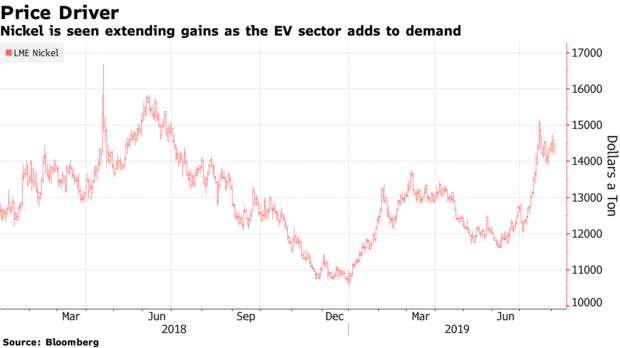
Nickel in London has jumped more than a third in 2019 and last month
touched the highest in more than a year. Future battery demand will add
further pressure on prices, according to Bradford, who is awaiting
delivery this month of his own Tesla Model S.
“The dramatic price rise we’ve seen will pale into insignificance
compared to the future,’’ Bradford said in the Friday phone interview.
Japan’s Sumitomo Metal Mining Co., said in June the nickel market
faces a deficit of 51,000 tons in 2019, raising an earlier forecast.
Last month, First Quantum Minerals Ltd. confirmed it’ll reopen the Ravensthorpe
mine in Western Australia –- shuttered since 2017 — in the first
quarter of 2020 amid the strength of interest from potential nickel and
cobalt customers.
Western Areas Ltd. recently
visited China’s Contemporary Amperex Technology Co. Ltd., a leading
battery maker, and is winning interest from the EV sector for nickel
supply contracts, the Perth-based producer said Monday in a
presentation. Contracts with BHP Group and Tsingshan Holding Group Co.
are scheduled to expire in January.
Meetings with companies in the EV supply chain in China and South
Korea in the past month, including battery suppliers and producers of
key raw materials and chemicals, had also underscored the industry’s
concerns about supply, Bradford said.
“The big question everyone will be asking in a year’s time is where does the nickel come from to satisfy the demands for nickel in stainless steel, as well as the increasing demand for nickel into electric vehicle batteries?’’ he said. (Adds Western Areas’ comment in 11th paragraph.) Â