Agoracom Blog Home

Posts Tagged ‘tsx’

Tartisan #Nickel $TN.ca – A nickel for your thoughts – The price of nickel has run up to a five-year high of late $ROX.ca $FF.ca $EDG.ca $AGL.ca $ANZ.ca

Posted by AGORACOM-JC at 11:03 AM on Wednesday, October 30th, 2019

SPONSOR: Tartisan Nickel (TN:CSE)  Kenbridge Property has a measured and indicated resource of 7.14 million tonnes at 0.62% nickel, 0.33% copper. Tartisan also has interests in Peru, including a 20 percent equity stake in Eloro Resources and 2 percent NSR in their La Victoria property. Click her for more information

Tc logo in black
TN: CSE
—————————-

A nickel for your thoughts – The price of nickel has run up to a five-year high of late

By Gwen Preston

The price of nickel has run up to a five-year high of late, defying softness in the rest of the base metal complex.

The reasons are both simple and complicated. The price of nickel doubled in two years, from US$4 per lb. in August 2017 to US$8 per lb. a few weeks ago. The reasons:

· Robust demand. Nickel is primarily used to make stainless steel. And despite slowing growth, stainless steel demand keeps marching up.

In the first half of 2019, for instance, Chinese stainless steel production was up 8.5% yearover-year. (As the chart suggests, forecasts predict softening of demand in the current quarter.)

· China makes most of the world’s stainless steel. And China gets the nickel for that steel from its own mines as well as mines in Indonesia and the Philippines, many of which produce a lowgrade, high-impurity ore called nickel pig iron (NPI). NPI production has ballooned over the last decade, enough that as of 2020 the world will get more of its nickel from NPI than from conventional nickel ores. However, this reliance on NPI brings with it a few problems.

· Indonesia will implement a ban on nickel ore exports at the start of 2020. This has been in the works for some time but until a few months ago the ban was not scheduled to take effect until 2022. Indonesia produces roughly ~12% of global supply, so this ban is significant. The idea is to push the development of domestic smelters, which would keep more of the resource upside in country versus exporting raw ore. This is in the works – the country already has 11 nickel smelters and 25 more are planned or under construction – so Indonesian nickel supplies should slide in the near term but recover within about three years. However, the smelters in China that relied on Indonesia’s nickel pig iron (NPI) ore will have to find feed elsewhere; the main candidate is the Philippines, where ore is generally lower grade. The only other option is to upgrade to processing Class I ores. Either move would increase costs overall, which supports a higher nickel price.

· Batteries. Eighty percent of the world’s nickel goes into stainless steel, so steel certainly drives the market. But many of the batteries that power laptops, electric vehicles, phones, and even power grids require nickel. This has transformed nickel from a one trick pony to a two trick market – and if electric cars take off then nickel’s battery market will take off right alongside. Right now batteries consume 5% of global nickel but demand is rising rapidly and is expected to reach 8% by 2020. Vice President of market analysis and economics for BHP, Dr Huw McKay, says he sees a future where batteries and stainless steel become “equally important” nickel consumers. Global nickel demand currently sits around 2 million tonnes per annum; it is expected to grow to 6 million tonnes per annum by 2035 with batteries accounting for almost half of demand growth.

· In addition, batteries cannot use nickel from NPI, as impurities are too high, so the battery factor has divided the nickel market into two parts – high purity Class I nickel and lower purity Class II. All of this has two important effects: it is bringing energy metal investors into the nickel space and it is underlining that NPI, which has been the dominant source of nickel growth for the last 10-plus years, will not solve the nickel supply gap going forward.

· To address that second point and boost production of Class I nickel, China is developing several mines tapping into nickel laterite deposits. Nickel laterite is easy to mine but very difficult to process, requiring high pressure acid leaching (HPAL). Most analysts are highly skeptical that China’s planned HPAL facilities will come online anywhere near their projected timelines or budgets, as these facilities are notoriously difficult and expensive.

· Because NPI has ballooned so in the last decade, explorers and developers have not looked for conventional nickel deposits. There is a true lack of development-stage nickel projects with conventional sulphide deposits that could be built to fill supply gaps.

· Current mine-specific supply issues. The biggest producer of NPI in the Philippines just ran out of ore. The Ramu project in Papua New Guinea is temporarily suspended, which removes 35,000 tonnes of annual nickel supply.

· Stockpiles are falling – and fast. Nickel stockpiles have been declining for five years.

This is what happens when a market is persistently undersupplied. But as you can see, the decline accelerated in the last two years…and stockpiles dropped off a cliff a few weeks ago.

The cliff is likely the result of panic buying and/or stockpiling ahead of the Indonesian ban.

I told you it was complicated!

Complicated is normal for nickel, which has a long track record of extreme price moves. In 2008 a supply shortage drove the price as high as US$22 per lb. before steel mills found substitutes, 7 including manganese, and within 18 months the price was back at US$4.50 per lb. (The Great Financial Crisis likely exacerbated the price decline.)

The Bear Case

The key question on this side is: to what extent is speculation driving nickel?

If speculators are pushing the price up, entering the space now is risky because (1) speculative tides turn fast and (2) that turn would likely transpire in the next 6 to 9 months. Indonesia’s ban comes into effect in January 1 so over the next six months the impacts start to play out.

It’s clear that stockpile drawdowns are at least in part because smelters and speculators have been stockpiling metal privately. That metal will be used or sold to ease any nickel price jumps.

If increased physical metal availability coincides with the absence of speculative upside pressure…nickel could turn down fast.

On top of all that, there are reasons to believe (1) stainless steel demand will weaken to end this year, (2) EV demand is taking longer to ramp than expected, (3) scrap usage is increasing, and (4) rising backwardation alongside falling physical premiums is a sign that actual demand is lower than perceived.

The fourth point above needs some explaining. In a tight market, limited stockpiles lead to backwardation – people paying more for metal today than in the future. Backwardation should only happen when the current physical market is very tight. If that’s the case, there should also be high physical premiums, which are extra amounts paid for actual metal now (rather than paper metal).

What weird about nickel is that premiums are down sharply, from $200 per tonne a few months ago to negative $50 per tonne today. It’s the first-time premiums have ever gone negative in China and something that is very rare across the metals complex. European nickel briquette premiums are also down 80% in recent months.

The dark blue line below shows physical premiums. The light blue line shows the difference between current and three-month nickel prices; a positive Cash-3M is backwardation.

<

This suggests:

· The physical market is not that tight

· Speculation in the paper market is driving the price

· Speculation is not simply investors; nickel users and producers are also playing games (stockpiling) to boost the price. When they stop, the price will lose ground rapidly.

The Bottom Line

Nickel may or may not continue its bull run from here. The fact the physical premiums are so low when prices have gained so much and the paper market is in backwardation is definitely concerning, enough that I am not ready to enter the space right now. The fact that nickel spot price recently stepped back almost 10% reinforces my outlook.

However, in the medium and long term this is a market that has good opportunity. Stainless steel demand growth is reliable. The battery space will need more and more Class I nickel with each year. The pipeline of new projects is very limited, especially if you (like me) see China struggling with its nickel laterite output mines and HPAL facilities.

I might be wrong and my hesitation on entering now may mean missing out on near term upside, but such decisions are common in this sector!

Source: https://www.kitco.com/commentaries/2019-10-28/A-nickel-for-your-thoughts.html

ThreeD Capital Inc. $IDK.ca – Twitter’s $TWTR #Dorsey puts another bet on #crypto #bitcoin #ether $HIVE.ca $BLOC.ca $CODE.ca

Posted by AGORACOM-JC at 10:29 AM on Wednesday, October 30th, 2019

SPONSOR: ThreeD Capital Inc. (IDK:CSE) Led by legendary financier, Sheldon Inwentash, ThreeD is a Canadian-based venture capital firm that only invests in best of breed small-cap companies which are both defensible and mass scalable. More than just lip service, Inwentash has financed many of Canada’s biggest small-cap exits. Click Here For More Information.

IDK: CSE

Twitter’s Dorsey puts another bet on crypto

  • Bitcoin proponent Twitter CEO Jack Dorsey continues to bet on crypto by investing in CoinList, a two-year-old venture that helps startups raise money through token sales.
  • The company says it connects investors with thoroughly vetted blockchain-related companies in compliance with crypto regulations.
  • CoinList has supported more than $800M of token offerings since August 2017.
  • Dorsey participated in a recent $10M funding round, the Wall Street Journal reports. The new capital will help with its plans to offer new services including a new exchange, CoinList Trade, and a crypto wallet.

Source: https://seekingalpha.com/news/3511491-twitters-dorsey-puts-another-bet-crypto

New Age Metals $NAM.ca Provides #Lithium Division Update: Drill Permit Issued at Lithium Two Project $LIC.ca $LIX.ca $LI.ca $ELR.ca $ATL.ca

Posted by AGORACOM-JC at 9:00 AM on Wednesday, October 30th, 2019
  • A drill permit has been issued by the Manitoba government for a drill program on the company’s Lithium Two Project.
  • NAM has 100% ownership of eight pegmatite hosted Lithium and Rare Element Projects in the Winnipeg River Pegmatite Field, located in southeast (SE) Manitoba.
  • Exploration in SE Manitoba is focused on Lithium-bearing pegmatites.
  • Archaeological Assessment in progress on Lithium One as part of the drill permit process.
  • The eight projects are strategically situated within the Winnipeg River Pegmatite Field, which hosts the world-class Tanco Pegmatite that has been mined for Tantalum, Cesium and Spodumene (one of the primary Lithium minerals) in varying capacities, since 1969.
  • NAM management is finalizing a plan for a 1,500-metre drill program on Lithium Two.

October 30th, 2019 – Rockport, Canada – New Age Metals Inc. (NAM) (TSX.V: NAM; OTCQB: NMTLF; FSE: P7J) New Age Metals is pleased to announce that a drill permit has been issued to the company’s wholly owned subsidiary, Lithium Canada Development by the Manitoba government for the company’s Lithium Two Project located in the Cat Lake area of southeast (SE) Manitoba.

The Winnipeg River Pegmatite Field

The Winnipeg River-Cat Lake Pegmatite Field in SE Manitoba is host to numerous pegmatite deposits and contains the world-class Tanco Pegmatite. The Tanco pegmatite has been mined since 1969 in varying capacities for spodumene (Li rich mineral), Tantalum and Cesium. The pegmatite field contains at least 10 pegmatite groups and hosts hundreds of pegmatite bodies. Many of the pegmatites are lithium bearing.

The Tanco Mine, which was owned by the Cabot Corporation, was recently sold to Sinomine Rare Metals Resources Co. Ltd. (Sinomine) at a purchase price of $130 million ($US). Sinomine is a joint stock public company based in China, principally engaged in the provision of geological exploration, mining investment and base metal chemical manufacturing. This transaction certainly adds new interest in the region as to the potential of the pegmatite field and lithium and/or rare element potential in the area. This sale should advance the Lithium production potential of the area as Lithium Ore feed may be required in the event that Sinomine commences lithium production.

Lithium Two Project

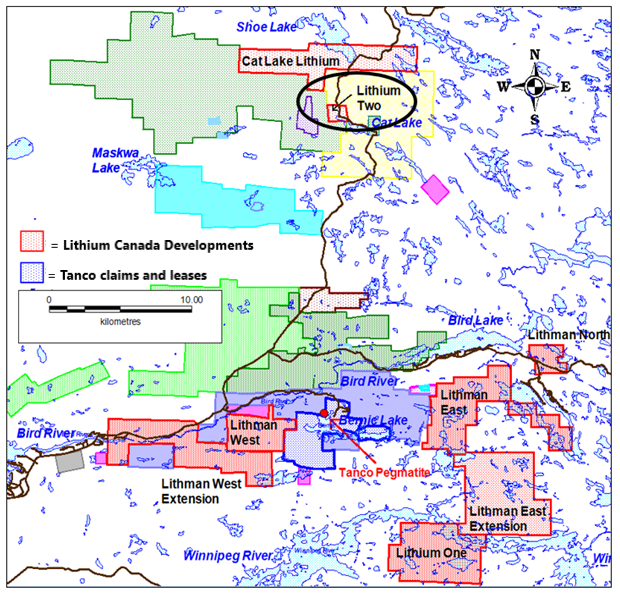
The Lithium Two Project is located approximately 20 kilometres north of the Tanco Mine and is an active area for Lithium exploration. Several companies are active in the immediate region, exploring for Lithium.

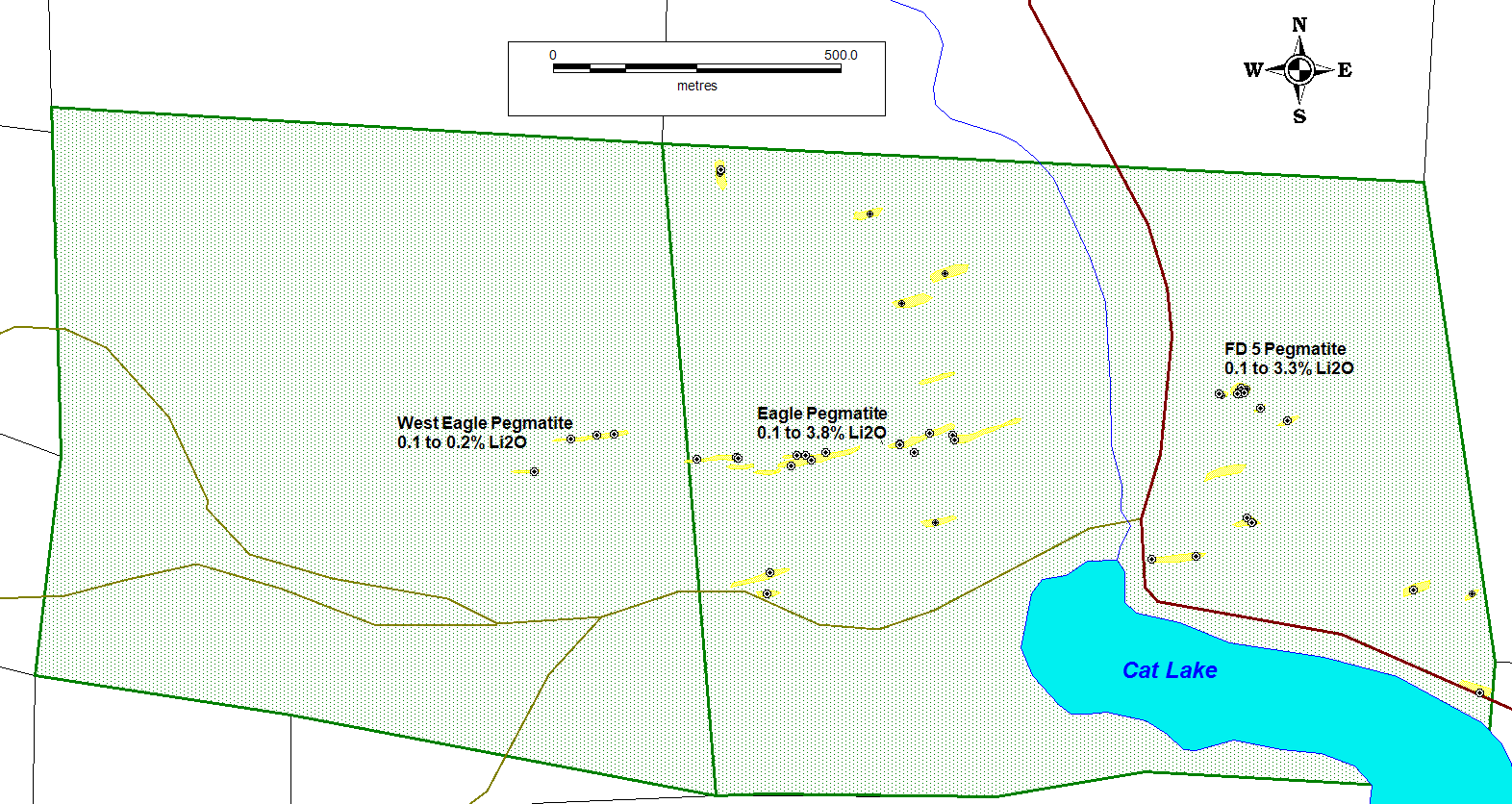
Surface exploration was carried out on the Lithium Two Project during the summer of 2018 (see News Release October 30th, 2018). The exploration work was designed to examine the known surface pegmatites to aid in the determination of drill targets. The field program also focussed on more detailed structural geological mapping and mapping of the westward extent of the Eagle Pegmatite. The Lithium Two Project has several historically known Spodumene bearing pegmatites (see Figure 2).


Click Image To View Full Size

Figure 1: Manitoba Lithium and Rare Element Projects 2019

The Eagle Pegmatite was drilled in 1947 with a historic (non 43-101 compliant) tonnage estimate of 544,460 tonnes with a grade of 1.4% Li2O to the 61-metre level. These historical estimates do not use categories that conform to current CIM Definition Standards on Mineral Resources and Mineral Reserves as outlined in National Instrument 43-101, Standards of Disclosure for Mineral Projects (“NI 43-101”) and have not been redefined to conform to current CIM Definition Standards. A qualified person has not done sufficient work to classify the historical estimates as current mineral resources and the Company is not treating the historical estimates as current mineral resources. Investors are cautioned that the historical estimates do not mean or imply that economic deposits exist on the properties. The Company has not undertaken any independent investigation of the historical estimates or other information contained in this press release nor has it independently analyzed the results of the previous exploration work in order to verify the accuracy of the information. The Company believes that these historical estimates and other information contained in this news release are relevant to continuing exploration on the properties as it identifies significant mineralization that will be the target of future exploration and development.

The Eagle Pegmatite was historically reported to remain open to depth. The FD5 Pegmatite, located east of the Eagle Pegmatite has never been drilled. Historic assessment reports revealed a Spodumene bearing pegmatite drilled in the late 1940’s, located approximately 500 metres southeast of the Eagle Pegmatite but is not exposed on surface. No assays were provided in the report at the time. This pegmatite, as well as the Eagle and FD5, will be tested during an upcoming recommended drill program.


Click Image To View Full Size

Figure 2: 2018 Lithium Assays at the Lithium Two Project, SE Manitoba

The Eagle Pegmatite has been mapped on surface for over 850 metres and has surface assays of 0.1 to 3.8% Li2O. The FD5 pegmatite had surface assays from 0.1 to 3.3% Li2O. In geological terms, the pegmatites encountered on the Lithium Two Project are LCT Type (Lithium-Cesium-Tantalum) Pegmatites and are in the Albite-Spodumene Subgroup. Spodumene is expressed in the pegmatites as small green blades up to 3 centimetres in length. The Eagle Pegmatite is a west-northwest to west-striking, vertically dipping, lenticular pegmatite dyke intruded into mafic volcanics. The widths of the pegmatite have been measured to be between 2 to 10 metres. The Eagle Pegmatite system appears to be a swarm of closely spaced pegmatite bodies.

Phase 1 Drill Program Planning in Progress

A drill program of 1,500 metres is planned to test three spodumene bearing pegmatite targets. A drill permit has recently been issued by the Manitoba government.

Lithium One Drill Program

Recently, NAM engaged White Spruce Archaeology as part of its Exploration Agreement with the Sagkeeng First Nation to conduct an archaeological assessment on the proposed drill sites for Lithium One as part of the drill permitting process. The assessment was completed in October and the report is pending. A 1,500 metre drill program is planned to test targets on the Silverleaf pegmatite ( News Release Sept 27, 1018) situated in the Lithium One project area.

NAM/AAZ Property Option Update

JV partner Azincourt Energy (AAZ) and NAM are in discussions regarding AAZ’s compliance for its contractual obligations as part of the option agreement with NAM. NAM and AAZ are in continuing talks regarding a revision to the existing option agreement or termination.

OPT-IN LIST

If you have not done so already, we encourage you to sign up on our website (www.newagemetals.com) to receive our updated news.

ABOUT NAM’S PGM DIVISION

NAM’s flagship project is its 100% owned River Valley PGM Project (NAM Website – River Valley Project) in the Sudbury Mining District of Northern Ontario (100 km east of Sudbury, Ontario). Recently the company announced the results of the first PEA (see News Release – June 27th, 2019) completed on the River Valley Project. The PEA has been developed by various independent consultants – P&E Mining Consultants Inc. (P&E) was responsible for the open pit mining, surface infrastructure, tailings facility, and project economics; DRA Americas Inc. (“DRA”) was responsible for all metallurgical test work and processing aspects of the Project; and WSP Canada Inc. (“WSP”) was responsible for the Mineral Resource Estimate. The PEA is a preliminary report but it has demonstrated that there are positive economics for a large-scale mining open pit operation, with 14 years of Palladium and Platinum production.

The Genesis project is a PGM-Cu-Ni property located in the northeastern Chugach Mountains, 75 paved road miles north of the all-season port city of Valdez, Alaska. The project is within 3 km of the all-season paved Richardson Highway and a high capacity electric power line. The project is covered by 4,144 hectares of State of Alaska mining claims owned 100% by New Age Metals. Past exploration has revealed the presence of chromite-associated platinum and palladium mineralization and stratabound Ni-Cu-PGM mineralization within magmatic layers of the Tonsina Ultramafic Complex. Pyrrhotite, pentlandite, and chalcopyrite occur in disseminations and net textured segregations associated with platinum and palladium sulfides. There has been limited exploration over the Genesis project and there has been no past exploration drilling on the project. NAM management is actively seeking an option/joint-venture partner for this road accessible PGM and Multiple Element Project.

QUALIFIED PERSON

The contents contained herein that relate to exploration results or geological aspects is based on information compiled, reviewed or prepared by Carey Galeschuk, P. Geo., a consulting geoscientist for New Age Metals. Mr. Galeschuk is the Qualified Person as defined by National Instrument 43-101 and has reviewed and approved the technical content of this news release.

On behalf of the Board of Directors

Harry Barr”

Harry G. Barr

Chairman and CEO

Neither the TSX Venture Exchange nor its Regulation Services Provider (as that term is defined in the policies of the TSX Venture Exchange) accepts responsibility for the adequacy or accuracy of this release.

Cautionary Note Regarding Forward Looking Statements: This release contains forward-looking statements that involve risks and uncertainties. These statements may differ materially from actual future events or results and are based on current expectations or beliefs. For this purpose, statements of historical fact may be deemed to be forward-looking statements. In addition, forward-looking statements include statements in which the Company uses words such as “continue”, “efforts”, “expect”, “believe”, “anticipate”, “confident”, “intend”, “strategy”, “plan”, “will”, “estimate”, “project”, “goal”, “target”, “prospects”, “optimistic” or similar expressions. These statements by their nature involve risks and uncertainties, and actual results may differ materially depending on a variety of important factors, including, among others, the Company’s ability and continuation of efforts to timely and completely make available adequate current public information, additional or different regulatory and legal requirements and restrictions that may be imposed, and other factors as may be discussed in the documents filed by the Company on SEDAR (www.sedar.com), including the most recent reports that identify important risk factors that could cause actual results to differ from those contained in the forward-looking statements. The Company does not undertake any obligation to review or confirm analysts’ expectations or estimates or to release publicly any revisions to any forward-looking statements to reflect events or circumstances after the date hereof or to reflect the occurrence of unanticipated events. Investors should not place undue reliance on forward-looking statements.

PRIMO Nutraceuticals Inc. $PROM.ca Harvests 13,000 lbs of Dried Bio-mass from Oregon Hemp Farm $CROP.ca $VP.ca NF.ca $MCOA

Posted by AGORACOM-JC at 8:24 AM on Wednesday, October 30th, 2019
  • Company has completed a harvest totaling 13,000 lbs of dried bio-mass of hemp from the Oregon hemp farm.
  • The dried bio-mass hemp is currently being stored at a local drying facility located near Eugene, Oregon.
  • The value for the crop in its current state is estimated to be worth $200,000 – $300,000 USD.

VANCOUVER, British Columbia, Oct. 30, 2019 — PRIMO NUTRACEUTICALS INC. (CSE: PRMO) (OTC: BUGVF) (FSE: 8BV) (DEU: 8BV) (MUN: 8BV) (STU: 8BV) (“Primo” or the “Company”)is pleased to announce that further to the Company news release dated October 1, 2019 the Company has completed a harvest totaling 13,000 lbs of dried bio-mass of hemp from the Oregon hemp farm. The dried bio-mass hemp is currently being stored at a local drying facility located near Eugene, Oregon. The value for the crop in its current state is estimated to be worth $200,000 – $300,000 USD. This will be added to the 28 kilo grams of crude oil currently in inventor from last year’s harvest. 

The completion of the 2019 harvest season is a major milestone for the company and for the hemp farm in Oregon, as this is the first year hemp has been federally legal since the Farm Bill was passed. This year in Oregon alone there are nearly 63,000 acres registered growing hemp compared to the 11,500 acres growing hemp registered in 2018. This is a significant increase in the amount of hemp being grown, which solidifies the Primo strategy of providing drying facilities to the ever growing hemp market in Oregon. Primo plans to have its first drying facility built and in operation by the end of the first quarter of next year.

President, Andy Jagpal Comments:

“I am very proud and excited with the amount of dried hemp that was harvested as it surpassed our expectations by a few thousand pounds. During a time in the cannabis market where companies have spent tens of millions of dollars building out facilities and cultivation infrastructure and have little to show for it, we have two harvests under our belt and product in inventory ready for sale. Together with this year’s harvest and last year’s inventory we estimate our inventory alone to be worth between $400,000 and $500,000 USD.”

VP Sales & Distribution, Andy Dhaliwal Comments:

“The on-hand inventory and quality of the hemp as starting material is a major advantage in the current marketplace. While the revenue opportunities from the harvest are extremely promising, the hemp processing infrastructure supports the expansion of our in-house product lines, and increases our white-label offering to the USA market as well. Both of which are tremendous assets for the company.”

About Primo Nutraceuticals, Inc.

Primo Nutraceuticals Inc. (“Primo” or the “Company”) provides strategic capital to the thriving cannabis cultivation sector through ownership and development of commercial real estate and farm friendly properties. Primo is dedicated to funding the rapid growth in production, processing, retail and branding of cannabis and cannabis related products in Canada and the United States. Primo provides fully built out turnkey facilities equipped with state-of-the-art growing infrastructure to cannabis growers and processors. In addition to the Company’s flagship hemp project in Oregon State and the Greenhouse campus in Washington State, Primo has invested in several brands and is pursuing partnerships with retailers and distribution companies in Canada and the United States. Primo’s management is in the process of building a corporate road map to further vertically integrate the Company, specifically by way of “Primo” branded retail outlets – offering “Thrive,” “Primo,” and a selection of curated partner brands. The Company possesses proprietary formulas for cannabis edibles, topical, and tinctures. Primo is focused on building a strong presence in the hemp industry with the objective of extracting and selling cannabinoids (CBD) products in both Canada and the United States.

On behalf of the Board of Directors
PRIMO NUTRACEUTICALS INC.

Andy Jagpal, President and Director

To learn more about what this news means to the shareholders visit https://marketnewsfirst.com/primo-nutraceuticals, as well as on the company’s site.

For further information, please contact Zoltan, IR Representative at: 604-722-0305 [email protected]. Or toll free at 1-877-517-7816.

http://primoceuticals.com/
https://twitter.com/prmonutra
www.thriveCBD.org

FORWARD LOOKING STATEMENTS: This news release contains certain forward-looking statements within the meaning of Canadian securities laws. Forward-looking statements are based on the expectations and opinions of the Company’s management on the date the statements are made. The assumptions used in the preparation of such statements, although considered reasonable at the time of preparation, may prove to be imprecise and, as such, undue reliance should not be placed on forward-looking statements. The Company expressly disclaims any intention or obligation to update or revise any forward-looking statements whether as a result of new information, future events or otherwise.

No regulatory authority has approved or disapproved the information contained in this news release.

A photo accompanying this announcement is available at https://www.globenewswire.com/NewsRoom/AttachmentNg/ddc63988-72ec-4630-a25d-5d418ba2ea1b

INTERVIEW: “The Gold Standard Of Gold Research” Publisher, Ronnie Stoeferle, Appointed To Affinity Metals $AFF.ca $SII.ca $TUD.ca $GTT.ca $AMK.ca $OSK.ca

Posted by AGORACOM-JC at 9:36 AM on Wednesday, October 23rd, 2019

When the Wall Street Journal calls your Gold Report “The Gold Standard Of Gold Research”, it is safe to say you are a global influencer and expert in all things gold.

This is Ronnie Stoeferle, whose “In Gold We Trust” report has also been downloaded 1.8 million times in English, German and Mandarin in case anyone had any doubt as to his expertise.

Today, Ronnie became the founding member of the Affinity Metals (AFF:TSXV) Advisory Board, which implies that we can expect others to be appointed as well. Why would Ronnie join a company with a market cap under $5,000,000?  You’ll have to watch the interview to find out … but here are a couple of hints:

1.  Affinity Metals flagship project, the Regal, has reported HISTORICAL reserves of 590,703 tonnes grading 71.6 grams per tonne silver, 2.66 per cent lead, 1.26 per cent zinc, 1.1 per cent copper, 0.13 per cent tin and 0.015 per cent tungsten.  These were prepated prior to 43-101 standards and should not be relied upon until they are brought into compliance with 43-101 standards. 

2.  A Technical Report, which was prepared in 1971 using a silver price of $1.75 per troy ounce, makes a positive recommendation for production, including the establishment of a 500 ton per day concentrator with a 400 ton per day silver, lead and zinc circuit and a 100 ton per day tin, tungsten and copper circuit.

These are just 2 factors that led Ronnie to declare that Affnity Metals is “one of the largest investments in my private portfolio”.

Grab your favourite beverage, kick back and watch this great interview with both Ronnie and Affinity CEO, Rob Edwards.

VIDEO: $HPQ.ca An Emerging Low Cost #Silicon Metal Producer Goes Beyond The Presentation $FSLR $SPWR $CSIQ $PYR.ca $XMG.ca

Posted by AGORACOM-JC at 5:45 PM on Friday, October 18th, 2019

HPQ Silicon makes its strongest case ever for the lead it has taken in the commercialization of its’

  • Solar grade silicon;
  • Silicon wafers for Li-ion batteries
  • High purity silicon for high value niche applications;
  • Metallurgical grade silicon at prices the industry has never seen before;

More than just lip service that we have typically come to expect from 98% of small cap companies, the Company’s pilot plant is about to go live and produce test samples of silicon wafers for batteries and is supported by not 1 but 2 (TWO) world class technology partners that validate both the HPQ process and commercialization plan.

This is a powerful presentation that is worthy of your time to watch and learn about the rise of HPQ Silicon. 

Enthusiast Gaming $EGLX.ca – The Battle for #Esports Dominance is on $INTC $TMUS $NKE $SAP

Posted by AGORACOM-JC at 4:18 PM on Friday, October 18th, 2019

SPONSOR: Enthusiast Gaming Holdings Inc. (TSX-V: EGLX) Uniting gaming communities with 85 owned and affiliated websites, currently reaching over 150 million monthly visitors. The company exceeded 2018 target with $11.0 million in revenue. Learn More

The Battle for Esports Dominance is on

  • As esports teams battle out in front of millions of fans online, companies are engaging in similar warfare as they look to lock up sponsorship deals with some of the most prized assets in the industry
  • This year, esports sponsorship revenue is projected to be the highest revenue stream at US$456.7 million, growing 34.3% from 2018 (NewZoo, 2019)

By: Ben Feferman

The race is on! As esports teams battle out in front of millions of fans online, companies are engaging in similar warfare as they look to lock up sponsorship deals with some of the most prized assets in the industry. This year, esports sponsorship revenue is projected to be the highest revenue stream at US$456.7 million, growing 34.3% from 2018 (NewZoo, 2019). As casual fans continue to tune into extended amounts of esports content daily, businesses are beginning to understand the value proposition that esports presents; an industry that is ubiquitous, interactive and rapidly growing. In turn, sponsors provide vast amounts of financial resources that help transcend the nature of esports events, teams and players, alike.

Top Sponsors in Esports

Intel (NASDAQ: INTC)

From producing CPUs to dabbling in the game, Intel has held the longest sponsorship in esports with the Electronic Sports League (ESL). The two companies announced a partnership in which they will invest US$100 million towards esports initiatives to help the global growth and expansion of esports. Intel also sponsors many large esports events, including Intel Extreme Masters, ESL One, Intel Grand Slam, Counter-Strike: Global Offensive Pro League and the LPL league.

T-Mobile (NASDAQ: TMUS)

T-Mobile is a telecommunications company that started sponsoring some major teams very early. In 2017, T-Mobile was sponsoring both Cloud 9 and TSM, some of the largest esports teams in North America. Although they no longer sponsor those teams, T-Mobile continues to make an impact in the Overwatch League (OWL) by sponsoring the league and two of its teams, the Houston Outlaws and New York Excelsior.

BMW (ETR: BMW)

BMW is switching gears in 2019 as it begins to watch the esports landscape closely. The automotive company not only sponsored its first esports team in 2019 in Cloud 9, but also partnered with Brazil’s paiN Gaming in the same year.

Nike (NYSE: NKE)

It is hard to imagine a competitive environment in this world that does not have Nike’s footprint. Nike treats esports the exact same way. Nike supports esports athletes, such as Jain “Uzi” Zihao (Chinese League of legends Pro), through endorsement deals and sponsors the Chinese League of Legends Pro League, supplying the entire 16 team roster with Nike apparel. Through these synergies, Nike hopes to create sportswear catered to the esports audience and training programs for gamers to improve.

SAP (NYSE: SAP)

In a data-driven age, where analytics are helping countless athletes improve, it is only natural for electronic sports to follow the same path. In 2018, SAP, a business software company, announced a three-year sponsorship with Team Liquid to help improve the team’s performance through innovation in data driven analysis. SAP will use its SAP Huna, a business analytics platform, along with Team Liquid’s DOTA team’s collaboration to help pioneer the first wave of deep game analysis. SAP also sponsors large events, such as ESL and DreamHack, to provides these live events with data analysis using its cloud platform.

As the arms race heats up for dominance in esports sponsorships, the companies with established relationships with top tier teams and leagues will have a strong first to market advantage. However, with the centrality and fragmentation of the industry, there are still many untapped pockets for new entrants.

The vast majority of esports companies, be in teams, franchises or content plays, will be relying on corporate sponsorships to drive revenue and these companies know, sponsorships are what will continue to drive their valuations. This market is going to heat up and get way more interesting.

Other Large Esports Sponsors.

  • Honda (TYO: 7267) – Team Liquid
  • Monster Beverage Corp (NASDAQ: MNST) – PSG Esports
  • Nissan (TYO: 7201) – FaZe Clan, Optic Gaming
  • Puma (ETR: PUM) – Cloud 9
  • HTC Cord (TPE: 2498) – FaZe Clan
  • Pepsi (NASDAQ: PEP) – Team Dignitas, Splyce, Sk Gaming
  • Disney (NYSE Disney) – Team Liquid
  • Daimler AG (ETR: DAI) – ESL
  • Razor (HKG: 1337) – Immortals, Evil Geniuses, Seoul Dynasty, LA Valiant, EDG,

Source: https://investorintel.com/sectors/esports-gaming/esports-gaming-intel/battle-for-esports-dominance/

ThreeD Capital Inc. $IDK.ca – #Crypto Correlations Change As #Ethereum Becomes Benchmark, and #Bitcoin Analysis Today $HIVE.ca $BLOC.ca $CODE.ca

Posted by AGORACOM-JC at 2:17 PM on Friday, October 18th, 2019

SPONSOR: ThreeD Capital Inc. (IDK:CSE) Led by legendary financier, Sheldon Inwentash, ThreeD is a Canadian-based venture capital firm that only invests in best of breed small-cap companies which are both defensible and mass scalable. More than just lip service, Inwentash has financed many of Canada’s biggest small-cap exits. Click Here For More Information.

IDK: CSE

Crypto Correlations Change As Ethereum Becomes Benchmark, and Bitcoin Analysis Today

  • An important change from Q2 is a gradual ‘flippening’ of Ethereum and Bitcoin.
  • As the #1 cryptocurrency began increasing its dominance, Ethereum became the benchmark asset for the rest of the market, with most cryptocurrencies showing higher correlation with it than Bitcoin. 

By: Andrey Shevchenko

The cryptocurrency markets are seeing a small retracement today. Bitcoin continues its low-volatility trading around the $8,400-8,500 level, while altcoins are still pulling back from their previous gains.

Notable exceptions are 0x (ZRX), Algorand (ALGO) and Chainlink (LINK), which gained 3%, 10% and 5% over yesterday respectively.

Cryptocurrency price dynamics on October 11, by Coin360

Correlations, correlations everywhere in crypto 

A report by Binance Research analyzed the relative performance of cryptos in Q3. As markets slid downwards from their yearly high in the summer, large market-cap coins did so in unison. 

“Over the third quarter of 2019, the average correlation between Bitcoin and most other large cryptoassets ​remained in line with the previous quarter,” the report notes. “​However, the average correlation among large cryptoassets increased in Q3 2019 with a significant positive increase in the correlations of BNB, ChainLink, and Bitcoin SV with other cryptoassets.

An important change from Q2 is a gradual ‘flippening’ of Ethereum and Bitcoin. As the #1 cryptocurrency began increasing its dominance, Ethereum became the benchmark asset for the rest of the market, with most cryptocurrencies showing higher correlation with it than Bitcoin. But correlation with Ethereum Classic was surprisingly among the lowest, amounting ‘only’ to 0.69.

The report also highlighted the significant correlation between XRP and Stellar, previously noted by Crypto Briefing. 

Lastly, cryptocurrencies appear to be specializing in distinct branches. Proof-of-Work assets such as Bitcoin, Litecoin and Bitcoin Cash exhibited higher correlation between each other than median. The same can be said for privacy coins such as Monero, Zcash and Dash, as well as programmable blockchains including EOS, NEO and Ethereum.

But while some of these trends have a logical underpinning, the report cautions that the future is unknowable. “Yet, past empirical results are not representative of the future of this industry. Hence, it remains to be seen whether some of these findings will repeat in the fourth quarter of 2019,” analysts conclude.

Daily Bitcoin Commentary With Nathan Batchelor 

Bitcoin is under downside pressure as we head into the U.S trading session, after the BTC/USD pair reversed sharply from just above $8,800 level earlier this morning.

Around $10,000,000,000 was wiped off the total market cap of the entire cryptocurrency market in just under one-hour. Interestingly, the total market cap of the cryptocurrency market hit its highest level in two-weeks before reversing.

No apparent fundamental catalyst has been attributed to the news. The only real bearish news is that one of the largest payment systems in China, Alipay, has recently promised to ban all payments related to Bitcoin.

From a technical perspective, traders will likely continue to fade rallies until the market cap of the entire cryptocurrency starts to trade comfortably above its 200-day moving average.

Traders are currently selling advances towards the $230,000,000,000 level, as it represents the 61.8 Fibonacci retracement of the September monthly trading low to the September 24th swing-high.

As far as Bitcoin is concerned, the cryptocurrency is back under short-term selling pressure while trading below the $8,500 level, with its 200-day moving average currently located around the $8,660 level.

According to short-term technical analysis, the BTC/USD pair can expect to find support from the $8,215 and $8,100 levels if the reversal continues.

If there is a sustained loss of the $8,100 level, we should expect short-term bulls to capitulate, leaving the door-open for further decline towards the $7,715 level.

* ‘The weekly time frame is showing that a bullish falling wedge is forming. A move away from the $9,780 to $7,500 price range will trigger the pattern’. *

SENTIMENT

Intraday bullish sentiment for Bitcoin has fallen, to 51.50%, according to the latest data from TheTIE.io. Long-term sentiment for the cryptocurrency is unchanged, at 61.50%.

UPSIDE POTENTIAL

Buyers need to move price back above the $8,500 level to stabilize the BTC/USD pair today. A multi-day price close above its 200-day moving average is currently needing to encourage a technical test of the $9,000 level.

The daily RSI indicator is starting to roll over and now trades below 40, while the Choppiness indicator on the mentioned time frame is showing that the market is still lacking a strong trend.

DOWNSIDE POTENTIAL

The loss of the $8,500 level has encouraged traders to test towards the $8,300 level. A loss of the $8,300 level later today may lead to a key test of the BTC/USD pair’s weekly pivot point, at $8,100.

Extended intraday technical support for the BTC/USD pair is currently located at the $7,715 and $7,500 levels.

Source: https://cryptobriefing.com/crypto-correlation-trends

Enthusiast Gaming $EGLX.ca – Visualized: The #Esports Journey to Mainstream $EPY.ca $FDM.ca $WINR $TCEHF $ATVI $TNA.ca

Posted by AGORACOM-JC at 11:34 AM on Friday, October 18th, 2019

SPONSOR: Enthusiast Gaming Holdings Inc. (TSX-V: EGLX) Uniting gaming communities with 85 owned and affiliated websites, currently reaching over 150 million monthly visitors. The company exceeded 2018 target with $11.0 million in revenue. Learn More

Visualized: The Esports Journey to Mainstream

Although esports might seem like a relatively new phenomenon, its origins can be traced all the way back to the 1970s.

It was only in the past decade however, that a wave of technological innovation transformed the entire industry from an underground niche into a billion-dollar mainstream phenomenon.

Today, the nascent esports industry competes with some of the biggest sports leagues in the U.S., while global tech giants hastily invest billions of dollars to make their mark in what many consider to be the future of sports and entertainment.

How did it evolve into the industry we know today—and more importantly, will it maintain its furious pace of growth?

The History of Esports

Electronic sports (or esports), are organized, multiplayer video game competitions commonly played by professional gamers. Since its inception, the industry has continued to exceed expectations and reach new milestones every decade.

Note: The timeline of events are an abridged version of major achievements in the industry.

1970s: The Birth of Esports

The earliest known video game competition—the Intergalactic Spacewar Olympics—took place in 1972 at Stanford University. The winner of the event received an annual subscription to Rolling Stone magazine.

While it was a modest first prize for the industry, it would set a foundation for future prize pools in the millions of dollars.

1980s: More Gaming Options

The 1980s ushered in better consoles for esports. The Nintendo Entertainment System (NES) took graphics, controls, gameplay, and video game accessibility to the next level.

Five years later, the Sega Genesis console was released in the U.S. and Japan to compete with Nintendo—which held a 95% market monopoly at the time.

1990s: The First Tournaments

Nintendo increased its commitment to esports by hosting the Nintendo World Championships. After touring 30 cities in the U.S., the finals challenged players to games like Super Mario Bros. and Tetris, with a 40-inch TV awarded to the winner.

Developers and gaming entrepreneurs created a flurry of leagues, including QuakeCon in 1996, followed by both the Cyberathlete Professional League (CPL) and the Professional Gamers League (PGL) in 1997.

In just a few years, these competitions helped esports gain significant traction.

2000s: The Explosion of Esports

Esports fully burst into the mainstream with Amazon’s acquisition of Twitch for $970 million in 2014. The live video game streaming site gave esports a platform to reach previously unthinkable heights, with popular games like League of Legends (LoL) and Defense of the Ancients 2 (Dota) receiving millions of views.

In 2019, Google followed suit with its Stadia streaming service. The cloud-based video game platform aims to eliminate the need for hardware, allowing Google to aggressively compete in the esports space.

A Snapshot of Esports Today

The increasing involvement of developers and global tech giants has not only increased the audience size of esports—it has also led to bigger prize pools, and larger scale competitions across the world.

  • Demographics: 50% of esports viewership now comes from Asia.
  • Engagement: 6 billion hours were dedicated to watching esports in 2018, and will continue to grow to 9 billion by 2021.
  • Buy-in: The price of one of the 12 Overwatch League teams for sale in 2017 was $20 million.
  • Incentives: The Fortnite competition prize pool for the 2018 season was $100 million—equal to the entire esports prize pool in 2017.

It’s clear that esports continues to attract rapidly growing audiences at an unprecedented rate. However, there are still significant barriers inhibiting the industry from reaching its full potential.

The Future of esports

In order to maintain its furious pace of growth, the esports industry must first address five key challenges:

  • Diversity of game genres: The industry will need to produce more game genres in order to appeal to a wider audience outside of its current player base.
  • Geographic expansion of leagues: esports will need to expand to national, regional, and global levels if it wants to tap into bigger advertising budgets. However, while esports gains attention from global media, local events are more difficult to organize.
  • Regulation of competitions: With multimillion-dollar prize pools at stake, new rules and regulations are needed to combat cheating and match fixing.
  • Ownership of media rights: Content rights have not been a focus for publishers, as fan-generated content has served as free advertising for their games.
  • Media alignment: Traditional media brands are still reluctant to associate themselves with esports, as prejudices against competitive gaming still exist. For example, gaming culture is viewed as a harmful distraction, rather than a legitimate sport.

In less than 50 years, esports has evolved into a dominant form of entertainment today, eclipsing film and music industries by a wide margin. With an increasingly mainstream audience, the industry’s popularity and profitability shows no signs of slowing down—despite the challenges it faces.

Source: https://www.visualcapitalist.com/visualized-the-esports-journey-to-mainstream/

NORTHBUD $NBUD.ca – ‘It is quite amazing’: #CBD oil entering the mainstream $CGC $ACB $APH $CRON.ca $HEXO.ca $TRST.ca $OGI.ca

Posted by AGORACOM-JC at 10:26 AM on Friday, October 18th, 2019

SPONSOR: NORTHBUD (NBUD:CSE) Sustainable low cost, high quality cannabinoid production and procurement focusing on both bio-pharmaceutical development and Cannabinoid Infused Products. Learn More.

NBUD: CSE
—————————–

‘It is quite amazing’: CBD oil entering the mainstream

By James Pugh

Some people are infusing the cannabis extract in cocktails, others are buying it in the form of dog treats, while many more are using it as a form of pain relief.

Unlike tetrahydrocannabinol, the psychoactive extract of the cannabis plant commonly known as THC, cannabidiol doesn’t cause users to get high.

And it is legal in the UK, assuming it does not contain one part in 10,000 of THC.

“When I first got involved with CBD I wanted to know what it was all about,” says Richard Butler, part of the management team at CBD Virtue, between Bridgnorth and Wolverhampton.

“It is still new in the UK.”

Some of the products

His company uses CBD to make products such as tablets, oils, body creams and balms.

Mr Butler says people are turning to CBD products to alleviate symptoms from physical ailments like pain and inflammation as well as mental ones like anxiety and depression.

At present, use of the oil is largely unregulated, and clinical trials into its usefulness are ongoing, but Mr Butler says he has witnessed its benefits.

“You learn more from the responses and feedback you get from customers,” he says. “It helps with pain relief, mental issues, anxieties.

“It also helps with eczema, psoriasis and acne – it is quite amazing actually.

“A lot of our initial customers were 40 plus and many were buying products for the younger generation.

Dean Burke using a CBD Pod Filler at CBD Virtue

“What has amazed me is the amount of depression and anxiety that exists among teenagers up to people in their late 20s.”

CBD oil, its proponents say, offers numerous benefits, from pain relief to reducing anxiety. As an anticonvulsant, it may also help treat neurological disorders such as epilepsy and multiple sclerosis.

CBD is also one of the biggest buzzwords in food and drink. It has been hailed the next big thing, with more and more chefs and producers using the products in their recipes.

After already taking other countries by storm, more businesses in the UK are looking to tap into the market.

Ross Burke viewing the product range at CBD Virtue

Mr Butler insists he has seen some significant success stories of people using the product for remedial purposes.

“I know someone who suffered with Parkinson’s for years who every time they woke up their whole body would be shaking and during the day they would shake out of control,” he says.

“I said ‘try this’ and within two weeks they went from their whole body shaking to feeling a slight twitch in their first finger and thumb.

“I am not allowed to say it cures cancer, but cancer sufferers are using it. There was someone who had skin cancer and it helped clear up blisters on their skin.

“My partner was on a lot of medication for various things and after taking four or five drops a day her stress and anxiety has gone.”

The product’s relationship to recreational cannabis also means that some people are reluctant to accept its use, and the medical benefits it provides have still to be proven beyond doubt.

But Mr Butler insists that the hemp-derived oil should be trusted.

“It is from a natural product that has been around for years,” he says. “Initially people were sceptical because it relates to cannabis. Yes, it is derived from cannabis plant, but the ‘high’ has been removed with the remedial side left behind.

The management team at CBD Virtue: Dean Burke, Richard Butler, Shannon Fyfe and Ross Burke

“We had the over 50s saying ‘ yeah but it’s cannabis, it’s cannabis’, but once you have explained to them they are willing to try it.

“A big part of my role has been educational. I would spend about two hours a day on Facebook educating people and answering a lot of questions.

“Initially it is getting people to try it, then after they see how effective it is they speak about it to their friends and family – a lot of it comes down to word of mouth.”

The plant is grown in Colorado in the USA, and a powdered form of the product is sent to the UK for the oil to be extracted by Richard’s team.

CBD Virtue employs 16 people, and is looking to double that by moving to larger premises to cope with demand.

Richard says: “We have a lab which is about 15ft by 20ft where a lot of our mixing is done. We also have another facility where we do the bottling up and everything else.

Jean Price packing up an order at CBD Virtue

“We are looking for larger premises due to growing demand and want to stay local. We employ 16 people and with the way things are going we are looking to double the workforce.”

Sales of products containing CBD have skyrocketed by 99 per cent in the UK, according to data.

Analysis by deals firm Wowcher suggests purchases of CBD products have almost doubled in 2019, with an increasing number of Brits trying the ingredient.

“The industry is exploding,” Mr Butler says. “Initially as a company we had a slow start with various issues with banks and online payment systems, but we have got more and more people on board who know how to get around these things.

Source: https://www.expressandstar.com/news/business/2019/10/17/it-is-quite-amazing-cbd-oil-entering-the-mainstream/