Posted by AGORACOM-JC
at 2:17 PM on Wednesday, May 29th, 2019
SPONSOR: Esports Entertainment
$GMBL Esports audience is 350M, growing to 590M, Esports wagering is
projected at $23 BILLION by 2020. The company has launched VIE.gg
esports betting platform and has accelerated affiliate marketing
agreements with 190 Esports teams. Click here for more information
GMBL: OTCQB
———————–
Gamers Fight for Rights as Billion-Dollar Esports Market Matures
While there’s disagreement over how big a problem this is, there’s consensus that esports organizations have too much power.
“Orgs have strong counsel with 30-page agreements that have all sorts
of terms in them, and often on the other side you’ve got a teenager, or
early 20s, who’s probably never read a contract before,†said Gordon,
whose firm represents both players and organizations. “It’s really
weighted against the player.â€
As some esports leagues push to make themselves more and more like traditional sports
leagues, the industry may need to decide whether its players will get
the benefits of traditional sports stars (unions, collective bargaining
and rigid salary structures) or whether it will mirror more the music
and entertainment world, where young creators often sign away a large
bulk of their rights and income on their way up.
Finding Agents
One major concern in esports: Teams often serve as management for
their players. Trink said that earlier this year, while FaZe Clan was
trying to reach a new agreement with Tenney, it began encouraging those
on its roster to find outside representation. He said it’s better for
the players and better for the organization to help avoid situations
like the one they’re in now.
That’s part of what Trink called the new-era contract. In addition to
helping gamers find agents or managers, the team is rethinking revenue
splits. Instead of teams getting 80% of brand deals that it brings to a
player, Trink said the team now takes 20%. (The $60,000 that FaZe claims
to have made from Tenney came from 20% cuts off two different brand
deals.)
FaZe Clan is also getting more granular on revenue details. Instead
of simply taking a cut of Twitch revenue, FaZe Clan is separating out
different streams. It no longer takes a percentage of donations or
subscriptions that its gamers earn from Twitch, which for top streamers
can be tens of thousands of dollars each month.
“We feel that is too personal and that we shouldn’t take that money,†Trink said.
Proving Themselves
Only so much change can come from the teams themselves. In the
future, gamers may need fully independent unions, similar to those in
the NFL or NBA, and a collectively bargained salary structure.
But as in pro sports, up-and-coming gamers will have to demonstrate that they deserve lucrative contracts, said Bryce Blum, founding partner at ESG Law.
“An unproven player in esports, like the majority of rookies in
traditional sports, isn’t worth a massive deal,†he said. “They need to
get their foot in door and prove their worth on the first contract in
order to improve their value in the marketplace.â€
Posted by AGORACOM-JC
at 11:47 AM on Wednesday, May 29th, 2019
SPONSOR: ThreeD Capital Inc. (IDK:CSE) Led by
legendary financier, Sheldon Inwentash, ThreeD is a Canadian-based
venture capital firm that only invests in best of breed small-cap
companies which are both defensible and mass scalable. More than just
lip service, Inwentash has financed many of Canada’s biggest small-cap
exits. Click Here For More Information.
——————-
Debunking the Top 5 Blockchain Myths
Satoshi Nakamoto’s seminal paper “Bitcoin: A Peer-to-Peer Electronic Cash System,†published in 2009, which took cues from “How to Time-Stamp a Digital Document,†published by Stuart Haber and W. Scott Stornetta in 1991, sparked a feeding frenzy of accolades for blockchains
which inscribed an urban legend about trusted public decentralized
blockchains, a historical departure from the mediation of brokers and
third parties. The first paper sought to create trust in digital
currencies by solving the decades-old “double spend†problem associated
with digital currencies with applied cryptography and the second by preventing the tampering of digital documents with time stamping.
The information, documents, transactions or digital coins are mathematically protected with hard-to-crack hash functions
that create a block and interconnect it to previously created blocks.
To validate the new chain of blocks, it is then broadcasted and shared,
to a distributed network of computers, to collectively agree about the
authenticity of the transactions, using additional mathematics of a
consensus algorithm.
The entire cryptographic proof of transactions is stored as an
immutable record on a distributed and shared ledger, or the blockchain.
“In effect, this is triple entry accounting which includes the two
entries of the transacting parties and a third record for the public,
registered on a public distributed ledger, which cannot be tampered
with,†Ricardo Diaz, the Charlotte, North Carolina-based founder of Blockchain CLT and management consultant for commercialization of enterprise blockchains, told us.
Rising from the trough of disillusionment, the myths around public
centralized blockchains have been reexamined and we will now assess the
controversy. (Blockchain is being used for much more than just
cryptocurrency. Learn more in Why Data Scientists Are Falling in Love with Blockchain Technology.)
Myth #1: Private permissioned blockchains cannot be secure.
Private permissioned blockchains are a contradiction in terms and
public blockchains are the only secure and viable option. Public
blockchains gain trust by consensus, which is not possible when private
blockchains need permission for a small group of people.
In actual implementations, centrally controlled private or federated
permissioned blockchains, albeit distributed, are common. Federated
blockchains focus on specific verticals
such as R3 Corda for banks, EWF for energy and B3i for insurance
companies. The motivation to keep a blockchain private is
confidentiality and certainty of regulatory compliance as in banking,
unique needs such as in renewable energy
where small producers need to connect with consumers, or the fear of
cost overruns or underwhelming performance of unproven technologies as in insurance.
The jury is still out whether private blockchains will last beyond their pilot programs. TradeLens is one private blockchain which IBM created with Maersk,
the largest container company in the world. According to press reports,
the project has gotten off to a slow start as other carriers, which
could be potential partners, have expressed skepticism about the
benefits they will realize from joining.
Steve Wilson, VP and Principal Analyst at Constellation Research,
cautioned against a rush to judgment. “IBM is moving slowly because it
is bringing together a group of partners who have not worked together
before. They are also transitioning from a world where trades were
mediated by brokers to an unfamiliar world of direct trading. The trade
documentation is convoluted, and IBM is trying to avoid errors,†he told
us.
Fundamentally, Wilson does not see a well-defined use case for public
blockchains. “Public blockchains overlook the plain fact that any
business solution is inseparable from people and processes. The double
spend problem does not exist when transactions in physical worlds are
tracked at each stage,†he concluded.
By contrast, private blockchains, such as Corda in financial services,
are solving real problems. “The supervision of private blockchains by
credible stewards narrows down the problem of trust. Private blockchain
realize efficiency gains from a common and secure distributed ledger
which takes advantage of the cryptography, time-stamping, and smart contracts which were prototyped in public blockchains,†Wilson explained.
Myth #2: Hybrid blockchains are an incompatible mix of private and public.
Public, permissionless decentralized blockchains and private
centrally controlled permissioned blockchains are mutually exclusive.
They seek to create a trustworthy environment for transactions in
entirely different ways which are not compatible. It is not possible to
have a combination of the private and the public in a single secure
chain.
Hybrid combinations emerge as the market matures and dispel the
skepticism about the early forms of new technologies. Just like the
precursors to the internet were intranets and extranets which evolved into the internet with sites searchable with browsers; the cloud followed a similar path and hybrid clouds are widely accepted these days.
In the crypto community, there are two camps: the public,
permissionless blockchains and private, permissioned blockchain.
According to Diaz:
The private blockchain side has historically presumed to require miners and a cryptocurrency
financial incentive to validate the blockchain was unnecessary. Today,
new blockchain projects support private and public distributed ledger
technologies. Ternio.io, an enterprise
blockchain platform, leverages Hyperledger Fabric (a permissioned
blockchain technology) AND Stellar (a permissionless blockchain). Veridium.io, a carbon credit marketplace blockchain project, also has a similar DLT architecture.
Diaz also noted:
Jaime Dimon, CEO of JPMC, who dismissed bitcoin as a fraud, has not only invested in building a popular, secure, private blockchain called Quorum, but also introduced an enterprise stable coin (a type of cryptocurrency token) called the JPM Coin. It was built using the Ethereum
blockchain code base, a public blockchain protocol, and the privacy
technology from ZCash, another public but more secure blockchain
protocol. Security on Quorum is reinforced by secure enclave technology
which is hardware-based encryption.
Quorum is not a hybrid blockchain that has public and private
blockchains working together, but it incorporates the code from public
blockchains and cryptocurrencies that are normally integral to public
blockchains. It creates a fork on Ethereum to create a private
blockchain. There are other hybrid blockchains in which private and
public blockchains play complementary roles.
Hybrid blockchains have a compelling value that is driving skeptical
enterprise clients to progress from private blockchains to hybrid ones
that incorporate public blockchains and token economics on an as-needed
basis. The bridges between the private and the public chains in the
hybrid blockchain ensure that the security is not compromised, and
intruders are disincentivized by requiring them to pay to cross the
bridge.
Hybrid crypto networks of the future will be more secure than anything the internet, Web 2.0, has today. Diaz explained:
Crypto mesh networks that are supported by crypto routers, like the wireless router
in your home, will only process transactions that are cryptographically
secured not only with blockchain technology but also true crypto
economics. Imagine a crypto router or device that requires a small
amount of cryptocurrency to process a transaction like an email between
two parties. This one key difference will drastically impact hackers across the planet who are used to freely hacking computers and networking them together to launch a massive denial of service attack on some business. On the Decentralized Web, Web 3.0, the hacker would have to pay upfront for his/her bot army to launch the same attack. That is token economics crushing a major cybersecurity issue.
Myth #3: Data is immutable in any circumstance.
A cornerstone of public blockchains is the immutability of the pool of the data for all transactions that it stores.
The reality is that public blockchains have been compromised either
by an accumulated majority, also known as a “51% attack†of the mining
power by leasing equipment rather than purchasing it, and profit from their attacks or by bad code in poorly written smart contracts.
Rogue governments are another cybersecurity risk. “Private
individuals respond to incentives for keeping the data honest. My worry
is governments who have other non-economic objectives immune to
financial incentives,†David Yermack, Professor of Finance at the Stern
Business School in New York University, surmised.
Public blockchains have to come to grips with the fact that human error is possible
despite all the vetting — it happens in any human endeavor.
Immutability breaks when corrections are made. Ethereum was split into
Ethereum Classic and Ethereum following the DAO attack which exploited a vulnerability in a wallet built on the platform.
“The Bitcoin blockchain network has never been hacked. The Ethereum
blockchain has suffered attacks but the majority of them can be
attributed to bad code in smart contracts. Over the last two years, an
entirely new cybersecurity sector has emerged for the auditing of smart
contract code to mitigate the common risks of the past,†Diaz told us.
Auditing of software associated with blockchains, including smart
contracts, helps to plug the vulnerabilities in supporting software that
exposes blockchains to cybersecurity risks. (For more on blockchain
security, see Can the Blockchain Be Hacked?)
Myth #4: Private keys are always secure in the wallets of their owners.
Blockchains rely on public key infrastructure (PKI) technology for security, which includes a private key to identify individuals. These private keys are protected by cryptography and their codes are not known to anyone except their owners.
The reality is that in 2018 over $1 billion in cryptocurrency was stolen.
The myth about the privacy and security of private keys rests on the assumption that they cannot be hacked. Dr. Mordechai Guri
of the Ben-Gurion University in Israel demonstrated how to steal
private keys when they are transferred from a safe location, unconnected
with any network, to a mobile device for usage. The security vulnerability is in the networks and associated processes.
“Today there are many best practices and technologies that reduce the
risk of this perceived weakness in basic cryptography to protect
private keys. Hardware wallets, paper wallets, cold wallets and
multi-signature (multi-sig) enabled wallets all significantly reduce
this risk of a compromised private key,†Diaz informed us.
Myth #5: Two-factor authentication keeps hot wallets secure.
My private keys are safe on a crypto exchange like Coinbase or Gemini. The added security of two-factor authentication (2FA) these sites provide in their hot wallets can’t fail.
A crypto hot wallet cybersecurity hack that is becoming more and more common is called SIM hijacking, which subverts two-factor authentication. Panda Security explains how hackers receive verification passcodes by activating your number on a SIM card
in their possession. This is usually effective when someone wants to
reset your password or already knows your password and wants to go
through the two-step verification process.
“If you must purchase cryptocurrency through a decentralized or
centralized crypto exchange, leverage a third-party 2FA service like
Google Authenticator or Microsoft Authenticator, NOT SMS 2FA,†Diaz
advised.
Conclusion
Distributed ledger technologies and blockchain technologies are
evolving, and the current perceptions about their risk are more muted as
new innovations emerge to solve their inadequacies. Although it is
still early days for the crypto industry, when Web 3.0 and decentralized
computing become more mainstream, we will live in a world that will put
more trust in math and less in humans.
Posted by AGORACOM-JC
at 8:12 AM on Wednesday, May 29th, 2019
Will release its first quarter financial and operating results at 7:50am EST (4:50am PST) Thursday, May 30, 2019. GLN will then host a conference call beginning at 9:00am EST (6:00am PST) to discuss the results.
Vancouver, British Columbia–(May 29, 2019) – Good Life Networks Inc. (TSXV: GOOD) (FSE: 4G5) (“GLN“, or the “Company“), a Vancouver-based programmatic advertising technology company, will release its first quarter financial and operating results at 7:50am EST (4:50am PST) Thursday, May 30, 2019. GLN will then host a conference call beginning at 9:00am EST (6:00am PST) to discuss the results.
Conference Call Access
To access the conference call by phone, please dial the following numbers.
Canada/USA TF: 1-800-319-4610 International Toll: +1-604-638-5340 Germany TF: 0800-180-1954 UK TF: 0808-101-2791
Callers should dial in five to 10 minutes prior to the scheduled
start time and ask to join the Good Life Networks call. We encourage you
to access the webcast and presentation material that will be published
in the Investors section of GLN’s website at https://glninc.ca/overview/
The GLN Story
GLN is a patent pending machine learning programmatic video
advertising technology company that does not collect PII (Personal
Identifiable Information). GLN has the ability to transact on millions
of online video ads daily 3 times faster than IAB (Interactive
Advertising Bureau) standards. GLN is headquartered in Vancouver, Canada
with offices in the US and UK and trades on the TSX Venture Exchange
under the stock symbol “GOOD” and The Frankfurt Stock Exchange under the
stock symbol 4G5.
Addressable Market: The total media ad spend worldwide will rise 7.4%
to $628.63 billion in 2018, according to “Global Ad Spending: The
eMarketer Forecast for 2018.” Digital media will account for 43.5% of
that investment, thanks to rising global ecommerce spending and shifting
viewership from traditional TV to digital channels. By 2020, digital’s
share of total advertising will near 50%.
Posted by AGORACOM-JC
at 8:09 AM on Wednesday, May 29th, 2019
Partnered with Ubisoft Canada to host the Rainbow Six Canada Nationals and bring the Ubisoft show floor activation to Enthusiast Gaming Live Expo (EGLX) in October 2019.
Rainbow Six Canada Nationals will kick off in June 2019 and conclude in a live finals at EGLX in October 2019
TORONTO, May 29, 2019 — Enthusiast Gaming Holdings Inc. (TSXV: EGLX) (OTCQB: EGHIF), (“Enthusiast Gaming†or the “Companyâ€), the largest publicly traded video game media and esports company in North America, is excited to announce that through its subsidiary, Enthusiast Gaming Live Inc, it has partnered with Ubisoft Canada to host the Rainbow Six Canada Nationals and bring the Ubisoft show floor activation to Enthusiast Gaming Live Expo (EGLX) in October 2019.
Ubisoft is one of the world’s leading game publishers, responsible
for creating acclaimed video game franchises including: Assassin’s
Creed, Far Cry, Just Dance, Prince of Persia, Rayman, Raving Rabbids,
and Tom Clancy’s. The esports tournament is a unique team-based
competitive first-person shooter experience with high-level gamers
playing Rainbow Six, a popular Ubisoft video game.
Presented by Ubisoft Canada and powered by Enthusiast Gaming, the
Rainbow Six Canada Nationals will kick off in June 2019 and conclude in a
live finals at EGLX 2019 on October 20, in downtown Toronto at the
Metro Toronto Convention Centre.
The strategic partnership is in collaboration with Waveform
Entertainment Inc., a leading esports operator and tournament producer,
which Enthusiast invested in earlier this year. The partnership includes
the full broadcast and live final production and tournament management.
In addition, Ubisoft Canada will bring its Ubisoft Canada showfloor
activation to EGLX 2019.
“We are excited to partner with Ubisoft Canada on the second
season of the Rainbow Six Canada Nationals. Ubisoft Canada is a leader
in the Canadian gaming publisher landscape, so bringing the finals to
EGLX, Canada’s largest video game expo, is the perfect collaboration.
Partnering with one of the largest game publishers and a fellow Canadian
gaming titan speaks to the immense growth of EGLX and we look forward
to putting on another amazing show in 2019†commented Menashe Kestenbaum, CEO of Enthusiast Gaming.
Tickets to EGLX 2019 will be on sale this summer. More information can be found at eglx.ca. To learn more about sponsorship or exhibit space at EGLX 2019, reach out to [email protected].
Canadian Rainbow Six Siege players can register their team for the Canada Nationals today and find more information about the tournament at r6canadanationals.com.
About Ubisoft
Ubisoft is a leading creator, publisher and distributor of
interactive entertainment and services, with a rich portfolio of
world-renowned brands, including Assassin’s Creed, Just Dance, Tom
Clancy’s video game series, Rayman, Far Cry and Watch Dogs. The teams
throughout Ubisoft’s worldwide network of studios and business offices
are committed to delivering original and memorable gaming experiences
across all popular platforms, including consoles, mobile phones, tablets
and PCs. For the 2017-18 fiscal year Ubisoft generated sales of €1,732
million. To learn more, please visit www.ubisoft.com.
About Waveform Entertainment
Waveform Entertainment Inc. is a leading Canadian broadcast and production agency specialized in the gaming and esports industry. Founded in 2018, Waveform has been on the leading edge of live event production and broadcast for several years and services clients all around the world. In April 2019, Enthusiast acquired a 20% interest in Waveform. Learn more about Waveform at www.waveform.gg.
About Enthusiast Gaming
Founded in 2014, Enthusiast Gaming is the largest vertically
integrated video game company and has the fastest-growing online
community of video gamers. Through the Company’s organic and acquisition
strategy, it has amassed a platform of over 150 million monthly
visitors across its network of websites and YouTube channels. Enthusiast
also owns and operates Canada’s largest gaming expo, Enthusiast Gaming
Live Expo, EGLX, (eglx.ca) with approximately 55,000 people attending in 2018. For more information on the Company, visit www.enthusiastgaming.com.
CONTACT INFORMATION:
Investor Relations: Julia Becker Head of Investor Relations & Marketing [email protected] (604) 785.0850
This news release contains certain statements that may constitute
forward-looking information under applicable securities laws. All
statements, other than those of historical fact, which address
activities, events, outcomes, results, developments, performance or
achievements that Enthusiast anticipates or expects may or will occur in
the future (in whole or in part) should be considered forward-looking
information. Such information may involve, but is not limited to,
comments with respect to strategies, expectations, planned operations
and future actions of the Company. Often, but not always,
forward-looking information can be identified by the use of words such
as “plans”, “expects”, “is expected”, “budget”, “scheduled”,
“estimates”, “forecasts”, “intends”, “anticipates”, or “believes” or
variations (including negative variations) of such words and phrases, or
statements formed in the future tense or indicating that certain
actions, events or results “may”, “could”, “would”, “might” or “will”
(or other variations of the forgoing) be taken, occur, be achieved, or
come to pass. Forward-looking information is based on currently
available competitive, financial and economic data and operating plans,
strategies or beliefs as of the date of this news release, but involve
known and unknown risks, uncertainties, assumptions and other factors
that may cause the actual results, performance or achievements of
Enthusiast to be materially different from any future results,
performance or achievements expressed or implied by the forward-looking
information. Such factors may be based on information currently
available to Enthusiast, including information obtained from third-party
industry analysts and other third-party sources, and are based on
management’s current expectations or beliefs regarding future growth,
results of operations, future capital (including the amount, nature and
sources of funding thereof) and expenditures. Any and all
forward-looking information contained in this press release is expressly
qualified by this cautionary statement. Trading in the securities of
the Company should be considered highly speculative.
Neither the TSX Venture Exchange nor its Regulation Services
Provider (as that term is defined in the policies of the TSX Venture
Exchange) accepts responsibility for the adequacy or accuracy of this
release. The securities of the Corporation have not been and will not be
registered under the United States Securities Act of 1933, as amended
and may not be offered or sold in the United States absent registration
or an applicable exemption from the registration requirement. This press
release shall not constitute an offer to sell or the solicitation of an
offer to buy nor shall there be any sale of the securities in any
jurisdiction in which such offer, solicitation or sale would be
unlawful.
Posted by AGORACOM-JC
at 9:00 PM on Tuesday, May 28th, 2019
SPONSOR: Good Life Networks (GOOD:TSX-V)
Video advertising is the future! Company’s A.I. makes 80,000
calculations / second, targeting 750 million users to deliver higher
prices and volume. Company announced FY2018 trailing pro forma of ~
$48,000,000 with Adjusted EBITDA of $7,100,000 Click here for more information.
GOOD: TSX-V
—————————
Mobile advertising trends to watch in 2019
In the US, digital ad spends recently passed $100 billion due to dominant increases in mobile advertising and video ad spend.
PubMatic released its first Quarterly Mobile Index (QMI) of 2019. The report includes key trends, providing both advertisers and publishers with insights around mobile advertising, leading to smarter programmatic strategies and future mobile opportunities.
In the US, digital ad spends recently passed $100 billion due to
dominant increases in mobile advertising and video ad spend. As mobile
advertising continues to evolve, it’s imperative for advertisers and
publishers to both understand and prepare for these changes.
PubMatic’s Q1 2019 QMI report reveals the top four trends to watch:
Due to Video, Mobile Ad Spend Accelerates – The
promise of 5G has the potential to bring powerful and interactive
content and experiences, changing the way and speed at which video is
consumed.
Mobile In-App Header Bidding Still Needs Time to Grow – Despite recent popularity and publishers’ pressure to optimize mobile in-app header bidding, lack of knowledge has led to new obstacles in adoption.
Safety Practices Take Center Stage as Fraud Rises – The majority of additional programmatic display dollars over the next year will go to private setups like PMPs.
The Opportunity for Growth in APAC is Massive –
Marketers in APAC are becoming more knowledgeable in programmatic
strategies, illuminating the need to adopt automated ad strategies in
other parts of the world.
For the first time, consumption across mobile devices
will overtake television, as video viewing habits continue to impact
the fight for attention. This has led marketers to spend $29 billion
globally on mobile video advertising. The appearance of 5G makes
focusing on mobile all the more important, as the expectations arise
that consumers, advertisers and publishers will see a dramatic change in
how video is consumed. This will lead to more seamless, complex video
ad experiences for mobile users.
“Mobile advertising continues to see monumental increases in
spending, while still making strides towards greater transparency and
returns, which is hugely important for publishers and advertisers. That
said, the industry is only now learning how to properly take advantage
of in-app header bidding, which has led to more obstacles,†explained
Paulina Klimenko, SVP, Corporate Development and GM, Mobile at PubMatic.
“In order to find success, app publishers should consider the
differences in header bidding between desktop and in-app and how the implementation efforts will impact their dev teams.â€
Despite mobile advertising’s massive growth, spend within Android
apps is down 17% year-over-year, while iOS has seen an increase of 68%.
Most recently, Google blacklisted 6 apps from a major app developer for
large-scale fraud, reflecting a trend of ad fraud schemes targeting
GooglePlay apps. To avoid fraudulent apps and sophisticated invalid
traffic impressions, marketers’ tactics have shifted inventory to in-app
PMPs.
Programmatic, the automated buying and selling of digital media, is
an intrinsic aspect of the advertising industry in North America and
Europe, but there’s still room for growth in the Asia-Pacific (APAC)
region. As mobile connectivity and mobile phone users has grown in APAC,
the region’s advertisers and agencies are seeing the benefits in
targeting mobile-first consumers through automated buying,
though at roughly different paces. With 359 million new mobile users
coming in the next half decade, there is a greater urgency to adopt
automated ad buying strategies in other parts of the world.
Source: https://appdevelopermagazine.com/mobile-advertising-trends-to-watch-in-2019/
Posted by AGORACOM-JC
at 3:24 PM on Tuesday, May 28th, 2019
RECENT HIGHLIGHTS
ANNOUNCED MEDEVAC AGREEMENT WITH AMS HELI DESIGN
Entered into a long-term agreement with AMS Heli Design of Denison, Texas
Parties are now offering the STAR-ISAMM™ System as part of the Helicopter Emergency Medical Services configuration
STAR-ISAMM™ interfaces with existing bio-medical equipment aboard a medical evacuation and transport helicopter or airplane
Securely transmits the patients’ vital signs and other critical
information directly to receiving hospital physicians through SATCOM or
GSM, while at the same time providing tracking and location of the
vehicle.
Watch Our Recent Interview
FULL DISCLOSURE: Star Navigation Systems Group Ltd. is an advertising client of AGORA Internet Relations Corp.
Posted by AGORACOM-JC
at 2:50 PM on Tuesday, May 28th, 2019
SPONSOR: Enthusiast Gaming Holdings Inc.
(TSX-V: EGLX) Uniting gaming communities with 80 owned and affiliated
websites, currently reaching over 75 million monthly visitors. The
company exceeded 2018 target with $11.0 million in revenue. Learn More
EGLX: TSX-V ———————————-
Esports gaming platform Skillz hooks users even more than Netflix and Facebook
The esports market is going to be a multibillion-dollar industry.
Competitive gaming platform Skillz is seeing gamer use that surpasses time spent on Facebook and Netflix.
The company hosts about 2 million tournaments featuring online games
of solitaire, mahjong and a number of sports-related mobile titles for
amateur gamers who earn cash prizes.
When Netflix
CEO Reed Hastings acknowledged the streaming media giant’s growing list
of competitors in his latest annual shareholder letter, he didn’t cite
Disney or HBO as the biggest threats. “We compete with (and lose to)
Fortnite more than HBO,†Hastings wrote in January.
Call it the rise of the gamers.
Publisher Epic Games and megastreamers like Ninja turned Fortnite
into a sensation, the esports industry continues to grow, and the
biggest names in tech — Apple and Alphabet among them — revealed their plans to dive deeper into gaming. Apple unveiled its new Arcade subscription gaming service and Alphabet’s Google its own streaming platform for gamers called Stadia.
Amid the changing gaming industry landscape, mobile gaming has taken
an increasingly bigger chunk of the pie. In 2018 the mobile gaming
market, which encompasses smartphones and tablets, grew to $63 billion
in revenue, according to research firm Newzoo. This accounts for almost
half of the global games market. Mobile gaming is getting closer to
overtaking both console and PC platforms, with Newzoo estimating more than 50% market share between tablet and phone-based games in 2020 and 2021, and over $90 billion in annual revenue.
Mobile esports — competitive gaming with mobile-based titles — has
also become more established. Newzoo projects the global esports market
will exceed $1.6 billion in revenue by 2021 and will rake in more than $1 billion in revenue this year. Esports teams are now raising their own venture capital, too, with one team worth $310 million, according to Forbes, and a total of nine esports teams worldwide worth at least $100 million.
‘The most prolific media environment ever’
One of the key leaders of mobile esports growth is Skillz, which ranked No. 31 on the 2019 CNBC Disruptor 50 list.
It hosts about 2 million tournaments, featuring online games of
solitaire, mahjong and a number of sports-related mobile titles for
amateur gamers who earn cash prizes based on their performance. Back in
November, Skillz revealed that collectively, players on the platform earn, on average, over $675,000 in daily prizes.
And not only are they earning more, they’re playing more during a
time that Skillz CEO Andrew Paradise calls “the beginning of the most
prolific media environment ever.â€
Skillz CEO Andrew Paradise says the mobile gaming company has doubled revenue over the last five months. Skillz
“Skillz is delivering 65 minutes a day per person,†Paradise told
CNBC. “It’s more prolific than Facebook at its peak, YouTube and
Snapchat.â€
In fact, the average Skillz user is spending more time on the
platform than Netflix subscribers spend watching content, with the
average subscriber for the streaming site clocking in at about 50
minutes per day. The boom in Skillz’ platform, according to Paradise, is
in large part due to the competitive element that results in a higher
engagement number.
The so-called casual gamer is actually engaging the same way a hard-core gamer would.
Andrew Paradise
Skillz CEO
Paradise believes that the increasing focus on mobile is blurring the line between casual and so-called “hardcore†gamers.
“The casual gamer is becoming a hardcore or mid-core gamer, and it’s
reflective of this evolution in media usage,†said Paradise, who
specifies that a Skillz user in the past would spend an average of about
30 minutes a day on the platform.
Many of those users are women — seven of the top 10 earners on Skillz
last year were female players, a group that took home $8 million in
prize money. According to a study released by Newzoo earlier this year,
46% of all gamers are female and it is a market that may include more
than 1 billion women around the world.
Posted by AGORACOM-JC
at 11:09 AM on Tuesday, May 28th, 2019
SPONSOR: North Bud Farms Inc. (NBUD:CSE) Sustainable low cost, high
quality cannabinoid production and procurement focusing on both
bio-pharmaceutical development and Cannabinoid Infused Products. Learn More.
NBUD: CSE
—————
Cannabis continues to light up Canadian sec finance
Cannabis stocks continue to drive momentum in the Canadian securities finance market.
According to data from IHS Markit, Canadian equity securities lending revenue reached $144.82 million in 1Q19, up 11.5% on 1Q18.
Louise Fordham
Last year was a somewhat challenging one for the Toronto Stock
Exchange (TSX), with the TSX Composite Index down 11.64% at the end of
2018, says Phil Zywot, managing director and Canada regional securities
finance trading head at BNY Mellon Markets. However, 1Q19 experienced a
rebound. “It’s been the best start to any year in the last 19 years,
with the TSX Composite Index coming up 12.42% in the first quarter,â€
Zywot adds.
Cannabis stocks continue to drive momentum in the Canadian securities
finance market. According to data from IHS Markit, Canadian equity
securities lending revenue reached $144.82 million in 1Q19, up 11.5% on
1Q18. Canadian cannabis stocks accounted for $63 million of 1Q19’s
equity lending revenue, an increase of 32% year on year. In North
America, four of the top 10 revenue-generating stocks in the first
quarter of the year were in the Cannabis sector.
Mark Skowron, senior vice president, global securities lending
trading at Northern Trust, says: “In Canada, one of the main themes of
2018, and likely into 2019, was borrower interest in shares of
cannabis-related companies, as the country legalized the use of
recreational marijuana. Ongoing borrower demand and elevated lending
fees should drive good opportunities for holders of these companies’
shares as the sector is broadly viewed as overpriced.â€
While mining and energy stocks have historically been a key driver of
demand for specials in Canada from a short-selling perspective, recent
demand has been more subdued in these areas and cannabis stocks
currently represent the lion’s share of growth in the Canadian market,
explains Sam Pierson, director, securities finance at IHS Markit. “There
are hedge funds that seem to have a long-term view that it is going to
be hard for Canadian cannabis players to grow into their market caps,â€
he says. “As the market caps have grown so have the short balances, as
share price volatility continues to attract a lot of trading on both
sides.â€
Meanwhile, on the fixed income side, there has been continued
strength on the back of Canada’s AAA rating and the need for high
quality liquid assets (HQLA), notes BNY Mellon’s Zywot. This trend is
expected to continue over 2019.
Collateral diversification
The country’s securities finance market has also seen a move towards
greater collateral diversification. Zywot says: “Canada has generally
been a non-cash collateral, sovereign debt market. Now we are seeing
more equities as collateral, other sovereign debt options as collateral,
and an expansion into corporate bonds as collateral. We have even seen
an expansion into different forms of cash collateral and different
currencies.â€
The industry continues to push for broader collateral options for
Canadian mutual funds. The Canadian Securities Lending Association
(CASLA) is advocating for changes to National Instrument 81-102 in order
to allow mutual funds to accept equities as collateral for securities
lending transactions.
Regulatory change
The Canadian Federal Budget, announced on March 19 2019, laid out
proposed reforms with a bearing on the securities lending industry. This
includes changes to the tax treatment surrounding securities lending
transactions where a non-resident lends Canadian stocks to a Canadian
resident, which aim to ‘prevent non-resident taxpayers from avoiding
Canadian dividend withholding tax on compensation payments made under
cross-border share lending arrangements with respect to Canadian
shares’.
“These regulatory changes have been proposed but not yet
implemented,†says Zywot. “If they do pass, they will be retroactive
back to March 19. Participants both globally and here in Canada are
monitoring the situation closely.â€
2019 has already seen the introduction of new rules that provide
retail investors with access to liquid alternatives, which came into
effect on January 3. Zywot says: “This is potentially a new market
opportunity for the Canadian industry. It may be off to a slow start as
the retail sector gains a better understanding of what the product offer
is, but it should be an avenue of growth over the upcoming years for
the Canadian marketplace.â€
Beneficial owner engagement
While Canadian beneficial owners are typically au fait with, and
accepting of, securities lending practices, Zywot believes there has
been a trend towards increased utilisation of securities lending as a
tool to help generate incremental revenue for their underlying funds.
He says: “We have seen more engagement from securities lending
beneficial owners on all fronts, whether that’s getting into a
securities lending programme if there isn’t one, or looking at an
existing programme to see how they can expand it or consider new trading
strategies, ideas or collateral to further increase the incremental
revenue that it can generate.â€
Posted by AGORACOM-JC
at 9:58 AM on Tuesday, May 28th, 2019
The River Valley Project is the largest
undeveloped primary Platinum Group Metal (PGM) mineral resource in
North America. The Project has excellent infrastructure and is within
100 kilometres of the Sudbury Metallurgical Complex. The Project is 100%
owned by New Age Metals.
The Project’s first economic study a
Preliminary Economic Assessment (PEA) is underway and management plans
to release the summary press release by the end of the second quarter.
The price of an ounce of Palladium
represents a 35% price increase in the last 12 months. As such, for
2019, precious metals consultancy, Metals Focus believes
that professional investors will eventually return to palladium, with
an annual average price of US$1,490 per oz. in 2019. Rhodium, which is
also present at River Valley, has seen a price increase of over 15% this
YTD at US$2,860 per oz.
For Platinum, a turnaround in investor
sentiment stimulated heavy buying of platinum Exchange Traded Funds
(ETF’s) in early 2019. Investors were motivated by supply disruption
risks and an improving outlook for auto demand.
Drill permits for our Lithium Two and
Lithium One Projects in Manitoba have been applied for and the company
is in the final approval process from the province of Manitoba.
The Company is actively seeking a strategic partner for our Genesis PGM/Polymetallic Project in Alaska
May 28th, 2019 / Rockport, Canada – New Age Metals Inc. (TSX.V: NAM; OTCQB: NMTLF; FSE: P7J.F) Harry Barr, Chairman & CEO, stated; “We are pleased to update our shareholders and interested parties as to our ongoing activities in both our PGM and Lithium divisions. Specifically, give a progress update on the River Valley Project Preliminary Economic Assessment (PEA). This update will detail our exploration and development plans for both the PGM and Lithium divisions in 2019. Furthermore, we will highlight the current PGM market and particularly Palladium and Platinum price trends.”
Update on the PEA
NAM commissioned
both P&E Mining Consultants (P&E) and DRA Americas (DRA) to
complete the River Valley Project’s first economic study, a Preliminary
Economic Assessment (PEA) in August 2018.
The company has been informed by its engineering consultants that the preliminary
PEA mine plan, production schedule and financial model is nearing
completion, and we plan to release the highlights of the study in a
press release before the end of the second quarter this year.
At this
stage, the PEA is focused on investigating the mining potential of the
project, including the latest discovery, the Pine Zone and other
footwall mineralization potential. The study will also help define areas
of the project that require additional exploration and development.
The objective of
the PEA would be to create a conceptual mine plan, mine schedule, a
capital cost estimate, and operating cost estimate incorporated into a
financial model to provide total cash flow, net present value (NPV), and
internal rate of return (IRR).
River Valley PGM Project Goals & Objectives
During 2019, the company’s exploration & development objectives are as follows:
1.Complete the re-stated resource calculation (Q1 2019);
2.Complete the Projects first economic study, PEA (Q2 2019);
3.Complete surface exploration on
additional target areas based on recommendations of the updated 43-101
and the 2017/2018 geophysics (slated for Q3-Q4 2019);
4.Arrange additional funding for continued development of the project (ongoing);
5.Conduct a 5000-metre drill program focusing in the northern portion of the Project;
6.Solicit a strategic partner to aid in
further exploration and development of the Project. Potential major
partners are waiting for the PEA results to complete additional due
diligence on River Valley.
Palladium, Platinum, Rhodium Price & Performance
There are various reasons why the Palladium
(Pd) price movement has occurred and more to suggest that Pd price may
continue to rise. First, there are continued supply deficits forecasted
for Pd and in 2019 alone Johnson Matthey (JM) expects that it could
exceed a million ounces (PGM Market Report – May 2019). Emissions
standards are increasing worldwide as is the preference for larger
vehicles, both of which require more Pd to be used in the catalytic
converters.
The PGM’s Platinum, Palladium and Rhodium
are extensively used in catalytic converters to convert harmful gasses
like hydrocarbon emissions into less harmful substances. The allowable
limits of carbon monoxide (CO) and hydrocarbon (HC) from gasoline
passenger vehicles in China will be reduced by 60% by 2025 (SFA Oxford,
2019).
The Chinese emission standard story alone
tends itself to the increase in Pd demand to grow by 500,000 ounces by
2021. To summarize, the Palladium fundamentals and forecasts align well
with the timeline for development of our River Valley Project.
The platinum market is expected to move
into deficit in 2019, with a resurgence in investor activity outweighing
modest falls in industrial and jewellery demand. Johnson Matthey also
expects a tentative recovery in autocatalyst consumption, as stricter
heavy duty emissions legislation is enforced first in China and then in
India. JM forecasts a modest increase in primary supplies, but this
could be tempered by electricity shortages and, potentially, industrial
action in South Africa, while growth in recycling may be dampened by
processing capacity constraints in some regions.
Both Platinum and Palladium are considered
precious metals, like Gold and are used as a store of value. Rhodium,
which is also present at River Valley, has seen a price increase of over
15% this year at US$2,860 per oz.
2019 Mineral Resource Update
On January 9, 2019 NAM filed its latest
Mineral Resource Estimate on the River Valley Project. The May 2018
Resource Estimate presented a global mineral inventory. The January 2019
Resource presents a pit constrained mineral resource that shows
reasonable prospects for eventual economic extraction. The results of
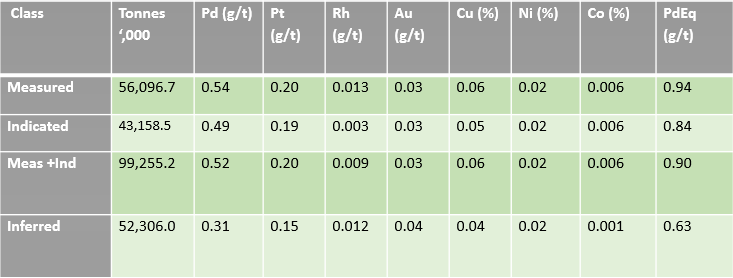
the updated Mineral Resource Estimate are tabulated in Table 1 below
(0.35 g/t PdEq open pit and 2.0 g.t PdEq underground cut-off). This
43-101 Technical Report is available on SEDAR. See page 4.
Table 1: Results from the January 2019 NI 43-101 Mineral Resource Estimate.
Click Image To View Full Size
Class
PGM + Au (oz)
PdEq (oz)
PtEq (oz)
Measured
1,394,000
1,701,000
1,701,000
Indicated
983,000
1,166,000
1,166,000
Meas +Ind
2,377,000
2,867,000
2,867,000
Inferred
841,000
1,059,000
1,059,000
Notes:
1.CIM definition standards were followed for the Mineral Resource Estimate.
2.The 2018 Mineral Resource models used
Ordinary Kriging grade estimation within a three-dimensional block model
with mineralized zones defined by wireframed solids.
3.A base cut-off grade of 0.35 g/t PdEq
was used for reporting Mineral Resources in a constrained pit and 2.00
g/t PdEq was used for reporting the Mineral Resources under the pit.
6.Mineral Resources that are not Mineral Reserves do not have economic viability
7. The Inferred Mineral Resource in this
estimate has a lower level of confidence than that applied to an
Indicated Mineral Resource and must not be converted to a Mineral
Reserve. It is reasonably expected that the majority of the Inferred
Mineral Resource could be upgraded to an Indicated Mineral Resource with
continued exploration.
Click Image To View Full Size
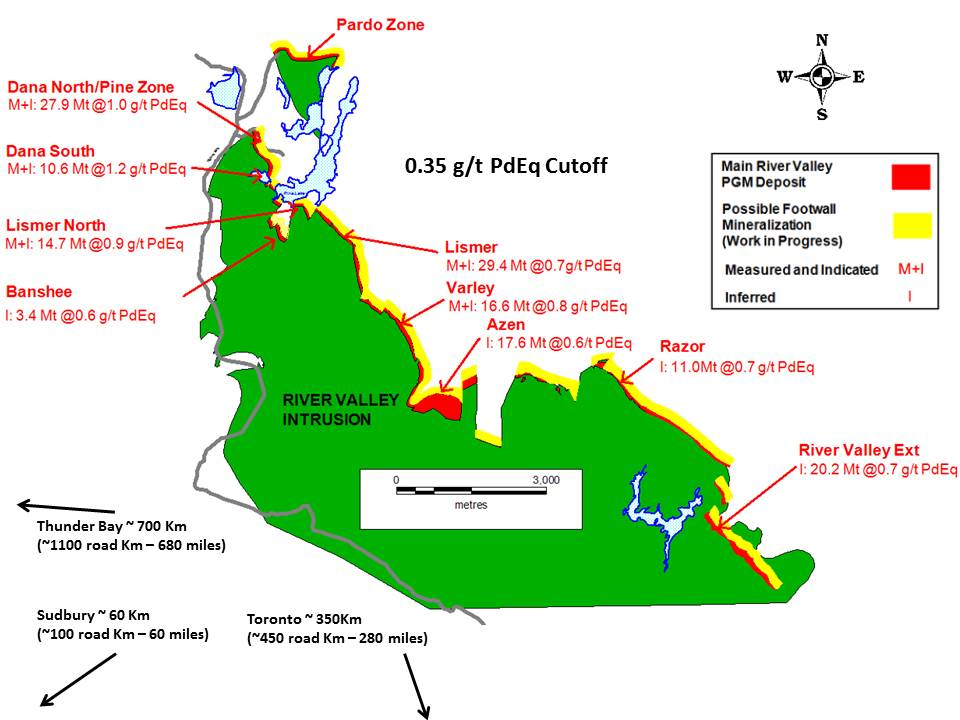
Figure
1: The Yellow Band represents the footwall potential area of the River
Valley Deposit based on the results of the Pine Zone where footwall
mineralization was noted to extend 150 metres eastward from the Pine
Zone/ T3 main deposit.
At
present the only area that has confirmed footwall mineralization is in
the Pine Zone (defined from 2015 to 2017 drilling). Geophysics and
exploration continues
to test other areas of the Deposit. Management’s specific focus is to
outline a potentially economic Mineral Resource in the northern portion
of the Project that can be subsequently developed as a series of open
pits (bulk mining), crushed,and concentrate on site, with concentrate shipped to a smelter in Sudbury.
2019 Exploration Plan – River Valley PGM Project
To date an approximate 160,441 metres (481,323 feet) in 710 drill holes have
been conducted by the company as operators on the River Valley Project.
Several independent 43-101 compliant resource estimates have previously
been generated for the deposit through the exploration and development
phases. The River Valley Deposit’s
present resource, with approximately 2.9M PdEq ounces in Measured Plus
Indicated mineral resources and near-surface mineralization, covers a
total of 16 kilometers of strike. The company continues to explore and enhance the River Valley PGM Deposit.
After the ground proofing and surface
exploration program conducted in the Summer/Fall of 2018, (which
followed up on the most recent induced polarization survey by Abitibi
Geophysics) NAM management has designed a 5,000 metre drill programs to
test the new geophysical anomalies. See Figure 2 below, which shows these new geophysical anomalies and potential targets for the next stage of drilling at River Valley superimposed over the upper 4 kilometres of the project map.
Click Image To View Full Size
Figure 2:
Northern portion of the project with superimposed 2018 merged IP at
-100m level. Retrieved from River Valley Geophysical review by
Geoscience North (Alan King, P. Geo., M.Sc.)
2019 Exploration Plans for Lithium Division
The Company has eight pegmatite hosted
Lithium Projects in the Winnipeg River Pegmatite Field, located in SE
Manitoba. In 2018 NAM conducted surface exploration programs on our
Lithman East, Lithman North, Lithium One and Lithium Two projects. The
programs consisted of reviewing, characterising and sampling the known
surface pegmatites. Samples were taken from the Eagle and FD5 pegmatites
on Lithium Two and returned results of up to 3.8% Li2O. On Lithium One,
samples were taken from the known Silverleaf and Annie pegmatites and
returned significant Li20 assays of up to 4.1%.
In 2019, the Company plans to drill the Lithium Two Project first. Drill
permits have been applied for and the company is awaiting approval from
the province. The application has been accepted by the relevant parties
to date and is in the final stages of the approval process. The first
drill permit is expected to be issued in June 2019.
Genesis PGM / Polymetallic Project
On April 4th, 2018,
NAM signed an agreement with one of Alaska’s top geological consulting
companies. The company’s stated objective is to acquire additional PGM
and Rare Metal projects in Alaska. On April 18th, 2018,
NAM announced the right to purchase 100% of the Genesis
PGM/Polymetallic Project, NAM’s first Alaskan PGM acquisition related to
the April 4th
agreement. The Genesis PGM/Polymetallic Project is a road accessible,
under explored, highly prospective and multi-prospect drill ready
Palladium (Pd)- Platinum (Pt)- Nickel (Ni)- Copper (Cu) property. A
comprehensive report on previous exploration and future phases of work
was completed by Avalon Development of Fairbanks Alaska in August 2018
on Genesis. (available here).
A 2019 sampling program will be conducted to continue to outline
additional mineralization along the 800-metre by 40-metre mineralized
zone. Management is actively seeking an option/joint-venture partner for
this road accessible PGM and multiple element Project using the
Prospector Generator business model.
Opt-in List
If you have not done so already, we encourage you to sign up on our website (www.newagemetals.com) to receive our updated news.
QUALIFIED PERSON
The contents contained herein that relate
to Exploration Results or Mineral Resources is based on information
compiled, reviewed or prepared by Carey Galeschuk, a consulting
geoscientist for New Age Metals. Mr. Galeschuk is the Qualified Person
as defined by National Instrument 43-101 and has reviewed and approved
the technical content of this news release.
On behalf of the Board of Directors
“Harry Barr”
Harry G. Barr
Chairman and CEO
For further information on New Age Metals,
please contact Anthony Ghitter or Cody Hunt, Business Development at
613-659-2773, or [email protected]
Neither the TSX Venture Exchange nor its
Regulation Services Provider (as that term is defined in the policies of
the TSX Venture Exchange) accepts responsibility for the adequacy or
accuracy of this release.
Cautionary Note Regarding Forward Looking
Statements: This release contains forward-looking statements that
involve risks and uncertainties. These statements may differ materially
from actual future events or results and are based on current
expectations or beliefs. For this purpose, statements of historical fact
may be deemed to be forward-looking statements. In addition,
forward-looking statements include statements in which the Company uses
words such as “continue”, “efforts”, “expect”, “believe”, “anticipate”,
“confident”, “intend”, “strategy”, “plan”, “will”, “estimate”,
“project”, “goal”, “target”, “prospects”, “optimistic” or similar
expressions. These statements by their nature involve risks and
uncertainties, and actual results may differ materially depending on a
variety of important factors, including, among others, the Company’s
ability and continuation of efforts to timely and completely make
available adequate current public information, additional or different
regulatory and legal requirements and restrictions that may be imposed,
and other factors as may be discussed in the documents filed by the
Company on SEDAR (www.sedar.com), including the most recent reports that
identify important risk factors that could cause actual results to
differ from those contained in the forward-looking statements. The
Company does not undertake any obligation to review or confirm analysts’
expectations or estimates or to release publicly any revisions to any
forward-looking statements to reflect events or circumstances after the
date hereof or to reflect the occurrence of unanticipated events.
Investors should not place undue reliance on forward-looking statements.
Posted by AGORACOM-JC
at 9:55 AM on Tuesday, May 28th, 2019
Entered into a Binding Term Sheet to license its Random Number Generator to a South Asian online gaming group.
also announced that it signed a binding term sheet to acquire intellectual property and enter into co-development agreements with two non arms-length blockchain developers
Montreal / May 28, 2019 – St-Georges Eco-Mining Corp. (CSE: SX)(OTC: SXOOF) (FSE: 85G1) is pleased to inform the public that its subsidiary, ZeU Crypto Networks Inc., has entered into a Binding Term Sheet to license its Random Number Generator to a South Asian online gaming group. ZeU is also pleased to announce that it signed a binding term sheet to acquire intellectual property and enter into co-development agreements with two non arms-length blockchain developers. ZeU would also like to disclose the current status of its blockchain email project.
Random Generator Licensing Agreement
ZeU
has signed a binding term sheet with Star Epigone Capital Ltd. of the
British Virgin Islands to provide Star Epigone with a license for ZeU’s
Random Number Generator to be used by Star Epigone in its online gaming
product offering. Star Epigone has access to an already established
clientele through its online gaming business and is planning to
integrate lotteries and other gambling offerings using ZeU’s
technologies solutions.
A long form version of the development and maintenance agreement for the creation of a blockchain lottery and gambling software
will be finalized no later than July 5, 2019. All development and
licensing costs will be covered by Star Epigone, the operator. The
profit-sharing component of the final agreement will distribute profits
along this breakdown:
Star Epigone Capital ltd.
75%
ZeU Crypto Networks Inc.
10%
St-Georges Eco-Mining Corp.
7.5%
Minority Partnership
7.5%
Closing is subject to Regulatory Approval and the approval of the ZeU’s board of directors.
Acquisition of a controlling position in vSekur Network Ltd.
ZeU
has entered into a binding term sheet to acquire 2,100,000 first rank
preferred shares of vSekur Network Ltd. The shares have a redemption
value of $1.00 and bear a 6% annual interest. The preferred shares can
be converted into common shares of vSekur at the current value of $1
each, or at the last equity raise price. ZeU will have the right to
maintain its equity position with a right of first refusal in all future
financing efforts of vSekur. If converted in common shares, this would
represent more than 21% of the company outstanding common shares.
vSekur
is already developing the patient account security component of ZeU
Healthcare SaaS. It will now become the primary provider of
anonymization solutions for the different development initiatives of
ZeU.
Considerations
As
a counterpart to vSekur preferred Shares, ZeU will issue to vSekur
approximately 215,325 convertible debenture units with a minimum floor
conversion of CAD $3.25 for one year. The transaction is planned to
close within 5 days of ZeU listing on a Canadian securities exchange.
Non Arm-Length Transaction
Jean-Philippe
Beaudet, ZeU’s director and CTO, is also a director and major
shareholder of vSekur. He will abstain from any discussion related to
this transaction or future negotiation between the companies.
The
transaction is conditional on regulatory approval and ZeU’s board of
director’s approval and will be subject to an independent valuation. A
long form agreement will be signed at closing.
Acquisition of a controlling stake in Hong-Kong’s Pure Data Tech
In
order to further accelerate the development of its blockchain
healthcare SaaS solution, ZeU management has entered into a binding term
sheet with Pure Data Tech Corporation of Hong Kong. The corporation is
controlled by Dr. Fenglian Xu, a director of ZeU. Pure has received
investment and grants in excess of ?1m up to today. The company operates
a turnkey solution that includes software, hardware and management
services (MIS) for the healthcare industry in South-East Asia with a
focus on Singapore and Malaysia. The companies will partner in certain
aspects of their development. While Pure will leverage ZeU’s blockchain
technology, ZeU will be able to integrate Pure’s machine learning IP
into its Healthcare SaaS solution.
The transaction is expected to close within 5 days of ZeU listing its common shares on a Canadian securities exchange.
Considerations
ZeU will issue 461,540 subordinated debenture units convertible at a floor price of CAD $3.25 for
a total of approximately CAD $1,500,000 and 400,000 three years special
warrants in favor of Pure at an execution price of CAD $3.75.
Pure will issue
approximately ?1,000,000 worth of 1st Rank, Fixed Redeemable and
Convertible Preferred Shares of Pure in favor of ZeU currently
representing after conversion, 42% of Pure’s common shares.
Non Arm-Length Transaction
Dr.
Fenglian Xu is a director of ZeU and also a director and major
shareholder of Pure Data Tech. She will abstain from any discussion
related to this transaction and of any future negotiation between the
companies.
The
transaction is conditional on regulatory approval and ZeU’s board of
director’s approval and will be subject to an independent valuation. A
long form agreement will be signed at closing.
Corporate Update
ZeU’s
management is pleased to inform its shareholders that its Maltese legal
advisors have cleared the way to a beta testing of its blockchain email
marketplace with a slightly altered version of its platform. ZeU will
use tokens with no commercial value and an expiry date for the duration
of the beta testing phase of its email. The tests will be migrated to
the Maltese licensing authority sandbox. Furthermore, ZeU will create a
Maltese wholly owned subsidiary to run the blockchain email marketplace
and request the proper master license allowing all commercial clients of
the email marketplace to fall under the ZeU license when issuing their
own tokens. The initial expectations of the company were that it must
obtain a final license from the authorities before the beginning of its
trial. Management is happy with the recent development on this aspect of
the regulatory framework for its email marketplace platform.
The company is actively
coding a new version of the email platform with limited capabilities
that will be used for its beta testing and for the Maltese Sandbox
trial.
ON BEHALF OF THE BOARD OF DIRECTORS
“Frank Dumas”
FRANK DUMAS
DIRECTOR & COO, ST-GEORGES ECO-MINING
PRESIDENT & CEO, ZEU CRYPTO NETWORKS.
The
Canadian Securities Exchange (CSE) has not reviewed and does not accept
responsibility for the adequacy or the accuracy of the contents of this
release.