Posted by AGORACOM-JC
at 11:17 AM on Tuesday, February 12th, 2019
Investment Highlights
Kenbridge property has a measured and indicated resource of 7.14 million tonnes at 0.62% nickel, 0.33% copper
17.5 (21.8 fully diluted) percent equity stake in Eloro Resources and 2 percent NSR in their La Victoria property
Kenbridge Ni Project (ON, Canada)
Advanced stage deposit remains open in three directions, is
equipped with a 623m deep shaft and has never been mined.
Preliminary Economic Assessment completed and updated returned robust project economics and operating costs including a NPV of C$253M and cash costs of US$3.47/lb of nickel net of copper credits.
Plans for Kenbridge include updating PEA,
advancing the project through to feasibility and exploring the open
mineralization at depth
FULL DISCLOSURE: Tartisan Nickel Corp. is an advertising client of AGORA Internet Relations Corp.
Solar shines brightest for renewables-keen investors
Institutional investors surveyed by the Octopus Group have ranked grid-scale solar power as their top deployment target, amid plans to inject US$210 billion in the broader renewable sector within five years.
A poll of 100 names published by the firm on Monday found 43% of those managing a portfolio of renewables were invested in solar, ahead of firms invested in onshore and offshore wind (28% each), hydropower (27%) and waste-to-energy and biomass (an aggregate 24%).
Institutional investors ranked uncertainty with energy prices as a top obstacle (Source: Karnakata Tata)
Institutional investors surveyed by the Octopus Group have ranked
grid-scale solar power as their top deployment target, amid plans to
inject US$210 billion in the broader renewable sector within five years.
A poll of 100 names published by the firm on Monday found 43% of
those managing a portfolio of renewables were invested in solar, ahead
of firms invested in onshore and offshore wind (28% each), hydropower
(27%) and waste-to-energy and biomass (an aggregate 24%).
Of the respondents – a mix including pension funds, insurers and
banks with US$6.8 trillion in combined assets under management –
Australians (63%) were keenest on solar, followed by EMEA (58%), Asian
(45%) and UK firms (29%).
The industry was the most sought-after also among firms currently not
invested in renewables, although some appeared sceptical. Some 58% of
those managing a renewables-free portfolio claimed to be considering
solar plays, while 21% were not contemplating it and another 21% felt
unsure.
Five years to unlock US$210 billion
Even as they singled out grid-scale solar as their top target, the
polled investors promised to scale up allocations to all forms of
renewables, with US$210 billion set to be deployed within five years.
Private banks appeared the most ambitious, sharing plans for renewables
to represent 9.7% of their portfolios over the period. They were
followed by strategic investors (8.9%) and pension funds (7.8%), while
high-net-worth individuals and family offices (5.5%) and insurers (4.7%)
were the most reluctant.
The Octopus survey evidenced the renewables momentum won’t be
challenge-free, though. Energy price uncertainty, liquidity challenges
and skills shortages ranked as the top concerns for the polled
investors, although costs and regulatory barriers were also seen as
obstacles.
Europe before its subsidy-free hour
The Solar Finance and Investment conference held in London in late
January identified investors as the key enablers of subsidy-free solar
in Europe. Corporate PPAs and other emerging arrangements are easing –
although not fully dispelling – investors’ unease around merchant risks
and potentially low returns, it was argued.
The Octopus poll placed the continent as the most in-demand
destination for renewables investors. Of the top 10 countries and
region, only Australia (seventh) and Japan (10th) were non-European.
The survey produced a finding likely to be welcomed by subsidy-free
players. Almost one-in-two institutional investors piling into clean
energy worldwide was driven by stable cash flows (a driver for 48%) and
attractive risk-adjusted returns (40%); only diversification and ESG
considerations placed higher.
Posted by AGORACOM-JC
at 10:52 AM on Monday, February 11th, 2019
RECENT HIGHLIGHTS
SIGNED A COOPERATION AGREEMENT FOR THE EMERGENCY MEDICAL SERVICES MARKETS
Will enable them to provide real-time monitoring of patients while in transit on the ground or in the air.
CHUSJ is one of the top 10 mother-child hospitals in the World, with over 3500 births a year.
Has over 1500 nurses, over 500 Doctors and over 200 researchers on staff.
COMPLETED SALE OF FIVE STAR-A.D.S SYSTEMS TO ALMASRIA UNIVERSAL AIRLINES
Announced that AlMasria Universal Airlines of Egypt has decided to
proceed with the installation and activation of the STAR-A.D.S.® System
across all five (5) of its current aircraft fleet, which includes A-320,
A-321, A330 and B737 aircraft.
BOMBARDER JOINT RESEARCH AND DEVELOPMENT PROGRAM
Joint research and development program with Bombardier and other
industrials and universities of Canada is progressing very positively.
The STAR-A.D.S. ® system which is at the heart of the program, after
having been validated and extensively used by the aircraft
manufacturer, has now been transferred to another flight test vehicle to
complete the flight testing and the data collection.
EMERGENCY MEDICAL SERVICES APPLICATIONS
Star’s Land System Aided Medical Monitoring system for ground
ambulance applications has undergone a series of demonstrations by a
care organization in North America.
Its airborne parent system, the In-Flight System Aided Medical
Monitoring system (STAR-ISAMM™â€), has now been demonstrated to several
stakeholders of the commercial and civil air ambulance market.
CHECK OUT OUR RECENT INTERVIEW
FULL DISCLOSURE: Star Navigation Systems Group Ltd. is an advertising client of AGORA Internet Relations Corp.
By Frank Holmes CEO and Chief Investment Officer U.S. Global Investors
Gold mining is one of the very oldest human occupations. The earliest
known underground gold mine, in what is now the country of Georgia,
dates back at least 5,000 years, when people were just starting to
develop written language.
Over the centuries, a number of innovations have emerged that
disrupted and forever changed how we explore and mine for gold and other
metals. Think dynamite, or the steam engine.
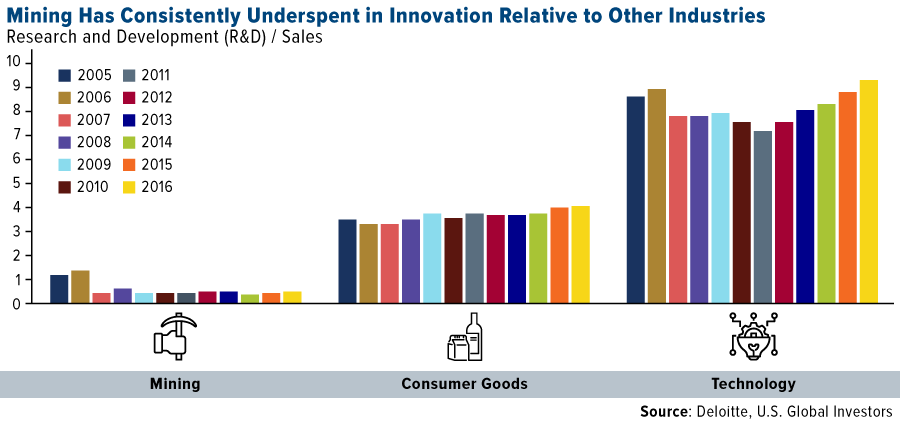
Lately, however, innovation has slowed. Mining companies are in cost-cutting mode,
and many producers have favored generating short-term cash flow, often
to the detriment of longer-term value. In last year’s “Tracking the
Trends†report, Deloitte analysts observed that “miners from 50 years
ago would find little has changed if they entered today’s mines, a
situation that certainly doesn’t hold true in other industries.â€
Consider the earth-shattering change that’s taken place in oil and
gas over the past two decades. Fracking and horizontal drilling have
completely revolutionized how we extract resources from the ground,
making hard-to-reach oil and natural gas accessible for the first time.
No equivalent technology exists in precious metals. Some companies are now using cutting-edge technology like blockchain
to improve supply chain efficiency and transparency, but to date
there’s no “gold fracking†method. As a result, metal ore grades are
decreasing, and large-scale gold discoveries are becoming fewer and farther between.
One company thinks it has the formula to reverse this trend. I think it could be sitting on a gold mine, pun fully intended.
Meet Goldspot Discoveries
“Some people call it ‘peak gold,’ but I tend to think of it more as
‘peak discovery,’†says Denis Laviolette, the brains behind Goldspot
Discoveries, a first-of-its-kind quant shop that aims to use artificial
intelligence (AI) and machine learning to revolutionize the mineral
exploration business.
A geologist by trade, Denis conceived of Goldspot while serving as a
mining analyst with investment banking firm Pinetree Capital. His
vision, as he described it to me, was to disrupt mineral exploration as
profoundly as Amazon disrupted retail and Uber the taxi business.
“We have more data at our fingertips than ever before, yet new
discoveries have been on the decline despite ever increasing exploration
spending on data collection,†Denis continues. “We believe Goldpsot can
change that. Harnessing a mountain’s worth of historic and current
global mining data, AI can identify patterns necessary to fingerprint
geophysical, geochemical, lithological and structural traits that
correlate to mineralization. Advances in AI, cloud computing, open
source algorithms, machine learning and other technologies have made it
possible for us to aggregate all this data and accurately target where
the best spots to explore are.â€
Hence the name Goldspot—though I should point out that Denis
considers the Montreal-based company “commodity agnostic,†meaning it
collects and aggregates data for all metals, including base metals, not
just gold.
Moneyball for Mining
Denis has the record to back up his extraordinary claims. In 2016,
Goldspot took second place in the Integra Gold Rush Challenge, a
competition with as many as 4,600 worldwide applicants. After
consolidating more than 30 years of historical mining and exploration
data into a 3D geological model, the company was able to identify
several target zones with the highest potential for gold mineralization
in Nevada’s Jerritt Canyon district, among several others.
Goldspot’s targeting approach was a complete success. New zones were
discovered by AI, validating the company’s models of finding patterns in
the data that humans alone couldn’t have seen.
The exercise stands as an example of what can be unlocked when machine learning is applied to geoscience.
“When I first entered the field, geologists were still using
pen and paper, and I’m not even that old,†Denis says. “We were paying
for all this data, but no one was really doing anything with it.â€
Denis’ quant approach to discovery reminds me a lot of Billy Beane,
the former general manager of the Oakland A’s and subject of the 2003 bestseller and 2011 film Moneyball.
Beane was among the first in sports to pick players, many of them
overlooked and undervalued, based on quantitative analysis. His strategy
worked better than anyone anticipated.
Although the A’s had one of the lowest combined salaries in Major
League Baseball—only the Washington Nationals and Tampa Bay Rays had
lower salaries—the team finished the 2002 season first in the American
League West.
Similarly, Goldspot seeks to help mining companies cut some of the
costs and risks associated with discovering high-quality
deposits—something it’s managed to do for a number of its clients and
partners, including Hochschild Mining, McEwen Mining and Yamana Gold.
And speaking of teams, Denis has assembled an impressive roster of
PhDs and experts in geology, physics, data science and other fields.
But Wait, There’s More…
The company, not yet three years old, does more than assist in
exploration. It also invests in and acquires royalties from exploration
companies, similar to the business model practiced by successful firms
such as Franco-Nevada, Wheaton Precious Minerals, Royal Gold and
others.>
The difference, though, is that Goldspot has developed an AI-powered
screening platform to identify the very best and potentially most
profitable investment opportunities.
For this, Goldspot has also received accolades. It was one of only
five finalists in Goldcorp’s 2017 #DisruptMining challenge, for
“revolutionizing the investment decision model by using the Goldspot
Algorithm to stake acreage, acquire projects and royalties, and invest
in public vehicles to create a portfolio of assets with the greatest
reward to risk ratio.â€
I’ll certainly have more to say about Goldspot in the coming weeks.
For now, I’m excited to share with you that the company is scheduled to
begin trading on the TSX Venture Exchange early next week. The future
belongs to those that can mine data and harness the power of AI, and I’m
convinced that what Denis and his partners have created fits that bill.
Congratulations, and the best of luck to Denis Laviolette and Goldspot
Discoveries!
Posted by AGORACOM-JC
at 2:30 PM on Friday, February 8th, 2019
.
Announced the appointment of Mr. Aamer Siddiqui as Chief Financial Officer (CFO) of the Company.
Mr. Siddiqui is a Chartered Professional Accountant(CPA) and Chartered Accountant(CA), Chartered Professional Accountants of Canada.
TORONTO, ON / February 8, 2019 / Tartisan Nickel Corp. (CSE: TN, FSE: A2DPCM) (“Tartisan”, or the “Company”) is pleased to announce the appointment of Mr. Aamer Siddiqui as Chief Financial Officer (CFO) of the Company. Mr. Siddiqui is a Chartered Professional Accountant(CPA) and Chartered Accountant(CA), Chartered Professional Accountants of Canada.
Additionally, the Company reports that Tartisan Nickel has engaged
Marrelli Support Services Inc. to provide accounting support services to
the Company.
The Board of Directors of Tartisan Nickel would like to thank
outgoing CFO, Mr. Dan Fuoco, for his support and efforts during his
tenure and wish him well in his new endeavours.
About Tartisan Nickel Corp
The Company is a Canadian mineral exploration and development company
which owns the Kenbridge Nickel-Copper- Cobalt project in Ontario,
Canada. In addition, Tartisan owns a 100% stake in the Don Pancho
Zinc-Manganese Project and a 100% stake in the Ichuna Copper-Silver
Project, both located in Peru. Tartisan Nickel Corp also owns an equity
stake (6 million shares and 3 million full warrants at 40c per share),
in Eloro Resources Ltd. which is exploring the low-sulphidation
epithermal La Victoria Gold/Silver Project, located in Ancash, Peru.
The Company also owns 1,750,000 common shares of VaniCom Resources
Ltd. a private Australian exploration and development resource company.
Tartisan Nickel Corp. common shares are listed on the Canadian
Securities Exchange (CSE: TN, FSE: A2DPCM). Currently, there are
99,703,550 shares outstanding (108,803,550 fully diluted).
For further information, please contact Mr. D. Mark Appleby,
President & CEO and a Director of the Company, at 416-804-0280 ([email protected]). Additional information about Tartisan can be found at the Company’s website at www.tartisannickel.com or on SEDAR at www.sedar.com.
Jim Steel MBA P.Geo. is the Qualified Person under NI 43-101 and has
read and approved the technical content of this News Release.
This news release may contain forward-looking statements
including but not limited to comments regarding the timing and content
of upcoming work programs, geological interpretations, receipt of
property titles, potential mineral recovery processes, etc.
Forward-looking statements address future events and conditions and
therefore, involve inherent risks and uncertainties. Actual results may
differ materially from those currently anticipated in such statements.
The Canadian Securities Exchange (operated by CNSX Markets Inc.)
has neither approved nor disapproved of the contents of this press
release.
Posted by AGORACOM-JC
at 1:21 PM on Friday, February 8th, 2019
SPONSOR: Tartisan Nickel (TN:CSE) The company’s Kenbridge Property
has a measured and indicated resource of 7.14 million tonnes at 0.62%
nickel, 0.33% copper. Tartisan also has interests in Peru, including a
20 percent equity stake in Eloro Resources and 2 percent NSR in their La
Victoria property. Click her for more information
TN:CSE
———————
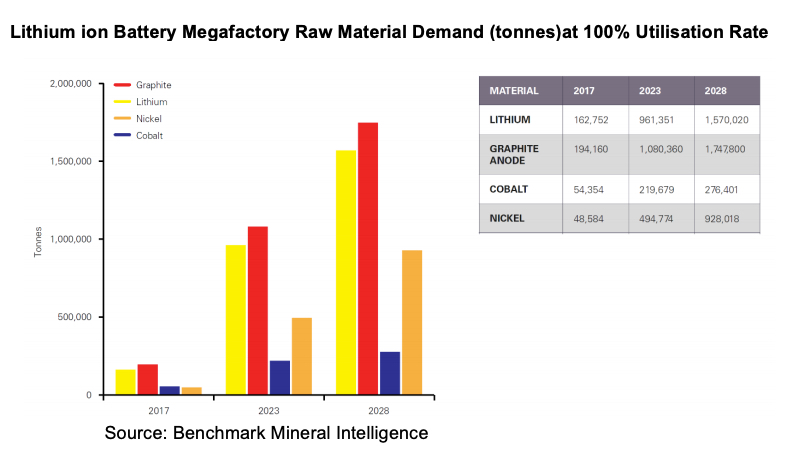
Megafactories buildout could up nickel demand in batteries 19 fold—Benchmark
Moores said that these megafactories are being built almost exclusively to make lithium ion battery cells using two chemistries: nickel-cobalt-manganese (NCM) and nickel-cobalt-aluminium (NCA)
“Under this scenario, lithium demand will increase by over eight times, graphite anode by over seven times, nickel by a massive 19 times
It was encouraging for miners when Simon Moores, managing director, Benchmark Mineral Intelligence, testified before the U.S. Senate Committee on Energy and Natural Resources on Tuesday.
Moores was summoned by the Senate Committee to testify on the
lithium, cobalt, nickel and graphite supply chains for energy storage.
“Benchmark Mineral Intelligence is now tracking 70 lithium ion
battery megafactories under construction across four continents, 46 of
which are based in China with only five currently planned for the US.
When I gave my last testimony in October 2017, the global total was at
17,” Moores said.
Moores said that these megafactories are being built almost
exclusively to make lithium ion battery cells using two chemistries:
nickel-cobalt-manganese (NCM) and nickel-cobalt-aluminium (NCA).
“This means the supply of lithium, cobalt, nickel and manganese to
produce the cathode for these cells, alongside graphite to produce
battery anodes, needs to rapidly evolve for the 21st century,” Moores
testified.
Moores presented a chart based on the assumption that all of these megafactories are built and run at 100% capacity utilization.
“Under this scenario, lithium demand will increase by over eight
times, graphite anode by over seven times, nickel by a massive 19 times,
and cobalt demand will rise four-fold, which takes into account the
industry trend of reducing cobalt usage in a battery,” Moores testified.
Posted by AGORACOM-JC
at 11:21 AM on Friday, February 8th, 2019
SPONSOR: Enthusiast Gaming Holdings Inc.
(TSX-V: EGLX) Uniting gaming communities with 80 owned and affiliated
websites, currently reaching over 75 million monthly visitors. The
company partial 2018 reported revenue of $7.4 million representing a
625% increase over the same period in 2017.
EGLX: TSX-V ———————————-
Esports Playing in the Big Leagues Now
In 2018, esports captured the attention of nearly 400 million viewers worldwide—and cable and OTT platforms took note, with media rights revenues topping $180 million.
Total esports revenues reached $869 million in 2018, and is forecast to more than triple by 2022, reaching $2.96 billion, according to an October 2018 report by Goldman Sachs.
By Lucy Koch
In 2018, esports captured the attention of nearly 400 million viewers
worldwide—and cable and OTT platforms took note, with media rights
revenues topping $180 million.
Total esports revenues reached $869 million in 2018, and is forecast
to more than triple by 2022, reaching $2.96 billion, according to an
October 2018 report by Goldman Sachs.
More modestly, a report from PwC
(cited by the Goldman Sachs report) projected worldwide esports revenues
of $1.58 billion by 2022—an 18.4% compounded annual growth rate.
Ad Revenue
According to PwC, esports revenues totaled $805 million in 2018, with
the largest portion coming from sponsorships ($277 million), followed
by media rights and streaming advertisements.
PwC estimated that over the next three to five years, media rights
revenue would grow 11.5%—to roughly $449 million by 2022. That’s more
than twice the growth rate of sponsorship and advertising, at 5.5%.
As audiences grow, so do expectations. Esports viewers want to be
able to watch their favorite teams, players and tournaments on any
screen, at any time—and this will push profitability.
Paul Verna, principal analyst at eMarketer, explains: “Marketers who
try to reach esports fans through video ads will be able to tap into the
sophisticated targeting and measurement capabilities that streaming
services offer. In that sense, there’s more value to a marketer in
attaching itself to game streams than sponsoring an event or team. It’s
all about harnessing data.â€
And there’s plenty of data to harness.
Esports Viewers
There were approximately 380 million esports viewers in 2018, and
that’s expected to surge to roughly 557 million viewers by 2021,
according to a report from Newzoo. Of
those 557 million projected viewers, 307 million will identify as
“occasional viewers” and 250 million will consider themselves “esports
enthusiasts”.
Breaking Down Key Players
Occasional Viewers: People who watch professional esports content less than once a month.
Esports Enthusiasts: People who watch professional esports content more than once a month.
What’s more, Asia-Pacific leads the global esports market and is
projected to capture the largest market share, with $1.5 billion by
2022, according to a study from Activate. Close behind, Europe and the US tie for second at $1.2 billion.
“The US is a natural growth opportunity for esports because of the
strong gaming culture here, the ties between gaming and sports, and the
country’s natural inclination toward competitive endeavors. The same is
true of Western European markets, particularly the UK, Germany, and
France,†Verna said.
Somewhat behind the curve due to the lack of fixed broadband, Latin
America will account for just $100 million of esports market share by
2022. However, growth is expected in Brazil and Mexico, where esports is
officially recognized as a sport.
Verna adds that the majority of the esports market is young and is
“therefore less likely to be reached through traditional ad channels
than an older TV audience,†saying that “sponsorships and endorsements
are equally viable for marketers whose brands align with the target
audience.â€
Posted by AGORACOM-JC
at 4:23 PM on Thursday, February 7th, 2019
SPONSOR: Good Life Networks (GOOD:TSX-V)
Video advertising is the future! Company’s A.I. makes 80,000
calculations / second, targeting 750 million users to deliver higher
prices and volume. Company announced combined trailing 12 month revenue
at just over $40 Million, $7.9M EBITDA, $3 Million net income. Click here for more information.
GOOD: TSX-V
—————————
How Blockchain Integration Will Evolve Programmatic RTB for Smart TV
Programmatic RTB(Real-time bidding) is set to become a leading method for advertising on Smart TV.
Is anticipated to grow at a CAGR of 9.5% during the forecast period and reach $292.55 billion by 2025.
Alex Bornyakov, founder of Adtelligent, talks about how the growth of blockchain will help in the transformation of programmatic advertising through RTB for Smart TV.
The programmatic advertising industry is rife with issues, including
fraud, manipulation of data, low traffic quality, and lack of
transparency of the bidding process. Despite these issues, programmatic
RTB(Real-time bidding) is set to become a leading method for advertising
on Smart TV. The global Smart TV market, according to Grand View Research,
was valued at $145 billion in 2017, is anticipated to grow at a CAGR of
9.5% during the forecast period and reach $292.55 billion by 2025.
I, along with other leaders in the digital advertising space, believe
that blockchain integration has the potential to satisfy the market
demand for transparency and reinstate trust in programmatic advertising.
This will be achieved by creating a new blockchain-based RTB protocol
for Smart TV that propels industry growth, meets required thresholds for
transaction speeds, and fights fraud through irrefutable smart
contracts.
Big potential for industry growth
Programmatic and RTB have had a tremendous impact on the web,
becoming the most popular and widely-used types of digital display
advertising in the USA and the UK in 2015. In the US alone, $27.47
billion was spent on programmatic digital display advertising just last
year.
Programmatic RTB for Smart TV has the potential to scale into an
increasingly valuable ad channel. 32% of TV buyers today own Smart TVs,
totalling 1 billion devices worldwide. Yet, this form of advertising has
several new roadblocks when it comes to growth. One such example is the
current low availability of premium inventory. Publishers today have to
adapt quickly to the latest media buying trend if they want to remain
on board.
Blockchain removes intermediaries, meaning that brands and content
owners can directly transact with one another. Content owners, as a
result, are faced with fewer restrictions and will be able to attract
with smaller and niche brands of all shapes and sizes. Due to the nature
of P2P transactions through blockchain and less funds going to
middlemen, brands will have the opportunity to place targeted
advertisements at lower costs than ever before. With all transactions
recorded on an irrefutable ledger, blockchain ensures marketing budgets
are used effectively, another compelling impetus to advertise and for
industry growth.
A need for speed
One of the central issues with executing blockchain RTB for Smart TV
today is transaction speed. A system does not yet exist that allows
large enough volumes. This inhibits the potential for advertisers.
What’s needed is a new protocol that can handle sending sufficient
volumes of data to the blockchain.. With transaction volumes up to
speed, brands will be able to optimize their costs, better target
clients, and choose the time and amount of advertising scrolling at
suitable prices. In turn, enabling brands to not only pay for the number
of scrolls, but also the displayed duration which cannot be done today.
As an example, this approach would allow advertising at a time when a
television is being viewed across many devices, increasing audience
coverage and the overall effectiveness of advertising.
Enforcing safeguards to fight fraud
Trust is eroding in the ecosystem for a number of reasons. For one,
ad fraud is alive and well across OTT channels, typically in the format
of masking n techniques that go undetected. In fact, Pixalate, the first
MRC accredited vendor of detecting and filtering invalid traffic in
OTT, reported that global OTT fraud rates average 19% and that Marketers may lose $10 billion annually in OTT ad spend by 2020.
Due to the aforementioned issues, advertisers are demanding
transparency from partners to ensure fair value. Blockchain integration
would allow brands to control pricing and manipulation of data, ensure
transparency of the bidding process, target users at the right time
through access to user data via blockchain smart contracts.
Today, there are a few major players working to make RTB for Smart TV a reality.
In September 2017, The Interactive Advertising Bureau (IAB) Technology Lab announced version 3.0 of their OpenRTB framework
which was, “evolving to handle new kinds of programmatic buying and
selling, such as header bidding, content sales, product recommendations,
Smart TV, or perhaps even products.†It was the biggest revision to the
protocol in seven years and has recently been rolled out in beta, with
mass adoption projected for 2019.
Such innovative types of the business models which combine B2B
marketplaces and blockchain technology has created a new system that
allows accumulating a large volume of events, and after that sends this
data to blockchain in one package. In other words, it’s not
necessary for B2B advertising marketplace to save each transaction from
RTB to the blockchain due to the fact that customers of such type of
platforms will use an independent verification accounting system
that will be able to benefit from internal RTB. Not all data will be
saved into blockchain, but only critical resulting events such as
division of profits among participants.
Integrating blockchain technology into the RTB system for Smart TV
shows promise for growth of the advertisement industry and the
elimination of fraud and lack of transparency. By eliminating
intermediaries and introducing smart contracts to the platform, brands
large and small have more opportunity to be profitable and are granted
access to accurate analytics and data.
Tags: stocks, tsx Posted in All Recent Posts, Good Life Networks | Comments Off on Good Life Networks $GOOD.ca – How #Blockchain Integration Will Evolve #Programmatic RTB for Smart TV $TTD $RUBI $AT.ca $TRMR $FUEL
Posted by AGORACOM-JC
at 2:29 PM on Thursday, February 7th, 2019
Announced change in their Drug Development Plan (DDP) priorities.
This will allow Tetra to rapidly leverage the PANAG pipeline and expertise and align its research programs on indications with unmet medical needs or a higher return on investment (ROI).Â
Last Week’s Agreement to Acquire PANAG Establishes Exhaustive Dermatology and Ophthalmic Product Portfolios
ORLEANS, Ontario, Feb. 07, 2019 – Tetra Bio-Pharma Inc. (“Tetra” or the “Corporation“) (TSX VENTURE: TBP) (OTB: TBPMF), a global leader in cannabinoid-derived drug development and discovery, today announced a change in their Drug Development Plan (DDP) priorities. This will allow Tetra to rapidly leverage the PANAG pipeline and expertise and align its research programs on indications with unmet medical needs or a higher return on investment (ROI). Through an expanded and focused pipeline, the Corporation intends to maintain its position as a leader in cannabis and cannabinoid drug development with a clear objective to generate value for shareholders.  In addition to its DDP in oncology and neuropathic pain programs, Tetra will pursue the development of prescription products in ophthalmic, dermatology as well as other pain segments.
Tetra Bio-Pharma Drug Development Plans address key therapeutic
sectors which address the medical needs of millions of patients and
represent substantial potential revenue. Priorities are summarized
below:
“Immediately following the PANAG closing we held an Executive Team
Meeting to prioritize our solid and robust prescription product pipeline
and ensure we maintain our lead in the cannabis prescription drug
market,†stated Dr. Guy Chamberland, CEO and CSO of Tetra Bio-Pharma.
“The products in this pipeline address high potential unmet medical
needs, such as uveitis, corneal neuropathic pain, interstitial cystitis,
fibromyalgia and glioblastoma. Some of these products will come from
PANAG’s pipeline and medical and scientific expertise. These innovative
products target disease indications with global unmet medical needs and
where we are confident that cannabinoid-derived products can play an
important role in alleviating pain, discomfort and associated symptoms.â€
Dr. Chamberland further stated, “The news on Tuesday is a reality in
the world of drug development. The safety and wellness of patients is
always Tetra’s number one priority. We also kept in mind the
importance and responsibility of taking a first cannabinoid drug to the
market. Our responsibility was to ensure timely and accurate disclosure
of the events subsequent to the results of the mycotoxin analyses of
the clinical trial lots which arrived on January 22nd and February 1st.
Tetra, and its Executive Team is engaged in a rapid transformational
change with the PANAG acquisition which will enable Tetra to mitigate
the risk that comes with developing a pharmaceutical drug while creating
value for shareholders. As some of our peers have demonstrated, a
single approved drug, even for a rare disease indication, can play a
significant role in our valuation.â€
Dr. Chamberland goes on to say, “It was my responsibility to rapidly
adjust our research priorities while we address the impurity issue and
risk to cancer patients. Although our DDP in Advanced Cancer Pain is
temporarily suspended, we had been assessing our PPP001 research data
and planned to accelerate DDP programs that address more diseases or
health conditions with a larger ROI. Down the road this transformation
will provide us with a more sustainable and robust product pipeline. The
Leadership Team is engaged to stay focused on these research
priorities, and rest assured that we will deliver value to our
shareholders.â€
About Tetra Bio-Pharma Inc.
Tetra Bio-Pharma (TSX-V: TBP) (OTCQB: TBPMF) is a biopharmaceutical
leader in cannabinoid-based drug discovery and development with a Health
Canada approved, and FDA reviewed, clinical program aimed at bringing
novel prescription drugs and treatments to patients and their healthcare
providers. The Company has several subsidiaries engaged in the
development of an advanced and growing pipeline of Bio Pharmaceuticals,
Natural Health and Veterinary Products containing cannabis and other
medicinal plant-based elements. With patients at the core of what we do,
Tetra Bio-Pharma is focused on providing rigorous scientific validation
and safety data required for inclusion into the existing bio pharma
industry by regulators, physicians and insurance companies.
Neither the TSX Venture Exchange nor its Regulation Services
Provider (as that term is defined in the policies of the TSX Venture
Exchange) accepts responsibility for the adequacy or accuracy of this
release.
Forward-looking statements Some statements in
this release may contain forward-looking information. All statements,
other than of historical fact, that address activities, events or
developments that the Company believes, expects or anticipates will or
may occur in the future (including, without limitation, statements
regarding potential acquisitions and financings) are forward-looking
statements. Forward-looking statements are generally identifiable by use
of the words “may”, “will”, “should”, “continue”, “expect”,
“anticipate”, “estimate”, “believe”, “intend”, “plan” or “project” or
the negative of these words or other variations on these words or
comparable terminology. Forward-looking statements are subject to a
number of risks and uncertainties, many of which are beyond the
Company’s ability to control or predict, that may cause the actual
results of the Company to differ materially from those discussed in the
forward-looking statements. Factors that could cause actual results or
events to differ materially from current expectations include, among
other things, without limitation, the inability of the Company to obtain
sufficient financing to execute the Company’s business plan;
competition; regulation and anticipated and unanticipated costs and
delays, the success of the Company’s research and development
strategies, including the products mentioned in this release, the
applicability of the discoveries made therein, the successful and timely
completion and uncertainties related to the regulatory process
including the applications for Orphan Drug Designation, the timing of
clinical trials, the timing and outcomes of regulatory or intellectual
property decisions and other risks disclosed in the Company’s public
disclosure record on file with the relevant securities regulatory
authorities. Although the Company has attempted to identify important
factors that could cause actual results or events to differ materially
from those described in forward-looking statements, there may be other
factors that cause results or events not to be as anticipated, estimated
or intended. Readers should not place undue reliance on forward-looking
statements. While no definitive documentation has yet been signed by
the parties and there is no certainty that such documentation will be
signed. The forward-looking statements included in this news release are
made as of the date of this news release and the Company does not
undertake an obligation to publicly update such forward-looking
statements to reflect new information, subsequent events or otherwise
unless required by applicable securities legislation.
For further information, please contact Tetra Bio-Pharma Inc. Robert (Bob) Bechard Executive Vice President, Corporate Development and Licensing 514-817-2514 [email protected]
Media Contact energi PR Carol Levine [email protected] 514-288-8500 ext. 226
Tags: pharma, tsx, tsx-v Posted in Tetra Bio-Pharma Inc. | Comments Off on Tetra Bio-Pharma $TPB.ca Pursues Its Research Priorities Accelerating Other Drug Development Plans
Posted by AGORACOM-JC
at 12:26 PM on Thursday, February 7th, 2019
SPONSOR: North Bud Farms Inc. (NBUD:CSE) Sustainable low cost, high
quality cannabinoid production and procurement focusing on both
bio-pharmaceutical development and Cannabinoid Infused Products. Click Here For More Information
NBUD: CSE
—————
Canada’s top marijuana enforcer stands by Liberals’ new pot policy
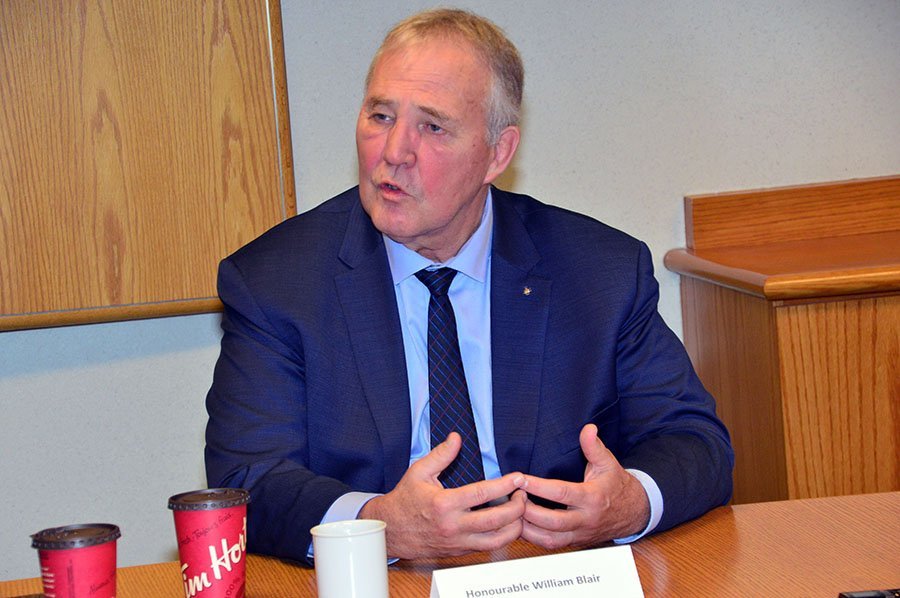
A former police chief and narcotics enforcement officer, federal Minister of Border Security and Organized Crime Reduction Bill Blair is convinced Canada has done the right thing with its new marijuana decriminalization and regularization laws.
Martin C. Barry
As the federal minister responsible for the implementation and
enforcement of Canada’s new marijuana legalization and regularization
laws, there’s no mistaking the fact Bill Blair stands one hundred per
cent behind the Trudeau Liberal government’s groundbreaking policy.
If anybody might be in a position to question the government’s
stance, it could easily be Blair. The veteran policeman and former chief
of the Toronto Police Service spent years fighting on the front lines
against drug-related crime as a narcotics squad officer.
Former narcotics cop
“As a police officer for 40 years, I was involved in drug
enforcement,†Blair, who is Minister of Border Security and Organized
Crime Reduction, said in an interview with Newsfirst Multimedia while on
a ministerial stopover in Montreal.
As chair of the Canadian Association of Chiefs of Police’s Organized
Crime Committee, he said he was “well aware of the impact that illegal
drug trafficking as controlled by organized crime was having in all of
our communities.â€
Drugs and violence linked
While noting that the link between organized crime and illegal drug
trafficking had a lot do with an escalation of violence in Canadian
cities these past few decades, Blair also pointed out that organized
crime was earning billions of dollars in profits each year being the
sole purveyors of a range of illegal substances that included marijuana.
Since the only means of controlling the situation available to
society was criminal sanction, young people got swept up in the overall
enforcement of the country’s drug laws, “which was disproportionate,â€
added Blair, “and was actually causing in many cases more harm. We
wanted to discourage their use of the drug. But we also did not want to
saddle that child with a criminal record for the rest of their life.â€
Approached by Trudeau
According to Blair, all of this transpired long before he was asked
by Justin Trudeau to run in the suburban Toronto riding of Scarborough
Southwest in the October 2015 election. Blair and the future Prime
Minister discussed the possibility of radically changing Canada’s
cannabis laws.
“We talked about Canada’s control of cannabis. And he said ‘What do
you think of legalizing it?’ And I said if we lift the criminal
prohibition it gives the opportunity to get the situation back under
control. Because currently the situation we were in was we had the
highest rates of use among our kids in the world. And this is a
dangerous drug for children. This is a drug that can have very serious
implications for children.â€
One third were breaking law
Leading up to the changes last October by the Liberal government to
the country’s longstanding prohibition on cannabis, more than a third of
Canada’s population had been breaking the law, Blair added. As such,
“we began the process of looking at how do we reduce the harm of this
drug.
“Some people say to me, ‘Well you’ve legalized cannabis.’ And I say
no – we’ve regulated the daylights out of it. We’ve brought in all sorts
of new rules – enforceable, proportionate, sensible rules – that
control every aspect of its production, its sale and its consumption.
Says no to other drugs
“Whereas before we had only one tool and it was like a sledgehammer
and we were trying to drive a nail. And no one wanted to swing the
sledgehammer. But now we have the right suite of tools to control the
system. And I believe it’ll result in a healthy situation for our
children and a safer situation for our communities.â€
Blair insisted that neither he nor the Liberal government would ever
consider going down the same route with other street drugs as it has
done with marijuana. “Cannabis is not a drug that kills people,†he
said.
“But unfortunately with other more serious drugs which are deadly –
the opioid crisis, for example, crystal methamphetamine, which is
ravishing some of our prairie and northern communities – those drugs
represent such a significant risk. And we don’t have a system of
regulated production and control.
Meth and fentanyl out
“There is no alternative. We can go to a Health Canada-regulated
production facility for marijuana, for cannabis. But we’re not going to
create a similar thing for crystal methamphetamine. So there will be no
other source other than the criminal source.†For drugs like
methamphetamine and fentanyl, Blair said an important of the approach
for dealing with them is to “interdict the supply to keep those drugs
out of our country. We need to be very effective at restricting the
supply. But we also have an enormous amount of work to do – and we have
embarked as a government on this – to reduce the demand for those drugs.
And that’s to prevent people from beginning to use them in the first
place.â€
Tags: Marijuana, tsx, weed Posted in All Recent Posts, North Bud Farms Inc | Comments Off on North Bud Farms Inc. $NBUD.ca – Canada’s top marijuana enforcer stands by Liberals’ new pot policy $ACB $WEED.ca $HIP.ca