American Creek owns a 20% Carried Interest to
Production at the Treaty Creek Project in the Golden Triangle. 2019’s
first hole averaged 0.683 g/t Au over 780m
in a vertical intercept. The Treaty Creek property is located in the
same hydrothermal system as Pretivm and Seabridge’s KSM deposits.
Eric Sprott recently made a strategic 1$M investment in AMK
Lead by Shawn Ryan and Roger Moss, LAB has 2 district scale Gold
projects in Labrador that have never seen any modern exploration
techniques. Ashuanipi and Hopedale are being systematically explored for
gold potential utilizing the same techniques that created the White
Gold discoveries. At Ashuanipi , a 15km long by 2 to 6 km wide
north-south trend exists and a second 14 km long by 2 to 4 km wide
east-west trend exists. At Hopedale, 2019 exploration has discovered
two new mineralized showings.First showing extends potential strike
length by approximately 500 metres along strike of the Thurber Dog gold
occurrence; Second showing was discovered in the Misery North area
GGX gold has discovered high grade gold silver and tellurium in the
Greenwood-Republic mining camp, British Columbia. The current 2019 drill
program follows up on 2018 intercept of high grade gold-silver (129 g/t gold and 1,154 g/t silver over 7.28 meter) from the near surface COD vein which is projected to be 1.5 kms in length. In addition tellurium grades were announced with “up to 3,860 g/t telluriumâ€, including “823 g/t tellurium over 7.28-meter core length†and “640 g/t tellurium over 6.90-meter core length. 2019 drilling on COD North is currently underway.
Great Atlantic is situated between Marathon Gold and Sokoman in
Canada’s newest emerging gold district. The Company reported a NI
43-101mineral resource estimate for the JMZ in late 2018 on Golden
Promise and 2019 is focused on prospecting and geochemical sampling at
high priority targets within the property. Planned 24 hole program in
the northern half of the property at the gold-bearing Jaclyn Zone,
specifically at the Jaclyn Main Zone (JMZ) and Jaclyn North Zone (JNZ).
American Creek owns a 20% Carried Interest to
Production at the Treaty Creek Project in the Golden Triangle. 2019’s
first hole averaged 0.683 g/t Au over 780m
in a vertical intercept. The Treaty Creek property is located in the
same hydrothermal system as Pretivm and Seabridge’s KSM deposits.
Eric Sprott recently made a strategic 1$M investment in AMK
Lead by Shawn Ryan and Roger Moss, LAB has 2 district scale Gold projects in Labrador that have never seen any modern exploration techniques. Ashuanipi and Hopedale are being systematically explored for gold potential utilizing the same techniques that created the White Gold discoveries. At Ashuanipi , a 15km long by 2 to 6 km wide north-south trend exists and a second 14 km long by 2 to 4 km wide east-west trend exists. At Hopedale, 2019 exploration has discovered two new mineralized showings.First showing extends potential strike length by approximately 500 metres along strike of the Thurber Dog gold occurrence; Second showing was discovered in the Misery North area
GGX gold has discovered high grade gold silver and tellurium in the
Greenwood-Republic mining camp, British Columbia. The current 2019 drill
program follows up on 2018 intercept of high grade gold-silver (129 g/t gold and 1,154 g/t silver over 7.28 meter) from the near surface COD vein which is projected to be 1.5 kms in length. In addition tellurium grades were announced with “up to 3,860 g/t telluriumâ€, including “823 g/t tellurium over 7.28-meter core length†and “640 g/t tellurium over 6.90-meter core length. 2019 drilling on COD North is currently underway.
Great Atlantic is situated between Marathon Gold and Sokoman in
Canada’s newest emerging gold district. The Company reported a NI
43-101mineral resource estimate for the JMZ in late 2018 on Golden
Promise and 2019 is focused on prospecting and geochemical sampling at
high priority targets within the property. Planned 24 hole program in
the northern half of the property at the gold-bearing Jaclyn Zone,
specifically at the Jaclyn Main Zone (JMZ) and Jaclyn North Zone (JNZ).
Posted by AGORACOM
at 3:16 PM on Tuesday, August 6th, 2019
SPONSOR: Lomiko Metals LMR:TSX-V – A Canadian exploration-stage company discovered high-grade graphite at its La Loutre Property in Quebec and is working toward a Pre-Economic Assessment (PEA) that will increase its current indicated resource of 4.1 Mt of 6.5% Cg to over 10 Mt of 10%+ Cg through a 21 hole program at the Refractory Zone. Click Here For More Information
Dahn is considered a pioneer in Li-ion battery cells.
His work now focuses mainly on a potential increase in energy density and durability, while also decreasing the cost.
Jeff Dahn, the head of Tesla’s battery research group in Halifax,
talks about achieving $100 kWh cost of battery cells, removing cobalt
from cells, and more in a rare new interview.
Dahn is considered a pioneer in Li-ion battery cells. He has been
working on the Li-ion batteries pretty much since they were invented. He
is credited for helping increase the life cycle of the cells, which
helped their commercialization.
His work now focuses mainly on a potential increase in energy density and durability, while also decreasing the cost.
In 2016, Dahn transitioned his research group from their 20-year research agreement with 3M to a new association with Tesla under the newly formed ‘NSERC/Tesla Canada Industrial Research’.
Through the agreement, Tesla invested in a new research lab close to Dahn’s group near Halifax, Nova Scotia.
Dahn is also on board with the latest projections that battery cell cost should go below $100 kWh within the next few years.
The milestone has been described as the tipping point that makes
battery-electric vehicles cost-competitive with gasoline cars on a
massive scale.
I also found it interesting how Dahn has a very similar approach to
Elon Musk when it comes to evaluating new battery technologies. He said:
“Until you put it in a prototype and you demonstrate that
it’s a manufacturable item and economically viable, you can’t jump and
down too muchâ€
That’s something we hear Elon say a lot every time new battery technologies are announced.
Posted by AGORACOM
at 2:39 PM on Tuesday, August 6th, 2019
A 3D Induced Polarization (IP) geophysical survey on its Tabasquena project in Zacatecas, Mexico is underway.
Survey designed to complement and enhance current 3D model of Tabasquena Epithermal veins
Goal of the survey is to assess the depth potential below the near surface mineralized zone
Kamloops, British Columbia–(Newsfile Corp. – August 6, 2019) – Advance Gold Corp. (TSXV: AAX) (“Advance Gold” or “the Company”) is pleased to announce that a 3D Induced Polarization (IP) geophysical survey on its Tabasquena project in Zacatecas, Mexico is underway. This geophysical survey is designed to complement and enhance the 3D model derived from the recent drilling which confirmed a widespread gold and silver mineralized epithermal vein system.
Prior to Advance Gold acquiring the project, a limited IP survey had
been carried out. This historical IP survey effectively identified three
of the known veins as significant chargeability and resistivity
anomalies.
The goal of the survey is to assess the depth potential below the
near surface mineralized zone that was encountered in the andesites,
with the graphitic phyllites below still open at depth. It is important
to note that the vein systems in the nearby mines operated by Fresnillo
Plc., and MAG Silver’s Juanicipio mine currently under construction, are
epithermal veins systems focused on zones within the graphitic
phyllites.
The 3D IP geophysical survey will take thousands of data point
readings on an 800 X 500 metre grid. It is designed to give a clearer
picture of anomalies adjacent to and below the current drilling, which
is primarily down to 300 metres, and possibly see down to approximately
600 metres.
Allan Barry Laboucan, President and CEO of Advance Gold Corp. commented: “We
are in a unique position for a gold and silver explorer as having found
a fully intact epithermal vein system. This is a fairly rare
occurrence. Making things somewhat challenging is that with a system
like this, the boiling zone of the system is deeper. This is the case in
all of the nearby mines around the cities of Fresnillo and Zacatecas,
Mexico. The mines are hosted in the graphitic phyllites below the
andesites. We have drilled a widespread zone of gold and silver
mineralization in the andesites at Tabasquena. Hopefully, once the
geophysical survey is completed we will be better able to focus our
deeper drilling in the search for the boiling zone of the system. With
the gold and silver markets gaining strength, it is a very exciting time
for us to be advancing this exceptional project. In addition to the
technical merits of the project, we are in one of the most prolific
mining regions worldwide for silver as 10% of the historical world
silver production comes from the state of Zacatecas, from epithermal
vein systems. Since we made the discovery of this system approximately
one year ago, the gold and silver markets have gone from being subdued
to much more optimistic. One of the defining attributes of this region,
in addition to the prolific mines, is that the costs for exploration,
development and mining are some of the lowest in the mining sector. We
have a highly prospective project at Tabasquena, are doing the work to
advance the project, have a small and tight share structure and will be
delivering crucial news as the market for gold and silver are improving
yet the menu for investors to choose from is small when it comes to the
exploration of quality projects.”
Julio Pinto Linares is a QP, Doctor in Geological Sciences with
specialty in Economic Geology and Qualified Professional No. 01365 by
MMSA., and QP for Advance Gold and is the qualified person as defined by
National Instrument 43-101 and he has read and approved the accuracy of
technical information contained in this news release.
About Advance Gold Corp. (TSXV: AAX)
Advance Gold is a TSX-V listed junior exploration company focused on
acquiring and exploring mineral properties containing precious metals.
The Company acquired a 100% interest in the Tabasquena Silver Mine in
Zacatecas, Mexico in 2017, and the Venaditas project, also in Zacatecas
state, in April, 2018.
The Tabasquena project is located near the Milagros silver mine near
the city of Ojocaliente, Mexico. Benefits at Tabasquena include road
access to the claims, power to the claims, a 100-metre underground shaft
and underground workings, plus it is a fully permitted mine.
Venaditas is well located adjacent to Teck’s San Nicolas mine, a VMS
deposit, and it is approximately 11km to the east of the Tabasquena
project, along a paved road.
In addition, Advance Gold holds a 14.63% interest on strategic claims
in the Liranda Corridor in Kenya, East Africa. The remaining 85.37% of
the Kakamega project is held by Acacia Mining (63% owned by Barrick Gold
Corporation).
For further information, please contact: Allan Barry Laboucan, President and CEO Phone: (604) 505-4753 Email: [email protected]
American Creek owns a 20% Carried Interest to Production at the Treaty Creek Project in the Golden Triangle. 2019’s first hole averaged 0.683 g/t Au over 780m in a vertical intercept. The Treaty Creek property is located in the same hydrothermal system as Pretivm and Seabridge’s KSM deposits. Eric Sprott recently made a strategic 1$M investment in AMK
Lead by Shawn Ryan and Roger Moss, LAB has 2 district scale Gold projects in Labrador that have never seen any modern exploration techniques. Ashuanipi and Hopedale are being systematically explored for gold potential utilizing the same techniques that created the White Gold discoveries. At Ashuanipi , a 15km long by 2 to 6 km wide north-south trend exists and a second 14 km long by 2 to 4 km wide east-west trend exists. At Hopedale, 2019 exploration has discovered two new mineralized showings.First showing extends potential strike length by approximately 500 metres along strike of the Thurber Dog gold occurrence; Second showing was discovered in the Misery North area
GGX gold has discovered high grade gold silver and tellurium in the Greenwood-Republic mining camp, British Columbia. The current 2019 drill program follows up on 2018 intercept of high grade gold-silver (129 g/t gold and 1,154 g/t silver over 7.28 meter) from the near surface COD vein which is projected to be 1.5 kms in length. In addition tellurium grades were announced with “up to 3,860 g/t telluriumâ€, including “823 g/t tellurium over 7.28-meter core length†and “640 g/t tellurium over 6.90-meter core length. 2019 drilling on COD North is currently underway.
Great Atlantic is situated between Marathon Gold and Sokoman in Canada’s newest emerging gold district. The Company reported a NI 43-101mineral resource estimate for the JMZ in late 2018 on Golden Promise and 2019 is focused on prospecting and geochemical sampling at high priority targets within the property. Planned 24 hole program in the northern half of the property at the gold-bearing Jaclyn Zone, specifically at the Jaclyn Main Zone (JMZ) and Jaclyn North Zone (JNZ).
Posted by AGORACOM
at 10:13 AM on Thursday, August 1st, 2019
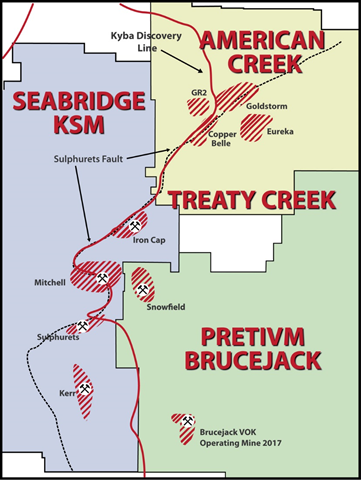
American Creek owns a 20% Carried Interest to Production at Treaty Creek.
Intersect included a high grade portion of 1.095g/t gold over 370m
Broad intercept an indication of a deep system at Goldstorm Zone
Located on trend and 5 km Northeast of Seabridge’s KSM deposits
Goldstorm system increases in grade as it trends Northeast
Eric Sprott recently placed 1$M strategic investment with AMK
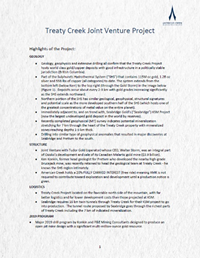
If you have not yet read the 2019 REPORT ON TREATY CREEK (potential world-class deposit in B.C.’s GOLDEN TRIANGE) click on the image for the fullreport.
Hub on Agoracom FULL DISCLOSURE: American Creek is an advertising client of AGORA Internet Relations Corp.
Posted by AGORACOM
at 9:40 AM on Thursday, August 1st, 2019
SPONSOR: Great Atlantic Resources Corp (TSX-V: GR) Great Atlantic Resources. A Canadian exploration company focused on the discovery and development of mineral assets in the resource-rich and sovereign risk-free realm of Atlantic Canada, one of the number one mining regions of the world. Great Atlantic is currently surging forward building the company utilizing a Project Generation model, with a special focus on the most critical elements on the planet that are prominent in Atlantic Canada, Antimony, Tungsten and Gold. Click Here for More Info
Central banks’ insatiable appetite for gold dominated the marketplace between April and June, according to the latest data from the World Gold Council
Global gold demand totaled 1,123 tonnes in the second quarter, up 8% from the second quarter of 2018.
For the first half of the year, physical gold demand rose of 2,181.7 tonnes, its highest level in three years.
(Kitco News) –
Central banks’ insatiable appetite for gold dominated the marketplace
between April and June, according to the latest data from the World
Gold Council (WGC).
In its second-quarter Gold Demand Trends report, the council said
that central banks bought a total of 224 tonnes of gold between April
and June. Official gold reserves increased by 374.1 tonnes in the first
half of the year — “the largest net H1 increase in global gold reserves
in our 19-year quarterly data series,†the analysts said in the
report.
“Buying was again spread across a diverse range of – largely emerging market – countries,†the WGC said.
The WGC said that nine central banks bought gold in the first half of the year.
“Central
banks, like other investors, sought safety in gold as they looked to
protect themselves in the face of many looming risks,†the analysts
said.
The report said that global gold demand totaled 1,123 tonnes in the
second quarter, up 8% from the second quarter of 2018. For the first
half of the year, physical gold demand rose of 2,181.7 tonnes, its
highest level in three years.
The report highlighted renewed strength in key sectors of the gold
market. In particular, gold jewelry demand in India increased by 12% to
168.8 tonnes, compared to the second quarter of 2018. This was the best
year-over-year quarterly increase since the second quarter of 2017.
“Indian demand was boosted early in the quarter by the wedding
season and festival buying, before slowing sharply as the gold price
rallied in June,†the report said.
The WGC noted that India’s gold demand faces strong headwinds as purchases have come to a “virtual standstill.â€
“The slowing economic environment and restrictions on the movement
of cash during the elections were a drag on demand in April and May,â€
the report said.
The India gold market was also hit with higher tariffs in early July with import duties rising to 12.5% from 10%.
“Although we do not expect this to have a long-term impact on gold
demand in India, we do see it having a dampening impact on Q3,
particularly as gold prices have remained elevated,†the WGC said.
While India saw strong growth in the second quarter, the world’s
largest gold consuming nation saw its third consecutive quarterly drop.
The WGC said that Chinese jewelry demand dropped by 4% in Q2 to 137.8
tonnes.
“Demand ground to a halt once the June price rally began and
retailer’s promotional efforts could not tempt consumers back.
Reportedly, showrooms were deserted as the quarter came to a close,†the
analysts said.
ETF Investment Demand Remains Robust
The second quarter started on a sour note for gold investors but
ended with a bang, according to the report. Renewed interest in
gold-backed exchange-traded products led the investment surge,
increasing by 67.2 tonnes in the second quarter an increase of 99% from
the second quarter of 2018.
The gains were predominantly seen in June as the month saw inflows
of 126.7 tonnes, reversing April’s outflows of 57.2 tonnes. The WGC
said that total hold holding reached a six-year high of 2,548 tonnes in
the first half of the year.
“Geopolitical uncertainty, dovish monetary policy commentary by
central banks, and a rising gold price were among the key factors that
drove investors to increase their holdings,†the analysts said.
The WGC highlighted the growing trend of European and U.K. investors
leading the way in the gold market. It noted that U.K.-listed funds
accounted for 75% of all global inflows during the second quarter.
“Investors sought the safe haven of gold amid the uncertainty
surrounding Brexit and the leadership battle that followed Theresa
May’s resignation as Prime Minister,†the analysts said. “The sharp drop
in the value of the pound also fueled inflows during the quarter as
the U.K.’s growth prospects were cut following repeated failures in
Brexit negotiations.â€
The WGC added that historic negative bond yields in German bonds also added to gold’s investment appeal.
Lackluster Coin and Bar Demand
Although
investors have been jumping into gold-backed ETFs, interest in
physical gold was fairly muted. The WGC said that gold coin and bar
demand dropped 12% in Q2 to 476.9 tonnes, the lowest level since 2009.
They noted that June’s sharp price rally has weighed on physical demand.
“This market has been struggling for some time, with many
traditional gold investors focused on America’s healthy economic growth,
low unemployment, and continued wage growth,†the WGC said. “The gold
price rally in June triggered selling by some investors, and coin
premiums in the secondary market fell to their lowest level since
before the global financial crisis, spurring gold exports from the US
to Germany.â€
Tech Sector Sees Lower Gold Demand
Although not a significant factor for the physical gold market,
analysts said that the tech sector saw gold demand drop by 3% in the
second quarter to 81.1 tonnes.
“This was the third consecutive quarter of falling demand, due to a
range of challenges in the electronics sector, including the ongoing
trade dispute between China and the US. However, there are signs of
recovery and we expect declines to continue to slow throughout H2
2019,†the WGC said.
Gold Supply Rises Due To Record Production
The council noted that robust gold demand is being met with strong
production; the analysts said that gold supply increased by 6% in the
second quarter to 1,186.7 tonnes. The supply was led by record gold
production between April and June.
The WGC added that gold production increased by 2% to 882.6 tonnes
in the second quarter. “This is a record level of global output for a
second quarter and follows on from a Q1 record of 847.5t.
Global gold production was let by Canada, Russia and the U.S. that
saw their domestic production increase by 9% in the third quarter.
Australia, which has reported record gold production in 2018 saw an
increase of 6% in the second quarter.
The WGC also noted an increase in recycled gold as consumers sold into higher prices late in the quarter.
Posted by AGORACOM
at 9:00 AM on Thursday, August 1st, 2019
Concerning the existing joint venture between Acacia and Advance Gold respecting the Gold Rim property in Kenya
Advance Gold has been notified that Barrick would like to renegotiate the terms of the agreement in principle.
One of the highest-grade intersections on the Liranda Corridor came from the joint venture ground, returning 6 metres of 30.9 g/t gold
Kamloops, British Columbia–(Newsfile Corp. – August 1, 2019) –
Advance Gold Corp. (TSXV: AAX) (“Advance Gold” or “the Company”) wishes
to report that having reached a signed agreement in principle with
Acacia Mining plc (“Acacia”) concerning the existing joint venture
between Acacia and Advance Gold respecting the Gold Rim property in
Kenya, during the period of the proposed takeover of Acacia by Barrick
Gold Corp. (“Barrick), Advance Gold has been notified that Barrick would
like to renegotiate the terms of the agreement in principle.
Two of the three claims that make up the joint venture are to the
east and west of Acacia’s 100% owned property. The joint venture covers
approximately â…” of the Liranda Corridor, with Acacia’s 100% property
making up the remaining â…“ of the corridor. Acacia has spent
approximately $70 million on exploration and development on the Liranda
Corridor, with $5 million spent on the joint venture ground and the
remainder on Acacia’s 100% owned property.
The Liranda Corridor is in an Archean craton setting, with a large
deep-seated structure, and high-grade gold zones. One of the
highest-grade intersections on the Liranda Corridor came from the joint
venture ground, returning 6 metres of 30.9 g/t gold, see April 18/2016
news release. The remaining key exploration question for the joint
venture ground is concerning the continuity of the high-grade gold zones
which will require further exploration drilling.
Allan Barry Laboucan, President and CEO of Advance Gold Corp., commented: “After
months of negotiations to come to terms on an agreement in principle
concerning Advance Gold’s purchase of the Acacia interest in the joint
venture, it is disappointing that Barrick now want to renegotiate the
terms. The agreement in principle included no cash payments up front, or
stock at any time, a one-time $3 million payment upon commercial
production and a sliding scale royalty. The terms of the agreement would
allow us to focus funds on exploration and was something we could move
on. The joint venture ground is highly prospective having the key
criteria on a target like this, including the right age of the rocks, a
large deep-seated structure that runs throughout 2 of the 3 claims in
the joint venture. Most importantly, it has high-grade gold
mineralization drill confirmed in several areas as set out in the news release of April 18/2016and
is open for exploration to advance the known zones along strike and at
depth, as well as exploring for potentially more zones. We will assess
our various options that are described below. We are keenly eager to
advance the Kenya projects, but it must be on the right terms with funds
focused on exploration not on “upfront” cash payments, for us the funds
need to be focused on exploration drilling to move the Kenya projects
forward.”
The joint venture is owned 85.37% by Acacia and 14.63% by Advance
Gold. If during the joint venture either party decides to sell their
interest, the other party has a first right of refusal on any offering
price. If Advance Gold is diluted down to a 10% interest (approximately
$1.7 million in exploration to dilute to an NSR), then its interest
converts to a 3% uncapped net smelter royalty (NSR). In the event that
Advance Gold is diluted to an NSR, Acacia Mining has no first rights of
refusal and the NSR can be sold directly to any interested party. Both
parties have the right to dilute the other down if the other party
decides to not contribute exploration funds.
Julio Pinto Linares is a QP, Doctor in Geological Sciences with
specialty in Economic Geology and Qualified Professional No. 01365 by
MMSA., for Advance Gold and is the qualified person as defined by
National Instrument 43-101 and he has read and approved the accuracy of
technical information contained in this news release.
About Advance Gold Corp. (TSXV: AAX)
Advance Gold is a TSX-V listed junior exploration company focused on
acquiring and exploring mineral properties containing precious metals.
The Company acquired a 100% interest in the Tabasquena Silver Mine in
Zacatecas, Mexico in 2017, and the Venaditas project, also in Zacatecas
state, in April, 2018.
The Tabasquena project is located near the Milagros silver mine near
the city of Ojocaliente, Mexico. Benefits at Tabasquena include road
access to the claims, power to the claims, a 100-metre underground shaft
and underground workings, plus it is a fully permitted mine.
Venaditas is well located adjacent to Teck’s San Nicolas mine, a VMS
deposit, and it is approximately 11km to the east of the Tabasquena
project, along a paved road.
In addition, Advance Gold holds a 14.63% interest on strategic claims
in the Liranda Corridor in Kenya, East Africa. The remaining 85.37% of
the Kakamega project is held by Acacia Mining (63% owned by Barrick Gold
Corporation).
For further information, please contact:
Allan Barry Laboucan, President and CEO Phone: (604) 505-4753 Email: [email protected]
Posted in Advance Gold, All Recent Posts | Comments Off on Advance Gold $AAX.ca Reaches Agreement in Principle with Acacia Mining – Barrick Wants to Renegotiate Terms Since Agreeing To Takeover Of Acacia $ACA.gbx $ANG.jo $ABX.ca $NGT.ca $MGG.ca $SIL.ca $FA.ca $LON
Posted by AGORACOM
at 11:48 AM on Wednesday, July 31st, 2019
SPONSOR: GGX Gold Corp (TSX-V: GGX) GGX’s Gold Drop Property resides within a multi-million ounce gold producing region in British Columbia. The property holds the C.O.D. Vein and recently discovered Everest Vein. GGX has initiated 2019 drilling at Gold Drop. Click Here for More Info
Expectations are the Fed will cut rates by 25 basis points
Falling interest rates make metals more attractive
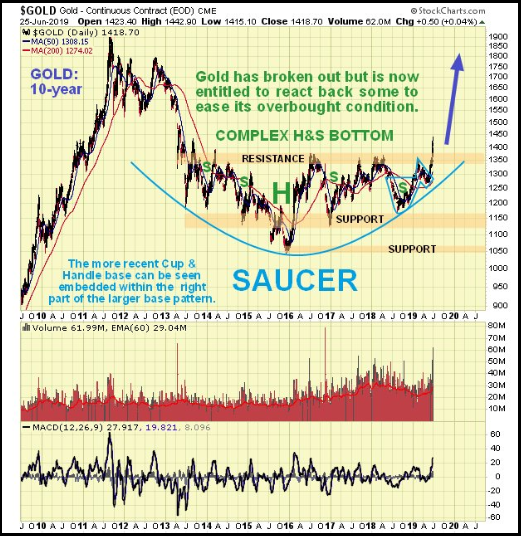
Tie in bullish technicals with a clueless Fed and we should see higher gold and silver prices.
Yesterday we wrote that gold and silver would probably be quiet and
flat until after the Fed reported on Wednesday. It now looks like the
metals are trying to get a jump on the Fed and have started to rally
early.
Friday saw gold
trade as low as $1,412 and suddenly the metal is back over $1,440.
There was a late-day rally Monday with some early morning follow-through
today. The key to watch in gold is the $1,450 level, since a close
above would signal $1,500 is not far behind. Silver looks like it wants to join the rally and push through $17.
Expectations are the Fed will cut rates by 25 basis points; that
would be bullish for the metals. Falling interest rates make metals more
attractive. Tie in bullish technicals with a clueless Fed and we should
see higher gold and silver prices.
Posted by AGORACOM
at 10:00 AM on Wednesday, July 31st, 2019
Sponsor: American Creek Resources (TSX-V: AMK) American Creek owns a 20% Carried Interest to Production at the Treaty Creek Project in the Golden Triangle. 2019’s first hole averaged of 0.683 g/t Au over 780m in a vertical intercept. The Treaty Creek property is located in the same hydrothermal system as the Pretivm and Seabridge’s KSM deposits.
Sprott sold 3.3 million shares of Kirkland stock for C$168m
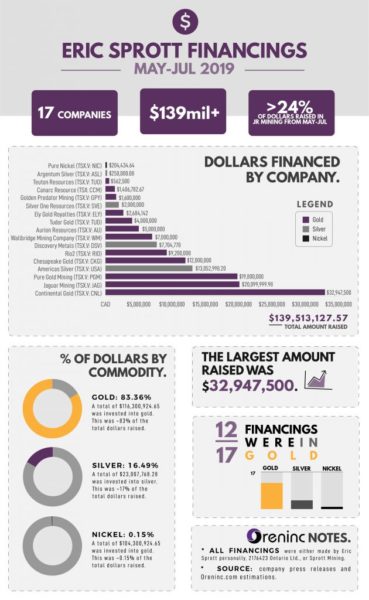
Deployed C$139m on 16 gold and silver explorers since May
Includes $4M in Tudor Gold and most recently 1$M in American Creek for Treaty Creek Exposure at Goldstorm
Eric Sprott is responsible for nearly a quarter of the money flowing into junior mining since May, says Oreninc. Image from archives.
The gold price has now been camped out above $1,400 an ounce for a month, and silver has finally come alive above $16 per ounce, but legendary mining financier Eric Sprott had already kicked off a major junior investment spree when the metals were significantly cheaper than they are today.
The Canadian billionaire investor – also a pioneer in the gold-backed
ETF industry – has splashed more than C$139 million on 16 gold and
silver explorers (and some nickel on the side) since May, according to
junior mining finance authority Oreninc. $127m of the total found its way to Canada-domiciled companies.
Sprott uses a company called 2176423 Ontario to play the space and
was able to flash the cash thanks in part to a divestment from Kirkland
Lake Gold, (TSX:KL) (NYSE:KL) where he was chairman until recently.
Sprott, has sold some 3.3 million shares of Kirkland stock for C$168
million, reducing his position from 10% to 8% according to Oreninc data.
Kirkland Lake has been on a roll, doubling its share price in under a
year.
Kirkland Lake output could reach 1 million ounces for the first time this year, driven by record production at its flagship Fosterville mine in Australia. Fosterville is the lowest cost gold mine in the world, extracting the metal for a mere $313 an ounce all-in this year.