Agoracom Blog Home

Archive for the ‘Featured’ Category

MUST READ: Sustainable Development Goal #4 will fail to meet #UN’s 2030 global goals #education #Edtech #betterU $BTRU.ca $ARCL $CPLA $BPI $FC.ca

Posted by AGORACOM-JC at 9:22 PM on Wednesday, August 21st, 2019
BTRU: TSX-V

By Brad Loiselle, President/CEO and Kate O’Neil, Director International Partnerships, betterU

Dreamers, visionaries and sustainability enthusiasts imagine a world where everyone is equal, where the water runs clean, where a child never goes without a meal, where people of different countries, religions, and cultures respect each other’s beliefs, and where the word hate is no longer part of our vocabulary. This is a world we all want for our children, but unfortunately this utopia is never going to exist if we don’t join and commit to building a better future for all.

In 2015, the United Nations defined a set of 17 global development goals that, if achieved, would have the power to eradicate poverty, fight inequality and stop the climate crisis we are now faced with. The 2030 Agenda for Sustainable Development was created as a “universal call to action” to inspire us to come together to enact change that will result in a safer and more sustainable planet for future generations. In September of that same year, 193 UN member states adopted the Agenda and committed to supporting the 169 targets identified in the global framework of action. 

The challenges to achieving the Agenda

Many critics of the 2030 Agenda for Sustainable Development will tell you that the goals are failing and that there is no evidence of transformative change in any of the 17 focus areas. Truth be told, it was exciting and encouraging to see so many UN nations and world leaders sign their commitment to achieve the Agenda but as we gather speed towards 2030 it is evident that something critical is missing; something hindering progress on a global scale.

When we look at those who are leading the charge, we see world leaders who are talking about why this global movement is important but then calling on other governments, educators, corporations and private enterprises to take action, to collaborate and work together to put in place systems and solutions. Many global leaders emphatically committed to the cause, but it is becoming clearer that most do not fully grasp both the importance of the Agenda or the measures required to act and impart change. 

Upon review of the Agenda, it is evident that there has been a breakdown along the way. Firstly, the goals were developed without clear plans for execution, division of labour, or assignment of responsibility not only from the people that have committed to the movement, but their respective governments. The Addis Ababa Action Agenda supported the SGDs by taking the steps to identify action areas and implementation, but the statements within the document are vague and do not hold any one person or group accountable for seeing each action item through. The goals then become more inspirational and generalized statements that do not demonstrate an understanding for how to achieve results country by country, which is fundamental for global adoption and advancement.

Secondly, timelines for accomplishing the goals span more then a decade and much can change over that time. A country’s political leadership, governance and policies can change every few years. Leaders who were initially instrumental in establishing and monitoring commitments for the Social Development Goals, along with relationships that were formed as part of the vision to achieve the goals may no longer be stakeholders in the fight for global action. Furthermore, by the time some or all the SDGs are realized, many of the worlds most vulnerable will not be around to benefit. Change needs to happen now!

Finally, when looking at the actions taken over the years towards impacting change, it is evident that many are working in silos, ignoring the importance of collaboration. SGD17 – Partnerships for the Goals, identifies the importance of collaboration by aiming to “strengthen the means of implementation and revitalize the global partnership for sustainable development (*1).” Furthermore, it has been stated that “the Global Goals can only be met if we work together. International investments and support are needed to ensure innovative technological development, fair trade and market access, especially for developing countries. To build a better world, we need to be supportive, empathetic, inventive, passionate, and above all, cooperative (*2).” When we take a step back and review what has been accomplished since the Agenda’s inception it is fair to say that many, if not most of the targets under SDG17 have not been addressed on a global scale and that the call for collaboration and partnerships has not been answered.

With a timeline of 15 years to fulfill the targets set out in the SDGs, but no executable action plan or singular governing body to hold each of the signatories and their countries accountable, achievement of the goals becomes less tangible.

Access to education – A focus on SDG4

As the years passed and people got to work to achieve the targets set out in the global goals, the importance of one goal started to come to light; Goal 4 – Quality Education. According to UNESCO, “Education is a human right and a force for sustainable development and peace. Every goal in the 2030 Agenda requires education to empower people with the knowledge, skills and values to live in dignity, build better lives and contribute to their societies (*3).” Education has the potential to spark creativity, innovation, and critical thinking in an individual, paving the way forward to solving the problems faced in the world today and in the future.

The Global Goals for Sustainable Development states that “Education liberates the intellect, unlocks the imagination and is fundamental for self-respect. It is the key to prosperity and opens a world of opportunities, making it possible for each of us to contribute to a progressive, healthy society. Learning benefits every human being and should be available to all (*4).” However, the barriers to making quality education accessible to all are complicated and overcoming them has proven to be a challenge for many.

In order to solve SDG4 we must call on government and key stakeholders in every country to promote the welfare of their people by supporting all targets outlined in the Agenda. When it comes to education specifically, efforts as defined by the SDG4 goals need to be made in several areas;

·         Government and industry need to enact policies that will provide compulsory free access to primary and secondary education as well as pre-primary program development and support with a focus on literacy and numeracy.

·         Government and industry must create opportunities that encourage learners to continue into post-secondary education. Removing financial barriers though scholarships and subsidies and focusing support on the most vulnerable demographics will encourage learners to continue their path of lifelong learning.

·         Governments and industry must commit to developing supportive and sustainable infrastructure and technologies to support a growing population and ensure every student has access to a safe and accessible learning environment.

·         Government and industry leaders need to source, create and maintain a curriculum that is relevant, evolving, and value based to ensure all students are receiving a world-class and globalized education.

·         Government and industry need to invest in the recruitment and development of qualified teachers and facilitators. Job training, job satisfaction, and retention must remain a key focus.

·         Government and industry must create opportunities for equity within the education landscape. Ensuring that boys and girls, women and men, have equal access to education and equal skill development opportunities will change the current state of inequity we experience in many countries.

·         Government and industry must commit to removing barriers to education through the creation and enactment of policies and programs nationwide. 

·         Government need to work with other governments and industry to leverage already developed and proven learning models, content, policies, frameworks and other such structures that can advance developing countries more efficiently. 

A strained education system – a focus on India

betterU was created with a mission to change the world through equitable and universal access to education. During the initial stages of the company’s development it was quite clear that many of the world’s education systems were facing substantial challenges. School systems are fragmented, curriculum is outdated, governance is money-driven, methods of delivery are inadequate for globalization and for many, a quality education is completely inaccessible. Countries that have more mature education systems, do not seem to be working closely enough with countries that need the support. Re-emerging countries like India for example have significant pressures to skill upwards of hundreds of millions of people across all industries.

With a population of over a billion people and a strong desire to globalize their economy though improved access to quality education, betterU decided to bring their ‘Education for All’ efforts to India first. For many years our small but passionate team has worked tirelessly to show the world that inclusive and equitable educational opportunities are possible for everyone, everywhere with the right foundation, global collaborations, technologies and a vision for scale. In 2013, the Prime Minister of India called for international educators to help support the education needs of his country. Like a Prime Minister’s vision for his country’s future, every parent’s priority is to ensure that they can provide their child with access to the best education available. However, in countries like India, the educational system is strained and under pressure to support the growing population. The barriers faced by many are overwhelming and often insurmountable in today’s education landscape. With 29 states, 7 territories and over 650,000 villages, as well as a gap of over 350,000 qualified teachers needed to support the country, the options available to those looking for a better life through education are bleak without immediate action.    

Many international educators and Ed-Tech companies have since flocked to India and other emerging markets in the hopes of tapping into the potentially massive revenue opportunities without first understanding the many barriers and requirements for access and delivery. These companies and organizations, while ambitious, ultimately face unanticipated challenges; eventually pushing them to abandon their pursuits. betterU however, did not abandon efforts in India and in fact, advanced to become an opportunity to support the entire country. betterU has been aligning efforts with like-minded organizations around the world partnering with those who are working to advance access to quality education in India. Most recently the National Skills Development Corporation (NSDC), a not-for-profit public limited company under the Ministry of Skills Development and Entrepreneurship, partnered with betterU to help achieve the objectives set out in the Skill India initiative. 

Overcoming barriers – together

Many global educators have a misunderstanding of emerging markets and believe that with their small international team they can service an entire country. Companies looking to quickly tap into a market the size of India, Africa, Indonesia and others without fully understanding the complexities and intricacies of the country and the industry are going to be greatly disappointed. Through conferences, keynote speeches, lectures, and personal meetings, betterU has been working to educate global leaders on the unique requirements of emerging markets to truly illustrate the types of barriers that must be considered and pillars that need to be put in place to fully support mass populations.

Not all of us come from the same upbringing, have access to the same technologies, can afford the same programs, learn the same way, have the same interests, or have the right resources in place for quality learning such as shelter, food, clean water, and facilities within a safe and supportive learning environment. Collectively all these variables should be considered when creating a solution for access to ‘Education for All’. Additional barriers also include the location of students, language, literacy level, social systems, availability of qualified teachers and availability of suitable learning facilities. Without a comprehensive understanding by educators, service providers, technology, corporate and government SDG4 will be impossible to solve.

Pioneering change

There are endless amounts of technologies, educators, and support services available in today’s global education landscape. The following model helps illustrate the scope of the education and what it would take to solve access to ‘Education for All’. This is important because if the scope of education in its entirety is not being addressed, no solution can be provided that suits the needs of the world. The Scope of Education model has been segmented into 5 sections, as defined below, representing each stage of a learner’s development throughout their lifetime. Please note, this model is not a complete representation of the scope of education required but simply an illustration of the complexities of requirements.

1.    Solving for SDGs requires a level of knowledge and understanding that starts from an early age. This needs to be the foundation of all educational programs. We need to educate the world on what it means to eradicate poverty, have zero hunger, live in good health, have access to quality education, live in an equitable society, have access to clean water and sanitation as well as affordable and clean energy. We need to take the lead and show how we can all live in a world with decent work and economic growth, healthy industries, innovation and infrastructure, sustainable cities and communities while being responsible for sustainable consumption and production. We need to be educated on climate action, life below water, life on land, peace and justice, and strong institutions and partnerships to achieve the Agenda. By educating everyone from the start we set values and an awareness for a sustainable and prosperous future.

2.    Basic school programs are essential because they teach our children the right skills, behaviours, tolerance and fundamentals to support not only their futures, but the world as a whole. As individuals move through each level of education, they begin to focus their efforts and individualize their learning path. Most emerging markets do not have the ability to support the basic schooling requirements for their population. There are hundreds of millions of people without access to quality education and millions more who are not even receiving the basics to live a healthy and prosperous life.

3.    In general, most countries around the world have the same or similar industries. Each industry has their own educational requirements and while most post secondary programs align with industry in developed countries, this is often not the case in emerging markets. What this means is that students entering the workforce might not have access to the knowledge and skills to support their career aspirations. This creates is higher unemployment and a skill gap within the country that now must be addressed after the core education system that has failed the learner.

4.    Skills development is changing everyday due to the advancement of new technologies and emerging innovations. Even after a learner starts a job, there will be an ongoing requirement for skills development. Depending on the employee’s skill levels, their job role, the company’s goals and the industry’s requirements, an employer can be faced with hundreds of learning and skilling variables to contend with across their organization. In today’s employment landscape, there are tens of thousands of skills development solutions to choose from. What makes this more complicated for a corporate is that each provider could be using difference technologies, have different methods of access, focus on only partial part of the skilling requirements or struggle to track the learner’s progress. These additional variables add to the complexity of the solution.

5.    Global relevance is critical to the education and skills of an individual. Education and skill development need to be aligned not only with industry, but also with global standards. The closer this alignment is to global standards, the more opportunities for the globalization of an economy and its people.

The Scope of Education model represents, for the most part, what the education landscape looks like in developed countries. There are many additional variables and challenges that need to be considered for emerging markets, but the point of the model is to illustrate the scope of education so that people understand SDG4 requires a lot more than what is out there and available today.

Education and Delivery

When we look at being able to provide ‘Education for All’, we need to understand that bringing together the breath and depth of education across primary learning, post secondary education, industry specific training, and ongoing skills development requires an inclusive view of everyone’s needs and abilities.

Many of the world’s leading companies such as Google, Facebook, Microsoft, Alibaba, Amazon and more have been investing in those who can contribute to providing access to education on a global level. Many others have chosen to focus on methods for delivering education. Furthermore, there is an overwhelming number of educators, Ed-Tech providers, assessors, consultants, tutors and more all competing for the same students. There is so much noise in the market that anyone looking to access global education can quickly become overwhelmed. All believe they are addressing the barriers to providing access to quality education, however these efforts, while important, are singular efforts competing for a share of the market. Education and technology giants all want to come out on top and dominate the industry but are falling short because they are not considering the importance of balancing their strengths with the strengths of another to provide a solution that truly addresses the totality of the issues. When solving the problem of ‘Education for All’, we must look at the solution from both sides of ‘Education’ and ‘Delivery’. Without one, access to quality education will fail.

‘Education’ is the Who, Why and What which encompasses the materials required to support educating the masses, including all ages, demographics, education levels, genders, industry requirements and cultural diversities. ‘Education for All’ must include education that can support the variable needs of a country while also supporting the requirements of an individual. This part of the puzzle is far more difficult to solve because of the level of global complexities and is the reason why so many have not even attempted to focus on it.

‘Delivery’ is the When, Where and How to connect the potential learner to the relevant education they need. This includes such things as the use of technology, classroom facilities, internet connectivity and associated infrastructure, facilitators, teachers, schedules, and system sustainability. â€˜Delivery’ should also include a combination of online and offline solutions as online education is still in an early growth stage for many emerging markets. Delivery is about providing access to quality education through the best possible method required to support the individual. Accessibility and the delivery of education must take into consideration the circumstances of everyone to be effective. 

Overcoming these challenges can be a daunting thought. There is not one educator, one technology company, not one government or one social good enterprise anywhere in the world that can provide education across so many age groups, educational categories, and industries to support the multitude of barriers and obstacles. There are simply too many challenges and variables from country-to-country and person-to-person for one educator to be everything to everyone.

The Solution – Collaboration is key

The only way to solve SDG4 is through global collaboration in one inclusive system that brings together the full scope of education and delivery options. Through collaboration, emerging markets would not have to start from scratch. Emerging markets and developing countries could leverage the world’s leading education programs and work with global educators to establish the necessary frameworks, content and alignment with industry. One world, one education system!

betterU has created an asset-light ecosystem that we believe supports ‘Education for All’. This multi-layered model includes a collaboration of education providers, assessment and support providers, multiple delivery methods, teachers, facilitators and coordinators accessible to all types of learners who are integrated into an online marketplace supported by global partners and technology.

To support inclusion of global educators, we needed our providers to embrace the idea of coming together on one platform and to share the common goal of educating everyone, everywhere. In order to accomplish this, we had to create a system that was technology agnostic to support all types of global educators’ learning environments, the technologies they use and their methods of delivery. The asset-light model also needed to be scalable and easy to replicate across all developing and developed countries.

Our solution also had to consider that not all learners accessed education in the same way. While we are seeing an upswing in the adoption of online learning, many around the world still rely on in-class learning or a blended approach. Many educators typically do not work together directly, either for competitive reasons or because their goals are not aligned. Convincing each educator of the value of bringing them together onto one online platform was important. We spent many years travelling the world and speaking at global events to educate educators to the importance of collaboration and bringing together quality education from around the world. While one educator might not have the solution for all individuals, hundreds and thousands of educators would. Working together, hand in hand, towards common goals as set out by the Agenda will truly benefit all.

betterU’s asset-light model (for global scale) 

Conclusion

According to a United Nations report presented by Secretary-General António Guterres, “If the world is to eradicate poverty, address climate change and build peaceful, inclusive societies for all by 2030, greater efforts are needed to accelerate progress on the Sustainable Development Goals (SDGs) (*5).” While SDG4 may be headed toward failure, betterU has been working for many years to put in place the foundation on which the world can leverage, collaborate and advance their efforts to meet the global goal requirements. We have the opportunity to succeed at SDG4 and the remaining SDGs, but we need to work together. Global leaders need to collaborate and support each other to achieve ‘Education for All’. If global leaders and influencers invest their efforts and energy in companies who can help solve a portion of the issues facing education, we can to work together to leverage their successes for the world. We need to collaborate now because as they say, “Time and tide wait for no man”

About betterU

Through partnerships with leading global job portals, industry partners, employment service providers and top global educators, betterU provides access to quality education, employment and career services for all.

betterU enables learners to access education from global leaders through their easy-to-use marketplace. With over 53,000 programs currently available through 75 global educators, betterU supports access to KG-12, higher education, skills development, job preparation and a lifetime of learning. They provide learning programs across multiple age groups, careers paths and industries. betterU also connects learners to support systems, such as their Upskill Engine, designed to help individualize skill learning to help them make informed decisions about their required skills and their future.

betterU evolves with the market to meet the growing needs of the industry. They have focused exclusively on India, spending years researching and understanding how to bring global education to the country. Most recently, betterU has partnered with the National Skills Development Corporation to support and enable of the people of India to reach the goals set out in the Skill India initiative and secure a better livelihood.

*Sources:

  1. 17 Partnerships for the Goals, Global Goals, https://www.globalgoals.org/17-partnerships-for-the-goals
  2. 17 Partnerships for the Goals, Global Goals, https://www.globalgoals.org/17-partnerships-for-the-goals
  3. Leading SDG 4 – Education 2030, https://en.unesco.org/themes/education2030-sdg4
  4. SDG 4 Quality Education, Global Goals, https://www.globalgoals.org/4-quality-education
  5. UN report urges accelerated efforts to achieve Sustainable Development Goals, UN News, https://news.un.org/en/story/2017/07/561632-un-report-urges-accelerated-efforts-achieve-sustainable-development-goals#.WYoDuogrJaQ

Source: https://www.linkedin.com/pulse/sustainable-development-goal-4-fail-meet-uns-2030-global-loiselle/


North Bud Farms Inc. $NBUD.ca – #CBD usage in beverages; functionality, cultural acceptance and legislation $WEED.ca $CGC $ACB $APH $CRON.ca $HEXO.ca $TRST.ca $OGI.ca

Posted by AGORACOM-JC at 10:24 AM on Wednesday, August 21st, 2019

SPONSOR: North Bud Farms Inc. (NBUD:CSE) Sustainable low cost, high quality cannabinoid production and procurement focusing on both bio-pharmaceutical development and Cannabinoid Infused Products. Learn More.

NBUD: CSE

CBD usage in beverages; functionality, cultural acceptance and legislation

By: Megan Kindelin

  • growth of the legal cannabis industry has opened doors to new product innovations, particularly in beverages, with no signs of slowing down.
  • According to Zenith Global, the CAGR forecast for 2018- 2023 volume sales is 75%, with 5.2 million litres of CBD drinks consumed in the US in 2018. 

The growth of the legal cannabis industry has opened doors to new product innovations, particularly in beverages, with no signs of slowing down. According to Zenith Global, the CAGR forecast for 2018- 2023 volume sales is 75%, with 5.2 million litres of CBD drinks consumed in the US in 2018. 

Although CBD is being included in alcoholic drinks such as low ABV beer, with a trending decline in alcohol consumption, new CBD categories such as RTD coffee, sodas and water-based drinks are posed to be a high growth market for the beverage sector.

The culture of cannabis is evolving from a product associated with negative, psychoactive effects to being full of medically-backed health benefits previously unexplored and underappreciated. 

To better understand why the CBD use in beverages is enjoying a recent boom, we should examine where it comes from and how the body utilises it. 

Defining Cannabis, CBD, THC, marijuana and hemp

Cannabis – or more the more biologically correct Cannabis Sativa – is the umbrella term for both marijuana and hemp. They are of the same genus and species with the main divertive being the THC content of each. They look nearly identical, with marijuana being illegal and hemp being legal. There are many strands of Cannabis, however we will touch base on just the two mentioned, which contain both the cannabinoids (plant oils) THC and CBD in different concentrations. Cannabis makes most of its cannabinoids in its flowers, which are more commonly referred to as “buds”. 

Marijuana tends to contain high levels of THC and lower levels of CBD and requires certain sometimes controlled conditions to grow fruitfully. It also has a higher concentration of cannabinoids per gram so generates a better yield.  Hemp will contain higher levels of CBD and trace amounts of THC with a lower yield of cannabinoids, so it tends to take more plants to extract the same amount of CBD.

Difference between CBD and THC and how they function in the body

Since research on cannabis is still fresh as it was only partially legalised recently, most of its functionality is yet unknown. Cannabis is theorised to work like many other drugs, binding to receptors in our body. 

Interestingly, our bodies are set up to accept cannabinoids already. The endocannabinoid system (ECS) is a complex cell-signalling system in the body that we so far understand to play a role in regulating a range of functions in the body such as sleep, mood and memory, according to an article by Healthline.com. 

The ECS actively exists in our body and we already naturally produce endocannabinoids, even if we do not consume cannabis. A similar comparison of a process in the body that does a similar process would be the pancreas produce insulin for our blood sugar regulation. 

So not only do we produce our own endocannabinoids, we have two main receptors that accept them; CB1 receptors mainly found central nervous system and CB2 receptors found mainly in the peripheral nervous system. Once bound to either of these receptors, the endocannabinoids can then tell the ECS system the action needs to happen i.e., boost our mood, relieve pain or go to sleep. 

Once our endocannabinoids have served their purpose, they must be broken down by enzymes in the body, which are regularly regenerating. 

It appears the main function of the endocannabinoid system is to maintain bodily homeostasis, states a report by the Facultad de Medicina at University of Buenos Aires. 

So now that we defined the difference between THC and CBD, what do they actually do when they are in the body? Since we know that the ECS receptors are linked with the nervous system, it’s understandable that the sides effects we hear about cannabis tend to be related to relaxation.

THC – tetrahydrocannabinol- the compound which can get you ‘high’, binds to the CB1 and CB2 receptors just like our bodily endocannabinoids, almost like a substitute. 

THC can have positive effects such as stimulating appetite, which can be great for medical patients who find it difficult to eat, but it is also responsible for side effects such as paranoia. THC is more frequently used for therapy since is similarity to our own endocannabinoids is nearly identical. Currently there is not a way to separate the two effectively, but research is continuing.

CBD – cannabidiol– which typically doesn’t have any negative effects, would be seen to be the superior compound and used more widely. So why bother using THC if CBD is better and easier to regulate? CBD actually works best in conjunction with THC, because CBD doesn’t appear to interact with our ECS the way THC does by binding to receptors. 

Though experts aren’t quite sure, it’s believed that CBD may work by preventing our endocannabinoids from being broken down and allowing them to have a longer effect on the body. 

As CBD is more widely accepted and there are less legal restrictions on this compound currently, it is being more readily used in beverages as opposed to THC.

Cultural acceptance and legalisation worldwide

Regulation is ongoing, and constantly changing worldwide. As of press time, CBD is legal in all 50 of the US, as long as it contains less than 0.3 % of THC, though some states require you to have a prescription to purchase it, such as Virginia. 

THC is legal in 10 states with a prescription, and in an additional 23 states with a doctor’s prescription. The US Food and Drug administration has approved four cannabis related drug products, however they are only available with a prescription from a licenced healthcare provider.

Press and recent legalisation, particularly in the US, has brought CBD to the public’s attention while increasing demand for new, innovative ways to consume it. For those unfamiliar with the drug but curious to try it, beverages are seemingly the most accessible (and perhaps culturally acceptable) way to consume the cannabis-based product. The category is still in early stages, with fragmented legislation fuelling conflicting information from multiple sources about usage, benefits and dosages. 

The most popular way to consume CBD it is through oil, as CBD is naturally soluble and most effective delivered in fat. It is also easy to control dosages this way which is handy for consumers. This easy-to-consume format comes in dropper applications called tinctures. Though with the rise in innovation through beverages and food, this could change in the next few years.

CBD is now popping up in snacks and even ice cream with doses ranging per serving of 10-50mg.  As CBD is still very new to the market there aren’t many regulations on quantities in food and beverage due to its minimal side effects, though the expense of the ingredient will affect the price point of the product. It’s always best to check the label and research the effects of CBD before consumption.

Source: https://www.foodbev.com/news/cbd-usage-in-beverages-functionality-cultural-acceptance-and-legislation/

Enthusiast Gaming $EGLX.ca – Prize pot of $30 million at #Fortnite World Cup shows #Esports’ rapid growth $EPY.ca $FDM.ca $WINR $TCEHF $ATVI $TNA.ca

Posted by AGORACOM-JC at 11:45 AM on Monday, August 19th, 2019

SPONSOR: Enthusiast Gaming Holdings Inc. (TSX-V: EGLX) Uniting gaming communities with 80 owned and affiliated websites, currently reaching over 75 million monthly visitors. The company exceeded 2018 target with $11.0 million in revenue. Learn More

EGLX: TSX-V

Prize pot of $30 million at Fortnite World Cup shows eSports’ rapid growth

The recent Fortnite World Cup had a total prize pool of $33m and the top winners took away several million each.

By: Federico Winer, PhD researcher, Loughborough University

  • Kyle Giersdorf, or Bugha to give him his game name, is $3m better off after winning the 2019 Fortnite World Cup.
  • The American teenager took home the largest-ever payout for a single player in an eSports tournament.
  • His win reflects the growing popularity of the game and the power of the eSports market. British teenager Jaden Ashman shared $2.25m with his teammate as the runners-up in the doubles competition.

The finals, at the end of July, followed ten weeks of competition involving more than 40m competitors and a total prize pot of over $30m. The tournament packed out the 23,771-seat Arthur Ashe stadium at Flushing Meadows, New York’s largest tennis arenas.

Fortnite Battle Royale is emerging as one of the most popular computer games with an estimated 250m players around the world. Essentially, it is a First-Person Shooter game where players fight to survive in a battle against other human players. Unlike some other games in this genre, such as PUBG or Counter-Strike, its graphics are cartoonish, which means parents of teenage players are less likely to object to the content – it doesn’t look violent of feature excessive blood, bullets and bombs.

Fortnite is rising to prominence in an increasingly lucrative market. Out of 7.6 billion people on the planet, there are approximately 2.2 billion gamers. This includes social gaming, mobile gaming, as well as free-to-play and pay-to-play multiplayer gaming. Of these players, there are about 380m eSports viewer fans – 165m of them regular viewers and 215m occasionals.

Epic Games, publisher of Fortnite, attracts players by making the game itself free to play. But they also sell “V-Bucks” to the players, which cost US$9.99 per 1,000 and can be spent on a variety of customisation and enhancements for players’ characters.

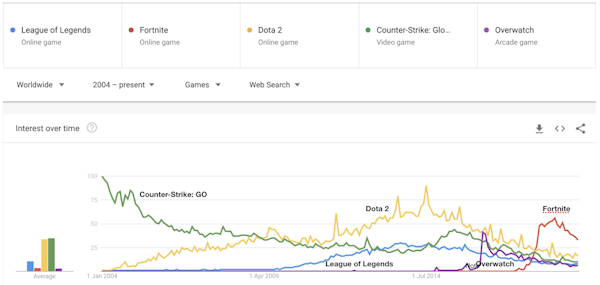
Evolution of eSports titles’ popularity, breakdown by searches in Google, 2004-present. Google Trends, 2019b, Author provided

None of these influence the actual performance of the character in the battle – accuracy and pace still depend on the skill of the individual competitor. This is similar to most eSports titles. But according to research firm Superdata, between its release in July 2017 and May 2018 Fortnite netted US$1.2 billion in revenue.

Competitive edge

So what exactly are eSports? They are defined as competitive tournaments involving electronic games – especially among professionals. Players compete in leagues or play for an audience on a live-streaming service in exchange for payment, which can range to several million dollars for the most successful players.

Top players and teams are well remunerated. Forbes reported that the “average starting North America League of Legends Championship Series (NA LCS) player salary is now over US$320,000, with over 70% of the players performing on multi-year contracts”. An article in Business Insider in 2018 reveals that top teams such as Evil Geniuses earn more than US$10m a year in revenue. This is almost the same budget as a top second division team from La Liga, in Spain.

The recent Fortnite world cup had a total prize pool of $33m and, as we have heard, the top winners took away several million each. Even players who ranked as lowly as 65-108 took away $50,000 for their pains.

When it comes to training for competition, you could be forgiven for thinking that eSports players are not like traditional athletes, building strength and endurance over long hours in the gym or pounding the streets. But, as the growth in prize money means the potential rewards for success grow ever larger, a new generation of eSports professionals is finding that fitness aids concentration. Some of the more successful teams are even drafting in coaches from other sports.

I have connected with several teams and, even in those with low budgets, they are aware of the importance of their physical and mental well-being through nutrition and exercise to perform better in games.

What’s next?

ESports look to be here to stay, but the degree of success will depend on a variety of factors, including general entertainment trends, industry governance and the possibility of government censorship in certain regions. To help the various players in the market understand consumers better and react proactively to changes in the business environment, it is essential to highlight the critical value of eSports data – something that I have been researching for some time.

The huge and rapid growth of eSports – and the massive revenues this promises – are thought by many industry insiders to be indicative of a bubble. Commenting on headlines which implied that gaming tournaments were “bigger than the Superbowl”, Sebastian Park, vice-president of eSports with the Houston Rockets (which owns a majority stake in professional League of Legends team Clutch Gaming) said recently: “When I read a lot of these papers, I don’t know where they derive 50% of those numbers”.

For the health of the industry, it’s critical to be able to establish how different esports industry stakeholders are collecting data and information from the fans to understand their behaviour and consumer trends. There has been speculation that Nielsen, which has been collecting data on TV viewing since the 1950s, is working on a solution. This could be the next big step in establishing eSports credibility.

Source: https://scroll.in/field/933717/prize-pot-of-30-million-at-fortnite-world-cup-shows-esports-rapid-growth-but-is-it-sustainable

$HPQ.ca Silicon PUREVAP™: Impacting the Global #Silicon, #Solar and Battery Industries $FSLR $SPWR $CSIQ $PYR.ca $XMG.ca

Posted by AGORACOM-JC at 9:08 AM on Monday, August 19th, 2019
  • Since the 2015 commencement of the Company’s quest to improve the global economics and supply concerns of the Silicon market, the PUREVAP™ project has reached several substantial operational milestones:
  • Unique Proprietary Capability of converting low quality inputs in to high purity Silicon (Si) [2];
  • Production yields may exceed 90% of input material;
  • Demonstrating to the market that the technology functions as expected.

MONTREAL, Aug. 19, 2019 – HPQ Silicon Resources Inc.TSX-V: HPQ; OTCPink: URAGF; FWB: UGE – (“HPQ” or “the Company”) is pleased to present the market with key metrics on the impact of the Company’s progress since the H2 2018 closing of a CDN$ 5,250,000 financing1 and provide guidance for H2 2019 for the PUREVAP™ Quartz Reduction Reactor (QRR) technology.

Since the 2015 commencement of the Company’s quest to improve the global economics and supply concerns of the Silicon market, the PUREVAP™ project has reached several substantial operational milestones:

  1. Unique Proprietary Capability of converting low quality inputs in to high purity Silicon (Si) [2];
  2. Production yields may exceed 90% of input material3;
  3. Demonstrating to the market that the technology functions as expected.4

The potential economic implications for the global downstream Silicon market and shareholders is extremely significant in that the HPQ PUREVAP™ QRR technology may:

  1. Reduce raw material cost by 50%, representing a direct 20% reduction in OPEX5;
  2. Reduce HPQ Silicon Manufacturing CAPEX by 90% or more versus all other manufacturer6.

The addressable market for PUREVAP™ Silicon (“Si”) is enormous with applications growing beyond just solar.  The market for standard grade material is estimated to increase from US$ 7.5B in 2018 to US$ 12B in 20237.

The global solar energy market is forecasted by Deutsche Bank to grow 10x by 2035 to be a US $ 400B industry.  The Solar Grade Silicon (“SoG-Si”) sub-market is expected to grow from US $7.1B to US $11.8B by 20288. 

Although not commercialized it is well publicized that silicon could replace graphite anodes in Lithium batteries.  As reported by CNBC, private Venture Capital backed firms are exploring the use of silicon in batteries and are positioning to provide the auto industry with the solutions it needs to substantially improve vehicle performance. Presently, Silicon content in lithium-ion battery anodes is roughly 6% and is estimated to represent an addressable market value of US $ 1B by 20229.  If Silicon replaces other materials in batteries, this new addressable market will grow exponentially.

Bernard Tourillon, President & CEO of HPQ Silicon Resources Inc. stated: “HPQ is ready to solve the real world challenges facing Silicon markets today.  We are ready to start commercializing our PUREVAP™ QRR technology. We are aiming to completely revolutionize the economics of the $24B industry and create significant cash flow.”  Mr. Tourillon continued: “In the coming months we will be meeting with end users to see exactly what specs they will be needing for their applications and tweaking our output for them.”

In H2 of 2019 the Company anticipates that the Gen3 Pilot Plant will be operational and should prove scalability. Throughout H2 the Company will be meeting with industry participants and, by the end of H2, start sending test material from the Gen2 unit with a goal of booking orders for material produced by the Gen3 Pilot Plant, as soon as operationally feasible.

___________________________________________
1 HPQ August 13th 2018 Release
2 HPQ February 26th 2019 Release
3 HPQ April 25th 2019 Release
4 HPQ May 23 2019 Release
5 HPQ June 17th 2019 Release
6 HPQ July 11th 2019 Release
7 CRU – Silicon Market Outlook – November 14 2018 (Pages 20 – 23)
8 HPQ_NEW_DECK_JUNE_2019_AGM_V2.pdf
9 Source Marketandmakerts.com


About Silicon

Silicon (Si) is one of today’s strategic materials needed to fulfil the renewable energy revolution presently under way. Silicon does not exist in its pure state; it must be extracted from quartz, one of the most abundant minerals of the earth’s crust and other expensive raw materials in a carbothermic process.

About HPQ Silicon

HPQ Silicon Resources Inc. is a TSX-V listed company developing, in collaboration with industry leader PyroGenesis (TSX-V: PYR) the innovative PUREVAPTM “Quartz Reduction Reactors” (QRR), a truly 2.0 Carbothermic process (patent pending), which will permit the transformation and purification of quartz (SiO2) into Metallurgical Grade Silicon (Mg-Si) at prices that will propagate its significant renewable energy potential.

HPQ is also working with industry leader Apollon Solar to develop a metallurgical pathway of producing Solar Grade Silicon Metal (SoG Si) that will take full advantage of the PUREVAPTM QRR one-step production of high purity silicon (Si) and significantly reduce the Capex and Opex associated with the transformation of quartz (SiO2) into SoG-Si.

HPQ focus is becoming the lowest cost producer of Silicon (Si), High Purity Silicon (Si) and Solar Grade Silicon Metal (SoG-Si). The pilot plant equipment that will validate the commercial potential of the process is on schedule to start in 2019.

This News Release is available on the company’s CEO Verified Discussion Forum, a moderated social media platform that enables civilized discussion and Q&A between Management and Shareholders. 

Disclaimers:

The Corporation’s interest in developing the PUREVAP™ QRR and any projected capital or operating cost savings associated with its development should not be construed as being related to the establishing the economic viability or technical feasibility of the Company’s Roncevaux Quartz Project, Matapedia Area, in the Gaspe Region, Province of Quebec.

This press release contains certain forward-looking statements, including, without limitation, statements containing the words “may”, “plan”, “will”, “estimate”, “continue”, “anticipate”, “intend”, “expect”, “in the process” and other similar expressions which constitute “forward-looking information” within the meaning of applicable securities laws. Forward-looking statements reflect the Company’s current expectation and assumptions, and are subject to a number of risks and uncertainties that could cause actual results to differ materially from those anticipated. These forward-looking statements involve risks and uncertainties including, but not limited to, our expectations regarding the acceptance of our products by the market, our strategy to develop new products and enhance the capabilities of existing products, our strategy with respect to research and development, the impact of competitive products and pricing, new product development, and uncertainties related to the regulatory approval process. Such statements reflect the current views of the Company with respect to future events and are subject to certain risks and uncertainties and other risks detailed from time-to-time in the Company’s on-going filings with the securities regulatory authorities, which filings can be found at www.sedar.com. Actual results, events, and performance may differ materially. Readers are cautioned not to place undue reliance on these forward-looking statements. The Company undertakes no obligation to publicly update or revise any forward-looking statements either as a result of new information, future events or otherwise, except as required by applicable securities laws.

Neither the TSX Venture Exchange nor its Regulation Services Provider (as that term is defined in the policies of the TSX Venture Exchange) accepts responsibility for the adequacy or accuracy of this release.

For further information contact
Bernard J. Tourillon, Chairman, President and CEO Tel (514) 907-1011
Patrick Levasseur, Vice-President and COO Tel: (514) 262-9239
http://www.hpqsilicon.com Email: [email protected]

INTERVIEW: American Creek Resources $AMK.ca – Eric #Sprott Is Shooting For A 10-20 MILLION Ounce Discovery $SII.ca $SA $SEA.ca $TUD.ca $PVG.ca

Posted by AGORACOM-JC at 9:11 PM on Sunday, August 18th, 2019

30 days ago, American Creek Resources (AMK:TSXV) was well known only amongst investors that believe in the Golden Triangle of Northern B.C.  Then, it all changed overnight when Eric Sprott stated the following on July 19, 2019 about the Company’s Treaty Creek project:

“It’s drilling a monster play just like the GT Gold play … It’s in the perfect logistical place to develop it …. what we’re shooting for is to define a 10 or 20-million-ounce discovery, so you’re paying nothing for this discovery.”

To add further fuel to the fire, the Company’s JV partner is Tudor Gold, whose CEO (Walter Storm) startup funded Osisko to a $4.5 BILLION market cap.  Drill results were so good at the end of July that Tudor Gold brought in a second drill, while Eric Sprott personally invested $1,000,000 into AMK 8 days later.
If 3rd party validation is important to you in the world of gold exploration, it doesn’t get better than having Eric Sprott and Walter Storm in your corner.

Grab your favourite cold beverage and watch this interview with CEO Darren Blaney and Investor Relations officer Kelvin Burton …. the laughter and smiles on their faces are priceless.

CardioComm Solutions $EKG.ca – Consumers want mobile health #Mhealth convenience $ATE.ca $TLT.ca $OGI.ca $ACST.ca $IPA.ca

Posted by AGORACOM-JC at 11:01 AM on Friday, August 16th, 2019

SPONSOR: CardioComm Solutions (EKG: TSX-V) – The heartbeat of cardiovascular medicine and telemedicine. Patented systems enable medical professionals, patients, and other healthcare professionals, clinics, hospitals and call centres to access and manage patient information in a secure and reliable environment.

EKG: TSX-V
———————-

Consumers want mobile health convenience

  • According to an article in HealthPayer Intelligence published on May 16, 2018, “Telehealth is a promising opportunity to increase member engagement because a greater number of individuals are open to the use of telehealth services.
  • Telehealth and remote care provide an exceptional customer experience opportunity for payers.

by Mike Greiwe, MD

According to an article in HealthPayer Intelligence published on May 16, 2018, “Telehealth is a promising opportunity to increase member engagement because a greater number of individuals are open to the use of telehealth services. Telehealth and remote care provide an exceptional customer experience opportunity for payers. Consumers want telehealth as a convenient way to receive checkups, preventive care and non-critical services without the need for travel and wait times.”

A study cited by mHealth Intelligence suggests patients are willing, the technology is ready, but clinical providers and insurance payers have lagged behind data that show patients are ready for the convenience found in mobile health applications. Of the 400 consumers surveyed, 77% said they would be more likely to pick a doctor who offered telemedicine applications over one that hadn’t yet adopted the technology. Data showed the reasons behind the interest in mobile health virtual visits included that:

  • Patients want the option of skipping a time-consuming trip to the doctor for a simple recheck or non-urgent visit; and
  •  Short wait times and the convenience of receiving a virtual house call are attractive to patients.

When combined with data showing that telehealth reduces costs in the medical practice, it seems clear there are new options in health care that may improve the bottom line.

Keep the customer satisfied — Mobile health in the orthopedic practice

According to a Beckers Hospital CFO Report, “This direct link between patient satisfaction and revenue will likely become stronger because the U.S. Department of Health and Human Services has set a goal of linking 90% of Medicare payments to quality or value by 2018.”

Although many orthopedic providers continue to express their concern that patients will not be willing to evolve from traditional visits, the most recent research does not hold up this assumption. A 2017 Advisory Board study of patients’ attitudes toward the virtual visits shows 77% would be willing to at least try the model.

The Accenture study highlighted what patients say are the primary benefits of telehealth:

•          faster diagnosis and treatment;

•          reduced costs;

•          providing and receiving high-quality care;

•          more flexibility in scheduling; and

•          time savings for physicians and doctors.

A 2018 article in The New England Journal of Medicine suggests the current model of traditional in-patient visits will eventually be flipped to the visit of last resort over mobile health or telehealth options. The authors suggested, “Face-to-face interactions will certainly always have a central role in health care, and many patients prefer to see their physician in person. However, a system focused on high-quality non-visit care would work better for many others  â€” and quite possibly for physicians as well.”

Some of the systems leading the way are Kaiser Permanente, with 52% of their 100 million-plus patient encounters each year conducted as virtual visits. However, a large health system has the budget to establish telehealth applications while retraining clinical providers and their patients on best practices for using the service. How can a small medical practice find the time and energy to reinvent itself under a mobile health framework?

The answer may lie in the individual practice seeking innovative ways to obtain a competitive advantage. An article by a solo orthopedist in AAOS Now recounted his experience in using telehealth applications to treat postoperative patients. His decision to use the technology was tied to improved patient experience, lower overheads and higher quality of care.

Is it time for your practice to discuss the opportunities to offer mobile health as an option for your patients? OrthoLive has developed a cloud-based affordable telehealth model designed specifically for the orthopedic practitioner. Contact us to find out more.

Source: https://www.healio.com/orthopedics/business-of-orthopedics/news/blogs/%7Bcf0e8b3d-850f-4328-9a71-971b5f29cf36%7D/business-minded-surgeon/blog-consumers-want-mobile-health-convenience

#Luminosity Gaming Signs Popular #Fortnite Influencer, #Yelo – Adds over 2 million followers to combined network of over 200 million $EGLX.ca $EPY.ca $FDM.ca $WINR $TCEHF $ATVI $TNA.ca

Posted by AGORACOM-JC at 10:11 AM on Friday, August 16th, 2019
EGLX: TSX-V

Adds over 2 million followers to combined network of over 200 million

  • Signed international Fortnite influencer, Yelo, to its roster of over 50 professional esports players and video gaming influencers.
  • Yelo’s combined social network reaches over 2 million followers across all social channels, a substantial addition to the 200 million plus fans the combined organization currently reaches.

TORONTO, Aug. 16, 2019 — Enthusiast Gaming Holdings Inc. (TSXV: EGLX) (OTCQB: EGHIF), (“Enthusiast” or the “Company”), one of the largest vertically integrated video gaming media companies in North America, is excited to announce that Luminosity Gaming (“Luminosity”) has signed international Fortnite influencer, Yelo, to its roster of over 50 professional esports players and video gaming influencers. Yelo’s combined social network reaches over 2 million followers across all social channels, a substantial addition to the 200 million plus fans the combined organization currently reaches.

The amalgamation of Enthusiast and Luminosity creates one of the largest esports organizations in the world. The organization is comprised of the top players and content creators in the esports ecosystem. Yelo joins Luminosity’s team of players and influencers which currently reaches over 60 million followers across social media. Combined with Enthusiast’s network of over 150 million monthly visitors, the collective reach totals over 200 million gaming enthusiasts across 85 websites, 900 YouTube channels, 8 professional esports teams and over 50 social influencers.

Steve Maida, President of Luminosity commented, “We are excited to sign Yelo to our talent roster and social audience of 60 million followers. With over 2 million social media followers, he is rapidly growing into one of the biggest Fortnite influencers on the scene. Yelo joining the Luminosity and Enthusiast Gaming family of players is further validation of the Luminosity brand power as one of the fastest growing esports organizations in the world, attracting top talent in the industry.”

About Enthusiast Gaming

Enthusiast Gaming is one of the largest vertically integrated video game companies and has the fastest-growing online community of video gamers. Through the Company’s organic and acquisition strategy, it has amassed a platform of over 150 million monthly visitors across its network of websites and YouTube channels. Enthusiast also owns and operates Canada’s largest gaming expo, Enthusiast Gaming Live Expo, EGLX, (eglx.ca) with approximately 55,000 people attending in 2018. For more information on the Company, visit www.enthusiastgaming.com.

About Luminosity Gaming

Luminosity Gaming is one of the largest globally recognized esports organizations in the world, with over 60 million registered active users. Luminosity has 8 world class esports teams competing across top games such as Fortnite, Apex, Rainbow Six: Seige, Counter Strike, Call of Duty, Madden, Smite, etc. For more information visit www.luminosity.gg

CONTACT INFORMATION:

Investor Relations: 
Julia Becker
Head of Investor Relations & Marketing
[email protected]
(604) 785.0850 

This news release contains certain statements that may constitute forward-looking information under applicable securities laws. All statements, other than those of historical fact, which address activities, events, outcomes, results, developments, performance or achievements that Enthusiast anticipates or expects may or will occur in the future (in whole or in part) should be considered forward-looking information. Such information may involve, but is not limited to, comments with respect to strategies, expectations, planned operations and future actions of the Company. Often, but not always, forward-looking information can be identified by the use of words such as “plans”, “expects”, “is expected”, “budget”, “scheduled”, “estimates”, “forecasts”, “intends”, “anticipates”, or “believes” or variations (including negative variations) of such words and phrases, or statements formed in the future tense or indicating that certain actions, events or results “may”, “could”, “would”, “might” or “will” (or other variations of the forgoing) be taken, occur, be achieved, or come to pass. Forward-looking information is based on currently available competitive, financial and economic data and operating plans, strategies or beliefs as of the date of this news release, but involve known and unknown risks, uncertainties, assumptions and other factors that may cause the actual results, performance or achievements of Enthusiast to be materially different from any future results, performance or achievements expressed or implied by the forward-looking information. Such factors may be based on information currently available to Enthusiast, including information obtained from third-party industry analysts and other third-party sources, and are based on management’s current expectations or beliefs regarding future growth, results of operations, future capital (including the amount, nature and sources of funding thereof) and expenditures. Any and all forward-looking information contained in this press release is expressly qualified by this cautionary statement. Trading in the securities of the Company should be considered highly speculative.

Neither the TSX Venture Exchange nor its Regulation Services Provider (as that term is defined in the policies of the TSX Venture Exchange) accepts responsibility for the adequacy or accuracy of this release.

The securities of the Corporation have not been and will not be registered under the United States Securities Act of 1933, as amended and may not be offered or sold in the United States absent registration or an applicable exemption from the registration requirement. This press release shall not constitute an offer to sell or the solicitation of an offer to buy nor shall there be any sale of the securities in any jurisdiction in which such offer, solicitation or sale would be unlawful. 

Spyder Cannabis $SPDR.ca Launches Same-Day Delivery Service for #Vapes and #Cannabis Accessories in the GTA $ACB $APH $CRON.ca $HEXO.ca $OGI.ca

Posted by AGORACOM-JC at 7:37 AM on Wednesday, August 14th, 2019
  • Announced the launch of a new same-day delivery service for customers in the Greater Toronto Area.
  • Spyder customers in the Greater Toronto Area now have the option, for a nominal fee, of choosing guaranteed same-day delivery for vapes and cannabis accessories on orders placed before 2pm.

Vaughan, Ontario–(August 14, 2019) –  Spyder Cannabis Inc. (TSXV: SPDR) (“Spyder“), an established Canadian cannabis and vape retail operator, announces the launch of a new same-day delivery service for customers in the Greater Toronto Area.

Spyder customers in the Greater Toronto Area now have the option, for a nominal fee, of choosing guaranteed same-day delivery for vapes and cannabis accessories on orders placed before 2pm.

“Our decision to launch our same-day delivery service in the GTA is a clear example of our customer-centric approach. We are committed to providing our customers with the highest quality products and the most convenient and personalized service available, “said Dan Pelchovitz, President and CEO of Spyder Cannabis. “We believe that our same-day delivery service will give Spyder a significant competitive advantage in the vapes and cannabis accessory market. We hope to expand the same-day delivery service to other major Canadian centers in the near future,” added Dan.

About Spyder Cannabis

Founded in 2014 Spyder is an established chain of three high-end vape stores, and two cannabis accessory stores, in Ontario, with locations in Woodbridge, Scarborough, Burlington, Pickering and Niagara Falls. The Spyder brand is defined by its high-quality proprietary line of e-juice, liquids and exclusive retail deals, dispensed in uniquely designed stores creating the optimal customer experience. Spyder is building off this leading retail, distribution and branding eCig and vapes company and is pursuing expansion into the legal cannabis and hemp derived market. Spyder has developed a scalable retail model with plans to create a significant footprint with targeted and disciplined retail distribution strategy focusing on Canadian retail and U.S. boutique retail and kiosks in high traffic peripheral areas

FOR ADDITIONAL INFORMATION, PLEASE CONTACT:

For more information, please contact:

Spyder Cannabis Inc.
Dan Pelchovitz
President & Chief Executive Officer
Contact: Investor Relations
Phone: 1-888-504-SPDR (1-888-504-7737)
Email: [email protected]

Bullseye Corporate
Crystal Quast
Bullseye Corporate
[email protected]

Cautionary Statements

Neither the TSX Venture Exchange nor its Regulation Services Provider (as that term is defined in the policies of the TSX Venture Exchange) accepts responsibility for the adequacy or accuracy of this release.

This news release includes statements containing certain “forward-looking information” within the meaning of applicable securities laws (“forward-looking statements”). Forward-looking statements are frequently characterized by words such as “plan”, “continue”, “expect”, “project”, “intend”, “believe”, “anticipate”, “estimate”, “may”, “will”, “potential”, “proposed” and other similar words, or statements that certain events or conditions “may” or “will” occur..

These statements are only predictions. Various assumptions were used in drawing the conclusions or making the projections contained in the forward-looking statements throughout this news release. Forward-looking statements are based on the opinions and estimates of management at the date the statements are made. Any number of risks and uncertainties and other factors that could cause actual events or results to differ materially from those projected in the forward-looking statements.

To view the source version of this press release, please visit https://www.newsfilecorp.com/release/46905

INTERVIEW: Newly Listed Spyder #Cannabis $SPDR.ca Scores 5 US Retail Locations, With Possibility To Expand To 39, With US Outlet Partner $ACB $APH $CRON.ca $HEXO.ca $OGI.ca

Posted by AGORACOM-JC at 10:45 AM on Tuesday, August 13th, 2019

Spyder Cannabis (SPDR:TSXV) went public just a couple of months ago and hit the ground running with 5 operating Canadian retail locations – and a 6th one on the way via an 8,000 sq ft super store in Alberta.  
Most companies would be ecstatic to have this number of locations – but Spyder just announced a major move into the United States, with a 5 location deal for boutique stores up and down the US Eastern seaboard.  The news gets better.  If all goes well with these 5 locations, the US outlet partner has a total of 39 locations across 20 states for Spyder to grow into to.

Spyder Cannabis may have just gone public but they are making big moves into the highly coveted retail space for marijuana, CBD and Hemp products, including carrying their own brands within their stores.

Grab your favourite cold summer beverage and watch this interview with CEO, Dan Pelchovitz.

BREAKING: Spyder Cannabis $SPDR.ca Signs Retail Agreement with Tanger Outlet $SKT Gaining Access to Millions of Consumers Coast-to-Coast in the U.S. $CGC $ACB $APH $CRON.ca $HEXO.ca $OGI.ca

Posted by AGORACOM-JC at 7:35 AM on Tuesday, August 13th, 2019
  • Spyder to open 5 hemp boutique locations at Tanger Outlet centers throughout the United States
  • Agreement will expand Spyder’s physical footprint to a projected 11 total locations by the end of this year
  • Potential for additional locations in the future

Vaughan, ON, August 13, 2019, Spyder Cannabis Inc. (“Spyder“), an established Canadian cannabis and vape retail operator, announced today an arrangement through which Spyder will open 5 hemp boutique locations with potential for more at Tanger Outlet centers throughout the United States.

This agreement will expand Spyder’s physical footprint to a projected 11 total locations by the end of this year, with the potential for additional locations in the future.  â€œTanger Outlet operates 39 upscale outlet shopping centers located in 20 states coast to coast and will allow us access to millions of consumers,” stated Daniel Pelchovitz, CEO and President of Spyder. “They offer a superior outlet experience and deep tenant relationships, and we are excited to introduce our hemp retail to their centers.”

These boutiques will stock Spyder’s SPDR (R) branded hemp derived, and infused products developed for an aging, health and wellness demographic.  Spyder will offer a wide array of hemp product offerings including; hemp -infused muscle balm, face oil, body lotion and bath salts, as well as hemp tinctures, capsules and sprays.

The hemp industry is booming and has the potential to become a $22 billion business by 2022, according to cannabis-focused research firm Brightfield Group. Spyder plans on executing an aggressive expansion plan to create a significant retail brand in the U.S. hemp market and is committed to developing and acquiring prime North American retail locations and continuing to build its fast growing brand.

About Spyder Cannabis

Founded in 2014 Spyder is an established chain of three high-end vape stores, and two cannabis accessory stores, in Ontario, with locations in Woodbridge, Scarborough, Burlington, Pickering and Niagara Falls. The Spyder brand is defined by its high-quality proprietary line of e-juice, liquids and exclusive retail deals, dispensed in uniquely designed stores creating the optimal customer experience.  Spyder is building off this leading retail, distribution and branding eCig and vapes company and is pursuing expansion into the legal cannabis and hemp derived market.  Spyder has developed a scalable retail model with plans to create a significant footprint with targeted and disciplined retail distribution strategy focusing on Canadian retail and U.S. boutique retail and kiosks in high traffic peripheral areas

FOR ADDITIONAL INFORMATION, PLEASE CONTACT:

For more information, please contact:

Spyder Cannabis Inc.

Dan Pelchovitz

President & Chief Executive Officer
Contact: Investor Relations
Phone: 1-888-504-SPDR (1-888-504-7737)

Email: [email protected]