Mr. Booth was one of the 2 original founders of Aurora Cannabis Inc. In 2013, he personally provided over $3.0 million in start-up capital to the building of a new from the ground up high quality purpose-built medical cannabis production facility in Mountain View County.
Appointed CEO in December 2014, he has skillfully raised Aurora from its infancy into one of the world’s largest and fastest growing cannabis companies, valued at $18B at its peak
THE MARKET OPPORTUNITY
Vision Therapy captures 3% of a $36B Yearly Vision Market today
Vision Therapy will grow by 22% this year and account for 4% of the $39B Yearly Market by year end
Sights are set on disrupting the sports performance industry in 2020 while receiving engagement from leaders within the human performance – sport performance industry
The size of the sports performance market reached a value of nearly $488.5B in 2018, having grown at a compound annual growth rate (CAGR) of 4.3% since 2014
Expected to grow at a CAGR of 5.9% to nearly $614.1B by 2022
WATCH OUR RECENT INTERVIEW
Eyecarrot Innovations is an advertising client of AGORA Internet Relations Corp.
Posted by AGORACOM
at 7:41 AM on Tuesday, June 2nd, 2020
The market for psychedelic derived medicines and therapies is estimated to be as high as USD$100 Billion
VANCOUVER, BC / June 2, 2020 / Mota Ventures Corp. (CSE:MOTA)(FSE:1WZ:GR)(OTC PINK:PEMTF) (the “Company“) a leading ecommerce provider of CBD products to consumers in the United States and Europe, is pleased to announce the completion of its’ Cdn$20,000,000 acquisition (the “Transaction“) of all of the outstanding share capital of Verrian Ontario Ltd. (“Verrian“) effective June 1, 2020. Verrian is an established and well advanced European psychedelic medicine company that is focused on delivering and developing products related to addiction reduction, with a focus on alcohol and opiates.
Ryan Hoggan, CEO of the Company stated, “The massive shift towards psychedelic derived medicines is no longer in doubt and this acquisition sends a strong signal to the market that Mota Ventures intends to be a serious participant this coming decade. Unlike some companies that use psychedelics as a marketing term, this acquisition of Verrian brings Mota market ready products, world renowned addiction medicine experts, R&D facilities and a 110,000 square foot facility to make it happen. In my opinion this is the most complete psychedelic asset on the market, and therefore should immediately make Mota a market leader in the space.”
Hoggan further added, “In 2020, we have proven our e-commerce ability to acquire tens of thousands of customers and generate millions of dollars in monthly revenues from CBD sales. We intend to bring that same market expertise to bear with our psychedelics business in 2020 and far beyond.”
ACQUISTION PROVIDES MOTA WITH IMMEDIATE ENTRY INTO FAST GROWING $100 BILLION PSYCHEDELICS INDUSTRY
The market for psychedelic derived medicines and therapies is estimated to be as high as USD$100 Billion*. Over the past decade, growing societal awareness and acceptance of mental disorders and addiction as real diseases has accelerated the push for new and innovative treatments using psychedelics, including psilocybin.
As a result, psychedelic research published back in the 50s and 60s has resurfaced and once again highlighted their curative properties. Moreover, the recent legalization of Cannabis in Canada, as well as, across 33 US states for medicinal purposes, has significantly mitigated any stigma, leading to accelerated interest and investment in the psychedelics industry.
Verrian has already developed two psilocybin products that are natural psilocybin extracts, from organically cultivated mushrooms, combined with metabolism enhancing natural herbs. This is only the beginning with further products in various stages of development.
ESTABLISHED EUROPEAN PSYCHEDELIC MEDICINE COMPANY
Verrian owns and operates a 110,000 square foot pharmaceutical manufacturing facility in Radebuel, Germany. Operations within this full suite pharmaceutical manufacturing site include analytical laboratory and finished dose manufacturing, which exceed all international quality standards. The facility and equipment of Verrian have been independently appraised at Cdn$10,600,000 and include an analytical laboratory and full pharmaceutical manufacturing suite.
Verrian operates three distinct business segments:
Pharmaceutical Manufacturing – A portfolio of medical & wellness products
Phyto API – API creation from medical plants
Analytical Testing – European Medicine Agency Standards
PRODUCTS FOCUSED ON OPIATE ADDICTION REDUCTION
Verrian’s singular focus is rewiring the mind to overcome addiction through natural medicine. Specifically, the micro dosing of psilocybin demonstrates potential to remove the dopamine reward of addictive substances, potentially diminishing the desire for addictive substances, thereby reducing or eliminating the need for the addictive substance.
To date Verrian has developed two psilocybin products: PSI GEN and PSI GEN+. These Psilocybin products are focused on opiate addiction reduction. As natural psilocybin extracts, from organically cultivated mushrooms, combined with metabolism enhancing natural herbs, they are ideal for individuals commencing micro-dosing and capable of being combined with additional anti-addiction therapies.
All of Verrian’s compounds are derived from organic, glyphosate free naturally occurring plants, grown specifically for its own purposes.
GOALS AND VISION
In addition to the facility and equipment outlined above, Verrian has invested approximately Cdn$2,400,000 in clinical trial design and development of proprietary formulations for its psilocybin trademarked PSI-GEN products, and cannabis products, including trademarked CBDaily and CBNight.
Verrian’s world renowned addiction medicine experts are moving ahead to develop new potential treatments for therapy, with rigorous clinical research. Once EU GMP and narcotics handling recertification are secured, capabilities will extend to: specialty pharmaceutical formulations; and psilocybin refinement and production for micro dosing.
In consideration for the acquisition of all of the outstanding share capital of Verrian, the Company has issued 54,347,826 common shares (the “Consideration Shares“) to the existing shareholders of Verrian at a deemed price of $0.368 per Consideration Share. 50,543,478 of the Consideration Shares are subject to terms of a thirty-six month time release pooling arrangement, during which time they may not be transferred, assigned, pledged or otherwise traded. The Consideration Shares will be released from the pooling arrangement in tranches, of which ten-percent will be released after four months, fifteen percent after six months, and the balance in five equal tranches every six months thereafter. In addition to the Consideration Shares, upon closing of the Transaction, the Company has arranged for repayment of $150,000 of existing shareholder loans of Verrian, and will arrange for repayment of the balance of $950,000 within sixty days of closing.
The Company is at arms-length from Verrian, and each of its shareholders. The Transaction does not constitute a fundamental change for the Company, nor has it resulted in a change of control of the Company, within the meaning of applicable securities laws and the policies of the Canadian Securities Exchange. In connection with completion of the Transaction, the Company has paid a finders’ fee of 5,434,783 common shares to certain arms’-length parties who have assisted in facilitating the Transaction. The Company has also paid an administrative fee of 1,086,957 common shares of the Company to a consultant who assisted with the Transaction.
We encourage shareholders and prospective investors to visit the Company’s AGORACOM Discussion Forum, a moderated social media platform that enables civilized discussion and Q&A between Management and Shareholders.
About Mota Ventures Corp.
Mota Ventures is an established natural health products company focused in the CBD and psychedelic medicine sectors. Through its powerful eCommerce business, Mota is a leading is a direct-to-consumer provider of a wide range of natural health products throughout the United States and Europe. In the United States, the Company sells a CBD hemp-oil formulation derived from hemp grown and formulated in the United States through its Nature’s Exclusive brand. Within Europe, its Sativida brand of award winning 100% organic CBD oils and cosmetics are sold throughout Spain, Portugal, Austria, Germany, France, and the United Kingdom.
Through its German-based Verrian operation, Mota is researching and testing the efficacy and application of natural psilocybin products for the treatment of opioid and other life altering addictions. Mota is also seeking to acquire additional revenue producing CBD brands and operations in both Europe and North America, with the goal of establishing an international distribution network for CBD and other natural health products.
ON BEHALF OF THE BOARD OF DIRECTORS MOTA VENTURES CORP.
Ryan Hoggan Chief Executive Officer
For further information, readers are encouraged to contact Joel Shacker, President at +604.423.4733 or by email at [email protected] or www.motaventuresco.com
American Creek Resources Ltd. (TSXV: AMK) (the “Company” or “American Creek”) – Following its press release of April 29, 2020, the Company is providing a further update on the status of filing of its annual financial statements, management’s discussion and analysis and related CEO and CFO certificates for the year ended December 31, 2019 (collectively, the “Annual Filings“).
On March 18, 2020, the Canadian Securities Administrators announced that they would provide issuers with a 45-day filing extension for filings required on or before June 1, 2020, as a result of COVID-19 pandemic. As such, the British Columbia Securities Commission has enacted BC Instrument 51-515 Temporary Exemption from Certain Corporate Finance Requirements (“BCI 51-515“).
In its April 29, 2020, press release, the Company announced its reliance on the exemption with respect to extending the deadline of the required filings pursuant to BCI 51-515. The Company currently still expects to file the Annual Filings on or prior to June 15, 2020.
The Company will also rely on BCI 51-515 to extend the deadline of filing its first-quarter consolidated interim financial statements, accompanying management’s discussion and analysis, and related CEO and CFO certificates for the three months ended March 31, 2020 (collectively, the “First-Quarter Filings“), which are required to be filed by June 1, 2020 under sections 4.3 and 4.4 of National Instrument 51-102 – Continuous Disclosure Obligations. The Company is continuing to work diligently and currently expects to have the First-Quarter Filings filed on or prior to the extended filing deadline of July 16, 2020.
As required by BC Instrument 51-515, and similar Instruments and Orders enacted in Alberta, Saskatchewan and Ontario, the Company discloses the following:
Until such time as the Company has filed the Annual Filings and the First-Quarter Filings, members of management and other insiders are subject to a trading black-out policy that reflects the principles in section 9 of National Policy 11-207 – Failure-to-File Cease Trade Orders and Revocations in Multiple Jurisdictions.
The Company confirms that there have been no material business developments, other than those announced through news releases, since November 2019 when the Company filed its third quarter interim financial results for the period ended September 30, 2019.
About American Creek
American Creek is a Canadian junior mineral exploration company with a strong portfolio of gold and silver properties in British Columbia.
Three of those properties are located in the prolific “Golden Triangle”; the Treaty Creek and Electrum joint venture projects with Tudor Gold/Walter Storm as well as the 100% owned past producing Dunwell Mine.
A major drill program was conducted in 2019 at Treaty Creek by JV partner and operator Tudor Gold. The focus of the program was on the Goldstorm zone where drilling has produced very wide intercepts of gold including a 780 meter intercept of 0.683 g/t gold including a higher grade upper portion of 1.095 g/t over 370.5 meters.
The Treaty Creek Project is a Joint Venture with Tudor Gold owning 60% and acting as operator. American Creek and Teuton Resources each have 20% interests in the project. American Creek and Teuton are both fully carried until such time as a Production Notice is issued, at which time they are required to contribute their respective 20% share of development costs. Until such time, Tudor is required to fund all exploration and development costs while both American Creek and Teuton have “free rides”.
A drill program was also recently concluded on the 100% owned Dunwell Mine property located near Stewart. Assay results are pending.
The Corporation also holds the Gold Hill, Austruck-Bonanza, Ample Goldmax, Silver Side, and Glitter King properties located in other prospective areas of the province.
For further information please contact Kelvin Burton at: Phone: 403 752-4040 or Email: [email protected]. Information relating to the Company is available on its website at www.americancreek.com
Posted by AGORACOM
at 1:30 PM on Friday, May 29th, 2020
SPONSOR: Lomiko Metals is focused on the exploration and development of minerals for the new green economy such as lithium and graphite. Lomiko has an option for 100% of the high-grade La Loutre graphite Property, Lac Des Iles Graphite Property and the 100% owned Quatre Milles Graphite Property. Lomiko is uniquely poised to supply the growing EV battery market. Click Here For More Information
When an electric vehicle (EV) comes off the road, what happens to the vehicle battery? The fate of the lithium ion batteries in electric vehicles is an important question for manufacturers, policy makers, and EV owners alike. Today, EVs are a still a small piece of the automotive market. Many of the batteries coming off the road are being used to evaluate a range of options for reuse and recycling. Before batteries are recycled to recover critical energy materials, reusing batteries in secondary applications is a promising strategy.
The economic potential for battery reuse, or second-life, could help to further decrease the upfront costs of EV batteries and increase the value of a used EV. Given the growing market for EVs, second-life batteries could also represent a market of low-cost storage for utilities and electricity consumers. But in order to enable widespread reuse of EV batteries, policy will play an important role in reducing barriers and ensuring responsible, equitable, and sustainable practices.
Today, I’ll be providing testimony to the California Lithium Battery Recycling Advisory Group regarding the reuse of EV batteries; the advisory group’s goal is to make recommendations to ensure 100% of EV batteries sold in California are reused or recycled. In this blog, I describe current industry landscape and explain the potential use cases for second-life EV batteries. This blog summarizes a brief white paper I helped developed with researchers from the University of California Davis for the group.
The market for second-life batteries
As the market for electric vehicles grows, so too will the supply of second-life batteries. Forecasts from academic studies and industry reports estimate a range of 112-275 GWh per year of second-life batteries becoming available by 2030 globally. For context, this is over 200 times total energy storage installed in the US in 2018 (~780 MWh).
California is the largest market for EVs in the US and by 2027, an estimated 45,000 EV batteries will be retired from the state. Assuming a conservative capacity for each of these batteries (25 kWh), this amounts to over 1 GWh/year of available storage in the Golden State.
Why EV batteries could be reused
After 8 to 12 years in a vehicle, the lithium batteries used in EVs are likely to retain more than two thirds of their usable energy storage. Depending on their condition, used EV batteries could deliver an additional 5-8 years of service in a secondary application.
The ability of a battery to retain and rapidly discharge electricity degrades with use and the passing of time. How many times a battery can deliver its stored energy at a specific rate is a function of degradation. Repeated utilization of the maximum storage potential of the battery, rapid charge and discharge cycles, and exposure to high temperatures are all likely to reduce battery performance. I break down battery degradation more in a previous blog post.
Given the light-duty cycles experienced by EV batteries, some battery modules with minimal degradation and absent defects or damage could likely be refurbished and reused directly as a replacement for the same model vehicle. Major automakers, including Nissan and Tesla, have offered rebuilt or refurbished battery packs for purchase or warranty replacement of original battery packs in EVs.
The value of used energy storage
The economics of second-life battery storage also depend on the cost of the repurposed system competing with new battery storage. To be used as stationary storage, used batteries must undergo several processes that are currently costly and time-intensive. Each pack must be tested to determine the remaining state of health of battery, as it will vary for each retired system depending on factors that range from climate to individual driving behavior. The batteries must then be fully discharged, reconfigured to meet the energy demands of their new application; in many cases, packs are disassembled before modules are tested, equipped with a new battery management system (BMS), and re-packaged.
Depending on the ownership model and the upfront cost of a second-life battery, estimates of the total cost of a second-life battery range from $40-160/kWh. This compares with new EV battery pack costs of $157/kWh at the end of 2019. The National Renewable Energy Laboratory (NREL) has also created a publicly available battery second-use repurposing calculator that accounts for factors such as labor costs, warranty, and initial battery size and cost. The figure below illustrates the potential cost structure of a repurposed battery in a second-life application where the buying price is the maximum value paid for the used battery. If this value could be passed through to the original owner, it could help to defray the cost of an electric vehicle.
Comparing new and repurposed EV battery pack costs
Based on the NREL’s Battery Second-Use Repurposing Cost Calculator; assumes a throughput of 10,000 tons of spent batteries per year (~1 GWh/year), and net repurposing and testing costs of $22/kWh.
Most applications of distributed energy storage have considerable downtime where batteries are not being cycled. Therefore, second-life batteries offer the greatest economic benefit when battery systems provide multiple services at the same time. Bundling services together to improve the economics of energy storage is referred to as value stacking.
For example, a consumer customer might install so-called behind-the-meter storage primarily to reduce electricity costs by avoiding demand charges (i.e. additional electricity costs related to high loads). The customer might also value resilience in a power outage. Both behind and in front of the meter, distributed storage can provide a range of services for electric utilities including reducing the need to build new power plants or leveling out large changes in electricity supply or demand. A key challenge for battery storage (new or used) in a commercial market is how to capture each of these value streams.
A major barrier will be developing fair compensation for the enhanced ability of batteries to perform certain services within these storage markets. On top of this, the value of the service provided by these batteries must be thoroughly quantified to reduce uncertainty.
Customer energy management
There are a variety of options ‘behind the meter’ for customers to deploy energy storage to reduce energy costs and improve system resilience.
Time of use rate (TOU) rate structures encourage customers to shift their energy use to off-peak hours by charging higher rates for usage during peak hours. Capacity bidding into demand response is another mechanism to reward commercial customers for reducing load for a short duration. The implementation of storage in these cases is to charge when electricity is cheaper, then discharge during peak hours when it is advantageous to reduce customer load (this is known as “peak shavingâ€).
As TOU rates trend towards evening hours, utilizing second-life batteries in behind-the-meter load shifting applications provides an environmental benefit as well, since they charge from cleaner electricity during the day then displace demand for energy that would otherwise be supplied by natural gas peaker plants.
Battery storage can also be used to directly balance the intermittency of wind and solar generation. Storage enables customers to take advantage of times when onsite generation exceeds demand; energy can be stored, then discharged to fill in the “lull†periods. On-site storage could also provide a greater value than net-metering for some types of private systems.
Utility scale services
There are a number of services that distributed energy storage an provide for electric utilities. As mentioned previously, a key barrier for second-life EV batteries and distributed energy storage more broadly is the ability to capture these different value streams. There are four general types of grid services storage can provide:
Frequency regulation – Broadly characterizes the need for the grid to maintain the balance between generation and load (demand)
Transmission and distribution – Upgrading this infrastructure is costly and storage could help to alleviate congestion
Spinning Reserves – Reserve generation for an unexpected event, usually available at short notice
Energy arbitrage – Storing excess energy generation during the day and providing resource adequacy when demand outpaces generation.
Existing behind the meter pilot projects
Several pilot projects exist for second-life LIBs used in customer energy management strategies, ranging from small to large-scale customers (Table). For example, Nissan’s European headquarters in Paris, France features a 192kWh/144kW system composed of 12 second-life Nissan Leaf batteries. The system allows the headquarters to manage demand and take advantage of TOU electricity rates.
The Robert Mondavi Institute at UC Davis is another example of a behind-the-meter system that is paired with solar PV. In a project sponsored by the California Energy Commission (CEC), a 300-kWh system comprised of 18 repurposed Nissan leaf battery packs was assembled inside a shipping container.
On the larger end of customer demand, a cooperative effort between Nissan, Eaton, BAM and The Mobility House has led to the installation of a hybrid first-life/second-life system at the Johan Cruijff Arena, in Amsterdam, Netherlands. This system, comprised of 148 Nissan Leaf batteries, has a 3 MW power capacity and a 2.8 MWh electricity storage capacity. The battery system helps to decrease energy costs and provides up to one hour of back-up power to the arena. In 2016, a 13 MWh system was commissioned in Lunen, Germany based on 1,000 BMW i3 packs, approximately 90% of which are second-life batteries.
Developing policy to enable battery reuse
Although there are no uniform global or regional policies governing the reuse and recycling of EV batteries, there has been an increase in attention paid to the issues of end of life (EOL) management in recent years.
One key challenge for EOL management is sharing of critical data like battery manufacturer, cathode material, battery condition, and usage history down the value chain to the potential secondary market or recycler. The Global Battery Alliance (GBA) was founded in 2017 as a collaboration of 70 public and private organizations with the goal of establishing a sustainable battery value chain including repurposing and recycling. The GBA ‘Battery Passport’ aims to improve the sharing of data along the value chain by standardizing labelling and creating a database of battery information. Sharing of battery data could decrease the costs of battery repurposing and increase the value proposition of battery reuse.
Another key challenge for battery reuse is logistics. Used batteries, once removed from a vehicle, are considered hazardous waste and are therefore governed by restrictions on the transportation of hazardous wastes. The costs and challenges in transporting and aggregating used batteries are also a barrier to widespread reuse.
The waste hierarchy is a useful framework for considering the fate of used EV batteries: reduce first, followed by reuse, recycling, energy recovery, and finally treatment and disposal. EVs already deliver significant environmental benefits compared to conventional gasoline vehicles; encouraging battery reuse and ensuring proper recycling are important strategies for further increasing the sustainability of EVs.
Existing second-life pilot projects
Lead Entity
Location
Year(s)
Capacity
United Technologies Research Centre Ireland, Ltd.
Paris, France
2017-
88 kWh (Kangoo packs number unspecified)
Gateshead College, United Technologies Research Centre Ireland, Ltd.
Sunderland, United Kingdom
2017-
48 kWh (3 Leaf packs, 50 kW PV capacity)
Nissan
Paris, France
2017-
192 kWh (12 Leaf packs)
RWTH Aachen University
Aachen, Germany
2017-
96 kWh (6 Kangoo packs)
City of Kempten, the Allgäuer Überlandwerk GmbH
Kempten, Germany
2017-
95 kWh ( 6 Kangoo packs, 37.1 kW PV capacity)
City of Terni, ASM Terni
Terni, Italy
2017-
66 kWh (Kangoo packs number unspecifed, 200 kW PV capacity)
Daimler, Getec Energie, The Mobility House, Remondis
Lunen, Germany
2016-
12 MW, 13 MWh (1000 i3 packs, 90% 2nd life)
Nissan, Eaton, BAM, The Mobility House
Amsterdam, Netherlands
2019-
3 MW, 2.8 MWh (148 Leaf packs, 42% 2nd life)
Daimler, The Mobility House, GETEC ENERGIE, Mercedes-Benz Energy
Posted by AGORACOM
at 8:39 AM on Friday, May 29th, 2020
Gratomic Inc. is an advanced, vertically integrated Licenced Mining and Exploration Company focused on mine to market commercialization of graphite and graphite products for a range of mass-market applications. The Company currently holds two off-take agreements, one with TodaQ and one with Phu Sumika. The first purchase order is anticipated to be filled in the fall of 2020 with high-purity vein graphite extracted from the Company’s Aukam Graphite Mine in Namibia. CliChina Graphite flake-195 spot prices were slightly higher in May. For More Info Click Here
Graphite market news – Graphite supply needs to increase nearly 500 percent by 2050.
Graphite company news – Bass Metals identified mineralization of at least 4.5km in strike. Magnis
Energy NY Battery Plant funding is close to closing. Nouveau Monde receives $5.2m funding.
Welcome to the May edition of the graphite miners news. May saw graphite prices rise slightly and not a lot of news.
Our cells should be called Nickel-Graphite, because primarily the cathode is nickel and the anode side is graphite with silicon oxide.
Graphite price news
During May China graphite flake-195 EXW spot prices were up 0.71%, and are up 10.26% over the past year. Note that 94-97% is considered best suited for use in batteries; it is then upgraded to 99.9% purity to make “spherical” graphite used in Li-ion batteries.
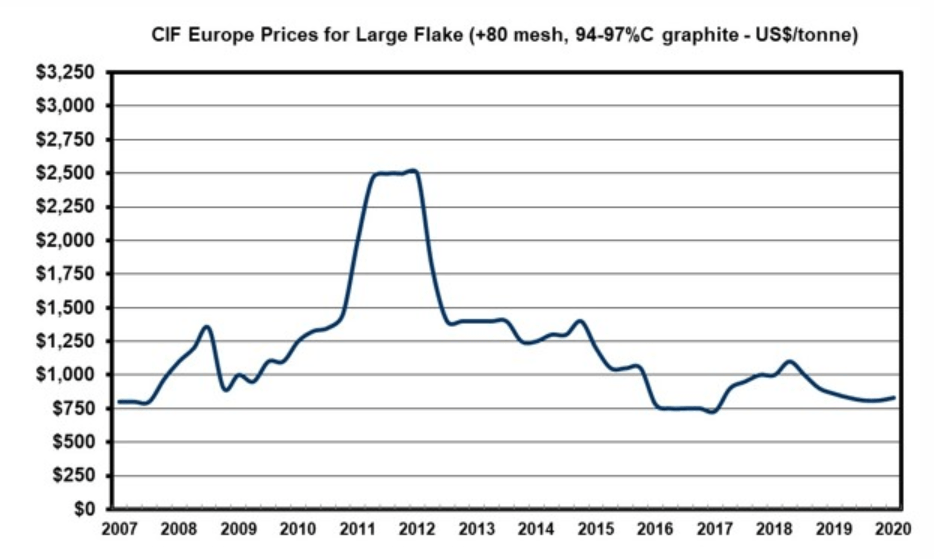
Graphite price chart – Large flake graphite price is ~USD 830/t
In my January 30, 2018 Trend Investing Interview with Benchmark Minerals Simon Moores said about graphite:
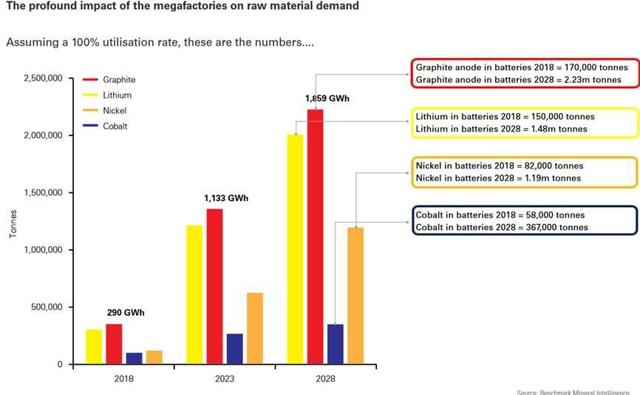
Spherical graphite anode plants, predominately based in China, were traditionally 5-10,000 tpa but now we are tacking four megafactories are looking to produce 60,000 to 100,000 tpa from 2020 onwards.
The impact of the proposed megafactories on raw material demand (graphite in red)
LG Chem bets big on carbon nanotubes. LG Chem will invest 65 billion won ($53 million) by the first quarter of 2021 to expand production of carbon nanotubes, which are known to be among the strongest, lightest and most conductive fibers, at its plant in Korea. With the investment, the company said it will expand the annual production capacity to 1,700 tons from the current 500 tons. “By using carbon nanotubes as anode-conductive additives, we will be able to reduce the use of conductive materials by about 30 percent and increase the capacity of lithium-ion batteries,” the company said.
Graphite supply needs to increase nearly 500 percent by 2050. The energy revolution and the push for lower carbon emissions are unstoppable trends that will continue to unfold in the coming decades. Demand for energy storage is expected to be so high that production of key battery metals such as graphite will need to ramp up to unprecedented levels. According to a new World Bank report, just to meet the increasing demand from this segment, graphite output will need to jump by nearly 500 percent by 2050.
Fine flake prices fall while market for larger sizes tightens. Prices in the +194 market and parts of the +894 market have risen, with consumers that need to secure material being prepared to accept higher offers.
Graphite miner news
Graphite producers
I have not covered the following graphite producers as they are not typically accessible to most Western investors. They include – Aoyu Graphite Group, BTR New Energy Materials, Qingdao Black Dragon, National de Grafite, Shanshan Technology, and LuiMao Graphite.
Note: Imerys Graphite and Carbon (OTC:IMYSF) and AMG Advanced Metallurgical Group NV [NA:AMG] [GR:ADG] (OTCPK:AMVMF) are also “diversified producers”, producing graphite. SGL Carbon (OTCPK:SGLFF) [ETR:SGL] is a synthetic graphite producer.
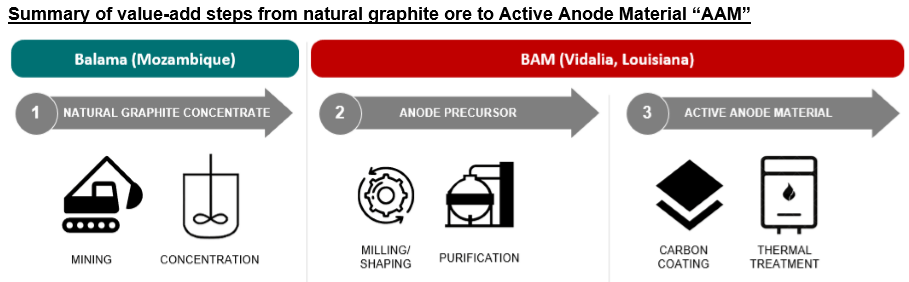
Battery Anode Material Project [USA] – Restart of Operations. Syrah Resources Limited is pleased to announce restart of operations at the Battery Anode Material (“BAM”) plant in Vidalia (Louisiana, USA)……Currently 100% of all anode precursor material into the lithium ion battery supply chain is manufactured in China. Ex-China AAM producers in Korea and Japan are therefore wholly reliant on China for supply of natural graphite anode precursor material. This in-turn means ex-China battery cell manufacturers in Japan, Korea, the USA and Europe are therefore reliant on China for their anode supply chains. Syrah aims to provide an alternate and complementary supply of anode material to existing China supply to meet growing demand…..Production of qualification samples of AAM is planned during H2 2020.
On May 18 Bass Metals announced: “exploration update”.
Highlights:
“Bass recently completed an initial surface exploration program which identified mineralization of at least 4.5km in strike between the Mahela and Loharano large flake graphite deposits (the “Mineralized Trend”)(ASX announcement 29th April 2020) and identified several high priority targets……
14 of the 15 holes drilled to date have recorded regolith hosted, large flake graphite mineralization present.
The Project is a near-mine mineralization zone located a short 2km haul to well-established large flake graphite mining and processing infrastructure (Graphmada).
The Company plans for the results of this drilling, and follow up diamond drilling, to support materially expanding Graphmada’s Mineral Resource.”
Ceylon Graphite has ‘Vein graphite’ production out of one mine in Sri Lanka with 121 square kilometers of tenements.
No news for the month.
Mineral Commodities Ltd. (“MRC”) [ASX:MRC]
Skaland Graphite is 90% owned by MRC. Skaland is the highest grade flake graphite operation in the world and largest producing mine in Europe; with immediate European graphite production of up to 10,000 tonnes per annum with regulatory approval to increase to 16,000. MRC owns 90%.
On April 30, Mineral Commodities Ltd. announced: “Quarterly activities report-March 2020.” Highlights include:
“Tormin – Key environmental approval received at Tormin for expanded mining rights and downstream processing.
Tormin – Prospecting Rights for Northern Beaches and Inland Strand granted and registered.
Tormin – Resource drilling underway with up to 62% THM intersected at Inland Strandline along with new Eastern Strandline discovery.
Skaland Graphite – Maiden JORC resource of Indicated and Inferred 1.78 million tonnes at 22% TGC announced.
Munglinup DFS completed, demonstrating robust outcomes that enable MRC to move to 90% ownership: Post-tax – Net Present Value (“NPV7”) US$111M [AU$160M]. Post-tax project – IRR 30%. Capex – US$61M (AU$88M). Opex – US$491/tonne [FOB] (AU$720/tonne).
Munglinup/Skaland downstream purification testwork progressing well with results due for release in Q2 2020.
NPBT 2019 full year results – Revenue of US$61.8M up 12%, EBITDA US$16.5M up 12%, NPBT US$11.9M up 14% and NPAT US$7.8M down 11%.”
Tormin Northern Beach delivers high grade maiden resource…High-grade resource of 2.5 Million tonnes at 23.5% Total Heavy Minerals (“THM”).
Graphite developers
Magnis Energy Technologies Ltd. [ASX:MNS] (OTC:URNXF) (formerly Magnis Resources)
Magnis is an Australian based company that has rapidly moved into battery technology and is planning to become one of the world’s largest manufacturers of lithium-ion battery cells. Magnis has a world class graphite deposit in Tanzania known as the Nachu Graphite Project.
On May 15, Magnis Energy Technologies Ltd. announced: “NY Battery Plant – major milestones completed.” Highlights include:
“Detailed engineering and facility pre-work completed on the New York Battery Plant.
Reports commissioned at the request of three prospective investors have been finalised for their due diligence process.
Potential financiers have provided Non-Binding term sheets and a LOI, but COVID-19 pandemic is delaying funding closure.
Sale of a portion of the nickel foam purchased as part of the plant acquisition, nets iM3NY over AUD$500,000.”
On May 21, Magnis Energy Technologies Ltd. announced: “Evaluation of Nachu Graphite by major prospective customers.” Highlights include:
“Samples of Nachu high purity graphite provided to South Korean and Japanese LIB battery anode suppliers.
Ongoing metallurgical work to optimise production of uncoated spherical graphite at >99.95% TGC purity using low cost mechanical process.
Two-step process with Flake graphite concentrate produced initially at 99.8%TGC purity with subsequent spheronisation achieving >99.95% TGC purity.”
The Black Crystal Project is located in the Slocan Valley area of British Columbia, Canada, 35km West of the city of Nelson, and 70km North of the border to the USA. The quarry and plant areas are the project’s two main centers of activity.
No news for the month.
Battery Minerals [ASX:BAT] [GR:0FS]
Battery Minerals core commodity targets are graphite, zinc/lead and copper. BAT is maintaining a focus on its two graphite development assets Montepuez and Balama which are located in Mozambique.
No news for the month.
You can view the latest investor presentation here.
You can view the latest investor presentation here.
Triton Minerals [ASX:TON][GR:1TG]
Triton Minerals Ltd. engages in the acquisition, exploration and development of areas that are highly prospective for gold, graphite and other minerals. The company was founded on March 28, 2006 and is headquartered in West Perth, Australia. Triton has three large graphite projects in Mozambique, not far from Syrah Resources Balama project.
No significant news for the month.
You can view the latest investor presentation here and an excellent video here.
NextSource Materials Inc. [TSX:NEXT] [GR:1JW] (OTCQB:NSRCF)
NextSource Materials Inc. is a mine development company based in Toronto, Canada, that’s developing its 100%-owned, Feasibility-Stage Molo Graphite Project in Madagascar. The Company also has the Green Giant Vanadium Project on the same property.
No news for the month.
Investors can view the latest company presentation here. You can watch the company’s Senior Vice President Brent Nykoliation video interview here.
Northern’s principal asset is the Bissett Creek graphite project located 100km east of North Bay, Ontario, Canada and close to major roads and infrastructure. The Company has completed an NI 43-101 Bankable final Feasibility Study and received its major environmental permit.
No news for the month.
You can view the latest investor presentation here.
Talga Resources Ltd. is a technology minerals company enabling stronger, lighter and more functional materials for the multi-billion dollar global coatings, battery, construction and carbon composites markets using graphene and graphite. Talga 100% owned graphite deposits are in Sweden, proprietary process test facility is in Germany.
On April 30, Talga Resources announced: “Quarterly activities review for the period ending 31 March 2020.” Highlights include:
Commercial & Product Development
“MOU agreement signed with Mitsui for joint project development.
Successful 60 tonne pilot graphite concentrate program supports anode market development.
Talga in Bentley Motors electric drive project (subsequent to the period).
“Environmental approval received for Vittangi Stage 1 Mining Operation, Sweden.”
Corporate & Investor Relations
“COVID-19 operational update and cost reduction measures.
Cash balance of A$6.6 million as at 31 March 2020.”
You can view the latest investor presentation here.
SRG Mining Inc. [TSXV:SRG] [GR:18Y] [Formerly SRG Graphite Inc.]
SRG is focused on developing the Lola graphite deposit, which is located in the Republic of Guinea, West Africa. The Lola Graphite occurrence has a prospective surface outline of 3.22 km2 of continuous graphitic gneiss, one of the largest graphitic surface areas in the world. SRG owns 100% of the Lola Graphite Project.
On May 8, SRG Mining Inc. announced: “SRG Mining Inc. announces grant of Stock Options.”
You can view the latest investor presentation here.
Leading Edge Materials Corp. is a Canadian company focused on becoming a sustainable supplier of a range of critical materials. Leading Edge Materials’ flagship asset is the Woxna Graphite production facility in central Sweden. The company also owns the Bergby lithium project, the Norra Karr REE project, and the Kontio cobalt project all located in Scandinavia.
No significant news for the month.
Investors can view the latest company presentation here.
Nouveau Monde Graphite own the Matawinie graphite project, located in the municipality of Saint-Michel-des-Saints, approximately 150 km north of Montreal, Canada.
On April 29, Nouveau Monde Graphite announced: “Nouveau Monde receives over $5.2m in financial support.” Highlights include:
5% increase to Sustainable Development Technology Canada’s $4,250,000 initial grant representing an additional $212,500.”
You can view the latest investor presentation here.
Volt Resources [ASX:VRC] [GR:R8L]
Volt Resources Ltd. is a graphite exploration company. The Company is focused on the exploration and development of its existing wholly owned Bunyu Graphite Project in Tanzania and the identification of further assets globally which have the potential to add value to shareholders.
No news for the month.
You can view the latest investor presentation here.
Renascor Resources [ASX:RNU]
Renascor Resources Ltd. is an Australian exploration company, which focuses on the discovery and development of economically viable deposits containing uranium, gold, copper, and associated minerals. Its projects include graphite, copper, precious metals, and uranium.
On April 30, Renascor Resources announced: “Quarterly report 31 March 2020.” Highlights include:
“Renascor’s development of its 100%-owned Siviour Graphite Project continues, with focus on battery-grade, Purified Spherical Graphite for use in lithium-ion batteries. Work undertaken during the recently completed quarter included. Discussions with potential offtake partners in Northeast Asia and Europe, which have revealed strong interest in Renascor’s plans to develop a Purified Spherical Graphite Advanced Manufacturing operation within Australia. An advanced study on a vertically integrated Purified Spherical Graphite operation. Additional production trials to produce qualifying Purified Spherical Graphite samples from Siviour graphite concentrates. Continued mineral processing tests aimed at optimising production parameters for producing graphite concentrates and Purified Spherical Graphite.
Letter of Support received for the provision of finance from Export Finance Australia, the official Export Credit Agency of the Australian Government.
Renascor has taken steps to manage the impact of COVID-19, with work programs being designed to ensure that they can continue with minor disruptions due to travel restrictions and shipping delays.
Cash position of approximately $2.1m as of 31 March 2020, which does not include a further $137,000 in placement proceeds due from Renascor Directors following Shareholder approval at 11 March 2020 Shareholder meeting.”
You can view the latest investor presentation here.
EcoGraf Limited [ASX:EGR]
On April 30, EcoGraf Limited announced: “March 2020 quarterly report. Australian Government Agency provides in-principle debt funding support for Kwinana battery recycling provides new global market opportunity.” Highlights include:
“Kwinana battery graphite manufacturing facility advances towards development. In-Principle debt funding support received from Export Finance Australia. Commercial and technical due diligence for debt and equity funding processes underway with prospective financiers. Sales and offtake arrangements under discussion with major battery and industrial groups in Asia and Europe. Feedstock supply agreement signed with leading German group TECHNOGRAFIT GmbH. Successful completion of feedstock optimisation program.
Epanko debt financing. US$60 million debt financing proposal submitted to the Government of Tanzania for the construction of the new Epanko Graphite Mine.
Successful EV battery recycling trial achieving. 99% carbon. Recycling results provide new opportunity for EcoGraf™ purification technology as market demand shifts to zero waste batteries and closed-loop manufacturing.
Investment continues in Europe to transition towards renewable energy for electric vehicles, supporting the shift to new responsibly produced raw material supplies.
Board and management implement cost reduction measures to preserve shareholder value in reaction to COVID-19 virus.
Company progressing several alternatives to provide additional funding for Kwinana and Epanko pre-development programs.”
High purity fines qualified with European customers. An additional Commercial advantage for Kwinana Facility. EcoGraf Limited is pleased to announce that it has received confirmation that the Company’s high purity graphite which is produced from low value graphite by-product fines utilising the EcoGraf. Process has been qualified by two leading European industrial customers as meeting their strict physical and chemical specifications. In the production of battery [spherical] graphite for the lithium-ion battery market up to 50% of the initial graphite feedstock reports as fines. The ability to further process this low value by-product and sell as a high value product adds significant further value to the processing economics for production of battery [spherical] graphite using the EcoGraf proprietary non-hydrofluoric purification process.
On May 21, EcoGraf Limited announced: “EcoGraf successfully completes share placement. Funds to be applied towards development of New Australian battery graphite business.” Highlights include:
“Share Placement oversubscribed, raising $1.6 million at 6.5 cents per share.
Strong support from existing shareholders and encouraging participation by new institutional investors.
Funds to be applied towards: Development of a state-of-the-art EcoGraf™ battery graphite facility in Kwinana, Western Australia, including: Finalising offtake arrangements with priority customers in Europe and Asia. Preparation of marketing and technical reports to support Government funding processes. Securing lender approvals for the proposed US$35 million debt financing. Pre-development technical programs and submission of Government development approvals. Completion of engineering, procurement, construction and operations planning arrangements. Securing Government approvals for the Epanko US$60 million debt financing proposal developed with KfW IPEX-Bank.
Opportunity for eligible existing shareholders to participate via a Share Purchase Plan at 6.5 cents per share to raise up to an additional $500,000.”
You can view the latest investor presentation here.
ZEN Graphene Solutions Ltd. [TSXV:ZEN] (OTCPK:ZENYF) (formerly Zenyatta Ventures)
ZEN Graphene Solutions Ltd. is a mineral development company based in Thunder Bay, Ontario. ZEN Graphene is currently developing the Albany Graphite Deposit (“Albany”), as well as developing graphene and graphene applications.
No significant news for the month.
Sovereign Metals [ASX:SVM] [GR:SVM]
Sovereign Metals Ltd. is an exploration company, which engages in the explorations of graphite, copper and gold resources. It operates through the Queensland, Australia and Malawi geographical segments. Sovereign Metals has world’s biggest graphite saprolith resource of 65m tonnes at 7.1% TGC at their Maligunde project in Malawi.
No significant news for the month.
You can view the latest investor presentation here.
New Energy Metals Corp. (OTCPK:NEMCF) [ASX:NXE] (formerly Mustang Resources)
New Energy Minerals are pioneering Vanadium and Graphite mining, exploration, and technology. With the unique Caula Project in Mozambique nearing production, they are set to supply the high quality resources critical to the rapidly expanding new energy market.
No news for the month.
You can view the latest investor presentation here.
Westwater Resources Inc. is developing an advanced battery graphite business in Alabama, holds dominant mineral rights positions in the Western United States and the Republic of Turkey for both lithium and uranium deposits, as well as licensed production facilities for uranium in Texas.
Westwater Resources prevails in key decision in the international arbitration against Turkey. Westwater Resources, Inc., an energy materials development company, announced that the tribunal appointed by the International Centre for Settlement of Investment Disputes [ICSID] has issued a procedural order that denies a request made by the Republic of Turkey to bifurcate the arbitration proceeding. As a result, a hearing on the merits is now scheduled for September 2021.
On May 14, Westwater Resources Inc. announced: “Westwater Resources reports first quarter 2020 results & Energy Materials business update.” Highlights include:
Battery Graphite Business Update:
“Our battery graphite business continues on track toward operation of a pilot plant, which we anticipate will make battery graphite in bulk quantities in the fourth quarter of 2020……
You can view the latest investor presentation here.
Other graphite juniors
Berkwood Resources [TSXV:BKR] [GR:BR2N] (OTC:CZSVF), BlackEarth Minerals [ASX:BEM], Black Rock Mining [ASX:BKT], DNI Metals [CSE:DNI] (OTCPK:DMNKF), Eagle Graphite [TSXV:EGA] [GR:NJGP] (OTC:APMFF), Elcora Advanced Materials Corp. [TSXV:ERA](OTCPK:ECORF), First Graphene [ASX:FGR] (OTC:FGPHF), Focus Graphite [TSXV:FMS][GR:FKC] (OTCQB:FCSMF), Graphite One Resources Inc. [TSXV:GPH] [GR:2JC] (OTCQB:GPHOF), Gratomic Inc. (TSXV:GRAT), Graphite Energy Corp. [CSE:GRE] [GR:GOA] (OTCPK:GRXXF), Lomiko Metals Inc. [TSXV:LMR] (OTCQB:LMRMF), NovoCarbon Corp. (formerly Great Lakes Graphite [TSXV:GLK] [GR:8GL] (OTC:GLKIF)), Walkabout Resources Ltd. [ASX:WKT].
Conclusion
May saw graphite prices rise slightly.
Highlights for the month were:
Fine flake prices fall while market for larger sizes tightens.
LG Chem bets big on carbon nanotubes.
Graphite supply needs to increase nearly 500 percent by 2050.
Bass Metals identified mineralization of at least 4.5km in strike between the Mahela and Loharano large flake graphite deposits, 2kms from their Graphmada mine.
Magnis Energy NY Battery Plant funding is close to closing.
Nouveau Monde receives over $5.2m in financial support.
EcoGraf Kwinana battery graphite manufacturing facility advances towards development.
Posted by AGORACOM-JC
at 6:15 PM on Thursday, May 28th, 2020
Eyecarrot Innovations (EYC:TSXV) is a Vision Therapy and Training Company that goes well beyond fixing eyes that simply can’t read letters on an eye chart. That’s what your optometrist does when they prescribe glasses.
What Eyecarrot does is far more exciting and groundbreaking. Without getting scientific, Eyecarrot delivers higher performing brains by optimizing the performance of your eyes. The result is a faster brain through stronger eyes, which creates quite the edge for the world’s best athletes and explains why their client list includes:
Dallas Stars (NHL)
Chicago Cubs (MLB)
Sporting KC (MLS)
Tennis Canada
Showcased During NFL Scouting Combine
Eli Wilson Goaltending – The World Leader In Hockey Goaltending Development
BUT NEW EXECUTIVE CHAIRMAN, TERRY BOOTH, HAS A DIFFERENT AND BIGGER VISION (PARDON THE PUN) FOR EYECARROT – GLOBAL CHILDREN Â
When Terry’s daughter was 1 years old, she developed eye problems that could only be treated by patching - something he says would be considered “barbaric” today. Terry discovered that 1 in 4 kids (not a typo) have vision problems beyond those treatable by an optometrist. This was a global, epidemic without a solution that often leads to kids losing critical learning time and self-confidence by Grade 3.  Â
Fast Forward 30 years to about 4 weeks ago and Terry finally found the solution – Eyecarrot – but not before he and his science team put CEO Adam Cegielski and the Company through the ringer. When the due diligence was complete, Terry Booth was all in…. Â
… And he’s bringing his entire science, government and finance network to the table to bring Eyecarrot to children around the world.  Â
Turn off NetFlix. Ignore your social media notifications. Grab your favourite beverage, call a couple of friends and watch this interview … twice. Â
Treaty Creek Project is Fully Funded for the 2020 Exploration Season
Last year Eric Sprott became the largest external investor in Treaty Creek in B.C.’s Golden Triangle. He stated “Treaty Creek has a great shot at having 20 million ounces of gold.†A very successful program was run hitting wide intervals of gold in every drill hole. This year we’ll see if Eric is right as the objective of this year’s program is to develop a resource calculation.
The Goldstorm Zone will host a significantly larger drilling program in 2020
18,000 to 20,000 Meter Drill Program
7-10 Drill Platforms
Four Diamond Drill Rigs
The drill program is designed to extend and to explore the limits of Goldstorm System
The current conceptual model for Goldstorm is 1 billion tonnes at close to 1 gram of gold
The system remains open in all directions and to depth
The best mineralization encountered to date is from the two consecutive 150m step-out holes to the Northeast:
GS-19-42 yield 0.849 g/t Au Eq over 780 m with 1.275 g/t Au Eq over 370.5m
GS-19-47 yield 0.697 g/t Au Eq over 1,081.5m with 0.867 g/t Au Eq over 301.5m
The best Southeast extension:
GS-19-52 yields 0.783 g/t Au Eq over 601.5m
Includes 1.062 g/t Au Eq over 336.0m (NR dated March 3rd, 2020)
The Treaty Creek Project is a Joint Venture with Tudor Gold owning 3/5th and acting as operator. American Creek and Teuton Resources each have a 1/5th interest in the project. American Creek and Teuton are both fully carried until such time as a Production Notice is issued, at which time they are required to contribute their respective 20% share of development costs. Until such time, Tudor is required to fund all exploration and development costs while both American Creek and Teuton have “free ridesâ€.
Treaty Creek Background
The Treaty Creek Project lies in the same hydrothermal system as Pretium’s Brucejack mine and Seabridge’s KSM deposits with far better logistics.
We believe that the Goldstorm deposit at Treaty Creek is quickly becoming one of most significant assets in the gold industry and will be highly sought after.
About American Creek
American Creek is a Canadian junior mineral exploration company with a strong portfolio of gold and silver properties in British Columbia. Three of those properties are located in the prolific “Golden Triangleâ€; the Treaty Creek and Electrum joint venture projects with Tudor Gold/Walter Storm as well as the 100% owned past producing Dunwell Mine.
For further information please contact Kelvin Burton at: Phone: 403 752-4040 or Email: [email protected]. Information relating to the Corporation is available on its website at: www.americancreek.com
Posted by AGORACOM
at 9:05 AM on Wednesday, May 27th, 2020
SPONSOR: Labrador Gold – Two successful gold explorers lead the way in the Labrador gold rush targeting the under-explored gold potential of the province. Exploration has already outlined district scale gold on two projects, including a 40km strike length of the Florence Lake greenstone belt, one of two greenstone belts covered by the Hopedale Project. Recently acquired 14km of the potential extension of the new discovery by New Found Gold’s Queensway project to the south.Click Here for More Info
Time of economic uncertainty requires you have a 10 percent weighting in gold and gold mining stocks.
“The 10 Percent Golden Rule”.
“I think there is a strong likelihood we will need another bill.â€
That’s according to Treasury Secretary Steven Mnuchin, who supports additional fiscal stimulus to combat the economic impact of the novel coronavirus—within reason.
The secretary’s statement comes after the House passed a record-shattering $3 trillion relief package, though leaders in the Senate have said they will not put it up for a vote. Senate Majority Leader Mitch McConnell has made it clear that the next coronavirus bill “cannot exceed $1 trillion,†according to reporting by Axios.
Even so, the U.S. government’s response is already massive, dwarfing anything that’s come before it.
Across the pond, Britain’s government is likewise spending like crazy. The U.K. budget deficit widened to a record 62.1 billion pounds ($76 billion) in the month of April, equal to the government’s total borrowing in 2019, according to Bloomberg.
Against this backdrop of anything-goes spending, the idea of having a national currency backed by a real asset like gold seems less and less crazy to some. Doing so, it’s believed, would force lawmakers to practice fiscal discipline, reign in inflation and normalize international trade.
Judy Shelton, President Donald Trump’s nominee to the Federal Reserve Board of Governors, has long favored a return to a gold standard, which officially ended in 1971. In an interview with Investment News Network (INN) last week, Shelton said she liked “the idea of a gold-backed currency,†adding that “it could even be done in a cryptocurrency sort of way.â€
Although the chances of the U.S. returning to a gold standard are slim to none, I think it’s incredibly important in this time of economic uncertainty to ensure you have a 10 percent weighting in gold and gold mining stocks. I call this the 10 Percent Golden Rule.
The 10 Percent Golden Rule is rational and prudent. The U.S. government and Federal Reserve can’t pump this much money into the financial system and not trigger rapid inflation—and potentially even hyperinflation.
There’s one thing that can’t be printed, and that’s gold. In fact, we may be looking at peak gold supply right now, which should only help the precious metal retain its value as cash deteriorates.
Unprecedented Money-Printing
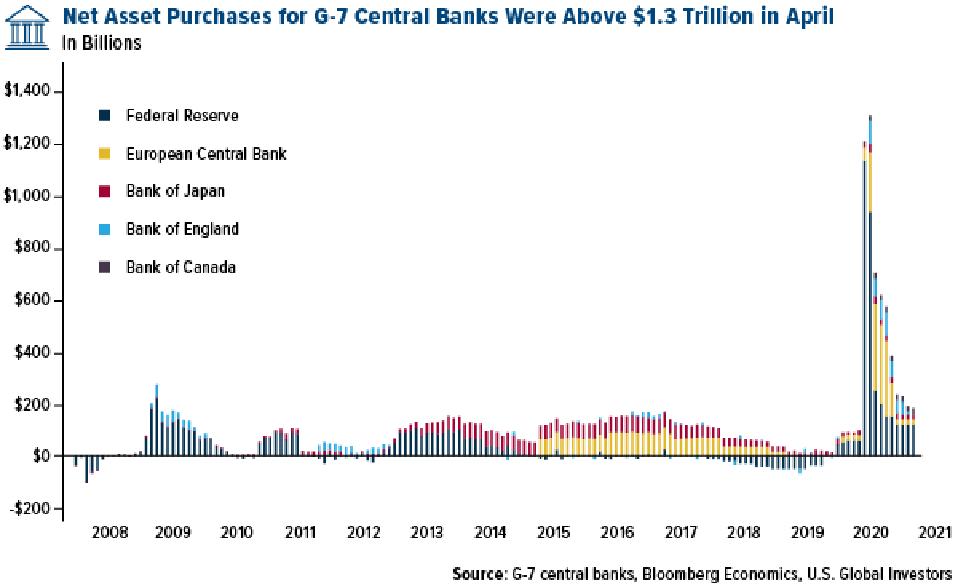
Group of Seven central banks made net asset purchases of $2.5 trillion in March and April together. In April alone, these purchases were an unbelievable $1.3 trillion, nearly five times more than the previous peak of $270 billion in April 2009, according to Bloomberg data.
As of last week, the Federal Reserve’s total assets stood at a record $7.04 trillion. That’s a third of the entire U.S. economy.
U.S. Global Investors
You may have heard that the Fed has been buying ETFs that invest in corporate debt, as part of its emergency lending program intended to support corporate debt markets. In the first six days of the program, as much as $1.8 billion worth of such ETFs were purchased.
These are all incredibly large numbers. Fed Chairman Jerome Powell himself acknowledged this during a 60 Minutes interview last week, stating that the bank’s recent actions are “substantially larger†than they were during the last crisis.
And just check out this remarkable exchange:
SCOTT PELLEY: Fair to say you simply flooded the system with money?
POWELL: Yes. We did. That’s another way to think about it. We did.
PELLEY: Where does it come from? Do you just print it?
POWELL: We print it digitally. So as a central bank, we have the ability to create money digitally. And we do that by buying Treasury bills or bonds for other government guaranteed securities. And that actually increases the money supply. We also print actual currency and we distribute that through the Federal Reserve banks.
Again, we can’t just print more gold, digitally or otherwise.
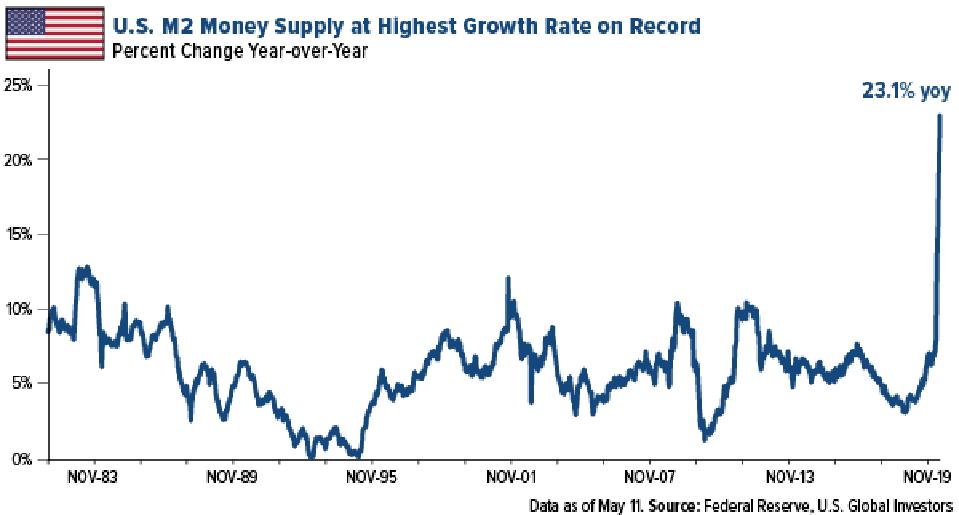
Growth in M2 money supply—which includes not just cash but also savings deposits, money market funds and other “near†money—has historically been like Miracle-Gro for gold prices. As of May 11, the percent change in money supply from a year earlier was greater than 23 percent. That’s the highest rate since at least 1981, the furthest I could go back on the Federal Reserve Bank of St. Louis’ website.
U.S. Global Investors
U.K. Bonds Now Have a Negative Yield. Is the U.S. Next?
Gold has also benefited from low to negative rates, which are likely here to stay for some time.
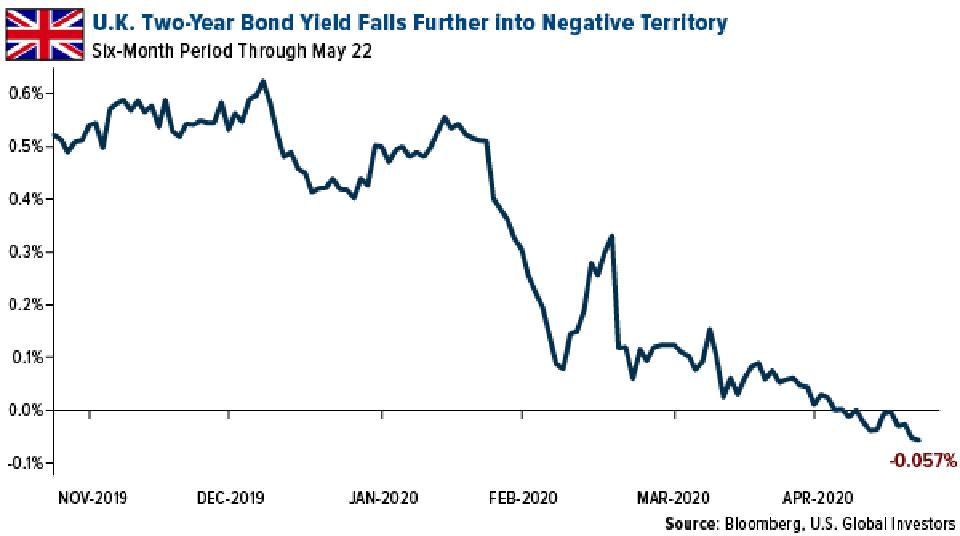
Last week the U.K. sold bonds with an average yield below 0 percent for the first time ever. The yield on the two-year gilt dropped as low as negative 0.080 percent. The five-year yield traded at negative 0.043 percent.
U.S. Global Investors
Meanwhile, Bank of England (BoE) governor Andrew Bailey admitted last Wednesday that a negative interest rate policy (NIRP) was in “active review,†despite saying in March that negative rates were “not an area I would want to go to.â€
That’s why I don’t have a whole lot of faith when New York Fed president John Williams says that “negative rates are not the right tool to be used right now.â€
It may only be a matter of time before subzero rates make landfall in the U.S., something President Trump is in favor of. “As long as other countries are receiving the benefits of Negative Rates, the USA should also accept the ‘GIFT,’†he tweeted on May 12.
Big-Name Money Managers Back Gold
Other financial experts and money managers are similarly making the case for gold and other hard assets as helicopter money floods the economy.
“This is a perfect environment for gold to take center stage,†wrote Paul Singer, billionaire hedge fund manager, in a memo to Elliott Management clients. “Gold today, despite its modest run up in recent months, is the answer to the question: Is there an asset or asset class which is undervalued, underowned, would preserve its value in severe inflation, and is not adversely affected by COVID-19 or the destruction of business value that is being caused by the virus?â€
Macro investor Paul Tudor Jones sees gold rallying to $2,400 an ounce and possibly to $6,700 on extreme inflation reminiscent of 1980. (And he also likes bitcoin, for the same reason.)
London-based hedge fund manager Crispin Odey says he increased the gold position in his flagship Odey European Inc. fund in April. What’s more, Barrick Gold is now his largest single long equity position.
Finally, in a viral tweet, Robert Kiyosaki of Rich Dad Poor Dad fame sounded off on the “incompetent†Fed before predicting $3,000 gold within a year and $75,000 bitcoin within three years.
“ECONOMY dying. FED incompetent,†Kiyosaki said. “Next BAILOUT trillions in pensions. HOPE fading. Bought more gold silver Bitcoin. GOLD @$1,700. Predict $3000 in 1 year. Silver @ $17. Predict $40 in 5 years. Bitcoin @$9800. Predict $75000 in 3 years. PRAY for the BEST-PREPARE for the WORST.â€
Posted by AGORACOM
at 9:18 AM on Tuesday, May 26th, 2020
The project is adjacent to Melkior’s Carscallen project
Melkior recently made a significant gold discovery at Carscallen.
Plan to begin drilling the first target in the very near future
Vancouver, British Columbia–(Newsfile Corp. – May 26, 2020) – Affinity Metals Corp. (TSXV: AFF) (“the Corporation”) (“Affinity”) is pleased to report that it has entered into an option agreement with an arm’s length third party to acquire up to a 90% interest in the West Timmins Gold property located approximately 29 km southwest of Timmins, Ontario, Canada.
The property package consists of 20 mineral tenures spanning 429 hectares. The property directly adjoins to the west and along geological strike to the Melkior Carscallen project with both properties optimally located directly along the northern flank of the prolific Destor Porcupine Fault Zone. Melkior very recently made a significant gold discovery that has attracted not only the market’s attention but also the interest of Kirkland Lake Gold to participate in furthering exploration of the Melkior project model through joint participation.
The ground making up the West Timmins Gold property was included/highlighted as a specific project example which meets exploration model recommendations as outlined within the 2012 published, Timmins Resident Geologist Report: “Recommendations for Exploration – Gold in Felsic Intrusions”. The geological model and potential of the West Timmins Gold property correlate positively with the recent Melkior Carscallen exploration advancements and the West Timmins Gold property potentials are based on the same geological model to that of the neighboring Melkior project.
The West Timmins Gold property is road accessible with a major highway (101) and regional scale power utility transmission lines passing directly through the property. Both Induced Polarization and Acoustic EM geophysics surveys have been conducted on the property and will assist in guiding future exploration.
The West Timmins Gold property is located along the same structural and geological trend which hosts the Pan American Silver “Timmins West Mine” located approximately 13 km to the east along highway 101 and is also in close proximity to the Timmins mining camp, which is a major structural control corridor that has produced over 75 million ounces of gold.
A Timmins West “staking rush” this past week has resulted in the recent acquisition of over 300 square kilometers of additional claims being positioned by area play participants which now surround both the Melkior – Carscallen and Affinity – West Timmins Gold projects.
Robert Edwards, CEO of Affinity stated: “We are very excited to have added the West Timmins Gold project to Affinity’s portfolio. It diversifies the Company’s Canadian exploration exposure to another very mining friendly jurisdiction in Canada. The seasonal window for exploration is much longer than at our flagship Regal Project, which allows for exploration on the West Timmons Gold property without taking away the focus on the Regal. The project is optimally located in the very prolific Timmons township area, immediately adjacent to Melkior’s Carscallen, which has attracted significant market attention the past few weeks with their recent gold discovery. We believe that the West Timmins Gold property has significant and similar discovery potential and we plan to begin drilling the first target in the very near future.”
The West Timmins Gold property is being acquired through a staged option agreement with terms/payments as follows:
Affinity will drill 500 meters within a specific drill target as directed by the property optionor. Upon the completion of the initial 500 meters of drilling, Affinity will elect to either abandon the option or continue and earn a 70% interest by paying the optionor $15,000 cash, issuing 300,000 Affinity shares, and drilling an additional 700 meters in a specified target(s) as directed by the optionor.
Within 120 days of completing/fulfilling the 70% option terms, Affinity may elect to earn an additional 10% (for a total of 80%) by issuing the optionor 500,000 Affinity share purchase warrants, granting a 1% NSR and paying a corresponding $25,000 cash advance royalty payment, and by drilling an additional 4,800 meters (6,000 meters total) on drill targets specified by the optionor.
Within 120 days of completing/fulfilling the 80% option terms, Affinity may elect to earn an additional 10% (for a total of 90%) by drilling an additional 4,800 meters (10,800 meters total) on drill targets specified by the optionor.
All shares or warrants issued under this agreement will be subject to a statutory 4 month hold period. This agreement is subject to approval by the TSX Venture Exchange.
About Affinity Metals
Affinity is focused on the acquisition, exploration and development of strategic metal deposits within North America.
In addition to this West Timmins Gold acquisition, Affinity is advancing the Regal Project located near Revelstoke, British Columbia, Canada. The Regal property is located in the northern end of the prolific Kootenay Arch and hosts two major geophysical anomalies as well as three past producing mines. Recent drill results included a new silver discovery with an 11.10 meter interval of 143.29 g/t silver which included a 0.55 meter interval of 2,612.0 g/t silver.
On behalf of the Board of Directors
Robert Edwards, CEO and Director of Affinity Metals Corp.