Posted by AGORACOM
at 3:06 PM on Thursday, December 12th, 2019
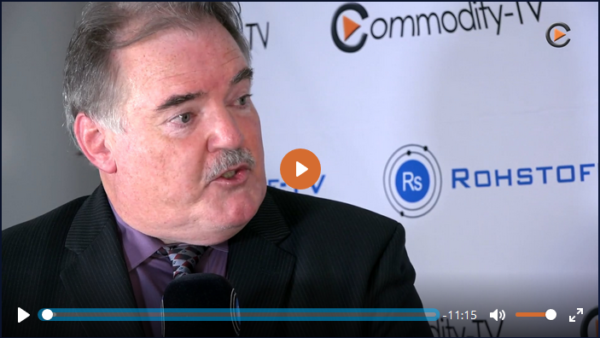
Ken Konkin Discusses the Goldstorm Deposit at Treaty Creek (including recent outstanding drill results like 0.725 g/t over 838.5m), it’s Potential, and 2020 Development Plans
American
Creek is a Canadian junior mineral exploration company with a strong
portfolio of gold and silver properties in British Columbia.
Three
of those properties are located in the prolific “Golden Triangleâ€; the
Treaty Creek and Electrum joint venture projects with Tudor Gold/Walter
Storm as well as the 100% owned past producing Dunwell Mine.
The
Treaty Creek Project is a Joint Venture with Tudor Gold owning 60% and
acting as operator. American Creek and Teuton Resources each have 20%
interests in the project. American Creek and Teuton are both fully
carried until such time as a Production Notice is issued, at which time
they are required to contribute their respective 20% share of
development costs. Until such time, Tudor is required to fund all
exploration and development costs while both American Creek and Teuton
have “free ridesâ€.
The Corporation also holds the Gold Hill, Austruck-Bonanza, Ample Goldmax, Silver Side, and Glitter King properties located in other prospective areas of the province.
For further information please contact Kelvin Burton at: Phone: 403 752-4040 or Email: [email protected]. Information relating to the Corporation is available on its website at www.americancreek.com.
Hub on Agoracom FULL DISCLOSURE: American Creek is an advertising client of AGORA Internet Relations Corp.
Posted by AGORACOM-JC
at 11:37 AM on Wednesday, December 11th, 2019
SPONSOR: BetterU Education Corp.
aims to provide access to quality education from around the world.
The company plans to bridge the prevailing gap in the education and job
industry and enhance the lives of its prospective learners by developing
an integrated ecosystem. Click here for more information.
10 Ways Edtech Advances Are Shaking Up Education
The development of edtech isn’t expected to slow down any time soon.
No traditional teaching methods can compete with the levels of student attentiveness, availability and convenience that edtech currently offers.
Professionals from Forbes Technology Council look at the most compelling recent advances in edtech, and why they’re such a big deal to education in the 21st century.
Expert Panel, Forbes Technology Council
Education technology or edtech offers unique opportunities for
student development. The roots of edtech in whiteboards, projectors and
tablets have given rise to popular learning platforms. Now, students can
access on-demand courses, and learn whatever they want thanks to
technological advances in the field. Companies can provide classes to
their workers the same way, allowing them to leverage industrial edtech
for their own business needs and purposes.
The development of edtech isn’t expected to slow down any time soon.
No traditional teaching methods can compete with the levels of student
attentiveness, availability and convenience that edtech currently
offers. Professionals from Forbes Technology Council look at the most compelling recent advances in edtech, and why they’re such a big deal to education in the 21st century.
1. Online Learning Platforms
Digital transformations are now letting students ditch the physical
classroom. You can learn everything from coding skills to personal
finance basics from resources like Coursera.
These programs are taught by industry leaders who are aligned with
current trends and needs in the job market. You learn more valuable and
relevant skills in a shorter amount of time compared to traditional
education. – Marc Fischer, Dogtown Media LLC
2. Live Online Tutoring
Live online tutoring used to be relegated to English-language
teachers who had to wake up at odd hours to meet their pupils online. As
a more accessible option, the schedules of parents and kids no longer
need to coordinate, reducing traffic on the roads and carbon emissions.
It also allows parents to be more selective in their tutors instead of
going with whoever can accommodate their schedule. – Arnie Gordon, Arlyn Scales
3. Educational Phone Apps
Instead of fighting with students to keep them away from their
beloved phones, how about using smartphones to help them learn? We need
more simple, high-quality apps like Grasshopper.
Apps need to have bite-sized chapters that are small but super focused.
The interface should also be simple and intuitive. The more interactive
the content is, the higher the learning will be. Edtech is fun with
these apps. – Vikram Joshi, pulsd
Extended reality (XR) moves students away from traditional lectures
toward more engaging, immersive learning experiences within a simulated
real-world space. Other benefits include increased comprehension levels
and long-term memory retention among students. Best of all, as the
technology enters the mainstream market, XR will be an affordable
teaching option for many educational institutions. – Christopher Yang, Corporate Travel Management
6. Faculty Tech
Classroom edtech isn’t the only thing that’s been booming. There’s a
huge trend in primary and higher education systems using new technology
to track and monitor their strategic and operational plans. It’s really
interesting to see the difference in the past few years as universities
in particular have shifted from tracking plans in spreadsheets to using
integrated plan management tools. – Christy Johnson, AchieveIt
7. Screencasting
Screencasting has changed the dynamics of the classroom as it offers
both teachers and students the freedom to actively engage with the
lessons. It has helped teachers untether from the front of the classroom
and empowered students to share their work. This results in overall
higher engagement amongst the students, but in a fun and interesting
manner more importantly! – Mihir Shinde, B&H Photo Video Pro Audio
8. Gamification
One of my favorite edtech advancements has been gamification in the
classroom. Gamification is being applied to educational environments
through different pieces of software in the marketplace. This enables
greater student interaction in the classroom and in place of traditional
homework. I am a big fan of gamification in education as it gets
students more excited about learning. – Marcus Turner, Enola Labs
9. Professional-Grade Tools
Giving students professional-grade tools means they have the ability
to produce amazing things. Google’s G Suite and Chromebooks give
students professional tools at budget prices without any of the fluff or
bloatware of other solutions. Schools that deploy these tools are more
likely to have students that enter the workforce with experience and
familiarity with enterprise offerings. – Tom Roberto, Core Technology Solutions
10. Collaboration
I’ve seen some great edtech tools come and go, but one tool that has stuck out is Flipgrid.
It effectively combines the preferred way students like to share with
the way educators set instructional goals. By coupling these two,
students and teachers can collaborate, share and connect. It’s one of
the tools that is enabling engagement beyond traditional instruction. – Tyler Shaddix, GoGuardian
Posted by AGORACOM-JC
at 10:18 AM on Wednesday, December 11th, 2019
SPONSOR:ThreeD Capital Inc. (IDK:CSE)
Led by legendary financier, Sheldon Inwentash, ThreeD is a
Canadian-based venture capital firm that only invests in best of breed
small-cap companies which are both defensible and mass scalable. More
than just lip service, Inwentash has financed many of Canada’s biggest
small-cap exits. Click Here For More Information.
Here’s a New Banking Tool for Vetting Crypto Exchanges
From left to right: CEO and co-founder James Smith; Chief
Scientist and co-founder Tom Robinson; Chief Operating Officer Simone
Maini; Vice President of Engineering Jon Bradshaw; and Vice President of
Product Andrea Ramoino.
“Most banks at the moment have a zero-tolerance approach to crypto,†said Tom Robinson, Elliptic’s chief scientist and co-founder. “They don’t have any visibility into the risks that a particular exchange may possess – they all look the same to them. So, many of them won’t bank any exchanges.â€
Nathan DiCamillo
A risk-based approach rather than a blanket ban on crypto activity –
that’s what blockchain forensics startup Elliptic is hoping to engender
among banks with its latest offering.
“Most banks at the moment have a zero-tolerance approach to crypto,â€
said Tom Robinson, Elliptic’s chief scientist and co-founder. “They
don’t have any visibility into the risks that a particular exchange may
possess – they all look the same to them. So, many of them won’t bank
any exchanges.â€
The product, called Elliptic Discovery, aims to give institutions
up-to-date risk profiles of more than 200 of the largest exchanges
globally.
Robinson says Elliptic’s tool offers risk indicators that matter to bankers:
An exchange’s know-your-customer and anti-money laundering policies
Jurisdictions that an exchange operates under and what licenses it holds
The coins listed at the exchange that might be risky (i.e. privacy coins)
Analysis of an exchange’s transactions (i.e. funds going to
anonymizing services or funds going to entities/countries on a sanctions
list)
Similar banking products in the market include
TRM Labs’ risk-score for cryptocurrency transactions, with the startup
analyzing more than a dozen blockchains for banks looking to fight
money-laundering and fraud in the crypto sphere. Banks have also used Chainalysis’ transaction-monitoring tools to be able to compliantly work with crypto firms.
Elliptic’s Robinson said he spoke with about a dozen bankers to
determine what risk indicators would be valuable to them. One insight
gained from his informal survey was that bankers would be more likely to
bank exchanges if they had more information about their risk profiles,
he said.
The co-founder wouldn’t reveal which banks he had spoken with, but Elliptic has publicly worked with crypto-friendly Silvergate Bank since Spring 2017.
Robinson said that he believes that banks are not only missing out on
business opportunities to bank more clients but are also working
against the will of their retail customers who are likely already
purchasing and trading crypto without their bank’s knowledge.
“I do think this is going to have a positive impact on the whole crypto system,†Robinson said. Last month, Elliptic began providing anti-money-laundering services to the Zilliqa blockchain and cryptocurrency. In September, the firm closed
a $23 million Series B funding round led by Japanese financial company
SBI Holdings, which will help Elliptic expand in Asia. The company partnered with crypto exchange Binance in May.
As Greg McDougall prepared to fly the world’s first all-electric
commercial aircraft Tuesday morning, he said “nervous†wasn’t quite the
word to describe how he was feeling.
The fact that the Harbour Air CEO would be the first person to take
the modified de Havilland Beaver on a full test flight didn’t faze him,
nor did knowledge of a charging glitch the night before.
McDougall had gone for a dinner break Monday evening while a crew of
designers and engineers stared at their computers with furrowed brows,
and he returned later to find them smiling and laughing, crisis averted.
“The emotion isn’t necessarily excitement, it’s more sort of anticipation and focus,†he said.
Harbour Air pilot and CEO Greg McDougall talks to media after
completing the world’s first all-electric, zero-emission commercial
aircraft test flight in a 62 year old de Havilland DHC-2 Beaver from
Vancouver International Airports South Terminal on the Fraser River in
Richmond on Tuesday. DON MACKINNON / AFP via Getty Images
With the sun hanging low over the Fraser River in Richmond, McDougall
shifted the throttle into gear and took off. After landing, he said it
felt just like flying any other plane, only with more kick.
“For me, that flight was just like flying a Beaver but it was a
Beaver on electric steroids,†he said, adding he had to throttle back in
order to delay the takeoff to be in line with about a dozen cameras.
“It wanted to fly. With the tailwind it was going to leap off the water.â€
The brief but successful test flight marked a significant win for
Harbour Air and partner magniX, which designed the electric motor, in
the race to electrify commercial aviation fleets.
Harbour Air pilot and CEO Greg McDougall flies the world’s
first all-electric, zero-emission commercial aircraft during a test
flight in a de Havilland DHC-2 Beaver from Vancouver International
Airports South Terminal on the Fraser River in Richmond on Tuesday. DON MACKINNON / AFP via Getty Images
Dozens of companies are working on electric planes, including Boeing
and Airbus. Israeli company Eviation unveiled a nine-seat, all-electric
plane named “Alice†at the Paris Air Show in June, which also happens to
be a magniX project.
Roei Ganzarski, CEO of Seattle-based engineering firm magniX,
described the test flight as the beginning of a revolution in aviation.
In 1903, the Wright brothers made history with the first successful
flight and, in 1939, the Heinkel jet launched the jet age, he said.
“Since 1939, we’ve pretty much stayed stable. Today that team made history,†Ganzarski said, gesturing toward the design team.
Harbour Air announced in March that it had partnered with magniX with
the goal of becoming the world’s first all-electric airline.
The 62-year-old Beaver was outfitted with a 750-horsepower electric
motor, which gives it capacity to fly about 160 kilometres before
needing a recharge.
Harbour Air pilot and CEO Greg McDougall flies the world’s
first all-electric, zero-emission commercial aircraft during a test
flight in a de Havilland DHC-2 Beaver from Vancouver International
Airports South Terminal on the Fraser River in Richmond on Tuesday. DON MACKINNON / AFP via Getty Images
Weight, altitude and storage remain the biggest barriers to flying
electric. A mid-sized passenger plane weighs 100 times as much as a
mid-sized car and the battery technology hasn’t quite adjusted to the
aviation market.
Fuel also remains about 40 to 50 times more power dense than
batteries, Ganzarski said. But the team expects innovation in the
battery industry to continue in the same way for aviation as it has for
electric cars. The key will be developing batteries that are more
compact at the same time that they are more powerful.
The test flight used lithium-ion batteries because they are the most
“tried and true,†but there are already others on the market that are
more powerful, McDougall said.
“The evolution of lithium batteries is constant and there are
literally billions of dollars being poured into that technology as we
speak,†he said.
In the meantime, Ganzarski said the market is there for electric planes to take off around the world.
Harbour Air Pilot and CEO Greg McDougall taxis to the water to
fly the world’s first all-electric, zero-emission commercial aircraft
during a test flight in a de Havilland DHC-2 Beaver from Vancouver
International Airports South Terminal on the Fraser River in Richmond on
Tuesday. DON MACKINNON / AFP via Getty Images
Forty-five per cent of flights worldwide cover distances of 800
kilometres or less, and five per cent cover distances under 160
kilometres, he said.
Exactly when the electric aircraft will be approved for commercial
flight is unclear as Transport Canada will be entering new territory.
But McDougall said the goal is to get passengers on Harbour Air electric flights within two years.
The operating costs are between 50 and 80 per cent lower than
combustion engines and ultimately, that will mean lower ticket prices
for passengers, he said.
Harbour Air covers 12 routes and operates about 30,000 flights a year between Vancouver, Victoria, Seattle and other locations.
Posted by AGORACOM
at 4:25 PM on Tuesday, December 10th, 2019
Definitive distribution agreement to partner on the sale of
Vertical’s wollastonite from its world-class St-Onge Deposit in place.
Supplying the fast growing cannabis and hemp industries.
Vertical’s high quality Wollastonite has been shown to be beneficial to cannabis plants in a variety of ways
In every case the most optimal results occurred with an admixture rate of 10% to 15% wollastonite to the growth medium.
The
high-grade St-Onge Wollastonite deposit has pit-constrained mineral
resources of: 7,155,000 tonnes Measured@ 36.20% Wollastonite &
6,926,000 tonnes Indicated@ 37.04%
B.C. Buds Testing Confirmed Wollastonite is critical to marijuana growers
Engaged
AGRINOVA over the past year to conduct research and testing of
Vertical’s St-Onge wollastonite on a range of important agricultural end
uses.
WOLLASTONITE
St-Onge-Wollastonite Deposit located approximately 90 kilometres
Northwest of the city of Saguenay, in St-Onge township, in the
Saguenay-Lac-St-Jean region of Quebec, Canada.
Research and testing in the Phase 1 program for use in cannabis growth was managed and monitored by AGRINOVA, a highly-regarded Center for Research and Innovation in Agriculture in Quebec
Posted by AGORACOM-JC
at 3:50 PM on Tuesday, December 10th, 2019
SPONSOR:ThreeD Capital Inc. (IDK:CSE)
Led by legendary financier, Sheldon Inwentash, ThreeD is a
Canadian-based venture capital firm that only invests in best of breed
small-cap companies which are both defensible and mass scalable. More
than just lip service, Inwentash has financed many of Canada’s biggest
small-cap exits. Click Here For More Information.
London Startup Aurus Launches Gold-Backed Crypto Token, Possibly Opening The Gold Market To New Investors
Stablecoins offer the potential for crypto to be used as day-to-day payments because their value is pegged to an underlying asset, where price stability is more consistent.Â
Still, the middleman sitting in-between buyer and seller exists to exchange digital assets into traditional fiat currency
The idea that crypto coins can be used for everyday goods and
services is not a reality, yet. Stablecoins offer the potential for
crypto to be used as day-to-day payments because their value is pegged
to an underlying asset, where price stability is more consistent. Still,
the middleman sitting in-between buyer and seller exists to exchange
digital assets into traditional fiat currency. Typically, stablecoins,
like Paxos or USDT, are used in the crypto market as hedging instruments
or as value stores. Payment pipelines for everyday purchases are
essential, and only when seamless integration is a reality can the
public reap the benefits of a more streamlined infrastructure, as some
blockchain purists promise. When we examine what is under the hood of
our payment systems, we can see where blockchain innovation could
transform older infrastructure into something better.
If we look at the evolution of stablecoins as an innovation in
payments, how they are regulated and hold value creates new risks for
investors. Stablecoins have been criticized over the past year as
potentially not being as price stable as believed. However, the market
for this type of security has grown significantly and is becoming more
crowded with new coins. Are stablecoins something worth integrating into
our economy? How does the crypto industry design a way where
decentralized technology creates an independent and non-controlled
currency that can be used for everyday transactions? Can the reality of
digital gold be achieved and utilized as a form of payment?
Aurus – newly launched – has created a form of tokenized gold, and
represents an actual ownership stake in physical gold. This adaptation
is an innovation from existing stablecoins that could decrease the
middleman footprint and could expand the traditional gold market.
I interviewed Guido Van Stijn, who is the CEO of Aurus. Aurus
is a software company that provides tokenization-as-a-service (TaaS)
that enables the gold market to autonomously tokenize their gold into
AurusGOLD (AWG). Mr. Van Stijn
explained that each AWG token is collateralized and redeemable for 1
gram of physical gold. As described to me, AWG will not be controlled by
a government and exists as an ERC-20 token. The claim being regardless
if Aurus survives as a company, the gold-backed token will survive on as
an asset, just as a gold bar would. This is a unique approach to
tokenization because each coin is traceable to a specific gold bar
registration. Unlike ownership in a gold exchange-traded fund, which is
an equity and does not represent physical gold ownership, AWG states
that it is actual gold ownership.
Using a tokenized asset like a gold-backed token could be a benefit
to the traditional gold buyer. The AWG tokens are sold at just a
fraction above the gold spot price. Mr. Van Stijn explained, “Our
processes are different than other gold-backed projects. All gold-backed
stablecoins currently on the market have a centralized minting process.
Meaning the company itself will, at some point, hold the gold. By
digitally replicating the traditional gold market, Aurus is the first
project to create a self-sustaining ecosystem made up of gold providers,
vaults, and distributors that work together to produce a
semi-decentralized gold-backed cryptocurrency.â€
To allow the self-sustaining ecosystem to exist, Aurus circulates a
second hybrid utility token, AurusCOIN (AWX). Mr. Mark Gesterkamp, the
Business Development Director for Aurus, said, “AWX is limited to a
total supply of 30,000,000 units, deriving transactional fees from the
usage of AWG. AWX offers investors the opportunity to buy into the
future growth of Aurus.†Mr. Van Stijn said, “As people around the world
trade AWG, 70% of all the generated transaction fees are proportionally
distributed across all AWX holders (paid in AWG). The remaining 30% of
the generated fees are allocated towards the ecosystems’ operational
costs as follows: 15% to gold providers, 15% to vault partners.†For the
first time, market participants can generate a passive income stream on
the bullion they sell.
Who wants gold when you can have Bitcoin?
There is nothing special about gold-backed stablecoins in crypto. But
Aurus has created something different that bridges the gap between
traditional gold trading and the crypto world. More importantly, access
to the gold market can be achieved without the need for gold
brokers. The claim made by Mr. Van Stijn is that his method lowers the
barriers of entry for public gold investment.
Tony Dobra, who sits on the Aurus advisory board, formally a general
manager of Baird & Co., believes that AWG is unique. Mr. Dobra said,
“While it is not the only gold on the blockchain, it is the most truly
gold-based trade available in crypto. Via the AWG cryptocurrency,
producers, refiners, and traders can tokenize their gold in multiple
locations of their choice and trade the underlying gold on several
platforms and exchanges. Because there are multiple locations,
providers, and traders, the best price can be obtained. You are not
limited to just one location or one price provider.â€
Aurus expects and is working to achieve a state where AWG will create
more liquidity in the gold market. More importantly, the team at Aurus
explained their main goal is for AWG to be used for everyday
transactions, i.e., have AWG be used like cash for everyday
purchases. While there is a long way to go before this is a reality, the
Aurus project seems to be a shift in the direction of asset-backed
digital currency. If this works, commodity and precious metal trading
could be influenced to follow suit. As for use in payments, stablecoins
like AWG, still require an exchange mechanism at the point of sale. Time
will tell if this style will become publicly adopted.
Posted by AGORACOM
at 3:16 PM on Tuesday, December 10th, 2019
SPONSOR: Advance Gold AAX.v – Advance Gold controls 100% interest in the Tabasquena Silver Mine in Zacatecas, Mexico. A cluster of 30 Epithermal veins have been discovered, with recent emphasis on exploring a large anomaly to drill. Advance also owns 13.5% of the Kakamega JV attached to Barrick Takeover Offer for Acacia Mining. Click Here For More Info
Opportunities
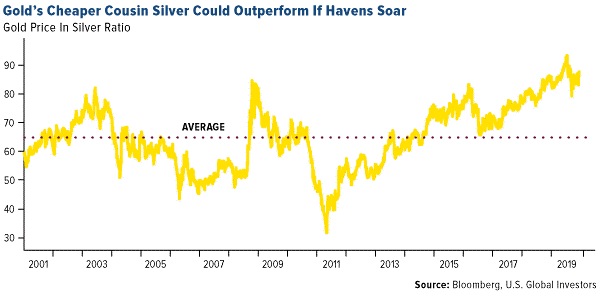
2019 is on track to be a 50-year high in central banks’ net gold
purchases. Bloomberg Intelligence reports that central banks have been
absorbing about 20 percent of global gold mine supply. Based on the
gold-to-silver ratio, it looks like silver might have more upside if
demand for safe haven assets rises. Bloomberg’s Eddie van der Walt
writes that the gold-silver ratio has dropped to 86 from 93 in July and
that means silver has outperformed on the back of gold’s gains. UBS
analyst Giovanni Staunovo is bullish on palladium and platinum. Staunovo
wrote in a December 5 report that palladium will likely enter its ninth
straight year of market deficit in 2020 and could climb above $2,000 an
ounce. Even as platinum is set to enter a surplus, its price could be
driven by gold. “As platinum is highly correlated to gold, our bullish
view for gold should mean higher platinum prices, which we expect to
trade at around $1,000 an ounce next year.â€
Zijin Mining Group Co. has agreed to buy Continental Gold in a
rare all-cash deal worth C$1.37 billion – the second big takeover in a
few weeks of a junior Canadian gold miner. Bloomberg reports the offer
reflects a 29 percent premium to the Continental Gold share price from
the past 20 days and that major shareholder Newmont Goldcorp was
supportive of the deal. In hostile M&A news, Centamin Plc rejected
Endeavour Mining Corp.’s $1.9 billion takeover offer saying that it
undervalues its assets, reports Bloomberg News. Centamin has been a
takeover candidate since the size of its Egyptian mine was discovered at
the start of the decade, though the company has faced many operational
setbacks.
Kinross Gold has been busy raising cash. Kinross announced this
week that it has agreed to sell its remaining shares of Lundin Gold for
C$150 million to Newcrest Mining and the Lundin Family Trust. Kinross
earlier announced that it has sold its royalty portfolio to Maverix
Metals for $74 million.
Threats
ABN Amro strategist Georgette Boele says they see gold weakening in the coming weeks and months with a price average of $1,400 an ounce. However, they do expect prices to increase to $1,600 by December of 2020. Before this happens, extreme net-long positioning would clear u p because “these positions currently hang over the market and prevent prices from moving substantially higher.â€
Another sign of a weakening economy was released last week. The ISM manufacturing PMI unexpectedly declined to 48.1 in November, below the median forecast of 49.2. The reading remains below the 50 level that indicates activity is shrinking.
Bloomberg’s Enda Curran writes that cheap borrowing costs have sent global debt to another record – $250 trillion of government, corporate and household debt. This level is almost three times global economic output and policymakers are now grappling with how to keep economies afloat – with more debt? According to Cornerstone Macro’s head of technical analysis Carter Worth, his S&P 500 chart signals a 5 to 8 percent decline in the coming months. Bloomberg reports that the S&P 500 fell 1.4 percent on Tuesday, pushing it below an upward trend line established in October.
Posted by AGORACOM-JC
at 2:35 PM on Tuesday, December 10th, 2019
SPONSOR: New Age Metals Inc.
The company owns one of North America’s largest primary platinum
group metals deposit in Sudbury, Canada. Updated NI 43-101 Mineral
Resource Estimate 2,867,000 PdEq Measured and Indicated Ounces, with an
additional 1,059,000 PdEq Ounces in the Inferred. Learn More.
Palladium roars to record $1,900/oz. on South Africa power cuts
“South Africa produces 40% of world’s palladium and the ESKOM outages are hitting some mines, giving palladium just that extra nudge above $1,900,” says Tai Wong, head of base and precious metals derivatives trading at BMO
Spot palladium recently was +1% at $1,901.27/oz., after hitting an all-time high $1,903/oz.
“South Africa produces 40% of world’s palladium and the ESKOM outages
are hitting some mines, giving palladium just that extra nudge above
$1,900,” says Tai Wong, head of base and precious metals derivatives
trading at BMO, but after 13 straight positive sessions, “it wouldn’t be
surprising to see some consolidation, though the overall trend
continues to look positive.”
Scarcity concerns over palladium already have helped lift the metal by ~50% in 2019, due to its large demand in the auto sector.
Other metals also gained on the South African outages, with platinum +3.1% at $922.40/oz., the highest since Nov. 21, and silver +0.4% to $16.66/oz.; spot gold only +0.1% at $1,463.66/oz.
Posted by AGORACOM-JC
at 10:30 AM on Tuesday, December 10th, 2019
Tartisan Nickel Corp. has begun
An Investor Awareness Initiative with particular focus on Tartisan’s
flagship asset – The Kenbridge Nickel Deposit in Kenora, Ontario.
Kenbridge property has a measured and indicated resource of 7.14 million tonnes at 0.62% nickel, 0.33% copper
Advanced stage deposit remains open
in three directions, is equipped with a 623m deep shaft and has
never been mined.
Preliminary Economic Assessment completed and updated returned robust project economics and operating costs including a NPV of C$253M and cash costs of US$3.47/lb of nickel net of copper credits.
Plans for Kenbridge include updating PEA, advancing the project through to feasibility and exploring the open mineralization at depth
FULL DISCLOSURE: Tartisan Nickel Corp. is an advertising client of AGORA Internet Relations Corp.
Posted by AGORACOM
at 6:41 PM on Monday, December 9th, 2019
Sponsor: Affinity Metals (TSX-V: AFF) a Canadian mineral exploration company building a strong portfolio of mineral projects in North America. The Corporation’s flagship property is the Drill ready Regal Property near Revelstoke, BC. Recent sampling encountered bonanza grade silver, zinc, and lead with many samples reaching assay over-limits. Further assaying of over-limits has been initiated, results will be reported once received. Click Here for More Info