Agoracom Blog Home

Archive for the ‘All Recent Posts’ Category

ThreeD Capital Inc. $IDK.ca – Zero-Commission Trading Is Coming to #Crypto #Bitcoin #Ethereum $HIVE.ca $BLOC.ca $CODE.ca

Posted by AGORACOM-JC at 2:32 PM on Friday, November 22nd, 2019

SPONSOR: ThreeD Capital Inc. (IDK:CSE) Led by legendary financier, Sheldon Inwentash, ThreeD is a Canadian-based venture capital firm that only invests in best of breed small-cap companies which are both defensible and mass scalable. More than just lip service, Inwentash has financed many of Canada’s biggest small-cap exits. Click Here For More Information.

Zero-Commission Trading Is Coming to Crypto

  • ShapeShift exchange debuts zero fees following user defections
  • Firms are slashing fees as race for market share intensifies

By Olga Kharif

Zero-fee trading first came to exchanged-traded funds and then to online stock and option transactions. Now the strategy is spreading into the cryptocurrency sphere.

Seen as the most profitable sector of digital-asset world, trading platforms are feeling the pressure as industry heavyweights such as Binance Holdings Ltd. and BitMex grab market share with both trading volume and coin prices sagging. ShapeShift, which has operated an exchange since 2014, said Wednesday it’s begun offering free “perpetual” trades.

“Free trading has become a feature of all fintech direct trading offerings, from Robinhood to SoFi and even JPMorgan,” said Lex Sokolin, global financial technology co-head at ConsenSys, which offers blockchain technology. “So it’s not surprising that in a digital race to acquire the most users, execution prices are starting to collapse.”

The practice turned out to be a catalyst for Charles Schwab Corp., which recently reported it opened 142,000 new trading accounts in October, a 31% jump from September, after the brokerage offered zero fees. Fresh income is being generated from interest earned on client cash holdings. Firms in the crypto world are taking notice.

“We’ve definitely seen how people often need very simple messages,” Erik Voorhees, the Denver-based chief executive of ShapeShift, said in a phone interview. “Everyone understands free.”

ShapeShift lost about 90% of its trading volume a year ago when it began checking user identifications to comply with regulatory guidelines, Voorhees said.

Daily-trading volume in crypto overall is about half of what it was in late October, and it’s been sluggish for most of the past few months, according to data compiler CoinMarketCap.com. The percentage of exchanges that are offering no-fee trading has increased to about 10% from 8% in June, data from CryptoCompare, which tracks exchanges.

To execute free transactions, traders will have to use so-called Fox tokens that ShapeShift is rolling out. Every user ShapeShift.com will get 100 free tokens, and the exchange may sell additional ones, Voorhees said. Each token — which are deposited in a user’s crypto wallet and are never spent — provides $10 of free trading volume on a rolling-30-day basis. So the more Fox tokens customers hold, the more free trades they can execute. Voorhees estimates that 90% of the exchange’s users will be able to do all their trades for free.

“We’d rather make a smaller amount of revenue from a larger pool of customers, and get those customers off centralized custodial exchanges,” Voorhees said. “It’s a risk we’re taking, but we think it’s worth it.”

Other, mostly smaller, exchanges are offering zero fees as part of short- and long-term promotions. Liquid.com is waiving costs for traders who have less than $25 million per month in transactions. Zebpay introduced zero-trading fees in February. HitBTC lowered its fees in August. Malta-based Binance — often the largest spot trading exchange — lets users lower their trading fees by investing in its own cryptocurrency, Binance Coin.

“The end result of price wars tends to be consolidation and the starving of smaller players,” Sokolin said. “Already we see this with the dominance of Binance.”

Source: https://www.bloomberg.com/news/articles/2019-11-20/zero-commission-trading-is-coming-to-crypto-as-boom-times-fade

New Age Metals $NAM.ca – What role are #lithium-ion batteries playing in energy transition? $LIC.ca $LIX.ca $LI.ca $ELR.ca $ATL.ca

Posted by AGORACOM-JC at 12:06 PM on Friday, November 22nd, 2019

SPONSOR: New Age Metals Inc. The company’s Lithium Division has already made significant acquisitions in Canada and the USA. The company also owns one of North America’s largest primary platinum group metals deposit in Sudbury, Canada. Updated NI 43-101 Mineral Resource Estimate 2,867,000 PdEq Measured and Indicated Ounces, with an additional 1,059,000 PdEq Ounces in the Inferred. Learn More.

What role are lithium-ion batteries playing in energy transition?

  • Lithium-ion batteries have been essential to the mainstream adoption of electric vehicles as part of a larger energy transition.
  • This has led to an unprecedented surge in the market for lithium-ion batteries and an even larger spike in supply. Prices have fallen recently, but demand is expected to continue rising.
  • Lithium-ion batteries also have potential applications in utility-scale renewable energy, although they face competition from newly developed technologies in that arena.

The energy transition has encouraged industries to move from fossil fuel to renewable energy sources. In doing so, companies have faced challenges in determining how to store significant amounts of energy for extended periods of time. This need is especially acute in the electric car market, which has turned to lithium batteries for energy storage. Demand for lithium is projected to grow by as much as 20% in 2019 compared to the previous year, according to Chilean producer SQM, largely because of increasing investment in and mainstream adoption of electric vehicles.

More traditional technologies, like internal combustion engines, use energy almost as soon as it is created. Comparatively, electric vehicles need to store electrical energy for long periods of time before using the supplies. Lithium-ion batteries, specifically those using the compound lithium hydroxide, store energy while taking up less space than other battery technologies, and their adoption by the mass market has encouraged innovation in the technologies underpinning the batteries. The impact and success of lithium-ion battery technology and its potential in the global energy transition to renewable energy has been recognized on an outsized scale — the technology’s creators won the Nobel Prize for chemistry in 2019.

Tesla, the electric car manufacturer owned by Elon Musk, has become a major player in the American lithium business. Tesla acquired lithium deposits across the American West while building huge “gigafactories” to mass produce the batteries. The company’s plans call for the first of these factories in Nevada to process 25,000 metric tons of lithium hydroxide per year, and it has a larger footprint than any other building in the country. Electric vehicle sales worldwide surged 75% year over year in the first quarter of 2019, even as the overall global automobile market contracted; regardless of opinions over the energy transition’s evolution, all of these cars need batteries.

Although electric vehicles have been the most significant application of lithium-ion batteries to date in the energy transition, lithium could also make renewable energy sources more viable for utilities. Whereas traditional fossil fuel power plants constantly produce energy, renewables like solar and wind can only produce energy while the sun is shining or the wind is blowing. To ensure that the power grid works constantly, regardless of external variables, transitioning to renewable energy would require the utility-scale use of energy storage. S&P Global Market Intelligence analysis shows that lithium-ion batteries are seen as the technology to compete with in this market.

Potential alternatives to lithium-ion batteries include batteries made from different chemical compounds. Lithium has faced some technological challenges in its adoption at the grand scale necessary for utilities, which resulted in multiple fires in Arizona that led a member of the state’s public utilities commission to call for different technology solutions.

The increasing demand for lithium-ion batteries and the importance they may hold for the transition to renewable energy has sparked geopolitical competition to secure a stable supply of batteries. Chinese firms have invested billions of dollars in lithium deposits across Australia and South America in recent years as part of the country’s plan to quadruple electric vehicle production between 2019 and 2025. In response, European companies have sought to expand their own investments in lithium so that their supply of batteries does not rely on foreign supply chains. Companies investing in European lithium processing have also voiced concerns about the potential environmental impact of processing the lithium into batteries in China and then shipping them across the world for use in Europe. As similar tensions arise between China and the U.S., lithium has become another flash point in the countries’ trade battles.

Market demand has contributed to a surge in the lithium mining and production businesses. Budgets for mining industry lithium exploration grew nearly sevenfold worldwide between 2015 and 2018, according to S&P Global Market Intelligence. The jump in demand for lithium-ion batteries led to a spike in prices in the early 2010s, and acquisitions of lithium deposits and mines rose sharply. Since then, the supply of lithium has risen more quickly than demand, so prices have fallen and deal-making has slowed.

Although lithium prices across autumn 2019 were on the lower side and some projects have been delayed or cut back, many market participants still expect the sector to grow significantly. Lithium production is expected to triple to 1.5 million metric tons worldwide by 2025. S&P Global Platts has reported on fears that even this increase in supply might not be enough to keep up with demand, especially if expected electric vehicle adoption rates continue.

Source: https://www.spglobal.com/en/research-insights/articles/what-role-are-lithium-ion-batteries-playing-in-energy-transition

Labrador Gold $LAB.ca – Announces Up to 8.26g/t Gold in Selected Grab Samples from New Showing at Hopedale Project, Labrador $RIO.ca $WHM.ca $SIC.ca $NXS.ca

Posted by AGORACOM at 9:06 AM on Friday, November 22nd, 2019
  • Selected grab samples from new gold showing north of the Thurber Dog gold occurrence show assays between 1.67 and 8.26 g/t Au
  • Extends potential strike length of gold mineralization by approximately 500 metres along strike to the north 
  • Occurs within a larger 3km trend of anomalous gold in rock and soil associated with the contact between mafic/ultramafic volcanic rocks and felsic volcanic rocks

Labrador Gold Corp. (TSX-V: LAB) (“Labrador Gold” or the “Company”) is pleased to announce results of rock sampling at its Hopedale project in Labrador.

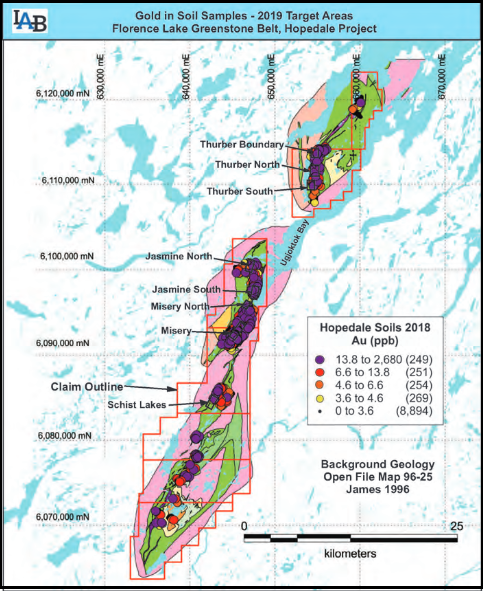
The Company controls a 57-kilometre strike length of stratigraphy prospective for gold in the Florence Lake Greenstone Belt (FLGB). To date, the Company has defined eight high potential areas for gold within the belt. The 2019 exploration program was designed to generate drill targets within these areas using detailed geological mapping, rock sampling and prospecting and ground magnetics/VLF-EM (very low frequency electromagnetics).

Sampling of the prospective areas resulted in 201 rock samples with gold values ranging from below the detection limit of 5 parts per billion (ppb) to 8.26 grams per tonne (g/t) in selected grab samples. The highest gold values were from three samples taken at the site of a new mineralized showing discovered shortly after the start of field work (see News Release dated July 26, 2019). The showing is located approximately 500 metres north, and along strike of, the Thurber Dog gold occurrence where previous Labrador Gold rock sampling returned values up to 7.87 g/t Au. Mineralization is comprised of disseminated to semi-massive pyrite and arsenopyrite hosted by felsic metavolcanic rocks with pervasive iron oxide alteration. The three samples from the occurrence assayed 1.67 g/t Au, 2.83 g/t Au and 8.26 g/t Au.

Anomalous gold values were also found in samples from elsewhere in the targeted areas and range from 0.11 g/t Au to 0.6 g/t Au (See table below). To date the company has collected 12,510 soil samples, 414 lake sediment samples and 834 rock samples along the length of the greenstone belt.

“Our systematic approach to exploration of the Florence Lake belt continues to turn up anomalous gold values in areas of high potential.” said Roger Moss, President and Chief Executive Officer of Labrador Gold. “The Thurber Dog area stands out as the most consistently mineralized gold trend in the belt and we are still finding gold mineralization that fills in gaps along the three kilometre stretch of anomalous gold in both rock and soil. The discovery of the new gold showing this season is the latest addition to what is turning into a prolific trend.”

 Highlights of 2019 rock sample assays.


Sample IDEastingNorthingSample Type*Rock typeMineralizationAu (ppb)Area
17026766547816110696GrabQuartz veinPy, Apy8,263New Showing
17101486547786110691GrabFelsic volcanicPy, Apy1.672New Showing
17101496547816110696GrabFelsic volcanicPy, Apy2.831New Showing
17101406547456111249GrabChlorite schist602Thurber Trend
16954446546286112280GrabUltramafic volcanicPy114Thurber North
19954336546286112280GrabQuartz veinPy224Thurber North
17052306549966113663GrabMafic volcanicApy532Thurber Boundary
16912246476396100795GrabUltramafic volcanicApy, Py107Jasmine North
17026876480216098550GrabIron formationPy388Jasmine South
17057386470746095318GrabQuartz vein134Misery North
17026786449146091661GrabQuartz veinPy488Misery
17852706433386085835GrabMafic volcanicPy336Schist Lakes

*Note that grab samples are select samples and are not necessarily representative of gold mineralization found on the property. Abbreviations: Py pyrite; Apy Arsenopyrite.

All samples were shipped to the Bureau Veritas laboratory in Vancouver, BC, where they were crushed and split and a 500g sub sample pulverized to 200 mesh. Samples of 30g were analyzed for gold by fire assay with an atomic absorption finish and another 15g sample for 36 elements by ultratrace ICP-MS (inductively coupled plasma-mass spectrometry) following an aqua regia digestion. Over limit samples (greater than 10g/t Au) are re-assayed using fire assay with a gravimetric finish. In addition to the QA-QC conducted by the laboratory, the Company routinely submits blanks, field duplicates and certified reference standards with batches of samples to monitor the quality of the analyses.

Roger Moss, PhD., P.Geo., is the qualified person responsible for all technical information in this release.

About Labrador Gold:

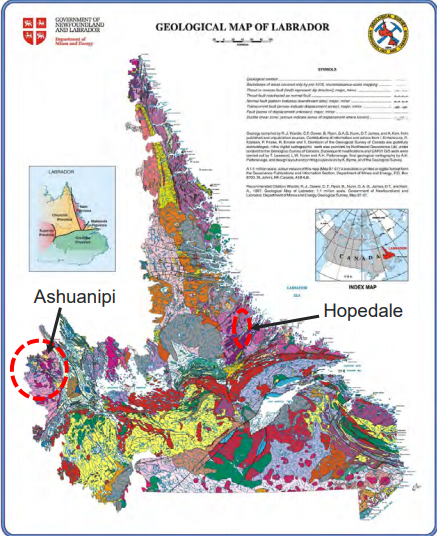
Labrador Gold is a Canadian based mineral exploration company focused on the acquisition and exploration of prospective gold projects in the Americas. In 2017 Labrador Gold signed a Letter of Intent under which the Company has the option to acquire 100% of the 896 square kilometre (km2) Ashuanipi property in northwest Labrador and the Hopedale (458 km2) property in eastern Labrador.

The Hopedale property covers much of the Hunt River and Florence Lake greenstone belts that stretch over 80 km. The belts are typical of greenstone belts around the world but have been underexplored by comparison. Initial work by Labrador Gold during 2017 show gold anomalies in soils and lake sediments over a 3 kilometre section of the northern portion of the Florence Lake greenstone belt in the vicinity of the known Thurber Dog gold showing where grab samples assayed up to 7.8g/t gold. In addition, anomalous gold in soil and lake sediment samples occur over approximately 40 kilometres along the southern section of the greenstone belt (see news release dated January 25th 2018 for more details). Labrador Gold now controls approximately 57km strike length of the Florence Lake Greenstone Belt.

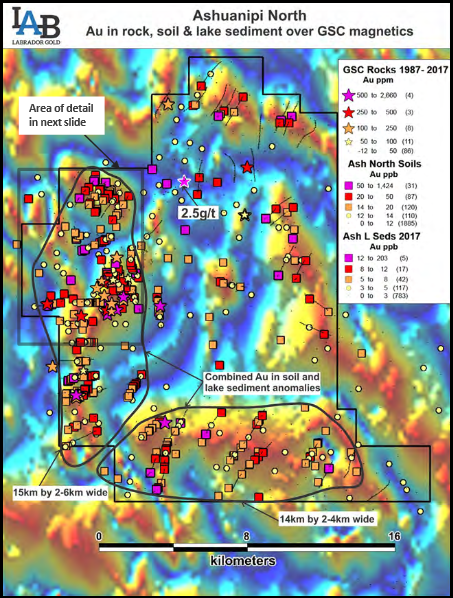
The Ashuanipi gold project is located just 35 km from the historical iron ore mining community of Schefferville, which is linked by rail to the port of Sept Iles, Quebec in the south. The claim blocks cover large lake sediment gold anomalies that, with the exception of local prospecting, have not seen a systematic modern day exploration program. Results of the 2017 reconnaissance exploration program following up the lake sediment anomalies show gold anomalies in soils and lake sediments over a 15 kilometre long by 2 to 6 kilometre wide north-south trend and over a 14 kilometre long by 2 to 4 kilometre wide east-west trend. The anomalies appear to be broadly associated with magnetic highs and do not show any correlation with specific rock types on a regional scale (see news release dated January 18th 2018). This suggests a possible structural control on the localization of the gold anomalies. Historical work 30 km north on the Quebec side led to gold intersections of up to 2.23 grams per tonne (g/t) Au over 19.55 metres (not true width) (Source: IOS Services Geoscientifiques, 2012, Exploration and geological reconnaissance work in the Goodwood River Area, Sheffor Project, Summer Field Season 2011). Gold in both areas appears to be associated with similar rock types.

The Company has 57,039,022 common shares issued and outstanding and trades on the TSX Venture Exchange under the symbol LAB.

For more information please contact:             

Roger Moss, President and CEO      Tel: 416-704-8291

Or visit our website at: www.labradorgold.com

Twitter: @LabGoldCorp

NORTHBUD $NBUD.ca – Cannabis Canada: Ontario sets plans to let private sector handle cannabis distribution $CGC $ACB $APH $CRON.ca $HEXO.ca $TRST.ca $OGI.ca

Posted by AGORACOM-JC at 5:20 PM on Thursday, November 21st, 2019

SPONSOR: NORTHBUD (NBUD:CSE) Sustainable low cost, high quality cannabinoid production and procurement focusing on both bio-pharmaceutical development and Cannabinoid Infused Products. Learn More.

Cannabis Canada: Ontario sets plans to let private sector handle cannabis distribution

Ontario sets plans to let private sector handle cannabis distribution  

Ontario is gradually reducing its exposure to the legal pot industry. An email obtained by BNN Bloomberg shows the province plans to allow the private sector to handle distributing cannabis from producers to retailers. The email, which was sent to Canadian licensed producers late Tuesday, shows that Ontario plans to soon adopt a new measure to allow for a “third-party centralized distribution” system. The changes follow feedback the Ontario Cannabis Store solicited from the industry last month to determine whether it should get out of its wholesale cannabis business. The email also stated that the OCS is seeking further consultation with industry participants interested in services where cannabis can be shipped directly from a cannabis producer to a retailer, sidestepping a wholesale operator entirely.

Source: https://www.bnnbloomberg.ca/cannabis-canada-1.1351119

Vertical Exploration $VERT.ca – Signs Distribution Agreement with AREV Brands International to Supply St-Onge Wollastonite to the Cannabis and Hemp Industry $TORR.ca $FA.ca $WEED.ca $CGC $ACB $APH $CRON.ca $HEXO.ca $TRST.ca $OGI.ca

Posted by AGORACOM at 9:29 AM on Thursday, November 21st, 2019
  • A definitive distribution agreement to partner on the sale of Vertical’s wollastonite from its world-class St-Onge Deposit
  • Vertical will supply wollastonite to AREV Brands for distribution and/or resale
  • Vertical’s high quality wollastonite has been shown to be beneficial to cannabis plants – significant improvements in root mass, powdery mildew control and pest elimination.
  • At a microscopic level, wollastonite’s needle-like structure penetrates soft-bodied insect larvae and pupae, interrupting the life cycle without the use of pesticides

VERTICAL EXPLORATION INC. (TSXV:VERT) and AREV BRANDS INTERNATIONAL LTD. (CSE:AREV) are pleased to announce that, further to the press release of September 12th, 2019, the two companies have entered into a definitive distribution agreement to partner on the sale of Vertical’s wollastonite from its world-class St-Onge Deposit in order to supply the fast growing cannabis and hemp industries.

Vertical and AREV Brands have agreed to enter into this distribution agreement, whereby Vertical will supply wollastonite materials produced from its St-Onge mineral property located in Quebec to AREV Brands for distribution and/or resale to both small scale “craft” cannabis or hemp growing operations and large scale cannabis or hemp growing operations licensed by Health Canada.

Vertical’s high quality wollastonite has been shown to be beneficial to cannabis plants in a variety of ways. In February 2019, Vertical announced the successful completion of Phase Three trials involving cannabis grown with wollastonite (CaSiO3) as a soil additive at BC Bud Depot’s (BCBD) ACMPR-licenced Research and Development facilities in Vancouver, BC. In the Phase Three trials BCBD measured and recorded significant improvements in root mass, powdery mildew control and pest elimination. At a microscopic level, wollastonite’s needle-like structure penetrates soft-bodied insect larvae and pupae, interrupting the life cycle without the use of pesticides. Wollastonite’s unique properties also allow it to break down into calcium, magnesium and silicon in a highly bio-available form that balances soil PH throughout the growth cycle – this allows the cannabis plants to uptake silicic acid and promotes strong cell walls that better resist insect feeding and spore penetration, supporting increased growth and elevated product yields. (see February 5th, 2019 news release)

Peter P. Swistak, President/CEO of Vertical Exploration Inc., commented: “We are very pleased to have signed our first distribution and sales agreement with AREV Brands, as we believe there is a large and growing cannabis and hemp market opportunity for Vertical’s world-class St-Onge wollastonite. I firmly believe that this distribution partnership will be highly beneficial to both companies.”

This transaction is subject to the approval of the TSX Venture Exchange.

ABOUT AREV BRANDS INTERNATIONAL LTD.

AREV Brands International Ltd. (“AREV”) produces and delivers functional compounds and ingredients from its world-class extraction systems. AREV is revolutionizing the current delivery method of terpenes, cannabinoids and flavonoids. These premium ingredients and formulations are used in products targeted for sale in the natural health, medical, functional food, nutraceutical, sport nutrition and bioceutical markets. AREV innovates through extraction to produce extracts from specific selected plant and exude from trees that address 5 areas of health including Anxiety, Pain Management, Insomnia, Central Nervous System Disorders & Libido.

ABOUT VERTICAL EXPLORATION

Vertical Exploration’s mission is to identify, acquire, and advance high potential mining prospects located in North America for the benefit of its stakeholders. The Company’s flagship St-Onge Wollastonite property is located in the Lac-Saint-Jean area in the Province of Quebec.

ON BEHALF OF THE BOARD

Peter P. Swistak, President/CEO

FOR FURTHER INFORMATION PLEASE CONTACT:

Telephone: 1-604-683-3995
Toll Free: 1-888-945-4770
www.vertxinc.com

INTERVIEW: American Creek $AMK.ca Attracting Attention Of Majors As #Sprott Hopes For 20 Million Ounces $TUD.ca $SII.ca $GTT.ca $AFF.ca $SEA.ca $SA $PVG.ca

Posted by AGORACOM-JC at 9:18 AM on Thursday, November 21st, 2019

There is a lot we could say about American Creek’s Treaty Creek Project … But we’ll let the words of 4 much smarter and wealthier people do all the talking:

Walter Storm, CEO Tudor Gold (JV Partner; Funded Startup Of Osisko Mining Until Sold For $4.5 Billion)

“The Goldstorm (System On Treaty Creek) now has the attention of several major industry players and we expect that future results will continue to impress as we further define this potential world-class deposit“.”

Eric Sprott, Billionaire Investor and 2X PP Investor In American Creek Resources

“What we’re shooting for is to define a 10 or 20-million-ounce discovery

Ken Konkin , Tudor Gold Exploration Manager (Credited With Discovering Brucejack Mine Just South Of Treaty Creek) 

“The Goldstorm System shows no signs of weakening to the northeast and several more drill holes will be needed to find the length and depth of this huge gold system.
“2020 is going to be a breakout year.”
Darren Blaney, President & CEO American Creek Resources

“Ken Konkin, the geologist credited for the discovery and development of Pretium’s neighbouring Brucejack Mine is advancing the Goldstorm zone to potentially becoming a world-class deposit with far better logistics than the neighbouring KSM deposits.”

“Clearly, we have a massive, world-class gold system that still shows no signs of weakening to the northeast nor at depth.”

To find out why world renowned gold mine finders are so bullish on Treaty Creek, grab your favourite beverage, grab a seat and watch this interview with  American Creek Resources.

AGORACOM INTERVIEW … WHY SMALL CAP COMPANIES ARE FAILING AT SOCIAL MEDIA & LOSING THE ATTENTION WAR

Posted by AGORACOM-JC at 9:11 AM on Thursday, November 21st, 2019

If you are a small cap CEO, Director or Investor Relations Officer in North America, my 23 minute interview with James Black of the Canadian Securities Exchange (CSE) is the most important podcast you will listen to in 2019. Not because I am the guest but because of what I have to say.

Why does what I say matter? AGORACOM surpassed 600 million page views this year, we’re averaging over 4.5M views per month on Twitter and we’ve served over 300 clients. As such, the powerful information in this podcast comes from a deep understanding of both social media, why small cap companies are failing at it and what the serious implications are of that failure.

Make no mistake about it, this isn’t some generic social media discussion. James and I go deep and I hit hard because that is what good friends do. I’m sounding the alarm because of the massive implications if I don’t.

The good news is that, if you are not an AGORACOM client, you can turn this ship around but you have to do it now and that can only be done by understanding why small caps are failing today.

I suggest that your entire management team listens to it and discusses it. Then let’s have a call to discuss what can be done.

The beauty of this audio format is you can listen to it at work or in your car / subway to and from work. I’ve done the hard work presenting this powerful information, all you have to do is press play.

Thank-you and I look forward to discussing this with you and potentially working together in 2020. Our cashless and fully compliant shares for services program should make the decision an easy one.

NORTHBUD $NBUD.ca – Open letter to Ottawa: This one small detail is hindering the #cannabis industry’s success $CGC $ACB $APH $CRON.ca $HEXO.ca $TRST.ca $OGI.ca

Posted by AGORACOM-JC at 1:48 PM on Wednesday, November 20th, 2019

SPONSOR: NORTHBUD (NBUD:CSE) Sustainable low cost, high quality cannabinoid production and procurement focusing on both bio-pharmaceutical development and Cannabinoid Infused Products. Learn More.

Open letter to Ottawa: This one small detail is hindering the cannabis industry’s success

The excise stamp on a package of cannabis. Industry leaders say these stamps unique to every province and territory are making it more expensive to produce, package and ship cannabis to individual markets.Darren Brown/Postmedia

The devil is in the details. It’s a common but important refrain. It reminds us how even the smallest facets of plans, processes and situations can derail large-scale efforts.

Such is the case facing Canada’s cannabis industry. The federal government currently requires that all cannabis products carry excise stamps — proof the appropriate taxes have been paid by the licensed producer — like those attached to tobacco packaging. These stamps are also unique to each province and territory.

Excise stamps have been a source of ongoing frustration since legalization

For such a small item, the stamp significantly complicates the business of providing legal cannabis to law-abiding consumers. In addition, excise stamps hinder the flow of legal cannabis across the country, leading to costly supply issues for both governments and consumers.

Excise stamps have been a source of ongoing frustration since legalization. The logistics of applying these stamps has resulted in unnecessary product delays. Likewise, when the industry is criticized for excessive packaging, it’s often the result of complying with federal cannabis packaging requirements, which include provincial/territorial excise stamps.

Logistics aside, the stamps hinder the industry’s long-term success. Requiring producers to use province/territory-specific excise stamps impedes the flow of product across the country. Aside from the complexity of per-province labelling, product that does not sell in one region cannot easily be transported to another province where demand may be higher. The labelling requirement removes licensed producers’ ability to respond in real time to changing demand, adds unnecessary complexity to product forecasting, and means jurisdictions and retailers face completely preventable product shortages. And when consumers can’t find what they want in the legal market, they turn to the unregulated market.

The administrative and production burdens of the stamp also mean that it’s more expensive to produce, package and ship cannabis to individual markets. This means it’s substantially tougher for legal producers and retailers to compete, particularly with respect to price, with the illegal cannabis market, which shoulders absolutely none of the costs imposed on the legal system. One of the primary goals of cannabis legalization was to compete with and thereby eliminate the unregulated market for cannabis. So why do we insist on requirements like a unique provincial/territorial excise stamp that prevents that competition?

The current system isn’t working because it ignores both business and market realities

No one is objecting to industry regulation. Licensed producers have complied with regulatory requirements related to production, distribution and promotion of the product — and have made the financial investments necessary to do so. Province- and territory-specific excise stamps, however, are costly and unnecessary when one national excise stamp would do. Especially in such a new industry, where the efficiency of the manufacturing process is paramount, it is not only counter-intuitive but also counter-productive to continue the practice.

The current system isn’t working because it ignores both business and market realities. We’re not the first industry to come to this realization. In fact, Canada’s alcohol industry moved away from province/territory-specific excise stamps years ago, after delivering its own regulatory impact analysis and successfully arguing the benefits of an alternative approach.

As an industry, we have heard consistently from both public and private retailers across Canada that the current system of unique stamps offers them little to no value. At least one territory has indicated it has asked the Canada Revenue Agency to allow it to use product excise stamps for another province in order to increase its ability to access additional supply. More importantly, CRA has indicated a willingness to work with the industry on a redesign of the excise stamp. That’s progress.

If we are wholly committed to the goals of a thriving industry, we need to alleviate the logistical, financial and environmental burden of monitoring these products while successfully competing with the unregulated market. We can do so in a way that is effective, safe, and benefits the industry as well as Canadian consumers. It’s time to excise multiple excise stamps and move, instead, to a national one.

Terry Booth, CEO, Aurora; Adine Carter, Chief Marketing Officer, Tilray; Nav Dhaliwal, CEO, The Supreme Cannabis Company; Greg Engel, CEO, Organigram; Torsten Kuenzlen, CEO, Sundial Growers; Csaba Reider, President, The Green Organic Dutchman; Irwin Simon, Interim CEO and Board Chair, Aphria; Sebastien St-Louis, President & CEO, HEXO; Mark Zekulin, CEO, Canopy Growth Corporation. The authors are members of the Cannabis Council of Canada, the national industry association representing the legal cannabis sector.

Source: https://business.financialpost.com/opinion/open-letter-to-ottawa-this-one-small-detail-is-hindering-the-cannabis-industrys-success

CLIENT FEATURE: Labrador Gold $LAB.ca: Sean Ryan Looking to Repeat Discovery Process with Labrador Gold $RIO.ca $WHM.ca $SIC.ca $NXS.ca

Posted by AGORACOM at 10:48 AM on Wednesday, November 20th, 2019
http://www.smallcapepicenter.com/LAB%20square.png
  • Labrador Gold is aggressively pursuing the under explored gold potential of Labrador.
  • 2 large, separate, under-explored land packages that demonstrate potential for district scale gold discoveries.
  • Two successful gold explorers lead the way in the Labrador gold rush: Shawn Ryan and Roger Moss.
  • 2 Key Exploration Properties: Hopedale and Ashuanipi

Hopedale:

The Hopedale property covers much of the Hunt River and Florence Lake greenstone belts that stretch over 80 km. The belts are typical of greenstone belts around the world but have been underexplored by comparison. Initial work by Labrador Gold during 2017 show gold anomalies in soils and lake sediments over a 3 kilometre section of the northern portion of the Florence Lake greenstone belt in the vicinity of the known Thurber Dog gold showing where grab samples assayed up to 7.8g/t gold. In addition, anomalous gold in soil and lake sediment samples occur over approximately 40 kilometres along the southern section of the greenstone belt (see news release dated January 25th 2018 for more details). Labrador Gold now controls approximately 57km strike length of the Florence Lake Greenstone Belt.

Ashuanipi:

  • Two district scale gold anomalies outlined by soil and lake sediment survey: 15x3km north south anomaly and a 14 x 3km east west anomaly
  • 2018 Soil Sampling identified: 164 samples with over 50 ppb gold, 67 samples over 100 ppb (0.1g/t) gold and a high of 8,973 ppb (8.97 g/t) Au

The Ashuanipi gold project is located just 35 km from the historical iron ore mining community of Schefferville, which is linked by rail to the port of Sept Iles, Quebec in the south. The claim blocks cover large lake sediment gold anomalies that, with the exception of local prospecting, have not seen a systematic modern day exploration program. Results of the 2017 reconnaissance exploration program following up the lake sediment anomalies show gold anomalies in soils and lake sediments over a 15 kilometre long by 2 to 6 kilometre wide north-south trend and over a 14 kilometre long by 2 to 4 kilometre wide east-west trend. The anomalies appear to be broadly associated with magnetic highs and do not show any correlation with specific rock types on a regional scale (see news release dated January 18th 2018). This suggests a possible structural control on the localization of the gold anomalies.

LAB Agoracom Hub

FULL DISCLOSURE: Labrador Gold is an advertising client of AGORA Internet Relations Corp.

INTERVIEW: Empower Clinics $CBDT.ca Bucks #Cannabis Downfall With 137% Increase In Revenue, 211% Increase In Patient Visits $WEED.ca $CGC $ACB $APH $CRON.ca $HEXO.ca $OGI.ca $FAF.ca

Posted by AGORACOM-JC at 5:10 PM on Tuesday, November 19th, 2019

Empower Clinics JV Could Generate $US 30,000,000 In Annual Revenue From CBD Extraction … But It Doesn’t End There

With 165,000 patients, Empower Clinics (CBDT:CSE) (EPWCF:OTCQB) has a database that almost every medical cannabis and CBD company would kill for.  Add in the fact it is now on a ~ $USD 4,000,000 annualized revenue run rate for 2019 and it becomes the kind of company small cap investors have been dying to find as they watch pretender companies melt away.

But it doesn’t end there.

The Company’s latest Q3 financials show that Empower is in full growth mode, with substantial increases in revenue and patient visits, as well as, big reductions in expenses.  Moreover, Company CEO Steven McAuley says growth will continue full steam ahead in Q4, Q1 and beyond.

But it doesn’t end there. 

CBD extraction has been a key element of the company’s vertical integration. Producing its’ own hemp-derived CBD products for its own massive patient list just makes sense. However, thanks to an LOI (moving towards definitive agreement) to JV with extraction experts Heritage Cannabis, the Company’s 5,000 sq ft facility in Oregon is also planning to serve big brand 3rd party partners in the USA .  Empower brings the infrastructure, Heritage brings the expertise and balance sheet.  The result is a match made in shareholder heaven with initial annual capacity of 6,000 Kg at ~ $US 5,000 per Kg, which adds up to $US 30,000,000 in potential revenue.

We emphasize potential  because nobody has started selling anything yet but the facility is expected to begin producing soon.  However, with a built in patient database and talks already having commenced for white label products, Empower is on its way.  Moreover, “potential” cuts both ways, with capacity capable of increasing 2x – 3x without much trouble given the size of the facility.  

Can Empower successfully execute its extraction plan?  It’s a legitimate question, with a blow away answer..
The Company’s new CEO, Steven McAuley, who replaced the previous management team in January, is Six Sigma certified under the quality initiative of legendary GE chairman Jack Welch. We’ve never seen a Six Sigma certified CEO in the Canadian small cap markets. Never …. which also explains how McAuley has brought Empower to such heights in just 11 months.

The cannabis market is currently throwing away babies with the bathwater – but just as the dot-com crash brought us massive riches through Web 2.0 companies that were REAL, investors need to start looking for the REAL companies that will survive and thrive.  With 165,000 patients, rapidly increasing revenues, a franchise plan to grow clinics across America and a vertical integration CBD extraction strategy to tie them all together, Empower Clinics may be such a company.  

Grab your favourite beverage and settle in to watch what may be your next great small cap investment.