Posted by AGORACOM-JC
at 9:15 PM on Sunday, July 28th, 2019
Real-Time Flight Tracking Technology And Ruggedized Flat Panel displays
PRODUCT UPDATES
STAR-A.D.S. ®
STAR-A.D.S. ® system installed on a major private operator in the Mid-East has been operating for more than one year now
Discussions are being finalized to expand the installation of the STAR solution of real-time monitoring to the rest of the customers’ fleet
Contract for 5 aircraft installations with a scheduled flights airline in Egypt has been implemented
First installation is scheduled for Fall 2019 as scheduling permits, with the balance of fleet installations to match the C-check schedule of the remaining aircraft in the fleet
Production of 27 STAR-A.D.S.® System units has commenced in order to meet ongoing requirements
STAR M.M.I.™
STAR M.M.I.™ Division (displays), continues to service, repair and offer case-by case new unit build for legacy LCD panels for Lockheed Martin (P3 aircraft), Northrop Grumman, and Blue Aerospace. Star qualified for these activities as a stable, long-term and direct offsets (Industrial Regional Benefit “IRBâ€) provider to these main US based integrators
STAR-ISAMM™ and STAR-LSAMM™ systems have generated a rapid and growing interest in the North American market
Distribution and Sales agreement with AMS Heli Design has been signed, with the first contract covering 6 installations on EMS helicopters awaiting final approval by the end customer
STAR-ISAMM™
STAR-ISAMM™ presentations have been made targeting Canadian Defense retrofit programs.
Star has received a high level of interest from the military industry and market segments.
Two applications have been submitted to the Federal and Provincial
governments for Research and Development funding covering mid-2019 to
end of 2021.
FULL DISCLOSURE: Star Navigation Systems Group Ltd. is an advertising client of AGORA Internet Relations Corp.
Posted by AGORACOM-JC
at 9:00 PM on Sunday, July 28th, 2019
SPONSOR: Esports Entertainment
$GMBL Esports audience is 350M, growing to 590M, Esports wagering is
projected at $23 BILLION by 2020. The company has launched VIE.gg
esports betting platform and has accelerated affiliate marketing
agreements with 190 Esports teams. Click here for more information
Esports have become one of the fastest-growing industries in the world in the last decade with millions of dollars on the line for players to compete over.
The eSports industry has generated over $1billion yearly in revenue in the past couple of years and has provided many players with a stable income.
Being a gamer or streamer is more viable as a career option now with ever-increasing viewership and tournament prize pools each year. However, selections can be tough and not everyone can make the cut.
Blockchain can provide increased transparency into gaming as well as
more ways in which platforms can monetize activities. On top of that,
blockchain also reduces the barriers of entry into the gaming industry
and provides regular gamers a stepping stone onto what could provide
them a stable income.
Here are some ways in which blockchain and cryptocurrencies have been used in gaming so far!
Gambling
The gambling industry is a lucrative business and eSports has provided people with new options to throw their money on. Unikrn is
a sports and eSports betting platform that also provides up-to-date
news about eSports. They offer all the top popular games such as Dota 2,
LOL, CS:GO and many others. They have 2 gaming currencies UKG(Unikoin
Gold) and Unikoin silver which you can use for betting or even entering
jackpots. Users will not be required to make an initial deposit or
purchase and Unikoin Silver is given free to all users who signed up.
Buying and selling skins
Unikrn also has the function to allow users to connect their Unikrn
account to steam and convert selected skins for UKG. Skins from popular
games such as Dota 2 and CS:GO will be available for conversion. This
provides players with an additional way to earn money as money earned by
selling on platforms such as Steam can’t be withdrawn. UKG is being
sold on some exchanges and can even be used to buy games, gift cards and
keys from Gamivo.
Wagering
Wagering is a good way for players to use their gaming skills to earn money or items for themselves. Arena Match,
an eSports gaming app, has the perfect platform for players to pit
their skills against one another or push themselves to the limits.
Currently, they have only PUBG unlocked for skill challenges but will
have many other top games such as CS:GO, Fortnite and Apex Legends
available in the future. To give you an idea on how wagering works in
PUBG on Arena Match here is an illustration. Players have to pay an
entry fee in credits and enter into a solo match in PUBG. Depending on
your performance in the game, a multiplier will be applied to your wager
amount if you hit a certain requirement. For example, having 5 kills in
a single game could earn you a 3x multiplier and a 10kill game could
earn you an 8x multiplier and the payout will be in terms of real cash.
Arena Match has also adopted the Enjin Blockchain SDK and even has
Enjin backed perks for players to use in-game to reduce the difficulty
of challenges.
Streaming
Streaming can be considered bread and butter for many gamers and is a
huge part of the entertainment industry as well. Some common ways of
income for streamers are donations and partnership with the streaming
platform.
Refereum has just announced a
partnership with PUBG and is rewarding players for streaming. Due to
their blockchain technology, players will also be able to receive
rewards for streaming on some of their partnered platforms such as
Twitch and Mixer.
Sliver.tv who has partnered with
Theta is another streaming platform which allows streamers and watchers
ways to earn by participating in activities on their platform. Users
will be able to earn TFUEL(the operation token on the Theta protocol) by
watching streams, winning giveaways and also donate to streamers. TFUEL
can also be used to purchase items such as a Nintendo switch or a
Playstation 4 in the Sliver shop.
Earn through playing
Refereum is also offering rewards for completing in-game achievements during their PUBG campaign.
Unikrn is giving players ways to earn UKG by linking their game
account to the Unikrn platform and completing certain achievements.
Games such as CS:GO, Dota 2, Fornite and many more are available in
their list of premium games in their play to earn system.
Game hosting
Plairlife, a
decentralized gaming ecosystem, has successfully hosted a Dota 2
tournament on their platform. Plair hosted a series of 1v1 and 5v5 Dota 2
matches for their Alpha testers to enjoy and also established a
partnership with Team Eazy(HongKong Dota 2 team).
DreamTeam is a
platform for players to find teammates, use of AI to improve their
gaming skills and to manage teams. As many people most commonly game at
home, getting scouted by a pro team can be indeed near to impossible.
DreamTeam connects and allows regular gamers to go professional with
amateur or semi-professional eSports teams with over a 60% rate of
success.
Salary and payment
DreamTeam platform also allows salaries, prize money and other deals
to be settled on their platform. Due to the nature of blockchain,
players can be sure to receive their payments as not getting paid is a
real and not so uncommon thing in the pro scene of eSports.
Conclusion
Blockchain has shown its capability and also enhances the quality of
gaming as well. It also shows it can solve many real and burning issues
in the eSports world and provide gamers with more ways to be able to
earn money. This also shows how blockchain and the eSports industry can
work and grow together. Blockchain is constantly evolving and eSports is
not showing signs of slowing down either. This space will be super
exciting to watch and I am thrilled onto what developments blockchain
can bring.
Posted by AGORACOM-JC
at 12:29 PM on Friday, July 26th, 2019
SPONSOR: Spyder Cannabis Inc.
(TSX-V: SPDR) An established chain of high-end vape stores in Ontario,
Canada. The company has an aggressive expansion plan already in place
that will focus on Canadian retail and US Hemp-Derived kiosks in high
traffic areas. Click here for more info.
(TSX-V: SPDR) ————————
Here’s Why Gen-Z Are Turning To CBD Skincare
CBD extract is popping up in everything, from CBD infused cosmetics to cocktails. (AP Photo/Damian Dovarganes)
Health trends come and go but one wellness phenomenon that shows no sign of slowing is CBD.
CBD, otherwise known as cannabidiol, is indisputably one of the hottest health topics right now, with CBD products now available on the high-street in food and beverages and no longer restricted to supplements from a pharmacy.
Health trends come and go but one wellness phenomenon that shows no sign of slowing is CBD. CBD, otherwise known as cannabidiol, is indisputably one of the hottest health topics right now, with CBD products now available on the high-street in food and beverages and no longer restricted to supplements from a pharmacy. According to the Cannabis Trades Association U.K., the number of CBD users has doubled over the past year from 125,000 to 250,000 and the acquisition of This Works, the British beauty and wellness brand, by Canopy Growth, the world’s largest cannabis company, is just one of many examples highlighting the growing presence of CBD in the U.K. market.
Used for a variety of ailments from pain relief to anxiety and depression, CBD oil should not be confused with cannabis use, which has previously been linked with causing depression in teenagers by the NHS. Shiona Redmond, CBD expert and creator of Graces London, a luxury CBD oil beauty and lifestyle brand, explains that CBD is a non-psychoactive cannabinoid from the cannabis plant, whereas tetrahydrocannabinol (THC) is the psychoactive cannabinoid that creates the “high” commonly associated with marijuana use. Because CBD contains less than 0.2% of the psychoactive THC it is, therefore, legal to buy and consume in the U.K.
The increasing popularity of CBD in
the U.K. is perhaps a delayed reflection of the success in the U.S.,
where legal sales of marijuana products surpassed $10 billion in 2018.
Bolstered by a growing cohort of Gen-Z consumers, who are twice as likely to use CBD than the national average, it’s no surprise that CBD uptake in the U.K. has grown so quickly, given that 1 in 5 young adults have a diagnosable mental health disorder.
But how does CBD help mental wellbeing? Redmond explains that humans
have cannabinoid receptors in our bodies, part of a self-regulatory
system called the endocannabinoid system which aims to create
homeostasis, a sort of consistent internal balance, in the body. “The
ECS has been noted as one of the most important physiologic systems
involved in maintaining our health and balance,†says Redmond, “In 2007
the ECS was discovered to play an important regulatory role in the
secretion of hormones related to reproductive functions and response to
stress.â€
The human body actually produces its
own cannabinoids which have the same composition as the CBD cannabinoids
from cannabis plants, therefore a CBD intake interacts with our bodies
in a similar way. The sensation is akin to the “runners high” or
feel-good buzz felt after physical activity because the naturally
produced cannabinoids in the brain are heavily linked with euphoria and
serotonin.
CBD products are growing not only in
availability but also range, with several popular alternatives instead
of vaping. Often taken sublingually, as an oil, tincture or spray
absorbed via the mouth under the tongue, CBD is also popping up in food
and beverages, with Crussh becoming the first U.K. chain to offer cannabidiol products with the recent launch of a CBD booster to add to drinks.
CBD products are increasingly available in the U.K to address a range of health and wellbeing concerns (Photo/Graces London)
Graces London
For those who would prefer not to ingest CBD orally, topical CBD products
like skincare oils, body balms, bath bombs and face masks are also
increasing in popularity. Redmond says: “CBD extracts can be absorbed
through the epidermis layers of the skin to interact with cannabinoid
receptors located on skin surface cells. With the skin being the largest
organ of the human body, what we put on our skin doesn’t only affect
the skin, but it can have long-lasting effects on our health and general
wellbeing.â€
With wellbeing at the center of the CBD phenomenon, further growth in the U.K. is inevitable. Partly linked to the arrival of trendy CBD beauty brands like Milk Makeup—aimed at a younger audience and now sold in the U.K. since January—but also hard to not draw parallels with the downward trend in smoking and drinking amongst the younger generation. Gen-Z music artists like Lil Pump are now becoming cannabis ambassadors, rather than the traditional alcohol advertising contracts that millennials and baby boomers are accustomed to seeing. Reflecting this cultural change in consumer behavior, Facebook has recently relaxed its rules on CBD advertising, now allowing the promotion of topical CBD, but still banning ingestible CBD.
It will be interesting to see how CBD
advertising is regulated going forward, due to the wide-spread use of
CBD but varying levels of concentration within products.â€Not
all CBD is created equal., says Redmond, “The CBD cannabinoid content
in extracts can vary from just a few percents to more than 90% CBD. The
extraction method used will determine the CBD cannabinoid content. CBD
flowers can be cold-pressed, distillation processes can be used or
varied forms of alcohol, solvent, and C02 extractions can be used to
extract the oil. The clearer and more golden the oil, the more purified
and concentrated the whole plant CBD extract is.â€
Although greenwashing often refers to
brands attempting to appear more environmentally friendly, the term
still applies here with the rise of CBD and mental wellbeing giving
brands an opportunity to capitalize by using hemp seed oil, another
derivative from the cannabis plant. Hemp seed oil, sometimes referred to as Cannabis Sativa seed oil,
should not be confused with CBD. It’s been widely available within the
health and beauty industry for years and does not contain the same
beneficial cannabinoids as CBD. Having social media at their fingertips,
Gen-Z shoppers are not afraid to call out big beauty brands for greenwashing. Time will tell how young consumers respond, as they become more clued up to what’s within their products.
Posted by AGORACOM-JC
at 10:50 AM on Friday, July 26th, 2019
SPONSOR: Betteru Education Corp.
aims to provide access to quality education from around the world. The
Company plans to bridge the prevailing gap in the education and job
industry and enhance the lives of its prospective learners by developing
an integrated ecosystem. Click here for more information.
BTRU: TSX-V
————————
[Funding alert] Edtech platform Brainly raises $30M led by Naspers; plans to expand user base in India
The latest investment brings the total funding received by the edtech platform to $68.5 million.
Poland-based Brainly, a peer-to-peer learning community for students, parents, and teachers across 35 countries including India,
has raised $30 million in its new funding round led by Naspers with participation from Runa Capital and Manta Ray.Â
Poland-based Brainly, a peer-to-peer learning community for students, parents, and teachers across 35 countries including India, has raised $30 million in its new funding round led by Naspers with participation from Runa Capital and Manta Ray.
The latest investment brings the total funding received by the edtech platform to date up to $68.5 million.
The company said in a statement that the current round of funding
will be used to enhance Brainly’s user experience and invest further in
the quality of the help provided to students and parents across the
globe. In addition, these funds will enable the company to further expand its user base in India, one of its key markets, which is witnessing continual growth with more than 15 million unique monthly users.
Brainly CEO and Co-Founder, Michał Borkowski said
“Our goal is to extend that access to academic help to every
student in the world, including India, giving them the resources and
the tools to succeed while inspiring collaborative learning. This
funding allows us to do just that. We also plan to utilise these funds
to expand our offerings for the Indian community of students, parents,
and teachers, by providing a platform to discuss and study in other
local languages like Marathi, Gujarati, Bengali, Telugu, and Punjabi, to
name a few.”
Brainly CEO and Co-Founder Michał Borkowski with students
Founded in 2009 by Michal Borkowski, Lukasz Haluch, and Tomasz Kraus , Brainly last raised $38.5 million in Series B round from seven investors, including Naspers, which also funded India’s first edtech unicorn BYJU’s.
“We have been impressed by Brainly’s growth over the past 10
years, particularly in the US, and high-growth markets like India,
Indonesia, Turkey, and Brazil,” said Larry Illg, CEO of Naspers Ventures.
“At Naspers, we extend our support to companies that can address
grave societal needs like education, helping them fulfill their vision
with the ultimate aim of bringing about a change at a global scale,†he
said.
With more than 150 million monthly unique users, Brainly now reaches out to students, teachers, and parents across 35 countries in
solving their academic problems and exchanging knowledge. In addition
to India, the platform’s largest communities are in the US, Russia, Indonesia, India, Brazil, and Poland, among others.
Middle and high-school students, as well as their parents across
India, have been leveraging Brainly’s platform to strengthen their
skills in core academic subjects such as Math, Science, local languages like Hindi, and Social Studies, the company added.
In 2016 and 2017, Brainly closed $15 million Series B funding and $14 million Series B-1 funding,
led by Naspers and Kulczyk Investments, respectively. The platform’s
previous investors also include General Catalyst Partners, Point Nine
Capital, Runa Capital, and Learn Capital.
Brainly’s ‘crowdlearning’ model combines online education, social media, and machine learning, and is disrupting the $2.6 billion education market on a global level.
Posted by AGORACOM
at 9:33 AM on Friday, July 26th, 2019
Cardston, Alberta–(Newsfile Corp. – July 26, 2019) – American Creek Resources Ltd.
(TSXV: AMK) (“the Company”) (“American Creek”) today announced that it
will be offering on a non-brokered private placement basis (“the
Offering”) up to 6,000,000 units (“Units”) at a price of $0.05 per Unit
for proceeds of $300,000 if the Offering is fully subscribed. Each Unit
will consist of one common share of the Corporation (“Common Share”) and
one non-transferrable Common Share purchase warrant (“Warrant”). Each
Warrant may be exercised for one additional Common Share at a price of
$0.06 for a period of 24 months from the closing date of the Offering.
The securities will be offered to qualified purchasers in reliance
upon exemptions from prospectus and registration requirements of
applicable securities legislation. A Finder’s Fee of 5% may be paid
associated with this financing.
Proceeds will be used for general operating purposes including the advancement of key assets in BC’s Golden Triangle.
This private placement is subject to approval by the TSX Venture Exchange.
American Creek Resources “CEO Verified” Discussion Forum on
AGORACOM to act as Primary Investor Social Media and Online Marketing
Platform
The Company is also pleased to announce the launch of a “CEO
Verified” Discussion Forum on AGORACOM. The forum will serve as the
Company’s primary social media platform to interact with both
shareholders and the broader investment community in a fully moderated
environment.
AGORACOM “CEO Verified” provides the first ever identity verification
of small cap executives on a finance platform, which will provide
American Creek Resources executives and shareholders with a trusted
online forum. There are no log-in requirements for investors to visit
the forum and read posts. Those wishing to post questions, comments and
interact with both company officers and other shareholders can quickly
log-in using their Facebook or LinkedIn accounts, or create an anonymous
new user account.
Darren Blaney, President and CEO Rob Edwards, CFO Kelvin Burton, Investor Relations
Darren Blaney, President and CEO stated, “Social media participation
is very important for growth companies such as ours and AGORACOM forums
are purpose built to facilitate intelligent discussion without the
nonsense that plagues other such sites. I encourage everyone to read and
participate in our CEO Verified Discussion Forum to create great,
vibrant and constructive interaction for the long term benefit of
everyone. “
George Tsiolis, AGORACOM Founder stated “Given the state of affairs
in the red hot Golden Triangle, American Creek executives will have a
lot to say and their shareholders are going to have a lot of questions
in the coming months. This CEO Verified Discussion Forum will provide a
home for trusted information, full transparency and civilized 24/7/365
interaction.”
In addition to the CEO Verified Forum, the Company will also receive
significant exposure through millions of content brand insertions on the
AGORACOM network, extensive search engine marketing and social media
engagement targeting the Golden Triangle over the next 12 months.
Sponsorships of digital properties such as AGORACOM TV, the AGORACOM home page and the AGORACOM Twitter account will serve to significantly raise the brand awareness of American Creek amongst small cap investors.
About AGORACOM
AGORACOM achieved a major milestone on February 28, 2019 surpassing
600 Million-page views (90% AGORACOM / 10% Twitter) from 7.7 Million
investors that visited 55.2 Million times. These milestones continue to
demonstrate that AGORACOM is the primary home for serious small cap
investors that want to discover their next great small cap company.
Shares for Services
The Company intends to issue common shares in the capital of the
Company (the “Common Shares”) to AGORA in exchange for the Services.
Pursuant to the terms of the Agreement, the Company will be issuing a
total fee of $45,000 (plus GST) in instalments over the next 12 months.
The number of Common Shares to be issued at the end of each period
will be determined by using the closing price of the Common Shares of
the Company on the Toronto Venture Exchange on the first trading day
following the end of each period for which the Services were provided by
AGORA.
The term of the Agreement is for 12 months effective July 15, 2019 and the agreement is subject to Exchange approval.
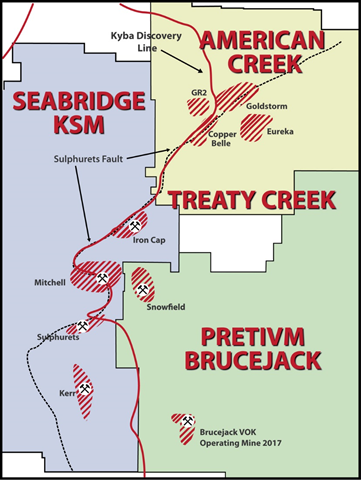
Image of mineralized zones on Treaty Creek located adjacent to Seabridge Gold’s KSM deposits.
With Eric Sprott’s latest $3,000,000 investment announced on Friday
he has now personally invested $4.5 million into the Treaty Creek Joint
Venture through its operator and 60% owner Tudor Gold. In a podcast
(also on Friday) Eric enthusiastically described the potential of the
Treaty Creek project when he made statements like:
“It’s drilling a monster play just like the GT Gold play”
“The last hole they announced, which was last year, was 563 meters of
1.08 gold.”
“It’s in the perfect logistical place to develop it. The
market cap of the company (Tudor) is like under $50 million and yet what
we’re shooting for is to define a 10 or 20-million-ounce discovery, so
you’re paying nothing for this discovery.”
“So that’s the sort of play that I like where man, if the
price of gold goes to $1,700 or $2,000 these plays will look so
economically viable and the stock will go up so much, and the analogy I
use is Seabridge back in 2000. I remember buying it at a dollar…and
Seabridge went from $1 to $35 dollars! That is what we are looking for –
a dollar to $35 dollars, set you up for life!”
American Creek Resources has a fully carried 20% interest (1/3 of
Tudors 60% interest) in the Treaty Creek Joint Venture and has a “free
ride” with no associated exploration/development costs until such time
as a production notice is given. This puts American Creek shareholders
in an extremely favorable leveraged position, especially considering the
other exceptional properties it owns including two more in BC’s Golden
Triangle. American Creek is presently valued at, and is trading at less
than 1/3 of Tudor’s present value (Treaty Creek being Tudor’s focus and
flagship property), offering an even more leveraged opportunity at the
moment.
The Goldstorm zone at Treaty Creek has the potential to be a world
class gold deposit with lower costs and far better logistics than
Seabridges’ adjacent KSM. According to Sprott, Seabridge set a lot of
people up for life and the opportunity for something similar by “paying
nothing for the discovery” is right here, right now.
Click the link below for the Sprott podcast. Tudor/Treaty Creek are
discussed beginning at about the 10:07 mark….but we suggest you listen
to the whole thing as Eric describes the present gold/silver market in
general.
American Creek is a Canadian junior mineral exploration company with a
strong portfolio of gold and silver properties in British Columbia.
Three of those properties are located in the prolific “Golden Triangle”;
the Treaty Creek and Electrum joint venture projects with Tudor
Gold/Walter Storm as well as the 100% owned past producing Dunwell Mine.
The Corporation also holds the Gold Hill, Austruck-Bonanza, Ample
Goldmax, Silver Side, and Glitter King properties located in other
prospective areas of the province.
For further information please contact Kelvin Burton at: Phone: 403 752-4040 or Email: [email protected]. Information relating to the Corporation is available on its website at www.americancreek.com
Posted by AGORACOM
at 8:31 AM on Friday, July 26th, 2019
Highlights:
Discovery of two new mineralized showings at Hopedale, Labrador
First showing extends potential strike length by approximately 500 metres along strike of the Thurber Dog gold occurrence;
Second showing was discovered in the Misery North area and followed for approximately 50 metres along strike.
VANCOUVER, British Columbia, July 26, 2019 (GLOBE NEWSWIRE) —
Labrador Gold Corp. (TSX-V: LAB) (“Labrador Gold†or the “Companyâ€) is
pleased to announce the discovery of two new mineralized showings
shortly after the start of field work at its Hopedale project in
Labrador.
The company controls a 57-kilometre strike length of stratigraphy
prospective for gold in the Florence Lake Greenstone Belt (FLGB). The
current program aims to generate drill targets within these areas using
detailed geological mapping, rock sampling and prospecting and ground
magnetics/VLF-EM (very low frequency electromagnetics).
Shortly after the start up of field work two new mineralized showings
were discovered and sampled. The first showing is located approximately
500 metres north and along strike of the Thurber Dog gold occurrence
where previous Labrador Gold rock sampling returned values up to 7.87
g/t Au. Mineralization is comprised of disseminated to semi-massive
pyrite and arsenopyrite hosted by mafic metavolcanic rocks with
pervasive iron oxide alteration.
The second occurrence “Sunshine†was found in the Misery North area
of the belt and is a two-metre-wide gossanous zone that was followed and
sampled for approximately 50 metres along strike. It is hosted by
altered felsic metavolcanic rocks close to the contact with mafic
metavolcanics rocks where the rock is pervasively silicified.
Mineralization is dominated by disseminated pyrite, locally up to 60%
with minor pyrrhotite and chalcopyrite. Limited previous rock sampling
by Labrador Gold at Misery North has returned gold values up to 0.56 g/t
Au.
“The early results of our 2019 exploration program at Hopedale are
very promising and indicate that our systematic approach to exploration
of the belt is getting us into the most favourable areas for gold
mineralization.†said Roger Moss, President and Chief Executive Officer
of Labrador Gold. “We anticipate further discoveries as we continue our
detailed, systematic follow up of the remaining anomalous areas that
will allow us to select the best targets for drilling.â€
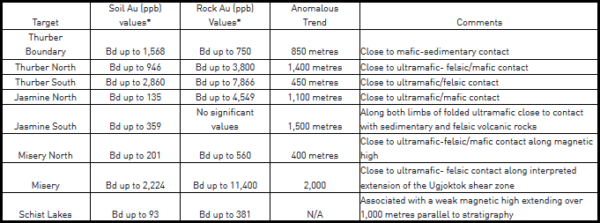
The 2019 exploration program at Hopedale is designed to follow up on successful results of 2017 and 2018 work that outlined eight high potential areas of gold anomalies in both soil and rock in the belt (see table below and maps at www.labradorgold.com/portfolio/hopedale/ ). These areas typically occur along geological contacts and are commonly associated with magnetic anomalies. To date the company has collected 12,510 soil samples, 414 lake sediment samples and 633 rock samples along the length of the greenstone belt.
*See news releases dated February 5, 2019 and March 13, 2019 for further details of the results. Bd = below detection: 5ppb for rock and 0.5ppb for soil.
Roger Moss, PhD., P.Geo., is the qualified person responsible for all technical information in this release.
About Labrador Gold:
Labrador Gold is a Canadian based mineral exploration company focused
on the acquisition and exploration of prospective gold projects in the
Americas. In 2017 Labrador Gold signed a Letter of Intent under which
the Company has the option to acquire 100% of the 896 square kilometre
(km2) Ashuanipi property in northwest Labrador and the Hopedale (458
km2) property in eastern Labrador.
The Hopedale property covers much of the Hunt River and Florence Lake
greenstone belts that stretch over 80 km. The belts are typical of
greenstone belts around the world but have been underexplored by
comparison. Initial work by Labrador Gold during 2017 show gold
anomalies in soils and lake sediments over a 3 kilometre section of the
northern portion of the Florence Lake greenstone belt in the vicinity of
the known Thurber Dog gold showing where grab samples assayed up to
7.8g/t gold. In addition, anomalous gold in soil and lake sediment
samples occur over approximately 40 kilometres along the southern
section of the greenstone belt (see news release dated January 25th 2018
for more details). Labrador Gold now controls approximately 57km strike
length of the Florence Lake Greenstone Belt.
The Ashuanipi gold project is located just 35 km from the historical
iron ore mining community of Schefferville, which is linked by rail to
the port of Sept Iles, Quebec in the south. The claim blocks cover large
lake sediment gold anomalies that, with the exception of local
prospecting, have not seen a systematic modern day exploration program.
Results of the 2017 reconnaissance exploration program following up the
lake sediment anomalies show gold anomalies in soils and lake sediments
over a 15 kilometre long by 2 to 6 kilometre wide north-south trend and
over a 14 kilometre long by 2 to 4 kilometre wide east-west trend. The
anomalies appear to be broadly associated with magnetic highs and do not
show any correlation with specific rock types on a regional scale (see
news release dated January 18th 2018). This suggests a possible
structural control on the localization of the gold anomalies. Historical
work 30 km north on the Quebec side led to gold intersections of up to
2.23 grams per tonne (g/t) Au over 19.55 metres (not true width)
(Source: IOS Services Geoscientifiques, 2012, Exploration and geological
reconnaissance work in the Goodwood River Area, Sheffor Project, Summer
Field Season 2011). Gold in both areas appears to be associated with
similar rock types.
The Company has 56,264,022 common shares issued and outstanding and trades on the TSX Venture Exchange under the symbol LAB.
Posted by AGORACOM-JC
at 11:00 AM on Thursday, July 25th, 2019
SPONSOR: Betteru Education Corp.
aims to provide access to quality education from around the world. The
Company plans to bridge the prevailing gap in the education and job
industry and enhance the lives of its prospective learners by developing
an integrated ecosystem. Click here for more information.
BTRU: TSX-V
————————
How Edtech Solutions are Building a Productive Digital Space for Millennials
Beas Dev Ralhan
Co-Founder & CEO – Next Education India Pvt. Ltd.
Education technology has, therefore, undoubtedly helped the millennials gain a productive, adaptable learning environment in the digital space that caters for multiple kinds of learners in multiple ways.
Need for governmental policies to work towards the integration of such tools in an organised and all-encompassing manner so that such a space can become much more productive than it is today.
The 21st-century learners are characterised by their inherent thirst for knowledge that goes beyond the linear search of information, their preference of choice and individualism over one-size-fits-all trends, and their expertise in tech tools and social networking via various forms of digital media. On the other hand, the 21st-century teacher may be one who is concerned about quality but lacks the resources and skills necessary to ensure that the learners’ potential is not wasted. Edtech solutions are bridging the gaps in the teaching-learning ecosystem by transforming the essential elements of the education space. Let us see how.
Breaking the Traditional Frames of Learning
Traditional models of education dictate the frames of learning such
as time and place; for instance, the majority of academic activities
happen in the brick-and-mortar confines of a school within 8-10 hours of
a day. E-learning has done away with such frames and given students the
ability to learn anywhere, anytime. Similarly, while books were once
the chief source of learning, aiding only the visual learners, the
edtech sector has helped in bringing multimedia content, including
immersive experiences such as augmented and virtual realities to cater
for all kinds of learners.
Most of all, such tools challenge the passive one-way lecture-mode
learning, helping learners be more active in their learning with
hands-on learning, flipped learning and peer interaction. Now teachers
are facilitators of their students’ learning, monitoring their
individual performances and helping them with personalised
feedback/recommendations.
Doing and Understanding: The Real-world Connection
Edtech tools help students learn better by providing the platform to
solve real-life problems with ease, which hones their understanding of
the world around them and helps them develop skills necessary to
navigate through their lives. For instance, robotics help youngsters
develop their STEM skills, and in the process, aid their understanding
of the existing problems in the world around them. Similarly,
collaborative digital spaces are being utilised in a constructive manner
to drive discussion and action with respect to real-world situations.
Game-based learning also helps in a deeper understanding of situations
in a simulated environment with the help of creative games such as
Minecraft.
Innovative Methods of Assessments
For education to meet the requirements of the students, it is
necessary for the instructor to know precisely where the individual
learner stands at the beginning of the academic course and to measure
the gaps through the course of learning. Assessment is the best method
to carry this out. Unfortunately, traditional tests do not give an
accurate picture of what the learners know or don’t know, and what kind
of instructions the students need to learn new concepts.
Artificial intelligence, one of technology’s greatest boons, has
helped shape adaptive tests to quantify the proficiency or knowledge
level of the examinee accurately. These tests adapt to the abilities of
the learners and act as a morale booster, since the chances of
discouragement or boredom are reduced.
Gamified assessments are also an innovative way to assessments, so
that fear of tests are eliminated. Gamified assessments will capture
learners’ attention, provide simulated situations to train them in
handling real-life scenarios and help them retain information better.
Questionnaires can be prepared in a Kaun Banega Crorepati (How
To Be A Millionaire) style, or in crossword-puzzle mode, or based on
motifs of common games, such as Tic-Tac-Toe, Hangman and Find-Your-Way
so that students enjoy the process of assessments.
Promoting Personalised and Self-learning Styles
The viewpoint of learning has changed from teacher-centred to
learner-centred, and therefore ‘personalisation’ and ‘self help’ are the
buzzwords in today’s education scenario. The factory method of learning
does not help most students and hinders their potential by trying to
fit all students in a single mould. Personalised learning is powered by
adaptive learning technology, which helps the individual student
understand his or her skill level, and suggests the most suitable course
of study. A lot of self-learning solutions are also available which can
help students and teachers upskill themselves as per individual
requirement. This has bolstered distance learning through popular
platforms.
Education technology has, therefore, undoubtedly helped the
millennials gain a productive, adaptable learning environment in the
digital space that caters for multiple kinds of learners in multiple
ways. We need governmental policies to work towards the integration of
such tools in an organised and all-encompassing manner so that such a
space can become much more productive than it is today.
Posted by AGORACOM
at 10:55 AM on Thursday, July 25th, 2019
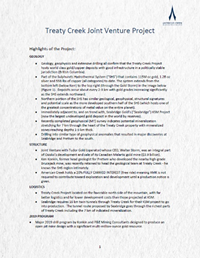
AMK owns a 20% carried interest to production at Treaty Creek
Last hole at Goldstorm 2018: 563.8m of 0.98 g/t gold and unknowingly stopped while still in the gold zone
Seabridge’s production logistics require Treaty Creek ownership approval.
Potential scale of Treaty Creek equal to KSM
Tudor is currently drilling Goldstorm
If you have not yet read the 2019 REPORT ON TREATY CREEK (potential world-class deposit in B.C.’s GOLDEN TRIANGE) click on the image for the fullreport.
Hub on Agoracom  FULL DISCLOSURE: American Creek is an advertising client of AGORA Internet Relations Corp.
Posted by AGORACOM
at 3:18 PM on Wednesday, July 24th, 2019
SPONSOR: Gratomic Inc. (TSX-V: GRAT) Advanced materials company focused on mine to market commercialization of graphite products, most notably high value graphene based components for a range of mass market products. Collaborating with Perpetuus, Gratomic will use Aukam graphite to manufacture graphene products for commercialization on an industrial scale. For More Info Click Here
Kaustav Banerjee’s lab overcomes a stubborn obstacle to wide-scale deployment of graphene in the semiconductor industry
Ever
since graphene, the flexible, two-dimensional form of graphite (think a
1-atom-thick sheet of pencil lead), was discovered in 2004, researchers
around the world have been working to develop commercially scalable
applications for this high-performance material.
Graphene is 100 to 300 times stronger than steel and has a maximum
electrical current density orders of magnitude greater than that of
copper, making it the strongest, thinnest and, by far, the most reliable
electrically conductive material on the planet. It is, therefore, an
extremely promising material for interconnects, the fundamental
components that connect billions of transistors on microchips in
computers and other electronic devices in the modern world.
For over two decades, interconnects have been made of copper, but
that metal encounters fundamental physical limitations as electrical
components that incorporate it shrink to the nanoscale. “As you reduce
the dimensions of copper wires, their resistivity shoots up,†said Kaustav Banerjee,
a professor in the Department of Electrical and Computer Engineering.
“Resistivity is a material property that is not supposed to change, but
at the nanoscale, all properties change.â€
As the resistivity increases, copper wires generate more heat,
reducing their current-carrying capacity. It’s a problem that poses a
fundamental threat to the $500 billion semiconductor industry. Graphene
has the potential to solve that and other issues. One major obstacle,
though, is designing graphene micro-components that can be manufactured
on-chip, on a large scale, in a commercial foundry.
“Whatever the component, be it inductors, interconnects, antennas or
anything else you want to do with graphene, industry will move forward
with it only if you find a way to synthesize graphene directly onto
silicon wafers,†Banerjee said. He explained that all manufacturing
processes related to the transistors, which are made first, are referred
to as the ‘front end.’ To synthesize something at the back-end — that
is, after the transistors are fabricated — you face a tight thermal
budget that cannot exceed a temperature of about 500 degrees Celsius. If
the silicon wafer gets too hot during the back-end processes employed
to fabricate the interconnects, other elements that are already on the
chip may get damaged, or some impurities may start diffusing, changing
the characteristics of the transistors.
Now, after a decade-long quest to achieve graphene interconnects,
Banerjee’s lab has developed a method to implement high-conductivity,
nanometer-scale doped multilayer graphene (DMG) interconnects that are
compatible with high-volume manufacturing of integrated circuits. A
paper describing the novel process was named one of the top papers at
the 2018 IEEE International Electron Devices Meeting (IEDM), from more
than 230 that were accepted for oral presentations. It also was one of
only two papers included in the first annual “IEDM Highlights†section of an issue of the journal Nature Electronics.
Banerjee first proposed the idea of using doped multi-layer graphene
at the 2008 IEDM conference and has been working on it ever since. In
February 2017 he led the experimental realization of the idea by
Chemical Vapor Deposition (CVD) of multilayer graphene at a high
temperature, subsequently transferring it to a silicon chip, then
patterning the multilayer graphene, followed by doping. Electrical
characterization of the conductivity of DMG interconnects down to a
width of 20 nanometers established the efficacy of the idea that was
proposed in 2008. However, the process was not “CMOS-compatible†(the
standard industrial-scale process for making integrated circuits), since
the temperature of CVD processes far exceed the thermal budget of
back-end processes.
To overcome this bottleneck, Banerjee’s team developed a unique
pressure-assisted solid-phase diffusion method for directly synthesizing
a large area of high-quality multilayer graphene on a typical
dielectric substrate used in the back-end CMOS process. Solid-phase
diffusion, well known in the field of metallurgy and often used to form
alloys, involves applying pressure and temperature to two different
materials that are in close contact so that they diffuse into each
other.
Banerjee’s group employed the technique in a novel way. They began by
depositing solid-phase carbon in the form of graphite powder onto a
deposited layer of nickel metal of optimized thickness. Then they
applied heat (300 degrees Celsius) and nominal pressure to the graphite
powder to help break down the graphite. The high diffusivity of carbon
in nickel allows it to pass rapidly through the metal film.
How much carbon flows through the nickel depends on its thickness and
the number of grains it holds. “Grains†refer to the fact that
deposited nickel is not a single-crystal metal, but rather a
polycrystalline metal, meaning it has areas where two single-crystalline
regions meet each other without being perfectly aligned. These areas
are called grain boundaries, and external particles — in this
case, the carbon atoms — easily diffuse through them. The carbon atoms
then recombine on the other surface of the nickel closer to the
dielectric substrate, forming multiple graphene layers.
Banerjee’s group is able to control the process conditions to produce
graphene of optimal thickness. “For interconnect applications, we know
how many layers of graphene are needed,†said Junkai Jiang, a Ph.D.
candidate in Banerjee’s lab and lead author of the 2018 IEDM paper. “So
we optimized the nickel thickness and other process parameters to obtain
precisely the number of graphene layers we want at the dielectric
surface. “Subsequently, we simply remove the nickel by etching so that
what’s left is only very high-quality graphene — virtually the same
quality as graphene grown by CVD at very high temperatures,†he
continued. “Because our process involves relatively low temperatures
that pose no threat to the other fabricated elements on the chip,
including the transistors, we can make the interconnects right on top of
them.â€
UCSB has filed a provisional patent on the process, which overcomes
the obstacles that, until now, have prevented graphene from replacing
copper. Bottom line: graphene interconnects help to create faster,
smaller, lighter, more flexible, more reliable and more cost-effective
integrated circuits. Banerjee is currently in talks with industry
partners interested in potentially licensing this CMOS-compatible
graphene synthesis technology, which could pave the way for what would
be the first 2D material to enter the mainstream semiconductor industry.
Support for the research has come from various sources over the years, including the National Science Foundation, the National Institute of Standards and Technology, Semiconductor Research Corporation, and currently, the U.S. Army Research Office and the University of California Research Initiatives.
Posted by AGORACOM-JC
at 11:50 AM on Wednesday, July 24th, 2019
SPONSOR: Esports Entertainment
$GMBL Esports audience is 350M, growing to 590M, Esports wagering is
projected at $23 BILLION by 2020. The company has launched VIE.gg
esports betting platform and has accelerated affiliate marketing
agreements with 190 Esports teams. Click here for more information
GMBL: OTCQB
———————–
Dota 2’s The International 2019 Prize Pool Surpasses $30M
The prize pool for Dota 2‘s The International 2019 tournament has topped $30M USD to date.
The total is primarily crowdfunded via in-game Battle Pass sales, with 34 days of funding left until the final tally is reached.
The International 2019’s prize pool has now surpassed the $30M pool of this coming weekend’s Fortnite World Cup.
The prize pool for The International 2019—the de facto Dota 2 world championship—has topped $30M to date, beating the prize pool for the upcoming Fortnite World Cup finals.
As of this writing, The
International’s prize pool sits at $30.2M, which beats the 2018 record
of $25.5M. The prize pool can continue to grow for another month, as
well, until the end of the actual tournament on August 25.
The International’s prize pool primarily comes via crowdfunding. Dota 2 publisher Valve
contributes the first $1.6M, with the remainder provided by a
percentage of sales from the game’s Battle Pass. The purchase lets
players unlock in-game content and access The International Compendium,
which includes a Fantasy Challenge for the tournament.
Every edition of The International
has surpassed the prize pool of the previous year ever since Valve
introduced the Battle Pass in 2013. Each tournament has also set a new
record for the largest prize pool for any single esports event. Last
year’s winner, OG , took home $11.2M of the $25.5M pool.
This year’s prize pool surge is especially interesting in the wake of this coming weekend’s Fortnite World Cup finals, which has a $30M prize pool provided entirely by Epic Games .
With 34 days of crowdfunding left and
the $30.2M tally already 29% of last year’s prize pool total at this
point (according to the Dota 2 Prize Pool Tracker), the final amount could still be significantly higher. The International 2019 takes place at the Mercedes-Benz Arena in Shanghai from August 20-25.