Posted by AGORACOM-JC
at 8:51 AM on Monday, January 28th, 2019
SPONSOR: ThreeD Capital Inc. (IDK:CSE) Led by
legendary financier, Sheldon Inwentash, ThreeD is a Canadian-based
venture capital firm that only invests in best of breed small-cap
companies which are both defensible and mass scalable. More than just
lip service, Inwentash has financed many of Canada’s biggest small-cap
exits. Click Here For More Information.
————————
Many big players including IBM and Walmart are continuing to push ahead, confident it can provide real value for organizations in need of innovative solutions around record keeping and secure recording of transactions.
Blockchain traveled a rocky road in 2018 but is still hotly tipped as
a technology with huge potential for transforming business and
day-to-day life.
The past year saw huge drops in value for its flagship use case –
cryptocurrency Bitcoin – and reports that many pilot programs are
failing to show true value. However, many big players including IBM and
Walmart are continuing to push ahead, confident it can provide real
value for organizations in need of innovative solutions around record
keeping and secure recording of transactions.
5 Blockchain Trends Everyone Should Know About
So, here are my five predictions for how we’re likely to see blockchain use growing and continuing to make headlines – although they may be slightly less hyperbolic – in 2019.
Less Hype and Scams, More Substance
Any new technology has the potential to attract snake-oil salesman,
and perhaps blockchain attracted more than most. This meant that 2018
saw regulators
stepping in, meaning that those offering “miracle solutions†and
get-rich-quick schemes built (or not built) on blockchain should be far
less visible in the next 12 months.
What we should see instead is results of more considered, mature
endeavors in the blockchain arena. Businesses such as Walmart that is
investing in solutions designed to shore up food safety standards in the
wake of crises such as 2018’s E.coli outbreak. Walmart’s solution
means anyone involved in the supply of certain products will be able to
trace individual items back to the farm where they were grown, using a
tamper-proof distributed database.
Amazon is also announcing
blockchain projects for this year – with two blockchain initiatives
aiming to enable its AWS customers to take advantage of distributed
ledger technology in their own projects.
With big players like those two (and others) entering the game, it
seems certain that blockchain will start to demonstrate that it can
bring real value during 2019.
The Blockchain and Internet of Things Convergence Continues to Gather Pace
According to one report, the use of blockchain technology to secure data and devices in the internet of things (IoT)
doubled during 2018. This trend is likely to continue next year and
beyond, as more organizations wake up to the potential of distributed,
encrypted ledger technology in this field. The powerful encryption used
to secure blockchains means that attackers need a vast amount of
computing power to brute-force their way into just one node.
Additionally, their decentralized nature means attackers can’t bypass
security by disabling a single-point-of-failure with, for example, a
denial-of-service attack.
As well as security, blockchain offers utility benefits in the IoT
field, too. With the number of connected devices predicted to top 26 billion during 2019,
vast amounts of machine-to-machine communication will be taking place,
at far too high a speed for humans to keep up manually. Experts predict
that blockchains will increasingly be used to log and monitor these
communications and transactions, and although this convergence is at a
very early stage, 2019 will see an explosion in its use.
More Blockchain Offerings from the Financial Services Industry
Cryptocurrency values may have taken a hammering during 2018, due in
no small part to a bursting of the speculative bubble built up around
the arrival of such potentially transformative technology.
But the mainstream financial services industry was undoubtedly shaken
by the emergence of this tech and the potential it has to disrupt their
businesses. So much so that it seems likely they will be at the
forefront of the next wave, when it comes crashing in. One example is
Bakkt, the Bitcoin-based futures trading platform planned by ICE, the
operator the New York Stock Exchange.
In developing markets particularly, where much of the population is
labeled “unbankable†due to institutions’ inability or unwillingness to
connect them to its services, start-ups are likely to lead the way with
innovative services built around blockchains and digital,
fraud-resistant currencies, storage, and transfer mechanisms.
More Investment Opportunities
Not just in quirky, unknown cryptocurrencies with unproven use cases –
blockchain technology makes it possible to offer and track investments
in a whole range of asset classes that traditionally have been the
preserve of institutional investors and the wealthy.
For example, tokenization lowers the bar to entry for investment in
property, potentially allowing more liquid trading of high-value assets
and allowing more of us a slice of the pie of the growth (or losses)
they can generate. Regulation will be needed before these investment
opportunities will be considered safe enough for everyday investors to
take part, and as we’ve seen over the last year, this certainly seems to
be on its way.
Art, fine wines and property are all examples of investment assets
that traditionally were only an option for well-off investors with the
luxury of being able to put capital in up-front and be in no hurry for
their investment to pay off. With regulation in place, everyday
investors can purchase digitally-backed “shares†in these asset classes
and sell them off when they need to liquidate their funds.
Additionally, blockchain-based “smart contracts”
are designed to reduce the reliance on middlemen such as brokers and
lawyers when establishing these transactions, further lowering the costs
and barriers to entry.
Bitcoin (and other cryptocurrencies) will still be big business
I’m not going to be stupid or irresponsible enough to predict that
the value of cryptocurrencies is going to shoot into the stratosphere
(again) in 2019. As I’ve said before, speculating on the value of these
digital assets isn’t my business, and if the tumultuous volatility of
recent years proves anything, it’s that no one can accurately predict
what will happen next.
One thing that is clear, though, is that cryptocurrencies are far
from dead. Using the Bitcoin price as a benchmark, prices are still some
ten times higher than they were two years ago, and trading volumes on
exchanges show there is still a healthy appetite for speculative
investment.
And that’s before we even start to consider the possible future of
alternative cryptocurrencies such as Ethereum, Ripple and Tether, that
all promise to improve on Bitcoin in some way – offering more utility,
security or speed.
Posted by AGORACOM-JC
at 8:16 AM on Monday, January 28th, 2019
Filed a patent application for its PPP001 drug product.
Tetra’s research has led to a significant discovery that has enabled the company to apply for patent protection.
ORLEANS, Ontario, Jan. 28, 2019 — Tetra Bio-Pharma Inc (“Tetra†or the “Companyâ€) (TSX VENTURE: TBP) (OTCQB: TBPMF), a leader in cannabinoid-based drug discovery and development has announced that it filed a patent application for its PPP001 drug product. Tetra’s research has led to a significant discovery that has enabled the company to apply for patent protection.
Tetra’s research demonstrated that the class II medical device or
pipe used to combust the PPP001 drug pellet generates a unique
composition of medicinal ingredients. This composition is significantly
different from that created when heating the drug pellet in a vaporizer.
The data demonstrated that the drug produced by combustion is different
from that of the vapor and may partly explain the recognized efficacy
of smoked cannabis. The composition of the remaining chemicals was
expected to be different between smoke and vapor. This led the
Corporation to implement two separate drug development paths and allow
Tetra to commence developing second generation drugs for inhalation.
The patent covers methods of fabrication and composition of matter.
“This patent application, if granted, would provide Tetra with full
protection of its PPP001 prescription drug product placing PPP001 in the
same category as any other innovative prescription drug,†said Dr. Guy
Chamberland, CEO and CSO of Tetra Bio-Pharma. “This will give Tetra a
much longer period of exclusivity. We recognize the inherent value of
our intellectual property and the necessity to seek appropriate patents,
to the extent possible, to protect our shareholders’ investments in the
Company.â€
Dr. Chamberland further stated, “In addition, we are pleased to
announce that Tetra Natural Health’s exclusive distribution partner,
Kombucha Baby Brewing Company, has advised us that our Hemp Energy Drink
will be made available in a number of additional outlets in Ontario and
Quebec in the not too distant future. We are very encouraged by the
reaction of the market since its introduction in Q4 2018.â€
About Tetra Bio-Pharma: Tetra Bio-Pharma (TSX-V: TBP) (OTCQB: TBPMF) is a biopharmaceutical leader in cannabinoid-based drug discovery and development with a Health Canada approved, and FDA reviewed, clinical program aimed at bringing novel prescription drugs and treatments to patients and their healthcare providers. The Company has several subsidiaries engaged in the development of an advanced and growing pipeline of Bio Pharmaceuticals, Natural Health and Veterinary Products containing cannabis and other medicinal plant-based elements. With patients at the core of what we do, Tetra Bio-Pharma is focused on providing rigorous scientific validation and safety data required for inclusion into the existing bio pharma industry by regulators, physicians and insurance companies.
Forward-looking statements Some statements in
this release may contain forward-looking information. All statements,
other than of historical fact, that address activities, events or
developments that the Companybelieves, expects or
anticipates will or may occur in the future (including, without
limitation, statements regarding: the anticipated benefits of the
Proposed Transaction for Tetra; completion and expected timing of the
Proposed Transaction; whether the terms of the Proposed Transaction will
be as described in this press release; whether the Proposed Transaction
will be successful; the receipt of the approval of the TSXV in
respect of the Proposed Transaction) are forward-looking statements.
Forward-looking statements are generally identifiable by use of the
words “may”, “will”, “should”, “continue”, “expect”, “anticipate”,
“estimate”, “believe”, “intend”, “plan” or “project” or the negative of
these words or other variations on these words or comparable
terminology. Forward-looking statements are subject to a number of risks
and uncertainties, many of which are beyond the Company’s ability to
control or predict, that may cause the actual results of the Company to
differ materially from those discussed in the forward-looking
statements. Factors that could cause actual results or events to differ
materially from current expectations include, among other things,
without limitation, the inability of the Company to obtain sufficient
financing to execute the Company’s business plan; competition;
regulation and anticipated and unanticipated costs and delays, the
success of the Company’s research and development strategies, the
success of PPP001 and the Hemp Energy Drink, the applicability of the
discoveries made therein, the successful and timely completion and
uncertainties related to the regulatory process including the
applications for Orphan Drug Designation, the timing of clinical trials,
the timing and outcomes of regulatory or intellectual property
decisions and other risks disclosed in the Company’s public disclosure
record on file with the relevant securities regulatory authorities.
Although the Company has attempted to identify important factors that
could cause actual results or events to differ materially from those
described in forward-looking statements, there may be other factors that
cause results or events not to be as anticipated, estimated or
intended. Readers should not place undue reliance on forward-looking
statements. No definitive documentation has yet been signed by the
parties and there is no certainty that such documentation will be
signed. The forward-looking statements included in this news release are
made as of the date of this news release and the Company does not
undertake an obligation to publicly update such forward-looking
statements to reflect new information, subsequent events or otherwise
unless required by applicable securities legislation.
For further information, please contact Tetra Bio-Pharma Inc.
Guy Chamberland, Ph.D.,
Chief Executive Officer and Chief Scientific Officer
Tags: CSE, Hemp, stocks Posted in All Recent Posts, Tetra Bio-Pharma Inc. | Comments Off on Tetra $TBP.ca Natural Health’s Distribution Partner Expands Distribution Network for the Hemp Energy Drink
Posted by AGORACOM-JC
at 3:52 PM on Thursday, January 24th, 2019
SPONSOR: New Age Metals Inc.
(TSX-V: NAM) The company’s new Lithium Division has already made
significant acquisitions in Canada and the USA. The company also owns
one of North America’s largest primary platinum group metals deposit in
Sudbury, Canada. Learn More.
NAM: TSX-V
———————
The diesel emissions scandal helped make palladium more valuable than gold
Palladium prices have never known such glittering heights. The silvery-white precious metal is now $1,351.40 an ounce: more expensive than gold ($1,283.75 an ounce) or platinum ($792.30 an ounce), and just a little cheaper than iridium ($1,460 an ounce) and rhodium ($2,460).
Palladium prices have never known such glittering heights. The
silvery-white precious metal is now $1,351.40 an ounce: more expensive
than gold ($1,283.75 an ounce) or platinum ($792.30 an ounce), and just a
little cheaper than iridium ($1,460 an ounce) and rhodium ($2,460). As Bloomberg reports, palladium has surged around 50% in the past four months. A decade ago, it cost less than $200 an ounce.
About 80% of all palladium winds up in the exhaust systems of cars—it
helps turn nasty pollutants into more benign water vapor and carbon
dioxide. (The metal has also occasionally been used for jewelry,
particularly during World War II, where a scarcity of platinum led it to be used in wedding bands.)
Two years ago, market researchers predicted that palladium had already hit its peak. Instead, it’s only continued to become more valuable—bolstered by the Volkswagen emission scandal, and China’s new emissions regulations, which have affected how the country’s cars are made.
In the past, palladium prices were held in a kind of dynamic
equilibrium with platinum. While palladium is used in cars fueled by
gasoline, platinum is the metal of choice for catalytic converters in
diesel cars. This long looked unlikely to change: For European
customers, and especially Germans, owning a diesel car meant saving
money at almost every turn. The fuel was government subsidized; the
mileage was second to none; even diesel car registration taxes were
cheaper than their gas counterparts. In 1990, diesel cars had a 13% market share in western Europe; within 15 years, it was more than 50%.
But ever since the Volkswagen emissions scandal, when the company
falsified US vehicle emission tests, the image of clean diesel has gone
up in smoke. Increasingly, European consumers are leaving diesel cars by
the wayside, and opting for gasoline instead. In
2017, British diesel sales plunged by 17% and last year sales of
gas-powered cars in Germany outstripped diesel for the first time since
1999.
Demand for already scarce palladium has risen with these sales of gas-powered cars. For eight years, supply has outstripped demand and this recent boost has only exacerbated already high prices. Add to that China’s new emissions regulations,
which have forced car manufacturers to invest more heavily in effective
catalytic converters, and a sellers’ market is no surprise. Mining
companies won’t be able to fulfill the rise in demand either: As the Financial Times reports (paywall), world leader Norilsk Nickel anticipates flat supply until 2020, with no new projects until after 2025.
But the tremendous upswing in demand may not last long. China’s
automobile sales are no longer rocketing up as they once were, with the
nation’s car market contracting this year for the first time since the 1990s. There’s a technical solution, too: Gasoline cars could also
use platinum instead of palladium, though doing so would require a
significant, and expensive, change in how the vehicles are manufactured.
On the horizon, there’s a much more distant resolution—the mass
adoption of electric cars, which don’t use either metal. At current
estimates, however, this is at least a decade or two away. Either way, high palladium prices are here for the foreseeable future, leaving speculators laughing all the way to the bank.
Posted by AGORACOM-JC
at 12:39 PM on Thursday, January 24th, 2019
Investment Highlights
Kenbridge property has a measured and indicated resource of 7.14 million tonnes at 0.62% nickel, 0.33% copper
17.5 (21.8 fully diluted) percent equity stake in Eloro Resources and 2 percent NSR in their La Victoria property
Kenbridge Ni Project (ON, Canada)
Advanced stage deposit remains open in three directions, is
equipped with a 623m deep shaft and has never been mined.
Preliminary Economic Assessment completed and updated returned robust project economics and operating costs including a NPV of C$253M and cash costs of US$3.47/lb of nickel net of copper credits.
Plans for Kenbridge include updating PEA,
advancing the project through to feasibility and exploring the open
mineralization at depth
FULL DISCLOSURE: Tartisan Nickel Corp. is an advertising client of AGORA Internet Relations Corp.
Posted by AGORACOM-JC
at 10:50 AM on Thursday, January 24th, 2019
SPONSOR: Enthusiast Gaming Holdings Inc.
(TSX-V: EGLX) Uniting gaming communities with 80 owned and affiliated
websites, currently reaching over 75 million monthly visitors. The
company has year to date revenue of $7.4 million representing a 625%
increase over the same period in 2017.
EGLX: TSX-V ———————————-
Major Streaming Companies Threatened by Fortnite as Gaming Communities Capitalize on eSports Explosion
Analysts are now calling eSports and egaming the greatest investment opportunity of the past few years, and the proof is in the threat it poses to competitors.
Huge gaming networks such as Enthusiast Gaming(EGLX) (otcqb:EGHIF) are best positioned to cash in on the upcoming eSports investment rush.
Online gaming communities form the most crucial link within the eSports ecosystem.
NEW YORK, January 23, 2019 – NEW YORK, January 23, 2019 /PRNewswire/ — FN Media Group Presents Microsmallcap.com Market CommentaryÂ
Analysts are now calling eSports and egaming the greatest investment
opportunity of the past few years, and the proof is in the threat it
poses to competitors. In a recent letter to shareholders, NetflixNFLX, +2.78%wrote, “We compete with (and lose to) Fortnite more than HBO.” Multiplayer video games like “Fortnite,” which raked in a massive $2.4-billion
in digital revenue last year and is one of the fastest-growing games of
all time, have evolved into a popular spectator sport where gaming
enthusiasts spend hours watching others play online. Major streaming
companies such as Netflix are now in competition for screen time with
eSports, and they’re worried that the growing youth demographic is
starting to find their primary source of entertainment from YouTube or Amazon‘sAMZN, +0.61% Twitch. Chinese social media giant Tencent Holdings LtdTCEHY, +1.11% which holds a 40% stake in Epic Games (Fortnite’s developer), plans to invest $150-million a year in eSports, a burgeoning industry that’s already generating up to $1-billion in revenue for Activision Blizzard Inc.ATVI, +2.74% But for those who want to get in early on the eSports gold rush, investors should look at Enthusiast Gaming(EGLX) , who has managed to capture the largest gaming network in North America in three short years.
Online networks fuelling the growth of eSports
Huge gaming networks such as Enthusiast Gaming(EGLX)
(otcqb:EGHIF) are best positioned to cash in on the upcoming eSports
investment rush. Online gaming communities form the most crucial link
within the eSports ecosystem. These networks are to eSports what the
nation’s sports bars and living rooms are to the NFL and MLB – serving
as a crucial hub for the growth of a real community while propelling the
eSports engine, driving the popularity of games such as Fortnite. Let’s
take professional sports as an analogy: A first-time viewer watching a
baseball game, for instance, may have no notion of what’s happening.
Fans and enthusiasts are an outgrowth of a real community of passionate
people, sharing their love and discussing strategies and techniques.
With the Internet, gamers can now visit these forums and websites to get
research on how to play the game better, finding like-minded peers to
share their enthusiasm and build an authentic community.
These days, Gen-X, Millennial and Post-Millennial gamers frequent
popular media sites such as Destructoid, Daily eSports, Operation Sports
and the Escapist (all owned by Enthusiast Gaming) or on Twitch, a
streaming network that Amazon (NASDAQ:AMZN) purchased back in 2014 for $1-billion.
Within these networks, gaming enthusiasts become part of a wider
community, sharing their passion for video games while discussing tips
and strategies. This is why companies like Enthusiast Gaming(EGLX)
(otcqb:EGHIF) who understand the value of building a network have
positioned themselves at the forefront of the video gaming market.
Cultivating these communities is how Menashe Kestenbaum, founder and CEO of Enthusiast Gamin,
got his start when he began writing for a then-new gaming site called
IGN. Connecting for the first time with people as passionate about
gaming as he was, Kestenbaum went on to start a passion blog named
“Nintendo Enthusiast”, taking his followers with him, and organizing
small meetups of gamers at a local Toronto pub.
It’s a testament to the popularity of video gaming and eSports that
over the next three years, this single blog grew into one of the largest
network of gaming enthusiasts in North America. Enthusiast Gaming (EGLX) (otcqb:EGHIF)
now boasts a network of 80 sites and counting, drawing over 75 million
visitors a month. High-performing sites become targets for buyouts from Enthusiast Gaming.
It’s on these online communities, where gamers actually learn how to
excel at multiplayer games such as Fortnite and learn about their
favourite teams and players. This record haul contributed to pushing
digital games revenue up 11% to $109.8 billion last year.
Enthusiast Gaming(EGLX) (otcqb:EGHIF) recognize the
opportunity that lies in multiplayer games such as Fortnite, Overwatch
and League of Legends. To truly grasp the size of this opportunity, we
need to first understand that online gamers and the gaming community are
essentially recreating the very thing that traditionally makes live
television into a tremendously profitable ratings juggernaut. With
multiplayer games, we can now have must-watch live eSports events seen
by millions and then sell ads at these showcases. Currently, these
events are streamed online through sites such as Amazon’s Twitch,
YouTube Gaming, and the Microsoft-owned Mixer, but there’s been talk
about streaming services such as NetflixNFLX, +2.78% getting into streaming eSports too.
Live eSports events are now pulling in larger and larger amounts of
marketing and sponsorship budgets, as brands jump at the opportunity to
showcase their brand at events such as Enthusiast Gaming‘s(EGLX) (otcqb:EGHIF) Enthusiast Gaming Live Expo (EGLX) pulling in over 55,000 attendees in 2018, smashing its own records year after year as the largest gaming convention in Canada. Approximately 39% of the total US gaming demographic is in the 25-34 age range,
according to Gamescape, with 16% of 18+ viewers taking in an
above-average $50,000-per-year income. This hard-to-target market is why
the sponsorship and advertising funds in eSports continue to increase
annually.
It’s now the spectator sport of choice among the youngest
generation-which is why well-known sports industry giants are also
throwing their hats in the live eSports ring. In 2017, Robert Kraft of
the New England Patriots and two of his fellow sports owners, the New
York Mets’ Jeff Wilpon and LA Rams’ Stan Kroenke, all invested tens of
millions into their own franchises within Activision-Blizzard‘sATVI, +2.74% Overwatch eSports league. Meanwhile, Tencent Holdings Ltd. (otcpk:TCEHY), which has plans to create a $14.6 billion
eSports industry in China, already owns a 40% stake in Epic Games,
which publishes Fortnite, currently the world’s most popular game.
eSports: an iPhone-class industry disruptor
As shown by Enthusiast Gaming‘s(EGLX)
(otcqb:EGHIF) ascent, the growth of this industry has been absolutely
staggering. From a small Sunday gathering of 120 gamers, EGLX is now the
largest gaming convention in Canada. The live EGLX event also helps to
fuel the growth of Enthusiast Gaming‘s(EGLX) (otcqb:EGHIF) online network, lending it authenticity within the wider gaming community.
eSports is on the cusp of revolutionizing the gaming industry. ESPN
has signed deals to broadcast hours of gaming on its main channel and
affiliates. 2024 Olympics organizers are now in talks to include eSports as a “demonstration sport” at the Games in Paris. According to Newzoo, eSports is the “biggest disruption to hit the industry since the launch of the iPhone in 2007.”
Meanwhile, Enthusiast Gaming‘s(EGLX)
(otcqb:EGHIF) continues to add to its online portfolio at a rapid pace,
having recently announced an exclusive partnership with Blue Ant Media
to represent all the United States online traffic of the 900-channel
Omnia Media network, the No. 1 network for global gaming in terms of
viewership. With such a diversified network, the company can now better
cater to a fast-growing gaming segment, which allows advertisers to
better target their gaming audience. A current comScore rank of No. 5
in gaming traffic and climbing puts them just behind corporate-owned
sites such as Twitch, IGN, GameSpot and Curse. In its latest third
quarter results, the company posted eye-watering YoY revenue growth of 625% year to date, with plenty of room for growth.
The communities within Enthusiast Gaming‘s
networks are the birthplace of eSports and will continue to have the
finger on the pulse of which new games will skyrocket in popularity.
Companies such as Enthusiast are well placed to secure opportunities and
position themselves to dominate the video game and eSports industry far
into the future.
DISCLAIMER: Microsmallcap.com (MSC) is the source of the Article and
content set forth above. References to any issuer other than the
profiled issuer are intended solely to identify industry participants
and do not constitute an endorsement of any issuer and do not constitute
a comparison to the profiled issuer. FN Media Group (FNM) is a
third-party publisher and news dissemination service provider, which
disseminates electronic information through multiple online media
channels. FNM is NOT affiliated with MSC or any company mentioned
herein. The commentary, views and opinions expressed in this release by
MSC are solely those of MSC and are not shared by and do not reflect in
any manner the views or opinions of FNM. Readers of this Article and
content agree that they cannot and will not seek to hold liable MSC and
FNM for any investment decisions by their readers or subscribers. MSC
and FNM and their respective affiliated companies are a news
dissemination and financial marketing solutions provider and are NOT
registered broker-dealers/analysts/investment advisers, hold no
investment licenses and may NOT sell, offer to sell or offer to buy any
security. The Article and content related to the profiled company
represent the personal and subjective views of the Author (MSC), and are
subject to change at any time without notice. The information provided
in the Article and the content has been obtained from sources which the
Author believes to be reliable. However, the Author (MSC) has not
independently verified or otherwise investigated all such information.
None of the Author, MSC, FNM, or any of their respective affiliates,
guarantee the accuracy or completeness of any such information. This
Article and content are not, and should not be regarded as investment
advice or as a recommendation regarding any particular security or
course of action; readers are strongly urged to speak with their own
investment advisor and review all of the profiled issuer’s filings made
with the Securities and Exchange Commission before making any investment
decisions and should understand the risks associated with an investment
in the profiled issuer’s securities, including, but not limited to, the
complete loss of your investment. FNM was not compensated by any public
company mentioned herein to disseminate this press release but was
compensated forty six hundred dollars by MSC, a non-affiliated third
party to distribute this release on behalf of Enthusiast Gaming. FNM
HOLDS NO SHARES OF ANY COMPANY NAMED IN THIS RELEASE. This release
contains “forward-looking statements” within the meaning of Section 27A
of the Securities Act of 1933, as amended, and Section 21E the
Securities Exchange Act of 1934, as amended and such forward-looking
statements are made pursuant to the safe harbor provisions of the
Private Securities Litigation Reform Act of 1995. “Forward-looking
statements” describe future expectations, plans, results, or strategies
and are generally preceded by words such as “may”, “future”, “plan” or
“planned”, “will” or “should”, “expected,” “anticipates”, “draft”,
“eventually” or “projected”. You are cautioned that such statements are
subject to a multitude of risks and uncertainties that could cause
future circumstances, events, or results to differ materially from those
projected in the forward-looking statements, including the risks that
actual results may differ materially from those projected in the
forward-looking statements as a result of various factors, and other
risks identified in a company’s annual report on Form 10-K or 10-KSB and
other filings made by such company with the Securities and Exchange
Commission. You should consider these factors in evaluating the
forward-looking statements included herein, and not place undue reliance
on such statements. The forward-looking statements in this release are
made as of the date hereof and MSC and FNM undertake no obligation to
update such statements.
Media Contact: FN Media Group, LLC [email protected] +1(561)325-8757
Tags: egaming, tsx Posted in All Recent Posts, Enthusiast Gaming Holdings Inc. | Comments Off on Enthusiast Gaming $EGLX.ca – Major Streaming Companies Threatened by #Fortnite as Gaming Communities Capitalize on #Esports Explosion $ATVI $TTWO $GAME $EPY.ca $TCEHF
Posted by AGORACOM-JC
at 9:32 AM on Thursday, January 24th, 2019
Announced that CEO Jesse Dylan will speak at the upcoming Cantech Conference in Toronto
The Cantech Investment Conference takes place January 29th and 30th at the Metro Toronto Convention center, where CEO Jesse Dylan will be a guest speaker.
VANCOUVER, Jan. 24, 2019 – Good Life Networks Inc. (“GLN“, or the “Company“) (TSXV: GOOD) (FSE: 4G5), a programmatic advertising technology company, today announced that CEO Jesse Dylan will speak at the upcoming Cantech Conference in Toronto.
“I’m looking forward to sharing the GLN success story, our leadership
role in digital technology, and our strategy for the future with
current and prospective investors at the Cantech Conference,” stated CEO
Jesse Dylan.
The Cantech Investment Conference takes place January 29th
and 30th at the Metro Toronto Convention center, where CEO Jesse Dylan
will be a guest speaker. You can join him for his presentation on
Tuesday 29th at 1:50 pm on the Paradigm stage. We would
also like to invite everyone attending the convention to visit us at the
GLN booth on both days (Booth 520).
Neither the TSX Venture Exchange nor its Regulation Services
Provider (as that term is defined in the policies of the TSX Venture
Exchange) accepts responsibility for the adequacy or accuracy of this
release.
The GLN Story GLN’s technology is the engine that
sits between advertisers and publishers. The GLN Platform is built for
cross device video advertising: Mobile, In-App, Desktop and CTV
(Connected Television). The Programmatic Video Marketing Platform is
powered by GLN’s Patent Pending proprietary machine learning technology
that targets and connects digital advertisers with consumers three times
faster than industry standards, with among the lowest fraud rates of
similar venders without collecting PII (Personal Identifiable
Information).
The Programmatic Video Technology Platform features integrations at
the server level with both Publishers and Advertisers. Our technology
quickly finds the most valuable advertisement for every consumer.
Publishers make more money through improved CPM (advertising fill rate)
combined with a more engaged consumer experience. Advertisers make more
money by reaching their target audience more effectively. GLN makes
money by retaining a percentage of the advertiser’s fee.
GLN is headquartered in Vancouver, Canada with offices in Newport Beach and Santa Monica California, New York
and UK and trades on the TSX Venture Exchange under the stock symbol
“GOOD” and The Frankfurt Stock Exchange under the stock symbol 4G5.
Addressable Market: Programmatic trading of digital ads continues to
rise with 65% of all ad expenditure in 2019 being traded
programmatically. This year, advertisers are projected to spend $84 billion programmatically, up from $70 billion in 2018, representing 62% of digital media expenditure according to Zenith Media’s latest Programmatic Marketing Forecasts.
Forward Looking Statements: Forward-looking
statements relate to future events or future performance and reflect the
expectations or beliefs regarding future events of management of GLN.
This information and these statements, referred to herein as
“forwardâ€looking statements”, are not historical facts, are made as of
the date of this news release and include without limitation, statements
regarding discussions of future plans, estimates and forecasts and
statements as to management’s expectations and intentions with respect
to the performance of the company. These statements generally can be
identified by use of forward-looking words such as “may”, “will”,
“expect”, “estimate”, “anticipate”, “intends”, “believe” or “continue”
or the negative thereof or similar variations. These forwardâ€looking
statements involve numerous risks and uncertainties and actual results
might differ materially from results suggested in any forward-looking
statements. Important factors that may cause actual results to vary
include without limitation, risks relating to the digital advertising
industry and general economic conditions, success of acquisitions and
any growth strategies implemented by the company. In making the
forwardâ€looking statements in this news release, the Company has applied
several material assumptions, including without limitation that any
acquisitions and corporate directives and initiatives will be
successfully completed in the time expected by management and produce
the desired results, generate the anticipated revenue and expand GLN’s
global reach per management’s expectations. GLN does not assume any
obligation to update the forward-looking statements, or to update the
reasons why actual results could differ from those reflected in the
forward looking-statements, other than as required by applicable
securities laws. Additional information identifying risks and
uncertainties is contained in GLN’s filings with the Canadian securities
regulators, which filings are available at www.sedar.com.
Posted by AGORACOM-JC
at 9:25 AM on Thursday, January 24th, 2019
MONTREAL, Jan. 24, 2019 — HPQ Silicon Resources Inc. (HPQ) (TSX-V “HPQâ€) is pleased to provide investors this corporate overview of the milestones attained since our 2014 entry in the Quartz exploration business and our 2015 decision to become a vertically integrated producer of Solar Grade Silicon Metal through the development of the PUREVAP™ Quartz Reduction Reactor (QRR). Shareholders and prospective investors are encouraged to review the following information in its entirety to understand the progress made and plans being implemented to transform HPQ into the lowest cost and greenest producer of Solar Grade Silicon Metal, as we commence 2019 with the final assembly of the PUREVAP™ Pilot Plant, “Gen 3†and it’s mid 2019 start-up.
Mr. Bernard J. Tourillon, President and CEO of HPQ-Silicon provides
his responses in the following Q&A format. The questions, for the
most part, are derived from inquiries received from investors,
investment professionals and industry participants. A table summarizing
the Purevap™ milestones appears on page 2 of this summary:
Q. To start,could you please briefly describe the focus and objectives of HPQ going forward?
A. Most certainly. Following the successful closing
of our $ 5,250,000 Financing in August 2018 and the December 2018
completion of our Beauce Gold Field assets spinout, HPQ is now entirely
focused on becoming a vertically integrated producer of solar grade
silicon metal. In 2019, we intend to:
Use our 50 tpa (tonnes per year) Pilot Plant, developed by our
partners PyroGenesis Canada Inc. (“PyroGenesis†or “PYRâ€), to
demonstrate the commercial potential of the PUREVAPTM “Quartz Reduction Reactors†(QRR)
process (patent pending), and its ability to convert Quartz (Silicon
Dioxide or SiO2) into High Purity Silicon Metal of 99.9% to 99.99% Si,
(referred to as 3N and 4N, respectively) in just one step;
Use the material produced by the Pilot Plant to finalize the best metallurgical pathway (UMG) to upgrade “HPQ PUREVAP™ Siâ€
(Silicon Metal) to Solar Grade Silicon Metal (SoG Si), through
collaboration with PYR and Apollon Solar (“Apollonâ€), and in doing so
becoming the world’s leading Low Cost, Low Carbon Footprint producer of
SoG Si;
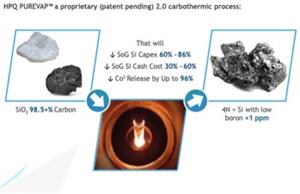
HPQ expects to confirm that PUREVAPTM and UMG processes will:
Reduce CAPEX to transform Quartz to SoG Si by between 60% (China) and 86% (“Rest of the World†or “ROWâ€) 1;
Reduce OPEX to transform Quartz to SoG Si by between 30% (China) and 60% (ROW)1;
Reduce the Carbon Footprint to transform Quartz to SoG Si by up to 96%2;
Investigate new opportunities for high value niche applications that need the High Purity Silicon Metal that our PUREVAPTM QRR produces in one step.
Q. Could you please briefly describe what started HPQ
interest in becoming a vertically Integrated Producer of Solar Grade
Silicon metal?
A. Well, the short answer is: “Necessity is the
Mother of Inventionâ€. The long answer is that in 2014 HPQ had a number
of gold properties that contained extensive quartz veins with which gold
is typically associated. Quartz (Silicon Dioxide or SiO2) is the key
ingredient required for making Silicon Metal (Si).
Silicon Metal (Si), is one of today’s key strategic metals, like
Lithium and Cobalt, that is needed to fulfil the renewable energy
revolution presently under way.
By early 2015, HPQ management came to the realization that in order
for HPQ to succeed in the Quartz business, HPQ needed to transform its
low value quartz resources into a higher value material, Silicon Metal,
and ultimately Solar Grade Silicon Metal (SoG Si), which is a higher
purity form of Silicon Metal that allows the transformation of the sun’s
energy into electricity in photovoltaic (PV) modules.
In short, we needed to find a pathway to become a vertically
integrated producer of Si, and preferably SoG Si. That is when we
discovered PyroGenesis.
Q. Ok, its one thing to say “HPQ wants to become a
vertically integrated producer of Solar Grade Silicon metal†but
implementing is another. Could you please describe what makes the HPQ
plan unique?
A. Certainly. From the start we knew that HPQ could
not afford the time or money required to assemble a world-class
technical team with Silicon Metal (Si) or Solar Grade Silicon Metal (SoG
Si) expertise. To reach our goal, our choices were either a)
collaborate with a university, knowing that it would take years just to
pass the proof of concept phase, or b) outsource our R&D with a
technological partner that possesses proven expertise with high
temperatures processes, and a track record of successfully taking new
concepts, from the lab to commercialization phase.
During 2015, HPQ concluded that to convert our Quartz into Si, and
possibly SoG Si, we needed to convince PyroGenesis Canada Inc
(“PyroGenesisâ€), with their vast expertise on high temperature plasma
base processes, to partner with us.
PyroGenesis has an impressive track record of successfully taking new
concepts from the lab to commercialization, including but not limited
to, the following:
The US Navy, developing the PAWDS™ technology from lab scale to
finally being specified in the design of the new US Aircraft Carriers,
Plasma atomization for 3D printing;
More recently with the deployment of their DROSRITE™ technology.
PyroGenesis expertise is of such high level that:
In addition to the US Navy, during the last 2 months, PyroGenesis
has concluded exclusive partnerships with two multi-billion
conglomerates to commercialize specific applications they have
developed, from lab to commercial scale, on a global basis.
In 2015, HPQ’s Board of Directors accepted a testing proposal from
PyroGenesis regarding laboratory scale, proof of concept, metallurgical
testing of the PUREVAPTM QRR. The proposed program was to
validate its capacity to produce high purity silicon metal from HPQ
quartz in just one step (September 30, 2015 release).
In June 2016, the first successful lab scale tests were completed and
by test #6, results confirmed the game changing potential of the PUREVAPTM QRR process.
HPQ immediately approached PyroGenesis regarding additional testing
and the development of a pathway to building a pilot plant that could
validate the commercial scalability of the process as quickly as
possible. As they say, the rest is history.
Q. What motivated HPQ to move so fast to validate the commercial scalability of the PUREVAPTM QRR process?
A. The decision was simple; the first bench test
showed all equipment and data analyzers worked. By test #6, not only
did the system operate as designed, but also the PUREVAPTM QRR
process was already reaching its first major milestones, the ability to
transform quartz into high purity Silicon Metal (Si) exceeding 99.9+% Si
“3N†(June 29, 2016 release).
HPQ and PyroGenesis came to an agreement whereby HPQ would invest
100% of project costs for 90% of the revenues to be generated by
PUREVAPTM QRR and, with that, HPQ obtained the participation of a world
class technical team to work on our project of becoming a vertically
Integrated producer of Solar Grade Silicon Metal (SoG Si).
Fundamentally, the agreement allows both Parties to reap the rewards of
the new process to make High Purity Silicon Metal (Si) and eventually
SoG Si using HPQ Quartz and the PyroGenesis PUREVAPTM QRR.
On August 2, 2016, PyroGenesis and HPQ announced the terms under which HPQ would invest the funds and own the PUREVAPTM QRR’s
Intellectual Property3 (August 2, 2016 release), with PyroGenesis
taking responsibility for the bench testing, process design,
fabrication, assembly, and cold commissioning of the Pilot Plant.
Q. In your press releases you refer to Gen 1 and Gen 2 can you please describe Gen 1 and the testing milestones?
A. As we outlined above, the project started in 2015
with PyroGenesis’ technical team designing and building a laboratory
scale proof of concept PUREVAPTM QRR, the Gen1 reactor.
The Gen1 PUREVAPTM QRR laboratory scale equipment completed
15 tests between March 29th and July 22th 2016 under the scope of the
“Phase 1 – Proof of Concept Metallurgical Tests Programâ€. These tests
confirmed that the PUREVAP™ QRR concept of combining different
known steps into a one step process works at lab scale. With this
milestone achieved, we then agreed to expand our collaboration to go all
the way to Pilot Plant.
In September 2016, while initial Pilot Plant design was underway, HPQ
also ordered a new series of lab scale R&D tests using the Gen1 PUREVAPTM QRR
to provide invaluable input toward the design of the pilot plant, as
well as, determine the most efficient way of scaling up the PUREVAPTM QRR process to commercial scale production.
In November 2016, another key milestones was reached as Gen1 testing
results demonstrated that the PUREVAP™ QRR was capable of using SiO2
feed material below minimum industry specifications to produce Silicon
Metal (Si) of greater purity than what could be achieved by traditional,
status quo processes used to make Metallurgical Grade (98.5% to 99.5% Si) Silicon Metal4 today.
By the end of January 2017, in tests using a modified and expanded
Gen1 PUREVAP™ QRR reactor, the yield increased from less than 0.1 g to
8.8 g (test #32), an increase of approximately 9,000% (roughly one
hundred-fold), thereby confirming the potential scalability of the
process.
Ongoing work to the end of Q2 2017 validated our systematic and
methodical approach to the project and allowed PyroGenesis to advance
the detailed engineering and design of the pilot plant.
By the end of Q2 2017, it was clear that the Gen1 PUREVAP™ QRR had
reached its maximum usefulness so the decision was made to build a Gen2
PUREVAP™ QRR, pushing the design envelope of the lab scale system to a
point that will allow it to be operated in a semi-batch mode to increase
Silicon Metal (Si) yields. This would provide further insight into
process improvements needed for the Pilot Plant, thereby saving millions
of dollars in future development work.
Q. Now during 2017 you announced an agreement with
Apollon Solar, can you diverge a bit and tell us how that came about,
and the impact?
A. In 2017, we attracted the attention of Apollon
Solar SAS, (“Apollonâ€). This is significant because Apollon is a private
French company with longstanding expertise in Silicon Purification and
Crystallisation, Solar Silicon, Photovoltaic Cells and Photovoltaic
Modules. The team at Apollon has become one of the world leaders in the
development of processes to refine Solar Grade Silicon Metal “SoG Si
UMGâ€. They achieved, an independently confirmed, world record
conversion efficiency of 21.1% with a monocrystalline ingot, for a solar
cell made with 100% “SoG Si UMGâ€.
Apollon first completed a technological audit of the Gen1 PUREVAP™
QRR results to evaluate the potential of the innovative PUREVAP™ QRR
process. They concluded that successful commercial scaling-up of the
PUREVAP™ process could lead to the production of solar quality silicon
at a significantly lower cost compared to those of competing process
technologies (examples include Siemens chemical process, Elkem Solar,
Silicor Materials, etc.).
As a result, in December 2017, HPQ and Apollon announced the signing
of a consultancy agreement whereby Apollon agreed to transfer knowledge
it has acquired in solar silicon over the last 20 years for the benefit
of HPQ and PyroGenesis.
Q. That’s all very exciting, now can you discuss Gen 2 and the commercial scalability of the PUREVAPTM QRR process?
A. The Gen2 PUREVAP™ QRR incorporates important
process modifications identified during Gen1 testing and is designed to
be a scale replica of the planned larger pilot plant (Gen3 PUREVAP™
QRR). In Q2 of 2017 we set about constructing the newly redesigned
reactor while awaiting the final report from the Gen1 work. In Q4, as
Gen2 was being finalized, HPQ received a final report on the Gen1
PUREVAP™ QRR testing and we learned that:
The highest silicon tested for bulk purity was produced in test #75 and measured 99.92% Silicon Metal (Si)5.
Si yield could be increased by increasing production yield, which had been constrained around an average of about 3% in Gen1.
Theoretical calculations indicated that purity of the Si produced
under various conditions could range from 3N (99.984 % Si) to 4N (99.996
% Si) with the addition of volatilization agents for low purity
feedstock, to over 4N (99.998 % Si) when using high purity feedstock5.
These results were incorporated into Gen2 and, by November 2017, the
Gen2 PUREVAP™ QRR was operational, allowing the de-facto start of the
pilot plant testing and commissioning, thereby reducing the risk profile
of the project and allowing additional process modifications and
further proof of commercial scalability work to be done in parallel with
major plant fabrication, to keep advancing work.
JANUARY 2018
PyroGenesis confirmed that the Gen2 PUREVAP™ QRR was operating as
designed and yielding results that were in line with expectations. By
this time, we had also arranged monthly meetings with Apollon and
PyroGenesis to benefit from the backend expertise of Apollon in our
ongoing test work as we continued to plan for the Gen3 Pilot Plant
design.
Gen2 PUREVAP™ demonstrated it could be operate and perform under the
conditions demanded for optimum operational parameters to produce the
purities required in one step. Again, this was another major milestone
because, to our knowledge, there is no other process that does this in
the world.
With the main design and equipment performance characteristics reached, significantly increasing the Yield6 and the Production Yield7 of the Gen2 PUREVAP™ became the next key objectives in contributing to final purity.
FEBRUARY 2018
By mid February 2018, the Gen2 PUREVAP™ was proving to be an
invaluable bench test platform and the results were used to scale back
on the size of the planned Pilot Plant from 200 tonnes per year to 50
tonnes per year. This had a massive benefit on our planned costs,
timing, and on locating the Pilot Plant test site – right inside the
PyroGenesis testing facility, another huge cost saver.
By the end of February 2018, the Gen2 reactor was operating within
the 90th percentile of its achievable production yield. By mid April
2018, as a direct result of continuous process improvements done by
PyroGenesis, Gen2 PUREVAP™ test #14 attained Yield and Production Yield
numbers that surpassed theoretical expectations. The total mass of
Silicon Metal (Si) produced (yield) during test 14 was 101.45 gr; and
conversion of material, referred to as Production Yield, of 34.3%, the
highest to date.
APRIL 2018
PyroGenesis completed a scheduled audit of the Gen2 PUREVAP™
equipment for wear and tear following test#14. The audit was needed to
help identify critical operational parameters for the PUREVAP™ Pilot
Plant and allowed the evaluation of additional design modifications that
could be implemented for further tests using the Gen2 PUREVAP™.
JULY 2018
By the end of July 2018, the Gen2 PUREVAP™ equipment had been
refurbished, re-assembled and modified to incorporate the latest design
modifications and was ready to start a new series of at least 8
additional tests focused on:
Continuing to optimize conditions for the Gen2 PUREVAP™ and the planned Gen3 PUREVAP™ Pilot Plant operation;
Increasing the Yield and the Production Yield;
Testing the Purity range of the Silicon Metal (Si) from low purity
feed stock (98.84% SiO2) and ultra high purity feed stock (> 99.9%
SiO2), analyzed using ICP-OES8;
Q. It sounds like Gen2 is giving great results and
contributing to the Pilot Plant final parameters. You mentioned CO2
(“Greenhouse Gas†or “GHGâ€) reductions as another positive feature of
the PUREVAP™ process can you elaborate on that?
A. Yes we are very excited about this aspect of the project. First, readers must understand that: “It’s
not because photovoltaic solar panels do not emit CO2 (GHG) while
producing electricity that solar energy is not a significant source of
GHGâ€.9 In fact solar power has its greenhouse gas issues that lurk
behind the scenes. Seventy percent (70%) of the GHG generated when
building a new solar farm10 comes from the production of the Solar Grade
Silicon Metal (SoG Si) needed for the fabrication of the solar panels.
Manufacturing SoG Si in China, the world’s largest producer,
generates an astounding 141 kg of CO2 per kg of SoG Si produced. In
Germany that ratio is reduced to 87.7 kg CO2 per kg of SoG Si produced.
What we see is that solar power is not that panacea of low carbon if one
looks at the entire process from start to finish.
96% REDUCTION IN CARBON FOOTPRINT – OPPORTUNITY TO RESOLVE SOLAR PARADOX
In August 2018, PyroGenesis prepared a report11 that found that the
PUREVAPtm QRR process operated in Quebec should only produce 5.4 kg CO2
per kg of SoG Si produced, a 96% reduction in the carbon footprint
compared to existing processes. This is why we are so excited about this
“green†opportunity revolutionizing the solar energy industry.
Q. Technically it sounds like great progress is being made, how is HPQ set financially today?
Thanks to these new financings HPQ, in collaboration with its
technical partners, will now be able to dedicate its efforts and
energies toward the fulfilment of the ambitious commercial validation of
the PUREVAPtmQRR process and the production of Solar Grade Silicon Metal (SoG Si) at the Pilot Plant level.
Q. Sounds like you have the financing under control. You
mentioned at the onset that HPQ and partners are targeting a Pilot
Plant, with bench test work well in hand and financing complete, can you
give a status update of the Pilot Plant that you are now referring to
as Gen3?
As of the date of this corporate update, the Gen2 PUREVAP™
equipment is still being used by PyroGenesis to test different
operational conditions in order to gain more information about future
Gen3 PUREVAP™ operation and testing is also ongoing to find new ways of increasing the Yield and the Production Yield of the Gen2 PUREVAP™.
Finally, a new progress report on the test results completed in 2018 with the Gen2 Purevap should be ready soon.
Q. How transferable are the results obtained from Gen2 to the pilot plant?
A. We believe they are very transferable. In fact,
we expect the results to be even better at larger scale. By increasing
the scale, we are increasing the production rate. As you can imagine, we
are already extremely excited about the results we have had with Gen2,
and at a larger scale, the production rate is automatically higher
which, as we have already proven with Gen1, should lead to a higher
conversion yield and better purity.
Q. HPQ has started talking about using a metallurgical process to transform the Si produced via the PUREVAPTM QRR to produce SoG Si. Is this just a semantic change or is HPQ changing its objectives?
A. It is more semantic than anything else; the
project is advancing towards meeting our stated objectives when we
started it in 2015:
“The “PUREVAP ™ Quartz Reduction Reactor is a proprietary process
that uses a plasma arc within a vacuum furnace. This unique technology
should allow HPQ (Uragold then) to convert its (…) Quartz Projects into
the highest purity, lowest cost supplier of Solar Grade Silicon Metal
(…) to the solar industry.
But this may be a good opportunity to explain in detail what makes the PUREVAPtm QRR such a game changing technology and why we have started to refer to it as a “Second Generation (2.0) Carbothermic processâ€.
Presently, using the status quo to produce Solar Grade Silicon Metal
(SoG Si), you first need to transform Quartz (Silicon Dioxide or SiO2)
into Metallurgical Grade Silicon Metal (MG Si) and then the MG Si needs
to be further purified produce SoG Si.
PRESENT LEGACY CARBOTHERMIC PROCESS
The first step in making SoG Si involves mixing Pure Quartz (99.5%+
SiO2), Low Ash Carbon and Wood Chips and heating the mixture to very
high temperatures in an electric arc furnace to create the Carbothermic
process required to reduce the SiO2 to Metallurgical Grade Silicon Metal
(MG Si).
The traditional smelter process to make MG Si requires six (6) tonnes
of raw material to produce one (1) Tonne of Silicon Metal (Si).
By its design, the impurities contained in the raw material end up
being concentrated in the final product, that is why traditional
smelters need (99.5%+ SiO2) to produce 98.0% Si.
The maximum purity that can be attained in traditional smelters is
around the 99.5% Si threshold, but that requires additional post
treatments. On average these postproduction processes can increase the
purity of the MG Si by a factor ranging from ½ N to 1 N.
For Silicon Metal (Si) to be used in the Solar and High Tech
Industries, higher purity levels than what can be attained by standard
carbothermic reduction are required. Presently, less then twenty
percent (20%) of MG SI produced by smelter meets the demanding feedstock
purity specs required for the different additional purifications steps.
CHEMICAL DISTILLATIONS PROCESS (Siemens)
Chemical distillations process (Siemens process) to purify MG Si to
purity required for Solar Grade applications or electronic applications
has become the gold standard, with over 95% of the world SoG Si produced
through chemical distillations, even with it negative environmental
footprint.
Producing SoG Si (Polysilicon) via chemical distillations requires
between 72,000 KWh/T up to 120,000 kWh/t and as the term clearly
indicates chemical distillation implies that further refinement involves
the use of harsh chemicals like hydrochloric acid, and the final
products include liquid silicon tetrachloride and polysilicon. Each ton
of polysilicon is manufactured at the cost of three to four tons of
these hazardous by-products. When silicon tetrachloride is exposed to
water it releases hydrochloric acid, which causes acidification of soil
as well as the emission of toxic fumes.12
For many years, companies have been searching and investing funds
looking for a metallurgical alternative to Chemical distillations
process to transform MG Si into SoG Si.
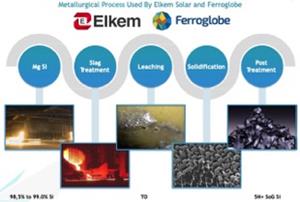
Two groups, Elkem and Ferroglobe have been able to demonstrate, at
commercial scale, the technical viability of using metallurgical process
to further purify what is essentially 2N MG Si (99.0% Si) into a 5N+
SoG Si (UMG) that can be used to produce solar cells that deliver
efficiencies and yield ratios which compare very favourably with
photovoltaic industry benchmarks.13
The main advantage of a metallurgical process is the low operational
cost, (for each individual step and total) combined with lower energy
consumption for producing the UMG SoG Si (35,000 kWh/t versus a minimum
of 72,000 KWh/t).
The biggest drawback of this process and the reason why, until now,
it has not become the industry standard is that the CAPEX cost
associated with every operational step (Slag Treatment, Leaching,
Solidification and Post Treatment) are high, due to size and capacity
needed to purify what is essentially 2N MG Si (99.0% Si) into a 5N+ SoG
Si (UMG).
The fact that the operational cost saving are marginal on relative
term while the CAPEX (Cost per kg of annual capacity matrix) associated
with a complete metallurgical process to make UMG SoG Si is equivalent
to the CAPEX (Cost per kg of annual capacity matrix) of building a
chemical distillation process (Siemens) plant, is the only reason why
metallurgical processes to make UMG SoG Si have not become mainstream in
the industry.
Q. Now that is all very interesting, but if big companies
like Elkem and Ferroglobe have not been able to make metallurgical
processes work, why should we believe that HPQ with it’s PUREVAPTM QRR can?
A. It really comes down to big corporate culture.
Our approach to the problem is disruptive; we are not looking at
tweaking existing process to transform Quartz (Silicon Dioxide or SiO2)
to Metallurgical Grade Silicon Metal (MG Si) or developing a new process
that will be more efficient at removing the impurities from MG Si to
produce Solar Grade Silicon Metal (SoG Si). We are looking for a new
pathway of reducing Quartz (Silicon Dioxide or SiO2) to Solar Grade
Silicon Metal (SoG Si) by developing the PUREVAP™ QRR a “Second Generation (2.0) Carbothermic processâ€.
Imagine a young engineer walking into a meeting and telling his
bosses that the billions of dollars invested in the technology assets of
the company should be scrapped for a brand new concept. Those bosses
grew up, as it were, on the existing technology. There is no way that
is going to happen, so big corporations spend all their effort tweaking
the existing process.
It takes an upstart that is unencumbered with this corporate culture
to bring about change. Examples include Microsoft with IBM, Tesla and
GM, as simple examples of this concept.
This is what we are working on accomplishing and we believe that the PUREVAPtm QRR is that game changing disruptive technology for Solar Grade Silicon Metal.
Q. Ok, its one thing to say: the PUREVAPTM QRR is a game changing disruptive technology, but why and more important when will HPQ be in a position to demonstratethat the project is truly advancing toward that tipping point?
A. We, HPQ and technical partners PyroGenesis and Apollon Solar, have identified the following reasons why the PUREVAPtm QRR process will become the game-changing technology that could revolutionize the solar energy industry:
Using metallurgical process to purify 2N MG Si (99.0% Si) into a 5N+ SoG Si (UMG) is technically feasible;
The costs (CAPEX and OPEX) of removing, with metallurgical
processes, multiple N of impurities from MG Si to produce 5N+ SoG Si
(UMG) are prohibitive and make these process not financially feasible at
present;
Increasing by one (1) or better yet two (2) N the purity of the
Silicon Metal (Si) produced during the carbothermic phase of converting
Quartz (Silicon Dioxide or SiO2) to Si, for the same (CAPEX and OPEX)
costs as traditional smelters incur to produce 2N MG Si (99.0% Si),
should generate significant reductions of (CAPEX and OPEX) costs to make
UMG SoG Si;
This is what our Gen1 PUREVAPtm QRR results indicated should happen at commercial scale, and that is what the Gen3 PUREVAPtm QRR was built to demonstrate at commercial scale.
So, during 2019, as the Gen3 PUREVAPtm QRR pilot plant
confirms the key working hypothesis of the November 2017 Gen1 based
theoretical calculations is working at commercial scale, is when we expect to start receiving inquires from players in Silicon Metal and Solar Grade Silicon Metal industries.
If we can demonstrate a capacity to produce, in one step, a Silicon
Metal (Si) with a purity that range from 3N+ to 4N+ from low purity
Quartz (Silicon Dioxide or SiO2) feedstock, interest may also come from
Solar players, since we would be starting to validate our claim that our
PUREVAPtm QRR and UMG process will be the cheapest and greenest way to produce SoG SI in the world.
This does not mean that they are not looking at what we are doing,
“au contraireâ€â€¦ But presently, we are attracting mostly interest from
industry participants that have invested significant funds developing
Quartz resources looking for ways of increasing the economic model of
their projects.
Finally, shareholders and prospective investors would be wrong to
assume that nothing will happen until then. As stated above, the Gen2
PUREVAP™ equipment is still being used to test different operational
conditions in order to gain more information about future Gen3 PUREVAP™
operations and testing, to find new ways of increasing the Yield and the
Production Yield of the Gen2 PUREVAP™.
A new progress report on the test results completed in 2018 with the Gen2 Purevap should be ready soon.
Q. With Solar Energy Prices now at Parity with Natural Gas and Coal, is there still a need for a new process like thePUREVAPTM (QRR)?
A. Yes, actually more than ever, as the size and
speed of future investment in renewables energy is dependent on an
ever-declining cost per watt model going forward, while the GHG concerns
are becoming more challenging to governments and industry.
Over the last 40 years, solar energy innovations, financed mostly by
government incentives, have allowed solar energy prices to reach parity
with most fossil fuels today14. While this type of approach has
generated phenomenal success regarding the cost per watt matrix, this
approach is also responsible for phenomenal long term and short term
market dislocation.
One of the most important dislocations is related to the costs (CAPEX
and OPEX) of making Solar Grade Silicon Metal (SoG Si). Process
improvements for making SoG Si have plateaued while returns for
producing SoG Si are vanishing for investors, making financing of new
high purity silicon capacity using old processes to turn MG Si into SoG
Si difficult. HPQ solves this problem.
As figures 5 and 6 demonstrates, without new processes (like the
PUREVAPTM QRR) that can bring about a new leg down in the cost (CAPEX
and OPEX) of making SoG Si, this situation will either lead to
production bottlenecks and potential shortage of SoG Si to meet demand.
As with all commodities, this will result in a surge in the price of
silicon, causing an unexpected increase in the price of solar energy.
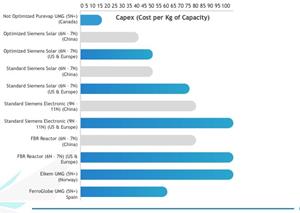
CAPEX reduction as it pertains to the cost of making SoG Si have
plateaued around the US $35 Cost per Kg of annual Capacity in China and
US$ 50 Cost per Kg of annual Capacity in the Rest of the World.
Figure 5 clearly demonstrates the disruptive Capex potential (US$) of the PUREVAPTM QRR process.
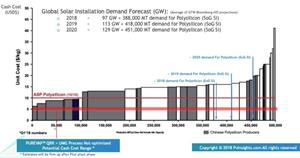
Figure 6 for its part demonstrates that, even in 2018, the cost curve
for SoG SI suggests that reductions in the OPEX costs had now plateaued
and that a longâ€term SoG Si price below USD 14/Kg is simply not
feasible. It is clear that to break this plateau, new processes like
the PUREVAPTM QRR will need to reach commercial viability.
Q. According to a specialized publication15, Solar Grade Silicon Metal (SoG Si) consumption should decline to 3g/W by 2022, from 4g/W in 2018, how will this new reality affect HPQ Business Model?
A. My answer may sound counter intuitive, but HPQ sees this as a
positive factor for our PUREVAPTM QRR + UMG project going forward. The
effect of the decline will negatively impact mainly the highest cost
producer, but a new process that can cut CAPEX and OPEX costs as much as
our PUREVAPTM QRR + UMG project appears to be on the threshold of
doing, will definitively benefit the entire industry and future
consumers, possibly leading to the breakout needed to catapult solar
energy ahead of carbon based energy for future generations.
What is important to realize is that demand for SoG Si is a
combination of demand for each new GW of solar energy for the consumer
and the SoG Si consumption needed to produce that new GW.
What is also shown in Figure 6 is the demand need for increased
amounts of SoG Si required to meet the demand growth for solar energy:
2018 was projected at 97 GW @ 4.0 g per W; ≈ 388,000 MT of SoG Si demand;
2019 was projected at 113 GW @ 3.7 g per W; ≈ 418,000 MT of SoG Si demand;
2020 was projected at 129 GW @ 3.5 g per W; ≈ 451,000 MT of SoG Si demand.
Future demand projections for solar energy is such that even at 3.5 g
thresholds, demand for SoG Si in 2020 should exceed the 451,000 MT
mark, and that can be directly related to the fact that Solar Energy
demand grows from its present two percent (2%) market share of the
global electricity generation capacity to the ten percent (10%)
threshold anticipated by 203016.
This translates into a demand in US$ for SoG Si that will grow from US$ 7.1 B in 2018 to over the US$ 11.8 B mark by 202817.
Q. An often-asked question is, how comfortable are you with the patent application?
A. The short answer is: very comfortable. PyroGenesis is leading the
patent application, which is progressing as expected. Given PyroGenesis
vast experience in obtaining patents and their $1,950,000 investment in
HPQ at a premium in August, this question should be put to rest once
and for all.
Q. Some investors/shareholders are skeptical about the whole process. Do you have any comments?
A. Well, they should meet the engineers! Now there is a skeptical
bunch and that is natural with any new process as groundbreaking as
this. Every step of the way has brought its share of challenges but has
also brought about many more positive surprises and developments. This
is the immense competitive advantage HPQ has as a result of bringing
together the engineering brainpower of PyroGenesis and Apollon Solar.
Seriously, we are talking about a process that potentially could be game
changing by several magnitudes. Who wouldn’t be skeptical? You would
have to be a fool not to be. Adding to this is the fact that the
results to date are beyond our expectations, which, in a weird way,
fuels the “too good to be true†skepticism, no? On the other hand, how
many chances do you get to invest into such potential, at 6 cents a
share and market cap of CAD$13 million, when our strategic partner and
the Government have invested CAD$5,250,00 at a Company valuation of
CAD$26 million? Food for thought!
Q. What about the quartz properties? The last we heard about
quartz exploration was in Q4 2017 when you announced a drilling
campaign on the Ronceveaux?
A. We are still fully invested in our 100% owned Martinville and
Ronceveaux quartz properties. However we decided to hold off on quartz
exploration to allocate exploration funds for geophysics and geology
work on the Beauce Gold property.
Now that the spin-off of Beauce Gold Fields is done, we intend to go
back to Martinville and Ronceveaux properties to bulk sample quartz as
test feed for the Gen3 PUREVAP reactor. For the next twelve (12) to
twenty-four (24) mounts our need in Quartz as feedstock is limited to
about 150 MT for 2019-2020.
Q. Ok so you have talk a lot about your plans for the solar
market but in your first answer you mentioned silicon for batteries,
what is that about?
A. From phones to electric cars, batteries play important role for
just about everyone on earth, and Si usage in the batteries space is
increasing. The most promising new type of battery being developed
presently is Lithium Silicon Anode Batteries (Li-Si
Batteries). Researchers have found that by replacing the graphite with
silicon in a standard lithium battery, your drastically improve
performance. Anyone who owns a mobile phone or for that matter, an
electric car, wishes that the battery would charge faster and last
longer.
For everybody involved in this project it has given an appreciation
of silicon metal, and some surprises have included opportunities that
may have an impact on the lithium ion battery industry. We will not
retire the Gen2 reactor as we did Gen1 but we will use it to pursue some
of the interesting ‘accidental outcomes’ from our efforts to develop a
new pathway to make clean energy cleaner and more cost efficient.
Q. Conclusion?
A. There is no other way to say it, our belief that PUREVAP™ process
is going to become a game-changing event that has the potential to
revolutionize the solar energy industry has not waned one bit since we
made our first bold statements in 2015. The project is advancing, the
success we have attained in less than 3 years is spectacular and the
de-risking that has occurred with every successful phase is significant.
In short, all three partners are happy with the progress to date and
stand firmly behind the project. We are more convinced than ever that
we will be successful in having a commercially viable process at the end
of the 2019. Investors need to remember that we are just at the start
of this process and that we have more exciting developments moving
forward then what we have already accomplished to this point. The future
of HPQ is very bright – no pun intended.
This News Release is available on the company’s CEO Verified Discussion Forum, a moderated social media platform that enables civilized discussion and Q&A between Management and Shareholders.
About HPQ Silicon
HPQ Silicon Resources Inc. is a TSX-V listed resource company
planning to become a vertically integrated and diversified High Purity,
Solar Grade Silicon Metal (SoG Si) producer and a manufacturer of multi
and monocrystalline solar cells of the P and N types, required for
production of high performance photovoltaic conversion.
HPQ’s goal is to develop, in collaboration with industry leaders,
PyroGenesis (TSX-V: PYR) and Apollon Solar, that are experts in their
fields of interest, the innovative PUREVAPTM “Quartz Reduction Reactors
(QRR)â€, a truly 2.0 Carbothermic process (patent pending), which will
permit the transformation and purification of quartz (SiO2) into high
purity silicon metal (Si) in one step and reduce by a factor of at least
two-thirds (2/3) the costs associated with the transformation of quartz
(SiO2) into SoG Si. The pilot plant equipment that will validate the
commercial potential of the process is on schedule to start mid-2019.
Disclaimers:
This press release contains certain forward-looking statements,
including, without limitation, statements containing the words “may”,
“plan”, “will”, “estimate”, “continue”, “anticipate”, “intend”,
“expect”, “in the process” and other similar expressions which
constitute “forward-looking information” within the meaning of
applicable securities laws. Forward-looking statements reflect the
Company’s current expectation and assumptions, and are subject to a
number of risks and uncertainties that could cause actual results to
differ materially from those anticipated. These forward-looking
statements involve risks and uncertainties including, but not limited
to, our expectations regarding the acceptance of our products by the
market, our strategy to develop new products and enhance the
capabilities of existing products, our strategy with respect to research
and development, the impact of competitive products and pricing, new
product development, and uncertainties related to the regulatory
approval process. Such statements reflect the current views of the
Company with respect to future events and are subject to certain risks
and uncertainties and other risks detailed from time-to-time in the
Company’s on-going filings with the securities regulatory authorities,
which filings can be found at www.sedar.com. Actual results, events, and
performance may differ materially. Readers are cautioned not to place
undue reliance on these forward-looking statements. The Company
undertakes no obligation to publicly update or revise any
forward-looking statements either as a result of new information, future
events or otherwise, except as required by applicable securities laws.
Neither the TSX Venture Exchange nor its Regulation Services
Provider (as that term is defined in the policies of the TSX Venture
Exchange) accepts responsibility for the adequacy or accuracy of this
release.
For further information contact
Bernard J. Tourillon, Chairman and CEO Tel (514) 907-1011 Patrick Levasseur, President and COO Tel: (514) 262-9239 www.HPQSilicon.com
Shares outstanding: 222,284,053
1 PyroGenesis Budgetary cost number for a 2,5K TPA Purevap, Apollon Rough Order of Magnitude Costing for a 2,5K UMG process 2 PyroGenesis Canada Inc. Technical Memo: “TM-2016-707 REV 01, (July 2018),- Purevap system – Carbon Footprint study 3
PyroGenesis retains a royalty-free, exclusive, irrevocable worldwide
license to use the process for purposes other than the production of
silicon metal from quartz. Should PyroGenesis develop any other such
application, HPQ Silicon shall have a right of first refusal in the
event of any sale or otherwise disposal. 4 http://pyrometallurgy.co.za/Pyro2011/Papers/083-Xakalashe.pdf5 PyroGenesis Canada Inc. Technical Memo: “TM-2017-830 REV 00, – Final Report-Silicon Metal Purity Enhancement 6 Total mass of Si produced during one test 7 Production Yield is the conversion efficiency of Quartz into Silicon Metal of the process 8 Inductive coupled plasma optical emission spectrometry 9 https://www.economist.com/news/science-and-technology/21711301-new-paper-may-have-answer-how-clean-solar-power10 Assessing the lifecycle greenhouse gas emissions from solar PV and wind energy: A critical meta-survey, Energy Policy , February 2014, Pages 229-244 11 PyroGenesis report – Silicon SoG Carbon Footprint TM-2016-708, revision #2 12 https://www.azocleantech.com/article.aspx?ArticleID=831 13 Ferroglobe PLC, Aug. 14, 2018 release. 14 http://news.mit.edu/2018/explaining-dropping-solar-cost-1120 15 https://www.pv-tech.org/editors-blog/china-531-to-accelerate-demise-of-multi-polysilicon-consumption-decline-to 16 (Canadian Solar latest investor presentation) 17
(Deutsche Bank, Future Market Insights report titled, “Polysilicon
Market: Global Industry Analysis 2013-2017 and Opportunity Assessment
2018-2028”)
Figure 1 – Quartz to MG Si process
Figure 1 – Quartz to MG Si process
Figure 2 – Chemical Process (Mg SI to SoG)
Figure 2 – Chemical Process (Mg SI to SoG)
Figure 3 Metallurgical Process (MG si to SoG Si)
Figure 3 Metallurgical Process (MG si to SoG Si)
Figure 4 PUREVAP
Figure 4 PUREVAP
Figure 5 CAPEX analysis (US$ Cost per Kg of annual Capacity)
Figure 5 CAPEX analysis (US$ Cost per Kg of annual Capacity)
Posted by AGORACOM
at 9:23 AM on Thursday, January 24th, 2019
Launching Graphene Ultra Fuel Efficient Tires (GUET) toward the end of summer 2019
Gratomic certification and terrain testing targeted for completion in Q3, 2019
Gratomic anticipates GUET to be the first range of Graphene-enabled ultra fuel-efficient tires
Gratomic will now target mass market sales demand via Graphene Ultra Fuel Efficient Tires (GUET)
About Gratomic Inc.
Gratomic
is an advanced material company focused on mine to market
commercialization of graphite products, most notably high-value
graphene-based components for a range of mass market products.
FULL DISCLOSURE: Gratomic is an advertising client of AGORA Internet Relations Corp.
Posted by AGORACOM
at 9:22 AM on Thursday, January 24th, 2019
Dr. Xiang-Qun (Sean) Xie has joined its Scientific Advisory Board
Dr. Xie has over 30 years of experience in the fields of Genomics, Cancer Research
Has multiple patents that have been licensed to BioTech and Pharmaceutical companies
LOS ANGELES, Jan. 24, 2019 (GLOBE
NEWSWIRE) — Applied BioSciences Corp. (OTCQB: APPB), a diversified
cannabinoid therapeutics company focused on the medical, bioceutical and
pet health industries, announced that Dr. Xiang-Qun (Sean) Xie has
joined its Scientific Advisory Board. Dr. Xie has over 30 years of
experience in the fields of Genomics, Cancer Research and has multiple
patents that have been licensed to BioTech and Pharmaceutical
companies.
Although the health benefits of Cannabis and CBD are becoming well known, one of the challenges is the research and development of products for both the consumer, adult-use and pharmaceutical market. Many universities and doctors have been unable to research and access scientific data on the molecules and effect of phytocannabinoids.
The company continues to add professionals who are expert in relevant fields, such as scientific research and development, FDA procedures and medicine. These professionals will provide the company with an outstanding base of knowledge and experience to build on and advance the development of additional products. With the addition of several prominent scientists and physicians and their knowledge base, clinical trials, product development, and design procedures for submitting products to the FDA can be done in an expedited time frame.
Dr Xiang-Qun (Sean) Xie is an Associate Dean
for Research Innovation at the School of Pharmacy and a Professor of
Pharmaceutical Sciences/Drug Discovery Institute, and a PI of an
integrated Medicinal Chemistry Biology laboratory of CompuGroup,
BioGroup and ChemGroup at the University of Pittsburgh. He is a member
of the Science Advisory Board to the US Food and Drug Administration
(FDA). He is a Founding Director of Computational Chemical Genomics
Screening Center, and a Director/PI of NIH National Center of Excellence
for CDAR. He holds joint positions at Dept of Computational Biology and
Dept of Structural Biology, and Pitt Cancer Institute MT/DD Program. He
is an Editorial Advisory Board member for the AAPS Journal and American
Journal.
“I have been impressed with the Applied BioSciences team
and their experience in the Cannabis and CBD space and use of
analytical science and best practices of testing in the manufacturing of
products. I look forward to bringing my own background in research and
development of compounds, patents to help further commercialize
products that help to treat and provide the natural healing and
properties of both Cannabis and CBD,†commented Dr Xie.
“Applied
BioSciences continues to develop, produce and commercialize products for
the consumer, medical and the over-the-counter market to treat
ailments, as well as for general health and wellness. Research and
scientific formulation are at the heart of everything we do. As the
company continues to expand our product lines, it is important to expand
our scientific and research development pipeline and partner with
leaders in the space. We will now be able to expand the addressable
market of our products and focus on additional scientific research,
clinical data and patents to expand our product portfolio,†commented
Chris Bridges, President of Applied BioSciences Corp.
Applied
BioSciences products use base ingredients that are USDA Organic and
non-GMO. Offering Vegan, sugar-free, 99% Pure CBD Isolate infused. The
products are formulated with CBD extracted from pesticide-free,
organically grown, domestically produced, High-CBD Industrial Hemp.
Lab-tested and guaranteed Pesticide and Chemical-free. Our proprietary
blends also contain USDA certified organic botanicals, herbals and
essential oils to provide synergy with other healing elements found in
nature.
About Applied BioSciences Corp. Applied BioSciences Corp. (www.appliedbiocorp.com),
is a diversified company focused on multiple areas of the medical,
bioceutical and pet health industry. As a leading company in the CBD and
Pet health space, the company is currently shipping to the majority of
US states as well as to 5 International countries. The company is
focused on select investment, consumer brands, and partnership
opportunities in the recreational, health and wellness, nutraceutical,
and media industries.
About Trace Analytics Inc. Trace
Analytics Inc. is a leading cannabis science and technology company
with significant footprints in lab testing, research and development and
licensing. Trace Analytics was started by a group of scientists who
specialized in analytical chemistry, genetics and molecular biology.
The focus of the team is to ensure compliance with public safety
standards and end user safety. Trace Analytics is in the process of
expanding throughout the United States, and globally. With the goal of
helping the rest of the world adopt “best practices” in cannabis and
hemp testing, the company also provides expert consulting services to
legislators and regulators in many countries, states and municipalities
around the world. For more information, please visit:
http://traceanalytics.com
Posted by AGORACOM-JC
at 8:30 AM on Thursday, January 24th, 2019
[New York, NY – January 24, 2019] – Following the huge success of the first KoreSummit, in New York this
past October, KoreConX is now taking the event to the sunny shores of Miami,
Florida, in an expanded version.
“The first
KoreSummit was a half-day event and our guests wanted more. So now we are
making it a full-day event, bringing in more experts and covering more topics.
This is an invite-only educational summit for entrepreneurs, CEOs, CFO, lawyers, marketers, investors, VC, Family
office, shareholders, and advisors to learn more about tokenizing securities,â€
said Oscar Jofre, Co-Founder & CEO at KoreConX.
The goal of the
KoreSummit is to provide much-needed education about all things related to
tokenizing securities, including (among others): details of what tokenization
entails, legal and compliance aspects, marketing a Securities Token Offering
“STOâ€, investor relations post fundraise, highlights of the role of regulated
issuance platforms and secondary market trading.
“Tokenized
securities will completely transform the way we do business in 2019 and beyond.
While these new technologies can bring much-needed security, compliance and
most important efficiencies to the private capital markets, there is still a
lot of confusion surrounding these terms,†said Kiran Garimella, Chief
Scientist & CTO at KoreConX. “This is why we created the KoreSummit, so business
leaders can learn about what is to come, and take full advantage of all the
benefits that tokenization has to offer.â€
The global
securities marketplace is changing, and the future is tokenization. Combining
corporate and securities law with tokenization facilitates efficient liquidity
and fully-compliant transactions in multiple jurisdictions.
“We have come a
long way since the creation of the JOBS Act in 2012. We now have the necessary
conditions for every company to tokenize their securities and completely
transform their relationship with the capital markets,†said Jason Futko,
Co-Founder & CFO at KoreConX. “But it is also important for people to
understand the legal responsibilities that come along with tokenization. And
that’s our main goal with the KoreSummit Tour: to educate the public.â€
The keynote,
fireside chats will take place in the main hall, while workshops about topics
such as the legal requirements for tokenization, will take place in smaller
breakout rooms. The event will start at 8:30 am and will end at 5:00 pm
followed by a cocktail hour. Breakfast, lunch and the evening cocktails are
included for the convenience of the attendees.
For more
information about the KoreSummit Tour and the Miami agenda, visit the KoreSummit website.
About KoreConX
KoreConX is the world’s first highly-secure
permissioned blockchain ecosystem for fully-compliant tokenized securities
worldwide.
To ensure compliance with securities
regulation and corporate law, the KoreConX all-in-one, AI-based blockchain
platform manages the full lifecycle of tokenized securities including the
issuance, trading, clearing, settlement, management, reporting, corporate
actions, and custodianship. KoreConX connects companies to the capital markets
and secondary markets facilitating access to capital and liquidity for private
investors.
KoreConX is the first secure, all-in-one
platform for private companies to manage their capital market activity and
stakeholder communications. Removing the burden of fragmented systems and
inefficient tools across multiple vendors, KoreConX offers a single environment
to connect companies, investors and broker/dealers. Leveraged for investor
relations and fundraising, private companies can share and manage corporate
records and investments including portfolio management, capitalization table
management, virtual minute book, security registers, transfer agent services
and virtual deal rooms for raising capital.