Agoracom Blog Home

Archive for the ‘All Recent Posts’ Category

A Prime Setup for Buying Power to Rush into #Gold Investment $AMK.ca $EXS.ca $GGX.ca $GR.ca $GZD.ca $MQR.ca

Posted by AGORACOM-JC at 12:11 PM on Wednesday, May 2nd, 2018

  • All signs point to gold investment
  • The safe haven metal took a hit as bond rates jumped in the fourth-quarter of 2016, but has been trending higher despite the rise in real interest rates
  • Gold bulls should take note of how gold prices have behaved in relation to long-term treasury bonds because they appear to be behaving differently than they have in the past

A Prime Setup for Buying Power to Rush into Gold Investment

All signs point to gold investment. The safe haven metal took a hit as bond rates jumped in the fourth-quarter of 2016, but has been trending higher despite the rise in real interest rates. Gold bulls should take note of how gold prices have behaved in relation to long-term treasury bonds because they appear to be behaving differently than they have in the past.

“U.S. inflation breakeven rates have been rising in tandem with oil prices, and gold tends to have a tight positive correlation with moves in inflation expectations.”

After the Great Financial Crisis, the two big exceptions were in the lead-up to the Brexit vote and in the aftermath of President Donald Trump’s election. In the former case, gold rose even as inflation expectations declined with bond yields; in the latter case, the opposite occurred. Here are two charts from TS Lombard, one shows gold decoupling from the 10-year TIPS yield and the other shows how gold tracking the yield curve:

Gold’s outlook looks rosy. The precious metal should benefit from late-cycle dynamics, which tend to favor real assets over stocks. A weaker dollar could help too and Venetis said what appears to be in the works today is the opposite of what happened following the 2013 taper tantrum:

“Back then, the currencies of current account-deficit emerging markets came under pressure as the dollar strengthened from a low point, deflationary headwinds spread and commodity prices suffered. Now, the currencies of large current account-surplus developed markets are appreciating as the dollar retreats from lofty levels, inflation picks up speed and commodity prices increase.”

He isn’t the only one bullish on gold. The commodity team at Goldman Sachs is betting that rising emerging-market wealth combined with geopolitical and trade war concerns will push haven prices higher.

Based on gold supply and demand dynamics, RBC Capital Markets’ gold analyst Christopher Louneyforecasts an average price of $1,307 per ounce for gold for 2018. “Each time gold has touched the higher end of the range [this year] it hasn’t been able to cling to that level for very long,” he wrote last week. “The question remains, how sustainable is this level?”

Maybe not that sustainable given the drop today. Or maybe this is merely a golden window of opportunity to buy. – Crystal Kim

Prefer gold investment now, or keep chasing momentum later?

You need to own gold – and you need to own shares in companies that find and mine it. I lay out seven reasons below, in what I’m calling the “Seven Pillars of Gold.”

Each “pillar” reinforces the argument for holding gold.

There’s some overlap between each of the pillars. In fact, it’s fair to say that many of the reasons to own gold actually segue back and forth, bumping into each other. But it’s possible to lay out seven distinct ideas. Here they are:

Pillar One: Oil prices are rising. Doubtless, you’ve noticed it if you’ve filled the fuel tank in your car with gasoline in the past nine months. From 2015 to late 2017, we enjoyed a three year respite from the olden days of $100 oil; but now, oil has decided to get up off the mat.

From a price in the $40 range a mere six months ago, we’re now into the $70s per barrel and higher prices are forecast. Of course, oil means energy, which means that higher oil costs will translate into higher prices for just about everything, not just at the fuel pump.

More costly energy will be a core component of inflation throughout the economy. That is, it will cost more to drive your car, for farmers to grow food, truckers to transport that food, businesses to buy supplies ranging from paint to roofing shingles.

That, and it will cost more to move all the other goods that support the economy. Indeed, energy-based inflation will eventually work its way all through the economy.

Rising energy costs are a type of inflation that we saw in the mid-2000s, during the previous runup to oil at over $130 per barrel in 2008. Then though, energy costs were squashed by “importing deflation” from low-priced overseas goods. But that trick has played out.

Americans haven’t experienced gut-ripping energy-based inflation in perhaps two generations, since the late 1970s and early 1980s. But when higher oil prices really pull into port, the ripple effect of inflation across every part of the economy will weaken the dollar’s purchasing power. We’ll see it in higher gold prices.

Pillar Two: Interest rates are rising. According to the Congressional Budget Office (CBO), interest on the national debt is among the fastest growing parts of the federal budget. In fact, by 2028 – just 10 years from now – the federal budget will spend more on interest payments (about one trillion dollars per year) than on defense (currently about $800 billion total).

Rising interest rates will crowd out most everything else in the federal budget, from defense to air traffic control to national parks. The budget money just won’t be there, because so much will go to pay interest. The only workarounds for Congress are less spending (ha!) or just open the spigots and roll with higher annual budget deficits.

Any way you cut it, the dollar – and the Federal Reserve’s unique powers of “money creation” – will surely be in play to wallpaper this mess. Again, we’ll see reduced purchasing power and higher gold prices.

Pillar Three: The petro-yuan. China has begun trading for oil in yuan, recently launching its so-called “petro-yuan.” Here’s the facts.

China is working hard to abandon the dollar as an instrument with which to pay for oil. It’ll use its own currency, the yuan, where and when possible. Currently, China’s petro-yuan contracts are what are called “long-dated,” meaning they commence in September 2018. (Four months is “long” if you’re trading.) In this respect, the Chinese are taking things slowly at first; no surprises.

China’s ultimate goal is to convince Saudi Arabia – one of China’s top-three oil suppliers – to take yuan in exchange for oil, and thus to abandon the 45-year link of Saudi oil to the petro-dollar.

If the globally dollarized oil trade takes a hit, it means many more bad things for the purchasing power of those “dead presidents” in your wallet or bank account.

Here’s the good news in all this. If you understand the implications, you are already several months ahead of the broad market on this. You have time to buy in on gold and miners. The entire setup is overall favorable for gold.

Pillar Four: Currency Wars. We’re already in the midst of “Currency Wars,” along the lines of what my colleague Jim Rickards discussed in his 2010 book of that title.

These types of monetary competitions are built around the very real understanding that nuclear armed nations cannot afford to fight old-fashioned, kinetic wars with each other. No battleships and bombers; but large, powerful nations can still play other games; such as cyber war and attacks on the other nation’s currency.

The currency war idea is ripe to hatch in the sense that Russia and China (among others) have accumulated immense amounts of gold over the past decade or so. Russia, in particular, is quite transparent about its national gold reserves, and Russian spokespeople make no secret that the gold is intended as a defense against dollar hegemony.

One of Jim’s theses in Currency Wars is that Russia and China could team up to combine their respective gold resources, and create a rival currency to the dollar. If the world trading system has an alternative to the dollar, it’s hard to imagine that the scenario would favor the U.S. dollar. Usage would likely decline to some level from decades past.

In other words, the dollar has had a runup in its percentage of world trade over the past 45 years. Looking ahead, if the dollar loses even some of its status as the world’s “reserve currency,” we should definitely expect to see its value decline and gold prices to increase.

Pillar Five: Tariffs, sanctions and potential trade wars. With global trade, it’s fair to say that everything is related to everything else. Lay a higher tariff on Chinese steel, and China taxes U.S. soybeans. Ban exports of high tech chips to China, and China might ban exports of rare earth magnetic powders to the U.S.

The “era of dollar supremacy is fast ending.

We no longer live in a unipolar, post-Cold War world in which the U.S. reigns supreme.” Indeed, to a large degree, the U.S. owes its current global economic and political dominance to a unique, near-accidental correlation of forces at the end of World War II in 1945. It’s a long story.

The short version is that the most destructive war in human history created the greatest economic engine that the world has ever seen. Post war, the U.S. was like the proverbial Phoenix, rising out of the ashes. It’s a massive, complex historical process, of course; but the point to keep in mind is that the post-war world – certainly that world for the U.S. – is coming to the end of its long, 73-year run.

Other nations, and even entire regions of the rest of the world, are rising; new phoenixes from their own beds of ash. Consider what analyst Christopher Preble recently wrote in the New York Times, that “America’s share of global wealth is shrinking. By some estimates, the United States accounted for roughly 50% of global output at the end of World War II… It has fallen to 15.1% today.”

Now, President Trump is using tariffs, taxes, sanctions and policy changes to try and rearrange the global trading dynamic. But global trade has evolved over the past four generations. Trump may or may not succeed in his quest to rearrange the elements of the U.S. economy; to “Make America Great Again. But if our nation is going to get into a trade war, you better have some gold in the vault.

Pillar Six: War. We’re living in a time of risky geopolitics, right at the edge of true war. Wars cost much “silver,” as the ancient Chinese scholar Sun Tzu once noted. As Sun Tzu wrote, “if the campaign is protracted, the resources of the State will not be equal to the strain.”

Now, consider the global scale of current saber rattling, from the Baltics to the Black Sea, to the Persian Gulf to the South China Sea, Korea and more.

More specifically, consider how NATO has expanded right against Russia, drawing wrath from the latter. Or think about Ukraine, where recent fighting has killed tens of thousands of soldiers and civilians. I barely need mention the Middle East, from Libya to Syria to Afghanistan.

You may have seen articles about the “new Cold War” between Russia and the West. It’s not just abstract anymore, either. It’s fair to say that U.S. forces are already “fighting” against Russians, in a manner of speaking, via full-fledged electronic warfare in the skies over Syria.

Meanwhile, on the other side of the globe, according to Admiral Philip Davidson, the likely next leader of U.S. Pacific Command, China has already taken control of the South China Sea.

We’re living in a world that’s quite close to real war, not just “currency wars.” And gold prices tend to spike on rumors of war, let alone when the shooting begins. One way or another – near-war, fight a war, win a war or especially when a side “loses” a war – it’s not good for the dollar. Come war, and rumor of war, we’ll see the value of dollars decline and gold prices increase.

Pillar Seven: Peak Gold. In a world where demand for gold is likely to rise for a wide variety of reasons, there will be less of it available to buy. We’re just not seeing a lot of new gold discovery. And fewer companies are spending the kind of funds required to make big impacts.

I’ve discussed the lack of investment and how large companies are spending big bucks, simply to stand still in terms of output. Even large gold miners are actively planning to shrink output, to focus on profitability.

We’re “there,” at the peak of gold production for a while to come, barring some sort of technical revolution – which might happen, but we’re not there yet.

When I look at the landscape for gold, I see the results of the lack of past exploration and development, and in consequence, few new mines coming online.

It’s accurate to say that gold output globally has plateaued just now; it’s likely declining in years to come. The result will be higher prices for gold, and for companies that mine it.

So there you have it; seven reasons why gold prices are geared to rise, benefitting metal owners and well-run miners that can pull yellow metal out of the ground.

Gold is in a breakout pattern, awaiting its moment. The price has been dammed-up for a while, via all manner of manipulations. But that golden dam is ready to break.

All the debt, the bad policy, the war dangers, the lack of investment and new output… It’s a prime setup for buying power to rush into the precious metal space.

Thus, Jim and I say to Gold Speculator subscribers, “Buy gold!”

And if you’re not already invested when the move begins, you’ll wind up chasing momentum. – Byron King

Source: http://www.commoditytrademantra.com/gold-trading-news/a-prime-setup-for-buying-power-to-rush-into-gold-investment/


Namaste $N.ca Acquires #Findify, a Leading A.I. and Machine Learning Company, to Increase Conversion Rates, Average Order Value, Retention and Referrals $ACB.ca $HIP.ca $WEED.ca $CMED.ca

Posted by AGORACOM-JC at 11:06 AM on Wednesday, May 2nd, 2018

Nlogo

  • Company executed a definitive agreement to acquire all of the issued and outstanding shares of Findify AB
  • purchase price of US $12,000,000 in a combination of cash and common shares of the Company
  • Findify is a global leader in A.I. powered e-commerce personalization, delivering solutions such as personalized search, recommendations, and advanced data analytics

VANCOUVER, British Columbia, May 02, 2018 – Namaste Technologies Inc. (“Namaste” or the “Company”) (TSX-V:N) (FRA:M5BQ) (OTCMKTS:NXTTF) is pleased to announce that on May 1, 2018 the Company executed a definitive agreement to acquire (the “Acquisition”) all of the issued and outstanding shares of Findify AB (a Swedish corporation, “Findify”), for a purchase price of US $12,000,000 in a combination of cash and common shares of the Company. Findify is a global leader in A.I. powered e-commerce personalization, delivering solutions such as personalized search, recommendations, and advanced data analytics. Among its customers are Nine West, PLV Shoes, and Rocketdog.

Management expects the integration of Findify’s proprietary technology to increase monetization and propel revenue growth in both cannabis and hardware sales. In addition to anticipated growth in Namaste’s core business, the Company will allocate resources to expand on Findify’s existing platform and expects this to result in increased EBITDA by the end of 2019. Namaste also anticipates accelerating patient growth through its wholly owned subsidiary and Canada’s first fully-compliant online patient portal, NamasteMD Inc. (“NamasteMD” or “NamasteMD.com”). By implementing Findify’s technology in applications of patient acquisition, conversion rates, order value and customer retention, the Company expects to reach 50,000 medical cannabis patients by the end of 2018 and up to 100,000 by the end of 2019.

Findify’s platform which is used by leading e-commerce websites, including Namaste, uses proprietary real-time machine learning algorithms to build unique user profiles, and deliver a personalized experience for each user. The platform continuously learns from user behavior to automatically improve search results, recommendations, and product landing pages, displaying the most relevant products at any given time. It identifies product trends and, in combination with an analysis of unique customer behavior, ranks products in a way to optimize revenue, conversion rates and average order value. Based on the Bank of Canada’s exchange rate on May 1, 2018, Findify’s annual 2017 revenue was $503,170 and its first quarter 2018 revenue was $198,211.

Key terms of the Acquisition:

  • Namaste will acquire all issued and outstanding shares of Findify in exchange for:
    • US $2,000,000 in cash to be paid upon the closing date of the transaction.
    • US $10,000,000 to be paid in common shares of Namaste at a mutually agreed price of C$1.80 per common share.

Key designated employees of Findify will be remaining with the company after the completion of the acquisition.

The acquisition of Findify brings an incredible amount of value to the Company in applications related to the online retail of medical cannabis. Namaste recognizes this as a unique opportunity to offer medical cannabis patients an even more personalized experience. The acquisition of Findify will reinforce Namaste’s goal of becoming the global leader in cannabis technology solutions by further expanding its innovative e-commerce platform and enhancing the user experience for cannabis patients globally.

In addition, the acquisition of Findify creates a new revenue stream for the Company in the field of artificial intelligence and data analytics. Namaste will continue to operate and expand on Findify’s existing platform and client portfolio.  Namaste anticipates rapid expansion of its technology licensing business.

Management Commentary

Meni Morim, Founder and CEO of Findify comments: “The Findify team is very excited to join the Namaste family, and take part in revolutionizing the online cannabis domain. The team brings years of experience, having built a unique machine learning platform that leverages user behavior, to deliver a personalized e-commerce experience across touchpoints, with a focus on search & discovery. We believe that Namaste’s strong positioning in the market will enable us to take advantage of this technology in the best possible way, and deliver immediate value to customers and shareholders – by buildings the world’s first fully integrated A.I. platform for cannabis.

Having built a relationship with Namaste as a client over the past two years, we found that we share many of the same core values, work ethic, and passion for building products that people love. We’re confident that the merging of our teams will enable us to continue innovating in this fast-paced, growing industry.”

Laurens Feenstra, Director of Namaste, an A.I. expert, and Product Manager for Google Waymo comments: “I am super excited for the talented team of Findify to join Namaste! Their leading machine learning models have already made Namaste much better at recommending the right products to our customers. And, even more importantly, we are thrilled to apply their deep A.I. expertise to cannabis. There are approximately 800 identified strains of cannabis each with hundreds of active ingredients, meaning each plant works differently for each person. Understanding which plant works for whom will be key in helping cannabis benefit everyone.”

Sean Dollinger, President and CEO of Namaste comments: “We’re very pleased to announce the acquisition of Findify. This is a very exciting opportunity for Namaste to forge new ground in the cannabis industry by introducing what we believe to be the most innovative technology for on-site personalization. Moving forward we believe global cannabis patients will demand a more customized online experience, as products and services in the cannabis industry continue to grow exponentially. Having worked with Findify as a client, we have witnessed excellent results through the implementation of their technology and believe strongly in the quality of their management team. Based on the success we have seen in the utilization of similar technology in other industries, we are extremely excited and optimistic to become the first company to introduce this incredible technology into the cannabis market and further enhance the online experience for cannabis patients.

Our vision for the Company in becoming a global leader in medical cannabis technology is evident from the addition of our new board members coming from Google and SpaceX, industry leaders in the areas of machine learning and A.I. that chose to join Namaste’s team. Furthermore, this acquisition represents a major milestone for Namaste in solidifying itself as one of the most innovative technology companies in the cannabis industry.”

About Findify AB

Findify is a leader in e-commerce machine learning applications, with over 1200 customers in more than 60 countries around the world. Findify has developed a unique machine learning core, that leverages user behaviour, to personalize online experiences in real-time. Findify’s machine learning technology has been proven to deliver up to 27% uplift in conversion rate, and up to 30% uplift in revenue per user.

Findify is an official Shopify Plus Technology Partner, recognized as a “Best-In-Class Solution” for modern, rapidly growing e-Commerce businesses.

About Namaste Technologies Inc.

Namaste Technologies is a global leader in the sale of medical cannabis consumption devices. Namaste has nine offices with multiple distribution centers around the globe and operates over 30 websites under various brands. Namaste has developed innovative technology platforms including NamasteMD.com, Canada’s first ACMPR compliant telemedicine application. The company is focused on patient acquisition through NamasteMD and intends on building Canada’s largest database of medical cannabis patients. The company’s subsidiary, CannMart Inc. is an ACMPR Licensed Producer with a “sales-only” license, whereby the company will offer a large variety of medical cannabis sourced from domestic and international producers. Namaste will continue to develop and acquire innovative technologies which will provide value to the Company and to its shareholders as well as to the broader cannabis market.

On behalf of the Board of Directors

“Sean Dollinger”
Chief Executive Officer
Direct: +1 (786) 389 9771
Email: [email protected]

Further information on Namaste and its products can be accessed through the links below:
namastetechnologies.com
namastevapes.ca
everyonedoesit.ca
namastevaporizers.co.uk
everyonedoesit.co.uk
australianvaporizers.com.au

Forward Looking Information

This press release contains forward-looking information based on current expectations. These statements should not be read as guarantees of future performance or results. Such statements involve known and unknown risks, uncertainties and other factors that may cause actual results, performance or achievements to be materially different from those implied by such statements. Although such statements are based on management’s reasonable assumptions, Namaste assumes no responsibility to update or revise forward-looking information to reflect new events or circumstances unless required by law. Although the Company believes that the expectations and assumptions on which the forward-looking statements are based are reasonable, undue reliance should not be placed on the forward-looking statements because the Company can give no assurance that they will prove to be correct. Since forward-looking statements address future events and conditions, by their very nature they involve inherent risks and uncertainties. These statements speak only as of the date of this press release. Actual results could differ materially from those currently anticipated due to a number of factors and risks including various risk factors discussed in the Company’s disclosure documents, which can be found under the Company’s profile on www.sedar.com. This press release contains “forward-looking statements” within the meaning of Section 27A of the Securities Act of 1933, as amended, and Section 21E the Securities Exchange Act of 1934, as amended and such forward looking statements are made pursuant to the safe harbour provisions of the Private Securities Litigation Reform Act of 1995. Neither the TSX Venture Exchange nor its market regulator has reviewed or approved the contents of this press release.

3 Things Every Business Leader Should Know About #Esports $ATVI $TTWO $GAME $EPY.ca $TCEHF

Posted by AGORACOM-JC at 10:33 AM on Wednesday, May 2nd, 2018

  • Esports is already a multi-billion dollar industry and, according to Business Insider, it will reach $1.5 billion in revenue by 2020
  • There were more viewers for the League of Legends World Championships than the 2016 NBA finals. That’s 46 million vs. 30 million.
  • The 2017 Dota 2, a popular online multiplayer game, featured a total prize pool of more than $24 million. For perspective, the 2017 Masters Tournament announced a prize pool of $11 million.
CEO of U GIT GUD

Call it esports. Call it professional video gaming. Whatever you call it, call it a business. As the CEO of a startup in this industry, I receive a lot of mixed reactions from traditional business people when I talk about what I do. They often force a smile and nod, but I sense there are questions burning within them. “Really? People are getting paid to play video games? And people watch them? And your business is built, not on playing games, but improving performance in them?”

Most are too polite to ask the questions, but this is what I love to talk about. In the greater business world, it is becoming common knowledge that esports is booming. Here’s a look at just how big it is:

  1. Esports is already a multi-billion dollar industry and, according to Business Insider, it will reach $1.5 billion in revenue by 2020.
  2. There were more viewers for the League of Legends World Championships than the 2016 NBA finals. That’s 46 million vs. 30 million.
  3. The 2017 Dota 2, a popular online multiplayer game, featured a total prize pool of more than $24 million. For perspective, the 2017 Masters Tournament announced a prize pool of $11 million.
  4. Within the last few years, Riot games, a prominent developer, announced 100 million unique monthly active users for League of Legends, its flagship game.

Mainstream views on esports range from NBA champion Rick Fox, conductor of the esports hype train, to Keith Olbermann, who derided esports as “snotty rando kids playing children’s games.”

Here’s the thing. Every single popular game exists because it captured the imagination and sparked the creativity of some snotty rando kid — whether that is Little League Baseball or League of Legends. The games that persist are those that continue to capture their imagination into adulthood.

Enough of my personal soapbox, let’s make this work for you and your business. According to MarketWatch, the average MLB viewer in 2016 was 57 years old. The average esports viewer is 25. And, more often than not, the majority are male – although more and more female gamers and esports viewers are joining the fray. If you, like most business leaders, are having a hard time reaching this audience, or just want to double-down to grow your business, consider betting on esports. I have a couple tips from my personal experience — plus decades as a gamer – to help you strategize along the way.

Related: Virtual Reality Is Already Changing How We Work and Communicate

1. Don’t use too much “polish.”

First, gamers don’t care for the business world. This feeling is the result of a collective belief that the community of esports built itself. Back when professional teams consisted of five of us cramming into a two-bedroom house, subsisting on microwavable meals and too much soda, battling for prize pools of a couple hundred dollars just to feed ourselves for the next month, where were the advertisers? When we had nothing but passion and a dream, where were the investors? Did the competitive gaming community need the help of corporations to bring esports to where it is today?

The predominant answer, whether right or wrong, is a resounding no. Luckily for everyone involved, we do need the help of corporations, cultural influencers and other business leaders to help esports realize its greatest potential.

Every single one of us was told at some point that video games are a waste of time. There was a real social stigma attached to gaming, especially into adulthood. The World Health Organization plans to add “gaming disorder” to its list of mental health conditions. To be honest, gaming can certainly be addictive, and excessive gaming is a disorder. Under this framework, society is not wrong to assign this stigma to those who are negatively affected by gaming. But society is objectively wrong to lump us all into this bucket.

In 2016, 17 universities offered esports scholarships for high achieving individuals. The Big Ten already hosts a collegiate league. The days when students have access to college scholarships for excellence in esports are already upon us. The North American LCS, the League of Legends professional league, recently instituted a minimum salary of $75,000 per year for its athletes under contract. In the 2018 season, pros were rumored to have signed multi-year contracts averaging over a million dollars per year. That’s pretty good for a 20-year-old kid who plays games instead of working a desk job for a living.

All in all, gamers are just people, and they desire understanding and respect. Understanding this, and treating us as individuals rather than a monolith, will ensure a better response to your message and product.

We see ourselves as pros.

If you’re even a little familiar with pro sports, you know about Steph Curry, who inspired a generation of kids to play the game of basketball in a way that did not exist even 10 years ago. Curry is 6’3″, listed at 195 pounds, and far from an Olympic sprinter or high jumper when it comes to pure athletic ability. When kids looks at Curry, they see a version of themselves that is within the realm of possibility.

Related: Why Are We So Good at Finding the Next LeBron but Not the Next Einstein?

I don’t mean to discount the incredible agility, hand-eye coordination, intelligence or any of the other traits that make Curry a superstar, but rather to highlight how he captivates and inspires the imagination of a kid passionate about basketball.

This “Steph effect” is everywhere in esports. Every single one of us believes we could be a pro. We see people who look just like us, who talk and walk just like us, and our minds create an image of ourselves basking in the glory of victory on an esports stage. We disregard the inhuman reaction times and ability to consistently make sound strategic decisions under pressure that are two of the baseline requirements of a professional gamer. We discount the thousands of hours current pros invested to hone the minutiae of their craft. It doesn’t matter because our minds have already tricked us into believing, and because of that esports will continue to grow and flourish.

At the end of the day there are plenty of opportunities to make money in esports, and we are willing to share in the profits. Just remember we are people who happen to be passionate about a competitive game that isn’t your traditional stick and ball sport. And if you don’t understand that, find someone who does and empower them to set your strategy. I’m betting on esports. And you should too.

Source: https://www.entrepreneur.com/article/311979

New Age Metals $NAM.ca /Azincourt Energy Acquire Lithman East Extension, Expands #Lithium Project Portfolio in Southeast Manitoba $LAC.ca $LIX.ca

Posted by AGORACOM-JC at 9:41 AM on Wednesday, May 2nd, 2018

New age large

  • Lithium Canada Development is the 100% owned subsidiary of New Age Metals (NAM) who presently has an agreement with Azincourt Energy Corporation (AAZ) whereby AAZ will now commit an additional $250,000 in exploration expenditures and issue NAM an additional 250,000 shares of AAZ. This increases AAZ’s initial 50% exploration expenditure earn in for AAZ from $2.1 million to $2.350 million. This acquisition will also increase the shares to be issued to NAM from 1 million to 1.250 million and add an additional 2% royalty for NAM. For additional information on the NAM/AAZ option/joint-venture see the news release dated Jan 15th, 2018.
  • AAZ has also agreed to increase the minimum exploration commitment for 2018 from $500,000 to $600,000
  • The 2018 budget will allow for 2 out of the 3 drill ready projects to be drilled and preliminary field work and additional ground proofing to be completed.
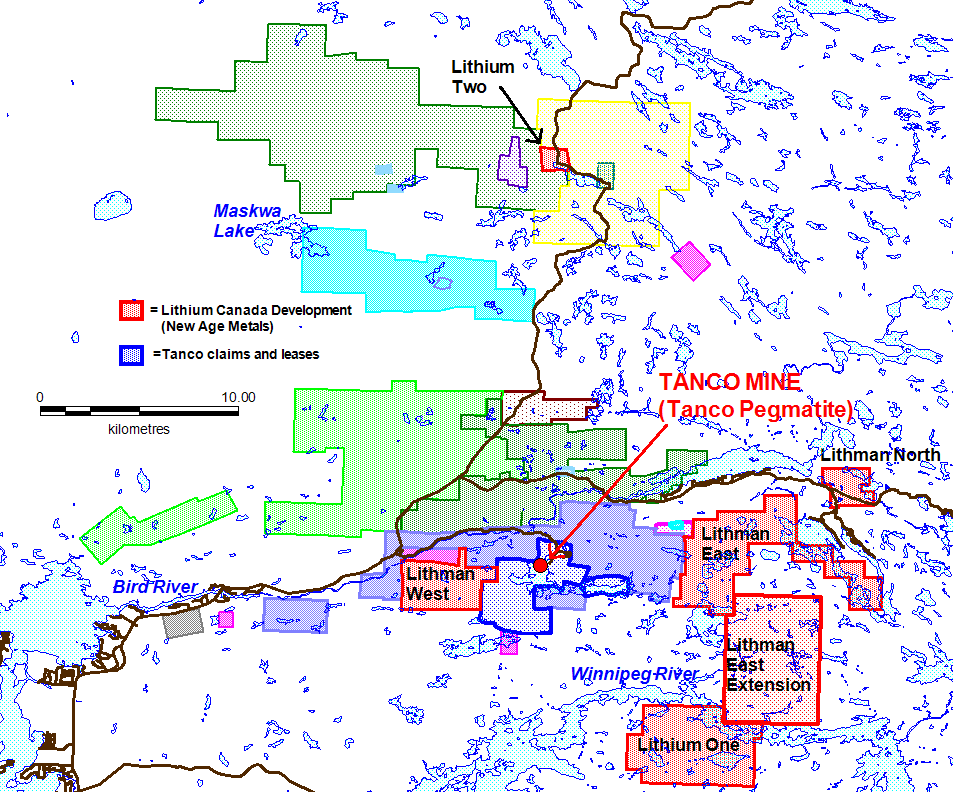
  • The Lithman East Extension, another Lithium-bearing pegmatite project in the Winnipeg River Pegmatite Field, consists of 12 claims for a total of 3072 hectares (7591 acres) (figure 1) and adds to NAM/AAZ’s growing Lithium project inventory in this large pegmatite field.
  • Lithium has an ever increasing demand for batteries in electric cars cellphones, laptops, solar storage, wireless charging and renewable energy products.
  • New Age Metals flagship project is the River Valley Project, which is the largest undeveloped primary Platinum Group Metals (PGM) resource in North America, with 4.6 Moz PdEq in Measured Plus Indicated including an additional 2.6 Moz PdEq in Inferred. The River Valley PGM Project is located in Ontario and has an excellent infrastructure and is within 100 kilometers of the Sudbury Metallurgical Complex. The project is 100% owned by New Age Metals (see news releases dated March 21st, 2018 and April 11th, 2018).

May 2nd, 2018 / Rockport, Canada – New Age Metals Inc. (TSX.V: NAM; OTCQB: NMTLF; FSE: P7J.F) is pleased to announce that through its Lithium Division, Lithium Canada Developments (LCD) it has acquired 100% of the Lithman East Extension Project, by way of staking, in southeast Manitoba

The new Lithman East Extension Project consists of 12 claims for a total of 3072 hectares (7591acres) (Figure 1). It is located approximately 10 kilometers east and southeast from the Tanco Mine Site. The world-class Tanco Pegmatite has been mined for Tantalum, Cesium and Spodumene (one of the primary Lithium ore minerals) in varying capacities, since 1969 at the Tanco Mine.


Click Image To View Full Size

Figure 1: Lithman East Extension Project Claim Outline

Lithman East Extension Project

The new project is located south of the previous acquired Lithman East Project and north of the Lithium One Project. The Lithman East Project was originally acquired in 2016 to tie onto the geological strike potential of the Tanco Pegmatite system and to examine the exposed pegmatite and pegmatitic granites in the Birse Lake Pegmatite group. Both projects cover the Bernic Lake Formation (the geological unit/formation that hosts the Tanco Pegmatite and several other lithium bearing pegmatites) of the Bird River Greenstone Belt. The northern portion of the Lithman East Extension Project covers the Bernic Lake Formation while the central and southern portions were staked to focus on the potential of the Axial Pegmatite Group. Historical Government of Manitoba academic work on the Axial Pegmatites has shown them to be well fractioned and evolved.

The project is situated over several axial planes of regional folds, as is the Tanco Pegmatite. The giant world-class Tanco Pegmatite has been postulated to be situated in a limb of fold and is located along strike approximately 10 kilometers to the west of the project area. The axial plane trace of this fold runs through both the Lithman East Project while it’s postulated extension and other axial planes runs through the newly acquired Lithman East Extension Project. The exploration focus of the region is to find and explore lithium-bearing pegmatites with the possibility of discovering a pegmatite as large and as mineralogically rich as the Tanco Pegmatite.

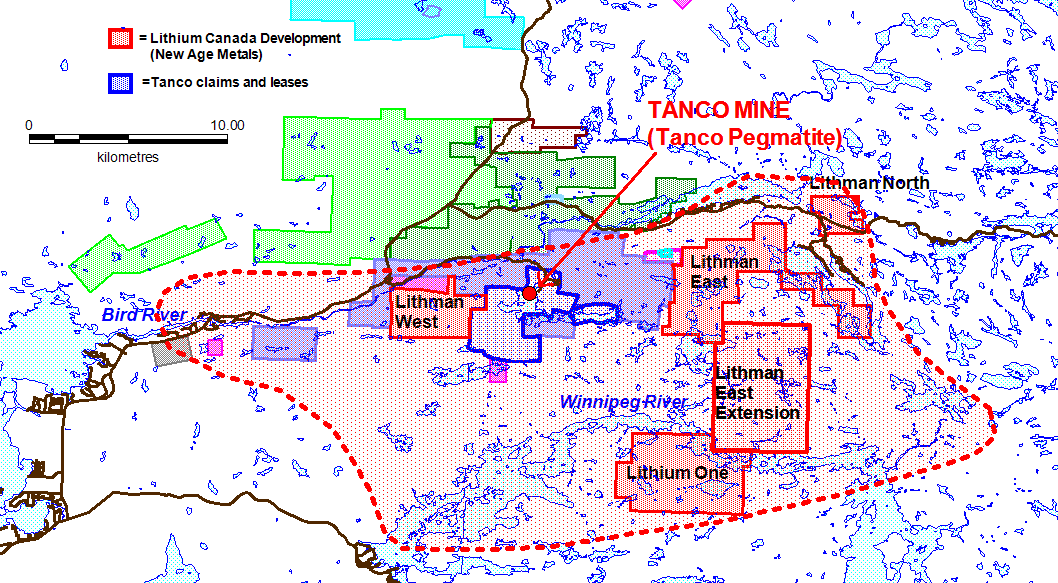
The pegmatites in this region of southeast Manitoba are described as being a part of the Winnipeg River Pegmatite Field. Several large lithium-bearing pegmatites exist in this region and exploration activity in the region is increasing (see Figure 2). This pegmatite field is host to the world-class Tanco Pegmatite, which is a highly fractionated Lithium-Cesium-Tantalum (LCT Type) pegmatite and has been mined in varying capacities since 1969.


Click Image To View Full Size

Figure 2: Idealized outline of the Winnipeg River Pegmatite Field.

Exploration Plan 2018

Work permits have been applied for with the province of Manitoba for surface exploration. Once the permits are granted, field crews will be mobilized. Exploration on the Lithman East Extension Project will consist of prospecting and sampling the known surface pegmatites and their surrounding areas.

The recent project acquisition of claims has made the New Age Metal/Azincourt Joint Venture the largest claim holder for Lithium in the Winnipeg River Pegmatite Field as well as the largest mineral claim holder in southeastern Manitoba. All claims presently held by Lithium Canada Developments. The company believes in the Lithium potential of the area and has an aggressive exploration program planned with their joint venture partners, Azincourt Energy. At present, the Joint Venture has six projects in the pegmatite field exploring for Lithium-bearing Pegmatites.

OPT-IN LIST

If you have not done so already, we encourage you to sign up on our website (www.newagemetals.com) to receive our updated news or click here.

ABOUT NAM’S PGM DIVISION

NAM’s flagship project is its 100% owned River Valley PGM Project (NAM Website – River Valley Project) in the Sudbury Mining District of Northern Ontario (100 km east of Sudbury, Ontario). Presently the River Valley Project is North America’s largest undeveloped primary PGM deposit with Measured + Indicated resources of 160 million tones @ 0.44 g/t Palladium, 0.17 g/t Platinum, 0.03 g/t Gold, with a total metal grade of 0.64 g/t at a cut-off grade of 0.4 g/t equating to 3,297,173 ounces PGM plus Gold and 4,626,250 PdEq Ounces. This equates to 4,626,250 PdEq ounces M+I and 2,713,933 PdEq ounces in inferred (see March 21st, 2018 press release). Having completed a 2018 NI-43-101 resource update the company is finalizing its 2018 exploration programs which will include geophysics, and extensive drill programs, which are all working towards the completion of a Preliminary Economic Assessment (PEA). Our objective is to develop a series of open pits (bulk mining) over the 16 kilometers of mineralization, concentrate on site, and ship the concentrates to the long-established Sudbury Metallurgical Complex. Alaska: April 4th, 2018, NAM signed an agreement with one of Alaska’s top geological consulting companies. The companies stated objective is to acquire additional PGM and Rare Metal projects in Alaska. On April 18th, 2018, NAM announced the right to purchase 100% of the Genesis PGM Project, NAM’s first Alaskan PGM acquisition related to the April 4th agreement. The Genesis PGM Project is a road accessible, under explored, highly prospective, multi-prospect drill ready Pd-Pt-Ni-Cu property.

The results of the new resource estimation are tabulated in Table 1 below (0.4 PdEq cut-off).

Class Tonnes

‘,000

Pd (g/t) Pt (g/t) Rh (g/t) Au (g/t) Cu (%) Ni (%) Co (%) PdEq (g/t)
Total Measured 62,877.5 0.49 0.19 0.02 0.03 0.05 0.01 0.002 0.99
Total Indicated 97,855.2 0.40 0.16 0.02 0.03 0.05 0.01 0.002 0.83
Total Meas +Ind 160,732.7 0.44 0.17 0.02 0.03 0.05 0.01 0.002 0.90
Inferred 127,662.0 0.27 0.12 0.01 0.02 0.05 0.02 0.002 0.66
Class PGM + Au (oz) PdEq (oz) PtEq (oz) AuEq (oz)
Total Measured 1,440,248 1,999,575 1,999,575 1,136,930
Total Indicated 1,856,925 2,626,675 2,626,675 1,463,793
Total Meas +Ind 3,297,173 4,626,250 4,626,250 2,600,724
Inferred 1,578,367 2,713,933 2,713,933 1,323,809

Notes:

1. CIM definition standards were followed for the resource estimation.

2. The 2018 resource models used Ordinary Krig grade estimation within a three-dimensional block model with mineralized zones defined by wireframed solids.

3. A base cut-off grade of 0.4 % g/t PdEq was used for reporting resources.

4. Palladium Equivalent (PdEq) calculated using (US$): $1,000/oz Pd, $1,000/oz Pt, $1,350/oz Au, $1750/oz Rh, $3.20/lb Cu, $5.50/lb Ni, $36/lb Co.

5. Numbers may not add exactly due to rounding.

6. Mineral Resources that are not mineral reserves do not have economic viability

7. The quantity and grade of reported inferred resources in this estimation are uncertain in nature and there has been insufficient exploration to define these inferred resources as an indicated or measured mineral resource and it is uncertain if further exploration will result in upgrading them to an indicated or measured mineral resource category.

ABOUT NAM’S LITHIUM DIVISION

The Company has six pegmatite hosted Lithium Projects in the Winnipeg River Pegmatite Field, located in SE Manitoba. Three of the projects are drill ready. This Pegmatite Field hosts the world class Tanco Pegmatite that has been mined for Tantalum, Cesium and Spodumene (one of the primary Lithium ore minerals) in varying capacities, since 1969. NAM’s Lithium Projects are strategically situated in this prolific Pegmatite Field. Presently, NAM is the largest mineral claim holders for Lithium in the Winnipeg River Pegmatite Field. On January 15th 2018, NAM announced an agreement with Azincourt Energy Corporation (see Jan 15, 2018, Feb 22nd, 2018 and April 11th, 2018 Press Releases) whereby Azincourt will commit up to $4.1 million dollars in exploration, up to 3.25 million shares of Azincourt stock to NAM, up to $210,000 in cash, and a 2% net smelter royalty on all 6 projects. Exploration plans for 2018 are currently in progress, whereby a minimum of $600,000 will be expended this year. For complete details on the terms and conditions of the NAM/AAZ option joint venture please see the press release dated Jan 15th, 2018.

Stock Option Grant

In addition, the Company announces that it has granted 300,000 incentive stock options to a consultant of the Company at an exercise price of $0.12 per share for a period of five (5) years from the date of grant in accordance with the Company’s Stock Option Plan. The Stock Options granted will be subject to vesting restrictions, acceptance by the TSX Venture Exchange and will be subject to regulatory hold periods in accordance with applicable Canadian Securities Laws.

QUALIFIED PERSON

The contents contained herein that relate to Exploration Results or Mineral Resources is based on information compiled, reviewed or prepared by Carey Galeschuk, a consulting geoscientist for New Age Metals. Mr. Galeschuk is the Qualified Person as defined by National Instrument 43-101 and has reviewed and approved the technical content of this news release.

On behalf of the Board of Directors

“Harry Barr”

Harry G. Barr

Chairman and CEO

ADDITIONAL INFORMATION

Should you have additional inquiries, please contact Paul Poggione, Corporate Development, Tel: 1-613-659-2773, email: [email protected].

Neither the TSX Venture Exchange nor its Regulation Services Provider (as that term is defined in the policies of the TSX Venture Exchange) accepts responsibility for the adequacy or accuracy of this release.

Cautionary Note Regarding Forward Looking Statements: This release contains forward-looking statements that involve risks and uncertainties. These statements may differ materially from actual future events or results and are based on current expectations or beliefs. For this purpose, statements of historical fact may be deemed to be forward-looking statements. In addition, forward-looking statements include statements in which the Company uses words such as “continue”, “efforts”, “expect”, “believe”, “anticipate”, “confident”, “intend”, “strategy”, “plan”, “will”, “estimate”, “project”, “goal”, “target”, “prospects”, “optimistic” or similar expressions. These statements by their nature involve risks and uncertainties, and actual results may differ materially depending on a variety of important factors, including, among others, the Company’s ability and continuation of efforts to timely and completely make available adequate current public information, additional or different regulatory and legal requirements and restrictions that may be imposed, and other factors as may be discussed in the documents filed by the Company on SEDAR (www.sedar.com), including the most recent reports that identify important risk factors that could cause actual results to differ from those contained in the forward-looking statements. The Company does not undertake any obligation to review or confirm analysts’ expectations or estimates or to release publicly any revisions to any forward-looking statements to reflect events or circumstances after the date hereof or to reflect the occurrence of unanticipated events. Investors should not place undue reliance on forward-looking statements.

$GGX.ca GGX Gold Extends the Gold Bearing COD Vein an Additional 65 Meters to the South — Greenwood BC

Posted by AGORACOM at 9:29 AM on Wednesday, May 2nd, 2018

  • Completed holes 25 through 30 on the COD Vein, located in the Gold Drop Southwest Zone
  • DD-COD18-30 extended the COD vein 65 meters to the south, intersecting a 2.2 meter mineralized quartz vein with visible tellurides and visible gold.
  • The company is continuing with its summer drill program utilizing two drill rigs


Vancouver, British Columbia (FSCwire)GGX Gold Corp. (TSX.V: GGX) (OTCQB: GGXXF), (the “Company” or “GGX”) is pleased to announce the completion drill holes 25 through 30 on the COD Vein, located in the Gold Drop Southwest Zone. Thirty holes have been completed to date during the current 2018 diamond drill program testing the COD Vein, totaling 2,020 meters (6,627 feet).


To view the graphic in its original size, please click here


To view the graphic in its original size, please click here

The latest series of diamond drill holes were drilled from a pad located 40 meters south of the 2017 COD trenches. These holes targeted an area of historical cross trenches that never reached bedrock. The highlight of the latest series of holes is DD-COD18-30 that extended the COD vein 65 meters to the south. The hole intersected a 2.2 meter mineralized quartz vein with visible tellurides and visible gold.


To view the graphic in its original size, please click here

Listed below are the highlights from the latest series of COD diamond drill holes. All reported widths are core length.

DDCOD18-26 – intersected a 11.25 m mineralized zone including 6.38 m of quartz veining.

DDCOD18-29 – intersected a 3.94 m mineralized zone including 1.6 m of quartz vein intercept.

DDCOD18-30 – intersected a 3.51 m mineralized zone including a 2.2 m quartz vein intercept.

The core is currently being split and securely packaged for shipment to ALS laboratories in Vancouver, BC. There the core will be analyzed for gold by Fire Assay and for 48 multi element Four Acid and ICP-MS. Quality control (QC) samples are being inserted at regular intervals.

The company is continuing with its summer drill program utilizing two drill rigs, one drill is on the newly discovered Everest Vein located approximently 100 Meters west of the COD and 600 Meters south of the COD trench. The second Drill rig is continuing to extend the Gold bearing COD vein both north and south.

Further updates on these programs will be provided shortly and a steady flow of assays results are expected to begin at the end of May and continue over the seasons program.


To view the graphic in its original size, please click here

David Martin, P.Geo., a Qualified Person as defined by NI 43-101 and consultant for GGX, is responsible for the technical information contained in this News Release.

To view the Original News release with pictures please go to the website or contact the company.

On Behalf of the Board of Directors,

Barry Brown,

Director

604-488-3900

[email protected]

Investor Relations:

Mr. Jack Singh, 604-488-3900   [email protected]

“ We don’t have to do this, we get to do this ”

The Crew


To view the graphic in its original size, please click here

FEATURE: American Creek $AMK.ca encounters high grade #Gold / #Silver at Treaty Creek, same system as Seabridge Gold $SEA $SA $SKE.ca $TUD.ca $PVG

Posted by AGORACOM-JC at 3:01 PM on Tuesday, May 1st, 2018

AMK: TSX-V, OTCBB: ACKRF

Geology, geophysics, and exploration on Treaty Creek indicate potential for world class deposits.

  • Adjoining Pretivm and Seabridge Gold claims (Snowfield / Brucejack / VOK / KSM)
  • Intersected various mineralized zones
  • Most significant was 337.5m of continuous mineralization grading 0.76 g/t gold from 2 to 339.5m depth,
  • Including a higher grade intercept of 124.5m grading 0.98 g/t gold from 53.0 to 177.5m

Hub On AGORACOM / Corporate Profile

Clean Energy Revolution Needs Clean Solar Panels $HPQ.ca

Posted by AGORACOM-JC at 12:01 PM on Tuesday, May 1st, 2018

Solar energy is a clean alternative to fossil fuels; however, making the panels themselves comes with an environmental price tag.

  • Solar power is the fastest-growing source of that new renewable energy.
  • According to a report published by research firm Zion Market Research, the global solar panel market accounted for US$30.8 billion in 2016
  • Expected to reach US$57.3 billion by 2022, growing at a CAGR of 10.9 percent.

The Clean Energy Revolution is all about sustainability from cradle to grave. 

Both investors and consumers in this space want the manufacturing process for clean-energy products to have as small an environmental footprint as possible. Otherwise the movement away from fossil fuels will not lead us to a truly low-carbon economy.

Renewable forms of energy such as solar are key to that transition. In 2017, new renewable-energy-generating capacity surpassed that of net new fossil fuel capacity. “We are at a turning point … from fossil fuels to the renewable world,” Erik Solheim, head of UN Environment, told Reuters. “The markets are there and renewables can take on coal, they can take on oil and gas.”

This INNspired Article is brought to you by:

HPQ Silicon (TSXV:HPQ) is a technology and resource company working towards becoming a vertically integrated producer of high-purity, solar-grade silicon metal.Send me an Investor Kit

Solar power is the fastest-growing source of that new renewable energy. According to a report published by research firm Zion Market Research, the global solar panel market accounted for US$30.8 billion in 2016 and is expected to reach US$57.3 billion by 2022, growing at a CAGR of 10.9 percent.

The International Energy Agency (IEA) believes solar will dominate future growth in the renewable energy sector, with global capacity in five years’ time expected to be greater than the current combined total power capacity of India and Japan, reports the Guardian. “What we are witnessing is the birth of a new era in solar photovoltaics (PV). We expect that solar PV capacity growth will be higher than any other renewable technology up to 2022,” said Dr. Fatih Birol, IEA executive director.

That increased solar capacity will require more solar panels, and that means more silicon, the material responsible for converting solar energy into electricity.

Silicon is the solar energy metal

Silicon, an excellent semiconductor, is essential in the fabrication of solar panels. Unlike other metals, its conductivity improves as temperatures increase — making it ideally suited for solar-energy generation.

Yes, solar panels do not emit greenhouse gases when they are generating electricity; however, the conventional process for producing solar-grade silicon, or polysilicon, uses harsh chemicals and requires a lot of energy.

Environmental cost of conventional silicon production

According to a 2014 National Geographic report, the entire process results in the emission of greenhouse gases and the production of toxic chemicals. “The dirty little secret about solar panels is that while solar energy as a concept is green because you can generate electricity without generating pollution, you create a lot of pollution during the manufacturing of those solar cells,” Bernard Tourillon, CEO of HPQ Silicon (TSXV:HPQ), told INN. HPQ Silicon owns a portfolio of high-grade quartz properties in Quebec, and with PyroGenesis Canada (TSXV:PYR) is developing a new carbothermic process that has the capability to convert quartz into solar-grade silicon metal in just one step.

Although silicon is one of the most abundant elements on earth, it doesn’t occur freely but rather is found in compound form with oxygen as silicon dioxide (SiO2) or silica. Quartz is the most common form of silica. The conventional process for producing pure silicon from quartz and further refining it for use in solar panels requires a lot of energy and the use of caustic chemicals — leading to the emission of greenhouse gases and the production of the very toxic chemical silicon tetrachloride.

“Traditionally this is a very high-CAPEX smelter process that requires large-size plants and is extremely pollutive because to transform quartz into silicon metal by default you create carbon monoxide,” added Tourillon.

Silicon has a melting point of 1,414° Celsius, nearly that of iron. Freeing silicon from SiO2 requires passing quartz through a carbothermic process (basically adding carbon through extremely high heat) in giant electric furnaces, which in turn requires a lot of energy, notes Fengqi You, assistant professor of engineering at Northwestern University and a co-author of a study on the subject conducted in partnership with Argonne National Laboratory.

Further increasing the carbon footprint of solar-panel manufacturing, coal is often the source of energy used to heat the furnaces, especially in China where the majority of the world’s polysilicon and solar panels are produced. Hence, as the Economist points out, “when a new solar panel is put to work it starts with a ‘carbon debt’ that, from a greenhouse-gas-saving point of view, has to be paid back before that panel becomes part of the solution, rather than part of the problem.”

Nearly all of the silicon used in today’s solar panels comes from the refining of metallurgical-grade silicon using a chemical purification method known as the Siemens process, which involves the use of caustic chemicals, including sodium hydroxide and hydrofluoric acid. This process produces waste in the form of highly toxic silicon tetrachloride.

While most manufacturers recycle this waste to produce more silicon, the reprocessing equipment can carry a hefty price tag — in the range of tens of millions of dollars — leading some companies to dump the waste. Once silicon tetrachloride comes into contact with water it releases hydrochloric acid, which acidifies the surrounding soil and emits toxic fumes.

In an effort to crack down on illegal dumping of toxic waste produced by polysilicon manufacturers, environmental regulators in China shut down operations at several offending factories in 2017. The move sent prices of polysilicon soaring on shortages and spiked production costs for solar panel manufacturers.

Clearly, without sustainably produced silicon, solar panels are not a genuine clean-energy alternative to fossil fuels.

Game-changing technology

A potential solution to this challenge may come in the form of the fourth state of matter: plasma.

Plasma is a charged gas capable of strong, electrostatic interactions, making it a great conductor of electricity. Plasma’s semiconductive property is why in 2015, HPQ Silicon approached PyroGenesis, one of the largest concentrations of plasma expertise in the world, and inquired about the possibility of using its plasma-based knowhow to transform quartz into solar-grade silicon metal.

PyroGenesis has successfully developed plasma-based systems for the US Navy, including technology that destroys chemicals-based weapons, and has invented a plasma-based process for producing power for 3D printing that is now used internationally.

The resulting cooperation between HPQ Silicon and PyroGenesis led to the development of the PUREVAP™ Quartz Reduction Reactors process, a new carbothermic process that has the capability to convert quartz into solar-grade silicon metal.

In less than 18 months, the PUREVAP™ QRR process has demonstrated the possibility of converting quartz into solar-grade silicon metal at commercial scale in one step.

“Plasma is a very exciting area of technology. Our PUREVAP™ metallurgical process harnesses the advantages of plasma to commercially produce solar-grade silicon directly from quartz,” Peter Pascali, president and CEO of PyroGenesis, told INN. “If you can conduct that transformation in one step using a clean technology like plasma then without a doubt there are significant environmental benefits from that.”

A third-party revenue analysis of the process, conducted by private France-based Apollon Solar, found that at the commercial scale, the PUREVAP™ process could lead to the production of solar-grade silicon at a significantly lower cost compared to conventional processes.

PyroGenesis’ recent GEN2 testing results have validated the commercial scalability of the PUREVAP™ process. “The results we have achieved recently with the GEN2 PUREVAP™ give us increased confidence and assurance that at pilot scale, we will be able to reach significant higher production yields of the high-purity silicon metal that we are targeting,” said Pierre Carabin, PyroGenesis’ chief technology officer.

HPQ Silicon owns the PUREVAP™ technology as it relates to the transformation of quartz to silicon through a binding agreement with PyroGenesis. HPQ Silicon provides the strategic direction, marketing and funding for the project for a 90-percent interest.

HPQ Silicon, PyroGenesis and Apollon Solar are working together to conduct the GEN3 Pilot Plant phase, now in the planning stages, to further validate the commercial scalability of the PUREVAP™ process.

The takeaway

There are of course other factors that contribute to the carbon footprint of solar energy outside of how silicon is produced; for example, in the fabrication of the solar panels themselves. But solving this one challenge may still be a huge step forward for the solar industry and could bring the world closer to a more energy-efficient and environmentally sustainable future.

This INNspired article is sponsored by HPQ Silicon (TSXV:HPQ). This article was written according to INN editorial standards to educate investors.

Source: https://investingnews.com/innspired/environmental-impacts-of-solar-panels-manufacturing-threaten-the-clean-energy-revolution/?mqsc=E3953446

INTERVIEW: Good Life Networks $GOOD.ca Discusses Recent Quarterly Revenues of $9.7M

Posted by AGORACOM-JC at 10:01 AM on Tuesday, May 1st, 2018

PyroGenesis Announces 2017 Results: Revenues Increase 38%; Gross Margins Increase to 44%; Gross Profit Increases 258%; EBITDA (Mod.) Improves 22% Year Over Year; Current Backlog $7.2MM; Pipeline exceeds $20MM

Posted by AGORACOM-JC at 9:39 AM on Tuesday, May 1st, 2018

Pyr header 1

2017 was a year in which PyroGenesis posted:

  • An increase of 38% in Revenues to $7,192,861 year over year;
  • A 258% increase in Gross Profit to $3,126,967 compared to a loss of ($1,980,336) in 2016;
  • An increase in Gross margins (Before amortization of intangible assets and write-offs of inventories and costs and profits in excess of billings on uncompleted contracts) to 43.5% (2016: 41.6%);
  • An increase in Gross margins (After amortization of intangible assets and write-offs of inventories and costs and profits in excess of billings on uncompleted contracts) to 43.5% (2016: 14.8%);
  • 22% decrease in Modified EBITDA loss to ($1,445,784) for fiscal 2017;
  • A backlog of $7.2MM at December 31, 2017;
  • Pipeline exceeds $20MM (Pipeline is considered to be negotiations with either existing clients who wish to re-order, or new clients that have paid for demonstrations after receiving a quote).

MONTREAL, April 30, 2018 – PyroGenesis Canada Inc. (http://pyrogenesis.com) (TSX-V:PYR) (OTCQB:PYRNF), a high-tech company (the “Company” or “PyroGenesis”) that designs, develops, manufactures and commercializes plasma waste-to-energy systems and plasma torch products, is pleased to announce today its financial and operational results for the fourth quarter and the fiscal year ended December 31, 2017.

“2017 was a year in which all key indicators of operational performance posted significant gains, year over year, and once again the Company is well positioned for the coming year,” said P. Peter Pascali, President and CEO of PyroGenesis. “2016 was a pivotal year for PyroGenesis as the Company decided to re-enter the market for metal powder production (this time for additive manufacturing), and leverage off of both its extensive Plasma expertise and the fact that it invented Plasma Atomization for this space.  2017 became the year in which the Company went from relative obscurity within the additive manufacturing industry to being nominated for “Materials Company of the Year” at the 3D Printing Industry Awards 2018.  2017 also saw the commercial acceptance of its patented DROSRITE™ System with the acceptance of its first commercial sale and a subsequent re-order by the same client.   As reviewed in a press release dated February 1st, 2018, we now have visibility on an additional 6-10 DROSRITE™ systems to be delivered in 2018 and there is a high probability that the Company will be profitable in 2018 from the addition of DROSRITE™ system sales to our backlog. All this to say that 2017 seems to have set the stage for a profitable 2018.”

Highlights

2017 was a year in which PyroGenesis posted:

  • An increase of 38% in Revenues to $7,192,861 year over year;
  • A 258% increase in Gross Profit to $3,126,967 compared to a loss of ($1,980,336) in 2016;
  • An increase in Gross margins (Before amortization of intangible assets and write-offs of inventories and costs and profits in excess of billings on uncompleted contracts) to 43.5% (2016: 41.6%);
  • An increase in Gross margins (After amortization of intangible assets and write-offs of inventories and costs and profits in excess of billings on uncompleted contracts) to 43.5% (2016: 14.8%);
  • 22% decrease in Modified EBITDA loss to ($1,445,784) for fiscal 2017;
  • A backlog of $7.2MM at December 31, 2017;
  • Pipeline exceeds $20MM (Pipeline is considered to be negotiations with either existing clients who wish to re-order, or new clients that have paid for demonstrations after receiving a quote).

Outlook

2017 was a year in which all key indicators of operational performance posted significant gains and positioned the Company for profitability in the future.  Building upon the successes of 2016, which saw the establishment of healthy gross margins, in excess of 40% continue and improve throughout 2017, as the Company put in place the infrastructure and personnel to ensure that these margins, not only continue into the foreseeable future, but improve once powder production is in full commercialization.

The following is a non-exhaustive review of PyroGenesis’ main commercial activities:

A)  Powder Production:

2017 became the year in which the Company went from relative obscurity within the additive manufacturing industry, to being nominated “Materials Company of the Year” at the 3D Printing Industry Awards 2018.

Not only, during this period,  did the Company successfully assemble and commission its first metal powder production system, but also (i) successfully delivered orders for Titanium and Inconel powders, all while still in the ramp up phase, (ii) generated new, game changing, IP which provides for more control over particle size distribution, with little to no waste, while increasing powder production even further, and (iii) entered into several NDA’s with significant players in the industry (end users, printer manufacturers, and distributors) all with a view of providing sample orders, repeat orders, long term orders, contract R&D, and/or strategic partnerships for long term powder supply contracts, some with a view to a possible acquisition.  Given the level of activity, and the prospect of significant orders in the near term, management decided to order the long lead items for two powder production systems, both of which should be fully operational by the end of July 2018. These new powder production units will incorporate some of the cutting-edge IP that has recently been developed and/or is in development. We expect these units will cost significantly less to manufacture, generate higher production rates, and provide greater control over particle size distributions.

Of note, although the Company’s strategic plan has always been based on its existing IP, know-how, and system (the economics of which remain true to this day), management has decided to leverage off of its significant advantage in plasma technology and dedicate certain limited assets to increasing its IP base with the goal of further significantly reducing capital and operating costs of the powder production system while at the same time improving production rates even further.  PyroGenesis is confident that these goals once achieved will significantly impact our build out strategy for the better.

The Company expects that one of the next significant milestones is to be formally placed on a powder user’s approved supplier list.  This requires significant time and money on the part of the user and would be the first formal step to a powder production contract. Although we cannot predict the time frame in which this might happen, we can confirm that we have not been rejected during any powder qualification process leading to this ultimate goal.

B)  DROSRITE™:

As the Company positioned itself, during 2017, to become a significant powder producer to the Additive Manufacturing Industry, it also successfully positioned its DROSRITETM Furnace System to become a fully commercial product line in and of its own right.

2017 saw the commercial acceptance of PyroGenesis’ patented DROSRITE™ System with, not only an acceptance of its first commercial sale, but a subsequent re-order by the same client at a higher price.

During this time, a successful demonstration of the DROSRITE™ System in the Middle East has resulted in significant interest from that region while the Company’s demonstration unit is already fully booked in India, to September, with paid-for-demonstrations. This flurry of activity and interest for the DROSRITE™ System resulted in the Company hiring a full-time business development manager to market the DROSRITE™ System, and who’s role is exclusively to secure DROSRITE™ system sales. PyroGenesis is aggressively targeting both primary aluminum smelters in Asia and the Middle East where the market is estimated to be in excess of 1 million tonnes of dross1, as well as tertiary casting producers worldwide. These two markets alone represent a potential market for DROSRITE™ systems numbering in the hundreds of units.

1 http://www.world-aluminium.org/statistics/primary-aluminium-production/

As of this writing, PyroGenesis

  1. is currently discussing the purchase of an additional two (2) systems with an existing client;
  2. has demonstrated the system in the Middle East and are expected to close on the equivalent of three (3) systems over the next few months;
  3. has a demonstration system in India on contract for paid-for-demonstrations, which if successful could result in 1-4 additional orders;

Plus,

  1. as noted, this demonstration system is fully booked until September 2018.

Due to this high demand for on-site paid-for demonstrations, the Company is in the process of constructing a second DROSRITE™ demonstration system which is expected to be available for demonstrations in Q3 2018.  There is a high probability that PyroGenesis will be profitable in 2018 from DROSRITE™ system sales when combined with existing backlog.

C)  US Military:

Originally it was thought that just one new US Aircraft Carrier would be ordered in 2018, with an estimated value of approximately $6MM, but now it seems that the interest is for two, for an estimated value of between $10-12MM.

The chemical warfare destruction unit, that PyroGenesis developed for a consortium involving various groups within the US military, and was in the process of being tested, continues to have its schedule delayed to accommodate other unrelated testing needs by the group. This testing timeline is out of the Company’s control.

Revenues from military contracts in 2017 were over $4,300,000, mainly related to providing technical support, training services and sale of spare parts.  Over the past three years, revenues from military contracts have typically represented more than $2,000,000 per year of PyroGenesis’ revenues.  As the PAWDS technology becomes fully operational on US Navy ships, management expects the level of recurring revenues from the sale of parts and services to increase over the next 2 to 5 years.

D)  HPQ:

On August 2, 2016, PyroGenesis announced that it had signed contracts totalling $8,260,000 with HPQ Silicon Resources Inc., formally Uragold Bay Resources Inc. (“HPQ”) for the sale of IP and to provide a pilot system to produce silicon metal directly from quartz. Of particular note, if successful, PyroGenesis benefits from a 10% royalty on all revenues derived from the use of this system by HPQ, subject to annual minimums.

Management remains focused on reducing PyroGenesis’ dependency on long-cycle projects by developing a strategic portfolio of volume driven, high margin/low risk products that resolve specific problems within niche markets and doing so by introducing these plasma-based technologies to industries that have yet to consider such solutions.

Management is also actively targeting recurring revenue opportunities that will generate a growing, and profitable, regular cash flow to the Company.

PyroGenesis has one of the largest concentrations of plasma expertise in the world, with over 250 years of accumulated technical experience and supporting patents, combined with unique relationships with major Universities performing cutting edge plasma research and development, positions the Company well to execute its strategies.

Management’s focus will continue to be to generate an improved mix of short and long-term projects that will, in turn, facilitate operational and financial planning. Repeat orders for the same, or similar, products will further result in the standardization of manufacturing processes which will lead to improved gross margins.

All indications are that 2018 should be a profitable year for the Company given that business lines, other than non-additive manufacturing, continue to contribute significantly to Pyrogenesis’ revenues.  Management expects that the Corporation’s non-additive manufacturing business lines will generate enough revenues, on their own in 2018, to make PyroGenesis profitable overall.

Financial Summary

Revenue

PyroGenesis recorded revenue of $7,192,861 in the year of 2017, representing an increase of 38% compared with $5,222,133 recorded in the year of 2016.

Revenues recorded in fiscal 2017 were generated primarily from:

  1. the development of a vacuum arc reducing process to convert Silica into high purity Silicon metal,
  2. the manufacture and further field testing of Tactical PACWADS, the first mobile plasma system for destruction of chemical warfare agents under contract with an international military consortium,
  3. the demonstration of the viability of PyroGenesis’ existing plasma chemical warfare agent destruction platform with locally available materials, for the complete eradication of chemical warfare agents without creating hazardous by-products,
  4. support services related to PAWDS-Marine systems supplied to the US Navy.

Cost of Sales and Services and Gross Margin

Cost of sales and services before amortization of intangible assets was $4,065,894 in 2017, representing an increase of 33% compared with $3,051,356 in 2016.

In 2017 employee compensation, subcontracting costs, direct materials and manufacturing overhead increased to $4,436,508 (2016 – $3,277,813) as a result of increased volumes during the year.  The cost of sales and services for 2017 and 2016 are in line with management’s expectations. The type of contracts being executed, and the nature of the project activity has a significant impact on both the overall level of cost of sales and services reported in a period, as well as the composition of the cost of sales and services, as the mix between labour, materials and subcontracts may be significantly different. The cost of sales and services for 2017 and 2016 are in line with management’s expectations

Investment tax credits recorded against cost of sales are primarily related to client funded projects that qualify for tax credits from the provincial government of Quebec. Qualifying tax credits increased to $367,342 in 2017, compared with $249,550 in 2016. This represents an increase of 47% year-over-year. The increase is primarily due to a higher amount of these costs being eligible for tax credits.

The gross margin before amortization of intangible assets for 2017 was $3,126,967 or 43.5% of revenue compare to a gross margin of $2,170,777 or 41.6% of revenue for 2016 before amortization of intangible assets and write-offs of inventories and costs and profits in excess of billings on uncompleted contracts. The inventory write-off in 2016 was comprised of the Transportable Waste to Energy system ($147,774) and the CFC destruction system ($846,241). The write-off of costs and profits in excess of billings on uncompleted contracts ($1,760,423) was related to the Company no longer expecting to recover the full amounts owed from a customer for a contract.

The amortization of intangible assets of $Nil in 2017 and $1,396,675 for 2016 relates to the licenses and know-how purchased in 2011 from a company under common control. Of note, this expense is a non-cash item and the underlying asset was fully amortized by December 31, 2016.

Selling, General and Administrative Expenses

Included within Selling, General and Administrative expenses (“SG&A”) are costs associated with corporate administration, business development, project proposals, operations administration, investor relations and employee training.

SG&A expenses for 2017 excluding the costs associated with share-based compensation (a non-cash item in which options vest principally over a two-year period), were $4,394,837, representing an increase of 10% compared with $3,990,837 reported for 2016.

The increase in SG&A expenses in 2017 over the same period in 2016 is mainly attributable to the net effect of:

  • an increase of 11% in employee compensation due primarily to additional headcount,
  • a decrease of 11% for professional fees, primarily due to a decrease in investor relations expense and patent expenses,
  • an increase of 27% in office and general expenses, due to an increase in computers and internet expenses,
  • travel costs increased by 29%, due to an increase in travel abroad,
  • depreciation on property and equipment decreased by 12% due to a lower amount of property and equipment being depreciated. In 2017, the Company had $1,879,455 of assets under development, which will begin to be depreciated when these assets are available or ready for use (expected in 2018),
  • government grants decreased by 11% due to a decreased level of activities supported by such grants and,
  • other expenses increased by 61%, primarily due to an increase in promotion and advertising expenses, an increase in marketing expenses, and an increase in insurance expense.

Separately, share based payments increased by 107% in 2017 over the same period in 2016 as a result of the vesting structure of the stock option plan including the stock options granted on November 3, 2017.

Net Comprehensive Loss

The net comprehensive loss for 2017 of $6,174,303 compared to a loss of $6,952,219, in 2016, represents a decrease of 11% year-over-year.

The decrease of $777,916 in the comprehensive loss in 2017 is primarily attributable to the factors described above, which have been summarized as follows:

  1. an increase in product and service related revenue of $1,970,728 arising in 2017,
  2. an increase in cost of sales and services totaling $1,014,538, primarily due to the concentration of engineering on material purchases, and due to the increase in product and service revenue,
  3. a decrease in amortization of intangible assets of $1,396,675,
  4. a decrease in impairment loss in 2017 of $2,754,438 recorded in 2016 for a write-off of inventories and costs and profits in excess of billings on uncompleted contracts,
  5. an increase in SG&A expenses of $796,988 arising in 2017 primarily due to an increase in employee compensation and office and general expenses,
  6. an increase in R&D expenses of $197,672 primarily due to the increase in development expenditures relating to the asset under construction in 2017,
  7. an increase in the settlement of the IP debt balance of $3,215,643,
  8. an increase in net finance costs of $119,084 in 2017 primarily due to an increase in the adjustment in fair value of investments.

EBITDA, Adjusted and Modified

The EBITDA loss in 2017 was $5,558,640 compared with an EBITDA loss of $4,935,997 for 2016, representing an increase of 13% year-over-year. The decrease in the EBITDA loss in 2017 compared with 2016 includes amounts written-off of $2,754,438 in 2016.

Adjusted EBITDA loss in 2017 was $1,583,984 compared with an Adjusted EBITDA loss of $1,815,534 for 2016. The decrease of $231,550 in the Adjusted EBITDA loss in 2017 is attributable to the decreased comprehensive loss of $777,916, a decrease of $15,468 in depreciation on property and equipment, a decrease of $1,396,675 in amortization of intangible assets, an increase in finance charges of $11,584, an increase in cost of other non-cash items, specifically share-based payments of $392,988, an increase in a settlement of a claim related to the long-term debt of $3,215,643 a decrease in write-off of inventories of $994,015 and a decrease in write-off of costs and profits in excess of billings on uncompleted contracts of $1,760,423.

The Modified EBITDA loss in 2017 was $1,445,784 compared with a Modified EBITDA loss of $1,846,234 for 2016, representing a decrease of 22%. The decrease in the Modified EBITDA loss in 2017 is attributable to the decrease as mentioned above in the Adjusted EBITDA and a decrease in change of fair value of investments of $168,900.

Liquidity and Capital Resources

The Company has incurred, in the last several years, operating losses and negative cash flows from operations, resulting in an accumulated deficit of $43,200,708 and a negative working capital of $9,403,370 as at December 31, 2017 (December 31, 2016 – $37,026,405 and $2,079,353 respectively). Furthermore, as at December 31, 2017, the Company’s current liabilities and expected level of expenses for the next twelve months exceed cash on hand of $622,846 (December 31, 2016 – $385,257). The Company has relied upon external financings to fund its operations in the past, primarily through the issuance of equity, debt, and convertible debentures, as well as from investment tax credits.

About PyroGenesis Canada Inc.

PyroGenesis Canada Inc. is the world leader in the design, development, manufacture and commercialization of advanced plasma processes. We provide engineering and manufacturing expertise, cutting-edge contract research, as well as turnkey process equipment packages to the defense, metallurgical, mining, advanced materials (including 3D printing), oil & gas, and environmental industries. With a team of experienced engineers, scientists and technicians working out of our Montreal office and our 3,800 m2 manufacturing facility, PyroGenesis maintains its competitive advantage by remaining at the forefront of technology development and commercialization. Our core competencies allow PyroGenesis to lead the way in providing innovative plasma torches, plasma waste processes, high-temperature metallurgical processes, and engineering services to the global marketplace. Our operations are ISO 9001:2008 certified, and have been since 1997. PyroGenesis is a publicly-traded Canadian Corporation on the TSX Venture Exchange (Ticker Symbol: PYR) and on the OTCQB Marketplace. For more information, please visit www.pyrogenesis.com

This press release contains certain forward-looking statements, including, without limitation, statements containing the words “may”, “plan”, “will”, “estimate”, “continue”, “anticipate”, “intend”, “expect”, “in the process” and other similar expressions which constitute “forward- looking information” within the meaning of applicable securities laws. Forward-looking statements reflect the Corporation’s current expectation and assumptions, and are subject to a number of risks and uncertainties that could cause actual results to differ materially from those anticipated. These forward-looking statements involve risks and uncertainties including, but not limited to, our expectations regarding the acceptance of our products by the market, our strategy to develop new products and enhance the capabilities of existing products, our strategy with respect to research and development, the impact of competitive products and pricing, new product development, and uncertainties related to the regulatory approval process. Such statements reflect the current views of the Corporation with respect to future events and are subject to certain risks and uncertainties and other risks detailed from time-to-time in the Corporation’s ongoing filings with the securities regulatory authorities, which filings can be found at www.sedar.com, or at www.otcmarkets.com. Actual results, events, and performance may differ materially. Readers are cautioned not to place undue reliance on these forward-looking statements. The Corporation undertakes no obligation to publicly update or revise any forward- looking statements either as a result of new information, future events or otherwise, except as required by applicable securities laws.

Neither the TSX Venture Exchange, its Regulation Services Provider (as that term is defined in the policies of the TSX Venture Exchange) nor the OTCQB accepts responsibility for the adequacy or accuracy of this press release.

SOURCE PyroGenesis Canada Inc.

For further information please contact: Rodayna Kafal, VP, Investor Relations and Strategic Business Development, Phone: (514) 937-0002, E-mail: [email protected] 

Namaste $N.ca Receives Final Approval to List on TSX Venture Exchange $ACB.ca $HIP.ca $WEED.ca $CMED.ca

Posted by AGORACOM-JC at 9:36 AM on Tuesday, May 1st, 2018

Nlogo

  • Received final approval to list the common shares and warrants of the Company on the TSX Venture Exchange as a Tier 1 issuer
  • Common shares and warrants of the Company will be delisted from the Canadian Securities Exchange at the close of trading on May 1, 2018 and listed on the TSXV at the opening of trading on May 2, 2018

VANCOUVER, British Columbia, May 01, 2018 – Namaste Technologies Inc. (“Namaste” or the “Company”) (CSE:N) (FRA:M5BQ) (OTCMKTS:NXTTF) is pleased to announce that the Company has received final approval to list the common shares and warrants of the Company on the TSX Venture Exchange (“TSXV”) as a Tier 1 issuer. The common shares and warrants of the Company will be delisted from the Canadian Securities Exchange at the close of trading on May 1, 2018 and listed on the TSXV at the opening of trading on May 2, 2018. The Company’s common shares will continue to trade under the symbol “N” and its warrants will continue to trade under the symbol “N.WT.” The Company believes that listing on the TSXV will provide Namaste and its shareholders with many advantages, including greater visibility and enhanced market access for Canadian and international investors.

Management Commentary

Sean Dollinger, President and CEO of Namaste comments: “We are very pleased to have received final approval to list on the TSXV as a Tier 1 issuer. We’re proud to have reached a point where the Company will gain more exposure through a larger market and to join many of our peers on the TSXV. We’d like to thank our shareholders and management team for their continued support. This is certainly an exciting day in the history of Namaste and we look forward to a bright future.”

About Namaste Technologies Inc.

Namaste is the largest online retailer for medical cannabis delivery systems globally. Namaste distributes vaporizers and smoking accessories through e-commerce sites in 24 countries and with 5 distribution hubs located around the world. Namaste has majority market share in Europe and Australia, with operations in the UK, Canada and Germany and has opened new supply channels into emerging markets including Brazil, Mexico and Chile. Namaste, through its acquisition of Cannmart Inc., which operates a medical cannabis “sales-only” license under Canada’s Access to Cannabis for Medical Purposes Regulations (“ACMPR”), is pursuing a new revenue vertical in online retail of medical cannabis in the Canadian market. Namaste intends to leverage its existing database of Canadian medical cannabis consumers, along with its expertise in ecommerce to create an online marketplace for medical cannabis patients, offering a larger variety of product and a better user experience.

On behalf of the Board of Directors

“Sean Dollinger”

Chief Executive Officer

Direct: +1 (786) 389 9771

Email: [email protected]


Further information on Namaste and its products can be accessed through the links below:

namastetechnologies.com

namastevapes.ca

everyonedoesit.ca

namastevaporizers.co.uk

everyonedoesit.co.uk

australianvaporizers.com.au

Forward Looking Information

This press release contains forward-looking information based on current expectations. These statements should not be read as guarantees of future performance or results. Such statements involve known and unknown risks, uncertainties and other factors that may cause actual results, performance or achievements to be materially different from those implied by such statements. Although such statements are based on management’s reasonable assumptions, Namaste assumes no responsibility to update or revise forward-looking information to reflect new events or circumstances unless required by law. Although the Company believes that the expectations and assumptions on which the forward-looking statements are based are reasonable, undue reliance should not be placed on the forward-looking statements because the Company can give no assurance that they will prove to be correct. Since forward-looking statements address future events and conditions, by their very nature they involve inherent risks and uncertainties. These statements speak only as of the date of this press release. Actual results could differ materially from those currently anticipated due to a number of factors and risks including various risk factors discussed in the Company’s disclosure documents, which can be found under the Company’s profile on www.sedar.com. This press release contains “forward-looking statements” within the meaning of Section 27A of the Securities Act of 1933, as amended, and Section 21E the Securities Exchange Act of 1934, as amended and such forward looking statements are made pursuant to the safe harbour provisions of the Private Securities Litigation Reform Act of 1995. The Canadian Securities Exchange has neither reviewed nor approved the contents of this press release.