Posted by AGORACOM-JC
at 11:27 AM on Thursday, May 14th, 2020
SPONSOR: CardioComm Solutions (EKG: TSX-V) – The heartbeat of cardiovascular medicine and telemedicine. Patented systems enable medical professionals, patients, and other healthcare professionals, clinics, hospitals and call centres to access and manage patient information in a secure and reliable environment.
Could COVID-19 be telehealth’s big moment?
Over the five-year period that the analysis looks at, the U.S. telehealth market could see a compound annual growth rate (CAGR) of 38.2%
This year alone, the analysts expect the market to experience year-over-year growth of 64.3%
Over the five-year period that the analysis looks at, the U.S. telehealth market could see a compound annual growth rate (CAGR) of 38.2%. This year alone, the analysts expect the market to experience year-over-year growth of 64.3%.
“The critical need for social distancing among physicians and patients will drive unprecedented demand for telehealth, which involves the use of communication systems and networks to enable either a synchronous or asynchronous session between the patient and provider,†Frost & Sullivan healthcare principal analyst Victor Camlek said in a news release. “However, all stakeholders need to remember that many people use the terms ‘telehealth’ or ‘telemedicine’ without understanding the ecosystem that is involved. This study will clarify the many components that are needed in order to implement telehealth.â€
Camlek said that virtual visits and remote patient monitoring will propel the telehealth market, then mHealth and personal emergency response systems will come into play as well.
The analysis hypothesizes that the opportunity for telehealth to become the standard of care is growing amid the pandemic and the main challenge for providers is the capabilities for scaling up during the increase in demand.
Frost & Sullivan expects growth to be sustained beyond the pandemic by vendors who deliver user-friendly sensors, practical applications of artificial intelligence, interactive virtual assistants and robotics, as well as use of big data analytics and adherence to cybersecurity, among other things.
Posted by AGORACOM-JC
at 11:18 AM on Thursday, May 14th, 2020
SPONSOR: BetterU Education Corp. aims to provide access to quality education from around the world. The company plans to bridge the prevailing gap in the education and job industry and enhance the lives of its prospective learners by developing an integrated ecosystem. betterU / Ottolearn launch FREE COVID-19 mobile resource toolkit to fight the global crisis – Click here for more information.
Online test preparations is also one of the growing segments in the Indian Ed tech space, almost 70 percent of traditional publishers are digitising their content since they see a sizeable addressable market
Students are looking for technology-driven, flexible and convenient options for themselves and these factors are gradually making the prospect of higher education online more appealing for students and professionals.
India is known as one of the best education markets globally. However, education in India comprises of high costs especially related to textbooks as one is never enough. The founders saw a market opportunity as students restrict their intelligence and score by accessing a limited number of course books simply because it is not affordable and possible to buy all the books available physically.
Thus, KopyKitab helps students whether in school, college or competitive exams aspirants to access the top-selling syllabus digitally through their library. The AI and ML programs also help students access relevant books for their needs.
Amit Shrivastava, Co-founder & CTO, KopyKitab tells us why depending on technology in the education space is a good idea.
The current pandemic has left many topsy turvy. Has this lockdown led to an upsurge in traffic?
Ed tech today has spread its wings far and wide; for KopyKitab, we are growing fast and have seen 69% rise in new users, a 45% increase in reading session and 200% jump in revenue. As students and institutions get more comfortable using Ed tech services and virtual classrooms, they are not shying away from paying for relevant content. We believe that Ed tech has shown the potential to disrupt the entire value chain.
Online test preparations is also one of the growing segments in the Indian Ed tech space, almost 70 percent of traditional publishers are digitising their content since they see a sizeable addressable market. Students are looking for technology-driven, flexible and convenient options for themselves and these factors are gradually making the prospect of higher education online more appealing for students and professionals.
How are you abiding by a different business model, especially when there are plenty of other players in the market?
For KopyKitab, since its inception, we have set out to make education more affordable and accessible. From the day when Ed tech was yet to go through a technological disruption and textbooks especially Higher Education, costs a lot, and students, especially from Tier II and Tier III towns, had limited access, we understood the pain points from our own experience as both the founders have grown up in small towns and did their schooling. At that time, due to lack of technology, getting study books access was a task as compared to our peers in Tier I and Metros. The KopyKitab model is aimed at making education a level playing field for students anywhere in India
We have mastered the content acquisition and distribution, and adopted a mobile-first strategy and have managed to recreate an offline studying experience for students online, at a much lower cost, our focus areas are into higher education and competitive exams sector and we are already very near to creating a niche for ourselves.
As students need everything quickly on the go, KopyKitab is exactly giving them that, bite-sized learning on their mobiles.
How areAI and ML contributing to your cause?
At KopyKitab, we are using Artificial Intelligence & Machine Learning programs that help track users consumption patterns and make more accurate recommendations based on language, city, campus, grade level, renting history, etc. It also helps us identify specific student’s needs
AI and ML programs have helped us increase the reach even in the remotest areas. Since, about 68 percent of our users hail from Tier II and III towns, with maximum demand coming from Patna, Jaipur, and Indore; five percent are overseas users, while the remaining comes from metros and Tier-I cities
The most critical and latest technology which we started catering in the COVID-19 pandemic is P2P (Peer to Peer) with structured learning options & Video Connectivity, be it teacher to students, coach to the students & content publishers to students, which is creating a highly optimised beneficial learning environment
Also, this will continue to be the base for all the tech platforms since it provides digital connection between people
How important do you think is it for people to rely on technology? Are there any major follies per se?
The future will undoubtedly be technology-driven, as stakeholders in the education ecosystem look to make access easier and provide flexibility in the learning environment. All this while keeping in mind that social distancing will be the norm going forward, technology will be the front runner for this connection be it WFH, P2P, Group connect as mentioned above
One of the major follies per se will be the absence or scarcity of direct human connect leading to longer time for execution for all the verticals
Could you acquaint us with your funding scenario?
In 2018, KopyKitab was backed by ECF, a Rs 100 crore fund registered under the SEBI. The fund’s marquee investors include Michael and Susan Dell Foundation and Gray Matters Capital, both US-based international investors in the education sector.
KopyKitab has also raised about $2 million from Pactolus Singapore, CBA Capital (ECF) and well-known angels including Praveen Gandhi, Paula Mariwala (Stanford Angels), Mohit Dubey (Carwale), Satyen Kothari (Citrus Pay), and others
What are KopyKitab’s upcoming plans like?
Our immediate priority would be to continue to serve our subscribers i.e students with more content in easy and engaging forms. We saw a surge in our traffic since the lockdown started in Mar and our aim to serve them with the best learning options.
For longer-term, providing P2P and Video-based access for our students, teachers/coaches and publishers to continue education without much interference because of the current scenario.
A piece of advice for others?
My advice would be to think long term solutions in digital/online space and if possible convert part of your business to digital/internet driven. Also, provide more accessibility between employees and customers using technology as base.
Posted by AGORACOM-JC
at 10:58 AM on Thursday, May 14th, 2020
SPONSOR: Imagine AR Inc. (IP:CSE) (IPNFF:OTCQB) is an Augmented Reality platform that allows businesses to easily launch AR campaigns. Clients Include: NBA Sacramento Kings, Mall of America, AT&T Shape and The Basketball Hall of Fame. The company recently announced partnership with Engaged Nation, an award winning leader in digital engagement marketing for casinos Learn More.
Augmented Reality for Ecommerce: the Why and the How
With the relentless pursuit of customer experience excellence and the competition getting tougher by day, online merchants are often spread too thin
Feeling the pressure to step up their game, ecommerce brands are looking for new ways to meet consumer demand and differentiate their business
Rising to the challenge is augmented reality, which promises to reinvent online shopping for customers and drive sales. As AR is approaching technological maturity, businesses are wising up to AR-enabled opportunities and are making AR an integral part of their strategy.
So, let us focus on two main questions — why you need AR for your custom ecommerce development project and how you can do it.
Why do you need AR for your ecommerce business?
Supercharge customer engagement
A pillar to ecommerce success, customer engagement comes in many forms. Exceptional service, personalized offers, and brand storytelling all contribute to fostering an engaged and loyal audience.
Augmented reality opens a new dimension to customer engagement. Highly interactive in nature, the technology enables brands to deliver creative digital experiences. Think AR-powered product discovery, context-driven personal recommendations, or interactive tours. On top of that, AR adds gamification, making the entire online shopping process more fun.
Boost conversion rates
Fun as it is, online shopping has one major drawback that stops users from converting into customers. Without actually seeing and trying the product, it’s difficult to decide whether it’s a good fit for us. Augmented reality can make all the difference.
Through interactive 3D object presentation, AR encourages users to see in great detail how a selected product will function in a real environment, shaping the purchase decision. A well-informed decision, in turn, translates into a significantly lower return rate — a win-win for both a buyer and a happy customer.
Reach new customers
With the spending power of $143 billion, Gen-Zers are becoming a much coveted group for retailers and ecommerce stores. But to successfully market to this digital-native generation, brands need to adapt their approach and leverage all that digital has to offer.
Incorporating AR into your marketing strategy helps position your brand as forward-thinking and attracts digital natives. Take it from the ecommerce giants. Amazon introduced its AR View to let users see thousands of items in the settings of their own homes. Instagram, too, now lets you shop with augmented reality.
How can you integrate AR into your ecommerce strategy?
Immersive product catalogs
AR-powered catalog apps help brands bring their products to life. For those online stores that do not have a showroom, these virtual catalogs are a great way to allow customers to not only get the look and feel but also to customize configurations according to their preferences.
Imagine trying a sofa in different colors to see what matches your interior best. Ikea’s app lets you do just that. Taking things a step further, you can enhance your AR-driven ecommerce app with machine learning capabilities to analyze a user’s environment and offer tailored recommendations based on the context and previous purchase history.
Virtual fitting rooms
Just like exploring different interior design options, an AR-fueled mobile app can let you try on clothes, jewelry, accessories, and even makeup. To delight its customers with novel experiences and boost brand recognition, Converse has launched the Sampler app, which lets you try on a pair of shoes to see how they look, snap a picture, and share it with friends.
These virtual fitting rooms can also solve the size problem for potential buyers. An AR-enabled app captures a user’s measurements and reproduces the accurate silhouette so that customers can try on clothes and adjust size as needed until they find a perfect fit.
Interactive user manuals
Augmented reality can help you further nurture a relationship with your customers even after the sale. For that, provide your customers with AR-enhanced product manuals and interactive tours to guide users through complex installation and maintenance processes or teach them how to use additional features.
These compelling demonstrations through life-like AR animations enable customers to get the most of their purchase while improving the overall shopping experience and boosting satisfaction — exactly what you need to cement users’ loyalty with your brand.
Wrapping up
According to Gartner, in 2020 100 million customers will shop in augmented reality, both online and in-store. With these numbers in mind, it’s about time to jump on the AR bandwagon and start reaping the benefits of stellar customer engagement, improved conversion rates, and wider reach.
Olga Ezzheva is a technical writer at Oxagile, a provider of software engineering and IT consulting services for SMEs and Fortune 500 companies alike. You can reach Olga at [email protected] or connect via LinkedIn.
Posted by AGORACOM
at 9:34 AM on Thursday, May 14th, 2020
TORONTO, May 14, 2020 (GLOBE NEWSWIRE) — Loncor Resources Inc. (“Loncor” or the “Company“) (TSX: “LN”; OTCQB: “LONCF”) is pleased to provide an update on its activities within the Ngayu Greenstone Belt, where the Company has a dominant foot-print through its joint venture with Barrick Gold (Congo) SARL (“Barrickâ€) and on its own majority-owned exploration licences and exploitation concessions, including the Imbo exploitation concession (76.29%) that contains the Adumbi deposit and its wholly-owned exploration licence containing the Makapela deposit
Barrick Joint Venture
Loncor recently received the quarterly exploration report from joint venture partner Barrick for the first quarter of 2020. As announced in February 2020, joint venture partner and operator Barrick had identified a number of priority drill targets within the 1,894 square kilometre joint venture land package at Ngayu and drilling was due to commence in March. Some delays were encountered at the border due to additional permitting requirements resulting from the COVID-19 situation but the two drill rigs are now at the Kibali mine site and are planned to be mobilised to Ngayu in the second quarter.
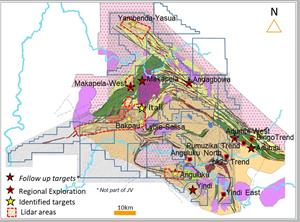
The first drill target is expected to be at Anguluku where an initial six core holes are planned. Depending on results, additional holes will be drilled at Anguluku or the drills will be moved to Salisa/Lybie where an initial twelve holes are planned. Other targets to be drilled include Yambenda/Yasua (see Figures 1 and 2 below).
A large component of Barrick’s Q1 2020 exploration program was focused on reconnaissance follow up. The goal of these reconnaissance studies was to delineate new targets for prioritisation and assess existing targets to advance them to the drilling stage or remove them from the resource triangle. At the time of reporting, of the eleven Areas of Interest identified during the last quarter, eight had been evaluated for potential of hosting tier 1 deposits. Two of the eight assessed did not pass the preliminary indicators to host tier 1 deposits. This quarter’s further assessment was completed on the Andagbowa, Zunguluka, Makapela West and Imva South blocks. At Andagbowa, two new targets were delineated for follow up work.
Andagbowa is located to the northeast corner of the Ngayu concession and about 32 kilometres northeast of the Mambati base camp. It is characterised by complex lithological and structural settings, which includes the presence of folded and fractured banded ironstone formation (“BIFâ€) and the hinge of a belt scale fold. Previous work has shown localized low grade BLEG anomaly basins, intense alluvial artisanal activities and a lack of quartz pebbles in the streams which could suggest potential for disseminated style gold mineralization.
Exploration fieldwork completed during the quarter at Andagbowa aimed at gaining geological characteristics of the area in order to evaluate its potential and perspectivity for future detailed work. The fieldwork undertaken included preliminary exploration study combining geological, structure and alteration mapping and sampling for gold analysis. Structural data confirmed the interpreted open folding system with NNW fold axis occurring within the area close to the Makapela Intrusive. The identified NE-SW, E-W and NW-SE moderate to steeply dipping mineralized sheared zones are aligned along the regional fold and parallel to the interpreted domain boundary subsidiary fault which could play a part in controlling the distribution of gold mineralization, either hosting mineralization or by acting as conduit for hydrothermal fluids.
The preliminary exploration work at Andagbowa area revealed two potential prospects for future work; namely Bon Marche and Tozali. The two prospects are characterized by sheared and brecciated rocks including BIF containing either stockworks of quartz veinelts or sheeted stringers of silica associated with pervasive sericite and weak disseminated fine to coarse sulphides.
NE and ENE trending mineralized shear zones (up to 12 metres wide) containing sheeted quartz stringers and veinlets associated with pervasive sericite hosted by metasediment rock. Each of the two shear zones is mined along 100 metre length by artisanal miners. Assay results of up to 2 metres @ 1.07g/t Au was intercepted from channel sampling.
2.5 kilometres folded and fractured BIF with weak disseminated sulphide and pervasive silica with 0.83 g/t Au from litho samples.
The potential hinge at Bon Marche is located 1.5 kilometres north of soil anomalies localized almost within the same hinge zone.
1.5 kilometre potential NW trending brecciated BIF containing disseminated boxworks and stockworks of quartz-carbonate stringers. Received results revealed anomalised values up to 0.76g/t Au.
At the beginning of the quarter, LIDAR (Light Detection and Ranging remote sensing) surveys were also conducted on four exploration blocks in the joint venture. The benefits of LIDAR data compared to traditional aerial-photo-based interpretation are in more detailed identification of possible surface deposits, mapping lithology, structures and more precise edging of the geomorphologies, which could hold large scale deposits. This method also reflects more accurately the true ground surface in areas of dense vegetation. The results of the LiDAR surveys are being collated with other existing geological and geophysical layers to further generate and prioritise more targets.
Imbo Exploitation Permit (Loncor 76.29%)
Outside of the Barrick joint venture, exploration activities have continued on Loncor’s Imbo exploitation concession (76.29%) in the east of the Ngayu belt. Fieldwork by Loncor geologists have focused on the Imbo East prospect 12 kilometres west-southwest of Adumbi along the same mineralised structural trend. Gridding, soil and rock sampling are being undertaken over a strike length of 3.6 kilometres. Additional follow up will be dependent on assay results which are pending.
Qualified Person Peter N. Cowley, who is President of Loncor and a “qualified person” as such term is defined in National Instrument 43-101, has reviewed and approved the technical information in this press release.
About Loncor Resources Inc. Loncor is a Canadian gold exploration company focussed on the Ngayu Greenstone Belt in the Democratic Republic of the Congo (the “DRCâ€). The Loncor team has over two decades of experience of operating in the DRC. Ngayu has numerous positive indicators based on the geology, artisanal activity, encouraging drill results and an existing gold resource base. The area is 200 kilometres southwest of the Kibali gold mine, which is operated by Barrick Gold (Congo) SARL (“Barrickâ€). In 2019, Kibali produced record gold production of 814,000 ounces at “all-in sustaining costs†of US$693/oz. Barrick has highlighted the Ngayu Greenstone Belt as an area of particular exploration interest and is moving towards earning 65% of any discovery in 1,894 km2 of Loncor ground that they are exploring. As per the joint venture agreement signed in January 2016, Barrick manages and funds exploration on the said ground at the Ngayu project until the completion of a pre-feasibility study on any gold discovery meeting the investment criteria of Barrick. In a recent announcement Barrick highlighted six prospective drill targets and are moving towards confirmation drilling in 2020. Subject to the DRC’s free carried interest requirements, Barrick would earn 65% of any discovery with Loncor holding the balance of 35%. Loncor will be required, from that point forward, to fund its pro-rata share in respect of the discovery in order to maintain its 35% interest or be diluted.
In addition to the Barrick JV, certain parcels of land within the Ngayu project surrounding and including the Makapela and Adumbi deposits have been retained by Loncor and do not form part of the joint venture with Barrick. Barrick has certain pre-emptive rights over the Makapela deposit. Loncor’s Makapela deposit (which is 100%-owned by Loncor) has an indicated mineral resource of 614,200 ounces of gold (2.20 million tonnes grading 8.66 g/t Au) and an inferred mineral resource of 549,600 ounces of gold (3.22 million tonnes grading 5.30 g/t Au). Adumbi and two neighbouring deposits hold an inferred mineral resource of 2.5 million ounces of gold (30.65 million tonnes grading 2.54 g/t Au), with 76.29% of this resource being attributable to Loncor via its 76.29% interest in the project.
Resolute Mining Limited (ASX/LSE: “RSG”) owns 26% of the outstanding shares of Loncor and holds a pre-emptive right to maintain its pro rata equity ownership interest in Loncor following the completion by Loncor of any proposed equity offering.
Additional information with respect to Loncor and its projects can be found on Loncor’s website at www.loncor.com.
For further information, please visit our website at www.loncor.com, or contact: Arnold Kondrat, CEO, Toronto, Ontario, Tel: + 1 (416) 366 7300.
Figure 1 Ngayu Belt. Developing Prospectivity, Work Programs and Drill Targets for 2020
Posted by AGORACOM
at 7:49 AM on Thursday, May 14th, 2020
VANCOUVER, BC / ACCESSWIRE / May 14, 2020 /Mota Ventures Corp. (CSE:MOTA)(FSE:1WZ:GR)(OTC PINK:PEMTF) (the “Company“) announces that it has entered into a letter of intent (the “Letter of Intent“), dated May 11, 2020, with Verrian Ontario Ltd. (“Verrian“), pursuant to which the parties intend to evaluate a potential transaction involving the acquisition of all of the outstanding share capital of Verrian (the “Proposed Transaction“). Verrian is an arms’-length privately-held company that is focused on delivering and developing products related to addiction reduction, with a focus on alcohol and opiates.
ESTABLISHED EUROPEAN PSYCHEDELIC MEDICINE COMPANY
Verrian owns and operates an EU-GMP, ISO 14001 compliant 110,000 sq. ft. pharmaceutical manufacturing facility in Radebuel, Germany. Verrian purchased the facility from a major global pharmaceutical manufacturer in 2019. Both the facility and equipment are independently appraised at Cdn$10,600,000, including an analytical laboratory, and full pharmaceutical manufacturing suite.
Operations within this full suite pharmaceutical manufacturing site include analytical laboratory and finished dose manufacturing, which exceed all international quality standards.
Verrian is composed of three distinct business segments:
Pharmaceutical Manufacturing – A portfolio of medical & wellness products
Phyto API – API creation from medical plants
Analytical Testing – European Medicine Agency Standards
PRODUCTS FOCUSED ON OPIATE ADDICTION REDUCTION
Verrian’s singular focus is rewiring the mind to overcome addiction through natural medicine. Specifically, the micro dosing of psilocybin demonstrates potential to remove the dopamine reward of addictive substances, potentially diminishing the desire for addictive substances, thereby reducing or eliminating the need for the addictive substance.
To date Verrian has developed:
PSI GEN and
PSI GEN+
These Psilocybin products are focused on opiate addiction reduction. As Natural Psilocybin extracts, from organically cultivated mushrooms, combined with metabolism enhancing natural herbs, they are ideal for individuals commencing micro-dosing and capable of being combined with additional anti-addiction therapies.
All of Verrian’s compounds are derived from organic, glyphosate free naturally occurring plants, grown specifically for its own purposes.
GOALS AND VISION
In addition to facility & equipment investments outlined above, the company has invested Cdn$2,400,000 worth of clinical trial design development and proprietary formulations into its psilocybin trademarked PSI-GEN formulations, and cannabis products, including trademarked CBDaily and CBNight.
Verrian’s world renowned addiction medicine experts are moving ahead to develop new potential treatments for therapy, with rigorous clinical research. Once EU GMP & narcotics handling recertification are secured, capabilities will extend to:
Specialty Pharma – Custom formulations
Psilocybin Refinement & Production – For micro dosing
“I am extremely excited at the opportunity to acquire an established Psychedelic medicine company in Europe. As an innovative company, Mota always seeks to be a leader in the natural health space and we see the psychedelic medicine market becoming a major part of the industry. This acquisition allows us to have first mover advantage in the Psychedelic market, and Mota’s existing distribution network will be ready to capitalize on the opportunity once regulation has been put in place,” stated Ryan Hoggan, CEO of the Company.
The Letter of Intent contemplates that the Company would acquire all of the outstanding share capital of Verrian in consideration for Cdn$21,100,000, of which Cdn$20,000,000 will be satisfied through the issuance of common shares (the “Consideration Shares“) to the existing shareholders of Verrian, and the balance will be payable in cash to retire certain outstanding shareholder loans due and owing by Verrian. The Consideration Shares will be subject to the terms of a thirty-six month time release pooling arrangement, during which time they may not be transferred, assigned, pledged or otherwise traded.
Readers are cautioned that the Letter of Intent entered into with Verrian does not set forth the final terms of the Proposed Transaction, nor have such terms been finalized. Any consideration offered to acquire Verrian remains subject to the results of ongoing due diligence. Completion of the Proposed Transaction is subject to a number of conditions, including, not limited to, completion of due diligence, negotiation of definitive documentation, and the receipt of any required regulatory approvals. The Proposed Transaction cannot be completed until these conditions are satisfied and there can be no assurance that the Proposed Transaction will be completed at all.
The Proposed Transaction is not expected to constitute a fundamental change for the Company, nor is it expected to result in a change of control of the Company, within the meaning of applicable securities laws and the policies of the Canadian Securities Exchange. The Company will provide further information regarding its review of Verrian, and the Proposed Transaction, as that information becomes available.
About Mota Ventures Corp.
Mota Ventures is an established eCommerce, direct to consumer provider of a wide range of CBD products in the United States and Europe. In the United States, the company sells a CBD hemp-oil formulation derived from hemp grown and formulated in the US through its Nature’s Exclusive brand. Within Europe, its Sativida brand of award winning 100% organic CBD oils and cosmetics are sold throughout Spain, Portugal, Austria, Germany, France, and the United Kingdom. Mota Ventures is also seeking to acquire additional revenue producing CBD brands and operations in both Europe and North America, with the goal of establishing an international distribution network for CBD products. Low cost production, coupled with international, direct to customer, sales channels will provide the foundation for the success of Mota Ventures.
ON BEHALF OF THE BOARD OF DIRECTORS
MOTA VENTURES CORP.
Ryan Hoggan Chief Executive Officer
For further information, readers are encouraged to contact Joel Shacker, President at +604.423.4733 or by email at [email protected] or www.motaventuresco.com
Posted by AGORACOM-JC
at 9:27 PM on Wednesday, May 13th, 2020
“As the country begins to emerge from stay at home orders, we thought it would be prudent to provide our shareholders with an update on our operations and some additional details on our recently announced acquisitions, Alphamind and Venom Extracts.” Said Carl Saling, CEO Hollister. “Integration of the new companies is well underway and continues to run smoothly”
VANCOUVER, May 13, 2020 - Hollister Biosciences Inc. (CSE: HOLL, OTC: HSTRF, FRANKFURT: HOB) (the “Company“, “Hollister Cannabis Co.” or “Hollister“) a diversified cannabis branding company with products in over 220 dispensaries throughout California, is pleased to provide a Corporate Update from CEO, Carl Saling.
“As the country begins to emerge from stay at home orders, we thought it would be prudent to provide our shareholders with an update on our operations and some additional details on our recently announced acquisitions, Alphamind and Venom Extracts.” Said Carl Saling, CEO Hollister. “Integration of the new companies is well underway and continues to run smoothly”
COVID-19 (the “Pandemic”) Update
In many states across the country cannabis was deemed an essential business and Hollister has been able to stay operational in all the states in which it operates.
It has been a challenging environment; however, we have navigated the new environment effectively. Some cities and counties only allowed curbside pick-up and or delivery of cannabis, while others have closed but others stayed completely open for business using and implementing safety precautions.
Hollister took action to help the communities in which they operate by manufacturing hand sanitizer and donated it to offices and front-line workers. As recognition for our efforts the county of Hollister, California awarded Hollister Cannabis Co. a Certificate of Appreciation for our support.
Today, Hollister’s facilities are operating under social distancing guidelines to ensure the Company’s employees are safe. The Company has also provided employees with gloves, masks and hand sanitizer to take home. It is the Company’s first order concern during the pandemic to ensure that employees are operating in a safe and healthy environment and provide them with the tools they need to keep themselves and their families safe.
Hollister Cannabis Co.
Hashbone, the Company’s bubble hash infused pre roll brand, continues to grow and gain new fans daily. The Company introduced HashBone “Minis” which are 0.5 gram bubble hash infused pre-rolls packaged in a 5 pack. The Company has rolled out Hybrid and Sativa SKU’s now available in select California dispensaries.
The Company also plans to introduce the HashBone “Wolfie”, which answers the call of the true connoisseur. The HashBone Wolfie is a traditional HashBone coated with full spectrum cannabis oil and rolled in bubble hash. There is hash on the inside and hash on the outside with full spectrum oil holding them together. The HashBone Wolfie is currently in the testing phase and estimated to be in the market before the end of May 2020.
Strategic Alliances with Tommy Chong
Further to the news release dated February 7, 2020, the Company is pleased to disclose the strategic relationship with Tommy Chong is progressing well. Hollister is very close to launching its 1st SKU with Tommy Chong called Tommy Chong’s Cannabis Full Spectrum Elixir comprising a 1:1 ratio – 500mg CBD: 500mg THC. The product has completed testing, labels are being generated, and the Company expects product launch before the end of May 2020.
Venom Extracts
Venom Extracts (“Venom“) continues to be integrated within Hollister Biosciences operations and the synergies are evident. Plans are underway for expansion of Venom into Hollister’s manufacturing facility in California with engineering and permitting processes underway. The Company anticipates Venom will be producing in California in Q4 2020.
Throughout the pandemic, Venom products continued to see significant growth in demand which resulted in record revenue for Q1, 2020. Although these numbers will be disclosed in Hollister’s Q1 report, only a small portion will be included in Hollister’s audited financial statements, as the acquisition closed on March 24, 2020
AlphaMind
The integration process is underway pursuant to the Company’s recently announced acquisition of AlphaMind (see News release dated April 30, 2020). The Company believes AlphaMind’s medicinal mushroom based product SKU’s will be complementary to Hollister’s existing product line. AlphaMind has an agreement in place with an established US based manufacturing partner. It is the Company’s intention to build out an e-commerce platform to market and distribute AlphaMind’s product line. AlphaMind is a new entrant in the burgeoning medicinal mushroom sector and is also in the process of developing IP surrounding psilocybin based pharmaceutical treatments.
Future Objectives
The Company believes the pandemic has changed consumer behaviour, possibly in a permanent fashion.
Hollister believes it can capitalize on this in several ways:
The company is looking to accelerate its direct to consumer platform for both the hemp and the cannabis markets.
Hollister Biosciences will look to build a centralized ecommerce management system that will streamline the sales and marketing of all Hollister Biosciences non cannabis brands like Rebel Hemp Company & AlphaMind.
The Company will continue to evaluate the changing cannabis regulatory landscape to expand operations into new states.
The Company will also evaluate new technologies which may be utilized in the Company’s Facilities in the future.
Hollister Cannabis Co. is currently in the design phase of expanding its facility to accommodate the Venom brand.
About Hollister Biosciences Inc.
Hollister Biosciences Inc. is a multi-state cannabis company with a vision to be the sought-after premium brand portfolio of innovative, high-quality cannabis & hemp products. Hollister uses a high margin model, controlling the whole process from manufacture to sales to distribution or seed to shelf. Products from Hollister Biosciences Inc. include HashBone, the brand’s premier artisanal hash-infused pre-roll, along with concentrates (shatter, budder, crumble), distillates, solvent-free bubble hash, pre-packaged flower, pre-rolls, tinctures, vape products, and full-spectrum high CBD pet tinctures. Hollister Cannabis Co. additionally offers white-labeling manufacturing of cannabis products. Our wholly-owned California subsidiary Hollister Cannabis Co is the 1st state and locally licensed cannabis company in the city of Hollister, CA birthplace of the “American Biker”.
The CSE, nor its regulation services provider, does not accept responsibility for the adequacy or accuracy of this release.
Forward-Looking Information: This news release includes certain statements that may be deemed “forward-looking statements”. The use of any of the words “anticipate”, “continue”, “estimate”, “expect”, “may”, “will”, “would”, “project”, “should”, “believe” and similar expressions are intended to identify forward-looking statements. Although the Company believes that the expectations and assumptions on which the forward-looking statements are based are reasonable, undue reliance should not be placed on the forward-looking statements because the Company can give no assurance that they will prove to be correct. Since forward-looking statements address future events and conditions, by their very nature they involve inherent risks and uncertainties. These statements speak only as of the date of this News Release. Actual results could differ materially from those currently anticipated due to a number of factors and risks including various risk factors discussed in the Company’s disclosure documents which can be found under the Company’s profile on www.sedar.com
Tags: Cannabis, CBD, CSE, Hemp, small cap, tsx Posted in Hollister Biosciences | Comments Off on Hollister Biosciences Inc. $HOLL.ca CEO Provides Corporate Update $WEED.ca $CGC $ACB $APH $CRON.ca $OGI.ca $FAF.ca
Posted by AGORACOM-JC
at 6:14 PM on Wednesday, May 13th, 2020
SPONSOR: Esports Entertainment Group(GMBL:NASDAQ) – Millions of people from around the world tune in to watch teams of video game players compete with each other. In first quarter 2020, YouTube reported 1.1 billion hours watched, an increase of 13% when compared to fourth quarter 2019. Wagering on Esports is projected to hit $23 BILLION this year although that number will likely be eclipsed due to the recent pandemic. Esports Entertainment Group is the next generation online gambling company designed for the purpose of facilitating as much of this wagering as possible. LEARN MORE.
Coronavirus Has Caused A Boom In Esports Betting
With all traditional sporting events on hold across the world thanks to the coronavirus pandemic many gambling fans have turned to esports, and as a result bookmakers are seeing a massive increase in esports betting.
While esports events have still been cancelled due to the coronavirus pandemic, most competitions are still taking place online, meaning no one has to put themselves at risk to continue playing. The digital nature of esports makes this incredibly easy to do, and as a result it is pretty much the only sports adjacent competition that is still happening on a regular basis.
This has resulted in many fans who would normally bet on more traditional sports turning their attention to the world of esports and they are now placing bets on competitive gaming.
“All of our key performance indicators have been through the roof in the past three months,†says Quentin Martin, CEO of Luckbox, an esports gambling site. “Turnover has risen to almost 13 times that seen in November 2019, while deposits are up 10x since then. The uptick is across the board and globally. As well as an increase in registrations, we’ve noticed an increase in average bet size, almost double since February.â€
But it’s not just consumers who are focusing more on the world of esports betting. With no sports to look for sponsors and investors are also investing more into the esports side of things during this time, looking to capitalize on the boom that is currently happening.
“Clearly, these are challenging times for many people across the world but, for many, esports and gaming is a welcome distraction,†says Martin. “As well as an increase in customers and betting activity, we’ve seen a huge level of interest from potential investors, who are realizing that esports is resilient to many of the forces that affect traditional sports, not least COVD-19 and a potential recession.â€
Typically in most esports it is agreed that when matches are played online there is more potential for major upsets, be it because of technical issues, poor connections or simply players being more comfortable in their own homes. While this certainly makes for more interesting matches, it also helps out the bookmakers, who credit this as another reason for their improved profits during this time.
“Our data shows that we see an increased number of upsets when moving from LAN to online,†says Martin. “It’s especially noticeable for favorites in odds ranges 1.2 to 1.3 and 1.4 to 1.5, where the trend is clear. There are respectively 6.81% and 11.02% more upsets since most events were forced online due to the pandemic. From our point of view, this is certainly better for the bottom line and we see an increase in profit margins.â€
Of course the pandemic won’t last forever, and when traditional sports returns so too will the massive amounts that are gambled on them across the world every day, but for those bookmakers like Luckbox who specialize in esports, it is clear that this pandemic will actually have a long term benefit for their business.
“Undoubtedly, the lack of traditional sports has prompted more fans to consider esports and it’s realistic to expect that, when sports eventually return, a lot of those fans will go back to the games they know best,†says Martin. “However, the potential of esports betting is well documented and these past few months have brought that into sharper focus, accelerating the numbers. I think the growth level won’t sustain, but the uplift will. A lot of fans of traditional sports have been exposed to the excitement of esports for the first time and, hopefully, they like what they see and will be sticking around.â€
Vision is to capitalize on this success to become the sought after premium brand portfolio of Cannabis across multiple states and Hemp nationwide
Major LOI, Joint Ventures and Licensing Agreements Support Proof Of This Vision
“Easy Riders” – Milliions Of Global Followers
“Tactical Relief” – Veteran Founded, Hemp Based CBD Brand With Nation Wide Members
“Tommy Chong” – Exclusive Manufacture & Distribution Of Tommy Chong’s Cannabis (TM) Full Spectrum Elixir 1:1
“I only partner with the best-in-class companies and I am really pleased to have the Hollister Cannabis Co. bring their amazing Tommy Chong’s Cannabis™ Full Spectrum Elixir to the market for me”.
one of Arizona’s premier extract brands and one of the state’s largest producers of award-winning medical cannabis distillate and related products.
HIGHLY ACCRETIVE $20,000,000 ACQUISITION, ADDING OVER CDN$16.4 MILLION OF 2019 REVENUE
For the year ended December 31, 2019, management of Venom Extracts reports having generated over CDN$16.4 million in revenue and over CDN$2.5 million in EBITDA from its product line of cannabis concentrates and cartridges.Â
Venom Extract’s management also reports a strong start to 2020 and is anticipating record Q1 revenue.
Alphamind Brands is developing a portfolio of certified legal mushroom based natural health products
The company’s “ready to ship†product SKU’s include Cordyceps, Lion’s Mane, Shiitake, Oyster and Reishi Mushroom based: liquid tinctures, concentrated mushroom powder(s), teas, and chocolate.
FULL DISCLOSURE: Hollister Biosciences Inc. is an advertising client of AGORA Internet Relations Corp.
Posted by AGORACOM-JC
at 11:57 AM on Wednesday, May 13th, 2020
If you don’t know what Augmented Reality (AR) is, this quote from Apple CEO Tim Cook is all the motivation you need to get up to speed:
“AR Will play an important role in how we use technology in the future – and promises to be as influential in our society as the smart phoneâ€
AR is essentially a technology that lays digital images and graphics over the real world.
As the name implies, ImagineAR (IP:CSE) (IPNFF:OTCQB) is an Augmented Reality Company that enables businesses to create their own mobile phone AR campaigns with no programming or technology experience. More than just lip service, the Company recently announced a partnership with Engaged Nation, an award winning leader of digital market for some of the world’s biggest casinos, whose CEO said the following about ImagineAR
“”We are excited to add ImagineAR to our interactive platform. We pride ourselves on offering the most advanced technology to our clients and their customers. We know that augmented reality can play a significant role in driving more customer engagement and trips to a casino property. ImagineAR’s platform is ideal to help accomplish that goal”
That quote is just the tip of the iceberg. Watch what Epstein has to say about how his company selected ImagineAR and how aggressively they plan to roll it out to casinos. If Engaged Nation knows a good bet when it sees one, Imagine AR (IP:CSE) is the Augmented Reality company that allows small cap investors to participate in the growth of the space, which IP says is projected to grow ~ 2,000% in the next 4 years …. that is not a typo!
IP is not a one trick pony either. They started commercializing their mobile Augmented Reality Platform long before this deal with Engaged Nation. Clients include:
NBA Sacramento Kings
Mall Of America
AT&T Shape
Basketball Hall Of Fame
….. more
As a result, ImagineAR is now well positioned to further commercialize and capitalize on massive demand for Augmented Reality If our interview with CEO Alen Paul Silverrstieen and Jerry Epstein is any indication, it sounds like the Company’s growth into the casino industry is all but assured in 2020.
Posted by AGORACOM
at 8:23 AM on Wednesday, May 13th, 2020
Review of historical work as well as more recent exploration over the past four years shows excellent potential for a gold mineralized system at Kingsway.
Historical work showing subangular gold grains recovered from till samples indicate a source of 100 to 500 metres up ice.
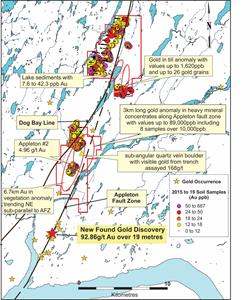
A sub-angular boulder of quartz vein containing visible gold recovered from a trench with gold grains in till assayed 168 g/t Au. The source of the boulder has not been found.
TORONTO, May 13, 2020 (GLOBE NEWSWIRE) — Labrador Gold Corp. (TSX-V: LAB) (“LabGold†or the “Companyâ€) is pleased to provide an update on its Kingsway Property near Gander, Newfoundland.
The two claim blocks that comprise the Kingsway Property cover over 14 kilometres of strike length of the potential extension of the Appleton fault zone which is associated with many of the gold showings, including the new discovery (downhole drill intersection of 92.86g/t Au over 19 metres), on New Found Gold’s Queensway project to the south. (Note that mineralization hosted on adjacent and/or nearby properties is not necessarily indicative of mineralization hosted on the Company’s property).
Since the Company acquired the option to acquire a 100% interest in the property (see news release dated March 3, 2020) it has been compiling historical data from work completed between 1989 and 2005. More recent exploration over the past four years has confirmed and expanded on this historical data and indicates the potential for a gold mineralized system at Kingsway.
Historical sampling of glacial till over the southern claim block showed gold values from below detection (<5ppb) to 89,000ppb (89g/t Au) in heavy mineral concentrates with 8 samples assaying over 10,000ppb (10g/t Au). Gold anomalies in the concentrates extend over three kilometres along the Appleton fault zone. Panning of till samples for gold grains showed between 2 and 13 grains in five samples from the south claim block and between 6 and 26 gold grains in six samples from the north claim block. Shape analysis of the gold grains showed many of them to be subangular, suggesting that they did not travel far from their source which was estimated to be between 100m and 500m up ice.
In addition, trenching in the vicinity of the high gold values in heavy mineral concentrates uncovered a subangular boulder of quartz vein containing visible gold which assayed 168 g/t Au. Neither the source of the boulder nor of the gold grains has been found.
Previous work suggests that gold mineralization is associated with regional structures, particularly where second order cross structures occur. This has been further demonstrated by the New Found Gold discovery to the south of the Kingsway Property, where gold mineralization appears to be related to structures cross cutting the Appleton fault zone. Despite the recognition of this control on mineralization early on, there does not appear to have been an attempt to target such structures in the drilling to date on the property. While historical drilling did not result in a discovery, there were indications of proximity to a mineralized system. In particular, a hole drilled near the heavy mineral concentrates with high gold values intersected approximately 22 metres of brecciated and silicified siltstone with numerous quartz stringers and quartz carbonate veins containing pyrite mineralization as stringers and blebs.
Exploration over the past four years by Torq Resources and Shawn Ryan included over 1,758 till samples 3,724 vegetation (spruce tips) samples 2,381 till XRF samples and 2,958 soil samples taken over a 45km by 15km (675 square kilometre) area. This work resulted in the identification of an area of 66 square kilometres most prospective for gold mineralization covered by the Kingsway north and south claim blocks. Till and vegetation sampling over the south claim block confirms the results of the historical work and identified new gold anomalies while the work on the northern claim block identified new gold anomalies associated with north-northeast trending magnetic lineaments that need to be followed up. On both claim blocks there is a close association between the gold anomalies and the Appleton or Dog Bay structures.
Gold anomalies in soil samples on the southern claim block occur to the west (up ice) of the historical gold anomalies in heavy mineral concentrates and may indicate a potential source area. More detailed sampling on a tighter spacing is required to test this interpretation.
On the northern claim block, which is covered by a historical detailed airborne Dighem survey, most of the gold anomalies are associated with north trending resistivity high/low contacts and NE cross cutting magnetic lineaments. Significant gold in soil anomalies occur both to the northwest and to the south east of three gold in lake sediment anomalies. The anomalies to the northwest also occur over anomalous gold in vegetation samples, whereas those to the south, where there is no detailed vegetation or till samples, occur in the vicinity of historical till samples assaying between 163 and 1,398 ppb Au that also contain gold grains.
The assays from the historical work presented here, while considered accurate, have not yet been verified by independent sampling as the Company has not been able to conduct fieldwork since acquiring the Project.
Roger Moss, President and CEO stated: “Historical exploration and more recent work has clearly demonstrated the potential of the Kingsway project for the discovery of orogenic gold deposits associated with deep seated structures. The presence of the Appleton and Dog Bay structures on the property with evidence of gold in till, vegetation, soil, stream sediments, lake sediments and float suggest the presence of a significant mineralized system. Detailed soil sampling combined with ground magnetic and VLF-EM are planned for the coming field season to define targets for subsequent drill testing. In the meantime, compilation and interpretation of the historical work continues to define the most prospective areas for successful follow up.â€
Shawn Ryan, technical advisor stated: “The Kingsway Project covers some of the first claims I staked outside of the Yukon. It was based on extensive research and ground follow up. The government till sampling and historical work was very compelling in showing that the Appleton and Dog Bay Line structures are very anomalous in gold. The previous option holder conducted extensive regional till and vegetation sampling that outlined nice anomalous gold areas. I pared down the large claim block to the two best areas. The subsequent announcement of the New Found Gold high-grade intersection south of Kingsway has given the district the evidence needed that good gold grades are associated with regional NNE (Appleton) structures cross cut by NE trending structures. These same structural patterns are seen in the geophysics on the Kingsway project. I look forward to the follow up work to be conducted over the next couple of seasons.â€
Roger Moss, PhD., P.Geo., is the qualified person responsible for all technical information in this release.
About Labrador Gold:
Labrador Gold is a Canadian based mineral exploration company focused on the acquisition and exploration of prospective gold projects in the Americas.
In early March 2020, Labrador Gold acquired the option to earn a 100% interest in the Kingsway project in the Gander area of Newfoundland. The property is along strike to the northeast of New Found Gold’s discovery of 92.86 g/t Au over 19.0 metres on their Queensway property. The two licenses comprising the Kingsway project cover approximately 16km of the Appleton fault zone which is associated with gold occurrences in the region, including the New Found Gold discovery. Historical work over the area covered by the Kingsway licenses shows evidence of gold in till, vegetation, soil, stream sediments, lake sediments and float. Infrastructure in the area is excellent located just 18km from the town of Gander with road access to the project, nearby electricity and abundant local water.
The Hopedale property covers much of the Florence Lake greenstone belt that stretches over 60 km. The belt is typical of greenstone belts around the world but has been underexplored by comparison. Initial work by Labrador Gold during 2017 show gold anomalies in soils and lake sediments over a 3 kilometre section of the northern portion of the Florence Lake greenstone belt in the vicinity of the known Thurber Dog gold showing where grab samples assayed up to 7.8g/t gold. In addition, anomalous gold in soil and lake sediment samples occur over approximately 40 kilometres along the southern section of the greenstone belt (see news release dated January 25th 2018 for more details).
The Ashuanipi gold project is located just 35 km from the historical iron ore mining community of Schefferville, which is linked by rail to the port of Sept Iles, Quebec in the south. The claim blocks cover large lake sediment gold anomalies that, with the exception of local prospecting, have not seen a systematic modern day exploration program. Results of the 2017 reconnaissance exploration program following up the lake sediment anomalies show gold anomalies in soils and lake sediments over a 15 kilometre long by 2 to 6 kilometre wide north-south trend and over a 14 kilometre long by 2 to 4 kilometre wide east-west trend. The anomalies appear to be broadly associated with magnetic highs and do not show any correlation with specific rock types on a regional scale (see news release dated January 18th 2018). This suggests a possible structural control on the localization of the gold anomalies. Historical work 30 km north on the Quebec side led to gold intersections of up to 2.23 grams per tonne (g/t) Au over 19.55 metres (not true width) (Source: IOS Services Geoscientifiques, 2012, Exploration and geological reconnaissance work in the Goodwood River Area, Sheffor Project, Summer Field Season 2011). Gold in both areas appears to be associated with similar rock types.
The Company has 57,039,022 common shares issued and outstanding and trades on the TSX Venture Exchange under the symbol LAB.