Posted by AGORACOM-JC
at 7:22 AM on Friday, April 17th, 2020
Empower Clinics closes private placement of $653,000.00 to support the Company growth plan and goes live with physician based immune boosting tele-medicine consultations with online professional supplement dispensing
Recently announced digital health initiative, has added physician based tele-medicine consultations to address immune system boosting requirements for existing patients and new patients, on a nationwide basis
The Company clinics have also seen a 480% increase in patient visits in the first half of April 2020
VANCOUVER, BC / April 17, 2020 / EMPOWER CLINICS INC. (CSE:CBDT)(Frankfurt:8EC)(OTCQB:EPWCF) (“Empower” or the “Company”), a vertically integrated life sciences company, is pleased to announce the closing of its non-brokered private placement of an aggregate of 16,325,000 units of the Company (each, a “Unit”) at a price of $0.04 per Unit for gross proceeds of $653,000.00 (the “Offering”).
The proceeds of the Offering are expected to be used by the Company for general working capital and corporate purposes.
The Company, as part of the recently announced digital health initiative, has added physician based tele-medicine consultations to address immune system boosting requirements for existing patients and new patients, on a nationwide basis. The Company clinics have also seen a 480% increase in patient visits in the first half of April 2020.
“Securing additional capital provides our Company more flexibility to support our staff and patients, during such a difficult time in history”, said Steven McAuley, Chairman & CEO. “We are hiring physicians and administrative staff right now to meet patient demand and adding technology resources to ensure our new services are available nationwide.”
In addition, our network of physicians will now be able to dispense over 250 premium supplement products to support patients’ needs, through a new online Sun Valley Health supplement store.
“Our new telemedicine platform is extremely robust, giving us the opportunity to provide a variety of modalities to our patients.” said Dustin Klein, Director and SVP Business Development. “We are focused on helping patients boost their immune systems and reduce stress and anxiety that may arise with isolation and social distancing.”
Each Unit is comprised of one Share and one Warrant, with each Warrant exercisable into one Warrant Share at an exercise price of $0.10 per Warrant Share for a period of two years following the Closing.
The Units, and the underlying Shares, Warrants and Warrant Shares (collectively, the “Securities”), are subject to restrictions on resale under applicable Canadian securities laws for a period of four months and one day from the closing of the Offerings. None of the Securities have been or will be registered under the United States Securities Act of 1933, as amended, and may not be offered or sold in the United States absent registration or an applicable exemption from the registration requirements. This news release shall not constitute an offer to sell or the solicitation of an offer to buy, nor shall there be any sale of the securities, in any jurisdiction in which such offer, solicitation or sale would require registration or otherwise be unlawful.
ABOUT EMPOWER
Empower is a vertically integrated health & wellness company operating a network of physician-staffed wellness clinics, focused on helping patients improve and protect their health, through innovative physician recommended treatment options. The Company has its first hemp-derived CBD extraction facility under development, to produce proprietary lines of cannabidiol (CBD) based products to distribute through company owned and franchised clinics, wholesale partnerships, online channels and developing retail channels nationwide in the U.S.
For French inquiries: Remy Scalabrini, Maricom Inc., E: [email protected], T: (888) 585-MARI
DISCLAIMER FOR FORWARD-LOOKING STATEMENTS
This news release contains certain “forward-looking statements” or “forward-looking information” (collectively “forward looking statements”) within the meaning of applicable Canadian securities laws. All statements, other than statements of historical fact, are forward-looking statements and are based on expectations, estimates and projections as at the date of this news release. Forward-looking statements can frequently be identified by words such as “plans”, “continues”, “expects”, “projects”, “intends”, “believes”, “anticipates”, “estimates”, “may”, “will”, “potential”, “proposed” and other similar words, or information that certain events or conditions “may” or “will” occur. Forward-looking statements in this news release include statements regarding; the Company’s intention to open a hemp-based CBD extraction facility, the expected benefits to the Company and its shareholders as a result of the proposed acquisitions and partnerships; the effectiveness of the extraction technology; the expected benefits for Empower’s patient base and customers; the benefits of CBD based products; the effect of the approval of the Farm Bill; the growth of the Company’s patient list and that the Company will be positioned to be a market-leading service provider for complex patient requirements in 2019 and beyond. Such statements are only projections, are based on assumptions known to management at this time, and are subject to risks and uncertainties that may cause actual results, performance or developments to differ materially from those contained in the forward-looking statements, including; that the Company may not open a hemp-based CBD extraction facility; that legislative changes may have an adverse effect on the Company’s business and product development; that the Company may not be able to obtain adequate financing to pursue its business plan; general business, economic, competitive, political and social uncertainties; failure to obtain any necessary approvals in connection with the proposed acquisitions and partnerships; and other factors beyond the Company’s control. No assurance can be given that any of the events anticipated by the forward-looking statements will occur or, if they do occur, what benefits the Company will obtain from them. Readers are cautioned not to place undue reliance on the forward-looking statements in this release, which are qualified in their entirety by these cautionary statements. The Company is under no obligation, and expressly disclaims any intention or obligation, to update or revise any forward-looking statements in this release, whether as a result of new information, future events or otherwise, except as expressly required by applicable laws.
Tags: CBD, CSE, edibles, Hemp, Marijuana Posted in All Recent Posts, Empower Clinics Inc. | Comments Off on Empower Clinics $CBDT.ca Announces Closing of Private Placement the Launch of Immune System Tele-Medicine Services and Patient Visits Up 480% $WEED.ca $CGC $ACB $APH $CRON.ca $OGI.ca
Posted by AGORACOM-JC
at 7:17 AM on Friday, April 17th, 2020
Announced a multi-year partnership with Eli Wilson Goaltending, a world leader in goaltending development, goaltending camps, and clinics
Eli Wilson has established himself as one of the premier goaltending coaches in the world through his work with dozens of goaltenders in the National Hockey League (NHL) and Team Canada
Toronto, New York -Â April 17th, 2020 – Eyecarrot Innovations Corp., (Eyecarrot) (TSXV:EYC) | (OTC:EYCCF) | (2EYA:GR) is excited to announce a multi-year partnership with Eli Wilson Goaltending, a world leader in goaltending development, goaltending camps, and clinics. Eli Wilson has established himself as one of the premier goaltending coaches in the world through his work with dozens of goaltenders in the National Hockey League (NHL) and Team Canada. The partnership will provide Eli Wilson Goaltending camps with the Binovi Touch neurovision sports training hardware, alongside screen-based resources for athletes to support their development on and off the ice. The Eli Wilson Goaltending partnership will ultimately expose 600 active goaltending camp participants, aged 10 to 19 years and a global network of over 50,000 aspiring goaltending athletes to Eyecarrot’s Binovi Sport Vision Platform for off-ice training. As many nations continue to practice social distancing during COVID-19 and post pandemic, the Binovi Sports Vision Platform offers accessible turnkey athletic resources in step with subscription-based home fitness solutions Tonal, Peloton (PTON: NASDAQ) and Mirror. A subscription structure will support the company’s global product scaling strategy and “at-home” consumer offerings.
“I emphatically believe the best way to develop goaltenders is by teaching a system within a system. Quality drills, attention to detail, repetition and simplicity are major factors in building successful goaltenders. The goaltender must learn needed skills in a progressive manner in a controlled environment. With Binovi, we are gaining a sports vision training system to improve vision in that same controlled way, ensuring proper analysis and progress,” commented Eli Wilson, Eli Wilson Goaltending Founder, CEO
Under his tutelage, Eli’s camps –which see over 600 athletes annually– have produced more than 50 NHL draft picks, over 60 Division I, Canadian University goaltenders, and more than 200 players drafted by Major Junior teams. His goaltenders have gone on to win numerous prestigious awards and championships, including the Stanley Cup, Conn Smythe Trophy, Vezina Trophy, World Junior Gold Medals, American Hockey League (AHL) championships, AHL Playoff MVPs, Western Hockey League (WHL) Goaltender of the Year awards, Ontario Hockey League (OHL) Goaltender of the Year awards, and Canadian Hockey League (CHL) Goaltender of the Year awards. In addition to standard camp programming, Eli has introduced a number of specialty camps, including the popular 24/7 camp, where goaltenders actually live and train with Eli over a three-day weekend. A main staple of Eli’s year-round training is advanced video technology, whereby he and his staff can analyze video remotely to further goaltending development.
This strategic partnership will support Eyecarrot’s aggressive positioning of its sports vision performance offerings in the sport of hockey through an increased presence in key hockey development programs including direct NHL team alignments. Hockey, a leading sport in Canada, will benefit from big-tech partnerships of this nature that are designed to enhance athlete performance at all development levels of the sport.
“We’re very excited to be working with an athletic training team that clearly has a very high drive for success, and such an incredible track record for turning out exceptional players. Our goal is to see Binovi boost the performance of athletes going through these camps and training regimens. After all, competition is what drives sport, and any edge players and their training teams can get to get that competitive edge over an opponent is key. We look forward to working alongside Eli and his team as we continue to develop Binovi for sports,” stated Adam Cegielski, President and CEO.
Click here for more information on Binovi Sports Vision Training.
About Eli Wilson Goaltending
Eli Wilson has worked with over 30 NHL goalies (and counting) to sharpen all essential goaltending skills, including mental conditioning and off-ice training. Eli’s programs help to hone an athlete’s reflexes and improve agility in the net. The camp experience mirrors how Pro and NHL goaltenders’ practice, train, think, and act, to get to the top of their game. In 2004, Eli was named to Hockey Canada’s goaltending consultant group. He has consulted with Creative Artists Agency (CAA) Sports during their summer development camps for top young prospects in Los Angeles, California. Eli has also traveled to South Korea to work with the Kangwon Land Ice Hockey team and other young goaltenders in the country. From 2007 through 2010, Eli was the goaltending coach for the Ottawa Senators, where he was responsible for the Ottawa Senators goaltenders as well as for the goalies playing for their AHL affiliate, the Binghamton Senators. Established in 2010, the Eli Wilson Goaltending program sees over 600 athletes every year and helps give them the competitive edge to set themselves apart in a very challenging and exclusive club.
About the NHL
The National Hockey League (NHL(R)), founded in 1917, consists of 31 Member Clubs, each reflecting the League’s international makeup with players from more than 20 countries represented on team rosters, vying for the most cherished and historic trophy in professional sports – the Stanley Cup(R). Every year, the NHL entertains more than 670 million fans in-arena and through its partners on national television and radio; more than 151 million followers – league, team and player accounts combined – across Facebook, Twitter, Instagram, Snapchat and YouTube; and more than 100 million fans online at NHL.com. The League broadcasts games in more than 160 countries and territories through its rightsholders including NBC/NBCSN and the NHL Network(TM) in the U.S., Sportsnet and TVA in Canada, Viasat in the Nordic Region and CCTV and Tencent in China. The NHL reaches fans worldwide with games available online in every country including via its live and on-demand streaming service NHL.TV(TM). Fans are engaged across the League’s digital assets on mobile devices via the free NHL(R) App; across nine social media platforms; on SiriusXM NHL Network Radio(TM); and on NHL.com, available in eight languages and featuring unprecedented access to player and team statistics as well as every regular-season and playoff game box score dating back to the League’s inception, powered by SAP. The NHL is committed to building healthy and vibrant communities through the sport of hockey by increasing youth participation and engagement; fostering positive family experiences; promoting inclusion, positive culture and leadership; and supporting sustainable community impact.
About Eyecarrot Innovations Corp
Eyecarrot is a human performance technology company that has developed Binovi, a hardware and software-centered platform. Binovi combines hardware, software, specialized expert knowledge, and unique big data insights in order to deliver customized one-on-one training and treatment. Binovi is designed for vision optimization and the enhancement of cognitive skills related to human performance. We are working together under a common banner to help neuro-optometry, vision rehabilitation, and vision performance professionals gain measurable results in less time, and with less effort.
Adam Cegielski
President | CEO
Tania Archer
Head of Global Marketing | Sales | Strategic Partnerships
Certain statements contained in this news release constitute “forward-looking information” as such term is used in applicable Canadian securities laws. Forward-looking information is based on plans, expectations and estimates of management at the date the information is provided and is subject to certain factors and assumptions, including, that the Company’s financial condition and development plans do not change as a result of unforeseen events and that the Company obtains regulatory approval. Forward-looking information is subject to a variety of risks and uncertainties and other factors that could cause plans, estimates and actual results to vary materially from those projected in such forward-looking information. Factors that could cause the forward-looking information in this news release to change or to be inaccurate include, but are not limited to, the risk that any of the assumptions referred to prove not to be valid or reliable, that occurrences such as those referred to above are realized and result in delays, or cessation in planned work, that the Company’s financial condition and development plans change, and delays in regulatory approval, as well as the other risks and uncertainties applicable to the Company as set forth in the Company’s continuous disclosure filings filed under the Company’s profile at www.sedar.com . The Company undertakes no obligation to update these forward-looking statements, other than as required by applicable law. Neither TSX Venture Exchange nor its Regulation Services Provider (as that term is defined in the policies of the TSX Venture Exchange) accepts responsibility for the adequacy or accuracy of this release.
Posted by AGORACOM-JC
at 6:02 PM on Thursday, April 16th, 2020
SPONSOR: NORTHBUD (NBUD:CSE) Sustainable low cost, high quality cannabinoid production and procurement focusing on both bio-pharmaceutical development and Cannabinoid Infused Products. The company recently received Canadian Cultivation Licence for its Quebec Facility. Learn More.
Ontario online pot orders hit high, keep steady amid coronavirus-related stockpiling
Data provided by the Ontario Cannabis Store showed daily online orders hovered in the mid-2,000 range for the first half of last month, tripling when Canada moved to restrict U.S. border access and spiking to a high of nearly 14,000 when Ontario announced pot shops would be a non-essential business, requiring their temporary closure.
Ontario online pot orders hit high, keep steady amid coronavirus-related stockpilingÂ
Cannabis stockpiling in Ontario led to some heavy sales last month, and early signs show that the demand may be sticking around. Data provided by the Ontario Cannabis Store showed daily online orders hovered in the mid-2,000 range for the first half of last month, tripling when Canada moved to restrict U.S. border access and spiking to a high of nearly 14,000 when Ontario announced pot shops would be a non-essential business, requiring their temporary closure. Two weeks later, daily sales have held steady around the 9,000 level, almost five times the amount made prior to the start of the pandemic. While it may be too early to really gauge how COVID-19 will impact legal cannabis sales over the long term, the OCS numbers provide a highly precise glimpse at how people are consuming cannabis during the pandemic.
Posted by AGORACOM
at 2:17 PM on Thursday, April 16th, 2020
SPONSOR: Labrador Gold – Two successful gold explorers lead the way in the Labrador gold rush targeting the under-explored gold potential of the province. Exploration has already outlined district scale gold on two projects, including a 40km strike length of the Florence Lake greenstone belt, one of two greenstone belts covered by the Hopedale Project. Recently acquired 14km of the potential extension of the new discovery by New Found Gold’s Queensway project to the south.Click Here for More Info
Gold extended its rally to hit the highest in more than seven years on concern that the coronavirus pandemic will have a deep effect on the global economy, hammering corporate earnings while supercharging demand for havens.
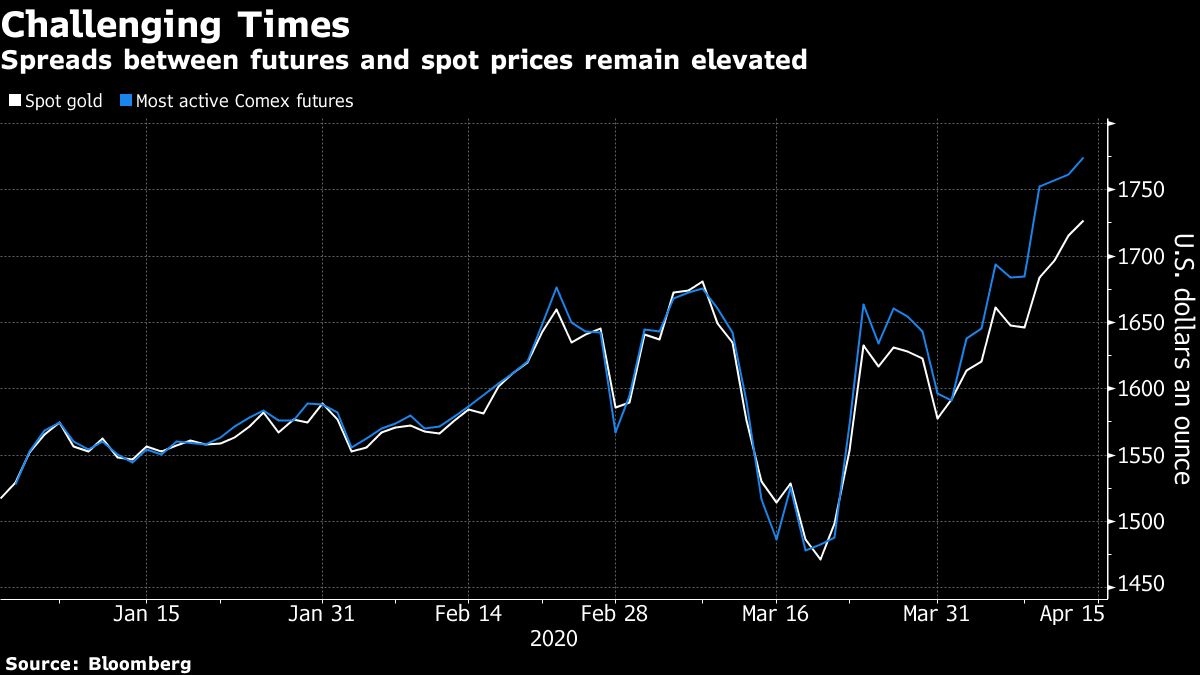
Futures in New York moved closer to US$1,800 an ounce, a level last seen in 2011. Spreads between futures and spot prices remain wide, suggesting thinner liquidity, which is further exacerbating price dislocation.
“Liquidity conditions are challenging and market participants are understandably cautious,†Joni Teves, a strategist at UBS Group AG, said Tuesday in a note. “Gold’s journey has been quite bumpy so far, but given the macro backdrop we think the destination remains higher.â€
Bullion has soared this year as the global heath crisis tipped economies toward recession and spurred central banks to launch huge stimulus measures. Since last month’s wave of forced selling, as equities sank, gold has staged a recovery.
Comex gold futures for June delivery climbed as much as 1.6 per cent to US$1,788.80 an ounce, the highest for a most-active contract since October 2012. The metal rose 0.4 per cent to settle at US$1768.90 at 1:30 p.m. in New York. Spot gold was more than US$30 cheaper at US$1,737.20, with the spread a feature of trading in recent weeks amid physical market disruptions.
Futures pared earlier gains as “there’s a little bit of a move on volatility, and equities turned around a bit, and what we might be seeing is that people are locking in what they’ve gained on gold here,†Bart Melek, head of commodity strategy at TD Securities, said by phone.
Overall, gold still has room to run, according to Hans Goetti, founder and chief executive officer of HG Research.
“What’s happening here is that the Fed is expanding its balance sheet and every other central bank in the world is doing the same,†he told Bloomberg TV. “What you’re looking at is massive currency debasement in the long term. That’s the major reason why gold is higher, and I would think that over the next few weeks or months, we’re probably going to retest the high that we saw in 2011.â€
The Federal Reserve’s massive U.S. monetary program and the fiscal stimulus “could see long-end rates rise during the recovery phase, but not without rising inflation expectations, which should keep real rates suppressed,†TD Securities analysts said in an emailed note. “In this context, we suspect that investment demand for gold will continue to rise as capital seeks shelter from a long-term environment in which real rates are negative.â€
Negative real rates boosts the appeal of non-interest-bearing bullion.
Gold’s latest upswing has come even as risk sentiment received a boost after China’s trade data beat estimates, while the pace of coronavirus infections has slowed in some countries, with the focus shifting toward how lockdowns can be eased. President Donald Trump said he has “total†authority to order states to relax social distancing and reopen their economies.
Worldwide holdings in bullion-backed exchange-traded funds have ballooned to a record on rising demand, with investors seeking additional portfolio protection. On Monday, volumes in SPDR Gold Shares, the largest such fund, surged above 1,000 tons to the highest since mid-2013.
In other precious metals, silver futures also advanced on the Comex, while platinum and palladium gained on the New York Mercantile Exchange.
Posted by AGORACOM-JC
at 1:52 PM on Thursday, April 16th, 2020
Announced that further to its press release dated March 24th, 2020, the second payment of approx. $1.4M has already been received under the exclusive contract with Drosrite International LLC
“Due to an unprecedented number of inquiries received from investors, we decided to confirm receipt of the second payment of $1.4M noted in this press release,†said Mr. P. Peter Pascali, President and CEO of PyroGenesis
MONTREAL, April 16, 2020 — PyroGenesis Canada Inc. (http://www.pyrogenesis.com) (TSX-V: PYR) (OTCQB: PYRNF) (FRA: 8PY), a high-tech company, (the “Company”, the “Corporation†or “PyroGenesis”) that designs, develops, manufactures and commercializes plasma atomized metal powder, plasma waste-to-energy systems and plasma torch products, in response to an extraordinary volume of inquiries with respect to the subject matter, is pleased to announce that, further to its press release dated March 24th, 2020, the second payment of approx. $1.4M has already been received under the exclusive contract with Drosrite International LLC (“DIâ€).
“Due to an unprecedented number of inquiries received from investors, we decided to confirm receipt of the second payment of $1.4M noted in this press release,†said Mr. P. Peter Pascali, President and CEO of PyroGenesis. “We would also like to confirm that additional payments are being processed as anticipated and that, as per DI’s press release dated January 27th, 2020, work has already begun. I would also like to take this opportunity to further emphasize to readers that in general, notwithstanding receipt of payments, revenues and expenses are based on percent completion and not receipt of payments.â€
As previously disclosed, and as part of this exclusive arrangement between DI and PyroGenesis, DI will pay PyroGenesis approximately $25M, based on current exchange rates, over the first 12 months as well as approx. $3M per year (fixed) for the next two (2) years, together with a variable amount for the subsequent 18 years based on certain international benchmarks.
About Drosrite International LLC
DI is a US based private company duly constituted and existing under the laws of the State of Delaware, providing state-of-the-art waste management technologies to the aluminum industry. DI is duly licensed by PyroGenesis to manufacture, market, sell and distribute DROSRITE™ systems and technology to the Kingdom of Saudi Arabia, and certain other countries in the Middle East, on an exclusive basis. All DROSRITE™ systems supplied by DI are manufactured in the USA.
About PyroGenesis Canada Inc.
PyroGenesis Canada Inc., a high-tech company, is the world leader in the design, development, manufacture and commercialization of advanced plasma processes and products. We provide engineering and manufacturing expertise, cutting-edge contract research, as well as turnkey process equipment packages to the defense, metallurgical, mining, advanced materials (including 3D printing), oil & gas, and environmental industries. With a team of experienced engineers, scientists and technicians working out of our Montreal office and our 3,800 m2 manufacturing facility, PyroGenesis maintains its competitive advantage by remaining at the forefront of technology development and commercialization. Our core competencies allow PyroGenesis to lead the way in providing innovative plasma torches, plasma waste processes, high-temperature metallurgical processes, and engineering services to the global marketplace. Our operations are ISO 9001:2015 and AS9100D certified, and have been since 1997. PyroGenesis is a publicly-traded Canadian Corporation on the TSX Venture Exchange (Ticker Symbol: PYR) and on the OTCQB Marketplace. For more information, please visit www.pyrogenesis.com
This press release contains certain forward-looking statements, including, without limitation, statements containing the words “may”, “plan”, “will”, “estimate”, “continue”, “anticipate”, “intend”, “expect”, “in the process” and other similar expressions which constitute “forward- looking information” within the meaning of applicable securities laws. Forward-looking statements reflect the Corporation’s current expectation and assumptions and are subject to a number of risks and uncertainties that could cause actual results to differ materially from those anticipated. These forward-looking statements involve risks and uncertainties including, but not limited to, our expectations regarding the acceptance of our products by the market, our strategy to develop new products and enhance the capabilities of existing products, our strategy with respect to research and development, the impact of competitive products and pricing, new product development, and uncertainties related to the regulatory approval process. Such statements reflect the current views of the Corporation with respect to future events and are subject to certain risks and uncertainties and other risks detailed from time-to-time in the Corporation’s ongoing filings with the securities regulatory authorities, which filings can be found at www.sedar.com, or at www.otcmarkets.com. Actual results, events, and performance may differ materially. Readers are cautioned not to place undue reliance on these forward-looking statements. The Corporation undertakes no obligation to publicly update or revise any forward- looking statements either as a result of new information, future events or otherwise, except as required by applicable securities laws. Neither the TSX Venture Exchange, its Regulation Services Provider (as that term is defined in the policies of the TSX Venture Exchange) nor the OTCQB accepts responsibility for the adequacy or accuracy of this press release.
SOURCE PyroGenesis Canada Inc.
For further information please contact:
Rodayna Kafal, Vice President Investors Relations and Strategic Business Development, Phone: (514) 937-0002, E-mail: [email protected]
Posted by AGORACOM-JC
at 1:06 PM on Thursday, April 16th, 2020
Common stock and Unit A Warrants began trading on the Nasdaq Capital Market on April 14, 2020, under the symbols “GMBL†and “GMBLW,†respectively
Company received gross proceeds of approximately $8.4 million, before deducting underwriting discounts and commissions and other estimated offering expenses
BIRKIRKARA, Malta, April 16, 2020 — Esports Entertainment Group, Inc. (NasdaqCM: GMBL, GMBLW) (or the “Companyâ€) a licensed online gambling company with a focus on esports wagering and 18+ gaming, today announced the closing of its previously announced underwritten public offering of 1,980,000 units at a price to the public of $4.25 per unit. Each unit issued in the offering consists of one share of common stock, one Unit A Warrant to purchase one share of common stock and one Unit B Warrant to purchase one share of common stock. The common stock, Unit A Warrants and Unit B Warrants were immediately separable from the units and were issued separately. The common stock and Unit A Warrants began trading on the Nasdaq Capital Market on April 14, 2020, under the symbols “GMBL†and “GMBLW,†respectively. Esports Entertainment Group received gross proceeds of approximately $8.4 million, before deducting underwriting discounts and commissions and other estimated offering expenses.
Each Unit A Warrant is immediately exercisable for one share of common stock at an exercise price of $4.25 per share and will expire 5 years from issuance, and each Unit B Warrant is immediately exercisable at an exercise price of $4.25 per share and will expire one year from issuance.
Esports Entertainment Group has granted the underwriters a 45-day option to purchase up to 297,000 additional shares of common stock, and/or 297,000 Unit A Warrants, and/or 297,000 Unit B Warrants, or any combination thereof, to cover over-allotments, if any. On April 16, 2020, the Company issued additional Unit A Warrants to purchase 209,400 shares of the Company’s common stock and additional Unit B Warrants to purchase 209,400 shares of the Company’s common stock pursuant to the partial exercise of the underwriters’ over-allotment option in connection with the offering.
Maxim Group LLC acted as the lead book-running manager for the offering. Joseph Gunnar & Co., LLC acted as co-book-running-manager for the offering.
The offering was conducted pursuant to the Company’s registration statement on Form S-1 (File No. 333-231167) previously filed with and subsequently declared effective by the Securities and Exchange Commission (“SEC”). A prospectus relating to the offering will be filed with the SEC and will be available on the SEC’s website at http://www.sec.gov. Electronic copies of the prospectus relating to this offering, when available, may be obtained from Maxim Group LLC, 405 Lexington Avenue, 2nd Floor, New York, NY 10174, at (212) 895-3745.
This press release shall not constitute an offer to sell or the solicitation of an offer to buy these securities, nor shall there be any sale of these securities in any state or jurisdiction in which such offer, solicitation or sale would be unlawful prior to registration or qualification under the securities laws of any such state or jurisdiction.
ABOUT ESPORTS ENTERTAINMENT GROUP
Esports Entertainment Group, Inc. is a licensed online gambling company with a specific focus on esports wagering and 18+ gaming. Esports Entertainment offers fantasy, pools, fixed odds and exchange style wagering on esports events in a licensed, regulated and secure platform to the global esports audience at vie.gg. In addition, Esports Entertainment intends to offer users from around the world the ability to participate in multi-player mobile and PC video game tournaments for cash prizes. Esports Entertainment is led by a team of industry professionals and technical experts from the online gambling and the video game industries, and esports. The Company holds a license to conduct online gambling and 18+ gaming on a global basis in Curacao, Kingdom of the Netherlands. The Company maintains offices in Malta. For more information visit www.esportsentertainmentgroup.com
FORWARD-LOOKING STATEMENTS
The information contained herein includes forward-looking statements. These statements relate to future events or to our future financial performance, and involve known and unknown risks, uncertainties and other factors that may cause our actual results, levels of activity, performance, or achievements to be materially different from any future results, levels of activity, performance or achievements expressed or implied by these forward-looking statements. You should not place undue reliance on forward-looking statements since they involve known and unknown risks, uncertainties and other factors which are, in some cases, beyond our control and which could, and likely will, materially affect actual results, levels of activity, performance or achievements. Any forward-looking statement reflects our current views with respect to future events and is subject to these and other risks, uncertainties and assumptions relating to our operations, results of operations, growth strategy and liquidity. We assume no obligation to publicly update or revise these forward-looking statements for any reason, or to update the reasons actual results could differ materially from those anticipated in these forward-looking statements, even if new information becomes available in the future. The safe harbor for forward-looking statements contained in the Securities Litigation Reform Act of 1995 protects companies from liability for their forward-looking statements if they comply with the requirements of the Act.
Contact:
U.S. Investor Relations RedChip Companies, Inc. Dave Gentry 407-491-4498 [email protected]
Posted by AGORACOM
at 9:16 AM on Thursday, April 16th, 2020
Affinity Metals Corp. (TSXV: AFF) (“Affinity”) (“the Corporation”) is pleased to release assay results from the late fall drill program conducted on the Regal property encompassing 8,800 hectares of the northern end of the prolific Kootenay Arc approximately 25 km northeast of Revelstoke, British Columbia, Canada.
Along with numerous high grade intercepts in multiple holes, a significant new silver discovery was made in the ALLCO area with drill hole #10 intersecting 11.10 meters of 143.29 g/t silver including 0.55 meters of 2612.0 g/t silver. This intersection also carried high grade zinc and lead with some copper.
A total of 1,846.35 meters of diamond drilling was completed with 21 holes being drilled.
The drilling was divided over two separate target areas with 10 holes from two separate drill pads allocated to testing two areas within a graphitic argillite/limestone contact in the ALLCO area. Mineralized intersections encountered within the ALLCO area drill core consisted mostly of argentiferous galena, sphalerite and tetrahedrite hosted within quartz veins and breccias along a northwest-southeast fault that separates the limestones from the argillites.
A further 11 preliminary confirmation holes were drilled from a single drill pad designed to begin testing the underground structure associated with the historic 1971 resource (pre NI43-101 and therefore not compliant) reported for the past producing Regal/Snowflake mines. The Regal mine is located within moderately to gently, westerly dipping, graphitic phyllites/argillites of the lower Index Formation. Mineralization, hosted in quartz veins concordant with host rocks, consists of pyrite, galena, sphalerite, and locally with scheelite (lower levels), stannite (upper levels), and trace chalcopyrite/tetrahedrite throughout. Sulphides occur either as disseminations in the quartz, or as massive pods or bands parallel with slatey partings.
Robert Edwards, CEO of Affinity stated: “We are extremely encouraged to see such positive assay results from the 2019 drilling, our first drill program on the property. Our expectations were that the assays would show strong mineralization given what we have seen from our prior surface sampling program and the historical production grades, but to find this new 11 meter silver zone is truly exciting! These results set the backdrop for our 2020 exploration program which will target not only this new silver discovery but even more importantly, the two very large anomalies identified by the geophysics that may be the core deposits associated with all this surrounding mineralization. 2020 should be a very exciting year for Affinity.”
Significant intervals from the drill program are presented below:
ALLCO
Hole No.
From (m)
To (m)
Interval (m)
Ag g/t
Cu %
Pb %
Zn %
RP-19-01
28.67
29.09
0.42
106.00
0.06
0.33
0.01
RP-19-01
105.00
106.00
1.00
28.72
0.10
0.05
0.09
RP-19-03
48.70
48.77
0.07
171.00
0.05
1.24
0.46
RP-19-04
38.64
41.00
2.36
214.13
0.14
2.60
2.67
including
38.64
40.32
1.68
62.55
0.08
0.25
0.16
and
40.32
41.00
0.68
588.63
0.30
8.41
8.87
RP-19-05
40.25
43.00
2.75
29.74
0.02
0.02
0.01
RP-19-05
44.75
45.51
0.76
50.80
0.02
0.25
1.64
RP-19-05
56.33
56.78
0.45
26.16
0.00
0.89
0.91
RP-19-06
39.26
43.29
4.03
29.53
0.08
0.13
7.38
including
42.00
42.62
0.62
17.90
0.04
0.02
4.12
and
42.62
43.29
0.67
130.00
0.40
0.41
40.14
RP-19-06
49.72
50.57
0.85
129.02
0.03
0.04
0.32
RP-19-07
38.37
39.27
0.90
182.00
0.13
0.30
0.32
RP-19-07
43.70
46.51
2.81
49.21
0.02
0.34
0.78
including
45.10
46.25
1.15
91.92
0.02
0.71
1.68
RP-19-07
56.61
57.42
0.81
98.60
0.01
2.42
2.45
RP-19-08
45.44
45.94
0.50
20.64
0.00
0.46
0.01
RP-19-08
47.84
52.27
4.43
111.96
0.09
0.23
0.29
including
49.24
51.12
1.88
238.20
0.19
0.51
0.50
RP-19-08
57.51
58.52
1.01
45.70
0.00
0.05
0.03
RP-19-08
67.86
68.05
0.19
85.24
0.02
1.21
0.11
RP-19-08
82.46
82.66
0.20
11.39
0.00
0.32
0.01
RP-19-08
84.82
85.02
0.20
568.00
0.55
0.08
0.18
RP-19-09
44.41
46.62
2.21
28.70
0.02
0.15
0.13
RP-19-09
46.62
48.70
2.08
31.70
0.02
0.47
1.12
RP-19-09
48.70
49.76
1.06
6.88
0.00
0.14
0.32
RP-19-10
61.00
72.10
11.10
143.29
0.04
0.62
0.50
including
61.00
67.81
6.81
230.84
0.07
0.94
0.66
including
61.00
61.31
0.31
122.00
0.03
4.18
5.04
and
62.72
63.27
0.55
2612.00
0.66
6.00
2.89
REGAL
Hole No.
From (m)
To (m)
Interval (m)
Ag g/t
Cu %
Pb %
Zn %
RP-19-11
9.14
9.38
0.24
13.24
0.00
0.73
0.03
RP-19-11
11.14
15.79
4.65
12.23
0.00
0.32
0.36
including
15.35
15.79
0.44
52.47
0.00
1.20
2.89
RP-19-11
58.44
59.85
1.41
24.85
0.01
0.77
0.25
RP-19-12
7.32
7.62
0.30
40.02
0.00
0.69
0.02
RP-19-12
11.20
11.80
0.60
39.64
0.00
0.95
0.25
RP-19-12
11.93
13.02
1.09
35.90
0.01
0.89
0.79
RP-19-12
13.80
17.77
3.97
26.00
0.00
0.59
0.25
including
13.8
16.17
2.37
39.78
0.00
0.90
0.30
RP-19-12
60.18
60.70
0.52
12.28
0.00
0.07
0.96
RP-19-13
13.76
17.41
3.65
25.38
0.00
0.58
0.48
including
16.91
17.41
0.50
102.21
0.00
1.87
0.28
RP-19-13
18.57
19.05
0.48
15.44
0.01
0.71
0.22
RP-19-14
10.89
11.18
0.29
60.81
0.02
1.24
1.64
RP-19-14
12.28
12.84
0.56
19.83
0.00
0.25
0.21
RP-19-14
12.99
13.34
0.35
13.28
0.03
0.54
0.47
RP-19-14
13.49
13.82
0.33
20.02
0.00
0.35
0.96
RP-19-14
13.93
14.22
0.29
33.00
0.00
1.32
0.53
RP-19-14
16.04
16.31
0.27
43.86
0.00
1.65
1.01
RP-19-15
14.88
15.38
0.50
12.37
0.00
0.38
0.68
RP-19-16
11.30
11.88
0.58
31.23
0.01
0.91
0.55
RP-19-16
13.07
13.80
0.73
41.88
0.00
0.92
0.46
RP-19-16
14.48
15.32
0.84
23.84
0.00
0.62
0.44
RP-19-16
16.88
17.80
0.92
32.15
0.00
1.40
0.56
RP-19-16
28.13
28.29
0.16
4.99
0.02
0.02
2.21
RP-19-17
7.01
7.16
0.15
1360.00
0.01
19.67
0.21
RP-19-17
10.94
11.69
0.75
62.32
0.00
2.78
0.19
RP-19-17
14.64
15.47
0.83
19.82
0.00
0.52
0.36
RP-19-18
12.12
13.41
1.29
48.31
0.00
2.66
0.53
including
12.12
12.94
0.82
70.50
0.00
4.02
0.53
RP-19-18
15.97
18.53
2.56
13.02
0.00
0.33
1.43
including
15.97
17.41
1.44
12.81
0.01
0.37
2.52
RP-19-18
19.92
20.52
0.60
27.27
0.04
1.15
0.76
RP-19-19
6.00
7.00
1.00
68.42
0.00
2.38
0.22
including
6.00
6.30
0.30
134.00
0.01
7.13
0.13
RP-19-19
12.13
17.68
5.55
13.35
0.00
0.46
0.39
including
15.82
17.68
1.86
30.83
0.00
1.17
0.78
RP-19-19
29.91
30.42
0.51
22.88
0.02
1.22
0.89
RP-19-20
6.15
6.65
0.50
46.47
0.01
1.75
0.13
RP-19-20
7.60
8.32
0.72
33.37
0.00
0.50
0.19
RP-19-20
12.01
12.68
0.67
21.51
0.01
0.67
0.49
RP-19-20
15.27
16.36
1.09
18.63
0.00
0.48
0.43
RP-19-20
17.29
18.68
1.39
10.52
0.00
0.34
0.62
RP-19-20
28.08
31.17
3.09
58.78
0.00
0.35
0.33
including
29.52
30.22
0.70
214.00
0.00
0.34
0.19
RP-19-21
9.05
9.56
0.51
37.45
0.00
0.58
0.02
RP-19-21
12.98
13.82
0.84
17.29
0.01
0.47
0.79
RP-19-21
15.89
17.27
1.38
39.77
0.00
1.55
0.70
including
15.89
16.57
0.68
76.50
0.00
3.07
0.31
and
17.00
17.27
0.27
1.84
0.00
0.06
2.27
RP-19-21
30.40
30.54
0.14
46.83
0.00
0.31
0.16
RP-19-21
31.82
32.82
1.00
61.10
0.01
3.39
1.49
RP-19-21
72.01
72.26
0.25
77.11
0.00
0.62
0.02
Note: True widths are presently unknown.
Additional assay work is presently being conducted regarding Tin results in the drill core. Those results will be released once received and interpreted.
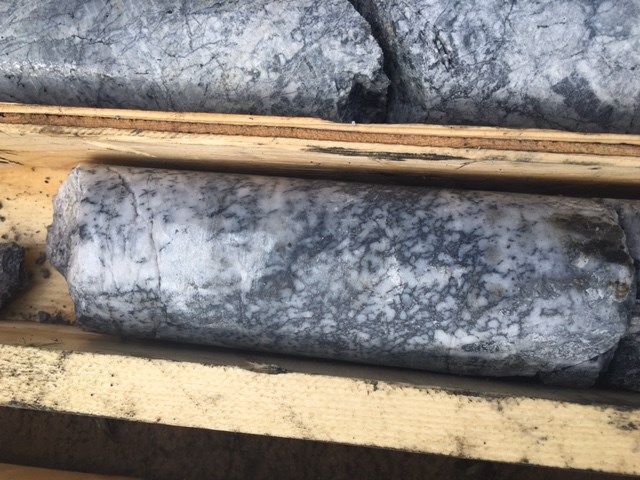
Photo description: Photos of 11.10 meter silver discovery intersection in Hole #10. Host rock is a limestone dissolution breccia/dolomitization breccia with weak to moderate silicification overprinting. Flooding this is milky quartz which hosts wispy veinlets of galena and blebby sphalerite at intersections of these or other veinlets.
As previously reported, the Corporation received assay results for 22 rock samples collected from surface outcrops in September 2019 from the Black Jacket and ALLCO areas of the property. Of the 22 grab samples collected, the majority contained bonanza grade silver, zinc, and lead with many samples reaching assay over-limits. The over-limit results for zinc and lead are reported in the table below (italicized) beside the original assay values. Assay values for tin, including high grade samples 11, 14 and 20 which were over-limit in the original assay report, are also presented in the last column of the table.
Sample Number
Sample Type
Silver g/t
Copper %
Zinc %
Lead %
Gold g/t
Tin ppm
ALC19CR01
grab
0
.035
0
0
0
0.4
ALC19CR02
grab
1300
.415
18.20
>20.0 (35.69)
0.70
46.1
ALC19CR03
grab
120
.232
.034
.984
0.02
2.4
ALC19CR04
grab
131
.089
.026
.102
2.66
1.1
ALC10CR05
grab
16.7
.295
.060
.013
0.09
0.4
ALC19CR06
grab
74.9
.144
>30.00 (34.97)
.059
0.28
2.6
ALC19CR07
grab
10.05
.310
.086
.029
0.04
0.5
ALC19CR08
grab
1870
.495
24.5
>20.0 (31.90)
1.85
189.5
ALC19CR09
grab
88.1
.077
>30.00 (39.98)
1.88
0.08
32
ALC19CR10
grab
1545
.178
26.7
>20.0 (28.67)
0.68
373
ALC19CR11
grab
2360
.366
16.80
>20.0 (43.67)
0.11
900
ALC19CR12
grab
3700
.624
1.645
>20.0 (71.14)
3.14
273
ALC19CR13
grab
964
.716
17.30
17.5
0.11
386
ALC19CR14
grab
3530
.350
1.945
>20.0 (59.54)
1.57
1600
ALC19CR15
grab
3670
.026
1.895
>20.0 (77.01)
0.33
205
ALC19CR16
grab
1790
.107
5.28
>20.0 (52.77)
0.37
146.5
ALC19CR17
grab
751
.069
6.45
18.05
0.45
107
ALC19CR18
grab
1065
.718
.178
.514
0.10
7.6
ALC19CR19
grab
2510
.299
5.58
>20.0 (70.63)
0.06
167
ALC19CR20
grab
4410
2.27
26.40
>20.0 (21.56)
5.68
4500
ALC19CR21
grab
47.5
.177
.048
.092
1.78
8.8
ALC19CR22
grab
87.7
.095
.011
.047
4.79
2.9
Property History & Background
The Regal Project hosts several past producing small-scale historic mines including the Regal Silver.
The property also hosts numerous promising mineral occurrences. From the historic records it appears that most, and perhaps all, of the known mineralized showings/zones have not been previously drilled using modern diamond drilling methods.
The geology of the Regal property generally consists of the Badshot and Lade Peak limestones, and argillites and phyllites of the Index Formation.
Snowflake and Regal Silver (Stannex/Woolsey) Mines
The Snowflake and Regal Silver mines were two former producing mines that operated intermittently during the period 1936-1953. The last significant work on the property took place from 1967-1970, when Stannex Minerals completed 2,450 meters of underground development work and a feasibility study, but did not restart mining operations. In 1982, reported reserves were 590,703 tonnes grading 71.6 grams per tonne silver, 2.66 per cent lead, 1.26 per cent zinc, 1.1 per cent copper, 0.13 per cent tin and 0.015 per cent tungsten (Minfile No. 082N 004 – Prospectus, Gunsteel Resources Inc., April 29, 1986). It should be noted that the above resource and grades, although believed to be reliable, were prepared prior to the adoption of NI43-101 and are not compliant with current standards set out therein for calculating mineral resources or reserves.
ALLCO Silver Mine
The ALLCO Silver Mine is situated 6.35 Kilometers northwest of the above described Snowflake/Regal Mine(s). The ALLCO Silver Mine operated from 1936-1937 and produced 213 tonnes of concentrates containing 11 troy ounces of gold (1.55 g/t), 11,211 troy ounces of silver (1,637 g/t) and 173,159 lbs of lead (36.9%).
Airborne Geophysics to Guide Future Exploration
An extensive airborne geophysics survey conducted by Geotech Ltd of Aurora, Ontario, for Northaven Resources Corp. in 2011, on the Regal Project identified four well defined high potential linear targets correlating with the same structural orientation as the Allco, Snowflake and Regal Silver mines. Northaven also reported that the mineralogy and structural orientation of the Allco, Snowflake and Regal Silver appeared to be similar to that of Huakan’s J&L gold project located to the north, and on a similar geophysical trend line. The J&L is reportedly now one of western Canada’s largest undeveloped gold deposits. Rokmaster Resources Corp. recently optioned the J&L property in a $44.2M deal and has renamed it the Revel Ridge Project. Rokmaster is presently working on expanding the current resource.
After completing the airborne survey, Northaven failed in financing their company and conducting further follow up exploration on the property and subsequently forfeited the claims without any of the follow up work ever being completed. Affinity Metals is in the fortunate position of benefitting from this significant and promising geophysics data and the associated targets.
The aforementioned Northaven airborne geophysical survey conducted at a cost of $319,458.95 in August of 2011 is described in The BC Ministry of Energy, Mines and Petroleum Resources Assessment Report #33054. The results of the survey are competently explained and illustrated by professionals on You Tube at: https://www.youtube.com/watch?v=GX431eBY_t0
Condor Consulting, Inc. who compiled the survey data and produced the original geophysics report was recently retained by Affinity in order to provide more detailed interpretations and potential drill target locations with the aim of testing two of the four main target areas in the future.
Earth Sciences Services Corp. (ESSCO) has also recently provided acoustical geophysics data for portions of the Regal property. This data is also being interpreted and analyzed with respect to future drill targets.
The Corporation is presently in the process of correlating and interpreting all of the historic and new geophysical and geochemical data as well as the 2019 drill results with the objective of further defining 2020 drill targets.
Affinity Metals has been granted a 5 Year Multi-Year-Area-Based (MYAB) exploration permit which includes approval for 51 drill sites.
Assay Procedure, Quality Assurance and Quality Control Procedures
All drill core samples were sent to MSA Laboratories in Langley, British Columbia for assay. Samples were analyzed by the following methods, as appropriate, to determine grades: ICP-130 35 element two acid digestion with ICP-AES finish, IMS-130 51 element two acid digestion with ICP-AES/MS finish, FAS-418 Ag 30g fire assay with gravimetric finish, determination of Ag, Cd, Pb, W, and Zn with four acid digestion and ICP-AES finish, determination of Pb and Zn by titration, and determination of Sn by Sodium Peroxide fusion with ICP-OES finish.
The Company employed a QA/QC program that was managed by a Qualified Person during the entire drill program. Blanks, duplicates (both pulp splits and 1/4 core), and two certified standard reference materials were used. These QA/QC samples were inserted at a rate of 1 every 10 to 15 samples.
Qualified Person
The Qualified Person for the Regal Project for the purposes of National Instrument 43-101 is Frank O’Grady, P.Eng. He has read and approved the scientific and technical information that forms the basis for the disclosure contained in this news release.
About Affinity Metals
Affinity Metals is focused on the acquisition, exploration and development of strategic metal deposits within North America.
The Corporation’s flagship project and present focus is the Regal.
On behalf of the Board of Directors
Robert Edwards, CEO and Director of Affinity Metals Corp.
Posted by AGORACOM
at 8:42 AM on Thursday, April 16th, 2020
Sponsor: Loncor, a Canadian gold explorer controlling over 2,400,000 high grade ounces outside of a Barrick JV. The Ngayu JV property is 200km southwest of the Kibali gold mine, operated by Barrick, which produced 800,000 ounces of gold in 2018. Barrick manages and funds exploration at the Ngayu project until the completion of a pre-feasibility study on any gold discovery meeting their Tier One investment criteria. Newmont $NGT$NEM owns 7.8%, Resolute $RSG owns 27% Click Here for More Info
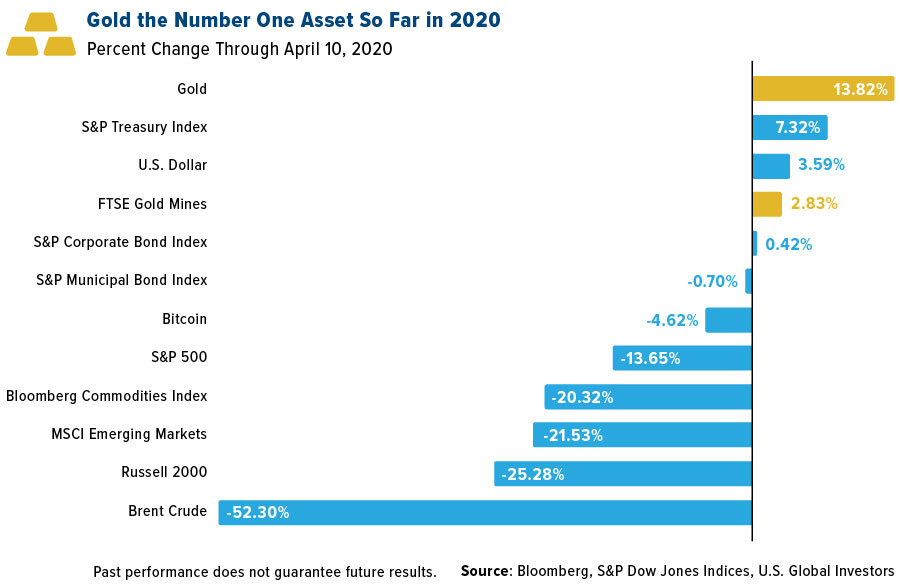
Physical gold was up 13.8 percent through April 10
Too few investors have adequate exposure to the yellow metal
Gold and gold stocks are among the highest performing assets of 2020 so far as investors seek a haven amid the coronavirus-fueled rout, and as central banks and governments around the world roll out unprecedented monetary and fiscal measures in an effort to mitigate the economic impact of the “Great Lockdown.â€
That’s the name the International Monetary Fund (IMF) has given this uncertain period, and I believe it may stick. The IMF added that the “world economy will experience the worst recession since the Great Depression,†with global economic growth this year projected to fall to negative 3 percent.
This highlights the importance of protecting your family’s wealth right now, which savvy investors have historically managed to do with gold and precious metals.
Physical gold was up about 13.8 percent through April 10, while senior gold miners advanced 2.8 percent, making the group the best asset class of the year so far. Longtime readers of Frank Talk know that I frequently recommend a 10 percent weighting in gold and gold stocks, and now you can see why. A 10 percent allocation at the beginning of the year—before any of us had ever heard of the novel coronavirus—could have helped minimize the impact of losses in other positions.
(Click on images to enlarge)
The problem is that too few investors have adequate exposure to the yellow metal. That’s the case even for many who may believe they do. As the World Gold Council (WGC) pointed out last year, most broad-based commodity indices have a very small weighting in gold — the S&P GSCI’s, for instance, is only 3.37 percent. What this means is that investors in funds that track these indices likely do not get the full benefit of having gold in their portfolio.
That’s why I recommend that the 10 percent weighting be split into two halves, with 5 percent in physical gold (bars, coins, 12-karat jewelry ) and the other 5 percent in high-quality gold and precious metal mining stocks, mutual funds and ETFs.
Maybe you’ve missed the rally up to this point, but the good news is that it’s probably still not too late to participate.
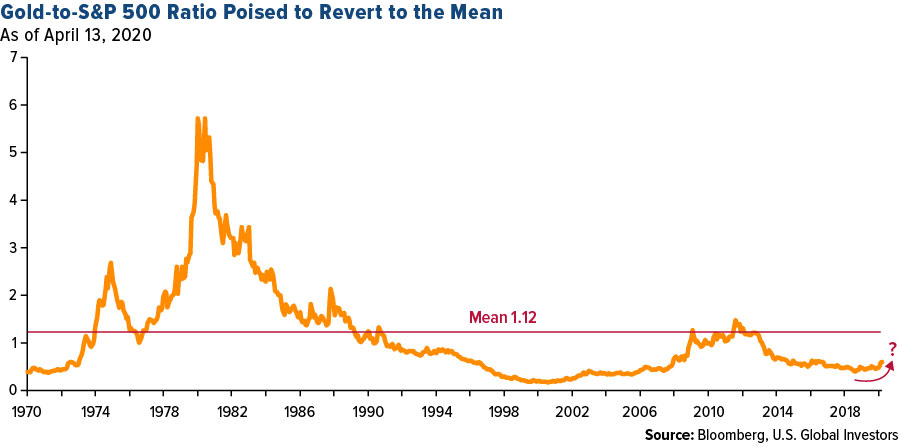
Gold Well-Positioned to Revert to Its Mean Relative to the S&P 500
According to analysis by Bloomberg commodity strategist Mike McGlone, the price of gold appears to be seeking to revert to its long-term mean relative to the S&P 500 Index. This would suggest that we could see a new record high, driven largely by excessive money printing.
“Unprecedented global monetary stimulus is a worthy catalyst for the per-ounce price of gold to revert to its long-term mean vs. the S&P 500 Index, in our view,†McGlone explains.
The implication of mean reversion right now is that gold would hit a new all-time high, assuming the S&P continues to trade around 2,800. After all, a one-to-one ratio means that both assets are trading at the same level.
This has happened before, as you can see in the chart above. As recently as March 2013, both spot gold and the S&P 500 were trading in the same 1,500 to 1,600 range. Before that, in May 1990, it was a 330 to 360 range.
A reversion to the mean now—again, assuming the S&P continues to trade at its current level—would put the yellow metal at approximately $2,800 an ounce, a new record high by far.
But remember, that’s just a simple one-to-one ratio. The long-term gold/S&P mean is slightly higher, at 1.12, so the gold price would also be slightly higher, possibly closer to $3,000 an ounce.
Mean reversion is something I write about more in-depth in “Managing Expectations: Anticipate Before You Participate in the Market,†which you can read by clicking here.
Interest in Gold Mining Stocks and Gold Royalty Companies Takes Off
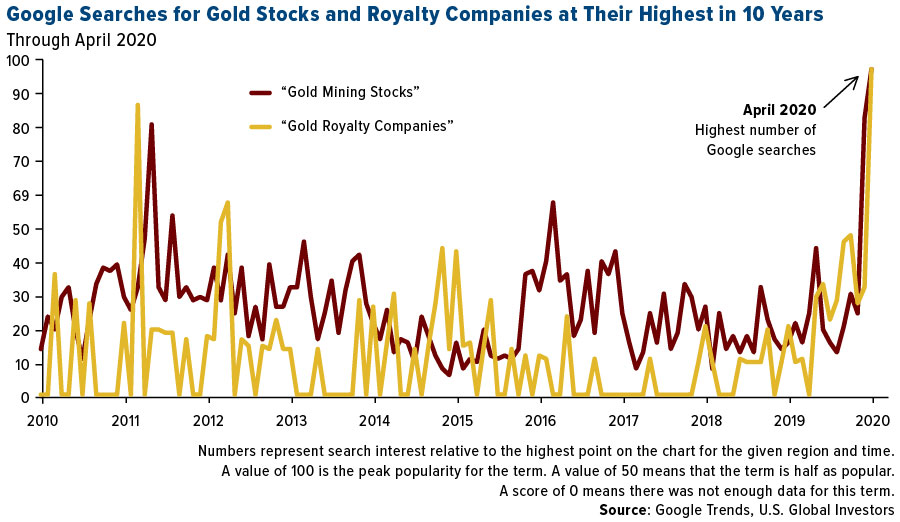
Not enough investors have optimal exposure to gold, according to the WGC, but we’re currently seeing a surge in interest in gold mining stocks and gold royalty companies, if Google search data is any indication.
Search terms using “gold mining stocks†and “gold royalty companies†were higher this month than at any other time in the past 10 years. That includes when the yellow metal hit its record high of $1,900 an ounce in 2011.
Google Trends isn’t a leading indicator recognized by mainstream economists and market analysts, but I believe it shows where investors’ thinking may be at right now. They’re seeking a way to preserve their wealth as we face what could be the worst economic downturn in nearly 100 years, and they’re betting that higher precious metal prices will send shares of gold mining and royalty companies higher as well.
Posted by AGORACOM-JC
at 7:15 AM on Thursday, April 16th, 2020
Entered into an agreement on April 13, 2020 securing the rights to import the iONEBIO INC’s iLAMP Novel-CoV19 Detection Kit (real-time Reverse Transcription LAMP-PCR assay system) into Canada
Under the terms of this agreement, Datametrex was also given rights to sell the tests into other countries around the globe, including the United States
iONEBIO Inc. claims their test kits provide results within approximately 15 to 20 minutes with 99.9% accuracy
TORONTO, April 16, 2020 — Datametrex AI Limited (the “Company†or “Datametrexâ€) is pleased to announce that entered into an agreement on April 13, 2020 securing the rights to import the iONEBIO INC’s iLAMP Novel-CoV19 Detection Kit (real-time Reverse Transcription LAMP-PCR assay system) into Canada, Under the terms of this agreement, Datametrex was also given rights to sell the tests into other countries around the globe, including the United States. Datametrex has developed strong relationships with many large multi-national companies in South Korea.  As a result of these relationships, the Canadian Embassy in Seoul contacted Datametrex to ask for help in procuring rapid test kits.
The COVID-19 test kits are manufactured by iONEBIO INC. in South Korea, and are the same test kits that have been successfully used in South Korea in their “drive-through†testing stations. This kit has also been used to test every traveller entering into South Korea and those testing positive for Covid-19 were immediately isolated. Datametrex believes a key factor that allowed South Korea to slow the spread of COVID-19 was its ability to swiftly identify and quarantine those infected by testing millions of people using these test kits These test kits were first approved for use by the Korean Ministry of Food and Drug Safety on August 30, 2019. In addition, an independent study was conducted by DankukUniversity (DKU) in Seoul, South Korea, and it was completed and approved on April 2, 2020.
Health Canada must approve these COVID-19 test kits before they can be used in Canada. The Company is currently working with Health Canada to have the approval of these kits fast tracked. These test kits are currently in use in some European and Asian countries outside of South Korea. Approval work has commenced with the FDA in the United States to obtain FDA approval and to authorize the tests under the Emergency Use Authorization Program run by US Center for Disease Control (CDC).
iONEBIO Inc. claims their test kits provide results within approximately 15 to 20 minutes with 99.9% accuracy. Each kit contains 288 individual tests, all of which can be completed in one hour. By utilizing these kits, screening stations can be set up almost anywhere and will allow for the early detection and swift quarantine of infected persons, which is believed to be a key factor in slowing the spread of the novel coronavirus. Early detection using rapid tests will also provide further protection to Canada’s front-line workers, especially health care professionals.
South Korea has used this kit to test millions of its citizens and, as of April 14, 2020, there have been 10,654 cases of Covid-19 and 222 deaths reported. In North America, where the use of a rapid test has not been implemented on a large scale, there have been, as at April 14, 2020, 25,680 cases and 780 deaths in Canada and 588,465 cases and 23,711 death in the US. (All data collected by Datametrex’s Covid-19 dashboard, which is available at http://www.datametrex.com/covid-board.html)
“We strongly believe these kits will assist Canada in slowing the spread of Covid-19 and ultimately save lives. It’s incredibly rewarding for us to be able to help Canada combat the spread of COVID-19,†said Andrew Ryu, Chairman of the Company.
If the test kits are approved by Health Canada and the Canadian government purchases these test kits as expected, the Canadian government will be required to pay the kits in advance. Datametrex expects that all of its costs and expenses related to the import of these tests will be satisfied out of the purchase price for the tests paid for by the Canadian government.
The Company is not making any express or implied claims that it has the ability to treat the Covid-19 virus at this time.
About Datametrex AI Limited
Datametrex AI Limited is a technology-focused company with exposure to Artificial Intelligence and Machine Learning through its wholly-owned subsidiary, Nexalogy (www.nexalogy.com). Additional information on Datametrex is available at www.datametrex.com
For further information, please contact:
Marshall Gunter – CEO Phone: (514) 295-2300 Email: [email protected]
Jeff Stevens- Co-Founder Phone: (647) 400-8494 Email: [email protected]
Neither the TSX Venture Exchange nor it’s Regulation Services Provider (as that term is defined in the policies of the TSX Venture Exchange) accepts responsibility for the adequacy or accuracy of this release.
Forward-Looking Statements
This news release contains “forward-looking information” within the meaning of applicable securities laws. All statements contained herein that are not clearly historical in nature may constitute forward-looking information. In some cases, forward-looking information can be identified by words or phrases such as “may”, “will”, “expect”, “likely”, “should”, “would”, “plan”, “anticipate”, “intend”, “potential”, “proposed”, “estimate”, “believe” or the negative of these terms, or other similar words, expressions and grammatical variations thereof, or statements that certain events or conditions “may” or “will” happen, or by discussions of strategy.
Readers are cautioned to consider these and other factors, uncertainties and potential events carefully and not to put undue reliance on forward-looking information. The forward-looking information contained herein is made as of the date of this press release and is based on the beliefs, estimates, expectations, and opinions of management on the date such forward-looking information is made. The Company undertakes no obligation to update or revise any forward-looking information, whether as a result of new information, estimates or opinions, future events or results or otherwise or to explain any material difference between subsequent actual events and such forward-looking information, except as required by applicable law.
Posted by AGORACOM-JC
at 6:23 PM on Wednesday, April 15th, 2020
Fueled its California growth with the execution of definitive agreements for a master lease, operations and royalty arrangement with an experienced California-licensed operator
To operate the licensed facilities at the Company’s Salinas, California farm
Significantly strengthens the Company’s facility operations while allowing the Company to increase its asset value
TORONTO, April 15, 2020 — North Bud Farms Inc. (CSE: NBUD) (OTCQB: NOBDF) (“NORTHBUD” or the “Company“) is pleased to announce that its U.S. subsidiary, Bonfire Brands USA Inc., has fueled its California growth with the execution of definitive agreements (the “Agreementsâ€) for a master lease, operations and royalty arrangement with an experienced California-licensed operator (the “Cultivatorâ€), to operate the licensed facilities at the Company’s Salinas, California farm.
Highlights of the California Deal
Partnering with a proven licensed cannabis cultivator who has been operating successfully in Salinas for several years;
Significantly strengthens the Company’s facility operations while allowing the Company to increase its asset value;
Reduces the Company’s capital expenditure requirements while still generating significant revenue and retaining a portion of the unlimited upside potential through a royalty agreement;
Builds EBITDA-positive operations; and
Access to a cost-efficient and reliable supply chain on which to build the Company’s branded product portfolio within the state of California.
Terms of the Agreement As per the terms of the Agreements, the Cultivator will lease the Company’s Salinas farm for 5 years, with options to extend the lease for up to an additional 5 years, and Bonfire Brands USA Inc. will receive the following consideration:
Lease payments of USD$900,000 per year, with incremental increases if the Cultivator extends the lease beyond the initial 5 year term;
A royalty equal to 5% of the gross revenue generated by the Cultivator from its use of the Salinas farm; and
The right to acquire a significant portion of the product harvested each quarter on the farm by the Cultivator, at a 15% discount to market rate.
During the term of the Agreements, the Cultivator will be responsible for the costs of operating the farm, including but not limited to staffing, operations, repair, maintenance, licensing and compliance; moreover, the Cultivator is committed to funding and managing the build-out of up to an additional 230,000 sq. ft. of licensed cultivation space in order to maximize the revenue-generating potential of the property.
“We are very pleased to have concluded this deal as we partner with an established operator to build up our asset and to secure access to high-quality, low-cost cannabis,†said Justin Braune, President of Bonfire Brands USA. “This deal will allow the Company to immediately achieve EBITDA-positive operations at our largest facility without incurring significant capital investments. By retaining preferential purchasing terms, the Company can now focus on the success of its branded product lines, on the back of the estimated 40,000 pounds of production capacity that the Cultivator is expected to bring online over the next 24 months.â€
About North Bud Farms Inc. NORTHBUD owns and operates, through its subsidiaries, licensed cannabis facilities in Canada, California and Nevada. Bonfire Brands USA, the Company’s U.S. subsidiary, acquired cannabis production facilities in Salinas, California and Reno, Nevada in late 2019. The Salinas, California 11-acre farm is actively cultivating cannabis in its 60,000 sq. ft. of licensed greenhouse production space. The Reno, Nevada facility, located on 3.2 acres of land, was acquired through the acquisition of Nevada Botanical Science, Inc., and includes a world-class cannabis production, research and development facility with 5,000 sq. ft. of indoor cultivation space which holds medical and adult-use licenses for cultivation, extraction and distribution. Through its wholly-owned Canadian subsidiary, GrowPros MMP Inc., the Company built and owns a state-of-the-art purpose-built cannabis production facility located on 135 acres of agricultural land in Low, Quebec, Canada. The Low, Quebec facility currently has 24,500 sq. ft. of licensed indoor cultivation space; the Company expects to submit its licence application to Health Canada for an additional 1,000,000 sq. ft. of outdoor cultivation space in the near future.
Neither the CSE nor its Regulation Services Provider (as that term is defined in the policies of the CSE) accepts responsibility for the adequacy or accuracy of this release.
Forward-looking statements Certain statements and information included in this press release that, to the extent they are not historical fact, constitute forward-looking information or statements (collectively, “forward-looking statementsâ€) within the meaning of applicable securities legislation. Forward-looking statements, include but are not limited to those identified by the expressions “anticipateâ€, “believeâ€, “planâ€, “estimateâ€, “expectâ€, “intendâ€, “mayâ€, “should†and similar expressions to the extent they relate to the Company or its management.
Forward-looking statements, including but not limited to, the success of its arrangement with the Cultivator to lease and operate its Salinas farm, U.S. and Canadian strategies, the success of the Company’s licence application with Health Canada, the Company’s ability to execute its strategic plan, conditions in the cannabis market, the Company entering agreements in connection with the B2B supply of cannabis and the Company’s transition into a revenue-generating operational phase of development are based on the reasonable assumptions, estimates, analysis and opinions of management made in light of its experience and its perception of trends, current conditions and expected developments, as well as other factors that management believes to be relevant and reasonable in the circumstances at the date that such statements are made, but which may prove to be incorrect.
Forward-looking statements involve known and unknown risks, uncertainties and other factors that may cause the actual results, performance or achievements of the Company to differ materially from any future results, performance or achievements expressed or implied by the forward-looking statements. Such risks and uncertainties include, among others, the risk factors included in the Company’s final long form prospectus dated August 21, 2018, which is available under the Company’s SEDAR profile at www.sedar.com. Accordingly, readers should not place undue reliance on any such forward-looking statements. Further, any forward-looking statement speaks only as of the date on which such statement is made. New factors emerge from time to time, and it is not possible for the Company’s management to predict all of such factors and to assess in advance the impact of each such factor on the Company’s business or the extent to which any factor, or combination of factors, may cause actual results to differ materially from those contained in any forward-looking statements. The Company does not undertake any obligation to update any forward-looking statements to reflect information, events, results, circumstances or otherwise after the date hereof or to reflect the occurrence of unanticipated events, except as required by law including securities laws. This news release does not constitute an offer to sell or a solicitation of any offer to buy any securities of the Company.
FOR ADDITIONAL INFORMATION, PLEASE CONTACT: North Bud Farms Inc. Edward Miller VP, IR & Communications Office: (855) 628-3420 ext. 3 [email protected]