Posted by AGORACOM-JC
at 4:13 PM on Friday, March 13th, 2020
SPONSOR: Datametrex AI Limited
(TSX-V: DM) A revenue generating small cap A.I. company that NATO and
Canadian Defence are using to fight fake news & social media
threats. The company announced three $1M contacts in Q3-2019. Click here for more info.
As videos faked using artificial intelligence grow increasingly
sophisticated, experts in Switzerland are re-evaluating the risks its
malicious use poses to society – and finding innovative ways to stop the
perpetrators.
In a computer lab on the vast campus of the Swiss Federal Institute
of Technology Lausanne (EPFL), a small team of engineers is
contemplating the image of a smiling, bespectacled man boasting a rosy
complexion and dark curls.
“Yes, that’s a good one,†says lead researcher Touradj Ebrahimi, who
bears a passing resemblance to the man on the screen. The team has
expertly manipulated Ebrahimi’s head shot with an online image of Tesla
founder Elon Musk to create a deepfake – a digital image or
video fabricated through artificial intelligence.
It’s one of many fake illustrations – some more realistic than others – that Ebrahimi’s teamexternal link has created as they develop software, together with cyber security firm Quantum Integrityexternal link (QI), which can detect doctored images, including deepfakes.
Using machine learning, the same process behind the creation of
deepfakes, the software is learning to tell the difference between the
genuine and the forged: a “creator†feeds it fake images, which a
“detector†then tries to find.
“With lots of training, machines can help to detect forgery the same
way a human would,†explains Ebrahimi. “The more it’s used, the better
it becomes.â€
Forged photos and videos have existed since the advent of multimedia.
But AI techniques have only recently allowed forgers to alter faces in a
video or make it appear the person is saying something they never did.
Over the last few years, deepfake technology has spread faster than most
experts anticipated.
The team at EPFL have created the image in the centre by using deep
learning techniques to alter the headshot of Ebrahimi (right) and a
low-resolution image of Elon Musk in profile found on the
Internet.​​​​​​​
(EPFL/MMSPG/swissinfo)
“Precisely because it is moving so fast, we need to map where this
could go – what sectors, groups and countries might be affected,†says
its deputy director, Aengus Collins.
Although much of the problem with malign deepfakes involves their use
in pornography, there is growing urgency to prepare for cases in which
the same techniques are used to manipulate public opinion.
A fast-moving field
When Ebrahimi first began working with QI on detection software three
years ago, deepfakes were not on the radar of most researchers. At the
time, QI’s clients were concerned about doctored pictures of accidents
used in fraudulent car and home insurance claims. By 2019, however,
deepfakes had developed a level of sophistication that the project
decided to dedicate much more time to the issue.
“I am surprised, as I didn’t think [the technology] would move so fast,†says Anthony Sahakian, QI chief executive.
Sahakian has seen firsthand just how far deepfake techniques have
come to achieve realistic results, most recently the swapping of faces
on a passport photo that manages to leave all the document seals intact.
Posted by AGORACOM
at 11:13 PM on Thursday, March 12th, 2020
Vertical Exploration is developing its St. Onge Wollastonite as a soil additive for optimizing marijuana growth. Recently engaged AGRINOVA’s Phase 1 Reseach program also demonstrated Wollastonite can potentially become BNQ certified for agricultural use in Quebec. Recently signed distribution agreement with AREV Brands International to Supply St-Onge Wollastonite to the Cannabis and Hemp Industries. Click Here for More Info.
Definitive
distribution agreement to partner on the sale of Vertical’s
wollastonite from its world-class St-Onge Deposit in place.
Supplying the fast growing cannabis and hemp industries.
Vertical’s high quality Wollastonite has been shown to be beneficial to cannabis plants in a variety of ways
In every case the most optimal results occurred with an admixture rate of 10% to 15% wollastonite to the growth medium.
The
high-grade St-Onge Wollastonite deposit has pit-constrained mineral
resources of: 7,155,000 tonnes Measured@ 36.20% Wollastonite &
6,926,000 tonnes Indicated@ 37.04%
B.C. Buds Testing Confirmed Wollastonite is critical to marijuana growers
Engaged
AGRINOVA over the past year to conduct research and testing of
Vertical’s St-Onge wollastonite on a range of important agricultural end
uses.
WOLLASTONITE
St-Onge-Wollastonite
Deposit located approximately 90 kilometres Northwest of the city of
Saguenay, in St-Onge township, in the Saguenay-Lac-St-Jean region of
Quebec, Canada.
Research and testing in the Phase 1 program for use in cannabis growth was managed and monitored by AGRINOVA, a highly-regarded Center for Research and Innovation in Agriculture in Quebec
Posted by AGORACOM-JC
at 6:12 PM on Thursday, March 12th, 2020
SPONSOR: CardioComm Solutions (EKG: TSX-V)
– The heartbeat of cardiovascular medicine and telemedicine. Patented
systems enable medical professionals, patients, and other healthcare
professionals, clinics, hospitals and call centres to access and manage
patient information in a secure and reliable environment.
Coronavirus Scare Gives Telehealth an Opening to Redefine Healthcare
With the coronavirus threatening to become a pandemic, health
systems and telehealth vendors see this as an opportunity to bring
connected health to the forefront – and reshape the future of
healthcare.
Most see the exercise as an extension of their preparations for flu
season. Some see this as an opportunity to lobby for telehealth adoption
across the board, saying a possible epidemic offers ample evidence of
the value of telehealth and mHealth.
Defining Telehealth’s Value in a Changing Landscape
“COVID-19 is different because we do not know all the factors
surrounding transmission and its effects on patients,†Jason Hallock,
Chief Medical Officer for SOC Telemed, points out. “Because coronavirus
is new and there have been a significant number of deaths, the
uncertainty surrounding that is scaring both patients and the general
public. Our healthcare workers do not have all the answers
yet. Telehealth providers are challenged to make recommendations when
there are still many unknowns. Telemedicine can be useful to evaluate
and reassure patients in alternative settings, and also can be used to
help patients decide who needs to be seen in the hospital or an
alternative setting like an urgent care.â€
Hallock says telehealth can help by enabling healthcare providers to
treat isolated patients, thus preventing the spread of what has so far
been an extremely contagious virus.
In a Q&A with mHealthIntelligence, Peter Antall, MD,
President and Chief Medical Officer for American Well, offered an
in-depth take on how telehealth might be used.
Q. Telehealth has long been seen as an ideal means of
expediting care during flu outbreaks. How is the coronavirus scare
different? Does this pose any unique challenges that telehealth can
address?
A. The novel coronavirus, or COVID-19, is similar to
influenza in how it is transmitted (airborne), how symptoms manifest
themselves, and the fear it stirs among those individuals at risk. When
evaluating patients through telehealth, we use similar methodology as
that used for influenza, except that the current Centers for Disease
Control and Prevention (CDC) recommendations call for risk
stratification based on known exposure or travel to endemic areas and
referral for testing for those at high risk or those who are sick enough
to need hospital care. Also, unlike with influenza, there are no
current specific treatments, like antivirals, for the coronavirus at
this time.
If local person-to-person spread expands to wide community spread, we
expect care will need to evolve to a method that is quite similar to
how we treat influenza today. Under those circumstances, we will likely
begin diagnosing coronavirus-like illness (CLI) on a clinical basis,
without testing. We would likely then only be expected to refer
inpatients with CLI who need hospital care clinically, while those with
milder symptoms will likely be treated and monitored at home so as to
limit the spread of this disease and not overwhelm our healthcare
facilities.
In this way, telehealth is an ideal venue for an outbreak like this.
We can increase access to care. We can offer care that is commensurate
with the acuity and nature of the symptoms and make referrals as needed.
This helps with infection prevention and control and also allows
patients to receive their care in the home without exposing themselves
to further illness.
One other notable point is the potential for telehealth to help in
providing routine care for other conditions and offset coronavirus fears
in the . Patients have other healthcare needs unrelated to coronavirus,
but many are afraid to go to healthcare settings for fear of catching
disease. This has begun to result in a migration of patients to
telehealth. For example, on February 25, we saw telehealth urgent care
patient volume that was 11 percent higher than expected. Many patients
are now sharing anecdotes indicating they were afraid to sit in a
waiting room, so they used telehealth instead.
Q. Are there new tools or technologies available that can be useful in dealing with the coronavirus?
A. Telehealth itself is a tool in this fight. Keep
in mind that there are many varieties of telehealth. It can be used to
connect a doctor or other provider with a patient in the home via
smartphones or tablets. It can also be used for provider
(specialist)-to-provider consultations in remote areas, for example.
Telehealth carts also exist in healthcare settings and can be used not
only to import care, but also to limit healthcare workers’ exposure to
the virus by using a cart in the isolation room. We see patients
primarily through live video interactions, but we also can fall back to
informed telephone calls, synchronous chatting for therapy and
asynchronous secure messaging for ongoing communications.
The use of symptom trackers and chatbots is another promising area
for coronavirus response. These technologies allow algorithms to be
created and adjusted as more is learned about the coronavirus. These
bots interact with patients and can perform assessments, triage and
ongoing support. The bots can even escalate an interaction to a
telehealth encounter or refer the patient for in-person care.
Finally, home monitoring and medical tricorders are another promising
approach to care. Traditional remote patient monitoring has established
value for managing certain chronic conditions, but the next wave of
home monitoring includes consumer devices like smartwatches (like
the Apple Heart Study), home TVs, and home medical tricorders
like Tytocare that can perform a remote examination. These tools aid
clinicians and patients and provide more robust health data conveniently
from the home setting. Providers can also use the data generated to
better care for the patient or regularly monitor certain conditions.
Q. What must care providers know about telehealth before using it to deal with the coronavirus?
A. Providers must know and understand their role in
this or any other healthcare crisis. They should be well informed and
trained to follow current CDC or World Health Organization guidelines.
They should also understand that telehealth is a powerful tool for
helping fight this outbreak. And they should know that telehealth is a
safe way to treat and/or triage these patients. Whether the provider is a
primary telehealth provider or is not using telehealth today, there is a
real opportunity to participate and play a role in the response.
Providers who have a brick-and-mortar practice should be encouraged
to use telehealth as a triage tool. Providers also need to understand
that during this time, patients with other non-respiratory conditions
also need care. These patients should be afforded a safe way to access
care without risk of infection. Telehealth is also a tool to aid in this
process, as some patients are fearful of going to healthcare facilities
right now. The office-based provider can likewise process other
patients by practicing this way.
Q. What are the barriers or challenges associated with using telehealth to deal with the coronavirus scare?
A. Telehealth visits are typically sufficient to
complete a robust initial assessment. This allow the provider to assign a
risk category, make other diagnoses, or deem the patient as “worried
well.†Some patients may require additional care, as most telehealth in
the home lacks certain medical peripherals that might be needed. Other
reasons for referral would include a high-risk patient who needs to be
tested or a patient who requires escalation of care due to the severity
of their illness. Telehealth visits are generally sufficient for
screening patients, assigning a risk category, answering questions and
recommending the next steps a patient should take.
The barriers to telehealth—such as instances when the patient and
provider do not yet have a relationship—are easily overcome providers
receive similar training around the use of telehealth and as
longitudinal patient records become more available to guide care.
Occasionally the lack of medical peripherals or the inability to touch
the patient during an exam is a barrier, as some patients need hands on
care (e.g., IV, procedures). We have policies that mitigate these
problems in most cases. However, on occasion, a telehealth patient must
be referred for in-person evaluation.
Q. Is there anything that the CDC or any other government
agency can do to support telehealth adoption to deal with the
coronavirus?
A. It is useful for the CDC (and the WHO) to
highlight the important role of telehealth in this outbreak because it
certifies our role within the broader medical community and raises
awareness about this tool.
It would be helpful if the CDC were to make specific recommendations
to telehealth providers that relate to telehealth evaluation of the
coronavirus and associated referrals, coding and monitoring. It would
also be helpful if the CDC were to play a role in advocacy efforts
focused on government reimbursement, particularly in this emergency
situation. Efforts to increase consumer awareness about telehealth as a
safe option for care also could prove essential. When this outbreak
settles down, we would encourage the CDC and HHS to collaborate around
coronavirus standards of care and preparedness so that patients can
expect telehealth providers to be ideally prepared and well-coordinated
for the next outbreak and so that we can offer high-quality care in this
manner to all Americans.
We also believe that our public health system would benefit greatly
from owning its own telehealth network infrastructure. This would allow
the CDC to better scale up, solve for geography and improve
surveillance. It would even allow its public health workers to use
technology to monitor patients under quarantine in the home, saving
themselves travel and limiting healthcare workers’ exposure.
Q. What more can be done with telehealth in the future to
plan for these types of outbreaks, or to perhaps address them before
they become serious?
A. Much needs to be done throughout our country to
better prepare. We need permanent leaders placed at the U.S. Department
of Health and Human Services, the National Institutes for Health, the US
Department of Homeland Security and other key areas, and we need to
reinstate a pandemic-preparedness role at the National Security Council.
We need to fund international efforts to improve screening and research
for emerging diseases, and we need surveillance programs and good
international coordination. We need to fund (not decrease funding) for
our frontline groups, like the CDC, HHS and local public health
services. These are our fighters, and we need them ready and funded
properly as an outbreak like this is a national security issue. We need
stockpiles of materials. Finally, we should be partnering with the
pharmaceutical industry on affordable medications and vaccine research.
Our national telehealth operation today acts like an emergency alert
system. We see cases or potential cases before they are reported. At
American Well, our influenza activity indicator map is more accurate and
more timely than that of the CDC. We already play a meaningful role in
many disease states, including outbreaks. There are still many adoption
and awareness challenges that exist when it comes to telehealth.
Hopefully this unfortunate event will help consumers, providers and
others start to more clearly see how they can and should use telehealth
for future healthcare needs.
Another barrier that we continue to work on is that of reimbursement.
Telehealth is a cost-effective way of receiving care, but it is still
not always a covered benefit by insurance. Most commercial plans are
reimbursing and there is increasing adoption in Medicare Advantage and
Medicaid managed care. But there are still gaps, including a big gap in
fee-for-service coverage for Medicare coverage in the home. Efforts at
reform are underway (see the CONNECT Act), but more work needs to be done so that all Americans can take advantage of this amazing service.
Additionally, with coordination being so important during outbreaks
like this, the simple step of integrating telehealth with other health
information systems, such as EHRs or clinical-decision support, can make
care more seamless and foster better care coordination. This would
speed up access to critical care. Case in point: Consider a scenario
where a patient consults with a physician over a telehealth network and
displays symptoms of COVID-19 while presenting one or more correlating
risk factors. The physician could easily document the experience,
dispatch an alert to a local ED, and ensure precautions are taken by
medical staff to usher this patient into a contained room or unit to
begin testing and treatment. We’re working to ensure this type of
communication is happening at all levels, but there’s still much room
for improvement on this front.
Health System Execs Respond to the Threat
In an op-ed prepared for the Alliance for Connected Care, Todd J.
Vento, MD, MPH, Intermountain Healthcare’s Medical Director of
Infectious Diseases Telehealth Service; Ethan Booker, MD, Medical
Director of MedStar’s Telehealth Innovation Center; and Lawrence “Rustyâ€
Hofmann, MD, Stanford Health’s Medical Director of Digital Health, made
their pitch for telehealth:
“Telehealth, which has proven to be a very useful tool in
addressing patient needs during flu season, will improve our collective
ability to address COVID-19 if it hits on a larger scale. Telehealth offers several advantages over in-person care in the event of a pandemic.
One key advantage of telehealth is speed,†the three wrote.
“Patients can access clinicians 24/7 without an appointment or physical
trip to the doctor. Using telehealth, our providers in the Stanford
Primary Care team, MedStar Health and Intermountain Healthcare have been
actively evaluating and treating patients with influenza. Current
providers at Stanford Health estimate that almost 50% of patients are
getting oseltamivir (Tamiflu). Because there is no current,
specific medication for Coronavirus, we must be able to advise patients
of reasonable self-directed treatment and surveillance to keep them
home.
Keeping patients at home is a significant advantage of
telehealth. In-home video visits limit community exposure by allowing
patients to avoid contact with other patients in waiting rooms and
direct contact with providers during the exam. Our health systems have
providers who are equipped to work from their own homes, significantly
increasing the safety of providers and bolstering the workforce to
respond to crisis. Workforce readiness in a crisis that may include
such dramatic measures as school and day care closures is a significant
concern for health systems which may be strained to respond. Health
systems are also using telehealth to continue surveillance of patients
already identified as at risk while keeping them at home.
Next, telehealth ensures that treatment in brick-and-mortar
settings is reserved for high-need patients. Moreover, with patients
being seen in their own homes, providers and health systems will be able
to triage and screen exponentially more patients with telehealth vs. an
in-person visit.
Finally, telehealth allows patients who do not have access to
infectious diseases (ID) specialists to access this specialized care
from the small number of experts across the country. When Intermountain
first offered ID telehealth consultation to rural systems throughout the
west, one provider fielded 1,000 consultation requests in the first
fifteen months. To date, the service has provided telehealth care to
over 4,700 patients, 50 percent of whom are over 65 years old.
Each of these advantages illustrate how telehealth can thwart the
spread of COVID-19 and stop it from overwhelming our already stretched
medical system.â€
The three health executive also urged lawmakers to take action to reduce barriers to telehealth that have kept adoption low:
“Congress must act to ensure that seniors – a particularly
vulnerable population generally and for this virus in particular – are
able to receive necessary triage and care through telehealth.
Today, there are restrictions in Medicare that prevent providers
outside of very rural areas from being paid for care provided through
telehealth. As a result, many providers do not offer telehealth services
to seniors. The lack of reimbursement creates a perverse incentive of
encouraging patients to come for in-person care, which will only
overwhelm our health system as well as augment the virus’s spread.
Congress must give the Secretary of Health and Human Services the
ability to waive these restrictions in times of public health
emergencies. As part of the bipartisan, bicameral CONNECT for Health
Act, telehealth champions in Congress foresaw this need and drafted a
provision that would give the Secretary the ability to waive telehealth
restrictions just as he/she would waive Conditions of Participation,
Stark Laws licensure, or other requirements when public health
emergencies are declared.â€
Posted by AGORACOM-JC
at 5:12 PM on Thursday, March 12th, 2020
SPONSOR: BetterU Education Corp.
aims to provide access to quality education from around the world. The
company plans to bridge the prevailing gap in the education and job
industry and enhance the lives of its prospective learners by developing
an integrated ecosystem. Click here for more information.
Edtech firms offer free access to colleges that is impacted by Coronavirus
Beginning Thursday, online learning giant Coursera said it is going
to provide every impacted university in the world free access to its
course catalogue through ‘Coursera for Campus’ until July 31
Beginning Thursday, online learning giant Coursera said it is going to provide every impacted university in the world free access to its course catalogue through ‘Coursera for Campus’ until July 31.
Online education companies in India and globally are offering their paid programmmes to students — whether in school or pursuing higher education — free of cost because of the COVID-19 pandemic.
Beginning Thursday, online learning giant Coursera said it is going to provide every impacted university in the world free access to its course catalogue through ‘Coursera for Campus’ until July 31.
“We’re going to make ‘Coursera for
Campus’ offering freely available to any college or university in the
world that is impacted by coronavirus, in the hope that they can rapidly
allow students to start learning and ensure we have minimal impact from
coronavirus on the student community,†said Leah Belsky, chief enterprise officer and senior vice-president, Coursera.
Coursera, founded by Stanford Professors Andrew Ng and Daphne Koller,
has 48 million registered learners worldwide and offers courses,
specialisations, degrees, and certificate programmes online.
The ‘Coursera for Campus’ offers job-relevant online education to
students, alumni, faculty, and employees of firms like Mindtree, Tata
Communications, Axis Bank, Infosys, Airtel, and Manipal Group.
Indian universities can continue teaching their students online
without creating new infrastructure. Coursera’s existing ‘Coursera for
Campus’ partners include Manipal Academy of Higher Education, UPES, Shiv
Nadar University, KL University, NMIMS, and Pearl Academy.
In India, it has 5 million registered learners, and is adding over 100,000 learners per month.
Universities can sign up to provide their enrolled students with
access to more than 3,800 courses and 400 specialisations from
Coursera’s top university and industry partners.
Similarly, Indian education technology firms are also offering free
classes and course material for students impacted by the novel coronavirus. On Wednesday, the World Health Organization declared COVID-19 a global pandemic.
Edtech firm Byju’s also said it will provide free access to its complete app to school students till the end of April.
Some Indian states like Kerala, Karnataka and New Delhi have already announced the closure of schools.
A UNESCO report
states that the education of over 290 million students across 13
countries will be interrupted because of the COVID-19 pandemic.
Another edtech platform Unacademy said it will conduct close to
20,000 free live classes on its platform, across exam categories like
UPSC, banking, railways and so on.
Unacademy claims it has 10,000 educators, 13 million learners, and subscriptions for over 30 exam categories.
Educational Initiatives, a 20-year old edtech company based out of
Bengaluru is also offering 60 days free access of Mindspark to all
students, so that the school closure due to COVID-19 does not impact
their learning.
Mindspark is an artificial intelligence-powered specialised mathematics programme developed for children’s learning.
Similarly, edtech firm Toppr is going to provide free live classes to students in classes 5 to 12.
While it is yet to be seen how effective these measures will be,
Coursera’s Belsky said the US education system invested in digitising
after events like Hurricane Katrina, which forced school and college
students to miss studies for months.
According to some estimates, in New Orleans alone, 110 of the 126
public schools were completely destroyed and students had to be moved to
neighbouring states to complete their education.
Posted by AGORACOM
at 3:00 PM on Thursday, March 12th, 2020
SPONSOR: Mota is seeking to become a vertically integrated global CBD brand. Mota is looking to establish sales channels and a distribution network internationally through the acquisition of the Sativida and First Class CBD brands. Low cost production, coupled with international, direct to customer sales channels will provide the foundation for the success of Mota. Combined total sales of almost $29,000,000 with a EBITDA of approximately 12.5% (2019) . Click Here for More Info
These countries are expected to account for virtually all of the legal marijuana sold globally in five years
Marijuana is one of the fastest growing industries on the planet.
Legal weed sales have more than tripled between 2014 and 2018, and
they’re on track to roughly quadruple between the $10.9 billion
generated in licensed cannabis stores 2018 and the projected $40.6 billion in worldwide licensed store sales
by 2024. That’s according to the 2019 “State of the Legal Cannabis
Markets†report released earlier this year by Arcview Market Research
and BDS Analytics.
Yet, what you might find intriguing about this rapid growth is that
it’ll wind up being attributed to just a select few countries. Even
though more than three dozen countries around the world have legalized
medical marijuana, five countries are forecast by Arcview and BDS to
account for $38.2 billion of this aforementioned $40.6 billion in
licensed-store sales by 2024. Note, licensed-store sales doesn’t include
general retailers selling cannabidiol (CBD) products, or
cannabinoid-based drug developers selling pot-derived pharmaceuticals.
1. United States: $30.1 billion in cannabis spending by 2024
As should be no surprise, the U.S. projects as the leading marijuana
market in the world by sales in 2024. In fact, the $30.1 billion in
licensed-store revenue should comprise almost three-quarters of global
licensed sales. According to Arcview and BDS, $9 billion of these sales
are expected to come from the medical side of the equation, up from $4
billion in 2018, with the remaining $21.1 billion derived from
recreational marijuana, up from $5.9 billion last year.
The thing about the U.S. is that cannabis stocks can still thrive even if the federal government doesn’t change its classification of marijuana
from Schedule I. As long as Congress and the president continue to
respect the right of states to make their own choices on cannabis, the
industry could have plenty of runway.
One of the fastest early stage growers looks to be multistate dispensary operator Cresco Labs (OTC:CRLBF).
Cresco, which holds the licenses to more than four dozen retail
locations in 11 states, made a bold move in April when it announced an
all-stock deal to acquire Origin House (OTC:ORHOF).
Origin House is one of only a few companies to hold a cannabis
distribution license in California, the state responsible for a quarter
of all U.S. marijuana spending by 2024. Thus, Cresco Labs’ purchase of
Origin House will give it access to more than 500 Californian
dispensaries, and over 700 nationwide. Cresco and its vertically
integrated peers appear well-positioned to take advantage of this huge
growth opportunity.
2. Canada: $5.18 billion by 2024
Despite being the first industrialized country in the world
to legalize recreational weed, Canada looks to take a distant second to
the United States by 2024 in terms of sales. Arcview and BDS are
projecting that $4.8 billion in sales will come from the recreational
market by then, with the remainder made up of medical cannabis sales.
It’s not uncommon for the medical industry to get cannibalized when
adult-use marijuana is legalized, because it means patients no longer
have to wait for a doctor’s approval and prescription to buy weed.
There’s a lot of competition in Canada right now, so it’s still unclear which company will be Canada’s kingpin. However, Aurora Cannabis (NYSE:ACB) is a relatively good bet to be near the top of the pack solely based on its production potential.
Aurora is already leaps and bounds ahead of its next-closest
competitors with an annual run-rate output of 150,000 kilos as of the
end of March, and plans to be producing at least 625,000 kilos on a
run-rate basis by the end of June 2020. With most of this production
located in Canada, and the company sporting a number of large-scale grow
farms, Aurora Cannabis should be able to take advantage of economies of
scale to drive down its growing costs per gram.
Of course, the real near-term excitement revolves around the upcoming launch of derivative products
(e.g,, edibles, vapes, topicals, concentrates, and infused beverages)
by mid-December. Derivatives have much better margins and pricing power
than dried cannabis flower, which is why Aurora Cannabis and its peers
have been busy beefing up their product offerings over the past year in
preparation for this upcoming launch date.
3. Germany: $1.35 billion by 2024
Even though Arcview and BDS are not expecting Germany to legalize
recreational cannabis, the company’s highly permissive stance toward
medical marijuana, and the fact that health insurers cover medical weed
in the country, should allow sales to soar from $79 million in 2018 to
$1.35 billion by 2024.
Interestingly enough, Canadian cannabis stocks were actually big-time
winners of the German cultivation licensing process. Both Aurora
Cannabis and Aphria (NYSE:APHA) were awarded licenses to grow cannabis in Germany.
For its part, Aphria plans to have an 8,000-square-meter facility in
Germany that’ll begin supplying the country with medical marijuana in
the early part of 2020. In addition to growing cannabis, Aphria
introduced CannRelief in Germany, which is a CBD-based nutraceutical and
cosmetics product line.
As for Aurora Cannabis, its approval to construct a growing facility
will allow the company to supply the German market with 4,000 kilos of
marijuana over four years, with shipments expected to commence October
2020. Of course, this production capacity is liable to be bumped up if
patient demand merits it.
4. Mexico: $1.02 billion by 2024
Arguably one of the oddest “legality†situations concerning marijuana
right now is with Mexico. The nation’s Supreme Court has ruled five
times since 2015 that imposing a ban on recreational cannabis is
unconstitutional. That’s important, because when Mexico’s Supreme Court
reaches five similar decisions on an issue, it becomes the standard throughout the country.
Or, in layman’s terms, the Supreme Court has essentially affirmed the
legality of recreational marijuana and is simply waiting for lawmakers
in the country to hash out the details.
According to Arcview and BDS, Mexico will have legalized adult-use
cannabis by 2024, although the ramp-up of legal sales could be slow. By
2024, recreational weed sales are only expected total $582 million, with
an additional $441 million in medical spending, for a combined $1.02
billion. Mexico’s considerably larger population than Canada makes for
an attractive market opportunity, but it’s unclear how well legal
industries will fare with the noted presence of illicit producers.
One company that hasn’t been shy about its push into Mexico is Medical Marijuana, Inc. (OTC:MJNA), the very first publicly listed pot stock. Southern California-based Medical Marijuana was the first company to import CBD-rich oils
into Mexico in 2016, giving it a head start on building important
relationships with the country’s medical community. You’ll note that
even with recreational legalization likely on the horizon, medical
spending should continue to grow in Mexico. That gives Medical Marijuana
and its RSHO-X hemp oil a real shot to continue penetrating the
Mexico’s medical cannabis market.
5. United Kingdom: $546.9 million by 2024
Although it may not be on track to tip the scales at $1 billion in
sales by 2024, the U.K. is poised to be one of the fastest growing
countries in the world based on cannabis spending. After only $9.9
million in medical spending last year, Britain is forecast for almost
$547 million in medical marijuana revenue by 2024, representing a
compound annual growth rate of 95.2%.
This sudden push to legalize and normalize medical pot use in the U.K. can be partially attributed to the success of GW Pharmaceuticals (NASDAQ:GWPH), the cannabinoid-based drug developer that had the U.S. Food and Drug Administration approve the very first cannabis-derived drug last year.
GW Pharmaceuticals’ CBD-based oral solution known as Epidiolex dazzled
in late-stage studies and wound up reducing seizure frequency for
patients with two rare forms of childhood-onset epilepsy by 30% to 40%.
Additionally, GW Pharmaceuticals’ Sativex, an oromucosal spray
containing both CBD and tetrahydrocannabinol (THC), is approved in more
than a dozen markets in Europe (but not the U.S.).
Britain’s citizens and its government have seen what the U.K.-based
GW Pharmaceuticals can do with cannabinoids, and its government has been
open to the possibility of expanding access to marijuana-based products
for medical patients.
Sean Williams has no position in any of the stocks mentioned. The Motley Fool recommends Origin House. The Motley Fool has a disclosure policy.
Posted by AGORACOM
at 12:54 PM on Thursday, March 12th, 2020
SPONSOR: Labrador Gold – Two successful gold explorers lead the way in the Labrador gold rush targeting the under-explored gold potential of the province. Exploration has already outlined district scale gold on two projects, including a 40km strike length of the Florence Lake greenstone belt, one of two greenstone belts covered by the Hopedale Project. Recently acquired 14km of the potential extension of the new discovery by New Found Gold’s Queensway project to the south.Click Here for More Info
Gold is known as the safe-haven asset, and whenever we see a
meltdown in the equity markets or prospects of loose monetary policy,
its price begins to explode to the upside.
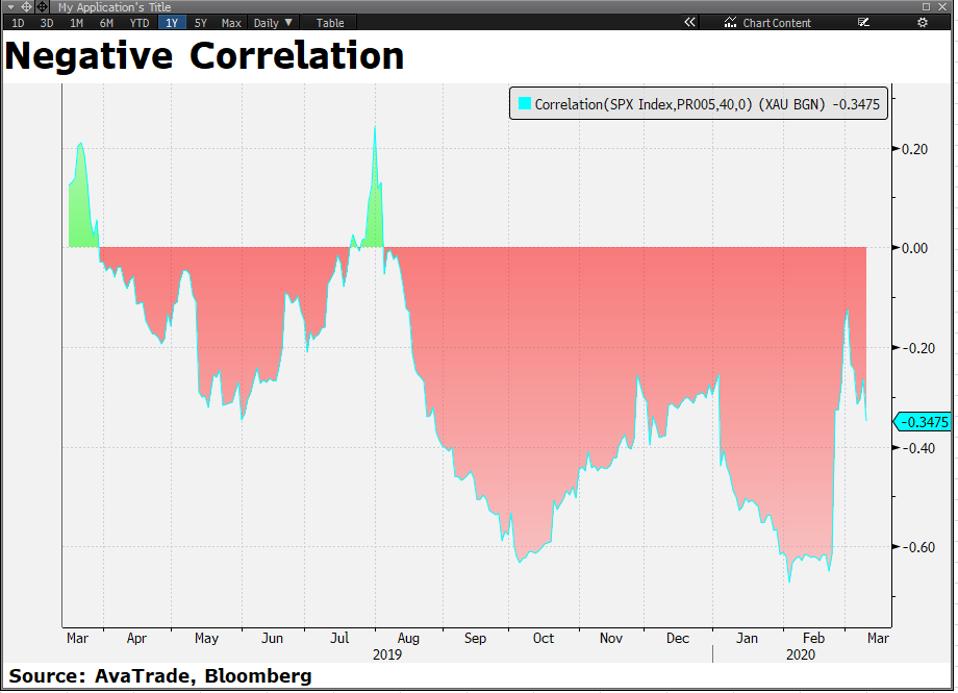
Currently, the gold price has a strong negative correlation with the
equity markets meaning when the equity markets fall; investors pour
money into gold and vice versa.
Gold and SPX chart shows negative correlation
The fact is that the current sell-off in the global equity markets is
only a start because there is a lot more to come. After all, the
economic weakness isn’t fully baked into economic data, let alone in
earnings. Thus, there is no better time to buy gold.
Why?
First, the equity markets are in major turmoil as a 1000 point move for the Dow Jones
index has become the norm. Secondly, the Coronavirus has pushed the
Federal Reserve into a corner, and it’s being forced to keep its
monetary policy on the dovish side. The Fed cut the interest rate by 50
basis points only a couple of weeks ago, and yet the market expects
further cuts.
Gold which is up nearly 10% year-to-date
is likely to score serious gain in the coming weeks. The reason is that
we have a situation where monetary policy itself isn’t enough to calm
the markets; however, governments are trying to provide support on the
fiscal front as well. For instance, Donald Trump has pitched the idea of
no payroll tax for this year to soften the blow of Coronavirus. So far,
we have not seen a green flag which is why investors are still nervous.
Donald Trump may achieve some of his goals, but it won’t be enough, the
economic damage is too considerable, and the Coronavirus is still
nowhere close to coming under control.
Going back to the monetary policy action and why there is serious
potential for the gold price to increase; at present, traders and Wall
Street are expecting further interest rate cuts from the Fed during
their meeting next week. An interest rate cut of 50 basis points is the
minimum that investors expect, and according to bigger banks like
Goldman Sachs and JP Morgan, we can expect 75 basis points and a full
percentage point.
Regarding the price action, an interest rate cut isn’t priced in at
all, if it had been, the price would have been trading much higher.
Currently, it’s trading near $1,661.
The Play
If the Fed cuts the interest rate by 50 basis points, this could push
the gold price above 1700 again. Anything more than 50 basis points,
especially a whole percentage point, could pump the price to 1750 or
higher.
The Flow
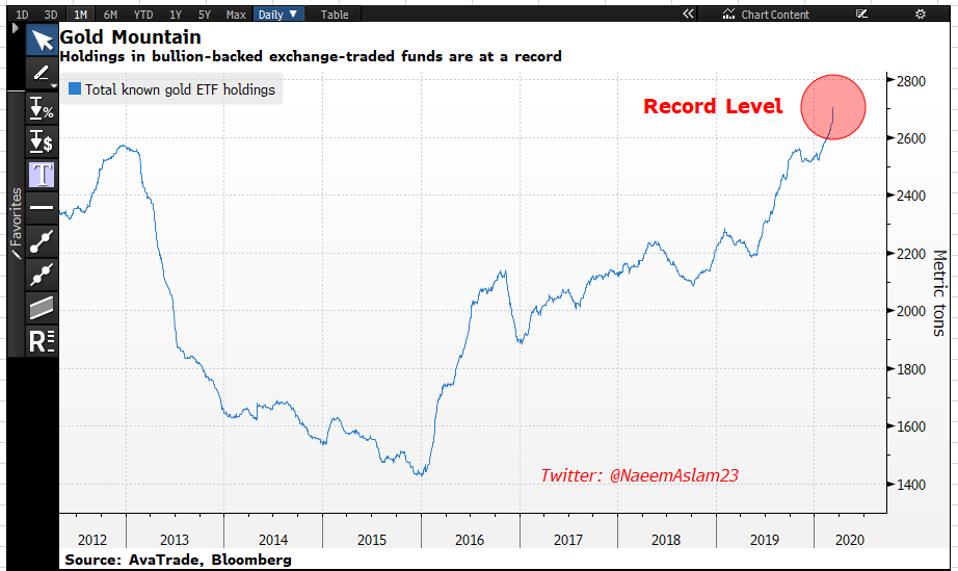
If we look at the total gold ETF holding data, it supports our thesis
that the gold price is likely to increase because the total holding in
ETFs is sitting at a record level, and the inflow continues to rise. It
appears that investors are discounting this current price weakness and
using this opportunity to buy more.
The chart shows all gold ETFs holding at a record high level
The Bottom Line
The current retracement in the gold price is an enormous opportunity
for traders to get back in the game or add to their position, similar
to the institutions. If for some reason, the Fed doesn’t cut the
interest rates during the meeting, it will create more panic in the
equity markets, which would be a positive sign for the gold price.
Posted by AGORACOM
at 11:35 AM on Thursday, March 12th, 2020
Sponsor: Affinity Metals Corp. (TSX-V: AFF) is a Canadian mineral exploration company building a strong portfolio of mineral projects in North America. The Corporation’s flagship property is the drill ready Regal Property near Revelstoke, BC where Affinity Metals is making preparations for a spring drill program to test two large Z-TEM anomalies. Click Here for More Info
With silver one hundred times cheaper than gold, the
silver-gold-price ratio is close to an all-time high. The obvious trade
is to sell gold and buy silver, says Dominic Frisby. But is that a wise
move?
Silver’s value has plummeted since it stopped officially being money
A friend sent me a screenshot from his phone earlier in the week. It
showed the gold price at $1,666/oz and silver at $16.66/oz. In other
words an ounce of gold is 100 times the price of an ounce of silver. Or,
to use the correct terminology, the gold-silver ratio has gone above
100 – which is almost unheard of.
According to my data, the gold-silver ratio has only ever gone above
100 once before. It didn’t happen in the financial crisis of 2008, the
dotcom crash of 2000, or the Long Term Capital Management Fund Crisis of
1998. It happened in 1991. Silver was $3.50/oz at the time and gold
was, of course, $350. (Actually, it was closer to $370 and the ratio
touched 105).
Apart from 1991 the ratio has never been as high as it was on Monday.
Not once in history. It’s one of the extraordinary extremes that the
coronavirus panic has caused.
The obvious trade here is to sell gold and buy silver. But on the
basis of ratios alone, you should also be selling gold and buying oil,
base metals, stocks, just about anything. To be clear, now is not the
time to be selling gold, particularly with all the fiscal stimulus
that’s coming.
A gold-silver ratio of 15 is but a distant memory
The gold-silver ratio is an odd one. Really, it should be somewhere
around 15. Silver is only 15 times as abundant as gold – there is about
15 times more silver in the earth’s crust as there is gold.
And, historically, the relative price of the two ranged between
around 15 and 20. Until 1875 the USA was a bi-metallic standard – both
silver and gold were money, in other words – and the exchange rate
between the two metals was 15, more or less.
However, in the 20th century, as we all know, countries abandoned
their ties to gold and silver and so money and metal went their separate
ways. That ratio of 15 has become an ever-more distant memory.
It did hit 15 briefly in 1981 as the Hunt Brothers tried to corner
the silver market. But this was an extraordinary situation. It wasn’t
typical. The typical broader trend is that silver is losing its value
relative to gold.
One day we will get back to 15, say the most diehard silver bugs.
This was something I was convinced of in the ardent silver-fanatic days
of my investment youth. I’m not so convinced today.
In fact, you could go one stage further. The gold-silver ratio should
be lower than 15. Silver gets used, gold does not – all the gold that
has ever been mined, pretty much, still exists somewhere. But silver,
with its numerous industrial applications, gets consumed. The ratio
between the two should be closer to ten. And yet here we are with that
ratio ten times higher – and silver ten times too cheap.
The sad fact for silver bugs is that since silver no longer has any
official monetary use, its relative value has plummeted. Some blame
shenanigans on futures exchanges for the low price of silver – I blame
the evolution of money.
Is the world going to go back to some sort of metallic standard as a
result of coronavirus? I doubt it. Money is getting more and more
digital; metal is too physical. But I can see one scenario where it
might.
Get ready for epic debasement
The authorities’ reaction to the crisis will be to debase currency:
slashing rates (we got a dose of that from the Bank of England just this
morning), bailouts, money printing (which will be given some new name
that is even more obfuscatory than quantitative easing), infrastructure
spending (I gather the chancellor is to announce plenty of that in his
Budget later today).
Gold bugs have long been waiting for that loss-of-faith moment when
faith in fiat money will be lost. Might all the monetary manipulation
that is already in place be the long-awaited trigger? The ensuing loss
of faith sees us going back to metal.
It’s a possibility, I suppose, but I think I’m too long in the tooth to see that really happening.
I own some silver. I love silver. I don’t think it’s a bad thing to
be holding in this time of crisis. If it wasn’t so “precious†it would
have been dragged down a lot more – like energy and base metals. It’s
certainly cheap. But so are a lot of other things at the moment.
The gold-silver ratio hit a low at 30 in 2011 when silver touched
$50. It has been in an uptrend ever since. Plenty of us – me included –
have tried to call the top in the ratio and it has kept grinding higher.
The likelihood is that it will pull back a little from the extremes,
perhaps even as far as the 80s. But the reality of our modern fiat age
is that, as far as the gold-silver ratio is concerned, it will take a
fairly extreme change in circumstances for us even to get back to 50. 50
is the new 15.
Sell gold and buy silver as a trade, by all means, but make sure you
reverse the trade – or at least start moving up the stops if we ever get
back to the 80s, 70s or 60s.
Posted by AGORACOM
at 11:07 AM on Thursday, March 12th, 2020
SPONSOR: ZEN Graphene Solutions: An emerging advanced materials and graphene development company with a focus on new solutions using pure graphene and other two-dimensional materials. Our competitive advantage relies on the unique qualities of our multi-decade supply of precursor materials in the Albany Graphite Deposit. Independent labs in Japan, UK, Israel, USA and Canada confirm this. Click here for more information
The first demonstration of graphene double quantum dots in which it
is possible to control the number of electrons down to zero has been
reported in Nano Letters. Far from an abstract academic stunt,
the results could prove key to future implementations of quantum
computing based on graphene. “Having exact information and control over
the number of electrons in the dots is essential for spin based quantum
information technology,” says Luca Banszerus, a researcher at RWTH
Aachen University in Germany and the first author of the paper reporting
these results.
Although this level of control has been demonstrated in single quantum dots, this is the first demonstration in graphene double quantum dots,
which are particularly useful as spin qubits. “Using a double dot
heavily facilitates the readout of the electron’s spin state and the
implementation of quantum gates,” Banszerus adds.
Less edgy quantum dots
The idea of using graphene in quantum dots dates back almost as far
as the first reports of the material’s isolation in 2004. Graphene has
almost no spin-orbit interaction and very little hyperfine coupling,
which would suggest that spin lifetimes can be extremely high.
Unfortunately, quantum dots physically etched from larger graphene
flakes run into problems due to the disorder at the dot’s edges
disrupting the material’s behavior. As a result, the transport behavior
of these quantum dots is dominated by localized states at the edges.
“This leads to an unknown effective quantum dot size and an occupation
of typically many electrons,” says Banszerus.
Instead, Banszerus and colleagues at RWTH Aachen and the National Institute of Materials Science in Japan work with bilayer graphene,
which can be tuned to be a semiconductor. A voltage applied to specific
regions of a bilayer graphene flake can switch those regions to behave
as insulators, electrostatically defining a quantum dot that has no edge
states nearby.
The Aachen researchers strip single flakes of bilayer graphene from
graphite (mechanical exfoliation) and handle it using a dry pick-up
technique that hinges on van der Waals interactions. They encapsulate
the bilayer graphene in hexagonal boron nitride (hBN) crystal. They then
place the structure on a graphite flake, which acts as the bottom
electrode, and add chromium and gold split gates and finger gates
separated from the split gates by a 30-nm-thick layer of atomic layer
deposited Al2O3.
They were able to control the number of electrons on the quantum dots
by applying a voltage, which also affected the tunneling coupling
between the dots. As a result, once the total occupation of the two
quantum dots exceeds eight electrons, they begin to behave as one single
quantum dot, rather than a double quantum dot. Transport measurements
also revealed that the number of electrons loaded on the quantum dot
could be controlled down to zero electrons.
The idea of defining quantum dots in bilayer graphene
electrostatically in this way is not new. However, although different
groups have attempted this approach since 2010, the process required
recently discovered tricks of the trade, such as better encapsulation in
hBN and the use of graphite flakes as gates to get a clean band gap.
Banszerus says these developments came as quite a surprise and revived
interest in graphene quantum dots in 2018. He hopes the capabilities
they have now demonstrated will further spark activity in this field.
Coupling control
“Even though being able to control the number of charges in a
graphene double dot is a huge step forward, there are still many
problems to be solved on the road toward spin-based quantum information technology in graphene,” says Banszerus. Next, he hopes to tackle the problem of controlling the coupling between the quantum dots and the reservoir, which he hopes to achieve by adding an additional layer of interdigitated finger gates on top.
Posted by AGORACOM
at 10:55 AM on Thursday, March 12th, 2020
SPONSOR: American Creek owns a 20% Carried Interest to Production at the Treaty Creek Project in the Golden Triangle. 2019’s first hole averaged of 0.683 g/t Au over 780m in a vertical intercept. The Treaty Creek property is located in the same hydrothermal system as the Pretivm and Seabridge’s KSM deposits. Click Here For More Info
Tudor Gold said it had discovered a significant new copper-silver horizon within the Goldstorm system.
The newly discovered copper-rich CS 600 Horizon is a very important feature of the Goldstorm System.
Presence of copper and silver mineralization gives this discovery a true polymetallic nature yet it remains a gold-dominant project.
Tudor Gold Corp. [TUD-TSXV, TUC-Frankfurt] has released the results
of gold-equivalent calculations for all drilling completed at the
company’s Treaty Creek project, which is located in British Columbia’s
Golden Triangle region.
These calculations are posted on the company’s website and include
credit for previously analyzed values for copper and silver. Geological
analysis and reinterpretation of all the drill holes to date exposed a
new copper horizon (CS 600 horizon) as well as significant silver and
copper mineralization through the Goldstorm system, the company said in a
press release, which was issued just after the close of trading on
March 3, 2020.
On Wednesday, Tudor shares eased 4.0% or $0.02 to 48 cents on volume
of 309,585. The shares are currently trading in a 52-week range of 26
cents and $1.08.
Tudor Gold holds a 60% stake in the Treaty Creek joint venture and is
the project operator. The other partners are American Creek Resources
Ltd. [AMK-TSXV] and Teuton Resources Corp. [TUO-TSXV, TUC-Frankfurt],
each of which hold a 20% stake in the project. American Creek and Teuton
are both fully carried to a production notice. At that point, each of
the two is required to contribute their respective 20% share of
development costs.
Until that happens, Tudor is required to fund all exploration and
development costs. The property is also subject to 3% net smelter return
royalties.
The 17,913-hectare Treaty Creek Project borders Seabridge Gold Inc.’s
[SEA-TSX, SA-NYSE] KSM property to the southwest and borders Pretium
Resources Inc.’s [PVG-TSX] Brucejack property to the southeast. The
past-producing Eskay Creek mine lies 12 kilometres to the west.
Exploration of the Treaty Creek area over the past 30 years by
various junior companies has resulted in the discovery of a number of
surface mineral showings, some with very high gold and silver values.
There have been over 150 diamond drill holes completed on the
property from 1987 to date, in eight different mineral zones. However,
it is only recently that drilling revealed the potential for a
large-scale porphyry-style gold deposit at the Copper Belle and
Goldstorm zones, which are located on trend and just five kilometres
northeast of the KSM deposits.
In a press release on December 16, 2019, Tudor Gold said it had
discovered a significant new copper-silver horizon within the Goldstorm
system.
The newly discovered copper-rich CS 600 Horizon is a very important
feature of the Goldstorm System, the company has said. It said presence
of copper and silver mineralization gives this discovery a true
polymetallic nature yet it remains a gold-dominant project.
“We are very encouraged to see that the silver copper mineralization
has made an important impact to the gold equivalent results from our
recent drilling as well as the historical drilling,’’ said Ken Konkin,
vice-president of project development at Tudor Gold.
“The next step is to plan the drill hole program for the 2020
exploration season,†he said. The company’s goal is to design a diamond
drill program that will fast-track the exploration program for 2020 with
the objective to begin mineral resource estimate work as soon as
possible.
Bay Street billionaire Eric Sprott recently increased his stake the company to 14.1% by investing in a non-brokered private placement of 4.2 million shares that raised $2.93 million. The shares are priced at 70 cents each.
About American Creek
American Creek holds a strong portfolio of gold and silver properties
in British Columbia. The portfolio includes three gold/silver
properties in the heart of the Golden Triangle; the Treaty Creek and
Electrum joint ventures with Walter Storm/Tudor, as well as the recently
acquired 100% owned past producing Dunwell Mine. Other properties held
throughout BC include the Gold Hill, Austruck-Bonanza, Ample Goldmax,
Silver Side, and Glitter King.
For further information please contact Kelvin Burton at: Phone: 403 752-4040 or Email: [email protected]. Information relating to the Company is available on its website at www.americancreek.com
Posted by AGORACOM
at 10:42 AM on Thursday, March 12th, 2020
SPONSOR: Lomiko Metals is focused on the exploration and development of minerals for the new green economy such as lithium and graphite. Lomiko owns 80% of the high-grade La Loutre graphite Property, Lac Des Iles Graphite Property and the 100% owned Quatre Milles Graphite Property. Lomiko is uniquely poised to supply the growing EV battery market. Click Here For More Information
Automaker plans to launch several electric vehicles with lower-cost batteries within the next three years.
“Accepted the challenge to transform product development at GM and position our company for an all-electric future”
Detroit, Michigan – General Motors (GM) is promising a wide array of
less-expensive electric vehicles (EVs) thanks to battery technologies it
is developing, improved product design processes, and plans to scale EV production to the size of its truck business.
“Our team accepted the challenge to transform product development at
GM and position our company for an all-electric future,†said GM
Chairman and CEO Mary Barra. “What we have done is build a multi-brand,
multi-segment EV strategy with economies of scale that rival our
full-size truck business with much less complexity and even more
flexibility.â€
The heart of GM’s strategy
is a modular propulsion system and a highly flexible, third-generation
global EV platform powered by proprietary Ultium batteries.
“Thousands of GM scientists, engineers, and designers are working to
execute an historic reinvention of the company,†GM President Mark Reuss
said. “They are on the cusp of delivering a profitable EV business that can satisfy millions of customers.â€
Ultium batteries use large-format, pouch-style cells that can be
stacked vertically or horizontally inside the battery pack. By avoiding
rigid, cylindrical cells, GM engineers can optimize pack shapes and
layouts for each vehicle.
Energy options range from 50kWh to 200kWh – enough for 400 miles of
range on the larger battery side. Motors designed in-house will support
front-wheel drive, rear-wheel drive, all-wheel drive, and performance
all-wheel drive applications.
Ultium-powered EVs are designed for Level 2 and DC fast charging.
Most will have 400V battery packs and up to 200kW fast-charging
capability. Trucks will get 800V battery packs and 350kW fast-charging
capability.
Developed with LG Chem, GM’s joint venture partner on a battery cell plant in Ohio,
upcoming cells reduce use of expensive cobalt, a development the
companies believe will drive cell cost to less than $100/kWh. At
$100/kWh, GM’s 200kWh batteries would cost $20,000, before considering
the cost of the rest of the vehicle, so lowering cell costs is critical
to affordable EVs.
Reuss said engineers are designing future vehicles and propulsion
systems together to minimize complexity and part counts compared to
adapting gasoline-powered vehicles for electric drive. GM plans 19
different battery and drive unit configurations initially, compared with
550 internal combustion powertrain combinations.
GM’s technology can be scaled to meet customer demand much higher
than the more than 1 million global sales the company expects
mid-decade.
Chevrolet, Cadillac, GMC, and Buick will all be launching new EVs starting this year.
2021 Bolt EV, launching in late 2020, updating GM’s first mass-market all-electric
2022 Bolt EUV, launching summer 2021, larger crossover version of
the Volt will be the first non-Cadillac GM to get Super Cruise
semi-autonomous driving
Cruise Origin, self-driving, electric shared vehicle, debuted at shows but no production plans announced
Cadillac Lyriq SUV unveiling set for April 2020
GMC HUMMER EV debuted in Super Bowl ads, more details coming May 20, production to begin fall 2021