Developing, in collaboration with industry leader PyroGenesis (TSX-V: PYR) the innovative PUREVAPTM “Quartz Reduction Reactorsâ€, will permit the transformation and purification of quartz (SiO2) into Metallurgical Grade Silicon (Mg-Si) at prices that will propagate its significant renewable energy potential.
Also working with industry leader Apollon Solar to develop a metallurgical pathway of producing Solar Grade Silicon Metal (SoG Si) that will take full advantage of the PUREVAPTM QRR one-step production of high purity silicon (Si) and significantly reduce the Capex and Opex associated with the transformation of quartz (SiO2) into SoG-Si.
Focused on becoming the lowest cost producer of Silicon (Si), High Purity Silicon (Si) and Solar Grade Silicon Metal (SoG-Si). The pilot plant equipment that will validate the commercial potential of the process is on schedule to start in 2019.
Posted by AGORACOM-JC
at 3:36 PM on Friday, September 20th, 2019
SPONSOR: Tartisan Nickel (TN:CSE)
Kenbridge Property has a measured and indicated resource of 7.14
million tonnes at 0.62% nickel, 0.33% copper. Tartisan also has
interests in Peru, including a 20 percent equity stake in Eloro
Resources and 2 percent NSR in their La Victoria property. Click her for more information
Nickel climbs as stainless steel producers prepare for Indonesia ban
Nickel prices climbed on Friday as stainless steel producers bought supplies ahead of a Chinese holiday and an Indonesian nickel ore export ban that could create shortages.
Top supplier Indonesia’s plan to ban exports of nickel ore has been brought forward by two years to Jan. 1, 2020, and the Philippines, the world’s second-biggest ore producer, could suspend five mining companies at the end of this year.
By: Eric Onstad
LONDON — Nickel prices climbed on Friday as stainless steel producers
bought supplies ahead of a Chinese holiday and an Indonesian nickel ore
export ban that could create shortages.
Top supplier Indonesia’s plan to ban exports of nickel ore has been
brought forward by two years to Jan. 1, 2020, and the Philippines, the
world’s second-biggest ore producer, could suspend five mining companies
at the end of this year.
“There have been some anecdotes of stainless mills restocking nickel
and that has been positive,†said analyst Nicholas Snowdon at Deutsche
Bank in London.
Nickel is mostly used as an alloy in the production of stainless steel.
“Across most sectors, in the week before the Golden Week holiday,
you’ll invariably see a bit of raw material restocking, so we have
elements of that in nickel alongside the broader potential restocking as
we head into the (Indonesia) ban application.â€
China celebrates its National Day Golden Week holiday in early October.
Benchmark nickel on the London Metal Exchange gained 2.6% to $17,725 a
tonne in official open-outcry trading, on track for its biggest one-day
gain in three weeks.
* CHINA RATE CUT: Base metals also gained support from China cutting
its one-year benchmark lending rate for the second month in a row on
Friday.
* NICKEL INVENTORIES: Nickel stocks in warehouses monitored by the
Shanghai Futures Exchange slid 13.6%, weekly data showed on Friday.
* NICKEL SPREAD: The premium of LME cash nickel over the three-month
contract climbed to $150 a tonne, near the recent decade high of $163,
indicating near-term tightness.
* MARKET DEFICIT: The global nickel market deficit widened to 6,700
tonnes in July from a revised 2,700 tonnes in the previous month, the
International Nickel Study Group (INSG) said on Thursday.
* ALUMINIUM OUTPUT: LME aluminum, untraded in official rings, was bid
down 0.6% at $1,790 a tonne after data showed that global primary
aluminum output rose to 5.407 million tonnes in August from a revised
5.404 million tonnes in July.
* COPPER DEMAND: Fitch Solutions cut its average price forecast for
copper to $5,900 a tonne this year and $5,700 in 2020, from previous
views of $6,300 a tonne and $6,600 a tonne respectively.
“A drop in Chinese demand has loosened the global (copper) market, while sentiment continues to worsen,†Fitch said in a note.
LME copper was bid up 0.3% at $5,804 a tonne but remained on course
for a 2.6% drop over the week, which would mark its steepest weekly fall
since the week ended Aug. 2.
* PRICES: LME three-month zinc was bid down 0.2% in official activity
at $2,308 a tonne, lead gained 0.9% to trade at $2,114 and tin slipped
0.3% to trade at $16,400.
* For the top stories in metals and other news, click or (Additional
reporting by Tom Daly in Beijing; editing by David Goodman and Jason
Neely)
Posted by AGORACOM
at 2:17 PM on Friday, September 20th, 2019
September 20, 2019) - Affinity Metals Corp. (TSXV: AFF) (“Affinity Metals”) (“the Corporation”) is pleased to report that it has commenced exploration on the Regal Project located approximately 35 km northeast of Revelstoke, British Columbia, Canada. The program will include geological mapping, sampling, and up to 2,000 meters of diamond drilling testing several targets identified in preliminary work. The total amount of drilling in this phase of the program will depend on weather and on evaluating target potential and results as the program progresses. Drilling will begin in the ALLCO area of the property.
The
extensive Regal property package spans 6,700 hectares in the northern
end of the prolific Kootenay Arc and hosts several past producing
small-scale historic mines. From the historic records it appears that
most, and perhaps all, of the known mineralized showings/zones have not
been previously drilled using modern diamond drilling methods.
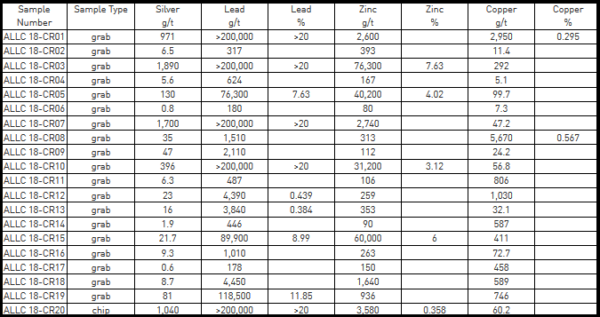
Preliminary work conducted in the fall of 2018 included collecting a total of 20 grab and chip samples from several different areas on the property including around the old Regal Silver workings, in the Clabon Creek drainage and at a promising showing along a logging road cut several km to the west of the Regal historic workings. The samples returned values as high as 1,890 g/t silver with >20% lead, and 7.63% zinc. A one-meter chip sample from a 4 meter wide galena vein immediately outside the Regal Silver #5 adit yielded 1,040 g/t silver as well as greater than 20% lead and 3,580 g/t (0.358%) zinc. Results for all 20 samples are reported below:
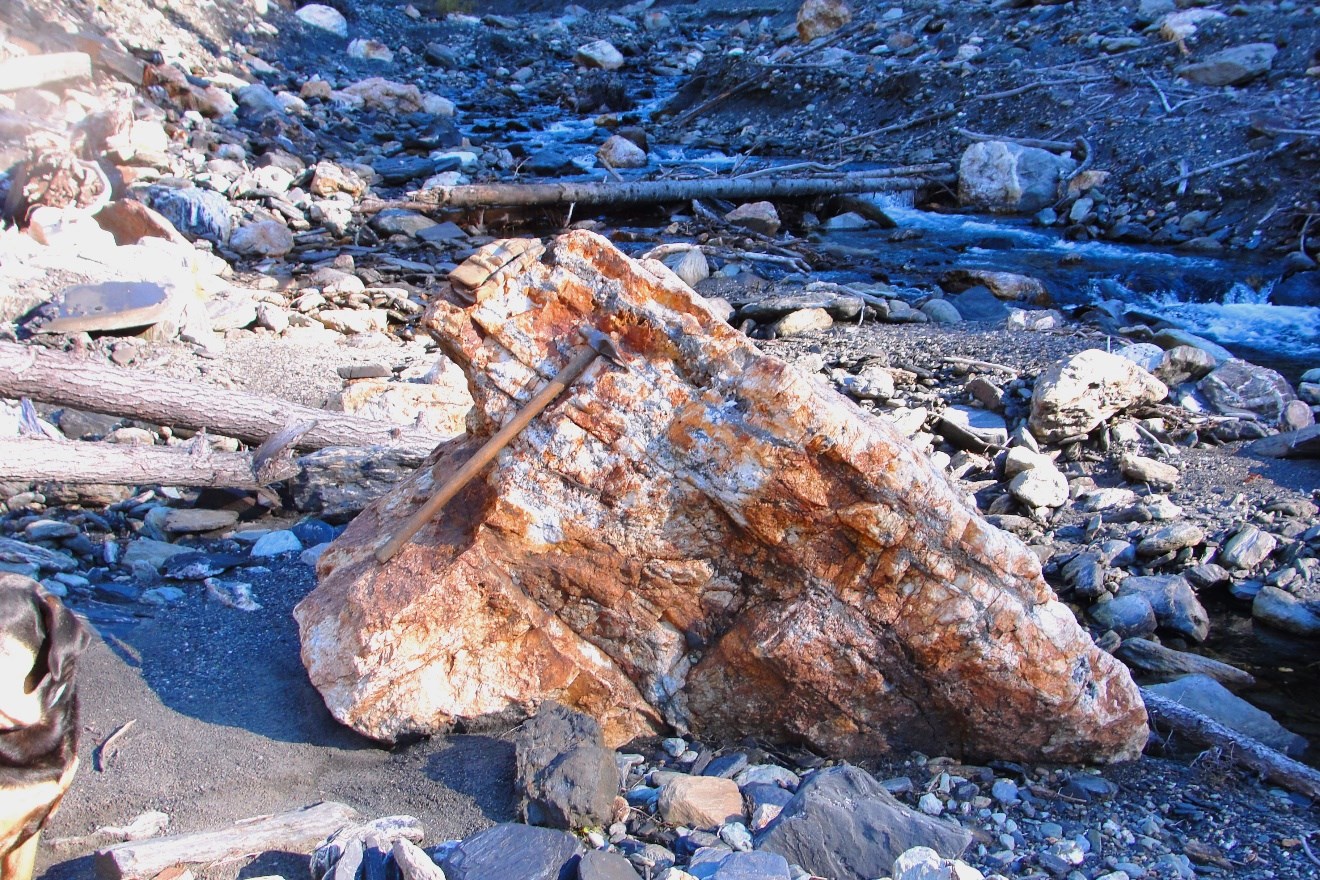
Significantly,
as a result of a recent, severe freshet event that totally scoured the
upper Clabon Creek drainage, a series of numerous large mineralized
boulders were exposed. Planned field work will include examination of
the mineralization and host rock which will be invaluable in identifying
the source of this mineable grade material (photo below). This float
material is present in the creek drainage over a distance of
approximately 3km indicating the strong potential for discovering new
mineralized zones upstream and in the immediate area.
Robert
Edwards, CEO stated: “We are very excited to finally be able to begin
exploration on the Regal Property in a meaningful way. It has taken
considerable time and effort to assemble the vast amounts of historic
geological data that has been accumulated on this project. Combining
that data with our prospecting time spent on the ground to begin to test
the many targets that have been identified should lead to some positive
results for this drill program.”
Property History & Background
The property hosts numerous mineral occurrences including the following past-producing mines:
Snowflake and Regal Silver (Stannex/Woolsey) Mines
The
Snowflake and Regal Silver mines were two former producing mines that
operated intermittently during the period 1936-1953. The last
significant work on the property took place from 1967-1970, when Stannex
Minerals completed 2,450 meters of underground development work and a
feasibility study, but did not restart mining operations. In 1982,
reported reserves were 590,703 tonnes grading 71.6 grams per tonne
silver, 2.66 per cent lead, 1.26 per cent zinc, 1.1 per cent copper,
0.13 per cent tin and 0.015 per cent tungsten (Minfile No. 082N 004 –
Prospectus, Gunsteel Resources Inc., April 29, 1986). It should be noted
that the above resource and grades, although believed to be reliable,
were prepared prior to the adoption of NI43-101 and are not compliant
with current standards set out therein for calculating mineral resources
or reserves. Samples ALLC18-1 to ALLC18-14 inclusive and ALLC18-20 were
taken on and in the vicinity of The Regal/Snowflake historical mine
workings during the 2018 preliminary exploration program.
ALLCO Silver Mine
The
Allco Silver Mine is situated 6.35 Kilometers northwesterly (azimuth
300o) from the above described Snowflake/Regal Mine(s) but still part of
the Affinity claim group.
The
Allco Silver Mine operated from 1936-1937 and produced 213 tonnes of
concentrates containing 11 troy ounces of gold (1.55 g/t), 11,211 troy
ounces of silver (1,637 g/t) and 173,159 lbs of lead (36.9%).
Black Jacket Showing.
The
Black Jacket showing was discovered by routine prospecting during 2008.
Samples taken on the showing are numbered ALLC18-15 to ALLC18-19
inclusive. This is a raw prospect in that no technical work excluding
sampling has been conducted on this showing. The showing is situated
10.3 kilometers westerly (azimuth 281o) from the historical
Snowflake/Regal Mine.
Airborne Geophysics to Guide Future Exploration
An
extensive airborne geophysics survey conducted by Geotech Ltd of
Aurora, Ontario, for Northaven Resources Corp. in 2011, identified four
well defined high potential linear targets correlating with the same
structural orientation as the Allco, Snowflake and Regal Silver mines.
Northaven also reported that the mineralogy and structural orientation
of the Allco, Snowflake and Regal Silver appeared to be similar to that
of Huakan International Mining Inc’s J&L gold project located to the
north, and on a similar geophysical trend line. The J&L is
reporting a NI43-101 compliant resource of 9.9M tonnes containing 2.4M
troz gold equivalent (combined measured, indicated and inferred) and is
reportedly now one of western Canada’s largest undeveloped gold
deposits. Northaven failed in financing their company and conducting
further exploration on the property and subsequently forfeited the
claims without any of the follow up work being completed. Affinity
Metals is in the fortunate position of benefitting from this significant
and promising geophysics data and associated targets.
The
aforementioned Northaven airborne geophysical survey conducted at a
cost of $319,458.95 in August of 2011 is described in The BC Ministry of
Energy, Mines and Petroleum Resources Assessment Report #33054. The
results of the survey are competently explained and illustrated by
professionals on You Tube at: https://www.youtube.com/watch?v=GX431eBY_t0
Affinity
Metals has successfully obtained a 5 Year Multi-Year-Area-Based (MYAB)
exploration permit which includes approval for 51 drill sites.
Qualified Person
The
qualified person for the Regal Project for the purposes of National
Instrument 43-101 is Frank O’Grady, P.Eng. He has read and approved the
scientific and technical information that forms the basis for the
disclosure contained in this news release.
About Affinity Metals
Affinity Metals is focused on the acquisition, exploration and development of strategic metal deposits within North America.
The Corporation’s flagship project and present focus is the Regal.
On behalf of the Board of Directors
Robert Edwards, CEO and Director of Affinity Metals Corp.
Posted by AGORACOM-JC
at 8:35 AM on Friday, September 20th, 2019
At 165,000 patients, Empower Clinics (CBDT:CSE) (EPWCF:OTCQB) has a database that almost every medical cannabis and CBD company would kill for. Add in the fact it is now on a ~ $USD 4,000,000 annualized revenue run rate for 2019 and it becomes the kind of company small cap investors have been dying to find as they watch pretender companies melt away.
But it doesn’t end there.
CBD extraction has been a key element of the company’s vertical integration. Producing its’ own CBD products for its own patients just makes sense. Up until a couple of days ago, it was a sound strategy that needed to be executed. As of yesterday, execution arrived thanks to a JV with extraction experts Heritage Cannabis that will light up the Company’s 5,000 sq ft facility in Oregon. Empower brings the infrastructure, Heritage brings the expertise and balance sheet. The result is a match made in shareholder heaven with initial annual capacity of 6,000 Kg at ~ $US 5,000 per Kg, which adds up to $US 30,000,000 in potential revenue.
We emphasize potential because nobody has started selling anything yet and the facility isn’t expected to begin producing for another 3-4 months. However, with a built in patient database and talks already having commenced for white label products, Empower is on its way. Moreover, “potential” cuts both ways, with capacity capable of increasing 2x – 3x without much trouble given the size of the facility.
Can Empower successfully execute its extraction plan? It’s a legitimate question, with a blow away answer..
The Company’s new CEO, Steven McAuley, who replaced the previous management team in January, is Six Sigma certified under the quality initiative of legendary GE chairman Jack Welch. We’ve never seen a Six Sigma certified CEO in the Canadian small cap markets. Never.
Grab your favourite beverage and settle in to watch what may be your next great small cap investment.
Posted by AGORACOM-JC
at 4:19 PM on Thursday, September 19th, 2019
SPONSOR: Betteru Education Corp.
aims to provide access to quality education from around the world. The
Company plans to bridge the prevailing gap in the education and job
industry and enhance the lives of its prospective learners by developing
an integrated ecosystem. Click here for more information.
BTRU: TSX-V
Edtech space AttainU raises an undisclosed sum from former head of Google India, others
AttainU, an edtech startup, has raised an undisclosed capital in angel funding from a clutch of investors including Shailesh Rao, former head of Google India.
Bengaluru-based platform said that the raised funding will be used to further strengthen faculty, development of courses, counselling teams, and build a semi-automated platform to cater to the huge inbound student demand AttainU is receiving.
Bengaluru-based platform said that the raised funding will be used to further strengthen faculty, development of courses, counselling teams, and build a semi-automated platform to cater to the huge inbound student demand AttainU is receiving.
Divyam Goel, CEO & Co-founder, AttainU, said, “For us, the goal
has always been about solving higher education in a systematic, scalable
way. From the beginning, we have had a very strong focus on maintaining
our high-quality learning outcomes as we scale. Over the last 10
months, we have been able to figure out many processes, complementing
human psychology, to facilitate deep-rooted learning.â€
AttainU was founded by Divyam Goel and Vaibhav Bajpai
in 2018. It provides live online courses as college alternative to
individuals. Currently, it offers full-time, online seven-month-long
software engineering courses for users.
The startup also provides career counselling as part of their student
assessment process and connects graduates to industry partners for
placement upon completion of the course.
The edtech space aims to serve students who have a college education
but don’t have a job or a satisfactory job and more importantly, don’t
need to have prior coding experience.
The company said its courses are focussed on industry-aligned
practical skills and professionally required life skills and follow a
deferred fee payment model conditional to employment aka Income Share
Agreement (ISA).
“At this point, we are receiving double-digit thousand student
applications every month and are very excited about the scale of impact
we will be able to deliver through our tech-first approach,†Goel added.
Furthermore, according to AttainU, every year approximately nine
million students graduate from colleges, out of which 85 percent don’t
make it to well paying, white collar jobs.
Data states that 50 percent of all BE/Btech graduates and 60 percent
of all MBA (including PG Diploma) graduates are still considered not
employable by tech first organisations, the company added.
Tags: CSE, edtech, india, online education, stocks, tsx, tsx-v Posted in betterU Education Corp | Comments Off on BetterU Education Corp. $BTRU.ca – #Edtech space #AttainU raises an undisclosed sum from former head of #Google #India, others $ARCL $CPLA $BPI $FC.ca
Posted by AGORACOM-JC
at 3:18 PM on Thursday, September 19th, 2019
SPONSOR:ThreeD Capital Inc. (IDK:CSE)
Led by legendary financier, Sheldon Inwentash, ThreeD is a
Canadian-based venture capital firm that only invests in best of breed
small-cap companies which are both defensible and mass scalable. More
than just lip service, Inwentash has financed many of Canada’s biggest
small-cap exits. Click Here For More Information.
IDK: CSE
CIOs can’t ignore these 5 realities of blockchain
By Rajesh Kandaswamy Gartner, Inc.
What would happen if a car automatically negotiated its own insurance rate, or if centralized banks were no longer necessary to verify payments?
What if neighbors could buy energy directly from each other’s solar panels? What if a contract enforced its own clauses?
These scenarios might seem overly futuristic, but the reality is that blockchain could
make all of them possible. The more important question is how might
these changes affect the enterprise, and how can the organization take
advantage of this technology?
Few enterprises have deployed blockchain, yet it can significantly impact
broad swaths of the business. The low adoption of blockchain
technologies lulls many CIOs into thinking they don’t yet have to take
action, yet the opportunities for blockchain technology are massive.
Only 4 per cent of enterprises expect
that blockchain will be a game-changer for them, according to the 2019
Gartner CIO Survey. Furthermore, only 11 per cent of enterprises have
deployed — or will deploy over the next year — even minimal,
blockchain-inspired technologies. CIOs
need to start thinking about what value blockchain can add to their
organization and how to tackle its challenges over the next five years.
Reality #1: Blockchain provides a spectrum of opportunities that evolve over time
Blockchain is not a monolithic
technology. The term blockchain actually encompasses a wide range of
technologies, from smart contracts to tokens to consensus models that
will continuously mature and become available. In turn, CIOs should plan
for incremental evolution of their own blockchain strategies.
Blockchain-enabling:
These are the building blocks of blockchain, including encryption and
consensus algorithm, distributed computing infrastructures, tokens and
others.
Blockchain-inspired: Technologies in this stage combine some elements of blockchain, but lack two core elements: decentralization and tokenization.
Blockchain-complete: These solutions have all five elements of blockchain. They are decentralized, immutable, encrypted, tokenized and distributed.
Blockchain-enhanced:
Alongside the five elements of blockchain, blockchain-enhanced is
combined with technologies such as artificial intelligence (AI) and the
Internet of Things (IoT) for more intelligent solutions.
Reality #2: Blockchain can change your operating model, not necessarily your business model, in the next 5 years
While blockchain will eventually
change the core of a business, in the next five years it will mostly
affect how an organization executes its business. Focusing solely on how
blockchain is being used today (i.e. efficiency and record keeping) is
limiting. CIOs should look for opportunities to leverage blockchain
technology for deeper business changes that can drive real value.
Begin by looking for areas where
blockchain could strengthen the organization’s value proposition, and
propose projects that could truly differentiate the organization. Put
real thought into how this technology could benefit the business, versus
just purchasing a cool “disruptor†venue.
Reality #3: Blockchain offers the ability to create a multi-asset digital economy
It’s time to think creatively about
tokenization and digitally representing assets in the marketplace. For
some organizations this will increase efficiency, and for others, it
will enable entirely new markets. Consider how tokenization would be
helpful in current business operations and in the future, and talk to
ecosystem partners about tokenization’s potential and challenges.
Reality #4: Blockchain enables a new society, but doesn’t solve trust problems at all levels
One of the main elements of
blockchain is decentralization. It removes central authorities from the
process and enables a level of trust between two parties who have never
done business together. This means that the definition of participant
will expand beyond individuals and businesses to include smart
contracts, distributed ledgers, connected things and DAOs.
Blockchain will facilitate the
interactions between all of these participants and enable a new society,
but it cannot solve all trust problems. For example, any goods that are
physical or not completely digital, would gain limited (if any) trust
value. Create a map that highlights potential gaps and weak spots, and
don’t oversell blockchain technologies to executives as a solution to
every problem.
Reality #5: The programmable economy will set the terms of competition in the future
The reality is that blockchain and
its core elements will radically alter not only the business world, but
the world in which businesses exist. Blockchain will allow autonomous
ecommerce and eventually a programmable economy.
A programmable economy results from
applying distributed computational resources, such as blockchain at
scale, in a decentralized manner to support exchanges of monetary and
nonmonetary value between people, organizations and artificial agents
that have a legal standing equivalent to today’s corporations and
individuals. This will eventually evolve into a digital society,
as consumers change behaviors and adopt new practices. Organizations
will need to develop the technology, but also the ethics and practices
to exist in the digital society.
Rajesh Kandaswamy is a Research Vice President and a
Gartner Fellow in Gartner’s Technology and Service Provider research
practice. His responsibilities include helping establish the direction
of research for emerging technologies and industries, as well as
co-leading blockchain research enterprisewide at Gartner. His Gartner
Fellows research is on how technology will radically transform the
concept of an organization.
Posted by AGORACOM-JC
at 11:55 AM on Thursday, September 19th, 2019
SPONSOR: NORTHBUD (NBUD:CSE) Sustainable low cost, high quality cannabinoid production and procurement focusing on both bio-pharmaceutical development and Cannabinoid Infused Products. Learn More.
—————————————————–
Marijuana’s Biggest Day of the Year Is 4 Weeks Away
Last year, the marijuana industry made history… many times over.
But nothing took precedence over Canada becoming the first industrialized country in the world to legalize recreational cannabis, with sales commencing on Oct. 17, 2018.
Last year, the marijuana industry made history… many times over.
But nothing took precedence over Canada becoming the first
industrialized country in the world to legalize recreational cannabis,
with sales commencing on Oct. 17, 2018. Even though Canada substantially
trails the U.S. in terms of aggregate annual legal weed sales, it’s
setting an example among industrialized countries that the legalization of marijuana is possible.
Now, the biggest date of 2019 is rapidly approaching. And wouldn’t you know it, it’s Oct. 17, once again.
Image source: Getty Images.
Why Oct. 17 is a big date for the pot industry (again)
Over the past 11 months and change, Canada has allowed for the sale
of dried cannabis flower, cannabis oil, and sublingual sprays.
Meanwhile, edibles, nonalcoholic cannabis-infused beverages, vapes,
concentrates, and topicals, weren’t legal. This sort of two-step
legalization process was done to allow the industry to find its footing,
as well as give regulators time to adjust to cannabis becoming legal
for adult purchase. But on Oct. 17, regulations now governing dried
cannabis will apply to derivative products as well.
However, investors and Canadian consumers should understand that
derivative pot products aren’t going to be showing up in dispensaries on
Oct. 17. Much in the same way that it took dried cannabis flower brands
weeks to begin populating dispensary store shelves, it’ll probably be the same story for derivative products.
Regulatory agency Health Canada has cautioned that derivative supply
won’t hit the market until mid-December, with it taking weeks or months
thereafter for supply to be adequate to meet demand.
This, of course, is really big news for marijuana stocks, because
derivative cannabis products are a considerably higher margin product
for the industry, relative to dried flower. In select U.S. states (ahem,
Oregon), we’ve witnessed the oversupply and commoditization of dried
flower, leading to weaker margins for pot businesses. We’re highly
unlikely to see oversupply and pricing concerns from derivatives anytime
soon.
A point that is sometimes lost on this derivative launch is that
these are products which speak to a younger generation of cannabis
users. Not only are derivatives more attractive in the respect that they
may not need to be smoked, but they’re going to attract potentially
long-term customers to the industry.
Image source: Getty Images.
Growers go all-out for derivative production
Considering the importance of derivatives to cannabis stock margins,
it’s not surprising to find that growers have been laser-focused on
derivative production for a good portion of 2019.
Some growers, such as OrganiGram Holdings (NASDAQ:OGI),
have chosen to set up a variety of in-house derivative options. During
the company’s fiscal third quarter, OrganiGram announced that it’d be
investing 15 million Canadian dollars into a line of fully automated
equipment necessary to produce up to 4 million kilos of chocolate
edibles per year. This coincides with OrganiGram’s 56,000-square-foot phase 5 expansion which, among other things, is targeted at extra space for derivative production and processing.
The company has also developed a nano-emulsification technology
that can speed up the onset of the effects of cannabinoids. This
product will first be introduced as a powder that can be added to
beverages, but OrganiGram is also actively looking for a partner to help
it develop an infused beverage product containing this proprietary
technology.
Cronos Group (NASDAQ:CRON), and its investment partnerAltria,
are also eager to see the green flag wave on derivatives. Cronos
Group’s peak annual output of nearly 120,000 kilos per year may not even
be enough to place this brand-name pot stock among the top-10 growers.
But that’s OK with Cronos, as it’s placed its attention almost entirely
on derivative cannabis products.
For instance, Cronos and Altria will be working together to roll out
an assortment of vape products. Altria is well-versed in the adult
smoking market and should prove helpful in assisting Cronos Group’s
marketing efforts and product launches (regarding vapes). Beyond vaping,
Cronos Group will be leaning on its partnership with Ginkgo Bioworks to
produce targeted cannabinoids at commercial scale, as well as other
third-party extraction service providers.
Image source: Getty Images.
Speaking of extraction services, there may not be a smarter way of
playing the derivatives craze than with third-party extraction
providers. As an example, MediPharm Labs (OTC:MEDIF) only commenced its extraction operations during the fourth quarter. Despite this, MediPharm managed to turn a nominal operating profit
of $0.01 per share in the second quarter. The company’s sales and
profitability are set to soar as growers scramble for derivative
exposure. Yet, MediPharm’s sales and profits should remain highly
predictable with the company locking in contracts for an extended period
of time. Soon enough, the company’s annual extraction capacity will hit
500,000 kilos.
The one thing to remember about the upcoming marijuana derivatives launch
While, on one hand, the launch of derivative products should be lauded by investors, there’s another side to this launch that everyone should be aware of.
As I alluded to earlier, Health Canada has cautioned that alternative
consumption products aren’t going to immediately hit dispensary shelves
once the green flag waves on Oct. 17. Rather, it’s going to take time
before any sort of supply is built up in the marketplace, with a
presumptive two-month gap between when derivative regulations going into
effect and when derivative products will begin showing up in licensed
stores.
But here’s the thing: Product showing up in stores doesn’t mean that
the supply will be sufficient to meet demand. Similar to what we’ve been
witnessing in the dried flower market, supply issues exist that are
likely going to make it difficult for derivative products to find their
way into dispensaries, at least in the early going.
Don’t get me wrong, I expect derivatives to push sales and margins
higher for cannabis stocks across the board. However, I think it’s going
to be multiple quarters before Health Canada resolves a number of
supply issues, resulting in what could be weaker-than-expected sales in
the months to come.
Make no mistake: Derivatives are the future of the cannabis industry. Just understand that the future isn’t going to happen overnight. Give this industry, and the rollout of derivatives, proper time to mature, and you won’t be disappointed.
Here’s The Marijuana Stock You’ve Been Waiting For A
little-known Canadian company just unlocked what some experts think
could be the key to profiting off the coming marijuana boom.
And make no mistake – it is coming.
Cannabis legalization is sweeping over North America – 10 states plus
Washington, D.C., have all legalized recreational marijuana over the
last few years, and full legalization came to Canada in October 2018.
And one under-the-radar Canadian company is poised to explode from this coming marijuana revolution.
Because a game-changing deal just went down between the Ontario
government and this powerhouse company…and you need to hear this story
today if you have even considered investing in pot stocks.
Posted by AGORACOM-JC
at 11:22 AM on Thursday, September 19th, 2019
A look at a mineralized outcrop containing Platinum Group
Metals (PGMs) on the River Valley project site. Metals such as PGMs and
lithium will continue to experience sustained increases in demand as the
global push for sustainability becomes mainstream.
The future of transportation is poised for sustainability
through the global adoption of hybrid electric vehicles (HEVs) and fully
battery electric vehicles (BEVs)
Industry experts are forecasting a consistent increase in demand for lithium, used to develop the batteries in HEVs and BEVs
Industry experts are also forecasting an increase in demand for the Platinum Group Metals (PGMs) used by autocatalyst manufacturers, to ensure compliance with tightening emissions regulations
New Age Metals’ flagship River Valley primary PGM project in
Ontario, and lithium division with assets in Manitoba positions the
company as a key player in the growth of HEVs and lowering CO2 emissions
By: Jason Smith
Harmful carbon dioxide emission levels are rising globally,
largely due to the use of fossil fuels as the primary source of energy
used by the transportation industry. Examples of this use include the powering of jumbo jets, container ships and semi-trucks.
Passenger vehicles also rely on fossil fuels and have a bad reputation
for the amount of pollutants they release into the atmosphere on a daily
basis.
However, passenger vehicles produce more than four times the
greenhouse gas (GHG) emissions of all domestic aviation, according to
the Globe and Mail. The focus over the last few years has been on making these passenger vehicles
more environmentally-friendly, which is a large reason why automakers
have started producing electric or hybrid electric vehicles (HEVs).
While automakers are being forced by emissions regulation to reduce
their carbon footprint, the majority of consumers are not ready to go
fully electric and are increasingly choosing hybrid vehicles to bridge
the gap with cars that solely use batteries. With more vehicles being
sold worldwide each year, especially those that are less pollutive,
automakers will need more of the critical raw materials used to create
the hybrid and electric vehicles.
This need for less pollutive methods of transportation is where
lithium and palladium enter the picture. Lithium is used to produce
batteries, but the size of car batteries used in HEVs and the increase
in HEV sales that is anticipated by the industry
will require substantially more lithium than what is available in the
market today. Palladium, which is a member of the PGM family, is largely
used to reduce pollution that originates from vehicles operating with
internal combustion engines (ICE) through its use as the primary
‘catalyst’ in catalytic converters (commonly known as auto-catalysts).
While palladium is often overlooked when it comes to the push for
sustainability, it has played a huge role in reducing the amount of
toxic emissions being released into the atmosphere. This positive impact
is most noticeable in urban areas where automobiles are concentrated.
The value of an ounce of palladium has increased exponentially in the
past year, rising 60 per cent year-over-year in Sept. 2019 from under
USD$950 to over USD$1500. The reason for the dramatic price movement is
due to supply concerns and the metals value as the premier option for
use in auto-catalysts.
With ICE-powered vehicles not going away any time soon, the global demand for palladium will endure as a pollution-control
device, and investors are taking notice. Anton Berlin is the head of
strategic marketing at the world’s largest producer of Palladium,
Norilsk Nickel. He recently stated, “Hybrids — cars with both an
electric battery and a combustion engine — will dominate the electric
vehicle market in the long-run, which suggests a long-term advantage for
the PGM market.â€
The extensive infrastructure required to support a universal
transition to EVs still needs time to be completely fleshed out but is
gaining speed. According to a new report entitled, “2019 Investor’s Business Daily/TIPP Electric Vehicle Outlook Study,â€
range and available charging stations are what make potential EV buyers
the most apprehensive, although these are issues that are currently
being addressed.
Regardless, the desire to limit pollution is leading to the growing
demand for middle-ground HEVs, which is causing car manufacturers to
focus on their abilities to design and assemble automobiles that emit
less noxious fumes primarily through the use of palladium and lithium.
Research has shown that hybrid electric vehicles actually require
more palladium and lithium than traditional gasoline-powered vehicles,
so increased adoption of hybrid vehicles will subsequently increase
demand for these metals.Harry Barr, CEO, New Age Metals.
A flagship project in a historic mining district
Anticipating the continued strength in demand for palladium and the general forecast for lithium demand is New Age Metals
(TSX.V: NAM, OTCQB: NMTLF, FSE: P7J), bolstered by the company’s
flagship River Valley project in the Sudbury region of Ontario. The
Sudbury region, known as the mining capital of Canada, is largely
dominated by major mining and processing operations run by Vale and
Glencore.
However, these companies’ operations are facing depleted ores to feed
processing facilities and may need to acquire additional sources to
operate closer to their intended capacity. This is where River Valley
comes in as an integral player, which lies just 100 km from Sudbury and
hosts 2.9 million ounces in the (NI-43 101 compliant) measured and
indicated category of palladium-equivalent (PdEq) resources and 1.1
million ounces in the inferred category.
Diagram of New Age Metals’ current project locations. Supplied
Harry Barr, CEO of New Age Metals, is well aware of the role his company is poised to play as demand for hybrids continually increases.
“Research has shown that hybrid electric vehicles actually require more
palladium and lithium than traditional gasoline-powered vehicles, so
increased adoption of hybrid vehicles will subsequently increase demand
for these metals,†he notes. New Age Metals recently had
a preliminary economic assessment completed on River Valley, projecting
a mine with a 14-year lifespan, 6 million tonnes annually of potential
process plant feed at an average grade of 0.88 g/t PdEq and a process
recovery rate of 80 per cent, resulting in an annual average payable
PdEq production of 119,000 ounces.
Barr elaborates, “It’s unique to have a deposit of mineable platinum
group metals in North America, and very unique to have a deposit near so
much processing infrastructure that’s also close to car manufacturers,â€
emphasizing the advantageous position the company finds itself in with
River Valley.
With this in mind, Barr and his team are focused on maximizing this
opportunity to expand the resources at River Valley and develop it to a
point where the project achieves feasibility and is producing. In the
meantime, the project also has tremendous exploration upside and
management plans to continue with an aggressive exploration program. A credible investment alternative to the big PGM players
A key advantage for the River Valley project is its location in a
safe, reliable mining jurisdiction. The majority of the world’s
palladium currently comes from South Africa and Russia,
both of which could be problematic in terms of long-term supply
security, political issues and concerns regarding human rights and
sustainability.
Worth noting is the fact that Norilsk Nickel is not only the worlds’ largest producer of palladium and nickel, but also the largest emitter of sulfur oxides which is a pollutant considered immediately dangerous to life and health.
Fortunately, New Age Metals’ Ontario-based project offers the benefit
of being located in a safe jurisdiction that has excess processing
infrastructure and is known for moderating the environmental impacts from mining and smelting.
Barr explains, “Sudbury’s been a mining center for 120 years, so every
type of mining service is nearby.†Given this unique situation, the
company represents a credible investment opportunity.
Sid Rajeev, vice-president of Fundamental Research Corp., conducted a
thorough analysis of the River Valley PEA. He notes, “Our biggest
takeaway from the PEA was that, at a reasonable palladium price estimate
of USD$1,200 per oz, the study showed an after-tax net present value at
5 per cent of $138 million. New Age Metals’ current enterprise value is
just USD$3 million, implying that shares are trading at just 2 per cent
of net asset value.â€
This level of potential upside is rarely available to the investment
community and as New Age Metals brings River Valley towards
pre-feasibility, it’s unlikely that the company will remain undervalued
for long.
Our biggest takeaway from the PEA was that, at a reasonable
palladium price estimate of USD$1,200 per oz, the study showed an
after-tax net present value at 5 per cent of $138 million. New Age
Metals’ current enterprise value is just USD$3 million, implying that
shares are trading at just 2 per cent of net asset value.Sid Rajeev, vice-president, Fundamental Research Corp.
Having a substantial deposit of PGMs in North America positions New
Age Metals to benefit from the future of sustainability, however there
is a general lack of knowledge about PGMs in North America due to the
low number of primary PGM producers in the arena. The company is in the
process of moving River Valley along the development curve but is also
seeking a qualified partner to assist in further exploration and
development of the project.
New Age Metals’ lithium angle
Adding to the company’s green energy story is its suite of lithium projects in Manitoba. The demand
for this metal is forecasted to increase by 20 per cent per year
through to 2028. With lithium in high demand due to the ever-increasing
growth in the popularity of battery-powered vehicles, these projects
give the company optionality on lithium discovery; two of its eight
projects are currently drill-ready. Plans to drill on the ‘Lithium One’
and ‘Lithium Two’ are in place and company management is anticipating
the initiation of these drill programs in the near future.
The company’s lithium projects are situated along strike of the Tanco
Pegmatite and the claims encompass several pegmatite groups. The
projects are also located 140 km northeast of Winnipeg, Manitoba. The
Tanco mine was owned by the Cabot Corporation who announced in Jan.
2019, that it would be selling the mine to Sinomine Rare Metals Co. Ltd
for USD$130 million. This sale demonstrates a high interest in the
project and potentially the surrounding area, which lends credibility to
New Age Metals’ projects, based on shared geology and proximity.
Exploration on Lithium One is ongoing with concentration of the
northern section, with focus on the Annie and Silverleaf Pegmatites.
Silverleaf Pegmatite has zones of spodumene and lepidolite exposed on
surface with samples up to 4.1 per cent lithium oxide (Li2O). The Annie
Pegmatite returned values up to 0.6 per cent Li2O and 0.37 per cent
Ta2O5.
On Lithium Two, the Eagle Pegmatite is exposed on surface and was
last drilled in 1948, and at the time it was indicated that it remains
open to depth and along strike. A historic tonnage of 544,460 tonnes
of 1.4 per cent Li2O was reported during this year, however the actual
amount has not been confirmed by a qualified person at this time.
An ownership map showing Tanco Mine location proximity to New Age Metals projects. Supplied
With drilling set to begin in Manitoba and River Valley continuing to
move along the development curve, New Age Metals expects to
consistently generate valuable news for investors in the coming months,
keeping the company top-of-mind. Its position in palladium and lithium
provide the company with incredible potential as a high-performing
source for investment as the need for sustainable transportation
continues to be a significant social issue.
To learn more about New Age’s operations and project portfolio, visit them online: newagemetals.com
The following video is a short overview of New Age Metals, and
outlines some of the reasons why the company is an avenue for investment
in the future of sustainability associated with the electrification of
transport
Posted by AGORACOM-JC
at 7:20 AM on Thursday, September 19th, 2019
Signed Richard Sherman, NFL cornerback for the San Francisco 49ers, 4-time Pro Bowl and 2014 Super Bowl Champion, as a global ambassador for the Company’s esports brand, Luminosity Gaming
As a brand ambassador and shareholder of Enthusiast Gaming, Sherman will help support Enthusiast’s growth and success while partnering with the Luminosity brand
TORONTO, Sept. 19, 2019 — Enthusiast Gaming Holdings Inc. (“Enthusiast Gaming†or “The Companyâ€) (TSX-V: EGLX) is excited to announce that it has signed Richard Sherman, NFL cornerback for the San Francisco 49ers, 4-time Pro Bowl and 2014 Super Bowl Champion, as a global ambassador for the Company’s esports brand, Luminosity Gaming (“Luminosityâ€).
As a brand ambassador and shareholder of Enthusiast Gaming, Sherman
will help support Enthusiast’s growth and success while partnering with
the Luminosity brand. Sherman will attend Luminosity and Enthusiast
Gaming live activations throughout the year, and challenge other NFL
players to team play with the company’s Call of Duty team, which is
based in Seattle, Washington. Sherman’s “player challenge†games will be
streamed publicly across the Luminosity network. Sherman will also
contribute to building out the Company’s professional player roster, as
Captain of Luminosity’s esports organization.
“We are excited to announce this strategic relationship and welcome Richard into the Enthusiast family!†said Steve Maida, President of Luminosity Gaming, Esports Division of Enthusiast Gaming. “As
a globally recognized athlete, and an avid gamer who was featured on
the cover of Madden NFL 15, Richard is a perfect fit for us. With over
50 gaming influencers and esports professional athletes, we are looking
forward to adding a Super Bowl champion to our roster.â€
“Luminosity is one of the most successful esports brands in the
world, and I’m excited to be a part of it! As a brand ambassador and
team captain of Luminosity, I plan to bring my competitive spirit and
love of the game to the esports organization,†said Richard Sherman. “I
am especially eager to challenge some of my NFL rivals and teammates to
join me for online matches, streamed on the Luminosity network for all
our fans to view and enjoy.â€
Sherman was drafted by the Seattle Seahawks in the fifth round of the
2011 NFL Draft. He has been selected to the Pro Bowl four times and
voted All-Pro four times, including three times to the first team. He
led the NFL in interceptions in 2013, when he also helped the Seahawks
win their first Super Bowl. Sherman’s favorite video game is Call of
Duty.
About Enthusiast Gaming
Enthusiast Gaming is one of the largest vertically integrated video
game and esports companies in the world. The Company’s digital platform
includes +85 gaming related websites and 900 YouTube channels which
collectively reach 150 million visitors monthly. Enthusiast’s esports
division, Luminosity Gaming, a leading global esports organization
consists of 8 professional esports teams under ownership and management,
including the #1 ranked Overwatch team, the Vancouver Titans and over
50 gaming influencers with a total audience of 60 million followers.
Collectively, the community reaches over 200 million gaming enthusiasts
on a monthly basis. Enthusiast also owns and operates Canada’s largest
gaming expo, Enthusiast Gaming Live Expo, EGLX, (eglx.ca) with approximately 55,000 people attending in 2018. For more information on the Company, visit www.enthusiastgaming.com. For more information on Luminosity Gaming, please visit luminosity.gg.
CONTACT INFORMATION:
Investor Relations: Julia Becker Head of Investor Relations & Marketing [email protected] (604) 785.0850
Forward-Looking Information
Certain statements in this release are forward-looking statements.
Forward looking statements consist of statements that are not purely
historical, including any statements regarding beliefs, plans,
expectations or intentions regarding the future. Such statements are
subject to risks and uncertainties that may cause actual results,
performance or developments to differ materially from those contained in
the statements, including risks related to factors beyond the control
of Enthusiast Gaming. The risks include risks that are customary to
transactions of this nature and customary to companies which have their
stock traded on the TSXV. No assurance can be given that any of the
events anticipated by the forward-looking statements will occur or, if
they do occur, what benefits Enthusiast Gaming will obtain from them.
This press release does not constitute an offer to sell or
solicitation of an offer to buy any of the securities in the United
States. The securities have not been and will not be registered under
the United States Securities Act of 1933, as amended (the “U.S.
Securities Actâ€) or any state securities laws and may not be offered or
sold within the United States or to a U.S. Person unless registered
under the U.S. Securities Act and applicable state securities laws or an
exemption from such registration is available.
Neither TSX Venture Exchange nor its Regulation Services
Provider (as that term is defined in the policies of the TSX Venture
Exchange) accepts responsibility for the adequacy or accuracy of this
release.
Posted by AGORACOM
at 9:19 AM on Wednesday, September 18th, 2019
Kamloops, British Columbia–(Newsfile Corp. – September 18, 2019) –
Advance Gold Corp. (TSXV: AAX) (“Advance Gold” or “the Company”) is
pleased to provide an exploration update on its Tabasquena gold and
silver project in Zacatecas, Mexico. To date, 10 drill holes have been
completed hitting widespread gold and silver mineralization in near
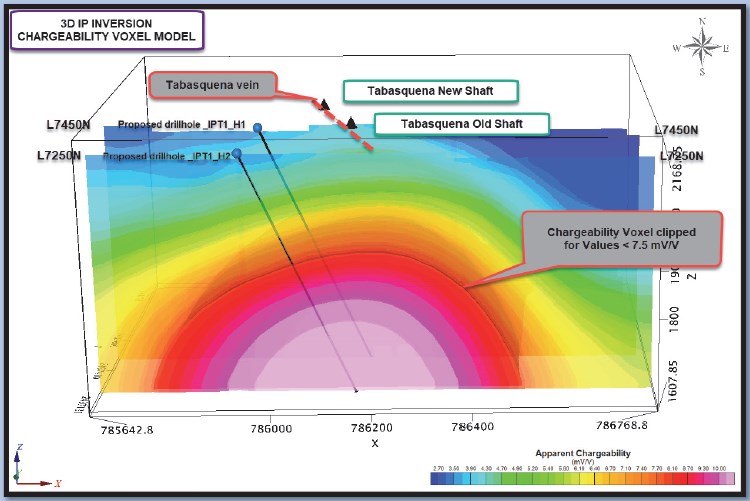
surface epithermal veins. Recently, a 3D induced polarization (IP)
survey was completed that identified a significant continuous
chargeability anomaly, with an east-west width of approximately 250
metres and an apparent strike length of over 800 metres. This anomaly is
located directly below the Tabasquena vein. The anomaly remains open
to the north and to the south and at depth. A second phase 3D IP
geophysical survey is scheduled to begin in the first week of October to
extend the grid to the south.
The purpose of the extended grid to
the south will be threefold, firstly it will establish the continuity
of the anomaly to the south, secondly whether or not the target anomaly
becomes shallower and lastly it will assist in positioning the upcoming
drill hole locations. It is planned to commence drilling once the IP
survey has been completed.
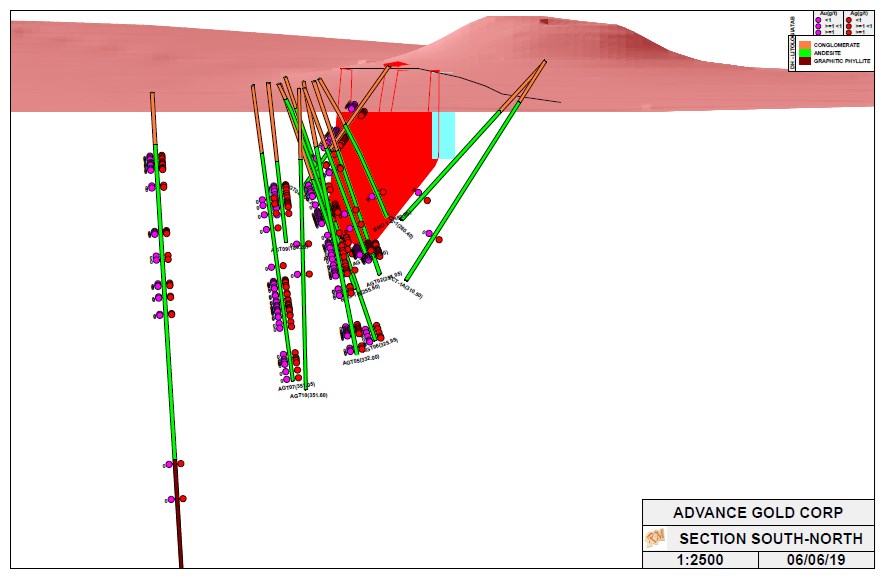
Images shown below are a 3D model of
the epithermal veins hit in previous drilling and a voxel inversion
model showing the extent of the large chargeability anomaly for lines
L7450N and L7250N. These two diagrams are an excellent representation of
the emerging targets at Tabasquena.
The black line at the surface
of the 3D model of drill holes is the surface projection of the
Tabasquena vein. The red shaded area is the historical mining done by
Penoles. The chargeability anomaly is approximately 250 metres below the
historical mining, and it follows the strike direction of the
Tabasquena vein. The epithermal veins, with highlighted widespread gold
and silver mineralization, are above and slightly to the west of the
deeper chargeability anomaly.
Allan Barry Laboucan, President and CEO of Advance Gold Corp., commented: “Our
exploration efforts at Tabasquena are coming together nicely with the
past drilling and the recent IP geophysical survey. It is important to
point out, the IP survey is meant to reveal sulphides through
chargeability. The epithermal veins are low sulphidation and relatively
small and don’t show up well in the IP survey, however right below these
veins is the large continuous chargeability anomaly of over 800 metres
from north to south and approximately 250 metres from east to west.
Before starting our next round of drilling, we wanted to extend the IP
grid to the south, where the anomaly is closer to surface. There is a
significant elevation change of approximately 300 metres from the
northernmost line of the geophysical survey to the most southerly one.
We have approximately 1500 metres to the southern limits of our claims.
The chargeability anomaly is open to the north, but due to the higher
elevation and more cover it exceeds the depth limits of the IP survey.
We are very excited to extend the grid to the south as that is the
direction of the highest intensity of the chargeability and where it
becomes closest to surface. The combination of the quality of Tabasquena
and our various projects, our low share count and a tight share
structure, with substantial insider ownership and tiny valuation, puts
us in a unique position relative to our exploration focused peers as the
market for gold and silver are gaining strength.”
Julio Pinto
Linares is a QP, Doctor in Geological Sciences with specialty in
Economic Geology and Qualified Professional No. 01365 by MMSA., and QP
for Advance Gold and is the qualified person as defined by National
Instrument 43-101 and he has read and approved the accuracy of technical
information contained in this news release.
About Advance Gold Corp. (AAX.V)
Advance
Gold is a TSX-V listed junior exploration company focused on acquiring
and exploring mineral properties containing precious metals. The Company
acquired a 100% interest in the Tabasquena Silver Mine in Zacatecas,
Mexico in 2017, and the Venaditas project, also in Zacatecas state, in
April, 2018.
The Tabasquena project is located near the Milagros
silver mine near the city of Ojocaliente, Mexico. Benefits at Tabasquena
include road access to the claims, power to the claims, a 100-metre
underground shaft and underground workings, plus it is a fully permitted
mine.
Venaditas is well located adjacent to Teck’s San Nicolas
mine, a VMS deposit, and it is approximately 11km to the east of the
Tabasquena project, along a paved road.
In addition, Advance Gold
holds a 13.23% interest on strategic claims in the Liranda Corridor in
Kenya, East Africa. The remaining 86.77% of the Kakamega project is held
by Barrick Gold Corporation.