Agoracom Blog Home

Posts Tagged ‘CSE’

NORTHBUD $NBUD.ca Amends Licence Application to Add 500K SQ. FT. of Outdoor Cultivation Area and Provides a Corporate Update $ACB $WEED.ca $HIP.ca

Posted by AGORACOM-JC at 8:26 AM on Thursday, December 20th, 2018

  • Announced the amendment of its license application to add 500K SQ. FT. of outdoor cultivation area and provides shareholders with a corporate update on the progress of the corporation and status on its various activities.
  • Construction of NORTHBUD’s cultivation facility is progressing on schedule and on budget. The building is soon to be completely enclosed and ready for the next phase in construction.

TORONTO, Dec. 20, 2018 – North Bud Farms Inc. (CSE: NBUD) (“NORTHBUD” or the “Company”) announced the amendment of its licence application to add 500K SQ. FT. of outdoor cultivation area and provides shareholders with a corporate update on the progress of the corporation and status on its various activities.

Construction of our Cannabis Production Facility in Low, Quebec: 

The construction of NORTHBUD’s cultivation facility is progressing on schedule and on budget. The building is soon to be completely enclosed and ready for the next phase in construction. Please see our website www.northbud.com/blog for videos, photos and ongoing updates.

Request for Outdoor Cultivation License:

NORTHBUD is pursuing a standard cultivation licence under The Cannabis Act after acquiring a confirmation of readiness stage ACMPR licence application in early 2018.

The NORTHBUD production facility is located on a 95-acre parcel of farmland in rural Quebec. Under the new regulations, licenced producers can cultivate outdoors. In collaboration with Cannabis Compliance Inc. NORTHBUD will be amending its application to include a 1000 x 500ft outdoor cultivation area.  We anticipate this outdoor production footprint to be operational in the spring of 2020 pending the required approvals by Health Canada. NORTHBUD expects to begin implementation of the required infrastructure in Q2 2019 after completion of our 25k sq. ft. indoor production facility that is currently under construction.

Implementation of this additional low-cost production footprint will provide NORTHBUD a unique platform to cultivate both premium quality dried flower as well as low cost commodity grade organic biomass to be transformed into food and pharma grade inputs. This will position NORTHBUD to capitalize on the highest margin market segments.

As the consumer market develops, we believe our diverse centralized infrastructure will provide NORTHBUD a solid, low cost, high quality cannabis supply, which will serve as the core of our products and brand moving forward.

The Gatineau valley has traditionally been a fertile area for outdoor cannabis cultivation with a growing season that typically occurs between mid June and early October. NORTHBUD will be engaging local legacy cultivators to acquire genetics with a track record of success in this particular climate. Our outdoor cultivation will follow international GAP (good agricultural practices) with the drying, trimming and packaging to be done in accordance with GMP standards inside our state-of-the-art custom designed cultivation facility.

About North Bud Farms Inc.
North Bud Farms Inc., through its wholly owned subsidiary GrowPros MMP Inc. which was acquired in February 2018, is pursuing a licence under The Cannabis Act.  North Bud Farms Inc. is constructing a state-of-the-art purpose-built cannabis production facility located on 95 acres of Agricultural Land in Low, Quebec. North Bud Farms Inc. will be focused on Pharmaceutical and Food Grade cannabinoid production in preparation for the legalization of edibles and ingestible products scheduled for October 2019.

For more information visit: www.northbud.com

Neither the Canadian Securities Exchange (the “CSE”) nor its Regulation Services Provider (as that term is defined in the policies of the CSE) accepts responsibility for the adequacy or accuracy of this release.

Forward-looking statements
Certain statements included in this press release constitute forward-looking information or statements (collectively, “forward-looking statements”), including those identified by the expressions “anticipate”, “believe”, “plan”, “estimate”, “expect”, “intend”, “may”, “should” and similar expressions to the extent they relate to the Company or its management. The forward-looking statements are not historical facts but reflect current expectations regarding future results or events. This press release contains forward- looking statements. These forward-looking statements are based on current expectations and various estimates, factors and assumptions and involve known and unknown risks, uncertainties and other factors. Such risks and uncertainties include, among others, the risk factors included in North Bud Farms Inc.’s final long form prospectus dated August 21, 2018 which is available under the issuer’s SEDAR profile at www.sedar.com

FOR ADDITIONAL INFORMATION, PLEASE CONTACT:
North Bud Farms Inc.
Edward Miller 
VP, IR & Communications
Office: (855) 628-3420 ext. 3
[email protected]

ThreeD Capital Inc. $IDK.ca – Top 5 #blockchain predictions for 2019 $HIVE.ca $BLOC.ca $CODE.ca

Posted by AGORACOM-JC at 9:01 AM on Wednesday, December 12th, 2018

SPONSOR: ThreeD Capital Inc. (IDK:CSE) Led by legendary financier, Sheldon Inwentash, ThreeD is a Canadian-based venture capital firm that only invests in best of breed small-cap companies which are both defensible and mass scalable. More than just lip service, Inwentash has financed many of Canada’s biggest small-cap exits. Click Here For More Information.

Idk large
————-

– Decentralization of apps, not just of the ledger

– Off-chain components are important for enterprise class apps

– Recognizing the importance of non-technology issues

December 12, 2018 Emmanuel Thiriez

2018 has certainly been a year. As the days grow shorter, we can’t help but look forward to a brand new 2019 and all the amazing tech trends in store for us. Today. we’re kicking off a week of predictions for next year. First up: blockchain! Emmanuel Thiriez explains five of his predictions for distributed ledger tech for the new year.

Blockchain is an increasingly key technology for enterprises that require trustless transactions and secure record keeping. Enterprises can track transactions with greater confidence and security, and blockchain adoption – completely distinct from the cryptocurrency hype or doom – is steadily gaining in enterprise environments.

However, while the technical benefits of the blockchain technology are widely acknowledged, enterprises looking to make budget decisions and start test projects or full implementations should know where this technology is headed, what tools are needed and what challenges can be expected. I talked with Emmanuel Thiriez, founder of Amalto and Platform 6, with over 15 years of implementation and operation of enterprise applications for clients in various industries, to find out what someone “in the trenches” is seeing. Thiriez’s company has an impressive list of clients (Chevron, GE, Iron Mountain, Suez, Superior Propane, Thales) with B2B applications powered by Platform 6, a blockchain development platform.

Thiriez cautioned against overestimating the impact of blockchain in your organization “immediately,” but he is extremely bullish on the mid- and long-term prospects.

Overall, there’s every indication that enterprise adoption will continue to grow in 2019. According to Thiriez, the following 5 trends are key to blockchain success. He also brought up one highly visible blockchain project in 2019 to follow.

1. Decentralization of apps, not just of the ledger

Implementing blockchain to ensure the trustability and immutability of records is only part of the story. 2019 will see more decentralization of apps themselves. Too many applications using a blockchain ledger rely on a centralized application that represents a single point of failure and also a vulnerability that could allow tampering with the data – before it gets written to the ledger.

The same approach needs to be applied to the application’s logic, which must be decentralized with no single point of control. Each trading partner or member of the ecosystem runs their own app. Building such applications is no easy feat, but it is a required step to ensure wide blockchain adoption for business usage.

2. Off-chain components are important for enterprise class apps

Building enterprise apps is a complex project. Enterprise apps are often designed to operate in a global business or government environment, and need to display, manipulate, and store large amounts of complex data and to support automation of business processes with that data.

Applying blockchain technology is important. However, the blockchain ledger is only a small part of the overall enterprise app. Many off-chain components are also needed – user management, workflows, systems integration, user interface, APIs, security, event mediation, and many more.

In 2019, more and more only applications that are designed and architected beyond the blockchain ledger and its smart contracts will make the cut.

3. Recognizing the importance of non-technology issues

As is often the case with bleeding edge technologies, there are many non-technology issues to deal with. Ecosystem management, industry-specific practices, legal issues that have little to do with blockchain per se but everything to do with whether a blockchain implementation is successful or not.

This issue is highlighted by Forrester Principal analyst Martha Bennett, who states in her “Predictions 2019” blog post:

I often use the phrase, “blockchains are 80% business, 20% technology.” If anything, that 80% is on the low side, and we’ll continue to see projects held up or even fail because companies’ focus is on the 20%.

When implementing blockchain projects, companies that pay attention to these non-technology issues in 2019 will have greater success rates.

4. Blockchain and the Internet of Things

The convergence between blockchain and the Internet of Things (IoT) is picking up steam. IoT adoption is significantly increasing the number of devices and sensors that gather data, and many parties are typically involved in a business transaction based on that data.

Blockchain enables safe record-keeping through an immutable ledger, and permits decentralized operations and transactions while preserving trust between all players in the value chain. Look for the intersection of these two technologies to speed up implementation of both.

5. An evolving ecosystem

The blockchain ecosystem is continuing to evolve quickly. This past year saw the dominance of Ethereum, Hyperledger Fabric, and R3’s Corda as the major platforms in blockchain. It is clear that new platforms will continue to emerge with different strengths, and this will mean popularity of platforms will rise and fall. Having the ability to develop for different platforms, prototyping new ones as needed, will be a strength for enterprises. In other words, when evaluating blockchain technologies, there will be no one-size-fits-all in 2019, and companies have to be prepared to jump from one technology to the other.

Major projects will raise visibility for blockchain

Several prominent blockchain projects in 2019 will influence interest in the technology. A key one to watch is Walmart. To better ensure food safety, Walmart and Sam’s Club are requiring produce suppliers to trace their products using blockchain technology.

Can Walmart and its suppliers make sure that all the different complicated steps from farm-to-table are accurately and safely completed? If blockchain delivers as promised, this will significantly raise visibility.

Suppliers still have some time for implementation but the system outlined by Walmart is scheduled to be in place by the end of 2019.

Summary

Blockchain is evolving rapidly. 2019 will see new projects and new platforms continue to emerge. A key trend is more decentralization of apps themselves. Currently, too many apps using a blockchain ledger rely on a centralized application. Understanding of this issue is increasing. In a similar vein, paying attention to off-chain components as a key part of your blockchain project and being flexible in evaluating your blockchain platform will continue to be key pieces of success in the coming year.     Source: https://jaxenter.com/top-5-blockchain-predictions-2019-152880.html

Tetra Bio-Pharma $TBP.ca Confirms Agreements With Multiple Suppliers

Posted by AGORACOM-JC at 8:25 AM on Tuesday, December 11th, 2018

  • Confirms its non-exclusive supply agreement for GMP-Grade THC with U.S.-based Rhodes Technologies Inc.
  • The supply will be used for several drug development activities including Tetra’s cannabinoid-derived products PPP002, PPP003, and PPP004, as well as for discovery phase projects.

Quality and volume of Active Pharmaceutical Ingredients (API) ensured

ORLEANS, Ontario, Dec. 11, 2018 — Tetra Bio-Pharma Inc. (“Tetra” or “TBP”), (TSX VENTURE: TBP) (OTCQB: TBPMF) a leader in cannabinoid-based drug discovery and development confirms its non-exclusive supply agreement for GMP-Grade THC with U.S.-based Rhodes Technologies Inc. The supply will be used for several drug development activities including Tetra’s cannabinoid-derived products PPP002, PPP003, and PPP004, as well as for discovery phase projects.  This is additional to having a supply agreement with True North Cannabis Inc.  for CBD from hemp which was necessary to meeting the demand associated with the Genacol Corporation transaction.

“With a robust development pipeline, it is essential for Tetra to have a reliable, API supply to support our expanding needs and avoid product shortages,” said Dr. Guy Chamberland, CEO and CSO of Tetra Bio-Pharma. “Our agreement with Rhodes is predicated on their long history and expertise in the production and sale of active chemical ingredients, particularly in the area of pain management.  In terms of CBD, our suppliers are selected based on their ability to provide us with both quality (GMP Pharmaceutical Grade) and volume.  Tetra is always mindful of the need to have consistent supply as well as back-ups for each of the products under development.”

About Tetra Bio-Pharma

Tetra Bio-Pharma (TSX-V: TBP) (OTCQB: TBPMF) is a biopharmaceutical leader in cannabinoid-based drug discovery and development with a Health Canada approved, and FDA reviewed, clinical program aimed at bringing novel prescription drugs and treatments to patients and their healthcare providers. The Company has several subsidiaries engaged in the development of an advanced and growing pipeline of Bio Pharmaceuticals, Natural Health and Veterinary Products containing cannabis and other medicinal plant-based elements. With patients at the core of what we do, Tetra Bio-Pharma is focused on providing rigorous scientific validation and safety data required for inclusion into the existing bio pharma industry by regulators, physicians and insurance companies.

For more information visit: www.tetrabiopharma.com

Source: Tetra Bio-Pharma

Neither the TSX Venture Exchange nor its Regulation Services Provider (as that term is defined in the policies of the TSX Venture Exchange) accepts responsibility for the adequacy or accuracy of this release.

Forward-looking statements
Some statements in this release may contain forward-looking information. All statements, other than of historical fact, that address activities, events or developments that the Company believes, expects or anticipates will or may occur in the future (including, without limitation, statements regarding potential acquisitions and financings) are forward-looking statements. Forward-looking statements are generally identifiable by use of the words “may”, “will”, “should”, “continue”, “expect”, “anticipate”, “estimate”, “believe”, “intend”, “plan” or “project” or the negative of these words or other variations on these words or comparable terminology. Forward-looking statements are subject to a number of risks and uncertainties, many of which are beyond the Company’s ability to control or predict, that may cause the actual results of the Company to differ materially from those discussed in the forward-looking statements. Factors that could cause actual results or events to differ materially from current expectations include, among other things, without limitation, the inability of the Company to obtain sufficient financing to execute the Company’s business plan; competition; regulation and anticipated and unanticipated costs and delays, the success of the Company’s research and development strategies, including the ability to obtain orphan drug status, the applicability of the discoveries made therein, the successful and timely completion and uncertainties related to the regulatory process, the timing of clinical trials, the timing and outcomes of regulatory or intellectual property decisions and other risks disclosed in the Company’s public disclosure record on file with the relevant securities regulatory authorities. Although the Company has attempted to identify important factors that could cause actual results or events to differ materially from those described in forward-looking statements, there may be other factors that cause results or events not to be as anticipated, estimated or intended. Readers should not place undue reliance on forward-looking statements. The forward-looking statements included in this news release are made as of the date of this news release and the Company does not undertake an obligation to publicly update such forward-looking statements to reflect new information, subsequent events or otherwise unless required by applicable securities legislation.

For further information, please contact Tetra Bio-Pharma Inc.
Robert (Bob) Bechard                                     
Executive Vice President, Corporate Development and Licensing
514-817-2514
[email protected]       
Media Contact 
energi PR
Carol LevineStephanie Engel 
[email protected] [email protected]   
514-288-8500 ext. 226 416-425-9143 ext. 209 

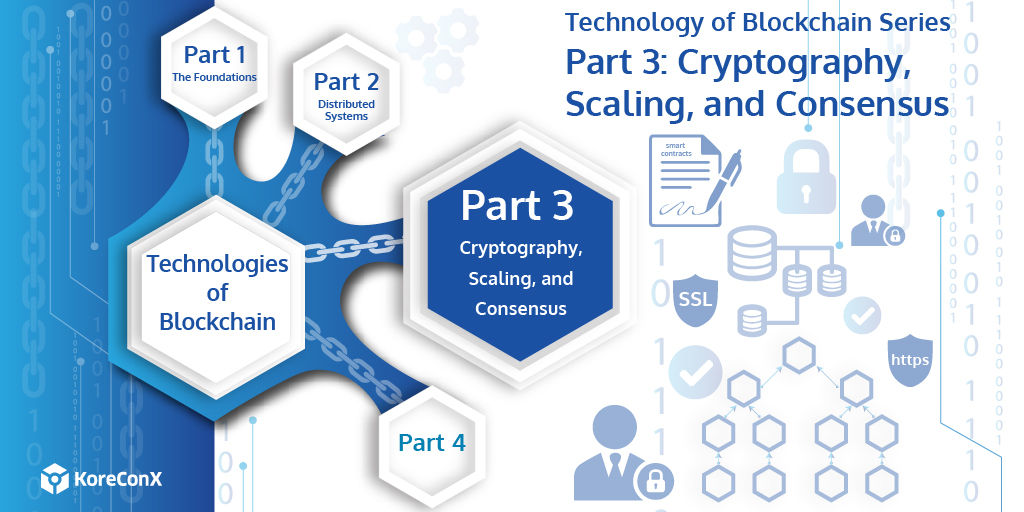
Technologies of #Blockchain Part 3: Cryptography, Scaling, and Consensus #KoreConx

Posted by AGORACOM-JC at 4:19 PM on Wednesday, December 5th, 2018

Kiran Garimella

In Part 2, we saw how a simple concept of a linked list can morph into complex, distributed systems. Obviously, this is a simple, conceptual evolution leading up to blockchain, but it’s not the only way distributed systems can arise. Distributed systems need coordination, fault tolerance, consensus, and several layers of technology management (in the sense of systems and protocols).

Distributed systems also have a number of other complex issues. When the nodes in a distributed system are also decentralized (from the perspective of ownership and control), security becomes essential. That’s where complex cryptographic mechanisms come into play. The huge volume of transactions makes it necessary to address performance of any shared or replicated data, thus paving the way to notions of scaling, sharding, and verification of distributed data to ensure that it did not get out of sync or get compromised. In this segment, we will see that these ideas are not new; they were known and have been working on for several decades.

Cryptography

One important requirement in distributed systems is the security of data and participants. This motivates the introduction of cryptographic techniques. Ralph Merkle, for example, introduced in 1979 the concept of a binary tree of hashes (now known as a Merkle tree). Cryptographic hashing of blocks was implemented in 1991 by Stuart Haber & W. Scott Stornetta. In 1992, they incorporated Merkle trees into their scheme for efficiency.

The hashing functions are well-researched, standard techniques that provide the foundation for much of modern cryptography, including the well-known SSL certificates and the https protocol. Merkle’s hash function, now known as the Merkle-Damgard construction, is used in SHA-1 and SHA-2. Hashcash uses SHA-1 (original SHA-0 in 1993, SHA-1 in 1995), now using the more secure SHA-2 (which actually consists of SHA-256 and SHA-512). The more secure SHA-3 is the next upgrade.

Partitioning, Scaling, Replicating, and Sharding

Since the core of a blockchain is the database in the form of a distributed ledger, the question of how to deal with the rapidly growing size of the database becomes increasingly urgent. Partitioning, replicating, scaling, and sharding are all closely related concepts. These techniques, historically used in enterprise systems, are now being employed in blockchains to address performance limitations.

As with all things blockchain, these are not new concepts either, since large companies have been struggling with these issues for many decades, though not from a blockchain perspective. The intuitively obvious solution for a growing database is to split it up into pieces and store the pieces separately. Underlying this seemingly simple solution lies a number of technical challenges, such as how would the application layer know in which “piece” any particular data record would be found, how to manage queries across multiple partitions of the data, etc. While these scalability problems are tractable in enterprise systems or in ecosystems that have known and permitted participants (i.e., the equivalent of permissioned blockchains), it gets trickier in public blockchains. The permutations for malicious strategies seem endless and practically impossible to enumerate in advance. The need to preserve reasonable anonymity also increases the complexity of robust solutions.

Verification and Validation

Zero-knowledge proofs (ZKP) are techniques to prove (to another party, called the verifier) that the prover knows something without the prover having to disclose what it is that the prover knows. (This sounds magical, but there are many simple examples to show how this is possible that I’ll cover in a later post.) ZKP was first described in a paper, “The Knowledge Complexity of Interactive Proof-Systems” in 1985 by Shafi Goldwasser, Silvio Micali, and Charles Rackoff (apparently, it was developed much earlier in 1982 but not published until 1985). Zcash, a bitcoin-based cryptocurrency, uses ZKPs (or variants called zkSNARKs, first introduced in 2012 by four researchers) to ensure validity of transactions without revealing any information about the sender, receiver, or the amount itself.

Some of these proofs and indeed the transactions themselves could be implemented by automated code, popularly known as smart contracts. These were first conceived by Nick Szabo in 1996. Despite the name, it is debatable if these automated pieces of code can be said to be smart given the relatively advanced current state of artificial intelligence. Similarly, smart contracts are not quite contracts in the legal sense. A credit card transaction, for example, incorporates a tremendous amount of computation that includes checking for balances, holds, fraud, unusual spending patterns, etc., with service-level agreements and contractual bindings between various parties in the complex web of modern financial transactions, but we don’t usually call this a ‘smart contract’. In comparison, even the current ‘smart contracts’ are fairly simplistic.

Read Part 1: The Foundations and Part 2: Distributed Systems

Source: https://www.koreconx.com/2018/11/28/technologies-blockchain-part-3-cryptography-scaling-consensus/

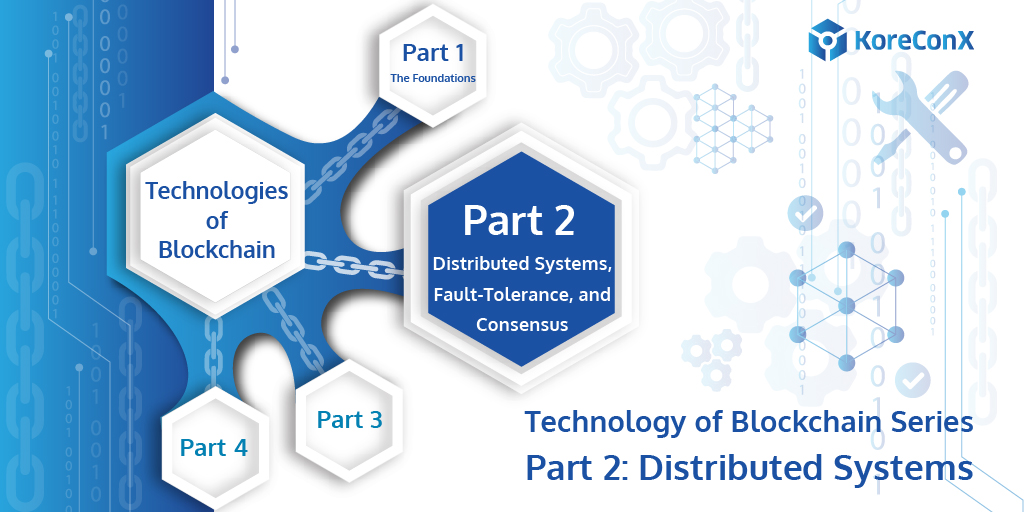
Technologies of #Blockchain – Part 2: Distributed Systems #KoreConX

Posted by AGORACOM-JC at 4:11 PM on Wednesday, December 5th, 2018

Kiran Garimella

We saw in Part 1 that linked lists provide the conceptual foundation for blockchain, where a ‘block’ is a package of data and blocks are strung together by some type of linking mechanism such as pointers, references, addresses, etc. In this Part 2, we will see how this simple concept gives rise to powerful ideas that lay the foundation for distributed systems.

What happens when one of the links in the linked list or one of the computers (aka, ‘nodes’) in a distributed system falls sick (and responds slowly), gets taken down (‘hacked’), or dies? How does the full list (or chain) recover from such tragic events? This brings us to the notion of fault tolerance in distributed systems. Once changes are made to the data in one of the nodes (blocks), how do we ensure that the same information is consistent with other nodes? That introduces the requirement for consensus.

Pushing the analogy of the linked list a bit further, algorithms that manage linked lists are carefully designed not to break the list. Appending links to the end or the front, for that matter, is an easy operation (we just need to make sure that the markers that indicate the start and end of the list are updated correctly). However, removing a link (or member of the chain) or adding one is a bit trickier. When it is necessary to remove or insert into the middle of the list, it’s a bit more complicated, but a well-understood problem with known solutions. We won’t go into the specifics in this article because the intent is not to describe these operations but to convey a high-level historical perspective.

In distributed systems, fault tolerance becomes a very important topic. In one sense, it is a logical extension to managing a linked list on a single computer. Obviously, in real-world applications, each of the nodes in a distributed system are economic entities that depend on other economic entities to achieve their goals. Faults within the system must be minimized as much as possible. When faults are inevitable, recovery must be as quick and complete as possible. Computer scientists began studying the methods of fault tolerance in the mid-1950s, resulting in the first fault-tolerant computer, SAPO, in Czechoslovakia.

Besides fault tolerance, when information needs to be added to the distributed system (a bit like adding, deleting, or updating the elements of a linked list), the different parties must agree. The reason for agreement is that the data that goes into the ‘linked list’ is data that arises out of transactions between these parties. Without agreement, imagine the chaos! My node would record that I sent you $90 while your node would record only $19! Or, if I send you payment for a product, I expect to receive the product. There should be agreement, settlement, and reconciliation between the transacting parties. A stronger requirement in distributed systems is that once the parties agree to something, the data that is agreed upon cannot be changed by one of the parties without the concurrence of the other party or parties. The strongest version of this requirement is ‘immutability’, where it is technically impossible to make any changes to data that is agreed to and committed to the chain.

Fault-Tolerance and Consensus

Distributed systems, therefore, require fault-tolerance, consensus, and immutability in varying degrees, depending on the needs of the business. Mechanisms for fault-tolerance and consensus evolved since the early days. Notable developments are:

  • Byzantine Fault Tolerance (BFT) by Lamport, Shostak, and Pease in 1982, to deal with situations where one or more of the nodes in the distributed system become faulty or malicious.
  • Proof-of-Work (POW), first described in 1993 and the term coined in 1999, which is a technique for providing economic disincentives for malicious attacks. A precursor idea of POW was proposed in 1992 by Cynthia Dwork and Moni Naor, as a means to combatting junk mail—a problem that was already a significant nuisance way back in 1992!* Their solution was to require a sender to solve a computational problem that was easy enough for sending emails normally but becomes computationally expensive for sending massive amounts of junk emails.
  • Hashcash, a POW algorithm, was proposed by Adam Back in 1997. This was used as the basis of POW in bitcoin by Satoshi Nakamoto in 2008, which brought awareness of POW to a much wider audience.
  • A high-performance version of BFT, called Practical Byzantine Fault Tolerance (PBFT), by Miguel Castro and Barbara Liskov, in 1999; and so on.
  • Paxos**, a family of consensus algorithms, has its roots in a 1988 work by Dwork, Lynch, and Stockmeyer, and first published in 1998 (even though conceived several years earlier) by Leslie Lamport.
  • Raft consensus algorithm was developed by Diego Ongaro and John Ousterhout. Published in 2014, it was designed to be a more understandable alternative to Paxos.

State machine replication (SMR) is a framework for fault-tolerance and consensus is a way to resolve conflicts or achieve agreement on the state values. SMR’s beginnings are in the early 1980s, with an influential paper by Leslie Lamport, “Using Time Instead of Timeout for Fault-Tolerant Distributed Systems” in 1984.

In Part 3, we will do a high-level review of mechanisms designed to keep distributed systems secure, consistent, and able to handle large volumes of transactions.

Read Part 1: The Foundations and Part 3: Cryptography, Scaling, and Consensus.


*Their paper, “Pricing via Processing or Combatting Junk Mail”, begins with a charming expression of exasperation: “Some time ago one of us returned from a brief vacation, only to find 241 messages in our reader.”

**No known relation to the blockchain company, Paxos.com

Source: https://www.koreconx.com/2018/11/20/technologies-blockchain-part-2-distributed-systems/

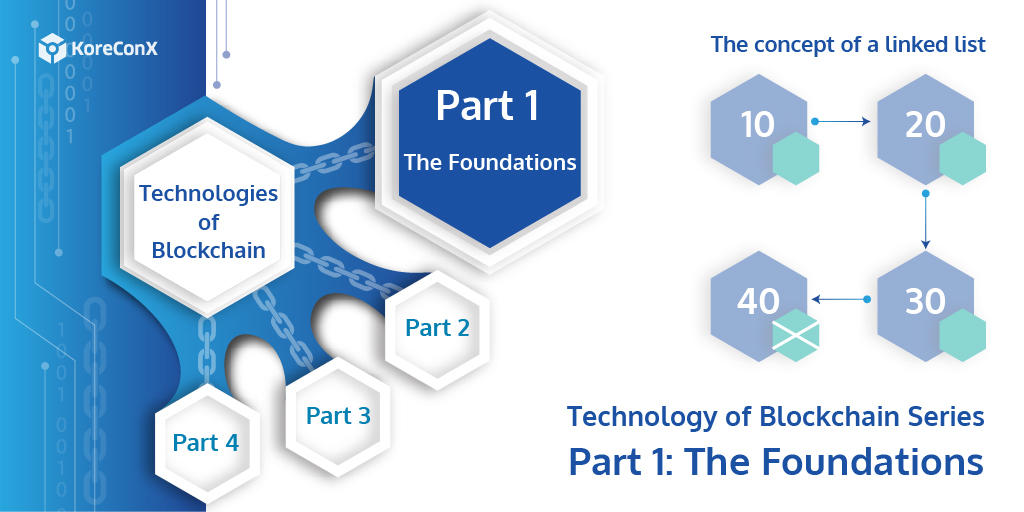
Technologies of #Blockchain – Part 1: The Foundations #KoreConX

Posted by AGORACOM-JC at 4:03 PM on Wednesday, December 5th, 2018

Kiran Garimella

Technologies of Blockchain – Part 1: The Foundations

Blockchain is not just a single technology but a package of a number of technologies and techniques. The rich lexicon in the blockchain includes terms such as Merkle trees, sharding, state machine replication, fault tolerance, cryptographic hashing, zero-knowledge proofs, zkSNARKS, and other exotic terms.

In this four-part series, we will provide a very high-level overview of each of the main components of technology. In reality, the number of technologies, variations, configurations, and considerations of trade-offs are numerous. Each piece in this puzzle was motivated by certain business requirements and technical considerations.

In this first part, we look at the origins of the ‘chain’ and the most important technological advancement that makes blockchain (and all e-commerce) possible, i.e., the Internet.

While there have been genuine innovations within the last decade, blockchain’s underlying technologies are mostly quite old (in computer science time scale). Let us unpack a typical blockchain to trace out the origins of the constituent technologies. In this short post, I’ll only point to a very small (some may say, infinitesimally small) subset of the historical origin of technologies that make the modern blockchain possible. I’ll make no attempt to trace the development of these concepts from origin to the present time (that would fill up several books). The fact that blockchain’s technologies have a long and respectable history should help us gain confidence that blockchain, as a technology, is not some fly-by-night, newfangled idea cooked up by the crypto fandom.

What is less certain and much more controversial is the economic justification for blockchain (or at least some types of blockchain), ranging from the unrealistic expectation that it is a panacea for all of humankind’s ills (most optimistically, for social and economic inequities), to the total and premature dismissal of blockchain in its entirety.

The Beginnings

At the conceptual heart of blockchain is the ‘chain’. By definition, the links of the chain are, well, linked. It’s a list of data elements or packets of information (in blockchain, these are called ‘blocks’) that are linked. A blockchain is, therefore, a type of linked list.

The concept of a linked list was defined by pioneers of computer science and artificial intelligence, Alan Newell, Cliff Shaw, and Herbert Simon, way back in 1955-56.

In the early days of computer science, data and processing power lived on individual computers. Soon, people wanted these computers to ‘talk’ to each other. The grand idea of an Intergalactic Computer Network was put forth by J. C. R. Licklider as early as 1963. Unfortunately, even after half a century of rapid development, we have achieved only a planetary-wide Internet so far. An ‘intergalactic’ network is still a few years away!*

These ideas and the need to connect dispersed computers gave rise to wide-scale distributed systems in the 1960s-70s, with the advent of ARPANET and Ethernet. Technically, these linked computers are not necessarily treated in the same way as a traditional linked list that lived on one computer, but the conceptual idea is similar. When data and computational power get dispersed, layers of management, coordination, and security become increasingly important.

Blockchain would not exist without the Internet, which itself would not exist without TCP/IP, developed by Bob Kahn and Vint Cerf in the 1970s and ‘80s. Along the way, some scientists managed to have some fun too. They carried out an April Fools prank in 1990 by issuing an RFC (1149) for IPoAC protocol (IP over Avian Carriers, i.e., carrier pigeons). The punch line was delivered in April 2001 when a Linux user group implemented CPIP (Carrier Pigeon Internet Protocol) by sending nine data packets over three miles using carrier pigeons. They reported packet loss of 55%. A joke that takes a decade to pull off is practically Saturday night live comedy in Internet time scale!

In part 2, we will see how the extension of the concept of linked list on the Internet leads to distributed systems, the attending challenges, and their solutions.

Source: https://www.koreconx.com/2018/11/14/technologies-blockchain-part-1-foundations/

Beauce Gold Fields Secures $550,000 Financing Required for Listing on Tsx Venture Exchange $BGF.ca $HPQ.ca

Posted by AGORACOM-JC at 10:32 AM on Wednesday, December 5th, 2018

Hpq large

  • HPQ subsidiary, Beauce Gold Fields Inc  has raised the minimum $550,000 concurrent private placement required for it’s listing on the TSX-Venture Exchange under the reserved stock symbol BGF
  • Following the satisfactory review, the Date of Record and subsequent Distribution and Listing Date will be announced.

MONTREAL, Dec. 05, 2018 — HPQ Silicon Resources Inc (“HPQ”) (TSX Venture: HPQ) is pleased to inform shareholders that HPQ subsidiary, Beauce Gold Fields Inc (“BGF”) has raised the minimum $550,000 concurrent private placement required for it’s listing on the TSX-Venture Exchange (“Exchange”) under the reserved stock symbol BGF.

Patrick Levasseur, President and CEO of HPQ Beauce Gold Fields subsidiary stated, “I would like to thank everyone who has subscribed to the private placement for the listing of BGF.  This will allow HPQ to unlock the full potential value of the Beauce Gold property through a fresh new entity starting with a tight capital structure.” Mr. Levasseur also stated  “The Beauce is Canada’s last underexplored historical placer mining camp. It’s similar to the placer to hard rock exploration projects in the Yukon or the Cariboo district in BC, that were both placer gold mining camps as well, but recently had major gold discoveries.  Combining our large claims holding in St-Simon-Les-Mines together with our increasing knowledge of the geology, we believe we have narrowed the search in exploring for a hard rock gold deposit”

TSX-V Conditional Approval and Concurrent Private Placement

The Listing of BGF was conditional to closing the private placement.  The listing is also conditional to the submission of the Listing Application, the required financial statements plus various supporting documents that HPQ is submitting to the Exchange for satisfactory review.

Following the satisfactory review, the Date of Record and subsequent Distribution and Listing Date will be announced.

In this regard, the BGF’s notice for filing in connection with this Private Placement will be the following basis:

  1. 3,500,000 hard-cash units (HC Units) at the price of $0.10 per HC Unit for total of $350,000.00
  2. 1,666,666 flow-through units (FT Units) at the price of $0.12 per FT Unit for total of $200,000.00

Each HC Unit will be comprised of one common share and one warrant to purchase one common share at the price of $0.15 per share for two years following the closing date. Each FT Unit will be comprised of one flow-through common share and one-half of one warrant, with each full warrant allowing the holder to purchase one common share at the exercise price of $0.18 per share for a period of two years following the closing date.

Beauce Gold Fields – A Tight Capital Structure at Listing

Transactions Number of Shares
Private Placement to HPQ 200,000
Spin-out – Shares at $0.10 per Share 13,350,000
HPQ Direct Ownership (≈ 15%) 2,870,000
Distributed to HPQ Shareholders (≈55%) 10,680,000
Flow Through Private Placement at $0.12 per Share 1,666,666
Hard Cash Private Placement at $0.10 per Share 3,500,000
BGF Shares outstanding at Listing 18,716,666
Warrants- Private Placement 4,333,333
Warrants – HPQ warrant holders * 4,158,350
Stock Option Plan (rolling 10%) 1,900,000
Fully Diluted Capital 29,108,349

* Subject to adjustment based on the final HPQ Ratio upon the Ex-Distribution Date.

About Beauce Gold Fields

BGF is a wholly owned subsidiary of HPQ Silicon into which HPQ gold assets were transferred.   Subject to approval by TSX-V, HPQ is in the process of listing BGF as a new public junior gold company, following the approval by shareholders during HPQ AGM held on Aug. 10, 2018, of the proposed terms of the plan of arrangement.

The Beauce Gold Fields project is a unique, historically prolific gold property located in the municipality of Saint-Simon-les-Mines in the Beauce region of Southern Quebec. Comprising of a block of 152 claims 100% owned by HPQ, the project area hosts a six kilometre long unconsolidated gold-bearing sedimentary unit (a lower saprolite and an upper brown diamictite). Textural observations (angularity) of gold nuggets suggest a relatively proximal source and therefore a short transport distance. The gold in saprolite indicates a close proximity to a bedrock source of gold, providing possible further exploration discoveries.  The property was also hosts numerous historical gold mines that were active from 1860s to the 1960s (see HPQ SEDAR-filed report).

Find more information at: www.beaucegold.com

About HPQ Silicon

HPQ Silicon Resources Inc. is a TSX-V listed resource company planning to become a vertically integrated and diversified High Purity, Solar Grade Silicon Metal (SoG Si) producer and a manufacturer of multi and monocrystalline solar cells of the P and N types, required for production of high performance photovoltaic conversion.

HPQ’s goal is to develop, in collaboration with industry leaders, PyroGenesis (TSX-V:PYR) and Apollon Solar, that are experts in their fields of interest, the innovative PUREVAPTM “Quartz Reduction Reactors (QRR)”, a truly 2.0 Carbothermic process (patent pending), which will permit the transformation and purification of quartz (SiO2) into high purity silicon metal (Si) in one step and reduce by a factor of at least two-thirds (2/3) the costs associated with the transformation of quartz (SiO2) into SoG Si. The pilot plant equipment that will validate the commercial potential of the process is on schedule to start mid-2019.

Disclaimers:

This news release does not constitute an offer to sell or a solicitation of an offer to buy nor shall there be any sale of any of the securities in any jurisdiction in which such offer, solicitation or sale would be unlawful. The securities have not been and will not be registered under the United States Securities Act of 1933, as amended (the “U.S. Securities Act”) or the securities laws of any state of the United States and may not be offered or sold within the United States or to, or for the account or the benefit of, U.S. persons (as defined in Regulation S un der the U.S.  Securities Act) unless registered under the U.S. Securities Act and applicable state securities laws or pursuant to an exemption from such registration requirements.

This press release contains certain forward-looking statements, including, without limitation, statements containing the words “may”, “plan”, “will”, “estimate”, “continue”, “anticipate”, “intend”, “expect”, “in the process” and other similar expressions which constitute “forward-looking information” within the meaning of applicable securities laws. Forward-looking statements reflect the Company’s current expectation and assumptions, and are subject to a number of risks and uncertainties that could cause actual results to differ materially from those anticipated. These forward-looking statements involve risks and uncertainties including, but not limited to, our expectations regarding the acceptance of our products by the market, our strategy to develop new products and enhance the capabilities of existing products, our strategy with respect to research and development, the impact of competitive products and pricing, new product development, and uncertainties related to the regulatory approval process. Such statements reflect the current views of the Company with respect to future events and are subject to certain risks and uncertainties and other risks detailed from time-to-time in the Company’s on-going filings with the securities regulatory authorities, which filings can be found at www.sedar.com. Actual results, events, and performance may differ materially. Readers are cautioned not to place undue reliance on these forward-looking statements. The Company undertakes no obligation to publicly update or revise any forward-looking statements either as a result of new information, future events or otherwise, except as required by applicable securities laws. Neither the TSX Venture Exchange nor its Regulation Services Provider (as that term is defined in the policies of the TSX Venture Exchange) accepts responsibility for the adequacy or accuracy of this release.

For further information contact

Bernard J. Tourillon, Chairman, President and CEO HPQ Tel (514) 907-1011
Patrick Levasseur, COO HPQ, President and CEO BGF Tel: (514) 262-9239
www.HPQSilicon.com

Shares outstanding: 222,284,053

Tetra Bio-Pharma $TBP.ca Responds to Shareholders

Posted by AGORACOM-JC at 12:45 PM on Tuesday, December 4th, 2018

Logo tetrabiopharma rgb web

  • Recent news regarding Aphria Inc. does not in any way affect Tetra’s business, operations, clinical and drug registration and source of supply.
  • Company is well funded to continue these activities in 2019 with plans to expand our clinical activities in the U.S.

“Tetra is Not a Cannabis Company” Says CEO Chamberland

ORLEANS, Ontario, Dec. 04, 2018 — Tetra Bio-Pharma Inc (“Tetra” or “TBP”), (TSX VENTURE: TBP) (OTCQB: TBPMF) – Recent news regarding Aphria Inc. does not in any way affect Tetra’s business, operations, clinical and drug registration and source of supply. We are well funded to continue these activities in 2019 with plans to expand our clinical activities in the U.S. We remind shareholders that we are not a cannabis company but a bio-pharmaceutical firm.

“It’s important for our shareholders to understand that Tetra is not a cannabis company. We do not grow, or sell cannabis,” said Dr. Guy Chamberland, CEO and CSO of Tetra Bio-Pharma. “Like the internationally recognized GW Pharma, we are a pharmaceutical company that discovers and develops prescription drugs. This strategy is entirely different from the hundreds of licensed producers and it is what makes Tetra completely unique. Our business model has, and will continue to be, to take a pharmaceutical pathway so that cannabinoid-derived drugs are integrated into the regulated healthcare system.”

Tetra Bio-Pharma has made tremendous progress in developing its lead products as prescription drugs and is in a strong financial position to execute on our innovative and robust business strategy. The following are some of the major achievements that have taken place this year and that reflect Tetra’s work as a bio-pharmaceutical innovator:

  • Obtained the Drug Establishment License for the manufacturing of PPP001;
  • Completed the Type B and C meetings with the U.S. FDA;
  • Made a bid to acquire Panag Pharma Inc. and grow its intellectual property;
  • Advanced the timing of its filing for PPP001 in Europe;
  • Signed two distribution and sales agreements with pharmaceutical companies based in Israel and Portugal for our PPP001 drug product;
  • Successfully setup a growing Hemp Energy Drink business and shortly after ordered 1.7 million cans for sales;
  • Hired senior pharmaceutical industry talent with depth of experience to oversee operations in a timely, systematic way; and
  • Implemented plans to ensure supply of cannabis raw materials thus avoiding back orders on drug or commercial products.

Dr. Chamberland further stated, “Tetra has never been in a stronger position in its history and looks forward to continued execution of its strategy.”

About Tetra Bio-Pharma

Tetra Bio-Pharma (TSX-V: TBP) (OTCQB: TBPMF) is a biopharmaceutical leader in cannabinoid-based drug discovery and development with a Health Canada approved, and FDA reviewed, clinical program aimed at bringing novel prescription drugs and treatments to patients and their healthcare providers. The Company has several subsidiaries engaged in the development of an advanced and growing pipeline of Bio Pharmaceuticals, Natural Health and Veterinary Products containing cannabis and other medicinal plant-based elements. With patients at the core of what we do, Tetra Bio-Pharma is focused on providing rigorous scientific validation and safety data required for inclusion into the existing bio pharma industry by regulators, physicians and insurance companies.

For more information visit: www.tetrabiopharma.com

Source: Tetra Bio-Pharma

Neither the TSX Venture Exchange nor its Regulation Services Provider (as that term is defined in the policies of the TSX Venture Exchange) accepts responsibility for the adequacy or accuracy of this release.

Forward-looking statements
Some statements in this release may contain forward-looking information. All statements, other than of historical fact, that address activities, events or developments that the Company believes, expects or anticipates will or may occur in the future (including, without limitation, statements regarding potential acquisitions and financings) are forward-looking statements. Forward-looking statements are generally identifiable by use of the words “may”, “will”, “should”, “continue”, “expect”, “anticipate”, “estimate”, “believe”, “intend”, “plan” or “project” or the negative of these words or other variations on these words or comparable terminology. Forward-looking statements are subject to a number of risks and uncertainties, many of which are beyond the Company’s ability to control or predict, that may cause the actual results of the Company to differ materially from those discussed in the forward-looking statements. Factors that could cause actual results or events to differ materially from current expectations include, among other things, without limitation, the inability of the Company to obtain sufficient financing to execute the Company’s business plan; competition; regulation and anticipated and unanticipated costs and delays, the success of the Company’s research and development strategies, including the ability to obtain orphan drug status, the applicability of the discoveries made therein, the successful and timely completion and uncertainties related to the regulatory process, the timing of clinical trials, the timing and outcomes of regulatory or intellectual property decisions and other risks disclosed in the Company’s public disclosure record on file with the relevant securities regulatory authorities. Although the Company has attempted to identify important factors that could cause actual results or events to differ materially from those described in forward-looking statements, there may be other factors that cause results or events not to be as anticipated, estimated or intended. Readers should not place undue reliance on forward-looking statements. While no definitive documentation has yet been signed by the parties and there is no certainty that such documentation will be signed. The forward-looking statements included in this news release are made as of the date of this news release and the Company does not undertake an obligation to publicly update such forward-looking statements to reflect new information, subsequent events or otherwise unless required by applicable securities legislation.

For further information, please contact Tetra Bio-Pharma Inc.
Robert (Bob) Bechard
Executive Vice President, Corporate Development and Licensing
514-817-2514
[email protected]

Enthusiast Gaming $EGLX.ca Appoints Leading Industry #Gaming and Technology Experts as Advisors to the Company $ATVI $TTWO $GAME $EPY.ca $TCEHF $Game.ca $EPY.ca

Posted by AGORACOM-JC at 9:29 AM on Tuesday, December 4th, 2018

Images

  • Appointed experienced, gaming industry and technology business leaders as Advisors to the Company
  • Enthusiast welcomes John Koller, Matt Levitan, Matt Ryan, and Mike Wall as Advisors to assist and provide expertise though its expansive growth

TORONTO, Dec. 04, 2018 – Enthusiast Gaming Holdings Inc. (“Enthusiast” or the “Company”) (TSXV: EGLX), a digital media company building the largest community of authentic  gamers, is excited to announce that it has appointed experienced, gaming industry and technology business leaders as Advisors to the Company. Enthusiast welcomes John Koller, Matt Levitan, Matt Ryan, and Mike Wall as Advisors to assist and provide expertise though its expansive growth.

John Koller has over 20 years of senior executive level experience in the video gaming sector with Electronic Arts (“EA”) and PlayStation. John spent 19 years as the VP of Marketing for PlayStation, during which he led  five major platform launches, including the highly successful PlayStation 4 launch in North America. He also led and managed a multi-billion dollar PlayStation business in the US with full P&L responsibility. Prior to PlayStation, John was the head of marketing for Electronic Arts.

Matt Levitan has over two decades experience in the Canadian video game industry. Before starting his own agency, Matt spent 9 years at the helm of the Sony office as Senior Director of Marketing and Public Relations, directing all sales, marketing and operations efforts for the $500M annual business.  Prior to Sony, Matt was VP, Client Services of Segal Communications, and directed all marketing and public relations efforts for PlayStation Canada from the agency side through the original PlayStation and PS2 lifecycles. Since 2014, Matt has helped create and launch a free-to-play Facebook game as well as starting his own consulting agency called Press Start Marketing.

Matt Ryan was the former lead at Nintendo Canada for communications and strategic partnerships, as well as retail and channel marketing, promoting gaming experiences to the masses via product-to-market campaigns for the launch of Wii, Wii U, Nintendo 3DS. Matt was also in charge of promoting all software franchises for the company, including; Mario, The Legend of Zelda, Donkey Kong, Pokemon and more. After Nintendo, Matt launched Trip To The Moon Marketing Inc., a marketing, communications and brand partnerships agency for entertainment, arts and culture brands. Matt is currently the VP of Marketing at National Access Cannabis, a best practices leader in delivering secure, safe, and responsible access to legal adult-use recreational and medical cannabis in Canada.

Mike Wall was Vice President, Sales at comScore, an Internet measurement pioneer that went public in 2007 and reached $2.5B market cap in 2015. Prior to his 11 years with comScore, he was Sales Executive at Visual Sports, a VR simulator startup founded in 2000 and acquired by market leader Full Swing Golf. Mike currently brings over 15 years of experience as a technology business leader, to provide angel investment, executive advisory and business consulting to high-growth Canadian startups.  Mike is the Founder and Principal of Park Hill Ventures, an early-stage venture advisory firm supporting Canada’s innovation economy.

Eric Bernofsky, COO of Enthusiast commented, “We are delighted to welcome John Koller, Matt Levitan, Matt Ryan and Mike Wall as Advisors of Enthusiast Gaming. These veteran industry leaders have a track record of success within significant gaming and technology brands, like Electronic Arts, PlayStation, Nintendo, and comScore which will greatly benefit our operations. Their combined expertise will be invaluable for the Company to help us navigate the rapid growth of our business and continue executing on our growth strategy.”

About Enthusiast

Founded in 2014, Enthusiast is the fastest-growing online community of video gamers. Through the Company’s unique acquisition strategy, it has a platform of over 70 owned and affiliated websites and currently reaches over 75 million monthly visitors with its unique and curated content. Enthusiast also owns and operates Canada’s largest gaming expo, Enthusiast Gaming Live Expo, EGLX, (www.eglx.ca). Over 30,000 people attended EGLX in October 2018. For more information on the Company, visit www.enthusiastgaming.com.

CONTACT:

Julia Becker
Head, Investor Relations & Marketing
(604) 785-0850
[email protected]

This news release contains certain statements that may constitute forward-looking information under applicable securities laws. All statements, other than those of historical fact, which address activities, events, outcomes, results, developments, performance or achievements that Enthusiast anticipates or expects may or will occur in the future (in whole or in part) should be considered forward-looking information. Such information may involve, but is not limited to, comments with respect to strategies, expectations, planned operations and future actions of the Company. Often, but not always, forward-looking information can be identified by the use of words such as “plans”, “expects”, “is expected”, “budget”, “scheduled”, “estimates”, “forecasts”, “intends”, “anticipates”, or “believes” or variations (including negative variations) of such words and phrases, or statements formed in the future tense or indicating that certain actions, events or results “may”, “could”, “would”, “might” or “will” (or other variations of the forgoing) be taken, occur, be achieved, or come to pass. Forward-looking information is based on currently available competitive, financial and economic data and operating plans, strategies or beliefs as of the date of this news release, but involve known and unknown risks, uncertainties, assumptions and other factors that may cause the actual results, performance or achievements of Enthusiast to be materially different from any future results, performance or achievements expressed or implied by the forward-looking information. Such factors may be based on information currently available to Enthusiast, including information obtained from third-party industry analysts and other third-party sources, and are based on management’s current expectations or beliefs regarding future growth, results of operations, future capital (including the amount, nature and sources of funding thereof) and expenditures. Any and all forward-looking information contained in this press release is expressly qualified by this cautionary statement. Trading in the securities of the Company should be considered highly speculative.

Neither the TSX Venture Exchange nor its Regulation Services Provider (as that term is defined in the policies of the TSX Venture Exchange) accepts responsibility for the adequacy or accuracy of this release.

The securities of the Corporation have not been and will not be registered under the United States Securities Act of 1933, as amended and may not be offered or sold in the United States absent registration or an applicable exemption from the registration requirement. This press release shall not constitute an offer to sell or the solicitation of an offer to buy nor shall there be any sale of the securities in any jurisdiction in which such offer, solicitation or sale would be unlawful.

Good Life Networks Inc. $GOOD.ca announces definitive agreement to acquire 495 Communications, LLC $TTD $RUBI $AT.ca $TRMR $FUEL

Posted by AGORACOM-JC at 8:42 AM on Tuesday, December 4th, 2018

Glnlogo black 11

  • Entered into a definitive agreement to acquire all of the issued and outstanding shares of 495 Communications, LLC
  • 495 is a leading advertising and content marketing company based in New York City and Santa Monica, California.

VANCOUVER, Dec. 4, 2018 – Good Life Networks Inc. (“GLN“, or the “Company“) (TSXV: GOOD) (FSE: 4G5), a programmatic advertising technology company, announced today that it has entered into a definitive agreement (the “Agreement“) to acquire all of the issued and outstanding shares (the “Purchased Shares“) of 495 Communications, LLC (“495“). 495 is a leading advertising and content marketing company based in New York City and Santa Monica, California. According to a third-party unaudited Quality of Earnings prepared by CohnReznick LLP in New York, as at August 31, 2018; 495’s Trailing Twelve Month revenue was reported at approximately USD$14.4M (CDN$18.1M equivalent), and adjusted EBITDA came in at USD$1.9M (CDN$3.3M equivalent).

“I’m thrilled to announce our second acquisition for 2018, which is also accretive to earnings,” stated CEO Jesse Dylan. “495 Communications is a content publisher with an impressive list of partners that includes more than 2,000 premium websites, as well as proprietary mobile and connected TV applications. This acquisition, along with the recently announced acquisition of ImpressionX, sets GLN up to achieve our aggressive earnings growth objectives for 2019 and beyond.”

Under the terms of the Agreement, consideration for the Purchased Shares will consist of the following:

a)      US$3,500,000 in cash, payable to the members of 495 less the amount of outstanding indebtedness;

b)      a cash earn-out, up to a maximum of US$5,500,000 for hitting performance benchmarks; and

c)      a share/cash earn-out, to be satisfied, at the sole discretion of the Company, in cash or through the issuance of common shares of the Company (“GLN Shares“) up to a maximum amount of US$6,000,000 for hitting performance benchmarks, such GLN Shares to be issued at a per share price based upon the greater of (i) the 20-day volume weighted average trading price of the GLN Shares on the TSX Venture Exchange (the “TSX-V“) immediately prior to the date of issuance and (ii) the lowest price permitted by the policies of the TSX-V.

The Agreement was negotiated at arm’s length.  495 was advised by CREO | Montminy & Co. as financial advisor and Foundation Law Group served as legal counsel.  GLN was advised by Oakhill Financial as financial advisor and Wang Legal served as legal counsel.

“GLN’s technology and growth strategy is in perfect alignment with our team at 495,” stated CEO Bret Polansky. “495 delivers compelling content and advertising across multiple devices, we have set the industry standard by which this is consumed on today’s cross market platforms. We look forward to adding our impressive suite of services, technology and large client and publisher rosters to the GLN family.”

Completion of the acquisition is subject to the Company obtaining debt financing on terms satisfactory to the Company. The Company expects to enter into a debt facility with a Schedule One bank on or before closing of the acquisition.

The Company anticipates the completion of the acquisition by the end of December 2018, pending TSX-V acceptance.

In connection with the acquisition of 495, the Company intends to issue Oak Hill Financial, Inc. (“Oak Hill“) 650,000 non-transferable finder’s warrants (the “Finder Warrants“) as a finder’s fee upon completion of the acquisition.  The Finder Warrants will be exercisable into common shares of the Company at an exercise price of $0.34 per common share until the date that is 2 years after the date of issuance. The issuance of the Finder Warrants to Oak Hill is subject to the acceptance by the TSX-V.

The GLN Story

GLN’s technology is the engine that sits between advertisers and publishers. The GLN platform is built for cross device video advertising: mobile, in-app, desktop and CTV (Connected Television). The Programmatic Video Marketing Platform is powered by GLN’s proprietary machine learning technology that uses “Big Data” to intelligently target and connect digital advertisers with consumers without collecting PII (Personal Identifiable Information).

The platform is the cornerstone of GLN’s business, providing industry leading insights, data and revenue. This allows GLN to match advertisers to publishers in a way that provides significant and sustainable value to both. GLN’s patent pending machine learning algorithm can forecast the needs and wants of the brands they represent, maximizing the efficiency for their partners while increasing their margins and profitability.

The Programmatic Video Technology Platform features integrations at the server level with both publishers and advertisers. Our technology quickly finds the most valuable advertisement for every consumer. Publishers make more money through improved CPM (advertising fill rate) combined with a more engaged consumer experience. Advertisers make more money by reaching their target audience more effectively. GLN makes money by retaining a percentage of the advertiser’s fee. GLN is headquartered in Vancouver, Canada with offices in the US and UK and trades on the TSX Venture Exchange under the stock symbol “GOOD” and The Frankfurt Stock Exchange under the stock symbol 4G5.

Neither the TSX Venture Exchange nor its Regulation Services Provider (as that term is defined in the policies of the TSX Venture Exchange) accepts responsibility for the adequacy or accuracy of this release.

Forward Looking Statements:

Forward-looking statements relate to future events or future performance and reflect the expectations or beliefs regarding future events of management of GLN. This information and these statements, referred to herein as “forward‐looking statements”, are not historical facts, are made as of the date of this news release and include without limitation, statements regarding discussions of future plans, including the timing, approval and completion of the acquisition of the Purchased Shares, TSX-V approval, ability of the company to secure debt financing, estimates and forecasts and statements as to management’s expectations and intentions with respect to the Company’s acquisition of 495. These statements generally can be identified by use of forward-looking words such as “may”, “will”, “expect”, “estimate”, “anticipate”, “intends”, “believe” or “continue” or the negative thereof or similar variations. These forward‐looking statements involve numerous risks and uncertainties and actual results might differ materially from results suggested in any forward-looking statements. Important factors that may cause actual results to vary include without limitation, risks relating to the timing of the acquisition of the Purchased Shares, risk related to securing a debt facility, successful completion of the acquisition of the Purchased Shares, fulfillment of all conditions to closing set forth in the Agreement, the number of securities of GLN that may be issued in connection with the transaction; GLN realizing on the anticipated value of acquiring the Purchased Shares, GLN maintaining its projected growth, acceptance of the TSX-V and general economic conditions or conditions in the financial markets. In making the forward‐looking statements in this news release, the Company has applied several material assumptions, including without limitation that the acquisition of the Purchased Shares will be successfully completed in the time expected by management and will generate the anticipated revenue and expand GLN’s global reach per management’s expectations. GLN does not assume any obligation to update the forward-looking statements, or to update the reasons why actual results could differ from those reflected in the forward looking-statements, unless and until required by applicable securities laws. Additional information identifying risks and uncertainties is contained in GLN’s filings with the Canadian securities regulators, which filings are available at www.sedar.com.