Posted by AGORACOM
at 12:43 PM on Thursday, January 24th, 2019
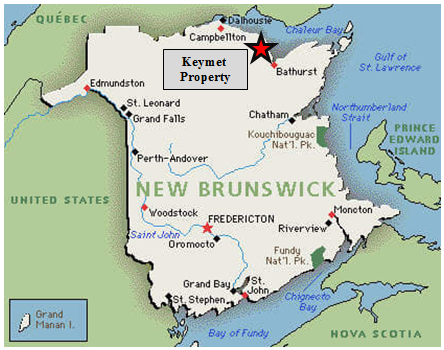
Drilling occurred in northwest region of the property, 1.5 km NW of the historic Keymet Mine.
Ky-18-14: 7.89% zinc equivalent over 34.3 meters (From 46.20 m to 80.50 m)
Elmtree 12 vein: System traced to approximately 145 meters depth, open at depth
Elmtree 12 vein: Strike length of approximately 110 meters and open along strike
The Company’s focus since acquiring the Keymet Property is the area of reported polymetallic veins with most work in the area of the Elmtree 12 copper-lead-zinc-silver bearing vein system.
At least seven vein occurrences with lead, zinc and +/- copper, silver and gold are reported in this region of the property in addition to the polymetallic veins reported at the historic Keymet Mine
FULL DISCLOSURE: Great Atlantic is an advertising client of AGORA Internet Relations Corp
Posted by AGORACOM
at 9:56 AM on Wednesday, January 23rd, 2019
Applied for a diamond drilling permit for the Company’s Golden Promise Jaclyn Main Zone (JMZ) and Jaclyn North Zone (JNZ)
In-fill drilling in west half of JMZ within conceptual pit-constrained area.
Explore along projected strike east of JNZ in area of high-grade quartz boulders (boulder samples of 163, 208 and 332 g/t gold
VANCOUVER, BC / ACCESSWIRE / January 23, 2019 / GREAT ATLANTIC RESOURCES CORP. (TSXV.GR) (the “Company” or “Great Atlantic”)
is pleased to announce it has applied for a diamond drilling permit for
the Company’s Golden Promise Gold Property, located in the central
Newfoundland gold belt. The application is for up to 50 drill holes (up
to 6,500 meters) in the northern half of the property at the Jaclyn
Zone, specifically at the Jaclyn Main Zone (JMZ) and Jaclyn North Zone
(JNZ). Pending approval of the drilling permit and financing, the
Company plans to begin drilling during spring 2019, with the following
focus:
In-fill drilling in west half of JMZ within conceptual pit-constrained area.
Both shallow and deeper drilling in central-east region of JMZ.
Provide data for up-dated JMZ mineral resource estimate, engineering studies and studies of mineralizing controls.
Explore
along projected strike east of JNZ in area of high-grade quartz
boulders (boulder samples of 163, 208 and 332 g/t gold – News Release of
August 31, 2017).
The Company recently reported a
National Instrument 43-101 mineral resource estimate for the JMZ (News
Release of December 6, 2018; and Sedar-filed National Instrument 43-101
Technical Report on the Golden Promise Property, Central Newfoundland
(revised), dated December 4, 2018 by Mr. Greg Z. Mosher, M.Sc. App.,
P.Geo., and Mr. Larry Pilgrim, B.Sc., P.Geo.). The reported inferred
mineral resource estimate for the JMZ is as follows:
Resource
Cutoff Au g/t
Au Cap g/t
Au Uncap g/t
Tonnes
Au Ounces Capped
Au Ounces Uncapped
Total
1.1
9.3
10.4
357,500
106,400
119,900
Pit-Constrained
0.6
11.4
14.1
157,300
57,800
71,200
Underground
1.5
7.5
7.6
200,200
48,600
48,700
Mineral Resources are not Mineral Reserves and do not have demonstrated economic viability.
There is no certainty that all or any part of the Mineral Resources estimated will be converted into Mineral Reserves.
Mineral
resource tonnage and contained metal have been rounded to reflect the
accuracy of the estimate, and numbers may not add due to rounding.
Mineral resource tonnage and grades are reported as undiluted.
Contained Au ounces are in-situ and do not include recovery losses
The
majority of 2019 planned diamond drill holes at the Golden Promise
Property will be in-fill drill holes in the west section of the JMZ in
the conceptual pit-constrained area. Some drilling is planned for the
central-east section of the JMZ. Historic drilling in this part of the
JMZ is less concentrated versus the west section. Planned drilling in
the central-east section of the JMZ will include near-surface drilling
to test continuation of gold mineralization to near-surface, and some
deeper holes. The drilling program will provide data for an up-dated JMZ
mineral resource estimate, engineering studies and studies of
mineralizing controls. Up to nine drill holes are planned testing
continuation of the JNZ east along projected strike. The Company
conducted trenching during 2017 along the projected east strike of the
JNZ. The trenching generally failed to reach bedrock due to thick
glacial till. However gold bearing quartz vein boulders were excavated
from multiple trenches, with some boulder samples returning high grade
gold (including 163.99, 208.51 and 332.67 g/t gold: News Release of
August 31, 2017). A qualified person managed the 2017 trenching program
and sampling and verified the analytical data.
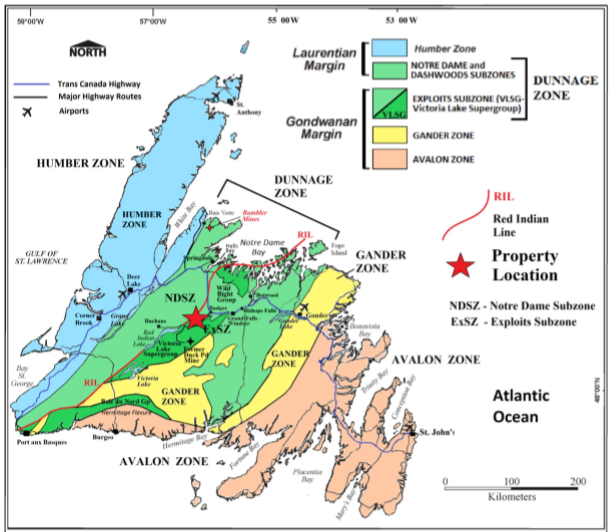
The Golden Promise
Property hosts multiple gold bearing quartz veins and is located in a
region of recent significant gold discoveries. The property is located
within the Exploits Subzone of the Newfoundland Dunnage Zone. Within the
Exploits Subzone, the property lies along the north-northwestern fringe
of the Victoria Lake Supergroup (VLSG), a volcano-sedimentary terrane.
The northwestern margin of the Golden Promise Property occurs proximal
to, and, in part, contiguous with a major (Appalachian-scale)
collisional boundary, and suture zone, known as the Red Indian Line
(RIL). The RIL forms the western boundary of the Exploits Subzone.
Recent significant gold discoveries in this region of the Exploits
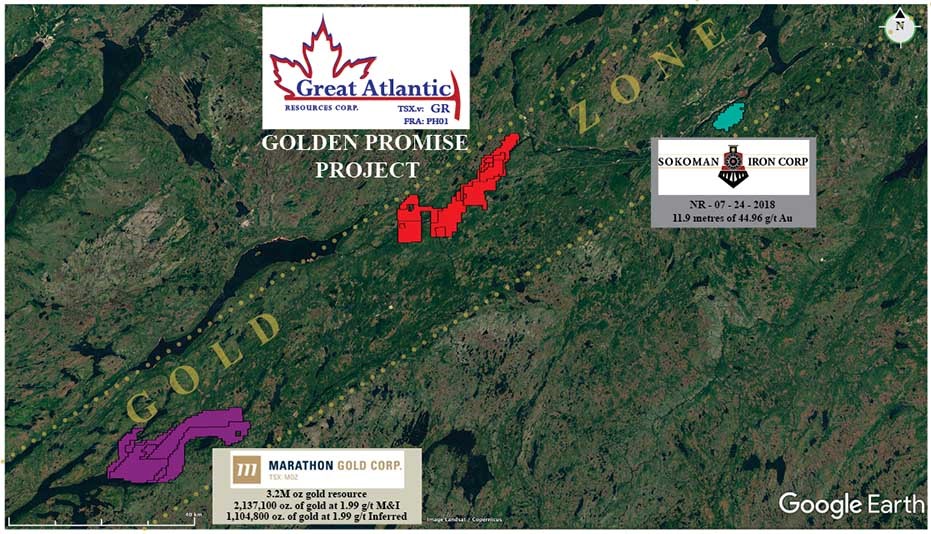
Subzone include those of Sokoman Iron Corp. (TSXV.SIC) at the Moosehead Project and Marathon Gold Corp. (TSXV.MOZ) at the Valentine Lake Gold Camp.
Sokoman Iron Corp. (TSXV.SIC) recently
announced a high-grade gold discovery on its Moosehead Property,
located approximately 40 kilometers east-northeast of the Golden Promise
Property. The discovery was made during the 2018 diamond drilling
program. A drill intersection of 44.96 g/t gold over 11.90 meters core
length was reported including a 1.35 meters core length quartz vein
intersection of 385.85 g/t gold (Sokoman Iron Corp. News Release of July
24, 2018). The Valentine Lake Gold Camp of Marathon Gold Corp. (TSXV.MOZ) is
located approximately 55 kilometers southwest of the Golden Promise
Property. As reported on Marathon’s website, the Valentine Lake Gold
Camp currently hosts four near-surface, mainly pit-shell constrained,
deposits with measured and indicated resources totaling 2,691,400 oz. of
gold at 1.85 g/t gold and inferred resources totalling 1,531,600 oz. of
gold at 1.77 g/t. Readers are warned that mineralization at the
Moosehead Property and Valentine Lake Gold Camp is not necessarily
indicative of mineralization on the Golden Promise Property.
High-grade
gold is reported in quartz veins and quartz vein boulders within the
Golden Promise Property. Gold bearing quartz veins are reported in
multiple areas of the property, including at least 5 gold bearing quartz
vein systems reported in the Jaclyn Zone. Much of the reported
historical exploration within the property has been focused on the
Jaclyn Zone with gold bearing vein systems reported at the JMZ, JNZ,
Jaclyn South Zone, Jaclyn East Zone and Jaclyn West Zone. The majority
of historic drilling (2002-2010) was conducted at the JMZ. Gold bearing
veins and gold bearing float are reported in other regions of the
property. These include the Linda/Snow White vein in the southern region
and the Shawn’s Shot vein in the central region of the property.
As
reported in the National Instrument 43-101 Technical Report on the
Golden Promise Property, Central Newfoundland (revised), dated December
4, 2018 by Mr. Greg Z. Mosher, M.Sc. App., P.Geo., and Mr. Larry
Pilgrim, B.Sc., P.Geo., the JMZ was modelled as a single quartz vein
that strikes east-west and dips steeply to the south. Modelled vein
thickness was based on true thickness derived from quartz vein
intercepts. The estimate is based on 220 assays that were composited to
135 one-meter long composites. A bulk density of 2.7 g/cm3 was used.
Blocks in the model measured 15 meters east-west, 1-meter north-south
and 10 meters vertically. The block model was not rotated. Grades were
interpolated using inverse-distance squared (ID2) weighting and a search
ellipse that measured 100 meters along strike, two meters across strike
and 50 meters vertically. Grades were interpolated based on a minimum
of two and a maximum of 10 composites with a maximum of one composite
per hole so the grade of each block is based on at least two drillholes
thereby demonstrating continuity of mineralization. For the capped
mineral resource estimate, all assays that exceed 65 g/t gold were
capped at 65 g/t gold. All resources were classified as Inferred because
of the relatively wide spacing of drill holes through most of the zone.
Because
part of the vein is near surface the resource estimate was constrained
by a conceptual open pit to demonstrate reasonable prospects of eventual
economic extraction. Generic mining costs of US$2.50/tonne and
processing costs of US$25.00/tonne were used together with a gold price
of US$1,300/ounce. A conceptual pit slope of 45° was assumed with no
allowance for mining loss or dilution. Based on the combined
hypothetical mining and processing costs and the assumed price of gold, a
pit-constrained cutoff grade of 0.6 g/t was adopted. For the
underground portion of the resource a cutoff of 1.5 g/t was assumed. The
cutoff grade for the total resource is the weighted average of the
pit-constrained and underground cutoff grades.
Jaclyn Main Zone Total Inferred Mineral Resource Estimate
Resource
Cutoff Au g/t
Au Cap g/t
Au Uncap g/t
Tonnes
Au Ounces Capped
Au Ounces Uncapped
Total
1.1
9.3
10.4
357,500
106,400
119,900
Pit-Constrained
0.6
11.4
14.1
157,300
57,800
71,200
Underground
1.5
7.5
7.6
200,200
48,600
48,700
Mineral Resources are not Mineral Reserves and do not have demonstrated economic viability.
There is no certainty that all or any part of the Mineral Resources estimated will be converted into Mineral Reserves.
Mineral
resource tonnage and contained metal have been rounded to reflect the
accuracy of the estimate, and numbers may not add due to rounding.
Mineral resource tonnage and grades are reported as undiluted.
Contained Au ounces are in-situ and do not include recovery losses
David
Martin, P.Geo., a Qualified Person as defined by NI 43-101 and VP
Exploration for Great Atlantic, is responsible for the technical
information contained in this News Release.
About Great Atlantic Resources Corp.: Great
Atlantic Resources Corp. is a Canadian exploration company focused on
the discovery and development of mineral assets in the resource-rich and
sovereign risk-free realm of Atlantic Canada, one of the number one
mining regions of the world. Great Atlantic is currently surging forward
building the company utilizing a Project Generation model, with a
special focus on the most critical elements on the planet that are
prominent in Atlantic Canada, Antimony, Tungsten and Gold. On Behalf of the board of directors
“Christopher R Anderson“
Mr. Christopher R. Anderson “Always be positive, strive for solutions, and never give up” President CEO Director 604-488-3900 – Dir
Posted by AGORACOM-JC
at 9:18 AM on Wednesday, January 23rd, 2019
Production activities at the Beaufor Mine extended until April 2019, taking place in known stopes with a smaller workforce
Sustained positive contribution of custom milling at the Camflo mill
During the quarter, successfully completed a positive feasibility study on its Wasamac deposit (see feasibility study), which can be summarized as follows:
Projected annual average gold production of 142,000 ounces over 11 years
Pre-tax NPV of $522 million
Pre-tax IRR of 23.6%
Production cash costs of US$550 per ounce
MONTREAL, Jan. 23, 2019 – MONARQUES GOLD CORPORATION(“Monarques” or the “Corporation”) (TSX: MQR) (OTCMKTS: MRQRF) (FRANKFURT: MR7) is pleased to report its production results and corporate highlights for the second quarter ended December 31, 2018. Amounts are in Canadian dollars unless otherwise indicated.
Production highlights
Monarques produced 4,417 ounces of gold in the second quarter, up
23% from the first quarter but down 19% from 5,444 ounces last year.
The Corporation recorded revenues of $11.4 million in the second quarter from the sale of 5,169 ounces of gold at an average price of $1,656 per ounce (US $1,254),
combined with revenues from custom milling operations, which were up 2%
from the first quarter and more than 71% year over year.
“These positive results for Monarques in the second quarter reflect a
number of factors, including better grades from known stopes at the
Beaufor Mine, higher gold prices and the sustained contribution of
custom milling activities at Camflo,” said Jean-Marc Lacoste,
President and Chief Executive Officer of Monarques. “We will continue
mining the ore remaining in the known stopes at Beaufor over the next
few months, which should allow us to continue producing until April 2019.
To reduce costs and in anticipation of the upcoming suspension of
production activities at Beaufor, we stopped doing exploration and
development work a few months ago and currently have 51 employees at the
Beaufor Mine, compared to approximately 130 employees prior to the
announcement of the suspension. I would also like to thank our employees
for their outstanding performance during the quarter.”
Production statistics
Three months ended December 31, 2018
Three months ended December 31, 2017
Six months ended December 31, 2018
Six months ended December 31, 2017
Beaufor Mine
Ore processed (tonnes)
26,079
35,005
55,454
35,005
Gold recovery (%)
98.50
98.68
98.26
98.68
Ounces produced
4,417
5,444
8,325
5,444
Ounces sold
5,169
5,444
8,441
5,444
Corporate highlights
On October 23, 2018, the Corporation provided new results from the Probe Metals Inc. 2018 drilling program on the Monique property, located near Val-d’Or, Quebec (see press release).
On December 3, 2018, the Corporation reported positive results from the feasibility study prepared by BBA Inc. for the Wasamac Gold project (see press release).
On December 13, 2018, Monarques announced that it had
closed a nonâ€brokered private placement of an aggregate of 3,029,606
flowâ€through shares at a price of $0.33 per flow-through share, for aggregate gross proceeds of $999,769.98 (see press release).
On December 18, 2018, the Corporation reported that it
had consolidated its position around its Wasamac property through an
exchange of mineral claims with Globex Mining Enterprises Inc. (see press release).
Monarques Gold Corporation (TSX: MQR) is an emerging gold mining
company focused on pursuing growth through its large portfolio of
high-quality projects in the Abitibi mining camp in Quebec, Canada. The Corporation currently owns close to 300 km² of gold properties (see map),
including the Wasamac deposit (measured and indicated resource of 2.6
million ounces of gold), the Beaufor Mine, the Croinor Gold (see video), McKenzie Break and Swanson
advanced projects and the Camflo and Beacon mills, as well as other
promising exploration projects. It also offers custom milling services
out of its 1,600 tonne-per-day Camflo mill.
Forward-Looking Statements
The forward-looking statements in this press release involve known
and unknown risks, uncertainties and other factors that may cause
Monarques’ actual results, performance and achievements to be materially
different from the results, performance or achievements expressed or
implied therein. Neither TSX nor its Regulation Services Provider (as
that term is defined in the policies of the TSX) accepts responsibility
for the adequacy or accuracy of this press release.
Tags: gold, gold demand, monarques, tsx-v Posted in Monarques Gold | Comments Off on Monarques Gold $MQR.ca Produces 4,417 Ounces of #Gold and Generates $11.4 million in Revenue in its Second Quarter $GDX.ca $ECR.ca $MZZ.ca $QMX.ca $IMG.ca $IAG $MUX
Posted by AGORACOM
at 11:08 AM on Tuesday, January 22nd, 2019
Two regional scale gold in soil and lake sediment anomalies trending 15km north-south and 14km east-west
The property covers 892 square km of ground prospective for gold.
7,458 soil samples were taken on 18 grids at a 100m line spacing and 25m sample spacing across the Ashuanipi north claim block.
Results of analyses show significant gold anomalies in all but two of the 18 grids and confirm the 15km north-south anomalous trend
VANCOUVER, British Columbia, Jan. 22, 2019 (GLOBE
NEWSWIRE) — Labrador Gold Corp. (TSX-V: LAB) (“Labrador Gold†or the
“Companyâ€) is pleased to announce results from detailed gold exploration
of its Ashuanipi project in Labrador and Quebec. The exploration
program at Ashuanipi followed up on successful results of 2017 work that
outlined two regional scale gold in soil and lake sediment anomalies
trending 15km north-south and 14km east-west. The property covers 892
square kilometres of ground prospective for gold.
A
total of 7,458 soil samples were taken on 18 grids at a 100m line
spacing and 25m sample spacing across the Ashuanipi north claim block.
In addition, 61 reconnaissance soil lines were taken over claims staked
in Labrador and Quebec following the results of the 2017 work. Results
of analyses show significant gold anomalies in all but two of the 18
grids and confirm the 15km north-south anomalous trend (See figures at
www.labradorgold.com). Analyses of the soils range from below detection
limit, <0.5 parts per billion (ppb) to 8.97g/t Au, with 67 samples
containing more than 0.1g/t Au and three samples containing more than
1g/t Au in the soil. In addition, 749 soil samples with gold
concentrations greater than the 90th percentile are considered anomalous and require detailed follow up.
Gold
anomalies do not appear to correlate with specific rock types, at least
on a regional scale, but are often associated with magnetic highs which
may be indicative of a structural control on the location of the gold.
“Results
of the detailed soil sampling at Ashuanipi has confirmed the regional
nature of the gold anomalies and indicted specific areas where gold
values are elevated above 0.1g/t and possibly related to near surface
gold enrichment,†said Roger Moss, President and Chief Executive Officer
of Labrador Gold. “These anomalies enable us to focus our exploration
at specific sites along the regional anomaly to rapidly assess the
potential for gold mineralization. Work during the coming field season
will include detailed mapping, rock sampling and, if warranted, eventual
drill testing of these anomalous areas. We anticipate an exciting field
season at Ashuanipi tracking down the source of these significant gold
anomalies.â€
“Last year’s soil sampling
program further resolved the anomalous gold trend down to the 25-metre
scale,†added Shawn Ryan, Technical Advisor to Labrador Gold. “The size
and intensity of the gold targets clearly explain the large regional
gold in lake sediment anomaly and with 164 samples running over 50 ppb
Au, 67 samples over 100 ppb Au and a high of 8,973 ppb Au it appears
that we truly have a robust mineralized system. These areas will be the
focus of aggressive exploration next season to identify high quality
drill targets.â€
The company also announces
that its major shareholder, Plethora Precious Metals Fund (‘Plethoraâ€)
has exercised 3,125,000 warrants at an exercise price of $0.13. Plethora
now holds 9,750,000 shares of the company representing 17.45% of the
issued and outstanding shares. We appreciate the continued support of
Plethora and their confidence in the exploration strategy of our
technical team.
All samples were dried in the
field before being shipped to the Bureau Veritas preparation laboratory
in Timmins, Ontario, with analyses completed at the Vancouver
laboratory. Samples were analyzed for gold and another 36 elements by
ICP-MS (inductively coupled plasma-mass spectrometry) following an aqua
regia digestion. The company routinely submits blanks, field duplicates
and certified reference standards with batches of samples to monitor the
quality of the analyses.
Roger Moss, PhD., P.Geo., is the qualified person responsible for all technical information in this release.
About Labrador Gold:
Labrador
Gold is a Canadian based mineral exploration company focused on the
acquisition and exploration of prospective gold projects in the
Americas. In 2017 Labrador Gold signed a Letter of Intent under which
the Company has the option to acquire 100% of the 896 square kilometre
(km2) Ashuanipi property in northwest Labrador and the Hopedale (458 km2) property in eastern Labrador.
The
Hopedale property covers much of the Hunt River and Florence Lake
greenstone belts that stretch over 80 km. The belts are typical of
greenstone belts around the world but have been underexplored by
comparison. Initial work by Labrador Gold during 2017 show gold
anomalies in soils and lake sediments over a 3 kilometre section of the
northern portion of the Florence Lake greenstone belt in the vicinity of
the known Thurber Dog gold showing where grab samples assayed up to
7.8g/t gold. In addition, anomalous gold in soil and lake sediment
samples occur over approximately 40 kilometres along the southern
section of the greenstone belt (see news release dated January 25th 2018 for more details). Labrador Gold now controls approximately 57km strike length of the Florence Lake Greenstone Belt.
The
Ashuanipi gold project is located just 35 km from the historical iron
ore mining community of Schefferville, which is linked by rail to the
port of Sept Iles, Quebec in the south. The claim blocks cover large
lake sediment gold anomalies that, with the exception of local
prospecting, have not seen a systematic modern day exploration program.
Results of the 2017 reconnaissance exploration program following up the
lake sediment anomalies show gold anomalies in soils and lake sediments
over a 15 kilometre long by 2 to 6 kilometre wide north-south trend and
over a 14 kilometre long by 2 to 4 kilometre wide east-west trend. The
anomalies appear to be broadly associated with magnetic highs and do not
show any correlation with specific rock types on a regional scale (see
news release dated January 18th 2018). This suggests a
possible structural control on the localization of the gold anomalies.
Historical work 30 km north on the Quebec side led to gold intersections
of up to 2.23 grams per tonne (g/t) Au over 19.55 metres (not true
width) (Source: IOS Services Geoscientifiques, 2012, Exploration and
geological reconnaissance work in the Goodwood River Area, Sheffor
Project, Summer Field Season 2011). Gold in both areas appears to be
associated with similar rock types.
The Company has 55,864,022 common shares issued and outstanding and trades on the TSX Venture Exchange under the symbol LAB.
Posted by AGORACOM
at 5:30 PM on Friday, January 18th, 2019
107.5 g/t gold and 880 g/t silver over 6.90 meters core length
High-grade quartz vein intersection is near-surface, near high grade intersections of COD18-45, 46 and 67 indicating high grade ore shoot.
COD18-67: 129 g/t gold and 1,154 g/t silver over 7.28 meters
VANCOUVER, BC / ACCESSWIRE / January 18, 2019 / GGX Gold Corp. (TSX-v: GGX), (OTCQB: GGXXF), (FRA: 3SR2) (the “Company” or “GGX“)
is pleased to announce it has received drill core analytical results
for the final four drill holes (COD18-68 to COD18-71) of the November
2018 diamond drilling program at its Gold Drop Property near Greenwood,
southern British Columbia. Drill hole COD18-70 intersected near-surface
high-grade gold and silver with significant tellurium in the southwest
part of the COD quartz vein. This high-grade intersection is in
close-proximity to high-grade intersections in drill holes COD18-45, 46
and 67 indicating a high grade ore shoot. The mineralized COD vein
system has been traced by drilling and / or trenching for approximately
400 meters strike length and is open to the northeast, at depth and
possibly to the southwest. Highlights for COD18-70 include:
107.5
g/t gold and 880 g/t silver over 6.90 meters core length (multiple
samples greater than the upper 500 g/t analytical limit for tellurium).
High-grade
quartz vein intersection is near-surface (18 to 24 meters vertical
depth), near high grade intersections of COD18-45, 46 and 67 indicating
high grade ore shoot.
Part of
exploratory shallow drilling designed to define high-grade
mineralization and expand the understanding of controls on
mineralization.
The
November 2018 diamond drilling program (11 drill holes: COD18-61 to
COD18-71) tested the southwest region of the COD vein in an area of
high-grade gold and silver mineralization. The COD vein is located
within the Gold Drop Southwest Zone. Prior 2018 drill holes in this part
of the COD vein intersected near-surface high-grade gold and silver
mineralization. The COD vein strikes approximately northeast-southwest.
Intersections
exceeding 1 g/t gold for drill holes COD18-68 to COD18-71 are listed in
the table below. Since true widths cannot be accurately determined from
the information available the core lengths (meters) are reported.
Hole ID
From (m)
To (m)
Length (m)
Au (g/t)
Ag (g/t)
Te (g/t)
Description
COD18-68
19.49
22.25
2.76
8.77
85.4
56.3
Quartz vein and wall rock
COD18-68
incl. 20.86
22.35
1.39
14.47
131.8
87.9
Quartz vein and wall rock
COD18-69
19.75
20.42
0.67
1.24
9.59
6.55
quartz band
COD18-69
26.72
34.18
7.46
5.76
67.9
61.2
Quartz veins & wall rock; local quartz breccia
COD18-69
incl. 27.30
28.10
0.80
9.77
95
110
Quartz vein
COD18-69
incl. 31.20
31.60
0.40
70.9
569
278
Quartz vein with massive sulfide band
COD18-70
22.57
29.47
6.90
107.5
880
Quartz vein with tellurides
COD18-70
incl. 23.3
24.15
0.85
541
4532
>500
Quartz vein with tellurides
COD18-71
28.50
30.30
1.80
1.57
11.7
8.4
Alteration zone
Note: 1-meter core loss in COD18-70 between 22.57 – 29.47m.
All
November 2018 drill holes were collared within 25 meters of prior 2018
drill holes COD18-45 and COD-46, the objective to define the high-grade
mineralization in this part of the COD vein and to provide information
on the controls on mineralization. Drill holes COD18-45 and COD18-46,
drilled to the west at 45 and 50 degree-dips, intersected near-surface,
high grade gold and silver mineralization in the COD vein (News Releases
of August 15 and 22, 2018). Drill holes COD18-67and COD18-70, part of
the November 2018 program, intersected high grade gold and silver
mineralization in the same area. These holes were drilled slightly
northeast at dips of 50 degrees (COD18-67) and 54 degrees (COD18-70) to
intersect the COD vein at a shallower angle and test the continuity of
the quartz veining and high-grade mineralization. Highlights of these
four holes include (core length):
COD18-45: 50.1 g/t gold and 375 g/t silver over 2.05 meters (including 167.5 g/t gold, 1,370 g/t silver & >500 g/t tellurium over 0.46 meters).
COD18-46: 54.9 g/t gold and 379 g/t silver over 1.47 meters (including 223 g/t gold, 1,535 g/t silver & > 500 g/t tellurium over a 0.30 meters).
COD18-67: 129 g/t gold and 1,154 g/t silver over 7.28 meters (multiple samples exceeding upper 500 g/t analytical limit for tellurium).
COD18-70: 107.5 g/t gold and 880 g/t silver over 6.90 meters (multiple samples exceeding upper 500 g/t analytical limit for tellurium).
The
close-spaced intersections of COD18-45, 46, 67 and 70 all occur within
18-25 meters vertical depth indicating a high-grade ore shoot.
Analytical
results for drill holes COD18-61 to COD18-64 were reported in the
Company’s News Release of January 9, 2018, the highlight being 28.0 g/t
gold, 424.7 g/t silver and 150.4 g/t tellurium over 1.17 meters core
length in COD18-63. Analytical results for drill holes COD18-64 to
COD18-67 were reported in the Company’s News Release of January 11,
2019, the highlight being the intersection of 129 g/t gold and 1,154 g/t silver over 7.28 meters core length in COD18-67.
Holes
COD18-61 to COD18-66 were drilled to the west and slightly northwest at
dips of 45 to 60 degrees to intersect the approximately northeast
striking vein(s). Holes COD18-67 to COD18-71 were drilled at dips of 45
to 60 degrees slightly northeast to intersect the vein(s) at a shallower
angle, the objective being to test the continuity of the quartz veining
and mineralization. Although drill holes COD18-67 and COD18-70 were not
drilled perpendicular to the strike of the COD vein, they still show
the exceptional high-grade nature of the vein, possibly being, or
leading to, a “motherlode”-style feeder system. As the Company continues
reminding of the old saying “we drill for structure and we drift for
grade”, both holes indicate how potential drifting may encounter the
vein in case a potential production decision can be made in the future.
Drilling along veins at slight angles helps in locating possible “ore
shoots” and gaining a structural understanding of its vertical and
horizontal orientations/extensions for targeted follow-up drilling.
The
drill core was split with half core samples securely packaged and
delivered to ALS Canada Ltd. in Vancouver, BC. The core samples were
analyzed for gold by Fire Assay-Atomic Absorption and for 48 elements
(including silver and tellurium) by Four Acid – ICP-MS. Samples
exceeding 100 g/t gold were re-analyzed for gold by Fire Assay –
Gravimetric Finish. Samples exceeding 100 g/t silver were re-analyzed
for silver by Four Acid – ICP-AES. Samples exceeding 1,500 g/t silver by
Four Acid – ICP-AES were re-analyzed for silver by Fire Assay –
Gravimetric Finish. Quality control (QC) samples were inserted at
regular intervals.
Gold
and silver bearing quartz veins occur in multiple regions on the Gold
Drop property with high grade gold reported (samples exceeding 1 oz. /
ton gold reported).
Historic gold and silver production occurred at the Gold Drop, North Star, Amandy and Roderick Dhu vein systems.
David
Martin, P.Geo., a Qualified Person as defined by NI 43-101, is
responsible for the technical information contained in this News
Release.
To view the Original News release with pictures please go to the website or contact the company.
On Behalf of the Board of Directors, Barry Brown, Director 604-488-3900 [email protected]
Posted by AGORACOM
at 9:18 AM on Friday, January 18th, 2019
Drill results for holes 10 – 22 completed during 2018 exploration
Drilling conducted 1.5 km northwest of the historic Keymet Mine
Ky-18-14: 7.89% zinc equivalent over 34.3 m
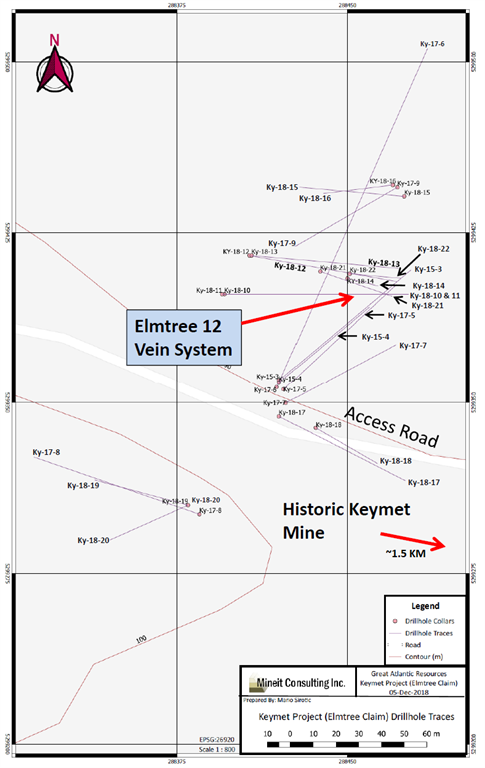
GREAT ATLANTIC RESOURCES CORP. (TSXV.GR) (the “Company” or “Great Atlantic”) is pleased to announce it has received drill core analytical results for 13 holes (Ky-18-10 to Ky-18-22) completed during the 2018 diamond drilling program at its Keymet Base Metal – Precious Metal Property, located near Bathurst, northeast New Brunswick. The program was conducted in the northwest region of the property approximately 1.5 km northwest of the historic Keymet Mine. Highlights include (core length):
Ky-18-14: 7.89% zinc equivalent over 34.3 meters (From 46.20 m to 80.50 m)
Ky-18-10: 10.91% zinc equivalent over 3.27 meters (From 85.03m to 88.30 m)
Elmtree 12 vein: System traced to approximately 145 meters depth, open at depth
Elmtree 12 vein: Strike length of approximately 110 meters and open along strike
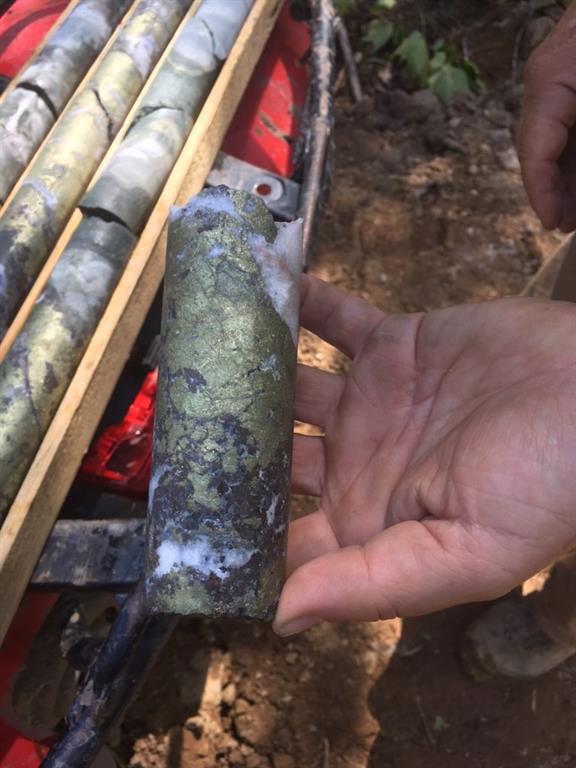
Vein with semi-massive sulfides in Drill Hole Ky-18-14 at Elmtree 12 Vein System
The
2018 drilling program (13 holes totalling 1,484 meters) was conducted
in the northwest region of the Keymet property. Eleven drill holes
(Ky-18-10 to Ky-18-18, Ky-18-21 and Ky-18-22) tested the Elmtree 12 vein
system as in-fill drilling and along strike with some holes testing
deeper than previous drilling. Company management speculate the Elmtree
12 vein system to be striking approximately north-south and
sub-vertical. Great Atlantic had previously drilled six holes in the
Elmtree 12 vein system during 2015 and 2017, intersecting zinc, copper,
lead and silver bearing polymetallic veins (News Releases of February
23, 2016, December 20, 2017 and March 2, 2018). Two drill holes
(Ky-18-19 and Ky-18-20) tested the continuation of another base metal
and silver bearing vein southwest of the Elmtree 12 vein system. This
vein was discovered during 2017 drilling (Ky-17-8: 18.8% Zn, 3.5% Cu and
576 g/t Ag over 1.27 meters core length – News Release of March 2,
2018).
Sulfide Bearing Veins in Drill Hole Ky-18-14 at Elmtree 12 Vein System
Intersections
from 2015, 2017 and 2018 diamond drilling programs in the area of the
Elmtree 12 vein system include the following (core length):
Hole ID
From (m)
To (m)
Length (m)
Zn Equiv. (%)
Zn (%)
Cu (%)
Pb (%)
Ag (g/t)
Au (g/t)
2015 Diamond Drill Holes:
Ky-15-3
30.10
32.20
2.10
3.28
Ky-15-3
60.80
62.60
1.80
22.77
16.68
1.11
0.44
152
Ky-15-4
90.07
94.35
4.28
10.44
8.68
0.29
0.2
44.8
2017 Diamond Drill Holes:
Ky-17-5
81.00
81.80
0.80
20.24
13.65
1.20
0.45
166
Ky-17-6
119.45
131.50
12.05
8.31
3.54
0.92
0.28
115.6
Ky-17-6
incl. 119.45
124.40
4.95
16.05
7.67
1.57
0.48
209.3
Ky-17-6
148.80
149.75
0.95
4.9
Ky-17-6
164
183.96
19.96
0.64
Ky-17-8
31.00
32.27
1.27
39.90
18.8
3.55
1.16
576
Ky-17-9
45.75
47.13
1.38
6.29
4.29
0.29
0.23
55.4
2018 Diamond Drill Holes:
Ky-18-10
85.03
88.30
3.27
10.91
7.91
0.53
0.21
77.2
Ky-18-10
incl. 85.74
86.74
1.00
25.59
16.80
1.60
0.55
223
Ky-18-11
108.70
109.40
0.70
4.95
3.89
0.11
0.14
33.9
Ky-18-12
78.82
84.55
5.73
7.88
4.07
1.19
0.23
39.2
Ky-18-12
incl. 78.82
79.64
0.82
14.03
10.90
1.07
0.09
24.8
Ky-18-12
incl. 83.35
84.55
1.20
21.65
8.90
3.81
0.60
157
Ky-18-13
80.00
81.00
1.00
1.76
Ky-18-14
46.20
80.50
34.30
7.89
3.29
0.88
0.26
112.6
Ky-18-14
incl. 46.20
49.20
3.00
56.23
9.04
9.19
2.16
1158
Ky-18-14
incl. 62.48
63.00
0.52
18.49
15.45
0.96
0.13
32
Ky-18-14
incl. 67.00
67.60
0.60
13.59
13.05
0.09
0.05
14
Ky-18-14
incl. 76.00
80.50
4.50
14.27
12.08
0.31
0.30
59.8
Ky-18-16
77.20
77.72
0.52
33.48
4.47
7.85
0.72
478
Ky-18-17
10.43
11.00
0.57
11.72
6.37
0.10
6.08
14.5
Ky-18-17
67.00
67.50
0.50
7.23
6.05
0.21
0.15
27.5
Ky-18-18
72.50
73.50
1.00
2.74
2.04
0.09
0.11
19.6
Ky-18-19
13.02
13.72
0.70
1.05
Ky-18-20
32.00
32.28
0.28
10.75
2.39
1.82
0.87
164
Ky-18-21
145.50
147.00
1.50
8.26
2.31
0.89
0.81
156.6
Zinc
equivalent (% Zn Equiv.) values for drill hole intersections are based
on the following metal prices (as of January 16, 2019): Zinc US$2,467 /
tonne (US$1.119 / lb.), Lead US$1,953 / tonne (US$0.886 / lb.), Copper
US$5,881 / tonne (US$2.668 / lb.) and Silver US$15.605 per troy ounce.
Metal recoveries of 100% were applied in the zinc equivalent
calculations. The zinc equivalent calculation is as follows: Zn Equiv. =
100 x ((Ag Price in grams x Ag Grade) + (Pb Price x 2204.6 x Pb Grade
(%) / 100) + (Cu Price x 2204.6 x Cu Grade (%) / 100) + (Zn Price x
2204.6 x Zn Grade (%) / 100)) / Zn Price x 2204.6.
Drill holes
Ky-18-10 to Ky-18-13 were in-fill holes drilled east to slightly
southeast at 45 to 57 degree dips. Drill holes Ky-18-14, Ky-18-21 and
Ky-18-22 were collared closer to the vein system and at steeper dips
(78-83 degrees) to intersect the vein system at a shallower angle to
test continuity of mineralization along dip, locate possible ore shoots
and gain a structural understanding of the vein’s vertical and
horizontal orientations / extensions for targeted follow-up drilling.
Hole Ky-18-21, drilled under Ky-18-14, tested the zone deeper. The
mineralized intersection at 145.5-147 meters in this hole is the deepest
intersection by the Company in the Elmtree 12 vein system and indicates
the system is open at depth at this location. This interval also
returned anomalous values for cobalt, including 0.07% Co over 1.0 meter
core length.
The meta-sediments in the lower half of Ky-18-22 are intruded my mafic dykes, possibly cutting the vein system.
Drill
holes Ky-18-15 and Ky-18-16 tested the extension of the Elmtree 12 vein
system to the north. Ky-18-15 was drilled slightly northwest
(approximate 55 degree dip). Ky-18-16 was drilled slightly southwest
(approximate 73 degree dip). The metal rich intersection in Ky-18-16
indicates the mineralized system is open to the north at slightly deeper
levels.
Drill holes Ky-18-17 and Ky-18-18 tested the Elmtree 12
vein system south of previous Company drilling. Mineralized veins and /
or alteration was intersected in both holes, indicating the mineralized
system to be open to the south.
Drill holes Ky-18-19 and Ky-18-20
were located southwest of the known extent of the Elmtree 12 vein
system. These holes tested the extension of the high grade vein
intersected in 2017 hole Ky-17-8. Ky-18-19 was drilled slightly
northwest at an approximate 66 degree dip to intersect the vein deeper.
Hole Ky-18-19 did not confirm the down-dip extension of the mineralized
vein. Hole Ky-18-20 was drilled southwest at an approximate 55 degree
dip. This hole intersected a near-surface narrow copper, lead, zinc and
silver bearing zone (approximate 26 meters vertical depth) approximately
10 meters south of the high grade vein intersection of hole Ky-17-8.
Drill
core from the 2018 program was geologically logged and sampled at a
secure location in Miramichi, New Brunswick. Drill core samples were
submitted to ALS Canada for gold analysis (Fire Assay-AA) and for 33
element analysis (including copper, lead, zinc and silver) by Four Acid
and ICP-AES. Samples exceeding 1,500 g/t silver were re-analyzed for
silver by Fire Assay-Gravimetric Finish. Quality Control samples were
included as part of the sample submission. A Qualified Person verified
the 2015, 2017 and 2018 exploration data for Great Atlantic. The
Qualified Person managed these exploration programs at the Keymet
Property.
Historic Keymet Mine (1950s)
The
Company’s focus since acquiring the Keymet Property has been the
northwest region of the property in the area of reported polymetallic
veins with most work in the area of the Elmtree 12
copper-lead-zinc-silver bearing vein system. At least seven vein
occurrences with lead, zinc and +/- copper, silver and gold are reported
in this region of the property in addition to the polymetallic veins
reported at the historic Keymet Mine (source: New Brunswick Dept. of
Energy and Resource Development Mineral Occurrence Database). The Keymet
Mine operated during the mid-1950s, producing copper, lead, zinc and
silver. Production at this mine was terminated due to a fire at the
site.
Significant
precious metal – base metal deposits are reported within 4 km of the
Keymet Property. The Elmtree gold deposits are located within 3 km
west-southwest of the Keymet Property. The historic Nigadoo River Mine
is located approximately 4 km south of the Keymet Property. Polymetallic
massive sulfide veins were mined at the Nigadoo River Mine during the
1960s and 1970s with copper, lead, zinc and silver being produced. The
N.B Dept. of Energy and Resource Development Mineral Occurrence Database
reports shaft depth and production totals at this historic mine.
Production during 1967-1971 is reported as 1.126 million tonnes at 2.2%
Pb, 2.1% Zn, 0.24% Cu and 92.57 g/t Ag. Production during 1973-1977
(after a 2 year closure) is reported to be 0.733 million tonnes (only
partial metal grades reported). The shaft is reported to at least 470
meter deep.
The Nash Creek Zinc Project of Callinex Mines Inc. is
located approximately 15 kilometers northwest of the Keymet Property.
Callinex Mines Inc. recently filed a 43-101 Technical Report (effective
date March 21, 2018) which was completed by Tetra Tech Canada Inc. The
report includes updated mineral resource estimates for the Nash Creek
Zinc Project (Hickey and Hayes Zones) using a 1.5% Zn Equiv. cut-off.
This included 13,592,000 tonnes indicated estimated resources at 2.68%
Zn, 0.58% Pb and 17.8 g/t Ag; and 5,929,000 tonnes inferred estimated
resources at 2.68% Zn, 0.47% Pb and 13.9 g/t Ag (source: Callinex Mines
Inc. Website).
Readers are warned that mineralization at the
Elmtree gold deposits, historic Nigadoo River Mine and Nash Creek Zinc
Project is not necessarily indicative of mineralization on the Keymet
Property.
Access to the Keymet Property is excellent with paved
roads transecting the property, including a provincial highway. The
property covers an area of approximately 3,400 hectares and is 100%
owned by the Company.
Readers are warned that historical records
referred to in this News Release have been examined but not verified by a
Qualified Person. Further work is required to verify that historical
records referred to in this News Release are accurate.
David
Martin, P.Geo., a Qualified Person as defined by NI 43-101 and VP
Exploration for Great Atlantic, is responsible for the technical
information contained in this News Release.
On Behalf of the board of directors
“Christopher R Anderson“
Mr. Christopher R Anderson ” Always be positive, strive for solutions, and never give up “ President CEO Director 604-488-3900 – Dir
About Great Atlantic Resources Corp.: Great
Atlantic Resources Corp. is a Canadian exploration company focused on
the discovery and development of mineral assets in the resource-rich and
sovereign risk-free realm of Atlantic Canada, one of the number one
mining regions of the world. Great Atlantic is currently surging forward
building the company utilizing a Project Generation model, with a
special focus on the most critical elements on the planet that are
prominent in Atlantic Canada, Antimony, Tungsten and Gold.
Posted by AGORACOM-JC
at 9:20 AM on Tuesday, January 15th, 2019
Hole CR-18-659 returned a very impressive 74.23 g/t Au over 2.0 metres, including 139.50 g/t Au over 1.0 metre.
This intersection is just below the historic 500-foot level drift, 150 metres below surface, and is 30 metres east and 30 metres down dip from two planned stopes, with no other holes between the stopes and this hole
Continuous positive assay results from initial drilling program on the Croinor Gold deposit
The results obtained from the initial program warranted additional
drilling on Croinor Gold. Drilling continued with one rig on the
property and a second drill was added on September 17,
allowing Monarques to drill an additional 6,645 metres before the winter
freeze. The results of the additional drilling will be released soon.
Hole CR-18-659 returned a very impressive 74.23 g/t Au over 2.0
metres, including 139.50 g/t Au over 1.0 metre. This intersection is
just below the historic 500-foot level drift, 150 metres below surface,
and is 30 metres east and 30 metres down dip from two planned stopes,
with no other holes between the stopes and this hole. This hole has the
potential to connect the two stopes and could substantially increase the
tonnage and grade of the resource at the 500-foot level.
Like Hole CR-18-659, Hole CR-18-660 is also an infill hole drilled
between two planned stopes that are 60 metres apart. Hole CR-18-660
returned values of 7.77 g/t Au over 2.1 metres, including 11.05 g/t Au
over 1.1 metres. This hole also connects the two stopes, increasing the
grade and tonnage in this part of the mine. This intersection is 80
metres below the surface and is just below the 250-foot level of the old
workings.
Hole CR-18-662 was drilled between four planned stopes and returned
values of 5.55 g/t Au over 2.5 metres, including 6.74 g/t Au over 1.3
metres just below the 250-foot level, 90 metres below surface. This hole
could connect the four stopes together, again increasing the grade and
tonnage in this area of the mine.
Hole CR-18-663 was drilled in the eastern part of the deposit. This
hole intersected two zones, the first on the 250-foot level and the
second below the 500-foot level. The first zone returned 4.69 g/t Au
over 20.9 metres, including 10.38 g/t Au over 1.6 metres and 10.71 g/t
Au over 1.9 metres. The hole was drilled east of the most easterly
planned stope, thereby enlarging the width of the stope eastward by
nearly 20 metres; most planned stopes at Croinor Gold are two metres
wide. The second zone is below the historic workings, 215 metres below
surface, and returned 13.85 g/t Au over 1.0 metre. This hole was drilled
between two holes drilled in 2011: the hole to the west is 43 metres
away and returned 3.26 g/t Au over 0.9 metre and the hole to the east is
75 metres away and returned 1.81 g/t Au over 1.0 metre. These values
show that the deposit is still open to the east, to the west and at
depth, and that this area merits further drilling.
Holes CR-18-664 and CR-18-665 are exploration holes drilled
approximately three kilometres to the west of the Croinor Gold deposit
in volcanic rocks and another narrow diorite sill. Both holes
encountered visible gold, but only Hole CR-18-665 showed significant
values, returning 12.20 g/t Au over 0.5 metre. An intersection with
visible gold in Hole CR-18-664 returned 0.76 g/t Au over half a metre.
These are encouraging results for pure exploration holes in an area that
has never been drilled. Follow-up drilling has been done between these
holes and assays will be released soon.
Holes CR-18-666 through CR-18-670 are exploration holes that were drilled to test induced polarization anomalies.
“These impressive results from the infilling diamond drilling phase
of the program demonstrate that the Croinor Gold deposit has room to
grow the resource even more, at depth and within the deposit itself,”
said Jean-Marc Lacoste, President and Chief Executive
Officer of Monarques. “The goal of the additional 6,645-metre drilling
program, which was completed before the winter freeze, was to increase
the tonnage of the Croinor Gold deposit, as well as to drill around the
periphery of the deposit to follow up on positive assay results to
extend the resource to the west, where it is still open. We should be
able to release the results of the additional drilling in the coming
weeks.”
Last set of results from the Croinor Gold initial drilling program
Hole
Length
From
To
Width*
Grade
Area
Number
(m)
(m)
(m)
(m)
(g/t Au)
Targeted
CR-18-659
232
138.3
139.0
0.7
4.08
Deposit
163.4
165.4
2.0
74.23
Including
164.4
165.4
1.0
139.50
CR-18-660
214
91.2
92.2
1.0
3.27
Deposit
99.0
101.1
2.1
7.77
Including
100.0
101.1
1.1
11.05
CR-18-661
232
104.7
105.9
1.2
2.57
Deposit
CR-18-662
280
3.1
3.6
0.5
4.05
Deposit
100.3
102.8
2.5
5.55
Including
101.5
102.8
1.3
6.74
111.3
112.2
0.9
4.59
CR-18-663**
331
113.1
114.0
0.9
8.75
Deposit
136.0
156.9
20.9
4.69
Including
136.0
142.0
6.0
7.54
Including
149.4
151.0
1.6
10.38
Including
155.0
156.9
1.9
10.71
268.0
270.0
2.0
6.57
275.0
276.0
1.0
13.85
CR-18-664
250
157.2
158.2
1.0
2.12
Exploration
224.2
224.7
0.5
0.76
CR-18-665
250
110.9
111.4
0.5
12.20
Exploration
CR-18-666***
151
13.8
15.2
1.4
0.01
Exploration
CR-18-667
304
No significant values
Exploration
CR-18-668
301
88.0
89.0
1.0
0.25
Exploration
CR-18-669
304
95.0
96.0
1.0
0.23
Exploration
CR-18-670
301
193.7
195.0
1.3
0.27
Exploration
CR-18-671
364
228.0
229.1
1.1
6.47
Deposit
*The width shown is the core length. True width is estimated to be 90-95% of the core length.
**Hole CR-18-663 was drilled down dip, parallel to the diorite,
to test for the presence of multiple directions of quartz veining. The
width shown is the core length. True width is estimated to be 30-35% of
the core length.
***Hole CR-18-666 is a vertical hole, to test the presence of
an interpreted flat-lying vein. The width shown is the core length. True
width is estimated to be 90-95% of the core length.
The Croinor Gold deposit is hosted in a sheared diorite sill three
kilometres long by 60-120 metres wide, striking 295 degrees north and
dipping 50-65 degrees to the north. The mineralization is associated
with pyrite found within and adjacent to quartz-tourmaline veins.
Sampling normally consists of sawing the core into equal halves along
its main axis and shipping one of the halves to the ALS Minerals
laboratory in Val-d’Or, Quebec for assaying. The samples
are crushed, pulverized and assayed by fire assay, with atomic
absorption finish. Results exceeding 3.0 g/t Au are re-assayed using the
gravity method, and samples containing visible gold grains are assayed
using the metallic sieve method. Monarques uses a comprehensive QA/QC
protocol, including the insertion of standards, blanks and duplicates.
The technical and scientific content of this press release has been reviewed and approved by Ronald G. Leber, P.Geo., the Corporation’s qualified person under National Instrument 43-101.
ABOUT MONARQUES GOLD CORPORATION
Monarques Gold Corporation (TSX: MQR) is an emerging gold mining
company focused on pursuing growth through its large portfolio of
high-quality projects in the Abitibi mining camp in Quebec, Canada. The Corporation currently owns close to 300 km² of gold properties (see map),
including the Wasamac deposit (measured and indicated resource of 2.6
million ounces of gold), the Beaufor Mine, the Croinor Gold (see video), McKenzie Break and Swanson
advanced projects and the Camflo and Beacon mills, as well as other
promising exploration projects. It also offers custom milling services
out of its 1,600 tonne-per-day Camflo mill.
Forward-Looking Statements The forward-looking
statements in this press release involve known and unknown risks,
uncertainties and other factors that may cause Monarques’ actual
results, performance and achievements to be materially different from
the results, performance or achievements expressed or implied therein.
Neither TSX nor its Regulation Services Provider (as that term is
defined in the policies of the TSX accepts responsibility for the
adequacy or accuracy of this press release.
Tags: gold Posted in Monarques Gold | Comments Off on Monarques Gold $MQR.ca Intersects 74.23 g/t Au Over 2.0 Metres and 13.85 g/t Au Over 1.0 Metre at its Croinor Gold Project $ECR.ca $MZZ.ca $QMX.ca $IMG.ca $IAG $MUX
Posted by AGORACOM
at 8:16 AM on Tuesday, January 15th, 2019
129 g/t
gold and 1,154 g/t silver over 7.28 meter core length (majority of
samples greater than the upper 500 g/t analytical limit for tellurium).
High-grade quartz vein intersection is near-surface (18 to 23 meters vertical depth).
Part
of exploratory shallow drilling designed to define high-grade
mineralization and expand the understanding of controls on
mineralization.
Telluride mineralization is common in vein intersection. Visible gold in one section.
VANCOUVER, BC / ACCESSWIRE / January 11, 2019 / GGX Gold Corp. (TSX-v: GGX), (OTCQB: GGXXF), (FRA: 3SR2) (the “Company” or “GGX“)
is pleased to announce it has received drill core analytical results
for drill holes COD18-65 to COD18-67 completed during the November 2018
diamond drilling program at its Gold Drop Property near Greenwood,
southern British Columbia. COD18-67 intersected near-surface high-grade
gold and silver with significant tellurium in the COD quartz vein.
COD18-67 tested the southwest region of the COD vein in an area of prior
high-grade gold drill intercepts. The mineralized COD vein system has
been traced by drilling and / or trenching for approximately 400 meter
strike length and is open to the northeast, at depth and possibly to the
southwest. Highlights for COD18-67 include:
The
November 2018 diamond drilling program (11 drill holes: COD18-61 to
COD18-71) tested the southwest region of the COD vein in an area of
high-grade gold and silver mineralization. The COD vein is located in
the Gold Drop Southwest Zone. Prior 2018 drill holes in this part of the
COD vein intersected near-surface high-grade gold and silver
mineralization (News Releases of August 15 and 22, 2018). These include
(core length):
COD18-45: 50.1 g/t gold and 375 g/t silver over 2.05 meters
COD18-46: 54.9 g/t gold and 379 g/t silver over 1.47 meters
(including 223 g/t gold, 1,535 g/t silver & > 500 g/t tellurium over a 0.30 meters).
Approximate 20 meter (COD18-45) to 23 meter (COD18-46) vertical depth of high grade gold and silver mineralization.
Drill
holes COD18-45 and COD18-46 were drilled at 45 and 50 degree dips to
the west from the same site to intersect the northeast-southwest
striking COD vein.
Intersections exceeding 1 g/t gold for drill
holes COD18-65 to COD18-67 are listed in the table below. Since true
widths cannot be accurately determined from the information available
the core lengths (meters) are reported.
Hole ID
From (m)
To (m)
Length (m)
Au (g/t)
Ag (g/t)
Te (g/t)
Description
COD18-66
16.35
16.75
0.40
1.02
6.22
3.46
Quartz veinlet & altered wall rock.
COD18-66
22.96
23.90
0.94
6.97
46.8
34.4
Quartz vein
COD18-67
23.19
30.47
7.28
129.1
1,154.9
Quartz vein with +/- tellurides
COD18-67
incl. 23.58
23.95
0.37
106
1250
>500
Quartz vein with tellurides & VG
COD18-67
incl. 24.50
27.63
3.13
232.1
2,001.1
>500
Quartz vein with +/- tellurides
COD18-67
incl. 29.70
30.47
0.77
143
1,372.9
>500
Quartz vein with tellurides
Samples
of felsic intrusive wall rock adjacent to the high grade vein in
COD18-67 returned low grade gold values of 0.77 g/t (22.00-23.19 meters)
and 0.57 g/t (30.47-32.72 meters).
All
of the November 2018 drill holes were collared within 25 meters of
holes COD18-45 and COD-46, the objective to define the high-grade
mineralization in this part of the COD vein and to provide information
on the controls on mineralization. Holes COD18-61 to COD18-66 were
drilled to the west and slightly northwest at dips of 45 to 60 degrees
to intersect the approximately northeast striking vein(s). Holes
COD18-67 to COD18-71 were drilled at dips of 45 to 60 degrees slightly
northeast to intersect the vein(s) at a shallower angle, the objective
being to test the continuity of the quartz veining and mineralization.
Analytical
results for drill holes COD18-61 to COD18-64 were reported in the
Company’s News Release of January 9, 2018, the highlight being an
intersection of 28.0 g/t gold, 424.7 g/t silver and 150.4 g/t tellurium
over 1.17 meter core length in COD18-63.
The
drill core was split with half core samples securely packaged and
delivered to ALS Canada Ltd. in Vancouver, BC. The core samples were
analyzed for gold by Fire Assay-Atomic Absorption and for 48 elements
(including silver and tellurium) by Four Acid – ICP-MS. Samples
exceeding 100 g/t gold were re-analyzed for gold by Fire Assay –
Gravimetric Finish. Samples exceeding 100 g/t silver were re-analyzed
for silver by Four Acid – ICP-AES. Samples exceeding 1,500 g/t silver by
Four Acid – ICP-AES were re-analyzed for silver by Fire Assay –
Gravimetric Finish. Quality control (QC) samples were inserted at
regular intervals.
Gold and silver bearing quartz veins occur in
multiple regions on the property with high grade gold reported (samples
exceeding 1 oz. / ton gold reported).
Historic gold and silver production occurred at the Gold Drop, North Star, Amandy and Roderick Dhu vein systems.
David
Martin, P.Geo., a Qualified Person as defined by NI 43-101, is
responsible for the technical information contained in this News
Release.
“With each additional drill program, we are
significantly improving the gold grade mineralization of the COD Vein.
We continue to expand the known strike length of the mineralized vein
system, which remains open in several directions. With another new
near-surface high-grade gold-zone and increasing strike length, we are
very satisfied with the results generated and optimistic on the gold
potential of the Gold Drop project.” comments Barry Brown, President.
On Behalf of the Board of Directors, Barry Brown, Director 604-488-3900 [email protected]
Posted by AGORACOM
at 9:23 AM on Wednesday, January 9th, 2019
Results for holes COD18-61 to COD18-64 completed during the 2018 November diamond drilling program at its Gold Drop Property
COD18-45: 50.1 g/t gold and 375 g/t silver over 2.05 meters.
COD18-46: 54.9 g/t gold and 379 g/t silver over 1.47 meters.
VANCOUVER, BC / ACCESSWIRE / January 9, 2019 / GGX Gold Corp. (TSX-V: GGX), (OTCQB: GGXXF), (FRA: 3SR2) (the “Company” or “GGX“)
is pleased to announce it has received drill core analytical results
for drill holes COD18-61 to COD18-64 completed during the 2018 November
diamond drilling program at its Gold Drop Property near Greenwood,
southern British Columbia. The drilling program that was completed at
the end of November last year consisted of 11 drill holes (COD18-61 to
COD18-71) targeting the gold bearing COD vein, the focus being an area
of previous high grade gold drill intercepts. Highlights from 2018
drilling at the COD vein and the Gold Drop Property include:
COD18-45: 50.1 g/t gold and 375 g/t silver over 2.05 meters.
COD18-46: 54.9 g/t gold and 379 g/t silver over 1.47 meters.
COD18-63: 28.0 g/t gold and 424 g/t silver over 1.17 meter core length.
Gold
and silver bearing quartz veins in multiple regions of the property
with high grade gold reported (samples exceeding 1 oz. / ton gold
reported).
Historic gold and silver production at the Gold Drop, North Star, Amandy and Roderick Dhu vein systems.
The
2018 Fall diamond drilling program tested the COD vein, located in the
Gold Drop Southwest Zone. The program followed up on results from
earlier 2018 diamond drilling at the southern extension of the COD vein.
Two earlier 2018 holes at the southern extension, COD18-45 and COD18-46
(which were drilled at 45 and 50 degree dips to the west from the same
site), intersected high grade gold and silver plus significant amounts
of tellurium. COD18-45 intersected of 50.1 grams per tonne (g/t) gold
and 375 g/t silver over 2.05 meter core length including 167.5 g/t gold,
1,370 g/t silver and >500 g/t tellurium over 0.46 meter core length
(News Release of August 15, 2018). COD18-46 intersected 54.9 g/t gold
and 379 g/t silver over a 1.47 meter core length, including 223 g/t
gold, 1,535 g/t silver and greater than 500 g/t tellurium over a 0.30
meter core length (News Release of August 22, 2018).
Intersections
exceeding 1 g/t gold for drill holes COD18-61 to COD18-64 are listed in
the table below. Since true widths cannot be accurately determined from
the information available the core lengths (meters) are reported.
Hole ID
From (m)
To (m)
Length (m)
Au (g/t)
Ag (g/t)
Te (g/t)
Description
COD18-61
22.62
24.00
1.38
5.29
32.4
31.4
Quartz vein
COD18-63
23.22
24.15
0.93
2.51
19.4
12.7
Quartz veins & altered granodiorite
COD18-63
25.74
26.14
0.40
1.16
9.78
8.72
Quartz veins & altered wall rock.
COD18-63
26.14
27.31
1.17
28.0
424.7
150.4
Quartz vein with local VG & tellurides
COD18-63
incl. 26.72
27.31
0.59
49.7
787
245
Quartz vein with VG & tellurides
COD18-64
30.10
30.40
0.30
3.04
24.6
31.3
Altered granodiorite
All
of the 2018 Fall drill holes were collared within 25 meters of holes
COD18-45 and COD-46. Holes COD18-61 to COD18-66 were drilled to the west
and slightly northwest at dips of 45 to 60 degrees to intersect the
approximately northeast striking COD vein. Holes COD18-67 to COD18-71
were drilled at dips of 45 to 60 degrees slightly northeast to intersect
the COD vein at a shallower angle, the purpose being to test the
continuity of the quartz veining and mineralization. The high grade
intercept of drill hole COD18-63 is at approximate 20 meter vertical
depth (similar depth of high grade intercept of drill hole COD18-45) and
approximately 5 meters north of the high grade intercept of drill hole
COD18-45.
The COD vein system is open to the northeast and at depth and possible open to the southwest.
The
drill core was split at a secure location in Greenwood with half core
samples securely packaged and delivered to ALS Canada Ltd. in Vancouver,
BC for preparation and analysis. The core samples were analyzed for
gold by Fire Assay-AA and for 48 elements (including silver and
tellurium) by Four Acid – ICP-MS. Samples exceeding 100 g/t silver were
re-analyzed for silver by Four Acid – ICP-AES. Quality control (QC)
samples were inserted at regular intervals.
David Martin, P.Geo., a
Qualified Person as defined by NI 43-101, is responsible for the
technical information contained in this News Release.
To view the Original News release with pictures please go to the website or contact the company.
On Behalf of the Board of Directors, Barry Brown, Director 604-488-3900 [email protected]
Tags: #exploration, #GoldDrop, #GreenwoodBC, #silver, #tellerium, $GGX.ca, gold Posted in GGX Gold Corp. | Comments Off on GGX Gold Intersects 28 g/t Gold and 424 g/t Silver over 1.17 Meters Diamond Drilling Program at COD Vein on the Gold Drop Property Southern British Columbia $GGX.ca, $Tusk.ca, $GZD.ca $K.ca
Posted by AGORACOM-JC
at 4:39 PM on Wednesday, December 12th, 2018
For the purpose of the execution of the Plan of Arrangement, HPQ subsidiary, Beauce Gold Fields Inc (“BGFâ€) has closed the $550,000 private placement required for the listing on the TSX-Venture Exchange
Submitted to the Exchange the Listing Application (Form 2B) under the reserved stock symbol BGF
MONTREAL, Dec. 12, 2018 — HPQ Silicon Resources Inc (“HPQâ€) (TSX VENTURE:HPQ)(FRANKFURT:UGE)(OTC PINK:URAGF) is pleased to inform shareholders that, for the purpose of the execution of the Plan of Arrangement, HPQ subsidiary, Beauce Gold Fields Inc (“BGFâ€) has closed the $550,000 private placement required for the listing on the TSX-Venture Exchange (“Exchangeâ€) and has submitted to the Exchange the Listing Application (Form 2B) under the reserved stock symbol BGF.
Once the Company receives satisfactory review of the Listing
Application, it will set (in collaboration with the Exchange) the
declaration date, record date, payment date of the distribution and
finally, the listing date of BGF shares on the Venture Exchange.
Patrick Levasseur, President and CEO of HPQ Beauce Gold Fields subsidiary stated, “We
are working closely with the Exchange to complete this listing process
that will allow HPQ to unlock the full potential value of the Beauce
Gold property through a fresh new entity starting with a tight capital
structure.†Mr. Levasseur also stated “The Beauce is Canada’s
last underexplored historical placer mining camp. It’s similar to the
placer to hard rock exploration projects in the Yukon or the Cariboo
district in BC, that were both placer gold mining camps as well, but
recently had major gold discoveries. Combining our large claims holding
in St-Simon-Les-Mines together with our increasing knowledge of the
geology, we believe we have narrowed the search in exploring for a hard
rock gold depositâ€.
The Private Placement is for:
3,500,000 hard-cash units (HC Units) at the price of $0.10 per HC Unit for total of $350,000.00
1,666,666 flow-through units (FT Units) at the price of $0.12 per FT Unit for total of $200,000.00
Each HC Unit will be comprised of one common share and one common
share purchase warrant of the Company to purchase one common share at
the price of $0.15 per share. Each FT Unit will be comprised of one
flow-through common share and one-half of one common share purchase
warrant, with each full warrant allowing the holder to purchase one
common share at the exercise price of $0.18 per share. The warrants are
valid until December 15, 2020.
In connection with the placement, the company paid Finders’ fees as follows:
1) $2,400 to Leede John Gable Inc., and the issuance of 24,000
warrants entitling the Agent to purchase 24,000 common shares at a price
of $0.15 per share for a period of 24 months until December 15, 2020;
2) $6,560 to Stephen Avenue Securities Inc. and the issuance of 40,000
warrants entitling the Agent to purchase 40,000 common shares at a price
of $0.15 per share and 4,800 warrants entitling the Agent to purchase
4,800 common shares at a price of $0.18, for a period of 24 months until
December 15, 2020; 3) the issuance to Falkenberg Holding Ltd and to
Gathering Waters Ltd 8,000 warrants entitling the Agents to purchase
8,000 common shares at the price of $0.15 as well as 1,600 warrants
entitling the Agents to purchase 1,600 common shares at the price of
$0.18 for a period of 24 months until December 15, 2020;
About Beauce Gold Fields
BGF is a wholly owned subsidiary of HPQ Silicon into which HPQ gold
assets were transferred. Subject to approval by TSX-V, HPQ is in the
process of listing BGF as a new public junior gold company, following
the approval by shareholders during HPQ AGM held on Aug. 10, 2018, of
the proposed terms of the plan of arrangement.
The Beauce Gold Fields project is a unique, historically prolific
gold property located in the municipality of Saint-Simon-les-Mines in
the Beauce region of Southern Quebec. Comprising of a block of 152
claims 100% owned by HPQ, the project area hosts a six kilometre long
unconsolidated gold-bearing sedimentary unit (a lower saprolite and an
upper brown diamictite). Textural observations (angularity) of gold
nuggets suggest a relatively proximal source and therefore a short
transport distance. The gold in saprolite indicates a close proximity to
a bedrock source of gold, providing possible further exploration
discoveries. The property was also hosts numerous historical gold mines
that were active from 1860s to the 1960s (see HPQ SEDAR-filed report).
HPQ Silicon Resources Inc. is a TSX-V listed resource company
planning to become a vertically integrated and diversified High Purity,
Solar Grade Silicon Metal (SoG Si) producer and a manufacturer of multi
and monocrystalline solar cells of the P and N types, required for
production of high performance photovoltaic conversion.
HPQ’s goal is to develop, in collaboration with industry leaders,
PyroGenesis (TSX-V: PYR) and Apollon Solar, that are experts in their
fields of interest, the innovative PUREVAPTM “Quartz Reduction Reactors
(QRR)â€, a truly 2.0 Carbothermic process (patent pending), which will
permit the transformation and purification of quartz (SiO2) into high
purity silicon metal (Si) in one step and reduce by a factor of at least
two-thirds (2/3) the costs associated with the transformation of quartz
(SiO2) into SoG Si. The pilot plant equipment that will validate the
commercial potential of the process is on schedule to start mid-2019.
For further information contact
Bernard J. Tourillon, Chairman, President and CEO HPQ Tel (514) 907-1011 Patrick Levasseur, COO HPQ, President and CEO BGF Tel: (514) 262-9239 www.HPQSilicon.com
Shares outstanding: 222,284,053
Disclaimers:
This news release does not constitute an offer to sell or a
solicitation of an offer to buy nor shall there be any sale of any of
the securities in any jurisdiction in which such offer, solicitation or
sale would be unlawful. The securities have not been and will not be
registered under the United States Securities Act of 1933, as amended
(the “U.S. Securities Act”) or the securities laws of any state of the
United States and may not be offered or sold within the United States or
to, or for the account or the benefit of, U.S. persons (as defined in
Regulation S un der the U.S. Securities Act) unless registered under
the U.S. Securities Act and applicable state securities laws or pursuant
to an exemption from such registration requirements.
This press release contains certain forward-looking statements,
including, without limitation, statements containing the words “may”,
“plan”, “will”, “estimate”, “continue”, “anticipate”, “intend”,
“expect”, “in the process” and other similar expressions which
constitute “forward-looking information” within the meaning of
applicable securities laws. Forward-looking statements reflect the
Company’s current expectation and assumptions, and are subject to a
number of risks and uncertainties that could cause actual results to
differ materially from those anticipated. These forward-looking
statements involve risks and uncertainties including, but not limited
to, our expectations regarding the acceptance of our products by the
market, our strategy to develop new products and enhance the
capabilities of existing products, our strategy with respect to research
and development, the impact of competitive products and pricing, new
product development, and uncertainties related to the regulatory
approval process. Such statements reflect the current views of the
Company with respect to future events and are subject to certain risks
and uncertainties and other risks detailed from time-to-time in the
Company’s on-going filings with the securities regulatory authorities,
which filings can be found at www.sedar.com.
Actual results, events, and performance may differ materially. Readers
are cautioned not to place undue reliance on these forward-looking
statements. The Company undertakes no obligation to publicly update or
revise any forward-looking statements either as a result of new
information, future events or otherwise, except as required by
applicable securities laws. Neither the TSX Venture Exchange nor its
Regulation Services Provider (as that term is defined in the policies of
the TSX Venture Exchange) accepts responsibility for the adequacy or
accuracy of this release.