Posted by AGORACOM
at 8:10 AM on Tuesday, September 22nd, 2020
Tartisan Nickel Corp. owns the Kenbridge Nickel Project in northwestern Ontario, the Sill Lake Silver Property in Sault St. Marie, Ontario as well as the Don Pancho Manganese-Zinc-Lead-Silver Project in Peru. The Company has an equity stake in; Eloro Resources Limited, Class 1 Nickel & Technologies Limited and Peruvian Metals Corp.
The federal government is planning investments in the electric vehicle industry to create a domestic supply chain for electric vehicle batteries that could supply the North American market. (Jonathan Hayward/The Canadian Press)
The Liberal government will use the speech from the throne to lay out a plan to create tens of thousands of jobs by connecting Canada’s resource sector with its manufacturing base to produce batteries for electric cars, Radio-Canada has learned.
“We recognize we have a unique opportunity to take advantage of our skilled labour force and we know we have a long and proud history of manufacturing vehicles, planes, ships and trains, and we also have an abundant amount of natural resources,” Innovation, Science and Industry Minister Navdeep Bains told Radio-Canada.
“We could be a world leader in [electric vehicle] battery manufacturing if we leverage our natural resources like lithium, cobalt … nickel, aluminum — the key ingredients that are required in batteries. Then we want to make sure that we manufacture them here and … use them in our trains, our buses, our ships and our planes.”
Bains said the green technology sector is expected to be worth trillions of dollars in the coming years and Canada could take advantage of that market by positioning itself as the chief North American supplier of batteries for electric vehicles.
“Not only do we want to be in a position to be building [electric vehicle] batteries here in Canada for the North American market, we want to be a global leader to take advantage of global opportunities,” he said.
CBC News has confirmed a report which first appeared in the Toronto Star — that the federal government is willing to put up to $500 million, with some money coming from the Ontario government, toward turning Ford’s Oakville plant over to the production of electric vehicles, an investment that could keep the plant open for years to come.
The paper reported that the mass production of electric vehicles and batteries is at the heart of talks between Ford Motor Co. and the union representing its employees.
When asked about the deal yesterday Ontario Premier Doug Ford said negotiations are still ongoing.
“What I can tell you is how important the auto industry is, one of the most important industries in Ontario,” he said during his daily briefing.
“This is good if we move forward. The parts are very important. We would like to manufacture the batteries here rather than bringing the batteries in from out of country. We have the capabilities and the raw materials here. Why can’t we produce the batteries? That’s my big ask to Ford.”
Adding value through manufacturing
Bains also said his government is looking at putting money into high-speed internet access — something he said the country needs more of now, with more and more Canadians working from home.
He also said the federal government is looking at investments in the agriculture sector to help make Canada “a world leader in plant proteins.”
Bains did not say if the agriculture and internet proposals will be a part of the throne speech.
“The bottom line is that we want to take advantage of what we have in Canada,” he said. “And what we have is an incredibly skilled labour workforce, we have natural resources and we have the ability to add value through our manufacturing processing initiatives.”
Posted by AGORACOM
at 8:24 AM on Monday, September 21st, 2020
TORONTO, ON / ACCESSWIRE / September 21, 2020 / Tartisan Nickel Corp. (CSE:TN)(OTC PINK:TTSRF)(FSE:A2D) (“Tartisan”, or the “Company”) is pleased to announce that the Company has appointed Thomas Larsen, Dean MacEachern and Ronald Wortel as advisors to the Company. The Board of Directors welcomes them on behalf of all shareholders.
THOMAS LARSEN, CEO ELORO RESOURCES LTD.
Thomas Larsen is an executive in the resources sector with over 40 years of experience in the investment industry, specializing in corporate finance and management of junior resource companies, raising in excess of $150 million. Mr. Larsen is currently the Chief Executive Officer of Eloro Resources Ltd. and Cartier Iron Corporation. Additionally, Mr. Larsen previously held the position of President and Chief Executive Officer of Champion Iron Limited.
DEAN MACEACHERN, B.SC. (HONS), P.GEO.
Mr. MacEachern has thirty years of exploration experience, seventeen of which were with Falconbridge Limited (now Glencore), where he was involved with significant nickel, copper and zinc discoveries in the Sudbury and Timmins mining camps. He coordinated numerous base and precious metals exploration programs at several of the world’s major operating nickel copper zinc and PGM mining camps, including the Sudbury, Thompson and Abitibi Nickel Camps, the Kidd Creek VMS Camp in Canada and, the Bushveld PGM Camp in South Africa. He has been involved in developing projects with junior exploration companies in Canada, South America, and Europe for base and precious metal. Mr. MacEachern was the former President & CEO of Canadian Arrow Mines Limited.
RONALD WORTEL, B.A.SC. P.ENG., MBA
Mr. Wortel is a finance executive with over 20 years of experience in resource project analysis, transaction due diligence and financing. Starting in 1997, Mr. Wortel provided equity research coverage on the mining equity sector for sell side investment banks: National Bank, Dundee Capital and Northern Securities. Initially he covered the major gold companies and transitioned to the junior resource sector with an emphasis on near term production stories. In 2006, he joined Pathway Asset Management, a resource fund providing flow through funding to exploration companies. Here Mr. Wortel reviewed hundreds of gold and other resource projects as the fund placed over $1 billion into the sector.
CEO Mr. Mark Appleby said, “I am delighted to welcome these three gentlemen with their combined 90 years of experience and expertise in various disciplines. Their counsel should prove to be a valuable asset to the Company”.
About Tartisan Nickel Corp.
Tartisan Nickel Corp. is a Canadian based mineral exploration and development company which owns; the Kenbridge Nickel Project in northwestern Ontario, the Sill Lake Silver Property in Sault St. Marie, Ontario as well as the Don Pancho Manganese-Zinc-Lead-Silver Project in Peru. The Company has an equity stake in; Eloro Resources Limited, Class 1 Nickel & Technologies Limited and Peruvian Metals Corp.
Tartisan Nickel Corp. common shares are listed on the Canadian Securities Exchange (CSE:TN)(OTC PINK:TTSRF)(FSE:A2D). Currently, there are 101,603,550 shares outstanding (fully-diluted 107,203,550).
For further information, please contact Mr. Mark Appleby, President & CEO and a Director of Tartisan Nickel Corp. at 416-804-0280 ([email protected]). Additional information about Tartisan Nickel Corp. can be found at the Company’s website at www.tartisannickel.com or on SEDAR at www.sedar.com.
Posted by AGORACOM
at 8:27 AM on Thursday, September 17th, 2020
TORONTO, ON / ACCESSWIRE / September 17, 2020 / Tartisan Nickel Corp. (CSE:TN)(OTC:TTSRF)(FSE:A2D) (“Tartisan”, or the “Company”) is pleased to announce that P&E Mining Consultants Inc. has completed a review and re-estimation of the historic NI 43-101 compliant Technical Report and Updated Mineral Resource Estimate of the Kenbridge Nickel-Copper-Cobalt Project, Atikwa Lake Area, NW Ontario.
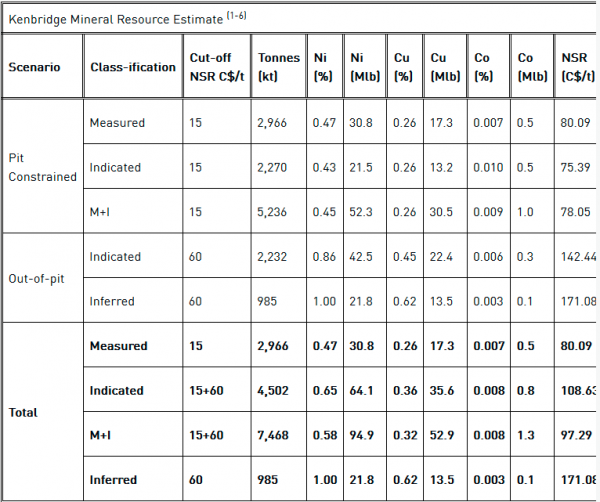
Updated estimates were done for pit constrained and out-of-pit nickel, copper, and cobalt Mineral Resources. Total Measured & Indicated Mineral Resources based on a Net Smelter Return (NSR) cut-off value of CDN$15 per tonne for pit constrained Mineral Resources and CDN$60 per tonne NSR for out-of-pit Mineral Resources is 7.5 Mt at 0.58% Ni and 0.32% Cu for a total of 95 Mlb of contained nickel. An additional 0.985 Mt at 1.0% Ni and 0.62% Cu (22 Mlb contained nickel) were calculated as Inferred Mineral Resources. The pit constrained Measured & Indicated Mineral Resources total 5.27 Mt of 0.45% nickel; 0.26% copper; and 0.009% cobalt at an NSR cut-off value of CDN$15/tonne. The out-of-pit Measured & Indicated Mineral Resources total 2.23 Mt of 0.86% nickel; 0.45% copper; and 0.006% cobalt. Inferred Mineral Resources out-of-pit total 0.985 Mt at 1.00% nickel; 0.62% copper; and 0.003% cobalt, at an NSR cut-off value of CDN$60/tonne. Details of the Mineral Resource Estimate are shown in Table 1.
The Kenbridge Property is located in the Kenora – Fort Frances, Ontario area with good access to roads and power. It has a shaft to a depth of 2,042 ft (622 m), with level stations at 150 ft. (45 m) intervals below the shaft collar and two levels developed at 350 ft (107 m) and 500 ft (152 m) below the shaft collar.
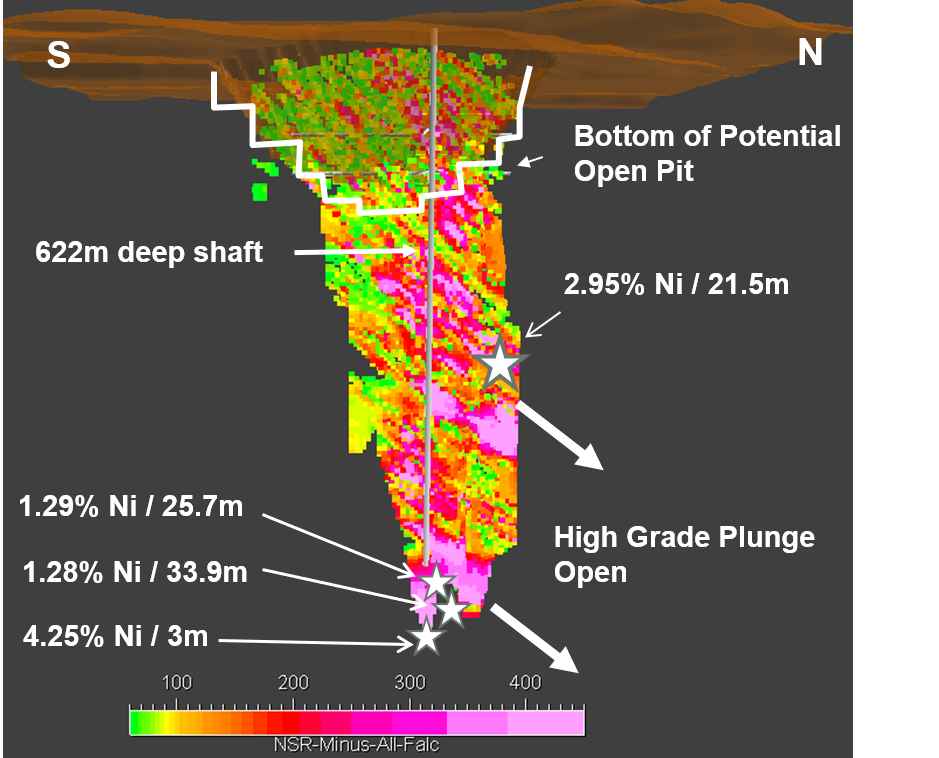
Visual inspection of the NSR Block Model for the Kenbridge Deposit shows the highest nickel grades (>2.0%) appear to have a strong down-plunge orientation as illustrated in Figure 1.
A historical Preliminary Economic Assessment (PEA) for the Kenbridge Deposit was completed by Buck et al. in 2008 for Canadian Arrow Mines Limited (now a 100% wholly owned subsidiary of Tartisan Nickel Corp). The PEA was updated by WMT Associates Ltd. in a Canadian Arrow Mines Limited news release dated January 21, 2008, and subsequently updated again in a news release dated September 4, 2008. The Updated PEA was completed by WMT Associates Limited, based on an updated NI 43-101 Mineral Resource Estimate by P&E Mining Consultants Inc. (Canadian Arrow Mines Limited news release dated August 19, 2008) and improved metallurgical recoveries (Canadian Arrow Mines Limited news release dated June 26, 2008). Highlights of the Updated PEA were: average Ni recovery life of mine was 86%; recovered Ni was 84.6 Mlb; NPV 7.5% pre-tax was $253M; and IRR% pre-tax was 65%. The cost, value and financial assumptions used in the Updated PEA were unchanged from the original January 2008 PEA (Buck et al., 2008), including average life of mine, US$10/lb nickel and US$2.50/lb copper prices, and a CD$1.00:US$0.90 exchange rate. Although this PEA is deemed to be historical by the Company, it is thought to be important.
Table 1.
Kenbridge Mineral Resource Estimate (1-6)
Note: Ni =Nickel Cu = Copper, Co = Cobalt, NSR = Net Smelter Return.
1. Mineral Resources, which are not Mineral Reserves, do not have demonstrated economic viability.
2. The estimate of Mineral Resources may be materially affected by environmental, permitting, legal, title, taxation, socio-political, marketing, or other relevant issues.
3. The Inferred Mineral Resource in this estimate has a lower level of confidence than that applied to an Indicated Mineral Resource and must not be converted to a Mineral Reserve. It is reasonably expected that the majority of the Inferred Mineral Resource could be upgraded to an Indicated Mineral Resource with continued exploration.
4. The Mineral Resources in this report were estimated using the Canadian Institute of Mining, Metallurgy and Petroleum (“CIM”), CIM Standards on Mineral Resources and Reserves, Definitions and Guidelines prepared by the CIM Standing Committee on Reserve Definitions and adopted by the CIM Council.
5. The Mineral Resource Estimate was based on US$ metal prices of $7.42/lb nickel, $3/lb copper and $25/lb cobalt.
6. The out-of-pit Mineral Resource grade blocks were quantified above the $60/t NSR cut-off, below the constraining pit shell and within the constraining mineralized wireframes. Additionally, only groups of blocks that exhibited continuity and reasonable potential stope geometry were included. All orphaned blocks and narrow strings of blocks were excluded. The longhole stoping with backfill mining method was assumed for the out of pit Mineral Resource Estimate calculation.
Figure 1. Kenbridge Deposit 3D view illustrating calculated NSR blocks and drill hole intersections of significance.
CEO Mr. Mark Appleby stated, “The Updated Mineral Resource Estimate was necessary to determine if Kenbridge mineralization is potentially extractable under current metal prices and exchange rates. This is a major milestone achieved by the Company as the market conditions for Class 1 nickel sulphide deposits improve. The differences between the previous P&E Mineral Resource Estimate (2008) and the current P&E Updated Mineral Resource Estimate are attributed to changes in metal prices and recalculation of NSR values. The Kenbridge Deposit shows there is great potential to expand the Mineral Resource down-plunge of high-grade intersections such as hole KB07-180 (2.95% Ni, 0.82% Cu/21.5m including 7.2% Ni, 0.67% Cu/5.5m) and also at depth. The deepest hole (end of hole K2010 = 880 m below surface) intersected mineralization grading 4.25% nickel and 1.38% copper over 10.7 ft (3.3 m), indicating that the Deposit remains open at depth. Tartisan plans to expand on these intersections, upgrade the Indicated and Inferred Mineral Resources and test high potential nickel exploration targets, such as the Kenbridge North Target. Additionally, given the market interest in Class 1 nickel deposits, we will look to update the historic Preliminary Economic Assessment completed in 2008 based on this very positive Mineral Resource update.”
The Company plans an aggressive surface exploration and definition drilling plan, in addition to geotechnical, metallurgical and environmental work to advance the Kenbridge Nickel-Copper-Cobalt Project in the upcoming 2020 winter season and into the summer of 2021.
The effective date of the 2020 Updated Mineral Resource Estimate is September 2nd, 2020 and the Technical Report relating to the Updated Mineral Resource has now been filed on SEDAR.
Qualified Person
The technical information in this news release has been prepared in accordance with Canadian regulatory requirements as set out in NI 43-101 and reviewed and approved by Eugene Puritch, P.Eng., FEC, CET, a Qualified Person as defined by NI 43-101.
About Tartisan Nickel Corp.
Tartisan Nickel Corp. is a Canadian based mineral exploration and development company which owns; the Kenbridge Nickel Project in northwestern Ontario, the Sill Lake Silver Property in Sault St. Marie, Ontario as well as the Don Pancho Manganese-Zinc-Lead-Silver Project in Peru.
The Company has an equity stake in; Eloro Resources Limited, Class 1 Nickel and Technologies Limited and Peruvian Metals Corp.
Tartisan Nickel Corp. common shares are listed on the Canadian Securities Exchange (CSE:TN; US-OTC:TTSRF; FSE: A2D). Currently, there are 101,603,550 shares outstanding (103,303 ,550 fully diluted).
For further information, please contact Mr. D. Mark Appleby, President & CEO and a Director of the Company, at 416-804-0280 ([email protected]). Additional information about Tartisan can be found at the Company’s website at www.tartisannickel.com or on SEDAR at www.sedar.com.
Posted by AGORACOM-JC
at 9:10 AM on Tuesday, September 15th, 2020
Completed its first reverse circulation drill hole at the Thor project in the vicinity of Reykjavik in Iceland
The hole was positioned to test a previous surface sample that assayed 37.4 g/t gold and 69.3 g/t silver
The hole was successfully ended at 124 meters
Reykjavik – September 15, 2020 – St-Georges Eco-Mining Corp. (CSE:SX) (CNSX:SX.CN) (OTC:SXOOF) (FSE:85G1) is pleased to disclose that it has completed its first reverse circulation drill hole at the Thor project in the vicinity of Reykjavik in Iceland. The hole was positioned to test a previous surface sample that assayed 37.4 g/t gold and 69.3 g/t silver. The hole was successfully ended at 124 meters.
The exploration team lead by Pr Helen Salmon and supported by Herb Duerr and lead field geologist Gary McLearn, had identified earlier in August a new target zone outside the historically explored area following the grab sample results from sample 008 that yielded 69.3 g/t silver, 0.216% Copper & 37.4 g/t Gold. (See Company’s Press Release from August 21, 2020).
Because of high grades in past mining and the presence of visible gold in past work, a decision to sample the hole on 30 cm intervals was made by management. Our contract geologist may have observed visible grains of gold and possible accessory silver minerals near the bottom of the hole. As such, management has decided to do a standard 50 assay ton fire assay with atomic absorption finish for both gold and silver. Any samples assaying over 0.8 g/t gold will be automatically reassayed. If the samples are inconsistent, the lab will be instructed to do metal screening for particulate gold on reject material.
The current surface exploration campaign conducted one drill hole via reverse circulation using a standard hammer drill bit of 5.5 inches (~14 cm) in size. The drilling was conducted under the constant supervision of the Company’s field geologist, and all the material of every 30cm of depth was collected in plastic buckets sealed, identified with a code, and carried to St-Georges’ secure warehousing facilities in Reykjavik. From there, the geologists will prepare a representative sample for every bucket. Based on the visual analysis conducted while logging the material so far, the Company expects to send over 400 samples to be assayed to ALS Global Laboratories (ISO/IEC 17025 accredited) in Loughrea, Ireland. The Company intends to request a rush treatment for the assay of these samples.
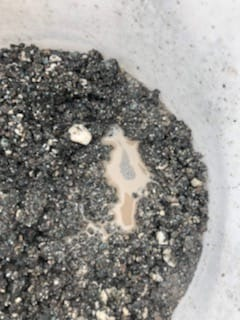
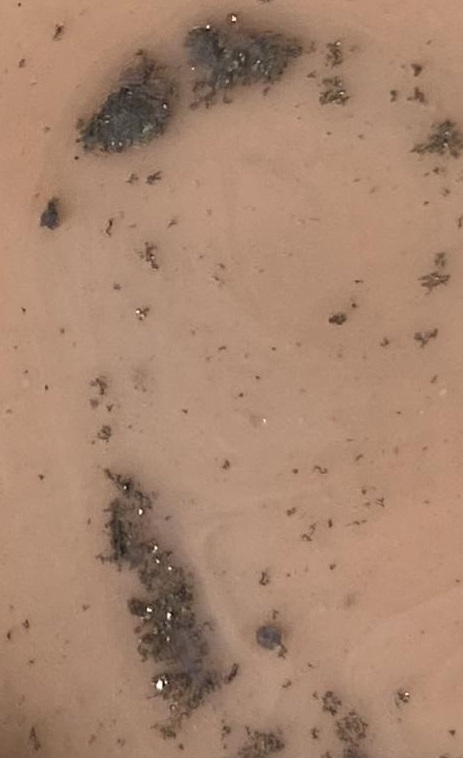
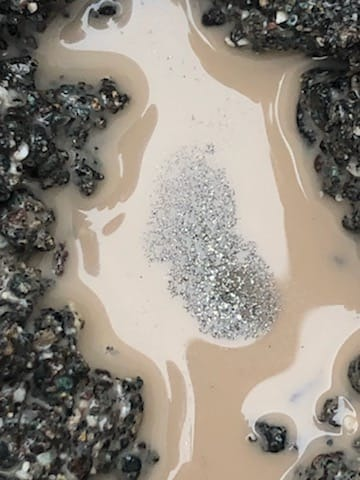
The hole completed went from surface to a depth of 124 meters on an azimuth of 110 degrees. The drill rig cased the hole to 2 meters depth encountering approximately 1.5 meters of overburden at the surface. The mineralization encountered is compatible with the type often favorable for gold on the Thor project consisting of quartz veining adjacent to basalt with apparent abundant pyrite and accessory sulphides. Visible gold and silver may have been identified in the field by the Company’s field geologist. These sections are still being logged and sampled and prepared to be sent to the laboratory. See Figures 1, 2 & 3.
Click Image To View Full Size
Figure 1. Mineralization floating on top of drilling mud
Click Image To View Full Size
Figure 2. Mineralization from quartz veining
Figure 3. Mineralization close up from Fig. 2
St-Georges’ President & CEO, Vilhjalmur Thor Vilhjalmsson, commented: “(…) We are encouraged by the current pace of the exploration work on the Thor Gold Project. The team has worked with the constraints of the COVID-19 quarantine and additional precautions imposed by the new government regulations, and still ended-up delivering within the aggressive target dates we had put forward (…) We are particularly pleased with the field team led by Gary. We have given the team much leeway and trusted their professional expertise. Gary took a bold decision in choosing an underexplored location for the only deeper drill hole we were authorized for to date under our agreement with Melmis. For what we know so far, it was worth the risk (…) we expect to close the transaction with Melmis this month, and we will keep the drilling contractor busy for the foreseeable future on the Thor Gold Project (…)”.
About Thor Gold
The Thormodsdalur Gold Project is located about 20km east of the city center of Reykjavik and south-east of the Lake Hafravatn. The project was discovered in 1908. The property produced a gold concentrate from 1911 to 1925, which shipped to Germany for processing. Over 300 meters of tunnels explored and mined one or more quartz veins and wall rock below open cuts at the surface.
Studies between 1996 and 2013 identified the project mineralization as a low sulfidation system hosted by basic to intermediate flows of Pliocene to Miocene age. The host contains banded chalcedony and ginguro within a fault zone up to 5 meters in width. To date, the identified gold trend has a known strike length of 700 meters determined by drill intercepts. Petrographic analysis of the vein material identified gold occurring in its free form and as part of an assemblage with pyrite and chalcopyrite. Petrographic and XRD studies show an evolution of the vein system from the zeolite assemblage to quartz-adularia and lastly, to minor calcite.
Thirty-two holes have been drilled within the license area, for a total of 2439 meters. Gold values vary from less than 0.5 g/t to a maximum of 415 g/t. (These values were obtained from selected random intervals and cannot be construed to be representative of any particular thickness or overall length.) Historically, the best intercepts from the diamond drilling are 33.5m of 8.0 g/t Au (true thickness) and 5.2m of 35.4 g/t Au (true thickness).
Gary McLearn, A professional geoscientist (Ontario APGO #2900) and an Independent Qualified Person as defined by National Instrument 43-101, has prepared, supervised the preparation or approved the scientific and technical disclosure in the news release.
ON BEHALF OF THE BOARD OF DIRECTORS
“Vilhjalmur Thor Vilhjalmsson”
Vilhjalmur Thor Vilhjalmsson
President and CEO
About St-Georges
St-Georges is developing new technologies to solve some of the most common environmental problems in the mining industry.
The Company controls directly or indirectly, through rights of first refusal, all of the active mineral tenures in Iceland. It also explores for nickel on the Julie Nickel Project & for industrial minerals on Quebec’s North Shore and for lithium and rare metals in Northern Quebec and in the Abitibi region. Headquartered in Montreal, St-Georges’ stock is listed on the CSE under the symbol SX, on the US OTC under the Symbol SXOOF and on the Frankfurt Stock Exchange under the symbol 85G1
The Canadian Securities Exchange (CSE) has not reviewed and does not accept responsibility for the adequacy or the accuracy of the contents of this release.
Posted by AGORACOM-JC
at 8:27 AM on Tuesday, September 15th, 2020
Announced that Tartisan has staked an additional ten single-cell mining claims contiguous to the Kenbridge Nickel Deposit patented and unpatented mining claim group, as well as an additional ten single-cell mining claims in a new area some 2.14 km to the northwest
The newly acquired claims bring the total claim count to 43 single-cell mining claims adjoining the Kenbridge patented mining claim group
TORONTO, ON / September 15, 2020 / Tartisan Nickel Corp. (CSE:TN)(OTC PINK:TTSRF)(FSE:A2D) (“Tartisan”, or the “Company”) is pleased to announce that Tartisan has staked an additional ten single-cell mining claims contiguous to the Kenbridge Nickel Deposit patented and unpatented mining claim group, as well as an additional ten single-cell mining claims in a new area some 2.14 km to the northwest. The newly acquired claims bring the total claim count to 43 single-cell mining claims adjoining the Kenbridge patented mining claim group. Each single-cell mining claim covers an area of approximately 20.92 ha. for a total area of 899.56 ha. The Kenbridge Nickel Project has now a combined total of 2,287.41 ha. of patented and unpatented mining claims.
The new lands were staked to cover multi-faceted anomalies that were discovered from analysis of spectral data and synthetic aperture data from the Aster Funds Ltd surveys carried out over the Kenbridge Nickel Property and environs.
The Aster Funds Ltd spectral analysis survey generated sixteen different elements, six of which are directly related to the mineral suite at the Kenbridge Nickel Deposit. Five areas with six out of six indicator elements as well as a favourable structural setting were determined, four of which were inside the patented ground and previously staked single-cell mining claims. One such six out of six anomaly was discovered just off the property to the south, also in the structural corridor in which the Kenbridge Nickel Deposit is situated. This newly discovered area was covered by the new claim staking.
In addition, the spectral analysis and synthetic aperture radar surveys outlined other anomalies, further afield. One such area is to the northwest, where a six/six anomaly and large five/six margin may highlight a parallel structure. This anomaly sits on top of a large magnetic anomaly in Ontario Geological Survey data. As well, a five/six anomaly in a large four/six margin was seen on the eastern side of the existing Kenbridge Property, and may represent another mineralized corridor, in as much as two of the minerals were talc and pyrrhotite, which represent mineralization and the host tectonic structure of the Kenbridge Nickel Deposit.
CEO Mr. Mark Appleby said, “The Kenbridge Nickel Deposit sits in a mineralized zone that has a strike length of approximately 250 m, as indicated by drill data. The mineralization has been investigated in detail on two underground levels and with drilling to a depth of 823 m. It makes sense that there may be other similar tectonic structures to the Kenbridge Deposit and the new staking covers two of these potential areas. The Company will follow up on these anomalies on the ground as well as the very prospective targets the surveys found inside the Kenbridge Property boundaries”.
Tartisan Nickel Corp. plans surface exploration and a definition plan for the Kenbridge Project for the autumn of 2020 and winter of 2021.
About Tartisan Nickel Corp.
Tartisan Nickel Corp. is a Canadian based mineral exploration and development company which owns; the Kenbridge Nickel Project in northwestern Ontario, the Sill Lake Silver Property in Sault St. Marie, Ontario as well as the Don Pancho Manganese-Zinc-Lead-Silver Project in Peru. The Company has an equity stake in; Eloro Resources Limited, Class 1 Nickel & Technologies Limited and Peruvian Metals Corp.
Tartisan Nickel Corp. common shares are listed on the Canadian Securities Exchange (CSE:TN; US-OTC:TTSRF; FSE:A2D). Currently, there are 101,603,550 shares outstanding (103,303,550 fully diluted).
For further information, please contact Mr. Mark Appleby, President & CEO and a Director of Tartisan Nickel Corp. at 416-804-0280 ([email protected]). Additional information about Tartisan Nickel Corp. can be found at the Company’s website at www.tartisannickel.com or on SEDAR at www.sedar.com.
Jim Steel MBA P.Geo. is the Qualified Person under NI 43-101 and has read and approved the technical content of this News Release.
This news release may contain forward-looking statements including but not limited to comments regarding the timing and content of upcoming work programs, geological interpretations, receipt of property titles, potential mineral recovery processes, etc. Forward-looking statements address future events and conditions and therefore, involve inherent risks and uncertainties. Actual results may differ materially from those currently anticipated in such statements.
The Canadian Securities Exchange (operated by CNSX Markets Inc.) has neither approved nor disapproved of the contents of this press release.
Posted by AGORACOM
at 11:07 AM on Tuesday, September 1st, 2020
Investment Highlights
Kenbridge property has a measured and indicated resource of 7.14 million tonnes at 0.62% nickel, 0.33% copper
The deepest hole extends to 838.4 metres, intersecting mineralization grading 4.25% nickel and 1.38% copper over 10.7 metres
The deposit remains open at depth
Tartisan completed a Spectral Analysis Survey that identified the Kenbridge Deposit, and has shown a possible extension and three additional trends
Owns 17.5 (21.8 fully diluted) percent equity stake in Eloro Resources and 2 percent NSR in their La Victoria property and are drilling their Iska Iska Pollymetallic project in Bolivia
Tartisan currently owns close to 4 million ELO shares
Tartisan owns close to 1,700,000 shares in Class 1 Nickel (CSE:NICO)
Tartisan vended the Alexo- Kelex asset to Class 1 Nickel, who recently listed on CSE
Kenbridge Ni Project (ON, Canada)
Advanced stage deposit remains open in three directions, is equipped with a 623m deep shaft and has never been mined
Preliminary Economic Assessment completed and updated returned robust project economics and operating costs including a NPV of C$253M and cash costs of US$3.47/lb of nickel net of copper credits
Plans for Kenbridge include updating PEA, advancing the project through to feasibility and exploring the open mineralization at depth
Recent News
Company has completed a Spectral Analysis Survey
Survey covered the patented and single-cell mining claims that make up the historic land position which contains the Kenbridge Deposit and the surrounding area, identifying several new exploration targets not only for nickel, copper, cobalt, but also for potential gold occurrences
Analysis Survey shows the distribution and intensity of up to 304 minerals, with the first pass showing up to 16 minerals
Each mineral can be classified into an exploration relevance for base metals, precious metals and industrial metals
Tartisan CEO Mark Appleby said, “the survey picked out the Kenbridge Deposit, and has shown the possible extension to the Kenbridge Deposit and three additional trends that relate directly to underlying geology and structure implicit in the Kenbridge Deposit. Of significant interest, the survey found two gold trends as well, which include the Violet and Nina historic gold occurrences. One of the occurrences is almost 54 hectares in size and covers almost all of three of our staked claims on the border of the Kenbridge property.”
DISCLOSURE: Tartisan Nickel Corp. is an advertising client of AGORA Internet Relations Corp.
Posted by AGORACOM
at 10:06 AM on Thursday, August 27th, 2020
SEOUL (Reuters) – Tesla Inc (TSLA.O) CEO Elon Musk has suggested the U.S. electric carmaker may be able to mass produce batteries with 50% more energy density in three to four years, which could even enable electric airplanes.
SEOUL (Reuters) – Tesla Inc (TSLA.O) CEO Elon Musk has suggested the U.S. electric carmaker may be able to mass produce batteries with 50% more energy density in three to four years, which could even enable electric airplanes.
His comments came as speculation is growing about announcements at Tesla’s anticipated “Battery Day” event where it is expected to reveal how it has improved its battery performance.
“400 Wh/kg *with* high cycle life, produced in volume (not just a lab) is not far. Probably 3 to 4 years,” Musk tweeted on Monday in response to a Twitter thread by Sam Korus, an analyst at ARK Investment Management LLC, about why Musk keeps hinting at a Tesla electric plane.
Researchers have said the energy density of Panasonic’s (6752.T) “2170” batteries used in Tesla’s Model 3 is around 260 Wh/kg, meaning a 50% jump from the current energy density which is key to achieving a longer driving range.
Musk said last year that for electric flight to work, the energy density of batteries needed to improve to over 400 Wh/kg, a threshold which may be achieved in five years.
The electric car manufacturer also showed an image where a number of dots are clustered in line formations, sparking speculation among media and fans about what it will reveal at the event. (here)
South Korean battery expert Park Chul-wan said the image may hint at “silicon nanowire anode,” a breakthrough technology which can potentially increase both battery energy density and battery life sharply.
Panasonic Corp (6752.T) earlier told Reuters that it plans to boost the energy density of the original “2170” battery cells it supplies to Tesla by 20% in five years.
Tesla is also working with China’s Contemporary Amperex Technology Ltd (CATL) (300750.SZ) to introduce a new low-cost, long-life battery in its Model 3 sedan in China later this year or early next year, with the batteries designed to last for a million miles of use, Reuters reported in May.
Tesla has said its Battery Day will take place on the same day as its 2020 annual meeting of shareholders on Sept. 22.
A very “limited number of stockholders” will be able to attend both of the events due to pandemic-related restrictions, Tesla said, and a lottery will be held to select attendees.
Posted by AGORACOM
at 9:29 AM on Tuesday, August 25th, 2020
“I’d just like to re-emphasize, any mining companies out there, please mine more nickel,” said Musk
Nickel is arguably the single most important metal component in EV batteries.
In the popular imagination, lithium is the element that powers EVs. However, as Elon Musk has pointed out, the term “lithium-ion batteries” is something of a misnomer, because they don’t really contain that much lithium. “Although [they’re] called lithium-ion, the actual percentage of lithium in a lithium-ion cell is approximately 2%,” Musk explained at Tesla’s 2016 shareholder meeting. “Technically, our cells should be called nickel-graphite, because the primary constituent in the cell as a whole is nickel.”
More recently, Musk reiterated the importance of nickel, and made what sounded to some like an urgent plea for more of the stuff. “I’d just like to re-emphasise, any mining companies out there, please mine more nickel,” said Musk during Tesla’s latest quarterly conference call. “Wherever you are in the world, please mine more nickel and…go for efficiency, obviously environmentally-friendly nickel mining at high volume. Tesla will give you a giant contract for a long period of time, if you mine nickel efficiently and in an environmentally sensitive way.”
However, meeting the expected surge in demand for element #28 may not be so easy, because of various supply-side issues. In a recent interview with Kitco News, Michael Beck, Managing Director at Regent Advisors, said he sees something of a “perfect storm” brewing in the nickel trade.
A Tesla Model 3 contains around 30 kilograms of nickel, Beck told Kitco’s Michael McCrae. “Nickel is probably the single most important metal component in battery fabrication. It’s where all of the energy is stored, and increasingly battery chemistries are being refined to allow the inclusion of as much nickel as possible. The more nickel, the higher the energy density of the battery.”
The spotlight on nickel is a recent development. Nickel prices collapsed in 2007, and there’s been little development of new capacity since then, says Beck. “In this intervening almost 12 years there was no material investment in new nickel capacity. The last 12 years has been a drawdown of excess inventory, and that’s coming to an end. The ramp-up of demand is just beginning.”
The long lead time for bringing new nickel mines into production is another constraining factor. “It takes 7 to 10 years to bring on new nickel projects,” says Beck. “So, you have the makings of a perfect storm. You have a baked-in structural deficit for the next 12 years…you have inventories in the next 18 months going down to almost zero. You also have this new demand source that never existed for nickel.”
Above: Ken Hoffman, senior expert at McKinsey, weighs in on Tesla’s need for nickel in order to expedite the EV revolution (YouTube: Kitco NEWS)
All that would seem to add up to an investment opportunity for somebody. “In the universe of metals, [nickel is] our favorite,” says Beck. “We think in the next two to three years you’re going to see a major up-tick of the nickel price…as shortages emerge, and that’s what’s going to be required to get new investment in the sector.”
So, what companies are poised to take advantage of the coming nickel rush? “Maybe the most interesting in the larger cap of established players is Norilsk,” says Beck. “They’re the number-two nickel producer, and they’re based in Russia. That’s probably the single best large-cap way to get exposure to nickel. It’s a major producer of the metal, and when nickel goes up, their share price goes up accordingly. At the smaller cap end of the spectrum, there are a bunch of smallish nickel explorers and emerging developers.”
Over the next few years, Beck believes that nickel shortages will emerge, and most companies with nickel exposure will benefit. However, there’s another factor in play. Tesla and other EV-makers are naturally eager to get their raw materials from sustainable sources. The industry has invested much effort and cash in cleaning up its supply chain for cobalt. Elon’s recent plea for nickel specified that it needed to be mined in an environmentally sensitive way. (Norilsk, by the way, has recently been involved in not one but two oil spills in Russia’s Arctic region.)
Vancouver-based Giga Metals quickly responded to Elon’s appeal, saying that it has a source of environmentally-responsible nickel in development. As Matthew Hall reports in Mining Technology, Giga Metals owns a property called Turnagain in north-central British Columbia, which it says is one of the largest undeveloped sulphide nickel projects in the world, and also contains cobalt.
Canada has plenty of nickel mines, but Giga Metals has a unique vision for the Turnagain mine. “Our goal is to be the world’s first carbon-neutral mine,” said Giga Metals President Martin Vydra. “We plan to use power from BC Hydro’s clean energy grid, which will involve more capital expenditure than the alternatives, but is the right thing to do.”
Above: Tesla’s Model 3 (Source: EVANNEX; Photo by Casey Murphy)
“If you want environmentally-responsible nickel, I really think you have to look at sulphide deposits in first-world jurisdictions such as Canada and Australia,” said Giga Metals CEO Mark Jarvis. “Canada has several very large, low-grade, open-pittable sulphide nickel deposits waiting to be developed, including Canada Nickel’s Crawford deposit, Waterton’s Dumont deposit and our own Turnagain deposit. Canada has some of the toughest environmental regulations in the world, so if you buy your nickel from Canada, you can be assured that this part of your supply chain is ethically sourced.”
Posted by AGORACOM
at 11:23 AM on Monday, August 24th, 2020
St-Georges Eco-Mining Corp. (CSE:SX) (CNSX:SX.CN) (OTC:SXOOF) (FSE:85G1)is pleased to release the initial fire assays results from the preliminary surface exploration campaign conducted on the Thor Gold Project in order to prepare this summer’s shallow drilling campaign.
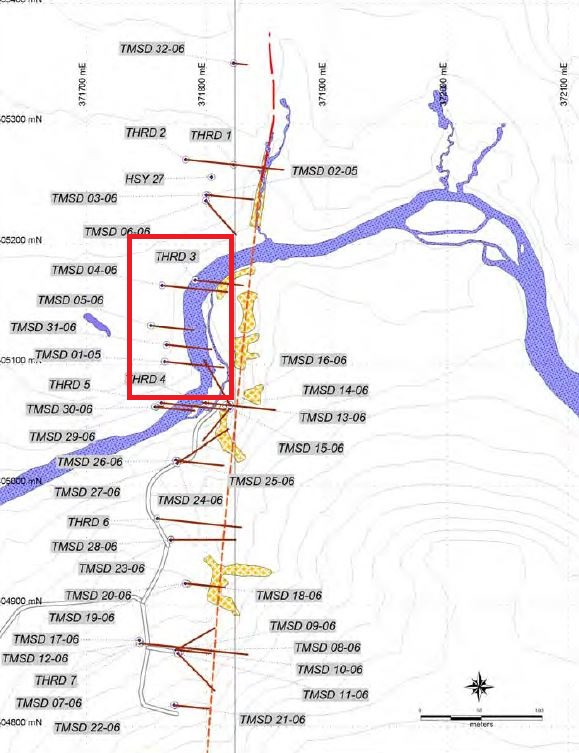
The Company’s exploration team collected grab samples from the dry riverbed on both sides of the river running to the west of the historical work areas (See Fig 1.) A total of eight samples were cut from the outcrops.
Figure 1. Project historical work locations and current targeted area in Red.
All grab samples have shown the presence of gold with assays results ranging from 0.001 g/t to 37.4 g/t.
The grab samples collected from the outcrop are, by nature, selected samples and are not necessarily representative of the mineralization hosted on the property.
Three of the grab samples located between 50 and 150 meters of the historical workings are deemed significant enough to warrant some adjustment to the previously planned shallow drilling grid for this summer’s campaign. These grab samples yielded the following results (Table 1):
Silver g/t
Copper %
Gold g/t
Lead
Sample 003
5.9 g/t
0.015%
11.75 g/t
Not significant
Sample 007
0.6 g/t
0.014%
2.47 g/t
Not significant
Sample 008
69.3 g/t
0.216%
37.4 g/t
4.37%
Table 1. Fire Assays Results
Quality Control
Samples were collected and bagged by the SX geological team and transported in secure bags directly from the site to Iceland Resources’ secured warehouse facilities in Keflavik. From there, two Q/C blank samples were added to the other eight samples, and the batch traveled by plane to ALS Global Laboratories (ISO/IEC 17025 accredited) in Loughrea, Ireland. All samples were tested using four acid trace analysis (ME-ICP61). Samples that yielded precious metals content in excess of 10 ppm were analyzed a second time via gravity separation and fire assay finish.
About Thor Gold
The Thormodsdalur Gold Project is located about 20km east of the city center of Reykjavik and south-east of Lake Hafravatn. The project was discovered in 1908. The property produced a gold concentrate from 1911 to 1925, which was shipped to Germany for processing. Over 300 meters of tunnels explored and mined one or more quartz veins and wall rock below open cuts at the surface.
Studies between 1996 and 2013 identified the project mineralization as a low sulfidation system hosted by basic to intermediate flows of Pliocene to Miocene age. The host contains banded chalcedony and ginguro within a fault zone up to five meters in width. To date, the identified gold trend has a known strike length of 700 meters determined by drill intercepts. Petrographic analysis of the vein material identified gold occurring in its free form and as part of an assemblage with pyrite and chalcopyrite. Petrographic and XRD studies show an evolution of the vein system from the zeolite assemblage to quartz-adularia and, lastly, to minor calcite.
Thirty-two holes have been drilled within the license area, for a total of 2439 meters. Gold values vary from less than 0.5 g/t to a maximum of 415 g/t. (These values were obtained from selected random intervals and cannot be construed to be representative of any particular thickness or overall length.) The best intercepts from the diamond drilling are 33.5m of 8.0 g/t Au (true thickness) and 5.2m of 35.4 g/t Au (true thickness).
Gary McLearn, A professional geoscientist (Ontario APGO #2900) and an Independent Qualified Person as defined by National Instrument 43-101, has prepared and supervised the preparation and has approved the scientific and technical disclosure in the news release.
Mr. Herb Duerr, P. Geo. (AIPG, CPG #11498), a St-Georges’ director, has also reviewed the scientific and technical content of this release. Mr. Duerr is a qualified person as defined by National Instrument 43-101 Standards of Disclosure for Mineral Projects.
ON BEHALF OF THE BOARD OF DIRECTORS
“Vilhjalmur Thor Vilhjalmsson”
Vilhjalmur Thor Vilhjalmsson
President and CEO
About St-Georges
St-Georges is developing new technologies to solve some of the most common environmental problems in the mining industry.
The Company controls directly or indirectly, through rights of first refusal, all of the active mineral tenures in Iceland. It also explores for nickel on the Julie Nickel Project & for industrial minerals on Quebec’s North Shore and for lithium and rare metals in Northern Quebec and in the Abitibi region. Headquartered in Montreal, St-Georges’ stock is listed on the CSE under the symbol SX, on the US OTC under the Symbol SXOOF and on the Frankfurt Stock Exchange under the symbol 85G1
Posted by AGORACOM
at 10:57 AM on Monday, August 24th, 2020
SPONSOR: Tartisan Nickel (TN:CSE) Kenbridge Property has a measured and indicated resource of 7.14 million tonnes at 0.62% nickel, 0.33% copper. Tartisan also has interests in Peru, including a 20 percent equity stake in Eloro Resources and 2 percent NSR in their La Victoria property. Click her for more information
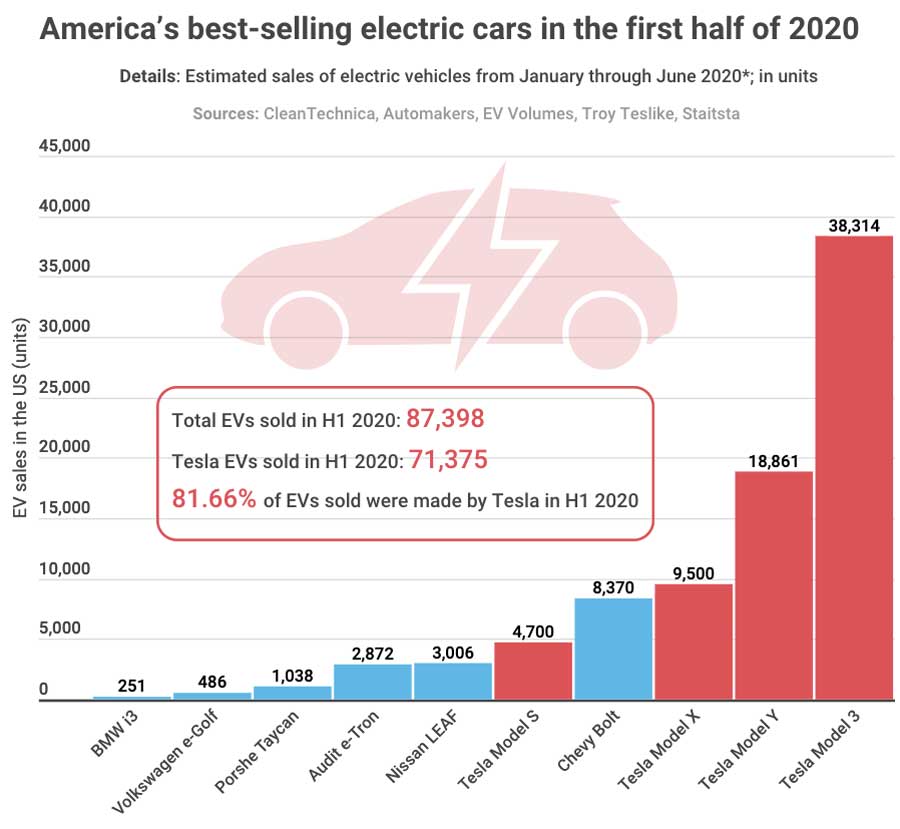
Tesla is hands down the biggest seller of electric vehicles (EVs) in the world’s largest economy, accounting for 81 per cent of the 87,398 EVs sold in the US in the first quarter.The Model 3 was the most popular, racking up sales of 38,314 for the three-month period.Second and third in the EV sales race were Tesla’s Model Y and Model X, with sales of 18,861 and 9,500 respectively, according to data from UK investor website Buy Shares.
America’s best-selling EVs in the first half of 2020. Source: Buy Shares
But just which other metals is the billionaire tech icon going to need more of?
EVs drive consumption of copper, cobalt and nickel
The Model 3 is Tesla’s most affordable EV at a retail price of $73,900 and requires 50kg of nickel, 4.5kg of cobalt, and approximately 130lbs of copper, according to reports.
Model 3 sales in Q1 for the US market would have accounted for 172 tonnes of cobalt, 2,260 tonnes of copper, and 1,915 tonnes of nickel.
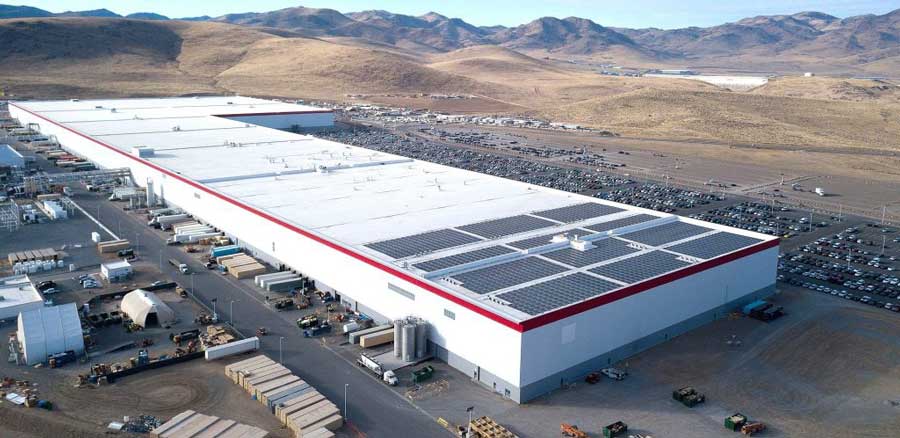
Tesla Gigafactory 1, where Model 3 battery cells are produced. Source: Tesla
Tesla’s total EV sales in the three-month period would require 321 tonnes of cobalt, 4,208 tonnes of copper, and 3,568 tonnes of nickel.
With the push for a “circular economy” to reduce the waste going to landfill and a shortage of supply of critical minerals, major car and battery makers are turning to recycled material.
Tesla recycled 1,000 short tons of nickel, 320 tons of copper, and 110 tons of cobalt in 2019, according to Tesla’s impact report.
“None of our scrapped lithium-ion batteries go to landfilling, and 100 per cent are recycled,” Tesla said.
Tesla is building a battery recycling system at its Gigafactory in Nevada that will process end-of-life batteries.
“Through this system, the recovery of critical minerals will be maximised along with the recovery of all metals used in Tesla battery cells, such as copper, aluminium and steel,” the company said.
EcoGraf, meanwhile, recovered graphite from a range of ‘black mass’ material from recycled batteries.
Black mass is the residual graphite material remaining after hydrometallurgical processes have recovered the high-value cathode metals from end-of-life lithium-ion batteries and is typically relegated to landfill.