Posted by AGORACOM
at 10:22 AM on Tuesday, January 7th, 2020
Sponsor: Loncor is a Canadian gold exploration company focused on two projects in the DRC – the Ngayu and North Kivu projects, both have historic gold production. Exploration at the Ngayu project is currently being undertaken by Loncor’s joint venture partner Barrick Gold. The Ngayu project is 200km southwest of the Kibali gold mine, operated by Barrick, which produced 800,000 ounces of gold in 2018. Barrick manages and funds exploration at the Ngayu project until the completion of a pre-feasibility study on any gold discovery meeting the investment criteria of Barrick. Click Here for More Info
Recent strong price gains are a bullish upside technical ‘breakout’ from recent trading levels, to suggest still more price gains are very likely in the coming weeks and months, or longer
Bullion’s price has benefited from heightened political tensions but also has enjoyed softness in the dollar,
Gold futures on Monday marked their highest settlement since April of 2013, as the killing last week of a top Iranian military commander, Qassem Soleimani, reverberated through financial markets, momentarily upending appetite for assets considered risky and boosting traditional haven assets like gold.
February gold GCG20, +0.23%
on Comex added $16.40, a gain of 1.1%, to settle at $1,568.80 an
ounce, after it briefly touched $1,590.90 in intraday action. The most
active contract saw its highest settlement since April 9, 2013,
according to FactSet data. Gold also rose for a ninth consecutive
session, its longest period of straight gains since an 11-day streak
that ran from December 2018 to January 2019.
March silver SIH20, +0.28%
edged up by 2.8 cents, or 0.2%, to finish at $18.179 an ounce, pulling
back from a high of $18.55, which was the highest intraday level since
late September.
Last week, the most-active gold contract gained 2.3%, its second week
of gains, while silver prices added 1.1%, also landing it higher for
two consecutive weeks.
“History shows that a big spike up in prices amid higher volatility
tends to produce near-term market tops sooner rather than later, after
that initial spike up,†said Jim Wyckoff, senior analyst at Kitco.com.
“That means in the coming days the gold market could put in a
‘near-term’ top that will last for a moderate period of time.â€
“However, for the longer-term investors in gold, it’s important to
note that the recent strong price gains are a bullish upside technical
‘breakout’ from recent trading levels, to suggest still more price gains
are very likely in the coming weeks and months, or longer,†he said in
daily commentary.
On Sunday, the Iraqi parliament passed a nonbinding resolution to
expel American troops in the wake of the U.S. drone strike that killed
Soleimani, leader of the foreign wing of Iran’s Islamic Revolutionary
Guard Corps, on Iraqi soil.
That act has intensified tensions in the Middle East, boosting the
appeal of assets considered safe during global political conflicts.
Trump has threatened harsh sanctions against
Iraq if it expels U.S. troops, and doubled down on earlier comments
threatening to target Iranian cultural sites if Iran strikes back. Iran has said it would no longer honor the 2015 nuclear deal with a group of world powers, which the U.S. backed out of in 2018.
Meanwhile, the benchmark 10-year Treasury yield TMUBMUSD10Y, +0.24% was up at 1.7917%, after tapping a four-week low on Friday after the Iranian military leader’s killing.
Bullion’s price has benefited from heightened political tensions but
also has enjoyed softness in the dollar, which has occurred as investors
shift to Swiss franc USDCHF, +0.3719% and Japanese yen USDJPY, +0.09% amid the potential for political turmoil.
The U.S. ICE Dollar Index DXY, +0.33%,
a measure of the buck against a half-dozen currencies, was down 0.2% at
96.661 and has posted weekly declines in the last two weeks.
A weaker buck can make gold more attractive to buyers using other
currencies, and lower bond yields can also help boost the comparative
appeal of gold against government debt.
“Gold continues its breakout higher as it is now at the highest level
since April 2013,†wrote Peter Boockvar, chief investment officer at
Bleakley Advisory Group, in a Monday research report.
“I remain bullish but caution not to buy it on geopolitical concerns
because as stated they are usually temporary. Buy it instead because the
dollar continues to weaken and real yields continue to fall,†he said.
Among other metals, March copper HGH20, -0.11% added 0.1% to $2.79 a pound. April PLJ20, -0.34% shed 2.4% to $966.20 an ounce, but March palladium PAH20, +0.87%
added 1.7% to $1,989.60 an ounce. Palladium futures notched a record
high, as they’ve done each day so far this year and many times
throughout 2019.
The platinum group markets are “not concerned that recent geopolitical events could derail the global economy and therefore demand for auto catalysts,†analysts at Zaner Metals, wrote in daily note. “Instead, it is apparent that platinum and palladium are being considered as safe haven instruments, with classic physical market fundamentals being pushed to the sidelines.”
Posted by AGORACOM
at 3:32 PM on Monday, December 9th, 2019
Sponsor: Loncor is a Canadian gold exploration company focused on two projects in the DRC – the Ngayu and North Kivu projects. Both projects have historic gold production. Exploration at the Ngayu project is currently being undertaken by Loncor’s joint venture partner Barrick Gold. The Ngayu project is 200km southwest of the Kibali gold mine, operated by Barrick, which produced 800,000 ounces of gold in 2018. Barrick manages and funds exploration at the Ngayu project until the completion of a pre-feasibility study on any gold discovery meeting the investment criteria of Barrick. Click Here for More Info
Millennials’ willingness to accept ever-increasing central-planning means gold is the go-to asset to preserve wealth over long-term horizons
Goldman keeps its 3,6 and 12m forecasts at $1,600toz.
“Drop Gold” – the ever-present tagline of Grayscale’s Bitcoin Trust TV commercial – appears to be working its magic on a certain cohort of society.
https://youtu.be/x6B6cj1CIMk
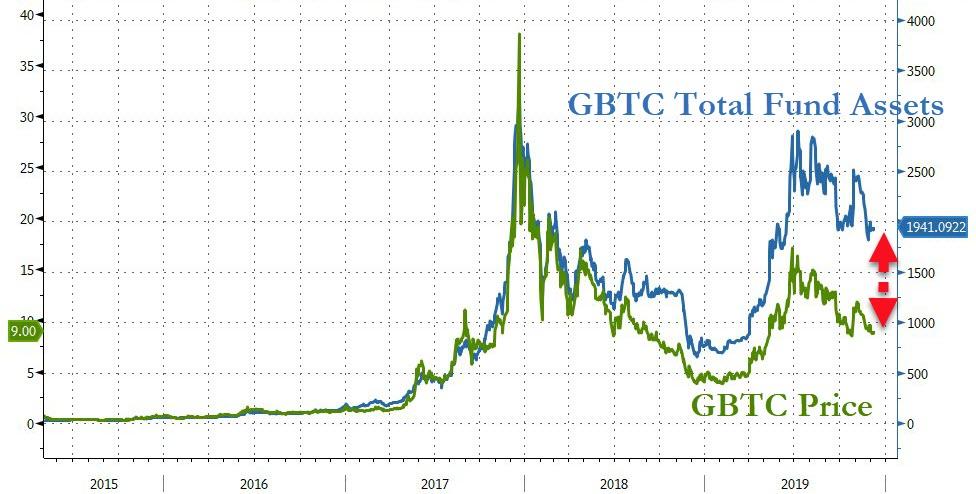
2019 has seen assets under management in GBTC soar…
Source: Bloomberg
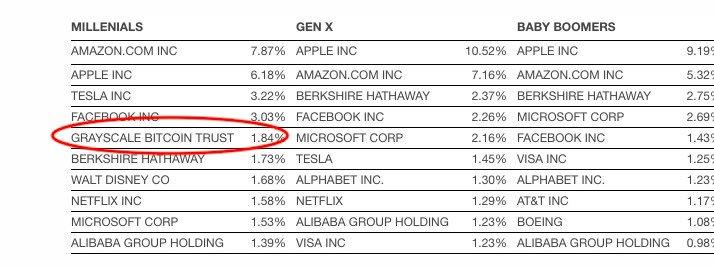
And for Millennials, according to the latest data from Charles Schwab, the
Grayscale Bitcoin Trusts is the 5th largest holding in retirement
accounts (including 401(k)s) with almost 2% of their assets tied to the success (or failure) of the largest cryptocurrency.
For now this remains a relatively small number…
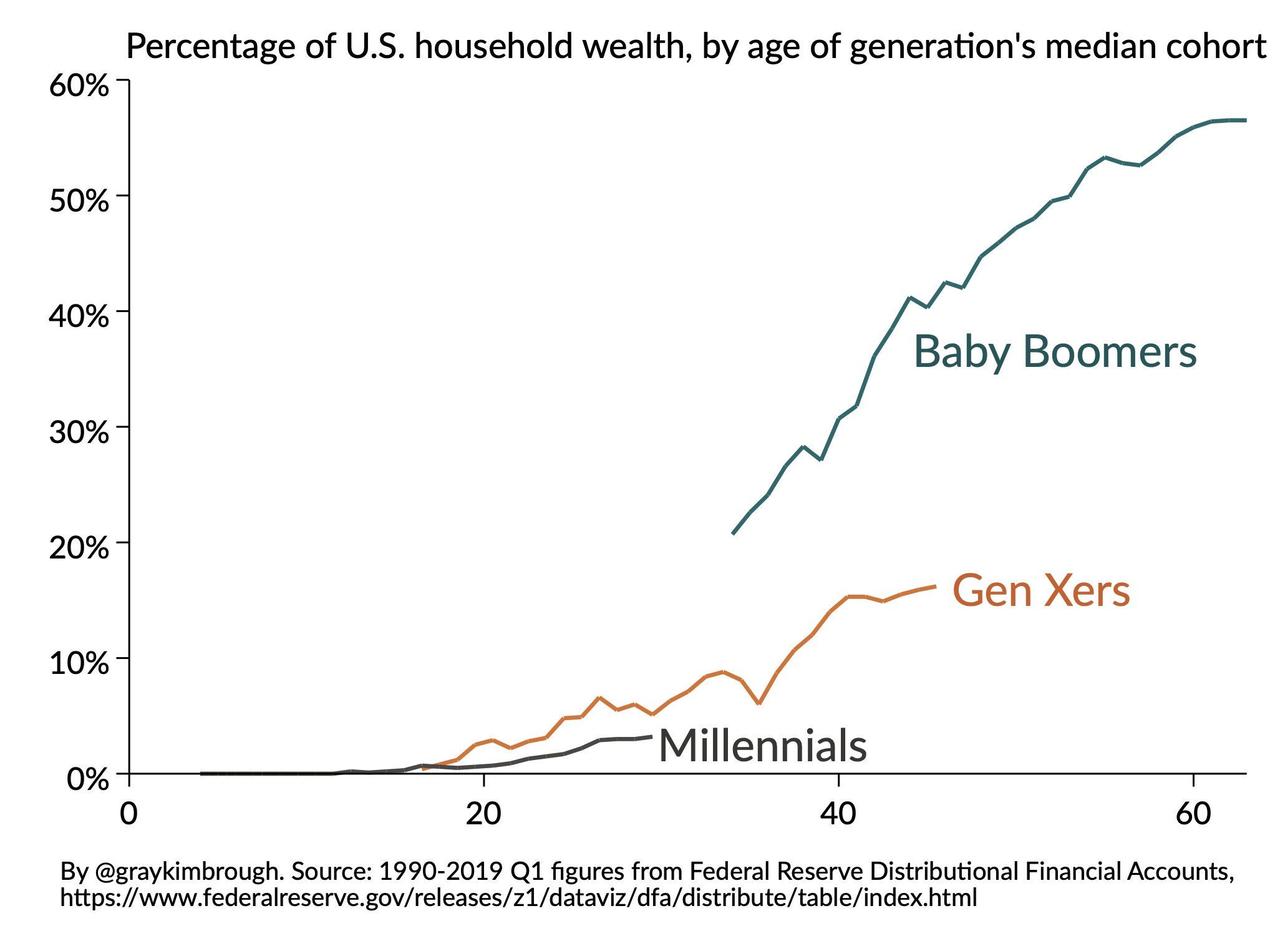
But, given the increasing acceptance of socialist policies, and the
historically-ignorant promise of MMT (and don’t forget UBI), Goldman
Sachs suggests that Millennials’ willingness to accept ever-increasing
central-planning means gold is the go-to asset to preserve wealth over
long-term horizons.
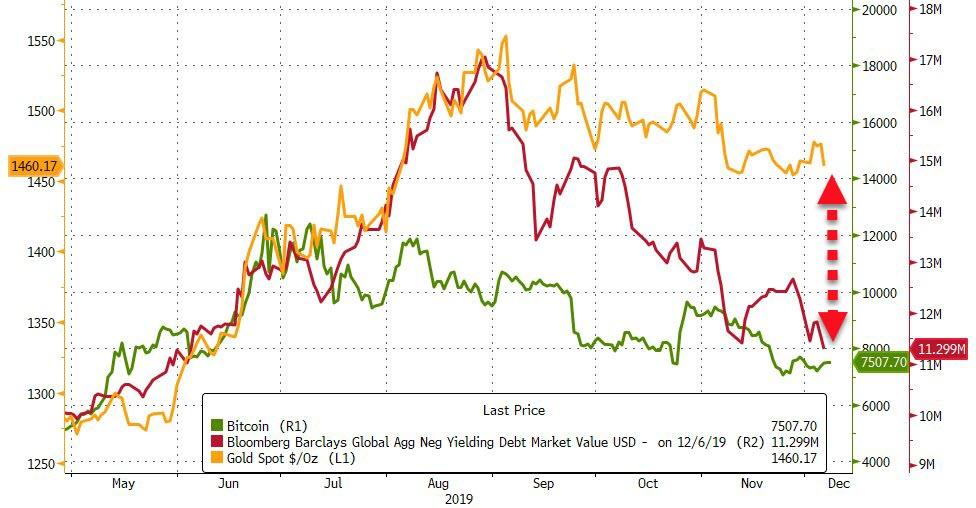
And, at least in the short-term, gold has held its value (relative to
Bitcoin) as the world’s volume of negative-yielding assets has shrunk
on the latest round of optimism that ‘this time is different’…
Source: Bloomberg
Indeed, Goldman notes that gold looks attractive particularly relative to DM bonds. Both
bonds and gold are defensive assets which go up in value when fear
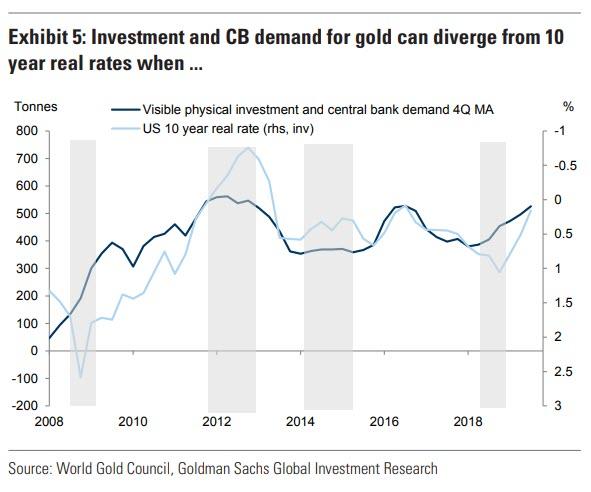
spikes. Exhibit 5 shows that investment and central bank demand for gold
has been highly correlated with US 10 year real rates.
During the next recession gold may offer better
diversification value to bonds because the latter may be capped by the
lower bound in rates limiting their ability to appreciate materially.
This is particularly relevant for Europe where rates are already close
to the lower bound. This means that during the next recession when fear
spikes, gold may decouple from rates and outperform them.
Specifically, Goldman says that Gold is a particularly good diversifier for investors with long term investment horizon.
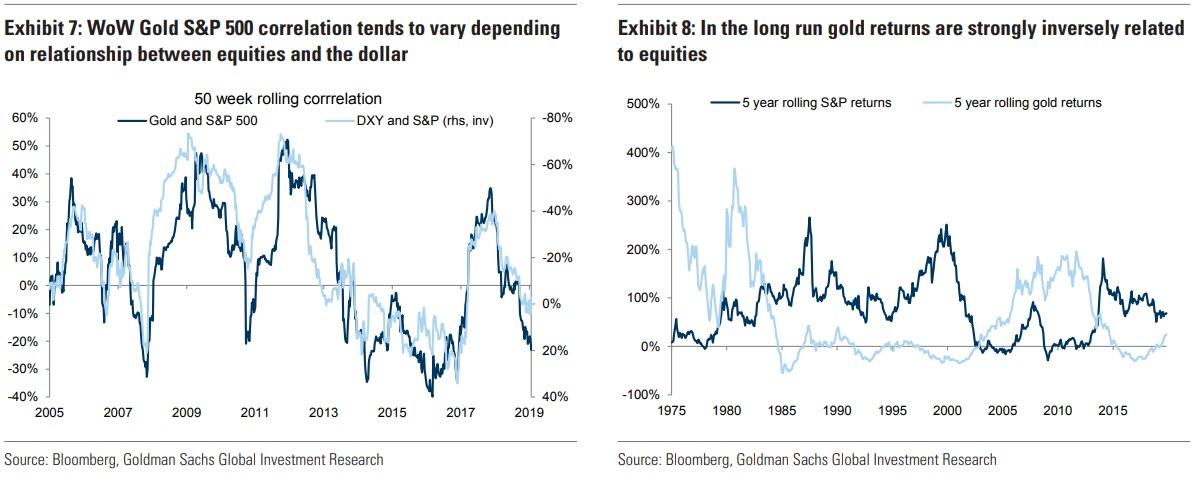
If we look at week on week changes in gold they tend to be dominated
by the dollar. As a result the gold S&P500 weekly changes
correlation looks almost identical to correlation of S&P 500 and the
dollar (see Exhibit 7).
However, if we look at 5 year returns gold and S&P 500 display
strong inverse relationship with gold performing great during the
1970ies and 2000s when the S&P 500 underperformed (see Exhibit 8).
This makes sense given that gold is ultimately a hedge
against systematic macro risks, which can lead to long periods of equity
underperformance. Our strategy team also finds that gold
historically has been a good hedge against periods of large drawdowns of
the 60/40 portfolio. This was particularly true when a drawdown is
caused by accelerating inflation as it was in the 1970ies. Therefore,
if one is concerned that the low macro volatility of 2010s will be
followed by higher volatility in the 2020s, which would hurt equities,
gold would be a good addition to the portfolio.
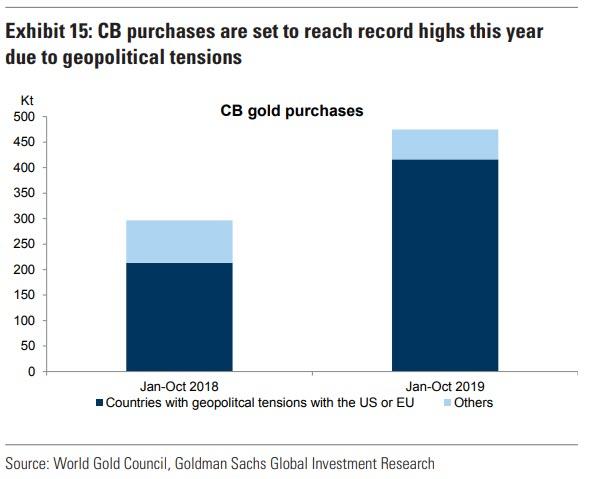
Geopolitical uncertainty is already translating into greater gold demand.
CBs globally have been buying gold at a very strong pace, albeit more
recently the rate of CB purchases has cooled off as China and Russia
have moderated their buying. Nevertheless, 2019 still looks to be a
record year for CB gold purchases with our target of 750 tonnes combined
purchases likely to be met (see Exhibit 15).
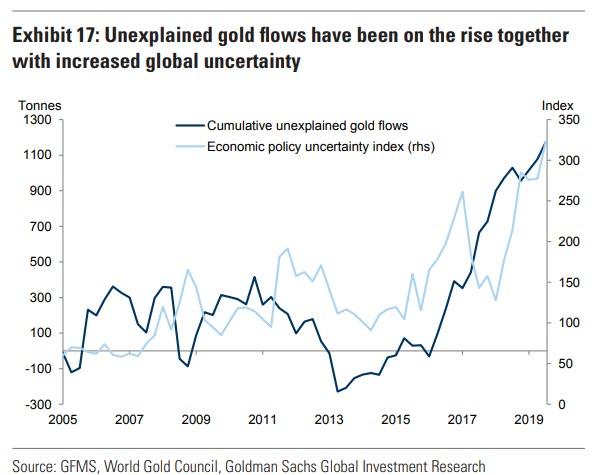
Rising political risk – together with negative European rates
– may be an important reason behind the large share of unaccounted gold
investment over the past several years.
Exhibit 17 shows cumulative unexplained gold demand based on World Gold Council (post 2010) and GFMS (pre 2010) balances data. It surged since 2016. Similar dynamics can be seen when we look at implied vaulted gold stocks built in the UK and Switzerland, which is calculated as implied cumulative total net imports minus transparent ETF gold stocks. In fact, since the end of 2016 the implied build in non-transparent gold investment has been much larger than the build in visible gold ETFs. This is consistent with reports that vault demand globally is surging.
Political risks, in our view, help explain this because if an
individual is trying to minimize the risks of sanctions or wealth taxes,
then buying physical gold bars and storing them in a vault, where it is
more difficult for governments to reach them, makes sense. Finally,
this build can also reflect hedges by global high net worth individuals
against tail economic and political risk scenarios in which
they do not want to have any financial entity intermediating their gold
positions due to the counterparty credit risk involved.
Finally, Modern Monetary Theory (MMT) – which advocates for
central bank financed fiscal deficits – has been gaining more airtime
recently, with former Fed Chair Ben Bernanke and former Fed
Vice Chair Stanley Fischer offering similar proposals. The logic is that
persistent low inflation and lack of borrowing capacity in many
developed markets means that direct CB financing of government deficit
is warranted. This is especially true for countries where monetary
policy is close to the limits of its capacity. Whilst there are arguments to be made in favor of MMT there are also risks associated with it. Notably some economists stress that if not used responsibly it could lead to a material acceleration in inflation.
In the next recession, our US economists do not expect governments to
adopt direct monetary financing and expect inflation to remain firmly
anchored. But this doesn’t necessarily prevent an increase in
debasement concerns if conversations around MMT become more widespread —
a potential boost to demand for gold as a debasement hedge.
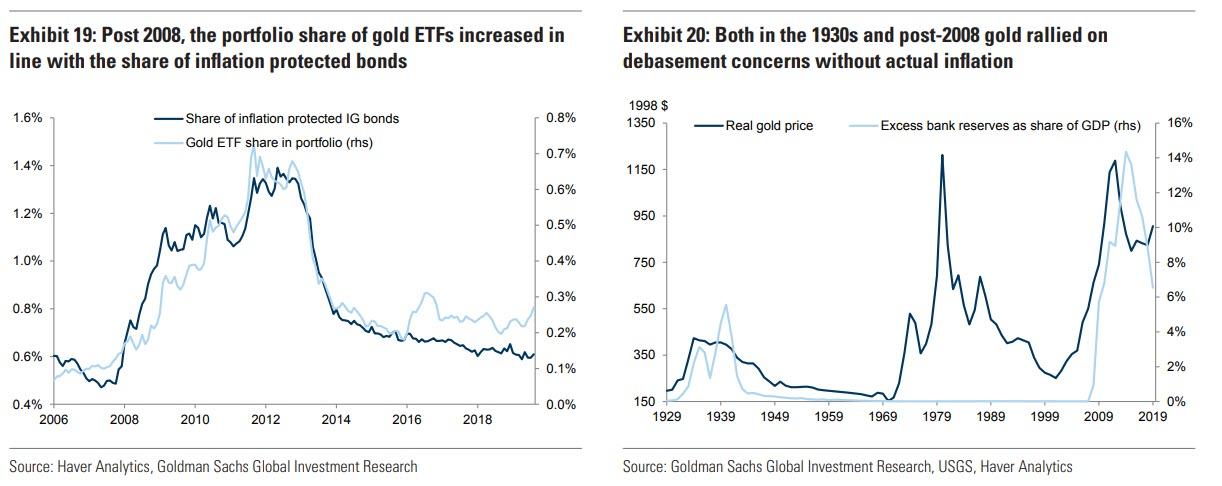
False debasement concerns have led to gold rallies in the past. Post
2008 aggressive QE in the US led to a considerable push into inflation
protected assets including gold (see Exhibit 19). These inflationary
concerns did not materialise and the allocation to gold and inflation
protected bonds fell sharply in 2013. Another period, currently is less
talked about, is the Great Depression when the Fed pumped a lot of money
into the economy leading to debasement concerns (see Exhibit 20). What
followed was actually disinflation and the gold price eventually
moderated.
Overall, while Goldman acknowledges the risks related to
still high gold positions we believe the strategic case is still strong,
particularly for investors with long term horizons.
This is based on a deteriorated attractiveness of long term DM bonds
as portfolio diversifiers and real return generation instruments,
exposure to growing EM wealth, limited mine supply growth, elevated
political risks and a potential increase in debasement concerns sparked
by rising airtime of Modern Monetary Theory.
As such Goldman keeps its 3,6 and 12m forecasts at $1,600toz.
So – will Millennials keep saying “bye gold” or come over the ‘dark side’ and “buy gold”?
Posted by AGORACOM
at 1:42 PM on Monday, November 25th, 2019
Sponsor: Loncor is a Canadian gold exploration company focused on two projects in the DRC – the Ngayu and North Kivu projects. Both projects have historic gold production. Exploration at the Ngayu project is currently being undertaken by Loncor’s joint venture partner Barrick Gold. The Ngayu project is 200km southwest of the Kibali gold mine, operated by Barrick, which produced 800,000 ounces of gold in 2018. Barrick manages and funds exploration at the Ngayu project until the completion of a pre-feasibility study on any gold discovery meeting the investment criteria of Barrick. Click Here for More Info
Rising US liabilities for entitlements could undermine the dollar
The Dutch Central Bank recently
argued in an article that if there were to be a major monetary reset,
“gold stock can serve as a basis†to rebuild the global monetary system.
“Gold bolsters confidence in the stability of the central bank’s
balance sheet and creates a sense of security.â€
Talk of gold, however, does not. Investor Ray Dalio recently spooked attendees at the Institute for International Finance conference when he mentioned the possibility of a flight to gold because of his concerns about America’s fiscal position.
That is not a new point. Since at least 2016, financial titans including JPMorgan chief Jamie Dimon and hedge fund manager Stanley Druckenmiller have
pointed out that unfunded pension and healthcare entitlements are a
looming iceberg for the US economy. Indeed, one theory about the recent
crisis in the “repo†overnight lending market is that it was caused by the federal deficit and the increasing unwillingness of investors outside the US to fund it.
But
Mr Dalio went further, concluding that the American entitlement crisis
meant the US Federal Reserve would have to continue to inflate its own
balance sheet indefinitely, and keep rates low (or even negative) well
into the future so the US could keep paying its bills.
That
would depreciate the US dollar. Taken to its extreme, that never ends
well. Prior experiments with rapidly falling currencies include
late-third century Rome, Germany’s interwar Weimar Republic and Zimbabwe.
At some point, Mr Dalio argued, nobody would want to own US debt or the
dollar, and investors would look to other assets for safety. “The
question is, what else?†he asked. “That’s the environment I think that
we’ll be in. And there’s a saying that gold is the only asset you can
have that’s not somebody else’s liability.â€
I
haven’t bought any gold yet myself, though I did sell out of equities
entirely in August. That decision has been somewhat painful given the recent upsurge in
the S&P 500, and yet it is one that I do not regret. There is logic
in believing — as I do — that US blue-chips and bonds are no longer a
safe haven while also believing that prices could stay high for some
time to come. After all, holding two seemingly contradictory thoughts in
your head at once is the sign of a mature mind. I believe US stock
prices are staying up for precisely the same reason that investors might
need to be in gold someday.
Analyst
Luke Gromen laid out the mathematical logic of this very well in a
recent newsletter. He calculates that US annual entitlement payments,
which he defines as Medicare, Medicaid and Social Security, plus defence
spending plus interest on the federal debt adds up to 112 per cent of
US federal tax receipts.
That
total has risen from 103 per cent only 15 months ago and 95 per cent
two years ago, as government revenue fell due to President Donald
Trump’s tax cuts. The proceeds of those cuts helped to further inflate
equity prices. The US has become “utterly dependent on asset price
inflation for tax receiptsâ€, Mr Gromen writes, adding that the only way
the US will be able pay its yearly bills is for asset prices to climb on
their own, or for the Fed to “print enough money to make asset prices
riseâ€.
I
expect the Fed will, like every central bank before it, do what is
politically required. Neither the US nor the world can afford for
America to nominally default on its Treasury bills. So, stock prices
will rise — for now. The essence of economic policy is, as Joseph
Schumpeter reportedly put it, “politics, politics, politicsâ€.
Share
price inflation has been under way since the Fed switched gears and
began lowering rates in July. It will probably be helped along by the easing of financial regulations enacted
after the 2008 crisis, and possibly even a new round of tax cuts before
the 2020 elections. Mr Trump measures his own success by that of the
market.
But
in the longer run, this financially engineered growth must erode
confidence in the dollar, particularly at a time when the US and China
are going in different directions. China is now the world’s largest natural gas buyer,
and is looking to start setting prices for this and other commodities
in its own currency. China is also doing more business in euros, as it
tries to woo Europe into its own economic orbit. China recently issued
its first euro-denominated bonds in 15 years. It is also moving away from buying oil in dollars and strengthening ties with EU companies such as Airbus.
The
de-dollarisation of Eurasia would support Mr Dalio’s worldview. So
would a shift to a non-dollar reserve asset such as gold. Such a change
would force the US to sell dollars in order to settle its balance of
payments in the new, neutral reserve asset.
One could argue that even if the US dollar were to weaken and creditors to lose faith in America’s ability to repay its debt, markets might still remain high for a period of time. But we are undergoing a period of deglobalisation. And history shows that when that happens, it eventually tends to trigger asset price collapses in whatever country is associated with the “old orderâ€. No wonder gold bugs abound. Source: [email protected]
Posted by AGORACOM
at 1:54 PM on Wednesday, November 13th, 2019
Sponsor: Loncor is a Canadian gold exploration company focused on two projects in the DRC – the Ngayu and North Kivu projects. Both projects have historic gold production. Exploration at the Ngayu project is currently being undertaken by Loncor’s joint venture partner Barrick Gold. The Ngayu project is 200km southwest of the Kibali gold mine, operated by Barrick, and produced 800,000 ounces of gold in 2018. Barrick manages and funds exploration at the Ngayu project until the completion of a pre-feasibility study on any gold discovery meeting the investment criteria of Barrick. Click Here for More Info
While it is an accepted fact that fundamental events shape the
financial markets, many analysts use technical indicators as a way to
mathematically quantify market sentiment. One of the simplest and most
widely used technical indicators used to determine a current trend for a
stock or commodity are moving averages.
The use of a simple 200-day moving average is used to determine on a
long-term basis whether a financial market is currently in a bullish or
bearish trend. The use of a 50-day moving average is commonly accepted
as determining the short-term trend. In both cases if current pricing is
above the moving average than the trend is bullish.
Another widely accepted technical study is based upon the
mathematician Leonardo Fibonacci’s golden ratio is Fibonacci retracement
theory.
According to Investopedia, “A Fibonacci retracement is a term used in
technical analysis that refers to areas of support or resistance.
Fibonacci retracement levels use horizontal lines to indicate where
possible support and resistance levels are. Each level is associated
with a percentage. The percentage is how much of a prior move the price
has retraced. The Fibonacci retracement levels are 23.6%, 38.2%, 61.8%
and 78.6%. While not officially a Fibonacci ratio, 50% is also used.â€
In this article we will use two Fibonacci retracement studies. The
first study will be a long-term study; however, this study will utilize
much less data then chart number two. The study will begin at the end of
2015 when gold hit a bottom of $1045 per ounce, and concludes at this
year’s current high of $1565 per ounce. The second study will be derived
from another long-term Fibonacci retracement study which begins in
2008, and concludes in the middle of 2011 when gold reached its record
high price against the U.S. dollar.
Of particular interest in the first study are the Fibonacci
retracement areas found at the .23%, and .382% retracement levels.
Currently gold futures are trading at $1457.40, which is a net decline
of $5.50 on the day. This continues the current bearish trend which has
been predominant since gold hit its highest value this year in August.
When you look at the .38% retracement level on this chart you can see
that it precisely defines a level of resistance at approximately $1370.
This was the defined and unbreakable resistance level which began in
2016, the first occurrence of hitting this price point and then trading
lower. This resistance was unbreakable throughout 2017 and 2018. In
fact, it was not until June of this year that gold was able to breach
that price point and trade to its highest value since bottoming out at
the end of 2015.
The other level of particular interest is the .23% Fibonacci
retracement level which occurs at $1446 per ounce. Currently gold
pricing is approximately $11 above that price point. While this study
alone will not confirm a potential bottom or support at $1446, it can
when combined with other technical indicators, be highly effective in
providing price targets for support and resistance.
The second study uses an extremely large data set from 2008 to the
middle of 2011 defining the rally which took gold to its all-time record
high. Of particular interest is the .38% Fibonacci retracement level
which occurs at $1451 per ounce. This defines the lowest price point
gold has traded to this month. It also occurs within dollars of the .23%
Fibonacci retracement level we looked at on chart 1. When you have two
different time sequences which have key Fibonacci retracement levels
occur at the same price point, we label this a Fibonacci harmonic.
While one should never use these technical indicators alone, they are
excellent tools to define price points to look at when a market is in a
corrective stage, which is the current scenario in gold pricing
Posted by AGORACOM
at 9:20 AM on Thursday, November 7th, 2019
Loncor Resources Inc. (“Loncor” or the “Companyâ€)
(TSX: “LN”; OTCQB: “LONCF”), a Canadian gold exploration company with
significant projects in the Democratic Republic of the Congo (“DRCâ€),
is pleased to provide an update on exploration activities undertaken by
Barrick Gold Corporation (NYSE: “GOLD”; TSX: “ABX”) (through its
subsidiary, Barrick Gold (Congo) SARL) (“Barrickâ€) on
Loncor’s Ngayu Joint Venture Project in northeastern DRC. Recent
exploration has focussed on the major Imva fold structure where a number
of drill targets have been developed. Drilling is now expected to
commence during the coming dry season.
The opening of the Mambati airstrip in September is expected to
assist in expediting the forthcoming drilling program. The Ngayu
Archaean Greenstone Belt is 200 kilometres southwest of
Barrick/AngloGoldAshanti’s Kibali Gold Mine. Barrick’s exploration at
Ngayu during the most recent quarter has focused on four priority areas
all located along the 30 kilometre-long Imva fold structure (see Figure 1
below). These blocks are Bavadili/Bavanidi, Bakpau, Lybie (Matete
east)/Salisa and Bikira-Makasi.
At Bavadili, further trenching was undertaken to test the concept of a
mineralized northwest trending shear corridor parallel to the
interpreted F2 axial plane. Results were encouraging and included 24
metres @ 0.94 g/t Au and confirmed the mineralized corridor with
mineralization associated with brecciated cherty “BIF†(Banded Ironstone
Formation) with disseminated limonite, weak hematite alteration along
with sugary quartz veins and fine cubic boxworks (~ 5% pyrite). The
mineralization occurs along a strongly foliated northwest-southeast
structure between dolerite to the south and basalt to the north.
Results support and confirm the model of a +1.5 kilometre potential
mineralized structure from Bavadili Hill to Bavanidi. At Bavadili Hill,
additional trenching undertaken to test the continuity of the folded,
mineralized cherty BIF, 250 metres southwest from the mineralized cherty
BIF intersected in trench BVTR0114A, gave results of 24 metres @ 0.94
g/t Au.
Additional work involved a geological re-assessment of the Bavadili
Block, integrating all data including gold and multi-element soil
geochemical and geophysical data to improve the understanding of the
regional model. The new interpretation highlights more than 6
kilometres of multiple folded layers of anomalous BIF displaying two
sets of regional F1 and F2 folds with the P1 axial plane, trending
northeast, reactivated by P2, trending east-northeast, producing the
S-shape fold configuration which is interpreted to host the mineralised
shoots within the Bavadili Block. The interpretation further suggests
the same BIF continues 12 kilometres to the east of the Lybie/Salisa
targets.
At Lybie, encouraging results from trench NZTR0006 confirmed a
continuous mineralized corridor of +1 kilometre hosted within
volcanoclastic and brecciated cherty BIF within an interpreted fold
limb. The trench revealed at least two continuous mineralized
structures – the northwestern most of the two structures is from
colonial trenching which returned 20 metres @ 0.58g/t Au, whereas trench
NZTR0006 returned 20 metres @ 0.54g/t Au.
At Salisa, results from rock sampling assayed up to 3.75 g/t Au in
volcaniclastic and 3.05 g/t Au hosted in BIF and coincide with the soil
source line trending northeast-southwest. To better trace the
mineralized system and constrain the potential and the source of the
higher grade rock samples, a scout trenching program is underway.
At Bakpau, trenching has been completed on northwest-southeast and
north-south trending sections on widely spaced trench lines. The two
trenches, BKTR0005 and BKTR0006, respectively, at 500 metres northeast
and southwest of trench BKTR0001 (70 metres @ 0.34g/t Au), returned 26
metres @ 0.35 g/t Au and 30 metres @ 0.12 g/t Au, respectively. These
trenches have exposed and confirmed the continuity of anomalous grade,
near surface mineralization in the Bakpau East Zone over a strike length
of 1.2 kilometres.
At Medere, trenching on the +800 metre long 80ppb soil anomaly along
the northeast trending hill, focused on establishing the controls on
mineralization (structure and alteration) and trends of mineralization
along strike between the zones exposed in previous trenches and
artisanal pits. Significant gold results from the first trench across
quartz stockwork style mineralization were received during the most
recent quarter with a trench intersection of 48 metres @ 0.51g/t Au and
is still open to the southeast. The current trenching has only been
able to expose the margin of the soil anomaly due to thick scree/talus
cover on the hill slopes towards the southeast.
In addition to outlining drill targets along the Imva fold, drilling
is also planned to be undertaken during the forthcoming drill campaign
at the Anguluku prospect area (including Golgotha, Baberu and Bayinga)
in the southwest side of the Ngayu greenstone where a sequence of fine
grained metasediment, carbonaceous shale, metabasalt and BIF trend
approximately east-west and dip moderately to south-southwest within an
antiformal structure. An initial 10 core hole (2,490 metres) drilling
program is proposed to test 4,500 metres of potential strike.
About Loncor Resources Inc. Loncor
is a Canadian gold exploration company focused on two projects in the
DRC – the Ngayu and North Kivu projects. Both projects have historic
gold production. Exploration at the Ngayu project is currently being
undertaken by Loncor’s joint venture partner Barrick Gold Corporation
through its DRC subsidiary Barrick Gold (Congo) SARL (“Barrickâ€).
The Ngayu project is 200 kilometres southwest of the Kibali gold mine,
which is operated by Barrick and in 2018 produced approximately 800,000
ounces of gold. As per the joint venture agreement signed in January
2016, Barrick manages and funds exploration at the Ngayu project until
the completion of a pre-feasibility study on any gold discovery meeting
the investment criteria of Barrick. Subject to the DRC’s free carried
interest requirements, Barrick would earn 65% of any discovery with
Loncor holding the balance of 35%. Loncor will be required, from that
point forward, to fund its pro-rata share in respect of the discovery in
order to maintain its 35% interest or be diluted.
Certain parcels of land within the Ngayu project surrounding and
including the Makapela and Yindi prospects have been retained by Loncor
and do not form part of the joint venture with Barrick. Barrick has
certain pre-emptive rights over these two areas. Loncor’s Makapela
prospect has an Indicated Mineral Resource of 614,200 ounces of gold
(2.20 million tonnes grading 8.66 g/t Au) and an Inferred Mineral
Resource of 549,600 ounces of gold (3.22 million tonnes grading 5.30 g/t
Au). Loncor also recently acquired a 71.25% interest in the
KGL-Somituri gold project in the Ngayu gold belt which has an Inferred
Mineral Resource of 1.675 million ounces of gold (20.78 million tonnes
grading 2.5 g/t Au), with 71.25% of this resource being attributable to
Loncor via its 71.25% interest.
Resolute Mining Limited (ASX/LSE: “RSG”) owns 27% of the outstanding
shares of Loncor and holds a pre-emptive right to maintain its pro rata
equity ownership interest in Loncor following the completion by Loncor
of any proposed equity offering. Newmont Goldcorp Corporation (NYSE:
“NEM”; TSX: “NGT”) owns 7.8% of Loncor’s outstanding shares.
Additional information with respect to Loncor and its projects can be found on Loncor’s website at www.loncor.com.
Posted by AGORACOM
at 2:34 PM on Friday, November 1st, 2019
Sponsor: Loncor is a Canadian gold exploration company focused on two projects in the DRC – the Ngayu and North Kivu projects. Both projects have historic gold production. Exploration at the Ngayu project is currently being undertaken by Loncor’s joint venture partner Barrick Gold (Congo) SARL (“Barrickâ€). The Ngayu project is 200 kilometres southwest of the Kibali gold mine, which is operated by Barrick and in 2018 produced approximately 800,000 ounces of gold. As per the joint venture agreement signed in January 2016, Barrick manages and funds exploration at the Ngayu project until the completion of a pre-feasibility study on any gold discovery meeting the investment criteria of Barrick. Subject to the DRC’s free carried interest requirements, Barrick would earn 65% of any discovery with Loncor holding the balance of 35%. Loncor will be required, from that point forward, to fund its pro-rata share in respect of the discovery in order to maintain its 35% interest or be diluted. Click Here for More Info
The first thing is gold
It’s true that gold has made a significant upward move from $1,300
per ounce in May to currently around $1,500 per ounce with at least some
of that move being attributable to bullish market fundamentals. Yet, we
can also count on a lot more whipsaw action as gold continues to be
ping-ponged about from geopolitical headline to geopolitical headline.
The devaluation of fiat currencies in the
face of rising and unsustainable debt loads across all developed
economies will be the true driver of the long-term bull market that’s
beginning to take form now.
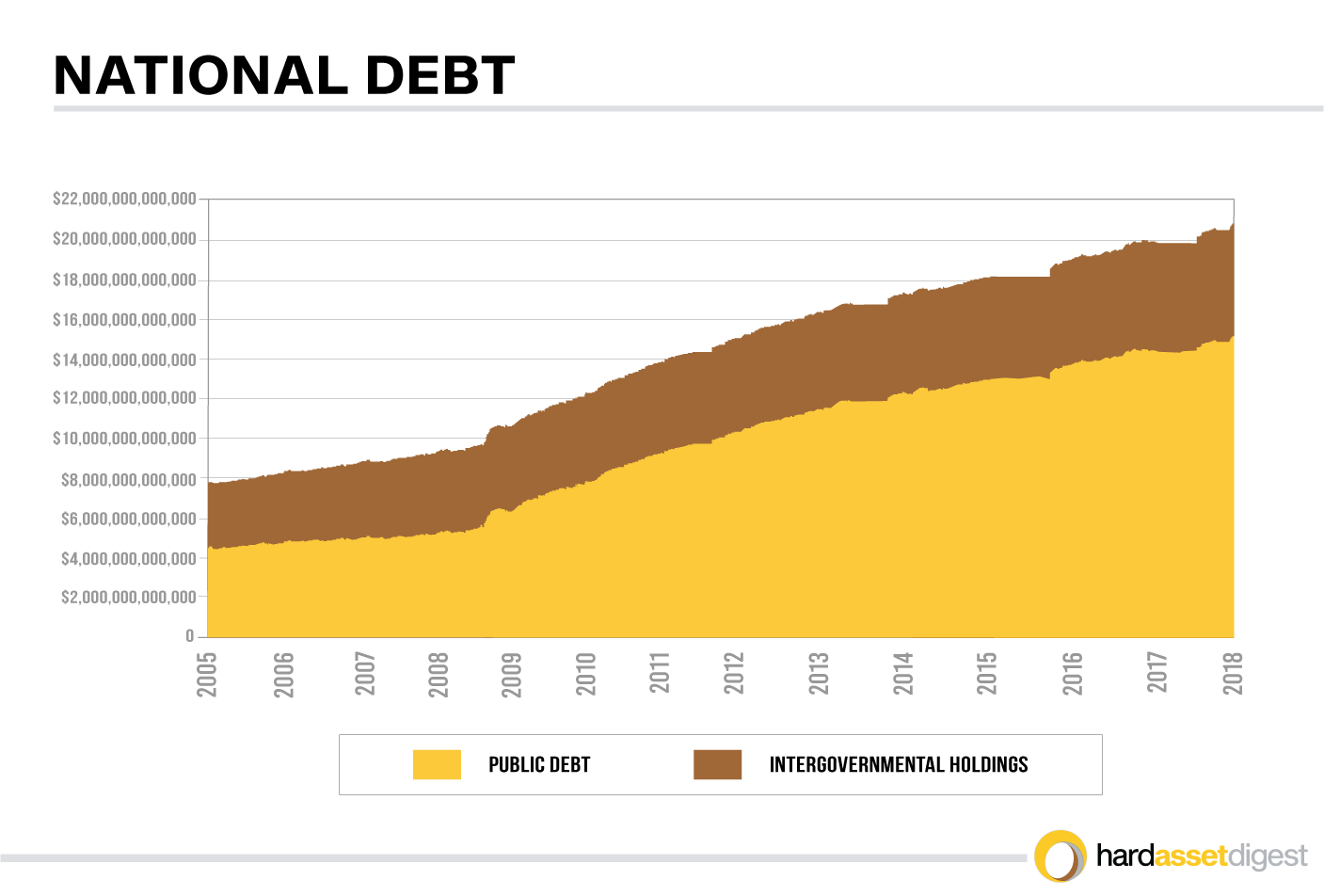
US government spending is so wildly out of control, and has been for
more than a decade, that the federal debt will become unmanageable in
the very near future.
Not that long ago, economists didn’t really have to think in terms
of “Trillions of Dollars.†Yet today, we’ve grown accustomed to the
fact… however dire it may be…that our federal debt is ballooning at a
rate of nearly $1.5 Trillion each and every year. It’s simply not
sustainable.
At this rate, it will only be a few years until America can no longer
afford to service its federal debt — no matter where interest rates
go.
Add to that the fact that we’re seeing this exact pattern of
excessive money printing combined with unsustainable debt accumulation
emerge across all developed economies.
The end result can be only one thing: A devaluation of all fiat currencies.
This doomed race to the bottom will leave gold, along with silver, standing alone as the only real store of value.
The EU is nearing recession
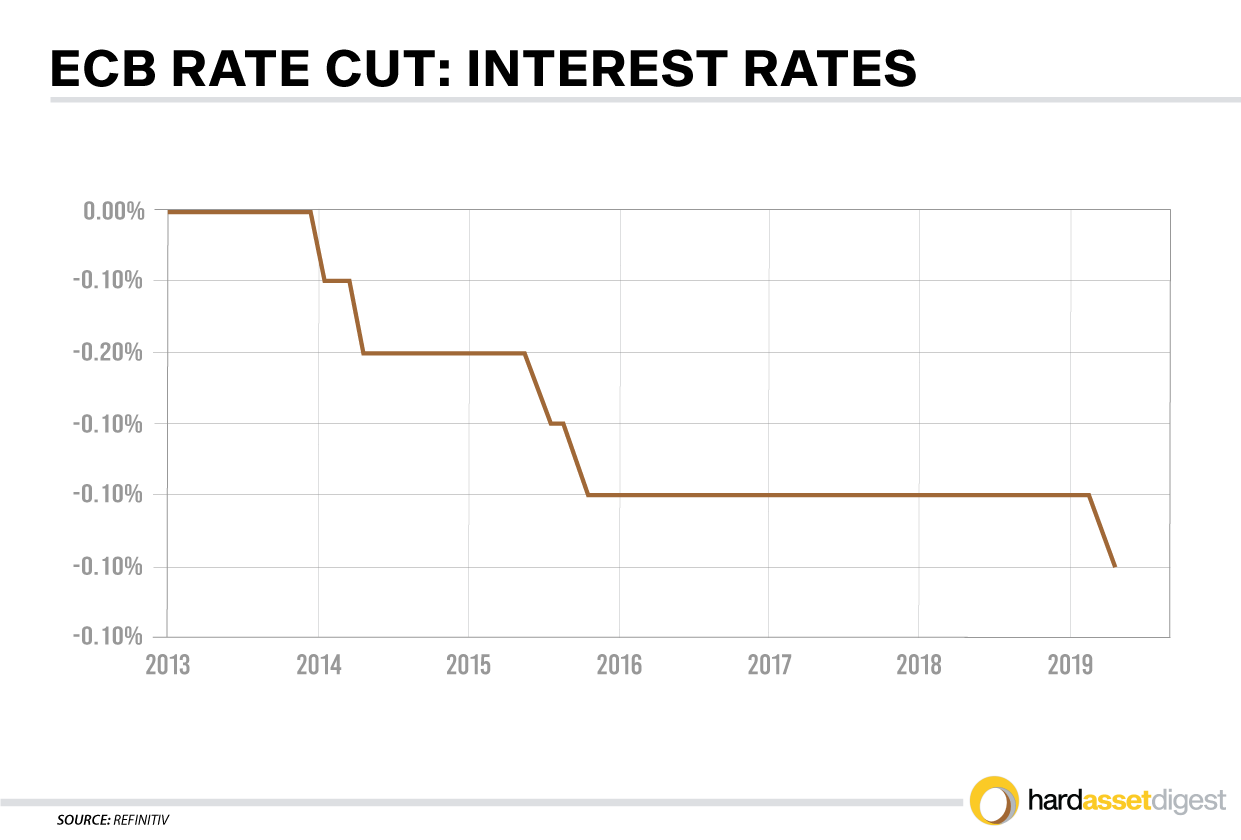
The Eurozone continues to experiment with negative interest rates in
an attempt to spur economic growth by encouraging bank lending and also
by boosting exports. Yet, the bottom line is that banks simply cannot
make money in a negative deposit rate environment.
As much as banks may continue to try and sway lenders to do
something more useful with their money than simply parking it with the
European Central Bank, it’s doubtful such an ill-devised monetary policy
can stave off recession.
Thus far, growth has remained anemic, raising the specter of a recession hitting the Eurozone sometime next year.
US/China Trade War: A trickle down effect across Europe’s largest economies
Germany, Europe’s largest economy, is suffering its worst
manufacturing downturn in almost seven years as the US/China trade war
spills over into european economies.
It’ll be interesting to see if Germany resorts to injecting fiscal
stimulus (aka, the printing of even more money!) to boost its sagging
export-reliant economy. Growth forecasts for 2020 have already fallen
below the key 1% threshold.
Britain, Europe’s second largest economy, remains mired in its
self-induced Brexit maelstrom, which certainly isn’t helping things from
an economic standpoint.
In what looks to be a warning sign of impending stagnation, the
British economy took its first step backward (in Q2) in more than 7
years. Amid all the turmoil, it seems increasingly doubtful Britain will
be exiting the EU on October 31st, with or without a deal, as the
Brexit cloud continues to darken.
New reports are also revealing weakness in Europe’s third largest
economy, France. In fact, the export sectors of both France and Germany –
which includes their high-profile automobile industries – are being hit
hard by flagging demand from China.
The luster is coming off the Chinese economy
While growth in China held steady at 6.4% in Q1 this year, it
proceeded to slip to 6.2% in Q2. Economic numbers over the last few
months reveal that the worst may not yet be over for China with analysts
projecting weakening third quarter data.
A recent survey by China Beige Book reveals slowing growth and soaring debt levels for the world’s second largest economy.
Here at home, the trade war continues to stoke recession fears
US gross domestic product grew at a 2% annual pace from April to
June, which was in-line with expectations. Yet, how long can that last?
Posted by AGORACOM
at 5:37 PM on Monday, October 28th, 2019
Loncor Resources Inc. (“Loncor” or the “Companyâ€)
(TSX: “LN”; OTCQB: “LONCD”), a Canadian gold exploration company with
significant projects in the Democratic Republic of the Congo (“DRCâ€)
and which is supported by Barrick Gold Corporation (NYSE: “GOLD”; TSX:
“ABX”) as joint venture partner and a second major gold producer,
Resolute Mining Limited (ASX/LSE: “RSG”), as a 27% shareholder, is
pleased to announce the appointment of Peter Cowley as President of the
Company and Minecon Resources and Services Limited as geological
consultants.
Peter Cowley History of Success in Africa
Mr.
Cowley is a geologist with over 40 years’ experience in the minerals
industry and a history of major exploration successes in Africa,
including the DRC. Among his major accomplishments, Mr. Cowley was Chief
Executive Officer and President of Banro Corporation from 2004 to 2008
where he led the exploration that delineated major gold resources at
Twangiza and Namoya in the DRC. Prior to joining Banro, Mr. Cowley was
Managing Director of Ashanti Exploration, where he led the exploration
team in the discovery and development of the Geita mine in Tanzania.
Prior to Ashanti, he was Technical Director of Cluff Resources which
discovered and developed mines in Zimbabwe, Ghana and Tanzania. He holds
an M.Sc from the Royal School of Mines, an MBA from the Strathclyde
Business School and is a Fellow of the Institute of Materials, Minerals
and Mining. He previously served as Chief Executive Officer and
President of Loncor from 2009 to 2015, which will allow him to move
rapidly in his new role.
Mr.
Cowley commented: “Loncor has a major footprint in the Ngayu greenstone
belt in northeastern DRC which has many geological similarities to the
Geita and Moto belts which host world class operating gold mines in
Tanzania and DRC, respectively, both in terms of size and profitability.
Besides the Barrick Joint Venture where the Company has a free carried
interest to the pre-feasibility study stage, Loncor has significant gold
resources at its KGL-Somituri and Makapela properties where there is
significant potential to increase this resource base. I am excited about
the opportunity to join up again with Daniel Bansah and his team at
MINECON who worked with me previously at Geita and Twangiza/Namoya, to
unlock the full potential of the underexplored Ngayu greenstone belt of
northeastern DRC.â€
Loncor’s
Chief Executive Officer, Arnold Kondrat, said: “We are thrilled to have
Peter return with a team that has a history of finding gold in Africa,
including the DRC. The current NI 43-101 compliant gold resources at our
Makapela and KGL-Somituri properties (including Adumbi) at Ngayu, and
the potential at our Yindi property, will provide us with an anchor for
future development outside of our existing Joint Venture with Barrick
Gold on our Ngayu gold project.â€
MINECON Appointment
Minecon Resources and Services Limited (“MINECONâ€) (www.mineconrsl.com)
has been appointed by Loncor as geological consultants to manage
exploration and development programs at Loncor’s properties within the
Ngayu Archean greenstone belt which are outside of Loncor’s Joint
Venture with Barrick Gold. MINECON is a full-service mining engineering
company headquartered in Ghana, Africa. MINECON works with companies
throughout Africa, with a focus on Ghana and DRC mining projects, to
support mineral exploration, mining operations, logistics, planning,
engineering and geological studies. MINECON’s mining industry
professionals have significant DRC-specific experience. The Company
believes that the MINECON team, headed by Daniel Bansah (MSc Mineral
Exploration) and supported by a team of geological professionals, will
provide the needed technical skills and leadership to assist Loncor in
advancing its gold properties up the value curve. MINECON will assist
Loncor in the continued development of Loncor’s:
100% owned Makapela gold prospect, which
has an Indicated Mineral Resource of 614,200 ounces of gold (2.20
million tonnes grading 8.66 g/t Au) and an Inferred Mineral Resource of
549,600 ounces of gold (3.22 million tonnes grading 5.30 g/t Au).
100% owned Yindi gold prospect,
which has previously reported drill results including 14.79 metres at
5.11 g/t Au, 19.40 metres at 1.30 g/t Au and 6.20 metres at 4.57 g/t Au.
71.25%-owned KGL-Somituri gold project,
which was recently acquired by Loncor (see Loncor’s September 27, 2019
press release) and has an Inferred Mineral Resource of 1.675 million
ounces of gold (20.78 million tonnes grading 2.5 g/t Au), with 71.25% of
this resource being attributable to Loncor via its 71.25% interest in
the KGL-Somituri project.
Makapela,
Yindi and KGL-Somituri are all located in the Ngayu gold belt and
outside of Loncor’s existing Joint Venture with Barrick Gold on the
Ngayu gold belt. Utilizing the expertise and experience of MINECON and
under Peter Cowley’s leadership, Loncor seeks to aggressively expand its
current gold resources as set out above.
Audit Committee Clarification The
Company wishes to clarify that as a result of the resignation of a
director of the Company, there was a vacancy on the Company’s audit
committee from August 17, 2018 to June 17, 2019, such that during this
period the audit committee was comprised of only two members and not
three as required under National Instrument 52-110. This vacancy was
filled on June 17, 2019. The Company’s audit committee is currently
comprised of the following three independent directors of the Company:
Zhengquan (Philip) Chen, William R. Wilson and Richard J. Lachcik.
About Loncor Resources Inc. Loncor
is a Canadian gold exploration company focused on two projects in the
DRC – the Ngayu and North Kivu projects. Both projects have historic
gold production. Exploration at the Ngayu project is currently being
undertaken by Loncor’s joint venture partner Barrick Gold (Congo) SARL
(“Barrickâ€).
The Ngayu project is 200 kilometres southwest of the Kibali gold mine,
which is operated by Barrick and in 2018 produced approximately 800,000
ounces of gold. As per the joint venture agreement signed in January
2016, Barrick manages and funds exploration at the Ngayu project until
the completion of a pre-feasibility study on any gold discovery meeting
the investment criteria of Barrick. Subject to the DRC’s free carried
interest requirements, Barrick would earn 65% of any discovery with
Loncor holding the balance of 35%. Loncor will be required, from that
point forward, to fund its pro-rata share in respect of the discovery in
order to maintain its 35% interest or be diluted.
Certain
parcels of land within the Ngayu project surrounding and including the
Makapela and Yindi prospects have been retained by Loncor and do not
form part of the joint venture with Barrick. Barrick has certain
pre-emptive rights over these two areas. Loncor’s Makapela prospect has
an Indicated Mineral Resource of 614,200 ounces of gold (2.20 million
tonnes grading 8.66 g/t Au) and an Inferred Mineral Resource of 549,600
ounces of gold (3.22 million tonnes grading 5.30 g/t Au). Loncor also
recently acquired a 71.25% interest in the KGL-Somituri gold project in
the Ngayu gold belt which has an Inferred Mineral Resource of 1.675
million ounces of gold (20.78 million tonnes grading 2.5 g/t Au), with
71.25% of this resource being attributable to Loncor via its 71.25%
interest.
Resolute
Mining Limited owns 27% of the outstanding shares of Loncor and holds a
pre-emptive right to maintain its pro rata equity ownership interest in
Loncor following the completion by Loncor of any proposed equity
offering. Newmont Goldcorp Corporation (NYSE: “NEM”; TSX: “NGT”) owns
7.8% of Loncor’s outstanding shares.
Additional information with respect to Loncor and its projects can be found on Loncor’s website at www.loncor.com.
Posted by AGORACOM-JC
at 8:31 AM on Wednesday, July 31st, 2019
Monarch produced 3,572 ounces of gold in the fourth quarter, up 169% from the third quarter and down 24% from the 4,695 ounces produced last year.
The increase was attributable to a rise in the production rate at the Camflo mill and the Beaufor mine combined with a higher grade of ore.
MONTREAL, July 31, 2019 – MONARCH GOLD CORPORATION (“Monarch” or the “Corporation”) (TSX: MQR) (OTCMKTS: MRQRF) (FRANKFURT: MR7) is pleased to report its production and corporate highlights for the fourth quarter ended June 30, 2019. Amounts are in Canadian dollars unless otherwise indicated.
Production highlights
Monarch produced 3,572 ounces of gold in the fourth quarter, up 169%
from the third quarter and down 24% from the 4,695 ounces produced last
year. The increase was attributable to a rise in the production rate at
the Camflo mill and the Beaufor mine combined with a higher grade of
ore.
The Corporation recorded revenues of $7.3 million in the fourth quarter from the sale of 2,666 ounces of gold at an average price of $1,764 per ounce (US $1,333)
plus custom milling revenue, which was down 3.1% from the third quarter
due to an increase in the tonnage milled from the Beaufor mine.
As at June 30, 2019, the Corporation had more than 1,100 ounces of gold in inventory.
“This was a solid quarter in terms of performance, especially given
that we operated with approximately one-third the workforce we had last
year,” said Jean-Marc Lacoste, President and Chief
Executive Officer of Monarch. “This quarter also marks the suspension of
our production activities at the Beaufor mine during the quarter, as of
June 27, 2019, and at the Camflo mill on July 10, 2019.
Given the current gold environment, our team is focusing on identifying
new exploration targets at the Beaufor mine and preparing a drilling
program on the most promising targets, while Camflo is currently
undergoing maintenance work that should take place over a 90-day
period.”
“Despite the fact that we have suspended our production activities,
Monarch is in an excellent position to benefit from the current upward
trend in gold prices. The Corporation has a large portfolio of
high-quality mining assets that include two mills, six advanced gold
projects with total measured and indicated resources of more than
3.1 million ounces of gold (see table at the end of this press release),
a 14.2% interest in Unigold (TSXV: UGD), as well as a strong financial
position. Our goal in the coming quarters will be to develop our
flagship Wasamac project, which has an annual production potential of
142,000 ounces of gold over 11 years (see press release dated December 3, 2018), and to increase the value of our assets through partnerships and other transactions.”
Production statistics
Three months ended June 30, 2019
Three months ended June 30, 2018
Twelve months ended June 30, 2019
Twelve months ended June 30, 2018
Beaufor mine
Ore processed (tonnes)
27,648
30,523
96,212
98,394
Gold recovery (%)
98.24
98.70
98.17
98.76
Ounces produced
3,572
4,695
13,225
15,071
Ounces sold
2,666
4,589
12,534
14,856
Corporate highlights
On May 9, 2019, the Corporation acquired a block of 6.5 million shares of Unigold Inc. (TSXV: UGD) from an investor at an agreed price of $0.115 per share, for a total of $747,500, payable by the issuance of 3.25 million common shares of the Corporation at an agreed price of $0.23 each (see press release).
On June 18, 2019, the Corporation announced the
signature of binding letters of intent for the acquisition of an
aggregate 100% interest in the Fayolle property from Hecla Quebec Inc.,
formerly known as Aurizon Mines Ltd. (NYSE: HL), and Typhoon Exploration
Inc. (TSXV: TYP) (see press release).
On June 19, 2019, the Corporation announced that its
wholly-owned subsidiary Louvem Mines Inc. had sold a 2% net smelter
return (“NSR”) royalty on certain claims of the Chimo Mine property to
Cartier Resources Inc. (TSXV: ECR) in consideration of a cash payment of
$350,000 (see press release).
On July 25, 2019, the Corporation sold its portfolio of
net smelter return (“NSR”) royalties on the Chimo property (owned by
Chalice Gold Mines Ltd) for a cash payment of $350,000.
Monarch held a portfolio of NSR royalties ranging from 0.50% to 2.50% on
the Chimo property, which surrounds the Chimo Mine property.
Monarch Gold Corporation (TSX: MQR) is an emerging gold mining
company focused on pursuing growth through its large portfolio of
high-quality projects in the Abitibi mining camp in Quebec, Canada. The Corporation currently owns close to 300 km² of gold properties (see map), including the Wasamac deposit (measured and indicated resource of 2.6 million ounces of gold), the Croinor Gold (see video), McKenzie Break, Beaufor and Swanson
advanced projects and the Camflo and Beacon mills, as well as other
promising exploration projects. It also offers custom milling services
out of its 1,600 tonne-per-day Camflo mill.
Forward-Looking Statements
The forward-looking statements in this press release involve known
and unknown risks, uncertainties and other factors that may cause
Monarch’s actual results, performance and achievements to be materially
different from the results, performance or achievements expressed or
implied therein. Neither TSX nor its Regulation Services Provider (as
that term is defined in the policies of the TSX accepts responsibility
for the adequacy or accuracy of this press release.
2 Source: Monarques prefeasibility study (January 19, 2018) and resource estimate (January 8, 2016)
3 Source: NI 43â€101 Technical Report on the Swanson Project,
June 20, 2018, Christine Beausoleil, P.Geo., and Alain Carrier, P.Geo.,
M.Sc., of InnovExplo Inc.
4 Source: NI 43â€101 Technical Report on the McKenzie Break
Project, April 17, 2018, Alain-Jean Beauregard, P.Geo., and Daniel
Gaudreault, Eng., of Geologica Groupe-Conseil Inc. and Christian
D’Amours, P.Geo., of GeoPointCom Inc.
Tags: #mining, #Resources, CSE, gold, stocks, tsx, tsx-v Posted in Monarques Gold | Comments Off on Monarch Gold $MQR.ca Produces 3,572 Ounces of Gold and Generates $7.3 Million in Revenue in the Fourth Quarter $GDX.ca $ECR.ca $MZZ.ca $QMX.ca $IMG.ca $IAG $MUX
Posted by AGORACOM
at 5:30 PM on Friday, January 18th, 2019
107.5 g/t gold and 880 g/t silver over 6.90 meters core length
High-grade quartz vein intersection is near-surface, near high grade intersections of COD18-45, 46 and 67 indicating high grade ore shoot.
COD18-67: 129 g/t gold and 1,154 g/t silver over 7.28 meters
VANCOUVER, BC / ACCESSWIRE / January 18, 2019 / GGX Gold Corp. (TSX-v: GGX), (OTCQB: GGXXF), (FRA: 3SR2) (the “Company” or “GGX“)
is pleased to announce it has received drill core analytical results
for the final four drill holes (COD18-68 to COD18-71) of the November
2018 diamond drilling program at its Gold Drop Property near Greenwood,
southern British Columbia. Drill hole COD18-70 intersected near-surface
high-grade gold and silver with significant tellurium in the southwest
part of the COD quartz vein. This high-grade intersection is in
close-proximity to high-grade intersections in drill holes COD18-45, 46
and 67 indicating a high grade ore shoot. The mineralized COD vein
system has been traced by drilling and / or trenching for approximately
400 meters strike length and is open to the northeast, at depth and
possibly to the southwest. Highlights for COD18-70 include:
107.5
g/t gold and 880 g/t silver over 6.90 meters core length (multiple
samples greater than the upper 500 g/t analytical limit for tellurium).
High-grade
quartz vein intersection is near-surface (18 to 24 meters vertical
depth), near high grade intersections of COD18-45, 46 and 67 indicating
high grade ore shoot.
Part of
exploratory shallow drilling designed to define high-grade
mineralization and expand the understanding of controls on
mineralization.
The
November 2018 diamond drilling program (11 drill holes: COD18-61 to
COD18-71) tested the southwest region of the COD vein in an area of
high-grade gold and silver mineralization. The COD vein is located
within the Gold Drop Southwest Zone. Prior 2018 drill holes in this part
of the COD vein intersected near-surface high-grade gold and silver
mineralization. The COD vein strikes approximately northeast-southwest.
Intersections
exceeding 1 g/t gold for drill holes COD18-68 to COD18-71 are listed in
the table below. Since true widths cannot be accurately determined from
the information available the core lengths (meters) are reported.
Hole ID
From (m)
To (m)
Length (m)
Au (g/t)
Ag (g/t)
Te (g/t)
Description
COD18-68
19.49
22.25
2.76
8.77
85.4
56.3
Quartz vein and wall rock
COD18-68
incl. 20.86
22.35
1.39
14.47
131.8
87.9
Quartz vein and wall rock
COD18-69
19.75
20.42
0.67
1.24
9.59
6.55
quartz band
COD18-69
26.72
34.18
7.46
5.76
67.9
61.2
Quartz veins & wall rock; local quartz breccia
COD18-69
incl. 27.30
28.10
0.80
9.77
95
110
Quartz vein
COD18-69
incl. 31.20
31.60
0.40
70.9
569
278
Quartz vein with massive sulfide band
COD18-70
22.57
29.47
6.90
107.5
880
Quartz vein with tellurides
COD18-70
incl. 23.3
24.15
0.85
541
4532
>500
Quartz vein with tellurides
COD18-71
28.50
30.30
1.80
1.57
11.7
8.4
Alteration zone
Note: 1-meter core loss in COD18-70 between 22.57 – 29.47m.
All
November 2018 drill holes were collared within 25 meters of prior 2018
drill holes COD18-45 and COD-46, the objective to define the high-grade
mineralization in this part of the COD vein and to provide information
on the controls on mineralization. Drill holes COD18-45 and COD18-46,
drilled to the west at 45 and 50 degree-dips, intersected near-surface,
high grade gold and silver mineralization in the COD vein (News Releases
of August 15 and 22, 2018). Drill holes COD18-67and COD18-70, part of
the November 2018 program, intersected high grade gold and silver
mineralization in the same area. These holes were drilled slightly
northeast at dips of 50 degrees (COD18-67) and 54 degrees (COD18-70) to
intersect the COD vein at a shallower angle and test the continuity of
the quartz veining and high-grade mineralization. Highlights of these
four holes include (core length):
COD18-45: 50.1 g/t gold and 375 g/t silver over 2.05 meters (including 167.5 g/t gold, 1,370 g/t silver & >500 g/t tellurium over 0.46 meters).
COD18-46: 54.9 g/t gold and 379 g/t silver over 1.47 meters (including 223 g/t gold, 1,535 g/t silver & > 500 g/t tellurium over a 0.30 meters).
COD18-67: 129 g/t gold and 1,154 g/t silver over 7.28 meters (multiple samples exceeding upper 500 g/t analytical limit for tellurium).
COD18-70: 107.5 g/t gold and 880 g/t silver over 6.90 meters (multiple samples exceeding upper 500 g/t analytical limit for tellurium).
The
close-spaced intersections of COD18-45, 46, 67 and 70 all occur within
18-25 meters vertical depth indicating a high-grade ore shoot.
Analytical
results for drill holes COD18-61 to COD18-64 were reported in the
Company’s News Release of January 9, 2018, the highlight being 28.0 g/t
gold, 424.7 g/t silver and 150.4 g/t tellurium over 1.17 meters core
length in COD18-63. Analytical results for drill holes COD18-64 to
COD18-67 were reported in the Company’s News Release of January 11,
2019, the highlight being the intersection of 129 g/t gold and 1,154 g/t silver over 7.28 meters core length in COD18-67.
Holes
COD18-61 to COD18-66 were drilled to the west and slightly northwest at
dips of 45 to 60 degrees to intersect the approximately northeast
striking vein(s). Holes COD18-67 to COD18-71 were drilled at dips of 45
to 60 degrees slightly northeast to intersect the vein(s) at a shallower
angle, the objective being to test the continuity of the quartz veining
and mineralization. Although drill holes COD18-67 and COD18-70 were not
drilled perpendicular to the strike of the COD vein, they still show
the exceptional high-grade nature of the vein, possibly being, or
leading to, a “motherlode”-style feeder system. As the Company continues
reminding of the old saying “we drill for structure and we drift for
grade”, both holes indicate how potential drifting may encounter the
vein in case a potential production decision can be made in the future.
Drilling along veins at slight angles helps in locating possible “ore
shoots” and gaining a structural understanding of its vertical and
horizontal orientations/extensions for targeted follow-up drilling.
The
drill core was split with half core samples securely packaged and
delivered to ALS Canada Ltd. in Vancouver, BC. The core samples were
analyzed for gold by Fire Assay-Atomic Absorption and for 48 elements
(including silver and tellurium) by Four Acid – ICP-MS. Samples
exceeding 100 g/t gold were re-analyzed for gold by Fire Assay –
Gravimetric Finish. Samples exceeding 100 g/t silver were re-analyzed
for silver by Four Acid – ICP-AES. Samples exceeding 1,500 g/t silver by
Four Acid – ICP-AES were re-analyzed for silver by Fire Assay –
Gravimetric Finish. Quality control (QC) samples were inserted at
regular intervals.
Gold
and silver bearing quartz veins occur in multiple regions on the Gold
Drop property with high grade gold reported (samples exceeding 1 oz. /
ton gold reported).
Historic gold and silver production occurred at the Gold Drop, North Star, Amandy and Roderick Dhu vein systems.
David
Martin, P.Geo., a Qualified Person as defined by NI 43-101, is
responsible for the technical information contained in this News
Release.
To view the Original News release with pictures please go to the website or contact the company.
On Behalf of the Board of Directors, Barry Brown, Director 604-488-3900 [email protected]
Posted by AGORACOM
at 9:18 AM on Friday, January 18th, 2019
Drill results for holes 10 – 22 completed during 2018 exploration
Drilling conducted 1.5 km northwest of the historic Keymet Mine
Ky-18-14: 7.89% zinc equivalent over 34.3 m
GREAT ATLANTIC RESOURCES CORP. (TSXV.GR) (the “Company” or “Great Atlantic”) is pleased to announce it has received drill core analytical results for 13 holes (Ky-18-10 to Ky-18-22) completed during the 2018 diamond drilling program at its Keymet Base Metal – Precious Metal Property, located near Bathurst, northeast New Brunswick. The program was conducted in the northwest region of the property approximately 1.5 km northwest of the historic Keymet Mine. Highlights include (core length):
Ky-18-14: 7.89% zinc equivalent over 34.3 meters (From 46.20 m to 80.50 m)
Ky-18-10: 10.91% zinc equivalent over 3.27 meters (From 85.03m to 88.30 m)
Elmtree 12 vein: System traced to approximately 145 meters depth, open at depth
Elmtree 12 vein: Strike length of approximately 110 meters and open along strike
Vein with semi-massive sulfides in Drill Hole Ky-18-14 at Elmtree 12 Vein System
The
2018 drilling program (13 holes totalling 1,484 meters) was conducted
in the northwest region of the Keymet property. Eleven drill holes
(Ky-18-10 to Ky-18-18, Ky-18-21 and Ky-18-22) tested the Elmtree 12 vein
system as in-fill drilling and along strike with some holes testing
deeper than previous drilling. Company management speculate the Elmtree
12 vein system to be striking approximately north-south and
sub-vertical. Great Atlantic had previously drilled six holes in the
Elmtree 12 vein system during 2015 and 2017, intersecting zinc, copper,
lead and silver bearing polymetallic veins (News Releases of February
23, 2016, December 20, 2017 and March 2, 2018). Two drill holes
(Ky-18-19 and Ky-18-20) tested the continuation of another base metal
and silver bearing vein southwest of the Elmtree 12 vein system. This
vein was discovered during 2017 drilling (Ky-17-8: 18.8% Zn, 3.5% Cu and
576 g/t Ag over 1.27 meters core length – News Release of March 2,
2018).
Sulfide Bearing Veins in Drill Hole Ky-18-14 at Elmtree 12 Vein System
Intersections
from 2015, 2017 and 2018 diamond drilling programs in the area of the
Elmtree 12 vein system include the following (core length):
Hole ID
From (m)
To (m)
Length (m)
Zn Equiv. (%)
Zn (%)
Cu (%)
Pb (%)
Ag (g/t)
Au (g/t)
2015 Diamond Drill Holes:
Ky-15-3
30.10
32.20
2.10
3.28
Ky-15-3
60.80
62.60
1.80
22.77
16.68
1.11
0.44
152
Ky-15-4
90.07
94.35
4.28
10.44
8.68
0.29
0.2
44.8
2017 Diamond Drill Holes:
Ky-17-5
81.00
81.80
0.80
20.24
13.65
1.20
0.45
166
Ky-17-6
119.45
131.50
12.05
8.31
3.54
0.92
0.28
115.6
Ky-17-6
incl. 119.45
124.40
4.95
16.05
7.67
1.57
0.48
209.3
Ky-17-6
148.80
149.75
0.95
4.9
Ky-17-6
164
183.96
19.96
0.64
Ky-17-8
31.00
32.27
1.27
39.90
18.8
3.55
1.16
576
Ky-17-9
45.75
47.13
1.38
6.29
4.29
0.29
0.23
55.4
2018 Diamond Drill Holes:
Ky-18-10
85.03
88.30
3.27
10.91
7.91
0.53
0.21
77.2
Ky-18-10
incl. 85.74
86.74
1.00
25.59
16.80
1.60
0.55
223
Ky-18-11
108.70
109.40
0.70
4.95
3.89
0.11
0.14
33.9
Ky-18-12
78.82
84.55
5.73
7.88
4.07
1.19
0.23
39.2
Ky-18-12
incl. 78.82
79.64
0.82
14.03
10.90
1.07
0.09
24.8
Ky-18-12
incl. 83.35
84.55
1.20
21.65
8.90
3.81
0.60
157
Ky-18-13
80.00
81.00
1.00
1.76
Ky-18-14
46.20
80.50
34.30
7.89
3.29
0.88
0.26
112.6
Ky-18-14
incl. 46.20
49.20
3.00
56.23
9.04
9.19
2.16
1158
Ky-18-14
incl. 62.48
63.00
0.52
18.49
15.45
0.96
0.13
32
Ky-18-14
incl. 67.00
67.60
0.60
13.59
13.05
0.09
0.05
14
Ky-18-14
incl. 76.00
80.50
4.50
14.27
12.08
0.31
0.30
59.8
Ky-18-16
77.20
77.72
0.52
33.48
4.47
7.85
0.72
478
Ky-18-17
10.43
11.00
0.57
11.72
6.37
0.10
6.08
14.5
Ky-18-17
67.00
67.50
0.50
7.23
6.05
0.21
0.15
27.5
Ky-18-18
72.50
73.50
1.00
2.74
2.04
0.09
0.11
19.6
Ky-18-19
13.02
13.72
0.70
1.05
Ky-18-20
32.00
32.28
0.28
10.75
2.39
1.82
0.87
164
Ky-18-21
145.50
147.00
1.50
8.26
2.31
0.89
0.81
156.6
Zinc
equivalent (% Zn Equiv.) values for drill hole intersections are based
on the following metal prices (as of January 16, 2019): Zinc US$2,467 /
tonne (US$1.119 / lb.), Lead US$1,953 / tonne (US$0.886 / lb.), Copper
US$5,881 / tonne (US$2.668 / lb.) and Silver US$15.605 per troy ounce.
Metal recoveries of 100% were applied in the zinc equivalent
calculations. The zinc equivalent calculation is as follows: Zn Equiv. =
100 x ((Ag Price in grams x Ag Grade) + (Pb Price x 2204.6 x Pb Grade
(%) / 100) + (Cu Price x 2204.6 x Cu Grade (%) / 100) + (Zn Price x
2204.6 x Zn Grade (%) / 100)) / Zn Price x 2204.6.
Drill holes
Ky-18-10 to Ky-18-13 were in-fill holes drilled east to slightly
southeast at 45 to 57 degree dips. Drill holes Ky-18-14, Ky-18-21 and
Ky-18-22 were collared closer to the vein system and at steeper dips
(78-83 degrees) to intersect the vein system at a shallower angle to
test continuity of mineralization along dip, locate possible ore shoots
and gain a structural understanding of the vein’s vertical and
horizontal orientations / extensions for targeted follow-up drilling.
Hole Ky-18-21, drilled under Ky-18-14, tested the zone deeper. The
mineralized intersection at 145.5-147 meters in this hole is the deepest
intersection by the Company in the Elmtree 12 vein system and indicates
the system is open at depth at this location. This interval also
returned anomalous values for cobalt, including 0.07% Co over 1.0 meter
core length.
The meta-sediments in the lower half of Ky-18-22 are intruded my mafic dykes, possibly cutting the vein system.
Drill
holes Ky-18-15 and Ky-18-16 tested the extension of the Elmtree 12 vein
system to the north. Ky-18-15 was drilled slightly northwest
(approximate 55 degree dip). Ky-18-16 was drilled slightly southwest
(approximate 73 degree dip). The metal rich intersection in Ky-18-16
indicates the mineralized system is open to the north at slightly deeper
levels.
Drill holes Ky-18-17 and Ky-18-18 tested the Elmtree 12
vein system south of previous Company drilling. Mineralized veins and /
or alteration was intersected in both holes, indicating the mineralized
system to be open to the south.
Drill holes Ky-18-19 and Ky-18-20
were located southwest of the known extent of the Elmtree 12 vein
system. These holes tested the extension of the high grade vein
intersected in 2017 hole Ky-17-8. Ky-18-19 was drilled slightly
northwest at an approximate 66 degree dip to intersect the vein deeper.
Hole Ky-18-19 did not confirm the down-dip extension of the mineralized
vein. Hole Ky-18-20 was drilled southwest at an approximate 55 degree
dip. This hole intersected a near-surface narrow copper, lead, zinc and
silver bearing zone (approximate 26 meters vertical depth) approximately
10 meters south of the high grade vein intersection of hole Ky-17-8.
Drill
core from the 2018 program was geologically logged and sampled at a
secure location in Miramichi, New Brunswick. Drill core samples were
submitted to ALS Canada for gold analysis (Fire Assay-AA) and for 33
element analysis (including copper, lead, zinc and silver) by Four Acid
and ICP-AES. Samples exceeding 1,500 g/t silver were re-analyzed for
silver by Fire Assay-Gravimetric Finish. Quality Control samples were
included as part of the sample submission. A Qualified Person verified
the 2015, 2017 and 2018 exploration data for Great Atlantic. The
Qualified Person managed these exploration programs at the Keymet
Property.
Historic Keymet Mine (1950s)
The
Company’s focus since acquiring the Keymet Property has been the
northwest region of the property in the area of reported polymetallic
veins with most work in the area of the Elmtree 12
copper-lead-zinc-silver bearing vein system. At least seven vein
occurrences with lead, zinc and +/- copper, silver and gold are reported
in this region of the property in addition to the polymetallic veins
reported at the historic Keymet Mine (source: New Brunswick Dept. of
Energy and Resource Development Mineral Occurrence Database). The Keymet
Mine operated during the mid-1950s, producing copper, lead, zinc and
silver. Production at this mine was terminated due to a fire at the
site.
Significant
precious metal – base metal deposits are reported within 4 km of the
Keymet Property. The Elmtree gold deposits are located within 3 km
west-southwest of the Keymet Property. The historic Nigadoo River Mine
is located approximately 4 km south of the Keymet Property. Polymetallic
massive sulfide veins were mined at the Nigadoo River Mine during the
1960s and 1970s with copper, lead, zinc and silver being produced. The
N.B Dept. of Energy and Resource Development Mineral Occurrence Database
reports shaft depth and production totals at this historic mine.
Production during 1967-1971 is reported as 1.126 million tonnes at 2.2%
Pb, 2.1% Zn, 0.24% Cu and 92.57 g/t Ag. Production during 1973-1977
(after a 2 year closure) is reported to be 0.733 million tonnes (only
partial metal grades reported). The shaft is reported to at least 470
meter deep.
The Nash Creek Zinc Project of Callinex Mines Inc. is
located approximately 15 kilometers northwest of the Keymet Property.
Callinex Mines Inc. recently filed a 43-101 Technical Report (effective
date March 21, 2018) which was completed by Tetra Tech Canada Inc. The
report includes updated mineral resource estimates for the Nash Creek
Zinc Project (Hickey and Hayes Zones) using a 1.5% Zn Equiv. cut-off.
This included 13,592,000 tonnes indicated estimated resources at 2.68%
Zn, 0.58% Pb and 17.8 g/t Ag; and 5,929,000 tonnes inferred estimated
resources at 2.68% Zn, 0.47% Pb and 13.9 g/t Ag (source: Callinex Mines
Inc. Website).
Readers are warned that mineralization at the
Elmtree gold deposits, historic Nigadoo River Mine and Nash Creek Zinc
Project is not necessarily indicative of mineralization on the Keymet
Property.
Access to the Keymet Property is excellent with paved
roads transecting the property, including a provincial highway. The
property covers an area of approximately 3,400 hectares and is 100%
owned by the Company.
Readers are warned that historical records
referred to in this News Release have been examined but not verified by a
Qualified Person. Further work is required to verify that historical
records referred to in this News Release are accurate.
David
Martin, P.Geo., a Qualified Person as defined by NI 43-101 and VP
Exploration for Great Atlantic, is responsible for the technical
information contained in this News Release.
On Behalf of the board of directors
“Christopher R Anderson“
Mr. Christopher R Anderson ” Always be positive, strive for solutions, and never give up “ President CEO Director 604-488-3900 – Dir
About Great Atlantic Resources Corp.: Great
Atlantic Resources Corp. is a Canadian exploration company focused on
the discovery and development of mineral assets in the resource-rich and
sovereign risk-free realm of Atlantic Canada, one of the number one
mining regions of the world. Great Atlantic is currently surging forward
building the company utilizing a Project Generation model, with a
special focus on the most critical elements on the planet that are
prominent in Atlantic Canada, Antimony, Tungsten and Gold.