Agoracom Blog Home

Posts Tagged ‘#smallcapstocks’

Liberty Star Updates the Hay Mountain Project, Southeast Arizona

Posted by AGORACOM-JC at 9:51 AM on Tuesday, May 20th, 2014

TUCSON, Ariz.–Liberty Star Uranium & Metals Corp. (“Liberty Star” or the “Company”)(OTCQB: LBSR) is pleased to update its shareholders and interested parties on the completion of the compilation and interpretation of the Hay Mountain porphyry copper geophysical data along with geochemistry and design of a Phase 1 drill program.

During the last 6 months significant additional details on the subsurface of the Hay Mountain porphyry copper geochemical anomaly have come to light. These are enumerated in approximate chronological order:

  1. Detailed interpretation of the ZTEM geophysical survey revealed that the anomaly is much larger than previously realized. Based on the analysis of all the data, it is now realized that it could contain the footprint of any of the largest porphyry copper deposits known in North America. Additional geophysical interpretive work on the abundant geophysical data was clearly warranted.
  2. The electromagnetic component of the ZTEM system shows conductors going to a depth of at least 1,520m (approx. 5,000 feet), which would be commensurate with the base of the Paleozoic sediments and their depositional contact with the Precambrian basement rocks. This is similar to the mineralization at Bisbee, Christmas, Twin Buttes, Rosemont and Morenci, Arizona and Cananea, Mexico, all within about 161 km (100 miles) of Hay Mountain, and all are sediment (skarn) hosted porphyry copper mines.
  3. The detailed magnetic component of the ZTEM survey allows the three dimensional analysis of the very large magnetic feature which is coincident with the geochemical porphyry copper signature and low resistivity signatures from the electromagnetic (EM) component. This magnetic resonance imaging (MRI – just like physicians use – except in our case it is helicopter borne, not stationary in an office – and of course the scale is different), reveals important details of what is comparable to known mineral bearing skarn in other districts in North and South America, and throughout the world. Skarn (altered limestone – see Liberty Star’s glossary on web site) frequently contains high grade copper, gold, molybdenum, tungsten and other metals. This is a common host for the nearby Bisbee mines where early day production ranged from 7% to 30% copper. Other deposits within about 241 km (150 miles) at Morenci, Silver Bell, Mission, Twin Buttes, Rosemont, Globe and Christmas, Arizona, Chino, New Mexico and Cananea, Mexico and others as well as mines in other parts of the world have similar grades in skarn bodies.
  4. The 3D magnetic data suggest the upper part of the skarn bodies lie 30 to 90 meters (approx. 100 to 300 feet) below dirt cover. Their magnetic signature suggests the upper 30 to 90 meters or more is oxidized and copper would be in oxide form that would allow shallow open pit mining, heap leaching solvent extraction and electrowinning (OPHLSXEW) to produce 99.99% wire grade copper as seen at the new Safford, Arizona mine and others. It might also be like the nearby Bisbee deposit which produced an astounding number of museum quality green copper oxide and other mineral specimens of great value.
  5. Analysis of the data generated in the studies identified above has made it possible to lay out a targeted drill program. Recent consultation with directional drilling contractors suggests that a significant reduction of the number of drill sites can be made. This will minimize surface disruption and allow the drilling of one mother hole and up to 8 daughter holes from one drill site. This should significantly reduce the cost of drilling, as the directional daughter holes will save penetrating repeatedly to the daughter hole kick off depth. This directional drilling is similar to oil field standard procedure.
  6. The availability of new equipment. Largely dependent on new high speed microcomputers, combined with the Internet suggest a more efficient approach to the rapid drilling this project will require.
  7. Development time and financing availability
    Briscoe has been told by well-capitalized investors during his world travels over the last 11 months that no more than seven years is an acceptable time for exploration and start of production. In response, the Company has designed a drilling exploration program to operate 24/7/365 for four years assuming ore grade material is intercepted. A mine would go into production in the seventh year. If a near surface oxide copper ore body is present (like the nearby Johnson Camp Mine and I-10 Porphyry-Excelsior proposed mines), as suggested by the geophysics, such production on a moderate scale from a shallow pit could be feasible, thus greatly simplify this very tight schedule. Continued enlargement of facilities could consist of a build out of a large deep high grade underground mine or a much larger open pit mine or both; or perhaps a block cave operation.

Required capital funding for the Hay Mountain Project would be Phase 1 drilling at US $5 million to be expended in the first year to confirm presence of ore grade mineralization. Post phase 1 drilling activities in the amount of US $60 million are to be expended over the next three years. Assuming success in defining a mineral resource, permitting, metallurgical studies, and mine planning and plant design would quickly follow as would a Bankable Feasibility Study, which would be completed at the end of year five. Production would follow and is projected to be attained in the seventh year.

“James A. Briscoe” James A. Briscoe, Professional Geologist, AZ CA
CEO/Chief Geologist
Liberty Star Uranium & Metals Corp.

Forward-Looking Statements

Statements in this news release that are not historical are forward-looking statements. Forward-looking statements in this news release include: that a porphyry copper system is indicated; that Phase 1 drilling will cost US $5 million to be expended in the first year. Post phase 1 drilling activities in the amount of US $60 million are to be expended over the next three years. That assuming success in defining a mineral resource, permitting, metallurgical studies, and mine planning and plant design would quickly follow as would a Bankable Feasibility Study, which would be completed at the end of year five. Production would follow and is projected to be attained in the seventh year.

Factors which may delay or prevent these forward-looking statements from being realized include misinterpretation of data; we may not be able to get equipment or labor as we need it; we may not be able to raise sufficient funds to complete our intended exploration or carry on operations; that weather, logistical problems or hazards may prevent us from exploration; that equipment may not work as well as expected; that analysis of data may not be possible accurately and at depth; and that despite encouraging data there may be no commercially exploitable mineralization on our properties. Readers should refer to the risk disclosures outlined in the Company’s recent S-1, its 10-K and the Company’s other periodic reports filed from time to time with the Securities and Exchange Commission.

Contacts

Agoracom Investor Relations
[email protected]
http://agoracom.com/ir/libertystar
or
Liberty Star Uranium & Metals Corp.
Tracy Myers, 520-425-1433
Investor Relations
[email protected]
Follow Liberty Star Uranium & Metals Corp. on Facebook, LinkedIn & Twitter @LibertyStarLBSR

El Nino Options the Kasala Project to MMG Limited

Posted by AGORACOM-JC at 8:40 AM on Tuesday, May 20th, 2014

  • ELN entered into an Option Agreement with MMG Limited to acquire 100% of ELN’s 70% interest in Infinity Resources Sprl, the joint venture company that owns the Kasala permits.
  • USD$6,000,000.00; consisting of an initial payment of $250,000 on the Satisfaction Date; Three annual payments of $916,666.00 for a total of USD$3,000,000 and additional USD$3,000,000.00 to exercise the option to acquire a 100% of ELN’s 70% interest.
  • MMG to pay a non-refundable US$350,000 for the exclusive right to acquire ELN’s 70% interest
  • Over the three year period, MMG must incur a total of USD$15,000,000 in exploration expenditures
  • ELN will retain a 1.5% NSR
  • MMG is one of the world`s largest producers of zinc and also produces significant amounts of copper, lead, gold and silver.
  • MMG Limited owns and operates the Kinsevere high-grade copper mine located approximately 30 km from ELN’s Kasala project
  • Kasala is one of the newest copper discoveries in the Central African Copper Belt. Kasala’s mineralized zone is open to the North, South and West and to depth; ~ 600m long/400m wide/30m thick

VANCOUVER, May 20, 2014 /CNW/ – El Niño Ventures Inc. (“ELN”) (TSX.V: ELN) (OTCQX: ELNOF) (Frankfurt: E7Q) is pleased to announce that it has entered into an Option Agreement (the “Agreement”) with MMG Limited (“MMG”), whereby MMG can acquire ELN`s 70% interest in the Kasala copper project in the Democratic Republic of the Congo (DRC) for a total consideration of USD$6,000,000.00.

Option Agreement

As consideration for the exclusive right to acquire El Nino`s 70% interest in Infinity Resources Sprl, the joint venture company that owns the Kasala permits, MMG has agreed to pay a non-refundable USD$350,000. Under the terms of the Agreement, once certain conditions have been satisfied (the “Satisfaction Date”), in order to maintain the option, MMG:

1. Is required to make staged payments of up to a total USD$3,000,000 consisting of an initial payment of $250,000 on the Satisfaction Date and three annual payments of $916,666; and
2. Must incur a total of USD$15,000,000 in exploration expenditures over the three option year period.

If MMG exercises the option, the consideration payable by MMG to ELN is;

3. USD$6,000,000 less the amounts set out above to maintain the Option (up to a total USD$3,000,000); plus
4. 1.5% NSR.

Harry Barr, Chairman and CEO, stated “We are very pleased to have concluded an agreement with MMG Limited that will return immediate and long term value to our shareholders. Management has fought long and hard to secure all of the assets of its Joint Venture Company, Infinity Resources Sprl, and in particular the Kasala Permits. The recent overwhelming success in winning our claims against GCP Group in the International Arbitration hearing has provided management with the opportunity to negotiate this Agreement with MMG. We would like to thank all of our shareholders for their patience and support over this very difficult period. With a commitment to an extensive exploration program, your company will finally have the opportunity to fully realize the potential for the Kasala project”

About MMG Limited:

MMG Limited, headquartered in Melbourne, Australia, is a global resources company which explores, develops and mines base metal deposits around the world (for more information please visit MMG’s website). MMG is one of the world`s largest producers of zinc, copper, lead, gold and silver. MMG’s major shareholder is China Minmetals Nonferrous Metals Co. Ltd. (CMN), a subsidiary of China Minmetals Corporation (CMC). CMC is one of China’s major multinational state-owned enterprises. It is a diversified company with businesses in metals trading, ferrous and non-ferrous metals production, finance, real estate and logistics.

In Africa, MMG Limited owns and operates the Kinsevere high-grade copper mine located in the Katanga Province of the Democratic Republic of Congo (DRC). The Kinsevere Mine is approximately 30 km from ELN`s Kasala project with both located in a region renowned for copper and cobalt deposits of exceptional quality. With the completion of the Stage 2 project in 2011 – a $400 million solvent-extraction and electro-winning (SX-EW) plant – the Kinsevere Mine has a nameplate capacity of 60,000 tonnes of copper cathode per year. In the first quarter 2014 Kinsevere achieved a quarterly production record, producing 16,848 tonnes of copper cathode. The Kinsevere Mine also achieved quarterly records in processing and sales in the first quarter of 2014.

About the Kasala Project

One of the newest copper discoveries in the Central African Copper Belt, El Niño Ventures’ Kasala prospect is located approximately 70 kilometres northwest of Lubumbashi, Democratic Republic of Congo’s second largest city and the center of the country’s massive copper/cobalt mining industry. The Central African Copper Belt contains over 10% of the world’s copper and 34% of the world’s cobalt. The Kasala project permits are located close to the Kinsevere Mine, which is expected to produce 60,000 tonnes of copper annually for the next 13 years.

The Kasala Block A was the subject of the Company’s 2008 drill campaign. 35 Reverse Circulation (R.C.) drill holes totaling 3,336 metres and 15 diamond drill holes totaling 2,584 metres were completed on the Kasala Block (A) leading to the discovery of substantial copper mineralization.

Significant Assay results for Kasala Block (A) are:

  • Hole MDB023: 80m @ 1.42% Cu from 17m downhole; includes 29m @ 2.82% Cu and 5m @ 4.11% Cu
  • Hole MDB027: 91m @ 1.16% Cu from 9m downhole; includes 22m @ 3.28% Cu and 5m @ 4.39% Cu
  • Hole MDBDD0011b: 91m @ 1.19% Cu from 54m downhole; includes 10m @ 6.7% Cu
  • Hole MDBDD0019: 22m @ 3.28% Cu from 125m downhole; includes 7m @ 7.02% Cu (sulphide)

The Kasala project has an excellent infrastructure and is ideally situated within 20 km of the national highway (a hard-surfaced all-weather road) and is also within 30 km of a rail line linking the mining centers of the Copper Belt. A high-tension electrical transmission line is located 12 km west of the projects’ boundaries. The assay results from the earlier drill programs confirm the presence of significant mineralization within the Kasala Main Zone with the potential for significant expansion of the mineralized zone, based on the results from an IP Survey completed in early 2009 which identified copper oxide mineralization at and near surface; sulphide mineralization at depth.

Kasala Prospect mineralization zone is open to expansion by drilling to the north, south and west, and to depth. As drilled, the Kasala Prospect oxide zone measures about 600m long x 400m wide x 30m thick. It is very important to note that many 2008 drill holes ended in copper oxide mineralization and to note that adjacent blocks are under‐explored (Figure 1).

A 4,071 soil geochemical sampling program was undertaken to test numerous targets south and east of the Kasala Blocks A, B and C and expand upon the area of soil geochemistry coverage on the exploration permit. Sampling had commenced in December 2009 and was completed in late January 2010; chemical analysis of the soil samples was completed by late February 2010. The sampling utilized Quality Alliance and Quality Control protocols established during previous soil geochemical sampling programs on the project.

Figure 1. Plan view of drill collar locations in Kasala prospect area (adapted from 2008 drill report by Allan Lines). The main mineralized zone projected to surface is shaded red. Collar locations labelled MDB are reverse circulation holes. Collar locations labelled MDBDD are diamond drill holes. Note that the mineralized zone is open to expansion by drilling to the north, south and west.
(http://www.elninoventures.com/i/maps/051214ELN-map1.jpg)

Figure 2. High grade oxide drill core Kasala Project & Sulfide drill core at depth on Kasala
(http://www.elninoventures.com/i/maps/051214ELN-map1.jpg)

The sampling program identified three new copper-in-soil anomalies (Figure 3) which warrant additional investigation. The presence of a narrow (150 to 200 metres in width) anomalous zone exceeding 1,200 metres in length was identified approximately 2 kilometres southeast of Kasala Block A. This copper-in-soil anomaly corresponds to a Total Count radiometric anomaly (identified during the Company’s 2007 airborne geophysical program), which is believed to result from potassic alteration of rocks of the Roan Supergroup in contact with rocks of the Kundelungu Supergroup.

A second anomaly in the northeast of the survey area is of a lower order of copper mineralization but, notably, shows a high degree of correlation with the western terminus of a strong Total Count radiometric anomaly which exceeds 3 kilometres in length (Block B). The third new copper-in-soil anomaly is being referred to as the Kasala Western Extension (Block C). It is immediately west and south of Kasala Block A. Kasala Western Extension is a high order copper anomaly with a known length of approximately 550 metres. It is felt that these additional radiometric anomalies may represent important targets for additional exploration programs.

Figure 3. Map showing copper-in-soil values for El Niño Ventures Inc’s soil geochemical sampling program. This program has identified three new copper-in-soil anomalies which are considered significant targets for further evaluation.
(http://www.elninoventures.com/i/maps/051214ELN-map5.jpg)

About other ELN’s Research Permits in the DRC:

El Nino currently holds a 70 % interest in four well located Research Permits, accessible by road from the town of Lubumbashi in southern Congo. Each Permit is partially underlain by the highly prospective Roan Formation which hosts most of the important copper deposits in this area. The accompanying map shows the general location of the licences, as well as the location of the known principal targets delineated on permit 5217 and the focus of the drilling to date. Between 2007 and 2011, EL Nino Venture Inc., as operators of the project carried out several phases of exploration on these permits. Details of the exploration programs are demonstrated in table below;

Exploration Programs from 2007 to 2010

Year/Date PR5214 (Kasala) PR5215 (Copper Mountain) PR5216 PR5217 (Copper Mountain)
2007-July Remote Sensing Remote Sensing Remote Sensing Remote Sensing
2007 Sep-Oct Airborne Gamma
Ray Spectrometer
& magnetic
gradient surveys
Airborne Gamma
Ray Spectrometer
& magnetic
gradient surveys
Airborne Gamma
Ray Spectrometer
& magnetic
gradient surveys
Airborne Gamma Ray
Spectrometer & magnetic
gradient surveys
2007 Oct-Nov 80 holes 6266 metres RC
drilling
2007-2008 Dec- June 2235 Soil Samples 1244 Soil Samples 4777 Soil Samples
2008 Jan- May 2068 Soil Samples
2008 June-July 32 holes 1995
metres RC Drilling
3215 metres RC Drilling
2008 July to September 56 holes 5883
metres RC Drilling
20 Holes 3583.6
metres Diamond
Drilling
2008 September Pole-Dipole IP
survey
2009-2010 Dec – Jan 4071 Soil Samples

(http://www.elninoventures.com/i/maps/051214ELN-map2.jpg)

In 2007 ELN completed 6266 metres of RC drilling across 80 holes. One of the highlights of the 2007 drilling program was the intersection of > %3 copper over 10 metres (see below).

Three RC holes drilled on Location Anomaly 3 returned the following intercepts:

  • Hole ANCU001: 10m @ 3.51% Cu from 12m below surface (including 4m @ 7.24% Cu from 15m)
  • Hole ANCU003: 10m @ 0.25% Cu from 20m below surface
  • Hole ANCU004: 5m @ 1.88% Cu from 20m below surface

Figure 4. Location of Permits in relation to Lubumbashi (PR 5214 is Kasala)
(http://www.elninoventures.com/i/maps/051214ELN-map3.jpg)

Figure 5. 2007 and 2008 Drill hole location map Kasala and PR-5217 Projects
(http://www.elninoventures.com/i/maps/051214ELN-map3.jpg)

El Nino would like to acknowledge our joint venture partner, Mr. Hassan Sabra, who has worked continually within the framework of the Joint Venture to advance the Kasala project and tirelessly with El Nino to secure the assets of Infinity Resources Sprl.

About El Niño Ventures Inc. Bathurst Projects, New Brunswick, Canada

ELN has two active projects in the Bathurst Mining Camp: Murray Brook and the Bathurst Option Joint Venture. A recent consolidation resulted in the Company having 30.6 million shares Issued & Outstanding with a current market capitalization of approx. $2.0 million.

Murray Brook Project

The Murray Brook Project is located 60 km west of Bathurst, in the northwest part of the Bathurst Mining Camp(Figure 6). The Murray Brook deposit is a zinc-lead-copper-silver massive sulphide which is the subject of a recently completed Preliminary Economic Assessment. The project is supported by excellent infrastructure including paved roads, grid electricity and communities to provide goods, services and skilled labour. ELN and Votorantim Metals Canada (VMC) currently own 100% of the Murray Brook Project with VMC acting as the operator. VMC controls 65% and ELN controls 35%.

Figure 6- Murray Brook Project and Camel Back property location map, Bathurst Mining Camp, New Brunswick
(http://www.elninoventures.com/i/maps/051214ELN-map4.jpg)

To date, more than 28,000 metres of drilling has been completed on the Murray Brook Project. The first NI43-101 mineral resource estimation and the first metallurgical results were published in press releases dated February 2012and January 2013, respectively. On June 5, 2013 a positive Preliminary Economic Assessment was announced (see news release). The results of the PEA demonstrate the potential technical and economic viability of establishing a new mine and mill complex on the Murray Brook property. The projected cash flows indicate an after-tax NPV at a 5% discount rate of $96.4 million, an IRR of 11.4%, and a payback period of 5.4 years (see news release). The NI43-101 Technical Report is filed on SEDAR and also available on the ELN website (http://www.elninoventures.com).

Qualified Persons Statement

This news release has been reviewed and approved for technical contents of the BOJV and Murray Brook projects byWilliam Stone, Ph.D., P.Geo. and a Qualified Person under the provisions of National Instrument 43-101. The information in this Press Release that relates to Exploration Results for the Kasala Project is based on information compiled and reviewed by Ali Hassanalizadeh Msc., P.Geo. and a Qualified Person under the provisions of National Instrument 43-101. Mr. Hassanalizadeh has relied on Mr. Benoit M. Violette, P. Geo., consulting geologist and the Qualified Person under NI‐43‐101.

On Behalf of the Board of Directors,

(signed)

Harry Barr
Chairman & CEO
El Niño Ventures Inc.

Neither the TSX Venture Exchange nor its Regulation Services Provider (as that term is defined in the policies of the TSX Venture Exchange) accepts responsibility for the adequacy or accuracy of this release.

Cautionary Note Regarding Forward Looking Statements. This release contains forward-looking statements that involve risks and uncertainties. These statements may differ materially from actual future events or results and are based on current expectations or beliefs. For this purpose, statements of historical fact may be deemed to be forward-looking statements. In addition, forward-looking statements include statements in which the Company uses words such as “continue”, “efforts”, “expect”, “believe”, “anticipate”, “confident”, “intend”, “strategy”, “plan”, “will”, “estimate”, “project”, “goal”, “target”, “prospects”, “optimistic” or similar expressions. These statements by their nature involve risks and uncertainties, and actual results may differ materially depending on a variety of important factors, including, among others, the Company’s ability and continuation of efforts to timely and completely make available adequate current public information, additional or different regulatory and legal requirements and restrictions that may be imposed, and other factors as may be discussed in the documents filed by the Company on SEDAR (www.sedar.com), including the most recent reports that identify important risk factors that could cause actual results to differ from those contained in the forward-looking statements. The Company does not undertake any obligation to review or confirm analysts’ expectations or estimates or to release publicly any revisions to any forward-looking statements to reflect events or circumstances after the date hereof or to reflect the occurrence of unanticipated events. Investors should not place undue reliance on forward-looking statements.

SOURCE El Nino Ventures Inc.

For further information:

Tel: +1 604 685 1870 Fax: +1 604 685 8045
Email: [email protected] or visit www.elninoventures.com
650-555 West 12th Avenue, City Square, West Tower, Vancouver, B.C., Canada, V5Z 3X7

Lomiko Receives TSX Venture Approval to Invest $300,000 in Graphene 3D Lab Reverse Takeover

Posted by AGORACOM-JC at 5:19 PM on Friday, May 16th, 2014

VANCOUVER, BRITISH COLUMBIA–(May 16, 2014) – LOMIKO METALS INC. (TSX VENTURE:LMR)(PINKSHEETS:LMRMF)(FRANKFURT:DH8B)(Europe: ISIN: CA54163Q1028, WKN: A0Q9W7,) (the “Company”) announces that it has received conditional approval from the TSX Venture Exchange to invest, through its wholly owned subsidiary, $300,000 in a private placement at .25 for 1,200,000 shares of Matnic Resources Inc. (“Matnic”), a public company that trades on the TSX Venture Exchange (TSX VENTURE:MIK). The transaction is subject to Matnic receiving regulatory approval to a reverse takeover (“RTO”) by Graphene 3D Lab (“Graphene 3D”).

In addition, Lomiko has created the new 100% owned subsidiary, Lomiko Technologies Inc. (“Lomiko Tech”). The above investment will be done through Lomiko Tech and will only proceed if the RTO receives the approval of the Exchange. This transaction is further to the Company’s investment in Graphene 3D, as approved by the Exchange on December 3, 2013. The Company made a $50,000 investment for a 15% interest and was issued 250,000 Series “A” Preferred stock of Graphene 3D. If the RTO is successful, Lomiko will exchange its 250,000 shares of Graphene 3D to shares in the newly formed graphene entity created through the RTO.

“This is an exciting time for graphene and 3D printing companies with large multi-nationals such as Imerys, Samsung and General Electric entering the market.” stated A. Paul Gill, CEO, “Lomiko Technologies allows Lomiko to invest in the future of 3D printing and graphene while Lomiko Metals works toward a 43-101 graphite resource in the near term.”

On September 17, 2013, Lomiko and Graphene Labs reported that in the first step of the conversion process of graphite to graphene, natural graphite flakes were oxidized and turned into Graphene Oxide (“GO”) by a modified Hummer’s method. The properties of graphene, including its high conductivity, mechanical strength, and high specific surface area, make it an ideal electrode material.

On January 20, 2014 Graphene 3D Lab reached a significant milestone by filing a provisional patent application for the use of graphene-enhanced material, along with other materials, in 3D Printing (Additive Manufacturing).

Additive Manufacturing is the process of creating a three-dimensional, solid object from a digital file, of virtually any shape. 3D printing is achieved using an additive process, whereas successive layers of material are laid down and create different shapes.

Adding graphene to polymers which are conventionally used in 3D printing improves the properties of the polymer in many different ways; it improves the polymers mechanical strength as well as its electrical and thermal conductivity. The method described in the provisional patent application allows consumers to use the polymer, infused with graphene, together with conventional polymers in the same printing process, thereby fabricating functional electronic devices using 3D printing.

New developments in 3D printing will allow for the creation of products with different components, such as printed electronic circuits, sensors, or batteries to be manufactured. 3D Printing is a new and promising manufacturing technology that has garnered much interest, growing from uses in prototyping to everyday products. Today, it is a billion dollar industry growing at a brisk pace

Graphene 3D Lab Inc. Background

Graphene 3D Laboratories Inc a spin-out of Graphene Laboratories Inc, and Lomiko Metals and focuses on the development of high-performance graphene-enhanced materials for 3D Printing. For more information on Graphene 3D Labs, Inc, visit www.graphene3Dlab.com

Lomiko Metals Inc. Background

Lomiko Metals Inc. is a Canada-based, exploration-stage company. The Company is engaged in the acquisition, exploration and development of resource properties that contain minerals for the new green economy. Its mineral properties include the Quatre Milles Graphite Property and the Vines Lake property which both have had recent major discoveries.

On Behalf of the Board

A. Paul Gill, Chief Executive Officer

We seek safe harbor. Neither TSX Venture Exchange nor its Regulation Services Provider (as that term is defined in the policies of the TSX Venture Exchange) accepts responsibility for the adequacy or accuracy of this release.

Lomiko Metals Inc.
A. Paul Gill
604-729-5312
[email protected]
www.lomiko.com

Garibaldi hits silver and gold in Mexico, hunts copper in BC

Posted by AGORACOM-JC at 2:33 PM on Friday, May 16th, 2014

VANCOUVER – Ten years of developing and permitting new technology, staking ground, flying surveys, mapping, sampling, and finally identifying drill targets is starting to pay off for Garibaldi Resources (TSXV: GGI), which hit a near-surface intercept 2,010 grams silver per tonne over 7 metres in the first hole to test the Silver Eagle target at the company’s Rodadero North project in Sonora state, Mexico.

Garibaldi staked the Rodadero project based on the results of hyperspectral remote sensing surveys, which maps mineralogy based on spectral signatures. It is a well-established technique in the exploration world, but the basic version only sees 12 wavelengths. That only outlines basic structures.

Garibaldi took the technique to the next level through a partnership with satellite data provider Macdonald Dettwiller.

“They said to us, ‘We’ve got this hyperspectral spectrometer, so you can take those 12 bands and expand it out to 127 bands and look at the specific mineralogical units,'” said Steve Regoci, president and CEO of Garibaldi. It took another two-plus years to put the concept into action because of design requirements and cross-border permitting, but in 2007 Garibaldi got out and overflew swaths of Mexico in areas they thought were prospective.

“In an arid place like Mexico, in the hottest time of the year when all the vegetation dies, you’re looking right down at the surface and every single mineral known to man has a certain exact spectra – it’s just like a barcode at the supermarket,” said Regoci.

Based on those barcodes, Garibaldo initially staked 300,000 hectares of ground, including the 54,000-hectare Rodadero North property. Through more surveying combined with on-the-ground prospecting, Garibaldi gradually cut Rodadero North down to 6,800 hectares. More importantly, the company identified eight high-priority exploration targets on the never-before-drilled property.

Then it came time to start testing targets, or eliminating targets as Regoci likes to put it.

“Silver Eagle definitely wasn’t our best target but it happened to be road-accessible, so it was the cheapest to go and eliminate,” said Regoci. “But it didn’t really eliminate itself. So we started a second hole that we’re going to re-enter after we get some hydraulics refurbished on the drill rig. You don’t walk away from an intersection like that.”

Garibaldi’s targeting system also led it to some good gold intercepts in the first holes ever drilled at its La Patilla property, in Sinaloa state. Five of six holes spread along 75 metres of prospective strike at La Patilla returned gold. The best intercept rang in at 30 metres grading 3.1 grams gold, starting 11 metres downhole and including 8.5 metres of 10.4 grams gold.

Other results include 38.9 metres grading 0.8 gram gold from surface, 13.7 metres grading 0.9 gram gold from 4 metres depth, and 10.8 metres averaging 1.9 grams gold from 35 metres depth.

Garibaldi is also preparing for a first-pass drill program at its Iris project, which is in Chihuahua state adjacent to Agnico Eagle Mines‘ (TSX: AEM) Pinos Altos mine and Minera Frisco‘s Ocampo mine.

Mexico is one half of the Garibaldi story. The other half is closer to the company’s head office in Vancouver: Garibaldi is exploring a set of properties in the Sheslay Valley, west of Dease Lake in northwest British Columbia.

“In BC we just really liked these properties – we liked the geology and the location,” Regoci said. “A couple times we thought we might lose them but we just kept our feet moving and now the time for this area has come. This is a brand new emerging mining camp.”

Explorers have long poked and prodded about in the Sheslay Valley, but interest in the area really ramped up in mid-2013 when Prosper Gold (TSXV: PGX) inked a deal to earn an 80% stake in the Sheslay project from Firesteel Resources (TSXV: FTR). Prosper is the new vehicle for the team that discovered the Blackwater gold deposit in south-central BC; for that discovery their company, Richfield Ventures, attracted a $500-million takeover from New Gold (TSX: NGD).

“That management group — they’re highly respected guys — they came up here and said, ‘OK, we’ve looked for three years globally and this is the best project we could get bang for our buck,'” said Regoci. So far Prosper has only drilled twin holes, to confirm earlier results, but nevertheless intercepts like 334 metres grading 0.35% copper, 0.11 gram gold, and 0.84 gram silver attracted market attention.

Prosper’s ground borders Garibaldi’s project to the north. Kitty-corner to the northeast is Doubleview Capital‘s (TSXV: DBV) Hat project, where one of the first holes returned 313 metres grading 0.22% copper, 0.18 gram gold, and 0.85 gram silver.

Garibaldi’s ground already hosts known porphyry occurrences at it west end, in an area known as Grizzly West, and in recent weeks the company identified a new porphyry zone 3 km to the south that it haslabeled West Kaketsa.

“What’s happening is we are all establishing this porphyry corridor here,” said Regoci. “I just think this whole area is going to take off. Galore Creek is nearby and it is something like 18 separate porphyries.”

Unlike Galore Creek, the nearby Teck Resources (TSX: TCK.B; NYSE: TCK) project that hosts one of the world’s largest undeveloped copper-gold-silver deposits, Sheslay Valley offers reasonable access and weather. Garibaldi is in talks with Prosper and Doubleview about rehabilitating an old road that runs right into the area. In terms of weather, its location east of the Coast Mountains means the Sheslay gets far less snow than Galore, which is on the west side.

Garibaldi plans to spend the next few months completing a first sweep of the 262 sq. km Grizzly property. The company is permitting 14 fly camps to support a 60-day mapping and sampling campaign. Once that is complete Regoci hopes to have identified some clear targets to drill before the summer is over.

Garibaldi has just enough money to fund its plans. The company has less than $1 million in the bank but it also has 1.5 million shares of Paramount Gold and Silver (TSX: PXG), part of a payment Paramount made to Garibaldi in exchange for the hyperspectral data Garibaldi gathered when it overflew Paramount’s San Miguel project while flying its own adjacent ground.

“It’s been ten years that we’ve been working to get where we are today. It’s hard to believe it’s been ten years but a good five years of that was really challenged by the global financial crisis, so survival in itself has been a challenge,” said Regoci. “Luckily, because we did the Paramount deal at the bottom of the market in 2009, we haven’t had to do a financing since 2009 because we can slowly sell that holding.”

Now that the work has generated a list of targets, Regoci is excited for the future.

“Every little target isn’t going to be a deposit, but we’re not in that broad-scale exploration phase anymore,” he said. “These are focused targets and we’re going to go at it systematically. I think we’ve got a good shot.”

Garibaldi’s share price gained 4¢ on the Rodadero North drill results to close at 26¢. The company has a 52-week trading range of 4¢ to 27¢ and has 58 million shares outstanding.

Source: http://www.northernminer.com/news/garibaldi-hits-silver-and-gold-in-mexico-hunts-copper-in-bc/1003067940/r42s4q0slWw0qBx4380M2vx/?ref=enews_NM&utm_source=NM&utm_medium=email&utm_campaign=NM-EN05162014#sthash.ppIGOM0t.LajUHesz.dpuf

Liberty Star and naseba Present Hay Mountain JV Proposal in Saudi Arabia

Posted by AGORACOM-JC at 9:34 AM on Thursday, May 15th, 2014

TUCSON, Ariz.–Liberty Star Uranium & Metals Corp. (“Liberty Star” or the “Company”)(OTCQB: LBSR) is pleased to announce Company CEO/Chief Geologist Jim Briscoe is scheduled to visit Saudi Arabia leaving May 23 and returning June 1. naseba extended the invitation for the Saudi Arabia visit to Liberty Star subsequent to Briscoe’s visit to China with naseba in October 2013 (NR 166). Preparation for this visit has been continuous since then but required the completion of geophysical compilation and interpretation of the Hay Mountain porphyry copper geophysical data along with geochemistry. naseba requested the event specifically for their Saudi clients, with the purpose to present the Company’s Hay Mountain Project in conjunction, at the Saudis’ request, with a unique educational program to train and mentor young qualified geoscientists from Saudi Arabia in the art and science of Mine Finding. Details are found below.

The Proposed Joint Venture Criteria and Funding, Saudi Arabia May 23 – June 1

A joint venture financing on the Hay Mountain Project for porphyry copper, gold, silver, moly, REEs and other metals has been requested specifically by naseba’s Saudi clients to include a structured program of instruction and mentoring of students from Saudi Arabia, in the science and art of mineral exploration in order that they will become Mine Finders for Saudi Arabia. Liberty has agreed to such an educational and mentoring program and through past experience has that expertise.

Funding of Hay Mountain drilling program through ore definition and Bankable Feasibility Study Leading to Production
Required capital funding for the Hay Mountain Project would be Phase 1 drilling at US $5.5 million for 20,422 meters (67,000 feet) of HQ diamond core drill hole to be expended in the first year to verify the presence of ore grade mineralization. Post phase 1 drilling activities in the amount of US $60 million including 204,000 meters (670,000 feet) of HQ diamond drill core are to be drilled over the next three years. Assuming success in defining a mineral resource, permitting, metallurgical studies, mine planning and plant design would quickly follow as would a Bankable Feasibility Study, which would be completed at the end of year five. Production would follow and is projected to be attained in the seventh year.

Mine Finding Instruction and Mentoring Program
This program would proceed simultaneously with the drilling of the Hay Mountain Project, and would be conducted with Mine Finding geoscientists, with particular expertise in specific types of mineral deposits and geologic terranes. Jim Briscoe will oversee both projects but the work will be accomplished by others.

The program will be of one year duration and be a hands-on physical visit and study of ore deposits and the alteration and geochemical zoning that reveal their presence. This will also include tours of active and dormant, mines and mills and metallurgical plants i.e. smelters and electrowinning plants and in situ leaching for uranium & copper. Arizona has examples of all of these for copper-gold-moly deposits. But it also has many other types of deposits. They are prevalent all over Arizona and too numerous to mention here, but include the Precambrian window in the central part of the State, exposing layered mafic intrusives with classic mineralization, volcanogenic massive sulfide deposits of copper zinc and other metals at Jerome, Arizona, distal Precambrian gold and base metal deposits, associated with the Jerome system. Additionally roll front uranium-copper and silver in the northeast part of the State, and rich breccia pipe uranium and associated poly metallic mineralization in the Grand Canyon area.

During the year of instruction a six day work week will be maintained. As an average, four days per week will be dedicated to field trips and two days will be dedicated to equipment, software training and lectures pertaining to mineral deposits and ore finding techniques, extractive metallurgy and open pit, underground mining of various types and in situ leaching techniques.

Most of the western USA states will be visited to look at different types of deposits including diamonds in Wyoming, platinum in Montana, gold deposits of several different types in California and Nevada, exposed rare earths in New Mexico and so on. All of these metals/minerals may be present in Saudi Arabia. We plan to also visit the home office of Geotech in Aurora, Ontario, Canada where the students will be trained in the understanding of the ZTEM geophysical technique that has been so successful at the Hay Mountain Project, Arizona.

We expect to cover about 80,000+ km (50,000+ miles) road miles with geologic guide books available for most of that travel and at destination points, and visit about 200 mines and mineral deposits, and associated infrastructure. The western USA is about the same size as Saudi Arabia which, if overlaid on the map of the USA would cover the area from the Mexican border to the Canadian Border and the Pacific Ocean to the eastern borders of Wyoming – New Mexico. The mineral endowment of Saudi Arabia, mostly never explored since early Egyptian, and Greek-Roman times, may have a similar mineral endowment to the western USA though this is not known until it is scientifically explored. Qualified experts will number about 50 and will be retained by Liberty Star to guide and give field lectures on each mine or mineral/geologic feature.

Cutting Edge Mineral Exploration Equipment for the Saudi Students
Liberty Star will arrange for each student participant to be equipped and trained by Liberty Star’s experts, on the most recent sophisticated personal mineral exploration equipment currently available. This equipment will become part of their personal field gear to be used in the field trip examinations and exercises. At the end of their one year study period it will be shipped with them on their return to Saudi Arabia for immediate use in their Mine Finding work. The last month of their training in Arizona will be dedicated to their work to design an effective exploration program in their home area, under the mentoring by the experts of the Liberty Star team.

Continuing Education and Mentoring Program
The mentoring by Liberty Star will continue as long as needed. Because of the availability of the Internet and the computers, cameras and other visual software/hardware acquired for the students as part of the Mine Finding program, communication by any of the students to their Liberty Star mentors will be quick and easy. Further it is estimated that two trips per year of one or two weeks’ duration will be made for an in person field examination and mentoring, by one or more of the Liberty Star team members. Because of the relations established during the training program, it is expected that the association and mentoring could continue for many years, on a consulting basis, for many of the Mine Finder experts from Liberty Star.

It is also proposed that the instruction program under Liberty Star will train a class of new students each year for the next 10 years, resulting in a core of 200 fully equipped and trained Mine Finders in Saudi Arabia. This is similar to the number of geologists in exploration hot spots in the USA such as Tucson or Reno or Elko, Nevada or Denver, Colorado, or various centers in Canada. This crop of 200 Mine Finders will be able to train additional geologists in the region in the art and science of Mine Finding in future years. It is believed the training program will allow a full stream of new mineral discoveries to meet the needs of Saudi Arabia for internal consumption and export in the future, by the Mine Finder students. Liberty Star proposes this will have mutual benefits beyond Hay Mountain in both the USA and Saudi Arabia, for both Liberty Star and the Saudi venture partner(s).

Comments Briscoe: “One package, two projects–The joint venture proposal fulfills two purposes efficiently and at a low cost in an environment that fosters Mine Finding education and copper mines. We have the experience and expertise to administer the Mine Finders program and the drilling & development of Hay Mountain simultaneously. We hope that our proposals are accepted and that we can do both projects.”

Naru Capital, a division of naseba, has organized meetings for Mr. Briscoe in Riyadh, Jeddah, and Dammam and has pre-qualified attendees.

“James A. Briscoe” James A. Briscoe, Professional Geologist, AZ CA
CEO/Chief Geologist
Liberty Star Uranium & Metals Corp.

Forward-Looking Statements

Statements in this news release that are not historical are forward-looking statements. Forward-looking statements in this news release include our entire planned drilling program and our planned instruction program. Factors which may delay or prevent these forward-looking statements from being realized include: the failure of our proposals to be accepted; we may not be able to raise sufficient funds to complete our intended exploration, keep our properties or carry on operations; and an inability to continue exploration due to weather, logistical problems, labor or equipment problems or hazards even if funds are available. Even if our proposal is accepted, we may not be able to carry out the instruction program as contemplated. Despite encouraging data there may be no commercially exploitable mineralization on our properties. Readers should refer to the risk disclosures in the Company’s recent 10-K and the Company’s other periodic reports filed from time to time with the Securities and Exchange Commission.

Contacts

Agoracom Investor Relations
[email protected]
http://agoracom.com/ir/libertystar
or
Liberty Star Uranium & Metals Corp.
Tracy Myers, 520-425-1433
Investor Relations
[email protected]

Canada Chrome Corporation Seeks Leave to Challenge Order Permitting AGO to Intervene in Cliffs’ Appeal of Mining Commissioner Decision

Posted by AGORACOM-JC at 9:50 AM on Wednesday, May 14th, 2014

TORONTO, ONTARIO–(May 14, 2014) – Counsel for KWG Resources Inc. (TSX VENTURE:KWG) (“KWG”) subsidiary Canada Chrome Corporation (“CCC”) has served notice that it will make a motion to the Court of Appeal for an order granting leave to appeal the order of the Honourable Justice Lederer of the Ontario Divisional Court dated April 28, 2014.

About KWG: KWG has a 30% interest in the Big Daddy chromite deposit and the right to earn 80% of the Black Horse chromite where resources are being defined. KWG has also acquired interests in provisional patents including a method for the direct reduction of chromite to metalized iron and chrome using natural gas. KWG also owns 100% of Canada Chrome Corporation which has staked claims and conducted a $15 million surveying and soil testing program for the engineering and construction of a railroad to the Ring of Fire from Exton, Ontario.

Neither TSX Venture Exchange nor its Regulation Services Provider (as that term is defined in the policies of the TSX Venture Exchange) accepts responsibility for the adequacy or accuracy of this release.

Cautionary Note Regarding Forward-Looking Statements: This Press Release contains forward-looking statements that involve risks and uncertainties, which may cause actual results to differ materially from the statements made. When used in this document, the words “may”, “would”, “could”, “will”, “intend”, “plan”, “anticipate”, “believe”, “estimate”, “expect” and similar expressions are intended to identify forward-looking statements. Such statements reflect our current views with respect to future events and are subject to such risks and uncertainties. Many factors could cause our actual results to differ materially from the statements made, including those factors discussed in filings made by us with the Canadian securities regulatory authorities. Should one or more of these risks and uncertainties, such actual results of current exploration programs, the general risks associated with the mining industry, the price of gold and other metals, currency and interest rate fluctuations, increased competition and general economic and market factors, occur or should assumptions underlying the forward looking statements prove incorrect, actual results may vary materially from those described herein as intended, planned, anticipated, or expected. We do not intend and do not assume any obligation to update these forward-looking statements, except as required by law. Shareholders are cautioned not to put undue reliance on such forward-looking statements.

Shares issued and outstanding: 777,512,273

KWG Resources Inc.
Bruce Hodgman
Vice-President
416-642-3575 Ext103
[email protected]

Garibaldi drills bonanza grade silver near-surface at Silver Eagle target – 2,010 g/t Ag (65 oz/ton) over 7 meters

Posted by AGORACOM-JC at 8:08 AM on Wednesday, May 14th, 2014

Photo_Asset_1
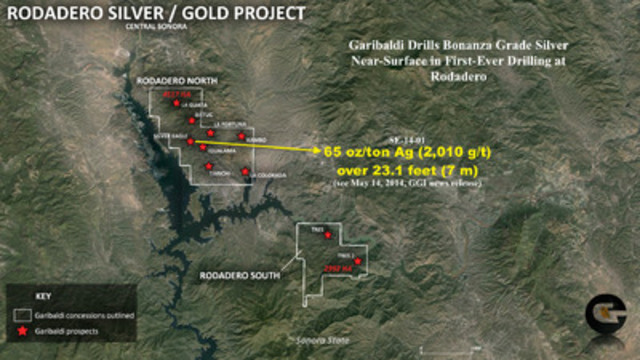
VANCOUVER, May 14, 2014 /CNW/ – Garibaldi Resources Corp. (TSX.V: GGI) (the “Company” or “Garibaldi”) is pleased to report that it has intersected exceptionally high silver grades within 30 meters of surface in first-ever drilling at the Company’s 45 sq. km Rodadero North Project in central Sonora State, Mexico. A second drill hole has started.

Highlights:

  • First hole at Silver Eagle target (SE-14-01) returned 2,010 g/t Ag (65 oz/ton) over 7 meters (23.1 feet) including 3 meters (9.9 feet) grading 4,565 g/t Ag (147 oz/ton);
  • A 50-meter step-out hole to the south of SE-14-01 has commenced;
  • Garibaldi’s exploration team has identified 7 high-priority targets in addition to Silver Eagle at Rodadero North – data compilation and regional work continues.

Steve Regoci, Garibaldi President and CEO, commented: “We’re excited with these initial drill results at Rodadero where we have made very effective use of hyperspectral remote sensing technology to outline a broad area of prospective targets. Given these numbers from Rodadero, and our recent solid drill results at La Patilla, we are moving at an accelerated pace in Mexico. In northwest British Columbia, we are extremely encouraged by the near-term discovery potential of our flagship Grizzly Project that covers more than half of the Sheslay Cu-Au porphyry district mineralized corridor. Garibaldi is uniquely positioned in two friendly jurisdictions to build shareholder value.”

Silver Eagle Target, Rodadero North

The first hole at Silver Eagle, drilled with Garibaldi’s company-owned rig, was designed to follow up on surface sampling along a silicified zone. DDH SE-14-01 intersected a strongly mineralized 7-meter zone.

Significant assay results, DDH SE-14-01:

Hole From (m) To (m) Width (m) Ag (g/t) Ag (oz/t) Au (g/t)
SE-14-1 19.5 26.5 7.0 2,010 65 0.42
includes 21.5 24.5 3.0 4,565 147 0.94
includes 21.5 22.5 1.0 7,633 245 1.5

At the present time, the geometry of the mineralized system is not known and true width for the drill intercepts remains to be determined. The widths given are downhole core lengths. The cut-off for the 7-meter intercept is 20 g/t Ag. The hole was drilled to a length of 100 meters.

The Silver Eagle target is an apparently flat lying silicified body that alters the upper parts of a conglomerate unit that overlies andesitic volcanic rocks. The silicified body is cut by several silver-bearing fractured zones that may reflect feeders to the silicified ‘cap’.

“We eagerly anticipate results from this next hole at Silver Eagle,” added Regoci. “In Mexico we’re also preparing for follow-up drilling at La Patilla and initial drilling at Iris. We have low exploration and drilling costs in Mexico, and these are also partly offset by continued royalty income from our pilot coal program at the Tonichi Project.”

Rodadero North & Rodadero South Target Areas

The Rodadero region hosts multiple precious metal occurrences over several tens of kilometers. Garibaldi has identified seven other targets at Rodadero North – Rambo, La Guata, Batuc, La Fortuna, La Colorada, Tarichi and Igualama – through mapping, sampling and the use of the Company’s proprietary hyperspectral database. To date, two targets have also been outlined at Rodadero South, where less exploration has been carried out, approximately five kilometers southeast of Rodadero North. A map showing the two project areas and targets is attached with this release and will be posted at www.GaribaldiResources.com in the Mexico “Projects” section under “Rodadero”. Alamos Gold’s Mulatos mine and Agnico Eagle’s La India mine are approximately 90 kilometers to the southeast.

Live Webinar and Corporate Video

Garibaldi will be conducting a live investor Webinar Wednesday, May 21, beginning at 1:15 p.m. Pacific (4:15 pm Eastern) through MarketSmart Communications Inc., official investor relations for Garibaldi. Log-in instructions for this presentation can be found on the Garibaldi homepage (www.GaribaldiResources.com).

Garibaldi is also pleased to announce the release of an updated short corporate presentation (video). You can view the video by going to the following web site URL:

http://www.garibaldiresources.com/s/Media.asp#video

Quality Assurance & Control

Garibaldi maintains strict QA-QC protocols for all aspects of its exploration programs that include the systematic insertion of blanks and standards into each sample batch. Acme Labs (now part of the Bureau Veritis group that includes BSI Inspectorate) performed assay analyses on core reported in this release, and ALS Global (formerly ALS Chemex) performed analyses on rock samples. All samples were assayed using certified and industry standard assay techniques for gold and multi-element packages and for over-limits. Au was analyzed by 30 or 50 gram fire assay with an atomic absorption finish, and other elements were analyzed by multi-element ICP. Samples in excess of 1,500 g/t Ag were analyzed by gravimetric methods.

Qualified Person

Dr. Craig Gibson, Certified Professional Geologist and a director of Garibaldi, is a non-arms length Qualified Person for the Company’s Mexico projects and the direct manager of the technical programs operated under contract by Prospeccion Y Desorrollo Minera del Norte (ProDeMin). Dr. Gibson has reviewed this news release and approved the content thereof.

About Garibaldi

Garibaldi Resources Corp. is an active Canadian-based junior exploration company focused on creating shareholder value through discoveries and strategic development of its assets in some of the most prolific mining regions in Mexico and British Columbia.

We seek safe harbor.

GARIBALDI RESOURCES CORP.

Per: “Steve Regoci”
Steve Regoci, President

Neither the TSX Venture Exchange nor its Regulation Services Provider accepts responsibility for the adequacy or the accuracy of this release.

SOURCE Garibaldi Resources Corp.

Image with caption: “Garibaldi drills bonanza grade silver near-surface at Silver Eagle target, Rodadero (CNW Group/Garibaldi Resources Corp.)”. Image available at: http://photos.newswire.ca/images/download/20140514_C8286_PHOTO_EN_40292.jpg

GARIBALDI RESOURCES CORP.
1150 – 409 Granville Street
Vancouver, BC V6C 1T2
Telephone: (604) 488-8851
Website: www.GaribaldiResources.com

Pot Firms Gain as CVS, Walgreen Competition a Pipe Dream

Posted by AGORACOM-JC at 2:13 PM on Tuesday, May 13th, 2014
By Shannon Pettypiece and Sonali Basak May 13, 2014 12:01 AM ET

Photographer: Kathryn Scott Osler/The Denver Post via Getty Images

Kayvan Khalatbari, has poured $500,000 into pot production and $150,000 into a store, started in the industry by delivering medical marijuana door to door. This year, he expects sales of almost $2 million, which may rise to $5 million once he can also begin selling the drug commercially under Colorado law.

Americans seeking medical marijuana for anything from pain to seizures must turn to a patchwork of small startups for help as U.S. laws keep traditional pharmacies out of a market that may exceed $6 billion by 2019.

While more than 21 states have legalized pot for medicinal use, the drug remains illegal under federal law and banks are hesitant to accept money from its sale. That’s keeping drugstore chains CVS Caremark Corp. (CVS), Walgreen Co. and Rite Aid Corp. (RAD), out of the market, leaving local entrepreneurs in control.

“We aren’t going to see a big guy enter this market within the next few years,” said David Yang, an analyst with research firm IBISWorld. “There are just too many regulations and too many elements that make this impossible for them.”

In one state alone, Colorado, more than 400 companies are licensed as medical marijuana centers, with government officials predicting sales there could soon reach $1 billion. For Colorado businessman Kayvan Khalatbari, a former electrical engineer who started his business with just $4,000, federal limitations on the drug are a major benefit.

Khalatbari, who has poured $500,000 into pot production and $150,000 into a store, started in the industry by delivering medical marijuana door to door. This year, he expects sales of almost $2 million, which may rise to $5 million once he can also begin selling the drug commercially under Colorado law, he said.

“We’re making money, we’re employing people, we’re being a beacon of light for this industry and showing it can be done professionally,” Khalatbari said in a telephone interview. “That to me is a success.”

Federal Law

Traditional pharmacies, meanwhile, face a hurdle that keeps them from competing with entrepreneurs like Khalatbari. Even though almost half of states and the District of Columbia accept the drug’s use for medical purposes, marijuana isn’t deemed legal by the federal government. The drug is classified as a Schedule I controlled substance, defined as having a high potential for abuse with no accepted medical use.

The Legalization of Marijuana

Schedule 1 drugs, which includes heroin, can’t by law be prescribed or dispensed. Pharmacies must register with the U.S. Drug Enforcement Agency to dispense controlled substances, making it illegal for them to sell medical marijuana.

Walgreen, Rite Aid and CVS said in separate statements they have no plans to sell medical marijuana. Doing so, according to CVS spokeswoman Carolyn Castel, would violate the company’s registration with the DEA.

Tax Revenue

That may change if the U.S. Congress sees taxes on the drug as a way to raise money, said Brad Barker, an analyst with Bloomberg Industries in New York.

“The second this is legalized they will start rolling out the marijuana cigarettes the next day,” Barker said. “I think the same thing can be said with everything else. Then you’ll have all the big boys jumping into this space.”

More pharmacies would sell medical marijuana if drug companies created cannabis products that can be approved by federal regulators, like drugs or tobacco products, said Mark Kleiman, a professor of public policy at the University of California at Los Angeles School of Public Affairs.

“It’s not drug stores that have to make these decisions, its pharmaceutical companies that have to decide if they want to make cannabis products,” Kleiman said in a telephone interview. Eventually, that could fuel a “big threat to the medical dispensary business model.”

Existing Products

Existing pharmaceutical cannabis products include Marinol, a prescription pill made with synthetic cannabinoid for uses including treating nausea associated by chemotherapy, sold by AbbVie Inc. (ABBV), and Sativex, a spray form of marijuana produced by GW Pharmaceuticals Plc (GWP), a U.K.-based medical marijuana research and development company. Sativex isn’t available in the U.S.

Shareholders are already investing in publicly traded marijuana companies like GW Pharmaceuticals and Advanced Cannabis Solutions Inc. (CANN), a company that leases growing facilities to licensed growers and dispensaries. Barker said he’s tracking 160 public marijuana companies.

American depositary receipts for GW Pharmaceuticals have increased more than sevenfold in the past 12 months to $69.77, raising the company’s market capitalization to $1.24 billion. Shares of Colorado Springs, Colorado-based Advanced Cannabis Solutions, with a market value of about $210 million, has risen more than ninefold to $15.75.

New Investors

Next Gen Metals Inc. (N), a mineral exploration company, is among the investors preparing to put private capital into marijuana startups.

“You can certainly believe the large industries, the large pharmaceutical companies, that they’re looking into it,” Jay Oness, Next Gen’s chief operating officer, said. “When the time is right, I’m positive they’ll want to be a part of it either through acquisitions or by themselves.”

Until legalization or more products are marketed by pharmaceutical companies, it will be an industry dominated by small dispensaries set up to serve about 1.4 million medical marijuana cardholders using the drug to treat their symptoms.

Three states allow medical marijuana companies to make a profit from the sale of pot. The remaining 18 states that approve of the use of medical marijuana require distribution only by nonprofit organizations and cooperatives, according to the Marijuana Policy Project.

To contact the reporters on this story: Shannon Pettypiece in New York at [email protected]; Sonali Basak in New York at [email protected]

To contact the editors responsible for this story: Reg Gale at [email protected] Andrew Pollack

Source: http://www.bloomberg.com/news/2014-05-13/pot-firms-gain-as-cvs-walgreen-competition-a-pipe-dream.html

Start your small cap medical marijuana research in the AGORACOM Small Cap Medical Marijuana Stocks Gateway
http://agoracom.com/portal/Small%20Cap%20Medical%20Marijuana%20Stocks

KWG Resources Inc.: Black Horse Chromite Resource Now 77.9 Million Tonnes @ 35.3%

Posted by AGORACOM-JC at 10:11 AM on Tuesday, May 13th, 2014

TORONTO, ONTARIO–(May 13, 2014) – KWG Resources Inc. (TSX VENTURE:KWG) (“KWG”) has received from Sibley Basin Group Geological Consulting Services Ltd. an updated geological report and calculation of the resources inferred from drilling data recovered to date from the Black Horse chromite deposit. The report dated May 12, 2014 was authored by Alan Aubut, P. Geo., under the provisions of National Instrument 43-101. The resources inferred therein were additionally informed by three drill intercepts generated during the winter 2014 drilling campaign and by the intercept in hole FNCB-13-031 which was not used in the 2013 calculation due to it being located 50 metres west of the western claim boundary on the adjoining claim of Noront Resources Inc. The report provides in part:

Using the drill hole data available as of May 6, 2014, an Ordinary Kriged block model was created for the Koper Lake Project chromite deposit. The volume modelled is 0.6 km long and has a down dip extent of approximately 1.0 km with the top of the mineral zone as high as 350 metres below surface and has been traced down to a depth of approximately 1400 metres below surface. All of the resources present have a low confidence in the estimate such that they can be classified only as Inferred Resources. The following table provides the identified Inferred Resources using a cut-off of 20% Cr2O3.

  1. CIM Definition Standards were followed for classification of Mineral Resources.
  2. The Mineral Resource estimate uses drill hole data available as of May 6, 2014.
  3. The cut-off of 20% Cr2O3 is the same cut-off used for the Kemi deposit as reported by Alapieti et al. (1989) and for the nearby Big Daddy chromite deposit (Aubut, 2012).
  4. Mineral Resources are not Mineral Reserves and do not have demonstrated economic viability.

Using this 20% cut-off, there are 77.9 million tonnes at a grade of 35.3% Cr2O3 of Inferred Resources. Due to the uncertainly in the estimate and that no mineability and dilution studies have been applied to these resources, they may not all be economically recoverable.

The drill hole spacing is 100 to 300 metres with several off-azimuth holes. To date only 8 holes have tested the mineral zone on the property and most of these intersections are very steep and cut the zone at a very oblique angle. As a result there is poor confidence in the lateral continuity of the mineralization to a degree that all of the defined resources can be classified only as Inferred Resources at this time.

The deposit remains open on strike to the northeast and at depth. The increase in the size of the inferred resource is the result of thickening of the deposit with depth. The true width of the deposit ranges from approximately 100 metres at the southwestern end to about 25 metres in the northeastern half. The southwestern half of the deposit is dominantly layered chromitites while the northeastern half is dominantly massive chromitite. It is recommended that initially, further drilling be done to better define the limits and continuity of the mineralisation in the northeastern half, and secondly by infill drilling. The estimated cost of the initial program is $3.5 million.

Maps and a cross-section can be viewed on the KWG websites: www.kwgresources.com

M.J. (Moe) Lavigne, P.Geo., is the Qualified Person (QP) with respect to this project and has reviewed and approved the related information within this press release. Alan Aubut, P.Geo., author of the 43-101 report, has reviewed and approved the related information within this press release.

About KWG: KWG has a 30% interest in the Big Daddy chromite deposit and the right to earn 80% of the Black Horse chromite where resources are being defined. KWG has also acquired interests in provisional patents including a method for the direct reduction of chromite to metalized iron and chrome using natural gas. KWG also owns 100% of Canada Chrome Corporation which has staked claims and conducted a $15 million surveying and soil testing program for the engineering and construction of a railroad to the Ring of Fire from Exton, Ontario.

Neither TSX Venture Exchange nor its Regulation Services Provider (as that term is defined in the policies of the TSX Venture Exchange) accepts responsibility for the adequacy or accuracy of this release.

Cautionary Note Regarding Forward-Looking Statements: This Press Release contains forward-looking statements that involve risks and uncertainties, which may cause actual results to differ materially from the statements made. When used in this document, the words “may”, “would”, “could”, “will”, “intend”, “plan”, “anticipate”, “believe”, “estimate”, “expect” and similar expressions are intended to identify forward-looking statements. Such statements reflect our current views with respect to future events and are subject to such risks and uncertainties. Many factors could cause our actual results to differ materially from the statements made, including those factors discussed in filings made by us with the Canadian securities regulatory authorities. Should one or more of these risks and uncertainties, such actual results of current exploration programs, the general risks associated with the mining industry, the price of gold and other metals, currency and interest rate fluctuations, increased competition and general economic and market factors, occur or should assumptions underlying the forward looking statements prove incorrect, actual results may vary materially from those described herein as intended, planned, anticipated, or expected. We do not intend and do not assume any obligation to update these forward-looking statements, except as required by law. Shareholders are cautioned not to put undue reliance on such forward-looking statements.

Shares issued and outstanding: 777,512,273

Contact Information

KWG Resources Inc.
Bruce Hodgman
Vice-President
416-642-3575 Ext. 103
[email protected]

KWG Announces Completion of Chromium Intellectual Property Acquisition

Posted by AGORACOM-JC at 8:09 PM on Monday, May 12th, 2014

TORONTO, ONTARIO–(May 12, 2014) – KWG Resources Inc. (TSX VENTURE:KWG) (“KWG”) is pleased to announce the completion of its agreement to acquire fifty-percent of the ownership rights in two United States provisional patent applications relating to the production of chromium iron alloys directly from chromate ore, and the production of low carbon chromium iron alloys directly from chromite concentrates (the “Chromium IP Transaction“) announced on April 21, 2014. The Chromium IP Transaction includes the right to use these provisional patent applications as the basis for filing additional patent applications in the United States, Canada and elsewhere worldwide and includes a fifty-percent interest in any of the vendor’s associated intellectual property (the “Chromium IP”).

The parties’ interests in the Chromium IP will be held through a limited partnership (the “LP“) established by the vendor and KWG for purposes of completing the Chromium IP Transaction and developing and exploiting the Chromium IP. The limited partners of the LP are a wholly-owned subsidiary of KWG and a corporation beneficially owned by the vendor. The general partner of the LP, which will manage the business of the LP, is another wholly-owned subsidiary of KWG.

The vendor assigned its fifty-percent interest in the Chromium IP to the LP in exchange for 25 million units of KWG (each, a “Unit“), with each Unit comprising one common share of KWG and one common share purchase warrant of KWG exercisable at a price of $0.10 for 5 years from closing.

KWG now has the option to acquire a further 25% interest in the Chromium IP from the vendor (held through the LP) in exchange for the issuance of an additional 12.5 million Units to the vendor at any time within one year (the “First Option“). If the First Option is exercised, KWG will have an additional option to acquire the vendor’s remaining 25% interest in the Chromium IP (held through the LP) in exchange for the issuance of a further 12.5 million Units to the vendor at any time within one year after the exercise of the First Option (the “Second Option“), thereby acquiring 100% of the LP.

The closing of the Chromium IP Transaction remains subject to the final acceptance of the TSX Venture Exchange.

About KWG: KWG has a 30% interest in the Big Daddy chromite deposit and the right to earn 80% of the Black Horse chromite where resources are being defined. KWG also owns 100% of Canada Chrome Corporation which has staked claims and conducted a $15 million surveying and soil testing program for the engineering and construction of a railroad to the Ring of Fire from Exton, Ontario.

Neither TSX Venture Exchange nor its Regulation Services Provider (as that term is defined in the policies of the TSX Venture Exchange) accepts responsibility for the adequacy or accuracy of this release.

Cautionary Note Regarding Forward‐Looking Statements: This Press Release contains or refers to “forward-looking information” within the meaning of applicable Canadian securities legislation. Generally, forward-looking information can be identified by the use of forward-looking terminology such as “plans”, “expects”, “is expected”, “budget”, “estimates”, “intends”, “anticipates” or “does not anticipate”, or “believes”, or variations of such words and phrases or statements that certain actions, events or results “may”, “could”, “would”, “might”, “occur” or “be achieved”. All information, other than information regarding historical fact that addresses activities, events or developments that KWG believes, expects or anticipates will or may occur in the future is forward-looking information. Forward-looking information contained in this Press Release is subject to a number of risks and uncertainties that may cause the actual results of KWG to differ materially from those discussed in the forward-looking information, and even if such actual results are realized or substantially realized, there can be no assurance that they will have the expected consequences to, or effects on, KWG. Should one or more of these risks and uncertainties, such as: the actual results of current exploration programs, the general risks associated with the mining industry, adverse changes in commodity prices, currency and interest rate fluctuations, increased competition and general economic and market factors, the risk that the new method of refining chromite ore into ferrochrome by means of natural gas that is the subject of the Chromium IP Transaction does not prove efficient or economical, the scope, likelihood of grant, enforceability, infringement, freedom to operate, and commercial value relating to the patent applications to be used to support the commercialization of the Chromium IP, the grant or approval of a patent on any invention disclosed in the patent applications relating to the commercialization of the Chromium IP, and any expected benefit of commercialization relating thereto occur, or should assumptions underlying the forward looking statements prove incorrect, actual results may vary materially from those described herein as intended, planned, anticipated, or expected. We do not intend and do not assume any obligation to update these forward‐looking statements, except as required by law. Shareholders are cautioned not to put undue reliance on such forward‐looking statements.

Shares issued and outstanding: 752,512,273

Contact Information


KWG Resources Inc.
Bruce Hodgman
Vice-President
416-642-3575 Ext103
[email protected]