Agoracom Blog Home

Posts Tagged ‘#smallcapstocks’

Bolero jumps on graphite trend

Posted by AGORACOM-JC at 4:04 PM on Thursday, May 3rd, 2012

VANCOUVER — Proving there is still healthy demand for new graphite plays, new entrant Bolero Resources‘ share price nearly doubled after announcing it had secured some prospective graphite claims in northern Ontario.

The claims happen to be contiguous to Northern Graphite‘s Bissett Creek claim block, a property that helped propel Northern’s share price from 90¢ in mid-January to an early April peak of $3.72. And not only are Bolero’s roughly 50 km2 of claims contiguous to the 30 km2 Bissett property, but they actually fully surround it.

On news of the announcement Bolero saw 4.3 million shares traded on the Venture as it’s share price doubled from 9¢ to 18¢, and briefly traded as high as 21¢. The company has 38.6 million shares outstanding, or 53.2 million fully diluted.

To secure the property Bolero paid $50,000 on signing the deal and has agreed to pay a further $50,000 and a million shares once the Venture approves the deal. GeoInvest Enterprises, the vendor, also receives a 2% net smelter return royalty and a production royalty equal to $25 per tonne of all graphite mined from the property.

This is by no means the first time Bolero has made the most of a trend or area play.

In December 2009 the company secured an option on 44.5-sq.-km of claims contiguous to Imperial Metals ‘Red Chris project in northern B.C., later adding roughly 13 km2 more. Bolero’s property border sits roughly 5.5 km southwest of the Red Chris East Zone discovery.

After completing preliminary work in 2010 on the property, which Bolero named Red Chris South, the company announced it would be drilling four holes totalling 1,400 metres in 2011 to follow up on two identified anomalies. After announcing the 2011 work plans in early July the company’s share price spiked from around 24¢ to a high of 58¢.

The excitement quickly wore off and the share price dropped back to pre-announcement levels by early August. It was not until early March 2012, however, that the company released results from the program. Of the four holes drilled, three hit no mineralization and a fourth returned a high of 0.0075% Cu and 0.015 g/t Au.

In March 2010 the company also jumped into the rare earth market, entering into an option agreement on 226.6 km2 of claims surrounding Spectrum Mining‘s Wicheeda rare earth discovery in British Columbia. After preliminary survey work in 2010 the company drilled 1,830 metres on the Carbonatite Syndicate property to test anomalies in 2011, but none of the seven holes hit any significant alteration or mineralization, so the company did not assay the holes.

The company plans further geochemical sampling in the region in 2012, while as of the end of 2011 the company had spent roughly $790,000 in acquisition costs and $2.2 million towards deferred development expenditures on the property.

And in September 2010 the company took a go at the Yukon gold rush, acquiring 128 quartz claims covering 26.3 km2 in the White Gold district “in close proximity to recently announced discoveries by Kaminak Gold…and by Underworld Resources.”

2010 work on the White Gold claims consisted primarily of soil sampling, with the highest values found coming in at 0.042 g/t and 0.045 g/t Au. 2011 work concentrated on infill soil sampling and returned a high of 0.121 g/t Au.

Bolero ended 2011 with roughly $857,000 in working capital. The company plans to soon start extensive work on its newly secured graphite project, as well as advance its Red Chris South and Carbonatite Syndicate properties this year.

To read more Northern Miner articles, click here

Source: http://www.canadianminingjournal.com/news/bolero-jumps-on-graphite-trend/1001127495/

Northern Graphite plans to open Ontario mine next year

Posted by AGORACOM-JC at 10:57 AM on Thursday, May 3rd, 2012

If the timeline holds, Northern Graphite’s (TSXV:NGC) Bissett Creek Project will be one of the first graphite mines to open outside China since the 1990s. Bankable feasibility is scheduled for completion later this month, along with a mine closure plan. Assuming the latter is approved by the Ontario government, a year of construction will bring the project to fruition by the end of next year.

“From a mining and metallurgical point of view, the project has pretty well been de-risked,” CEO Gregory Bowes declares. “This thing had a full feasibility study done on it during the 1980s, so we’re effectively doing the second one, and all the results are consistent. So it’s low risk, technically.”

The new feas will bring firmer numbers, but a 2011 PEA projected a capex of $70 million to $80 million for an open pit producing 19,000 tonnes of graphite a year at a cash cost of $1,000 a tonne and a 40-year mine life. To put those figures in perspective, world graphite production is dropping to about one million tonnes a year while flake-graphite prices range from “at least $1,500/tonne at the lower end and $2,500/tonne for higher-end products, with higher purity and larger flake size,” according to an April 17 Industrial Minerals article by graphite authority Simon Moores.


At first glance, Bissett Creek’s in situ grade appears underwhelming. Using a 0.99% cutoff, the September 2011 resource estimate shows 25.98 million tonnes grading 1.81% carbon for 470,300 tonnes graphite indicated, and 55.04 million tonnes grading 1.57% C for 864,100 tonnes graphite inferred.

Bowes maintains, however, that the grade is more than compensated by “the high percentage of large flakes, the high purity, very low strip ratio, good infrastructure and the fact that our project is very scalable. We can increase production three to four times based on the resource we have now.”

He adds, “I think we’re the only graphite company that’s really completed the full suite of metallurgical testing, bulk sampling, pilot plant, all of that stuff and published the results. And I think they confirm that we have the best flake-size distribution in the industry and the highest carbon content of our graphite concentrate, so we will be producing the highest-price, premium-value product.”

Metallurgical tests released April 23 show average flake-size distribution and purity from eight locations on the deposit, including

  • 19.1% of concentrate produced +32-mesh flakes, 98.1% carbon
  • 33% of concentrate +50 mesh, 97% C
  • 23.3% of concentrate +80 mesh, 95.1% C
  • 5.2% of concentrate +100 mesh, 94% C
  • 10.5% of concentrate +200 mesh, 92.7% C

Coarse-flake sizes of +80, +50 and +32 mesh and carbon levels of 94% or better qualify for premium prices, the company states.

As feasibility progresses, the company has been working on a value-added component. Northern announced April 2 the successful manufacture of test quantities of spherical graphite, a product crucial to the battery technology that’s expected to power the future for digital devices and, especially, electric vehicles. “All lithium-ion batteries use spherical graphite, but only some graphite concentrate can be made into spherical graphite,” Bowes explains. Northern’s success led to a strategic cooperation agreement with Panacis Inc, a supplier of li-ion batteries to military, telecom, medical and renewable energy sectors.

Advertisement

In February, Northern struck a cooperation agreement with Grafen Chemical Industries for graphene research. By supplying Grafen with +48-mesh and +32-mesh jumbo flake, Northern gets a 50% interest in North American patent rights to any products or processes developed by Grafen. As a graphite derivative, graphene is an R&D wonder that’s rollable, foldable, especially conductive and nearly transparent, despite being 200 times stronger than steel.

Bissett’s southeast Ontario location offers admirable infrastructure. “We are 15 kilometres from the Trans-Canada Highway, between Ottawa and North Bay, so we’re also 15 kilometres from the powerline and the natural gas pipeline,” Bowes reports. “We’re about 50 kilometres from nearby towns, so we don’t have to build a camp. We’re five hours by truck from the Port of Montreal. From there we can ship anywhere in the world. You can drive a transport truck from Toronto to the site in five hours.”

The project remains Northern’s sole interest. “Bissett Creek has enough resources that we can expand production three to four times in the future, if the demand is there. So why fiddle around with something else?”

A geologist, Bowes was Senior VP at Orezone Gold Corp (TSX:ORE), VP Corporate Development and later CFO for its predecessor, Orezone Resources, and President/CEO of San Anton Resource Corp. He’s also a director of Industrial Minerals Inc, the company that spawned Northern in the earliest days of the graphite exploration rush.

Among his colleagues is Northern President Don Baxter, who joined the company after five years as President of Ontario Graphite, which plans to reopen the Kearney Graphite Mine. Baxter worked there as Mine Superintendent and Chief Mine Engineer from 1990 to 1995. His background also includes stints with Inco and Noranda.

Technical Adviser George Hawley is a 40-year specialist in research, product development and market analysis for the industrial minerals sector.

Bowes will present a talk at OnPage Media’s May 2 Graphite Express-Conference in Toronto. “We are the leading graphite public story out there by a wide margin,” he says. “This is a supply-demand price story. The mine is very economic at current prices, and we believe the situation in China is going to get worse. So we think the outlook for prices is very positive.”

At press time, Northern Graphite had 46.4 million shares trading at $2.36 for a market cap of $109.5 million.

Disclaimer: Northern Graphite Corp is a client of OnPage Media, and the principals of OnPage Media may hold shares in Northern Graphite.

Read more articles like this at resourceclips.com.

All information on this website is: (a) for informational purposes only; (b) not to be used or construed as an offer to sell, a solicitation of an offer to buy, or an endorsement, recommendation, investment advice or sponsorship of any entity or security; and (c) not necessarily reflective of the views or policy of the Financial Post. Prior to making any investment decision, it is strongly recommended that you seek advice from a qualified investment advisor. The Financial Post does not provide or guarantee any financial, legal, tax or accounting advice or advice regarding the suitability, profitability, or potential value of any particular investment, security or information source, especially as it relates to mining companies. For further details, please Section 22 of http://www2.canada.com/aboutus/termsofservice.html.

Source: http://business.financialpost.com/2012/05/02/northern-graphite-plans-to-open-ontario-mine-next-year/

Pacific North West Capital Announces 2.5 million ounces PGM+Gold Measured and Indicated Resources for its 100% Owned River Valley Project

Posted by AGORACOM-JC at 9:00 AM on Tuesday, May 1st, 2012


                                                                    PFN: TSX


Pacific North West Capital Announces 2.5 million ounces PGM+Gold Measured and Indicated Resources for its 100% Owned River Valley Project, Sudbury, Ontario

Pacific North West Capital Corp. (TSX: PFN; OTCQX: PAWEF; Frankfurt: P7J) announced that the estimated NI43-101 compliant Measured and Indicated mineral resources at a cut-off grade of 0.80 g/t PdEq have increased by >400% from the previous NI43-101 compliant mineral resource estimate (May 2006) to 91,339,500 tonnes grading 0.84 g/t Pd+Pt+Au, 0.06% copper, and 0.02% nickel. The compliant Inferred mineral resources have increased by >1000% to 35,911,000 Mt grading 0.53 g/t Pd+Pt+Au, 0.06% copper, and 0.03% nickel. The River Valley PGM Project is located 100 km from the world-renown Sudbury Ni-Cu-PGM Mining Camp, has excellent infrastructure support, and is 100% owned by PFN.

Highlights:

  • River Valley Measured + Indicated resources: 91 million tonnes @ 0.58 g/t* palladium, 0.22 g/t platinum, 0.04 g/t gold at a cut-off grade of 0.8 g/t PdEq** for 2,463,000 ounces PGM*** plus gold
  • River Valley Inferred resources: 36 million tonnes @ 0.36 g/t palladium, 0.14 g/t platinum, 0.03 g/t gold at a cut-off grade of 0.8 g/t PdEq for 614,000 ounces PGM plus gold
  • On a PdEq basis, the Measured + Indicated resources contain 3,944,000 ounces PdEq and the Inferred resources contain 1,201,000 ounces PdEq
  • River Valley PGM-copper-nickel sulphide mineralized zones remain open to expansion with continued exploration

Dr. William Stone, President & COO, comments, “The large increase in the estimated mineral resources confirms that River Valley is one of the largest undeveloped primary PGM Projects in North America. The strategy of including all the mineralized zones and the full value of the metal suite in the mineral resource estimation produced a very positive result. It greatly increases PFN’s confidence in River Valley as the project is advanced toward a Preliminary Economic Assessment Study. The Company plans to further expand the PGM resources and to discover new resources with more drilling at the River Valley Project and its adjacent properties.

About Pacific North West Capital Corp

PFN is a mineral exploration company whose philosophy is to be a project generator, explorer and project operator in order to option/joint venture its projects through to production. PFN is focused on the discovery, exploration and development of PGM and nickel-copper sulphide deposits in geologically prospective regions in North America, particularly Canada. The Company’s key asset is its 100% owned River Valley PGM Project in the Sudbury region of northern Ontario. PFN also has PGM and nickel-copper projects and properties in northwest Ontario, Saskatchewan, and Alaska, and an option to joint venture a base metal project in northwestern BC’s Golden Triangle region. The Company continues to evaluate PGM and nickel-copper properties and projects in North America for potential acquisition opportunities.

IR Hub / Corporate Profile / Discussion Forum

Lomiko Metals Interviewed at Venture Capital Radio

Posted by AGORACOM-JC at 8:19 AM on Monday, April 30th, 2012

Lomiko Metals Interviewed at Venture Capital Radio


Watch video ›

Why Invest in Graphite?

  • Global consumption of natural graphite has increased from approximately 600,000 tonnes in 2000 to roughly 1.2 million tonnes in 2011
  • Demand for graphite has been increasing by approximately 5 per cent per year since 2000 due to the continuing modernization of China, India and other emerging economies
  • Graphite also has many important new applications such as lithium-ion batteries, fuel cells, and nuclear and solar power
  • There is roughly 10-20 times more graphite in a lithium-ion battery than there is lithium

Quatre Milles Graphite Property

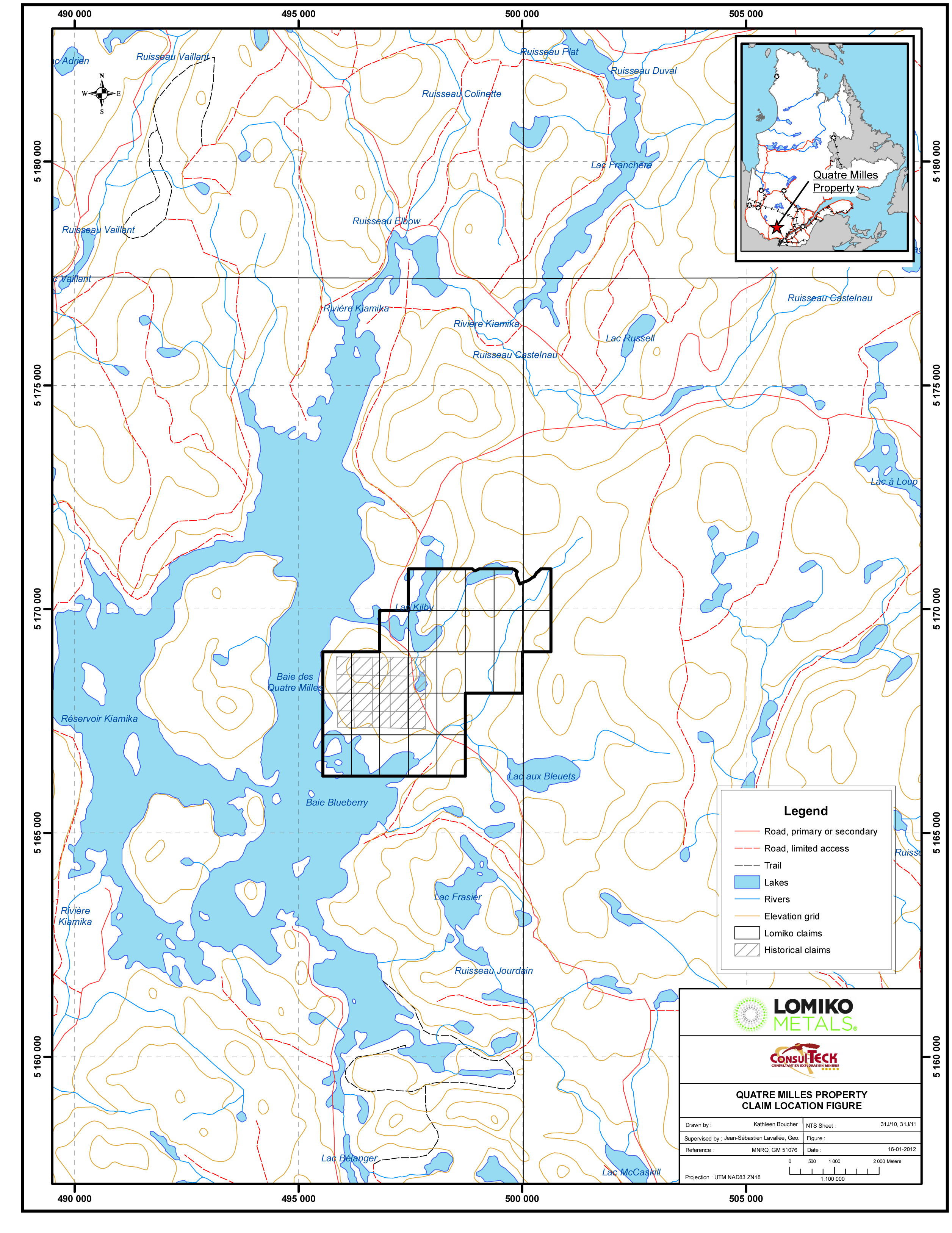
The Quatre Milles Property is road accessible and is located approximately 175 km northwest of Montreal and 17 km due north of the village of Sainte-Veronique, Quebec. The property consists of 28 contiguous claims totaling approximately 1,600 hectares.

The property was originally staked and explored by Graphicor Resources Inc. (“Graphicor”) in the summer of 1989 based on the results of a regional helicopter-borne EM survey. The underlying geology consists of intercalated biotite gneiss, biotite feldspar gneiss, marble, quartzite and calc-silicate lithologies of the Central Metasedimentary Belt of the Grenville Province.

Historical Highlights

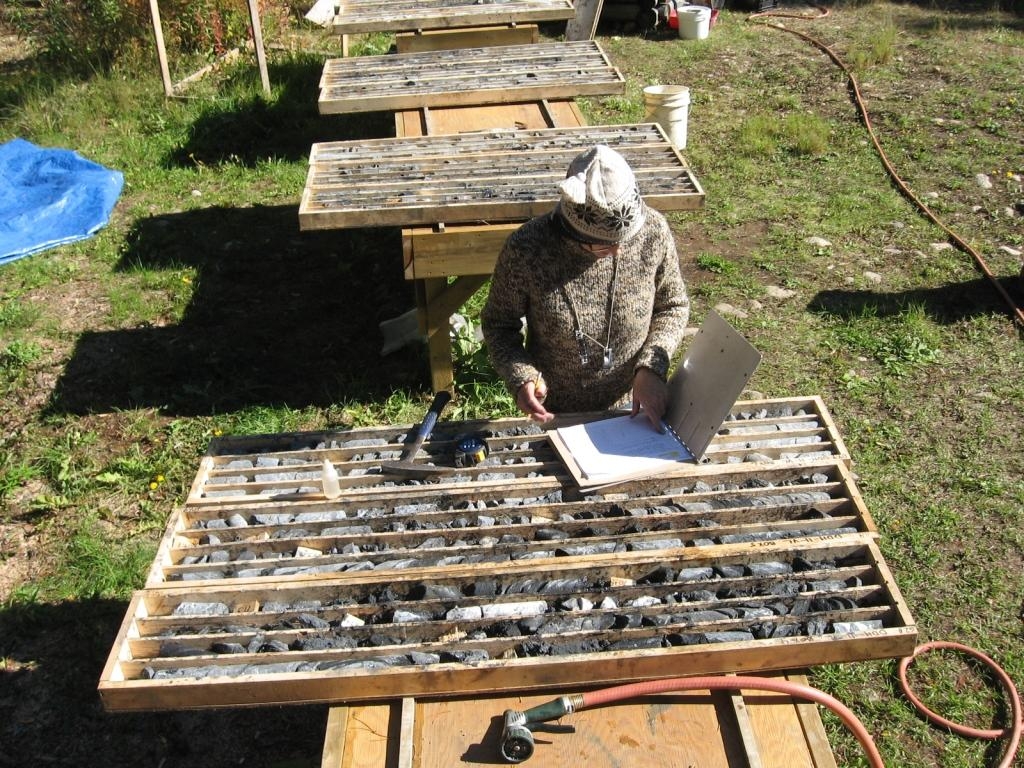
Graphicor completed reconnaissance mapping and prospecting as well as ground geophysics and a 26 hole diamond drill program totaling 1,625 metres. The work identified several conductive trends in the central portion of the property and at least three, relatively flat lying graphitic beds. Three surface samples were collected and analyzed returning results of 14.16% Cgf, 18.06% Cgf and 20.35% Cgf. 23 of the initial 26 drill holes intersected graphite concentrations with graphite concentration in range of 4.69% in hole Q90-1 to a highlight of 8.07% Cgf over 28.60 metres in hole Q90-7. The highest individual assay was reported in hole Q90-10 reporting 15.48% Cgf over 0.50 metres.

The Company cautions that it has not had the chance to verify the quality and accuracy of the historic sampling and drilling results reported in this news release which predate the introduction of NI 43-101 and cautions readers not to rely upon them. The historic figures were generated from sources believed to be reliable, however, they have not been confirmed. Although the sampling and drilling results are relevant, they have not been verified.

Graphicor geologists commented that the results of the initial drill program were extremely encouraging and recommended additional detailed drilling to properly understand and evaluate the potential of the propert

Salar de Aguas Caliente Lithium Brine Property

Lomiko Metals Inc. announced June 22, 2009 that it has purchased 100% of 8 pedimentos (claims) making up 1900 Ha of the Chilean Salt Lake known as Salar de Aguas Calientes. The Company now owns eight (8) of nine (9) claims that make up the Salar. One (1) claim of 400 Ha is currently owned by Sociedad Quimica y Minera de Chile S.A. (NYSE: SQM), the primary producer of Lithium in the region.

  • – The Claims are in an excellent location adjacent to a main paved highway.
  • – The Salar has significant surface brines known to contain Lithium, Sulfate and Potash
  • – The brines located on Lomiko claims were staked because of their excellent porosity and transmissivity *, which is required for economic extraction.
  • – The claims purchased surround a mining concession held by Sociedad Química y Minera de Chile S.A. (NYSE: SQM) at Lomiko’s Salar de Aguas Calientes.
  • – Producers such as SQM are searching for new sources of Lithium to meet or increase production requirements to meet current and anticipated market demand
  • – The claims are within 70 km of the SQM production facility located at Salar de Atacama.
  • – The potential for partnership exists with SQM, the leading producer in the region.
  • – The current market for Lithium Ion batteries is anticipated to grow 25% per year.
  • – The introduction of the electric car powered by Lithium Ion batteries will require new development of high grade Lithium Deposits to meet additional demand.
  • – The ‘Lithium Triangle’ located at the borders of Chile, Argentina and Bolivia contains 70% of the world’s economic Lithium deposits.
  • – Forbes Magazine referred to the region as the “Saudi Arabia of Lithium”.

The Vines Lake Property – Exploration Opportunity

Lomiko Metals Inc. holds the rights to 5,403 Ha located in the south western corner of the Cassiar Gold District or ‘Cassiar Gold Camp’ as it is often referred in the Liard Mining District, NTS 104P, (Figure 4.2). The Vines Lake property’s northern boundary crosses Hwy 37N 7 kilometers south of the unincorporated settlement of Jade City. Highway 37 N bisects the property north to south.

Lomiko Hub / Corporate Website

Strike Graphite Executes on Plan to be Among First to Large-Flake Graphite Resource – Drills Turning at 25km-long Conductor

Posted by AGORACOM-JC at 4:00 PM on Friday, April 27th, 2012

Strike Graphite Corp. (TSX-V: SRK) (Pink Sheets: SRKZF) (Frankfurt: QSG) this week announced drill mobilization at its Simon Lake graphite property in Saskatchewan, Canada. SRK.V also announced the appointment of two experienced and highly accomplished graphite mining experts to its advisory board. These developments are consistent with the focus of SRK.V to be among first in the sector to establish a quality large-flake graphite resource. Strike Graphite has three projects of significance with plans to drill to resource this 2012 the top prospect evidencing grade, flake distribution, purity, and tonnage. The initial drilling at Simon Lake, which began this week, will total ~2,500 to 3,500 m within ten holes. The Simon Lake graphite property holds world-class potential with a 25 km long electromagnetic conductor indicative of graphite and historic drilling having intersected course grain graphite, showing large-flake with visual estimates of up to 70+% graphite.

Strike Graphite Corp. appears to present an exceptional risk-reward scenario; trading at ~36 cents per share (current market cap ~$14M) SRK.V is poised for significant near-term upward share price revaluation with numerous potential intrinsic value adding catalysts in the pipeline and a tight share structure (under 40M shares outstanding) that is apt to see the share price deservedly rise on bullish news. SRK.V is well funded to accomplish its goals having secured ~$3,000,000.00 in funding.

A full review of Strike Graphite Corp. is available at http://www.miningmarketwatch.net/srk.htm online.

With the projected demand growth for various emerging technologies reliant upon large-flake graphite (i.e. next-gen nuclear power, fuel cells, and lithium-ion batteries) responsible for experts projecting 1 – 2 million tonne supply deficit of large-flake graphite over the next decade (necessitating the opening of 100+ new 20,000 Tonnes Per Year mines) investors seeking exposure to the large-flake graphite sector would do well to consider the exceptional opportunity afforded shareholders of SRK.V as it advances three graphite projects, two in Saskatchewan and one in Quebec. Strike Graphite has plans to achieve substantial resource at both of its Saskatchewan properties near-term. Added comfort for investors seeking exposure to the large-flake graphite sector (NOT to be confused with regular amorphous graphite) can be taken in the knowledge that, unlike other supply-critical resources, there exists NO ability for the market to be dominated, over supplied, or held hostage by multinationals or any country. The fact is that if large-flake graphite demand meets the estimates industry experts are forecasting there will need to be several new mines opening every year and the industrial market will readily be in a position to absorb the new supply. Industrial users of large-flake graphite are now keenly interested in securing proprietary sources and thus it is the focused goal of Strike Graphite to achieve a substantial large-flake graphite resource within 2012.

This release may contain forward-looking statements regarding future events that involve risk and uncertainties. Readers are cautioned that these forward-looking statements are only predictions and may differ materially from actual events or results. Articles, excerpts, commentary and reviews herein are for information purposes and are not solicitations to buy or sell any of the securities mentioned. Readers are referred to the terms of use, disclaimer and disclosure sections located at the above referenced URL.

Contact Information:
Brian Watkins, Associate Editor
Mining MarketWatch Journal
[email protected]

Source: http://app.quotemedia.com/quotetools/newsStoryPopup.go?storyId=50767948&cp=off&webmasterId=101442

Why Graphite is the High Tech Commodity of the Future

Posted by AGORACOM-JC at 8:45 AM on Friday, April 27th, 2012

by Dr. Alex Cowie on 27 April 2012

The high profile hedge fund manager, Jim Chanos, reckons Australia’s biggest money earner – iron ore – will fall from $140 per tonne to $100 per tonne.

To profit from this, his fund Kynikos – Greek for cynical – is short-selling Fortescue (ASX: FMG). Not that hedge funds are any sort of all-seeing oracles. Plenty of them get it wrong. Last year the average hedge fund lost 9%.

Although, looking at serious delays to the world’s new big iron ore projects, I reckon it’s hard to see iron ore prices falling that far. Where I agree with Chanos is that it’s hard to see iron ore prices rising much from here.

But forget iron ore for a minute.


This is a commodity that drove the last bull market and made Australian investors rich. But it won’t be the commodity that drives the NEXT bull market.

In fact, it’s getting harder for Aussie resource investors to find new areas of the market to make money from. Mainstream commodities are well known, and often the easy money has been made already.

The good news I want to bring to you is that there is a new generation of investing opportunities in the world of strategic minerals.

A New Story
The commodities story is changing. It’s still driven by the rise of the emerging markets, especially China and India. But Asia’s long-term future commodity demand isn’t just about skyscrapers and infrastructure.

It’s also about developing cleaner transportation, more efficient nuclear power, and new power sources. China’s economy is evolving. The whole growth story of the developing world is evolving. The mineral I want to tell you about today is playing a pivotal role in this evolutionary leap forward.

Welcome to the world of strategic mineral investing.

But you may be wondering, what do I mean by “strategic minerals”?

It’s simple. Strategic minerals usually face supply restrictions, and are integral to the national defense, aerospace or energy industries.

The commodity I’m talking about fits the bill as a ‘strategic mineral.’ Over 80% of supply comes from just one country. It is essential to the energy sector – in the form of batteries. And it’s not all about batteries either. It is also essential for modern nuclear reactors, fuel cells, and the evolution of electronics.

This is what I call a ‘high tech commodity’. It’s where you’ll find the commodity bull markets of the future.

Beyond Pencils
I’m talking about FLAKE GRAPHITE.

The word graphite may make you think of pencils. But the reality is very different!

With new technologies creating new levels of demand, and little flake graphite being available, this strategic mineral has a big future.

Graphite is a form of carbon with unique properties. It is like a diamond in two dimensions.

It’s important I make the point upfront that most of the world’s graphite is ‘amorphous’. This is used mostly for equipment in the steelmaking industry, and may as well be a different commodity to flake graphite.

Comparing amorphous graphite to flake graphite – is a bit like comparing thermal coal to coking coal.

The rarer, high-quality type of graphite to invest in is ‘FLAKE’ graphite.

Flake graphite production levels are just 400,000 tonnes a year. Analysts at Investment Bank, Canaccord, report that demand from lithium-ion battery manufacturers is increasing at 20% a year.

And you can see why. Uptake has been slow thus far, but the US still plans to put 250,000 electric cars on its roads each year by 2015. China wants to put a million electric cars on Chinese roads each year in the same period. With 50 kg of graphite going into the battery of each electric car, the market will need to find an extra 250,000 tonnes of flake graphite to keep up with this demand alone.

But it’s not just electric cars that have batteries…

The battery in your mobile phone contains graphite as well.

They may be much smaller than a car battery – but according to the International Telecommunication Union, out of a population of 7 billion people alive today there are 5.9 billion mobile phones in use around the world. That’s an incredible statistic. And by 2015, they reckon there will be MORE mobile phones in use than there are people on the planet.

In fact, any heavy-use electric gadget will have a graphite-filled battery. Electric cars mobile phones, your laptop computer, cordless drills, and electric toothbrushes….all these devices significantly increase the demand for flake graphite.

Based on this increased demand, the price of high quality flake graphite soared from US$1000 to $3000 a tonne in the last five years.

I’m convinced it has plenty more to run. Battery makers are not the only ones queuing up for flake graphite.

A new generation of nuclear reactors called ‘pebble-bed nuclear reactors’ use large amounts of flake graphite.

The reactors get their name from the pebble-sized spheres of graphite mixed with uranium they contain. This structure allows pebble bed reactors to produce power more efficiently – and safely – than conventional reactors. This technology means nuclear reactors can be smaller, and as easy to run as turning a switch.

Graphite demand from pebble bed reactors alone could be greater than current annual production by the end of this decade.

Electric batteries and pebble-bed nuclear reactors are two current technologies driving demand. In my view, these two applications alone are enough to justify a bullish long-term outlook. But “high tech” commodities are rapidly evolving. And more markets (with more demand for flake graphite) are already developing.

The Future of Graphite – Fuel Cells and ‘Graphene’
But the real future of graphite may lie in fuel cells.

According to the United States Geological Survey, fuel cells could create more demand for flake graphite than all other applications combined.

A fuel cell is like a large battery that produces power through chemical processes. You need to ‘refuel’ it from time to time. This fuel contains graphite.

This is not science-fiction. Fuel cells are already used to power phones, vehicles, and provide back-up power for buildings such as hospitals. Toyota plans full-scale commercial production of fuel cells within three years.

If fuel cells are the next source of demand for graphite, then graphene is the ‘blue sky’ for demand.

Graphene is a one-molecule-thick sheet of graphite.

The carbon molecules line up in hexagons. Close up it would look like chicken wire. It is stronger than diamond, is more elastic than silk, and conforms to any shape. It conducts electricity at the speed of light, and can transmit 1000 times the electric current than copper. This amazing material is quite new to science, and we are still working out its potential applications.


Click here to enlarge

IBM has already used graphene to produce the fastest computer chip in history. The US Air force and Navy are funding research to investigate its potential. Graphene chips may displace silicon chips in computers. If this happens, then graphite demand would go through the roof.

IBM are not the only ones researching it. Intel, the world’s biggest microchip manufacturer, is also investigating its potential uses, along with at least 200 other industrial companies.

Graphene production doesn’t generate any real graphite demand yet. This is still at the research and development stage. It’s worth mentioning here, because if scientists are even half-right, graphene could change the world we know it, and the price of graphite will soar.

Where’s the graphite going to come from?

The graphite price looks good to keep rising. Demand continues to rise, and there is very little flake graphite production coming on line.

The only new project of any size that could be in production soon is the Almenara graphite project run by Magnesita (unlisted) in Brazil. This could produce 40,000 tonnes of graphite a year, increasing global production by just 10%. Production is still at least a couple of years away.

With so little new production queued up, and new projects taking around five years to bring to production, it is hard to see how demand will be met. Analysts at a Canadian investment bank, Canaccord, reckon that demand for flake graphite will increase six-fold by the end of this decade. This paints a very bullish picture for flake graphite prices. A six-fold increase to demand without any significant increase in supply should send prices one way: UP.

Analyst predictions aren’t any kind of guarantee this will actually happen, of course. I think what is probably more important is just how strategically important graphite is: particularly graphite deposits based outside of China.

Whether it is used for batteries, nuclear reactors, fuel cells, or even graphene – the point is that graphite is essential for a group of new and developing technologies.

This makes it a commodity that important groups will want to control… and that makes it a great investment opportunity.

This story has just started on the Australian market. It has the same hallmarks that the rare earths stock boom had back in 2009. Investors that got into that at the start made spectacular returns.

The time to look at graphite is now.

Dr. Alex Cowie
Editor, Diggers & Drillers

The Conference of the Year “After America” DVD

Why You MUST Speculate

Disruptive Technology Stocks For Smart Small-Cap Investors

Source: http://www.moneymorning.com.au/20120427/why-graphite-is-the-high-tech-commodity-of-the-future.html

Strike Announces Appointments to Advisory Board

Posted by AGORACOM-JC at 8:12 AM on Thursday, April 26th, 2012

VANCOUVER, BRITISH COLUMBIA–(April 26, 2012) – Strike Graphite Corp. (TSX VENTURE:SRK) (the “Company” or “Strike“) is pleased to announce the following appointments to its Advisory Board:

Jerry Janik (Ontario)

Mr. Janik has over 20 years’ experience in the mining industry. He has extensive experience in quality control, mine planning/tailings deposition, production, project management, process improvement, and permitting and new product development. Mr. Janik holds dual diplomas in geology and mineral processing from Sir Sandford Fleming College School of Natural Resources in Peterborough, Ontario.

Most recently, Mr. Janik has been fulfilling the role as General Manager for Ontario Graphite’s mine in Kearney, Ontario, where after 16 years under care and maintenance, he is overseeing an operational plan that contemplates re-commissioning the mine. Production is expected to resume by the fall of 2012 with an aim of producing 20,000 tonnes annually of natural large flake high carbon graphite concentrate at >95% Cg in 4 different size ranges.

Ontario Graphite (a private company) has a confirmed mineral resource of 43.5 million tonnes measured and indicated (2.34% Cg average, Jan. 2010). Ontario Graphite’s Kearney Mine has the largest confirmed mineral resource of any North American graphite prospect and is one of the largest individual deposits outside of China and North Korea.

Jody Dahrouge – B.Sc., Sp.C., P.Geo. (Edmonton)

Mr. Dahrouge contributes over 20 years of leadership experience with mineral exploration and resource development projects worldwide. He has served as senior executive officer, director and/or geologist with a number of publicly traded companies, including Pacific Potash Corporation, Commerce Resources Corp., Quantum Rare Earth Developments Corp., Fission Energy Corp. and Equitas Resources Corp. Mr. Dahrouge is a member of the Association of Professional Engineers, Geologists and Geophysicists of Alberta and British Columbia.

Geoff Balderson, President of Strike, remarks, “As stated previously, the Company is committed to assembling a first-class executive and management team in the graphite space. Mr. Daroughe and Mr. Janik both have a wealth of experience. Their addition further demonstrates the Company’s commitment to achieving its objectives and rapidly maturing its graphite assets for the benefit of all shareholders.”

About the Company:

Strike Graphite Corp. is a progressive exploration company with seasoned management targeting strategic assets on a global scale. In addition to the Deep Bay East and Simon Lake graphite properties, the Company is also actively advancing its Wagon Graphite property in Quebec next to the Timcal Graphite mine. The Company also continues to advance the Satterly Lake gold project in north western Ontario, located just west of Gold Canyon Resources Inc.

On behalf of the Board of Directors,

Geoff Balderson, President

For more information on the above, or to view the Company’s corporate presentation on its graphite assets and opportunity, please visit the Company’s website at www.strikegraphite.com.

We seek safe harbor.

Contact Information


Strike Graphite Corp.
Geoff Balderson
President
604.669.9330 or Toll Free: 1.866.669.9337
604.669.9335 (FAX)
[email protected]
www.strikegraphite.com

GRAPHITE: The Driving Force Behind Green Technology

Posted by AGORACOM-JC at 9:44 AM on Wednesday, April 25th, 2012

GRAPHITE: The Driving Force Behind Green Technology

                                      click on image below

Logan Copper acquires graphite property

Posted by AGORACOM-JC at 9:30 AM on Wednesday, April 25th, 2012

DELTA, BC, April 25, 2012 – Logan Copper Inc. (the “Company”, “Logan Copper”, “LC”), (TSX.V: LC) is pleased to announce the acquisition of a 3,266 acre graphite property located near the town of Mayo, Quebec, Canada.

LC’s property, the “Mayo Graphite Property”, is located some 35 kilometres northeast of Ottawa, Ontario and 130 kilometres west of Montreal, Quebec, with excellent infrastructure. The property is 100% owned by Logan Copper Inc. with no net smelter royalty attached.

Summary: Mayo Graphite Project

  • Over 3,266 acres of land (13 sq km)
  • Known graphite occurrences in area
  • A historical Aeromagnetic survey completed over the entire property
  • Near major roads and good infrastructure

The Mayo Graphite Property is located 80 kilometres south of the producing Stratmin Graphite Mine. This mine has been producing natural flake graphite since 1988.

The past producing Bell Graphite mine is located 4 kilometres south of LC’s property. Historical records show this mine produced 6,700 tonnes of Graphite from 1906-1912.

Logan Copper is currently compiling all the historical geological data to prepare for an upcoming exploration program (s) on the Mayo Graphite property. Further announcements will be made once the geological / exploration team completes the review of the historical data.

About Graphite

Natural Graphite is an excellent conductor of heat and electricity. Graphite also has the highest natural strength and stiffness of any material. There are myriad of uses such as in brake linings, steelmaking, batteries, lubricants, and reinforcement of plastics.

The commodity price of natural flake Graphite has steadily increased to over $1,170 per tonne from $694 per tonne in 2009. Industrial demand for graphite is growing at approximately 5 per cent annually.

Of the 1.1 million tonnes of worldwide graphite production, 800,000 tons (73%) comes from China. The government of China has imposed an export duty of 20% plus an additional 17% value added tax on exports of graphite to ensure that they have sufficient supplies for domestic use. Demand for graphite continues to grow rapidly through increased use in ion batteries, carbon fibre reinforced plastics, and carbon alloyed metals. Furthermore, additional demand is expected from use in fuel cells and the construction of pebble bed nuclear reactors.

Some examples of uses of graphite are:

  1. An average fuel cell vehicle will use 80 kilograms of graphite.
  2. An electric car will require 25-50 Kilograms of graphite,
  3. Pebble Bed Nuclear Reactors require “3,000 tonnes of graphite at start-up and 600 to 1,000 tonnes per year”.

China has one operating prototype of a Pebble Bed Nuclear Reactor and has firm plans to build 30 more by 2020. Researchers at West Virginia University estimate that “500 new 100 GW pebble reactors will be installed in the US by 2020 with an estimated graphite requirement of 400,000 tonnes” (annually).

“We seek safe harbor”

SKYPE INTERVIEW: Bob Kasner Discusses Past Producing Open Pit Omega Project

Posted by AGORACOM-JC at 5:17 PM on Tuesday, April 24th, 2012

The Omega Gold Property is located in Larder Lake, Ontario approximately 18 miles east of Kirkland Lake, and 4 miles west of Kerr Addison a former mine that produced in excess of 10 million ounces of gold. The Omega Property and Kerr Addison both are situated on the Larder Lake Cadillac fault system. This system has produced over 40 million ounces of gold just in the Kirkland/Larder Lake area and is still a productive wealthy mining camp.

Drilling highlights

·OM-12-67:1.787 g/t gold over 16 metres (including 2 metres of 5.84 g/t gold)

·OM-12-69:2.687 g/t gold over 12 metres (including 8 metres of 3.706 g/t gold)

·OM-12-70:0.997 g/t gold over 54 metres (including 10 metres of 2.421 g/t gold: Open Pit)