Posted by AGORACOM-JC
at 2:33 PM on Monday, March 18th, 2019
SPONSOR: Good Life Networks (GOOD:TSX-V)
Video advertising is the future! Company’s A.I. makes 80,000
calculations / second, targeting 750 million users to deliver higher
prices and volume. Company announced combined trailing 12 month revenue
at just over $40 Million, $7.9M EBITDA, $3 Million net income. Click here for more information.
GOOD: TSX-V
—————————
Three trends shaping programmatic advertising in 2019
Programmatic customisation is now common practice, allowing teams to
improve performance and provide greater relevancy with personalised
messaging. Vast amounts of data also mean that advertising creative can
dynamically change to be all the more relevant to users, with ads
adapting to factors like location, device, weather, time, and
demographics.
One of the main benefits of the technology behind this is that it
generates a lot of quick feedback, which allows marketers to optimise
creative in real time, and to change what’s in front of consumers’ eyes
at a rapid rate.
Case studies have illustrated the effectiveness of personalisation in
programmatic campaigns. Mindshare Indonesia, for example, developed an always-on retargeting campaign
using dynamic creative optimisation technology for AirAsia, which
allowed its programmatic team to dynamically serve thousands of ad
versions based on the last destination travellers searched for on its
website. Mindshare created over 5,500 ad versions in three months,
saving an estimated 276 days of production time, and generating a higher
ROI for the airline.
Programmatic TV
Within the industry, there appears to be a growing desire for a
solution to bridge the gap between television advertising and online
advertising.
Consequently, with traditional TV advertising slowing in pace, and
programmatic TV advertising buying increasing, TV ads could increasingly
be purchased programmatically. Indeed, PWC predicts that programmatic TV will represent approximately one third of global TV ad revenue by 2021.
There are certainly challenges that come along with programmatic TV.
First, there is the need for greater diversity in terms of the inventory
available. Second, there are concerns around transparency and brand
safety, although this issue is continually improving.
On the other hand, there are big benefits to programmatic TV, the
main one being new format types on connected TVs, such as unskippable
15- and 30-second video ads (which can be both immersive and engaging).
Connected TV ad campaigns also allow for precision targeting based on
more accurate consumer data.
For automotive brand Volvo, a programmatic TV campaign generated
significant sales lift. It involved delivering interactive video ads
through Roku boxes and Samsung TVs, which were personalised by location
(and local deal information).
The campaign
produced nearly 526,000 unique engagements across approximately 95,000
homes. Impressively, the exposed group saw a 35% sales lift compared
with the control group.
In-housing
In-housing is not a new practice, but it is one that’s certainly
growing in popularity. In 2019, brand owners have an increased desire to
own and operate their own data, largely motivated by the opportunity to
gain more value from advertising spend (by utilising resources more
effectively).
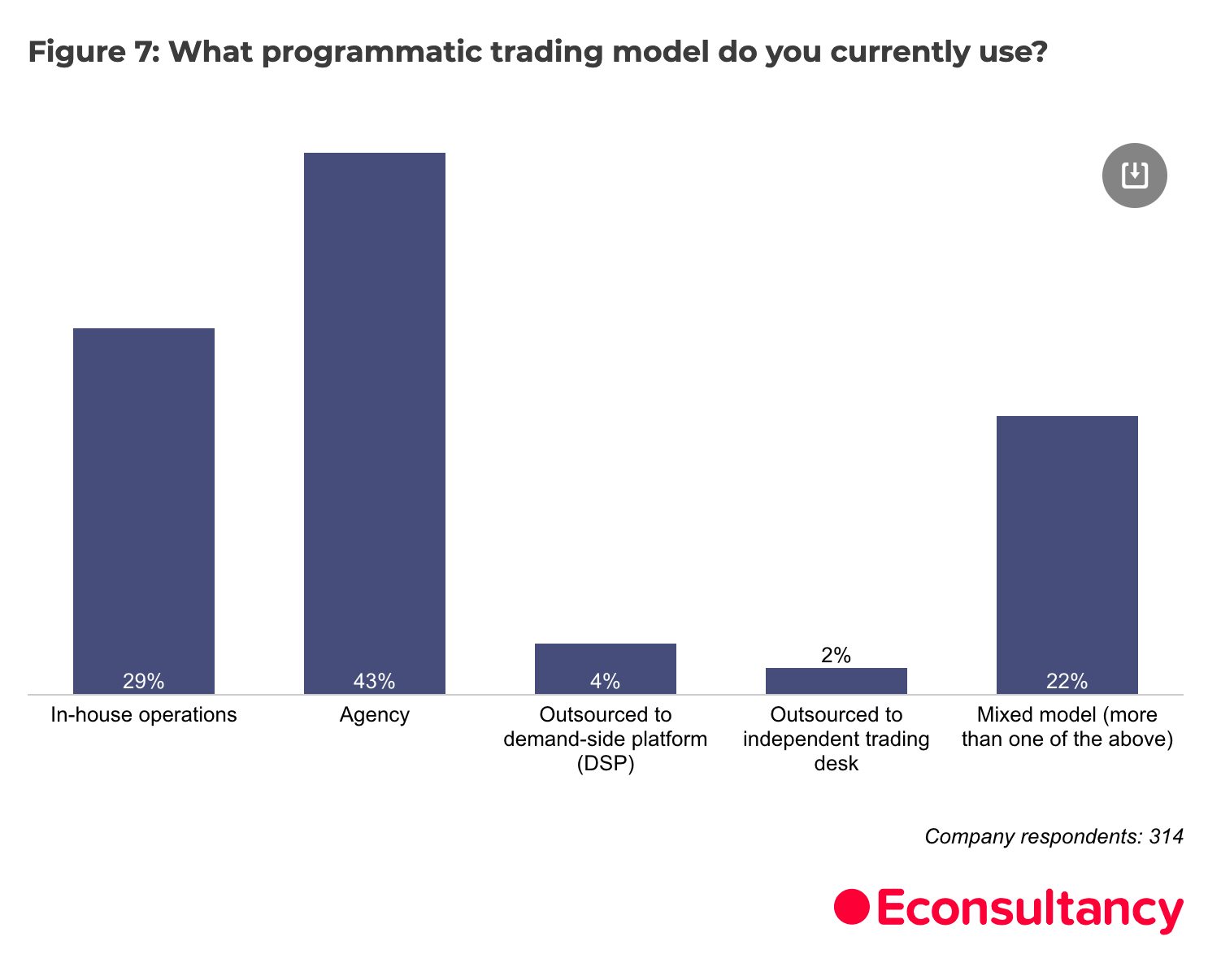
In Econsultancy’s survey, 22% of respondents reported using a ‘mixed’
programmatic trading model, with 29% running with solely in-house
operations. Forty-three percent reported still running entirely with an
agency.
As well as value from ad spend, another reason companies are
transferring in-house is to do with transparency and brand safety.
Negotiating and buying all digital media in-house allows for greater
control and visibility over where advertising is placed.
That being said, in-housing also come with its own challenges.
Finding the right talent is undoubtedly one of the biggest, as the role
of a programmatic trader not only requires in-depth knowledge of
multiple platforms and the optimisation strategies available, but also a
deep understanding of client and consumer needs.
In this case, experts advise not to blindly jump onto the trend for
in-housing, but to first ensure that they realise both the work
involved, and the skillset required in order to effectively overtake
agency involvement.
Tags: adtech, stocks, tsx Posted in All Recent Posts, Good Life Networks | Comments Off on Good Life Networks $GOOD.ca – Three trends shaping programmatic advertising in 2019 $TTD $RUBI $AT.ca $TRMR $FUEL
U.S.-Based Online Learning Leader Udemy Enters India
Udemy, the global marketplace for learning and teaching online with over 30 million students and 42,000 instructors worldwide, announced today expanded operations in India with an employee hub in Gurgaon.
India is one of the company’s fastest growing markets, with revenue and students doubling year-over-year.
NEW DELHI–Mar 18, 2019–Udemy, the global marketplace for learning and teaching online with over 30 million students and 42,000 instructors worldwide, announced today expanded operations in India with an employee hub in Gurgaon. India is one of the company’s fastest growing markets, with revenue and students doubling year-over-year. A local presence will enable Udemy to continue enhancing and localizing the student and instructor experience.
Founded in 2010, Udemy is an online learning destination that helps
individuals, companies, and governments gain the skills they need to
compete in today’s global economy. Built on the premise that not all
teachers are found in traditional classrooms, the platform allows
experts everywhere to develop courses on thousands of topics and share
their knowledge with the world. Students learn the most current and
in-demand skills from public speaking to mindfulness to the newest
programming languages and marketing strategies.
“Udemy’s rapid growth in India shows us the level of demand from
students, instructors, and companies for affordable skills training,â€
explained Gregg Coccari, Udemy CEO. “We are dedicated to our mission of
improving lives through learning and expanding in India enables us to
deliver on that promise.â€
While the Udemy marketplace serves the needs of individuals looking to upskill, Udemy for Business
is specifically designed for organizations, including business leaders
such as Booking.com, Publicis Sapient, Pinterest, and Adidas, looking to
continually invest in their workforces. This subscription-based product
offers 3,000+ of the highest-rated technical and business courses, as
well as learning analytics and an easy-to-use platform to create and
distribute content to their own teams.
Udemy courses are in over 50 languages that can be viewed on the web,
on a mobile device, Apple TV, and through Chromecast. In addition,
Udemy students are able to download and view the courses offline, as
well as change video quality for low-bandwidth environments.
About Udemy
Udemy is the online learning destination that helps students,
companies, and governments gain the skills they need to compete in
today’s economy. More than 30 million students learn from 42,000
instructors teaching 100,000 courses in over 50 different languages.
Whether learning for professional development or personal enrichment,
students everywhere can master new skills through self-paced, on-demand
courses, while experts have a way to share their knowledge with the
world. For companies, Udemy for Business offers subscription access to
3,000+ business-relevant courses, powerful learning analytics, as well
as an easy-to-use platform to host and distribute their own content in
one central place. We also offer Udemy for Government, a highly
customizable learning platform designed to upskill workers across
nations and prepare them for the jobs of today and tomorrow. Udemy is
privately owned and headquartered in San Francisco with offices in
Denver, Ireland, Turkey, and Brazil.
Posted by AGORACOM-JC
at 9:45 PM on Sunday, March 17th, 2019
SPONSOR: New Age Metals Inc.
(TSX-V: NAM) The company’s new Lithium Division has already made
significant acquisitions in Canada and the USA. The company also owns
one of North America’s largest primary platinum group metals deposit in
Sudbury, Canada. Learn More.
NAM: TSX-V
———————
Huge demand for copper, cobalt, lithium and nickel in the offing as EV uptake increases
Purkiss’s presentation also emphasises an increasing amount of nickel content in lithium nickel manganese cobalt oxide (NMC) batteries, adding that nickel input primarily sourced from sulphides is a declining supply source.
Creamer Media Senior Deputy Editor Contract Publishing and Sales
Investors focused on the mining
sector may not fully appreciate how quickly the electric vehicle (EV)
is being adopted globally, in light of the world pursuing a low-carbon
emissions future, says battery metals investment vehicle Cobalt 27 Capital chairperson and CEO Anthony Milewski, who warns of a potential deficit in the supply of the metals critical to achieving this future.
Global management consultancy firm McKinsey & Company says 2017
marked the first time EV sales passed the one- million mark, noting in
May 2018 that, by 2020, EV producers could be moving 4.5- million units,
about 5% of the overall global light-vehicle market.
Also presenting at this year’s MiningIndaba was nickel-focused development vehicle Consolidated Nickel Mines (CNM) CEO Simon Purkiss, who provided an update on the restarting of the company’s Munali nickel mine, in southern Zambia.
Purkiss points to EV growth being an important factor in nickel’s
demand-side development, noting a rapid increase in EV uptake, with financialservices company Credit Suisse predicting EV growth to 3.1- million units by 2021 and 14.2-million units by 2025.
CNM identified Munali, where operations
stopped in November 2011, owing to low nickel prices and poor
operational performance by the previous owners, as key to its
consolidation of nickel prospects in Southern Africa.
Purkiss told delegates that financing of the restart was complete and,
with the mine ramping up and the process plant being commissioned, first
concentrates were expected in February and were on track to being
transported to one of the nickel and copper smelters in the Southern Africa Development Community region in the first quarter of this year.
Purkiss says project economics were improved by changing the mining
method, revising the metallurgical process and optimising the labour
structure. Munali will produce low-cost nickel concentrate at $9 200/t
of nickel, while, in the long term, CNM expects lower-cost nickel
sulphate production of $5 000/t.
The company predicts global nickel stocks will decline until a
trigger point is reached, at which time restocking will take place.
Subsequently, says Purkiss, nickel prices will start rising, probably
rapidly, and nickel pig iron production will restart, but only to fill
Chinese stainless-steel demand, which will still be limited.
Purkiss’s presentation also emphasises an increasing amount of nickel content in lithium nickel manganese cobalt oxide (NMC) batteries, adding that nickel input primarily sourced from sulphides is a declining supply source.
Supporting his statement, a report on the lithium-ion battery market by Dublin-based market researcher Research & Markets foresees the market for NMC growing at a higher compound annual growth rate over 2018 to 2024.
EVs require high capacity and high power that can only be provided by using the NMC
battery type, says the researcher. “The use of new electrolytes and
additives support the charging of a cell up to 4.4 V/cell. The NMC cell is growing in its range as the three components involved are easy to blend together and can be made useful for a range of applications, from the automotive industry to energystoragesystems.â€
The lithium-ion battery market is estimated to grow exponentially
from $37.4-billion in 2018 to $92.2-billion by 2024. Research &
Markets attributes the growth of the market not only to increased demand
for plug-in vehicles but also to the growing need for automation and battery-operated materials- handling equipment, the increasing demand for smart devices and other industrial goods, and the high requirement of lithium-ion batteries for various industrial applications.
“However, factors such as safety issues related to storage and the transport of spent batteries hinder the market growth,†adds Research and Markets.
Nonetheless, Milewski is adamant that the level of activity in the EV
battery metals space is only the ‘tip of the iceberg’, with the broader
uptake of EVs yet to be fully realised.
He says demand for cobalt really depends on EV penetration. A material increase in the production of cobalt, a by-product of copper and nickel mining, is foreseen once demand for the metal more than doubles when EVs account for 15% of the world’s car sales.
“Cobalt 27, which owns the world’s largest private stockpile of physical cobalt,
is positioned to take advantage of the early stages of the battery
metals upcycle, where large- scale base metals producers are actively
seeking to leverage by-product metals, such as cobalt, to fund mine expansion and repay debt using alternative, nondilutive sources of capital,†he tells Mining Weekly.
Officially, 105 000 t of cobalt is supplied globally, but Milewski says the unofficial figure is closer to between 115 000 t and 125 000 t of cobalt. This discrepancy, he says, is due to production being skewed by supply from undocumented artisanal mining in the Democratic Republic of Congo (DRC), where as much as 70% to 75% of the world’s cobalt is produced.
“With 98% of global cobalt supply a relatively small by-product of nickel and coppermining, one of Cobalt 27’s core principles is to invest in geopolitically stable jurisdictions outside the DRC. We believe the primary issue facing cobalt supply is the major concentration of cobalt reserves and production in the DRC, and the underlying human rights, environmental issues and political uncertainty associated with the country,†he adds.
The ethical sourcing of cobalt from the DRC continues to challenge the sector’s supply chain,
with Milewski highlighting the significant challenges faced by industry
participants in their attempts to promote the adoption of solutions that may be highly impractical in terms of the DRCbusinessenvironment. Although, he adds, not all artisanal mining is bad, addressing the operations that are unethical will take years and large amounts of money.
A second challenge artisanal mining poses to the growth of the EV market involves the environmentally unfriendly mining methods practised, contradicting the intentions of early EV adopters: people concerned about the environment. However, other metals, such as lithium, whose mining process is highly reliant on water, also face challenges. “Each commodity has its own set of particular challenges,†adds Milewski.
Supply and Demand
As the electrification story unfolds, in 2025 and beyond, this sector could account for between 13% and 15% of the current copper market. “This is a massive demand, relative to the size of the copper market. Electrification is the much bigger story, as batteries will make energy
much more accessible, but the type of battery used is dependent on the
application and metals available to specific countries,†notes Milewski.
Market research specialist BMI Research last year forecast global copper
output to climb from 23.4-million tonnes in 2018 to 29.9-million tonnes
by 2027, averaging yearly growth of 2.7%. The global refined copper balance was also forecast to register a deficit of 251 000 t in 2018 and remain undersupplied through 2023.
In terms of nickel, BMI Research expects global yearly production to
reach 2.9-million tonnes by 2027, according to its ‘Strategic Metals and
Rare Earths Market Outlook – Q32018’ report.
Milewski says the size of the copper and nickel markets will continue to dwarf that of cobalt, predicting greater focus on investment and development around these metals.
However, he sees a lag in satisfying the need for these “future metals†and building the mines required to fulfil that need.
The issue is not whether there are enough of these metals in the
ground, but whether funding is being made available to miners for the
development of the operations necessary to meet future demand. Other than diversified miner Rio Tinto or Australian mining giant BHP, “I can’t think of any other mining company that has developed a mine recently for over $2-billionâ€, states Milewski.
Noting that capital markets are generally efficient, he says directors can make their miningprojects
look as attractive as possible, but “if the markets are closed, they
are closedâ€. Higher commodity prices could, however, spur investment in
the cobalt, copper, lithium and nickel markets, Milewski adds.
Sadly, with two-thirds of the world’s cobalt originating from coppermining in the DRC, where cobalt was declared a strategic metal last year, a supply surge from the country has resulted in a price slump. Subsequently, some major miners, such as Glencore, have implemented cost-cutting procedures to compensate for the two-year low. At its Mutanda mine, Glencore has retrenched workers and decided against renewing contracts with external contractors.
The suspension at ERG’s Boss Mining comes at a time of strained relations between the DRC and investors after the nation last year introduced a 10% levy on cobalt exports, owing to cobalt’s strategic metal status.
Future metals have the attention of investors, as they primarily impact the low-carbon future and awareness is growing among mining companies of the benefit of aligning with the delivery of a low-carbon emissions future, with Glencore, for example, over the last year having adjusted its marketing message, says Milewski.
“Where mining companies are able to raise money presently is in this space,†he explains, adding that Rio Tinto is also looking into low-carbon-emission-metals- related projects.
Copper, cobalt,
lithium and nickel are the core metals that will be impacted on by the
pursuit of the world’s low-carbon-emissions future and whether other
metals will join the story, only time will tell. Besides these
mainstream metals, Milewski highlights interest in graphene, vanadium
and certain zinc chemistries. “These metals are sitting on the sidelines
and only time will tell if the technology will develop to grow their demand,†he concludes.
The company based its prediction on the uptake of EVs locally
matching the global average, which it says will account for up to 11% of
all new-car sales in 2025.
“Actual EV car sales have far outpaced expectations and are going to have a tremendous impact on the demand for materials such as copper, cobalt, lithium and nickel,†says Milewski. Having recently spoken at the Investing in African MiningIndaba conference, which was held at the Cape Town International Convention Centre, in South Africa’s Western Cape, from February 4 to 7, Milewski highlights that most conversations at the event were around these metals.
Posted by AGORACOM-JC
at 9:15 PM on Sunday, March 17th, 2019
https://youtu.be/lkYWl6n_dAs
Jesse Dylan, Founder & CEO of Good Life Networks (TSXV: GOOD)
(FSE: 4G5) sits down with former Global TV anchor, Steve Darling of
Proactive Investors to discuss GLN’s significant growth over the last
year, how the company plans to drive 2019 projected revenues of $67M and
the importance of brand safety and protecting consumers Personally
Identifiable Information.
With the recent controversy around brands using PII and the
implementation of new regulations designed to protect consumers, GLN
prides itself on having built its patent pending technology from the
ground up without using consumers private information to target
advertisements. GLN continues to focus on the importance of brand
integrity and consumer privacy.
Posted by AGORACOM-JC
at 9:00 PM on Sunday, March 17th, 2019
SPONSOR: Bougainville
Ventures Inc (CSE: BOG) Converting irrigated farmland to
greenhouse-equipped farmland. Bougainville does not “touch the plantâ€
and only provides agricultural infrastructure as a landlord for
licensed marijuana growers. Click here for more info.
BOG:CSE —————————————
The marijuana industry looks like the fastest-growing job market in the U.S
The marijuana industry added 64,389 jobs in 2018, a 44 percent gain, according to industry experts Leafly and Whitney Economics.
Economists believe the U.S. job market overall is getting tight, evidenced by the 20,000 growth in payrolls for February
Job creation is expected to grow as more states legalize pot. Nick Colas at DataTrek Research said cannabis is the “fastest-growing labor market in the U.S.”
Published 19 Hours Ago Updated 17 Hours Ago CNBC.com
Tom Franck | CNBC
Canopy Growth operations in Smiths Falls, Ontario.
At a time when the rest of the labor market appears to be tightening
up, the marijuana industry is just getting started when it comes to job
creation, according to a recent report.
Pot manufacturers and distributors, on both the recreational and
medicinal sides, saw massive job creation in 2018, with 64,389 new
positions added to the rolls. That brings to 211,000 the number of jobs
directly related to the industry, part of a total of 296,000 in all
related areas combined, industry site Leafly said in a report it compiled with Whitney Economics.
The U.S. economy in total created about 2.7 million new jobs in 2018,
according to the Bureau of Labor Statistics, which does not count
cannabis-related hiring because the substance is still considered a
Schedule 1 narcotic at the federal level.
Hiring slowed to a crawl in February, with payrolls growing by just 20,000.
That came even though the BLS said there were 7.3 million job openings
against just 6.3 million considered unemployed in December, the most
recent month for which data were available.
Aurora Cannabis chair talks Peltz appointment and the future of the cannabis industry 8:56 AM ET Wed, 13 March 2019 | 05:34
“Amid the roiling debate over American jobs, the legal cannabis
industry remains a substantial and unrecognized engine of grassroots job
creation,” the report’s authors wrote. “In 2019, America’s cannabis
industry is one of the nation’s greatest economic success stories. That
success deserves to be recognized and celebrated.”
The document was written by Bruce Barcott, Leafly’s deputy editor, and Whitney Economics founder Beau Whitney.
Because there is no official count the report had to use some
unconventional methods to estimate the jobs total. They utilized state
data, industry surveys, information from operators, proprietary data and
other economic formulas.
What they found was stunning: a 44 percent gain in the workforce for
2018 that came on top of a 21 percent increase the previous year.
At 211,000, the total number of jobs compares favorably to other more
mainstream occupations: there were 131,430 chefs in the country, for
instance, along with 65,760 aerospace engineers and 40,000 computer
operators, according to the most recent BLS counts.
“US marijuana legalization is a rare example of disruption creating
jobs rather than destroying them,” Nick Colas, co-founder of DataTrek
Research, said in a note Thursday that highlighted some of the cannabis
jobs data. “With the US labor market recently showing signs of weakness
and fears of an eventual recession in the wings, this is one industry
that might soften the blow of an economic downturn.”
Colas expects pot-related job creation to continue as more states
legalize the substance. He called cannabis “the fastest-growing labor
market in the U.S.”
Along with the bottom-line gains, the industry’s growth also offers
an alternative to the push for young Americans to get a college degree,
which has led to an explosion of student loan debt that now totals
nearly $1.6 trillion.
“Americans with a college degree are basically at full employment,
but most Americans do not have those credentials and their participation
rates are lower than the former,” Colas wrote. “The marijuana industry
offers solid paying positions at all levels of experience and
educational attainment.”
Colas cited Glassdoor data showing that median pay in the cannabis
industry is 11 percent above the median U.S. salary of $52,863.
“Budtenders,” the staff members who work directly with customers,
generally earn $12 to $16 an hour, according to the site that allows
current and former employees to review their workplaces and list typical
salaries.
At the other end of the spectrum, cultivation and extraction
directors and outside sales representatives can earn well into six
figures.
Tags: Marijuana, otc, tsx, tsx-v, weed Posted in All Recent Posts, Bougainville Ventures | Comments Off on Bougainville Ventures Inc $BOG.ca – The #marijuana industry looks like the fastest-growing job market in the U.S #weed $CROP.ca $VP.ca NF.ca $MCOA
Posted by AGORACOM-JC
at 2:00 PM on Thursday, March 14th, 2019
SPONSOR:Â Betteru Education Corp. Connecting global leading educators to the mass population of India. BetterU Education has ability to reach 100 MILLION potential learners each week. Click here for more information.
BTRU: TSX-V
————————
Online platforms a step towards democratizing the education sector
Govt is urging colleges to offer online courses in rural India so that education reaches all
Online programmes are set to grow and we will see lots of innovation in the coming years
From ordering vegetables online to ordering classes online, we have
travelled a long way! The Internet of Things and digital transformations
have given us shocks as well as pleasant surprises. Like any other
industry, the wave of digital technology and improving bandwidths has
affected the education sector as well. Both the demand and the supply
side are witnessing an impact. Online education in
India has seen active growth over the last decade. The factors that
have led to this growth are better telecom and internet bandwidths
across India leading to growth in the usage of smartphones and hand-held
devices, advancement in video conferencing technologies, advent of
technology platforms for seamless transfers, and an ever-increasing need
for skill certification remotely and at the convenience of the student.
The consumer centricity that we have observed in conventional
product/service marketing is now being seen in education through online
programmes offered by reputed institutes in India. Online programmes can
be paid or free (famously known as MOOC, as in massive open online courses).
Online programmes can be live mode where faculty and students are
online at the same time. There are also recorded versions where the
participants can watch the class on the go at their convenience. Both
these types have their merits and demerits. The biggest factors
contributing to the growth of online programmes are its deep
penetration, convenience of learning infrastructure, skill upgradation need, and career break gaps.
The government is encouraging colleges to offer online courses in
rural India to ensure that education reaches all. Online programmes give
an opportunity to all to learn from institutes of repute. For
autonomous institutes, the deep penetration and reach of online
programmes is a step towards democratization of education and equal
opportunities for all, irrespective of their geographical location. The
other factor contributing to the growth is the convenience that online
courses offer to the participants where they can learn from any
hand-held device at their time and without leaving their jobs. This is
only getting easier with the improvement in bandwidths and penetration
of smartphones and mobile services. The third factor that has led to the
growth of online programmes is the element of constant change. Working
professionals enrol in niche and domain-specific online programmes to
upgrade their skills, learn new skills, or relearn conceptual areas of
work. The most interesting segment that has emerged over the last few
years is the segment of mostly women and some men who have taken career
breaks. These are women who have taken a maternity break and after a few
years want to get back to their professional life. For these people,
online programmes are a blessing and help them fill the gap created and
help them prepare for second term of their careers.
One more emerging segment is that of startups. Many startup owners’
sign up for online programmes as they lack certain skill sets and these
courses are an easy and effective way to learn and get certification.
As we grow in this space, institutes are reinventing and upgrading
online programmes in course content, delivery platforms, pedagogies, and
innovation. In programmes that I offer, there is a lot of usage of
videos, TED talks, in-class group exercise, and live discussions.
Online programmes are set to grow and we will see lots of innovation
in the coming years. The biggest factor pushing the growth is technology
infrastructure, cost, flexibility, and convenience. The advantage of
this growth will be in reach of education and specialized skills reaching everywhere. Online programmes are here to stay!
Falguni Vasavada-Oza is a professor at MICA, Ahmedabad.
Posted by AGORACOM-JC
at 9:17 AM on Thursday, March 14th, 2019
Announced that P. Peter Pascali, President and CEO of PyroGenesis, has been invited to present at the prestigious 5th Annual Gabelli & Company Waste Services Symposium
Held on Tuesday, March 26th at the Lotte New York Palace in New York City. Mr. Pascali will be presenting at 2:15 pm ET.
MONTREAL, March 14, 2019 — PyroGenesis Canada Inc. (http://pyrogenesis.com) (TSX-V: PYR) (OTCQB: PYRNF) (FRA: 8PY), a TSX Venture 50® high-tech company, (the “Company”, the “Corporation†or “PyroGenesis”) that designs, develops, manufactures and commercializes plasma atomized metal powder, plasma waste-to-energy systems and plasma torch products, today announced that P. Peter Pascali, President and CEO of PyroGenesis, has been invited to present at the prestigious 5th Annual Gabelli & Company Waste Services Symposium being held on Tuesday, March 26th at the Lotte New York Palace in New York City. Mr. Pascali will be presenting at 2:15 pm ET.
For investors interested in attending, please email: [email protected].
PyroGenesis Canada Inc., a TSX Venture 50® high-tech company, is the world leader in the design, development, manufacture and commercialization of advanced plasma processes and products. We provide engineering and manufacturing expertise, cutting-edge contract research, as well as turnkey process equipment packages to the defense, metallurgical, mining, advanced materials (including 3D printing), oil & gas, and environmental industries. With a team of experienced engineers, scientists and technicians working out of our Montreal office and our 3,800 m2 manufacturing facility, PyroGenesis maintains its competitive advantage by remaining at the forefront of technology development and commercialization. Our core competencies allow PyroGenesis to lead the way in providing innovative plasma torches, plasma waste processes, high-temperature metallurgical processes, and engineering services to the global marketplace. Our operations are ISO 9001:2015 certified, and have been since 1997. PyroGenesis is a publicly-traded Canadian Corporation on the TSX Venture Exchange (Ticker Symbol: PYR) and on the OTCQB Marketplace. For more information, please visit www.pyrogenesis.com
This press release contains certain forward-looking statements,
including, without limitation, statements containing the words “may”,
“plan”, “will”, “estimate”, “continue”, “anticipate”, “intend”,
“expect”, “in the process” and other similar expressions which
constitute “forward- looking information” within the meaning of
applicable securities laws. Forward-looking statements reflect the
Corporation’s current expectation and assumptions and are subject to a
number of risks and uncertainties that could cause actual results to
differ materially from those anticipated. These forward-looking
statements involve risks and uncertainties including, but not limited
to, our expectations regarding the acceptance of our products by the
market, our strategy to develop new products and enhance the
capabilities of existing products, our strategy with respect to research
and development, the impact of competitive products and pricing, new
product development, and uncertainties related to the regulatory
approval process. Such statements reflect the current views of the
Corporation with respect to future events and are subject to certain
risks and uncertainties and other risks detailed from time-to-time in
the Corporation’s ongoing filings with the securities regulatory
authorities, which filings can be found at www.sedar.com, or at www.otcmarkets.com. Actual
results, events, and performance may differ materially. Readers are
cautioned not to place undue reliance on these forward-looking
statements. The Corporation undertakes no obligation to publicly update
or revise any forward- looking statements either as a result of new
information, future events or otherwise, except as required by
applicable securities laws. Neither the TSX Venture Exchange, its
Regulation Services Provider (as that term is defined in the policies of
the TSX Venture Exchange) nor the OTCQB accepts responsibility for the
adequacy or accuracy of this press release.
Posted by AGORACOM-JC
at 9:00 AM on Thursday, March 14th, 2019
RECENT HIGHLIGHTS
SIGNED A COOPERATION AGREEMENT FOR THE EMERGENCY MEDICAL SERVICES MARKETS
Will enable them to provide real-time monitoring of patients while in transit on the ground or in the air.
CHUSJ is one of the top 10 mother-child hospitals in the World, with over 3500 births a year.
Has over 1500 nurses, over 500 Doctors and over 200 researchers on staff.
COMPLETED SALE OF FIVE STAR-A.D.S SYSTEMS TO ALMASRIA UNIVERSAL AIRLINES
Announced that AlMasria Universal Airlines of Egypt has decided to
proceed with the installation and activation of the STAR-A.D.S.® System
across all five (5) of its current aircraft fleet, which includes A-320,
A-321, A330 and B737 aircraft.
BOMBARDER JOINT RESEARCH AND DEVELOPMENT PROGRAM
Joint research and development program with Bombardier and other
industrials and universities of Canada is progressing very positively.
The STAR-A.D.S. ® system which is at the heart of the program, after
having been validated and extensively used by the aircraft
manufacturer, has now been transferred to another flight test vehicle to
complete the flight testing and the data collection.
EMERGENCY MEDICAL SERVICES APPLICATIONS
Star’s Land System Aided Medical Monitoring system for ground
ambulance applications has undergone a series of demonstrations by a
care organization in North America.
Its airborne parent system, the In-Flight System Aided Medical
Monitoring system (STAR-ISAMM™â€), has now been demonstrated to several
stakeholders of the commercial and civil air ambulance market.
CHECK OUT OUR RECENT INTERVIEW
FULL DISCLOSURE: Star Navigation Systems Group Ltd. is an advertising client of AGORA Internet Relations Corp.
Posted by AGORACOM-JC
at 8:39 AM on Thursday, March 14th, 2019
GlobalCardio 12 FLEX Supports Traditional 12-Lead ECG Devices and New Wearable Options for In-Clinic and In-Home Use
Released GlobalCardio 12 FLEX (“GC12 FLEX“), a complete remote 12- lead ECG acquisition and reading solution.
GC12 FLEX has been developed for use by clinics and telemedicine groups that operate from multiple locations and that require rapid and centralized ECG reading services through the use of automated algorithms or human ECG review.
Toronto, Ontario–(March 14, 2019) – CardioComm Solutions, Inc. (TSXV: EKG) (“CardioComm” or the “Company“), a provider of consumer heart monitoring and electrocardiogram (“ECG“) acquisition and management software solutions, has released GlobalCardio 12 FLEX (“GC12 FLEX“), a complete remote 12- lead ECG acquisition and reading solution. GC12 FLEX has been developed for use by clinics and telemedicine groups that operate from multiple locations and that require rapid and centralized ECG reading services through the use of automated algorithms or human ECG review.
The GC12 FLEX leverages two of the Company’s US Food and Drug Administration (“FDA“)
and Health Canada Class II medical device approvals for the sale of a
cloud-based ECG management software solution and an ECG viewing
technology with automated ECG analysis and interpretation capabilities.
ECGs can be captured using a standard one to 12-lead device, a 12-lead
ECG belt or any CardioComm-qualified ECG monitoring device. Data can be
uploaded to a centralized data store within the GC12 Flex Cloud solution
via computer or through a smartphone using the GEMS™ Mobile app. ECG
files may then be reviewed using an interpretive algorithm which will
provide results in near real time. As soon as an ECG has been uploaded
and reviewed, an email notification will go out to any healthcare
professional associated with the monitored person and allow them to log
in, review, over read and/or retrieve the ECG record.
The first installation of the newly-released GC12 FLEX solution is
currently being implemented within a clinical research organization
which will use the solution with CardioComm’s SMART Monitoring ECG
reading service. The Company confirms it has strong market interest form
customers, such as research organizations looking for a remote
monitoring 12-lead ECG management solution that can include the
provisioning of ECG triaging services. CardioComm’s ECG service can
return a result within 30 minutes, 24 hours a day, 7 days a week or 365
days a year.
To learn more about CardioComm’s products and for further updates
regarding HeartCheck™ ECG device integrations, please see the Company’s
websites at www.cardiocommsolutions.com and www.theheartcheck.com.
CardioComm Solutions’ patented and proprietary technology is used in
products for recording, viewing, analyzing and storing
electrocardiograms for diagnosis and management of cardiac patients.
Products are sold worldwide through a combination of an external
distribution network and a North American-based sales team. CardioComm
Solutions has earned the ISO 13485 certification, is HIPAA compliant and
holds clearances from the European Union (CE Mark), the USA (FDA) and
Canada (Health Canada).
This release may contain certain forward-looking statements and
forward-looking information with respect to the financial condition,
results of operations and business of CardioComm Solutions and certain
of the plans and objectives of CardioComm Solutions with respect to
these items. Such statements and information reflect management’s
current beliefs and are based on information currently available to
management. By their nature, forward-looking statements and
forward-looking information involve risk and uncertainty because they
relate to events and depend on circumstances that will occur in the
future and there are many factors that could cause actual results and
developments to differ materially from those expressed or implied by
these forward-looking statements and forward-looking information.
In evaluating these statements, readers should not place undue
reliance on forward-looking statements and forward-looking information.
The Company does not assume any obligation to update the forward-looking
statements and forward-looking information contained in this release
other than as required by applicable laws, including without limitation,
Section 5.8(2) of National Instrument 51-102 (Continuous Disclosure Obligations).
Neither TSX Venture Exchange nor its Regulation Services Provider (as
that term is defined in policies of the TSX Venture Exchange) accepts
responsibility for the adequacy or accuracy of this release.
Tags: EKG, mhealth, stocks, tsx, tsx-v Posted in CardioComm Solutions | Comments Off on CardioComm Solutions $EKG.ca Releases Remote 12-lead ECG Telemed Solution with Arrythmia Detection and ECG Reading Services $ATE.ca $TLT.ca $OGI.ca $ACST.ca $IPA.ca