Agoracom Blog Home

Posts Tagged ‘tsx’

Iconic Minerals $ICM.ca – #Lithium Ion #Battery Market Growth Factors, Demand and Trends $LI.ca $MGG.ca $PAC.ca $CYP.ca $NEV.ca $SX.ca Forecast

Posted by AGORACOM-JC at 2:00 PM on Monday, November 25th, 2019

SPONSOR: Iconic Minerals Ltd. ICM:TSX-V Bonnie Claire Lithium Property hosts Inferred resource of 11.8 billion pounds of lithium carbonate equivalent and has the potential to be the largest lithium resource globally. Learn More.

Lithium Ion Battery Market Growth Factors, Demand and Trends Forecast

  • In recent years, the growth in the industrial automation has been highly eye-catching
  • This has been particularly beneficial for the development of the global lithium ion battery market for the application of material handling equipment
  • Global lithium ion battery market is driven by the growing penetration of smartphones, tablets, PCs, power tools, and digital cameras
  • Also witnessing an increase from the flourishing automobile industry

By: tmrresearch

Lithium Ion Battery Market – Snapshot

Lithium ion batteries are a type of rechargeable batteries that have high energy density. These batteries have a very wide range of application. However, primarily these lithium ion batteries are used in portable devices and equipment. The global lithium ion battery market is expected to witness a considerable growth over the course of the given forecast period with a considerable rise in the use of tablets, PC, smartphones, digital camera, and other power tools. These batteries have gained immense popularity in recent years, especially in the automobile production sector as they provide a solid alternative to the nickel metal batteries that are primarily used in manufacturing of electric cars. Another reason for their growing use is because of their light weight and small size that make them an ideal fit for a wide range of applications.

In recent years, the growth in the industrial automation has been highly eye-catching. This has been particularly beneficial for the development of the global lithium ion battery market for the application of material handling equipment. Over the years, several technological advancements have brought considerable growth in the material handling equipment sector. Some of the highly popular material handling equipment are automated guided vehicles, intralogistics systems, industrial trucks, and elevating equipment. Interestingly, all of these machine handling equipment are battery operated. With lithium ion’s stronger energy density, long lasting power, compact size, and light weight, these batteries are the most preferred option to be fitted across the equipment. Naturally, this has helped in the development of the global lithium ion battery market.

Lithium-ion batteries are rechargeable batteries that have high energy density and are used extensively in portable equipment. The global lithium ion battery market is driven by the growing penetration of smartphones, tablets, PCs, power tools, and digital cameras. The demand for Li-ion batteries is also witnessing an increase from the flourishing automobile industry. The demand for electric vehicles is increasing and with it, the demand for lithium ion batteries. The popularity of these batteries is increasing among automobile manufacturers as they are small in size and light in weight as compared to nickel metal batteries.

The lithium ion battery market is greatly fragmented with a large number of domestic players. These domestic players are accounting for a high share in the lithium ion battery market. There are small, medium, and large scale players in the industry and this is the reason behind the extreme competitive environment within the global lithium-ion battery market. The introduction of innovative and new technologies will help with the growth of the market. Many players are also investing in research and development and this will trigger increased competition among existing players. Product launches are a key strategy adopted by players in the industry. The lithium ion battery market players are also adopting the strategy of mergers and acquisitions so as to gain competitive edge and increase their customer base.

Global Lithium Ion Battery Market: Overview

Lithium-ion batteries are rechargeable batteries, in which lithium ions move from positive electrode to negative electrode during charging and back when discharging. These batteries are commonly used in consumer electronics. They make use of an intercalated lithium compound as an electrode material, compared to the metallic lithium used in a non-rechargeable lithium battery.  Besides that, their popularity is growing rapidly across sectors such as military, automotive, aerospace, and industrial.

Global Lithium Ion Battery Market: Key Trends

The various advantages offered by lithium ion batteries such as lightweight, rechargeable, environment-friendliness, high energy density, and no memory effect are boosting their adoption in smartphones, tablets, and automobiles. Hence, the proliferation of smartphones and tablets is providing a fillip to the global lithium ion battery market. Moreover, the escalating need for efficient and green solutions for power supply and energy storage is augmenting the market. Traditional batteries such as nickel-metal-hybrid, lead-acid, and sodium-sulfur have hazardous effects on the environment. In addition, the rising production of hybrid electric vehicles and electrical vehicles is creating a staggering volume of demand for these batteries in the automotive sector.

On the flip side, the higher cost of lithium ion batteries as compared to traditional batteries is limiting their widespread adoption. Furthermore, the risk of overheating and a subsequent fire associated with these batteries can pose a major threat to cars and other electronic devices, which in turn is restricting the lithium ion battery market from realizing its utmost potential.

Global Lithium Ion Battery Market: Market Potential

Several players in the global lithium-ion battery market are aiming at expanding their lithium ion battery facilities to enhance their visibility in the market. A case in point is Utility San Diego Gas and Electric (SDG&E) and AES Energy Storage, a subsidiary of Automotive Energy Supply Corporation, which in February 2017, inaugurated their new energy storage facility in Escondido, California, which they claim to be the world’s largest lithium-ion battery energy storage site. The capacity of this system is 30MW/120MWh and has the ability to store energy for the equivalent of 20,000 customers for four hours. Such steps taken by players are likely to scale up energy storage capacity and drive the market over the coming years.

Global Lithium Ion Battery Market: Regional Outlook

The segments covered in the lithium ion battery market report on the basis of geography are Asia Pacific, Latin America, North America, Europe, and the Middle East and Africa. Asia Pacific is expected to represent a sizeable share in the market throughout the review period. The domicile of a large number of key manufacturers is providing an edge to the region over other regions. Countries such as India, China, Singapore, Australia, and Japan will be sights of high growth in APAC. The growth of the lithium ion battery market in these countries can be attributed to the increasing regulations to reduce the carbon footprint and lead pollution.

North America will be a prominent lithium ion battery market during the same period. The increasing sales of electric vehicles along with the burgeoning demand for high-quality consumer electronics products are contributing to the growth of the region.

Global Lithium Ion Battery Market: Competitive Landscape

The global lithium ion battery market is highly consolidated in nature. Strict regulatory framework for the manufacturing of conventional batteries is attracting new players to invest in the market. The influx of new manufacturers is likely to make this market fragmented over the coming years. However, prominent players offer stiff competition to new entrants due to their competitive advantage in their terms of strong foothold and easy access to raw materials.

Research and development activities are expected to be the top priority for the majority of players to increase their shares in the market. Some of the key companies operating in the global lithium ion battery market are LG Chemical Power, Johnson Controls, Hitachi Chemical, Panasonic, Samsung, Toshiba, Sony, and AESC.

Source: https://statsflash.com/lithium-ion-battery-market-growth-factors-demand-and-trends-forecast-to-2025/420030/


PRIMO Nutraceuticals Inc. $PRMO.ca – What’s the difference between #CBD derived from #hemp and #cannabis? $CROP.ca $VP.ca NF.ca $MCOA

Posted by AGORACOM-JC at 10:45 AM on Monday, November 25th, 2019

SPONSOR:  PRIMO NUTRACEUTICALS INC. (CSE: PRMO) (OTC: BUGVF) (FSE: 8BV) (DEU: 8BV) (MUN: 8BV) (STU: 8BV) provides strategic capital to the thriving cannabis cultivation sector through ownership and development of commercial real estate properties. The company also offers fully built out turnkey facilities equipped with state-of-the-art growing infrastructure to cannabis growers and processors. Click here for more info.

What’s the difference between CBD derived from hemp and cannabis?

By: Emma Ston

  • What’s in a name? When it comes to CBD products derived from hemp, CBD products derived from cannabis, and what’s considered legal, a lot.
  • Understanding cannabis nomenclature and the chemical difference between the two plants is essential to making informed choices about CBD.

Cannabis refers to a genus of plants which has three species: indica, sativa, and ruderalis. Hemp is not a different species of the cannabis plant. The above classifications have been devised to differentiate intoxicating cannabis from non-intoxicating cannabis. Hemp is a sativa species, while cannabis can be sativa, indica, or ruderalis.

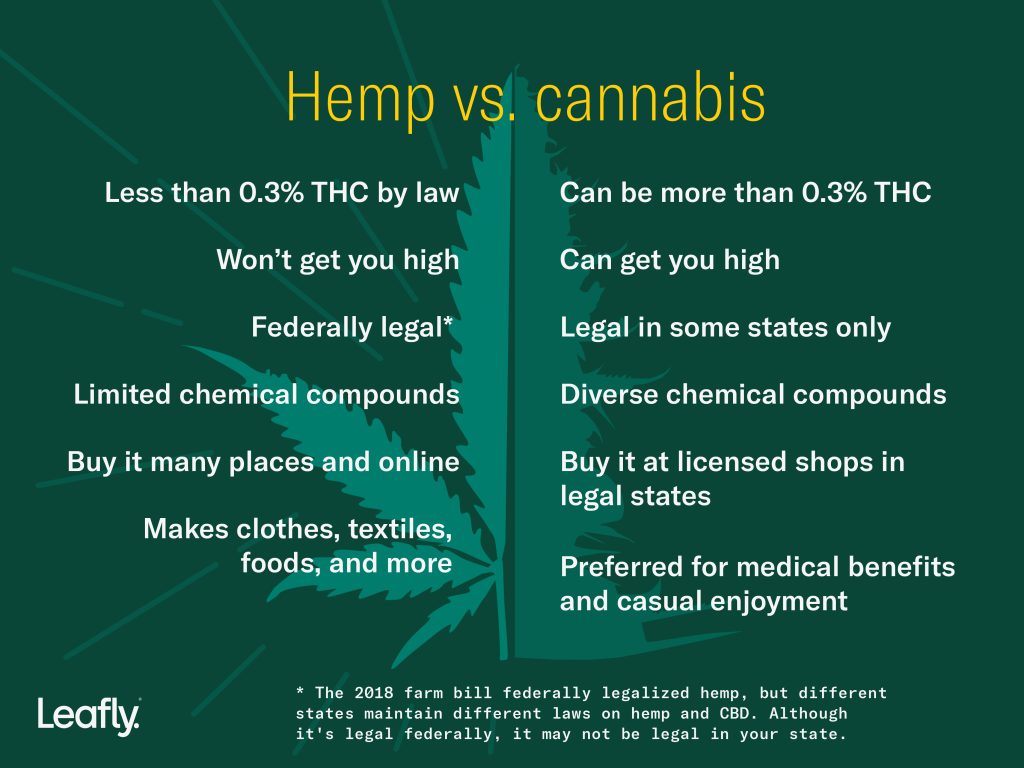
Although hemp and cannabis look (sort of) similar, from a functional and chemical perspective, they are distinctive. Here’s how you can distinguish the two.

(Leafly)

Hemp:

  • In order to be federally legal, it must contain 0.3% THC or less. For the uninitiated, THC is the cannabinoid that causes a high. With so little THC, hemp doesn’t have intoxicating effects.
  • Can be used to create products such as textiles, building materials, industrial products, paper, foods, and body care.
  • Is typically grown outdoors to maximize the size and yield of the plant. Hemp doesn’t require the same rigorous attention to lighting, humidity, and temperature that cannabis requires, and it can be grown in a range of different climates.
  • Tends to be tall and skinny with skimpy foliage, having an appearance similar to bamboo.

Cannabis:

  • Can contain 0.3% THC or more. Some high-THC strains can have 30% THC or more.
  • Is used for recreational or medicinal purposes. You won’t find cannabis plants being used to create hempcrete or denim.
  • Is generally grown in carefully managed and controlled conditions. Photoperiodic cannabis requires precise exposure to light in order to flower—its buds contain the valuable, potent compounds cannabis is famed for.
  • Tends to appear bushy, with large, full foliage.

Here’s the tricky thing: Both cannabis and hemp produce CBD. The CBD molecule is identical regardless of its cannabis source. However, from a legal perspective, CBD products derived from hemp and CBD products derived from cannabis are entirely different.

Hemp-derived CBD and cannabis-derived CBD: A legal perspective

According to federal law, cannabis—with 0.3% THC content or higher—is classified by the DEA as a Schedule I drug with no accepted medical use. CBD products sourced from cannabis, even those with 0% THC, are illegal at a federal level by virtue of their plant origin. Here’s the tricky thing: Both cannabis and hemp produce CBD. The CBD molecule is identical regardless of its cannabis source.

However, at a state level, the law changes. There are 33 US states which have medical cannabis programs, and CBD derived from cannabis is available from a licensed dispensary to eligible patients. The recreational use of cannabis is also legal in 11 states. In these states, cannabis-derived CBD products are available to those of age.

Industrial hemp, on the other hand, is no longer considered a Schedule I controlled drug. Following the 2018 farm bill, hemp was reclassified as an agricultural commodity. Since then, there has been an explosion of CBD products onto the market, prompting the U.S. Food and Drug Administration (FDA) to issue a statement that a regulatory framework for CBD products is still in the pipeline, and foods containing CBD, dietary supplements, and products making health claims are considered illegal.

CBD products sourced from hemp, such as oils and tinctures, are legal at a federal level, so long as they conform with other applicable laws. That said, certain states have their own legislation and regulations regarding CBD oil.

If you want to purchase CBD and err on the right side of the law, verify the legal status of hemp-derived CBD and cannabis-derived CBD in your state, so you know what you can or can’t purchase. Generally, hemp-derived CBD represents the more legal option.

Other differences between hemp-derived CBD and cannabis-derived CBD

CBD concentration

Cannabis represents a richer source of cannabinoids and terpenes than industrial hemp because it contains significantly more resin. Resin is the sticky, gooey substance found on female cannabis flowers, and to a lesser extent, on its leaves. Hemp contains resin on the flowers and leaves too, but much less. Most industrial hemp cultivators need to grow large quantities of hemp to produce CBD oil, although there are now more CBD-rich hemp strains being cultivated.

Safety

Hemp is a bioaccumulator, so it can absorb toxins such as residual pesticides and heavy metals from soil. When CBD is extracted from large quantities of industrial hemp cultivated in non-organic conditions, there is a possibility that contaminant residue will be passed into the final product. CBD products sourced from tainted hemp can compromise safety and efficacy.

Regulation

The hemp-derived CBD market is not yet subject to a widely enforced regulatory framework. For this reason, it’s essential to do your homework when buying hemp-derived CBD.

Look out for hemp-derived CBD that has been third-party tested. Products that have undergone this have been checked by an independent group outside of the producer using industry-approved techniques. The tester verifies the cannabinoid content of the product, along with heavy metals, pesticides, or microbes. Related

How to read a CBD label

A hemp-derived CBD product that has been third-party tested also guarantees you are getting what you paid for. Leafly’s investigation on CBD tested 47 products and found that almost half of them didn’t come within 20% of the labeled dosage. Third party testing confirms that the promised CBD content is present.

You can also look for hemp-derived CBD products with a USDA organic certification. This affirms that the growing conditions meet official USDA organic standards, and also provides assurance that the hemp extraction process was free of synthetic chemical additives.

In states where cannabis-derived CBD products are available from licensed dispensaries, there is greater regulation of these products. All are subjected to stringent testing from licensed facilities.

Effectiveness

Cannabis tends to have a wider terpene and cannabinoid profile than hemp. Cannabis-derived CBD from whole plant extract contains a range of beneficial terpenes and cannabinoids, including THC. These compounds work in concert with each other to provide additional benefits. This phenomenon is known as the entourage effect, and many cannabis experts assert that whole plant extracts offer greater therapeutic potential.

Hemp also contains some cannabinoids and terpenes, but not the range nor concentration of compounds present in cannabis. Hemp-derived CBD can be made into an full-spectrum extract that offers natural terpenes alongside minor cannabinoids. Broad-spectrum CBD is also available and contains minor cannabinoids and terpenes, but without the THC content.

However, full-spectrum and broad-spectrum hemp-derived CBD products may not have the potency of CBD derived from cannabis because trace amounts of THC appear to be less effective in treating certain symptoms.

CBD isolate

CBD can also be extracted from both hemp and cannabis to become an isolate. Isolates are identical whether derived from hemp or cannabis because they only contain CBD molecules. As there is more CBD in cannabis than hemp, it requires more hemp by dry weight to produce the same amount of CBD isolate.

CBD isolate is most commonly used in clinical trials to prove that results are linked to CBD rather than other compounds from either plant that may be present. Isolates may also be favored by those who wish to avoid THC entirely.

Source: https://www.leafly.com/news/cbd/hemp-vs-cannabis-derived-cbd-whats-the-difference

HPQ Silicon $HPQ.ca and Pyrogenesis $PYR.ca Actively Evaluating Joint Venture to Manufacture #Nanoscale Structure #Silicon Powders for Next Generation #Li-ion Batteries $FSLR $SPWR $CSIQ $PYR.ca $XMG.ca

Posted by AGORACOM-JC at 8:18 AM on Monday, November 25th, 2019
  • Actively evaluating a joint venture to manufacture Nanoscale Structure Silicon (Si) powders for next generation Li-ion Si batteries.
  • While Nanoscale Structure Silicon Powders improve Li-ion battery performance, high performance Silicon (Si) anodes are not presently commercially feasible due to high manufacturing costs. 
  • Specifically, two major issues have been identified as major impediments to commercial feasibility
  • The cost of the high purity Silicon feed material needed, and the cost of transforming Silicon into Nanoscale Structure Silicon Powders for Li-ion batteries.

MONTREAL, Nov. 25, 2019 — HPQ Silicon Resources Inc.(“HPQ” - “The Company”)TSX-V: HPQ; FWB: UGE; Other OTC : URAGF; (“HPQ”) announces that HPQ and PyroGenesis Canada Inc. (TSX-V: PYR) (“PyroGenesis”) are actively evaluating a joint venture to manufacture Nanoscale Structure Silicon (Si) powders for next generation Li-ion Si batteries.

NANOSCALE STRUCTURE SILICON POWDERS SELLING FOR US$ 30,000/Kg1

While Nanoscale Structure Silicon Powders improve Li-ion battery performance, high performance Silicon (Si) anodes are not presently commercially feasible due to high manufacturing costs.  Specifically, two (2) major issues have been identified as major impediments to commercial feasibility.  The cost of the high purity Silicon feed material needed, and the cost of transforming Silicon into Nanoscale Structure Silicon Powders for Li-ion batteries.

Combining the HPQ PUREVAP™ Quartz Reduction Reactor (“QRR”) technology with PyroGenesis Plasma Atomization knowhow to manufacture Nanoscale Structure Silicon (Si) powders, could potentially resolve these 2 issues and lead the way to full commercialization of Nanoscale Structure Silicon Powders.  If successful, that should subsequently lead to their wide scale adoption in the battery space.  If this occurs, HPQ and PyroGenesis would then be well positioned to assume a market leadership position.

THE RACE IS ON TO BUILD A BETTER BATTERY: NANOSCALE STRUCTURE SILICON POWDERS NEEDED

Presently, Silicon powders is used in a blended form with graphite but its content is typically less than 5 wt%, which reflects the infancy of Si anode technology and explains the limited performance improvement achieved to date.  Even at these levels, however, this is estimated to represent an addressable market of US $ 1B by 20222 expanding at a CAGR of 38.9% between 2019 – 2024.

The addressable market growth could be exponentially higher than projected as research suggests that replacing graphite materials with Nanoscale Structure Silicon (Si) powders in next generation Li-ion Batteries promises an almost tenfold (10x) increase in the specific capacity of the anode, inducing a 20-40% gain in the energy density of Li-ion batteries.

“PyroGenesis, the inventor of Plasma Atomization, has more than 20 years of experience manufacturing plasma atomized metal powders, so if anybody has the knowhow to use silicon materials produced from HPQ PUREVAP™QRR and manufacture Nanoscale Structure Silicon (Si) that can be used as high-capacity anode materials for next generations Li-ion batteries, it is them,” said Bernard Tourillon, President and CEO HPQ Silicon. “Silicon’s potential to meet energy storage demand is undeniable and generating massive investments, as well as, serious industry interest, so our timing could not be better.”

“We are taken by the potential of this joint venture as it checks all of the boxes we consider before evaluating a new business line:  It relates to our current activities, the market although niche is potentially massive, our expertise would be game changing, and the risk is low,” said Peter Pascali, President and CEO of PyroGenesis Canada Inc. “We are equally excited about the market drivers for this product.  The potential from the battery and energy storage markets alone is estimated, on first review, to be in the multi-billions of dollars.  I look forward to evaluating this opportunity more closely.”

RENEWABLE AND EV DEMAND INDICATE GLOBAL ENERGY STORAGE MARKET READY TO EXPLODE

At current growth rates of 2% per year, global energy consumption will be an estimated 125,000 Terawatt-hours 2020, which is 800,000 times more than the estimated storage capacity.A recent report by Wood Mackenzie Power projects that energy storage deployments are estimated to grow 1,300% from a 12 Gigawatt-hour market in 2018 to a 158 Gigawatt-hour market in 2024.  An estimated US$71 billion in investments will be made into storage systems where batteries will make up the lion’s share of capital deployment.

As reported by CNBC, private Venture Capital backed firms are also exploring the use of silicon in batteries and are positioning to provide the auto industry with the solutions needed to substantially improve vehicle performance.

About Silicon

Silicon (Si) is one of today’s strategic materials needed to fulfil the renewable energy revolution presently under way. Silicon does not exist in its pure state; it must be extracted from quartz, one of the most abundant minerals of the earth’s crust and other expensive raw materials in a carbothermic process.

About HPQ Silicon

HPQ Silicon Resources Inc. is a TSX-V listed company developing, in collaboration with industry leader PyroGenesis (TSX-V: PYR) the innovative PUREVAPTM “Quartz Reduction Reactors” (QRR), a truly 2.0 Carbothermic process (patent pending), which will permit the transformation and purification of quartz (SiO2) into Metallurgical Grade Silicon (Mg-Si) at prices that will propagate its significant renewable energy potential.

HPQ is also working with industry leader Apollon Solar to develop: Porous silicon wafers manufacturing using PUREVAP™ Silicon (PVAP Si) that can be used as anode for all-solid-state and Li-ion batteries; and a metallurgical pathway of producing Solar Grade Silicon Metal (SoG Si) that will take full advantage of the PUREVAPTM QRR one-step production of high purity silicon (Si) and significantly reduce the Capex and Opex associated with the transformation of quartz (SiO2) into SoG-Si.

HPQ focus is becoming the lowest cost producer of Silicon (Si), High Purity Silicon (Si), Porous Silicon Wafers and Solar Grade Silicon Metal (SoG-Si). The pilot plant equipment that will validate the commercial potential of the process is on schedule to start in 2019.

This News Release is available on the company’s CEO Verified Discussion Forum, a moderated social media platform that enables civilized discussion and Q&A between Management and Shareholders. 

Disclaimers:

The Corporation’s interest in developing the PUREVAP™ QRR and any projected capital or operating cost savings associated with its development should not be construed as being related to the establishing the economic viability or technical feasibility of the Company’s Roncevaux Quartz Project, Matapedia Area, in the Gaspe Region, Province of Quebec.

This press release contains certain forward-looking statements, including, without limitation, statements containing the words “may”, “plan”, “will”, “estimate”, “continue”, “anticipate”, “intend”, “expect”, “in the process” and other similar expressions which constitute “forward-looking information” within the meaning of applicable securities laws. Forward-looking statements reflect the Company’s current expectation and assumptions and are subject to a number of risks and uncertainties that could cause actual results to differ materially from those anticipated. These forward-looking statements involve risks and uncertainties including, but not limited to, our expectations regarding the acceptance of our products by the market, our strategy to develop new products and enhance the capabilities of existing products, our strategy with respect to research and development, the impact of competitive products and pricing, new product development, and uncertainties related to the regulatory approval process. Such statements reflect the current views of the Company with respect to future events and are subject to certain risks and uncertainties and other risks detailed from time-to-time in the Company’s on-going filings with the security’s regulatory authorities, which filings can be found at www.sedar.com. Actual results, events, and performance may differ materially. Readers are cautioned not to place undue reliance on these forward-looking statements. The Company undertakes no obligation to publicly update or revise any forward-looking statements either as a result of new information, future events or otherwise, except as required by applicable securities laws.

Neither the TSX Venture Exchange nor its Regulation Services Provider (as that term is defined in the policies of the TSX Venture Exchange) accepts responsibility for the adequacy or accuracy of this release.

For further information contact
Bernard J. Tourillon, Chairman, President and CEO Tel (514) 907-1011
Patrick Levasseur, Vice-President and COO Tel: (514) 262-9239
http://www.hpqsilicon.com Email: [email protected]

____________________
1 Source: Quotation from a producer (Confidential), Media article
2 Source Marketandmakerts.com

NORTHBUD $NBUD.ca – #Cannabis sector mounts furious lobbying drive in Ontario; Hillier seeks clarity $CGC $ACB $APH $CRON.ca $HEXO.ca $TRST.ca $OGI.ca

Posted by AGORACOM-JC at 4:50 PM on Friday, November 22nd, 2019

SPONSOR: NORTHBUD (NBUD:CSE) Sustainable low cost, high quality cannabinoid production and procurement focusing on both bio-pharmaceutical development and Cannabinoid Infused Products. Learn More.

Cannabis sector mounts furious lobbying drive in Ontario; Hillier seeks clarity

  • Over the past month, lobbyists have beat a path to Ontario’s legislature to discuss – among other things related to cannabis – taxation, labor policies, law enforcement and how adult-use marijuana is sold in the province

By Matt Lamers

Punished by disappointing sales due to a lack of retail stores, the cannabis industry has been mounting a fierce lobbying drive in Ontario to reach the decisionmakers driving the province’s marijuana policies, according to records from the Office of the Integrity Commissioner.

Over the past month, lobbyists have beat a path to Ontario’s legislature to discuss – among other things related to cannabis – taxation, labor policies, law enforcement and how adult-use marijuana is sold in the province.

The records show that efforts have been made to reach Ontario’s power brokers by:

  • Aurora Cannabis
  • Aphria
  • Convenience Industry Council of Canada
  • Cronos Group
  • The Green Organic Dutchman
  • Insurance Bureau of Canada
  • LeafLink
  • Loblaw
  • Supreme Cannabis Co.
  • Truss

Meanwhile, a former member of the ruling Progressive Conservative caucus is urging the party to adopt a clearer timeline for the planned pivot to an open allocation of adult-use retail stores.

Independent MPP Randy Hillier said Ontario’s bungled cannabis policies are costing the province, and its businesses, millions in lost economic opportunities.

“Here we have a government that promotes itself as ‘open for business,’ and what is the biggest impediment in the cannabis trade right now? Government’s lack of action and preventing people (from) opening retail establishments,” the independent MPP said in an interview.

He called Ontario’s cannabis lottery a “cluster you-know-what.”

The fledgling industry has already lost out on hundreds of millions of dollars of revenue, according to Craig Wiggins, managing director of market researcher TheCannalysts.

That has caused some producers to scale back production.

Hillier called on the government to empower the Alcohol and Gaming Commission of Ontario to license cannabis stores.

“We have 24 stores in operation a year out from legalization to serve 14 million people,” he said. “Newfoundland, with a population of 500,000 people, has as many stores as Ontario. Saskatchewan has twice as many with a population of a million people.

“We’re not achieving what we set out to with the legalization of cannabis, which is to get it out of the criminal marketplace. We’re allowing the criminal marketplace to continue to thrive.”

Ontario’s recent Economic Outlook restated the commitment to “an open allocation of cannabis retail store licenses where the number of stores is limited only by market demand,” however no timeline was offered.

Hillier’s advice to legal cannabis businesses is to speak up.

“If government policies are creating barriers for your businesses, then speak out.

“Bark as loud as possible, and possibly bite. That’s what often motivates government, is fear of embarrassment and fear of having to justify their actions.”

Matt Lamers is Marijuana Business Daily’s international editor, based near Toronto, Ontario. He can be reached at [email protected].

Source: https://mjbizdaily.com/cannabis-sector-mounts-furious-lobbying-drive-in-ontario-hillier-demands-clarity/

ThreeD Capital Inc. $IDK.ca – Zero-Commission Trading Is Coming to #Crypto #Bitcoin #Ethereum $HIVE.ca $BLOC.ca $CODE.ca

Posted by AGORACOM-JC at 2:32 PM on Friday, November 22nd, 2019

SPONSOR: ThreeD Capital Inc. (IDK:CSE) Led by legendary financier, Sheldon Inwentash, ThreeD is a Canadian-based venture capital firm that only invests in best of breed small-cap companies which are both defensible and mass scalable. More than just lip service, Inwentash has financed many of Canada’s biggest small-cap exits. Click Here For More Information.

Zero-Commission Trading Is Coming to Crypto

  • ShapeShift exchange debuts zero fees following user defections
  • Firms are slashing fees as race for market share intensifies

By Olga Kharif

Zero-fee trading first came to exchanged-traded funds and then to online stock and option transactions. Now the strategy is spreading into the cryptocurrency sphere.

Seen as the most profitable sector of digital-asset world, trading platforms are feeling the pressure as industry heavyweights such as Binance Holdings Ltd. and BitMex grab market share with both trading volume and coin prices sagging. ShapeShift, which has operated an exchange since 2014, said Wednesday it’s begun offering free “perpetual” trades.

“Free trading has become a feature of all fintech direct trading offerings, from Robinhood to SoFi and even JPMorgan,” said Lex Sokolin, global financial technology co-head at ConsenSys, which offers blockchain technology. “So it’s not surprising that in a digital race to acquire the most users, execution prices are starting to collapse.”

The practice turned out to be a catalyst for Charles Schwab Corp., which recently reported it opened 142,000 new trading accounts in October, a 31% jump from September, after the brokerage offered zero fees. Fresh income is being generated from interest earned on client cash holdings. Firms in the crypto world are taking notice.

“We’ve definitely seen how people often need very simple messages,” Erik Voorhees, the Denver-based chief executive of ShapeShift, said in a phone interview. “Everyone understands free.”

ShapeShift lost about 90% of its trading volume a year ago when it began checking user identifications to comply with regulatory guidelines, Voorhees said.

Daily-trading volume in crypto overall is about half of what it was in late October, and it’s been sluggish for most of the past few months, according to data compiler CoinMarketCap.com. The percentage of exchanges that are offering no-fee trading has increased to about 10% from 8% in June, data from CryptoCompare, which tracks exchanges.

To execute free transactions, traders will have to use so-called Fox tokens that ShapeShift is rolling out. Every user ShapeShift.com will get 100 free tokens, and the exchange may sell additional ones, Voorhees said. Each token — which are deposited in a user’s crypto wallet and are never spent — provides $10 of free trading volume on a rolling-30-day basis. So the more Fox tokens customers hold, the more free trades they can execute. Voorhees estimates that 90% of the exchange’s users will be able to do all their trades for free.

“We’d rather make a smaller amount of revenue from a larger pool of customers, and get those customers off centralized custodial exchanges,” Voorhees said. “It’s a risk we’re taking, but we think it’s worth it.”

Other, mostly smaller, exchanges are offering zero fees as part of short- and long-term promotions. Liquid.com is waiving costs for traders who have less than $25 million per month in transactions. Zebpay introduced zero-trading fees in February. HitBTC lowered its fees in August. Malta-based Binance — often the largest spot trading exchange — lets users lower their trading fees by investing in its own cryptocurrency, Binance Coin.

“The end result of price wars tends to be consolidation and the starving of smaller players,” Sokolin said. “Already we see this with the dominance of Binance.”

Source: https://www.bloomberg.com/news/articles/2019-11-20/zero-commission-trading-is-coming-to-crypto-as-boom-times-fade

New Age Metals $NAM.ca – What role are #lithium-ion batteries playing in energy transition? $LIC.ca $LIX.ca $LI.ca $ELR.ca $ATL.ca

Posted by AGORACOM-JC at 12:06 PM on Friday, November 22nd, 2019

SPONSOR: New Age Metals Inc. The company’s Lithium Division has already made significant acquisitions in Canada and the USA. The company also owns one of North America’s largest primary platinum group metals deposit in Sudbury, Canada. Updated NI 43-101 Mineral Resource Estimate 2,867,000 PdEq Measured and Indicated Ounces, with an additional 1,059,000 PdEq Ounces in the Inferred. Learn More.

What role are lithium-ion batteries playing in energy transition?

  • Lithium-ion batteries have been essential to the mainstream adoption of electric vehicles as part of a larger energy transition.
  • This has led to an unprecedented surge in the market for lithium-ion batteries and an even larger spike in supply. Prices have fallen recently, but demand is expected to continue rising.
  • Lithium-ion batteries also have potential applications in utility-scale renewable energy, although they face competition from newly developed technologies in that arena.

The energy transition has encouraged industries to move from fossil fuel to renewable energy sources. In doing so, companies have faced challenges in determining how to store significant amounts of energy for extended periods of time. This need is especially acute in the electric car market, which has turned to lithium batteries for energy storage. Demand for lithium is projected to grow by as much as 20% in 2019 compared to the previous year, according to Chilean producer SQM, largely because of increasing investment in and mainstream adoption of electric vehicles.

More traditional technologies, like internal combustion engines, use energy almost as soon as it is created. Comparatively, electric vehicles need to store electrical energy for long periods of time before using the supplies. Lithium-ion batteries, specifically those using the compound lithium hydroxide, store energy while taking up less space than other battery technologies, and their adoption by the mass market has encouraged innovation in the technologies underpinning the batteries. The impact and success of lithium-ion battery technology and its potential in the global energy transition to renewable energy has been recognized on an outsized scale — the technology’s creators won the Nobel Prize for chemistry in 2019.

Tesla, the electric car manufacturer owned by Elon Musk, has become a major player in the American lithium business. Tesla acquired lithium deposits across the American West while building huge “gigafactories” to mass produce the batteries. The company’s plans call for the first of these factories in Nevada to process 25,000 metric tons of lithium hydroxide per year, and it has a larger footprint than any other building in the country. Electric vehicle sales worldwide surged 75% year over year in the first quarter of 2019, even as the overall global automobile market contracted; regardless of opinions over the energy transition’s evolution, all of these cars need batteries.

Although electric vehicles have been the most significant application of lithium-ion batteries to date in the energy transition, lithium could also make renewable energy sources more viable for utilities. Whereas traditional fossil fuel power plants constantly produce energy, renewables like solar and wind can only produce energy while the sun is shining or the wind is blowing. To ensure that the power grid works constantly, regardless of external variables, transitioning to renewable energy would require the utility-scale use of energy storage. S&P Global Market Intelligence analysis shows that lithium-ion batteries are seen as the technology to compete with in this market.

Potential alternatives to lithium-ion batteries include batteries made from different chemical compounds. Lithium has faced some technological challenges in its adoption at the grand scale necessary for utilities, which resulted in multiple fires in Arizona that led a member of the state’s public utilities commission to call for different technology solutions.

The increasing demand for lithium-ion batteries and the importance they may hold for the transition to renewable energy has sparked geopolitical competition to secure a stable supply of batteries. Chinese firms have invested billions of dollars in lithium deposits across Australia and South America in recent years as part of the country’s plan to quadruple electric vehicle production between 2019 and 2025. In response, European companies have sought to expand their own investments in lithium so that their supply of batteries does not rely on foreign supply chains. Companies investing in European lithium processing have also voiced concerns about the potential environmental impact of processing the lithium into batteries in China and then shipping them across the world for use in Europe. As similar tensions arise between China and the U.S., lithium has become another flash point in the countries’ trade battles.

Market demand has contributed to a surge in the lithium mining and production businesses. Budgets for mining industry lithium exploration grew nearly sevenfold worldwide between 2015 and 2018, according to S&P Global Market Intelligence. The jump in demand for lithium-ion batteries led to a spike in prices in the early 2010s, and acquisitions of lithium deposits and mines rose sharply. Since then, the supply of lithium has risen more quickly than demand, so prices have fallen and deal-making has slowed.

Although lithium prices across autumn 2019 were on the lower side and some projects have been delayed or cut back, many market participants still expect the sector to grow significantly. Lithium production is expected to triple to 1.5 million metric tons worldwide by 2025. S&P Global Platts has reported on fears that even this increase in supply might not be enough to keep up with demand, especially if expected electric vehicle adoption rates continue.

Source: https://www.spglobal.com/en/research-insights/articles/what-role-are-lithium-ion-batteries-playing-in-energy-transition

North Bud Farms $NBUD.ca Expands U.S. Presence with Acquisition of a Fully Licensed and Operational #Cannabis Farm in Salinas, California $CGC $ACB $APH $CRON.ca $HEXO.ca $TRST.ca $OGI.ca

Posted by AGORACOM-JC at 8:47 AM on Friday, November 22nd, 2019
  • Bonfire Brands USA, a wholly owned subsidiary of NORTHBUD, has signed multiple definitive agreements related to its previously announced letters of intent with the Qlora Group and Monterey Holdings
  • Finalized the acquisition of an 11-acre property located at 20180 Spence Road Salinas, California
  • Property currently consists of 300,000 sq. ft. of licensable greenhouse space with 60,000 sq. ft. actively cultivating cannabis and a 2,000 sq. ft. building licensed for distribution

TORONTO, Nov. 22, 2019 — North Bud Farms Inc. (CSE: NBUD) (OTCQB: NOBDF) (“NORTHBUD” or the “Company”) is pleased to announce that Bonfire Brands USA (“Bonfire”), a wholly owned subsidiary of NORTHBUD, has signed multiple definitive agreements related to its previously announced letters of intent with the Qlora Group and Monterey Holdings (see September 12, 2019 press release).

Transaction Terms:

  1. Bonfire Brands USA has finalized the acquisition of an 11-acre property located at 20180 Spence Road Salinas, California from Monterey Holdings Inc. The property currently consists of 300,000 sq. ft. of licensable greenhouse space with 60,000 sq. ft. actively cultivating cannabis and a 2,000 sq. ft. building licensed for distribution. The purchase price of the property is USD$8,000,000 which represents the fair market value of the real estate. The buyer and seller have entered into a seller carry back financing for the full purchase price.

  2. Bonfire Brands USA has signed a definitive agreement with the Qlora Group for the acquisition of cultivation, processing and distribution licenses associated to the Spence Road property. As part of this acquisition Bonfire Brands USA also acquires all the Intellectual Property (IP) and assets related to the brands California Bud Co and Live For The Day (LFTD). The two brands combined for approximately USD$6,500,000 in unaudited sales over the past 18 months. In consideration for this acquisition Bonfire has assumed a USD$2,500,000 debt note from the Qlora Group. The debt will be settled over a 24-month period through a combination of cash and stock at the discretion of the note holder.  Immediately upon signing of the definitive agreement Bonfire will have acquired 80% ownership of the licenses with the remaining 20% to be transferred after approval from the California Cannabis Control and Licensing Bureau.

    The buyer will be taking possession of all biological assets including:
  •    6000 plants currently in the fifth week of flowering;
  • ~ 5000 plants in various stages of vegetative growth;
  • ~ 350 Lbs. of dried and harvested flower and trim; and 
  •    3000 filled vape cartridges of various strains.                                                  

“On the heels  of the historic adoption of the MORE Act, the NORTHBUD and Bonfire team is extremely proud to have finalized this agreement and how the structure allows for the acquisition to be financed from ongoing cash flow from the acquired business with minimal dilution while allowing the company to acquire what we believe to be exceptionally positioned infrastructure located in the heart of California’s Sun Belt and home to the largest cannabis cultivators in the state,” said Ryan Brown, CEO of NORTHBUD.

This infrastructure will serve as the primary operation for Bonfire Brands USA within the state of California, which is considered to be the largest cannabis market in North America valued at USD$3 billion dollars per year according to Arcview Market Research and BDS Analytics (August 2019).

“We are very pleased with the successful acquisition of the Salinas facility,” said Justin Braune, President of Bonfire Brands USA. “We have been working closely with the cultivation team at Qlora over the past two months and will immediately take over operations to begin driving revenue growth. We anticipate our first harvest within 45 days and have been actively negotiating agreements with distribution and cultivation partners whom wish to leverage our strategic infrastructure through joint venture and subletting agreements. We anticipate closing these transactions in the near future with the goal of having the California operation generating positive cash flow in the near term.”

The Transaction is a significant acquisition but will not result in a “Fundamental Change” pursuant to the policies of the CSE. NORTHBUD will be preparing the necessary corporate and securities filings in order to secure the required approvals for the Transaction.

NORTHBUD has agreed to pay up to 3% in finder fees to arm’s length parties in connection with the closing of the Transaction. The fee is payable in common shares of NORTHBUD.

The closing of the Transaction is conditional on the receipt by the parties of applicable corporate and regulatory approvals including that of the CSE.

About North Bud Farms Inc.
North Bud Farms Inc., through its wholly owned subsidiary GrowPros MMP Inc., is pursuing a license under The Cannabis Act. The Company has built a state-of-the-art purpose-built cannabis production facility located on 135 acres of Agricultural Land in Low, Quebec, Canada. NORTHBUD through its wholly owned U.S. subsidiary, Bonfire Brands USA has acquired cannabis production facilities in California and Nevada. The Salinas, California property is located on 11 acres which currently consists of a 300,000 sq. ft. of licensable greenhouse space with 60,000 sq. ft. actively cultivating cannabis and a 2,000 sq. ft. building licensed for distribution. The Reno, Nevada property is located on 3.2 acres of land which was acquired through the acquisition of Nevada Botanical Science, Inc. a world class cannabis production, research and development facility with 5,000 sq. ft. of indoor cultivation which holds medical and adult use licenses for cultivation, extraction and distribution.

For more information visit: www.northbud.com

Neither the Canadian Securities Exchange (the “CSE”) nor its Regulation Services Provider (as that term is defined in the policies of the CSE) accepts responsibility for the adequacy or accuracy of this release.

Forward-looking statements
Certain statements and information included in this press release that, to the extent they are not historical fact, constitute forward-looking information or statements (collectively, “forward-looking statements”) within the meaning of applicable securities legislation.  Forward-looking statements, including those identified by the expressions “anticipate”, “believe”, “plan”, “estimate”, “expect”, “intend”, “may”, “should” and similar expressions to the extent they relate to the Company or its management. This press release contains forward- looking statements including those relating to projected revenue for 2020 from the Qlora cannabis farm being acquired by Bonfire, the timing of the Company’s first harvest from the farm, and the negotiation of cultivation and distribution agreements. Forward-looking statements are based on the reasonable assumptions, estimates, analysis and opinions of management made in light of its experience and its perception of trends, current conditions and expected developments, as well as other factors that management believes to be relevant and reasonable in the circumstances at the date that such statements are made, but which may prove to be incorrect.

Forward-looking statements involve known and unknown risks, uncertainties and other factors that may cause the actual results, performance or achievements of the Company to differ materially from any future results, performance or achievements expressed or implied by the forward-looking statements.  Such risks and uncertainties include, among others, the risk factors included in the Company’s final long form prospectus dated August 21, 2018, which is available under the Company’s SEDAR profile at www.sedar.com. Accordingly, readers should not place undue reliance on any such forward-looking statements. Further, any forward-looking statement speaks only as of the date on which such statement is made. New factors emerge from time to time, and it is not possible for the Company’s management to predict all of such factors and to assess in advance the impact of each such factor on the Company’s business or the extent to which any factor, or combination of factors, may cause actual results to differ materially from those contained in any forward-looking statements. The Company does not undertake any obligation to update any forward-looking statements to reflect information, events, results, circumstances or otherwise after the date hereof or to reflect the occurrence of unanticipated events, except as required by law including securities laws. This news release does not constitute an offer to sell or a solicitation of any offer to buy any securities of the Company.

FOR ADDITIONAL INFORMATION, PLEASE CONTACT:
North Bud Farms Inc.
Edward Miller
VP, IR & Communications
Office: (855) 628-3420 ext. 3
[email protected]

NORTHBUD $NBUD.ca – Cannabis Canada: Ontario sets plans to let private sector handle cannabis distribution $CGC $ACB $APH $CRON.ca $HEXO.ca $TRST.ca $OGI.ca

Posted by AGORACOM-JC at 5:20 PM on Thursday, November 21st, 2019

SPONSOR: NORTHBUD (NBUD:CSE) Sustainable low cost, high quality cannabinoid production and procurement focusing on both bio-pharmaceutical development and Cannabinoid Infused Products. Learn More.

Cannabis Canada: Ontario sets plans to let private sector handle cannabis distribution

Ontario sets plans to let private sector handle cannabis distribution  

Ontario is gradually reducing its exposure to the legal pot industry. An email obtained by BNN Bloomberg shows the province plans to allow the private sector to handle distributing cannabis from producers to retailers. The email, which was sent to Canadian licensed producers late Tuesday, shows that Ontario plans to soon adopt a new measure to allow for a “third-party centralized distribution” system. The changes follow feedback the Ontario Cannabis Store solicited from the industry last month to determine whether it should get out of its wholesale cannabis business. The email also stated that the OCS is seeking further consultation with industry participants interested in services where cannabis can be shipped directly from a cannabis producer to a retailer, sidestepping a wholesale operator entirely.

Source: https://www.bnnbloomberg.ca/cannabis-canada-1.1351119

CardioComm Solutions $EKG.ca – Big Trends in #Mhealth Solutions Market to Make Great Impact in Near Future $ATE.ca $TLT.ca $OGI.ca $ACST.ca $IPA.ca

Posted by AGORACOM-JC at 2:58 PM on Thursday, November 21st, 2019

SPONSOR: CardioComm Solutions (EKG: TSX-V) – The heartbeat of cardiovascular medicine and telemedicine. Patented systems enable medical professionals, patients, and other healthcare professionals, clinics, hospitals and call centres to access and manage patient information in a secure and reliable environment.

Big Trends in MHealth Solutions Market to Make Great Impact in Near Future over 2023

  • The market is growing rapidly because of the widespread need for health care around the world. According to the KD market Insights Market is expected to achieve CAGR of 23.1% during the forecasted period

The mHealth solutions or mobile healthcare solutions are a wireless device to improve healthcare services. The market is growing rapidly because of the widespread need for health care around the world. According to the KD market Insights, the market is expected to achieve CAGR of 23.1% during the forecasted period of 6 years i.e. 2018-2023. Further, the increasing occurrence of healthcare needs has encouraged the market for mobile healthcare services. These devices are directly delivered to the patient home and used by the hospital to monitor patients directly through this system.

The mHealth solutions market reports aim to provide the in-depth report of the demand of the infant formula in the market, market size, segmentation of the market, availability of the product, acquisition process, Insights, product type, supply chain analysis, macroeconomic and regional trends impacting cost and opportunities in the mhealth solutions market.

The mHealth solutions market is segmented on the basis of the end user, by offering and by geography.  By offering it is divided into connected medical devices, applications and services. Further connected medical devices it is divided into heart rate monitors, activity monitors, electrocardiograph, fetal monitoring and neuromonitoring and others. Applications have been divided further divided into fitness and wellness, diabetes, cardiovascular diseases, Central nervous system diseases, respiratory diseases, musculoskeletal diseases, smoking cessation and medication adherence and others. On the basis of services, it is divided into health monitoring, consultation, diagnostic service, treatment service, emergency response and others. The end users are public/private health care institutions, physicians, mhealth care worker and individuals

The mHealth solutions market provides the current scenario of the market, the major key stakeholders of the market and their competitive dynamics so that the plans, policies and strategies of the competitors are evaluated in advance so that strategies can be modified according to the need of the market.  The major market players are Vodafone Group Plc., AT&T Inc., Apple Inc., Boston Scientific, Airstrip technologies Inc., Cerner Corporation, Soft Serve Inc, Honeywell, Symantec Corporation, and Koninklijke Philips N.V. and Other Prominent Players.

Source: http://virtualnewsusa.com/big-trends-in-mhealth-solutions-market-to-make-great-impact-in-near-future-over-2023/97352/

New Age Metals $NAM.ca – #Lithium: The New Oil $LIC.ca $LIX.ca $LI.ca $ELR.ca $ATL.ca

Posted by AGORACOM-JC at 11:59 AM on Thursday, November 21st, 2019

SPONSOR: New Age Metals Inc. The company’s Lithium Division has already made significant acquisitions in Canada and the USA. The company also owns one of North America’s largest primary platinum group metals deposit in Sudbury, Canada. Updated NI 43-101 Mineral Resource Estimate 2,867,000 PdEq Measured and Indicated Ounces, with an additional 1,059,000 PdEq Ounces in the Inferred. Learn More.

Lithium: The New Oil

  • Lithium prices will likely increase in the next few years.
  • As electric cars replace gasoline powered ones, lithium will gain a strategic value not unlike that of crude oil today.
  • And, Bolivia, the poorest country in South America, has the resources to become the ‘Saudi Arabia’ of lithium.

Alessandro Bruno

The Coup in Bolivia Could Boost Lithium Prices and Energy Resource Geopolitical Dynamics

Lithium prices will likely increase in the next few years. As electric cars replace gasoline powered ones, lithium will gain a strategic value not unlike that of crude oil today. And, Bolivia, the poorest country in South America, has the resources to become the ‘Saudi Arabia’ of lithium. The resignation of Evo Morales has tightened the market, indefinitely putting a halt to important lithium mining projects, which should sustain prices in the medium term. Notably, the coup and its possible – if not probable – links to lithium mining have stressed how all South American leaders (just as those of the Persian Gulf in relation to oil) will have to decide how manage the largest lithium reserves in the world.

Lithium: The New Oil

To an even more anxious extent than drivers looking for gas stations during the 1973 OPEC oil embargo, nothing characterizes 21stcentury ‘homo-sapiens’ lifestyle quite like the (insert gadget of choice)-battery-socket triangle. If social scientists, media gurus and advertising copywriters have noticed this trend, investors should have perceived by now that much monetary value lurks behind the gesture of ‘plugging-in’. The whole world needs to ‘plug-in’ angst, and the angst to recharge batteries will only intensify as car manufacturers are shifting away from the internal combustion engine in favor of electric motors at a faster pace than anyone had imagined even five years ago. Whoever has the most reliable, enduring, lightest and most powerful battery will build the best vehicles. Batteries, in an imminent future, will even generate enough power (and be light enough) to propel airplanes.A cell phone, a notebook, a tablet, work because of the  energy contained and released through lithium-ion batteries. But, the appeal of electric cars, (or even hybrid cars), is driving the appetite. Such vehicles are, quite literally, battery packs on wheels. And the batteries alone make up some 42% of the sticker price. (Source: Investopedia).

Many see ‘electric power’ as the way to end dependence on oil from the Middle East. However, such independence is the stuff of geopolitical fantasies: the rising demand for battery generated electric power has already shifted the geopolitical balance away from the sands of Saudi Arabia and closer to those of South America, which holds the richest lithium deposits in the world; especially, Argentina, Chile and Bolivia together hold some 80% of the world’s lithium (the Salar de Uuuni, a salt flat covering 10,000 square kilometers at 3,600 meters above sea level). being the largest known deposit). It is located near Potosi, perhaps the most important mining center of South America during the Spanish colonial era. The salt flat, which is also rich in magnesium, potassium and sodium, contains some 47% of the known world’s lithium reserves. At a price ranging between $8,000-10,000 per metric ton, the potential is clear.

Indeed, the batteries that have hooked the whole world are the lithium-ion (Li-ion) kind. And they are found in anything from smartphones to tablets, to electric cars and modern airliners.

Lithium is a low-density metal, typically found in salt form, noted for its ability to keep its level of charge (in case of inactivity). It is an abundant alkaline mineral, but nowhere is it abundant (and easy to extract) as it is in vast majority of the kind that’s most suitable to make rechargeable batteries. However, one of lithium’s main advantages as a resource is that, unlike oil, just about everyone has some. It’s found everywhere; and therefore, it’s unlikely that conflicts will break out because of it. Should a geopolitical dispute develop over lithium, it will have more to do with the know-how to advance related battery technology than Nevertheless, because of its sheer size, all major industrial powers, starting from the United States, are coveting South American lithium. Those who will, write rules of the contest to build the best lithium battery, therefore, will not focus on the geographic control of the resource. Rather, they will focus on the ability to combine the expertise, technology and resource together in order to transform the resource directly into batteries. More than power-relations, the winners of this game will excel at diplomacy. Battery dominance will be a factor of scientific competence, mining and geopolitics.

Who Wants South American lithium?

All industrial powers want South American lithium, though, clearly the United States, Japan, Germany, South Korea and, of course, China have the most interest. But, it’s China, which has been investing most heavily in the research. And therein rests the core of the problem. Because the real ‘resource’ is the manipulation and technology around lithium, ambitious governments, focused on lifting standards of living, have imposed conditions on would-be extractors. They must invest in the mining as well as the technology. And that’s the key to understand what happened to President Evo Morales of Bolivia – and the key to understanding how the race for lithium, the ‘21stcentury oil’, will have to be played. Indeed, as commercial lithium mining operations in the Salar de Ayuni began in 2016, President Morales quickly became dissatisfied with the notion of perpetuating the exporting model that has kept so many countries behind: that is the export of natural resources and the import of expensive finished goods.

Morales wanted to establish an in-house battery production process in order to export finished batteries. And Morales reached such an agreement in January 2019 with Germany’s ACI System(ACISA). Among others, ACISA supplies batteries to Tesla Motors. Germany, which is one of the remaining industrial powers, needs to secure batteries for its large auto manufacturing groups, which have quickly developed electric vehicle lineups, after a few years of trailing behind the Japanese and Americans. But last November 4, the Bolivian government canceled the agreement after protests from Potosi locals, expressing anger over the terms of the deal and the environmental consequences deriving from the magnesium tailings from the lithium extraction. Morales, for his part, probably expected more investment in the human resources through the installation of educational facilities, chemistry faculties, or at least scholarships to train the local people in the relevant skills. Morales, in turn, wanted to sign a $2.3 billion agreement – this time with China – turning Beijing into its strategic partner for lithium extraction and battery technology. Morales thought China to offer the best solution to achieve a complete battery production supply chain.  The Bolivian government was even rumored to attempt a nationalization of the project, but a week after the cancellation, President Evo Morales ‘resigned’ (or was the victim of a coup).

Is there a coincidence between the cancellation and the resignation? Perhaps, but the resulting political turmoil has effectively cut out Bolivia and its massive lithium resources from the market. Even China, which had designs with a project of its own in the Salar de Uyuni, will not have a chance to pursue any mining, given the political and social instability – even if the new people in charge will seek re-alignment with the West (i.e. USA, Europe) instead of China and Russia.

Source: https://midasletter.com/2019/11/lithium-the-new-oil/