Agoracom Blog Home
![]()
Posts Tagged ‘$TSXV’
VIDEO: Bradley Loiselle Featured at Leadership Forum on Skills Development in Delhi $BTRU.ca
Posted by
at 10:57 AM on Thursday, July 27th, 2017
Marijuana Company of America Completes $250,000 Investment in MoneyTrac Technology $MCOA.us
Posted by
at 8:08 AM on Thursday, July 27th, 2017
Equalizing Global Education – Building the future value of Ed-tech $BTRU.ca
Posted by
at 4:50 PM on Wednesday, July 26th, 2017

Brad Loiselle
President/CEO SKILLSdox – betterU (TSX-V: BTRU)
President/CEO SKILLSdox – betterU (TSX-V: BTRU)
As a serial entrepreneur I am always looking for new ideas and asking myself “what value and solutions can I bring to a problem that no one else has attempted nor succeeded at?†The hardest part about being an entrepreneur isn’t coming up with good ideas, it’s having the ability, courage, determination and persistence to lead a market and bringing an idea to fruition.
There are really only two types of entrepreneurs: ‘leaders’ and ‘followers’. Entrepreneurs who create “me too†products or services tend to be followers who enter the market after seeing proof of market acceptance. Many venture capital firms tend to also be followers which creates one of the largest challenges entrepreneurial ‘Leaders’ face when pioneering new ideas. Aside from peers and business associates with doubts and uncertainties, ‘naysayers’ in the investment community have the greatest impact on start-ups because unless they see a proven market, generated revenue or other large investment groups participating, they tend to sit passively by. What we need are more visionaries both in business pioneering and from the investment world who see beyond immediate revenues and towards value creation.
When I come up with an idea, one of the first questions I always ask myself is “How easy is it to duplicate this business?†In today’s global economy, entrepreneurs need to be rethinking how they develop their businesses in order to remain competitive because there are now a significant number of global followers. In the past, entrepreneurs could comfortably focus on building a solid business foundation, growing their revenues and market footprint at a reasonable pace. Today’s globalized landscape however, is competitive and fast-paced. We are seeing entrepreneurs from all around the world now having access to localized markets. These global entrepreneurs, through social and traditional media, are now able to hear about and gain access to opportunities once limited or unthought-of. The growing challenge with global competition now is that these entrepreneurs can significantly disrupt the opportunities traditionally built by local leaders. This is exactly what happened in the Ed-tech industry between 2004 and 2012. As a result of significant Silicon Valley investments and overhyped media on the value potential of Ed-tech opportunities, global entrepreneurs oversaturated North American Ed-tech markets.
Building Future Ed-tech Value
In order for entrepreneurs to create sustainable Ed-tech businesses in this new global environment they need to be focused on building additional ‘value’ into their business models and avoid relying on technology as a safety net. While many investors might emphasize that revenue is critical to the validation of a business, entrepreneurs must also understand that if their company has not been properly developed with inherent value outside the ‘lines of code’, thereby making it difficult to duplicate by future competitors, they run the risk of being knocked off by the ‘followers’. Many years ago simply developing software itself would have been seen as a barrier to entry that could prevent most competition, but with tens of thousands of technology companies operating in this space today, developing technology in general is one of the last things start-ups should be focused on. When I see Ed-tech start-ups spending time and money trying to build a better technology ‘mouse trap’ it tells to me that they have not really understood the value chain for their business or the industry they are entering into. The same theory can be applied to investment groups. If a venture capitalist is more on the Ed-tech as a barrier to entry, it’s a good indication that the VC is probably not well informed or prepared to the shift in the global Ed-tech market and are most likely following the leading investors instead of being innovators themselves.
Entrepreneurs in the technology space must identify what their value drivers are going to look like before they start building their company. If they want to build value that will be difficult to compete with, an entrepreneur must identify the hardest areas of business for a competitor to duplicate and plan out how they themselves will secure them. I call these areas ‘pillars’ of business. In the case of my company betterU, which I have been building for the last four years, I realized that there were four key pillars that I needed to set up in order to be successful in securing my company’s future position as a leader. I knew my vision was ambitious, and if I was able to successfully build it, I could create a company that would change the world for the better. My goal was to create an Ed-tech business that could help provide access to top quality education from around the world to people in emerging countries.
Focusing my efforts in India, my vision for the ‘equalization of education’ stemmed from a deeply rooted passion from my own history of struggling with education. My aim was to provide access to a lifetime of learning across all industries and verticals of education. Out of all the Ed-tech companies that I have seen through my many years of research, I have not found one company that has tried to build an Ed-tech marketplace with the ability to reach an entire country with a population as enormous as India. I would bet that most entrepreneurs would never dream of attempting to build this type of business because it seems impossible and success would be unattainable. All of the VCs I have met have felt the same way and would ask me “Why hasn’t anyone else already done this?†They would then convince themselves that it must be because there isn’t a market opportunity, that it will be too costly to build or that the total addressable market was an unrealistic proposition. They would conclude that a guy like me, standing alone with ideas of grandeur and limited funds, could never accomplish what seemed to be the impossible.
Establishing betterU’s Future Value
In building betterU for the emerging markets, the four key pillars of business that were required to build included: ‘Operations’, ‘Technology’, ‘Content’ and the ‘Network’. In a country like India, establishing ‘Operations’ was critical in order to be able to transact in local currency. This first step would prove to take time and patience to set up, but it was a much easier task to duplicate so this became a background administrative activity. Even though this was not a key priority from a value creation standpoint, in the end it would add to the value proposition of betterU because almost all foreign educators were unable to transact with the mass consumer market in India.
When I looked at each key pillar to determine what was the hardest to duplicate the ‘Network’ stood above the rest. If my goal was to educate an entire country, it would mean that we would need to be able to communicate with everyone on a constant basis. This was not an easy task and would prove to be very expensive since India is so vast; with a population of over 1 billion across various territories, languages, technology and financial constraints. To ensure that we had inherent value within our ‘Network’ pillar I had to look at what we would need to do to ensure that when competition entered the market they would have a much harder time competing and duplicating our model. The solution to staying ahead of any possible competition was to remain at the forefront of media visibility. In order to give our marketplace and our content partners a stronger position we needed to have a partner that communicated across the country each day and we needed to get them to become an integrated partner to betterU.
In 2014, I met with the Times Group to discuss this very idea. The Times Group is the largest media conglomerate in India so securing a partnership was a key factor to future success and would provide betterU with mass marketing across the country on nearly a daily basis; definitely limiting the number of competitors trying to duplicate our model. By mid-2015, after a year of meetings and significant due diligence, Bennett Coleman & Co. Ltd (Times Group) invested 150 crore or approximately $30 million into SKILLSdox India Private Ltd. (betterU India). This investment would now help secure and ensure that our pillar for ‘Network’ development and growth would include inherent future value.
With our ‘Network’ pillar value in hand, our focus turned to building value within our ‘Content’ pillar. In 2008, when I entered the Ed-tech market, it was apparent to me that there was an overabundance of content providers and Ed-tech companies around the world fighting for market share, for investment attention and for shrinking revenue opportunities. With our vision to provide access to all levels of education across a country, leveraging content leaders and Ed-tech companies from around the world we were able to stand out from the ‘me-too†Ed-tech companies who were solely focused on building content or technology. We would now be able to focus and achieve greater success with our asset light model by creating the ability to add, remove and scale content offerings much more quickly than any other educators in the world.
It is important to emphasize that our ‘Content’ pillar was a critical pillar to the success of our company as without content, we would have nothing to offer India. To attract leaders in the global education space we had to have an inherent value that they could not otherwise realize on their own, hence why I focused on securing our ‘Network’ value as our priority. I knew that if we could secure the network opportunity, content partners would see this value’s future potential and would be willing to join our education marketplace. With the Times Group secured, the value proposition to content partners had now increased. What this meant for betterU was that we could then start to bring together the top education leaders across all levels of education from around the world onto one platform. No one anywhere in the world has done this before to the extent that we were going to do with betterU. In the beginning of 2016, we had only a couple hundred courses and by the end of 2016 we were closing in on 10,000 courses across KG-12, Exam Preparation, High School Support Programs, College/University Level Programs, Skills Development, Self-Interest and much more.
There becomes a tipping point in the development of a marketplace whereby the more quality content partners we have, the more interest the market itself will take in our offering and the cycle grows. As our content partners grow, our business model is able to grow into other areas of opportunity such as corporate programs, employment opportunities and the creation of an education to employment ecosystem which becomes much harder to duplicate. The following is an example of our marketplace model.

There are many examples of businesses that have focused on building value into their key pillars in order to secure their future value. Facebook and LinkedIn are two good examples that focused on building their ‘Network’ as a priority. If Facebook had only developed their technology without onboarding students, would it have built its future value? If they would have focused on generating revenue, would they have built out a network as large as they did? It is so important in the building of your business pillars to identify which of the pillars would add the most value to your future business. From there you can then build value around that pillar which will help ensure that your business would be hard to duplicate by future competitors. When you look at all the key value pillars of these companies the most critical pillar that they needed to secure was their network of users. While it no doubt took time, it is what secured their future value. No matter how great their technology was it could be duplicated, which many other companies have tried after they saw social media succeeding. The reality is however, that Facebook and LinkedIn had built enough value in their key pillars that even after competitors tried duplicating their models they simply could not directly compete. Of course, as years past, there were many other types of social media companies that succeeded, but these two leaders remained as leaders throughout the growth of the industry.
In today’s Ed-tech space, building value into a company’s key pillars is very difficult to do because there are so many players already jockeying for market share in the shrinking North American markets. In 2008 however, I already knew that there were going to be too many future Ed-tech companies getting lost in the noise, so my focus and energy turned to the emerging markets where most seemed to be ignoring. My research showed that India could end up being the leading emerging market by 2015 so I began my journey across the globe. Having access to a total addressable market of over a billion people, and a country with a projected growth in technology presence and internet access, this decision made more sense to me if I wanted to position my future company as a leader. Unfortunately for potential competitors, most Ed-tech companies in 2008 were focused on revenue generation and not on securing their future value leading to significant problems for many of these companies today. betterU however, is now positioned to become a dominant player within India.
It takes significant time and money to build a business while remaining focussed on future value. Most start-up entrepreneurs do not have the financial resources to be able to support this way of building a company, so they are forced to jump into revenue generating mode or to try and seek funding which can be frustrating, often pulling efforts away from building the business. When entrepreneurs are forced to compromise building pillar value for revenue generation, it becomes very easy to lose sight of future security. Over the years of building both traditional and tech companies myself, I have been through the fund raising process many times with traditional banks, entrepreneurship banks, angel investors and venture capitalists and the one thing that has stood out for me the most was the blind value most put on revenue as the key business pillar. I believe this to be an old school way of thinking and is not right for today’s global environment. While I agree revenue is critical for sustainability, the difference between a billion dollar company and a million dollar company is the time and effort put towards the upfront pillar value creation that will position and help secure the company’s future. While investment obviously helps, if these pillars are not set up properly, the company will struggle with securing and maintaining its growth leadership. From personal experience, I have built many companies in my lifetime and the last two succeeded in generating millions in revenue. However, I was never able to build them to the potential opportunity to be the next billion dollar company because I simply did not have the time to build the proper value into my pillars and I found myself always chasing the next sale. This all changed for me in 2011 after I sold my last Ed-tech company and had my own funds to able to dedicate my focus to building betterU.
Solving Real Global Problems
There are many ideas that could solve significant global problems, but for the most part they present too many challenges, risks, costs or uncertainty, so the ideas stay unrealized. In addition, most investors unfortunately shy away from the unknown or from the entrepreneurs pioneering these initiatives. For me on the other hand, in 2008 when I saw an opportunity within the Ed-tech industry to build a company that could provide access to education into the emerging markets and help solve one of the world’s largest problems, I stepped up to be that leader.
When I entered this space, most Ed-tech companies were focused on building their solutions for markets like North America, Europe and Australia – all markets that already had relatively easy access to quality education. Their businesses were not about solving real problems, or changing the world, or providing education solutions that could help the needy get access to education, they were chasing revenues or investment opportunities because of the increasing number of large investments being made by VCs across the USA. The majority of the Ed-tech companies I saw entering into this space, some financed, others not, were for the most part short-sighted and blind to the much larger opportunity that could not only change the world, but had a real potential to be the next billion dollar company.
My vision to equalize education for countries that were in need of quality education like India meant that I would have to build value into my business and forgo a focus on revenue generation. I knew that the path I set my sights on was going to be a difficult road ahead, but I told myself that if it were easy, everyone would be doing it. My longer term vision and focus meant that I would likely be unable to get investment capital from traditional VCs or banks. Investors tend not to invest in uncertain markets, especially ones like emerging markets that have many significant barriers to overcome. Investors would look at my vision as a ‘pie in the sky’ idea and suggest that if no one else had already done it, it simply must not be possible. As an entrepreneur, I tend to follow my gut and I knew that what I was going to build, would be big. While it would take many years to put in place, I knew that my vision and determination would result in a business that could equalize education for all and position us to become a global leader. As Gandhi said “Be the change you wish to see in the worldâ€.
There are many large corporations and charities supported by the likes of Microsoft, Facebook, Google, etc. that have Corporate Social Responsibility programs in place to help support the education of the emerging markets and while I agree that these are so important, they could be doing so much more. The problem is that they are not thinking large enough, not envisioning how to educate nations and then making it happen, not leveraging their immense funding pools to put in place what is required. Instead they tend to focus on smaller sectors, territories, or age groups, which limit the scope of their potential. This is really only a limitation to their experiences as a corporation because they might not have the vision of an entrepreneur.
My expectations in the development of betterU is that once the visibility of our marketplace takes shape, these leaders will be inspired to see how they too can make a global difference across all levels of education, all ages, all classes, genders and the multitude of languages and not be limited to servicing smaller segments. A close friend of mine, Praveen Varshney, once told me that “while alone you might be able to move fast, together we can go much fartherâ€.
We can collectively make a huge global difference in the equalizing of education!
www.betterU.in
Marijuana Company of America Files for Non-Provisional Patent Protection on Its HempSmart Brain CBD Product $MCOA.us
Posted by
at 9:00 AM on Wednesday, July 26th, 2017
FEATURE: Namaste (N:CSE) World’s Largest E-Commerce B2C Vaporizer Company with $1.3M in Monthly Revenue (June ’17) $N.ca
Posted by
at 12:50 PM on Tuesday, July 25th, 2017

(CSE:N) (FRANKFURT:M5BQ) (OTCMKTS:NXTTF)
- World’s Largest E-Commerce B2C Vaporizer Company
- Record Monthly Sales of CAD$1.349M For June 2017
- Revenue for AUG 31 2018 expected $24.9 million
- Owns 26 e-commerce stores in 20 countries
- Distribution centers in North America, South America, Europe and Asia Pacific
- Aggressively expanding into manufacturing and wholesaling
Namaste Signs Marketing Agreement With Peeks Social to Promote and Sell Vaporizers in Peeks Platform
- To work with strong social influencers actively involved in the network and supportive of the medical cannabis industry to promote certain brands of products selected by Namaste.
- Its wholly owned subsidiary, has been approved by Health Canada for a Medical Device Establishment Licence
- MDEL will allow Namaste to import and distribute vaporizers which are approved by Health Canada as Medical Devices
Namaste Enters Into Non-Binding LOI With CannMart, a Late Stage ACMPR Applicant
- Namaste will purchase all of the issued and outstanding shares in the capital of CannMart, a late stage applicant under the Access to Cannabis for Medical Purposes Regulations
- In 2014, CannMart submitted its application to become a “sales only” licensed producer of medical cannabis (the “ACMPR Application”).
Entered into a definitive agreement with Australian Vaporizers PTY Limited
- Further Increase to Bought Deal Financing to $10M
- For the period ended June 30, 2016, the company produced approximately $4.5 million of revenue and $1.1 million of EBITDA


- International ecommerce distribution
- Proprietary vaporizer products
- Targeting organic growth at 100% per year
- Sourcing accretive M & A transactions
Namaste Expands Product Portfolio in Advance of US Elections
- Secured new agreements with manufacturers of indoor growing equipment
- Product lines added to Namaste’s e-commerce portals and complement the Company’s existing portfolio of vaporizers, pipes, papers and other accessories
- New product portfolio also represents a further monetization of Namaste’s customer list of approximately 250 thousand names
- Unaudited 12 month trailing revenues were approximately C$3.2 million for the period ended August 31, 2016
- Gross profit margin of 53%
- In business since 2000
- Combined proforma unaudited 12 month trailing revenues of approximately C$10 million for the period ended August 31, 2016
- Total monthly site traffic of over 550,000 visitors
- Entered into two new strategic partnerships to expand its market presence as the leading e-commerce company focused on vaporizers and accessories
- Partnerships are with well-known online reviewer Sneaky Pete (SPV Enterprises LLC) and VaporTownUSA.com
- Partnerships are anticpated to enhance the overall revenue of Namaste through online video reviews, high quality links to the Namaste sites and expansion of sales channels internationally

Regulation
- Decriminalization and destigmatization of marijuana for medical and recreational use in US, Canada and Europe
- Vaporizers have lower regulatory burden than growers
Health Advantages


Technical Advances
- Improved mobility from reduced size of vaporizers
- Ability to handle liquids, resins and plant matters
- Conduction, convection, induction technologies
- Mobile connectivity
- Increasingly becoming part of the internet of things


Tetra Bio-Pharma Accelerates Growth Strategy with Appointment of Bernard Fortier as CEO $TBP.ca
Posted by
at 9:09 AM on Monday, July 24th, 2017

- Appointmented of Bernard Fortier to the position of Chief Executive Officer
- Over 20 years of international experience in management and business development in the biopharma, specialized medical nutrition and medical fields
OTTAWA, ONTARIO–(July 24, 2017) – Tetra Bio-Pharma Inc. (“Tetra” or the “Company“) (CSE:TBP)(CSE:TBP.CN)(CNSX:TBP)(OTCQB:TBPMF) today announced that it has strengthened its management team with the appointment of Bernard Fortier to the position of Chief Executive Officer, effective today, July 24, 2017. Mr. Andre Rancourt, previous interim CEO will take the position as Chairman of the Board of Directors. Mr. Andre Audet will step down as Chairman of the Board of Directors but will continue to serve as a Board member.
Bernard Fortier is a graduate from the MBA program at l’école des Hautes Études Commerciales (HEC) in Montreal, with over 20 years of international experience in management and business development in the biopharma, specialized medical nutrition and medical fields.
Mr. Fortier spent 5 years in the USA working in the therapy and rehabilitation market, having graduated from the physiotherapy program at Laval University. His experience in the USA enabled him to work on business development and management early in his career. After completing his MBA in 2001, he joined the pharmaceutical industry with a biotechnology company. He spent 8 years in various key commercial roles at Serono Canada (now EMD Serono) in the Multiple Sclerosis field, including National Sales Manager for the Neurology business unit.
In 2010, Bernard became the Country Manager for Nutricia Canada, the specialized medical nutrition division of Groupe Danone. He was recruited in 2012 to launch a new pharmaceutical company called Orimed Pharma. Through licensing deals and internal product development, the company’s portfolio grew from 3 to 10 products within 4 years.
“I am very pleased to welcome Bernard to the team as our new CEO as we are focused on building Tetra as a leading bio-pharmaceutical organization,” said Andre Rancourt, Chairman of Tetra Bio-Pharma. “Bernard is an experienced leader and executive with proven skills in leadership, strategy and execution, as well as business development and negotiation. Mr. Fortier has a clear mandate from the Board, to grow revenue and build Tetra as a global leader in pharmaceutical cannabis. Going forward, we will be placing considerable efforts in expanding Tetra in the U.S. market.”
Corporate Update:
Mr. Andre Rancourt, previous interim CEO was elected to the position as Chairman of the Board of Directors. The Board has mandated Mr. Rancourt to continue taking an active and dynamic role as he demonstrated as Interim CEO. Mr. Rancourt will be responsible for the administration, overall corporate governance and financing of the corporation.
Mr. Andre Audet will step down as Chairman of the Board of Directors but will continue to serve as a member of the Board. The Corporation wishes to thank Mr. Audet for all his efforts in working to grow Tetra where it is today and looks forward to his continued participation in building Tetra as a global leader in pharmaceutical cannabis.
About Tetra Bio-Pharma:
Tetra Bio-Pharma is a multi subsidiary publicly traded company (CSE:TBP)(CSE:TBP.CN)(CNSX:TBP)(OTCQB:TBPMF) engaged in the development of Bio Pharmaceuticals and Natural Health Products containing Cannabis and other medicinal plant based elements.
Tetra Bio-Pharma is focused on combining the traditional methods of medicinal cannabis use with the supporting scientific validation and safety data required for inclusion into the existing bio pharma industry by regulators physicians and insurance companies. More information is available about the company at: www.tetrabiopharma.com.
The Canadian Securities Exchange (“CSE”) has not reviewed this news release and does not accept responsibility for its adequacy or accuracy.
Forward-looking statements
Some statements in this release may contain forward-looking information. All statements, other than of historical fact, that address activities, events or developments that the Company believes, expects or anticipates will or may occur in the future (including, without limitation, statements regarding potential acquisitions and financings) are forward-looking statements. Forward-looking statements are generally identifiable by use of the words “may”, “will”, “should”, “continue”, “expect”, “anticipate”, “estimate”, “believe”, “intend”, “plan” or “project” or the negative of these words or other variations on these words or comparable terminology. Forward-looking statements are subject to a number of risks and uncertainties, many of which are beyond the Company’s ability to control or predict, that may cause the actual results of the Company to differ materially from those discussed in the forward-looking statements. Factors that could cause actual results or events to differ materially from current expectations include, among other things, without limitation, the inability of the Company, through its wholly-owned subsidiary, GrowPros MMP Inc., to obtain a licence for the production of medical marijuana; failure to obtain sufficient financing to execute the Company’s business plan; competition; regulation and anticipated and unanticipated costs and delays, and other risks disclosed in the Company’s public disclosure record on file with the relevant securities regulatory authorities. Although the Company has attempted to identify important factors that could cause actual results or events to differ materially from those described in forward-looking statements, there may be other factors that cause results or events not to be as anticipated, estimated or intended. Readers should not place undue reliance on forward-looking statements. The forward-looking statements included in this news release are made as of the date of this news release and the Company does not undertake an obligation to publicly update such forward-looking statements to reflect new information, subsequent events or otherwise unless required by applicable securities legislation.
Tetra Bio-Pharma Inc.
Edward Miller
Vice President, IR & Corporate Communications
(514) 360-8040 Ext. 203
[email protected]
www.tetrabiopharma.com
The traditional sports world is taking eSports into the mainstream $GMBL.us
Posted by
at 11:47 AM on Friday, July 21st, 2017

- US channels like Disney XD, ESPN, NBC and TBS are all trying to put eSports on the same level as traditional sports, with the end goal being to reach new, younger audiences
- Recent interest from giant broadcasters comes as the world of eSports continues to reach new heights
Five years ago, you couldn’t have imagined video game competitions being broadcasted on the same channel as traditional sports. TV networks have been historically obsessed with pastimes such as baseball, basketball, football and soccer, but times are changing. Thanks to the massive popularity of eSports, driven in large part by the internet-streaming generation, the entertainment landscape has transformed drastically over the past couple of years. Nowadays, US channels like Disney XD, ESPN, NBC and TBS are all trying to put eSports on the same level as traditional sports, with the end goal being to reach new, younger audiences. Want to watch a EA’s FIFA or Rocket League tournament on ESPN? Well, you can do just that.
The recent interest from giant broadcasters comes as the world of eSports continues to reach new heights. Pro gaming tournaments are selling out arenas worldwide and, every time a competition is streamed on Twitch, there are millions of viewers tuning in. With business this good, why wouldn’t anyone want a piece of the pie? NBCUniversal, which owns NBC and NBC Sports, is the perfect example. The company announced it would be launching its own two-on-two eSports tournament this summer, featuring one of the most popular games right now: Rocket League. It’ll air on the NBC Sports network, right alongside the English Premier League.

“We’re in the sports business,” says Rob Simmelkjaer, senior vice president for NBC’s Sports Ventures, when asked about why his team decided to join the space. “I’ve always defined sports as competitive entertainment, and whenever you’ve got competition that people are watching to be entertained, that to me is what sports is about.” Simmelkjaer touched on how there are still people who question whether eSports are “real” sports, which he says is an argument that doesn’t make sense: “It’s got people who are passionate about it, both playing it and watching it [and] lines up with our desire to reach as many audiences as we can around the country, of all demographics, of all interests.”
ESPN is another media company making a major push into eSports, which is surprising considering the somewhat controversial comments president John Skipper made not too long ago. “It’s not a sport,” he claimed in 2014 at Recode’s Code/Media Series event in New York City. “It’s a competition. Chess is a competition. Checkers is a competition. Mostly, I’m interested in doing real sports.” Despite that, ESPN really started embracing eSports in 2015, when it broadcasted a pro gaming tournament (Blizzard’s Heroes of the Storm) on ESPN2 for the first time ever. The year before that, the network streamed a League of Legends competition online, but giving eSports a slot on actual TV was quite a significant move.
“We are at a point now where fans no longer question why we’re covering an eSports event, but are asking for more.”
That strategy shouldn’t come as a surprise, though, since ESPN’s first-ever eSports stream netted the network more viewers than that year’s NBA Finals and the last game of MLB’s 2014 World Series. League of Legends on its own is estimated to be a $1 billion-per-year business, so it’s only natural that ESPN, NBC, Turner (owner of TBS) would want to get involved. In its latest report about the eSports industry, research firm Newzoo said it expects competitive gaming to reach yearly revenues of $1.5 billion by 2020.
“eSports has been around for some time, but its trajectory is still exciting to us because it allows us to experiment with various content, coverage and distribution platforms,” says Kevin Lopes, director of programming and acquisitions at ESPN, says. “We are at a point now where fans no longer question why we’re covering an eSports event, but are asking for more.”
There are growing pains, however. For instance, ESPN forced a player to change the outfit of his Street Fighter V character Cammy during the EVO fighting game championships, because it was deemed too revealing. She was wearing her usual green thong jumpsuit, which obviously showed most of her butt. The network later said it had to abide by “Broadcast Standards,” but Lopes says it’s about something bigger than that. “One of the goals for our coverage is to highlight and celebrate the diversity, inclusiveness and sportsmanship of eSports,” he says. In other words, ESPN probably wants to change the course on gaming’s long history of objectifying female characters — and rightly so.
Organizations like ESPN and NBC aren’t the only ones making efforts in eSports. The National Basketball Association, along with developer and publisher Two-Take Interactive, is developing a new competition called the “NBA 2K eLeague.” A first of its kind, it will feature esquads that will represent 17 NBA teams, including the Boston Celtics, Cleveland Cavaliers, Dallas Mavericks, Golden State Warriors and New York Knicks. The inaugural season is set to take place in 2018, and the pro gamers who participate will get the full NBA treatment: health benefits, training, personal development, sponsorships and more.
“It may be a different kind of physical prowess in terms of reflexes and your ability to move your thumbs very quickly, but these athletes can be any shape or size, and any age, and from anywhere.”
“Physical prowess, at least the way it’s necessary on an NBA court, will no longer be necessary,” said NBA Commissioner Adam Silver during a press conference at All-Star Weekend in March. “It may be a different kind of physical prowess in terms of reflexes and your ability to move your thumbs very quickly, but these athletes can be any shape or size, and any age, and from anywhere.” According to the NBA, each of its 30 teams will eventually have their own eSports squad, though it’s unclear when exactly that’s going to happen.
If the 2K eLeague ends up being successful, don’t be shocked to see other major US sports organizations like the NFL, MLB or MLS follow suit. In Europe, we’ve already seen football (er, soccer) teams such as Manchester City and West Ham recruit their own FIFA gaming stars, while others such as German club FC Schalke 04 have acquired renowned League of Legends crew “Elements.”
Source: https://www.engadget.com/2017/07/21/how-the-traditional-sports-world-is-embracing-esports/
Tetra Bio-Pharma Signs LOI with Constance Therapeutics TBP.ca
Posted by
at 9:52 AM on Wednesday, July 19th, 2017
- Signed a Letter of Intent (LOI) with Constance Therapeutics,
- Clinical development and commercialization in Canada of its signature standardized, patent-pending, medicinal cannabis extract products
- AgroTek Health subsidiary of Tetra will work with Constance Therapeutics to bring these products to the Canadian medical marijuana market
OTTAWA, ONTARIO–(July 19, 2017) – Tetra Bio-Pharma Inc. (“Tetra” or the “Company“) (CSE:TBP)(CSE:TBP.CN)(CNSX:TBP)(OTCQB:TBPMF), announced today it has signed a Letter of Intent (LOI) with Constance Therapeutics, Inc. of San Francisco, California, USA, for the clinical development and commercialization in Canada of its signature standardized, patent-pending, medicinal cannabis extract products.
The AgroTek Health subsidiary of Tetra will work with Constance Therapeutics to bring these products to the Canadian medical marijuana market under a commercial license agreement. “Over the coming months, the corporation will be focusing its energy on generating revenues while becoming an important player in the medical marijuana market,” commented Mr. Andre Rancourt, CEO of Tetra. “The products developed by Constance Therapeutics are exactly what the corporation is looking for in terms of novel cannabis products developed for patients. The approach used by Constance Therapeutics is exactly the type of business model that Tetra is implementing to bring medical marijuana products to patients.”
“Constance Therapeutics works in conjunction with physicians and medical professionals to provide integrative medicinal options to those suffering from serious conditions, such as cancer, lyme, auto-immune, chronic pain, neurodegenerative diseases, and other out-of-option patients,” commented Constance Finley, Founder and CEO of Constance Therapeutics, Inc. She added, “over the years, research demonstrates that cannabinoids including specific terpenes, reduce and inhibit tumor growth in various animal models. Early clinical studies suggest cannabinoids enhance the effects of traditional cancer treatments with radiation therapy and help reduce the size of brain cancers, such as Glioma, compared to controls.”
Tetra will enter into a licensing agreement with Constance Therapeutics to perform clinical research on the novel cannabis extract products initially focusing on their use in treating patients with brain cancer. Tetra will work closely with oncologists to evaluate the therapeutic benefit of these products according to pharmaceutical standards.
These products are currently available to patients living in California, USA and are consumed sublingually and through vaporization. As part of its mission to bring effective cannabinoid-based products to cancer patients, Tetra will be working in partnership with Constance Therapeutics to investigate the potential efficacy in a clinical trial.
About Constance Therapeutics:
Constance Therapeutics, Inc. is a manufacturer and licensor of cannabis products designed to enable medical professionals offer their patients a broader array of treatment options. The products fill the gap between traditional pharmaceuticals and commonplace cannabis products through manufacturing protocols using highly controlled, quantitatively-defined and patented processes. The products are third-party tested in the industry’s most respected laboratories. Since 2008, the company has employed stringent, science-based processes and standards to ensure the highest quality and consistency. Headquartered in San Francisco, California, Constance Therapeutics’ products have historically been accessed exclusively for therapeutic use and could only be purchased by registered California patients, in keeping with Proposition 215, and California Senate Bill 420. For further information, visit: www.constancetherapeutics.com.
About Tetra Bio-Pharma:
Tetra Bio-Pharma is a multi subsidiary publicly traded company (CSE:TBP)(CSE:TBP.CN)(CNSX:TBP)(OTCQB:TBPMF) engaged in the development of Bio Pharmaceuticals and Natural Health Products containing Cannabis and other medicinal plant based elements.
Tetra Bio-Pharma is focused on combining the traditional methods of medicinal cannabis use with the supporting scientific validation and safety data required for inclusion into the existing bio pharma industry by regulators physicians and insurance companies. More information is available about the company at: www.tetrabiopharma.com.
Source: Tetra Bio-Pharma
The Canadian Securities Exchange (“CSE”) has not reviewed this news release and does not accept responsibility for its adequacy or accuracy.
Forward-looking statements
Some statements in this release may contain forward-looking information. All statements, other than of historical fact, that address activities, events or developments that the Company believes, expects or anticipates will or may occur in the future (including, without limitation, statements regarding potential acquisitions and financings) are forward-looking statements. Forward-looking statements are generally identifiable by use of the words “may”, “will”, “should”, “continue”, “expect”, “anticipate”, “estimate”, “believe”, “intend”, “plan” or “project” or the negative of these words or other variations on these words or comparable terminology. Forward-looking statements are subject to a number of risks and uncertainties, many of which are beyond the Company’s ability to control or predict, that may cause the actual results of the Company to differ materially from those discussed in the forward-looking statements. Factors that could cause actual results or events to differ materially from current expectations include, among other things, without limitation, the inability of the Company, through its wholly-owned subsidiary, GrowPros MMP Inc., to obtain a licence for the production of medical marijuana; failure to obtain sufficient financing to execute the Company’s business plan; competition; regulation and anticipated and unanticipated costs and delays, and other risks disclosed in the Company’s public disclosure record on file with the relevant securities regulatory authorities. Although the Company has attempted to identify important factors that could cause actual results or events to differ materially from those described in forward-looking statements, there may be other factors that cause results or events not to be as anticipated, estimated or intended. Readers should not place undue reliance on forward-looking statements. The forward-looking statements included in this news release are made as of the date of this news release and the Company does not undertake an obligation to publicly update such forward-looking statements to reflect new information, subsequent events or otherwise unless required by applicable securities legislation.
Tetra Bio-Pharma Inc.
Edward Miller
Vice President, IR & Corporate Communications
(514) 360-8040 Ext. 203
[email protected]
Marijuana Company of America Receives Financing for JV in Washington State $MCOA.us
Posted by
at 9:41 AM on Wednesday, July 19th, 2017

- Contributed the first installment of capital to Bougainville Ventures, Inc. in partial satisfaction of the joint venture agreement entered into earlier this year in Washington State
- MCOA received $375,000 in its first round of financing
- Investment will contribute to funding the development of a state-of-the-art 30,000 sq. ft. greenhouse grow facility in Oroville, Washington
ESCONDIDO, CA–(Jul 19, 2017) – MARIJUANA COMPANY OF AMERICA INC. (“MCOA” or the “Company”) (OTC: MCOA), an innovative cannabis and hemp marketing and distribution Company, is pleased to announce that it has contributed the first installment of capital to Bougainville Ventures, Inc. (“BV”) in partial satisfaction of the joint venture agreement entered into earlier this year in Washington State.
MCOA received $375,000 in its first round of financing. This investment will contribute to funding the development of a state-of-the-art 30,000 sq. ft. greenhouse grow facility in Oroville, Washington. Once completed, the greenhouse facility will accommodate a cannabis production and processing tenant with a Tier 3, I-502 license with significant experience growing cannabis. The total principal amount of the convertible note that MCOA executed with its financing partner is $752,500, with a 16 month term and 10% annual interest rate. Additional rounds of financing will be received as part of this note, which MCOA intends to invest in BV in satisfaction of the terms of its JV agreement.
As turnkey landlords, MCOA and BV look to provide an ideal cultivation environment that their current tenant can move into in Q3, and be fully operational and revenue producing in early Q4. As more states legalize the cultivation and consumption of cannabis, MCOA intends to replicate this business model and build the Company’s real estate portfolio and increase its revenue.
Donald Steinberg, MCOA President and CEO, said, “I am very pleased that we obtained the financing to start our operations in Washington. We are projecting that this joint venture will soon be profitable and be a model that we can replicate in other states and countries. We are also happy to establish a relationship with a financing partner that is interested in supporting joint venture projects for MCOA in the future.”
The closing of its first round of financing is a significant step in completing the Company’s JV partnership that was formed to construct two greenhouses, provide management services and a commercial lease to an I-502 licensed grower in Washington State.
Separately, the Company announced effective July 1, 2017, the establishment of a new corporate office located at 1320 West Valley Parkway, Escondido, California, 92029, that will include space for the Company’s back office support team for its HempSMART brand, and provide office space for some Company executives.
ABOUT BOUGAINILLE VENTURES, INC.
Bougainville Venture Inc. is in the core business of converting irrigated farmland that was traditionally used to grow marginally profitable feed crops, to greenhouse-equipped farmland used to grow luxury crops with a primary focus on high-density and high-yielding crops. Bougainville is an agricultural services company that focuses on providing growers with state-of-the-art computer controlled greenhouses and processing facilities. Bougainville offers fully built out turnkey solutions to tenant-growers and provides growing infrastructure, as well as landlord services for licensed I-502 producers and processors in the state of Washington.
SAFE HARBOR STATEMENT
This release contains forward-looking statements that are based upon current expectations or beliefs, as well as a number of assumptions about future events. Although we believe that the expectations reflected in the forward-looking statements and the assumptions upon which they are based are reasonable, we can give no assurance or guarantee that such expectations and assumptions will prove to have been correct. Forward-looking statements are generally identifiable by the use of words like “may,” “will,” “should,” “could,” “expect,” “anticipate,” “estimate,” “believe,” “intend,” or “project” or the negative of these words or other variations on these words or comparable terminology. The reader is cautioned not to put undue reliance on these forward-looking statements, as these statements are subject to numerous factors and uncertainties, including but not limited to: adverse economic conditions, competition, adverse federal, state and local government regulation, international governmental regulation, inadequate capital, inability to carry out research, development and commercialization plans, loss or retirement of key executives and other specific risks. To the extent that statements in this press release are not strictly historical, including statements as to revenue projections, business strategy, outlook, objectives, future milestones, plans, intentions, goals, future financial conditions, events conditioned on stockholder or other approval, or otherwise as to future events, such statements are forward-looking, and are made pursuant to the safe harbor provisions of the Private Securities Litigation Reform Act of 1995. The forward-looking statements contained in this release are subject to certain risks and uncertainties that could cause actual results to differ materially from the statements made.
For more information, please visit the Company’s websites at:
MarijuanaCompanyofAmerica.com
hempSMART.com
agoracom.com/ir/MarijuanaCompanyofAmerica
Marijuana Company of America, Inc.
Investor Relations
1+(888)-777-4362
[email protected]
New Age Metals Commences 15,000 ft Drill Program at River Valley – Largest Underveloped PGM Project in Canada $PGM.ca
Posted by
at 9:53 AM on Tuesday, July 18th, 2017

- Abitibi Geophysics has completed the surface IP geophysical program and borehole geophysics
- Drilling will focus on follow-up drilling to further test the continuation of the Pine Zone
- Further drilling will drill test the geophysical interpretation of Abitibi Geophysics
- River Valley is the Largest Undeveloped Primary PGM resource in Canada, with 2.5 Moz PGM, in Measured Plus Indicated mineral resources and near-surface mineralization covering over 16kms of strike
Vancouver, Canada / July 18, 2017 – New Age Metals Inc. (TSX.V: NAM; OTCQB: PAWEF; FSE: P7J.F) is pleased to announce that the 2017 Drill Program has commenced on the Pine Zone at the River Valley PGM Project approximately 100km’s from Sudbury, Ontario. The Induced Polarization (IP) geophysical survey and borehole geophysics has been completed by Abitibi Geophysics and a final report will be generated. The Company will focus the exploration on drill testing the previous PGM mineralization in the Pine Zone and the recommendations from the geophysical interpretation report.
The Pine Zone is one of numerous prospective PGM zones (Figure 1) within the district-scale River Valley PGM Project and was recently drilled in the fall of 2016 (press release December 13, 2016). The 2016 drill program confirmed the higher-grade, near-surface PGM discovery made in the 2015 drill program (press release March 11, 2015) and highlighted the continuity of the mineralization for 200 metres along strike and 100-200 metres depth at the Pine Zone. The Pine Zone remains open along strike and at depth.
The surface geophysical survey was designed to test the eastward and southward extension of the Pine Zone as well as the adjacent Dana North Zone (Figure 2). The extension of the IP survey is designed to test the depth potential of the Banshee Zone. The survey will aid in the generation of new targets for follow up drill testing. The diamond drill crew is currently onsite and will begin drilling to test the on strike and depth extensions of the Pine Zone as a continuation of the 2016 drilling (press release December 13, 2016).Approximately 15,000ft of drilling is planned in this program.
Abitibi Geophysics will generate a final report and interpretation of the IP Geophysical Survey. This report will recommend additional drill targets. These targets will be on the Pine and Banshee Zones. Approximately 2 km of untested potential for discovery of additional mineralization presently exists along strike between the current drilled extent of the Pine Zone and the underexplored Pardo Zone to the northwest (Figure 2).
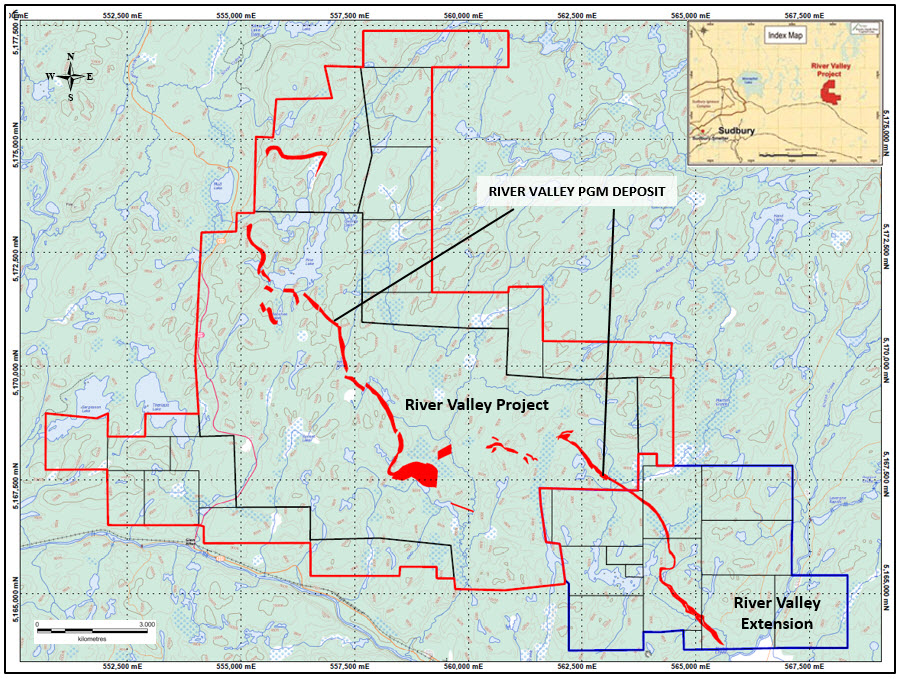
Click Image To View Full Size
Figure 1. Location of NAM’s 100% owned River Valley PGM Project.
This present exploration activity of drilling and geophysics is geared to establish the resource base for a Preliminary Economic Assessment (PEA) Report which the company plans to initialize in the near future.

Click Image To View Full Size
Figure 2. Property scale geological map showing the location of the Pine Zone discovery relative to the Dana North Zone immediately to the west and the Pardo Zone 2 km to the northeast. Note the apparent dextral sense of offset of the River Valley PGM deposit (red) across the Grenville Front Tectonic Zone.
To date an approximate 612 holes (136,574 metres) have been conducted by the company and its past joint venture partners to test the PGM mineralization extents of the River Valley Intrusion. As well, several 43-101 complaint resource estimates have been generated. The River Valley Deposit is the Largest Undeveloped Primary PGM resource in Canada, with 2.5M oz PGM, in Measured Plus Indicated mineral resources and near-surface mineralization covering over 16kms of continuous strike length.
The Company will continue to update investors as the drill results are received.
ABOUT NAM’S PGM DIVISION
NAM’s flagship project is its 100% owned River Valley PGM Project (NAM Website – River Valley Project) in the Sudbury Mining District of Northern Ontario (100 km east of Sudbury, Ontario). Presently the River Valley Project is Canada’s largest primary undeveloped PGM deposit with Measured + Indicated resources of 91 million tonnes @ 0.58 g/t* Palladium, 0.22 g/t Platinum, 0.04 g/t Gold, at a cut-off grade of 0.8 g/t for a PdEq of 2,463,000 ounces PGM plus Gold. The River Valley PGM-Copper-Nickel Sulphide mineralized zones remain open to expansion, and geophysics currently completed and drilling to commence mid July 2017 as part of our ongoing continued exploration.
In 2016, the Company acquired the River Valley extension property from Mustang Minerals which added approximately 4kms to the project’s mineralized strike length.
ABOUT NAM’S LITHIUM DIVISION
The Company has several Hard Rock Lithium Projects in the Winnipeg River Pegmatite Field, located in SE Manitoba. This Pegmatite Field hosts the world class Tanco Pegmatite that has been mined for Tantalum, Cesium and Spodumene (one of the primary Lithium ore minerals) in varying capacities, since 1969. Today, the Tanco Mine is focused on the mining of Pollucite (primary Cesium ore) and the production of Cesium Formate, a completion drilling fluid for the petroleum industry. NAM’s Lithium Projects are strategically situated in this prolific Pegmatite Field. Presently, NAM is the largest mineral claim holder in the Winnipeg River Pegmatite Field and is seeking JV partners to further develop the company’s Li division.
QUALIFIED PERSON
The contents contained herein that relate to Exploration Results or Mineral Resources is based on information compiled, reviewed or prepared by Carey Galeschuk, a consulting geoscientist for New Age Metals. Mr. Galeschuk is the Qualified Person as defined by National Instrument 43-101 and has reviewed and approved the technical content of this news release.
On behalf of the Board of Directors
“Harry Barr”
Harry G. Barr
Chairman and CEO
Neither the TSX Venture Exchange nor its Regulation Services Provider (as that term is defined in the policies of the TSX Venture Exchange) accepts responsibility for the adequacy or accuracy of this release.
Cautionary Note Regarding Forward Looking Statements: This release contains forward-looking statements that involve risks and uncertainties. These statements may differ materially from actual future events or results and are based on current expectations or beliefs. For this purpose, statements of historical fact may be deemed to be forward-looking statements. In addition, forward-looking statements include statements in which the Company uses words such as “continue”, “efforts”, “expect”, “believe”, “anticipate”, “confident”, “intend”, “strategy”, “plan”, “will”, “estimate”, “project”, “goal”, “target”, “prospects”, “optimistic” or similar expressions. These statements by their nature involve risks and uncertainties, and actual results may differ materially depending on a variety of important factors, including, among others, the Company’s ability and continuation of efforts to timely and completely make available adequate current public information, additional or different regulatory and legal requirements and restrictions that may be imposed, and other factors as may be discussed in the documents filed by the Company on SEDAR (www.sedar.com), including the most recent reports that identify important risk factors that could cause actual results to differ from those contained in the forward-looking statements. The Company does not undertake any obligation to review or confirm analysts’ expectations or estimates or to release publicly any revisions to any forward-looking statements to reflect events or circumstances after the date hereof or to reflect the occurrence of unanticipated events. Investors should not place undue reliance on forward-looking statements.