Agoracom Blog Home

Author Archive

Bullion Bank Nightmare as LBMA-COMEX Spread Blows Up Again SPONSOR: Affinity Metals $AAF.ca $SII.ca $TUD.ca $GTT.ca $AMK.ca $OSK.ca $RKR.ca

Posted by AGORACOM at 4:04 PM on Monday, April 13th, 2020
This image has an empty alt attribute; its file name is Affinity_Metals_Corp_Logo.png

Sponsor: Affinity Metals Corp. (TSX-V: AFF) is a Canadian mineral exploration company building a strong portfolio of mineral projects in North America. The Corporation’s flagship property is the drill ready Regal Property near Revelstoke, BC where Affinity Metals is making preparations for a spring drill program to test two large Z-TEM anomalies. Click Here for More Info

  • The gaping price differential between spot gold and gold futures that has been plaguing the paper gold markets in London and New York for the last three weeks shows no signs of abating and is continuing to flare up.
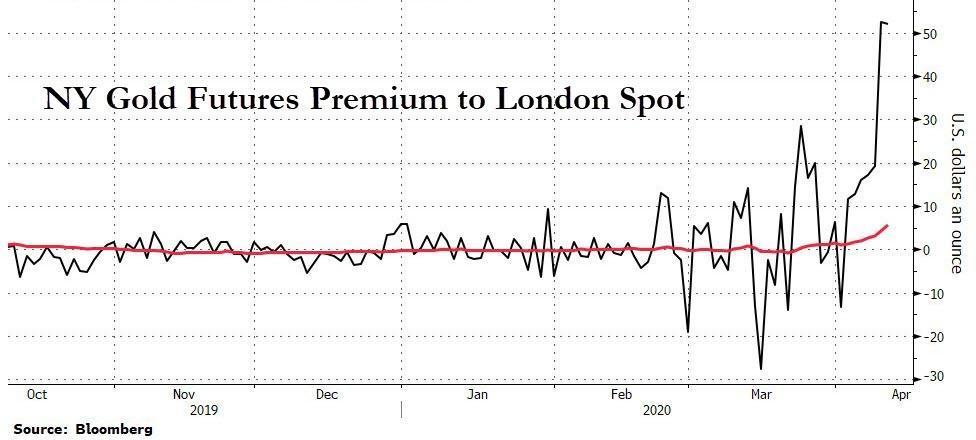
In essence, the contango phenomenon we are seeing is one of gold futures prices trading far above spot gold prices, a sign of liquidity problems in the London gold market and a signal that something is completely broken between the world‘s two predominant â€œgold price discovery” trading venues – which both, by the way, trade paper gold. As a reminder, London LBMA trades unallocated gold over the counter (OTC), a form of synthetic fractional gold derivative. The vast quantities of unallocated gold which are traded in London are then netted and cleared in an electronic clearing engine called Aurum by 5 LBMA bullion banks that comprices London Precious Metals Clearing Limited (LPMCL), namely JP Morgan, HSBC, UBS, Scotia, and ICBC Standard Bank). Allocation of physical gold is a totally separate process beyond clearing in Aurum

COMEX trades predominantly cash-settled gold futures contracts on exchange and facilitates the trading of these contracts bilaterally. COMEX futures are 99.9% cash-settled and even those that result in delivery really result in warehouse warrants changing hands but the gold staying in the New York vaults of JP Morgan, HSBC and Scotia.

That the wide-open spread continues to persist is even more remarkable, despite the best efforts of the London Bullion Market Association (LBMA), CME Group (operator of COMEX) and the powerful London-New York bullion bank syndicate to throw all they have at the problem.

At the time of writing, spot gold was trading at US$ 1696 against US$ 1753 for the front-month (most actively traded) COMEX gold futures contract, a $36 spread with futures over 3.44% over spot. The spread we‘re referring to can be seen in the below 3-day chart, which plots June 2020 gold futures (red and green line) against spot XAUUSD (blue line) from 6 April to 8 April. Notice that over this time the futures price has stayed far above spot, and more importantly, it has persistently done so.
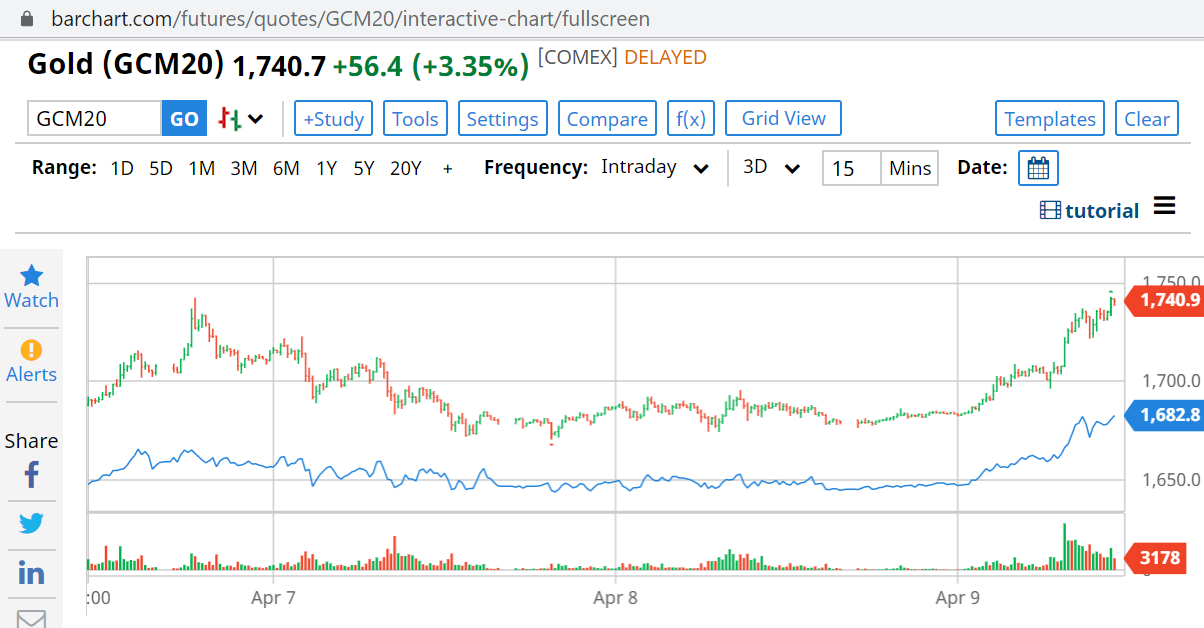
3 day chart of COMEX gold futures price (June 2020) versus LBMA spot gold price, 6 – 9 April 2020. Source: www.barchart.com

The spot-futures spread blow out that has been running into its third week now can vividly be seen by zooming out and looking at a similar chart but this time from 24 March until 9 April, the first day that the price spread between London and New York gaped open. Notice the big gaps between futures and spot over 24-25 March, the persistence of the gap over the remainder of the week, and the subsequent re-explosion of the divergence since early April, particularly over the last few days.
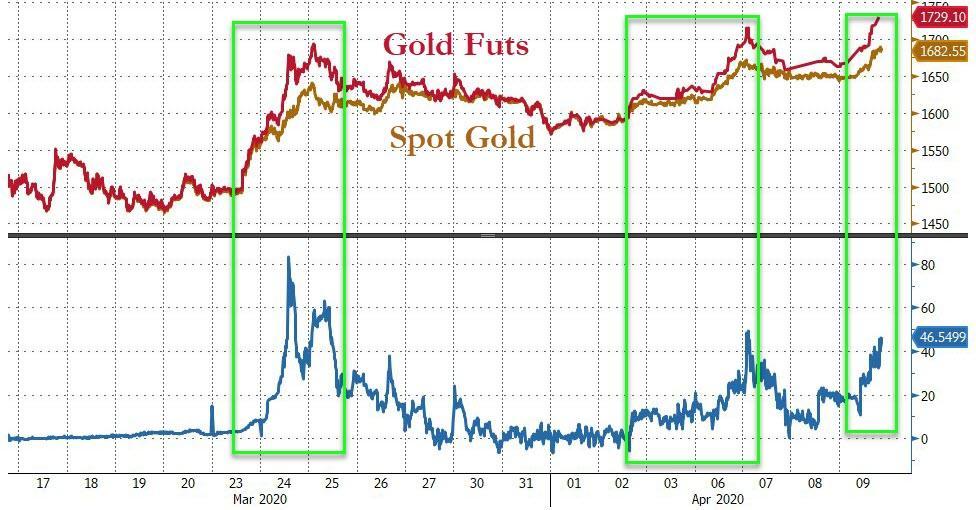
COMEX gold futures price (June 2020) versus LBMA spot gold price; Source: Bloomberg


Three Weeks and Counting

Its instructive to review a short timeline of some of the events which have contributed to this ongoing saga over the last three weeks, because it shows that no matter what the LBMA and CME do, the spread between London and COMEX continues to stay out there.

Week 1

23 March – COMEX gold futures (April contract) begin trading noticeably above LBMA bullion bank spot gold prices.

24 March – Spreads between COMEX futures and London spot blew out to $100 at one point during the day, while bid – ask spreads within London spot widened substantially.

24 March – Rumors in the gold market suggested that bullion banks that were required to deliver physical gold for COMEX Exchange for Physical (EFP) transactions failed to do so, suffered losses and exited the market, and that this caused the Spread between COMEX and London to widen substantially.

The bullion bank controlled LBMA releases its first control statement, deflecting attention away from London, saying it will help (essentially collude with) the CME-COMEX in the gold market – The official language is that the LBMA â€œis working closely with COMEX and other key stakeholders to ensure the efficient running of the global gold market.”

Note – Who are these other key stakeholders, what do they mean by efficient running, and what gives them the right to think they can â€œrun“ the global gold market?

24 March – LBMA and its bullion banks pressure CME to launch a gold futures contract with a deliverable clause in London 400 oz gold bars.

24 March – At end of day, CME announces the launch of a new gold futures contract that can theoretically deliver 400 oz bars, 100 oz bars and kg bars but that uses a fractional paper concept called Accumulated Certificates of Exchange (ACEs) to divide 400 oz deliverable bars into 100 oz bars, and that critically includes all refiner brands on the LBMA Good Delivery List (current and former Good Delivery refiners). This contract will be called 4GC (See here and here).

See BullionStar article “LBMA colludes with the COMEX – To lockdown the global gold market?” for background to the above.

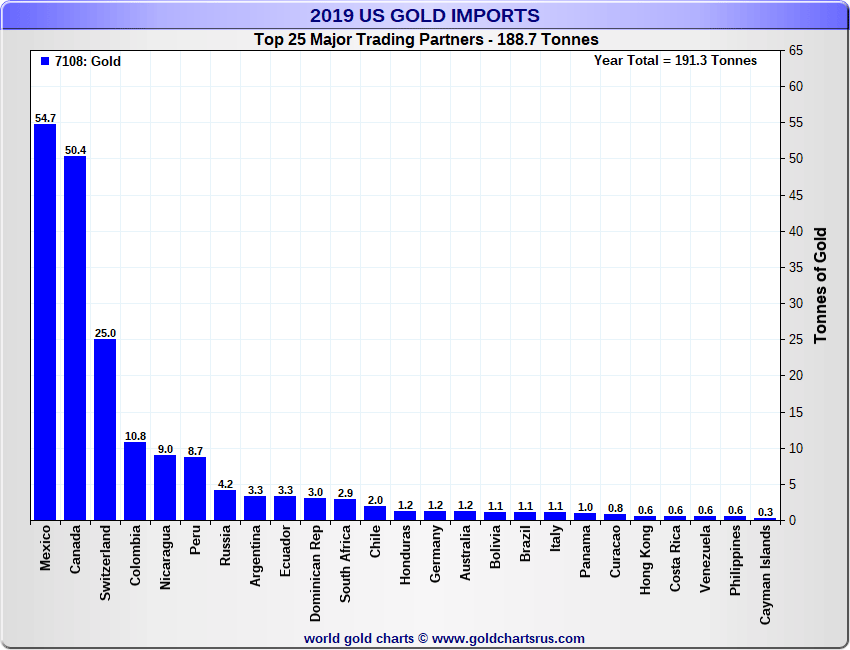
25 March until end of March – For the rest of the week, disinformation from bullion banks to mainstream media about flight cancellations and refinery closures preventing bullion banks delivering gold from London to New York thus causing prices on COMEX and London to diverge. See hereherehere and here for examples. From the below chart you can see that there is never any gold exported from London to New York.Gold imports in the USA, 2019. US DOES NOT import gold from the UK, despite what Reuters parrots without checking facts. Source: www.GoldChartsRUs.com


Week 2

30 March – CME published its daily gold vault stocks report (for Friday 27 March) with a new category for “400 oz AND eligible brands”, but with all vaults showing zero stocks of 400 oz gold bars. And notably, that the JP Morgan vault in New York had zero holdings.

30 March – When Bullionstar draws attention to this new CME vault report,  in “COMEX can’t find a 400 oz bar for its new 400 oz gold futures contract“, the CME then deletes the new report from its website on the morning of 31 March,  and replaces it intra-day with a report which reverted to the original version.

1 April – LBMA and CME publish an unprecedented second control statement titled “LBMA and CME group comment on healthy gold stocks in New York and London”, saying that “CME Group and LBMA..will continue to coordinate efforts as market circumstances evolve”. See “LBMA and COMEX try to Reassure the Market – Twice in One Week“ for background.

Note – If LBMA and CME are trading gold bars, why would they need to coordinate efforts, and more importantly, coordinate efforts to what end?

LBMA disingenuously refers to 8326 tonnes of gold in London, a figure that is from 3 months ago, and nearly all of this total tonnage is central bank gold, gold held in ETFs, and allocated gold held by other investors. The real float of physical gold in the london LBMA gold vaults controlled by the LBMA bullion banks is less than 1000 tonnes and some estimates from sources in the bullion banks say it could be between 300 and 500 tonnes.

In the same statement, CME refers to 9.2 million ozs ( 287 tonnes) of gold held in its approved vaults, with irrelevant claims that 5.6 million ozs of this is eligible gold. Eligible gold is gold which just happens to be in the form that satisfies the deliverable unit of the contracts (1 kg bars or 100 oz bars). The rest of this figure is registered gold, which already has warehouse warrants attached.

2 April – The spread between COMEX gold futures prices and London spot gold prices starts to gap up strongly again.

Rest of week – CME Group releases publicly a PowerPoint slide presentation titled â€œPrecious Metals Physical Delivery Process”, which includes the new 4GC contract and explains how to get an electronic warrant if standing for delivery of COMEX gold futures contracts, but that explains nothing about withdrawing gold from the COMEX vaults.

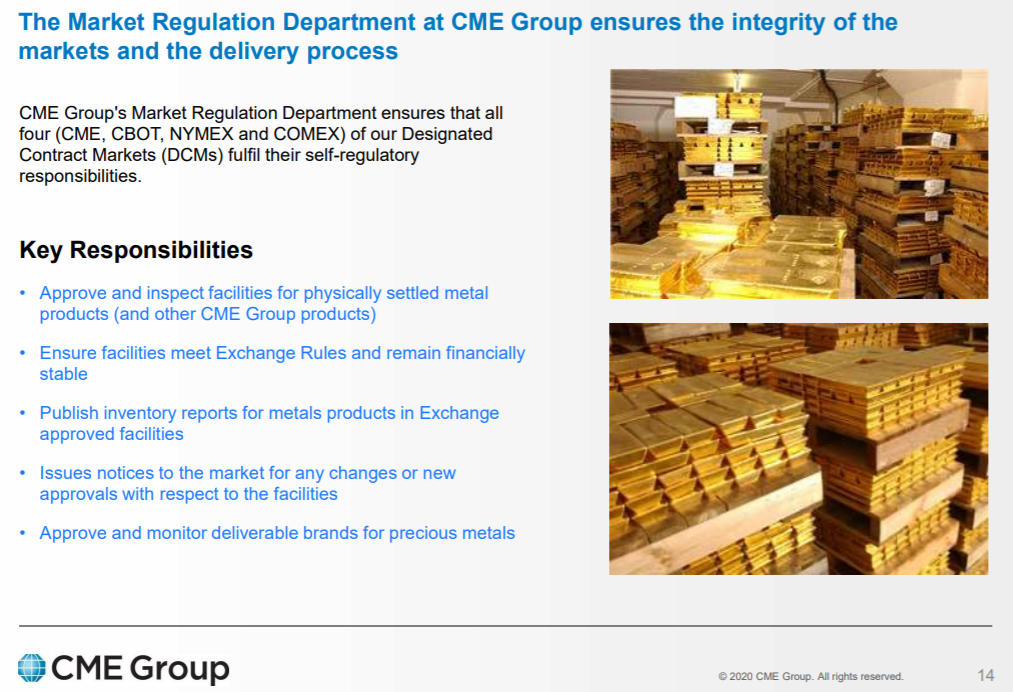
The COMEX presentation also features a slide discussing the COMEX New York approved vaults but unbelievably instead of showing photos of one of its approved New York vaults, this slide contains photos of a HSBC gold vault in London showing gold bars belonging to the exchange traded fund, the SPDR Gold Trust (GLD). This GLD gold has nothing to do with COMEX gold vaults in New York (or does it?).

COMEX presentation slide uses photos of a HSBC gold vault in London featuring SPDR Gold Trust gold bars

Week 3

6 April – The spread between the COMEX June gold futures contract and the LBMA spot gold price blows out again very widely to over $80 at one point in the day.

6 April – CME adds back the category “Enhanced Delivery (400 oz AND eligible brands)” to its New York daily vault report. Of the 9 vaults on the report, 5 have 0 holdings in this 400 oz category, 2 (Brinks & Loomis) have a combined 2 tonnes, HSBC claims 21.5 tonnes, JP Morgan appears for the second time, claiming 126.8 tonnes. The first time being 30 January when JP Morgan was listed as having zero tonnes of 400 oz bars.

Note – “400 oz AND Eligible Brands” will be the subject of another article soon, but for now it means as follows. For the new 4GC contract, CME added all LBMA Good Delivery gold bar Brands (Current and Former) as Eligible brands. That’s 68 brands from the existing GC100 contract + 71 brands from the LBMA current Good Delivery List  + another 113 LBMA former Good Delivery List As another aside, where did the JP Morgan New York vault suddenly get 126.8 tonnes of gold suddenly to add to Eligible category for the COMEX 4 GC contract? Was this 126.8 tonnes of gold suddenly shipped in to the JP Morgan vault from London? Hardly. Were 126.8 of London Good Delivery gold bars already sitting in its New York vault. Probably not as its London and not New York which is the center of 400 oz gold bar storage. Was there some type of gold swap involved between London and New York. Possibly.

Another intriguing possibility is that now that former LBMA Good Delivery List gold bars are eligible for the new 400 oz contract, that JP Morgan borrowed Old US Assay Office gold bars from the New York Fed (their two gold vaults are beside each other), and then added these to the Eligible category for the new 4GC gold contract.

Root Cause of Spot vs Futures Gold Price Discrepancy

So what is the cause of this dislocation in pricing between the lower ‘spot’ price and the higher ‘futures’ price, i.e. between the London LBMA gold spot market and the New York COMEX gold futures market? The answer in general is that the problem is with the spot price. And where is the spot price? London.

Ironically, the LBMA bullion banks are trying to shift the attention away from London, when London is exactly where the problem is. The spot price problem appears to be due to liquidity problems of the LBMA market makers in London where they are suspicious of trading with each other. This is despite the fact that these LBMA market makers are obliged to constantly make a market and offer two way price quotations to each other. These market makers are BNP Paribas, Citibank, Goldman Sachs, HSBC, ICBC Standard, JP Morgan Chase, Merrill Lynch, Morgan Stanley, Standard Chartered, Bank of Nova Scotia, Toronto-Dominion and UBS.

The spot price problem has nothing to do with air travel cancellations or shipments of 100 oz gold bars from London to New York. These market makers do not make markets in physical gold. The unit of trading in London is not real gold anyway, its unallocated gold or gold credit which is issued by a bullion bank and which has counterparty risk.

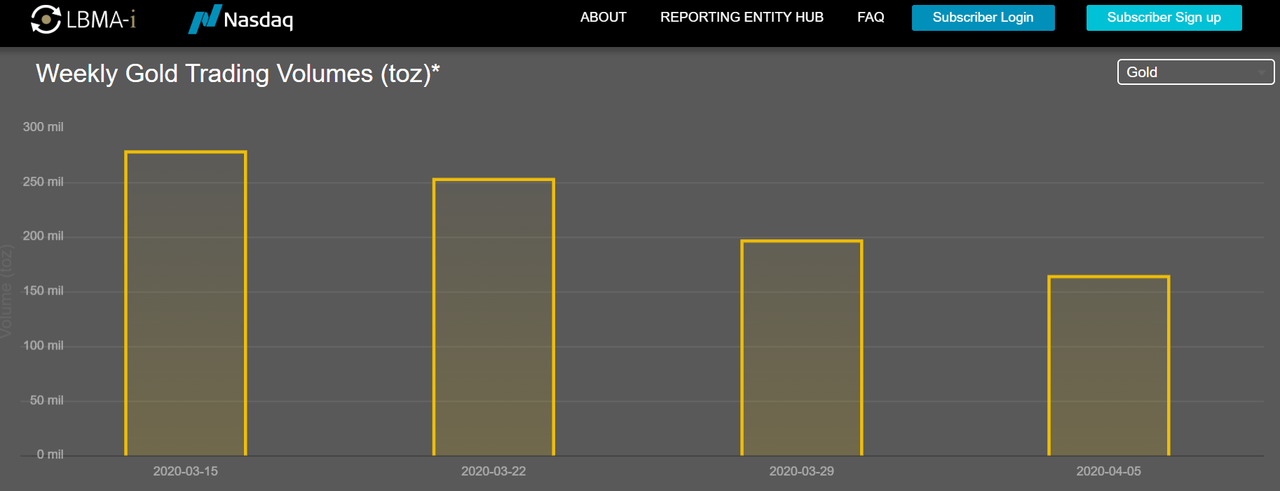
Something has spooked these market makers and caused a drop in liquidity in the London market. These banks, which normally trade with each other, now do not want to trade with each other due to heightened counterparty risk. Unallocated trading volumes in the London gold market have fallen over the last three weeks. See chart below.LBMA – Unallocated gold trading volumes, week-to-week, last 4 weeks to 5th April. Source: www.lbma-i.com

Likewise, according to Bloomberg, COMEX gold futures trading volume last week was 80.6 million ounces, a 72% drop compared to the end of February. From the same Bloomberg article, there is an intriguing and obviously dramatic quote from commodities broker Marex Spectron, saying:

“You have a bunch of shell-shocked market makers who are literally hiding under their desks and do not and possibly can not make markets in any size, shape or form,” said David Govett, head of precious metals trading at Marex Spectron. “Hence we have the lack of liquidity, the small volumes and the wide spreads.”

Marex is a broker for EFPs, so maybe the LBMA market makers are not answering calls. Then they are failing in their duty and obligations as market makers. But why would market makers not want to trade and how does this relate to EFP spreads? If banks suffered EFP problems and then the EFP spread between London and New York blew up, and then they use the excuse that the EFP spread is too large for them to make a market in spot because they don’t want to take on risk, then that’s just circular logic and a pathetic excuse. But what causes LBMA market makers to become shell shocked and literally hide under their desks?

Could it be that the gold trading activities of some of these LBMA bullion banks have blown up and they have ceased their market making activities, but have not publicly stated this, and covered it up? Stranger things have happened. All the while, as trading volumes continue to fall in the paper gold markets of London and New York, the opposite is the case in physical gold markets, where BullionStar and other bullion dealers – those that continue to have inventory – see unprecedented demand and increasing trading volumes.

SOURCE:BullionStar.com website with the same title “Bullion Bank Nightmare as LBMA-COMEX Spread Blows Up Again“.


Excess Money Supply Has Been Like Miracle-Gro For Gold Prices SPONSOR: Loncor Resources $LN.ca $ABX.ca $TECK.ca $RSG $NGT.to $GOLD $NEM

Posted by AGORACOM at 10:19 AM on Thursday, April 9th, 2020

Sponsor: Loncor, a Canadian gold explorer controlling over 2,400,000 high grade ounces outside of a Barrick JV. The Ngayu JV property is 200km southwest of the Kibali gold mine, operated by Barrick, which produced 800,000 ounces of gold in 2018. Barrick manages and funds exploration at the Ngayu project until the completion of a pre-feasibility study on any gold discovery meeting their Tier One investment criteria. Newmont $NGT $NEM owns 7.8%, Resolute $RSG owns 27% Click Here for More Info

This image has an empty alt attribute; its file name is Loncor-Small-Square.png
  • 285 stimulus measures have been announced around the world in the past eight months
  • Japan, which only this week declared a state of emergency, approved a $1 trillion relief package

The $2.2 trillion coronavirus relief package that President Donald Trump signed into law on March 27 is just the beginning. The Treasury Department is now seeking some $250 billion more to replenish small business loans, and there’s hope that the president and House Democrats can agree on a “Phase Four” spending deal, one that may target infrastructure. Trump has asked for $2 trillion.

And that’s just the U.S.

According to Evercore ISI’s Ed Hyman, as many as 285 stimulus measures have been announced around the world in the past eight months, “the most ever by a wide margin.” Japan, which only this week declared a state of emergency, approved a $1 trillion relief package on Tuesday.

Last month I predicted that at least $10 trillion would be spent to mitigate the economic impact of this virus, and it appears as though we’re already there, with much more to go. And this is all before considering monetary stimulus in the form of near-zero rates and quantitative easing (QE).

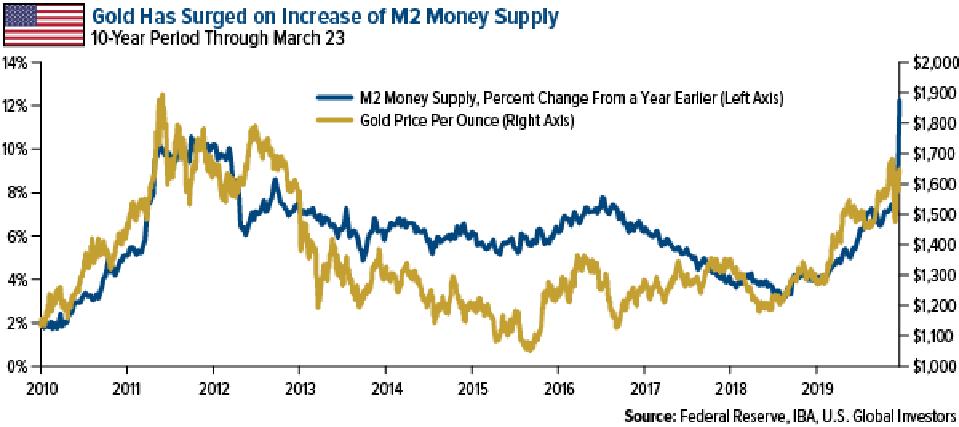
The U.S. economy is being flooded with excess money and liquidity right now. Compared to the same period a year ago, M2 money supply––which includes not just cash but also savings deposits, money market funds and other “near” money––has increased some 12 percent, the most in more than 10 years.

Money Supply Flowing Into Physical Gold

All this excess liquidity has to go somewhere, and historically it’s acted as Miracle-Gro for gold prices. Look at the chart below. There’s a clear correlation between the annual growth rate in M2 money supply and the price of the yellow metal. In the times when money supply surged from the same period a year earlier, gold prices followed.

Gold touched its all-time high of $1,900 an ounce in 2011 when M2 money supply growth soared above 10 percent year-over-year. With supply growth now at 12 percent––and likely headed higher––liquidity has flowed into physical gold as well as paper gold. On Monday, spot gold traded above $1,700 for the first time since December 2012. The next test, I believe, is $2,000, and as I’ve said before, $10,000 gold isn’t crazy.

Gold ETF Inflows Smash Records

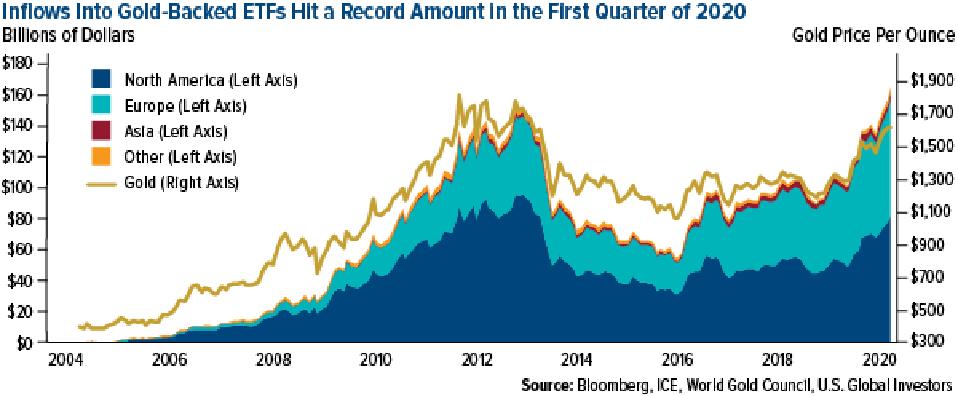
Global exchange-traded funds (ETFs) backed by physical gold notched a new all-time record in the first quarter of 2020, attracting 298 metric tons, or net inflows of $23 billion, for a total of more than $164 billion, according to a report by the World Gold Council (WGC). That’s the highest ever in U.S. dollar terms for a quarter and the most in tonnage terms since the first quarter of 2016, after the start of the current

U.S. Global Investors

The WGC expects the recent drivers of gold to persist, including “widespread market uncertainty and the improved opportunity cost of holding gold as yields move lower.”

“With the Fed taking interest rates to zero for the foreseeable future, gold could do well as it tends to outperform during easing cycles,” the group writes. “Additionally, multi-trillion dollar fiscal stimulus policies to combat the economic impact of COVID-19 could prove inflationary––a development that could support gold prices in the long run.”

So far inflation in the U.S. has been moderate, despite earlier expectations that Trump’s tariffs and the U.S.-China trade war would push up consumer prices. But I agree that the global $10 trillion+ stimulus effort will have a noticeable impact on the prices of goods and services, which could be constructive for gold.

Precious Metal Royalty and Streaming Companies Have the Cushion to Weather the Coronavirus

There are other ways to get exposure to gold and precious metals, of course. I believe the best way is with royalty and streaming companies, led by heavyweights Franco-Nevada, Wheaton Precious Metals and Royal Gold, with a combined market cap of close to $40 billion as of April 7.

These companies, as I’ve shared with you many times before, are not the ones spending money to develop a project. They simply put up the capital, and in exchange, they enjoy either a royalty on whatever the miner produces or rights to a stream of metal supply at a fixed, lower-than-average cost.

While they enjoy a lot of the upside potential when gold prices are rising, royalty companies share very little of the downside potential with producers and explorers when the metal is in decline. Royalty companies are better insulated from bear markets because they have a diversity of high-quality active mines in their portfolio.

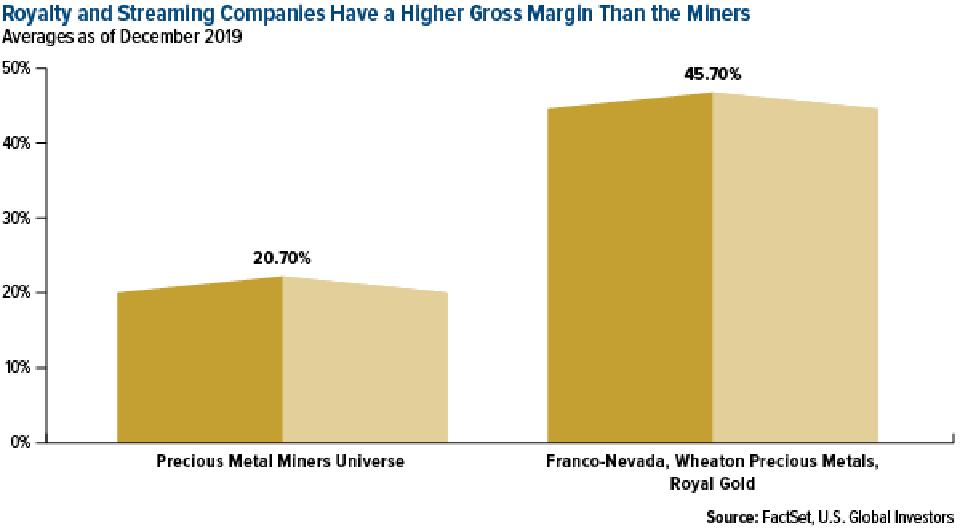
The superiority of their business model can be seen in the chart below. Whereas the universe of publicly traded precious metal miners had an average gross profit margin of 20.7 percent as of December 2019, the three top royalty and streaming companies had one of 45.7 percent, or more than twice the amount. This, I believe, gives them an adequate cushion to weather the coronavirus downturn.

U.S. Global Investors

For full disclosures pertaining to this post click here.

SOURCE: https://www.forbes.com/sites/greatspeculations/2020/04/08/excess-money-supply-has-been-like-miracle-gro-for-gold-prices/#30566fb6be41

Green Transportation, From Electric Cars to Walkable Cities SPONSOR: Lomiko Metals $LMR.ca $CJC.ca $SRG.ca $NGC.ca $LLG.ca $GPH.ca $NOU.ca

Posted by AGORACOM at 12:29 PM on Wednesday, April 8th, 2020

SPONSOR: Lomiko Metals is focused on the exploration and development of minerals for the new green economy such as lithium and graphite. Lomiko owns 80% of the high-grade La Loutre graphite Property, Lac Des Iles Graphite Property and the 100% owned Quatre Milles Graphite Property. Lomiko is uniquely poised to supply the growing EV battery market. Click Here For More Information

https://grist.files.wordpress.com/2020/04/grist-edu-transpo-1.jpg?w=1024&h=576&crop=1

The transportation sector is one of the biggest reasons why the average temperature on our planet is climbing, a phenomenon you probably know as climate change. In the United States, transportation contributes about a third of the carbon dioxide, or CO2, that the country releases into the atmosphere where it traps heat and causes temperatures to rise. Every year, Americans produce about 1.9 billion metric tons of carbon dioxide from driving cars, flying in planes, and shipping things by road, sea, rail, and air all over the country. That’s the weight of more than 20,000 Washington Monuments.

https://grist.files.wordpress.com/2020/03/transportation-1.jpg

We want to get that 1.9 billion number closer to zero as soon as possible. But we still need ways to get people and products from one part of the country to another. How do we change the way we move ourselves and our things so that we create fewer planet-warming emissions?

Grist has put together some introductory videos and activities to help you understand some of the ways the transportation sector might go green.

Electric Cars

Electric vehicles are an exciting alternative to the traditional, gas-guzzling, combustion-powered cars. Instead of filling up at the gas station, you simply plug your car into an electric socket and charge the car’s battery. In the past decade, electric cars have gotten better, cheaper, and more popular.

So is an electric car right for your family? It all depends on where you live, how you gets around, and what your family can afford.

Activities:

Research: Look up and see if there are electric vehicle charging stations in your area. If you live in an area where there are very few charging stations, it might be difficult to imagine owning an electric car. Think about all the car trips you normally make: school, work, grocery shopping, even weekend trips and vacations. If your electric car could go 100 miles on a charge, could you still easily make most of these trips?

Do: The “greenness” of your electric vehicle depends on how your region generates electricity. You can find out by typing your ZIP code into the “power profiler” sidebar on this Environmental Protection Agency web page. It will tell you how many pounds of carbon dioxide it takes to produce a megawatt-hour of electricity — the energy equivalent of about 28 gallons of gasoline. We can use this number to compare whether an electric car is better than a gas car in your city.

For our comparison, we’re going to use a 2020 Honda Civic as our gas-powered car, and a 2020 Nissan Leaf as our electric car.

https://grist.files.wordpress.com/2020/03/math6.png?w=1200
So … which car produces more CO2 in your city?
Discuss: Would an electric car work with your family’s budget and driving habits? Why or why not?

Walkable Cities

Have you ever gotten in the car only to drive a few blocks away? You’re not alone. Americans take a lot of unnecessary car trips. If we could get more people to take the bus, hop on a bike, or simply walk more, we could shave off a big chunk of the U.S.’s transportation-related emissions.

Some neighborhoods are less walkable than others. If you live near a busy road or in a neighborhood far from your favorite hangouts, it can be inconvenient or even dangerous to walk. To get more people out of their cars and walking, we need to think about how our neighborhoods are designed.

Activities:

Research: Look up your address on the Walk Score website. This will give you a ranking based on how easy it is to walk to nearby stores, schools, or parks. If you click “About your score,” you can see which categories your home scores low and high on.

What’s your score? Do you agree with this assessment? Why or why not?

Discuss: Think about all the places you go on a regular basis. Where do you shop for groceries, eat food, or watch movies? What parks do you like to visit? Can you find any alternate places to do these activities that are within walking distance?

Bikes

Bikes are fun, healthy, and climate-friendly forms of transportation. But not everyone owns a bike — or it can be impractical to lug one along for certain types of trips. In some cities, companies offer bikes on the sidewalk that you can just hop on and ride.

Activities:

Research: How does the built environment make people more or less likely to bike? Look up your neighborhood’s Bike Score. This tool grades each neighborhood’s bike-ability based on four factors: safe infrastructure (like bike lanes), hills, the number of gathering places within biking distance, and how many of your neighbors also ride bikes.

Observe: Does your neighborhood have bike lanes? Would you feel safe riding a bike in your neighborhood? How many of your favorite destinations — like parks, restaurants, stores, or museums — are within biking distance? Does your neighborhood have a lot of hills? If it does, would a rentable e-bike make you more likely to ride? The Bike Score website believes that it’s safer to ride on streets that have a lot of bike traffic already. Do you see people riding bikes in your neighborhood?

Discuss: Does your city have a bikeshare or short-term rental program? What are some trips you would take using a bike you own or could rent?

Do: Plan a fun fantasy trip you could take on a bike. Where would you want to go? What would you need to bring? How much time would you need?

Trains

Trains have been around for nearly two centuries, and they’re a promising solution for cutting the country’s transportation emissions. They’re also pretty efficient — meaning they only use a little bit of fuel to carry each rider. Some trains even run on electricity.

But in the United States, our trains are pretty slow and outdated. Can we fix them?

Activities:

Research: Think about the most recent plane trips you have taken. Would it have been possible to take the train instead? How much time would it take? How much would it cost?

Discuss: What might make you want to take a train over a plane? How would you make a train trip a more desirable option compared to an airplane flight?

SOURCE: https://grist.org/climate/lesson-plan-transportation-climate-electric-vehicles/

Gold in $1,700 Flight, Joining Wall Street’s Virus Rally for Different Reason SPONSOR: Labrador Gold $LAB.ca $RIO.ca $WHM.ca $SIC.ca $NXS.ca

Posted by AGORACOM at 11:52 AM on Wednesday, April 8th, 2020

SPONSOR: Labrador Gold – Two successful gold explorers lead the way in the Labrador gold rush targeting the under-explored gold potential of the province. Exploration has already outlined district scale gold on two projects, including a 40km strike length of the Florence Lake greenstone belt, one of two greenstone belts covered by the Hopedale Project. Recently acquired 14km of the potential extension of the new discovery by New Found Gold’s Queensway project to the south. Click Here for More Info

  • The virus is triggering huge physical demand for gold

They’re both rallying on the same thing. One is gaining on a negative spin and the other on a positive narrative. Gold cracked the $1,700 ceiling on Monday as global anxiety over the Covid-19 pandemic, its impact on economies and inflation widened. Wall Street, meanwhile, jumped on signs of some U.S. relief from the coronavirus.

“It’s like two tales of the same virus,” said Tariq Zahir, a proprietary gold trader at Tyche Capital Advisors in New York. “One is perpetuating fear that’s causing an accumulation of the safe haven called gold. The other is giving hope to equity markets that the U.S. may be getting some break from the pandemic, though it’s very very early in the day to say that.”

Gold futures on New York’s COMEX settled up $48.20, or 3%, at $1,693.90 per ounce. It hit $1,709.50 at the session high. The $1,700 level has been a rather important resistance mark for the yellow metal, which broke it only twice earlier this year, the first time in January and then in March. In both cases, gold futures fell back soon after the test.

Monday’s rally marked the fourth-straight day of gains for COMEX gold, which has gained just over $100 an ounce or 6% in that period. 

Spot gold, which tracks live trades in bullion, was up $41.64, or 2.6%, at $1,659.98 by 3:00 PM ET (19:00 GMT). 

“The virus is triggering huge physical demand for gold,” said Phillip Streible at Blueline Futures in Chicago. “Currencies around the world are being devalued right now because everyone is engaging in massive stimulus programs in order for their economies to be safe. So, the supply of gold is being attacked from all angles.”

“And don’t forget the trickle effect of all that money on inflation and gold as the best known instrument to hedge that,” Streible added.

The United States has passed a $2 trillion stimulus package to fight the pandemic and is considering another package, with White House Economic Adviser Larry Kudlow acknowledging on Monday renewed calls for a multi-trillion-dollar “Coronavirus Bond”.

On Wall Street, the Dow was up more than 1,200 points, or 6%, or  as new data from New York, the epicenter of the U.S. coronavirus, suggested the state may be peaking on infections from the pandemic, though the daily death toll remains alarmingly high.

SOURCE: https://finance.yahoo.com/news/gold-1-700-flight-joining-151715366.html

Mota Ventures $MOTA.ca Acquires Interest in Folium Life Sciences $APH.ca $GBLX $PFE $ACG.ca $ACB.ca $WEED.ca $HIP.ca $WMD.ca $CGRW

Posted by AGORACOM at 8:25 AM on Wednesday, April 8th, 2020
Mota large
  • Folium is a Health Canada licensed cannabis cultivator with facilities located on Vancouver Island.
  • Folium is nearing completion of the expansion of its existing cultivation facility, a further phase 2 expansion of the facility is expected.

VANCOUVER, BC / April 8, 2020 / Mota Ventures Corp. (CSE:MOTA)(FSE:1WZ1)(OTCPINK:PEMTF) (the “Company“) is pleased to announce that it has acquired (the “Acquisition“) all of the outstanding share capital of 1244780 B.C. Ltd. (the “Target“). The Acquisition was completed pursuant to a share exchange agreement (the “Purchase Agreement“), dated April 7, 2020, and entered into with an arms-length third-party (the “Vendor“). The sole asset of the Target consists of a 20% equity interest in Folium Life Sciences Inc. (“Folium“), which is in the process of developing a licensed indoor cannabis production facility located on Vancouver Island. In consideration for the Acquisition, the Company has issued 21,000,000 common shares.

Folium is a Health Canada licensed cannabis cultivator with facilities located on Vancouver Island. Folium is nearing completion of the expansion of its existing cultivation facility. Its business plan calls for a further phase 2 expansion of the facility. Folium aims to produce a high quality and consistent cannabis product through its facilities.

“Canada has been a pioneer in legalization and early adoption of cannabis for both recreational and medical purposes. This equity position in a well-capitalized licensed producer provides Mota with a sound financial investment in the sector.” stated Ryan Hoggan, CEO of the Company.

Each of the Vendor, the Target, and Folium are at arms-length from the Company. The Acquisition does not constitute a fundamental change for the Company, nor has it resulted in a change of control of the Company within the meaning of applicable securities laws and the policies of the Canadian Securities Exchange. In connection with completion of the Acquisition, the Company has issued 210,000 common shares (the “Administrative Fee Shares“) to a consultant who assisted with the Acquisition.

About Mota Ventures Corp.

Mota Ventures is seeking to become a vertically integrated global CBD brand. Its plan is to cultivate and extract CBD into high-quality value-added products from its Latin American operations and distribute it both domestically and internationally. Its existing operations in Colombia consist of a 2.5-hectare site that has optimal year-round growing conditions and access to all necessary infrastructure. Mota is looking to establish sales channels and a distribution network internationally through the acquisition of the Sativida and First Class CBD brands. Low cost production, coupled with international, direct to customer sales channels will provide the foundation for the success of Mota Ventures.

ON BEHALF OF THE BOARD OF DIRECTORS
MOTA VENTURES CORP.

Joel Shacker
President

For further information, readers are encouraged to contact Joel Shacker, President, at +604.423.4733 or by email at [email protected] or www.motaventuresco.com

Coronavirus To Fuel Gold-Miner Deals: Barrick Gold CEO SPONSOR: Loncor Resources $LN.ca $ABX.ca $TECK.ca $RSG $NGT.to $GOLD $NEM

Posted by AGORACOM at 1:35 PM on Tuesday, April 7th, 2020

Sponsor: Loncor, a Canadian gold explorer controlling over 2,400,000 high grade ounces outside of a Barrick JV. The Ngayu JV property is 200km southwest of the Kibali gold mine, operated by Barrick, which produced 800,000 ounces of gold in 2018. Barrick manages and funds exploration at the Ngayu project until the completion of a pre-feasibility study on any gold discovery meeting their Tier One investment criteria. Newmont $NGT $NEM owns 7.8%, Resolute $RSG owns 27% Click Here for More Info

This image has an empty alt attribute; its file name is Loncor-Small-Square.png
  • There’s a real opportunity that there might be some acquisition options coming out of this,” Bristow told FOX Business. “We’re certainly keeping very busy looking at those options.”

The COVID-19 pandemic could lead to a flurry of deals in the gold mining industry, according to Barrick Gold CEO Mark Bristow.

The pandemic has caused some miners to put operations on care and maintenance, shrinking gold supplies. At the same time, major central banks and governments have been injecting cash into their economies, devaluing their currencies and spiking interest in gold, a traditional safe haven.

“There’s a real opportunity that there might be some acquisition options coming out of this,” Bristow told FOX Business. “We’re certainly keeping very busy looking at those options.”

All of this comes as gold is seeing a declining reserve base due to miners not investing in their future and production forecasts pointing to a 20 percent to 30 percent decline in new gold supply over the next 10 years.

The gold mining industry has 14 so-called tier-one assets, according to Bristow, and Barrick already has six of them, including three in Nevada, two in Africa and one in the Dominican Republic. The company has a handful of other assets that are on the verge of becoming tier one, which refers to mines that have produced more than 500,000 ounces of gold per year for at least 10 years at the lower half of the cost curve.

Bristow says the opportunity created by the COVID-19 pandemic is similar to what happened following the 2008 global financial crisis when miners found themselves in an environment that was ripe for deals as the price of gold surged from about $700 per ounce to $1,900 before collapsing and leaving a trail of destruction.

“You’ve got to be careful that you don’t blow your brains out like the industry did between 2009 and the run-up to the peak in 2012,” Bristow said.

The VanEck Vectors Gold Miner ETF hit a peak market capitalization of $10.79 billion in September 2011 before falling to below $4 billion in January 2016.

The value of mergers and acquisitions in the gold industry increased by 45 percent to $18.2 billion in 2019, according to a report released in February by the consultancy Metals Focus. That number was 43 percent below the 2010 peak of $32.2 billion, the report said.

Even with the coronavirus, Bristow says the Toronto-based Barrick, the world’s No. 2 gold miner, aims to become the “most valued gold company” and will continue to acquire “best-in-class assets,” according to Bristow, as well as hire the best people.

“That always delivers superior returns,” he said.

The company recently released its 10-year plan, which sets out a path to reach 5 million ounces of annual production with its current resources.

Should Barrick make any new acquisitions or discover more gold, it would build on that foundation of 5 million ounces. The icing on the cake for the company may be the price of the yellow metal itself. “At these gold prices, we’re in very good shape because we’ve allocated and invested and built our business based on a long term gold price of $1,200,” Bristow said.

Gold this year has gained more than 10 percent and is hovering around $1,677 an ounce.

SOURCE: https://finance.yahoo.com/news/coronavirus-fuel-gold-miner-deals-111049052.html

GM and Honda are Co-Producing Two Latest Electric Vehicles Set To Come In 2024 SPONSOR: Lomiko Metals $LMR.ca $CJC.ca $SRG.ca $NGC.ca $LLG.ca $GPH.ca $NOU.ca

Posted by AGORACOM at 5:34 PM on Monday, April 6th, 2020

SPONSOR: Lomiko Metals is focused on the exploration and development of minerals for the new green economy such as lithium and graphite. Lomiko owns 80% of the high-grade La Loutre graphite Property, Lac Des Iles Graphite Property and the 100% owned Quatre Milles Graphite Property. Lomiko is uniquely poised to supply the growing EV battery market. Click Here For More Information

  • GM and Honda will mutually produce two new electric vehicles ready for 2024, the latest move by both the automakers to develop their current partnership.

Who Will Create What 

Following the Plan, the automakers will concentrate on their particular fields of expertise. 

Honda will create the exterior and interiors of the latest electric vehicles; GM will provide its new electric vehicle construction and Ultium batteries. 

This latest architecture, which GM revealed last month to showcase its EV plans, is competent of 19 distinctive battery and drive-unit configurations. 

The architecture involves large-format sack battery cells produced as part of a mutual venture among LG Chem and GM.

The vehicles that will have a Honda nameplate will include GM’s OnStar security and safety services. 

GM’s hands-free high-level driver support technology, identified as Super Cruise, will also be accessible in the new vehicles.

The vehicles will be manufactured at GM factories in North America. 

Transactions are assumed to start in the 2024 model year in Honda’s U.S. and Canadian stores.

The firms have a deep history of operating together, plus sharing vehicles in the late 1990s when Isuzu was a member of GM. 

The majority of the collective projects have focused on hydrogen fuel cell tech, batteries and now lately, autonomous vehicles.

Past Ventures

GM and Honda developed a vital partnership in July 2013 to produce hydrogen fuel cell technology, an alliance that has created some 1,200 patents. 

The automakers established a shared venture in 2017 named Fuel Cell System Manufacturing LLC to build hydrogen fuel cell systems. 

The firms declared in 2018 an agreement for Honda to utilise battery cells and models from GM in electric vehicles manufactured for the North American market.

GM obtained Cruise in 2016; Honda later pledged $2.75 billion as a part of an elite deal with GM and its self-driving technology subsidiary Cruise to produce and develop a different type of autonomous vehicle. 

Source: https://itmunch.com/gm-and-honda-are-co-producing-two-latest-electric-vehicles-set-to-come-in-2024/

Cannabis Expo London 2020 – Experience the Europe Canna Expo SPONSOR: Mota Ventures $MOTA.ca $APH.ca $GBLX $PFE $ACG.ca $ACB.ca $WEED.ca $HIP.ca $WMD.ca $CGRW

Posted by AGORACOM at 4:36 PM on Monday, April 6th, 2020

SPONSOR: Mota is seeking to become a vertically integrated global CBD brand. Mota is looking to establish sales channels and a distribution network internationally through the acquisition of the Sativida and First Class CBD brands. Low cost production, coupled with international, direct to customer sales channels will provide the foundation for the success of Mota. Combined total sales of almost $29,000,000 with a EBITDA of approximately 12.5% (2019) . Click Here for More Info

Mota large

With the current climate of social distancing and uncertainty, it’s no surprise that events have been forced to cancel or postpone left, right, and centre. Despite the disruption caused by the Coronavirus pandemic, some organisers are persevering with their plans – at least for the time being. One of those events is the Europe Canna Expo, set to take place in  London in July.

The Europe Canna Expo (ECE) is scheduled to make a return to London for a 2-day event on 26-27 July. Following the success of last year’s Europe CBD expo at the same location, the ECE will aim to bring together over 90 speakers and 125 exhibitors.

The Venue

The ECE is set to make a return to the London ExCel Centre in Canning Town East London. The event was held at the venue in July 2019, with an array of exhibitors and speakers. This year, the Europe Canna Expo is expected to be even bigger. However, uncertainty remains over the event.

The ExCel Centre is currently home to the temporary Nightingale hospital – the improvised care centre for victims of the Coronavirus. It remains unclear when the need for the venue will be over as the UK’s Coronavirus lockdown continues.

Exhibitors and Speakers

However, should the expo go on as planned, attendees will be spoilt for choice with speakers and professionals set to provide insights into the CBD, cannabinoid, and medical cannabis industries. In addition, the event will be present a huge number of exhibitors including a variety of manufacturers and businesses.

Speakers will include international experts showcasing senior-level insights and global scientific research in the CBD, cannabinoid and medical cannabis sectors. Organisers of the event expect that attendees will include consumers and businesses, as well as policymakers and press.

The event will provide an opportunity for global leading brands to showcase their products to thousands of attendees. From CBD drinks and chocolates to medicinal products, the Europe Canna Expo plans to present the most innovative international brands.

Event Schedule

The ECE organisers are yet to release a detailed schedule for the two-day cannabis expo. This may be due to the ongoing uncertainty surrounding the Coronavirus lockdown. For more information and up-to-date announcements, visit the ECE London website.

https://canex.co.uk/cannabis-expo-2020-europe-canna-expo-london/

Gold and Silver Mines Closed as Physical Silver Becomes “Most Undervalued Asset” SPONSOR: Affinity Metals $AAF.ca $SII.ca $TUD.ca $GTT.ca $AMK.ca $OSK.ca $RKR.ca

Posted by AGORACOM at 11:48 AM on Monday, April 6th, 2020
This image has an empty alt attribute; its file name is Affinity_Metals_Corp_Logo.png

Sponsor: Affinity Metals Corp. (TSX-V: AFF) is a Canadian mineral exploration company building a strong portfolio of mineral projects in North America. The Corporation’s flagship property is the drill ready Regal Property near Revelstoke, BC where Affinity Metals is making preparations for a spring drill program to test two large Z-TEM anomalies. Click Here for More Info

  • Production of scarce assets such as precious metals and an array of commodities is likely to fall off a cliff.
  • The current supply and demand dynamic in most raw materials is both unprecedented and unsustainable.

A surge in coronavirus cases, an expansion of economic lockdowns, and an explosion in unemployment claims hit markets this week.  But this deluge of bad news didn’t seem to catch investors by surprise.

Instead of crashing to new lows, the stock market held within a trading range and rallied yesterday following the release of a horrific jobs report. 

It’s been a huge week for commodity markets as oil prices posted their biggest single day percentage gain ever Thursday, popping more than 25%.  Oil prices lifted from their severely depressed $20 per barrel level after President Donald Trump met with oil executives and announced Russia and Saudi Arabia would agree to curtail production.

Turning to the precious metals, volatility finally tamped down a bit after three straight weeks of some of the wildest moves we’ve ever seen in both the spot market and the bullion market. 

With so many disruptions and dislocations now hitting the economy, investors have to ask themselves: What is truly sustainable?  A great many businesses won’t be around after this global pandemic finally recedes.  Entire industries will never be the same.  And so many families will be financially wiped out.

Government “stimulus” may well prevent politically favored companies from going under.  But at the cost of putting federal spending and borrowing on an even more unsustainably steep trajectory. 

While there is no limit to how much currency the Federal Reserve can create to prop up the government and the entire financial system, there are limits to the U.S. dollar’s credibility as a store of value. And they are likely to be tested as the currency supply accelerates upward.

At the same time, production of scarce assets such as precious metals and an array of commodities is likely to fall off a cliff.  The current supply and demand dynamic in most raw materials is both unprecedented and unsustainable. 

The big story we have been told with regard to crude oil is pandemic-driven demand destruction.  The global oil market is seeing demand contract by up to 25 million barrels per day as economies remain virtually shut down.

To make matters worse for oil producers, Russia and Saudi Arabia had been flooding the world with more output. They drove crude prices down so low that the entire North American shale industry, which was already reeling, now faces the prospect of being driven out of business.

In the first quarter of 2020, oil prices suffered a 66% crash – a record drop for a single quarter – settling right around $20 per barrel.  At that price, nearly the entire energy sector is unsustainable.  From the frackers to the deep-sea drillers to even the more conservatively positioned diversified energy giants, $20 oil simply doesn’t work.

Until oil prices get back above $40, the only way some of these companies can hope to survive is by drastically shrinking their operations.  Wells are being capped.  Industry analysts anticipate a 70% drop in U.S. drilling over the coming months.

At the same time, demand is also expected to recover from current levels.  Although energy use will increase gradually at first as sections of the economy reopen, demand can increase a lot faster than supply – especially when that demand is being accelerated by $6 trillion in federal stimulus so far, and likely even more ahead.

Similar supply and demand pressures face the base metals and precious metals mining industries.  Multiple mines around the world – from South Africa to South America – are currently shuttered due to the coronavirus.


Even before the pandemic, the mining industry was in distress due to low market prices for metals.  First Majestic CEO Keith Neumeyer had determined it made more business sense for the company to hold onto its silver assets rather than sell them into the market at extremely depressed prices.

This year could see a record decline in mining supply for silver and other metals.  And while the crude oil market entered the year with a supply glut that has only continued to grow, silver and palladium in particular were headed for supply deficits.  Although industrial demand is currently way down, when it does recover, it will be difficult to see how those deficits don’t widen and perhaps lead to price spikes.

Analyst and MoneyMetals.com contributor Steve St. Angelo expects investors will continue to seek precious metals for financial security during this pandemic and its aftermath.  But there may simply not be enough gold and silver above ground to go around – not at current prices, anyway. 

And here are some of Steve St. Angelo’s thoughts from a video presentation he posted earlier this week:

Steve St Angelo: 

As a lot of large cities in the US and around the world, and countries are on lockdown and they’re going to continue to be unlocked down. I believe the US now according to Trump, is on lockdown till the end of April. That’s another month. This is really going to damage the system and so we’re going to get into a financial storm in the next several months. So, I believe the precious metals, you’re going to see a lot more investors move into the precious metals and there just won’t be the supply.

I believe we’re going to see serious trouble with the bond market in the next month or so. And that’s going to cause trouble with actual bank accounts, the money market accounts, all the money… the digits that are held in the commercial banks, and then as well as the fiat money, the currency in circulation. So right now, the total gold value, and this is identifiable above ground investment stocks, central bank and private is valued about $4 trillion. Compare that to the base money supply, which is about $28 trillion. That’s seven times more than all the gold. Now, get silver, total silver value is only $40 billion. It’s 100 of the gold. Again, to me, I believe the most undervalued asset is physical silver, and we’ll start to see that in the future as more and more investors move into silver to protect wealth.

Retail investors in precious metals across the globe seem to agree that silver is the asset to own at current prices.  Supply of minted coins, bars, and rounds have all but disappeared in the past three weeks.

SOURCE: http://news.goldseek.com/GoldSeek/1585943940.php

Precious Metals Are About To Reset Like In 2008 – Gold Bugs, Buckle Up! SPONSOR: Loncor Resources $LN.ca $ABX.ca $TECK.ca $RSG $NGT.to $GOLD $NEM

Posted by AGORACOM at 10:48 AM on Monday, April 6th, 2020

Sponsor: Loncor, a Canadian gold explorer controlling over 2,400,000 high grade ounces outside of a Barrick JV. The Ngayu JV property is 200km southwest of the Kibali gold mine, operated by Barrick, which produced 800,000 ounces of gold in 2018. Barrick manages and funds exploration at the Ngayu project until the completion of a pre-feasibility study on any gold discovery meeting their Tier One investment criteria. Newmont $NGT $NEM owns 7.8%, Resolute $RSG owns 27% Click Here for More Info

This image has an empty alt attribute; its file name is Loncor-Small-Square.png

For years, many Gold Bugs (investors who’ve been advocating buying Gold and Silver at low prices as a hedge against future global economic risks) were shunned as conspiracy theorists and nuts. How could these people believe Gold and Silver were solid investments when the Global equities markets were rallying 5% a year consistently – what could go wrong?

Over the past two weeks, I have personally received multiple phone calls and emails from friends and associates asking how these people can suddenly “buy physical metals”. In one case, this individual was purchasing Airline and Food Services stocks in late February thinking this move would be short-lived and telling me how the airlines would recover quickly after this is all over.  Now, that person wants to know my secret contacts for buying physical metals.

If you know any Gold Bugs, you know we’ve built relationships with suppliers, friends and other Gold Bugs throughout the year. Believe it or not, I can still buy physical metals from a few of my closest associates in the industry. Eric Sprott is a fan of my precious metals forecasts and talked about my work a few times publicly.

Yes, the prices have begun to skyrocket a bit – Silver especially.  But I can still buy physical metals because I have a deep resource of friends and suppliers.

What’s going to happen over the next few weeks is that more and more average people are suddenly going to realize they should have been buying metals as security against risk.  Paper metals are going to explode as well, but physical metals will demand a premium that is much higher than paper/spot price. Right now, one ounce of Silver is going for about $21 to $25 per ounce in physical form (depending on my sources).  The current SPOT price of silver is $14.50. That means the premium for physical Silver is between +45% to +75% right now in the open market.

Daily Gold Chart

This Daily Gold chart highlights the upside Fibonacci price targets using our Adaptive Fibonacci Price Modeling system.  We believe the next upside price target for Gold is $1825. A higher upside price target is visible on this chart near $1950 and we believe Gold prices will reach this level eventually.  But we believe the current $1825 level is the immediate target.  This would represent an immediate +10 upside price advance and would establish NEW HIGH prices for the past 9 years.

Silver Daily Chart

This Silver Daily chart also highlights our Adaptive Fibonacci Price Modeling system and shows an upside price target of $17.25.  Remember, the current physical demand for Gold and Silver has skyrocketed over the past 2+ weeks. The Spot price is really not indicative of the open market price of physical at the moment.  If Spot Silver moves to $17.25 as we predict, that would be a +19% upside price advance.  If Silver advances to $18.25, that would be a +26% upside price advance.

You should also take a look at our silver chart from 1999 and what happened then, and should happen again now as well.

Silver Bugs are loving the setup right now because they know the pattern that sets up in the Metals market when a crisis hits.  First, Gold begins to rally faster than Silver and the Gold to Silver ratio spikes higher.  Then, once the shock-wave of the market crisis subsides, the metals begin a fairly usual price advance where both Gold and Silver advance – in unequal forms.  This is when the real fun for Gold & Silver Bugs begins.

Gold to Silver Weekly Ratio Chart

THE SILVER LINING

Take a look at this Gold to Silver Weekly Ratio chart.  This chart measures how much one ounce Silver it takes to purchase one ounce of gold at current prices.  Notice that spike in the ratio back in 2008?  That was the spike in gold prices relative to Silver prices as the top formed in 2008 and the “shock wave” struck global investors.  What happened?  Everyone tried to pile into the Gold trade and ignored Silver for about 6+ weeks.

Then what happened to the Gold to Silver Ratio?  It COLLAPSED from levels near 85 to a bottom hear 31.  That means the price of Silver advance almost 3x faster than the price of Gold over that span.  In order for the ratio to fall from near 90 to levels near 30, that indicates a very expansive price increase in the price of Silver.

Now, take a look at what has happened just recently in the Gold to Silver Ratio…  another massive price spike.  This time, the spike reached levels near 120 (Yikes).  Can you guess why Gold and Silver Bugs are so excited right now? If another price advance takes place in precious metals which is similar to the 2008~2011 rally, Gold may see a 300% to 500% rally and Silver may see a 450% to 900% rally over the next 2 to 3 years.

This is no joke.  Physical metals are why Gold and Silver Bugs believe the value of having it in your hands is much better than owning an IOU from a broker or bank.

Get ready for some incredible price moves in the metals markets and congrats to all the Gold and Silver bugs out there.  Our analysis says our patience and accumulation of physical metals will soon pay off in a big way.

As a technical analyst and trader since 1997, I have been through a few bull/bear market cycles. I believe I have a good pulse on the market and timing key turning points for short-term swing traders.

SOURCE:https://finance.yahoo.com/news/precious-metals-reset-2008-gold-223755361.html

Chris Vermeulen
Chief Market Strategies
Founder of Technical Traders Ltd.