Posted by AGORACOM
at 9:18 AM on Tuesday, May 12th, 2020
Cardston, Alberta–(Newsfile Corp. – May 12, 2020) – American Creek Resources Ltd. (TSXV: AMK) (“the Corporation”) (“American Creek”) today announced that it has executed an agreement with Tudor Gold Corp. (“Tudor”) whereby Tudor is buying out the Corporation’s 40% interest in the Electrum Project Joint Venture located near Stewart, British Columbia.
Tudor will pay American Creek $250,000 cash and issue 1,400,000 Tudor shares upon the transaction closing. The shares are subject to a standard four month hold period and a voluntary eight month hold as well.
This transaction is subject to approval by the TSX Venture Exchange.
Darren Blaney, American Creek CEO stated: “We think this transaction makes sense for American Creek and its shareholders as we are trading a minority interest in the Electrum property for non-dilutive operating cash as well as a substantial share position in Tudor which gives us more exposure to the upcoming Treaty Creek developments which we believe will be very significant.”
About American Creek
American Creek holds a strong portfolio of gold and silver properties in British Columbia.
Three of those properties are located in the prolific “Golden Triangle”; the Treaty Creek and Electrum joint venture projects with Tudor (Walter Storm) as well as the 100% owned past producing Dunwell Mine.
The Corporation also holds the Gold Hill, Austruck-Bonanza, Ample Goldmax, Silver Side, and Glitter King properties located in other prospective areas of the province.
For further information please contact Kelvin Burton at: Phone: 403 752-4040 or Email: [email protected]. Information relating to the Corporation is available on its website at www.americancreek.com
Posted by AGORACOM
at 8:57 AM on Tuesday, May 12th, 2020
Vaughan, Ontario–(Newsfile Corp. – May 12, 2020) – Spyder Cannabis Inc. (TSXV: SPDR) (“Spyder” or the “Company“) through its wholly-owned associated applicant, Spyder Cannabis Subco Inc., is pleased to announce that it has received a cannabis retail operator licence from the Alcohol and Gaming Commission of Ontario (the “AGCO”). Spyder has already applied for its Cannabis Retail Store Authorization, located at 6474 Lundy’s Lane, Niagara Falls, Ontario and will operate as SPDR Cannabis. The Retail Store Authorization is the next step required in the process to open its retail operation. Spyder will offer a full assortment of cannabis products from licenced producers.
“The issuance of the Retail Operator’s License is an important milestone in the company’s evolution, and we are excited to commence our growth strategy in the province of Ontario.”, said Daniel Pelchovitz Spyder’s President & CEO.
Spyder would also like to update the previous press release about the Alberta Gaming, Liquor and Cannabis Commission authoriziation. The licence previously announced represents a conditional licence until such time as the final inspection of our already built store is completed and the final licence is given.
About Spyder Cannabis Inc.
Spyder is a Cannabis, Vape and CBD retailer that operates in jurisdictions where the products are federally legal in both Canada and the United States. The Company, through its subsidiaries, is a retailer involved in the development of three retail business units. The first is the sale of Cannabis products, the second is the sale of CBD in the United States only, the third is the sale of smoking cessation products in Ontar
Posted by AGORACOM-JC
at 9:00 PM on Monday, May 11th, 2020
SPONSOR: CardioComm Solutions (EKG: TSX-V) – The heartbeat of cardiovascular medicine and telemedicine. Patented systems enable medical professionals, patients, and other healthcare professionals, clinics, hospitals and call centres to access and manage patient information in a secure and reliable environment.
How is COVID-19 Impacting the mHealth Sector?
Â
– COVID-19 is set to challenge the traditional working of the healthcare domain and push it towards an expedited adoption of digital health.
– The one thing that is certain amidst this time after the pandemic impact has ended, we all will be left with structural changes in ways healthcare works.
By Prateek Saxena
As you read, COVID-19 is shutting down one nation after another. Around the globe, the coronavirus pandemic is having an unprecedented effect on daily lives. The virus has contacted every single sector as part of its dire impact on the global economy.
But its impact on the healthcare sector has been seismic.
COVID-19 is set to challenge the traditional working of the healthcare domain and push it towards an expedited adoption of digital health.
The value of digital approaches which are designed to help health professionals and the public stay up to date about the disease, maintain communication, and allow better strategic planning are now being highlighted more than ever before.
The one thing that is certain amidst this time after the pandemic impact has ended, we all will be left with structural changes in ways healthcare works. Although these changes were happening, they were piecemeal. COVID-19 is everything that is needed to expedite the process and bring upon the digital transformation.
Here’s a detailed read on the coronavirus impact on healthcare industry.
How is mHealth changing?
Medical Distancing: To counter COVID-19 outbreak, key authorities like the WHO and CDC have been lobbying for ways to lower physical contact between the healthcare providers and patients, also known as medical distancing.
Telehealth service is becoming a force in the efforts to lower healthcare-specific COVID-19 transmission. It’s effectiveness has been acting as a promising one for areas including dermatology, cardiology, and diabetic care, etc. which allows high-quality remote care, all the while saving the time and physical space.
Even though telehealth has established itself as a great measure to back up medical distancing, there are certain barriers that have to be addressed. There are issues around patient characteristics like educational background and age, etc, uncertainties around the legal liabilities, in addition to issues of confidentiality and privacy.
Crowdsourced disease monitoring: the high surge of coronavirus crisis are highlighting the need of timely tracking the infected and their contacts. Flexibility and timeliness are known to be the two common weaknesses in the surveillance systems.
Digital health experts, through the mode of coronavirus tracing applications, make it possible to crowdsource disease monitoring. People from across the world put in their data – their travel routes, prospect of them having caught the virus, etc. for the healthcare agencies to track the hotspots and carriers.
Health Information Exchange to boost interoperability: Because of the pandemic and the overcrowding of patients and health facilities, a strong health data exchange has become a key in the health infrastructure. It has also shown us that ‘health data’ shouldn’t just consist of patients’ medical data but also consist of a wide data type coming in from individual’s offline and online activity.
We are going to see a lot more HIEs becoming open and un-localized. There will be many portals coming into existence for the patients and health systems to access the files.
“With the coronavirus exploding in communities and overwhelming hospitals nationwide, we need to help doctors and nurses on the front lines get the information they need now to stop the spread of this virus and save lives,’’ Allen Byington, co-founder of HIE Networks said. “There has never been a greater need for easy, seamless communications in health care.â€
Surging demand for health gadgets: The coronavirus impact on healthcare sector has been a seismic wave of wellbeing awareness and anxiety. The fear of infection has expedited the adoption of applications and wearable as a mode of making people feel protected. Wearables are giving people accurate feedback on their blood pressure, body temperature, and health signals which are restoring the sense of control in people in addition to helping them track their health.
In addition to the rising demand and usage of wearable for preventive measures, the users are also adopting them for being fit and keeping up with their fitness goals that they have set for themselves.
Companies using technology to track, test, and treat COVID-19
Apple & Google announced their plan to launch APIs which would enable interoperability between Android and iOS products. The two companies are also committed to developing bluetooth-based contact training features in their underlying operating systems. They believe that it would provide deeper data integration with the governments’ public health initiatives and health apps.
Walgreens has expanded its telehealth program in a way that it includes COVID-19 risk assessment, information on the clinical trials, etc. The platform also includes a website and mobile health application to help patients navigate telehealth providers and health systems so that they can connect with nurses and doctors.
The Kingdom of Bahrain has developed a COVID-19 tracking system which depends on the GPS tracking electronic bracelets and coronavirus contact tracing application. The system then alerts the government monitoring station when the infected individual leaves isolation.
Jefferson Health system laid a partnership with LifeLink for launching former’s chatbot across LifeLink’s 14 Philadelphia locations. The chabot would make use of AI for aiding pre-screen of coronavirus outbreak. The patients can also make use of the bot for figuring out the right approach of their treatment.
In conclusion: The post-coronavirus digital health
The after-COVID world is going to be remembered as when medical interactions such as a provision to primary care or management of several non-communicable diseases transferred to digital mode, by default, as opposed to exceptions. While we had very little impact on how coronavirus impacts the global digital health industry, the post-COVID19 world will see us accepting digital health as the new normal.
The new age will also likely enable other technologies like 5G, AI, IoT, etc. to help us all converge in a completely new variety of approaches. In this global pandemic, we are witnessing this happening in real-time and in a never-imaginable pace.
However, there’s plenty left to be done. There is a need for incorporation of a robust governance in deployment of these approaches. There should also be a robust clinic decision support within our deployments as a rule in place of exceptions.
The next important alteration which can be seen accelerating is an adoption of precision health: both in personalised and predictive health setup. We will see the utilization of digital technology in empowering the people to self-manage themselves in case of non-communicable disease.
Additionally, we have to understand that this new world of medical infrastructure will be very different from the health and care world we are used to. It would require us to remain open and adaptive. There is one thing guaranteed – the digital health world is going to change for the good.
Posted by AGORACOM-JC
at 4:59 PM on Monday, May 11th, 2020
Eyecarrot Goes Beyond Fixing Eyes That Simply Can’t Read Letters On An Eye Chart
THE MARKET OPPORTUNITY
Vision Therapy captures 3% of a $36B Yearly Vision Market today
Vision Therapy will grow by 22% this year and account for 4% of the $39B Yearly Market by year end
Sights are set on disrupting the sports performance industry in 2020 while receiving engagement from leaders within the human performance – sport performance industry
The size of the sports performance market reached a value of nearly $488.5B in 2018, having grown at a compound annual growth rate (CAGR) of 4.3% since 2014
Expected to grow at a CAGR of 5.9% to nearly $614.1B by 2022
Posted by AGORACOM
at 1:25 PM on Monday, May 11th, 2020
SPONSOR: Lomiko Metals is focused on the exploration and development of minerals for the new green economy such as lithium and graphite. Lomiko owns 80% of the high-grade La Loutre graphite Property, Lac Des Iles Graphite Property and the 100% owned Quatre Milles Graphite Property. Lomiko is uniquely poised to supply the growing EV battery market. Click Here For More Information
Electric vehicles (EVs) in their current form are not practical for long distance travel due to the need for multiple or lengthy stops at charging stations. But what if they could—like planes being refueled in the air from another aircraft—get a charge-on-the-go?
The idea sounds like science fiction, but there are already technologies in use that would help facilitate specialized vehicles for charging.
For instance, Tesla cars use radar to detect the speed of other cars around them, which controls the speed of the car in relation to traffic—a feature that would make “docking†possible.
With rural electric charging stations almost non-existent, Swarup Bhunia and engineers at the University of Florida, Gainesville, are postulating that “peer-to-peer charging†and “mobile charging stations†could likely solve this problem faster than the current proliferation of charging points or battery advancements
Along with the mobile charging stations idea, Bhunia believes that if more and more people buy electric cars, it would be super-efficient if all cars on the road could share charge with one another.
The idea is bold and definitely something out of Blade Runner or Ex Machina, but Bhunia explains that, incredibly, it’s the easiest way to solve the two largest hang-ups that prevent consumers from selecting an EV—battery range, and charging time.
Cloud Technology for Traffic
“A set of cloud-based schedulers decides charge providers and receivers,†begins the hypothesis written by Bhunia et al. in a journal called arxiv that allows non peer-reviewed material to be discussed.
What Bhunia and his team are describing is a cloud system that examines all of the EV drivers on the road, where they are going, and how much charge each vehicle has. The cloud then determines, for example, that EV-A has 89% battery, but requires only 4% to reach its destination, while EV-B has 22% battery, yet requires 31% to reach its destination.
If the rerouting isn’t intrusive, the system would instruct the two EVs to carry out the charge transfer. The system would then link the provider with the receiver, and a credit system would ensure that everyone is paying for the charge they use.
Inside the given traffic network, every vehicle’s charge could be examined against each vehicle’s demand, and “mobile charging stations,†which would be large automated trucks with onboard charging equipment to fill in the demand gaps.
“We envision a safe, insulated, and firm telescopic arm carrying the charging cable,†reads the paper, describing how to get one charge into another car while barreling down the freeway, much like two aircraft during mid-air refueling. “After two EVs lock speed and are in range for charge sharing, they will extend their charging arms.â€
They admit this would be just one possible way to tackle this problem. One extremely exciting thing that the team has also imagined would be wireless charging in the future, as we can already do with our phones. Imagine realizing you need a bit of a charge up, and so you simply pull your car alongside an 18 wheeler, set the cruise control, and charge up wirelessly before continuing on your way.
Volkswagen has already unveiled a conceptual design for a little robot that will tug around a trailer of batteries while charging all the cars inside a given parking garage, and if the technology could be adopted onto a mobile charging station like a truck, car, semi-trailer, or even drone, as some have imagined, Bhunia’s dream of a cloud-sharing peer-to-peer charging network is already halfway real.
Posted by AGORACOM
at 12:50 PM on Monday, May 11th, 2020
Sponsor: Affinity Metals Corp. (TSX-V: AFF) is a Canadian mineral exploration company building a strong portfolio of mineral projects in North America. The Corporation’s flagship property is the drill ready Regal Property near Revelstoke, BC where Affinity Metals is making preparations for a spring drill program to test two large Z-TEM anomalies. Click Here for More Info
COVID-19: The Pin that Punctured the Credit Balloon
Gold is on the cusp of breaking out to all-time highs in U.S. dollars and has already done so in virtually every other currency. Gold mining stocks continue to lag the metal and, in our opinion, represent a compelling investment opportunity at this moment. The COVID-19 pandemic panic was merely the black swan that punctured a financial market asset bubble that took almost a decade to inflate.
Think of the pandemic as the pin that punctured the credit balloon. In a few months, the pandemic will ease (hopefully) with the formulation of a COVID-19 vaccine, widespread testing and other responses that will surely come from the healthcare industry. However, the fiscal and monetary policy damage committed by all governments to save the world has created a debt hangover that will linger for years. Economic growth will rebound but only to subpar levels once extreme health-related restrictions are lifted and “stimulus†kicks in.
The requisites for robust economic growth most likely to misfire are investment confidence and bank lending. Both have been severely compromised. Whether this landscape evolves into a long stretch of deflation or combusts into untamed inflation remains to be seen. What seems quite apparent is that traditional Keynesian stimulus measures are in their endgame. They will most likely deliver only steadily diminishing returns. Starkly opposite economic outcomes are possible from this policy morass; both would be positive for gold but negative for real returns on fixed income or equities.
Q1 Marks a Pivotal Turning Point for All Asset Classes
As of this writing, gold is trading about 10% less than its all-time high of US$1,900 attained nine years ago (September 2011). In effect, it has gone nowhere for a decade despite a tectonic shift in the investment and economic outlook. A lengthy correction lasting until 2016 and subsequent churning resulted in the establishment of a powerful multi-year basing structure. From this base and with strong macroeconomic tailwinds, we believe new highs well above $1,900 can be achieved over the next four years.
Despite enthusiastic advocacy and much chatter from investment luminaries, including Ray Dalio, Jeff Gundlach, Seth Klarman and others, gold remains severely and inappropriately underrepresented in the portfolios of fiduciaries, endowments and family offices. Flows into channels such as gold-backed exchange traded funds (“ETFsâ€) have been strong relative to previous low levels, but must still be considered a trickle in terms of what could still come.
Figure 1. Gold-Backed ETFs Reach Record Levels Global gold-backed ETFs added 298 tonnes and net inflows of US$23 billion in Q1 2020 — the highest quarterly amount ever in absolute U.S. dollar terms and the largest tonnage additions since 2016. Source: World Gold Council. Data as of 3/31/2020.
In our opinion, the first quarter of 2020 will mark a pivotal, secular turning point for all major asset classes including equities, bonds, gold and currencies. A return to the pre-2020 financial market normalcy and investment complacency is unlikely. In our view, consensus hopes remain high that the credit smash is only a temporary repercussion of the health scare. We disagree and suggest the effects will be long lasting.
Despite the solid price gains achieved by gold in the past two years, there is much more upside to come as investors gradually give up on repeated equity market bottom fishing and the hope of a return to financial market normalcy. A full reversal to the previous complacency cannot take place following a brief crash. The mood change will more likely become pervasive after grueling stretches of disappointing returns from previously successful investment strategies.
Unprecedented Central Bank Monetary Expansion
In our view, the decade preceding 2020 was characterized by the systematic stifling of price discovery for interest rates and the appropriate dependent valuations for financial assets. Such distortion was made possible only by unprecedented central bank balance sheet expansion that encouraged, abetted and rewarded risk taking in the form of ever greater leverage.
The prolonged somnolence of gold was among the most egregious price distortions of the previous decade and this suppressed interest in the metal as a risk mitigator and portfolio diversifier. Disinterest was fed in large part by the nearly universal expectation that the past would always be prologue and that highly leveraged financial and economic structures would perpetually result in outsized returns. In our view, the greatest change stemming from the credit bust will be a mood shift or paradigm change in the opposite direction.
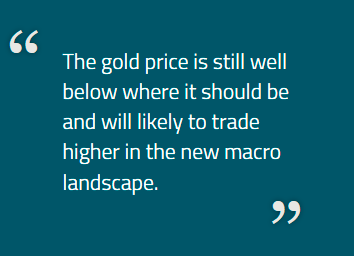
At gold’s previous peak in 2011, the combined balance sheets of the U.S. Federal Reserve (“U.S. Fedâ€) and the European Central Bank (“ECBâ€) totaled approximately US$5.5 trillion. Today, that number is more than $11.4 trillion and rapidly moving higher. The USD gold price is still lower than nine years ago. In our view, gold price is still well below where it should be and will likely trade higher in the new macro landscape.
Figure 2. Pandemic Policy Response Pushes Global Balance Sheets to Record Levels Source: Bloomberg. Data as of 3/31/2020.
Gold Mining Stocks are Inexpensive
If gold is not correctly priced for what has transpired and what lies ahead, gold mining stocks are even more inappropriately priced. Based on current metal prices, most companies are generating positive earnings and cash flow and in many cases, free cash flow that can be applied to higher dividend payouts. Compared to other sectors of the economy, the gold mining industry stands almost alone in looking forward to strong 2020 earnings and a positive outlook for 2021.
2020 free cash flow yields for large-cap producers range from 3%-7% and 6%-25% for intermediate producers based on conventional sell-side research. The stats are similar or better for 2021 based on spot gold prices. As Figure 3. shows, mining stocks are inexpensive in absolute terms and have never been so cheap relative to the gold price.
Figure 3. Gold Equities Are Undervalued Relative to Bullion Ratio of XAU Index to Spot Gold (12/23/1983-3/31/2020)
Since 2008, the relative valuation of gold equities to gold bullion has fallen 75% from the prior 25-year average. The ratio of the XAU Index to spot gold averaged 0.2497x for a quarter century through 2008. As of 3/31/2020, the ratio was 0.0501x.
It is undoubtedly true that the industry will suffer health-related mine shutdowns and other shortfalls this year. Much of the disruption potential has already been broadcast and priced into the market. Some downside news may still have yet to surface. However, most miners are not financially levered and should be able to survive a few quarters of lower or no production. Unlike the airline, leisure, retail and manufacturing sectors, gold not produced today should grow in value and be produced at higher prices and lower costs next year and those beyond. It is not the same story for many other sectors of the economy. Based on fundamentals, gold stocks are inexpensive. By contrast, several other sectors of the economy could face long stretches of poor earnings, bad news flow and financial woes.
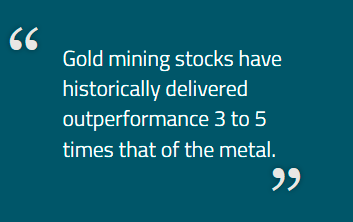
The gold mining sector registered a decline of approximately 20% in Q1 (as measured by GDX2) as shares did get battered by indiscriminate liquidations during March. However, as of this writing, two weeks after the close of the quarter, most shares trade near to where they stood at the beginning of the year, and have certainly registered outstanding performance in relative terms. It is remarkable that the largest sector ETF, GDX, suffered outflows of $381 million3 during the quarter at what could be the threshold of an upside breakout. In a favorable cycle for the gold price, mining stocks have historically delivered outperformance 3 to 5 times that of the metal itself.
Gold mining shares continue to be viewed by investors with deep skepticism as reflected by valuation and flows. When we scan Figure 4, it appears to us that the sector is on the verge of an upside breakout from a multi-year base should our assessment of the macroeconomic environment prove correct.
Figure 4. NYSE Arca Gold BUGS Index (HUI4)
Monetary and Fiscal Policy Going Ballistic
There is no need to belabor the obvious. However, the consequences of these actions have yet to be priced into the financial markets or gold. The risk parity trade has fallen short, partly because bonds were caught up in the indiscriminate liquidations of Q1. Looking forward, bonds may no longer be able to play the safe haven role they traditionally filled to balance equity risk. The vacuum could be filled in part by increased gold exposure for all classes of investors. Sovereign credit liquidity injections are likely to remain significant and permanent. The bond market has become socialized. Owning Treasury bonds of any duration could become akin to parking Treasury bills, with little upside and considerable risk of impairment through inflation. Gold is the antidote to the fixed-income investor’s dilemma.
Gold is extremely under-owned, under-represented, and poorly thought of in the circles of conventional investment thinking. It is still considered to be a fringe asset. Just ask Goldman Sachs which recently advised its clients:
“We concluded then (2010) that gold does not have a role as a strategic asset class in clients’ already well-diversified portfolios. We have updated the research and the evidence is even more compelling today than it was then.” (4/5/2020; Goldman Sachs Investment Strategy Group)
We remind the reader that Goldman is the same firm that in December 2019 declared the U.S. economy to be “recession proof†and then in March 2020 cautioned that stocks had substantial further downside:
“Overall, the changes underlying the Great Moderation appear intact, and we see the economy as structurally less recession prone today.†(12/31/2019; Goldman economists Jan Hatzius and David Mericle)
“Goldman Sachs on Friday dramatically cut its U.S. economic forecast, saying it now expects GDP to decline by 25% in the second quarter of 2020 because of the coronavirus panic.†(3/20/2020; Business Insider)
“What is your estimate for the S&P 500 by yearend 2020? David Kostin, “3400.†(1/2020; GS Podcast, David Kostin Goldman, U.S. chief equity strategist and Jake Siewert)
“Kostin thinks the market goes lower. ‘In the near term, we expect the S&P 500 will fall towards a low of 2000.’†(3/22/2020; Yahoo Finance)
Goldman’s commentary is, in our opinion, a reasonable proxy for conventional wisdom. One could easily find other embarrassing examples of mainstream thinking ignorant of the best-performing asset class (by far) versus equities and bonds since 2000.
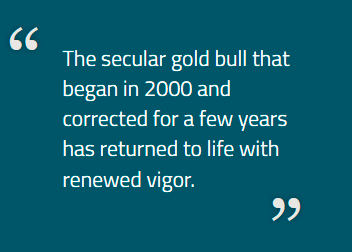
Contrarians and value investors, take note! The secular gold bull that began in 2000 and corrected for a few years has returned to life with renewed vigor. Pullbacks — price declines during this uptrend — should be bought. The setup for gold and gold mining shares ticks every box for highly rewarding investment returns.
Figure 5. Gold Has Outperformed Stocks, Bonds and USD over the Past 20 Years Returns for Period from 12/31/1999-4/13/2020 Source: Bloomberg. Period from 12/31/1999-4/20/2020. Gold is measured by GOLDS Comdty; US Agg Bond Index is measured by the Bloomberg Barclays US Agg Total Return Value Unhedged USD (LBUSTRUU Index); S&P 500 TR is measured by the SPX; and the U.S. Dollar is measured by DXY Curncy. Past performance is no guarantee of future results.
Figure 6. Gold Provides Portfolio Diversification Gold provides diversification in a portfolio, and has low correlation with other asset classes. The period measured is April 1, 2015 to April 1, 2020.
* Source: World Gold Council. Period from April 1, 2015 to April 1, 2020, based on monthly returns. Gold is measured by the LBMA Gold Price; stocks by the S&P 500 Index; commodities by the Bloomberg Commodity Index;Â Bonds by the BarCap Treasuries and Corporates.
1
The S&P 500 or Standard & Poor’s 500 Index is a market-capitalization-weighted index of the 500 largest U.S. publicly traded companies. You cannot invest directly in an index. TR, “Total Return”, represents the index with dividend income reinvested.
2
VanEck Vectors Gold Miners ETF (GDX) seeks to replicate the NYSE Arca Gold Miners Index (GDMNTR), which is intended to track the overall performance of companies involved in the gold mining industry.
3
Source: ETFtrends.com.
4
The NYSE Arca Gold BUGS Index (HUI) is a modified equal dollar weighted index of companies involved in gold mining.
Posted by AGORACOM
at 11:05 AM on Monday, May 11th, 2020
The length of the northeast axis of the Goldstorm System is over 850 meters
The Southeast axis is at least 600m
The system remains open in both dimensions, as well as to depth.
The strongest mineralization encountered to date is from two consecutive 150m step-out holes at the northeast end of the drill grid: GS-19-42 yielded0.849 g/t Au Eq over 780 m with the 300 Horizon averaging 1.275 g/t Au Eq over 370.5m and GS-19-47 yielded 0.697 g/t Au Eq over 1,081.5m with the 300 Horizon averaging 0.867 g/t Au Eq over 301.5m.
Program focused on expanding the mineralized area from these two very encouraging step-out holes.
Furthermore, we plan to continue advancing along the NE axis with yet another 150 meter step out hole. The best results from the southeast dimension came from GS-19-52 which yielded 0.783 g/t Au Eq over 601.5m with 1.062 g/t Au Eq over 336.0m within the 300 Horizon.“
Cardston, Alberta–(Newsfile Corp. – May 11, 2020) – American Creek Resources Ltd. (TSXV: AMK) (“the Corporation”) is pleased to report that its JV partner Tudor Gold Corp has begun this season’s diamond drill hole program at its flagship property, Treaty Creek, located in the heart of the Golden Triangle of Northwestern British Columbia. Diamond drilling has begun with two drill rigs on the Goldstorm Zone which is on-trend from Seabridges’ KMS Project located just five kilometers to the southwest. These first two drills have begun drilling the initial holes of the 20,000 meter exploration program.
Tudor Gold’s Vice President of Project Development, Ken Konkin, P.Geo., states: “We are very proud of the hard work and dedication that our crews exhibited during the weeks prior to the start of drilling. Due to their diligence in preparing the camp we have been able to start our drill program a month earlier than last year’s program. The priority is to continue to expand the Goldstorm System to the southeast and to the northeast.”
“The current known length of the northeast axis of the Goldstorm System is over 850 meters, and the southeast axis is at least 600 m; the system remains open in both dimensions, as well as to depth. The strongest mineralization encountered to date is from two consecutive 150m step-out holes at the northeast end of the drill grid: GS-19-42 yielded0.849 g/t Au Eq over 780 m with the 300 Horizon averaging 1.275 g/t Au Eq over 370.5m and GS-19-47 yielded 0.697 g/t Au Eq over 1,081.5m with the 300 Horizon averaging 0.867 g/t Au Eq over 301.5m. Our program will be focused on expanding the mineralized area from these two very encouraging step-out holes. Furthermore, we plan to continue advancing along the NE axis with yet another 150 meter step out hole. The best results from the southeast dimension came from GS-19-52 which yielded 0.783 g/t Au Eq over 601.5m with 1.062 g/t Au Eq over 336.0m within the 300 Horizon.“
(The above results were from Tudors news release dated March 3rd, 2020,, in which the following metal prices were used to calculate the Au Eq metal content: Gold $1322/oz, Ag: $15.91/oz, Cu: $2.86/lb. Calculations used the formula Au Eq g/t = (Au g/t) + (Ag g/t x 0.012) + (Cu% x 1.4835). All metals are reported in USD and calculations do not consider metal recoveries. True widths have not been determined as the mineralized body remains open in all directions. Further drilling is required to determine the mineralized body orientation and true widths.)
Tudor Gold and its associated service companies have taken extreme measures to maintain the highest professional standards while working under COVID-19 health and safety protocols. Only essential personnel are permitted to enter the camp and staging areas. An on-site certified paramedic conducts strict daily monitoring of temperatures and general health conditions of personnel and service providers who are working at the project site and the staging area.
Walter Storm, Tudor President and CEO, stated: “I am very pleased with the safe start-up of the 2020 exploration program thanks to the hard work and dedication of our crews. The Company’s intent is to advance the Treaty Creek Project with full recognition and confidence in the recommended COVID-19 safety protocols. The goal for this year is to complete enough drilling that we can begin to delineate a first resource estimation at Treaty Creek.”
Darren Blaney, American Creek President and CEO stated: “2019 was a very successful year at Treaty Creek and this year looks to be far better with an extension of the drilling season and a drill program that is over twice as big as last years. With the recent announcement of working towards a resource calculation along with baseline studies and metallurgical work for an initial economic assessment, Mr Storm was right in calling this a transformational year at Treaty Creek.”
Qualified Person
The Qualified Person for this news release for the purposes of National Instrument 43-101 is the Company‘s Vice President of Project Development, Ken Konkin, P.Geo. He has read and approved the scientific and technical information that forms the basis for the disclosure contained in this news release.
Treaty Creek JV Partnership
The Treaty Creek Project is a Joint Venture with Tudor Gold owning 3/5th and acting as operator. American Creek and Teuton Resources each have a 1/5th interest in the project creating a 3:1 ownership relationship between Tudor Gold and American Creek. American Creek and Teuton are both fully carried until such time as a Production Notice is issued, at which time they are required to contribute their respective 20% share of development costs. Until such time, Tudor is required to fund all exploration and development costs while both American Creek and Teuton have “free rides”.
Treaty Creek Background
The Treaty Creek Project lies in the same hydrothermal system as Pretium’s Brucejack mine and Seabridge’s KSM deposits with far better logistics.
American Creek is a Canadian junior mineral exploration company with a strong portfolio of gold and silver properties in British Columbia. Three of those properties are located in the prolific “Golden Triangle”; the Treaty Creek and Electrum joint venture projects with Tudor Gold/Walter Storm as well as the 100% owned past producing Dunwell Mine.
The Corporation also holds the Gold Hill, Austruck-Bonanza, Ample Goldmax, Silver Side, and Glitter King properties located in other prospective areas of the province.
For further information please contact Kelvin Burton at: Phone: 403 752-4040 or Email: [email protected]. Information relating to the Corporation is available on its website at www.americancreek.com
Posted by AGORACOM
at 7:37 AM on Monday, May 11th, 2020
VANCOUVER, BC / ACCESSWIRE / May 11, 2020 / Mota Ventures Corp. (CSE:MOTA)(FSE:1WZ:GR)(OTC PINK:PEMTF) (the “Company“) subsidiary, Nature’s Exclusive, an ecommerce provider of CBD products to consumers in the United States and Europe, is pleased to announce record revenues for the month of April totaling Cdn$3,818,000, representing an increase of 39% compared to April 2019. Expenses totaled Cdn$3,609,000, representing a Gross Profit of Cdn$209,000 for the month.
DOMINANT ONLINE CUSTOMER ACQUISITION STRATEGY
The Company credits this success to its’ online customer acquisition strategy, which is capitalizing on the strong consumer demand for natural health solutions, resulting in an interim record number of customer acquisitions for the Nature’s Exclusive brand, as well as, new customers for the immune support category introduced in March 2020.
The Company’s strong ability to continue capturing customers, for both existing and new products, bodes well for the Company’s CBD based hand sanitizer launch this month.
Ryan Hoggan, CEO of the Company stated, “I am very pleased to report another successful month with increased sales over 2019. Our investment in customer acquisition in March 2020, which yielded additional subscribers, has been a significant driver to our increased profitability. Despite the worldwide pandemic, we continue to move forward towards our full year goals for 2020, including expansion into the European market. I look forward to reporting on new customer acquisitions in the coming weeks”.
NATURE’S EXCLUSIVE CBD BRAND LEADING THE WAY
The Company’s Nature’s Exclusive brand offers a CBD hemp-oil formulation intended to provide users with the therapeutic benefits that hemp may offer. The hemp oil used in the products is derived from hemp grown and cultivated in the United States. The extraction process is designed to maintain all the beneficial qualities that hemp may offer. Nature’s Exclusive offers a range of products, which include CBD oil drops, CBD gummies, CBD pain relief cream, CBD skin serum, CBD hand sanitizer and CBD coffee.
We encourage readers to visit www.motaventuresco.com to view our brands and sign up to our newsletter.
We encourage shareholders and prospective investors to visit the Company’s AGORACOM Discussion Forum, a moderated social media platform that enables civilized discussion and Q&A between Management and Shareholders.
The Company cautions that figures for revenue, expenses and margin generated from the sale of Nature’s Exclusive products have not been audited, and are based on calculations prepared by management. Actual results may differ from those reported in this release once these figures have been audited. These figures were translated from US dollars into Canadian dollars using the Bank of Canada monthly average exchange rate of US$1.00:Cdn$1.4058 for April 2020 and US$1.00:Cdn$1.3378 for April 2019.
About Mota Ventures Corp.
Mota is an established ecommerce, direct to consumer provider of a wide range of CBD products in the United States and Europe. In the United States, the company sells a CBD hemp-oil formulation derived from hemp grown and formulated in the US through its Nature’s Exclusive brand. Within Europe, its Sativida brand of award winning 100% organic CBD oils and cosmetics are sold throughout Spain, Portugal, Austria, Germany, France, and the United Kingdom. Mota Ventures is also seeking to acquire additional revenue producing CBD brands and operations in both Europe and North America, with the goal of establishing an international distribution network for CBD products. Low cost production, coupled with international, direct to customer, sales channels will provide the foundation for the success of Mota Ventures.
ON BEHALF OF THE BOARD OF DIRECTORS
MOTA VENTURES CORP.
Ryan Hoggan
Chief Executive Officer
For further information, readers are encouraged to contact Joel Shacker, President at +604.423.4733 or by email at [email protected] or www.motaventuresco.com








 Source: Bloomberg. Data as of 3/31/2020.