Posted by AGORACOM
at 3:04 PM on Tuesday, March 31st, 2020
Sponsor: Affinity Metals Corp. (TSX-V: AFF) is a Canadian mineral exploration company building a strong portfolio of mineral projects in North America. The Corporation’s flagship property is the drill ready Regal Property near Revelstoke, BC where Affinity Metals is making preparations for a spring drill program to test two large Z-TEM anomalies. Click Here for More Info
When we don’t understand the present, we can turn to the past. It is
believed the natural ratio in the earth’s crust is ~10 ounces of silver
for one ounce of gold.
Back in 3000 BC in Mesopotamia (modern day Turkey, Iraq, Iran),
silver and gold were used to enable trade at a rate of 5 ounces of
silver to 1 ounce of gold. For about 2,000 years, from 1670 B.C. to 432
AD, the rate was between a low of 9 to 1 in 59-44 BC to a high of 18 to 1
in 422 AD.
For the next 1,000 years from 527 to1453, the price was roughly 15 to
1. For the next three centuries the ratio was a low of 10.75 to 1 to a
high of 15.52 to 1.
When the United States passed its first coinage law in 1792, the
ratio was fixed at 15 to 1 but at that rate gold was considered
undervalued and disappeared from circulation, so to correct the
situation Congress moved the ratio to 16 to 1 in 1834.
At that rate gold was slightly overvalued and silver undervalued and
silver coins began to disappear and were dropped from the list of coins
by the Act of February 12, 1873, or the “Crisis of 1873,” and so
thereafter the U.S. was on the Gold Standard, which became law in the
Gold Act of March 14, 1900. (Hint: two 60 year cycles to today).
In 1919 the ratio was 15.20 to 1; by 1932 the ratio was up to 72.27 to 1 or about five times.
John Newell
is a portfolio manager at Fieldhouse Capital Management and president
and CEO of Golden Sky Minerals Corp. He has 38 years of experience in
the investment industry acting as an officer, director, portfolio
manager and investment advisor with some of the largest investment firms
in Canada. Newell is a specialist in precious metal equities and
related commodities and is a registered portfolio manager in Canada
(advising representative)
Posted by AGORACOM
at 2:51 PM on Tuesday, March 31st, 2020
SPONSOR: Lomiko Metals is focused on the exploration and development
of minerals for the new green economy such as lithium and
graphite. Lomiko owns 80% of the high-grade La Loutre graphite
Property, Lac Des Iles Graphite Property and the 100% owned Quatre
Milles Graphite Property. Lomiko is uniquely poised to supply the
growing EV battery market. Click Here For More Information
It would be wrong to say that wireless charging systems are more
efficient today than wired systems. Even in wireless charging systems,
the phone needs to touch a device, but there are a lot of waves moving
in the air, and MIT researchers are working on a project where we can
use the wasted energy to charge our devices.
Terahertz radiation consists of high-frequency waves in the
electromagnetic spectrum between infrared and microwaves. These waves
are produced by devices that send Wi-Fi signals. Although these
irradiations are very difficult to use, the new method the MIT team has
found seems interesting.
Working principle of the device: It is worth
noting that at this stage the system is still in the project phase and
has not been tested yet. “We are surrounded by electromagnetic waves in
the frequency range of Terahertz radiation. If we turn this energy into
an energy that we can use in everyday life, it helps us fight the energy
problems we face,†said Hiroki Isobe, one of the scientists who led the
study.
The device produced by the team is known as a terahertz rectifier and
consists of a small graphene layer with a boron nitride layer
underneath and an antenna on both sides. These antennas collect
terahertz waves from the air in the environment and strengthen the
signals passing to the graphene. These allow electrons to flow in the
same direction and generate direct current. Graphene must be as pure as
possible, as any foreign matter will affect electron scattering, the
team said. Boron nitride layer is also used to prevent this.
Although Terahertz rectifier produces a small amount of energy at
first, it may be enough to charge small devices. The team first states
that this device can be used in pacemakers. This device, which may have
good results for wireless charging, is expected to be manufactured and
tested.
Posted by AGORACOM-JC
at 5:09 PM on Monday, March 30th, 2020
SPONSOR: CardioComm Solutions (EKG: TSX-V)
– The heartbeat of cardiovascular medicine and telemedicine. Patented
systems enable medical professionals, patients, and other healthcare
professionals, clinics, hospitals and call centres to access and manage
patient information in a secure and reliable environment.
The Tech That Could Be Our Best Hope for Fighting COVID-19—and Future Outbreaks
“The connectivity we have today gives us ammunition to fight this pandemic in ways we never previously thought possible,†says Alain Labrique, director of the Johns Hopkins University Global -mHealth Initiative.
Battling a pandemic as serious as COVID-19
requires drastic responses, and political leaders and public-health
officials have turned to some of the most radical strategies available.
What began with a lockdown of one city in China quickly expanded to the
quarantine of an entire province, and now entire countries including
Italy. While social isolation and curfews are among the most effective
ways to break the chain of viral transmission, some health experts say
it’s possible these draconian measures didn’t have to become a global
phenomenon. “If health officials could have taken action earlier and
contained the outbreak in Wuhan, where the first cases were reported,
the global clampdown could have been at a much more local level,†says
Richard Kuhn, a virologist and professor of science at -Purdue
University.
The key to early response lies in looking beyond centuries-old
strategies and incorporating methods that are familiar to nearly every
industry from banking to retail to manufacturing, but that are still
slow to be adopted in public health. Smartphone apps, data analytics and
artificial intelligence all make finding and treating people with an
infectious disease far more efficient than ever before.
“The connectivity we have today gives us ammunition to fight this
pandemic in ways we never previously thought possible,†says Alain
Labrique, director of the Johns Hopkins University Global -mHealth
Initiative. And yet, to date, the global public–health response to
COVID-19 has only scratched the surface of what these new containment
tools offer. Building on them will be critical for ensuring that the
next outbreak never gets the chance to explode from epidemic to global
pandemic.
Consider how doctors currently detect new cases of COVID-19. Many
people who develop the hallmark symptoms of the -disease—fever, cough
and shortness of breath—-physically visit a primary-care doctor, a
health care provider at an urgent-care center or an emergency room. But
that’s the last thing people potentially infected with a highly
contagious disease should do. Instead, health officials are urging them
to connect remotely via an app to a doctor who can triage their symptoms
while they’re still at home.
“The reality is that clinical brick-and-mortar medicine is rife with
the possibility of virus exposure,†says Dr. Jonathan Wiesen, founder
and chief medical officer of MediOrbis, a telehealth company. “The
system we have in place is one in which everyone who is at risk is
potentially transmitting infection. That is petrifying.†Instead, people
could call a telemedicine center and describe their symptoms to a
doctor who can then determine whether they need COVID-19
-testing—without exposing anyone else.
In Singapore, more than a million people have used a popular
telehealth app called -MaNaDr, founded by family physician Dr. Siaw Tung
Yeng, for virtual visits; 20% of the physicians in the island country
offer some level of service via the app. In an effort to control
escalating cases of coronavirus there, people with symptoms are getting
prescreened by physicians on MaNaDr and advised to stay home if they
don’t need intensive care. Patients then check in with their telehealth
doctor every evening and report if their fever persists, if they have
shortness of breath or if they are feeling worse. If they are getting
sicker, the doctor orders an ambulance to take those people to the
hospital. Siaw says the virtual monitoring makes people more comfortable
about staying at home, where many cases can be treated, instead of
flooding hospitals and doctors’ offices, straining limited resources and
potentially making others sick. “This allows us to care across
distance, monitor patients across distance and assess their progression
across distance,†says Siaw. “There is no better time for remote care
monitoring of our patients than now.â€
Other at-home devices and services currently being used in the U.S.
allow patients to measure dozens of health metrics like temperature,
blood pressure and blood sugar several times a day, and the results are
automatically stored on the cloud, from which doctors get alerts if the
readings are abnormal.
Telemedicine also serves as a powerful communication tool for keeping
hundreds of thousands of people in a specific region up to date with
the latest advice about the risk in their communities and how best to
protect themselves. That can go a long way toward reassuring people and
preventing panic and runs on health centers and hospitals.
Beyond individual-level care, the data gathered by telemedicine
services can be mined to predict the broader ebb and flow of an
epidemic’s trajectory in a population. In the U.S., Kaiser Permanente’s
tele-medicine call centers are now also serving as a bellwether for an
anticipated surge in demand for health services. Dr. Stephen Parodi,
national infectious–disease leader at Kaiser Permanente, was inspired by
a Google project from a few years ago in which the company created an
algorithm of users’ flu–related search terms to determine where clusters
of cases were mounting. Parodi started tracking coronavirus–related
calls from the health system’s 4.5 -million members in Northern
California in February. “We went from 200 calls a day to 3,500 calls a
day about symptoms of COVID-19, which was an early indicator of
community–based transmission,†he says. “Our call volume was telling us
several weeks before the country would have all of its testing online
that we have got to plan for a surge in cases.â€
Tags: EKG, mhealth, small cap stocks, stocks Posted in All Recent Posts, CardioComm Solutions | Comments Off on The Tech That Could Be Our Best Hope for Fighting #COVID19 —and Future Outbreaks – SPONSOR: CardioComm Solutions $EKG.ca – $ATE.ca $TLT.ca $OGI.ca $ACST.ca $IPA.ca
Posted by AGORACOM-JC
at 1:52 PM on Monday, March 30th, 2020
Currently working with various agencies within the United States Government on the mass amount of social media surrounding #coronavirus and #covid19
First contract with clients is a pilot for $25,000 USD
It was signed on March 12th, 2020 and has a duration of one month
TORONTO, March 30, 2020 — Datametrex AI Limited (the “Company†or “Datametrexâ€) is pleased to share that Company is currently working with various agencies within the United States Government on the mass amount of social media surrounding #coronavirus and #covid19. We will provide greater detail on the work we are doing once it is completed and our clients approve it for public dissemination.Â
The Company wishes to provide further details to this release as
requested by IIROC. This first contract with our clients is a pilot for
$25,000 USD. It was signed on March 12th, 2020 and has a duration of one
month. The clients contacted Datametrex after witnessing the technology
at a NATO working group presentation highlighting Nexalogy’s work on
#fakenews and #disinformation in the Canadian Federal Elections. This
Pilot represents a major milestone for the Company as it is the natural
progression to potentially expand into the US market, specifically the
US Government.
“We are thrilled to be working with the US Government on this very important issue. We recently completed work for Democracy Labs on #disinformation in social media regarding #covid19 and #Coronavirus and secured a relationship with Carnegie Mellon University IDeaS.
Both announcements assisted in getting Nexalogy in front of the
Government Agencies for this current opportunity in the United States.
The solid foundation we have built over the past years with our Canadian
Government clients like DRDC, the Canadian Military and NATO have
positioned Datametrex to be able to provide military grade solutions for
todays social media challengesâ€, says Marshall Gunter CEO of Datametrex
AI.
About Datametrex AI Limited
Datametrex AI Limited is a technology focused company with exposure
to Artificial Intelligence and Machine Learning through its wholly owned
subsidiary, Nexalogy (www.nexalogy.com).
Additional information on Datametrex is available at: www.datametrex.com
For further information, please contact:
Marshall Gunter – CEO Phone: (514) 295-2300 Email: [email protected]
Neither the TSX Venture Exchange nor its Regulation Services
Provider (as that term is defined in the policies of the TSX Venture
Exchange) accepts responsibility for the adequacy or accuracy of this
release.
Forward-Looking Statements
This news release contains “forward-looking information” within
the meaning of applicable securities laws. All statements contained
herein that are not clearly historical in nature may constitute
forward-looking information. In some cases, forward-looking information
can be identified by words or phrases such as “may”, “will”, “expect”,
“likely”, “should”, “would”, “plan”, “anticipate”, “intend”,
“potential”, “proposed”, “estimate”, “believe” or the negative of these
terms, or other similar words, expressions and grammatical variations
thereof, or statements that certain events or conditions “may” or “will”
happen, or by discussions of strategy.
Readers are cautioned to consider these and other factors,
uncertainties and potential events carefully and not to put undue
reliance on forward-looking information. The forward-looking information
contained herein is made as of the date of this press release and is
based on the beliefs, estimates, expectations and opinions of management
on the date such forward-looking information is made. The Company
undertakes no obligation to update or revise any forward-looking
information, whether as a result of new information, estimates or
opinions, future events or results or otherwise or to explain any
material difference between subsequent actual events and such
forward-looking information, except as required by applicable law.
Posted by AGORACOM
at 12:26 PM on Monday, March 30th, 2020
SPONSOR: American Creek owns a 20% Carried Interest to Production at the Treaty Creek Project in the Golden Triangle. 2019’s first hole averaged 0.683 g/t Au over 780m in a vertical intercept. 2020 drilling plans 18,000 to 20,000 metres from 7-10 drill platforms with four diamond drill rigs. The Treaty Creek property is located in the same hydrothermal system as the Pretivm and Seabridge’s KSM deposits and is fully funded for exploration in 2020. Click Here For More Info
Gold continues to deliver strong relative
performance and was up 7.31% on a year-to-date basis through Friday’s
close. This compares to -20.96% for the S&P 500 Total Return Index.1
Asset
YTD
1 YR
3 YR*
5 YR*
Gold Bullion
7.31%
24.33%
9.07%
6.32%
S&P 500 TR Index
-20.96%
-7.58%
4.82%
6.42%
* Average annual total returns. Bloomberg. Data as of Friday close, 3/27/2020.
Gold and precious metal equities have been collateral damage during
this most recent market correction. The broader markets had become a
tinder box with grossly elevated valuation metrics never seen before,
coupled with an economy burdened by record amounts of leverage
(government, corporate, personal) and widespread investor complacency.
All that was required was a spark — enter COVID-19. The speed of the
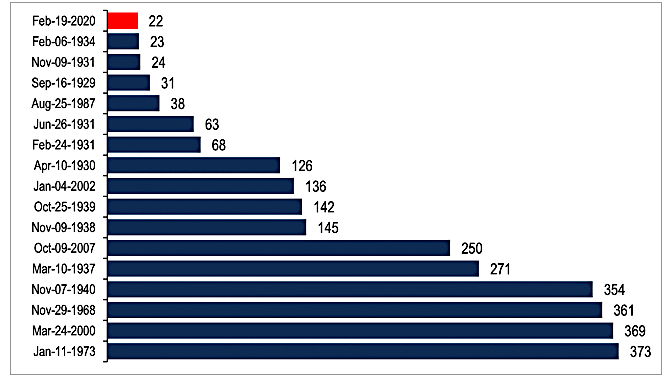
correction was historical. The February to March 30% drawdown was the
fastest 30% drawdown of all time (Figure 1).
For us at Sprott, the corresponding selloff in gold bullion and
precious metal equities was not surprising. During violent broader
market corrections, liquidity is priority number one. This time was no
different as broader markets gapped down in response to the greatest
demand shock in modern economic history. This resulted in many entities
selling gold bullion to meet liquidity requirements that surfaced
because of margin calls, and the shuttering of both credit and debt
markets. This pattern is similar to what the market witnessed as the
Global Financial Crisis (GFC) unfolded in 2008-2009.
Figure 1. Feb.-Mar. 2020 Selloff was the Fastest 30% Drawdown in History Measured by Number of Days
Source: BofA Global Research, Bloomberg.
Gold Serves its Function as Portfolio Insurance
Before hypothesizing where we will go from here, it is important to
highlight that gold bullion has served its function as portfolio
insurance. Year to date through March 27, 2020, gold bullion has
appreciated 6.84%, while the S&P 500 Index1 has declined
20.96%. At the same time, gold mining equities have not fared as well
gold bullion, because during the early stages of a correction, gold
stocks are first and foremost stocks; GDX2 was down 10.45% YTD.
The GFC as Playbook
As we are seeing today, there was a material demand shock as the GFC
unfolded, with demand across economies declining suddenly and sharply.
Although not a perfect analog, the GFC can serve as a playbook. As
liquidity became paramount for many market sectors during the GFC, gold
bullion was sold to meet liquidity requirements. From the beginning of
2008 to November 12, 2008 (gold bullion’s low price), the S&P 500
fell 41.11%, gold equities (GDX2) cratered 60.60% and gold
bullion depreciated by a relatively modest 16.94%. Once the U.S. Federal
Reserve (“Fed”) stabilized liquidity conditions, gold bullion and
precious metals stocks generated superior absolute and relative returns.
From November 12, 2008 to the end of 2009, gold bullion rallied 54.02%
and GDX rebounded 138.20%. The S&P 500 declined another 20.62% from
November 12, 2008, to its bottom in March 2009 and then appreciated
64.83% to year-end 2009.
Fed Announces Unlimited QE on March 23
This time around, the Fed and the U.S. federal government are pulling
no punches. Initially the Fed said it would undertake various
operations to provide market liquidity that could total $1.5 trillion.
This would include purchases of treasuries across all maturities and
repo market operations. President Trump then announced interest on
student loans would be waived in addition to a moderate $50 billion
emergency aid package. The Fed then announced another $700 billion
quantitative easing program which would include purchases of municipal
bonds.
This past week, the biggest bazooka of all time was pulled out of the
Fed’s arsenal as it amended its previously announced QE program by
removing limits on its asset purchases and adding corporate bonds to its
list of eligible securities it can purchase. Finally, the U.S.
announced a $2.3 trillion fiscal package. The package equates to 10.6%
of US GDP. The total budget deficit is expected to widen to at least
11.5% of GDP, which are levels not seen since WWII. The package includes
grants (hundreds of billions) and direct payments to taxpayers ($290
billion), both of which are forms of helicopter money.3
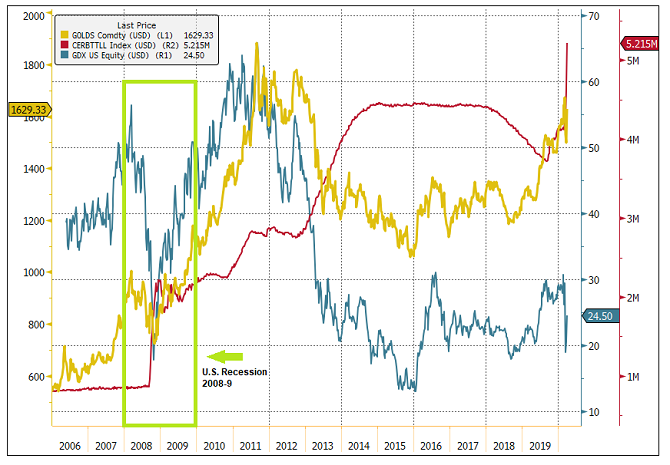
This is very good news for gold bullion and gold equities. There is
an 80% correlation between the Fed’s balance sheet and the price of gold
bullion. Similar to what occurred during the GFC, gold bullion should
move first followed by gold equities (see Figure 2).
A Tailwind for Gold and Gold Stocks
This response has not been limited to the U.S. Globally, we are
seeing central banks and governments deploying unprecedented amounts of
monetary and fiscal stimulus in response to the economic fallout caused
by Covid-19. All these actions should debase fiat currencies while
providing a tremendous tailwind for gold bullion and gold equities.
We believe the table is set for a move in gold bullion and gold equities that could dwarf the second half of 2008.
Figure 2. Fed Balance Sheet vs. Price of Gold Bullion and Gold Equities
Source: Bloomberg. Data as of 3/27/2020. The red
line represents reserve credit outstanding in $ trillions ($5.125
trillion as of 3/27/2020). The yellow line is the gold spot price based on GOLDS Comdty Index. The blue line is the price of gold mining equities represented by GDX.3
Posted by AGORACOM
at 11:24 AM on Monday, March 30th, 2020
Sponsor: Loncor, a Canadian gold explorer controlling over 2,400,000 high grade ounces outside of a Barrick JV. The Ngayu JV property is 200km southwest of the Kibali gold mine, operated by Barrick, which produced 800,000 ounces of gold in 2018. Barrick manages and funds exploration at the Ngayu project until the completion of a pre-feasibility study on any gold discovery meeting their Tier One investment criteria. Newmont $NGT$NEM owns 7.8%, Resolute $RSG owns 27% Click Here for More Info
Increasing production to 5 million ounces of gold a year
Boosted production at Kibali, Congo’s biggest gold mine, which last year beat its production guidance of 750,000 ounces of gold by a substantial margin, delivering a new record of 814,027 ounces.
Barrick Gold (TSX: ABX) (NYSE: GOLD), the world’s second largest gold miner, has unveiled a 10-year production plan, boosting Barrick’s production to about 5 million ounces of gold a year
The strategy, outlined in its first annual report since its merger with Randgold Resources,
includes boosting Barrick’s production to about 5 million ounces of
gold a year, with the bulk coming from its North American operations.
President and chief executive officer, Mark Bristow, said Nevada Gold Mines — its recent joint venture with Newmont (NYSE: NEM) — would be the “value foundation†of its business moving forward.
“Already the world’s largest gold mining complex, it holds enormous potential for growth,†Bristow said.
Bristow warned the new guidance might be impacted if operations were disrupted due to efforts to slow the spread of the covid-19.
He called the pandemic “a global disaster which is changing the way we
work and live in a radically disruptive process with currently no clear
end in sight.â€
In the past year, Barrick has been focusing on its tier one assets and has reported strong performance across the group, particularly at Cortez mine in Nevada and Veladero in Argentina.
It has also boosted production at Kibali, Congo’s biggest
gold mine, which last year beat its production guidance of 750,000 ounces of
gold by a substantial margin, delivering a new record of 814,027 ounces.
Porgera in Papua New Guinea has tier one potential but faces
many challenges in the form of legacy issues and an unruly neighbourhood,â€
Bristow said, adding the mine had exceeded guidance and the company continued
to negotiate a 20-year lease extension with the government.
The executive, who took
the helm in January 2019, said the work done over the past year had
equipped Barrick to move to the next level.
“All in all, I am confident that we are more than capable of
delivering on our promise: to build the world’s most valued gold
company,†he said.
Bristow noted that Barrick’s definition of value was more wide-ranging and included factors such as economic benefits, the care with which it treated its people, communities and environments, its strategic focus on long-term sustainability and returns for investors.
Palladium is the main payable metal accounting for 65% of revenue stream based on 2019 PEA.
1:0.4 (Pd:Pt).
Excellent infrastructure and within 100 kilometers of the Sudbury Metallurgical Complex.
NI 43-101 Mineral Resource Estimation (Q1 2019)
PEA done Q3 2019.
2020 plan to follow up on PEA recommendations.
Preliminary Economic Assessment demonstrates positive economics for a large-scale open pit mining operation.
PEA Highlights (CDN$):
Life of mine (LOM) of 14 years, with 6 million tonnes annually of potential process plant feed at an average grade of 0.88 g/t Palladium Equivalent (PdEq) and process recovery rate of 80%, resulting in an annual average payable PdEq production of 119,000 ounces.
Pre-Production capital requirements: $495 M.
Undiscounted cash flow before income and mining taxes of $586M.
Undiscounted cash flow after income and mining taxes of $384M.
Average unit operating cost of $19.50/tonne over the life-of-mine.
Potential for up to 325 jobs at the peak of production.
Using March 11, 2020 spot Palladium price (US$2,275/oz) River Valley Project After-tax IRR is 30% and After-tax NPV (5%) is $C858M.
New Age Metals Inc. is an advertising client of AGORA Internet Relations Corp.
Posted by AGORACOM
at 5:06 PM on Friday, March 27th, 2020
Since March 14, 2020, Mota has acquired over 5,500 new customers
The product has yielded an average initial order value of $189.00 USD.
Mota Ventures Corp. (CSE:MOTA)(FSE:1WZ:GR)(OTCPINK:PEMTF) (the “Company” or “Mota“) is pleased to announce that since the launch of its Immune Support product line on March 14, 2020, the Company has acquired over 5,500 new customers seeking natural solutions to help support their family’s immune systems. The popularity of the primary product has yielded an average initial order value for immune support customers of $189.00 USD. Earlier this week the Company introduced an Immune CBD oil and Elderberry Gummies. The new Immune CBD product contains CBD, B3, B12, vitamin C and zinc and is made from 100% pure essential oils containing cinnamon leaf, lemon, clove bud, lime, eucalyptus, globulus, rosemary, peppermint, spearmint and oregano.
The Company has acquired over
50,000 new customer inquiries for Immune Support/CBD products since
March 14, 2020. The Immune Support line is gaining interest from
customers that historically were hesitant to purchase CBD, but are now
interested in the Immune products and the potential anti-inflammatory
benefits of CBD. In addition, traditional brick-and-mortar stores have
been affected due to social distancing requirements, driving consumers
to purchase online from the safety of their homes.
“The Immune
Support product launch has been the most successful product launch in
the history of our First Class brand. E-Commerce is a fast-moving
sector, especially during these very unique times we are facing today.
Our ability as a company to quickly develop and launch new products to
meet market demand is a testament to our expertise. I am very excited by
the reception we have received to date for our Immune Line of products.
I project demand for the line will continue through Q2 and be a
significant driver to our growth for 2020,” stated Ryan Hoggan, CEO of
the Company.
Additionally, the Company has entered into a 12 month
programmatic digital advertising campaign with Native Ads, Inc. for a
total cost of C$80,000; consisting of C$72,000 for digital advertising,
paid distribution, and media buying over the campaign period and,
C$8,000 for content creation, consulting, managed services and
management fees over the course of the campaign period. Native Ads is a
full-service advertising agency, that owns and operates a proprietary ad
exchange with over 80 integrated SSPs (supply side platforms) resulting
in access to 3-7 billion daily North American ad impressions. Neither
Native Ads nor any of its directors and officers own any securities of
the Company.
About Mota Ventures Corp.
Mota is
seeking to become a vertically integrated global CBD brand. Its plan is
to cultivate and extract CBD into high-quality value-added products from
its Latin American operations and distribute it both domestically and
internationally. Its existing operations in Colombia consist of a
2.5-hectare site that has optimal year-round growing conditions and
access to all necessary infrastructure. Mota is looking to establish
sales channels and a distribution network internationally through the
acquisition of the Sativida and First Class CBD brands. Low cost
production, coupled with international, direct to customer sales
channels will provide the foundation for the success of Mota.
ON BEHALF OF THE BOARD OF DIRECTORS MOTA VENTURES CORP.
Ryan Hoggan Chief Executive Officer
For
further information, readers are encouraged to contact the President of
the Company, Joel Shacker, at +604.423.4733 or by email at [email protected] or www.motaventuresco.com
Posted by AGORACOM-JC
at 3:55 PM on Friday, March 27th, 2020
SPONSOR: Tartisan Nickel (TN:CSE)
Kenbridge Property has a measured and indicated resource of 7.14
million tonnes at 0.62% nickel, 0.33% copper. Tartisan also has
interests in Peru, including a 20 percent equity stake in Eloro
Resources and 2 percent NSR in their La Victoria property. Click her for more information
The thematic case for nickel
Nickel has exciting long-term prospects as its use in electric vehicle batteries is expected to drive its demand growth in the future
This structural trend has, however, not immunised it against the recent headwinds facing industrial metals
By Mobeen Tahir, Associate Director, Research, WisdomTree.
Nickel has exciting long-term prospects as its use in electric
vehicle batteries is expected to drive its demand growth in the future.
This structural trend has, however, not immunised it against the recent
headwinds facing industrial metals. Industrial metals are cyclical
commodities and their performance is fuelled by global economic growth.
The sector has therefore been under pressure from trade wars and, more
recently, coronavirus. In this blog, we want to shift the focus back to
nickel’s strategic case. We remain cognizant that the current storm is
not over yet but expect a smoother sail once the existing headwinds
subside.
Analysing nickel’s recent history
Nickel has strongly outperformed the industrial metals basket
(composed of copper, zinc, aluminium and nickel) in the last 3 years
(Figure 1). The sector has faced challenges since the advent of trade
wars in 2018 both directly due to tariffs and indirectly via a resulting
slowdown in global economic activity. Nickel too has had its share of
price volatility during this time. The metal rallied sharply in July
2019 on the expectation that Indonesia, which produces a quarter of
global nickel supply, will bring forward its nickel ore export ban by 2
years to January 2020. Indonesia announced this decision soon
thereafter. Concerns of supply shortages drove the price in a market
which was already in a deficit. Nickel’s fortunes reversed in the last
quarter of 2019 as stainless-steel demand, which currently accounts for
nearly two-thirds of the metal’s use, dwindled. The dynamics of the
nickel market are however changing which is why we have an optimistic
view of the future.
Source: WisdomTree, Bloomberg. Monthly data from 01/01/2017 to
03/01/2020. Industrial metals basket refers to the Bloomberg Industrial
Metals Subindex.
Battery solutions to take a larger share of nickel
According to metal experts Wood Makenzie, battery solutions are
expected to account for more than 30% of the total demand for nickel by
2040, up from around 4% today (Figure 2). This is because electric
vehicles are forecasted to be around 50% of all passenger car sales by
2040, up from around 8% today. Batteries need to become more efficient
to enable this growth and nickel is expected to play a pivotal role.
According to the Nickel Institute, nickel-containing Lithium-ion
batteries are powering the electric vehicle revolution as nickel in
batteries helps deliver higher energy density and greater storage
capacity at a lower cost. This will allow electric cars to have both a
longer range, i.e. the ability to drive longer distances without
requiring a recharge, and lower cost promoting wider adoption.
Now, the impact on price from demand growth can, in theory, be offset
by an equal increase in supply. We, however, believe that supply growth
will be much slower as, according to Wood Mackenzie, the average time
for a new nickel mining project to start producing the metal is around 9
years. Miners will seek higher prices to be incentivised to undertake
such projects.
Source: WisdomTree, Wood Mackenzie. Forecasts (F) from 2019.
It is uncertain how quickly the current headwinds facing industrial
metals will dissipate. Having said that, the market dynamics of nickel
are changing and the long-term outlook appears promising for the metal
supported by a thematic shift towards electric vehicles which is being
powered by nickel-containing batteries. With the nickel market already
in a supply deficit, we expect growing demand to support its price in
the long-term.
Posted by AGORACOM-JC
at 12:45 PM on Friday, March 27th, 2020
SPONSOR: Datametrex AI Limited
(TSX-V: DM) A revenue generating small cap A.I. company that NATO and
Canadian Defence are using to fight fake news & social media
threats. The company announced three $1M contacts in Q3-2019. Click here for more info.
Covid-19 fake news hacks its way onto government blockchain website
On March 14, the government in Argentina disclosed that its system had effectively been hacked.
Perpetrator(s) uploaded false information regarding guidelines for public officials on handling the coronavirus (Covid-19) onto the country’s official bulletin website, which just so happens to use blockchain technology.Â
As a result, officials took the site temporarily offline.
Correspondingly, another issuance will be necessary to disclaim the false statements posted on its 34,239 editions.
Have the blockchain gods forsaken the government of Buenos Aires? Not exactly. Blockchain isn’t bullet-proof.
Hacked! Why Argentina’s case is a big deal
Perhaps you’re wondering, “what’s the big deal? It’s just a bulletin.â€
No, it’s not just a bulletin.
Many countries have their own official bulletin or gazette wherein
laws, notifications, or other big-deal, high-level government
information is formally announced.
In Argentina, it’s known as the BoletÃn Oficial. Mexico’s is christiend the Diario Oficial de la Federación. In the US it’s called the Federal Register.
And the fact that something of such substantial importance in
government communications was hacked is both alarming and interesting.
First off, blockchain-based systems are often hailed as more fool-proof to this type of manipulation.
And that’s because each block within the chain is supposed to have
its own unique cryptographic fingerprint and use what’s known as a
“consensus protocol.†Through this protocol, the nodes on the network
share and record transactional history.
Thanks to these mechanisms, in theory, not just any outsider can show up and manipulate the data.
But with some creativity and determination, hackers can bust through blockchain’s apparently impenetrable defenses.
Secondly, everyone is well aware of how fake news can make its way
onto social media. As a result, we’re consistently advised to only rely
on official sources, like government websites, for more information on
the pandemic.
The hacking of a government outlet like Buenos Aires’ means that no
source is 100 percent safe and fool-proof to being used as a platform to
broadcast false statements.
That’s why we should make an effort to consult additional sources for
more information. Especially for a topic as sensitive as healthcare.
And remember, if the government is hackable, so are you. So take the necessary precautions to protect your own data and systems.