Agoracom Blog Home

Archive for the ‘All Recent Posts’ Category

India’s #Vedantu scores $24M more for its online tutoring service #Edtech – SPONSOR: BetterU Education Corp. $BTRU.ca $ARCL $CPLA $BPI $FC.ca

Posted by AGORACOM-JC at 10:34 AM on Thursday, February 13th, 2020
SPONSOR:  BetterU Education Corp. aims to provide access to quality education from around the world. The company plans to bridge the prevailing gap in the education and job industry and enhance the lives of its prospective learners by developing an integrated ecosystem. Click here for more information.

India’s Vedantu scores $24M more for its online tutoring service

  • The fresh infusion to Series C, which Vedantu first unveiled in August last year, was led by global VC firm GGV Capital.
  • Some existing investors also participated in the round. The $24 million extension broadens the five-year-old startup’s Series C round to $66 million, and its total raise to date to $82 million.

By: Manish Singh

Vedantu, a Bangalore-based startup that operates a learning app aimed at students aged between 12 to 18, has secured an additional $24 million as part of its Series C financing round as it looks to serve more students and make its brand a household name.

The fresh infusion to Series C, which Vedantu first unveiled in August last year, was led by global VC firm GGV Capital. Some existing investors also participated in the round. The $24 million extension broadens the five-year-old startup’s Series C round to $66 million, and its total raise to date to $82 million.

Vedantu serves students in grade 6 to 12 and offers live and interactive courses. Students who have enrolled for the interactive sessions are required to answer questions every few minutes by tapping on their smartphone screen or on the desktop. They also can raise their doubts at the end of the session.

Some of these sessions are free for students, but a selection of it requires a subscription, Vamsi Krishna, co-founder and CEO of the startup, told TechCrunch in an interview.

The app has amassed over 75,000 paying subscribers, a figure that Krishna expects to surpass 100,000 this year, he said. The cost of these subscriptions can vary from Rs 100 ($1.4) for students looking for sessions around a particular topic, to Rs 50,000 ($700) for long-term courses that focus on training students for undergraduate-level courses. More than 25 million users, in total, come to Vedantu app or website each month to consume free lessons.

India has the largest school-age population in the world and households in the nation are willing to invest in their children’s education to advance their lives. About a million students look to pursue under graduate courses each year, for instance.

But the quality of education and its affordability are two major challenges that millions of students, especially those living in smaller cities and towns, have to confront. An offline coaching centre can have as many as 100 students sitting in the room, with most not getting a chance to engage with the teacher. But for some, it also means there aren’t many teachers left to teach them.

From right to left: Vamsi Krishna, CEO and co-founder; Anand Prakash, co-founder; and Pulkit Jain, co-founder and head of product

In recent years, a wave of tech startups including Byju’s, which was valued at $8 billion in its most recent fund raise last week, have emerged to tackle these challenges as low-cost Android handsets flood the Indian market and mobile data prices become incredibly affordable.

Vedantu allows students to interact with their teachers through the microphone and camera on their smartphone or desktop and also through a chat box on the app. These teachers also have assistants who work with students on their doubts.

Since it’s a virtual class, Vedantu is also able to accommodate more students in a session. A paid session may have as many as 600 students while the free lessons could have 2,000, said Krishna, who is a teacher himself, and ran Lakshya Institute that helped students prepare for undergraduate-level courses until early 2014 before selling a majority stake to Mumbai-based K-12 tutoring and test preparation firm MT Educare.

Running a tech platform has also enabled Vedantu to offer its subscription service at a more affordable price than a typical offline coaching equivalent that can cost users anything between a few hundred dollars to a few thousand.

To ensure that students are paying attention and identify their weaknesses, Vedantu says it has built a patented system called WAVE that evaluates about 70 parameters including whether the student is looking at the screen. More than 90% of its students engage with the session (raise and answer questions, for one), said Krishna.

Hans Tung, Managing Partner at GGV Capital, who is joining the board of Vedantu as part of the investment, said he thinks Vedantu has reached the inflection point with its WAVE product. WAVE enables teachers to deliver “superior results as it can offer personalized education to many students at once,” he said. “We are excited to partner with Vamsi and the Vedantu team and share GGV’s global expertise and network to help them scale and shape learning outcomes for millions of students in India and beyond.”

Krishna said the startup has grown phenomenally in recent years so it is beginning to spend some money to better market its brand. In December, the startup ran some commercials on TV channels. In addition to that, Vedantu has also started to add courses to serve even younger students. The new courses are in pilot stage and would be broadly launched in a few months, he said.

Source: https://uk.finance.yahoo.com/news/indias-vedantu-scores-24m-more-103453756.html?guccounter=1&guce_referrer=aHR0cHM6Ly93d3cuZ29vZ2xlLmNvbS8&guce_referrer_sig=AQAAAMXOkOqEb0PPmTQ5AXZ9ds53Eyl4lc40TefWUy_IU_8p7idep45E8kdorerUVQwNTif3ONR83s31zGGdDOkHVCs8ZcEvIDl3m78BgbSjf2tjBJyID8xFTFE3k-EW1a6vEDCOuyYxChw_vwoVoSAQpwViZBO3rsMAPEgZd78hldFZ

Central Banks Just Love Gold and It’s Going to Stay That Way SPONSOR: Affinity Metals $AAF.ca $SII.ca $TUD.ca $GTT.ca $AMK.ca $OSK.ca $RKR.ca

Posted by AGORACOM at 7:16 PM on Tuesday, February 11th, 2020
This image has an empty alt attribute; its file name is Affinity_Metals_Corp_Logo.png

Sponsor: Affinity Metals (TSX-V: AFF) a Canadian mineral exploration company building a strong portfolio of mineral projects in North America. The Corporation’s flagship property is the Drill ready Regal Property near Revelstoke, BC. Recent sampling encountered bonanza grade silver, zinc, and lead with many samples reaching assay over-limits. Click Here for More Info

  • A recent survey of central banks showing 54% of respondents expect global holdings to climb in the next 12 months.

A major gold-buying spree by central banks is likely to persist in the coming years, according to Australia & New Zealand Banking Group Ltd., which flagged the potential for further purchases by nations including China.

“In the current environment, where uncertainty in emerging-market currencies is high, we see good reason for countries like Russia, Turkey, Kazakhstan and China to continue to diversify their portfolios,” ANZ said in a note on Tuesday. Net buying by the sector is likely to stay above 650 tons, it said.

Central banks are likely to increase gold reserves, ANZ says

Central-bank accumulation of bullion has emerged as a increasingly important trend in the global market, offering additional support for prices that have rallied to the highest level since 2013 on rising demand. Authorities have been adding to reserves as growth slows, trade and geopolitical tensions rise, and some nations seek to diversify away from the dollar. Official purchases now account for about 10% of worldwide consumption, according to ANZ.

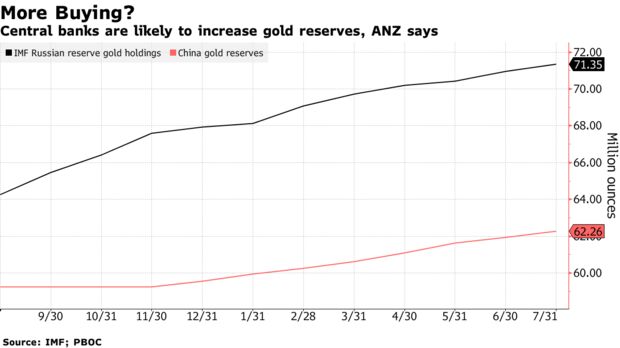
“The People’s Bank of China holds nearly 1,936 tons of gold, which equates to only 3% of its total foreign reserve holdings, giving the country plenty of room to increase its allocation,” ANZ said. China’s central bank expanded bullion reserves again in July, pressing on with a run that stretches back to December.

Spot gold traded at $1,531.45 an ounce on Tuesday after touching $1,555.07 on Monday, the highest in more than six years. The metal has surged 19% this year as the trade war flared up, bond markets signaled that a U.S. recession may be on the horizon, and the Federal Reserve cut rates.

‘Room to Run’

Central-bank accumulation of gold “has further room to run,” Deutsche Bank AG said in a report, citing factors including a gradual migration of reserve assets away from the dollar. “The stability of central-bank demand should help to bias gold prices higher over longer time frames.”

Goldman Sachs Group Inc. also put the spotlight on the same trend as the bank outlined its bullish stance on gold this month. “Central banks in emerging markets are buying gold,” Jeff Currie, global head of commodities research, told Bloomberg Television. “Why? Because they don’t want to own dollars with sanction risk, geopolitical risk, trade-war risk out there.

Central banks added 374.1 tons in the first six months, helping push total bullion demand to a three-year high, according to the World Gold Council. The trend is expected to continue, with a recent survey of central banks showing 54% of respondents expect global holdings to climb in the next 12 months.

SOURCE: https://www.bloomberg.com/news/articles/2019-08-27/central-bankers-new-found-love-of-gold-seen-bolstering-demand

INTERVIEW: $HPQ.ca Game Changing Silicon Process For #Lithium-Ion #Battery Market Is Just Months Away $FSLR $SPWR $CSIQ $PYR.ca $XMG.ca

Posted by AGORACOM-JC at 5:59 PM on Tuesday, February 11th, 2020

When a globally renowned technology partner – who supplies plasma torch technology to US Aircraft Carriers – says the following about your company, you are forced to stand up and take notice:

“We never thought, when we first embarked on this project, that we would be developing game-changing technology sought after by the Lithium-ion battery market.”

– Peter Pascali, President and CEO of PyroGenesis Canada Inc. 

There is no shortage of small cap companies claiming they want to supply materials to the Lithium-Ion battery market …. but only one of them is pursuing the material that can increase capacity by as much as 10X ….. Silicon. 

HPQ Silicon (HPQ:TSXV) isn’t just pursuing Silicon, they are on the verge of providing the market with multiple high-value silicon products sought after by Corporations building the next generation of Lithium-ion batteries, including one undisclosed company that is already under NDA with HPQ Silicon.

One of the best parts?  HPQ Silicon doesn’t have to worry about capital expenditure barriers that come with mining battery metals …. because Silicon is manufactured and HPQ has a patent pending process to manufacture Silicon at some of the lowest prices in the world.  A process that is fully funded all the way through to their pilot plant launching this year. 

If you believe in a future driven by electric vehicles and renewable energy, grab your favourite beverage and watch this video interview with CEO Bernard Tourillon.

Accessibility of Raw Materials for EV Batteries Is A Pressing Issue Says EESC SPONSOR: Lomiko Metals $LMR.ca $CJC.ca $SRG.ca $NGC.ca $LLG.ca $GPH.ca $NOU.ca

Posted by AGORACOM at 2:30 PM on Tuesday, February 11th, 2020

SPONSOR: Lomiko Metals is focused on the exploration and development of minerals for the new green economy such as lithium and graphite. Lomiko owns 80% of the high-grade La Loutre graphite Property, Lac Des Iles Graphite Property and the 100% owned Quatre Milles Graphite Property. Lomiko is uniquely poised to supply the growing EV battery market. Click Here For More Information

  • The European Economic and Social Committee (EESC) has singled out accessibility of raw materials as a pressing issue, warning that a prompt solution for the development of batteries is needed to make electric mobility and sustainable transport possible.

The European Union needs to secure permanent access to raw materials as soon as possible in order to develop a strong battery industry for electric vehicles. The alarm was sounded at the debate held in Brussels on 5th February 2020 by the Section for Transport, Energy, Infrastructure and the Information Society (TEN).

Widespread e-mobility, with zero COâ‚‚ emissions, is the next key step towards making sustainable transport and climate neutrality happen. Nevertheless, only by having ongoing access to raw materials for batteries will Europe be able to move away from fossil-based fuels and embrace electrification.

Colin Lustenhouwer, rapporteur for last year’s EESC opinion on batteries, pointed out that it was vital to raise awareness of the urgent measures needed.

“We must take immediate action” said Mr Lustenhouwer. “The accessibility of raw materials is an ongoing issue in an area where Europe has few resources and would like to guarantee supply. Electrification is the only solution for sustainable fuel and this requires batteries.”

Pierre Jean Coulon, president of the TEN section, added that for Europe’s sustainable future, the whole battery lifespan needs to be considered and that European countries need to equip themselves with the resources needed. European businesses can only become a major player in battery development and deployment in the global market by taking a huge leap forward over the next few years.

Car batteries are a crucial issue for Europe’s future and should not be taken for granted. They account for 40 percent of the cost of an electric vehicle, but 96 percent of them are produced outside Europe. The raw materials are not available in the EU to the extent needed and have to be imported. Lithium, nickel, manganese and cobalt mainly come from South America and Asia. This means that if the EU does not act, it will become increasingly dependent on third countries such as Brazil and China.

Furthermore, the need to secure the supply of raw materials for batteries is leading to international competition that may well affect the geopolitical balance and cause political tensions in exporting countries. The EU therefore needs to act swiftly to ensure that it has access on the global market and so will not be vulnerable as a result of the imminent race for raw materials.

The European strategy for batteries must be comprehensive and allow for their entire lifecycle, from creation to deployment and recycling. All actors have to be involved and pull together, in line with the principles of the value-chain approach which factors in every stage.

The EESC flagged up the importance of material recycling in its 2019 opinion on batteries, where ‘urban mining’ was promoted as a possible way to build new batteries by recovering elements from used products and waste, such as discarded electric and electronic devices.

In the opinion, the Committee called for a strong European battery industry and supported the Strategic Action Plan presented by the European Commission, emphasising two priorities: on the one hand, heavier investment was needed to achieve the necessary level of technological expertise while on the other, solutions had to be found to secure the supply of raw materials from third countries and EU sources.

Stressing that the EU needed to do more and adopt a structural approach to batteries, the EESC was one of the first institutions to bring together all the social partners to point out that batteries are one of the main challenges for Europe’s green and prosperous future.

SOURCE: https://www.renewableenergymagazine.com/electric_hybrid_vehicles/accessibility-of-raw-materials-for-ev-batteries-20200210

Mining Stocks Are Setting Up For Another Run SPONSOR: Loncor Resources $LN.ca $ABX.ca $TECK.ca $RSG $NGT.to $GOLD $NEM

Posted by AGORACOM at 1:10 PM on Tuesday, February 11th, 2020
This image has an empty alt attribute; its file name is Loncor-Small-Square.png

Sponsor: Loncor is a Canadian gold explorer that controls over 2,400,000 high grade ounces outside of a Barrick JV. The Ngayu JV property is 200km southwest of the Kibali gold mine, operated by Barrick, which produced 800,000 ounces of gold in 2018. Barrick manages and funds exploration at the Ngayu project until the completion of a pre-feasibility study on any gold discovery meeting the investment criteria of Barrick. Newmont $NGT $NEM owns 7.8%, Resolute $RSG owns 27% Click Here for More Info

The Fed is trapped.  If it stops adding money to the money supply, the stock market will crash.  It’s already extended the repo money printing program twice. The first extension was to February and now it has extended it again to April.

What was billed as a temporary “liquidity problem” in the overnight repo market is instead significant problems developing in the credit and derivative markets to an extent that it appears to be putting Too Big To Fail bank balance sheets in harm’s way.  That’s my analysis – the official narrative is that “there’s nothing to see there”.

The delinquency and default rates for below investment grade corporate debt  (junk bonds) and for subprime consumer debt are soaring.   Privately funded credit,  leveraged bank loans,  CLO’s and subprime asset-backed trusts (credit cards, ABS, CMBS)  are starting to melt down. The repo money printing operations is a direct bail out of leveraged funds, mezzanine funds and banks, which are loaded up  on those subprime credit structures.    Not only that,  but  a not insignificant amount of OTC credit default derivatives is “wrapped around” those finance vehicles, which further accelerates the inevitable credit meltdown “Minsky Moment.”

The point here is that I am almost certain, and a growing number of truth-seeking analysts are coming to the same conclusion, that by April the Fed will once again extend and expand the repo operations. As Milton Friedman said, “nothing is so permanent as a temporary government program.”

Gold will sniff this out, just like it sniffed out the September repo implementation at the beginning of June 2019.  I think there’s a good chance that gold will be trading above $1600 by this June, if not sooner.

Eventually the market will discover the junior exploration stocks and the share prices will be off to the races. This is part of the reason Eric Sprott continues to invest aggressively in the companies he considers to have the highest probability of getting enough “wood on the ball to knock the ball out of the park” (sorry, baseball is right around the corner).

Precious metals mining stocks are exceptionally cheap  relative to the price of gold (and silver).   Many of the junior exploration stocks  have sold down to historically cheap levels  in the latest pullback in the sector.   As such, this is a good opportunity to add to existing positions in these names or to start a new position.

 SOURCE: http://news.goldseek.com/GoldSeek/1581435213.php

Dave Kranzler

New Graphene-Based Material to Increase Recording Density of Data Storage Devices SPONSOR – ZEN Graphene Solutions $ZEN.ca $LLG.ca $FMS.ca $NGC.ca $CVE.ca $DNI.

Posted by AGORACOM at 12:58 PM on Tuesday, February 11th, 2020

SPONSOR: ZEN Graphene Solutions: An emerging advanced materials and graphene development company with a focus on new solutions using pure graphene and other two-dimensional materials. Our competitive advantage relies on the unique qualities of our multi-decade supply of precursor materials in the Albany Graphite Deposit. Independent labs in Japan, UK, Israel, USA and Canada confirm this. Click here for more information

Image result for graphene storage density

An international group of Russian and Japanese scientists recently developed a graphene-based material that might significantly increase the recording density in data storage devices, such as SSDs and flash drives. Among the main advantages of the material is the absence of rewrite limit, which will allow implementing new devices for Big Data processes.

The development of compact and reliable memory devices is an increasing need. Today, traditional devices are devices in which information is transferred through electric current. The simplest example is a flash card or SSD. At the same time, users inevitably encounter problems: the file may not be recorded correctly, the computer may stop “seeing” the flash drive, and to record a large amount of information, rather massive devices are required.

A promising alternative to electronics is spintronics. In spintronics, devices operate on the principle of magnetoresistance: there are three layers, the first and third of which are ferromagnetic, and the middle one is nonmagnetic. Passing through such a “sandwich” structure, electrons, depending on their spin, are scattered differently in the magnetized edge layers, which affects the resulting resistance of the device.

The control of information using the standard logical bits, 0 and 1, can be performed by detecting an increase or decrease in this resistance.

The international group of scientists from National University of Science and Technology MISIS (Russia) and National Institute for Quantum and Radiological Science and Technology (Japan) developed a material that can significantly increase the capacity of magnetic memory by increasing the recording density. The scientists used a combination of graphene and the semi-metallic Heusler alloy Co2FeGaGe.

“Japanese colleagues for the first time grew a single-atom layer of graphene on a layer of semi-metallic ferromagnetic material and measured its properties. The Japanese team, led by Dr. Seiji Sakai, conducts unique experiments, while our group is engaged in a theoretical description of the data obtained. Our teams have been working together for many years and have obtained a number of important results,” comments Pavel Sorokin, Sc.D. in Physics and Mathematics, head of the “Theoretical Materials Science of Nanostructures” infrastructure project at the NUST MISIS Laboratory of Inorganic Nanomaterials.

Previously, graphene was not used in magnetic memory devices as carbon atoms reacted with the magnetic layer, which led to changes in its properties. By careful selection of the Heusler alloy composition, as well as the methods of its application, it was possible to create a thinner sample compared to previous analogues. This, in turn, will significantly increase the capacity of magnetic memory devices without increasing their physical size.

Next, the scientists plan to scale the experimental sample and modify the structure.

https://www.graphene-info.com/new-graphene-based-material-increase-recording-density-data-storage-devices

Vertical Exploration $Vert.ca Moves Forward to Register its St-Onge Wollastonite as an Approved Supplement for the Canadian Agricultural and Cannabis Industries $TORR.ca $FA.ca $WEED.ca $CGC $ACB $APH $CRON.ca $HEXO.ca $TRST.ca $OGI.ca

Posted by AGORACOM at 8:28 AM on Tuesday, February 11th, 2020

VANCOUVER, BC / ACCESSWIRE / February 11, 2020 / VERTICAL EXPLORATION INC. (TSXV:VERT) (“Vertical” or “the Company”) is pleased to provide an update regarding registration of its high-quality St-Onge Wollastonite for use as an approved supplement for both the Canadian agricultural and cannabis/hemp industries.

Vertical and its distribution partner, Wollammo Distribution Inc. (Wollammo), have moved forward to seek registration of Vertical’s St-Onge Wollastonite as a Supplement under the Fertilizer Act established by the Canadian Food Inspection Agency (CFIA). Vertical and Wollammo have engaged Ms. Niki Nickel, Compliance Manager, QA, to help the companies move forward with the registration process in an expedited fashion, given the importance and market appeal that this registration will bring to Vertical and Wollammo.

Ms. Nickel has recently reviewed Wollammo’s compliance data documents and believes the Wollammo product, which consists of 100% St-Onge Wollastonite, meets the criteria for registration as a Supplement under the Canadian Fertilizer Act established by CFIA and the Safe Foods for Canada Act SOR 2018-108. Subsequently, a letter of intent will be filed as soon as possible for Vertical’s Wollastonite in the form of a Pre-Market Application Submission (PASO) at the Canadian Food Inspection Agency.

Wollammo’s compliance data shows that the St-Onge Wollastonite improves soil structure, supports plant growth and improves crop yields which are characteristics defined by CFIA as supplements under the Canadian Fertilizers Act and Regulations. Agriculture Canada Standards have been consolidated into the Safe Foods for Canada Act SOR 2018-108, which also includes related and consequential amendments to Section 88 of the Fertilizer Act and to Section 103 of the CFIA Act. Supplements registered under CFIA are therefore included in the Safe Foods for Canada Act, and can be used for Farm, Lawn and Garden uses.

Ms. Nickel, who has completed registrations in more than 60 Countries and U.S. States (including CFIA registration, REACH, and EPA in the U.S. States) and has also worked with several specialty fertilizer companies to complete label revisions and registration, states that “”I’m excited to help Wollammo move ahead with registration as a supplement with CFIA.”

Peter P. Swistak, President/CEO of Vertical Exploration Inc., commented: “I’m thrilled that, with the strong support of our distribution partner Wollammo, we have been able to move ahead so quickly to seek registration for Vertical’s Wollastonite under both the Agriculture Canada Standards Safe Foods for Canada Act SOR 2018-108 and the Canadian Fertilizer Act established by CFIA. Approval under these important Acts will pave the way for significant market awareness and future sales of our St-Onge Wollastonite, and also help provide verification that the Wollammo Wollastonite product has the highly sought after characteristics that agriculture and cannabis/hemp growers alike are looking for in a premium supplement.”

Vertical will provide a further update as soon as the registration process has been completed.

ABOUT VERTICAL EXPLORATION

Vertical Exploration’s mission is to identify, acquire, and advance high potential mining prospects located in North America for the benefit of its stakeholders. The Company’s flagship St-Onge Wollastonite property is located in the Lac-Saint-Jean area in the Province of Quebec.

ON BEHALF OF THE BOARD
Peter P. Swistak, President/CEO

FOR FURTHER INFORMATION PLEASE CONTACT:

Telephone: 1-604-683-3995
Toll Free: 1-888-945-4770

#Palladium Wave Analysis For 10 February, 2019 SPONSOR: New Age Metals $NAM.ca $WG.ca $XTM.ca $WM.ca $PDL.ca $GLEN

Posted by AGORACOM-JC at 4:58 PM on Monday, February 10th, 2020

SPONSOR: New Age Metals Inc. The company owns one of North America’s largest primary platinum group metals deposit in Sudbury, Canada. Updated NI 43-101 Mineral Resource Estimate 2,867,000 PdEq Measured and Indicated Ounces, with an additional 1,059,000 PdEq Ounces Inferred. Learn More.

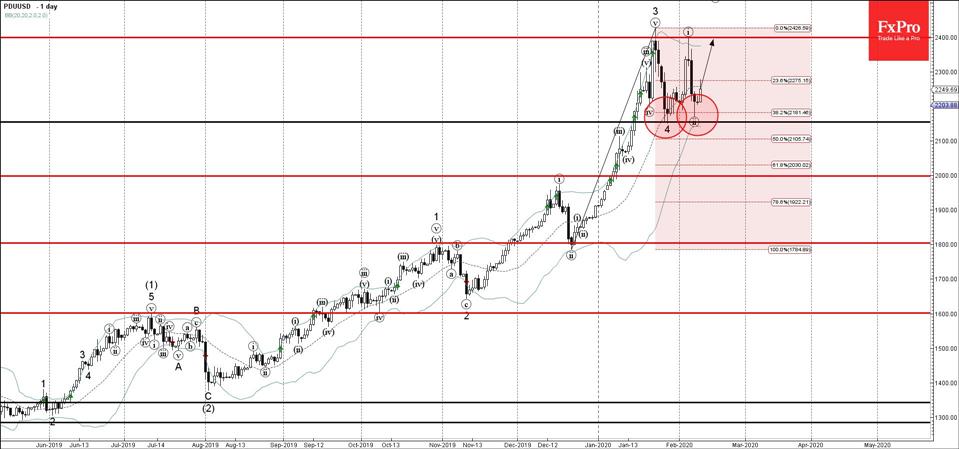
Palladium Wave Analysis 10 February, 2019

  • Palladium reversed from support area
  • Likely to rise to 2400.00

Palladium recently reversed up from the support zone located between the key level 2155.00 (low of the previous short-term correction 4), lower daily Bollinger Band and the 38.2% Fibonacci correction of the pervious upward impulse 3 from December.

The upward reversal from this support area created the daily Japanese candlesticks reversal pattern Hammer.

Palladium is likely to rise further toward the next resistance level 2400.00 (top of the pervious impulse waves 3 and (i)).

Source: https://menafn.com/1099682466/Palladium-Wave-Analysis-10-February-2019

Disinformation is more than fake news SPONSOR: Datametrex AI Limited $DM.ca

Posted by AGORACOM-JC at 2:15 PM on Monday, February 10th, 2020

SPONSOR: Datametrex AI Limited (TSX-V: DM) A revenue generating small cap A.I. company that NATO and Canadian Defence are using to fight fake news & social media threats. The company announced three $1M contacts in Q3-2019. Click here for more info.

Disinformation is more than fake news

By Jared Cohen, for Jigsaw blog

Jigsaw’s work requires forecasting the most urgent threats facing the internet, and wherever we traveled these past years — from Macedonia to Eastern Ukraine to the Philippines to Kenya and the United States — we observed an evolution in how disinformation was being used to manipulate elections, wage war, and disrupt civil society. By disinformation we mean more than fake news. Disinformation today entails sophisticated, targeted influence campaigns, often launched by governments, with the goal of influencing societal, economic, and military events around the world. But as the tactics of disinformation were evolving, so too were the technologies used to detect and ultimately stop disinformation.

Using technology to detect manipulated images

Beginning in 2016 we began working with researchers and academics to develop new methods for using technology to detect certain aspects of disinformation campaigns. Together with Google Research and academic partners, we developed an experimental platform called Assembler to test how technology can help fact-checkers and journalists identify and analyze manipulated media.

Debunking images is a time consuming and error-prone process for fact-checkers and journalists. To verify the authenticity of images, they rely on a number of different tools and methods. For example, Bellingcat, a group of researchers and investigative journalists dedicated to in-depth fact-checking, lists more than 25 different tools and services available to verify the authenticity of photos, videos, websites, and other media. Fact-checkers and journalists need a way to stay ahead of the latest manipulation techniques and make it easier to check the authenticity of images and other assets.

Assembler is an early stage experimental platform advancing new detection technology to help fact-checkers and journalists identify manipulated media. In addition, the platform creates a space where we can collaborate with other researchers who are developing detection technology. We built it to help advance the field of science, and to help provide journalists and fact-checkers with strong signals that, combined with their expertise, can help them judge if and where an image has been manipulated. With the help of a small number of global news providers and fact checking organizations including Agence France-Presse, Animal Politico, Code for Africa, Les Décodeurs du Monde, and Rappler, we’re testing how Assembler performs in real newsrooms and updating it based on its utility and tester feedback.

How Assembler Works

Assembler brings together multiple image manipulation detectors from various academics into one tool, each one designed to spot specific types of image manipulations. Individually, these detectors can identify very specific types of manipulation — such as copy-paste or manipulations to image brightness. Assembled together, they begin to create a comprehensive assessment of whether an image has been manipulated in any way. Experts from the University of Maryland, University Federico II of Naples, and the University of California, Berkeley each contributed detection models. Assembler uses these models to show the probability of manipulation on an image.

Additionally, we built two new detectors to test on the platform.The first is the StyleGAN detector to specifically address deepfakes. This detector uses machine learning to differentiate between images of real people from deepfake images produced by the StyleGAN deepfake architecture. Our second model, the ensemble model, is trained using combined signals from each of the individual detectors, allowing it to analyze an image for multiple types of manipulation simultaneously. Because the ensemble model can identify multiple image manipulation types, the results are, on average, more accurate than any individual detector.

“These days working in multimedia forensics is extremely stimulating. On one hand, I perceive very clearly the social importance of this work: in the wrong hands, media manipulation tools can be very dangerous, they can be used to ruin the life and reputation of ordinary people, commit frauds, modify the course of elections,” said Dr. Luisa Verdoliva, Associate Professor at the Department of Industrial Engineering at the University Federico II of Naples and Visiting Scholar, Google AI. “On the other hand, the professional challenge is very exciting, new attacks based on artificial intelligence are conceived by day, and we must keep a very fast pace of innovation to face them. Collaborating in Assembler was a great opportunity to put my knowledge and my skills concretely to the service of people. In addition I came to know wonderful and very diverse people involved in this project, all strongly committed in this fight. Overall a great experience.”

The Current: Exposing the architecture of disinformation campaigns

Jigsaw is an interdisciplinary team of researchers, engineers, designers, policy experts, and creative thinkers, and we’ve long wanted to find a way to share more of our team’s work publicly, especially our research insights. That’s why I’m excited to introduce the first issue of The Current, Jigsaw’s new research publication that illuminates complex problems through an interdisciplinary approach — like our team.

Our first issue is, as you might have guessed, all about disinformation — exploring the architecture of disinformation campaigns, the tactics and technology used, and how new technology is being used to detect and stop disinformation campaigns.

One feature of this inaugural issue is the Disinformation Data Visualizer. Jigsaw visualized the research from the Atlantic Council’s DFRLab on coordinated disinformation campaigns around the world and shows the specific tactics used and countries affected. The Visualizer is a work in progress. We’re sharing this with the wider community to enable a dialogue about the most effective and comprehensive disinformation countermeasures.

An ongoing experiment

Disinformation is a complex problem, and there isn’t any simple technological solution. The first step is to better understand the issue. The world ought to understand how disinformation campaigns are increasingly being used as a way of manipulating people’s perception of important issues. We’re committed to sharing our insights and publishing our research so other organizations can examine and scrutinize different ways to approach this issue. We’ll be sharing more updates about Jigsaw’s work in this space over the coming few months.

In the meantime we’d like to express our gratitude to our academic partners, our partners within Google, and the courageous publishers and journalists who are committed to using technology to bring people the truth, wherever it leads: Chris Bregler, Larry Davis, Alexei Efros, Hany Farid, Andrew Owens, Abhinav Shrivastava, Luisa Verdoliva, and Emerson Brookings, Graham Brookie and the Atlantic Council’s DFRLab team.

Source: https://www.stopfake.org/en/disinformation-is-more-than-fake-news/?__cf_chl_jschl_tk__=57eb9e0da0a582c3981aa8ed39e5f90a3cae9ebd-1581350912-0-AYw5r3RGxKqQMHhsZazGCBz7wTi9sZsM25j0X6X-RLqgmPiUWqB7PIEF_iEJx1V-pc-0fEmQ57LyMozcBAp7Oco-Uipl_R3nuYudhJdwnnBOovp12rcGmht1TowUugnZFYn8V-4UddKzmMsDP2Nu7IgasYOI6Q21teLNyGc81iMSGZMkJqLLBA8afv_2SoLGtyQ8KKGIx6ECKITuQaE5aA3w_cIEbAWd5sKH9RAmgKrU1c7uqqpCWkS-sxhOeclBEjqf23nkljl4f9Iqhtp3dHTnuvOZ1SjlyiAC0Ld-y5Z7s3lWb2FblSjPO1ko5kldvA2R0areN4kXGMnf0nyv0XY

TESLA, Lomiko and Batteries SPONSOR: Lomiko Metals $LMR.ca $CJC.ca $SRG.ca $NGC.ca $LLG.ca $GPH.ca $NOU.ca

Posted by AGORACOM at 1:33 PM on Monday, February 10th, 2020
BIG BIZ INTERVIEW

CEO INTERVIEW LINK

Lomiko Metals Outlines 2020 Project Plan for La Loutre Flake Graphite Property in Quebec

(Vancouver, British-Columbia and Montreal, Quebec) February 5, 2020 – Lomiko Metals Inc. (TSX-V: LMR, OTC: LMRMF, FSE: DH8C) (Lomiko or the “Company”) is pleased to announce plans to move forward with assessment and development of the La Loutre Property for 2020. The goals are as follows:

1) Complete 100% Acquisition of the Property
2) Complete Metallurgy and Graphite Characterization
3) Complete a Technical Report in accordance with NI 43-101 Guidelines

A “technical report” means a report prepared and filed in accordance with this Instrument and Form 43-101F1 Technical Report that includes, in summary form, all material scientific and technical information in respect of the subject property as of the effective date of the technical report;

4) Complete Preliminary Economic Assessment (PEA) compliant with NI 43-101 Guidelines

PEA means a study, other than a pre-feasibility or feasibility study, that includes an economic analysis of the potential viability of mineral resources;

Further details regarding the plan will be released when consultants are assigned for each task.

Results from Drilling Program

Results from the 2019 program (see Table 1 below, and Figure 1) at the Refractory Zone of the La Loutre graphite project (the “Project”) indicate considerable promise. A total of 21 holes were completed in 2019 on the Refractory Zone for a total of 2,985 metres. The Project is owned by Lomiko (80%) and Quebec Precious Metals Corporation (20%).

“La Loutre has proven to be a large and high-grade area worthy of further investment.” stated A. Paul Gill, CEO. “The only operating graphite mine in North America is the Imerys Graphite & Carbon at Lac-des-Îles, 53 km northwest of La Loutre which reported Proven reserves of 5.2 M Tonnes at a grade of 7.42 % Cg in July 1988 before the start of production.” (reference: Potentiel de la minéralisation en graphite au Québec, N’Golo Togola, MERN, page 31, Conférence Québec Mines, November 24 2016).

* mineralization hosted on adjacent and/or nearby projects is not necessarily indicative of mineralization hosted on the Company’s property:

Although the recent focus was on the Refractory Zone, the Project was also subject of an independent technical report in accordance with NI 43-101 – Standards of Disclosure for Mineral Projects, prepared by B. Turcotte and G. Servelle of InnovExplo Inc. from Val-d’Or, Québec, and O. Peters, of AGP Mining Inc., dated March 24, 2016, filed for the Project’s Graphene-Battery Zone. The report presented a mineral resource estimate of 18.4 M Tonnes at a grade of 3.19% carbon flake graphite (“Cg”) in the Indicated category and 16.7 M Tonnes at 3.75% Cg in the Inferred category using a cut-off of 1.5% Cg.

The above-noted 2016 mineral resource does not include the current results or the significant intercepts from the Refractory Zone in 2016 which were as follows:

LL-16-01 – 7.74% Cg over 135.60 m including 16.81% Cg over 44.10 m
LL-16-02 – 17.08% Cg over 22.30 m and 14.80% Cg over 15.10 m
LL-16-03 – 14.56% Cg over 110.80 m

The next task is to complete a new resource estimate in compliance with NI 43-101 for the entire Project since the above-mentioned 2016 resource estimate including the 2016 and 2019 drilling at the Refractory Zone.

Click Here For More Information