Posted by AGORACOM
at 8:28 AM on Tuesday, February 11th, 2020
VANCOUVER, BC / ACCESSWIRE / February 11, 2020 / VERTICAL EXPLORATION INC. (TSXV:VERT) (“Vertical” or “the Company”) is pleased to provide an update regarding registration of its high-quality St-Onge Wollastonite for use as an approved supplement for both the Canadian agricultural and cannabis/hemp industries.
Vertical and its distribution partner, Wollammo Distribution Inc. (Wollammo), have moved forward to seek registration of Vertical’s St-Onge Wollastonite as a Supplement under the Fertilizer Act established by the Canadian Food Inspection Agency (CFIA). Vertical and Wollammo have engaged Ms. Niki Nickel, Compliance Manager, QA, to help the companies move forward with the registration process in an expedited fashion, given the importance and market appeal that this registration will bring to Vertical and Wollammo.
Ms. Nickel has recently reviewed Wollammo’s compliance data documents and believes the Wollammo product, which consists of 100% St-Onge Wollastonite, meets the criteria for registration as a Supplement under the Canadian Fertilizer Act established by CFIA and the Safe Foods for Canada Act SOR 2018-108. Subsequently, a letter of intent will be filed as soon as possible for Vertical’s Wollastonite in the form of a Pre-Market Application Submission (PASO) at the Canadian Food Inspection Agency.
Wollammo’s compliance data shows that the St-Onge Wollastonite improves soil structure, supports plant growth and improves crop yields which are characteristics defined by CFIA as supplements under the Canadian Fertilizers Act and Regulations. Agriculture Canada Standards have been consolidated into the Safe Foods for Canada Act SOR 2018-108, which also includes related and consequential amendments to Section 88 of the Fertilizer Act and to Section 103 of the CFIA Act. Supplements registered under CFIA are therefore included in the Safe Foods for Canada Act, and can be used for Farm, Lawn and Garden uses.
Ms. Nickel, who has completed registrations in more than 60 Countries and U.S. States (including CFIA registration, REACH, and EPA in the U.S. States) and has also worked with several specialty fertilizer companies to complete label revisions and registration, states that “”I’m excited to help Wollammo move ahead with registration as a supplement with CFIA.”
Peter P. Swistak, President/CEO of Vertical Exploration Inc., commented: “I’m thrilled that, with the strong support of our distribution partner Wollammo, we have been able to move ahead so quickly to seek registration for Vertical’s Wollastonite under both the Agriculture Canada Standards Safe Foods for Canada Act SOR 2018-108 and the Canadian Fertilizer Act established by CFIA. Approval under these important Acts will pave the way for significant market awareness and future sales of our St-Onge Wollastonite, and also help provide verification that the Wollammo Wollastonite product has the highly sought after characteristics that agriculture and cannabis/hemp growers alike are looking for in a premium supplement.”
Vertical will provide a further update as soon as the registration process has been completed.
ABOUT VERTICAL EXPLORATION
Vertical Exploration’s mission is to identify, acquire, and advance high potential mining prospects located in North America for the benefit of its stakeholders. The Company’s flagship St-Onge Wollastonite property is located in the Lac-Saint-Jean area in the Province of Quebec.
ON BEHALF OF THE BOARD Peter P. Swistak, President/CEO
Posted by AGORACOM-JC
at 4:58 PM on Monday, February 10th, 2020
SPONSOR: New Age Metals Inc.
The company owns one of North America’s largest primary platinum
group metals deposit in Sudbury, Canada. Updated NI 43-101 Mineral
Resource Estimate 2,867,000 PdEq Measured and Indicated Ounces, with an
additional 1,059,000 PdEq Ounces Inferred. Learn More.
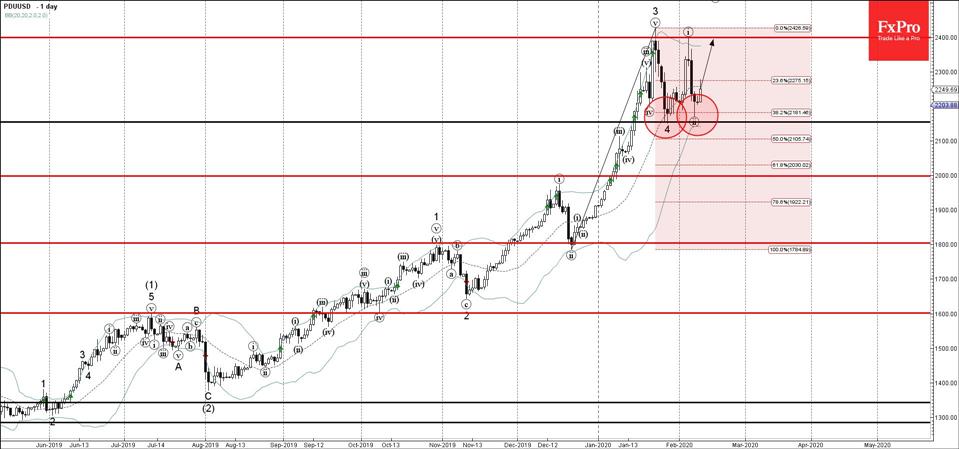
Palladium Wave Analysis 10 February, 2019
Palladium reversed from support area
Likely to rise to 2400.00
Palladium recently reversed up from the support zone located between
the key level 2155.00 (low of the previous short-term correction 4),
lower daily Bollinger Band and the 38.2% Fibonacci correction of the
pervious upward impulse 3 from December.
The upward reversal from this support area created the daily Japanese candlesticks reversal pattern Hammer.
Palladium is likely to rise further toward the next resistance level 2400.00 (top of the pervious impulse waves 3 and (i)).
Posted by AGORACOM-JC
at 2:15 PM on Monday, February 10th, 2020
SPONSOR: Datametrex AI Limited
(TSX-V: DM) A revenue generating small cap A.I. company that NATO and
Canadian Defence are using to fight fake news & social media
threats. The company announced three $1M contacts in Q3-2019. Click here for more info.
Jigsaw’s work requires forecasting the most urgent threats facing the
internet, and wherever we traveled these past years — from Macedonia to
Eastern Ukraine to the Philippines to Kenya and the United States — we
observed an evolution in how disinformation was being used to manipulate
elections, wage war, and disrupt civil society. By disinformation we
mean more than fake news. Disinformation today entails sophisticated,
targeted influence campaigns, often launched by governments, with the
goal of influencing societal, economic, and military events around the
world. But as the tactics of disinformation were evolving, so too were
the technologies used to detect and ultimately stop disinformation.
Using technology to detect manipulated images
Beginning in 2016 we began working with researchers and academics to
develop new methods for using technology to detect certain aspects of
disinformation campaigns. Together with Google Research and academic partners, we developed an experimental platform called Assembler to test how technology can help fact-checkers and journalists identify and analyze manipulated media.
Debunking images is a time consuming and error-prone process for
fact-checkers and journalists. To verify the authenticity of images,
they rely on a number of different tools and methods. For example,
Bellingcat, a group of researchers and investigative journalists
dedicated to in-depth fact-checking, lists more than 25 different
tools and services available to verify the authenticity of photos,
videos, websites, and other media. Fact-checkers and journalists need a
way to stay ahead of the latest manipulation techniques and make it
easier to check the authenticity of images and other assets.
Assembler brings together multiple image manipulation detectors from
various academics into one tool, each one designed to spot specific
types of image manipulations. Individually, these detectors can identify
very specific types of manipulation — such as copy-paste or
manipulations to image brightness. Assembled together, they begin to
create a comprehensive assessment of whether an image has been
manipulated in any way. Experts from the University of Maryland,
University Federico II of Naples, and the University of California,
Berkeley each contributed detection models. Assembler uses these models
to show the probability of manipulation on an image.
Additionally, we built two new detectors to test on the platform.The
first is the StyleGAN detector to specifically address deepfakes. This
detector uses machine learning to differentiate between images of real
people from deepfake images produced by the StyleGAN deepfake
architecture. Our second model, the ensemble model, is trained using
combined signals from each of the individual detectors, allowing it to
analyze an image for multiple types of manipulation simultaneously.
Because the ensemble model can identify multiple image manipulation
types, the results are, on average, more accurate than any individual
detector.
“These days working in multimedia forensics is extremely stimulating.
On one hand, I perceive very clearly the social importance of this
work: in the wrong hands, media manipulation tools can be very
dangerous, they can be used to ruin the life and reputation of ordinary
people, commit frauds, modify the course of elections,†said Dr. Luisa
Verdoliva, Associate Professor at the Department of Industrial
Engineering at the University Federico II of Naples and Visiting
Scholar, Google AI. “On the other hand, the professional challenge is
very exciting, new attacks based on artificial intelligence are
conceived by day, and we must keep a very fast pace of innovation to
face them. Collaborating in Assembler was a great opportunity to put my
knowledge and my skills concretely to the service of people. In addition
I came to know wonderful and very diverse people involved in this
project, all strongly committed in this fight. Overall a great
experience.â€
The Current: Exposing the architecture of disinformation campaigns
Jigsaw is an interdisciplinary team of researchers, engineers,
designers, policy experts, and creative thinkers, and we’ve long wanted
to find a way to share more of our team’s work publicly, especially our
research insights. That’s why I’m excited to introduce the first issue
of The Current, Jigsaw’s new research publication that illuminates complex problems through an interdisciplinary approach — like our team.
Our first issue is, as you might have guessed, all about
disinformation — exploring the architecture of disinformation campaigns,
the tactics and technology used, and how new technology is being used
to detect and stop disinformation campaigns.
One feature of this inaugural issue is the Disinformation Data Visualizer. Jigsaw visualized the research from the Atlantic Council’s DFRLab on
coordinated disinformation campaigns around the world and shows the
specific tactics used and countries affected. The Visualizer is a work
in progress. We’re sharing this with the wider community to enable a
dialogue about the most effective and comprehensive disinformation
countermeasures.
An ongoing experiment
Disinformation is a complex problem, and there isn’t any simple
technological solution. The first step is to better understand the
issue. The world ought to understand how disinformation campaigns are
increasingly being used as a way of manipulating people’s perception of
important issues. We’re committed to sharing our insights and publishing
our research so other organizations can examine and scrutinize
different ways to approach this issue. We’ll be sharing more updates
about Jigsaw’s work in this space over the coming few months.
In the meantime we’d like to express our gratitude to our academic
partners, our partners within Google, and the courageous publishers and
journalists who are committed to using technology to bring people the
truth, wherever it leads: Chris Bregler, Larry Davis, Alexei Efros, Hany
Farid, Andrew Owens, Abhinav Shrivastava, Luisa Verdoliva, and Emerson
Brookings, Graham Brookie and the Atlantic Council’s DFRLab team.
Lomiko Metals Outlines 2020 Project Plan for La Loutre Flake Graphite Property in Quebec
(Vancouver, British-Columbia and Montreal, Quebec) February 5, 2020 –
Lomiko Metals Inc. (TSX-V: LMR, OTC: LMRMF, FSE: DH8C) (Lomiko or the
“Companyâ€) is pleased to announce plans to move forward with assessment
and development of the La Loutre Property for 2020. The goals are as
follows:
1) Complete 100% Acquisition of the Property 2) Complete Metallurgy and Graphite Characterization 3) Complete a Technical Report in accordance with NI 43-101 Guidelines
A “technical report” means a report prepared and filed in accordance
with this Instrument and Form 43-101F1 Technical Report that includes,
in summary form, all material scientific and technical information in
respect of the subject property as of the effective date of the
technical report;
4) Complete Preliminary Economic Assessment (PEA) compliant with NI 43-101 Guidelines
PEA means a study, other than a pre-feasibility or feasibility study,
that includes an economic analysis of the potential viability of mineral
resources;
Further details regarding the plan will be released when consultants are assigned for each task.
Results from Drilling Program
Results from the 2019 program (see Table 1 below, and Figure 1) at the
Refractory Zone of the La Loutre graphite project (the “Projectâ€)
indicate considerable promise. A total of 21 holes were completed in
2019 on the Refractory Zone for a total of 2,985 metres. The Project is
owned by Lomiko (80%) and Quebec Precious Metals Corporation (20%).
The above-noted 2016 mineral resource does
not include the current results or the significant intercepts from the
Refractory Zone in 2016 which were as follows:
LL-16-01 – 7.74% Cg over 135.60 m including 16.81% Cg over 44.10 m LL-16-02 – 17.08% Cg over 22.30 m and 14.80% Cg over 15.10 m LL-16-03 – 14.56% Cg over 110.80 m
The next task is to complete a new resource estimate in compliance with NI 43-101 for the entire Project since the above-mentioned 2016 resource estimate including the 2016 and 2019 drilling at the Refractory Zone.
Posted by AGORACOM
at 4:55 PM on Friday, February 7th, 2020
SPONSOR: ZEN Graphene Solutions: An emerging advanced materials and graphene development company with a focus on new solutions using pure graphene and other two-dimensional materials. Our competitive advantage relies on the unique qualities of our multi-decade supply of precursor materials in the Albany Graphite Deposit. Independent labs in Japan, UK, Israel, USA and Canada confirm this. Click here for more information
“This company has the very rare graphite deposit in Ontario –
as it is able to transform or exfoliate into graphene products easier
than other graphites around the world”
“The goal of the facility is to start producing some of these
nanomaterials – graphene, graphene oxide, and graphene quantum dots.”
“These materials at the research level have a lot of excitement around
them. They also come at a very high price.”
ZEN is an emerging graphene technology solutions company with a focus
on the development of graphene-based nanomaterial products and
applications. The unique Albany Graphite Project provides the company
with a potential competitive advantage in the graphene market as
independent labs in Japan, UK, Israel, USA and Canada have independently
demonstrated that ZEN’s Albany PureTM Graphite is an ideal precursor
material which easily converts (exfoliates) to graphene, using a variety
of mechanical, chemical and electrochemical methods.
Posted by AGORACOM
at 3:00 PM on Friday, February 7th, 2020
SPONSOR: New Age Metals Inc. The company owns one of North America’s largest primary platinum group metals deposit in Sudbury, Canada. Updated NI 43-101 Mineral Resource Estimate 2,867,000 PdEq Measured and Indicated Ounces, with an additional 1,059,000 PdEq Ounces Inferred. Learn More.
Summary
The palladium market will remain tight and pressure prices higher.
Sibanye Gold with the Stillwater Mine has plunged back into SA.
The Aberdene palladium ETF and Canadian palladium juniors are the best proxies.
Palladium has been the best performing commodity in the past two
years or so, jumping over 100% and there is more to go. This palladium
bull market is much different than the last one. The bull market from
1997 to 2000 was about 3 years and then palladium dropped giving up most
of the gains in less than a year. There was a nice bump up from the
2008 crisis and then the price traded sideways for several years. The
price bottomed at the end of 2015 with the severe bear market in
precious metals. Since then, the price has been going steadily higher
with a major break out in 2016. This bull market is not going to end
anytime soon for the reasons below.
Palladium is mostly used in the auto industry for pollution control
with catalytic converters. Electric vehicles will be a long time coming
to replace any significant amount of gasoline/diesel driven vehicles.
Meanwhile, pollution standards are being tightened that will keep demand
high. China has been gobbling up palladium since their China 5
pollution standards took effect in 2013. China 6 will now be coming into effect that will increase loads per vehicle of palladium. Many analysts have been commenting that China has been secretly stock piling the metal and is driving prices.
Palladium demand by Sector
There is no doubt the demand will remain strong, but the real
story is on the supply side. This next graphic illustrates the supply
deficit since 2016.
It is obvious to expect an increased demand from China as pollution regulations are tightened with ‘China 6’.
This next graphic of global mine production is very important because of the palladium supply is in a very unstable region.
The Russian supply from Norilsk Nickel has always been quite stable
and is of no concern, but as investors, we cannot participate there.
South Africa is the other big producer and that country is becoming very
unstable and more worrisome, that is where most of the future reserves
are.
The world’s largest PMG reserves are in South Africa, precisely in
the Bushveld Complex (in the central-Northern part of the country) which
alone accounts for about 50% of the world’s palladium resources, but,
overall, South Africa has reserves of 63 million kilograms which
represent over 91% of the worldwide availability.
South African (SA) mines have always been plagued with labour issues,
strikes, and high costs. To make matters worse, the country is now
facing an energy crisis with rolling blackouts shutting down mines. The country will probably become much more unstable, with unemployment hitting 10-year highs.
Half of their youth are unemployed and the company that provides 95% of
the electricity (when it can) is reporting record financial losses.
This is a country teetering on the brink of chaos that will likely be
very disruptive to PGM mine supply. I am avoiding palladium and platinum investments there.
With all the issues in SA, Sibanye Gold (SBGL)
began diversifying out of the country and acquired the Stillwater PGM
mine in the US. That use to be my favourite stock to play palladium bull
markets. However, they jumped right back into the fray, acquiring
Lonmin in 2019, a struggling SA, PGM producer. They promptly cut 5,000
jobs at the mine and it now appears Sibanye is moving more into PGMs
from gold. According to what was released in the acquisition news,
Sibanye PGM production will increase from around 1.7M ounces per year
to 2.8M ounces/year. This compares to about 600,000 ounces/year at the
US Stillwater complex plus about 700,000 ounces produced through the
recycling unit, noted from the 2018 annual report.
SA PGM production was 627,991 ounces (this will increase significantly with Lonmin acquisition)
SA gold production was 344,752 ounces (this amount is well below normal because of mine strike)
US PGM production was 284,773 ounces
US PGM recycling was 421,450 ounces
The stock has done well with the rising palladium price, but at these
stock prices and the move back to SA, it has become too risky. I would
suggest selling at these prices.
To highlight risks further, the Q1 2019 financial report highlights a -63% decline in SA gold production in Q1 2019 compared to Q1 201 because of the labour strike. This news out on February 2nd
states that 19 attacks on SA gold facilities nearly doubled from last
year. On December 15, 2019, attackers took hostages and plundered the
smelting plant at Gold Fields Ltd.‘s South Deep mine. “Mining companies are being attacked by thugs and armed gangs and there is a lack of police response,” said Neal Froneman, CEO of Sibanye Gold Ltd., which repelled an attack on its Cooke mine two weeks ago. “It eventually has a knock-on impact into society, it’s lawlessness, it’s anarchy.”
There is the Aberdeen Standard Physical Palladium ETF Trust (PALL).
The investment objective of the Trust is for the Shares to reflect the
performance of the price of palladium, less the expenses of the Trust’s
operations. The ETF Trust physically holds palladium in JPMorgan vaults
in London and Zurich. PALL tracks the movements in palladium spot prices
fairly well and is the best direct exposure to palladium. Aberdeen
purchased the fund effective October 1, 2018, from ETF Securities. The
Aberdeen website is terrible, it just diverts you to something else they
are trying to sell. You can find some more info at etf.com.
One disadvantage, as a Trust it will often trade at a discount to NAV, so short term may not always reflect palladium movements precisely.
The chart of PALL reveals quite a jump in volume on the last rally. I
do not find this alarming, but shows it is really the first time the
palladium market has caught retail interest.
If we compare to the short-term chart on palladium below, it is easy
to see that PALL has tracked the palladium price very well. After a
needed correction, the price jumped higher on Monday. This is probably a
start to the next rally.
There is also Sprott Physical Platinum and Palladium Trust (SPPP), but it is split 50/50 between the two metals.
Canada is the third-largest producing country, so an obvious place to
look. A lot of the palladium production comes from major miners in the
Sudbury nickel/copper complex as a byproduct. Obviously, this is a good
area to look and there was an excellent proxy for investors called North
American Palladium that was operating the Lac Des Isles palladium mine.
Unfortunately, for us, investors, it was bought out last year by SA producer Implats.
The area had a number of discoveries back in the last bull market
around the year 2000, and I visited a number of those projects back
then. I believe the best one in this area is Canadian Palladium that acquired the East Bull project last year. There is also Palladium One that is not Canada but not in SA either.
Palladium One Mining (OTC:NKORF) – PGM project is in Finland.
Shares outstanding 111 million, 185 million fully diluted
Their LK project is located in north-central Finland, approximately
40 km north of the company’s exploration office in the town of
Taivalkoski. The property is 160 km (by road) east-southeast of
Rovaniemi and 190 km northeast of the port city of Oulu. Finland is a
very stable jurisdiction and has a viable mining sector.
The company is run by CEO/President, Derrick Weyrauch, CPA, CA who is
an experienced mining executive and corporate director. Mr. Weyrauch’s
background includes finance, risk management, corporate restructuring
and turnarounds, coupled with M&A strategy development, execution
and post transaction integration. He is the co-founder of Magna Mining
Corp. and is a former corporate director of a number of companies
including Eco Oro Minerals Corp., Jaguar Mining Inc., and Banro Corp.
and is a former CFO of Jaguar Mining Inc. and Andina Minerals Inc.
Currently, he is a non-executive director and at Cabral Gold Inc.
The LK Project is 100% owned by Palladium One Mining Inc.
Palladium One released a mineral resource estimate for the Kaukua deposit within the 100-per-cent-owned Lantinen Koillismaa (LK) project.
Highlights:
An optimized pit-constrained mineral resource, at a 0.3-g/t palladium cut-off;
635,600 PdEq (palladium equivalent) ounces of indicated resources grading 1.80 g/t PdEq contained in 11 million tonnes;
525,800 PdEq ounces of inferred resources grading 1.50 g/t PdEq contained in 11 million tonnes.
Significant potential exists to expand the historic Haukiaho
deposit along strike both to the east and west. For example, 1960s-era
historic drilling by Outokumpu about two km east of the historic 2013
Haukiaho inferred resource returned up to 36.36 m grading 0.20 per cent
Cu and 0.19 per cent Ni from 1.64 m to 38.00 m downhole in hole R692 (no
PGE analysis was conducted). Reconnaissance prospecting by Palladium
One in the vicinity of this historic drill hole returned up to 0.51 per
cent Cu, 0.33 per cent Ni, 0.19 g/t Pt, 0.56 g/t Pd and 0.21 g/t Au
(0.96 g/t PGE) (see press release dated Aug. 12, 2019). Palladium one
recently applied for the Haukiaho East reservation (see press release
date Sept. 5, 2019), which, if approved, the company would control about
24 km of the favourable Haukiaho basal contact.”
The company plans to conduct
a 75-line-kilometre induced polarization (IP) geophysical program,
along with a diamond drilling program of up to 5,000 metres, at the LK
project. Both drilling and geophysics contractor are expected to be
mandated soon.
The Tyko Ni-Cu-PGE project, i65km northeast of Marathon Ontario, Canada.
The Tyko project is an early stage, high sulphide tenor, nickel
focused project with recent drill hole intercepts returning up to 1.06 Ni over 6.22 m including 4.71% Ni over 0.87m in hole TK-16-010 (see press release dated June 8, 2016). On January 21, 2019, Palladium One reported prospecting samples with assay results of up to 0.74% Ni, 4.09% Cu, and 2.51g/t PGE
on the Tyko Nickel-Copper-PGE Property. This project has some
palladium, but if it is developed to a resource, it will be more like
the Sudbury copper and nickel mines with PGMs as a byproduct.
The company is well financed, closing a C$3,786,180 private placement
at C$0.06 per unit issuing 63,102,999 units. Eric Sprott took down
20,000,000 units. While funding is required, this is quite a bit of
dilution.
Currently, the stock is priced around $0.18 so all the warrants and
options are well in the money. So is appropriate to use the fully
diluted shares outstanding for valuation.
Market cap – $20 million. Market cap fully diluted Cdn $33.3 million
Subtracting $3.8 million financing from the market cap, it values
their 635,600 PdEq indicated resource at C$25 per ounce and fully
diluted at C$46 per ounce. This is a quite low valuation.
The stock mostly trades on the TSXV symbol (PDM), so I used the C$
chart. Support is around 16 cents and 12.5 cents. If 16 cents holds, the
stock could begin a leg higher.
Canadian Palladium
Shares outstanding 100.3 million approx.
All warrants and options are at 30 cents and higher.
What I consider one of the most important highlights is the company
is run by Wayne Tisdale. In the last 10 years, he has advanced three
juniors and sold them for large profits for their shareholders. He
helped start and finance the Rainy River project which was sold to NewGold in 2013 for $310 million. He developed US Cobalt and, in 2018, sold it to First Cobalt in a transaction worth $150 million to his shareholders’ delight. Going back further, he helped finance oil & gas company Ryland Oil that was bought out by Crescent Point in 2010 for a $121.8 million
valuation. Mr. Tisdale has a keen eye to find projects that can quickly
be advanced further to make them prime acquisition targets. Canadian
Palladium only has a market value now of about C$20 million, and I have
little doubt that Mr. Tisdale is going to do it again with Canadian Palladium.
Highlights:
Company run by Wayne Tisdale
Low market valuation – C$31 per ounce
East Bull with 43-101, 523,000 inferred palladium equivalent resource
East Bull can open to depth and along strike
Widely spaced drilling only needs infill drilling to upgrade and expand resource
Close to Sudbury complex where ore can be processed
Projects – East Bull, Ontario Canada
East Bull was drilled by Freewest and Mustang Minerals back in the
2000 era and now has a 43-101, 523,000 ounces inferred palladium
equivalent resource. A private company, Pavey Ark Minerals had the
property and in 2017 they twinned old drill holes and completed the work
to bring the project to 43-101 standards. Canadian Palladium (formerly
21C Metals) acquired a 100% option on the project last February.
This graphic from their presentation is a good summary and shows the location
In the 1999, 2000 period, Freewest drilled 27 holes for a total of
2,902 meters and carried out extensive surface trenching. Work by
Mustang on the eastern part of the Property (claim 1227910) included 11
drill holes for a total of 1,766 meters. The work by Freewest and
Mustang forms the majority of the data for the current resource
estimate. Additionally, Pavey Ark reviewed and re-sampled drill core
from the 27 BQ and NQ holes from the Freewest drilling program. Pavey
Ark’s exploration results in 2017 included;
hole EB17-01 that intersected 12.0 m at 2.87 g/t PGM+Au, 0.23% Cu and 0.13% Ni and
hole EB17-03 that intersected 7.0 m of 3.21 g/t PGM+Au, 0.16% Cu and 0.07% Ni.
(Note: Au = gold, Cu = copper, and Ni = nickel.)
In 2019, BULL completed their initial exploration program at East Bull and reported results Sept. 17, 2019.
These are highlights from the first sampling program on the East Bull
palladium project and field program on the Agnew Lake project:
Seventy-three grab samples were selected to help identify the
palladium-bearing rock types of the mineralized trend. Grab samples are
used to determine the presence mineralization and may not be indicative
of the overall grade of the zone
Sampling successfully defined locations for channel sampling and the
higher grades could indicate potential zones within the mineralized
zone for higher-grade starter pits
Range of palladium assay sample results were 37 samples below 0.1
g/t palladium, 17 between 0.1 and 0.5 g/t with 14 above 1 g/t. Nine of
these ran between 2 and 6.5 g/t
Geological mapping and review of the Freewest diamond drilling in
2000, indicates the northeast-trending faults are composed of multiple
intrusions of mafic to diabase dikes. Left lateral movement on the dikes
is measured to be up to 100 metres
This graphic gives a good snapshot of the current resource and
expansion potential. Mineralization starts at surface and the system
appears to be about 30 meters wide. This would be an open-pit operation.
Agnew Lake property
It is located 80 kms. west of Sudbury, Ont., home of Glencore and
Vale’s Canadian nickel-copper-platinum-group-elements mining and
smelting operations. The Agnew Lake property comprises over 260 claims
(about 6,000 hectares) and is part of the larger East Bull Lake-Agnew
Lake mafic-ultramafic complex.
The Agnew Lake magmas have major element compositions that are very
similar to the model parent liquids proposed for the mafic portions of
the Stillwater and Bushveld complexes. The Agnew intrusion and the East
Bull Lake intrusion are also considered to host significant PGE-Cu-Ni
mineralization in marginal rock units (Peck & James, 1990; Peck et
al., 1993a, 1993b, 1995; Vogel et al., 1997).
Financial/Summary
Last financial statements show just over $400,000 cash. The company
just closed a $4 million financing at 12 cents per share. Eric Sprott
bought 12.5 million shares of that financing.
Wayne Tisdale has been successful in financing and increasing the
value of properties and dealing them off for large profits. I believe he
will do it again and also has a loyal following of shareholders from
his past success. BULL just acquired the property last year and there
has been little exploration and no drilling so it has been under the
radar until the recent financing. The discovery is on the surface, so
will be cheap to mine and is close to the Sudbury complex where refiners
can recover PGMs. There is a couple other palladium exploration plays
in Canada, but they are mostly old stale stories and I believe none have
the short-term potential that the East Bull project has.
The current market cap is $20.1 Million less the $4 million financing
gives an enterprise value of C$31 per ounce on their 523,000-ounce
Pd-eq inferred resource. Part of the reason for the low value is the
resource is only inferred. If drilling success starts to prove larger
potential and the resource moves up to the measured and indicated
category it could easily increase the value potential.
Only exploration news last year was sample results that came out last
September just when the junior market started heading south. The stock
made a decent move higher than just drifted lower until a typical
year-end bottom. The stock took off when it hit 12 cents on good volume.
This is when they began marketing a financing that was way
oversubscribed in one day. Probably spill over buying drove the stock up
to the 23-cent level. The stock then came back to support around 16
cents and bounced off higher. Drill news will likely cause the next move
higher with the old highs around 27 cents last year as the first major
resistance.
Conclusion
A recent update on palladium by TD Securities
highlights tightening emission controls and South Africa as I have, but
most interesting is the lack of speculative trading positions. TD
comments positions held by traders are below average. This rally has
room to move and if excessive speculation builds it could go way higher.
Regardless of whether palladium is $1,200 or $2,400 per ounce,
palladium discoveries and deposits will be worth premium valuations,
especially in stable jurisdictions. The potential for discoveries in
South Africa is very good but the political risks are rising. Ivanhoe
Mines (OTCQX:IVPAF), Eastplats, and Platinum Group Metals (PLG)
have projects in SA, and if I had to pick one there, it would be
Platinum Group Metals because they have the most leverage to platinum
and palladium prices.
The best direct related investment to palladium is the PALL ETF, but
it does not offer any leverage. There are not any 2 times or 3 times
palladium ETFs. This leaves the best leverage to junior palladium
companies and there are few. I prefer those outside of SA like Canadian
Palladium and Palladium One. I prefer Canadian Palladium because of the
CEO’s track record, their resource is on surface, near PGM smelters and
likely cheaper exploration costs in Canada vs Finland. For
diversification, owning more than one palladium play is not a bad idea.
Disclosure: I am/we are long DCNNF. I wrote
this article myself, and it expresses my own opinions. I am not
receiving compensation for it (other than from Seeking Alpha). I have no
business relationship with any company whose stock is mentioned in this
article.
Additional disclosure: Canadian Palladium is a paid advertiser at affiliate playstocks.net
Posted by AGORACOM
at 1:45 PM on Friday, February 7th, 2020
SPONSOR: Lomiko Metals is focused on the exploration and development of minerals for the new green economy such as lithium and graphite. Lomiko owns 80% of the high-grade La Loutre graphite Property, Lac Des Iles Graphite Property and the 100% owned Quatre Milles Graphite Property. Lomiko is uniquely poised to supply the growing EV battery market. Click Here For More Information
Electric vans charge at a warehouse
of the German postal and logistics service Deutsche Post near Frankfurt
in July 2018. Fleet vehicles are increasingly going electric in Europe
and China, and some analysts say American fleets will be following suit.
As electric cars grow in popularity and visibility, experts say a revolution is coming in a place most people overlook: corporate and municipal fleets.
The scooter company Lime is the latest firm to announce
that it plans to completely remove gas- and diesel-powered vehicles
from its fleet and power its new electric work vehicles with renewable
energy.
Lime is famous, of course, for electric vehicles — the small battery-powered scooters
that have popped up on sidewalks across the United States. And as the
world’s largest scooter company, it promotes itself as an eco-friendly
alternative to driving. But so far, some gas-guzzling is still involved
behind the scenes.
“All of our scooters and e-bikes are already electric, already
powered by renewables,” says Andrew Savage, the head of sustainability
at Lime. “We’re going to take the vans and the vehicles used to manage
those programs and transition those to zero emissions as well.”
Lime’s fleet isn’t large — a few hundred vehicles for now. But the company is not alone in plotting the switch.
Lime, along with companies like Ikea and Unilever, is joining the EV100 initiative
to commit to an all-electric fleet. Other large companies, such as DHL,
Amazon and AT&T, have committed to “accelerating” the transition to
electric fleet vehicles.
Millions of fleet vehicles are on the road — everything from delivery
trucks and maintenance vans to police cars and school buses. Right now,
less than 1% of those vehicles are electric, according to the research
firm Guidehouse (formerly known as Navigant).
But in a decade, the group predicts that 12% of fleet vehicles will
be plug-ins. That will mean a rise from about 2 million electric fleet
vehicles now to more than 70 million in 2030.
“Given the life span of vehicles … 12% [of the] population will
require a significant portion of new vehicles sold being plug-in
electric vehicles,” says Guidehouse’s Ted Walker.
Interest in sustainability will drive some of that growth. Companies
like Lime that market themselves as climate friendly or have made
climate pledges to investors and partners need to reduce the emissions
from their fleets in order to restrain emissions. And around the world —
particularly in Europe and China — government pressure is spurring
investment in electric vehicles of all types.
But there are other factors too. In some ways, selling electric
vehicles to companies is easier than selling one to an individual car
owner.
Consider the price. “Electric vehicles are going to have a higher
purchase price, but there’s a lower maintenance, lower fuel cost,”
Walker says. Where an individual might focus on the sticker shock, a
company is more likely to consider the lifetime cost of the vehicle.
Then there’s range anxiety. It takes longer to charge a battery than
to fill up a gas tank, and some people (particularly those who have
never owned or leased an electric vehicle) worry that they’ll go on a
long trip and run out of juice. The concern is common even for drivers
who very rarely drive long distances.
Fleet operators think differently; they know how far their cars go in a day, says Steve Burns, the CEO of Lordstown Motors. The Ohio startup is making a pickup truck specifically to sell to fleets.
“We are catering mostly to people that stay local — whether that’s a
florist, a landscaper, a police officer,” Burns says. “[Our truck] can
go 250 miles on a charge. Most of these type of folks go 60 or 70 miles a
day.”
There are some logistical challenges — fleet operators have to set up
charging infrastructure in their garages or parking lots, for instance.
But there’s another obstacle. Lordstown Motors’ truck, the Endurance,
isn’t available yet. No mass-production electric pickup has yet arrived
on the U.S. market. And in America, options for vans and other work
vehicles are similarly slim.
“It’s only a small handful, and the supply is actually quite constrained,” says Savage, of Lime.
So companies are expressing their interest in electric fleets partly
as a signal to automakers — that they need to catch up with demand.
Posted by AGORACOM
at 1:16 PM on Friday, February 7th, 2020
SPONSOR: Labrador Gold – Two successful gold
explorers lead the way in the Labrador gold rush targeting the
under-explored gold potential of the province. Exploration has already
outlined district scale gold on two projects, including a 40km strike
length of the Florence Lake greenstone belt, one of two greenstone belts
covered by the Hopedale Project. Click Here for More Info
Labrador Gold: District Scale Discovery Potential
First stage drilling on selected targets in 2020 at Hopedale
Large under-explored properties, including the major portion of two greenstone belts
Potential for discovery of new gold district(s)
Experienced exploration success in finding gold deposits (>17 million oz)
First mover advantage
Results of aggressive initial exploration programs already indicate district scale gold targets
Hopedale Project Highlights:
Discovered a new gold showing north of the Thurber Dog gold
occurrence, grab samples from which assayed between 1.67 and 8.26 g/t
Au.
The Thurber Dog gold occurrence has assays in grab and channel
samples from below detection up to 7.866 g/t Au, with 5 samples greater
than 1 g/t Au and 16 samples assaying greater than 0.1 g/t Au.
The discovery extends the potential strike length of gold mineralization by approximately 500 metres along strike to the north.
The new showing occurs within a larger 3km trend of anomalous gold
in rock and soil associated with the contact between mafic/ultramafic
volcanic rocks and felsic volcanic rocks.
Exploration at Hopedale during 2020 will focus on determining the
extent of the Thurber Dog mineralized trend. Such work would aim to fill
in the gaps between showings over the three-kilometre strike length
with sampling and VLF-EM surveys. LabGold also intends to carry out an
initial drill program targeting prospective areas along this trend,
including the new showing.
The Hopedale property covers much of the Hunt River and Florence
Lake greenstone belts that stretch over 80 km. The belts are typical of
greenstone belts around the world but have been underexplored by
comparison. Initial work by Labrador Gold during 2017 show gold
anomalies in soils and lake sediments over a 3 kilometre section of the
northern portion of the Florence Lake greenstone belt in the vicinity of
the known Thurber Dog gold showing where grab samples assayed up to
7.8g/t gold. In addition, anomalous gold in soil and lake sediment
samples occur over approximately 40 kilometres along the southern
section of the greenstone belt (see news release dated January 25th 2018
for more details). Labrador Gold now controls approximately 57km strike
length of the Florence Lake Greenstone Belt.
FULL DISCLOSURE: Labrador Gold is an advertising client of AGORA Internet Relations Corp.
Posted by AGORACOM
at 2:03 PM on Thursday, February 6th, 2020
American Creek Resources Ltd. (TSXV: AMK) is positioned to take full
advantage of the precious metals bull run that many experts believe we
are only in the early stages of.
Image of the Goldstorm Zone found along the base of this hill at Treaty Creek.
With approximately one billion tonnes of gold enriched rock identified (potential for a resource calculation in 2020), the Goldstorm has potential to become a world class gold deposit.
The 2020 drilling is designed to significantly expand the deposit as the system is open to the north, the east and at depth.
The company raised over $3.3 million to strengthen existing
alliances and create a number of new strategic relationships, bringing
strength, credibility and future increased exposure.
Eric Sprott made two separate investments of $1,000,000 into
American Creek. Mr. Sprott is the largest external investor in Treaty
Creek. He recently stated that he is “very excited about the opportunity there as the project has a great shot at having 20 million ounces.”
If you have not yet read the 2019 REPORT ON TREATY CREEK (potential world-class deposit in B.C.’s GOLDEN TRIANGE) click on the image for the fullreport.
The Treaty Creek Project is a joint venture with Tudor Gold owning
3/5th and acting as project operator. American Creek and Teuton
Resources each have a 1/5th interest in the project. American Creek and
Teuton are both fully carried until such time as a Production Notice is
issued, at which time they are required to contribute their respective
20% share of development costs. Until such time, Tudor is required to
fund all exploration and development costs while both American Creek and
Teuton have “free rides”.
About American Creek
American Creek is a Canadian mineral exploration company with a
strong portfolio of gold and silver properties in British Columbia.
Three of those properties are located in the prolific “Golden Triangle”;
the Treaty Creek and Electrum joint venture projects with Tudor
Gold/Walter Storm as well as the 100% owned past producing Dunwell Mine.
The Corporation also holds the Gold Hill, Austruck-Bonanza, Ample
Goldmax, Silver Side, and Glitter King properties located in other
prospective areas of the province.
For further information please contact Kelvin Burton at: Phone: 403 752-4040 or Email: [email protected]. Information relating to the Corporation is available on its website at www.americancreek.com
Posted by AGORACOM
at 12:35 PM on Thursday, February 6th, 2020
Vancouver, British Columbia–(Newsfile Corp. – February 6, 2020) –
Affinity Metals Corp. (TSXV: AFF) (“the Corporation”) (“Affinity”) today
announced that it will be offering on a non-brokered private placement
basis (“the Offering”) up to 5,000,000 units (“Units”) at a price of
$0.20 per Unit for proceeds of $1,000,000 if the Offering is fully
subscribed.
Each Unit consists of one common share of the Corporation (“Common
Share”) and one non-transferrable Common Share purchase warrant
(“Warrant”). Each Warrant may be exercised for one additional Common
Share at a price of $0.30 for a period of 24 months from the closing
date of the Offering.
The securities will be offered to qualified purchasers in reliance
upon exemptions from prospectus and registration requirements of
applicable securities legislation.
Insiders may participate in the Offering. A finder’s fee in cash or
shares may be paid to arm’s length finders in relation to this Offering.
This private placement financing is subject to approval by the TSX
Venture Exchange.
About Affinity
Affinity is a Canadian mineral exploration company focused on
advancing the Regal polymetallic project located near Revelstoke,
British Columbia, Canada.
Information related to the Corporation and the Regal project can be found on the Corporation’s website at: