Agoracom Blog Home

Archive for the ‘All Recent Posts’ Category

Good Cheer for PM Sector Investors – The Completing Cup & Handle Continuation Pattern In GDX SPONSOR: Affinity Metals $AAF.ca $SII.ca $TUD.ca $GTT.ca $AMK.ca $OSK.ca $RKR.ca

Posted by AGORACOM at 2:25 PM on Thursday, February 13th, 2020
This image has an empty alt attribute; its file name is Affinity_Metals_Corp_Logo.png

Sponsor: Affinity Metals (TSX-V: AFF) a Canadian mineral exploration company building a strong portfolio of mineral projects in North America. The Corporation’s flagship property is the Drill ready Regal Property near Revelstoke, BC. Recent sampling encountered bonanza grade silver, zinc, and lead with many samples reaching assay over-limits. Click Here for More Info

Whilst it must be frustrating for Precious Metals sector investors to watch Tech stocks continuing to “shoot the moon” while PM stocks have mostly done nothing, the chart presented below suggests that this situation won’t persist for much longer.

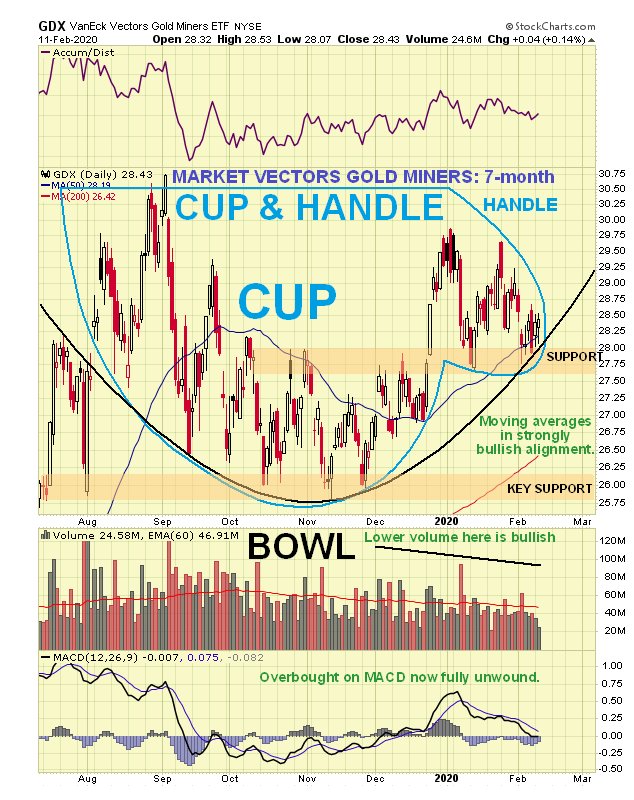
The 7-month chart for GDX shows it probably completing the Handle of a sizeable Cup & Handle continuation pattern. GDX has stayed above the support level shown as the Handle of the pattern has formed, which has allowed the earlier overbought condition at the start of the year to unwind and moving averages to catch up. Volume has eased over the past several weeks which is also a positive sign.

With respect to the timing of the next upleg, the valid Bowl pattern also drawn on the chart helps, for it shows that the price has consistently found support at the Bowl boundary since it started to form last August, and now that it is at it again, with the Handle of the Cup & Handle looking about complete, the time for a new upleg to start is believed to be at hand.

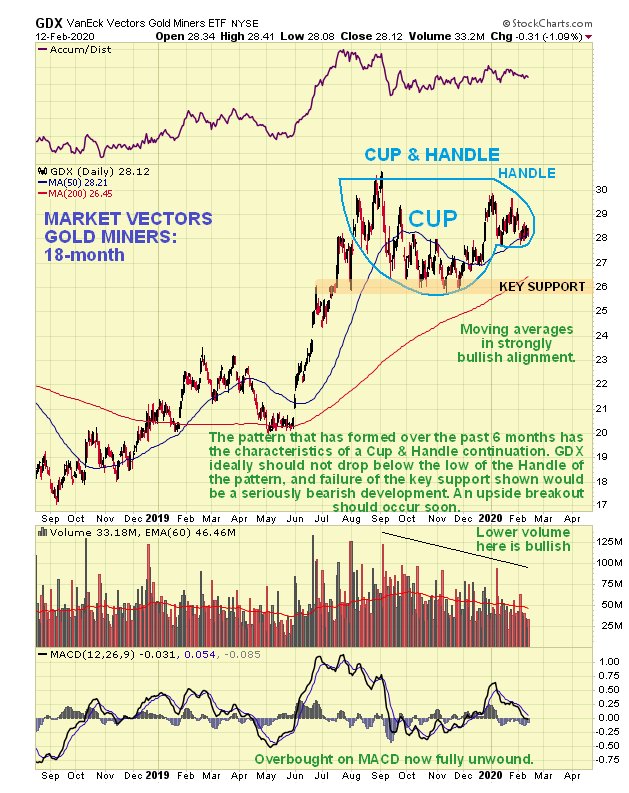
The longer-term 18-month chart for GDX shows what is meant by labeling the Cup & Handle as a “continuation pattern” rather than a Cup & Handle base, which of course follows a drop, for as we can see it has formed at a higher level following the steep runup last Summer. Calling it a continuation pattern means that it is believed to be a consolidation pattern that will lead to renewed advance. While it is expected to break to the upside shortly it should be noted that it would be an unwelcome development if it should drop below the low of the Handle, and also that a breach of the support shown at the lows of the pattern would be a seriously bearish development, although it is considered much more likely that it will soon break to the upside.


So, with the price at the right side of the Cup & Handle pattern, at the support of the Bowl boundary, at the rising 50-day moving average and at an important support level the time appears to be nigh for a new upleg to begin. In addition, the Bollinger Bands (not shown) are pinched together quite tightly suggesting that a big move is imminent and the dollar is in position to reverse to the downside after a run.

SOURCE: https://www.clivemaund.com/article.php?id=5269

Next Tech Frontier – Can Graphene Change The World? SPONSOR – ZEN Graphene Solutions $ZEN.ca $LLG.ca $FMS.ca $NGC.ca $CVE.ca $DNI.

Posted by AGORACOM at 1:03 PM on Thursday, February 13th, 2020

SPONSOR: ZEN Graphene Solutions: An emerging advanced materials and graphene development company with a focus on new solutions using pure graphene and other two-dimensional materials. Our competitive advantage relies on the unique qualities of our multi-decade supply of precursor materials in the Albany Graphite Deposit. Independent labs in Japan, UK, Israel, USA and Canada confirm this. Click here for more information

Every age in the history of human civilisation has a signature material, from the Stone Age, to the Bronze and Iron Ages. We might even call today’s information-driven society the Silicon Age.

Since the 1960s, silicon nanostructures, the building-blocks of microchips, have supercharged the development of electronics, communications, manufacturing, medicine, and more.

How small are these nanostructures? Very, very small – you could fit at least 3,000 silicon transistors onto the tip of a human hair. But there is a limit: below about 5 nanometres (5 millionths of a millimetre), it is hard to improve the performance of silicon devices any further.

So if we are about to exhaust the potential of silicon nanomaterials, what will be our next signature material? That’s where “atomaterials” come in.What are atomaterials?

What are atomaterials?

“Atomaterials” is short for “atomic materials”, so called because their properties depend on the precise configuration of their atoms. It is a new but rapidly developing field.

One example is graphene, which is made of carbon atoms. Unlike diamond, in which the carbon atoms form a rigid three-dimensional structure, graphene is made of single layer of carbon atoms, bonded together in a two-dimensional honeycomb lattice.

Diamond’s rigid structure is the reason for its celebrated hardness and longevity, making it the perfect material for high-end drill bits and expensive jewellery. In contrast, the two-dimensional form of carbon atoms in graphene allows electron travelling frictionless at a high speed giving ultrahigh conductivity and the outstanding in plane mechanical strength. Thus, graphene has broad applications in medicines, electronics, energy storage, light processing, and water filtration. 

Using lasers, we can fashion these atomic structures into miniaturised devices with exceptional performance.

Using atomaterials, our lab has been working on a range of innovations, at various stages of development. They include:

  • A magic cooling film. This film can cool the environment by up to 10℃ without using any electricity. By integrating such a film into a building, the electricity used for air conditioning can be reduced by 35%, and summer electricity blackouts effectively stopped. This will not only save electricity bills but also reduce greenhouse emissions.
  • Heat-absorbing film. Some 97% of Earth’s water is in the oceans, and is salty and unusable without expensive processing. Efficiently removing salt from seawater could be a long-term solution to the growing global freshwater scarcity. With a solar-powered graphene film, this process can be made very efficient.

The film absorbs almost all the sunlight shining on it and converts it into heat. The temperature can be increased to 160℃ within 30 seconds. This heat can then distil seawater with an efficiency greater than 95%, and the distilled water is cleaner than tapwater. This low-cost technology can be suitable for domestic and industry applications.

  • Smart sensing film. These flexible atomaterial films can incorporate a wide range of functions including environmental sensing, communication, and energy storage. They have a broad range of applications in healthcare, sports, advanced manufacturing, farming, and others. For example, smart films could monitor soil humidity near plants’ roots, thus helping to make agriculture more water-efficient.
  • Ultrathin, ultra-lightweight lenses. The bulkiest part of a mobile phone camera is the lens, because it needs to be made of thick glass with particular optical properties. But lenses made with graphene can be mere millionths of a millimetre thick, and still deliver superb image quality. Such lenses could greatly reduce the weight and cost of everything from phones to space satellites.
  • Near-instant power supply. We have developed an environmentally friendly supercapacitor from graphene that charges devices in seconds, and has a lifetime of millions of charge cycles. By attaching it to the back of a solar cell, it can store and deliver solar-generated energy whenever and wherever required. You will be free and truly mobile.

Where to next?

It can take years for some of these laboratory technologies to reach fruition. To try and speed up the process, we established the CTAM Global OpenLab to engage with industry, academia, government and the wider community and to promote sharing and collaboration. The lab was launched earlier this month at the International Conference on Nanomaterial and Atomaterial Sciences and Applications (ICNASA2020).

The world is facing pressing challenges, from climate change, to energy and resource scarcity, to our health and well-being.

Material innovation is more vital than ever and needs to be more efficient, design-driven and environmentally friendly. But these challenges can only be solved by joint effort from worldwide researchers, enterprise, industry and government with a sharing and open mindset.

SOURCE: https://techfinancials.co.za/2020/02/12/next-tech-frontier-can-graphene-change-the-world/

Barrick Gold Boosts Dividend by 40% After Earnings Beat Highest Analyst Estimate SPONSOR: Loncor Resources $LN.ca $ABX.ca $TECK.ca $RSG $NGT.to $GOLD $NEM

Posted by AGORACOM at 12:40 PM on Thursday, February 13th, 2020
This image has an empty alt attribute; its file name is Loncor-Small-Square.png

Sponsor: Loncor is a Canadian gold explorer that controls over 2,400,000 high grade ounces outside of a Barrick JV. The Ngayu JV property is 200km southwest of the Kibali gold mine, operated by Barrick, which produced 800,000 ounces of gold in 2018. Barrick manages and funds exploration at the Ngayu project until the completion of a pre-feasibility study on any gold discovery meeting the investment criteria of Barrick. Newmont $NGT $NEM owns 7.8%, Resolute $RSG owns 27% Click Here for More Info

On Wednesday, Barrick Gold Corp boosted its quarterly dividend by 40 per cent as it reported adjusted earnings of 17 cents a share for the fourth quarter, beating the highest analyst estimate.Barrick Gold

  • The company boosted its quarterly dividend by 40 per cent as it reported adjusted earnings of 17 cents a share for the fourth quarter, beating the highest analyst estimate.

Barrick Gold Corp., the world’s second-largest producer of the metal, will exceed its target of selling US$1.5 billion in assets by the end of this year, chief executive Mark Bristow said.

“We’re going to beat it,” Bristow said Wednesday in an interview following the release of the miner’s fourth-quarter earnings. “We still have some work to tidy up the portfolio.” The company has roughly US$450 million in sales to go to reach the US$1.5 billion mark, but expects to sell more than that this year, he said.

The Toronto-based company had announced the initial asset-sales target in the wake of its US$5.4 billion acquisition of Randgold Resources Ltd. last year. Barrick sold a number of assets in 2019 including a 50 per cent stake in its Kalgoorlie mine in Western Australia.

The sales have forced Barrick to narrow its five-year annual production range to 4.8 million to 5.2 million ounces. “This is our base plan and of course there are upsides that we’re working on.” In November, Barrick had said it expected to maintain its five-year gold production within a range of 5.1 million to 5.6 million ounces, based on its portfolio at the time.

The company plans to release 10-year production guidance at its annual general meeting later this year, Bristow said. Barrick is thinking about what the company should look like long-term, including its mix between copper and gold production.

In December, Bristow said Barrick may some day look into a possible merger with Freeport-McMoRan Inc., the largest publicly traded copper producer. On Wednesday, Bristow said that idea is still at a conceptual stage, but could include anything from a merger to the acquisition of Freeport assets. “Copper is the most strategic metal,” Bristow said.

On Wednesday, the company boosted its quarterly dividend by 40 per cent as it reported adjusted earnings of 17 cents a share for the fourth quarter, beating the highest analyst estimate.

Barrick is benefiting from rising bullion prices, reporting fourth-quarter revenue of US$2.88 billion that also topped analysts’ estimate. Spot gold averaged about US$1,483 an ounce in the fourth quarter, 21 per cent more than a year earlier, and the metal has extended gains this year as the coronavirus weighs on expectations for economic growth.

SOURCE: https://business.financialpost.com/commodities/mining/barrick-gold-ceo-expects-to-beat-1-5-billion-asset-sale-targe

Mercedes, Hydro-Québec Alliance Gives EV Battery Development a Boost SPONSOR: Lomiko Metals $LMR.ca $CJC.ca $SRG.ca $NGC.ca $LLG.ca $GPH.ca $NOU.ca

Posted by AGORACOM at 11:18 AM on Thursday, February 13th, 2020

SPONSOR: Lomiko Metals is focused on the exploration and development of minerals for the new green economy such as lithium and graphite. Lomiko owns 80% of the high-grade La Loutre graphite Property, Lac Des Iles Graphite Property and the 100% owned Quatre Milles Graphite Property. Lomiko is uniquely poised to supply the growing EV battery market. Click Here For More Information

Solid state battery research at Hydro-Québec

Mercedes-Benz is teaming with Hydro-Québec in the race to perfect a new generation of lithium-ion battery said to be lighter, stronger and safer than batteries now powering electric vehicles.

The partnership will allow researchers to field-test batteries in Mercedes vehicles and could hasten development of solid-state li-ion batteries that promise greater range and durability, the companies said

As well, solid-state batteries do not use the flammable liquid electrolytes blamed in numerous difficult-to-extinguish fires in electric vehicles around the globe.

Like other automakers, Mercedes is moving aggressively into electrification, with a goal of introducing at least 10 EVs for 2022 under its EQ and Smart subbrands. It also plans more plug-in gas-electric hybrids across its model lines.

Hydro-Québec is a leader in battery research and holds some 800 patents on energy storage technology. It developed its first solid-state li-ion battery in the 1990s.

Terms of the deal were not disclosed. Testing will take place at the Quebec agency’s research centre near Montreal and at the SCE France laboratory, a Hydro-Québec subsidiary in southwest France.

While battery technology has improved, issues around range, durability and safety are major obstacles to EV acceptance.

Karim Zaghib, who leads Hydro-Québec’s battery research, noted that EV batteries are not off-the-shelf products, so working with a major automaker that can integrate prototype unit into complex vehicle architecture should allow major progress toward better batteries.

As well, “our association will allow us to test new materials quickly in field conditions, and so accelerate the development cycle and respond to the concerns of automobile manufacturers.” Zaghib said in a release.

SOURCE: https://canada.autonews.com/automakers/mercedes-hydro-quebec-alliance-gives-battery-development-boost

India’s #Vedantu scores $24M more for its online tutoring service #Edtech – SPONSOR: BetterU Education Corp. $BTRU.ca $ARCL $CPLA $BPI $FC.ca

Posted by AGORACOM-JC at 10:34 AM on Thursday, February 13th, 2020
SPONSOR:  BetterU Education Corp. aims to provide access to quality education from around the world. The company plans to bridge the prevailing gap in the education and job industry and enhance the lives of its prospective learners by developing an integrated ecosystem. Click here for more information.

India’s Vedantu scores $24M more for its online tutoring service

  • The fresh infusion to Series C, which Vedantu first unveiled in August last year, was led by global VC firm GGV Capital.
  • Some existing investors also participated in the round. The $24 million extension broadens the five-year-old startup’s Series C round to $66 million, and its total raise to date to $82 million.

By: Manish Singh

Vedantu, a Bangalore-based startup that operates a learning app aimed at students aged between 12 to 18, has secured an additional $24 million as part of its Series C financing round as it looks to serve more students and make its brand a household name.

The fresh infusion to Series C, which Vedantu first unveiled in August last year, was led by global VC firm GGV Capital. Some existing investors also participated in the round. The $24 million extension broadens the five-year-old startup’s Series C round to $66 million, and its total raise to date to $82 million.

Vedantu serves students in grade 6 to 12 and offers live and interactive courses. Students who have enrolled for the interactive sessions are required to answer questions every few minutes by tapping on their smartphone screen or on the desktop. They also can raise their doubts at the end of the session.

Some of these sessions are free for students, but a selection of it requires a subscription, Vamsi Krishna, co-founder and CEO of the startup, told TechCrunch in an interview.

The app has amassed over 75,000 paying subscribers, a figure that Krishna expects to surpass 100,000 this year, he said. The cost of these subscriptions can vary from Rs 100 ($1.4) for students looking for sessions around a particular topic, to Rs 50,000 ($700) for long-term courses that focus on training students for undergraduate-level courses. More than 25 million users, in total, come to Vedantu app or website each month to consume free lessons.

India has the largest school-age population in the world and households in the nation are willing to invest in their children’s education to advance their lives. About a million students look to pursue under graduate courses each year, for instance.

But the quality of education and its affordability are two major challenges that millions of students, especially those living in smaller cities and towns, have to confront. An offline coaching centre can have as many as 100 students sitting in the room, with most not getting a chance to engage with the teacher. But for some, it also means there aren’t many teachers left to teach them.

From right to left: Vamsi Krishna, CEO and co-founder; Anand Prakash, co-founder; and Pulkit Jain, co-founder and head of product

In recent years, a wave of tech startups including Byju’s, which was valued at $8 billion in its most recent fund raise last week, have emerged to tackle these challenges as low-cost Android handsets flood the Indian market and mobile data prices become incredibly affordable.

Vedantu allows students to interact with their teachers through the microphone and camera on their smartphone or desktop and also through a chat box on the app. These teachers also have assistants who work with students on their doubts.

Since it’s a virtual class, Vedantu is also able to accommodate more students in a session. A paid session may have as many as 600 students while the free lessons could have 2,000, said Krishna, who is a teacher himself, and ran Lakshya Institute that helped students prepare for undergraduate-level courses until early 2014 before selling a majority stake to Mumbai-based K-12 tutoring and test preparation firm MT Educare.

Running a tech platform has also enabled Vedantu to offer its subscription service at a more affordable price than a typical offline coaching equivalent that can cost users anything between a few hundred dollars to a few thousand.

To ensure that students are paying attention and identify their weaknesses, Vedantu says it has built a patented system called WAVE that evaluates about 70 parameters including whether the student is looking at the screen. More than 90% of its students engage with the session (raise and answer questions, for one), said Krishna.

Hans Tung, Managing Partner at GGV Capital, who is joining the board of Vedantu as part of the investment, said he thinks Vedantu has reached the inflection point with its WAVE product. WAVE enables teachers to deliver “superior results as it can offer personalized education to many students at once,” he said. “We are excited to partner with Vamsi and the Vedantu team and share GGV’s global expertise and network to help them scale and shape learning outcomes for millions of students in India and beyond.”

Krishna said the startup has grown phenomenally in recent years so it is beginning to spend some money to better market its brand. In December, the startup ran some commercials on TV channels. In addition to that, Vedantu has also started to add courses to serve even younger students. The new courses are in pilot stage and would be broadly launched in a few months, he said.

Source: https://uk.finance.yahoo.com/news/indias-vedantu-scores-24m-more-103453756.html?guccounter=1&guce_referrer=aHR0cHM6Ly93d3cuZ29vZ2xlLmNvbS8&guce_referrer_sig=AQAAAMXOkOqEb0PPmTQ5AXZ9ds53Eyl4lc40TefWUy_IU_8p7idep45E8kdorerUVQwNTif3ONR83s31zGGdDOkHVCs8ZcEvIDl3m78BgbSjf2tjBJyID8xFTFE3k-EW1a6vEDCOuyYxChw_vwoVoSAQpwViZBO3rsMAPEgZd78hldFZ

Central Banks Just Love Gold and It’s Going to Stay That Way SPONSOR: Affinity Metals $AAF.ca $SII.ca $TUD.ca $GTT.ca $AMK.ca $OSK.ca $RKR.ca

Posted by AGORACOM at 7:16 PM on Tuesday, February 11th, 2020
This image has an empty alt attribute; its file name is Affinity_Metals_Corp_Logo.png

Sponsor: Affinity Metals (TSX-V: AFF) a Canadian mineral exploration company building a strong portfolio of mineral projects in North America. The Corporation’s flagship property is the Drill ready Regal Property near Revelstoke, BC. Recent sampling encountered bonanza grade silver, zinc, and lead with many samples reaching assay over-limits. Click Here for More Info

  • A recent survey of central banks showing 54% of respondents expect global holdings to climb in the next 12 months.

A major gold-buying spree by central banks is likely to persist in the coming years, according to Australia & New Zealand Banking Group Ltd., which flagged the potential for further purchases by nations including China.

“In the current environment, where uncertainty in emerging-market currencies is high, we see good reason for countries like Russia, Turkey, Kazakhstan and China to continue to diversify their portfolios,” ANZ said in a note on Tuesday. Net buying by the sector is likely to stay above 650 tons, it said.

Central banks are likely to increase gold reserves, ANZ says

Central-bank accumulation of bullion has emerged as a increasingly important trend in the global market, offering additional support for prices that have rallied to the highest level since 2013 on rising demand. Authorities have been adding to reserves as growth slows, trade and geopolitical tensions rise, and some nations seek to diversify away from the dollar. Official purchases now account for about 10% of worldwide consumption, according to ANZ.

“The People’s Bank of China holds nearly 1,936 tons of gold, which equates to only 3% of its total foreign reserve holdings, giving the country plenty of room to increase its allocation,” ANZ said. China’s central bank expanded bullion reserves again in July, pressing on with a run that stretches back to December.

Spot gold traded at $1,531.45 an ounce on Tuesday after touching $1,555.07 on Monday, the highest in more than six years. The metal has surged 19% this year as the trade war flared up, bond markets signaled that a U.S. recession may be on the horizon, and the Federal Reserve cut rates.

‘Room to Run’

Central-bank accumulation of gold “has further room to run,” Deutsche Bank AG said in a report, citing factors including a gradual migration of reserve assets away from the dollar. “The stability of central-bank demand should help to bias gold prices higher over longer time frames.”

Goldman Sachs Group Inc. also put the spotlight on the same trend as the bank outlined its bullish stance on gold this month. “Central banks in emerging markets are buying gold,” Jeff Currie, global head of commodities research, told Bloomberg Television. “Why? Because they don’t want to own dollars with sanction risk, geopolitical risk, trade-war risk out there.

Central banks added 374.1 tons in the first six months, helping push total bullion demand to a three-year high, according to the World Gold Council. The trend is expected to continue, with a recent survey of central banks showing 54% of respondents expect global holdings to climb in the next 12 months.

SOURCE: https://www.bloomberg.com/news/articles/2019-08-27/central-bankers-new-found-love-of-gold-seen-bolstering-demand

INTERVIEW: $HPQ.ca Game Changing Silicon Process For #Lithium-Ion #Battery Market Is Just Months Away $FSLR $SPWR $CSIQ $PYR.ca $XMG.ca

Posted by AGORACOM-JC at 5:59 PM on Tuesday, February 11th, 2020

When a globally renowned technology partner – who supplies plasma torch technology to US Aircraft Carriers – says the following about your company, you are forced to stand up and take notice:

“We never thought, when we first embarked on this project, that we would be developing game-changing technology sought after by the Lithium-ion battery market.”

– Peter Pascali, President and CEO of PyroGenesis Canada Inc. 

There is no shortage of small cap companies claiming they want to supply materials to the Lithium-Ion battery market …. but only one of them is pursuing the material that can increase capacity by as much as 10X ….. Silicon. 

HPQ Silicon (HPQ:TSXV) isn’t just pursuing Silicon, they are on the verge of providing the market with multiple high-value silicon products sought after by Corporations building the next generation of Lithium-ion batteries, including one undisclosed company that is already under NDA with HPQ Silicon.

One of the best parts?  HPQ Silicon doesn’t have to worry about capital expenditure barriers that come with mining battery metals …. because Silicon is manufactured and HPQ has a patent pending process to manufacture Silicon at some of the lowest prices in the world.  A process that is fully funded all the way through to their pilot plant launching this year. 

If you believe in a future driven by electric vehicles and renewable energy, grab your favourite beverage and watch this video interview with CEO Bernard Tourillon.

Accessibility of Raw Materials for EV Batteries Is A Pressing Issue Says EESC SPONSOR: Lomiko Metals $LMR.ca $CJC.ca $SRG.ca $NGC.ca $LLG.ca $GPH.ca $NOU.ca

Posted by AGORACOM at 2:30 PM on Tuesday, February 11th, 2020

SPONSOR: Lomiko Metals is focused on the exploration and development of minerals for the new green economy such as lithium and graphite. Lomiko owns 80% of the high-grade La Loutre graphite Property, Lac Des Iles Graphite Property and the 100% owned Quatre Milles Graphite Property. Lomiko is uniquely poised to supply the growing EV battery market. Click Here For More Information

  • The European Economic and Social Committee (EESC) has singled out accessibility of raw materials as a pressing issue, warning that a prompt solution for the development of batteries is needed to make electric mobility and sustainable transport possible.

The European Union needs to secure permanent access to raw materials as soon as possible in order to develop a strong battery industry for electric vehicles. The alarm was sounded at the debate held in Brussels on 5th February 2020 by the Section for Transport, Energy, Infrastructure and the Information Society (TEN).

Widespread e-mobility, with zero COâ‚‚ emissions, is the next key step towards making sustainable transport and climate neutrality happen. Nevertheless, only by having ongoing access to raw materials for batteries will Europe be able to move away from fossil-based fuels and embrace electrification.

Colin Lustenhouwer, rapporteur for last year’s EESC opinion on batteries, pointed out that it was vital to raise awareness of the urgent measures needed.

“We must take immediate action” said Mr Lustenhouwer. “The accessibility of raw materials is an ongoing issue in an area where Europe has few resources and would like to guarantee supply. Electrification is the only solution for sustainable fuel and this requires batteries.”

Pierre Jean Coulon, president of the TEN section, added that for Europe’s sustainable future, the whole battery lifespan needs to be considered and that European countries need to equip themselves with the resources needed. European businesses can only become a major player in battery development and deployment in the global market by taking a huge leap forward over the next few years.

Car batteries are a crucial issue for Europe’s future and should not be taken for granted. They account for 40 percent of the cost of an electric vehicle, but 96 percent of them are produced outside Europe. The raw materials are not available in the EU to the extent needed and have to be imported. Lithium, nickel, manganese and cobalt mainly come from South America and Asia. This means that if the EU does not act, it will become increasingly dependent on third countries such as Brazil and China.

Furthermore, the need to secure the supply of raw materials for batteries is leading to international competition that may well affect the geopolitical balance and cause political tensions in exporting countries. The EU therefore needs to act swiftly to ensure that it has access on the global market and so will not be vulnerable as a result of the imminent race for raw materials.

The European strategy for batteries must be comprehensive and allow for their entire lifecycle, from creation to deployment and recycling. All actors have to be involved and pull together, in line with the principles of the value-chain approach which factors in every stage.

The EESC flagged up the importance of material recycling in its 2019 opinion on batteries, where ‘urban mining’ was promoted as a possible way to build new batteries by recovering elements from used products and waste, such as discarded electric and electronic devices.

In the opinion, the Committee called for a strong European battery industry and supported the Strategic Action Plan presented by the European Commission, emphasising two priorities: on the one hand, heavier investment was needed to achieve the necessary level of technological expertise while on the other, solutions had to be found to secure the supply of raw materials from third countries and EU sources.

Stressing that the EU needed to do more and adopt a structural approach to batteries, the EESC was one of the first institutions to bring together all the social partners to point out that batteries are one of the main challenges for Europe’s green and prosperous future.

SOURCE: https://www.renewableenergymagazine.com/electric_hybrid_vehicles/accessibility-of-raw-materials-for-ev-batteries-20200210

Mining Stocks Are Setting Up For Another Run SPONSOR: Loncor Resources $LN.ca $ABX.ca $TECK.ca $RSG $NGT.to $GOLD $NEM

Posted by AGORACOM at 1:10 PM on Tuesday, February 11th, 2020
This image has an empty alt attribute; its file name is Loncor-Small-Square.png

Sponsor: Loncor is a Canadian gold explorer that controls over 2,400,000 high grade ounces outside of a Barrick JV. The Ngayu JV property is 200km southwest of the Kibali gold mine, operated by Barrick, which produced 800,000 ounces of gold in 2018. Barrick manages and funds exploration at the Ngayu project until the completion of a pre-feasibility study on any gold discovery meeting the investment criteria of Barrick. Newmont $NGT $NEM owns 7.8%, Resolute $RSG owns 27% Click Here for More Info

The Fed is trapped.  If it stops adding money to the money supply, the stock market will crash.  It’s already extended the repo money printing program twice. The first extension was to February and now it has extended it again to April.

What was billed as a temporary “liquidity problem” in the overnight repo market is instead significant problems developing in the credit and derivative markets to an extent that it appears to be putting Too Big To Fail bank balance sheets in harm’s way.  That’s my analysis – the official narrative is that “there’s nothing to see there”.

The delinquency and default rates for below investment grade corporate debt  (junk bonds) and for subprime consumer debt are soaring.   Privately funded credit,  leveraged bank loans,  CLO’s and subprime asset-backed trusts (credit cards, ABS, CMBS)  are starting to melt down. The repo money printing operations is a direct bail out of leveraged funds, mezzanine funds and banks, which are loaded up  on those subprime credit structures.    Not only that,  but  a not insignificant amount of OTC credit default derivatives is “wrapped around” those finance vehicles, which further accelerates the inevitable credit meltdown “Minsky Moment.”

The point here is that I am almost certain, and a growing number of truth-seeking analysts are coming to the same conclusion, that by April the Fed will once again extend and expand the repo operations. As Milton Friedman said, “nothing is so permanent as a temporary government program.”

Gold will sniff this out, just like it sniffed out the September repo implementation at the beginning of June 2019.  I think there’s a good chance that gold will be trading above $1600 by this June, if not sooner.

Eventually the market will discover the junior exploration stocks and the share prices will be off to the races. This is part of the reason Eric Sprott continues to invest aggressively in the companies he considers to have the highest probability of getting enough “wood on the ball to knock the ball out of the park” (sorry, baseball is right around the corner).

Precious metals mining stocks are exceptionally cheap  relative to the price of gold (and silver).   Many of the junior exploration stocks  have sold down to historically cheap levels  in the latest pullback in the sector.   As such, this is a good opportunity to add to existing positions in these names or to start a new position.

 SOURCE: http://news.goldseek.com/GoldSeek/1581435213.php

Dave Kranzler

New Graphene-Based Material to Increase Recording Density of Data Storage Devices SPONSOR – ZEN Graphene Solutions $ZEN.ca $LLG.ca $FMS.ca $NGC.ca $CVE.ca $DNI.

Posted by AGORACOM at 12:58 PM on Tuesday, February 11th, 2020

SPONSOR: ZEN Graphene Solutions: An emerging advanced materials and graphene development company with a focus on new solutions using pure graphene and other two-dimensional materials. Our competitive advantage relies on the unique qualities of our multi-decade supply of precursor materials in the Albany Graphite Deposit. Independent labs in Japan, UK, Israel, USA and Canada confirm this. Click here for more information

Image result for graphene storage density

An international group of Russian and Japanese scientists recently developed a graphene-based material that might significantly increase the recording density in data storage devices, such as SSDs and flash drives. Among the main advantages of the material is the absence of rewrite limit, which will allow implementing new devices for Big Data processes.

The development of compact and reliable memory devices is an increasing need. Today, traditional devices are devices in which information is transferred through electric current. The simplest example is a flash card or SSD. At the same time, users inevitably encounter problems: the file may not be recorded correctly, the computer may stop “seeing” the flash drive, and to record a large amount of information, rather massive devices are required.

A promising alternative to electronics is spintronics. In spintronics, devices operate on the principle of magnetoresistance: there are three layers, the first and third of which are ferromagnetic, and the middle one is nonmagnetic. Passing through such a “sandwich” structure, electrons, depending on their spin, are scattered differently in the magnetized edge layers, which affects the resulting resistance of the device.

The control of information using the standard logical bits, 0 and 1, can be performed by detecting an increase or decrease in this resistance.

The international group of scientists from National University of Science and Technology MISIS (Russia) and National Institute for Quantum and Radiological Science and Technology (Japan) developed a material that can significantly increase the capacity of magnetic memory by increasing the recording density. The scientists used a combination of graphene and the semi-metallic Heusler alloy Co2FeGaGe.

“Japanese colleagues for the first time grew a single-atom layer of graphene on a layer of semi-metallic ferromagnetic material and measured its properties. The Japanese team, led by Dr. Seiji Sakai, conducts unique experiments, while our group is engaged in a theoretical description of the data obtained. Our teams have been working together for many years and have obtained a number of important results,” comments Pavel Sorokin, Sc.D. in Physics and Mathematics, head of the “Theoretical Materials Science of Nanostructures” infrastructure project at the NUST MISIS Laboratory of Inorganic Nanomaterials.

Previously, graphene was not used in magnetic memory devices as carbon atoms reacted with the magnetic layer, which led to changes in its properties. By careful selection of the Heusler alloy composition, as well as the methods of its application, it was possible to create a thinner sample compared to previous analogues. This, in turn, will significantly increase the capacity of magnetic memory devices without increasing their physical size.

Next, the scientists plan to scale the experimental sample and modify the structure.

https://www.graphene-info.com/new-graphene-based-material-increase-recording-density-data-storage-devices