Agoracom Blog Home

Archive for the ‘All Recent Posts’ Category

Lomiko Metals $LMR.ca – Tesla May Soon Have a Battery That Can Last a Million Miles $CJC.ca $SRG.ca $NGC.ca $LLG.ca $GPH.ca $NOU.ca $DNI.ca

Posted by AGORACOM at 12:47 PM on Monday, September 23rd, 2019

SPONSOR: Lomiko Metals LMR:TSX-V – A Canadian exploration-stage company discovered high-grade graphite at its La Loutre Property in Quebec and is working toward a Pre-Economic Assessment (PEA) that will increase its current indicated resource of 4.1 Mt of 6.5% Cg to over 10 Mt of 10%+ Cg through a 21 hole program at the Refractory Zone. Click Here For More Information


http://blog.agoracom.com/wp-content/uploads/2019/09/Lomiko-Square-Logo-1.png
Tesla's New One Million Mile Battery
Lomiko Metals TSXV: LMR, OTCQB: LMRMF To Raise Funds to Develop North American Supply of Key Battery Material Ingredient Graphite

Last April, Elon Musk promised that Tesla would soon be able to power its electric cars for more than 1 million miles over the course of its lifespan. At the time, the claim seemed a bit much. That’s more than double the mileage current Tesla owners can expect to get out of their car’s battery packs, which are already well beyond the operational range of most other EV batteries. It just didn’t seem real—except now it appears that it is. 
A. Paul Gill, CEO of Lomiko Metals (TSXV: LMR, OTCQB: LMRMF) stated “If we’re going to continue to expand the electric vehicle industry in Europe and  North America, we need a secure supply of raw materials.”,stated Gill. “The shortage of graphite is going to be a real concern in the coming years.”,he added.   
Earlier this month, a group of battery researchers at Dalhousie University, which has an exclusive agreement with Tesla, published a paper in The Journal of the Electrochemical Society describing a lithium-ion battery that “should be able to power an electric vehicle for over 1 million miles” while losing less than 10 percent of its energy capacity during its lifetime.
Led by physicist Jeff Dahn, one of the world’s foremost lithium-ion researchers, the Dalhousie group showed that its battery significantly outperforms any similar lithium-ion battery previously reported. They noted their battery could be especially useful for self-driving robotaxis and long-haul electric trucks, two products Tesla is developing.
What’s interesting, though, is that the authors don’t herald the results as a breakthrough. Rather, they present it as a benchmark for other battery researchers. And they don’t skimp on the specifics.
“Full details of these cells including electrode compositions, electrode loadings, electrolyte compositions, additives used, etc. have been provided,” Dahn and his colleagues wrote in the paper. “This has been done so that others can recreate these cells and use them as benchmarks for their own R+D efforts.”
Within the EV industry, battery chemistries are a closely guarded secret. So why would Dahn’s research group, which signed its exclusive partnership with Tesla in 2016, give away the recipe for such a seemingly singular battery? According to a former member of Dahn’s team, the likely answer is that Tesla already has at least one proprietary battery chemistry that outperforms what’s described in the benchmark paper. Indeed, shortly after the paper came out, Tesla received a patent for a lithium-ion battery that is remarkably similar to the one described in the benchmarking paper. Dahn, who declined to comment for this article, is listed as one of its inventors.
The lithium-ion batteries described in the benchmark paper use lithium nickel manganese cobalt oxide, or NMC, for the battery’s positive electrode (cathode) and artificial graphite for its negative electrode (anode). The electrolyte, which ferries lithium ions between the electrode terminals, consists of a lithium salt blended with other compounds.
NMC/graphite chemistries have long been known to increase the energy density and lifespan of lithium-ion batteries. (Almost all electric car batteries, including the Nissan Leaf and Chevy Bolt, use NMC chemistries, but notably not Tesla.) The blend of electrolyte and additives is what ends up being the subject of trade secrets. But even those materials, as described in the paper, were well known in the industry. In other words, says Matt Lacey, a lithium-ion battery expert at the Scania Group who was not involved in the research, “there is nothing in the secret sauce that was secret!”
Instead, Dahn’s team achieved its huge performance boosts through lots and lots of optimizing of those familiar ingredients, and tweaking the nanostructure of the battery’s cathode. Instead of using many smaller NMC crystals as the cathode, this battery relies on larger crystals. Lin Ma, a former PhD student in Dahn’s lab who was instrumental in developing the cathode design, says this “single-crystal” nanostructure is less likely to develop cracks when a battery is charging. Cracks in the cathode material cause a decrease in the lifetime and performance of the battery.
Through its partnership with Tesla, Dahn’s team was tasked with creating lithium-ion batteries that can store more energy and have a longer lifetime than commercially available batteries. In electric cars, these metrics translate to how far you can drive your car on a single charge and how many charges you can get out of the battery before it stops working. Generally speaking, there’s a trade-off between energy density and battery lifetime—if you want more of one, you get less of the other. Dahn’s group was responsible for the seemingly impossible task of overcoming this tradeoff. The energy density of a lithium ion battery is one of the most important qualities in consumer electric cars like Tesla’s Model 3. Customers want to be able to drive long distances in a single charge. Tesla’s newer cars can get up to 370 miles per charge, which is well beyond the range of electric vehicles from other companies. In fact, based on the average American commute, Dahn estimates that most EV owners only use about a quarter of a charge per day. But to make a fleet of robotaxis or an empire of long haul electric trucks, Tesla will need a battery that can handle full discharge cycles every day. The problem is that fully discharging and recharging everyday puts greater stress on the battery and degrades its components more rapidly. But simply maintaining the current lifespan of a Tesla battery pack— about 300,000 to 500,000 miles—isn’t enough either. Long haul electric trucks and robotaxis will be packing in way more daily miles than your average commuter, which is why Musk wants a battery that can last for one million miles. Musk asked and Dahn delivered. As Dahn and his team detailed in their benchmarking paper, “one does not need to make a tradeoff between energy density and lifetime anymore.” The team’s results show that their batteries could be charged and depleted over 4,000 times and only lose about 10 percent of their energy capacity. For the sake of comparison, a paper from 2014 showed that similar lithium-ion batteries lost half their capacity after only 1,000 cycles
“4,000 cycles is really impressive,” says Greg Less, the technical director at the University of Michigan’s Energy Institute battery lab. “A million mile range is easily doable with 4,000 cycles.” Just days after the publication of the benchmarking paper, Tesla and Dahn were awarded a patent that described a single-crystal lithium-ion battery almost identical to the batteries described in the benchmarking paper. The patented battery includes an electrolyte additive called ODTO that the patent claims can “enhance performance and lifetime of Li-ion batteries, while reducing costs.”
It’s not certain that the battery described in the patent is the million-mile battery that Musk said would enter production next year, and neither Tesla nor Dahn are talking. But it’s a safe bet that Tesla’s proprietary battery performs even better.
Shirley Meng, who runs the Laboratory for Energy Storage and Conversion at the University of California, San Diego, says many electric vehicle companies are pursuing batteries with higher nickel content than what Dahn’s paper and patent describe. That approach can boost the energy density of a battery. Meng says the next step is to merge those higher-density designs with some high-performing mix of electrolytes and additives. Whether it’s the formula Dahn’s group perfected is an open question.
“I believe the ultimate goal of Jeff’s team is to demonstrate ultralong life in a high-nickel-content cathode, but perhaps they need a completely different mixture of the electrolyte additive cocktail,” Meng says. “I don’t think the same formula will work, and that’s why they released all the formulations.”
Whatever design ends up making it into production at Tesla’s massive Gigafactory, the signs are clear: A million-mile battery will be here soon.

Source: Daniel Oberhaus is a staff writer at WIRED, where he covers space exploration and the future of energy.

North Bud Farms $NBUD.ca – Global #Cannabis Infused Drinks Market Anticipated to Accelerate At 438% CAGR at the end of 2029 $CGC $ACB $APH $CRON.ca $HEXO.ca $TRST.ca $OGI.ca

Posted by AGORACOM-JC at 11:31 AM on Monday, September 23rd, 2019

SPONSOR: NORTHBUD (NBUD:CSE) Sustainable low cost, high quality cannabinoid production and procurement focusing on both bio-pharmaceutical development and Cannabinoid Infused Products. Learn More.

NBUD: CSE

Global Cannabis Infused Drinks Market Anticipated to Accelerate At 438% CAGR at the end of 2029

  • Global sales of cannabis infused drinks will surpass US$ 200 Mn in 2019, propelled by growing efficiencies in the delivery methods of drinkables, along with increasing discretion and social acceptance of the consumption method, in contrast to smoking cannabis.
  • Cannabis infused beer continues to account for leading shares of the market, approximately 80%, which can be attributed to the strong perception of leading beer brewers that intersection between cannabis-infused functional beverages and beer makes a good business sense.

Global sales of cannabis infused drinks will surpass US$ 200 Mn in 2019, propelled by growing efficiencies in the delivery methods of drinkables, along with increasing discretion and social acceptance of the consumption method, in contrast to smoking cannabis. Broader legalization of marijuana has led big alcohol producers to pivot to pot in the recent past. Cannabis infused beer continues to account for leading shares of the market, approximately 80%, which can be attributed to the strong perception of leading beer brewers that intersection between cannabis-infused functional beverages and beer makes a good business sense. The US will remain the leading market for cannabis infused drinks, as leading manufacturers focus on creating safer ways of ingesting cannabis for consumers, while the start-ups continue to scramble for capitalizing on demand through new range of cannabis-infused beverages. Canada is expected to be the high-growth market for cannabis infused drinks, with gains primarily driven by the recent federal legalization of marijuana.

What are the Key Growth Drivers of Cannabis Infused Drinks Market?

  • Manufacturers of cannabis infused drinks are putting more efforts for creating proper emulsification of THC, in a bid to achieve proper suspension within liquids and quicker uptake time – under 30 minutes. This falls in line with the consumer demand for faster feedback on their dosage, which in turn will favor sales of cannabis infused drinks. Leading beverage companies have taken notice of the ravenous appetite of consumers that exists inside the cannabis culture, thereby transitioning into cannabis infused drinks industry.
  • As recreational marijuana legalization continues to become a reality across more U.S. states, individuals have started showing more interest in cannabis-infused drinks. Established beverage companies as well as entrepreneurs are taking a close peek into formulas and methods for infusing CBD or THC or both into beverages.
  • Cannabis infused non-alcoholic beer is an emerging trend which is expected to gain significant traction, as companies focus on appealing the health-conscious pool of consumers. For instance, Grain wave is a THC-infused non-alcoholic beer that hit the dispensary shelves in December 2018.
  • The novelty of being able to drink THC-infused beverages has gained marked preference in the current adult-use recreational marijuana industry, especially for beverages that mimic beer or wine. While this trend gains pace, manufacturers are exploring the in-demand flavors to reinforce their product sales.

Cannabis Infused Drinks Market- Competitive Landscape

The competitive landscape of the cannabis infused drinks market continues to face the turmoil of regulations on the sales and consumption of cannabis. Cannabis infused drinks market in Canada is expected to grow at an impressive pace, in line with the existing favorable federal regulations that back the sales of cannabis in the region. Alcohol industry giants are buying into the ‘potent potable pot’ concept, however key issues prevail, such as the maze of laws that deal with beer and pot. Following the legalization of marijuana in Canada, beverage companies have increased the production of cannabis infused drinks in different flavors to tap growing demand from enthusiasts.

Source: https://webchronicletoday.com/2019/09/23/global-cannabis-infused-drinks-market-anticipated-to-accelerate-at-438-cagr-at-the-end-of-2029/

Nickel climbs as stainless steel producers prepare for Indonesia ban – #Tartisan hosts an M&I Resource of 7.14 million tonnes of 0.62% #Nickel $ROX.ca $FF.ca $EDG.ca $AGL.ca $ANZ.ca

Posted by AGORACOM-JC at 10:07 AM on Monday, September 23rd, 2019

SPONSOR: Tartisan Nickel (TN:CSE)  Kenbridge Property has a measured and indicated resource of 7.14 million tonnes at 0.62% nickel, 0.33% copper. Tartisan also has interests in Peru, including a 20 percent equity stake in Eloro Resources and 2 percent NSR in their La Victoria property. Click her for more information

Nickel climbs as stainless steel producers prepare for Indonesia ban – Tartisan hosts an M&I Resource of 7.14 million tonnes of 0.62% nickel

  • Top supplier Indonesia’s plan to ban exports of nickel ore has been brought forward by two years to Jan. 1, 2020, and the Philippines, the world’s second-biggest ore producer, could suspend five mining companies at the end of this year.

LONDON — Nickel prices climbed last week as stainless steel producers bought supplies ahead of a Chinese holiday and an Indonesian nickel ore export ban that could create shortages.

Top supplier Indonesia’s plan to ban exports of nickel ore has been brought forward by two years to Jan. 1, 2020, and the Philippines, the world’s second-biggest ore producer, could suspend five mining companies at the end of this year.

“There have been some anecdotes of stainless mills restocking nickel and that has been positive,” said analyst Nicholas Snowdon at Deutsche Bank in London.

Nickel is mostly used as an alloy in the production of stainless steel. It is also the most important metal mined in Sudbury.

“Across most sectors, in the week before the Golden Week holiday, you’ll invariably see a bit of raw material restocking, so we have elements of that in nickel alongside the broader potential restocking as we head into the (Indonesia) ban application.”

China celebrates its National Day Golden Week holiday in early October.

Benchmark nickel on the London Metal Exchange gained 2.6 per cent to $17,725 a tonne (or just over $US 8 a pound) in official open-outcry trading, on track for its biggest one-day gain in three weeks.

  • CHINA RATE CUT: Base metals also gained support from China cutting its one-year benchmark lending rate for the second month in a row on Friday.
  • NICKEL INVENTORIES: Nickel stocks in warehouses monitored by the Shanghai Futures Exchange slid 13.6 per cent, weekly data showed on Friday.
  • NICKEL SPREAD: The premium of LME cash nickel over the three-month contract climbed to $150 a tonne, near the recent decade high of $163, indicating near-term tightness.
  • MARKET DEFICIT: The global nickel market deficit widened to 6,700 tonnes in July from a revised 2,700 tonnes in the previous month, the International Nickel Study Group (INSG) said on Thursday.
  • ALUMINIUM OUTPUT: LME aluminum, untraded in official rings, was bid down 0.6 per cent at $1,790 a tonne after data showed that global primary aluminum output rose to 5.407 million tonnes in August from a revised 5.404 million tonnes in July.
  • COPPER DEMAND: Fitch Solutions cut its average price forecast for copper to $5,900 a tonne this year and $5,700 in 2020, from previous views of $6,300 a tonne and $6,600 a tonne respectively.

“A drop in Chinese demand has loosened the global (copper) market, while sentiment continues to worsen,” Fitch said in a note.

LME copper was bid up 0.3 per cent at $5,804 a tonne but remained on course for a 2.6 per cent drop over the week, which would mark its steepest weekly fall since the week ended Aug. 2.

  • PRICES: LME three-month zinc was bid down 0.2 per cent in official activity at $2,308 a tonne, lead gained 0.9 per cent to trade at $2,114 and tin slipped 0.3 per cent to trade at $16,400.

Source: https://www.fortmcmurraytoday.com/news/local-news/nickel-climbs-as-stainless-steel-producers-prepare-for-indonesia-ban/wcm/ca4cdbe5-1060-4b65-bfd0-992c54d3cfce

American Creek $AMK.ca Reports That 150m Step-out Intercepted the Largest Gold Interval Drilled to Date at Treaty Creek Project – 1081.5m Averaging 0.589 g/t $SII.ca $SA $SKE.ca $TUD.ca $PVG.ca $SPMT.ca $GTT.ca $III.ca $GGI.ca $SEA.ca

Posted by AGORACOM at 8:37 AM on Monday, September 23rd, 2019
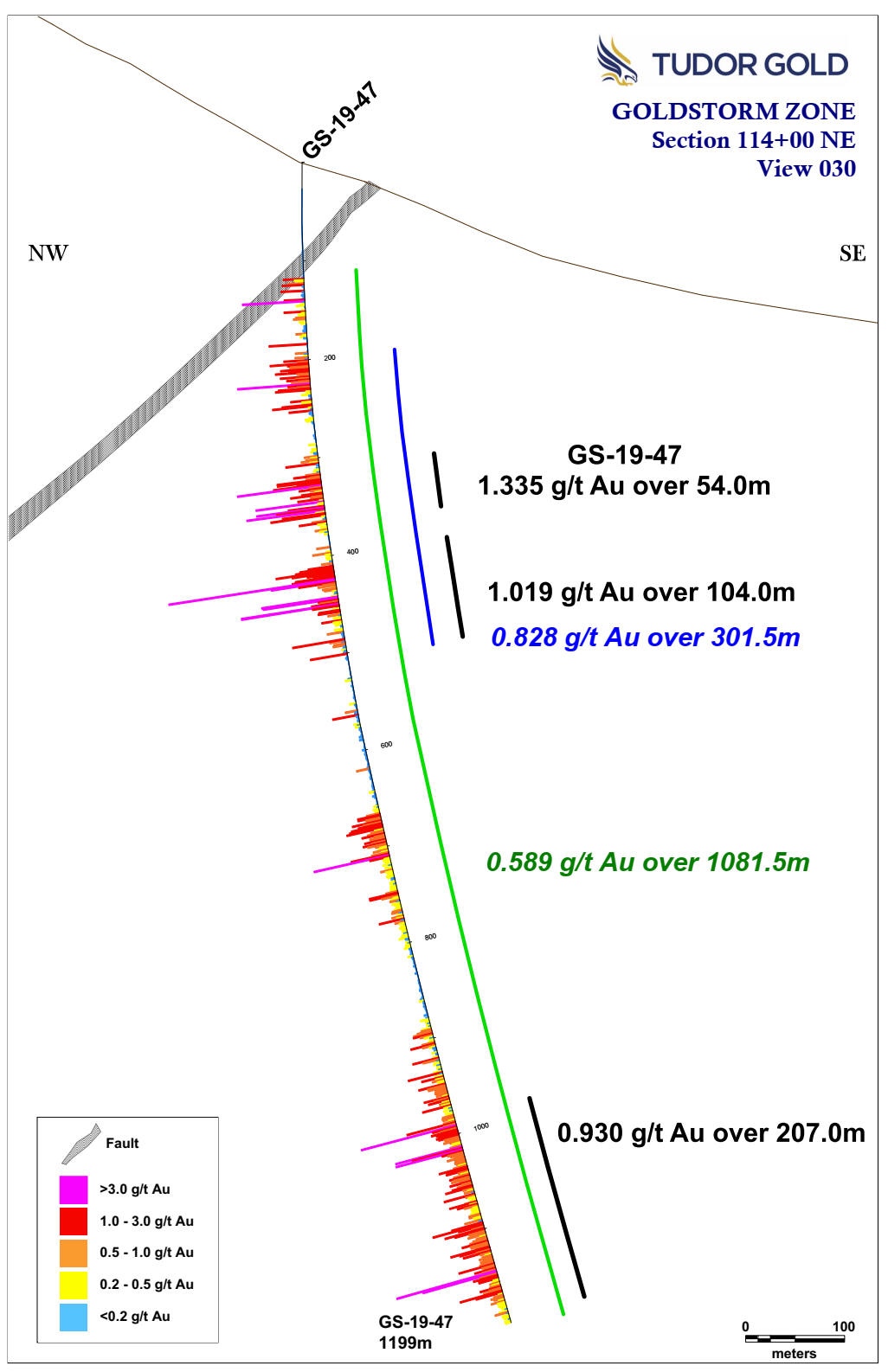
  • 0.589 g/t Au over 1081.5m including an upper interval of 0.828 g/t Au over 301.5m and a lower interval of 0.930 g/t Au over 207 m
  • The hole was stopped in mineralization due to the drill rig reaching its depth limitation
  • 150 meter step-out hole confirms that the Goldstorm system is gaining strength to the northeast.

Cardston, Alberta–(Newsfile Corp. – September 23, 2019) – American Creek Resources Ltd. (TSXV: AMK) (“American Creek”) (“the Corporation”) is pleased to announce results from JV partner Tudor Gold’s ongoing drill program being conducted at the Treaty Creek Project located in the Golden Triangle of NW British Columbia. Tudor today announced results from two deep vertical diamond drill holes (drilled to a depth of over 1,000m) and four definition drill holes. All six holes intercepted significant gold mineralization over wide intervals at the Goldstorm Zone.

Goldstorm Extension

Hole GS19-47 was drilled as a 150m step-out from hole GS19-42 (reported July 30, 2019 averaging 0.683 g/t Au over 780m) and was drilled vertically to a total depth of 1,199m, ending in mineralization. The hole contains strong stockwork with gold-bearing mineralization accompanied by significant base-metal disseminated sulphide mineralization averaging 0.589 g/t Au over 1081.5m including an upper interval of 0.828 g/t Au over 301.5m and a lower interval of 0.930 g/t Au over 207 m. The hole was stopped in mineralization due to the drill rig reaching its depth limitation, however, casing was left in the hole for possible continuation next year.

This 150 meter step-out hole confirms that the Goldstorm system is gaining strength to the northeast. With this strongly mineralized intercept, the Goldstorm Zone has been extended by a total of 300m this year from the best hole drilled in 2018 (CB18-39, averaging 0.981 g/t Au over 563.8m) and has now been traced along strike for over 800 meters.

Goldstorm Definition Drilling

Asecond deep vertical hole, GS19-48, was drilled to a total depth of 1035m from the same pad as CB18-39 (drilled in 2018). The results exhibit excellent continuity of mineralization between holes and this drill hole returned 0.725 g/t Au over 838.5m, including a near surface interval of 328.5m averaging 1.048 g/t gold Au.

Four footwall definition holes (GS19-43 to GS19-46) drilled on section 109+00 NE, were successful in extending the width of the mineralized zone, to the southeast into the footwall of the controlling fault structure.

  • Hole GS19-43 returned an average of 0.566 g/t Au over 493.5m;
  • Hole GS19-44 returned an average of 0.807 g/t Au over 267m including 1.065 g/t Au over 150m;
  • Hole GS19-45 returned an average of 0.719 g/t Au over 325.5m including 1.000 g/t Au over 173m.
  • Hole GS19-46 returned an average of 0.510g/t Au over 594m including 0.734 g/t Au over 162m.

Tudor Gold Exploration Manager, Ken Konkin explains: “Given the success of the two deep drill holes GS19-47 and GS19-48, the Goldstorm System shows no signs of weakening to the northeast and several more drill holes will be needed to find the length and depth of this huge gold system. Hole GS19-47 showed a very strong quartz stockwork system and was still in gold values at the end of the 1,199 meter drill hole. The bottom of GS19-47 averages 0.930 g/t Au over 207 meters. This is the first time we’ve seen this strength of gold mineralization at depth. Furthermore, a strong copper association was encountered with gold values at depth in both GS19-47 and GS19-48.

A 151.5m zone of 0.22% copper with 0.572 g/t gold was intercepted from 665.0 to 816.5 meters in GS19-47 and a 66.0m zone of 0.35% copper with 0.958 g/t gold was intercepted from 874.5 to 940.5m in GS19-48.

Not only does the Goldstorm Zone remain open at depth and along strike, we are now seeing base-metal associations possibly as part of a zonation within the metal system.”

The following table provides gold composites from the six drill holes completed on three sections that cut the Goldstorm Zone.

Table I: Gold Composites for GS19-48 to GS19-43

SECTIONHOLE IDFROM (M)TO (M)Interval (M)GOLD (g/t)
114+00NEGS19-47117.511991081.50.589
including200501.5301.50.828
and98611932070.93
111+00 NEGS19-4897.5936838.50.725
including97.5426328.51.048
109+00 NEGS19-4368561.5493.50.566
including141.5561.54200.605
including141.519755.51.005
GS19-441013682670.807
including1252751501.065
GS19-4544369.5325.50.719
including622782160.901
including1052781731.000
GS19-4634.5628.55940.51
including175.5337.51620.734
including564600361.328

* All assay values are uncut and intervals reflect drilled intercept lengths.

* True widths of the mineralization have not been determined

Goldstorm Zone Drill Section 109+00 NE, 111+00 NE and 114+00 NE

Section 114+00 NE is a 300 m step-out on strike from 111+00 NE and hole GS19-47 hosts what is now the longest and deepest gold intercept on the project to date.

Section 111+00 NE shows the consistency of the upper horizon gold grades between holes and new depth extension in hole GS19-48.

Section 109+00 NE shows four definition holes drilled this season to better outline the extent of the zone to the southeast.

Goldstorm Zone Plan Map

The Goldstorm Zone now extends more than 800 meters in strike length and remains open along strike to the Northeast and Southwest as well as to depth.

Goldstorm zone drill sections and the plan map are included at the bottom of the news release.

The diamond drilling program continues with two drill rigs. Additional results will be announced as they become available.

Walter Storm, Tudor Gold President and CEO, stated: “I am very pleased to see that all nine holes drilled have reported very good results and we have not missed on any step-out targets nor any footwall extension holes, they were all hits. These results have proven that we have an excellent understanding of the structure, geology and mineralogy of this massive gold system. I am looking forward to continuing our exploration efforts in order to unlock the full potential of this large gold system.”

Darren Blaney, American Creek CEO, stated: “The anticipation of waiting for this 150 meter step-out hole has now been rewarded with the largest gold interval drilled to date at the project. Further, all five other holes have also hit significant gold over wide intervals. Seeing the strong copper zones now showing up in drill holes has added yet further potential to the possible extent of the deposit. Clearly, we have a massive, world-class gold system that still shows no signs of weakening to the northeast nor at depth. The drilling continues to show strong correlation with the geophysics which indicates that the gold mineralization potentially continues for considerable depth below the bottom of the deepest drill holes.

I can’t state strongly enough how pleased I am with what Walter, Ken and the Tudor team have accomplished with the Treaty Creek exploration program!”

QA/QC

Drill core samples were prepared at MSA Labs’ Preparation Laboratory in Terrace, BC and assayed at MSA Labs’ Geochemical Laboratory in Langley, BC. Analytical accuracy and precision are monitored by the submission of blanks, certified standards and duplicate samples inserted at regular intervals into the sample stream by Tudor Gold personnel. MSA Laboratories quality system complies with the requirements for the International Standards ISO 17025 and ISO 9001. MSA Labs is independent of the Company.

Qualified Person

The Qualified Person for this news release for the purposes of National Instrument 43-101 is Tudor Gold’s Exploration Manager, Ken Konkin, P.Geo. He has read and approved the scientific and technical information that forms the basis for the disclosure contained in this news release.

About American Creek

American Creek is a Canadian junior mineral exploration company with a strong portfolio of gold and silver properties in British Columbia.

Three of those properties are located in the prolific “Golden Triangle”; the Treaty Creek and Electrum joint venture projects with Tudor Gold/Walter Storm as well as the 100% owned past producing Dunwell Mine.

A major drill program is presently being conducted at Treaty Creek by JV partner and operator Tudor Gold. There are two drills working on the Goldstorm zone at present.

The Treaty Creek Project is a Joint Venture with Tudor Gold owning 60% and acting as operator. American Creek and Teuton Resources each have 20% interests in the project. American Creek and Teuton are both fully carried until such time as a Production Notice is issued, at which time they are required to contribute their respective 20% share of development costs. Until such time, Tudor is required to fund all exploration and development costs while both American Creek and Teuton have “free rides”.

More information about the Treaty Creek Project can be found here: https://americancreek.com/index.php/projects/treaty-creek/home

A drill program is also ongoing on American Creek’s 100% owned Dunwell Mine property located near Stewart. More information can be found here: https://americancreek.com/index.php/projects/dunwell-mine

The Corporation also holds the Gold Hill, Austruck-Bonanza, Ample Goldmax, Silver Side, and Glitter King properties located in other prospective areas of the province.

For further information please contact Kelvin Burton at: Phone: 403 752-4040 or Email: [email protected]. Information relating to the Corporation is available on its website at www.americancreek.com

Cannot view this image? Visit: https://orders.newsfilecorp.com/files/682/48020_tudor9.jpg


Figure 1: Goldstorm Zone Selected Results From Deep Step-out Holes

To view an enhanced version of Figure 1, please visit:
https://orders.newsfilecorp.com/files/682/48020_tudor10.jpg

Cannot view this image? Visit: https://orders.newsfilecorp.com/files/682/48020_tudor5.jpg


Figure 2: Goldstorm Zone Section 114

To view an enhanced version of Figure 2, please visit:
https://orders.newsfilecorp.com/files/682/48020_tudor6.jpg

Cannot view this image? Visit: https://orders.newsfilecorp.com/files/682/48020_tudor3.jpg


Figure 3: Goldstorm Zone Section 111

To view an enhanced version of Figure 3, please visit:
https://orders.newsfilecorp.com/files/682/48020_tudor4.jpg

Cannot view this image? Visit: https://orders.newsfilecorp.com/files/682/48020_tudor1.jpg


Figure 4: Goldstorm Zone Section 109

To view an enhanced version of Figure 4, please visit:
https://orders.newsfilecorp.com/files/682/48020_tudor2.jpg

Cannot view this image? Visit: https://orders.newsfilecorp.com/files/682/48020_tudor7.jpg


Figure 5: Goldstorm Zone Plan View

To view an enhanced version of Figure 5 please visit:
https://orders.newsfilecorp.com/files/682/48020_tudor8.jpg

Neither the TSX Venture Exchange nor its Regulation Services Provider (as that term is defined in the policies of the TSX Venture Exchange) accepts responsibility for the adequacy or accuracy of this release.

#Palladium price peaks at new record high, bodes well for New Age Metals $NAM.ca $WG.ca $XTM.ca $WM.ca $PDL.ca $GLEN

Posted by AGORACOM-JC at 5:39 PM on Friday, September 20th, 2019

SPONSOR:

  • The company hosts North America’s largest primary PGM deposit
  • Updated NI 43-101 Mineral Resource Estimate of 2,867,000 PdEq Measured and Indicated Ounces, with an additional 1,059,000 PdEq Ounces Inferred

Read More

————————-

Palladium price peaks at new record high, rhodium roaring

  • Palladium hit a fresh all-time high on Friday on persistent worries about supply from South Africa and prospects of a pickup in demand in China.
  • Nymex Palladium futures gained 1.5% to $1,636.60 an ounce in New York in morning trading before easing back. Palladium’s gains for the year now top 40% or $477 per ounce.

By: Frik Els

Palladium hit a fresh all-time high on Friday on persistent worries about supply from South Africa and prospects of a pickup in demand in China.

Nymex Palladium futures gained 1.5% to $1,636.60 an ounce in New York in morning trading before easing back. Palladium’s gains for the year now top 40% or $477 per ounce.

The threat of labour unrest in South Africa, which together with Russia are responsible for more than 80% of global platinum group metal output, loomed large again on Friday after the militant union Amcu re-elected its firebrand leader.

Amcu rose to prominence in 2012 when clashes between police and striking workers at the Marikana mine in the African nation’s prolific platinum belt left 34 dead.

Any signs of stimulus from the Chinese auto market could lead to additional upside price potential. BMO Capital Markets

More than three-quarters of palladium ends up in catalytic converters for gasoline engines and the rise in the precious metal comes despite a severe slowdown in vehicle sales around the world.

Top consumer China has seen sales drop for 14 out of the last 15 months, and in August 9.9% fewer cars and truck rolled off lots compared to last year. Annual sales in the world’s no 2 market – the US – are also expected to come in below 2018’s total.

What has lifted palladium is greater average loadings per vehicle as more stringent emissions standards are implemented in China and Europe. BMO Capital Markets in a recent note said “any signs of stimulus from the Chinese auto market could lead to additional upside price potential.”

Robust rhodium

Sister metal rhodium is also on a roll, more than doubling in price so far this year. Rhodium, also used mainly in autocatalysts, exchanged hands at $5,400 an ounce on Friday in New York, the highest in 11 years.

Due to rarity, the small size of the market and concentrated supply, prices are typically volatile.

Rhodium (and sister metal ruthenium) stand out when it comes to price swings – rhodium touched $10,025 an ounce just before the 2008 financial crisis hit, but would drop 90% before the end of that tumultuous year.

Platinum was trading flat on Friday at $945.10 after briefly scaling $1,000 an ounce two weeks ago. Given the historically weak price, some investors are using the opportunity to stock up on the metal.

ETF holdings of platinum have expanded rapidly this year, reaching 3.3m ounces last week, up 38% or 916,000 ounces in 2019.

In contrast, palladium ETF vaults have been emptying as investors lock in some of the gains. Palladium-backed ETF holdings total 655,000 ounces, down 120,000 ounces year to date.

Source: https://www.mining.com/palladium-price-peaks-at-new-record-high-rhodium-roaring/

VOLUME ALERT: $HPQ.ca Silicon Resources Closes With Highest Volume On TSX Venture Exchange – 3.3M Shares Traded $FSLR $SPWR $CSIQ $PYR.ca $XMG.ca

Posted by AGORACOM-JC at 4:40 PM on Friday, September 20th, 2019

VOLUME ALERT!!!

LAST: $0.09     Volume: 3.3M Shares

Hub On AGORACOM

ABOUT THE COMPANY

  • Developing, in collaboration with industry leader PyroGenesis (TSX-V: PYR) the innovative PUREVAPTM “Quartz Reduction Reactors”, will permit the transformation and purification of quartz (SiO2) into Metallurgical Grade Silicon (Mg-Si) at prices that will propagate its significant renewable energy potential.
  • Also working with industry leader Apollon Solar to develop a metallurgical pathway of producing Solar Grade Silicon Metal (SoG Si) that will take full advantage of the PUREVAPTM QRR one-step production of high purity silicon (Si) and significantly reduce the Capex and Opex associated with the transformation of quartz (SiO2) into SoG-Si.
  • Focused on becoming the lowest cost producer of Silicon (Si), High Purity Silicon (Si) and Solar Grade Silicon Metal (SoG-Si). The pilot plant equipment that will validate the commercial potential of the process is on schedule to start in 2019.

Check Out Our Recent Interview

Affinity Metals $AFF.ca Commences Drill Program at Regal Project $SII.ca $GTT.ca $TUD.ca $AMK.ca

Posted by AGORACOM at 2:17 PM on Friday, September 20th, 2019

September 20, 2019) - Affinity Metals Corp. (TSXV: AFF) (“Affinity Metals”) (“the Corporation”) is pleased to report that it has commenced exploration on the Regal Project located approximately 35 km northeast of Revelstoke, British Columbia, Canada. The program will include geological mapping, sampling, and up to 2,000 meters of diamond drilling testing several targets identified in preliminary work. The total amount of drilling in this phase of the program will depend on weather and on evaluating target potential and results as the program progresses. Drilling will begin in the ALLCO area of the property.

The extensive Regal property package spans 6,700 hectares in the northern end of the prolific Kootenay Arc and hosts several past producing small-scale historic mines. From the historic records it appears that most, and perhaps all, of the known mineralized showings/zones have not been previously drilled using modern diamond drilling methods.

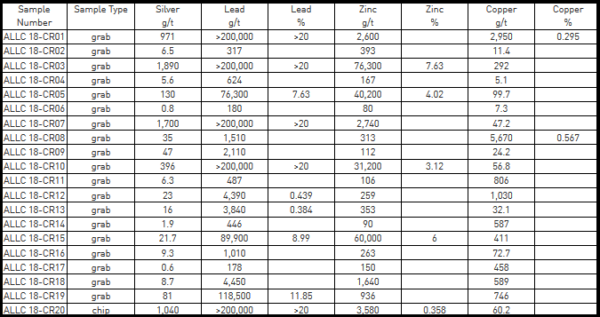
Preliminary work conducted in the fall of 2018 included collecting a total of 20 grab and chip samples from several different areas on the property including around the old Regal Silver workings, in the Clabon Creek drainage and at a promising showing along a logging road cut several km to the west of the Regal historic workings. The samples returned values as high as 1,890 g/t silver with >20% lead, and 7.63% zinc. A one-meter chip sample from a 4 meter wide galena vein immediately outside the Regal Silver #5 adit yielded 1,040 g/t silver as well as greater than 20% lead and 3,580 g/t (0.358%) zinc. Results for all 20 samples are reported below:

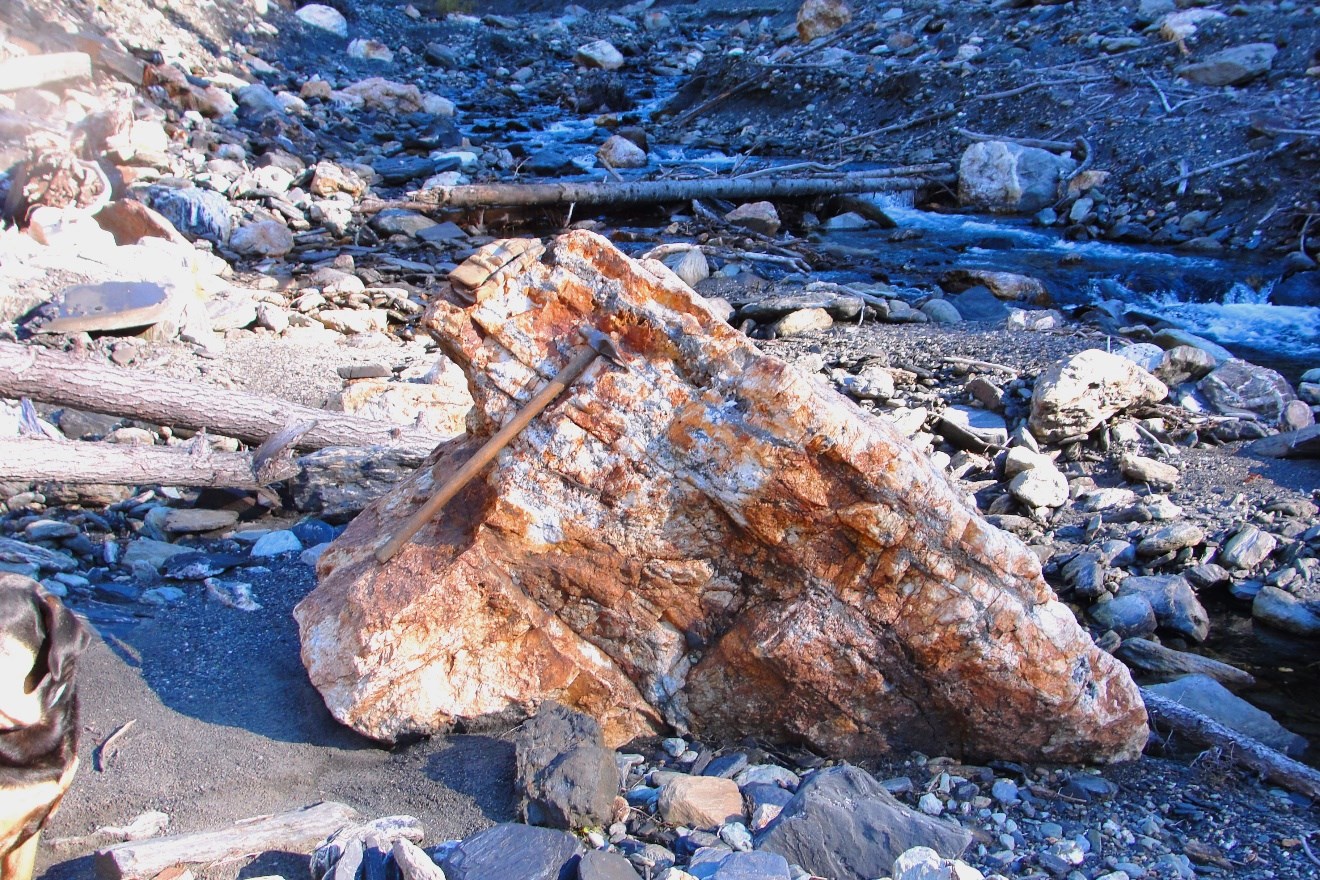
Significantly, as a result of a recent, severe freshet event that totally scoured the upper Clabon Creek drainage, a series of numerous large mineralized boulders were exposed. Planned field work will include examination of the mineralization and host rock which will be invaluable in identifying the source of this mineable grade material (photo below). This float material is present in the creek drainage over a distance of approximately 3km indicating the strong potential for discovering new mineralized zones upstream and in the immediate area.


Figure 1
To view an enhanced version of this graphic, please visit:
https://orders.newsfilecorp.com/files/5458/47980_3c8e5913b4ef988a_001full.jpg

Robert Edwards, CEO stated: “We are very excited to finally be able to begin exploration on the Regal Property in a meaningful way. It has taken considerable time and effort to assemble the vast amounts of historic geological data that has been accumulated on this project. Combining that data with our prospecting time spent on the ground to begin to test the many targets that have been identified should lead to some positive results for this drill program.”

Property History & Background

The property hosts numerous mineral occurrences including the following past-producing mines:

Snowflake and Regal Silver (Stannex/Woolsey) Mines

The Snowflake and Regal Silver mines were two former producing mines that operated intermittently during the period 1936-1953. The last significant work on the property took place from 1967-1970, when Stannex Minerals completed 2,450 meters of underground development work and a feasibility study, but did not restart mining operations. In 1982, reported reserves were 590,703 tonnes grading 71.6 grams per tonne silver, 2.66 per cent lead, 1.26 per cent zinc, 1.1 per cent copper, 0.13 per cent tin and 0.015 per cent tungsten (Minfile No. 082N 004 – Prospectus, Gunsteel Resources Inc., April 29, 1986). It should be noted that the above resource and grades, although believed to be reliable, were prepared prior to the adoption of NI43-101 and are not compliant with current standards set out therein for calculating mineral resources or reserves. Samples ALLC18-1 to ALLC18-14 inclusive and ALLC18-20 were taken on and in the vicinity of The Regal/Snowflake historical mine workings during the 2018 preliminary exploration program.

ALLCO Silver Mine

The Allco Silver Mine is situated 6.35 Kilometers northwesterly (azimuth 300o) from the above described Snowflake/Regal Mine(s) but still part of the Affinity claim group.

The Allco Silver Mine operated from 1936-1937 and produced 213 tonnes of concentrates containing 11 troy ounces of gold (1.55 g/t), 11,211 troy ounces of silver (1,637 g/t) and 173,159 lbs of lead (36.9%).

Black Jacket Showing.

The Black Jacket showing was discovered by routine prospecting during 2008. Samples taken on the showing are numbered ALLC18-15 to ALLC18-19 inclusive. This is a raw prospect in that no technical work excluding sampling has been conducted on this showing. The showing is situated 10.3 kilometers westerly (azimuth 281o) from the historical Snowflake/Regal Mine.

Airborne Geophysics to Guide Future Exploration

An extensive airborne geophysics survey conducted by Geotech Ltd of Aurora, Ontario, for Northaven Resources Corp. in 2011, identified four well defined high potential linear targets correlating with the same structural orientation as the Allco, Snowflake and Regal Silver mines. Northaven also reported that the mineralogy and structural orientation of the Allco, Snowflake and Regal Silver appeared to be similar to that of Huakan International Mining Inc’s J&L gold project located to the north, and on a similar geophysical trend line. The J&L is reporting a NI43-101 compliant resource of 9.9M tonnes containing 2.4M troz gold equivalent (combined measured, indicated and inferred) and is reportedly now one of western Canada’s largest undeveloped gold deposits. Northaven failed in financing their company and conducting further exploration on the property and subsequently forfeited the claims without any of the follow up work being completed. Affinity Metals is in the fortunate position of benefitting from this significant and promising geophysics data and associated targets.

The aforementioned Northaven airborne geophysical survey conducted at a cost of $319,458.95 in August of 2011 is described in The BC Ministry of Energy, Mines and Petroleum Resources Assessment Report #33054. The results of the survey are competently explained and illustrated by professionals on You Tube at: https://www.youtube.com/watch?v=GX431eBY_t0

Affinity Metals has successfully obtained a 5 Year Multi-Year-Area-Based (MYAB) exploration permit which includes approval for 51 drill sites.

Qualified Person

The qualified person for the Regal Project for the purposes of National Instrument 43-101 is Frank O’Grady, P.Eng. He has read and approved the scientific and technical information that forms the basis for the disclosure contained in this news release.

About Affinity Metals

Affinity Metals is focused on the acquisition, exploration and development of strategic metal deposits within North America.

The Corporation’s flagship project and present focus is the Regal.

On behalf of the Board of Directors

Robert Edwards, CEO and Director of Affinity Metals Corp.

The Corporation can be contacted at: [email protected]

Information relating to the Corporation is available at: www.affinity-metals.com

#Marijuana’s Biggest Day of the Year Is 4 Weeks Away! – SPONSOR: #NORTHBUD $NBUD.ca $WEED.ca $CGC $ACB $APH $CRON.ca $HEXO.ca $OGI.ca

Posted by AGORACOM-JC at 11:55 AM on Thursday, September 19th, 2019

SPONSOR: NORTHBUD (NBUD:CSE) Sustainable low cost, high quality cannabinoid production and procurement focusing on both bio-pharmaceutical development and Cannabinoid Infused Products. Learn More.

—————————————————–

Marijuana’s Biggest Day of the Year Is 4 Weeks Away

  • Last year, the marijuana industry made history… many times over.
  • But nothing took precedence over Canada becoming the first industrialized country in the world to legalize recreational cannabis, with sales commencing on Oct. 17, 2018.

Sean Williams Sep 19, 2019 at 6:06AM

Last year, the marijuana industry made history… many times over. But nothing took precedence over Canada becoming the first industrialized country in the world to legalize recreational cannabis, with sales commencing on Oct. 17, 2018. Even though Canada substantially trails the U.S. in terms of aggregate annual legal weed sales, it’s setting an example among industrialized countries that the legalization of marijuana is possible.

Now, the biggest date of 2019 is rapidly approaching. And wouldn’t you know it, it’s Oct. 17, once again.

Image source: Getty Images.

Why Oct. 17 is a big date for the pot industry (again)

Four weeks from today, laws governing the rollout of derivatives will officially go into effect in Canada. A derivative is an alternative cannabis consumption product that’s not already been approved.

Over the past 11 months and change, Canada has allowed for the sale of dried cannabis flower, cannabis oil, and sublingual sprays. Meanwhile, edibles, nonalcoholic cannabis-infused beverages, vapes, concentrates, and topicals, weren’t legal. This sort of two-step legalization process was done to allow the industry to find its footing, as well as give regulators time to adjust to cannabis becoming legal for adult purchase. But on Oct. 17, regulations now governing dried cannabis will apply to derivative products as well.

However, investors and Canadian consumers should understand that derivative pot products aren’t going to be showing up in dispensaries on Oct. 17. Much in the same way that it took dried cannabis flower brands weeks to begin populating dispensary store shelves, it’ll probably be the same story for derivative products. Regulatory agency Health Canada has cautioned that derivative supply won’t hit the market until mid-December, with it taking weeks or months thereafter for supply to be adequate to meet demand.

This, of course, is really big news for marijuana stocks, because derivative cannabis products are a considerably higher margin product for the industry, relative to dried flower. In select U.S. states (ahem, Oregon), we’ve witnessed the oversupply and commoditization of dried flower, leading to weaker margins for pot businesses. We’re highly unlikely to see oversupply and pricing concerns from derivatives anytime soon.

A point that is sometimes lost on this derivative launch is that these are products which speak to a younger generation of cannabis users. Not only are derivatives more attractive in the respect that they may not need to be smoked, but they’re going to attract potentially long-term customers to the industry.

Image source: Getty Images.

Growers go all-out for derivative production

Considering the importance of derivatives to cannabis stock margins, it’s not surprising to find that growers have been laser-focused on derivative production for a good portion of 2019.

Some growers, such as OrganiGram Holdings (NASDAQ:OGI), have chosen to set up a variety of in-house derivative options. During the company’s fiscal third quarter, OrganiGram announced that it’d be investing 15 million Canadian dollars into a line of fully automated equipment necessary to produce up to 4 million kilos of chocolate edibles per year. This coincides with OrganiGram’s 56,000-square-foot phase 5 expansion which, among other things, is targeted at extra space for derivative production and processing.

The company has also developed a nano-emulsification technology that can speed up the onset of the effects of cannabinoids. This product will first be introduced as a powder that can be added to beverages, but OrganiGram is also actively looking for a partner to help it develop an infused beverage product containing this proprietary technology.

Cronos Group (NASDAQ:CRON), and its investment partner Altria, are also eager to see the green flag wave on derivatives. Cronos Group’s peak annual output of nearly 120,000 kilos per year may not even be enough to place this brand-name pot stock among the top-10 growers. But that’s OK with Cronos, as it’s placed its attention almost entirely on derivative cannabis products.

For instance, Cronos and Altria will be working together to roll out an assortment of vape products. Altria is well-versed in the adult smoking market and should prove helpful in assisting Cronos Group’s marketing efforts and product launches (regarding vapes). Beyond vaping, Cronos Group will be leaning on its partnership with Ginkgo Bioworks to produce targeted cannabinoids at commercial scale, as well as other third-party extraction service providers.

Image source: Getty Images.

Speaking of extraction services, there may not be a smarter way of playing the derivatives craze than with third-party extraction providers. As an example, MediPharm Labs (OTC:MEDIF) only commenced its extraction operations during the fourth quarter. Despite this, MediPharm managed to turn a nominal operating profit of $0.01 per share in the second quarter. The company’s sales and profitability are set to soar as growers scramble for derivative exposure. Yet, MediPharm’s sales and profits should remain highly predictable with the company locking in contracts for an extended period of time. Soon enough, the company’s annual extraction capacity will hit 500,000 kilos.

The one thing to remember about the upcoming marijuana derivatives launch

While, on one hand, the launch of derivative products should be lauded by investors, there’s another side to this launch that everyone should be aware of.

As I alluded to earlier, Health Canada has cautioned that alternative consumption products aren’t going to immediately hit dispensary shelves once the green flag waves on Oct. 17. Rather, it’s going to take time before any sort of supply is built up in the marketplace, with a presumptive two-month gap between when derivative regulations going into effect and when derivative products will begin showing up in licensed stores.

But here’s the thing: Product showing up in stores doesn’t mean that the supply will be sufficient to meet demand. Similar to what we’ve been witnessing in the dried flower market, supply issues exist that are likely going to make it difficult for derivative products to find their way into dispensaries, at least in the early going.

Don’t get me wrong, I expect derivatives to push sales and margins higher for cannabis stocks across the board. However, I think it’s going to be multiple quarters before Health Canada resolves a number of supply issues, resulting in what could be weaker-than-expected sales in the months to come.

Make no mistake: Derivatives are the future of the cannabis industry. Just understand that the future isn’t going to happen overnight. Give this industry, and the rollout of derivatives, proper time to mature, and you won’t be disappointed.

Here’s The Marijuana Stock You’ve Been Waiting For
A little-known Canadian company just unlocked what some experts think could be the key to profiting off the coming marijuana boom.

And make no mistake – it is coming.

Cannabis legalization is sweeping over North America – 10 states plus Washington, D.C., have all legalized recreational marijuana over the last few years, and full legalization came to Canada in October 2018.

And one under-the-radar Canadian company is poised to explode from this coming marijuana revolution.

Because a game-changing deal just went down between the Ontario government and this powerhouse company…and you need to hear this story today if you have even considered investing in pot stocks.

Source: https://www.fool.com/investing/2019/09/19/marijuanas-biggest-day-of-the-year-is-4-weeks-away.aspx

Increasing popularity of #hybrid vehicles aiding global push for sustainability – New Age Metals $NAM.ca River Valley is the largest undeveloped primary #PGM Mineral Resource in North America $WG.ca $XTM.ca $WM.ca $PDL.ca

Posted by AGORACOM-JC at 11:22 AM on Thursday, September 19th, 2019

A look at a mineralized outcrop containing Platinum Group Metals (PGMs) on the River Valley project site. Metals such as PGMs and lithium will continue to experience sustained increases in demand as the global push for sustainability becomes mainstream.

  • The future of transportation is poised for sustainability through the global adoption of hybrid electric vehicles (HEVs) and fully battery electric vehicles (BEVs)
  • Industry experts are forecasting a consistent increase in demand for lithium, used to develop the batteries in HEVs and BEVs
  • Industry experts are also forecasting an increase in demand for the Platinum Group Metals (PGMs) used by autocatalyst manufacturers, to ensure compliance with tightening emissions regulations
  • New Age Metals’ flagship River Valley primary PGM project in Ontario, and lithium division with assets in Manitoba positions the company as a key player in the growth of HEVs and lowering CO2 emissions

By: Jason Smith

Harmful carbon dioxide emission levels are rising globally, largely due to the use of fossil fuels as the primary source of energy used by the transportation industry. Examples of this use include the powering of jumbo jets, container ships and semi-trucks. Passenger vehicles also rely on fossil fuels and have a bad reputation for the amount of pollutants they release into the atmosphere on a daily basis.

However, passenger vehicles produce more than four times the greenhouse gas (GHG) emissions of all domestic aviation, according to the Globe and Mail. The focus over the last few years has been on making these passenger vehicles more environmentally-friendly, which is a large reason why automakers have started producing electric or hybrid electric vehicles (HEVs).

While automakers are being forced by emissions regulation to reduce their carbon footprint, the majority of consumers are not ready to go fully electric and are increasingly choosing hybrid vehicles to bridge the gap with cars that solely use batteries. With more vehicles being sold worldwide each year, especially those that are less pollutive, automakers will need more of the critical raw materials used to create the hybrid and electric vehicles.

This need for less pollutive methods of transportation is where lithium and palladium enter the picture. Lithium is used to produce batteries, but the size of car batteries used in HEVs and the increase in HEV sales that is anticipated by the industry will require substantially more lithium than what is available in the market today. Palladium, which is a member of the PGM family, is largely used to reduce pollution that originates from vehicles operating with internal combustion engines (ICE) through its use as the primary ‘catalyst’ in catalytic converters (commonly known as auto-catalysts).

While palladium is often overlooked when it comes to the push for sustainability, it has played a huge role in reducing the amount of toxic emissions being released into the atmosphere. This positive impact is most noticeable in urban areas where automobiles are concentrated. The value of an ounce of palladium has increased exponentially in the past year, rising 60 per cent year-over-year in Sept. 2019 from under USD$950 to over USD$1500. The reason for the dramatic price movement is due to supply concerns and the metals value as the premier option for use in auto-catalysts.

With ICE-powered vehicles not going away any time soon, the global demand for palladium will endure as a pollution-control device, and investors are taking notice. Anton Berlin is the head of strategic marketing at the world’s largest producer of Palladium, Norilsk Nickel. He recently stated, “Hybrids — cars with both an electric battery and a combustion engine — will dominate the electric vehicle market in the long-run, which suggests a long-term advantage for the PGM market.”

The extensive infrastructure required to support a universal transition to EVs still needs time to be completely fleshed out but is gaining speed. According to a new report entitled, “2019 Investor’s Business Daily/TIPP Electric Vehicle Outlook Study,” range and available charging stations are what make potential EV buyers the most apprehensive, although these are issues that are currently being addressed.

Regardless, the desire to limit pollution is leading to the growing demand for middle-ground HEVs, which is causing car manufacturers to focus on their abilities to design and assemble automobiles that emit less noxious fumes primarily through the use of palladium and lithium.

Research has shown that hybrid electric vehicles actually require more palladium and lithium than traditional gasoline-powered vehicles, so increased adoption of hybrid vehicles will subsequently increase demand for these metals.Harry Barr, CEO, New Age Metals.

A flagship project in a historic mining district

Anticipating the continued strength in demand for palladium and the general forecast for lithium demand is New Age Metals (TSX.V: NAM, OTCQB: NMTLF, FSE: P7J), bolstered by the company’s flagship River Valley project in the Sudbury region of Ontario. The Sudbury region, known as the mining capital of Canada, is largely dominated by major mining and processing operations run by Vale and Glencore.

However, these companies’ operations are facing depleted ores to feed processing facilities and may need to acquire additional sources to operate closer to their intended capacity. This is where River Valley comes in as an integral player, which lies just 100 km from Sudbury and hosts 2.9 million ounces in the (NI-43 101 compliant) measured and indicated category of palladium-equivalent (PdEq) resources and 1.1 million ounces in the inferred category.

Diagram of New Age Metals’ current project locations. Supplied

Harry Barr, CEO of New Age Metals, is well aware of the role his company is poised to play as demand for hybrids continually increases. “Research has shown that hybrid electric vehicles actually require more palladium and lithium than traditional gasoline-powered vehicles, so increased adoption of hybrid vehicles will subsequently increase demand for these metals,” he notes.
New Age Metals recently had a preliminary economic assessment completed on River Valley, projecting a mine with a 14-year lifespan, 6 million tonnes annually of potential process plant feed at an average grade of 0.88 g/t PdEq and a process recovery rate of 80 per cent, resulting in an annual average payable PdEq production of 119,000 ounces.

Barr elaborates, “It’s unique to have a deposit of mineable platinum group metals in North America, and very unique to have a deposit near so much processing infrastructure that’s also close to car manufacturers,” emphasizing the advantageous position the company finds itself in with River Valley. 

With this in mind, Barr and his team are focused on maximizing this opportunity to expand the resources at River Valley and develop it to a point where the project achieves feasibility and is producing. In the meantime, the project also has tremendous exploration upside and management plans to continue with an aggressive exploration program.
A credible investment alternative to the big PGM players

A key advantage for the River Valley project is its location in a safe, reliable mining jurisdiction. The majority of the world’s palladium currently comes from South Africa and Russia, both of which could be problematic in terms of long-term supply security, political issues and concerns regarding human rights and sustainability.

Worth noting is the fact that Norilsk Nickel is not only the worlds’ largest producer of palladium and nickel, but also the largest emitter of sulfur oxides which is a pollutant considered immediately dangerous to life and health.

Fortunately, New Age Metals’ Ontario-based project offers the benefit of being located in a safe jurisdiction that has excess processing infrastructure and is known for moderating the environmental impacts from mining and smelting. Barr explains, “Sudbury’s been a mining center for 120 years, so every type of mining service is nearby.” Given this unique situation, the company represents a credible investment opportunity.

Sid Rajeev, vice-president of Fundamental Research Corp., conducted a thorough analysis of the River Valley PEA. He notes, “Our biggest takeaway from the PEA was that, at a reasonable palladium price estimate of USD$1,200 per oz, the study showed an after-tax net present value at 5 per cent of $138 million. New Age Metals’ current enterprise value is just USD$3 million, implying that shares are trading at just 2 per cent of net asset value.”

This level of potential upside is rarely available to the investment community and as New Age Metals brings River Valley towards pre-feasibility, it’s unlikely that the company will remain undervalued for long.

Our biggest takeaway from the PEA was that, at a reasonable palladium price estimate of USD$1,200 per oz, the study showed an after-tax net present value at 5 per cent of $138 million. New Age Metals’ current enterprise value is just USD$3 million, implying that shares are trading at just 2 per cent of net asset value.Sid Rajeev, vice-president, Fundamental Research Corp.

Having a substantial deposit of PGMs in North America positions New Age Metals to benefit from the future of sustainability, however there is a general lack of knowledge about PGMs in North America due to the low number of primary PGM producers in the arena. The company is in the process of moving River Valley along the development curve but is also seeking a qualified partner to assist in further exploration and development of the project.

New Age Metals’ lithium angle

Adding to the company’s green energy story is its suite of lithium projects in Manitoba. The demand for this metal is forecasted to increase by 20 per cent per year through to 2028. With lithium in high demand due to the ever-increasing growth in the popularity of battery-powered vehicles, these projects give the company optionality on lithium discovery; two of its eight projects are currently drill-ready. Plans to drill on the ‘Lithium One’ and ‘Lithium Two’ are in place and company management is anticipating the initiation of these drill programs in the near future.

The company’s lithium projects are situated along strike of the Tanco Pegmatite and the claims encompass several pegmatite groups. The projects are also located 140 km northeast of Winnipeg, Manitoba. The Tanco mine was owned by the Cabot Corporation who announced in Jan. 2019, that it would be selling the mine to Sinomine Rare Metals Co. Ltd for USD$130 million. This sale demonstrates a high interest in the project and potentially the surrounding area, which lends credibility to New Age Metals’ projects, based on shared geology and proximity.

Exploration on Lithium One is ongoing with concentration of the northern section, with focus on the Annie and Silverleaf Pegmatites. Silverleaf Pegmatite has zones of spodumene and lepidolite exposed on surface with samples up to 4.1 per cent lithium oxide (Li2O). The Annie Pegmatite returned values up to 0.6 per cent Li2O and 0.37 per cent Ta2O5.

On Lithium Two, the Eagle Pegmatite is exposed on surface and was last drilled in 1948, and at the time it was indicated that it remains open to depth and along strike. A historic tonnage of 544,460 tonnes of 1.4 per cent Li2O was reported during this year, however the actual amount has not been confirmed by a qualified person at this time.

An ownership map showing Tanco Mine location proximity to New Age Metals projects. Supplied

With drilling set to begin in Manitoba and River Valley continuing to move along the development curve, New Age Metals expects to consistently generate valuable news for investors in the coming months, keeping the company top-of-mind. Its position in palladium and lithium provide the company with incredible potential as a high-performing source for investment as the need for sustainable transportation continues to be a significant social issue.

To learn more about New Age’s operations and project portfolio, visit them online: newagemetals.com

The following video is a short overview of New Age Metals, and outlines some of the reasons why the company is an avenue for investment in the future of sustainability associated with the electrification of transport

WATCH VIDEO

Source: https://business.financialpost.com/business-trends/increasing-popularity-of-hybrid-vehicles-aiding-global-push-for-sustainability

Advance Gold $AAX.ca – Additional Drilling and Geophysics planned at Tabasquena #Epithermal Project $SIL.ca $FA.ca $ANG.jo $ABX.ca $NGT.ca $MGG.ca

Posted by AGORACOM at 9:19 AM on Wednesday, September 18th, 2019

Kamloops, British Columbia–(Newsfile Corp. – September 18, 2019) – Advance Gold Corp. (TSXV: AAX) (“Advance Gold” or “the Company”) is pleased to provide an exploration update on its Tabasquena gold and silver project in Zacatecas, Mexico. To date, 10 drill holes have been completed hitting widespread gold and silver mineralization in near surface epithermal veins. Recently, a 3D induced polarization (IP) survey was completed that identified a significant continuous chargeability anomaly, with an east-west width of approximately 250 metres and an apparent strike length of over 800 metres. This anomaly is located directly below the Tabasquena vein. The anomaly remains open to the north and to the south and at depth. A second phase 3D IP geophysical survey is scheduled to begin in the first week of October to extend the grid to the south.

The purpose of the extended grid to the south will be threefold, firstly it will establish the continuity of the anomaly to the south, secondly whether or not the target anomaly becomes shallower and lastly it will assist in positioning the upcoming drill hole locations. It is planned to commence drilling once the IP survey has been completed.

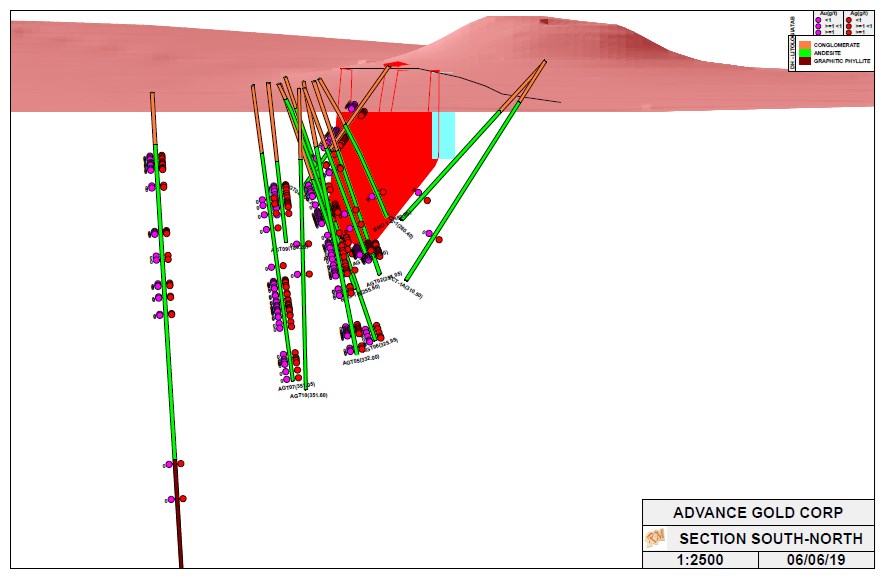
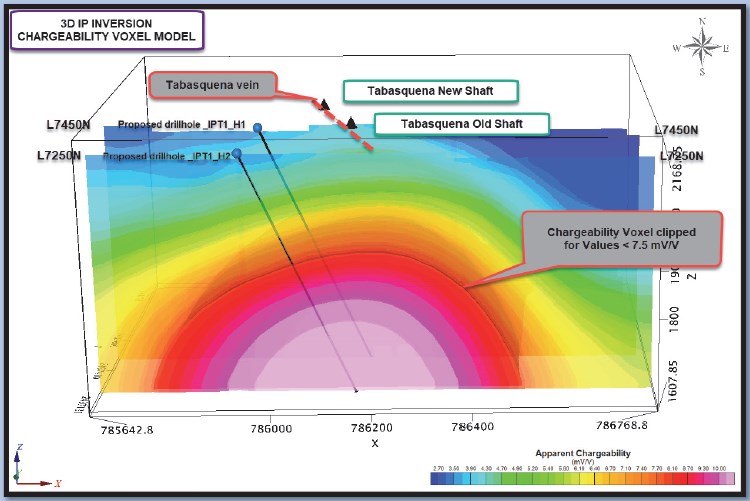
Images shown below are a 3D model of the epithermal veins hit in previous drilling and a voxel inversion model showing the extent of the large chargeability anomaly for lines L7450N and L7250N. These two diagrams are an excellent representation of the emerging targets at Tabasquena.

The black line at the surface of the 3D model of drill holes is the surface projection of the Tabasquena vein. The red shaded area is the historical mining done by Penoles. The chargeability anomaly is approximately 250 metres below the historical mining, and it follows the strike direction of the Tabasquena vein. The epithermal veins, with highlighted widespread gold and silver mineralization, are above and slightly to the west of the deeper chargeability anomaly.

Cannot view this image? Visit: https://orders.newsfilecorp.com/files/5492/47861_8ca2976fa4ff4af5_001.jpg


Diagram 1

To view an enhanced version of Diagram 1, please visit:
https://orders.newsfilecorp.com/files/5492/47861_8ca2976fa4ff4af5_001full.jpg

Cannot view this image? Visit: https://orders.newsfilecorp.com/files/5492/47861_8ca2976fa4ff4af5_002.jpg


Diagram 2

To view an enhanced version of Diagram 2, please visit:
https://orders.newsfilecorp.com/files/5492/47861_8ca2976fa4ff4af5_002full.jpg

Allan Barry Laboucan, President and CEO of Advance Gold Corp., commented: “Our exploration efforts at Tabasquena are coming together nicely with the past drilling and the recent IP geophysical survey. It is important to point out, the IP survey is meant to reveal sulphides through chargeability. The epithermal veins are low sulphidation and relatively small and don’t show up well in the IP survey, however right below these veins is the large continuous chargeability anomaly of over 800 metres from north to south and approximately 250 metres from east to west. Before starting our next round of drilling, we wanted to extend the IP grid to the south, where the anomaly is closer to surface. There is a significant elevation change of approximately 300 metres from the northernmost line of the geophysical survey to the most southerly one. We have approximately 1500 metres to the southern limits of our claims. The chargeability anomaly is open to the north, but due to the higher elevation and more cover it exceeds the depth limits of the IP survey. We are very excited to extend the grid to the south as that is the direction of the highest intensity of the chargeability and where it becomes closest to surface. The combination of the quality of Tabasquena and our various projects, our low share count and a tight share structure, with substantial insider ownership and tiny valuation, puts us in a unique position relative to our exploration focused peers as the market for gold and silver are gaining strength.”

Julio Pinto Linares is a QP, Doctor in Geological Sciences with specialty in Economic Geology and Qualified Professional No. 01365 by MMSA., and QP for Advance Gold and is the qualified person as defined by National Instrument 43-101 and he has read and approved the accuracy of technical information contained in this news release.

About Advance Gold Corp. (AAX.V)

Advance Gold is a TSX-V listed junior exploration company focused on acquiring and exploring mineral properties containing precious metals. The Company acquired a 100% interest in the Tabasquena Silver Mine in Zacatecas, Mexico in 2017, and the Venaditas project, also in Zacatecas state, in April, 2018.

The Tabasquena project is located near the Milagros silver mine near the city of Ojocaliente, Mexico. Benefits at Tabasquena include road access to the claims, power to the claims, a 100-metre underground shaft and underground workings, plus it is a fully permitted mine.

Venaditas is well located adjacent to Teck’s San Nicolas mine, a VMS deposit, and it is approximately 11km to the east of the Tabasquena project, along a paved road.

In addition, Advance Gold holds a 13.23% interest on strategic claims in the Liranda Corridor in Kenya, East Africa. The remaining 86.77% of the Kakamega project is held by Barrick Gold Corporation.

For further information, please contact:

Allan Barry Laboucan,
President and CEO

Phone: (604) 505-4753
Email: [email protected]