Agoracom Blog Home

Archive for the ‘All Recent Posts’ Category

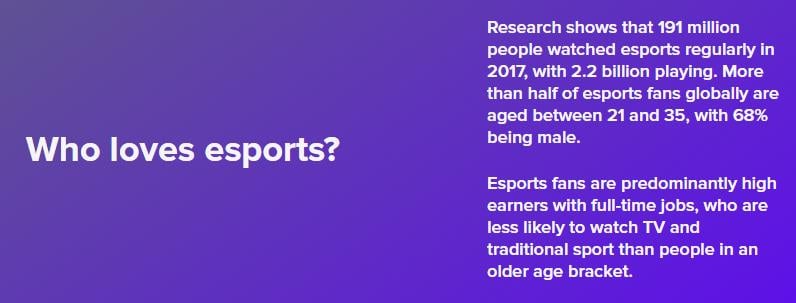
How Big Is The Market For Esports Entertainment Group? $GMBL One Image Says It All $TTWO $EAS $ATVI

Posted by AGORACOM at 11:29 AM on Thursday, December 6th, 2018

SPONSOR:  Esports Entertainment Group (GMBL:OTCQB) Agoracom HUB / Fast Profile /

LATEST NEWS:  Esports Entertainment Group Secures $2M Financing
 

$ZEN.ca Zenyatta Provides Graphene Market Development Update

Posted by AGORACOM at 9:23 AM on Thursday, December 6th, 2018

https://s3.amazonaws.com/s3.agoracom.com/public/companies/logos/564424/hub/ZENYATTA_HUB.jpg

  • Identified 5 vertical sets for its graphene products
  • Aerospace, Biomedical, Water Treatment, Transportation and Civil Engineering
  • Graphene has many potential applications and ZEN is working in close collaboration with researchers both in industry and in academia.
  • Multiple Canadian government agencies have already directly contributed over $2 million to ZEN’s graphene research and development work.
Thunder Bay, Ontario–(Newsfile Corp. – December 6, 2018) – Zenyatta Ventures Ltd. (TSXV: ZEN) (“Zenyatta”, “ZEN” or “Company”) is pleased to provide an update on its graphene market development work which has led to the creation of five significant potential market verticals for the Company which include aerospace, biomedical, water treatment, transportation and civil engineering.

Graphene is an emerging market opportunity with many potential applications. The challenge for a new supplier like ZEN is to define the priority market segments offering the best value creation potential. ZEN is tackling this challenge by working in close collaboration with researchers both in industry and in academia. From the work done by the ZEN team over just the past 6 months, the Company is now actively collaborating with 22 industrial end users and 10 Canadian universities. ZEN is also receiving significant interest from multiple Canadian government agencies who have already directly contributed over $2 million to ZEN’s graphene research and development work.

Dr. Francis Dubé Co-CEO commented, “Our model of bringing together end-users with specific graphene-related opportunities and researchers from top Canadian Universities to provide industry specific graphene solutions is proving to be attractive to all parties. We are creating win-win-win scenarios for everyone involved as we help solve industry challenges in delivering the power of graphene to end-users. Our work is also bringing leading edge research projects to Canadian academia and creating demand for our graphene products while developing potentially valuable intellectual property (IP) protected inventions. The work being done across the country has the potential to make Canada a leader in the emerging clean technology-oriented graphene industry.”

ZEN’s graphene solutions and the potential economic benefit that they can bring to the Canadian economy has attracted the attention of several government agencies that are supporting innovation, sustainability and new clean technology. The Company will continue to work with the government program coordinators for the opportunities that ZEN’s unique Albany Graphite product offers for innovative nano-materials applications. This effort is led by ZEN’s Ottawa-based Outreach Program Coordinator, Monique Manaigre.

The market development work is being led by the Company’s Head of Sales, Phil Chataigneau along with Research Catalyst, Colin van der Kuur. Their combined efforts have led to the development of the 5 most significant potential graphene market verticals:

Aerospace Applications:

Graphene light-weighting, hydrogen applications, Lightning strike protection, composite enhancement, solid state heat sinks, solid state wiring, leading edge/wing de-icing, ceramic armour, radar/sonar absorption, technical/smart fabrics, personal body armour, Graphene Oxide (GO) in jet fuel, lighter cargo containers.

Biomedical Applications:

Oncology treatment using Graphene Quantum Dots (GQD) to deliver targeted therapies.
Diabetes, other standard diagnostic testing with Functionalized GO sensors.

Water Treatment:

Graphene based desalination membranes and other water purification products.

Transportation:

Applications with auto makers and resin manufacturers for: Heat Sinks & Light-weighting, Graphene wires for electric motors, graphene 3-d printing apps to deliver weight savings, (GO) Fuel Additives (Diesel & Jet Fuel), Hydrogen Economy: Fuel Cells, Electrolysis Units, Next-Generation Fuel Cells with graphene 3-D printed circuits and graphene plates.

Civil Engineering:

Graphene additive in cement/concrete.
Graphene in roads/surfacing products.

In recognition of the excellent progress made by the Company’s market development team over the past six months, the Board of Directors has approved the grant of 50,000 incentive stock options grant to each of these three individuals. These options will be priced at $0.40 per share. One-third of the options vested on the date of their grant, one-third of the options will vest six months following the date of grant and the balance will vest on the one-year anniversary of the date of grant. The options have a term of two years and are subject in all respects to the terms of the Company’s incentive stock option plan and the policies of the TSX Venture Exchange.

For further information:

Dr. Francis Dubé, Co-CEO & Head of Business Development and Technology
Tel: +1 (289) 821-2820
Email: [email protected]

About Zenyatta

Zenyatta’s Albany Graphite Project hosts a large and unique quality deposit of highly crystalline graphite. Independent labs in Japan, UK, Israel, USA and Canada have demonstrated that Zenyatta’s Albany Graphite/Naturally PureTM easily converts (exfoliates) to graphene using a variety of simple mechanical and chemical methods. The deposit is located in northern Ontario just 30km north of the Trans-Canada Highway, near the communities of Constance Lake First Nation and Hearst. Important nearby infrastructure include hydro-power, natural gas pipeline, a rail line 50 km away and an all-weather road just 10 km from the deposit.

To find out more on Zenyatta Ventures Ltd., please visit our website at www.zenyatta.ca. A copy of this press release and all material documents with respect of the Company may be obtained on Zenyatta’s SEDAR profile at www.sedar.ca.

Technologies of #Blockchain- Part 4: Conclusion

Posted by AGORACOM-JC at 4:28 PM on Wednesday, December 5th, 2018

By Dr. Kiran Garimella

In parts 1-3, we briefly touched on some of the historical foundations of blockchains from computer science and mathematics, including their sub-topics such as distributed systems and cryptography. Specific topics in either of these categories were consensus mechanisms, fault-tolerance, scaling, zero-knowledge proofs, etc.

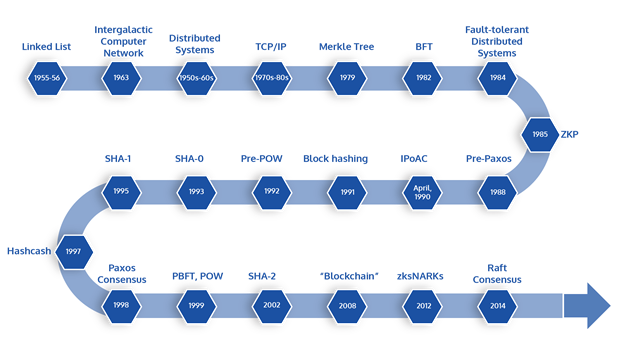
Obviously, this brief series doesn’t do justice. The history of computing and mathematics is rich, with many interconnections and dependencies. The goal of this series was to provide just enough to make the point that the technologies that power blockchain (whether public or private) were built on a well-established foundation of various topics with contributions from real scientists in both industry and academia. The graphic below depicts the broad brush-strokes of development, clearly showing how current blockchain technologies are based on a wide spectrum of historical developments.

Technologies of Blockchain – Historical Timeline
Conclusion
As you can see, a tremendous amount of development that took place for almost half a century made the modern blockchain possible. Bringing these technologies together—almost all of them based not on just techniques but deep mathematical foundations—into a cohesive whole in the form of a bitcoin application was no doubt a tremendous achievement in itself.

Moving forward, we need to keep in mind the initial motivation for each of these technologies, their strengths, their limitations, and determine how to create different architectures based on business needs. A good example of this is to relax the requirements of anonymity, strengthen safety, incorporate recourse, improve security, and incorporate the enormous complexity of regulatory compliance in securities transactions. Making such trade-offs doesn’t detract from the need for public, decentralized blockchains. On the contrary, this strengthens the use of the blockchain technology ‘horizontally’ across many industries and use cases.

In the near future, we expect to see some innovation in blockchains to improve performance and scalability, which is a special challenge for public blockchains. Along the same lines, there will be new consensus mechanisms going mainstream (such as proof-of-stake). For consensus and validation, blockchain researchers are investigating efficient implementation of zero-knowledge proofs and specific variants such as zkSNARKs.


Technologies of #Blockchain Part 3: Cryptography, Scaling, and Consensus #KoreConx

Posted by AGORACOM-JC at 4:19 PM on Wednesday, December 5th, 2018

Kiran Garimella

In Part 2, we saw how a simple concept of a linked list can morph into complex, distributed systems. Obviously, this is a simple, conceptual evolution leading up to blockchain, but it’s not the only way distributed systems can arise. Distributed systems need coordination, fault tolerance, consensus, and several layers of technology management (in the sense of systems and protocols).

Distributed systems also have a number of other complex issues. When the nodes in a distributed system are also decentralized (from the perspective of ownership and control), security becomes essential. That’s where complex cryptographic mechanisms come into play. The huge volume of transactions makes it necessary to address performance of any shared or replicated data, thus paving the way to notions of scaling, sharding, and verification of distributed data to ensure that it did not get out of sync or get compromised. In this segment, we will see that these ideas are not new; they were known and have been working on for several decades.

Cryptography

One important requirement in distributed systems is the security of data and participants. This motivates the introduction of cryptographic techniques. Ralph Merkle, for example, introduced in 1979 the concept of a binary tree of hashes (now known as a Merkle tree). Cryptographic hashing of blocks was implemented in 1991 by Stuart Haber & W. Scott Stornetta. In 1992, they incorporated Merkle trees into their scheme for efficiency.

The hashing functions are well-researched, standard techniques that provide the foundation for much of modern cryptography, including the well-known SSL certificates and the https protocol. Merkle’s hash function, now known as the Merkle-Damgard construction, is used in SHA-1 and SHA-2. Hashcash uses SHA-1 (original SHA-0 in 1993, SHA-1 in 1995), now using the more secure SHA-2 (which actually consists of SHA-256 and SHA-512). The more secure SHA-3 is the next upgrade.

Partitioning, Scaling, Replicating, and Sharding

Since the core of a blockchain is the database in the form of a distributed ledger, the question of how to deal with the rapidly growing size of the database becomes increasingly urgent. Partitioning, replicating, scaling, and sharding are all closely related concepts. These techniques, historically used in enterprise systems, are now being employed in blockchains to address performance limitations.

As with all things blockchain, these are not new concepts either, since large companies have been struggling with these issues for many decades, though not from a blockchain perspective. The intuitively obvious solution for a growing database is to split it up into pieces and store the pieces separately. Underlying this seemingly simple solution lies a number of technical challenges, such as how would the application layer know in which “piece” any particular data record would be found, how to manage queries across multiple partitions of the data, etc. While these scalability problems are tractable in enterprise systems or in ecosystems that have known and permitted participants (i.e., the equivalent of permissioned blockchains), it gets trickier in public blockchains. The permutations for malicious strategies seem endless and practically impossible to enumerate in advance. The need to preserve reasonable anonymity also increases the complexity of robust solutions.

Verification and Validation

Zero-knowledge proofs (ZKP) are techniques to prove (to another party, called the verifier) that the prover knows something without the prover having to disclose what it is that the prover knows. (This sounds magical, but there are many simple examples to show how this is possible that I’ll cover in a later post.) ZKP was first described in a paper, “The Knowledge Complexity of Interactive Proof-Systems” in 1985 by Shafi Goldwasser, Silvio Micali, and Charles Rackoff (apparently, it was developed much earlier in 1982 but not published until 1985). Zcash, a bitcoin-based cryptocurrency, uses ZKPs (or variants called zkSNARKs, first introduced in 2012 by four researchers) to ensure validity of transactions without revealing any information about the sender, receiver, or the amount itself.

Some of these proofs and indeed the transactions themselves could be implemented by automated code, popularly known as smart contracts. These were first conceived by Nick Szabo in 1996. Despite the name, it is debatable if these automated pieces of code can be said to be smart given the relatively advanced current state of artificial intelligence. Similarly, smart contracts are not quite contracts in the legal sense. A credit card transaction, for example, incorporates a tremendous amount of computation that includes checking for balances, holds, fraud, unusual spending patterns, etc., with service-level agreements and contractual bindings between various parties in the complex web of modern financial transactions, but we don’t usually call this a ‘smart contract’. In comparison, even the current ‘smart contracts’ are fairly simplistic.

Read Part 1: The Foundations and Part 2: Distributed Systems

Source: https://www.koreconx.com/2018/11/28/technologies-blockchain-part-3-cryptography-scaling-consensus/
Technologies of #Blockchain – Part 1: The Foundations #KoreConX

Posted by AGORACOM-JC at 4:03 PM on Wednesday, December 5th, 2018

Kiran Garimella

Technologies of Blockchain – Part 1: The Foundations

Blockchain is not just a single technology but a package of a number of technologies and techniques. The rich lexicon in the blockchain includes terms such as Merkle trees, sharding, state machine replication, fault tolerance, cryptographic hashing, zero-knowledge proofs, zkSNARKS, and other exotic terms.

In this four-part series, we will provide a very high-level overview of each of the main components of technology. In reality, the number of technologies, variations, configurations, and considerations of trade-offs are numerous. Each piece in this puzzle was motivated by certain business requirements and technical considerations.

In this first part, we look at the origins of the ‘chain’ and the most important technological advancement that makes blockchain (and all e-commerce) possible, i.e., the Internet.

While there have been genuine innovations within the last decade, blockchain’s underlying technologies are mostly quite old (in computer science time scale). Let us unpack a typical blockchain to trace out the origins of the constituent technologies. In this short post, I’ll only point to a very small (some may say, infinitesimally small) subset of the historical origin of technologies that make the modern blockchain possible. I’ll make no attempt to trace the development of these concepts from origin to the present time (that would fill up several books). The fact that blockchain’s technologies have a long and respectable history should help us gain confidence that blockchain, as a technology, is not some fly-by-night, newfangled idea cooked up by the crypto fandom.

What is less certain and much more controversial is the economic justification for blockchain (or at least some types of blockchain), ranging from the unrealistic expectation that it is a panacea for all of humankind’s ills (most optimistically, for social and economic inequities), to the total and premature dismissal of blockchain in its entirety.

The Beginnings

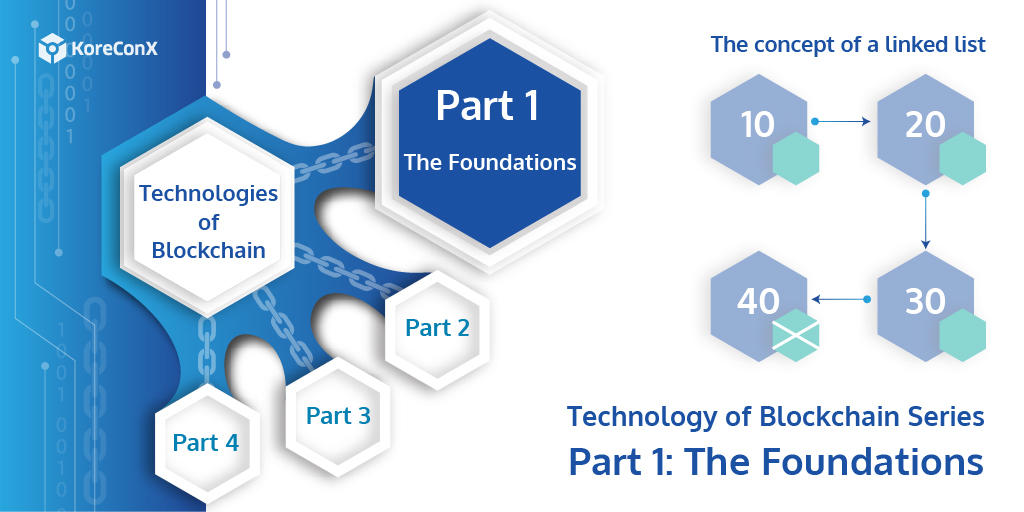
At the conceptual heart of blockchain is the ‘chain’. By definition, the links of the chain are, well, linked. It’s a list of data elements or packets of information (in blockchain, these are called ‘blocks’) that are linked. A blockchain is, therefore, a type of linked list.

The concept of a linked list was defined by pioneers of computer science and artificial intelligence, Alan Newell, Cliff Shaw, and Herbert Simon, way back in 1955-56.

In the early days of computer science, data and processing power lived on individual computers. Soon, people wanted these computers to ‘talk’ to each other. The grand idea of an Intergalactic Computer Network was put forth by J. C. R. Licklider as early as 1963. Unfortunately, even after half a century of rapid development, we have achieved only a planetary-wide Internet so far. An ‘intergalactic’ network is still a few years away!*

These ideas and the need to connect dispersed computers gave rise to wide-scale distributed systems in the 1960s-70s, with the advent of ARPANET and Ethernet. Technically, these linked computers are not necessarily treated in the same way as a traditional linked list that lived on one computer, but the conceptual idea is similar. When data and computational power get dispersed, layers of management, coordination, and security become increasingly important.

Blockchain would not exist without the Internet, which itself would not exist without TCP/IP, developed by Bob Kahn and Vint Cerf in the 1970s and ‘80s. Along the way, some scientists managed to have some fun too. They carried out an April Fools prank in 1990 by issuing an RFC (1149) for IPoAC protocol (IP over Avian Carriers, i.e., carrier pigeons). The punch line was delivered in April 2001 when a Linux user group implemented CPIP (Carrier Pigeon Internet Protocol) by sending nine data packets over three miles using carrier pigeons. They reported packet loss of 55%. A joke that takes a decade to pull off is practically Saturday night live comedy in Internet time scale!

In part 2, we will see how the extension of the concept of linked list on the Internet leads to distributed systems, the attending challenges, and their solutions.

Source: https://www.koreconx.com/2018/11/14/technologies-blockchain-part-1-foundations/

CLIENT FEATURE: Gratomic $GRAT.ca The Cleaner Carbon of Tomorrow $DNI.ca $LMR.ca

Posted by AGORACOM at 11:54 AM on Wednesday, December 5th, 2018

  • Gratomic is focused on the manufacture of high quality, high demand graphenes and graphene derivative products primarily targeted towards elastomers and polymers for automotive tires
  • Intends to cultivate and exploit Aukam graphite to facilitate the manufacture of graphenes for large volume, mass-market applications
  • Gratomic owns 63% of the Aukam graphite mine in southern Namibia which it has developed as its key asset since 2015
  • The Aukam graphite mine is a rare massive vein graphite occurrence which has formerly only been mined commercially in small veins in Sri-Lanka
  • Aukam graphite has been tested and proven in several high value applications including graphitic foils and is currently being tested by an anode manufacturer for performance quality
  • Gratomic recently announced LOI to create Blockchain ecosystem for Gratomic Graphene

FULL DISCLOSURE: Gratomic is an advertising client of AGORA Internet Relations Corp.

Beauce Gold Fields Secures $550,000 Financing Required for Listing on Tsx Venture Exchange $BGF.ca $HPQ.ca

Posted by AGORACOM-JC at 10:32 AM on Wednesday, December 5th, 2018

Hpq large

  • HPQ subsidiary, Beauce Gold Fields Inc  has raised the minimum $550,000 concurrent private placement required for it’s listing on the TSX-Venture Exchange under the reserved stock symbol BGF
  • Following the satisfactory review, the Date of Record and subsequent Distribution and Listing Date will be announced.

MONTREAL, Dec. 05, 2018 — HPQ Silicon Resources Inc (“HPQ”) (TSX Venture: HPQ) is pleased to inform shareholders that HPQ subsidiary, Beauce Gold Fields Inc (“BGF”) has raised the minimum $550,000 concurrent private placement required for it’s listing on the TSX-Venture Exchange (“Exchange”) under the reserved stock symbol BGF.

Patrick Levasseur, President and CEO of HPQ Beauce Gold Fields subsidiary stated, “I would like to thank everyone who has subscribed to the private placement for the listing of BGF.  This will allow HPQ to unlock the full potential value of the Beauce Gold property through a fresh new entity starting with a tight capital structure.” Mr. Levasseur also stated  “The Beauce is Canada’s last underexplored historical placer mining camp. It’s similar to the placer to hard rock exploration projects in the Yukon or the Cariboo district in BC, that were both placer gold mining camps as well, but recently had major gold discoveries.  Combining our large claims holding in St-Simon-Les-Mines together with our increasing knowledge of the geology, we believe we have narrowed the search in exploring for a hard rock gold deposit”

TSX-V Conditional Approval and Concurrent Private Placement

The Listing of BGF was conditional to closing the private placement.  The listing is also conditional to the submission of the Listing Application, the required financial statements plus various supporting documents that HPQ is submitting to the Exchange for satisfactory review.

Following the satisfactory review, the Date of Record and subsequent Distribution and Listing Date will be announced.

In this regard, the BGF’s notice for filing in connection with this Private Placement will be the following basis:

  1. 3,500,000 hard-cash units (HC Units) at the price of $0.10 per HC Unit for total of $350,000.00
  2. 1,666,666 flow-through units (FT Units) at the price of $0.12 per FT Unit for total of $200,000.00

Each HC Unit will be comprised of one common share and one warrant to purchase one common share at the price of $0.15 per share for two years following the closing date. Each FT Unit will be comprised of one flow-through common share and one-half of one warrant, with each full warrant allowing the holder to purchase one common share at the exercise price of $0.18 per share for a period of two years following the closing date.

Beauce Gold Fields – A Tight Capital Structure at Listing

Transactions Number of Shares
Private Placement to HPQ 200,000
Spin-out – Shares at $0.10 per Share 13,350,000
HPQ Direct Ownership (≈ 15%) 2,870,000
Distributed to HPQ Shareholders (≈55%) 10,680,000
Flow Through Private Placement at $0.12 per Share 1,666,666
Hard Cash Private Placement at $0.10 per Share 3,500,000
BGF Shares outstanding at Listing 18,716,666
Warrants- Private Placement 4,333,333
Warrants – HPQ warrant holders * 4,158,350
Stock Option Plan (rolling 10%) 1,900,000
Fully Diluted Capital 29,108,349

* Subject to adjustment based on the final HPQ Ratio upon the Ex-Distribution Date.

About Beauce Gold Fields

BGF is a wholly owned subsidiary of HPQ Silicon into which HPQ gold assets were transferred.   Subject to approval by TSX-V, HPQ is in the process of listing BGF as a new public junior gold company, following the approval by shareholders during HPQ AGM held on Aug. 10, 2018, of the proposed terms of the plan of arrangement.

The Beauce Gold Fields project is a unique, historically prolific gold property located in the municipality of Saint-Simon-les-Mines in the Beauce region of Southern Quebec. Comprising of a block of 152 claims 100% owned by HPQ, the project area hosts a six kilometre long unconsolidated gold-bearing sedimentary unit (a lower saprolite and an upper brown diamictite). Textural observations (angularity) of gold nuggets suggest a relatively proximal source and therefore a short transport distance. The gold in saprolite indicates a close proximity to a bedrock source of gold, providing possible further exploration discoveries.  The property was also hosts numerous historical gold mines that were active from 1860s to the 1960s (see HPQ SEDAR-filed report).

Find more information at: www.beaucegold.com

About HPQ Silicon

HPQ Silicon Resources Inc. is a TSX-V listed resource company planning to become a vertically integrated and diversified High Purity, Solar Grade Silicon Metal (SoG Si) producer and a manufacturer of multi and monocrystalline solar cells of the P and N types, required for production of high performance photovoltaic conversion.

HPQ’s goal is to develop, in collaboration with industry leaders, PyroGenesis (TSX-V:PYR) and Apollon Solar, that are experts in their fields of interest, the innovative PUREVAPTM “Quartz Reduction Reactors (QRR)”, a truly 2.0 Carbothermic process (patent pending), which will permit the transformation and purification of quartz (SiO2) into high purity silicon metal (Si) in one step and reduce by a factor of at least two-thirds (2/3) the costs associated with the transformation of quartz (SiO2) into SoG Si. The pilot plant equipment that will validate the commercial potential of the process is on schedule to start mid-2019.

Disclaimers:

This news release does not constitute an offer to sell or a solicitation of an offer to buy nor shall there be any sale of any of the securities in any jurisdiction in which such offer, solicitation or sale would be unlawful. The securities have not been and will not be registered under the United States Securities Act of 1933, as amended (the “U.S. Securities Act”) or the securities laws of any state of the United States and may not be offered or sold within the United States or to, or for the account or the benefit of, U.S. persons (as defined in Regulation S un der the U.S.  Securities Act) unless registered under the U.S. Securities Act and applicable state securities laws or pursuant to an exemption from such registration requirements.

This press release contains certain forward-looking statements, including, without limitation, statements containing the words “may”, “plan”, “will”, “estimate”, “continue”, “anticipate”, “intend”, “expect”, “in the process” and other similar expressions which constitute “forward-looking information” within the meaning of applicable securities laws. Forward-looking statements reflect the Company’s current expectation and assumptions, and are subject to a number of risks and uncertainties that could cause actual results to differ materially from those anticipated. These forward-looking statements involve risks and uncertainties including, but not limited to, our expectations regarding the acceptance of our products by the market, our strategy to develop new products and enhance the capabilities of existing products, our strategy with respect to research and development, the impact of competitive products and pricing, new product development, and uncertainties related to the regulatory approval process. Such statements reflect the current views of the Company with respect to future events and are subject to certain risks and uncertainties and other risks detailed from time-to-time in the Company’s on-going filings with the securities regulatory authorities, which filings can be found at www.sedar.com. Actual results, events, and performance may differ materially. Readers are cautioned not to place undue reliance on these forward-looking statements. The Company undertakes no obligation to publicly update or revise any forward-looking statements either as a result of new information, future events or otherwise, except as required by applicable securities laws. Neither the TSX Venture Exchange nor its Regulation Services Provider (as that term is defined in the policies of the TSX Venture Exchange) accepts responsibility for the adequacy or accuracy of this release.

For further information contact

Bernard J. Tourillon, Chairman, President and CEO HPQ Tel (514) 907-1011
Patrick Levasseur, COO HPQ, President and CEO BGF Tel: (514) 262-9239
www.HPQSilicon.com

Shares outstanding: 222,284,053

CLIENT FEATURE: Labrador Gold’s Shaw Ryan Targeting the Under Explored Gold Potential of the Province $MOZ.ca $SIC.ca $GR.ca

Posted by AGORACOM at 2:24 PM on Tuesday, December 4th, 2018

https://s3.amazonaws.com/s3.agoracom.com/public/companies/logos/564640/hub/Small-Logo-Labrador-GOLD.jpg

    • Led by Shawn Ryan, who’s prospecting and soil geochemistry work led to the discovery of  White Gold, Coffee, and QV projects for a total of 7.5M ounces Au
    • White Gold’s geochemical sampling program led to successful drill program
    • Exploration has already outlined district scale soil anomalies on two projects in Labrador
    • Hopedale property contains the Florence Lake greenstone belt and the Hunt River, both of which are under-explored for gold
    • Florence Lake greenstone belt has a 40 KM strike length and includes Thurber Dog
    •  Preliminary soil geochemical results show arsenic anomalies in several areas
    • Arsenic is a pathfinder element when exploring for gold


LAB Agoracom Hub

FULL DISCLOSURE: Labrador Gold is an advertising client of AGORA Internet Relations Corp.

Enthusiast Gaming $EGLX.ca Appoints Leading Industry #Gaming and Technology Experts as Advisors to the Company $ATVI $TTWO $GAME $EPY.ca $TCEHF $Game.ca $EPY.ca

Posted by AGORACOM-JC at 9:29 AM on Tuesday, December 4th, 2018

Images

  • Appointed experienced, gaming industry and technology business leaders as Advisors to the Company
  • Enthusiast welcomes John Koller, Matt Levitan, Matt Ryan, and Mike Wall as Advisors to assist and provide expertise though its expansive growth

TORONTO, Dec. 04, 2018 – Enthusiast Gaming Holdings Inc. (“Enthusiast” or the “Company”) (TSXV: EGLX), a digital media company building the largest community of authentic  gamers, is excited to announce that it has appointed experienced, gaming industry and technology business leaders as Advisors to the Company. Enthusiast welcomes John Koller, Matt Levitan, Matt Ryan, and Mike Wall as Advisors to assist and provide expertise though its expansive growth.

John Koller has over 20 years of senior executive level experience in the video gaming sector with Electronic Arts (“EA”) and PlayStation. John spent 19 years as the VP of Marketing for PlayStation, during which he led  five major platform launches, including the highly successful PlayStation 4 launch in North America. He also led and managed a multi-billion dollar PlayStation business in the US with full P&L responsibility. Prior to PlayStation, John was the head of marketing for Electronic Arts.

Matt Levitan has over two decades experience in the Canadian video game industry. Before starting his own agency, Matt spent 9 years at the helm of the Sony office as Senior Director of Marketing and Public Relations, directing all sales, marketing and operations efforts for the $500M annual business.  Prior to Sony, Matt was VP, Client Services of Segal Communications, and directed all marketing and public relations efforts for PlayStation Canada from the agency side through the original PlayStation and PS2 lifecycles. Since 2014, Matt has helped create and launch a free-to-play Facebook game as well as starting his own consulting agency called Press Start Marketing.

Matt Ryan was the former lead at Nintendo Canada for communications and strategic partnerships, as well as retail and channel marketing, promoting gaming experiences to the masses via product-to-market campaigns for the launch of Wii, Wii U, Nintendo 3DS. Matt was also in charge of promoting all software franchises for the company, including; Mario, The Legend of Zelda, Donkey Kong, Pokemon and more. After Nintendo, Matt launched Trip To The Moon Marketing Inc., a marketing, communications and brand partnerships agency for entertainment, arts and culture brands. Matt is currently the VP of Marketing at National Access Cannabis, a best practices leader in delivering secure, safe, and responsible access to legal adult-use recreational and medical cannabis in Canada.

Mike Wall was Vice President, Sales at comScore, an Internet measurement pioneer that went public in 2007 and reached $2.5B market cap in 2015. Prior to his 11 years with comScore, he was Sales Executive at Visual Sports, a VR simulator startup founded in 2000 and acquired by market leader Full Swing Golf. Mike currently brings over 15 years of experience as a technology business leader, to provide angel investment, executive advisory and business consulting to high-growth Canadian startups.  Mike is the Founder and Principal of Park Hill Ventures, an early-stage venture advisory firm supporting Canada’s innovation economy.

Eric Bernofsky, COO of Enthusiast commented, “We are delighted to welcome John Koller, Matt Levitan, Matt Ryan and Mike Wall as Advisors of Enthusiast Gaming. These veteran industry leaders have a track record of success within significant gaming and technology brands, like Electronic Arts, PlayStation, Nintendo, and comScore which will greatly benefit our operations. Their combined expertise will be invaluable for the Company to help us navigate the rapid growth of our business and continue executing on our growth strategy.”

About Enthusiast

Founded in 2014, Enthusiast is the fastest-growing online community of video gamers. Through the Company’s unique acquisition strategy, it has a platform of over 70 owned and affiliated websites and currently reaches over 75 million monthly visitors with its unique and curated content. Enthusiast also owns and operates Canada’s largest gaming expo, Enthusiast Gaming Live Expo, EGLX, (www.eglx.ca). Over 30,000 people attended EGLX in October 2018. For more information on the Company, visit www.enthusiastgaming.com.

CONTACT:

Julia Becker
Head, Investor Relations & Marketing
(604) 785-0850
[email protected]

This news release contains certain statements that may constitute forward-looking information under applicable securities laws. All statements, other than those of historical fact, which address activities, events, outcomes, results, developments, performance or achievements that Enthusiast anticipates or expects may or will occur in the future (in whole or in part) should be considered forward-looking information. Such information may involve, but is not limited to, comments with respect to strategies, expectations, planned operations and future actions of the Company. Often, but not always, forward-looking information can be identified by the use of words such as “plans”, “expects”, “is expected”, “budget”, “scheduled”, “estimates”, “forecasts”, “intends”, “anticipates”, or “believes” or variations (including negative variations) of such words and phrases, or statements formed in the future tense or indicating that certain actions, events or results “may”, “could”, “would”, “might” or “will” (or other variations of the forgoing) be taken, occur, be achieved, or come to pass. Forward-looking information is based on currently available competitive, financial and economic data and operating plans, strategies or beliefs as of the date of this news release, but involve known and unknown risks, uncertainties, assumptions and other factors that may cause the actual results, performance or achievements of Enthusiast to be materially different from any future results, performance or achievements expressed or implied by the forward-looking information. Such factors may be based on information currently available to Enthusiast, including information obtained from third-party industry analysts and other third-party sources, and are based on management’s current expectations or beliefs regarding future growth, results of operations, future capital (including the amount, nature and sources of funding thereof) and expenditures. Any and all forward-looking information contained in this press release is expressly qualified by this cautionary statement. Trading in the securities of the Company should be considered highly speculative.

Neither the TSX Venture Exchange nor its Regulation Services Provider (as that term is defined in the policies of the TSX Venture Exchange) accepts responsibility for the adequacy or accuracy of this release.

The securities of the Corporation have not been and will not be registered under the United States Securities Act of 1933, as amended and may not be offered or sold in the United States absent registration or an applicable exemption from the registration requirement. This press release shall not constitute an offer to sell or the solicitation of an offer to buy nor shall there be any sale of the securities in any jurisdiction in which such offer, solicitation or sale would be unlawful.

Good Life Networks Inc. $GOOD.ca announces definitive agreement to acquire 495 Communications, LLC $TTD $RUBI $AT.ca $TRMR $FUEL

Posted by AGORACOM-JC at 8:42 AM on Tuesday, December 4th, 2018

Glnlogo black 11

  • Entered into a definitive agreement to acquire all of the issued and outstanding shares of 495 Communications, LLC
  • 495 is a leading advertising and content marketing company based in New York City and Santa Monica, California.

VANCOUVER, Dec. 4, 2018 – Good Life Networks Inc. (“GLN“, or the “Company“) (TSXV: GOOD) (FSE: 4G5), a programmatic advertising technology company, announced today that it has entered into a definitive agreement (the “Agreement“) to acquire all of the issued and outstanding shares (the “Purchased Shares“) of 495 Communications, LLC (“495“). 495 is a leading advertising and content marketing company based in New York City and Santa Monica, California. According to a third-party unaudited Quality of Earnings prepared by CohnReznick LLP in New York, as at August 31, 2018; 495’s Trailing Twelve Month revenue was reported at approximately USD$14.4M (CDN$18.1M equivalent), and adjusted EBITDA came in at USD$1.9M (CDN$3.3M equivalent).

“I’m thrilled to announce our second acquisition for 2018, which is also accretive to earnings,” stated CEO Jesse Dylan. “495 Communications is a content publisher with an impressive list of partners that includes more than 2,000 premium websites, as well as proprietary mobile and connected TV applications. This acquisition, along with the recently announced acquisition of ImpressionX, sets GLN up to achieve our aggressive earnings growth objectives for 2019 and beyond.”

Under the terms of the Agreement, consideration for the Purchased Shares will consist of the following:

a)      US$3,500,000 in cash, payable to the members of 495 less the amount of outstanding indebtedness;

b)      a cash earn-out, up to a maximum of US$5,500,000 for hitting performance benchmarks; and

c)      a share/cash earn-out, to be satisfied, at the sole discretion of the Company, in cash or through the issuance of common shares of the Company (“GLN Shares“) up to a maximum amount of US$6,000,000 for hitting performance benchmarks, such GLN Shares to be issued at a per share price based upon the greater of (i) the 20-day volume weighted average trading price of the GLN Shares on the TSX Venture Exchange (the “TSX-V“) immediately prior to the date of issuance and (ii) the lowest price permitted by the policies of the TSX-V.

The Agreement was negotiated at arm’s length.  495 was advised by CREO | Montminy & Co. as financial advisor and Foundation Law Group served as legal counsel.  GLN was advised by Oakhill Financial as financial advisor and Wang Legal served as legal counsel.

“GLN’s technology and growth strategy is in perfect alignment with our team at 495,” stated CEO Bret Polansky. “495 delivers compelling content and advertising across multiple devices, we have set the industry standard by which this is consumed on today’s cross market platforms. We look forward to adding our impressive suite of services, technology and large client and publisher rosters to the GLN family.”

Completion of the acquisition is subject to the Company obtaining debt financing on terms satisfactory to the Company. The Company expects to enter into a debt facility with a Schedule One bank on or before closing of the acquisition.

The Company anticipates the completion of the acquisition by the end of December 2018, pending TSX-V acceptance.

In connection with the acquisition of 495, the Company intends to issue Oak Hill Financial, Inc. (“Oak Hill“) 650,000 non-transferable finder’s warrants (the “Finder Warrants“) as a finder’s fee upon completion of the acquisition.  The Finder Warrants will be exercisable into common shares of the Company at an exercise price of $0.34 per common share until the date that is 2 years after the date of issuance. The issuance of the Finder Warrants to Oak Hill is subject to the acceptance by the TSX-V.

The GLN Story

GLN’s technology is the engine that sits between advertisers and publishers. The GLN platform is built for cross device video advertising: mobile, in-app, desktop and CTV (Connected Television). The Programmatic Video Marketing Platform is powered by GLN’s proprietary machine learning technology that uses “Big Data” to intelligently target and connect digital advertisers with consumers without collecting PII (Personal Identifiable Information).

The platform is the cornerstone of GLN’s business, providing industry leading insights, data and revenue. This allows GLN to match advertisers to publishers in a way that provides significant and sustainable value to both. GLN’s patent pending machine learning algorithm can forecast the needs and wants of the brands they represent, maximizing the efficiency for their partners while increasing their margins and profitability.

The Programmatic Video Technology Platform features integrations at the server level with both publishers and advertisers. Our technology quickly finds the most valuable advertisement for every consumer. Publishers make more money through improved CPM (advertising fill rate) combined with a more engaged consumer experience. Advertisers make more money by reaching their target audience more effectively. GLN makes money by retaining a percentage of the advertiser’s fee. GLN is headquartered in Vancouver, Canada with offices in the US and UK and trades on the TSX Venture Exchange under the stock symbol “GOOD” and The Frankfurt Stock Exchange under the stock symbol 4G5.

Neither the TSX Venture Exchange nor its Regulation Services Provider (as that term is defined in the policies of the TSX Venture Exchange) accepts responsibility for the adequacy or accuracy of this release.

Forward Looking Statements:

Forward-looking statements relate to future events or future performance and reflect the expectations or beliefs regarding future events of management of GLN. This information and these statements, referred to herein as “forward‐looking statements”, are not historical facts, are made as of the date of this news release and include without limitation, statements regarding discussions of future plans, including the timing, approval and completion of the acquisition of the Purchased Shares, TSX-V approval, ability of the company to secure debt financing, estimates and forecasts and statements as to management’s expectations and intentions with respect to the Company’s acquisition of 495. These statements generally can be identified by use of forward-looking words such as “may”, “will”, “expect”, “estimate”, “anticipate”, “intends”, “believe” or “continue” or the negative thereof or similar variations. These forward‐looking statements involve numerous risks and uncertainties and actual results might differ materially from results suggested in any forward-looking statements. Important factors that may cause actual results to vary include without limitation, risks relating to the timing of the acquisition of the Purchased Shares, risk related to securing a debt facility, successful completion of the acquisition of the Purchased Shares, fulfillment of all conditions to closing set forth in the Agreement, the number of securities of GLN that may be issued in connection with the transaction; GLN realizing on the anticipated value of acquiring the Purchased Shares, GLN maintaining its projected growth, acceptance of the TSX-V and general economic conditions or conditions in the financial markets. In making the forward‐looking statements in this news release, the Company has applied several material assumptions, including without limitation that the acquisition of the Purchased Shares will be successfully completed in the time expected by management and will generate the anticipated revenue and expand GLN’s global reach per management’s expectations. GLN does not assume any obligation to update the forward-looking statements, or to update the reasons why actual results could differ from those reflected in the forward looking-statements, unless and until required by applicable securities laws. Additional information identifying risks and uncertainties is contained in GLN’s filings with the Canadian securities regulators, which filings are available at www.sedar.com.