Agoracom Blog Home

Archive for the ‘All Recent Posts’ Category

CLIENT FEATURE: Tartisan Nickel $TN.ca Kenbridge Property Hosts M&I Resource of 7.14 Million Tonnes at 0.62% Nickel, 0.33% Copper $ROX.ca $FF.ca $EDG.ca $AGL.ca $ANZ.ca

Posted by AGORACOM-JC at 5:16 PM on Monday, November 12th, 2018

Investment Highlights

  • Kenbridge property has a measured and indicated resource of 7.14 million tonnes at 0.62% nickel, 0.33% copper
  • 17.5 (21.8 fully diluted) percent equity stake in Eloro Resources and 2 percent NSR in their La Victoria property

Kenbridge Ni Project (ON, Canada)

  • Advanced  stage  deposit  remains open  in  three  directions,  is  equipped with a 623m  deep  shaft  and  has  never  been  mined.
  • Preliminary  Economic Assessment completed and updated returned robust project
    economics and operating costs including  a  NPV  of  C$253M  and  cash costs of US$3.47/lb of nickel net of
    copper credits.
  • Plans for Kenbridge include updating PEA, advancing the project through to feasibility and exploring the open mineralization at depth

FULL DISCLOSURE: Tartisan Nickel Corp. is an advertising client of AGORA Internet Relations Corp.

CTV ads outperforming those on other platforms, study shows #adtech #programmatic $GOOD.ca $TTD $RUBI $AT.ca $TRMR $FUEL

Posted by AGORACOM-JC at 4:12 PM on Monday, November 12th, 2018

By Andrew Blustein

  • A recent report from Extreme Reach shows that ads on connected television (CTV) are significantly outpacing ads on other platforms, most notably in terms of impressions and completion rate.
  • According to the quarterly report, CTV has held 38% of impressions by device over the past two quarters, followed by mobile, desktop, and tablet. Mobile impressions are the second highest, at 31% in the third quarter.

Average video completion rate in the third quarter is at 82%, a 14% climb year-over-year. By device, CTV completion rate is at 95%, 10 points higher than the nearest platform. The report noted, “Viewers tend to be committed to the content they choose to watch on connected TV and they often do not have the option to skip the ads.”

Extreme Reach chief marketer Melinda McLaughlin highlighted the captive audience CTV garners, and how viewers are committed to the ads they come across.

“While you can’t necessarily skip or fast-forward ads on CTV, you can absolutely abandon it and turn it off,” she said. “What we’re seeing in general in these numbers is [a] swing back to 30-second ads in a world that everyone thought [that would never happen.]”

According to the report, 30-second ads held 55% of impressions in Q3 when compared to six- and 15-second spots. That’s a 28% jump year-over-year.

With impressions up and 30-second spots resonating, McLaughlin said there’s value in the space, but “content providers have yet to completely figure out how to monetize it.”

Bruce Biegel, senior managing director at consultancy Winterberry Group, told The Drum that with cord-cutting on the rise, CTV is the only way to reach many future-spenders. He said the industry will see a reallocation of spend as the ad buying process gets simpler.

“Demand still outstrips supply,” Biegel said. “As inventory becomes available, as media buying becomes more programmatic and easier, we will see more of a shift in spend. But it will never all shift, and part of that is because when you think about real-time events, typically they do well in a shared environment.”

Although live programming still provides value to linear TV, it doesn’t offer the same kind of targeting and addressability that CTV does.

“You have more data that you’re capturing across devices. If you’re doing people-based marketing, you can start to follow segments and individuals from device to device to see what they’re consuming,” said Biegel.

Liveramp’s TV general manager, Allison Metcalfe, added that people-based measurement “is critical to understanding whether CTV advertising lives up to its hype.

“Ads delivered across the Roku platform were 67% more effective per exposure at driving purchased intent than ads on broadcast and cable television,” Metcalfe said, citing a report from Roku.

Both Metcalfe and Biegel said brands are diving into the space.

“They are embracing this new frontier by testing even more audiences and data types, coordinating cross-channel campaigns, and measuring results,” Biegel said. “Now they can do true multichannel, multi-touch attribution.”

Biegel said many brands are still spending experimentally, but there’s value in the space across all verticals.

All of the experts noted that with lengthening ad times and cross-channel targeting, brands will have to invest more in effective creatives that appear across CTV devices, be it a television, laptop, or mobile phone.

Source: https://www.thedrum.com/news/2018/11/12/ctv-ads-outperforming-those-other-platforms-study-shows

Goldman Sachs $GS #Esports moving from wild west to revenue boom $GMBL $ATVI $TTWO $GAME $EPY.ca $TCEHF $Game.ca $EPY.ca

Posted by AGORACOM-JC at 1:15 PM on Monday, November 12th, 2018
  • Goldman Sachs has become the latest financial powerhouse to give the future of esports a glowing report.
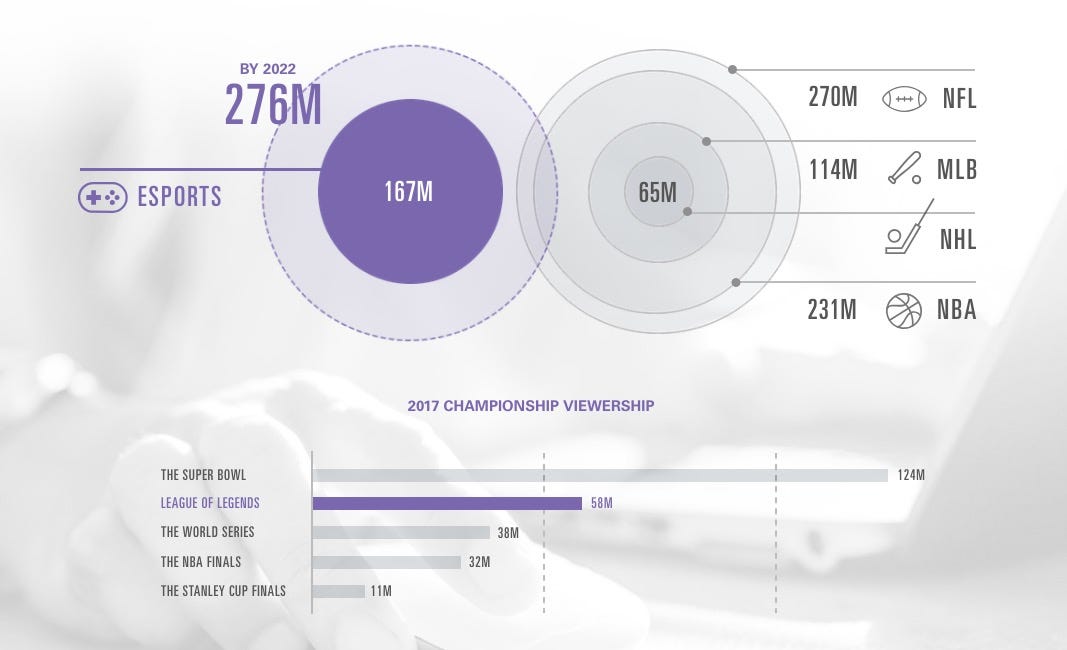
  • Following PwC’s Sports Survey 2018, US investment bank Goldman Sachs has published its own research on esports, concluding that, by 2022, the esports audience will “reach a similar size to the NFL today”.
  • GS reports that increasing levels of professionalism — not least organisational structure — is playing a significant role in growing esports revenues.

Esports audience figures compared with major US sports, according to Goldman SachsThe report reads: “In the early years of esports, there was little organisation or infrastructure and, as a result, the massive audience of esports did not translate into meaningful revenue streams for players, team owners, etc.

“But in 2017, Riot Games created the North American and EU League of Legends leagues, while in January of 2018, Blizzard launched the Overwatch League.

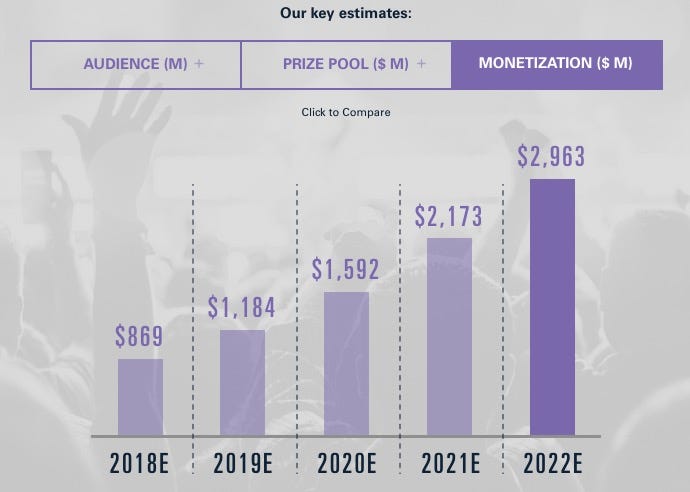
We expect total esports monetisation will reach $3bn by 2022

“We believe these leagues created the requisite infrastructure that will allow esports to finally start to close the monetisation gap relative to other established sports leagues. In 2017, we estimate esports generated $655m in annual revenue, including 38% from sponsorships, 14% from media rights, and 9% from ticket revenue.

8Goldman Sachs’ estimates for esports revenue growth to 2022“But by 2022, we expect media rights to reach 40% of total esports revenue — comparable to the average of the four major Western sports leagues today — as massive audiences and associated revenue for established online video platforms like Twitch, YouTube, Douyu, and Huya will be able to support a growing pool of media rights fees paid to top publishers for their content.

“As media rights and sponsorship continue to grow, along with the formalisation of pro sports leagues, we expect total esports monetisation will reach $3bn by 2022.”

GS says its research indicates that the growing popularity of “survival-based games” (battle royale) such as Fortnite and PUBG, will help drive esports into the mainstream.

We believe the esports audience should continue to outpace the growth of traditional leagues

The report said: “Due to the growing popularity of survival-based games Fortnite and PUBG, we believe esports viewership is moving more into the mainstream, which should support a 14% audience growth CAGR for the next five years.

“Recently, Epic games announced that it would set aside $100m in prize pool for the first year of Fortnite esports tournaments, nearly the size of the entire esports prize pool in 2017. With growing incentives for esports players, and by extension more interest from the casual observer, we believe the esports audience should continue to outpace the growth of traditional leagues.”

Going mobile

The GS report also features a Q&A with Andy Miller, co-founder of NRG org. In the interview, Miller shares his thoughts on franchising, growth in China and mobile esports.

Asked if he thought mobile and console esports would become as popular as PC-based games, he replied: “I do think it will be big. I have a mobile background myself — NRG entered the founding franchise into the Clash Royale League.

“Mobile is more here in gaming than you think, because what are the biggest games people are playing right now? Fortnite, PUBG? They’re on mobile. Clash [of Clans]? Mobile. Hearthstone and games like that have been around for a while.

“So the question is — will they translate into good esports? I think that’s probably more a function of the game than the fact that it’s on mobile, so we’ll see. There will definitely be breakout games. I think the touch screens are capable now — there is a lack of latency, so I think the opportunity is definitely there.”

Source: https://blog.luckbox.com/goldman-sachs-esports-moving-from-wild-west-to-revenue-boom-e9a551372336

Mapping the growth of digital learning in #India #edtech $BTRU.ca $ARCL $CPLA $BPI $FC.ca

Posted by AGORACOM-JC at 10:58 AM on Monday, November 12th, 2018

In a country as diverse as India, along with overcoming the infrastructure barrier, there needs to be a focus on overcoming the barriers of language and content.


  • The education divide in India with respect to quality and accessibility has existed for far too long
  • Indian education system has remained more or less the same, since last 150 years.
  • It is difficult for the existing physical infrastructure to meet the learning needs of the burgeoning population of our country which will touch 1.5B by 2030 and 1.7B by 2050 (equal to the population of China and USA combined)

Roman Saini

The education divide in India with respect to quality and accessibility has existed for far too long. The Indian education system has remained more or less the same, since last 150 years. It is difficult for the existing physical infrastructure to meet the learning needs of the burgeoning population of our country which will touch 1.5B by 2030 and 1.7B by 2050 (equal to the population of China and USA combined). Digital is gaining acceptance across numerous sectors and it is only right that the education sector too reaps benefits of this digital transformation.

In a country as diverse as India, along with overcoming the infrastructure barrier, there needs to be a focus on overcoming the barriers of language and content. It is impossible to have great teachers in each and every village/district in India. Similarly, the best teachers should not be restricted to certain institutes of the world. This is where e-learning comes in. It can level the playing field for all students. Students, in both rural and urban areas, can get access to the best learning resources, learn at their own pace and in the comfort of their own homes. Another key advantage with e-learning is that it is much easier to design courses with the latest online reference material than publishing crores of books. With the significant rise in internet penetration and the drop in the prices of smartphones in India, access to online learning resources will soon become ubiquitous.

Today, whether it is finding a new word on Google, or watching a photography video, without realising it, we are already using the internet to constantly learn. A major chunk of learning is already happening on the internet, with the government’s push we can expect it to grow to exponential levels.

The launch of the second phase of the Digital India campaign with a renewed focus on education is a welcome step towards the faster development of the education sector. Online education is also receiving its due importance in the New Education Policy drafted by the Kasturirangan Committee. Massive Open Online Courses (MOOCs) under the government’s SWAYAM initiative have the tremendous potential to make higher education accessible to India’s youth, that forms more than 50% of our population.

The government’s push for e-learning reinforces the efforts of online education providers to empower both learners and educators, create more engaging learning experiences and foster personal development. With the push, students will also realise that the accessibility to great teachers can take their learning to the next level.

Going forward, the e-learning space will witness new developments with respect to unconventional methods of learning. Availability of unique courses across categories will encourage students to expand the breadth of the content they consume. Gamification will ensure that the learning process is more interactive and fulfilling. Students will be able to set goals, measure their progress and celebrate their learning achievements. Live online interaction between the students and educators can offer personalised learning that will benefit students in remote areas as well as overcrowded schools. The role of AI and technology in all of this will be huge. AI Bots can act as Study Assistants, that will accompany you along your learning journey. It will know your strengths and weakness inside out and will even recommend what you should read on a given day to maximise your learning outcomes.

The future of e-learning in India is promising. Location, language and financial resources will no longer be a barrier to a great education.

Source: https://www.hindustantimes.com/education/mapping-the-growth-of-digital-learning-in-india/story-7xNIM3M9yZTwurCt80d6cP.html

#Cannabis industry says it needs more approved growers to meet Canadian demand $BOG.ca $NBUD.ca $MCOA

Posted by AGORACOM-JC at 10:09 AM on Monday, November 12th, 2018

  • More fully-licensed cannabis growers and cultivation space are needed to meet a voracious demand for legal marijuana, a spokesman for the industry said last week.
  • That means more licences for both producers and their grow areas need to be issued by Health Canada, said Allan Rewak, executive director of the Cannabis Council of Canada.
  • “Absolutely, we need more licensed producers, we need Health Canada to approve more production sites,” said Rewak, adding his group represents 85 per cent of the legal cultivation space in Canada.

Dean Pilling/Postmedia

More fully-licensed cannabis growers and cultivation space are needed to meet a voracious demand for legal marijuana, a spokesman for the industry said last week.

That means more licences for both producers and their grow areas need to be issued by Health Canada, said Allan Rewak, executive director of the Cannabis Council of Canada.

“Absolutely, we need more licensed producers, we need Health Canada to approve more production sites,” said Rewak, adding his group represents 85 per cent of the legal cultivation space in Canada.

“We’re talking to them every day.”

Private cannabis retailers in Alberta and across the country say the supply of product is often proving inadequate, with some insisting that shortage is preventing them from opening their stores a few weeks after the drug became recreationally legal on Oct. 17.

Alberta Gaming, Liquor and Cannabis, the provincial commission that distributes to private shops and sells pot online, echoes those sentiments.

On Friday, 72 of its 90 varieties of marijuana were listed as out of stock, while the number of total varieties had fallen by 100 from the day before.

Commission officials say they’ve canvassed all licensed producers in the country for more supply, but have been told there’s none to spare.

That bottleneck can be traced back to the federal government’s pace in approving producers’ ability to market their harvests, said AGLC spokeswoman Kaleigh Miller.

“There’s a lot of producers in the hopper waiting for a federal licence to sell,” said Miller.

Health Canada lists 132 producers as licensed to cultivate — nine in Alberta — though 78 of those have sales permits, which can take months to acquire.

Alberta has signed up 15 licensed producers to supply its market, though not all are making deliveries yet.

Those suppliers have reported inventory and shipped goods that should be enough to meet market requirements, said Health Canada spokesman Andre Gagnon.

“There will remain, in aggregate, more than enough supply of dried cannabis and cannabis oils to meet Canadian legal demand,” he said in a statement.

“The challenge will continue to be for licensed processors to work with distributors and retailers to process, package existing inventory and ship final products to meet consumer demand.”

In the past 16 months, he said, 89 companies were issued production licences and 46 granted sales permits, while growing space has expanded from two million to 13 million square feet.

Earlier this year, Postmedia reported that Health Canada was rejecting three licence applications for every one it approved, over concerns some of those requesting them had been involved in the black market.

Health Canada officials have said they’ve hired 300 additional staff to assess applications.

The Cannabis Council of Canada’s Rewak said he’s confident federal officials are working diligently to break the logjam.

“They’re working hard to migrate licences, no one is working against anybody else,” he said.

He also said the industry is working round the clock to meet demand, adding supply is making it to distributors and retailers.

“We’re not out of cannabis, it’s not like shelves are bare,” he said.

Millions of square feet of production capacity is being brought on line, which should help ease or erase supply gaps, said Rewak.

“In the weeks and months to come, it will normalize . . . we won’t see a completely rationalized market until the new year,” he said.

“We’ve got some great licensed producers at the final stages of approval.”

And he agrees with Health Canada that logistical hiccups, such as those in product packaging, are a factor in supply problems.

Included among those are difficulties in quickly affixing federal excise stamps to packaging, he said.

Another challenge has been the lack of data on cannabis demand, a realm shrouded in prohibition for 95 years, said Rewak.

“At the end of the day, there was no baseline to compare it to,” he said.

Overall, he said the system has worked reasonably well and expects it will eventually be proven a success.

Some estimates place the annual demand for cannabis at 800,000 kilograms in a market that could produce $6 billion in revenues.

Source: https://calgaryherald.com/cannabis/cannabis-business/cannabis-industry-says-it-needs-more-approved-growers-to-meet-canadian-demand

Peeks Social $PEEK.ca Announces Changes to Its Payments Procedures and Policies and the Appointment of Khalil Rajan as Interim CFO $IDK.ca $BCOV $AVID

Posted by AGORACOM-JC at 9:09 AM on Monday, November 12th, 2018

Peeks dark logo

  • Announced the appointment of Khalil Rajan as interim CFO
  • Khalil brings 4 years of public Company finance and accounting experience, including 3 years of professional financial services at KPMG Toronto.
  • Khalil holds a Bachelor of Commerce from the DeGroote School of Business at McMaster University, as well as a CPA, CA with the Chartered Professional Accountants of Ontario.”

TORONTO, Nov. 12, 2018 — Peeks Social Ltd. (TSXV: PEEK; OTCQB: PKSLF) (“Peeks Social” or the “Company”) announced that changes to its payment processing services, payment policies and broadcaster payout processes.

Peeks Social provides an ecommerce enabled livestreaming service that allows broadcasters on the Peeks platform, to earn commissions by receiving donations from viewers and by charging viewers for access to content.  In order to provide broadcasters with a competitive quality of service; the Company has historically accommodated weekly settlement of funds to broadcasters; as opposed to the three-week settlement period stated in the Company’s Terms of Service. Initially, credit card processing was the primary means by which the Company processed consumer payments. Credit card processors typically settle funds to the Company within 2 days; well within the one-week settlement window for broadcasters.  Throughout the evolution of the Peeks service, the primary payment processing service has shifted to in-app payment processing services provided by Apple and Google. The settlement period to the Company, for funds processed via in-app payments, ranges from 45 days to 60 days.  The longer funds settlement periods associated with in-app payments, in concert with a competitive requirement to settle broadcaster funds quickly, have collectively resulted in both, real and perceived payment delays to broadcasters.  In addition, a continuously growing userbase and a continuously increasing volume of payments processed has resulted in an increased number of users who have experienced both real and perceived payment delays.

Peeks Social Ltd. has performed an internal review of its financial processes and policies pertaining to payments and a review of its suite of consumer payment processing options.  As a result of the review the Company has identified all the factors causing broadcasters to experience real and perceived delays in receiving payments from the Company.  To resolve the delayed payment issue; management has implemented significant changes to its payments policies, including but not limited to, extending settlement periods out beyond the settlement period of the payment processing service used by the consumer to make purchases or send tips on the Peeks platform. In addition, the Company has made changes to its corporate communications to broadcasters. Broadcasters will now be made overtly aware of settlement periods for funds owing to them by the Company.  Moreover, the Company is implementing several new payment options that allow for significantly shorter settlement periods than in-app payment processing.

The new payment services allow for settlement periods ranging from the same day to 4 days, as compared to 45 days to 60 days for in-app payments.  The new payment options include: online debit, email money transfer, and online chequing (ACH/EFT). The Company’s objective is to migrate the majority of its payment processing away from in-app payments and onto its new payment processing services over the next few months.  The Company’s new payment processing services will be integrated into the Peeks Wallet found at www.peeks.social.  The Company will be promoting its new suite of payment services via all consumer contact points, such as; the Peeks Social website that can be found at www.peeks.social, email notification, in app notifications, broadcaster announcements and in-service promotions.  Users will be incented with discounts for the purchase of coin packages using any of the new payment options found on www.peeks.social.

The Company is also pleased to announce the appointment of Khalil Rajan as interim CFO. Khalil brings 4 years of public Company finance and accounting experience, including 3 years of professional financial services at KPMG Toronto. Khalil holds a Bachelor of Commerce from the DeGroote School of Business at McMaster University, as well as a CPA, CA with the Chartered Professional Accountants of Ontario.”

The Company will also like to announce the departure of Alex McDonald the Chief Financial Officer of Peeks Social Ltd. Mr. McDonald served as CFO for Keek Inc. from 2014 to 2016 and subsequently he served as the CFO of Peeks Social from 2016 to the present.  We would like to thank Alex for his many contributions to the Company and wish him well in his future endeavours.

For further information, please contact:

Peeks Social Ltd.
Mark Itwaru
Chairman & Chief Executive Officer
416-639-5339
[email protected]

David Vinokurov
Director Investor Relations
416-716-9281
[email protected]

Neither the TSX Venture Exchange nor its Regulation Services Provider (as that term is defined in the policies of the TSX Venture Exchange) has reviewed or accepts responsibility for the adequacy or accuracy of this Release.

ThreeD Capital Inc. $IDK.ca Acquires Securities of Imagination Park Entertainment Inc. $IP.ca

Posted by AGORACOM-JC at 4:16 PM on Friday, November 9th, 2018

Idk large

  • Acquired ownership and control of an aggregate of  4,750,000 common shares  and 4,750,000 common share purchase warrants  of Imagination Park Entertainment Inc.
  • Subject Units represented approximately 4.7% of all issued and outstanding common shares of the Company as of November 9, 2018 immediately following the transaction described above (or approximately 8.9% on a partially diluted basis, assuming exercise of the Subject Warrants only)

TORONTO, Nov. 09, 2018 — ThreeD Capital Inc. (“ThreeD” or “the Acquirer”) (CSE:IDK), a Canadian-based venture capital firm focused on investments in promising, early stage companies and ICOs with disruptive capabilities, is pleased to announce that it has acquired ownership and control of an aggregate of  4,750,000 common shares (the “Subject Shares”) and 4,750,000 common share purchase warrants (the “Subject Warrants” and together with the Subject Shares, the “Subject Units”) of Imagination Park Entertainment Inc. (the “Company”) on November 9, 2018.  The Subject Units represented approximately 4.7% of all issued and outstanding common shares of the Company as of November 9, 2018 immediately following the transaction described above (or approximately 8.9% on a partially diluted basis, assuming exercise of the Subject Warrants only), resulting in a corresponding increase in the percentage of shares held by the Joint Actors as a result of the transaction.

Immediately before the transaction described above, the Acquirer held an aggregate of 900,000 common shares of the Company (the “Pre-Shares”), and convertible securities entitling the Acquirer to acquire an additional 2,400,000 common shares of the Company (the “Pre-Convertible Securities”) representing approximately 1.2% of the issued and outstanding common shares of the Company (or approximately 4.2% on a partially diluted basis, assuming exercise of the Pre-Convertible Securities only).

Immediately following the transaction described above, the Acquirer held an aggregate of 5,650,000 common shares (the “Post-Shares”) and convertible securities entitling the Acquirer to acquire an additional 7,150,000 common shares of the Company (the “Post-Convertible Securities”), representing approximately 5.6% of the issued and outstanding common shares of the Company (or approximately 11.8% assuming exercise of such Post-Convertible Securities only).

The Subject Units were acquired in a private placement and not through the facilities of any stock exchange.  The holdings of securities of the Company by Inwentash and the Joint Actors are managed for investment purposes, and Inwentash and the Joint Actors could increase or decrease their investments in the Company at any time, or continue to maintain their current investment position, depending on market conditions or any other relevant factor. The aggregate consideration payable for the Subject Units was $570,000, or $0.12 per Subject Unit.

The trade was effected in reliance upon the exemption contained in Section 2.3 of National Instrument 45-106 on the basis that ThreeD is an “accredited investor” as defined herein.

About ThreeD Capital Inc.

ThreeD is a publicly-traded Canadian-based venture capital firm focused on opportunistic investments in companies in the Junior Resources, Artificial Intelligence and Blockchain sectors.  ThreeD seeks to invest in early stage, promising companies and ICOs where it may be the lead investor and can additionally provide investees with advisory services, mentoring and access to the Company’s ecosystem.

For further information:
Gerry Feldman, CPA, CA
Chief Financial Officer and Corporate Secretary
[email protected]
Phone: 416-941-8900 ext 106

Professional Sports Franchises Turn To #Esports For The Next Billion-Dollar Market Opportunity $GMBL $ATVI $TTWO $GAME $EPY.ca $TCEHF $Game.ca $EPY.ca

Posted by AGORACOM-JC at 2:14 PM on Friday, November 9th, 2018

  • 2018 marked the inaugural year of the NBA’s gaming league, known as the NBA 2K League. This league is composed of 17 competitive gaming teams that are essentially owned and operated by the same organizations that pay your favorite dunker or three-point shooter
  • But is there a real business opportunity here? There are a few data points that favor their efforts. For instance, it is estimated that nearly 1.6 million people play NBA 2K every day, at an average of 90 minutes per day, according to the league. Since consumer attention equals revenue opportunities, this may be a smart move for the league.

Mark Hall Contributor

The last four decades brought us generations of young athletic children whose sole aspiration was to become the nextMichael Jordan or Tom Brady of their sport. Since most people don’t make it to pros, these children grew up to become lifelong viewers and fans of the game and sports teams they love.

Midway through the 1990s, the growth of the video game industry enabled sports fans to live vicariously through the avatar of their favorite athlete or character. Fast forward to today, the broader industry, known as esports, has grown into nearly a billion-dollar market.

Leagues like the National Basketball Association (NBA) and others have taken notice.

In an effort to seize on this monumental shift, the NBA is jumping on board by creating new pathways and meaning to the term ‘professional athlete.’ People who would otherwise have no shot at shaking the commissioners hand while being drafted by the NBA are now doing just that.

2018 marked the inaugural year of the NBA’s gaming league, known as the NBA 2K League. This league is composed of 17 competitive gaming teams that are essentially owned and operated by the same organizations that pay your favorite dunker or three-point shooter.

Each team’s roster will mirror that of the actual game, with five players each covering a different position and a sixth player being in the rotation. What’s unique about this league is that players don’t play avatar versions of real NBA players, but rather digital versions of themselves with increased talent.

But is there a real business opportunity here? There are a few data points that favor their efforts. For instance, it is estimated that nearly 1.6 million people play NBA 2K every day, at an average of 90 minutes per day, according to the league. Since consumer attention equals revenue opportunities, this may be a smart move for the league.

The NBA isn’t the only league making moves like this. In August, the National Football League (NFL) announced a partnership with gaming company Electronic Arts and TV network ESPN to host a competitive league for their famed Madden game series.

True success of these league initiatives won’t be evident for years to come. However, the sheer announcement of such platforms will shape a new generation of aspiring professional athletes who can potentially achieve competitive domination like that of Lebron James, without having to break a sweat.

Mark Hall is a sales leader in a large technology company, contributing to Forbes on the topics of business, culture and leadership. He has been featured in The Huffington Post, Business Insider, among others. All opinions are solely his own and are not reflective of anyone …

Source: https://www.forbes.com/sites/mitsubishiheavyindustries/2018/11/02/the-worlds-most-dominant-manufacturing-powerhouse-is-about-to-get-a-lot-greener/#65e744fa5ddd

#Blockchain Technology Is “Underrated”: Ex- Google $GOOG CEO $IDK.ca $HIVE.ca $BLOC.ca $CODE.ca

Posted by AGORACOM-JC at 11:19 AM on Friday, November 9th, 2018

  • Eric Schmidt, the former chairman of technology giant Google and executive chairman at Alphabet, has recently participated in a live event hosted by venture capital firm Village Global, where he expressed his optimistic view on the prospects of blockchain technology and, particularly, Ethereum, the world’s second largest cryptocurrency by market cap.
  • Referred to Ethereum as a “powerful platform” with revolutionary but yet untapped potential.

by Tanya Chepkova

Eric Schmidt, the former chairman of technology giant Google and executive chairman at Alphabet, has recently participated in a live event hosted by venture capital firm Village Global, where he expressed his optimistic view on the prospects of blockchain technology and, particularly, Ethereum, the world’s second largest cryptocurrency by market cap. He referred to Ethereum as a “powerful platform” with revolutionary but yet untapped potential.

The private event sponsored by Village Global took place in San Francisco in September, but its details remained mostly undisclosed until Village Global decided this week to upload to YouTube a video recording of a conversation between a well-known economist, Tyler Cowen, and Eric Schmidt who was characterized in the description to the video as “one of the most influential technology executives in the world.”

During the conversation they discussed a variety of topics, from Antarctica to human life expectancy, and also Schmidt made a number of interesting remarks on blockchain technology.

When asked about his opinion on the blockchain, the billionaire investor said that there was no simple answer to the question of whether blockchain was overrated or underrated.

 “In the public format, overrated. In its technical use, underrated,” Schmidt explained and illustrated this with examples of problems that distributed ledger technology was able to solve. Also, “blockchain is a great platform for bitcoin and other currencies. And it’s a great platform for private banking transactions where people don’t trust each other.”

He also made specific mention of Ethereum by telling Cowen that this blockchain project seemed to be the most interesting and promising. Schmidt believes that Ethereum can be a “powerful platform” potentially able to upend both current business practices and the entire society.

While commenting on its major potential, Schmidt said,

“I think the most interesting stuff that’s going on are the beginning of execution on top of blockchain — the most obvious example being the capability of ethereum. And if ethereum can manage to figure out a way to do global synchronization of that activity, that’s a pretty powerful platform. That’s a really new invention.”

It’s worth mentioning that Schmidt was an early Bitcoin enthusiast. Back in 2014, he referred to Bitcoin as an amazing advancement and remarkable cryptographic achievement, while he had turned to bitcoins even earlier, in 2011, following the advice of Wikileaks founder Julian Assange.

Source: https://cryptovest.com/news/sto-platform-istox-gets-support-from-singapore-bourse-sgx-state-fund-temasek/

FEATURE: Great Atlantic Resources $GR.ca Focused on Exploring Atlantic Canada

Posted by AGORACOM at 8:00 AM on Friday, November 9th, 2018

https://s3.amazonaws.com/s3.agoracom.com/public/companies/logos/564603/hub/GREATATLANTIC_LOGO_TESTER-e1480712241913.jpg

https://tpc.googlesyndication.com/simgad/5752379710820707897

Great Atlantic Resources – Focused on Exploring Atlantic Canada

3 Outstanding Exploration Projects in One Company

Great Atlantic Hub GR:TSXV

  • Great Atlantic Resource Corp. is simultaneously exploring Golden Promise, Keymet and South Quarry and Kagoot Brook Cobalt project
  • Each project a potential company maker in Atlantic Canada
  • 3.6$ million market cap
  • 52,303,542 million shares outstanding
  • Multiple projects capable of demonstrating exploration success

Golden Promise – Gold

  • Large, new gold Zone discovered at Golden Promise
  • The Jaclyn Main Zone of Golden Promise contains a NI 43-101 compliant inferred resource of 921,000 tonnes averaging 3.02 g/t Au (89,500 contained ounces of gold) at a 1 g/t Au cutoff.
  • Strike length of approximately 800m in length with 420 meters vertical depth.
  •  National Instrument 43-101 Technical Report on the Company’s Golden Promise Gold Property to be completed on property


Keymet – Pollymetallic

  • Current discoveries and exploration occur 1.4KM from the old Keymet mine.
  • 2012 trenching exposed a gold bearing shear zone, multiple samples averaged 1.09 g/t Au over 11.8m.
  • Hole Ky-2015-3 drilled a gold bearing interval of 3.28 g/t Au over 2.1m
  • Highly prospective Pollymetallic system with a new gold discovery
  • Hole Ky-17-8 (2017 discovery): 18.80% Zn (37.32% Zn Equiv. as of June 14 2018), 3.55% Cu, 1.16% Pb & 576 g/t Ag / 1.27 meter core length
  • Hosts multiple gold, silver, zinc, lead & copper occurrences in high grade veins


South Quarry – Tungsten / Lithium

  • South Quarry is a high priority tungsten property with lithium potential
  • High grade tungsten mineralization in veins (rubble & bedrock) in the South Quarry
  • Ten rubble grab samples exceeded 5% WO3 (3 of which exceeded 10% WO3)
  • Recently completed sampling program focused on areas of tungsten soil geochemical anomalies and a gold soil geochemical anomaly
  • Analyses are pending for rock samples collected for tungsten and gold.

FULL DISCLOSURE: Great Atlantic is an advertising client of AGORA Internet Relations Corp