Agoracom Blog Home

Archive for the ‘All Recent Posts’ Category

Tartisan $TN.ca Closes the Sale of the Alexo-Kelex #Nickel Project to Vanicom Resources Limited of Perth, Western Australia $ROX.ca $FF.ca $EDG.ca $AGL.ca $ANZ.ca

Posted by AGORACOM-JC at 8:58 AM on Thursday, October 25th, 2018

Tc logo in black

  • Company has signed a Definitive Purchase Agreement with VaniCom Resources Limited of Perth, Western Australia for the sale of a 100% interest in the Alexo-Kelex Nickel Project located near Timmins, Ontario
  • purchase terms included the initial payment of C$50,000 by VaniCom to the Company on signing the Binding Letter of Intent with a further payment of C$100,000 to the Company on signing the Definitive Purchase Agreement

Not for distribution to U.S. news wire services or dissemination in the U.S.

TORONTO, ON / October 25, 2018 / Tartisan Nickel Corp. (CSE: TN, FSE: A2DPCM) (“Tartisan”, or the “Company”) is pleased to announce that the Company has signed a Definitive Purchase Agreement with VaniCom Resources Limited (“VaniCom”) of Perth, Western Australia for the sale of a 100% interest in the Alexo-Kelex Nickel Project located near Timmins, Ontario.

The purchase terms included the initial payment of C$50,000 by VaniCom to the Company on signing the Binding Letter of Intent with a further payment of C$100,000 to the Company on signing the Definitive Purchase Agreement. In addition, VaniCom has undertaken to issue to Tartisan 1,750,000 common shares in the capital of VaniCom Resources Limited with a deemed value of C$350,000 and subject to a six month lock-up provision. Tartisan will also receive a 0.5% Net Smelter Return Royalty on any future production from the Alexo-Kelex Nickel Deposit. VaniCom has the right to purchase the Royalty for $1,000,000. The Definitive Purchase Agreement also includes a requirement that VaniCom incur at least C$750,000.00 on exploration and development on the Alexo-Kelex over a 36-month period. Tartisan Nickel will also be entitled to receive a cash rebate from the Financial Assurance associated with the Reclamation Bond proceeds of up to approximately C$230,000 through a formal application process with the Ministry of Energy, Northern Development and Mines.

Tartisan CEO Mark Appleby commented, “We have concluded the sale of the Alexo-Kelex Nickel Project to VaniCom Resources Limited. The monetization of the Alexo-Kelex, a non-core asset, brings value to our shareholders, while retaining upside on the asset. Furthering the Alexo asset, while avoiding dilution and receiving cash and securities, will allow us to focus on the Kenbridge Deposit and other initiatives in an otherwise challenging mining environment. We are pleased to be working with VaniCom”.

The Alexo-Kelex Project produced 30,138 tonnes of ore averaging 1.92% nickel containing 1.3 million pounds of nickel in 2004 and 2005. Historically, the Alexo Deposit produced an additional 57,000 tonnes at 3.6% nickel for a total of 4.5 million pounds of contained nickel.

The Alexo-Kelex Project contains an NI 43-101 compliant resource of some 243,000 tonnes of 1.08% nickel for a contained 5.775 million pounds of nickel. The resource also contains 268,000 pounds of copper and some 202,000 lbs of cobalt at lower grades.

The deposits are classified as Kambalda-style named after similar type-deposits occurring in Western Australia. The Alexo and Kelex deposits are composed of massive to semi-massive nickel sulphide accumulations inhabiting basal embayments along the footwalls of steeply dipping komatiitic ultramafic volcanic flows. The massive, semi-massive sulphides are overlain by stringer, net-textured, blebby and lower grade disseminated sulphide haloes extending upwards and away from the contact. The flows contact with intermediate volcanic country rocks. Other komatiitic hosted nickel sulphide deposits and occurrences in the area include the Redstone, McWatters, Hart, Langmuir 1 and 2, and Texmont.

The Alexo-Kelex Project includes: one Mining and Surface Rights holding 27 mineral claims; one Mining Rights Lease holding two mineral claims; 17 Patents, with Mining and Surface Rights; 8 Patents with Mining Rights only; 1 Patent with Surface Rights only and 55 mineral claims, total package encompassing approximately 945 Ha.

About Tartisan Nickel Corp.

Tartisan Nickel Corp is a Canadian mineral exploration and development company which owns 100% of the Kenbridge Nickel-Copper-Cobalt Project in Ontario holding compliant resources of 97.8 million lbs of nickel and 47 million pounds of copper. In addition, the Company owns a 100% stake in the Don Pancho Zinc-Lead-Silver Project in Peru just 9 km from Trevali’s Santander mine and owns a 100% stake in the Ichuna Copper-Silver Project, also in Peru, contiguous to Buenaventura’s San Gabriel property. Tartisan also owns a significant equity stake (6 MM shares and 3 MM full warrants at 40c) in Eloro Resources Ltd, which is exploring the low-sulphidation epithermal La Victoria Gold/Silver Project in Ancash, Peru.

Tartisan Nickel Corp. common shares are listed on the Canadian Securities Exchange (CSE:TN, FSE:A2DPCM). Currently, there are 99,703,550 shares outstanding (112,830,217 fully diluted).

For further information, please contact Mark Appleby, President & CEO and a Director of the Company, at 416-804-0280 ([email protected]). Additional information about Tartisan can be found at the Company’s website at www.tartisannickel.com or on SEDAR at www.sedar.com.

Jim Steel MBA P.Geo. is the Qualified Person under NI 43-101 and has read and approved the technical content of this News Release.

This news release may contain forward-looking statements including but not limited to comments regarding the timing and content of upcoming work programs, geological interpretations, receipt of property titles, potential mineral recovery processes, etc. Forward-looking statements address future events and conditions and therefore, involve inherent risks and uncertainties. Actual results may differ materially from those currently anticipated in such statements.

The Canadian Securities Exchange (operated by CNSX Markets Inc.) has neither approved nor disapproved of the contents of this press release.

$GGX.ca GGX Gold Drilling Intersects 4.63 G/T Gold Over 0.32 Meters COD Vein $TUSK.ca $K.ca $GZD.ca

Posted by AGORACOM at 8:11 AM on Thursday, October 25th, 2018

https://s3.amazonaws.com/s3.agoracom.com/public/companies/logos/564602/hub/ggx_large.png

  • Completed holes COD18-55 to COD18-60 testing the COD Vein
  • COD18-3: 14.62 g/t Au over 2.1 meters
  • COD18-37: 8.23 g/t Au over 3.95 meters
  • COD18-45: 50.1 g/t Au over 2.05 meters
  • COD18-46: 54.9 g/t Au over 1.47 meters

VANCOUVER, BC / ACCESSWIRE / October 25, 2018 / GGX Gold Corp. (TSX-v: GGX), (OTCQB: GGXXF), (FRA: 3SR2) (the “Company” or “GGX“) is pleased to announce it has received remaining analytical results from its 2018 winter diamond drilling program on the Gold Drop property, located near Greenwood, B.C. These include results for drill holes COD18-55 to COD18-60 which tested the area of the COD Vein, located in the Gold Drop Southwest Zone. Eight samples from these holes exceeded 1 gram / tonne (g/t) gold. Previously reported gold intersections (including high grade gold) from the 2018 drilling program include:

  • COD18-3: 14.62 g/t Au over 2.1 meters
  • COD18-37: 8.23 g/t Au over 3.95 meters
  • COD18-45: 50.1 g/t Au over 2.05 meters
  • COD18-46: 54.9 g/t Au over 1.47 meters


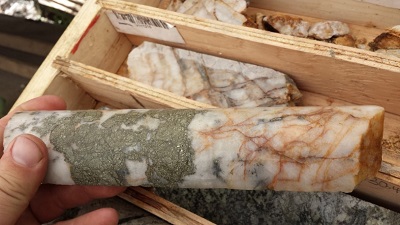
Gold bearing quartz vein with high grade gold in drill hole COD18-45
(50.1 g/t gold over 2.05meters)


The analytical results listed below are highlights from drill holes COD18-55 to COD18-60 (intersections greater than 1 g/t gold), testing the continuation of the COD Vein in the area of the 2017 trench at the COD Vein. Since true widths cannot be accurately determined from the information available the core lengths (meters) are reported. The gold, silver and tellurium analyses are reported in grams per tonne (g/t).

The samples listed in the preceding table include quartz veining (plus or minus calcite) and / or altered granodiorite. Pyrite is present in all samples, both in veining and wall rock.

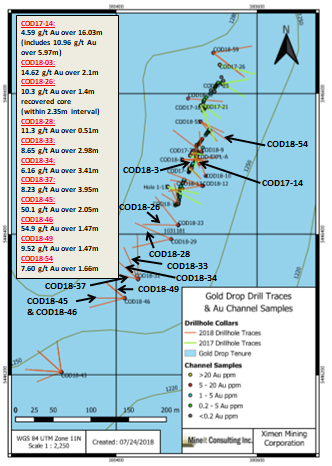
The 2018 winter drilling program focused on testing and defining the COD Vein, a Dentonia/Jewel style quartz vein. Trenching during 2017 exposed the northeast – southwest striking COD Vein for over 160 meter strike length. The majority of the drill holes tested the COD Vein with significant levels of gold, silver and tellurium intersected in numerous holes as reported in News Releases of May 29, June 14, June 27, July 11, July 19, July 25, August 1, August 9, August 15, August 22, August 30 and September 6. These included holes in the area of the 2017 trench and holes southwest of the 2017 trench. More significant gold intersections (core length) from the 2018 winter program at the COD Vein are as follows:

  • COD18-3: 14.62 g/t Au over 2.1 meters
  • COD18-26: 10.3 g/t Au over 1.4 meter recovered core (within 2.35 meter interval)
  • COD18-28: 11.3 g/t Au over 0.51 meters
  • COD18-33: 8.65 g/t Au over 2.98 meters
  • COD18-34: 6.16 g/t Au over 3.41 meters
  • COD18-37: 8.23 g/t Au over 3.95 meters
  • COD18-45: 50.1 g/t Au over 2.05 meters
  • COD18-46: 54.9 g/t Au over 1.47 meters
  • COD18-49: 9.52 g/t Au over 1.47 meters
  • COD18-54: 7.60 g/t Au over 1.66 meters


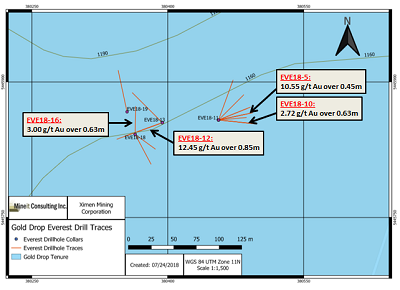
The 2018 drilling program also tested the continuation of the Everest Vein, which is located southwest of the COD Vein worksite. The Everest Vein was first discovered by Company prospectors during the 2017. Chip samples collected in 2017 across the approximate 0.4 meter wide vein exposure returned up to 52.8 g/t gold and 377 g/t silver while a grab sample of a quartz vein boulder broken off the outcrop by the excavator returned 81.8 g/t gold and 630 g/t silver (News Release of August 21, 2017).

The Everest Vein 2018 drill holes are located approximately 350 to 800 meters south of the area of 2017 and 2018 COD Vein drill holes. High gold intersections (core length) from the 2018 winter drill program at the Everest Vein include:

  • EVE18-5: 10.55 g/t Au over 0.45 meters
  • EVE18-12: 12.45 g/t Au over 0.85 meters


In addition to the gold discovered by the Company at the COD and Everest veins, gold mineralization is reported in quartz veins in the east and north regions of the property. These include the Gold Drop, North Star and the Silent Friend quartz veins in the east region of the property and Amandy, Roderick Dhu, Lady of the Lake, Lake View and Moonlight in northern region of the property. High grade gold is reported for historic samples at some of these veins with samples reported to exceed 1 oz. / ton gold. Historic gold production occurred at the Gold Drop, North Star, Amandy and Roderick Dhu veins.

Drill core from the 2018 winter program was geologically logged and sampled. Drill core was sawn in half with half core samples submitted for analysis and remaining half core stored in a secure location. Core samples were delivered to the ALS Minerals laboratory in Vancouver to be analyzed for gold by Fire Assay – AA. Samples exceeding 100 g/t gold were re-analyzed for gold by Fire Assay – Gravimetric Finish. The samples were also analyzed for 48 Elements by Four Acid ICP-MS. Samples exceeding 100 g/t silver were re-analyzed for silver by Four Acid ICP-AES. One sample from COD18-46 exceeded 1500 g/t silver and was re-analyzed for silver by Fire Assay – Gravimetric Finish. Quality control (QC) samples were inserted at regular intervals.

David Martin, P.Geo., a Qualified Person as defined by NI 43-101, is responsible for the technical information contained in this News Release.

To view the Original News release with pictures please go to the website or contact the company.

On Behalf of the Board of Directors,

Barry Brown, Director
604-488-3900
[email protected]

Investor Relations: Mr. Jack Singh, 604-488-3900 [email protected]

” We don’t have to do this, we get to do this “
The Crew

‘Shaky’ Global Stock Markets Trigger Bid For #Gold Says #Sprott $SII.ca $AMK.ca $EXS.ca $MQR.ca

Posted by AGORACOM-JC at 2:13 PM on Wednesday, October 24th, 2018
  • Volatility in global stock markets is boosting demand for gold, which has stood “the test of time,” said Eric Sprott, billionaire precious metals investor and founder of Sprott Inc.
  • As central banks around the world stepped up gold purchases, shouldn’t investors follow suit, Sprott was asked during the company’s Weekly Wrap-Up segment.

Anna Golubova

(Kitco News) – Volatility in global stock markets is boosting demand for gold, which has stood “the test of time,” said Eric Sprott, billionaire precious metals investor and founder of Sprott Inc.

As central banks around the world stepped up gold purchases, shouldn’t investors follow suit, Sprott was asked during the company’s Weekly Wrap-Up segment.

“In India, the central bank bought some gold for the first time in over a decade. Hungarians increased their gold [tenfold to 31.5] tons. Poland also made purchases,” Sprott said. And that’s aside from continued purchases of Russia and China, he added.

In the meantime, physical demand is also picking up, with India importing 95 metric tons of gold in August, Sprott added.

These are all positive numbers that investors should be paying attention to because there’s significant risk in the markets and gold is a proven safe-haven asset, he explained.

“There are lots of reasons to think that the Federal Reserve will have to change. It is uncertain what the Fed will do. You should not automatically count on four rate increases next year,” Sprott said.

On top of that, most stock markets in the world are in a bear market, he pointed out.

“Look at China, [the stocks] was down 32% this year. There are a lot of liquidity issues in a lot of markets, and when you’re the last man standing, [investors] are going to be selling American stocks first, because they’re the ones that are theoretically liquid,” he said. “The structure of markets is very risky … [And] as things get shaky here in the markets, you see the safe-safe-haven bid coming into gold,” Sprott said.

On Tuesday, equities dropped for the fifth consecutive session. The Dow Jones Industrial Average is seeing its worst monthly decline in three years and the S&P 500 is seeing its worst monthly performance in seven years, according to reports.

Meanwhile, the December Comex gold futures touched a three-week high of $1,242 Tuesday on increased safe-haven demand.

“The yellow metal was boosted by safe-haven demand amid keener geopolitical uncertainty in the marketplace. Gold prices did back off their daily highs as the U.S. stock indexes moved up from their daily lows,” said Kitco’s senior technical analyst Jim Wyckoff. “Global stock markets saw risk aversion return to the marketplace today amid heightened geopolitical tensions. China’s stock indexes were sharply down after good gains posted Monday. South Korea’s and Japan’s stock markets were also sharply lower.”

Source: https://www.kitco.com/news/2018-10-24/-Shaky-Global-Stock-Markets-Trigger-Bid-For-Gold-Sprott.html

Demand for #marijuana real estate ‘astronomical’ as Canada legalizes $BOG.ca $NBUD.ca $MCOA $AERO $CBDS $CGRW $APH.ca $GBLX $ACG $ACB $WEED.ca $HIP.ca

Posted by AGORACOM-JC at 10:32 AM on Wednesday, October 24th, 2018
  • Demand for marijuana facilities, including greenhouses, indoor grow-ops and warehouses will put more demand on the country’s already tight supply of industrial real estate.
  • British Columbia and Ontario combined took up more than half of the existing grow-op space, Altus said.

The rush for cannabis is on in Canada and so is finding the real estate to grow it.

The legalization of recreational weed on Wednesday has already fuelled a sixfold surge in pot-growing facilities to 8.7 million square feet (808,256 square meters) in the year through September, according to data from Altus Group Ltd. — space about the size of Amazon.com Inc.’s Seattle headquarters. Publicly listed companies have another 6.4 million square feet on the drawing board, not including retail.

“It’s grown astronomically,” Raymond Wong, vice president of data operations at Toronto-based Altus, said by phone. “With the publicly traded companies, there’s a lot more investment in these areas with anticipated growth and available capital, and they’re acquiring and expanding their existing facilities.”

The demand for marijuana facilities, including greenhouses, indoor grow-ops and warehouses will put more demand on the country’s already tight supply of industrial real estate. British Columbia and Ontario combined took up more than half of the existing grow-op space, Altus said.

Wong said expansion plans are likely conservative as it excludes private companies’ anticipated growth. “There’s a whole other market out there that anticipates further growth in this area,” he said. “We don’t see this slowing down.”

Source: https://business.financialpost.com/real-estate/property-post/demand-for-pot-grow-ops-is-astronomical-as-canada-legalizes

Tetra Bio-Pharma $TBP.ca Appoints Richard Giguère Chief Executive Officer of Tetra Natural Health $AERO $CBDS $CGRW $APH.ca $GBLX

Posted by AGORACOM-JC at 8:30 AM on Wednesday, October 24th, 2018

Logo tetrabiopharma rgb web

  • Announced the appointment of Richard Giguère to the position of Chief Executive Officer of Tetra Natural Health Inc. a newly created, wholly owned subsidiary of Tetra Bio-Pharma Inc.
  • Mr. Giguère has more than 20 years’ experience in national sales and marketing in the pharmaceutical industry. During his career, he has held numerous business development, management and negotiation positions and launched several new products on the Canadian market

ORLEANS, Ontario, Oct. 24, 2018 – Tetra Bio-Pharma Inc., a leader in cannabinoid-based drug discovery and development (TSX VENTURE: TBP) (OTCQB: TBPMF), today announced the appointment of Richard Giguère to the position of Chief Executive Officer of Tetra Natural Health Inc. a newly created, wholly owned subsidiary of Tetra Bio-Pharma Inc.

Mr. Giguère has more than 20 years’ experience in national sales and marketing in the pharmaceutical industry. During his career, he has held numerous business development, management and negotiation positions and launched several new products on the Canadian market. He has worked for several pharmaceutical companies in sectors such as generics, branded products and medical devices. He has also worked with OTC, natural products and original medications. Richard is recognized for his deep ethical sense, respect of others and talent for developing long-term business relationships. Over the past 10 years, he served as a member of the Board of Directors of the companies for which he worked.

“Richard has demonstrated his ability as a company builder which will prove crucial in his role as Chief Executive Officer of Tetra Natural Health,” stated Dr. Guy Chamberland, CEO and CSO of Tetra Bio-Pharma Inc.  “He has begun preparing Tetra Natural Health as a wholly owned subsidiary of Tetra Bio-Pharma with the intentions of creating a market leader in the wellness sector of the cannabis market.”

“I am honored by this appointment as well by the confidence that Tetra Bio-Pharma has shown in me,” said Richard Giguère, CEO of Tetra Natural Health Inc. “As the CEO of Tetra Natural Health, I am excited and deeply committed to lead the operations of Tetra Natural Health with my colleagues through the next stages of development and success. Tetra has a sound business model, and there are several significant opportunities for Tetra Natural Health to grow and commercialize innovative natural health products. I am committed to exploiting the development of this huge potential market in the natural health sector.”

About Tetra Bio-Pharma Inc.
Tetra Bio-Pharma (TSX-V: TBP) (OTCQB: TBPMF) is a biopharmaceutical leader in cannabinoid-based drug discovery and development with a Health Canada approved, and FDA reviewed, clinical program aimed at bringing novel prescription drugs and treatments to patients and their healthcare providers. The Company has several subsidiaries engaged in the development of an advanced and growing pipeline of Bio Pharmaceuticals, Natural Health and Veterinary Products containing cannabis and other medicinal plant-based elements. With patients at the core of what we do, Tetra Bio-Pharma is focused on providing rigorous scientific validation and safety data required for inclusion into the existing bio pharma industry by regulators, physicians and insurance companies.

For more information visit: www.tetrabiopharma.com

Source: Tetra Bio-Pharma

Neither the TSX Venture Exchange nor its Regulation Services Provider (as that term is defined in the policies of the TSX Venture Exchange) accepts responsibility for the adequacy or accuracy of this release.

Forward-looking statements
Some statements in this release may contain forward-looking information. All statements, other than of historical fact, that address activities, events or developments that the Company believes, expects or anticipates will or may occur in the future (including, without limitation, statements regarding potential acquisitions and financings) are forward-looking statements. Forward-looking statements are generally identifiable by use of the words “may”, “will”, “should”, “continue”, “expect”, “anticipate”, “estimate”, “believe”, “intend”, “plan” or “project” or the negative of these words or other variations on these words or comparable terminology. Forward-looking statements are subject to a number of risks and uncertainties, many of which are beyond the Company’s ability to control or predict, that may cause the actual results of the Company to differ materially from those discussed in the forward-looking statements. Factors that could cause actual results or events to differ materially from current expectations include, among other things, without limitation, the inability of the Company to obtain sufficient financing to execute the Company’s business plan; competition; regulation and anticipated and unanticipated costs and delays, the success of the Company’s research and development strategies, the applicability of the discoveries made therein, the successful and timely completion and uncertainties related to the regulatory process including the applications for Orphan Drug Designation, the timing of clinical trials, the timing and outcomes of regulatory or intellectual property decisions and other risks disclosed in the Company’s public disclosure record on file with the relevant securities regulatory authorities. Although the Company has attempted to identify important factors that could cause actual results or events to differ materially from those described in forward-looking statements, there may be other factors that cause results or events not to be as anticipated, estimated or intended. Readers should not place undue reliance on forward-looking statements. While no definitive documentation has yet been signed by the parties and there is no certainty that such documentation will be signed. The forward-looking statements included in this news release are made as of the date of this news release and the Company does not undertake an obligation to publicly update such forward-looking statements to reflect new information, subsequent events or otherwise unless required by applicable securities legislation.

For further information, please contact Tetra Bio-Pharma Inc.
Robert Bechard
Executive Vice-President Corporate Development and Licensing
514-817-2514
[email protected]
Media Contact
Energi PR
Carol Levine Stephanie Engel
514-288-8500 ext. 226 416-425-9143 ext. 209
[email protected] [email protected]

#Drake and Scooter Braun Purchase Ownership Stake in #Esports Brand #100Thieves #LOL $GMBL $ATVI $TTWO $GAME $EPY.ca $TCEHF $Game.ca $EPY.ca

Posted by AGORACOM-JC at 3:14 PM on Tuesday, October 23rd, 2018

  • 100 Thieves announced Tuesday that it completed its Series A funding round, which was co-led by SB Projects founder Scooter Braun and Grammy-winning artist Drake, who both become co-owners. Braun, who represents artists like Justin Bieber and Ariana Grande, also joins the company’s board
  • Included in the round is Sequoia Capital, WondrCo, Marc Benioff, Drew Houston, Green Bay Ventures, Tao Capital and Advancit Capital

In November 2017, former professional gamer Matt “Nadeshot” Haag took to his YouTube channel to announce that his apparel company, 100 Thieves, received a multimillion-dollar investment from Cleveland Cavaliers and Quicken Loans owner Dan Gilbert, allowing him to expand into a full-fledged esports organization. Less than a year later, 100 Thieves is one of the fastest-rising brands in the industry, and Haag is partnering with a few more notable names.

100 Thieves announced Tuesday that it completed its Series A funding round, which was co-led by SB Projects founder Scooter Braun and Grammy-winning artist Drake, who both become co-owners. Braun, who represents artists like Justin Bieber and Ariana Grande, also joins the company’s board. Included in the round is Sequoia Capital, WondrCo, Marc Benioff, Drew Houston, Green Bay Ventures, Tao Capital and Advancit Capital.

Along with last year’s investment, 100 Thieves now has $25 million in total funding, and the new influx of capital will go toward building out its content team, acquiring new talent and continuing to expand its apparel line.

What attracted Braun and Drake was Haag’s broader scope for the organization. While other esports companies pivot to style themselves as lifestyle brands, 100 Thieves began with it in mind. The company does design and production in-house, and all four of its apparel drops thus far have sold out in less than 20 minutes.

“He has a clear vision for where esports is going and how to build an amazing brand within it, and that’s why I wanted to bet on him and 100 Thieves,” Scooter Braun says.

Haag himself has built up his own personal brand as Nadeshot, with 3.1 million followers on YouTube and 2.4 million on Twitter. In building 100 Thieves, he wants to enable his players to do the same for themselves—a skill he hopes to learn from his new co-owner, Braun.

“He’s really defined pop culture with the clients that he’s worked with and helped their careers over the last decade, and for us, it’s just unbelievable to be able to tap into that wisdom and that knowledge,” Haag says

Part of that focus is building out its team. 100 Thieves is still a young organization, with a total of four rosters. It was one of the new teams buying into the North American region of League of Legends at the start of 2018 for a reported $10 million. Signing star player Zaqueri “aphromoo” Black before the spring season began, 100 Thieves immediately made itself known with a second-place finish in the first split and a trip to the international World Championships in the fall. The company was also one of the earliest to enter the budding Fortnite competitive scene.

100 Thieves currently has 12 operational employees plus 35 players and coaches, but with the investment, the team is looking to add 10 people for its content team and to acquire more talent—like the recent signing of its Call of Duty roster and of streamer Rachell “Valkyrae” Hofstetter, who has 500,000 followers on Twitch.

With Gilbert advising from the sports side and Braun and Drake from the side of entertainment, 100 Thieves’ president and COO John Robinson, believes they’ve “put together a dream team of collaborators.”

I’m the reporter for the Games section of Forbes.com. I previously served as a freelance writer for sites like IGN, Polygon, Red Bull eSports, Kill Screen, Playboy and PC Gamer. I also manage a YouTube gaming channel under the name strummerdood. I graduated with a BA in jour…

Source: https://www.forbes.com/sites/mattperez/2018/10/23/drake-and-scooter-braun-invest-in-esports-company-100-thieves/#6346b562710a

Use of #Blockchain in Major Industries by Numbers: Retail, Manufacturing, Finance, and Others $IDK.ca $HIVE.ca $BLOC.ca $CODE.ca

Posted by AGORACOM-JC at 9:54 AM on Tuesday, October 23rd, 2018

  • With billions of dollars being invested annually by major corporations in blockchain development, the emerging technology has become the focal point of the long-term vision of many companies internationally.
  • The exponential increase in demand and interest in blockchain technology has enabled multi-billion dollar markets for the blockchain in major sectors including manufacturing, agriculture, retail, supply chain, IoT, and payments.

Many startups, major conglomerates, supply chain operators, and distributors have attempted to integrate blockchain technology over the past two years, to increase transparency and reduce the power of central entities in data processing.

With billions of dollars being invested annually by major corporations in blockchain development, the emerging technology has become the focal point of the long-term vision of many companies internationally.

The exponential increase in demand and interest in blockchain technology has enabled multi-billion dollar markets for the blockchain in major sectors including manufacturing, agriculture, retail, supply chain, IoT, and payments.

Blockchain in manufacturing to be $566 million by 2025

On October 4, technology research firm ReportLinker disclosed in a research paper that the market for blockchain technology in the US manufacturing sector is expected to grow to $566 million by 2025, within the next seven years.

The researchers stated that the blockchain in manufacturing market is forecasted to be worth around $30 million by 2020, and the market will continue to grow at an annual growth rate of 80 percent, to $566 million by 2025.

While the report cited the increase in demand for blockchain-as-a-service (Baas) provided by technology conglomerates such as Microsoft and Intel as a major catalyst for the growth of the blockchain in manufacturing market, it cautiously suggested that the lack of regulatory clarity in the U.S. could limit the growth of the market.

Similarly, PricewaterhouseCoopers (PwC), a Big Four auditor, expressed its concerns in regards to regulatory uncertainty in the blockchain sector of the U.S., as it restricts the extent in which the blockchain can be integrated into the existing infrastructures of large conglomerates.

According to PwC blockchain head Steve Davies, many conglomerates and startups are exploring ways to integrate the blockchain at a commercial level. However, due to regulatory hurdles, companies are unable to commercialize the blockchain at a large scale:

“Businesses tell us that they don’t want to be left behind by blockchain, even if at this early stage of its development, concerns on trust and regulation remain. Blockchain by its very definition should engender trust. But in reality, companies confront trust issues at nearly every turn.”

China recognizes potential of blockchain technology in manufacturing

Other major cryptocurrency markets like Japan and South Korea have been encouraging the development of blockchain technology and utilization of decentralized systems across various industries.

South Korea recently recognized the blockchain as one of the three key technologies of the Fourth Industrial Revolution, alongside big data and artificial intelligence (AI), as the government disclosed its plans to promote blockchain training to bring young talent into the fast-growing industry.

But, as $393 billion Alibaba chairman Jack Ma emphasized, China operates the world’s biggest manufacturing hub, which is actively shifting to smart manufacturing strategies and technologies to optimize the creation and distribution of products.

The “Made in China 2025” initiative, a strategic plan established by the government of China to implement sophisticated and advanced technologies to revolutionize China as an innovative hi-tech manufacturing powerhouse, is encouraging local firms to apply smart solutions, green development, and emerging disruptive technologies like the blockchain to efficiently manufacture products.

In a total of ten industries that include robotics, railway transport, hi-tech ship development, energy, agriculture, new material manufacturing, IT, and aerospace equipment manufacturing, the “Made in China 2025” strategy will deploy many innovative solutions.

Forest Tian, a venture capitalist and founder of Precision Intelligent Technology, said that China is moving to automation in manufacturing, which requires AI and data processing technologies like the blockchain to eliminate manual labor.

“The biggest trend in manufacturing is that automation is irreversible. There will be huge demand for these machines.”

At World AI Conference 2018, Ma firmly emphasized that if the blockchain, AI, and IoT projects fail to target the manufacturing industry, the three technologies will eventually fall behind.

“AI, Blockchain and IoT will be meaningless tech unless they can promote the transformation of the manufacturing industry, and the evolution of the society towards a greener and more inclusive direction.”

Depending on the stance of the Chinese government towards blockchain technology, the blockchain in manufacturing market of China could surpass $1 billion, given the current size of the smart manufacturing market of the nation.

Less than four months ago, Chinese government-run national television network CCTV characterized the blockchain as a revolutionary technology that could be 10 times more valuable than the Internet.

“Blockchain is the second era of the Internet. The value of blockchain is 10 times that of the Internet. Blockchain is the machine that produces trust.”

The State Council of China also requested local government agencies to speed up the development of the blockchain, which could encourage the use of the blockchain in smart manufacturing.

“To build a regional equity market in Guangdong, according to the opening up of the capital market, timely introduction of Hong Kong, Macao and international investment institutions to participate in transactions. We will vigorously develop financial technology and accelerate the research and application of blockchain and big data technologies under the premise of legal compliance.”

How blockchain in agriculture enables a $430 million market

A study entitled “Blockchain: Agriculture Market Forecast until 2023” released on October 4, estimated the blockchain in agriculture and food supply market to be worth around $60.8 million. By 2023, within the next five years, researchers at ReportLinker stated that the market will grow to $429.7 million, at a compound annual growth rate of 47.8 percent.

“The blockchain market is expected to grow, owing to the increase in the demand for supply chain transparency along the agriculture and food verticals.”

Already, influential food product suppliers such as Dairy Farmers of America’s food supply chain and Dutch supermarket chain Albert Heijn, have started to utilize the blockchain to track certain products.

Intel, the $213 billion chip manufacturing giant, launched the Sawtooth Enterprise Blockchain in 2017, a decentralized network that prioritizes scalability and security to transfer seafood internationally with a higher level of transparency.

Hyperledger, a major blockchain consortium operated by the Linux Foundation, officially launched Sawtooth under the Hyperledger banner in January, to cooperate with its member conglomerates to test the blockchain.

With strong infrastructure being built by Intel, Hyperledger, and public blockchain projects, a growing number of food suppliers have started to run pilot tests on the blockchain. Walmart and Nestle, along with 10 corporations in the food industry have been working with IBM to operate IBM Food Trust, an initiative that utilizes the blockchain to improve the traceability of food products.

Frank Yiannas, Vice President of Food Safety at Walmart, said in an interview that the existing traceability systems employed by food suppliers are costly and impractical.

“We never had the intention of creating a product, all this started with the notion that we want to create a transparent food system. The way forward is decentralised as opposed to a supplier getting into a centralised database and putting data in there and the central authority owning the data. In this blockchain ecosystem, if you get into it and give data, it is your data, you own it.”

Considering the progress that has been made by 12 of the world’s largest food suppliers to actively test, utilize, and implement the blockchain, it can be said that the food supply industry could be one of the first sectors to see actual widespread adoption of blockchain technology.

Already, as IBM offering director and vice president of blockchain solutions Suzanne Livingston explained, IBM Food Trust and the 12 companies have tested the applicability of the blockchain for over a year, clearing 500,000 transactions.

“We have been in production for close to a year. We are working with a handful of companies. General availability will be announced in the third quarter. We can then onboard a higher volume of companies. We are starting on a small scale to make sure we’re getting it right. We are very close to being there.”

Biggest market of blockchain is retail, $2.3 billion market

In June, MarketsandMarkets published a new market research report “Blockchain in Retail Market by Provider, Application, Organization Size, and Region – Global Forecast to 2023,” disclosing that the blockchain in retail market is currently valued at $80 million.

By 2023, the researchers forecasted that the blockchain in retail market could grow to $2.339 billion, a Compound Annual Growth Rate (CAGR) of 96.4%. That is, the highest CAGR and forecasted growth amongst any blockchain-related industry.

The study suggested that the U.S. will lead the blockchain in retail market in the years to come, as the government has acknowledged blockchain technology as an important component of its innovation economy. Leading software-as-a-service (SaaS) providers have also started to offer blockchain-related solutions to conglomerates.

“Retailers have recognized the blockchain technology’s potential for the efficiency of supply chain systems and started adopting the technology to develop business applications. Moreover, the US government is exploring the blockchain technology to boost the innovation economy.”

For retail, a blockchain network that is able to handle at least 50,000 transactions per second is required to facilitate large supply chains that support merchants.

The researchers said that major blockchain vendors including IBM, SAP, Microsoft, Amazon Web Services (AWS), Bitfury, Auxesis Group, Cegeka, BTL, Guardtime, Loyyal, and BigchainDB are actively developing business applications of the blockchain.

Blockchain in finance: $3 trillion

The offshore banking market, which is mostly dominated by financial institutions and banks that oversee savings accounts for high profile retail traders and institutional investors, is estimated to be valued at around $32 trillion.

Coinbase alum and crypto investment firm 1Confirmation founder Nick Tomaino stated during an interview that based on speculation alone, the blockchain in finance market could achieve several trillion dollars in valuation.

“I see investing and speculating as adoption. I think it is possible that crypto gets from $200 billion to several trillion on just that [speculation]. From my perspective, what I’m seeing globally in terms of viewing this new investable asset class I think that’s possible.”

Most banks that operate in the offshore banking sector generate profit from transaction fees that occur when processing large transactions. For a transaction that surpasses $1 million, even on Transferwise, a platform that eliminates hidden bank fees, it costs over $7,500 to process it.

If the blockchain disrupts the global financial system, it is highly likely that the technology significantly impacts the offshore banking market by providing decentralized alternatives to investors that need to transfer value.

On October 16, a Bitcoin investor sent 29,999 BTC, the largest BTC transaction in recent months worth about $194 million, with a $0.01 fee. Given that it costs around 1 percent of the transaction to clear a $1 million payment in fiat currency, to send a $194 million transaction could easily cost hundreds of thousands of dollars with legacy systems.

As such, Alibaba chairman Jack Ma said in a recent speech that Alibaba is closely studying blockchain technology to ensure that a cashless society in which everyone is inclusive can be established.

“I pay special attention to cashless society and blockchain technology. Mine and Alibaba’s job is we will move the world into a cashless society. The society can make everybody equal, inclusive to get the money they need, make sure it is sustainable, and is transparent. I hate corruption. I don’t have opportunity is ok. But I don’t want somebody through a dirty way take away my opportunity. This is why we want a cashless society.”

There exists several public blockchain projects, such as Ripple and Stellar, that are working with banks and payment service providers to leverage the blockchain as a base layer to process payments.

Chain, which was acquired by Stellar to create Interstellar, collaborated with Visa to implement the blockchain prior to its deal with Stellar. Ripple has secured a partnership with Banco Santander to process payments on its mobile application with the Ripple blockchain network.

If some public blockchain networks can secure a fraction of the market share of the offshore banking sector and traditional stores of value like gold, then a multi-trillion blockchain market in finance could be achieved.

So far, blockchain in retail is predicted to be the biggest market for the new technology by 2023 at $2.3 billion. With analysts expecting blockchain technology in agriculture to be worth $430 million, and $500 million in manufacturing, a rapid growth of the technology has been foreseen.

Blockchain in energy and insurance are also predicted by MarketsandMarkets to grow to $7 billion and $1,4 billion respectively by the end of 2023, at a compound annual growth rate of 84.9 percent.

The $7 billion growth target of the blockchain in energy industry assumes exponential development will continuously be made in the blockchain in energy market, which remains uncertain at the current phase of growth.

Source: https://cointelegraph.com/news/use-of-blockchain-in-major-industries-by-numbers-retail-manufacturing-finance-and-others

Monarques Gold $MQR.ca Partner Probe Metals $PRB.ca Intersects 5.9 g/t Gold over 10.5 Metres on Monique Property $GDX.ca $ECR.ca $MZZ.ca $QMX.ca $IMG.ca $IAG $MUX

Posted by AGORACOM-JC at 8:31 AM on Tuesday, October 23rd, 2018

  • Numerous new discoveries made during the regional exploration program surrounding the past-producing Monique Mine, five kilometres east of the New Beliveau Resource.
  • Near surface discovery grading 24.8 g/t Au over 2.2 metres within a larger zone of 5.9 g/t over 10.5 metres, located 400 metres northwest of the Former Monique Open Pit.
  • Near-surface discovery grading 20.5 g/t Au over 2.0 metres, located 200 metres north of the Former Monique Open Pit
  • A 350-metre-long gold structure intersected in five holes 50 to 200 metres southwest of the historic A and B gold zones (450-650 metres south of Monique Open Pit), includes near-surface intercepts grading 3.8 g/t Au over 7.0 metres, 1.1 g/t Au over 41.2 metres and 2.4 g/t Au over 12.8 metres
  • Winter drilling program planned to follow-up on new zones.

MONTREAL, Oct. 23, 2018 – MONARQUES GOLD CORPORATION (“Monarques” or the “Corporation”) (TSXV: MQR) (OTCMKTS: MRQRF) (FRANKFURT: MR7) is pleased to provide new results from Probe Metals Inc. (“Probe”) 2018 drill program on the Monique property (the “Property”) located near Val-d’Or, Quebec. Probe may earn a 60% interest in the Property by spending an aggregate of $2 million on exploration before January 2021. Results from 14 drill holes, totaling 4,783 metres, were received and showed significant new discoveries northwest of the Former Monique open-pit gold mine and southwest of the A and B gold zones (see figure 1). Probe is now preparing for the 2019 winter drill program to follow up on the recent discoveries. Significant drill results are presented below.

“These initial results from drilling by Probe on the Monique gold project demonstrates the value of working with solid partners to develop our non-core projects,” said Jean-Marc Lacoste, President and Chief Executive Officer of Monarques. “While these are still early-stage results, we believe that Probe’s technical team has the capacity to make the most of Monique’s strong exploration potential.”

Of the fourteen holes, seven were designed to test a large under-explored area North, West and northwest of the Former Monique Open Pit along the mineralized trend. Best assay results were from hole MO-18-03 at 159 metres depth (down hole), which returned 24.8 g/t Au over 2.2 metres in a larger interval grading 5.9 g/t Au over 10.5 metres. This hole is located 400 metres northwest of the Monique pit and proximal to our 100%-owned property.  Hole MO-18-09 was drilled 200 metres North of the Monique pit and also returned encouraging results with two gold zones intersected at 175 and 373 metres depth (down hole) grading respectively 20.5 g/t Au over 2.0 metres and 2.1 g/t Au over 7.6 metres. The deepest intercept corresponds to the extension of the in-pit gold mineralization 50 metres to the North and the other intercept is possibly the lateral extension of the new gold structure intersected in hole MO-18-03.

Five holes were drilled to test a weak IP anomaly located 50 to 200 metres southwest of the historic A and B gold zones, with all returning significant results between the surface and 130 metres depth. Gold mineralization is associated mainly with felsic dykes cross-cutting mafic volcanics. Holes MO-10-14, 11 and 10 returned the best intercepts grading respectively: 3.8 g/t Au over 7.0 metres, 1.1 g/t Au over 41.2 metres and 2.4 g/t Au over 12.8 metres.

The remaining two holes were drilled 1 kilometre northeast of the Monique pit and tested a lone IP anomaly.  Neither hole returned significant gold values.

Mineralization intersected along the Monique Gold Trend is characterized mainly by sulphide-bearing quartz-carbonate-tourmaline veins and veinlets in mafic to ultramafic rocks or associated with mineralized dioritic or felsic dykes. Gold is generally associated with 1% to 5% finely disseminated pyrite, and visible gold is common. Rock units are generally altered with variable amounts of chlorite, carbonate, sericite and/or silica. Albite and fuschite alteration are locally observed. The orientation of the quartz vein systems is roughly parallel to the stratigraphy and to the deformation zones.

Assay results from selected drill holes are reported in the following table:

Selected drill results from the Monique drilling program1,2

Hole Number From (m) To (m) Length (m) Au (g/t) Area/Host Rock
MO-18-01 125.0 131.0 6.0 2.4 SW of AB / Felsic Dyke
MO-18-02 54.0 62.0 8.0 0.7 NW of OP / UM Rocks
MO-18-03 158.5 169.0 10.5 5.9 NW of OP / UM Rocks
including 162.8 165.0 2.2 24.8 NW of OP / UM Rocks
MO-18-04 360.5 371.0 10.5 2.4 NW of OP / UM Rocks
including 363.0 367.0 4.0 5.0 NW of OP / UM Rocks
MO-18-09 175.0 177.0 2.0 20.5 N of OP / UM Rocks
373.4 381.0 7.6 2.1 N of OP / UM Rocks
MO-18-10 108.0 120.8 12.8 2.4 SW of AB / Felsic Dyke
including 117.2 119.0 1.8 12.3 SW of AB / Felsic Dyke
MO-18-11 86.0 127.2 41.2 1.1 SW of AB / Felsic Dyke
including 91.0 92.0 1.0 22.1 SW of AB / Felsic Dyke
MO-18-12 123.5 130.7 7.2 1.9 SW of AB / Felsic Dyke
MO-18-14 94.0 101.0 7.0 3.8 SW of AB / Felsic Dyke
136.0 145.0 9.0 1.0 SW of AB / Felsic Dyke
(1) All the new analytical results reported in this release and in this table, are presented in core length and uncut. Additional drilling is planned for the immediate area which will enable the true width determination.
(2) Definitions: SW of AB =southwest of the AB zones, NW of OP = Northwest of the Former Monique Open Pit, N of OP = Northwest of the Former Monique Open Pit

About the Monique Property:

The Monique property is located 25 km east of Val-d’Or, in Quebec, and consists of 17 claims and one mining lease covering a total area of 546 hectares in the Louvicourt township. The property hosts a current inferred mineral resource of 107,500 tonnes at a grade of 4.88 g/t for 16,850 ounces of gold. From 2013 to 2015, the Monique open pit mine was in operation and a total of 0.58 Mt of ore was extracted at a grade of 2.5 g/t Au, from the surface to 100 metres depth for a total of 45,694 ounces of gold.

Gold mineralization on the Monique property has been identified in 12 zones, which are generally hosted by one of three deformation zones that cross the property from east to west. Gold mineralization is defined by a network of quartz/tourmaline/carbonate veins and veinlets, with associated disseminated sulphides, in the altered wall rocks.  Gold is frequently observed in the quartz-tourmaline veins.

Qualified Persons

The scientific and technical content of this press release has been reviewed, prepared and approved by Mr. Marco Gagnon, P.Geo, Executive Vice President of Probe, who is a “Qualified Person” as defined by National Instrument 43-101 – Standards of Disclosure for Mineral Projects.

Quality Control

During the last drilling program, assay samples were taken from the NQ core by sawing the drill core in half, with one-half sent to a certified commercial laboratory and the other half retained for future reference. A strict QA/QC program was applied to all samples; which includes insertion of mineralized standards and blank samples for each batch of 20 samples. The gold analyses were completed by fire-assayed with an atomic absorption finish on 50 grams of materials. Repeats were carried out by fire-assay followed by gravimetric testing on each sample containing 3.0 g/t gold or more. Total gold analyses (Metallic Sieve) were carried out on the samples which presented a great variation of their gold contents or the presence of visible gold.

ABOUT MONARQUES GOLD CORPORATION

Monarques Gold Corporation (TSXV: MQR) is an emerging gold mining company focused on pursuing growth through its large portfolio of high-quality projects in the Abitibi mining camp in Quebec, Canada. The Corporation currently owns close to 300 km² of gold properties (see map), including the Wasamac deposit (measured and indicated resource of 2.6 million ounces of gold), the Beaufor Mine, the Croinor Gold (see video), McKenzie Break and Swanson advanced projects and the Camflo and Beacon mills, as well as five promising exploration projects. It also offers custom milling services out of its 1,600 tonne-per-day Camflo mill.

Forward-Looking Statements

The forward-looking statements in this press release involve known and unknown risks, uncertainties and other factors that may cause Monarques’ actual results, performance and achievements to be materially different from the results, performance or achievements expressed or implied therein. Neither TSX Venture Exchange nor its Regulation Services Provider (as that term is defined in the policies of the TSX Venture Exchange) accepts responsibility for the adequacy or accuracy of this press release.

View original content to download multimedia:http://www.prnewswire.com/news-releases/monarques-gold-partner-probe-metals-intersects-5-9-gt-gold-over-10-5-metres-on-monique-property-300735744.html

SOURCE Monarques Gold Corporation

View original content to download multimedia: http://www.newswire.ca/en/releases/archive/October2018/23/c5875.html

Jean-Marc Lacoste, President and Chief Executive Officer, 1-888-994-4465, [email protected], www.monarquesgold.com; Elisabeth Tremblay, Senior Geologist – Communications Specialist, 1-888-994-4465, [email protected], www.monarquesgold.comCopyright CNW Group 2018

#Copper climbs to one-week high on #China demand hopes $LBSR $TMBXF $MIN.ca

Posted by AGORACOM-JC at 11:06 AM on Monday, October 22nd, 2018

  • Copper prices climbed to one-week highs on Monday due to expectations of stronger demand after authorities in top consumer China said they would take measures aimed at bolstering growth and liquidity
  • Benchmark copper on the London Metal Exchange was up 1.2 percent at $6,292 a tonne at 0919 GMT from an earlier $6,331.50 a tonne, the highest since Oct. 15.

Imaduddin October 22, 2018

LONDON: Copper prices climbed to one-week highs on Monday due to expectations of stronger demand after authorities in top consumer China said they would take measures aimed at bolstering growth and liquidity.

Benchmark copper on the London Metal Exchange was up 1.2 percent at $6,292 a tonne at 0919 GMT from an earlier $6,331.50 a tonne, the highest since Oct. 15.

China’s central bank governor said last week it would roll out targeted measures to help ease company financing problems and encourage commercial banks to boost lending to private firms.

“The news from China is encouraging for metals,” said Eugen Weinberg, analyst at Commerzbank. “Measures that add liquidity will help in the short to medium term, but it won’t solve the problem of indebtedness, a problem for some years now.”

CHINA TAX: China’s tax cuts next year could exceed the equivalent of 1 percent of gross domestic product, a central bank adviser said, in a sign policymakers might be considering another round of tax reductions.

GROWTH: China’s economic growth cooled to its weakest quarterly pace since the global financial crisis, with regulators moving quickly to calm nervous investors as a years-long campaign to tackle debt risks and the trade war with the United States began to bite.

DEMAND: China accounts for about half of global copper demand estimated this year at around 24 million tonnes.

China is “multiplying its efforts to support the economy, and in particular, the infrastructure sector amid domestic and international headwinds,” such as the trade war with the United States and high debt levels, Fitch Solutions said in a note.

The country’s demand for copper, an economic bellwether, “will improve over the coming months as property completions and grid investment picks up and demand from the autos and consumer sectors remain buoyant,” added the research house.

TECHNICALS: Strong upside resistance for copper is at the 100-day moving average, currently at around $6,320 and support is at $6,115, the 55-day moving average.

STOCKS: Traders say significantly higher copper prices in China could encourage further outflows from LME approved warehouses to those monitored by the Shanghai Futures Exchange.

LME copper stocks at 154,225 tonnes have tumbled 27 percent since Sept. 24, while those in ShFE warehouses are up about 27 percent over the same period to 140,789 tonnes.

PRICES: Aluminium was up 1.2 percent at $2,028, zinc  gained 1.3 percent to $2,660, lead added 1.4 percent to $2,020, tin rose 0.1 percent to $19,190 and nickel was up 1.4 percent to $12,615 a tonne.

Source: https://www.brecorder.com/2018/10/22/448516/copper-climbs-to-one-week-high-on-china-demand-hopes/

Canada Running Short Of #Marijuana After Legalization $BOG.ca $NBUD.a $MCOA $TBP.ca $AERO $CBDS $CGRW $APH.ca $GBLX $ACG $ACB $WEED.ca $HIP.ca

Posted by AGORACOM-JC at 9:54 AM on Monday, October 22nd, 2018

  • Just two days after it legalized the sale and personal use of recreational marijuana on Oct. 17, Canada has found itself suffering from a shortage of the commodity
  • Canadian cannabis producers and stores apparently underestimated the huge surge in demand for cannabis following its legalization.

Oct 22, 2018 06:47 PM

The United States might be in for the same surprise when it legalizes the use of recreational marijuana or cannabis in the future.

Just two days after it legalized the sale and personal use of recreational marijuana on Oct. 17, Canada has found itself suffering from a shortage of the commodity. Canadian cannabis producers and stores apparently underestimated the huge surge in demand for cannabis following its legalization.

Under the new law, Canadian citizens will be allowed to carry up to 30 grams of cannabis in public and each household will be able to grow up to four marijuana plants.

Statistics Canada, the country’s national statistics agency, estimated that 5.4 million Canadians will buy cannabis from legal dispensaries in 2018. That’s about 15 percent of the population. In addition, some 4.9 million Canadians already smoke weed. These projections included a boost from legalization but were still off the mark due to the high demand for cannabis.

Bill Blair, who led the government’s cannabis legalization program, said the country is unable to supply enough to meet demand. He said the government expected “certain strains might run out and there would be a bit of a run on supply.”

Cannabis supply began running low on Oct. 19. The supply dearth saw retailers are turning people away because they’d run out of stock.

The Ontario Cannabis Retail Corporation, the sole legal retailer of recreational cannabis in the province of Ontario, said some cannabis items are unavailable on its website. It said given the scarcity of cannabis products across Canada, it expects “significant” short-term supply problems.

Cannabis retailers in Alberta and Prince Edward Island said certain cannabis products quickly sold out online after vigorous business on their cannabis sales websites on the first day of legalization. Experts said the supply shortage situation is the same across Canada.

Experts said the shortage of cannabis brings with it the risk Canada might soon run out of practically its entire inventory of cannabis products. The situation is due to supply and demand with many users stocking-up due to worries there might not be enough stock in the stores over the next few weeks.

Cannabis demand is under threat because supply didn’t ramp up to meet demand, said marijuana advocate Steven Stairs. He expects the government to step in and try to ensure supply by mitigating regulation and taxation.

The Cannabis Commerce Association of Canada said most of the cannabis produced in Canada right now doesn’t come from the black market but rather from medically licensed growers, or the grey market. These licensed growers weren’t able to ramp-up production in time to meet demand because weed wasn’t legal at the time so there was no sense in boosting production.

Growers also held off on planting more weed because licenses allowing them to do so weren’t available before Oct. 17. Those who applied on Oct. 17 are still waiting for their applications to be processed.

Source: http://en.businesstimes.cn/articles/104225/20181022/canada-running-short-marijuana-legalization.htm