Agoracom Blog Home

Archive for the ‘All Recent Posts’ Category

Tetra $TBP.ca submits multiple #cannabinoid applications to the #FDA $AERO $CBDS $CGRW $APH.ca $GBLX

Posted by AGORACOM-JC at 8:22 AM on Thursday, August 23rd, 2018

Logo tetrabiopharma rgb web

  • Announced the submission of multiple applications for Orphan Drug Designation for cannabinoids to the U.S. Food and Drug Administration
    • For the treatment of various forms of rare cancers and ocular diseases

OTTAWA, Aug. 23, 2018 — Tetra Bio-Pharma Inc. (“Tetra” or “TBP”), today announced the submission of multiple applications for Orphan Drug Designation for cannabinoids to the U.S. Food and Drug Administration, for the treatment of various forms of rare cancers and ocular diseases. The applications align with Tetra’s strategy to develop cannabis prescription drug products for the treatment of several rare cancers and to expand its market exclusivity in the treatment of ocular diseases. If successful, the designation of cannabinoids as an Orphan Drug will open the door for fast track approval, tax credits on clinical research, and reduced registration fees, in addition to other opportunities. It further provides Tetra with a 7-year period of market exclusivity in the U.S.

Today’s announcement builds on previous milestones for Tetra in cancer, ocular disease and pain conditions.  In May 2017, Tetra announced its partnership with Panag Pharma to develop innovative cannabinoid-based prescription drugs for the treatment of ocular inflammatory and pain conditions.  The company also announced it submitted patent applications to expand its exclusivity for the development of pharmaceutical drug formulations to treat various forms of cancer and ocular disease.  This latter protection complements the intellectual property owned by Panag Pharma.

In March 2018, Tetra announced that the U.S. FDA granted an Orphan Drug Designation for Complex Regional Pain Syndrome.  The company has expanded its regulatory activities in the USA to accelerate making cannabinoid-based prescription drugs accessible to patients.

“Managing rare forms of cancer presents a huge challenge for physicians,” said Dr. Guy Chamberland, M.Sc., Ph.D., interim CEO and Chief Scientific Officer of Tetra Bio-Pharma. “Our R&D team has submitted numerous Orphan Drug Designation applications to the FDA over the past 6 months, which not only holds promise to improve patient care but lines up with our corporate strategy to develop and commercialize cannabinoid prescription drug products for both rare cancers and ocular diseases in the United States.”

About Tetra Bio-Pharma
Tetra Bio-Pharma (TSX-V: TBP) (OTCQB: TBPMF) is a biopharmaceutical leader in cannabinoid-based drug discovery and development with a Health Canada approved, and FDA reviewed, clinical program aimed at bringing novel prescription drugs and treatments to patients and their healthcare providers. The Company has several subsidiaries engaged in the development of an advanced and growing pipeline of Bio Pharmaceuticals, Natural Health and Veterinary Products containing cannabis and other medicinal plant-based elements. With patients at the core of what we do, Tetra Bio-Pharma is focused on providing rigorous scientific validation and safety data required for inclusion into the existing bio pharma industry by regulators, physicians and insurance companies.

For more information visit: www.tetrabiopharma.com

Source: Tetra Bio-Pharma

Neither the TSX Venture Exchange nor its Regulation Services Provider (as that term is defined in the policies of the TSX Venture Exchange) accepts responsibility for the adequacy or accuracy of this release.

Forward-looking statements
Some statements in this release may contain forward-looking information. All statements, other than of historical fact, that address activities, events or developments that the Company believes, expects or anticipates will or may occur in the future (including, without limitation, statements regarding potential acquisitions and financings) are forward-looking statements. Forward-looking statements are generally identifiable by use of the words “may”, “will”, “should”, “continue”, “expect”, “anticipate”, “estimate”, “believe”, “intend”, “plan” or “project” or the negative of these words or other variations on these words or comparable terminology. Forward-looking statements are subject to a number of risks and uncertainties, many of which are beyond the Company’s ability to control or predict, that may cause the actual results of the Company to differ materially from those discussed in the forward-looking statements. Factors that could cause actual results or events to differ materially from current expectations include, among other things, without limitation, the inability of the Company to obtain sufficient financing to execute the Company’s business plan; competition; regulation and anticipated and unanticipated costs and delays, the success of the Company’s research and development strategies, including the ability to obtain orphan drug status, the applicability of the discoveries made therein, the successful and timely completion and uncertainties related to the regulatory process, the timing of clinical trials, the timing and outcomes of regulatory or intellectual property decisions and other risks disclosed in the Company’s public disclosure record on file with the relevant securities regulatory authorities. Although the Company has attempted to identify important factors that could cause actual results or events to differ materially from those described in forward-looking statements, there may be other factors that cause results or events not to be as anticipated, estimated or intended. Readers should not place undue reliance on forward-looking statements. While no definitive documentation has yet been signed by the parties and there is no certainty that such documentation will be signed. The forward-looking statements included in this news release are made as of the date of this news release and the Company does not undertake an obligation to publicly update such forward-looking statements to reflect new information, subsequent events or otherwise unless required by applicable securities legislation.

For further information, please contact Tetra Bio-Pharma Inc.

Robert (Bob) Bechard
Executive Vice President, Corporate Development and Licensing
514-817-2514
[email protected]

Media Contact:
energi PR
Lana Power
[email protected]
514-288-8500 ext. 201
416-425-9143 ext. 201

Forrester: Video ad spending will hit $103B by 2023 #adtech $GOOD.ca $TTD $RUBI $AT.ca $TRMR $FUEL

Posted by AGORACOM-JC at 11:16 AM on Wednesday, August 22nd, 2018

  • Online video viewers will exceed 200 million in 2018, while TV audiences will reach 258 million, according to Forrester’s new Video Advertising Forecast provided to Marketing Dive.
  • Video ad spending is also expected to grow from $91 billion in 2018 to $103 billion by 2023. The total share of video ad spending will increase from 21% in 2018 to 34% in 2023. The study notes that while display video will account for 82.7% of online video ad spending this year, the pace of growth for social video is fast, with a 20.8% compounded annual growth rate through 2023.
  • TV Everywhere is expected to grow from 89 million users in 2018 to 111 million in 2023, while virtual multichannel video programming distributor users will grow from 24.2 million this year to 44.3 million in 2023.

Dive Insight:

The new Forrester research underscores how marketers are continuing to shift their digital marketing budgets toward video as viewership increases. The need to diversify spending toward video has been a long time coming as people grow accustomed to watching programming on their own time and on the platforms and devices of their choice.

Online video streaming is especially popular among younger consumers like Gen Zers, as members of the generation report spending 4.2 hours per week streaming content, according to MNI Targeted Media. Gen Zers, more so than other generations, also don’t mind seeing ads to learn about new products as long as the ads are relevant, per MNI’s findings.

This sentiment is in line with another key finding of the Forrester research, which shows that two-thirds of viewers don’t mind watching video ads to access free content. Seventy-two percent of those polled said that they would rather watch shows on TV that contain ads immediately than wait for an ad-free version.

Ad-supported, free online video is booming, with nearly 194 million people watching in 2018. However, marketers may want to capture that audience now, as Forrester predicts that consumers’ tolerance for video ads will wane, while paid streaming will accelerate.

Forrester’s findings additionally help signal why marketers have been boosting their investments in channels like advanced TV. Fifty-eight percent of marketers are investing in over-the-top or connected TV, 44% in programmatic linear TV, 40% in addressable TV, 35% in data-enabled linear TV and 32% in set-top box VOD, according to Advertiser Perceptions’ 2018 Video Advertising Convergence Report.

However, Advertiser Perceptions also found that many marketers poorly blend their digital video and TV strategies: Just 53% of respondents plan the two strategies together, and only 40% buy bundles from multichannel providers.

Source: https://www.marketingdive.com/news/forrester-video-ad-spending-will-hit-103b-by-2023/530657/

#ESPN says #Esports is not a fad $GMBL $ATVI $TTWO $GAME $EPY.ca $TCEHF $Game.ca $EPY.ca

Posted by AGORACOM-JC at 10:25 AM on Wednesday, August 22nd, 2018

  • “Look, esports is not a fad,” Pitaro said to reporters in response to a question at ESPN Media Day last week in Bristol, Conn. “It’s not going anywhere. We believe it is ascending, and in the spirit of us attracting a younger audience, esports has got to be a priority of ours.”
New York Excelsior (L) play the Shanghai Dragons during the inaugural season of Overwatch League at Blizzard Arena on May 4, 2018 in Burbank, Calif. (David McNew/AFP/Getty Images)

In July, Disney signed a deal with Activision Blizzard to broadcast the Overwatch League Grand Finals on its ESPN channels. The first round of the finals aired at 7 p.m. on Friday, July 27, on ESPN — yes, primetime on the main ESPN channel. It was the first time competitive video gaming (or “esports”) aired on ESPN.

The ratings were tiny. Friday night’s first round on ESPN rated a 0.18 (and reached 215,000 households), or 20% lower than a Golden Boy Boxing lightweight bout on ESPN on the previous Friday night, and well below a typical MLS game on ESPN. Saturday night on ESPN2 rated a 0.05.

Nonetheless, ESPN president Jimmy Pitaro says ESPN is doubling down on esports.

“Look, esports is not a fad,” Pitaro said to reporters in response to a question at ESPN Media Day last week in Bristol, Conn. “It’s not going anywhere. We believe it is ascending, and in the spirit of us attracting a younger audience, esports has got to be a priority of ours.”

Indeed, broadcasting the Overwatch finals was not ESPN’s first foray into esports. In 2014, ESPN entered an agreement with esports tournament organizer Riot Games to show the League of Legends World Championship on its ESPN3 streaming network; in 2014 and 2015 ESPN3 showed the International Dota 2 Championships, plus a preview show on ESPN2; and in 2016 and 2017 ESPN2 aired the Street Fighter V World Championship, to name just a few instances.

While esports may still look niche, it has grown rapidly. In 2015, a League of Legends tournament sold out Madison Square Garden. The esports industry is expected to hit $905 million in revenue this year, a 38% increase from 2017’s $655 million, according to market research firm Newzoo.

And according to a Citi research note, total prize money for all esports events held in 2017 topped $100 million for the first time. The 2017 International eSports tournament had a total prize pool of $24.7 million, which Citi points out was twice as big as the total purse for golf’s 2017 Masters.

Pitaro also quibbled with the common definition of esports. “I think it’s helpful to look at esports as just a category within games,” he said. “My 15-year-old son spends a ton of time watching Ninja play Fortnite on Twitch. That’s not esports. People say it’s esports, but that’s not. That is a gaming influencer demonstrating his performance within a specific game. All of that is interesting to us. We’re not looking solely through the lens of esports. We’re looking through the games lens as an opportunity for us to do something that is relevant to a sports audience on ESPN.”

Source: https://ca.sports.yahoo.com/news/espn-says-esports-not-fad-124537864.html

Namaste $N.ca $NXTTF announces supply agreement with #Bonify and acquisition of over 14,000 registered users with #NamasteMD $VAPE $VPCO $MCIG $ABCN.ca $ACG.ca $ACB $WEED.ca $HIP.ca

Posted by AGORACOM-JC at 9:14 AM on Wednesday, August 22nd, 2018

  • Signed a wholesale supply agreement with Manitoba-based ACMPR Licensed producer, Bonify Inc.
  • Under the terms of the Supply Agreement, Namaste will purchase bulk cannabis products through the Company’s wholly-owned subsidiary, Cannmart Inc

VANCOUVER, Aug. 22, 2018 – Namaste Technologies Inc. (“Namaste” or the “Company”) (TSXV: N) (FRANKFURT: M5BQ) (OTCMKTS: NXTTF) is pleased to announce that the Company has signed a wholesale supply agreement (the “Supply Agreement”) with Manitoba-based ACMPR Licensed producer, Bonify Inc. (“Bonify”). Under the terms of the Supply Agreement, Namaste will purchase bulk cannabis products through the Company’s wholly-owned subsidiary, Cannmart Inc. (“Cannmart”).  Bonify operates a large-scale cultivation facility and will expand capacity to over 350,000 square-foot that will accommodate Namaste’s growth trajectory. Namaste will work with Bonify to develop private-label strains of cannabis for the medical and recreational markets as well as in offering the full selection of Bonify products.

Further to the Company’s August 13th news release, Cannmart completed its Health Canada Pre-Sales inspection on July 31st, 2018 and the receipt of its “sales-only” license will represent a major milestone for the Company. With Cannmart’s “sales-only” license imminent, and in order to accommodate the acceleration of NamasteMD’s (NamasteMD.com) database and with the launch of Canadian recreational cannabis sales pending, the Supply Agreement with Bonify will guarantee adequate supply to support Namaste’s demand.

Namaste is also pleased to announce that it has registered over 14,000 users in its online patient portal and mobile app, NamasteMD representing a 130% increase in registered users in approximately 2 months. With the latest launch of the NamasetMD app, the Company has streamlined the on-boarding process, improved conversion rates and has opened the app’s scheduling to accommodate appointments within 15 minutes from sign-up. The accelerated growth in patient acquisition which has taken place over the past two and a half months is extremely encouraging. Namaste anticipates seeing further acceleration once Cannmart’s sales license is received and cannabis sales are integrated within the platform.

The Company is also pleased with initial results from the launch of its patient feedback app, Uppy Strain Journal (“Uppy”), with over 11,000 downloads from its launch one month ago. Data collection through Uppy will drive machine learning algorithms that will be used in tandem with cannabis strain data to provide better strain recommendations for medical patients. By adding value for medical patients in an online environment, Namaste will achieve lower cost per patient acquisition, higher conversion rates, increased revenue and provide a better user experience.

Namaste’s e-commerce platform and technology will continue to drive innovation that will have a major impact on the way in which patients can access medical cannabis online. Namaste’s goal is to create the most comprehensive user experience possible by personalizing product and strain recommendations through integration of its AI technology, providing convenient access to healthcare practitioners through its patient portal, NamasteMD, and to drive cannabis sales through Cannmart.

Management Commentary

Dalbir Bains, President and CEO of Bonify comments: “We are thrilled to be partnering with the leading cannabis technology company in Canada.  We have witnessed firsthand the impact Namaste MD is having on patients by providing the most convenient and accessible health care experience regardless of whether you live in an urban or rural market thanks to its telehealth capabilities.  The addition of Cannmart, which is coming shortly, will truly complete the patient experience from symptom to diagnosis, from a health care practioner, to receiving a product that will improve the quality of the patient’s life.  This aligns with Bonify’s mission of improving the lives of our patients”.

Sean Dollinger, President and CEO of Namaste comments: “We’re very excited to be working with Bonify and their team. I was personally on-site at their facility in Winnipeg and was very impressed with their operations and the quality of their products. Bonify will be a strong supply partner for Namaste as they understand our vision and have significant capacity to support our growing patient network. We’re in a key position now where many of our efforts are coming together with our anticipated sales license at Cannmart. We’re looking forward to expanding on our relationship with Bonify in the future and are very excited to be seeing all of these pieces now coming together. The Agreement with Bonify will ensure supply availability for Namaste during a period going in to recreational legalization where many producers anticipate a supply shortage.

I’m very happy to see incredible results in our progress with NamasteMD and Uppy. These platforms will provide Namaste with long term value in domestic and international markets. We will continue to focus on developing our e-commerce platform to encompass everything cannabis. We’re very excited for the future, looking forward to receiving our sales license soon and in rolling-out Cannmart’s platform. We believe that Namaste will emerge as the dominant leader in cannabis e-commerce sales globally and have already established the infrastructure to achieve this goal.”

About Bonify Inc.

Bonify is a Canadian-owned Licensed Producer and leading provider of medical cannabis. By maximizing research findings and strictly adhering to best-in-class practices, quality standards and procedures, Bonify produces medical cannabis products to help individuals get the most out of life each and every day. With over 1,000,000 square feet of potential productive capacity at its present site in Winnipeg, Manitoba, Canada, when at full scale, Bonify will be capable of growing over 100,000 kg of cannabis annually. For more information, visit www.bonify.com.

About Namaste Technologies Inc.

Namaste Technologies is Your Everything Cannabis Store™. Namaste operates the largest global cannabis e-commerce platform with over 30 websites in 20+ countries under various brands. Namaste’s product offering through its subsidiaries includes vaporizers, glassware, accessories, CBD products, and the company will soon be selling medical cannabis in the Canadian market, subject to approval by Health Canada.

Namaste has developed and acquired innovative technology platforms including NamasteMD.com, Canada’s first Health Canada compliant telemedicine application, and in May 2018 the Company acquired a leading e-commerce AI and Machine Learning Company, Findify AB. Findify uses artificial intelligence algorithms to optimize and personalize a consumer’s on-site buying experience. Namaste is focused on leveraging its cutting-edge technology to enhance the user experience throughout its platforms. Namaste will continue to develop and acquire innovative technologies which will provide value to the Company and to its shareholders as well as to the broader cannabis market.

On behalf of the Board of Directors

“Sean Dollinger”

Chief Executive Officer

Direct: +1 (604) 355 6100

Email: [email protected]

Further information on the Company and its products can be accessed through the links below:

NamasteTechnologies.com

NamasteMD.com

NamasteVapes.ca

Everyonedoesit.ca

FORWARD-LOOKING INFORMATION This press release contains forward-looking information based on current expectations. These statements should not be read as guarantees of future performance or results. Such statements involve known and unknown risks, uncertainties and other factors that may cause actual results, performance or achievements to be materially different from those implied by such statements. Although such statements are based on management’s reasonable assumptions, Namaste assumes no responsibility to update or revise forward-looking information to reflect new events or circumstances unless required by law. Although the Company believes that the expectations and assumptions on which the forward-looking statements are based are reasonable, undue reliance should not be placed on the forward-looking statements because the Company can give no assurance that they will prove to be correct. Since forward-looking statements address future events and conditions, by their very nature they involve inherent risks and uncertainties. These statements speak only as of the date of this press release. Actual results could differ materially from those currently anticipated due to a number of factors and risks including various risk factors discussed in the Company’s disclosure documents which can be found under the Company’s profile on www.sedar.com. This press release contains “forward-looking statements” within the meaning of Section 27A of the Securities Act of 1933, as amended, and Section 21E the Securities Exchange Act of 1934, as amended and such forward-looking statements are made pursuant to the safe harbor provisions of the Private Securities Litigation Reform Act of 1995. The TSXV has neither reviewed nor approved the contents of this press release.

View original content with multimedia:http://www.prnewswire.com/news-releases/namaste-announces-supply-agreement-with-bonify-and-acquisition-of-over-14-000-registered-users-with-namastemd-300700862.html

Posted by AGORACOM at 8:41 AM on Wednesday, August 22nd, 2018

https://s3.amazonaws.com/s3.agoracom.com/public/companies/logos/564602/hub/ggx_large.png

  • Results have been received COD18-46 to COD18-48 which tested the COD Vein
  • 54.9 grams per tonne (g/t) gold and 379 g/t silver over 1.47 meter core length in drill hole COD18-46

Vancouver, British Columbia (FSCwire)GGX Gold Corp. (TSX-v: GGX), (OTCQB: GGXXF), (FRA: 3SR2) (the “Company” or “GGX”) is pleased to announce it has received additional analytical results from its diamond drilling program on the Gold Drop property, located near Greenwood, B.C. Drill core analytical results have been received for 2018 drill holes COD18-46 to COD18-48 which tested the COD Vein. The COD gold bearing vein is located in the Gold Drop Southwest Zone.


Gold bearing quartz vein with high grade gold in drill hole COD18-46

(54.9 g/t gold over 1.47meters)

To view the graphic in its original size, please click here

The highlight from these analytical results is an intersection of 54.9 grams per tonne (g/t) gold and 379 g/t silver over 1.47 meter core length in drill hole COD18-46 which tested the COD Vein, including 223 g/t gold, 1,535 g/t silver and >500 g/t tellurium over 0.30 meter core length. This gold-bearing intersection of quartz veins and minor altered granodiorite in COD18-46 is located at approximately 25 meter vertical depth. This drill intersection is approximately 5 meters below the high grade intersection of drill hole COD-18-45 (50.1 g/t gold and 375 g/t silver over 2.05 meter core length as was reported in the Company’s News Release of August 15, 2018). Both COD18-45 and COD18-45 are approximately 160 meters southwest of the area of 2017 trenching at the COD Vein and approximately 220 meters southwest of drill hole COD17-14 which intersected the 4.59 g/t gold over 16.03 meters, including 10.96 g/t gold over 5.97 meters (News Release of September 7, 2017).

The 2018 drilling program focused on testing and defining the COD Vein, a Dentonia/Jewel style quartz vein. Trenching during 2017 exposed the northeast – southwest striking COD Vein for over 160 meter strike length. The 2018 drilling program also tested the continuation of the Everest Vein, which is located approximately 600 meters southwest of the COD Vein worksite. The Everest Vein was first discovered by Company prospectors during the 2017. Chip samples collected in 2017 across the approximate 0.4 meter wide vein exposure returned up to 52.8 g/t gold and 377 g/t silver while a grab sample of a quartz vein boulder broken off the outcrop by the excavator returned 81.8 g/t gold and 630 g/t silver (News Release of August 21, 2017).

The analytical results listed below are highlights from drill holes COD18-46 to COD18-48 (intersections greater than 1 g/t gold), testing the continuation of the COD Vein south-southwest of the 2017 trench. Since true widths cannot be accurately determined from the information available the core lengths (meters) are reported. The gold, silver and tellurium analyses are reported in grams per tonne (g/t).

Previous drill core analytical results from the 2018 drilling program are reported in News Releases of May 29, June 14, June 27, July 11, July 19, July 25, August 1, August 9 and August 15. The close-spaced intersections of drill holes COD18-45 and COD-18-46 at the COD Vein is the highlight of the 2018 drilling program to date and represents significant intersections with high grade gold southwest of the 2017 trench. Prior to the receipt of analytical results for these holes, the highlight of the 2018 drilling program was 14.62 g/t gold, 150.2 g/t silver and 102.0 g/t tellurium over 2.1 meter core length in drill hole COD18-3 at the COD Vein, located in the area of the 2017 trench and vicinity of drill hole COD17-14. The following map of the COD Vein work area includes some of the more significant 2017 – 2018 drill intersections.


To view the graphic in its original size, please click here


Drill core from the 2018 program was geologically logged and sampled. Drill core was sawn in half with half core samples submitted for analysis and remaining half core stored in a secure location. Core samples were delivered to the ALS Minerals laboratory in Vancouver to be analyzed for gold by Fire Assay – AA. Samples exceeding 100 g/t gold were re-analyzed for gold by Fire Assay – Gravimetric Finish. The samples were also analyzed for 48 Elements by Four Acid ICP-MS. Samples exceeding 100 g/t silver were re-analyzed for silver by Four Acid ICP-AES. One sample from COD18-46 exceeded 1500 g/t silver and was re-analyzed for silver by Fire Assay – Gravimetric Finish. Quality control (QC) samples were inserted at regular intervals.


David Martin, P.Geo., a Qualified Person as defined by NI 43-101, is responsible for the technical information contained in this News Release.


To view the Original News release with pictures please go to the website or contact the company.


On Behalf of the Board of Directors,


Barry Brown, Director


604-488-3900


[email protected]


Investor Relations:

Mr. Jack Singh, 604-488-3900   [email protected]

“ We don’t have to do this, we get to do this

The Crew

#HPQ Closes $ 5,250,000 Financing $FSLR $SPWR $CSIQ $PYR.ca $XMG.ca

Posted by AGORACOM-JC at 3:33 PM on Tuesday, August 21st, 2018

Hpq large

  • Announced the closing of the previously announced financings totalling $ 5,250,000 with participation of the Quebec government
  • “Créativité Québec” program, via Investissement Québec (IQ), has subscribed to an unsecured Convertible Debenture for gross proceeds of $1,800,000
  • Net proceeds of  $1,713,622 was received by HPQ on August 20, 2018,

MONTREAL, Aug. 21, 2018 – HPQ Silicon Resources Inc (“HPQ”) (TSX Venture: HPQ) is pleased to announce the closing of the previously announced financings totalling $ 5,250,000 with participation of the Quebec government, via its “Créativité Québec” program, and PyroGenesis Canada Inc. (“PyroGenesis”).

Bernard J. Tourillon, Chairman and CEO of HPQ Silicon stated, “Closing these financings, at more than a 40% premium to present market price, is a tangible validation that both the Quebec Government and PyroGenesis believe in the innovative potential of our PUREVAPtm QRR process.  With these financings earmarked for the completion of our pilot equipment project closed, our objective going forward will be delivering on the Gen3 PUREVAP™ Pilot Plant phase with our “Solar Silicon Team” as well as building market awareness of our progress, plans and success.”

$5,250,000 FINANCING SALIENT POINTS

The Quebec government, through its “Créativité Québec” program, via Investissement Québec (IQ), has subscribed to an unsecured Convertible Debenture for gross proceeds of $1,800,000.  Net proceeds of  $1,713,622 was received by HPQ on August 20, 2018, after deductions of filing studies fees and legal fees emanating from IQ lawyers for the due diligence review.

The 5-year Convertible Debenture matures on August 20, 2023 and bears interest at a rate of 5% per annum. The interest payment can be accrued, at the Company’s option, up to the term of the Debenture.  IQ will have the right, at anytime, to convert the Debenture into common shares of HPQ at a price of $0.12 per share.  IQ may also, at the date of the conversion of the capital into shares, convert the accrued interest payable in shares of HPQ, subject to the approval of the TSX-Venture and the conversion price for the payment of the accrued interest will be established in accordance with the policies of the TSX-Venture.

HPQ will be allowed to proceed with an early repayment of the Debenture, capital and accrued interest, 36 months after the issuance of the debenture, subject to the payment to IQ by HPQ of a redemption premium equal to a compounded annual return of 20% on the capital of the Debenture.

Concurrent to the issuance of the Debenture, HPQ issued to IQ 15,000,000 Warrants, each Warrant entitling IQ to purchase one common share of the capital stock of HPQ at an exercise price of $ 0.17, for a period of 36 months from the close.  The Debenture, the warrants and any stock issuance emanating from the Debenture and or warrant exercise will be subject to a holding period until December 20, 2018.

HPQ has closed the 16,250,000 units (“Unit”) at $0.12 per Unit private placement with PyroGenesis for a gross and net proceeds of $1,950,000.  Each Unit is comprised of one (1) common share and one (1) common share purchase warrant (“Warrant”) of the Company.  Each Warrant will entitle Pyrogenesis to purchase one common share of the capital stock of the Company at an exercise price of $ 0.17 for a period of 36 months from the date of closing of the placement. Each share issued pursuant to the placement will be subject to a holding period until December 20, 2018.

The TSX venture exchange (TSX-V) has conditionally approved the $ 1,500,000 Equity Line of credit PyroGenesis has granted to HPQ.  The equity line of credit can only be used to cover unexpected project cost overruns that could potentially occur after then end of planned test period in 2019 until December 31, 2020.

To be acceptable under the terms of the Equity Line of Credit, Cost Overruns shall be considered as such by both Parties and approved before they are incurred.  Upon approval, HPQ must send a written thirty days (30) notice of it’s intent to drawdown the Equity Line of Credit to pay for the Cost Overruns.  Once the approved work is completed, PyroGenesis shall remit to HPQ an invoice covering the completed work and HPQ will organize the payment of the invoice by means of issuance of common shares of its capital stock, as prescribed by TSX Venture Exchange policies, for a number of shares totalling the amount of the applicable invoice at an issuance price equal to the share quote on the invoice date, less a ten percent (10%) discount.

This Press Release Is Available On The Company’s CEO Verified Discussion Forum, A Moderated Social Media Platform That Enables Civilized Discussion and Q&A Between Management and Shareholders.    https://agoracom.com/ir/HPQ-SiliconResources/forums/discussion

About HPQ Silicon

HPQ Silicon Resources Inc. is a TSX-V listed resource company planning to become a vertically integrated and diversified High Purity, Solar Grade Silicon Metal (SoG Si) producer and a manufacturer of multi and monocrystalline solar cells of the P and N types, required for production of high performance photovoltaic conversion.

HPQ goal is to develop, in collaboration with industry leaders that are experts in their fields of interest, the innovative metallurgical PUREVAPTM “Quartz Reduction Reactors (QRR)” process (patent pending), which will permit the transformation and purification of quartz (SiO2) into high purity silicon metal (Si) in one step and reduce by a factor of at least two-third (2/3) the steps required to transform quartz (SiO2) into SoG Si. The pilot plant equipment that will validate the commercial potential of the process is on schedule for an end 2018 start.

Disclaimers:

This press release contains certain forward-looking statements, including, without limitation, statements containing the words “may”, “plan”, “will”, “estimate”, “continue”, “anticipate”, “intend”, “expect”, “in the process” and other similar expressions which constitute “forward-looking information” within the meaning of applicable securities laws. Forward-looking statements reflect the Company’s current expectation and assumptions, and are subject to a number of risks and uncertainties that could cause actual results to differ materially from those anticipated. These forward-looking statements involve risks and uncertainties including, but not limited to, our expectations regarding the acceptance of our products by the market, our strategy to develop new products and enhance the capabilities of existing products, our strategy with respect to research and development, the impact of competitive products and pricing, new product development, and uncertainties related to the regulatory approval process. Such statements reflect the current views of the Company with respect to future events and are subject to certain risks and uncertainties and other risks detailed from time-to-time in the Company’s on-going filings with the securities regulatory authorities, which filings can be found at www.sedar.com. Actual results, events, and performance may differ materially. Readers are cautioned not to place undue reliance on these forward-looking statements. The Company undertakes no obligation to publicly update or revise any forward-looking statements either as a result of new information, future events or otherwise, except as required by applicable securities laws. Neither the TSX Venture Exchange nor its Regulation Services Provider (as that term is defined in the policies of the TSX Venture Exchange) accepts responsibility for the adequacy or accuracy of this release.

For further information contact
Bernard J. Tourillon, Chairman, President and CEO Tel (514) 907-1011
Patrick Levasseur, COO Tel: (514) 262-9239
www.HPQSilicon.com

Jaro Education CEO asserts #India needs a dedicated framework for online #education $BTRU.ca $ARCL $CPLA $BPI $FC.ca

Posted by AGORACOM-JC at 10:11 AM on Tuesday, August 21st, 2018
  • Online education made its debut in the early-to-mid-2000s
  • It is still evolving, as education technology companies are connecting schools and students from all over the country onto a single platform

by Sanjay Verma in Education News

The education sector of India is currently an amalgamation of maximas and minimas. Somewhere in a remote Indian village, a 10-year-old paathshala student is struggling to learn about the Mauryan Empire through tattered NCERT books. On the other hand, a private school student in Delhi has an encyclopedia and a projector at his disposal to look up the Mauryan Empire in-depth. These maximas and minimas can be normalized through online education. It is needed especially in higher studies, suggests Jaro Education CEO, Sanjay Salunkhe.

Luckily, online education made its debut in the early-to-mid-2000s. It is still evolving, as education technology companies are connecting schools and students from all over the country onto a single platform. Courses that you once had to enroll in a distant campus, in a different state, are now available online.

The Jaro Education CEO, and Sarvesh Agarwal (Internshala CEO) agree that it’s boosting higher studies the most. The cost of traditional education has gone up more than 175% of what it was in 2008. The costs of online courses are much lower and the curriculum is more expanded. In some of the courses, students get to question experts themselves.

There’s also the factor of flexibility. A working professional can opt for online classes on weekends that saves him/her time. In some cases, like Jaro Education’s International Executive MBA, students can join a course from a foreign university and avail its valuable degree. Skype sessions and online classrooms are helpful for the teachers as they have flexible teaching timings and can earn more per day than teaching in a classroom. Students who sign up for the online classes are serious about their education too.

Online education is still not widespread, majorly due to the attitude of both the students and parents. They see it as a risky channel for learning. You can blame it on the lack of infrastructure that poorly manages virtual classrooms and educative online platforms.

Although India has over 409 million internet users, the average bandwidth of India is only 6.5 Mbps. This is lower than the global average of 7.2 Mbps. Hence, students will always find problems streaming hour long videos. To compensate the video speed, low settings are applied, garbling information in the process.

Imagine management professionals from tribal areas of Chhattisgarh that are usually disconnected from the outside world. “Sure, the Digital India movement is making things easier, but the country needs a dedicated framework to push online learning”, suggests Sanjay Salunkhe. The government needs to take a special interest in establishing virtual classrooms and promoting online education. No village should be left behind.

Source: https://newshour.press/education-news/jaro-education-ceo-asserts-india-needs-dedicated-framework-online-education/

‘It’s absolutely electric’: #Dota 2’s The International brings elite #Esports spectacle to Vancouver $GMBL $ATVI $TTWO $GAME $EPY.ca $TCEHF $Game.ca $EPY.ca

Posted by AGORACOM-JC at 9:42 AM on Tuesday, August 21st, 2018

Tournament draws best pro Dota 2 teams from around the world for a $30M-plus esports event

Matthew Black · CBC News

Members of Team Liquid celebrate with the Aegis trophy after winning the 2017 edition of The International and more than $10 million US in prize money. (Valve / Flickr)

  • Rock stars, a struggling hockey club and plenty of entertainers have found out the hard way that filling Rogers Arena isn’t easy for one night, let alone six.
  • But on Monday, the Canucks’ home will open its doors and usher in thousands of raucous fans of the video game Dota 2, an event akin to the Super Bowl of esports.

They’ll be there for the main event of The International: a six-day, all-day professional esports event pitting 16 teams of the world’s best Dota 2 players against each other in a $30-plus million tournament that will draw thousands of viewers in person and millions more online.

It’s the pinnacle of competition for a video game with an estimated 10 million active players worldwide, drawn by the game’s blend of fantasy, strategy, and teamwork.

The game has a rabid fanbase that invests hours of time and millions of dollars, crowdfunding almost all of the big money prize pool. ​​

Vancouver’s Kurtis ‘Aui_2000’ Ling is former winner of The International, capturing the 2015 title and with it, a cut of the $6.6 million US first place prize money.

Fans filled Seattle’s Key Arena for the 2015 edition of The International. This week’s event is expected to draw six days worth of similar crowds to Vancouver’s Rogers Arena. (Jason Redmond / Reuters)

Dota is an incredibly hard game to get into. But once you get down to understanding it, the strategical depth of the game is so high, and it’s incredibly exciting to watch,” he said.

“But at the same time, if I was a new spectator I wouldn’t have any idea what was going on either.”

If you’re one of those new fans, here’s some of what you need to know about The International and Dota 2.

Announcers, referred to as casters, provide commentary and analysis during game play. (Jason Redmond / Reuters)

What is Dota 2?

Here come the acronyms.

Dota 2 is a multiplayer online battle arena game, or MOBA. In the game, two teams of five players each select characters and battle across a virtual landscape in an effort to destroy each other’s base, referred to as an ancient.

Characters from the video game Dota 2 developed by Valve Corporation. Vancouver will play host to the game’s top tournament, The International, for the first time this month. (Valve Corporation)

Dota itself is an acronym for Defense of the Ancients, and as the name implies, Dota 2 was launched as a sequel to the original Dota.

One more: The International is the event’s formal name, but most there will call simply call it TI. Vancouver is hosting the eighth edition of the tournament, so this one is known informally as TI8.

“It’s absolutely electric,” said Ling of The International. “There’s so many people from all over the world who are just there to watch you play video games. It’s insane.”

Fans holding the flag of the People’s Republic of China cheer for CDEC Gaming during the 2015 grand finals at The International. (Jason Redmond / Reuters)

Isn’t it boring watching other people play video games?

In your living room, it probably is. But, at a tournament setting inside a NHL arena, it’s a true sporting spectacle.

“The crowd is really nice. Everyone in that arena wants to see good Dota so if you display good Dota, people are going to be happy about it,”  said Artour ‘Arteezy’ Babaev, a Vancouver-raised TI veteran at just 22 years old.

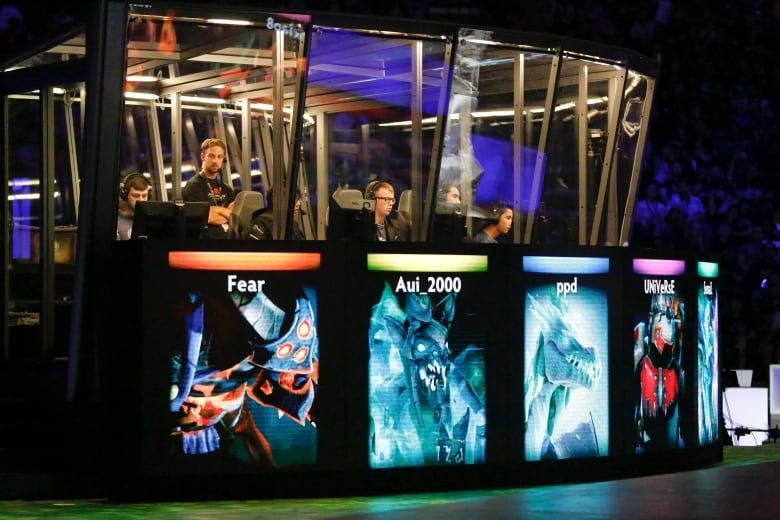
Matches play out with teams each sheltered in transparent soundproof booths positioned roughly where centre ice would be at a hockey game.

Fans watch and react as the action unfolds live on the view screens above.

“The only thing you can really hear is the vibration of the crowd,” said Babaev of playing amid the pressure-packed TI atmosphere.

“It’s muffled a bit, but you hear the vibration.”

“The audience’s energy actually shakes the booth. It’s crazy,” said Kurtis ‘Aui_2000’ Ling of competing at TI. (Jason Redmond / Reuters)

Most matches at TI’s main event will be best of three games, with Saturday’s grand finals between the final two teams contested as a best of five.

No one has won The International twice, meaning a TI victory carries with it a singular prestige in the gaming world.

Cosplayers dressed as Dota 2 characters are part of the spectacle at The International. (Valve / Flickr)

Who will local fans be cheering for in this?

Some teams are made up of players solely from one country or region, so national flags are a common sight in the stands.

Some players have massive social media followings and are the rock stars of the tournament.

For hometown fans, there will be five Canadians at TI’s main event this week — two players and three coaches — including B.C.’s Ling and Babaev.

  • Artour ‘Arteezy’ Babaev — raised in Vancouver’s West End, Babaev will be competing in his fifth TI, this time with Evil Geniuses.
  • Kurtis ‘Aui_2000’ Ling — winner of TI5, he’s at this year’s tournament as a coach for Fnatic.
  • Jacky ‘EternaLEnVy’ Mao — an Ontario player competing for Fnatic who’s playing in his fifth trip TI.
  • Aaron ​’Clairvoyance’ Kim — a Korean-born, Toronto-raised coach who will be at his second TI, this time working for VGJ.Storm.
  • Sivatheeban “1437” Sivanathapillai  — a Toronto-based gamer who’s a veteran of five TIs as player and will be coaching TNC Predator

Source: https://www.cbc.ca/news/canada/british-columbia/theinternational2018-ti8-comes-to-vancouver-1.4774658

CLIENT FEATURE: Monarques #Gold $MQR.ca A PRODUCER With $10M In Quarterly Revenues $GDX.ca $ECR.ca $MZZ.ca $QMX.ca $IMG.ca $IAG $MUX

Posted by AGORACOM-JC at 2:20 PM on Monday, August 20th, 2018


MQR: TSX-V

Why Monarques Gold?

  • A gold producer with the Beaufor Mine (gold production of 19,562 ounces in 2016; source Richmont 2016 annual report) located in one of the best mining jurisdictions in Canada.
  • A large portfolio of mining assets, including the Beaufor Mine, two mills (Camflo and Beacon), two advanced projects (Wasamac and Croinor Gold) and eight exploration projects covering more than 240 km2 in the Abitibi region.
  • Upside potential and leverage to the gold price with the Wasamac project.
  • NI 43-101 proven and probable reserves of 162,790 ounces of gold, measured and indicated resources of 1.76 million ounces and inferred resources of 1.67 million ounces
  • Over 150 highly experienced, qualified employees will join the Monarques team.
  • Strong financial position, with cash of $18.2 million

Q4 Highlights (June 30th)

  • Monarques produced 4,695 ounces of gold in its fourth quarter
  • Recorded revenues of $10.0 million in the fourth quarter, from the sale of 4,589 ounces of gold at an average price of $1,609 per ounce (US $1,246), combined with revenue from custom milling, which was up 31% for the quarter.
  • Reported an initial set of results for its 2018 drilling program at the Beaufor Mine. The results were for nine holes totalling 2,047 metres of drilling on the QF1 and 1700 projects (see press release dated July 17, 2018).

FULL DISCLOSURE: Monarques Gold Corp. is an advertising client of AGORA Internet Relations Corp.

26 Ways #Blockchain Will Transform (OK, May Improve) Education $BTRU.ca $ARCL $CPLA $BPI $FC.ca

Posted by AGORACOM-JC at 10:07 AM on Monday, August 20th, 2018

  • Blockchain is a public ledger that automatically records and verifies transactions.
  • The distributed ledger technology (DLT) powers Bitcoin, Ethereum and other virtual currencies (which have taken a beating this month).
  • Less publicized are all the ways DLT could transform many industries. Use cases for a transparent, verifiable register of transaction data are numerous because DLT operates through a decentralized platform making it fraud resistant.

With assistance from Educause and CB Insights, we’ve identified 26 ways that DLT could be deployed by school districts, networks, postsecondary institutions and community-based organizations to improve learning opportunities.

1. Transcripts. Academic credentials must be universally recognized and verifiable. In K-12 and postsecondary, verifying academic credentials remains largely a manual process (heavy on paper documentation and case-by-case checking). DLT solutions could streamline verification procedures and reduce fraudulent claims of unearned educational credits.

Learning Machine, a 10-year-old software startup, has collaborated with MIT Media Lab to launch of the Blockcerts toolset, which provides an open infrastructure for creating, issuing, viewing and verifying blockchain-based certificates.

Matt Pittinsky, CEO of transcript service Parchment, said there’s a lot of design decisions to work out before widespread use of DLT transcripts. He thinks blockchain will store locations to systems that that record comprehensive records–a balance between permanence and portability.

2. Badges. Specific skill assertions can be verified and communicated with a digital badge. Multiple badges can be assembled into an open badge passport that students can share with prospective employers.

Indorse is using blockchain to verify e-portfolios. Users upload claims with a link to verification and other users verify that claim.

3. Student records. Sony Global Education developed a educational platform in partnership with IBM that uses blockchain to secure and share student records.

Storing an comprehensive learner record on a distributed ledger may prove computationally intensive and, as a result, prohibitively expensive. As Pittinsky predicted, DLT may just be used as a directory rather than a data warehouse.

4. Identity. With the proliferation of learning apps and services, identity management is a big problem in education. Platforms like Blockstack and uPort help users carry their identity with around the internet. On Blockstack, users will access apps on decentralized networks and have data portability.

6. Infrastructure security. As schools add more security cameras and sensors, they need to protect their networks from hackers. Companies like Xage are using blockchain’s tamper-proof ledgers to sharing security data across device networks.

7. Ridesharing. Blockchain could inject new options into the rideshare oligopoly. With a distributed ledger, drivers and riders could create a more user-driven, value-oriented marketplace. DLT rideshare startup Arcade City allows drivers to establish their rates (taking a percentage of rider fares) with the blockchain logging all interactions. Arcade City appeals to professional drivers, who want to build up their own businesses than be controlled from a corporate headquarters.

School districts could negotiate with a group of screened Arcade City drivers for hard to serve aspects of pupil transportation (e.g., special needs, isolated students, work-based learning).

13.Cloud storage. As learners and education institutions store more data, DLT cloud storage could offer safer and potentially cheaper alternatives. Dubbed the “Airbnb for file storage,” Filecoin is a high-profile crypto project that rewards the hosting of files.

14. Energy management. For educational institutions with renewable energy sources, DLT could reduce the need for intermediaries. Brooklyn startup Transactive Grid enables decentralized energy generation schemes allowing entities to generate, buy, and sell energy to their neighbors.

15. Prepaid cards. Blockchains can help retailers offer secure gift cards and loyalty programs without a middleman. Gyft, an online platform for buying, sending, and redeeming gift cards, partnered with blockchain infrastructure provider Chain to run gift cards for thousands of small businesses on the blockchain, in a program called Gyft Block. Loyyal makes loyalty incentives easily exchangeable across different sectors.

Prepaid cards could be used by cities, schools, and families to purchase out of school learning experiences (e.g., an LRNG card) and associated transportation (#7).

16. Smart contracts. DLT can be used to automatically execute agreements once a set of specified conditions are met. These “smart contracts” have the potential to reduce paperwork in many sector including education.

Woolf University, formed by Oxford professors, will use DLT to execute smart contracts. A series of student and teacher “check-ins” are key to executing a series of smart contracts that validate attendance and assignment completion. A check-in could be a simple as clicking a button on a phone app but it executes a smart contract that pays the teacher and provides micro-credits to the student.

DLT could facilitate distributed learning skemes. A state or institution could fund a student’s account using blockchain-based smart contracts and and provide all the funding up-front. The smart contracts would release it when certain criteria are met. (There’s obviously a lot of policy to figure out: desirable experiences and skill verifications, eligible providers, terms and conditions, etc.)

17. Learning marketplace. The core competency of DLT is eliminating the middleman. It will be deployed to create various learning marketplaces from test prep to surfing school.

TeachMePlease is Russian pilot on the Disciplina platform where teachers and students come together. It helps students find and pay for courses, registered by educational organizations or teachers. Woolf (#16) is an example of a new higher ed marketplace.

18. Records management. DLT could reduce paper-based processes, minimize fraud, and increase accountability between authorities and those they serve. An early example, the Delaware Blockchain Initiative, aims to create an appropriate legal infrastructure for distributed ledger shares, to increase efficiency and speed of incorporation services. Illinois, Vermont, and other states have since announced similar initiatives. Startups are assisting in the effort as well: in Eastern Europe, the BitFury Group is currently working with the Georgian government to secure and track government records.

19. Retail. DLT could securely connect buyers and sellers in marketplaces.For example,  OpenBazaar operates as an open-source, peer-to-peer network that connects buyers and sellers without a middleman. Customers purchase goods using any of 50 cryptocurrencies and sellers are paid in Bitcoin.

DLT could be used to power school stores and student businesses. In some cases, a global network would be attractive, but in others, a permissioned (private) ledger could limit the scope of a school economy.

20. Charity. For charitable donations, DLT provides the ability to precisely track donations and, in some cases, impact. For example, GiveTrack, from the BitGive Foundation, is a blockchain-based donation platform that provides the ability to transfer, track, and provide a permanent record of charitable financial transactions across the globe.

Donors to schools and NGOs may find accountability and transparency attractive.

21. Human resources. Conducting background checks and verifying employment histories can be time-consuming, highly manual tasks for HR professionals. If employment and criminal records were stored in DLT, HR professionals could streamline the vetting process and move hiring processes forward more quickly.

Chronobank is focused on improving short-term recruitment for on-demand jobs (e.g., cleaning, warehousing, e-commerce). The startup aims to use blockchain to make it easier for individuals to find work on the fly and be rewarded for their labor through a decentralized framework via cryptocurrency, without the involvement of traditional financial institutions.

Schools could use similar capabilities in substitute and driver management and for a marketplace of afterschool and summer activities.

22. Governance. The benefits of using blockchain for smart contracts and verifiable transactions can also be applied toward making business accounting more transparent. The Boardroom app, for example, provides a governance framework and app enabling companies to manage smart contracts on the public and permissioned Ethereum blockchains.

The app provides an administrative system for organizations to ensure smart contracts are executed according to rules encoded on the blockchain (or to update the rules themselves). Boards can also use the app for shareholder voting by proxy and collaborative proposal management.

23. Libraries. DLT could help libraries expand their services by building an enhanced metadata archive, developing a protocol for supporting community-based collections, and facilitating more effective management of digital rights. San Jose State’s School of Information received a $100K grant from the Institute of Museum and Library Services to fund a year-long project exploring the potential of blockchain technology for information services.

24. Publishing. Blockchain could have multiple applications in the publishing industry, from breaking into the industry to rights management to piracy. New platforms are emerging to level the playing field for writers and encourage collaboration among authors, editors, translators, and publishers. Educators, students, and NGOs may appreciate the benefits of expanded publishing options.

Authorship allows writers to publish their work on the platform. Readers can purchase the books from the platform using Authorship Tokens (ATS), an Ethereum-based cryptocurrency, and writers get 90% of royalties in ATS. Authors own the copyright to their work, so they have the freedom to publish and distribute it elsewhere.

PageMajik is a workflow management system designed to streamline the publishing process. The system provides a secure, centralized catalog of all files, which can be easily accessed by teams of writers, editors, and publishers. Each person’s roles, rights, and duties can be specified before they actually start using the platform to minimize errors. PageMajik is in the process of adding blockchain technology to the next version of its workflow system.

25. Public assistance. Blockchain could help streamline public assistance system for families and students. The UK began working with startup GovCoin Systems in 2016 to conduct trials for developing a blockchain-based solution for welfare payments. GovCoin divides money into separate stashes for different expenses. Recipients gain access to their benefits which are paid in cryptocurrency via a mobile app.

26. Bonds. The World Bank is using blockchain to sell a bond. Moving the process to the blockchain could cut costs and speed up trading for both bond issuers and investors. School districts could benefit from faster and cheaper bond sales.

Writing for Educause, David McArthur outlines the limitations and challenges of DLT solutions in education. He also lays out the benefits Permissioned Distributed Ledgers rather than public ledger. These smaller private networks could enhance security and achieve faster and cheaper transactions consensus.

“When it comes to educational innovation, blockchains and ledgers are likely to lead to evolutionary gains, rather than revolutionary reforms,” concludes McArthur.

Source: https://www.forbes.com/sites/tomvanderark/2018/08/20/26-ways-blockchain-will-transform-ok-may-improve-education/#4f70a2b84ac9