Agoracom Blog Home

Archive for the ‘All Recent Posts’ Category

Explor Announces Multiple Copper Zones Grades Up to 3.65% Cu Over 5.35 Meters on the Chester Copper Property $EXS.ca

Posted by AGORACOM-JC at 5:02 PM on Tuesday, January 10th, 2017

Exs logo


  • 12 Diamond Drill Holes completed on the Chester Copper Property
  • 3.65% Cu Over 5.35 Meters
  • increase in strike length of the known mineralization from 500 to 750 meters

ROUYN-NORANDA, QUEBEC–(Jan. 10, 2017) – Explor Resources Inc. (“Explor” or the “Corporation“) (TSX VENTURE:EXS)(OTCQB:EXSFF)(FRANKFURT:E1H1)(BERLIN:E1H1) is pleased to announce further results from the 12 Diamond Drill Holes completed on the Chester Copper Property. The Chester Copper property is located in the Northumberland County, 70 km southwest of Bathurst, New Brunswick and 50 km west-northwest of Miramichi, New Brunswick, within the Bathurst Mining Camp. This area has an extensive history in base metal production from VMS deposits.

There has been very little exploration work in this area of the Bathurst Mining Camp (BMC) since the initial exploration more than 60 years ago. Of significance also is the fact that three (3) age date studies of the rock in the area since 2005 have indicated an age of 469+/- 0.3 ma. All of the main largest VMS deposits in the BMC (including BMS #12 and #6, the Caribou Deposit (currently being developed by Travalli) and the past producing Heath Steele Mines, are associated with this age date for the footwall felsic rocks. That new data in 2007 places Explor’s Chester deposit is in the same time frame as the Brunswick Mining No. 12 and No. 6 deposits located in the BMC.

New Brunswick is the home of the No 12 massive sulphide deposit (The Brunswick Deposit) which was in continuous production from 1964 to its closure in March of 2013 (to Feb 2013, 135,903,168 tonnes milled at 3.44 % Pb, 8.74 % Zn, 0.37 % Cu and 102 g/t Ag). The Brunswick deposits (No 6 and No 12) are situated in the Nepisiguit Falls Group of rocks in the Lower Tetagouche group of the BMC. There are 46 known VMS deposits in the BMC.

The property is located in the southern-most part of the Bathurst Mining Camp and consist of 174 Mineral Claim Units within a total of five (5) Mineral Claims (1571, 2428, 6003, 6005 and 7045) comprising approximately 3,828 hectares as shown on the attached map.

Chris Dupont, President and Chief Executive Officer of Explor Resources Inc. commented: “We are extremely pleased and encouraged by these preliminary drill results. The presence of multiple copper mineralized zones in each of the holes drilled is very significant in terms of exploration. The increase in strike length of the known mineralization from 500 to 750 meters confirms the potential to significantly increase the resources on the property. The property continues to be open on strike to the west and Northwest.”

A total of 4 diamond drill holes were drilled on claim 1571. The first three diamond drill holes that were drilled were fan holes from the same location. This successfully tested the extension of the copper stringer zone for a distance of 250 meters west of previous drilling. The fourth drill hole was located approximately 100 meters west (and 38 meters south) of the first three drill holes, confirming the continuity of the mineralization to the west and Northwest and adding 250 meters of strike length to the known deposit. It intersected the target horizon and favorable geology from 49 meters to 172 meters.

Further to the west the copper deposit goes down dip and onto claim 6003. At about 1,100 meters west of the first drill hole, drill hole 6003-16-012 was drilled at a vertical dip. It eventually went to a depth of 600 meters and intersected previously unknown mineralization near surface (18 meters) and also extending the deep main Chester Stringer zone an additional 650 meters westward than any previous reliable drilling (i.e. casing in place and core in government storage). It also confirms the existence of the alteration zone and the host stratigraphic horizon to a depth not previously known or expected. The chloritized favorable horizon extends from a depth of 472.5 meters to 561 meters with low grade copper mineralization documented from 519 meters to 543 meters.

In the north part of claim 6003, an untested soil geochemical anomaly was tested. Copper mineralization was discovered as pyrrhotite and chalcopyrite veinlets in felsic volcanic associated with the soil anomaly. Copper mineralization was also discovered in this area in 2014 and a soil survey on claim 7045 to the west have unexplained copper and lead anomalies which may be associated with previously mentioned soil anomaly and this horizon.

To the south on Claim 6005, two drill holes were put down to test a soil anomaly apparently associated with a historical drill hole, dating to about the 1956 to 1958 era, with a reported value of more than 2% copper. No indication of any mineralization was discovered in the two drill holes.

Preliminary results are shown below for Hole # 1571-16-002:

Summary of Results From Drill Hole 1571-16-002
Zones From
(m)
To
(m)
Length
(m)
Au
(ppb)
Ag
(ppm)
Cu
(%)
Zn
(ppm)
Pb
(ppm)
1 49.40 49.73 0.33 41 2.70 1.820 269 67
2 51.45 52.30 0.85 49 2.40 1.240 284 80
3 77.85 84.30 6.45 65 3.35 1.53 438 57
includes 77.85 80.70 2.85 47 2.78 1.18 350 61
and 80.70 81.93 1.23 28 1.60 0.18 401 48
and 81.93 84.30 2.37 105 4.94 2.66 562 56
4 112.90 113.30 0.40 105 9.6 7.111 439 49
5 121.00 127.00 6.00 82 3.92 3.20 381 43
includes 121.00 125.10 4.10 114 4.99 4.26 469 43
or 124.10 125.10 1.00 289 10.10 10.23 1014 76
and 126.05 127.00 0.95 26 2.60 1.70 276 62
6 141.80 142.90 1.10 114 3.55 2.889 317 40
142.90 151.10 8.20 3,6 0.16 0.065 59 21
7 151.10 151.85 0.75 34 2.8 2.130 252 26
FW Zone 171.5 171.85 0.35 50 3.2 1.580 214 42

A total of 8 zones of copper mineralization were intersected in the above referenced Hole # 1571-16-002.

Preliminary results are shown below for Hole # 1571-16-003:

Summary of Results From Drill Hole 1571-16-003
Zones From
(m)
To
(m)
Length
(m)
Au
(ppb)
Ag
(ppm)
Cu
(%)
Zn
(ppm)
Pb
(ppm)
1 58.10 58.57 0.47 28 4 1.760 586 52
2 64.00 70.80 6.80 42 4.3 1.45 565 106
includes 64.00 67.10 3.10 39 6.0 2.09 660 186
or 65,50 67.10 1.60 75 11.5 4.05 1279 360
and 69,90 70.80 0.90 139 7.0 3.05 1033 58
3 77.70 78.60 0.90 76 2.4 1.220 328 44
4 112.65 112.85 0.20 60 6.7 4.330 592 42
5 115.25 120,60 5.35 64 4.9 3.65 445 49
includes 115.25 117.40 2.10 47 4.6 3.25 372 39
and 117.40 120.,60 3.20 76 5.2 3.97 501 56
FW Zone 157.30 158.85 1.55 343.10 15.00 13.20 995.00 91.13

A total of 6 zones of copper mineralization were intersected in the above referenced Hole # 1571-16-003. Samples have been sent to the lab and assays are pending.

The Chester Property is known to contain both a copper deposit and a VMS deposit. The copper deposit has an Open Pit resource with Measured & Indicated resource of 1,400,000 tonnes grading 1.38% Cu, 0.06% Zn & 3.5 g/t Ag and an inferred resource of 2,089,000 tonnes grading 1.26% Cu (assayed for Cu only).

Chris Dupont, P.Eng is the qualified person responsible for the information contained in this release.

Explor Resources Inc. is a publicly listed company trading on the TSX Venture (EXS), on the OTCQB (EXSFF) and on the Frankfurt and Berlin Stock Exchanges (E1H1).

This Press Release was prepared by Explor. Neither the TSX Venture Exchange nor its Regulation Services Provider (as that term is defined in the Policies of the TSX Venture Exchange) has reviewed or accepts responsibility for the adequacy or accuracy of this release.

About Explor Resources Inc.

Explor Resources Inc. is a Canadian-based natural resources company with mineral holdings in Ontario, Québec, Saskatchewan and New Brunswick. Explor is currently focused on exploration in the Abitibi Greenstone Belt. The belt is found in both provinces of Ontario and Québec with approximately 33% in Ontario and 67% in Québec. The Belt has produced in excess of 180,000,000 ounces of gold and 450,000,000 tonnes of cu-zn ore over the last 100 years. The Corporation was continued under the laws of Alberta in 1986 and has had its main office in Québec since 2006.

Explor Resources Flagship project is the Timmins Porcupine West (TPW) Project located in the Porcupine mining camp, in the Province of Ontario. Teck Resources Ltd. is currently conducting an exploration program as part of an earn-in on the TPW property. The TPW mineral resource (Press Release dated August 27, 2013) includes the following:

Open Pit Mineral Resources at a 0.30 g/t Au cut-off grade are as follows:

Indicated: 213,000 oz (4,283,000 tonnes at 1.55 g/t Au)
Inferred: 77,000 oz (1,140,000 tonnes at 2.09 g/t Au)

Underground Mineral Resources at a 1.70 g/t Au cut-off grade are as follows:

Indicated: 396,000 oz (4,420,000 tonnes at 2.79 g/t Au)
Inferred: 393,000 oz (5,185,000 tonnes at 2.36 g/t Au)

This document may contain forward-looking statements relating to Explor’s operations or to the environment in which it operates. Such statements are based on operations, estimates, forecasts and projections. They are not guarantees of future performance and involve risks and uncertainties that are difficult to predict and may be beyond Explor’s control. A number of important factors could cause actual outcomes and results to differ materially from those expressed in forward-looking statements, including those set forth in other public filling. In addition, such statements relate to the date on which they are made. Consequently, undue reliance should not be placed on such forward-looking statements. Explor disclaims any intention or obligation to update or revise any forward-looking statements, whether as a result of new information, future events or otherwise, save and except as may be required by applicable securities laws.

To view the image associated with this press release, please visit the following link: http://media3.marketwire.com/docs/1082322a.pdf

Christian Dupont, President
888-997-4630 or 819-797-4630
819-797-1870
www.explorresources.com
[email protected]

Potential Chinese Coal Crackdown on North Korea Bodes Well For AIM Exploration AEXE.us

Posted by AGORACOM-JC at 10:30 AM on Monday, January 9th, 2017

1a93cd37a17b71f3562bd2343552

  • United Nations Security Council last week imposed fresh sanctions on North Korea, limiting its annual coal exports to 7.5 million tons, or a value of $400.9 million, after the isolated communist regime conducted a fifth nuclear weapons test
  • Significant for China’s imports of high-quality coal used to make steel, as North Korea is one of its top suppliers.

The already elevated price of coking coal could be boosted further if China decides to crack down on coal imports from its nuclear-armed neighbor North Korea.

The United Nations Security Council last week imposed fresh sanctions on North Korea, limiting its annual coal exports to 7.5 million tons, or a value of $400.9 million, after the isolated communist regime conducted a fifth nuclear weapons test.

This is significant for China’s imports of high-quality coal used to make steel, as North Korea is one of its top suppliers.

Chinese customs data show that China imported 18.517 million tons of North Korean coal in the first 10 months of the year, a gain of 12.8 percent on the same period last year.

The jump in imports from North Korea this year came in spite of earlier Chinese commitments to ban the coal trade with Pyongyang.

So far, the official line from Beijing is that China will meet its obligations under the UN Security Council sanctions, but as was the case earlier this year, it appears the commitment may not be absolute.

Earlier sanctions banning coal purchases from North Korea were not enforced by China due to an exemption allowing imports for what was translated as “the people’s well-being,” or “livelihood purposes.”

China’s Foreign Ministry said on Dec. 1 that while it will enforce the new measures, they aren’t intended to harm “normal” trade with North Korea or impact upon civilians.

“Resolution 2321 formulates new measures, showing the resolve of the Security Council, and also points out they must avoid creating adverse consequences for North Korean civilian and humanitarian needs, and are not intended to create negative effects on normal trade,” Foreign Ministry spokesman Geng Shuang said.

Once again, it will appear to come down to what Beijing considers adverse effects on the North Korean populace, and it seems that the Chinese authorities are leaving themselves some wiggle room around the sanctions.

Bullish coking coal signal

Certainly Chinese coal traders will be happy to be allowed to continue buying from North Korea once the new measures are put in place in January.

China is believed to be the only country that buys North Korean coal, which is the biggest export earner for the dynastic communist dictatorship.

Chinese customs data classifies North Korean coal as anthracite, which is a grade of coal high in energy content, making it ideal for use in the steel blast furnaces and ceramic factories in the northeast provinces close to North Korea.

Russia is the second-largest supplier of anthracite to China, but its 1.867 million tons in the first 10 months is barely 10 percent of what was imported from North Korea.

Rather, the main import competitor to North Korean anthracite is coking coal from Australia and Mongolia.

Chinese imports of Australian coking coal were up 11.3 percent in the first 10 months of the year to 23.45 million tons, while those from Mongolia surged 75.3 percent to 17.47 million tons.

Stronger steel production and a policy directive from Beijing to limit domestic coal output has combined to send coking prices sharply higher as China sucked up every available ton from the seaborne market.

Coking coal futures on the Dalian Commodity Exchange closed at 1,276 yuan ($185.46) a ton on Dec. 2, up 126 percent from the start of the year.

These gains have been tempered in recent weeks as the Beijing authorities took actions to try to cool commodity markets, with exchanges requiring higher margins and charging increased fees.

Australian coking coal prices ended last week at $308.70 a ton, about four times the $77 recorded at the end of last year.

With coking coal in strong demand in China, the potential loss of as much as 12 million tons of North Korean coal in 2017 would be a very bullish signal for prices.

It’s possible that Beijing will force domestic coking coal miners to ramp up output, and it’s also possible that imports from North Korean won’t be cut by as much as implied by the new UN sanctions.

But for now, coking coal’s extraordinary rally this year has just been given another reason to continue.
Source: Reuters – http://www.hellenicshippingnews.com/coking-coal-surge-may-extend-if-china-cracks-down-on-north-korea/

Tesla to begin lithium-ion battery production at US megafactory – bodes well for $DGO.ca $BFF.ca $PFN.ca $SX.ca $FMR.ca

Posted by AGORACOM-JC at 10:39 AM on Thursday, January 5th, 2017
Tesla Motors chief executive Elon Musk jumps out of one of his electric vehicles. Picture: NEWZULU.
Image: Tesla Motors chief executive Elon Musk jumps out of one of his electric vehicles. Picture: NEWZULU.

Elon Musk’s Tesla Motors says it has started producing lithium-ion battery cells at its $5 billion factory in Nevada.

The company says it began making high-performance cells in December and production started overnight for cells used in Powerwall energy-storage products.

Tesla plans to start making batteries for its Model 3 sedans later this year.

The massive Gigafactory outside Sparks is coming online in phases, with a goal of full operation in 2018.

Officials say it could almost double the world’s production of lithium-ion batteries, making them more affordable as the company looks beyond the luxury niche market.

The electric carmaker says it has more than 850 full-time employees, plus more than 1700 construction workers.

Nevada has promised Tesla $1.3 billion in state tax incentives based on projections that it’ll employ 6500 people at full production.

Source: https://thewest.com.au/business/startup/tesla-begins-lithium-ion-battery-production-at-us-megafactory-ng-b88347284z

Explor Announces Increase of Ogden Property With Acquisition of 2 Mining Claims $EXS.ca

Posted by AGORACOM-JC at 8:52 AM on Wednesday, January 4th, 2017

Exs logo

  • Announced the acquisition of 2 mining claims (3 mineral claim units) situated in the Porcupine mining division, district of Cochrane
  • Claims are located in Ogden Township contiguous and to the east of the Ogden Property

ROUYN-NORANDA, QUEBEC–(Jan. 4, 2017) – Explor Resources Inc. (TSX VENTURE:EXS)(OTCQB:EXSFF)(FRANKFURT:E1H1)(BERLIN:E1H1) (“Explor” or “the Corporation”) is pleased to announce the acquisition of 2 mining claims (3 mineral claim units) situated in the Porcupine mining division, district of Cochrane, in the Ogden Township, Ontario. These claims are located in Ogden Township contiguous and to the east of the Ogden Property. Highway 101 West is north of the property and provided excellent access to the city of Timmins. The claims were acquired because of encouraging results obtained in Explor’s past exploration on this property.

Explor Resources Inc. will pay CDN $1,000 and issue 100,000 common shares to acquire a 100% interest in the additional Ogden claim. The optionors have retained a 2% NSR in the property. This acquisition is subject to the approval of the TSX Venture Exchange.

With this acquisition, the Ogden property now consists of 15 mining claims (99 mineral claim units) covering 1,588 hectares situated in the Porcupine mining division, district of Cochrane, in the Ogden and Price Townships, Ontario. The Ogden property has been previously explored by Hollinger Mines, Tex-Sol Exploration, Inmet Mining Corporation, Amax Mineral Exploration, Noranda Exploration and Knick Exploration. The majority of the holes drilled by previous operators were less than 100 meters in length. Historically on the Ogden Property, the only hole that hit significant mineralization was a diamond drill hole by Tex-Sol Exploration in 1965 which returned 6.0 g/t Au over 9.1 m at a shallow depth. On the TPW Gold Property significant mineralization was intersected below 300 meters of vertical depth requiring drill holes of 500 to 600 m in length. Explor has completed a drill program on the Ogden Property with the following encouraging results:

Hole #OG-16-02 intersected 2.06 g/t Au over 1.50m from 154.5 to 156.0 meters

Hole #OG-16-05 intersected 1.99 g/t Au over 1.80m from 438.0 to 439.8 meters.

The preliminary exploration program conducted by Explor consisted of six NQ holes for a total of 3,648 meters of diamond drilling. The holes averaged 600 meters in length. The property was found to contained favourable geology to host gold mineralization. The diamond drill program used geophysical targets identified by Explor’s ground geophysical surveys conducted by Explor and Knick Exploration. The program was successful in that all IP targets were intersected. The geological environment identified was similar to the Timmins Porcupine West Property. Rock type intersected included Quartz Feldspar Porphyry (QFP), Mafic Volcanics, and Sulfide zones containing fine grain pyrite mineralization.

The most significant deposits in Timmins are spatially associated with porphyry units that are in proximity to the Porcupine Destor Fault. The deposits appear to be also associated with splay faults that trend off and to the North of the Porcupine Destor fault inside an interpreted splay fault corridor.

Chris Dupont P.Eng is the qualified person responsible for the information contained in this release.

Explor Resources Inc. is a publicly listed company trading on the TSX Venture (EXS), on the OTCQB (EXSFF) and on the Frankfurt and Berlin Stock Exchanges (E1H1).

This Press Release was prepared by Explor. Neither the TSX Venture Exchange nor its Regulation Services Provider (as that term is defined in the Policies of the TSX Venture Exchange) has reviewed or accepts responsibility for the adequacy or accuracy of this release.

About Explor Resources Inc.

Explor Resources Inc. is a Canadian-based natural resources company with mineral holdings in Ontario, Québec, Saskatchewan and New Brunswick. Explor is currently focused on exploration in the Abitibi Greenstone Belt. The belt is found in both provinces of Ontario and Québec with approximately 33% in Ontario and 67% in Québec. The Belt has produced in excess of 180,000,000 ounces of gold and 450,000,000 tonnes of cu-zn ore over the last 100 years. The Corporation was continued under the laws of Alberta in 1986 and has had its main office in Québec since 2006.

Explor Resources Flagship project is the Timmins Porcupine West (TPW) Project located in the Porcupine mining camp, in the Province of Ontario. Teck Resources Ltd. is currently conducting an exploration program as part of an earn-in on the TPW property. The TPW mineral resource (Press Release dated August 27, 2013) includes the following:

Open Pit Mineral Resources at a 0.30 g/t Au cut-off grade are as follows:
Indicated:          213,000 oz (4,283,000 tonnes at 1.55 g/t Au) 
Inferred:             77,000 oz (1,140,000 tonnes at 2.09 g/t Au)
Underground Mineral Resources at a 1.70 g/t Au cut-off grade are as follows:
Indicated:          396,000 oz (4,420,000 tonnes at 2.79 g/t Au)
Inferred:            393,000 oz (5,185,000 tonnes at 2.36 g/t Au)

This document may contain forward-looking statements relating to Explor’s operations or to the environment in which it operates. Such statements are based on operations, estimates, forecasts and projections. They are not guarantees of future performance and involve risks and uncertainties that are difficult to predict and may be beyond Explor’s control. A number of important factors could cause actual outcomes and results to differ materially from those expressed in forward-looking statements, including those set forth in other public filling. In addition, such statements relate to the date on which they are made. Consequently, undue reliance should not be placed on such forward-looking statements. Explor disclaims any intention or obligation to update or revise any forward-looking statements, whether as a result of new information, future events or otherwise, save and except as may be required by applicable securities laws.

Explor Resources Inc.
Christian Dupont
President
819-797-1870
888-997-4630 or 819-797-4630
[email protected]
www.explorresources.com

Check Out $GMBL eSports Predictions for 2017

Posted by AGORACOM-JC at 10:46 AM on Tuesday, January 3rd, 2017

Esports had a big year in 2016, and it’s aiming to have an even bigger year in 2017.

After examining how different esports progressed over the past year and looking at some of the recent rumblings and happenings in competitive gaming, Mashable compiled a list of things to expect in the world of esports in 2017. We aren’t predicting who’s going to win any upcoming tournaments, simply taking a look at some of biggest scenes and thinking about how they could change in the coming year.

In no particular order, here are seven things you can expect to see in esports in 2017.

1. More eyes on the fighting game community

Juan


Juan “Hungrybox” Debiedma after winning the Evo 2016 ‘Super Smash Bros. Melee’ championship.
 

IMAGE: EVO/TWITCH

The FGC continues to grow more and more every year, with increasing prize pools and bigger audiences than ever before. Street Fighter V’s Capcom Cup featured a crowd-funded prize pool that pushed the first place earnings up to $230,000 for American Du “NuckleDu” Dang. Next year’s Street Fighter Pro Tour will probably be even bigger.

Super Smash Bros. Melee has been attracting more attention over the past few years and was the event to watch at the biggest fighting game tournament in the world, Evo. With the possibility of the Nintendo Switch having a re-release of Melee on the Virtual Console, the GameCube game could be receiving even more love in 2017. Plus, the release of Marvel vs. Capcom Infinite in late-2017 will undoubtedly send some sparks through its fanbase.

2. A push for Call of Duty

'Call of Duty' World League Championship tournament.


‘Call of Duty’ World League Championship tournament.
 

IMAGE: MLG

In the first few days of 2016, publishing giant Activision acquired esports giant MLG. With the full force of MLG on its side, Activision has been ramping up Call of Duty esports over the past year, already doubling the Call of Duty World League Championship prize pool to $2 million in September and gathering a combined 20 million viewers throughout the tournament.

Activision and MLG won’t be backing off of Call of Duty: Infinite Warfare in 2017. Expect even more presence for the annual shooter in the esports scene and even bigger prize pools.

3. Another esports prize pool record from the Dota 2 International

This one is pretty much a given. The Dota 2 International has popularized crowd-funded tournament prize pools, using the method to ramp up its eye-watering prize pools to record-breaking numbers every year. 2016’s $20 million prize pool broke 2015’s $18 million prize pool record, gathered from sales on in-game items and features. 2016’s first place prize of over $9 million made everyone on Wings Gaming overnight millionaires.

Don’t expect the Dota 2 International’s crowd-funded prize pool to get any smaller anytime soon. The International’s viewer numbers continue to increase over the years and fans have yet to slow down their monetary support of the pro scene. Some year the prize pool will stop growing, but 2017 is not that year.

4. Overwatch League trying something new


IMAGE: BLIZZARD ENTERTAINMENT

When Blizzard announced the Overwatch League at BlizzCon in November, the developer laid out a vision that has never been seen before in esports. Taking heavy inspiration from traditional sports leagues like the NFL and NBA, the Overwatch League plans to attach Overwatch teams to cities around the world, host combines and try-outs, guarantee player pay and benefits, and put on LAN matches in every participating city. These are ambitious plans and will require a lot of work from a lot of people, plus outside investors who are up to the task of backing teams in a league that barely has precedent.

The Overwatch League will begin its early stages in 2017, not likely kicking into full gear until 2018. At the very least, we’ll get to watch the Overwatch League rev up for its success — or failure.

5. Traditional sports furthering involvement with esports

The world of traditional sports started dipping its toes into esports in late 2015 with three-time NBA champion Rick Fox starting the Echo Fox franchise. Since then, several big names in basketball and soccer have invested in esports teams, including the Philadelphia 76ers acquiring Team Dignitas. Expect even more traditional sports involvement in 2016.

With the continued growth of the esports industry, it won’t be a surprise to see more traditional sports players, executives and teams getting into esports. The incoming money and experience pouring in will probably help esports mature as a whole, give teams more staying power and help stabilize the competitive gaming scene.

6. An over-saturated Counter-Strike schedule

Fernando 'Fer' Alverenga at the ELeague Arena in Atlanta, Georgia.


Fernando ‘Fer’ Alverenga at the ELeague Arena in Atlanta, Georgia.
 

IMAGE: DANIEL SHIREY/GETTY IMAGES

Counter-Strike: Global Offensive hit the ground running when it came out in 2012 and reached its saturation point in 2016. More tournaments kept popping up around the world, each of them featuring pretty enticing prize pools for pro teams. But bouncing to a different corner of the earth every single week (or even twice a week) has a toll on players, and teams had to start being more selective over the past year.

So far, CS:GO isn’t looking any less cluttered in 2017. DreamHack alone has already scheduled 10 CS:GO tournaments with prize pools $100,000 or higher in five different countries. Throw in ESL’s tournaments and Pro Leagues, PEA’s new league, Intel Extreme Masters, StarSeries, ELeague and Esports Championship Series — none of which have given any indication of stopping — and 2017 is looking congested before it has even begun. So many tournaments could lead to burnout, not just for players but also for casters and analysts who have to fly all around to world every week to do their jobs.

The only thing that could stop the oversaturation is league exclusivity, which is something that has come up with the PEA, which won’t allow its seven-member teams to compete in ESL’s Pro League if they compete in the first season of PEA. While that may cut back on player burnout, teams are apprehensive to sign with one organization over the other, especially one that is so new.

7. Big changes in League of Legends

League of Legends had a tumultuous 2016.

Many problems around League of Legends and its developer Riot Games were brought to light thanks to a public spat between Riot co-founder and co-CEO Marc Merrill and Team SoloMid CEO Andy Dinh, which was followed by a letter outlining issues in the League of Legends pro scene sent by over a dozen teams in November. Teams’ problems include a lack of sustainable compensation, restrictions on sponsorships and outside revenue, lack of access to their own players at tournaments, and lack of job security and revenue security from relegation.

With so many grievances being aired in public, Riot Games has already started adapting. For 2016’s League of Legends Worlds, Riot attempted to solve problems with team revenue by introducing a crowd-funded prize pool via sales of in-game items (just like Dota 2 does) and sharing revenues with teams for sales of team-branded items. That’s a small improvement, and if Riot wants to keep teams competing in its own pro leagues, it will have to step up in 2017.

On another side of League, Riot has sold exclusive streaming rights of the game to BAMTech, which was created by the MLB and partially owned by Disney. This may mean an independent service for watching League matches in the near future, which could mean a premium (AKA not free) streaming experience outside of Twitch. Whether or not this will work for League of Legends is yet to be seen, but it will be an interesting new direction and test for esports as a whole. We will see if it inspires similar steps from other developers and publishers.

Source: http://mashable.com/2016/12/29/esports-2017-what-to-expect/#Goeni3cCriq1

Solar Panels Now So Cheap – Great news for $HPQ.CA who state they can reduce CAPEX and OPEX for solar grade silicon

Posted by AGORACOM-JC at 9:58 AM on Tuesday, January 3rd, 2017
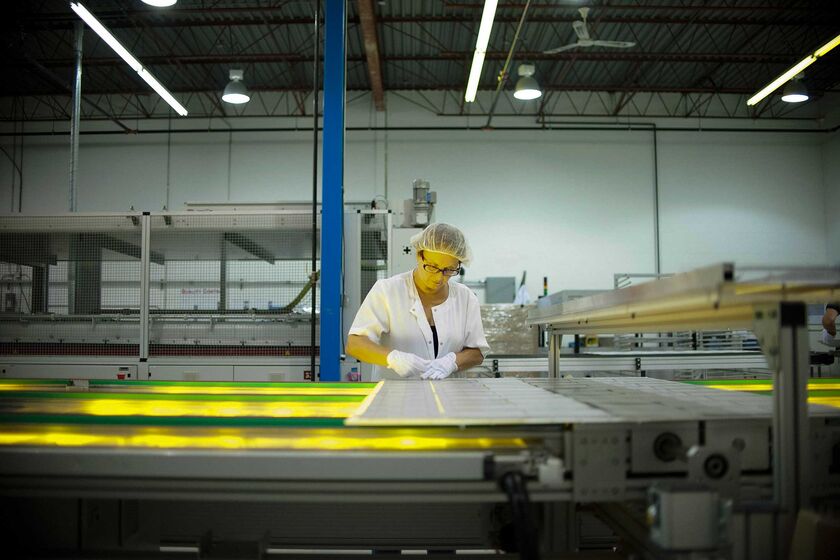
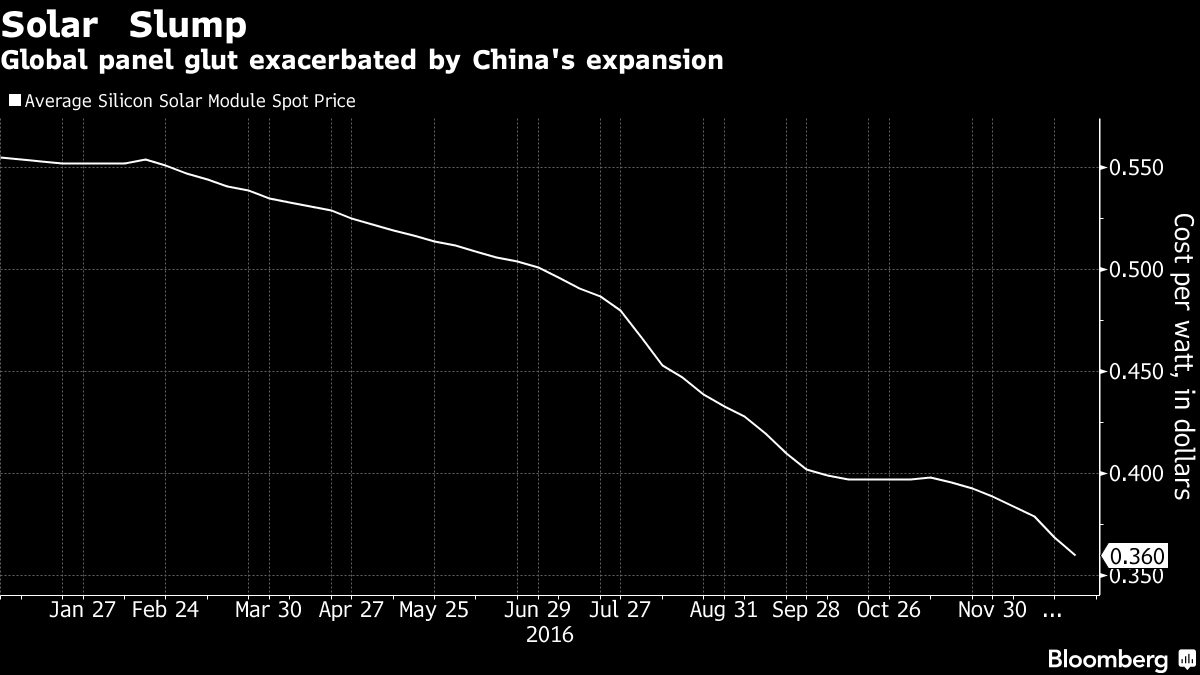
  • Spot prices fell to a record-low of 36 cents a watt this week
  • ‘A challenge for anyone to make money at that price’


Solar manufacturers led by China’s Trina Solar Ltd. are probably selling at a loss after prices fell to a record low this week.

The global spot market price for solar panels fell 2.4 percent to an average of 36 cents a watt on Dec. 28, according to PVinsights.

That’s the bottom end of the cost range for most producers in the third quarter, according to Jeffrey Osborne, an analyst at Cowen & Co. Suppliers are expandingcapacity this year while demand is expected to slow in 2017, helping to push prices down.

“Certainly it would be a challenge for anyone to make money at that price,” Osborne said in an e-mail. “The blended cost for most last quarter was about 36 cents to 38 cents.”

The current price is also lower than cost estimates from Trina. The biggest supplier of 2015 expected to reduce costs to about 40 cents a watt by the end of the year, from 45 cents in the second quarter, Chief Financial Officer Merry Xu said in an August conference call. The Changzhou, China-based company’s shareholders on Dec. 16 agreed to a $1.1 billion deal to take the company private. A spokesman declined to comment Friday.

Some companies’ cost structures remain competitive, even with prices this low.

Canadian Solar Inc., the second-biggest supplier, reported costs of 37 cents in the third quarter, down from 39 cents in the second quarter. The company has said its costs are among the lowest in the industry, and it expects to reach 29 cents a watt by the fourth quarter of 2017. Many of its competitors expect costs in the low 30s by then, Osborne said.

Source: https://www.bloomberg.com/news/articles/2016-12-30/solar-panels-now-so-cheap-manufacturers-probably-selling-at-loss

Will $PFN.ca $DGO.ca $BFF.ca SX.ca supply the lithium needed to run the future’s electric cars?

Posted by AGORACOM-JC at 4:46 PM on Friday, December 30th, 2016

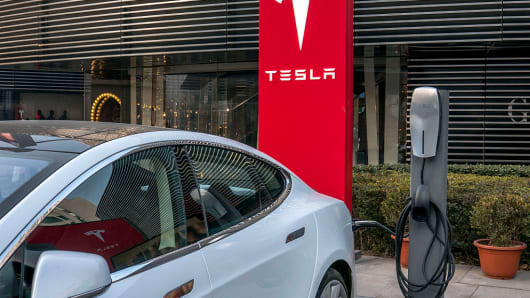
A Tesla electric car at a charging station.

A Tesla electric car at a charging station.
  • onus is now on rechargeable batteries – rather than petrol – to propel the automotive industry into its proposed greener future, with lithium ion cells being the prevailing form of this technology.
  • The automotive industry’s focus on electrification has accelerated in 2016.

Volkswagen Chairman Herbert Deiss told CNBC at the Paris Motor Show in November that “electric mobility will take off by 2020,” while Tesla CEO Elon Musk announced in May his aim for annual production to be at 1 million vehicles by this same year.

The onus is now on rechargeable batteries – rather than petrol – to propel the automotive industry into its proposed greener future, with lithium ion cells being the prevailing form of this technology.

“Lithium is a pretty abundant element naturally,” Jamie Speirs, a fellow in energy analysis and policy at Imperial College London, told CNBC via telephone. But, though worldwide production of the metal is increasing year on year, he detailed that “the current supply chain will not match up with lithium demand by, say, 2040.”

Unsurprisingly, as automakers gear up to sell more electric vehicles, prices for lithium have also risen.

“Owing to increased worldwide demand, spot lithium carbonate prices (in 2015) increased approximately 10% to 15% from those of 2014,” wrote the United States Geological Survey (USGS) in January of this year. So, which countries are crucial to lithium’s production – and who has the potential to control this market in the future? CNBC investigates.

The Chang Tang plateau in Tibet, China, is known for its lithium resources.

BSIP | UIG | Getty Images
The Chang Tang plateau in Tibet, China, is known for its lithium resources.

China

Analysts CNBC spoke to concurred that China was ahead of the game in terms of its lithium production.

China’s lithium reserves are an estimated 3.2 million metric tons, according to the USGS in January 2016, meaning that the superpower ranks among those with the largest domestic supply. Most resources are located in its Qinghai and Tibet regions.

Perhaps in response to how much the market has grown – and where it may progress to in coming years – the price of Chinese battery grade lithium is currently well over $20,000/tonne, compared to $7,000/tonne in mid-2015, according to mining analysis firm CRU.

“China has a stranglehold on lithium production,” Speirs said. “Well organised and professionally run mining companies” make this enterprise profitable, he added.

This is bolstered by the convenient fact that China is the world’s largest electric vehicle market. According to the China Association of Automobile Manufacturers, sales of battery electric vehicles reached 258,000 units in the first ten months of 2016, increasing 102.5 percent year on year. In addition, the Chinese government has unveiled several incentives in recent years aimed at addressing the country’s environmental problems.

“In the future, we expect supply from China to increase significantly to meet the domestic demand,” CRU told CNBC via e-mail.

Lithium: powering your electric car?  

Latin America’s ‘lithium belt’

Argentina, Bolivia and Chile form a troika of lithium producers in Latin America, otherwise known as the “lithium belt” or “lithium triangle.” Could these countries spearhead a second commodity boom in the region?

“Latin American countries once produced lithium from ore, as with other metals, but can now do so from brine, which is cheaper,” Speirs explained. Contributing to the metal’s profitability, CRU added that for Latin America, “industrial-grade lithium carbonate contract prices increased by around 40% in 2016 due to strong demand growth and the ongoing supply deficit. Battery-grade lithium carbonate and lithium hydroxide prices surged higher.”

But, structural problems could hamper this particular market from taking off.

The Salar de Atacama salt flats in Chile.

DEA | V. Giannella | De Agostini | Getty Images
The Salar de Atacama salt flats in Chile.

Chile, with its dry climate and lithium-rich Salar de Atacama salt flats, is an ideal production environment. The country is also popular with investors due to its free market economy. In addition, Reuters reported in November that Chilean firm SQM, one of the world’s largest lithium producers, saw 2016 third quarter profits more than quadruple due to rising lithium prices.

But, CRU told CNBC via e-mail that, “the [Chilean] industry is facing serious issues such as [the] imposition of production quota, on-going labour disputes [and] water shortage.”

Bolivia, though boasting 9 million metric tons in lithium resources, has suffered from a lack of exploration, infrastructure and technology, according to CRU. But, the Bolivian government is looking to establish a more foreign investment-friendly environment to encourage the growth of its lithium mining industry.

Unwinding Argentina’s formerly protectionist economy has been a key goal of President Mauricio Macri, which could foreground the country’s role in the lithium supply market. “Abolition of export duty on value-added products and capital controls have encouraged lithium players to consider Argentina for investment destination,” CRU told CNBC via e-mail.

The future benefits of lithium-ion batteries

The future benefits of lithium-ion batteries  

Australia

According to the USGC in January of this year, Australia’s estimated reserves sit at 1.5 million metric tons. By way of contextualizing this figure, CRU said that “in 2015, Australia was the largest producer of lithium and accounted for around 40% of global lithium supply.”

It added that lithium production capacity will increase, meaning that the country is expected to maintain its position as one of the largest lithium producers in the long term.

Location is key for Australia, as CRU explained that the country enjoys investment from “downstream players such as battery manufacturers in Asian countries.” Considering that lithium is not currently traded on any major commodities or futures exchanges, shoring up future supply is crucial.

Follow CNBC International on Twitter and Facebook.

Source: http://www.cnbc.com/2016/12/30/the-new-opec-who-will-supply-the-lithium-needed-to-run-the-futures-electric-cars.html

Company Sifts oilfield waste for US$10,000-per-tonne #lithium

Posted by AGORACOM-JC at 1:54 PM on Thursday, December 29th, 2016

 MGX claims to be the "largest lithium brine land holder in Canada".

  • MGX Minerals Inc. has been buying up metal and minerals permits in Alberta’s oil and gas producing regions but has no intention of mining the areas for lithium carbonate, which is used to make batteries for electric vehicles
  • Jared Lazerson, MGX’s president and CEO, said the company is working to sign agreements with oil and gas producers to process their wastewater, a byproduct of oil and gas production, so the company can extract the lithium carbonate from that water, which would otherwise simply be treated like waste.

CALGARY – A tiny Vancouver-based mining company is betting Alberta’s energy sector could benefit from the rise of electric vehicles by harvesting its oilfield wastewater for lithium carbonate.

MGX Minerals Inc. has been buying up metal and minerals permits in Alberta’s oil and gas producing regions but has no intention of mining the areas for lithium carbonate, which is used to make batteries for electric vehicles.

Instead, Jared Lazerson, MGX’s president and CEO, said the company is working to sign agreements with oil and gas producers to process their wastewater, a byproduct of oil and gas production, so the company can extract the lithium carbonate from that water, which would otherwise simply be treated like waste.

MGX claims to be the “largest lithium brine land holder in Canada” with permits covering over one million barrels per day of brine production by various oil field operators throughout Alberta.

While MGX has yet to deploy a pilot project in the oilfield (a pilot is scheduled to begin in the first quarter of 2017), in December the company signed an agreement with oilsands giant Canadian Natural Resources Ltd. to work on the Sturgeon Lake region, near Grande Praire, Alta.

“Canadian Natural has allowed a third party to obtain water samples from our operations for their work in lithium carbonate,” CNRL spokesperson Julie Woo said in an email. “Beyond that, no decisions, plans or commitments have been made on the application of this technology in Canadian Natural’s operations.”

Lazerson said he hopes that MGX’s technology, for which it has filed patents, will allow oil and gas producers to help supply new energy markets, including the market for electric vehicles.

“Who better to have a big piece of the new energy sector than the energy sector?” he said. “I think there are going to be incredible efficiencies from oil and gas and new ideas as word starts to get out.”

Wood Mackenzie analysts expect lithium demand will double by 2024 as more and more consumers, especially in Europe, purchase electric vehicles.

Lithium prices have spiked in recent years because, as Wood Mackenzie noted in a November report, that lithium ion “has become the technology of choice” for electric vehicles.

The commodity is not traded on any exchange, however, and analysts say that current prices – which have reached US$10,000 per tonne – are likely to fall as new supplies become available.

“The trick isn’t finding lithium, the trick is producing it inexpensively,” Stormcrow Capital president and lithium analyst John Hykawy said in an email.

Hykawy said there are several companies attempting to produce lithium using water treatment technologies like reverse osmosis and nano-filtration but cautioned these are early-stage technologies being developed in a time of high prices.

Most of the lithium carbonate produced in the world is produced in South America’s “lithium triangle,” — the salt flats in Bolivia, Chile and Argentina — where new projects are also set to begin production.

“Prices will fall again, it might take a year or two,” Hykawy said. “But almost none of the smaller companies in the space, with the exception of Orocobre Ltd., are in a position to produce and have their profits benefit from these high prices. By the time most will be able to sell something, prices will be back to lower levels.”

MGX’s Lazerson hopes to move from a pilot project in the first quarter of next year to a full-scale commercial project by the third quarter. MGX, which trades on the alternative Canadian Securities Exchange, has seen its share price rise 110 per cent this year.

The company’s goal, Lazerson said, is to connect its water-treatment units with oil and gas operators in regions where they produce between 12,000 barrels per day to 20,000 bpd.

“Big picture, this is an add-on to oil and gas,” Lazerson said, adding that he thinks energy companies will see the value in the minerals in their waste and venture with MGX to process their water.

Financial Post

[email protected]

Twitter.com/geoffreymorgan

Source: http://business.financialpost.com/news/vancouver-mining-company-plans-to-scour-oilfield-waste-for-us10000-per-tonne-lithium?__lsa=0ccc-5bdd


Fairmont Resources Inc. Receives Extension for Grabasa Acquisition $FMR.ca

Posted by AGORACOM-JC at 4:38 PM on Wednesday, December 28th, 2016

Logo

  • Received an extension to complete the payment for Granitos de Badajoz until February 22, 2017 from the Spanish Court in Badajoz
  • “We are optimistic that a financing solution is close at hand for completing the acquisition of Grabasa. With imports increasing 10.9% for worked granite into the United States from Spain in the 3rd Quarter 2016 versus 3rdQuarter 2015 when other countries have seen large decreases, other than China, we see an acceptance of Spanish product into the United States market, and for Grabasa this is a new large target market” states Michael Dehn, President and CEO of Fairmont Resources

VANCOUVER, BRITISH COLUMBIA–(Dec. 28, 2016) – Fairmont Resources Inc. (“Fairmont”) (TSX VENTURE:FMR) is pleased to announce it has received an extension to complete the payment for Granitos de Badajoz (“Grabasa”) until February 22, 2017 from the Spanish Court in Badajoz.

“We are optimistic that a financing solution is close at hand for completing the acquisition of Grabasa. With imports increasing 10.9% for worked granite into the United States from Spain in the 3rd Quarter 2016 versus 3rdQuarter 2015 when other countries have seen large decreases, other than China, we see an acceptance of Spanish product into the United States market, and for Grabasa this is a new large target market” states Michael Dehn, President and CEO of Fairmont Resources.

The U.S. imports of Worked Granite (sawn, one-side polished), a key product produced at Grabasa when last in operation, have generally fallen for most producing nations other that Spain where there was a 10.9% increase, and China where there was a 0.3% increase.

WORKED GRANITE: U.S. IMPORTS
(metric tons)
3Q 2016 3Q 2015 Change
TOTAL 420,616 526,118 -20.1%
Top Sources
Brazil 201,838 250,122 -19.3%
China 100,419 100,168 0.3%
India 64,084 76,819 -16.6%
Spain 17,954 16,191 10.9%
Italy 12,560 28,019 -55.2%
Canada 10,340 46,439 -77.7%
Source: U.S. International Trade Commission, Stone Update analysis

(From: December 26, 2016, stoneupdate.com)

About Fairmont Resources Inc.

Fairmont Resources Inc. is a rapidly growing industrial mineral and dimensional stone company trading on the Toronto Venture Exchange symbol FMR.

Fairmont’s Quebec properties cover numerous occurrences of high-grade titaniferous magnetite with vanadium, with the Buttercup property having a permit to quarry dense aggregate. Where these occurrences have been tested they have displayed exceptional uniformity with respect to grade. Fairmont also controls three quartz/quartzite properties, with the Forestville property having independent end user testing confirming the suitability of quartzite from Forestville for Ferro Silicon production. Fairmont is also in the process of acquiring the assets of Granitos de Badajoz (GRABASA) in Spain which includes 23 quarries and a 40,000 square metre granite finishing facility that has produced finished granite installed across Europe.

On behalf of the Board of Directors,

Michael A. Dehn
President and CEO, Fairmont Resources Inc.
Tel:647-477-2382
[email protected]
http://www.fairmontresources.ca/

Forward-Looking Statements

Information set forth in this news release contains forward-looking statements that are based on assumptions as of the date of this news release. These statements reflect management’s current estimates, beliefs, intentions and expectations. They are not guarantees of future performance. Fairmont cautions that all forward looking statements are inherently uncertain and that actual performance may be affected by a number of material factors, many of which are beyond Fairmont’s control. Such factors include, among other things: risks and uncertainties relating to Fairmont’s ability to complete the proposed private placement financing, limited operating history and the need to comply with environmental and governmental regulations. Accordingly, actual and future events, conditions and results may differ materially from the estimates, beliefs, intentions and expectations expressed or implied in the forward looking information. Except as required under applicable securities legislation, Fairmont undertakes no obligation to publicly update or revise forward-looking information.

NEITHER TSX VENTURE EXCHANGE NOR ITS REGULATION SERVICES PROVIDER (AS THAT TERM IS DEFINED IN THE POLICIES OF THE TSX VENTURE EXCHANGE) ACCEPTS RESPONSIBILITY FOR THE ADEQUACY OR ACCURACY OF THIS RELEASE.

Doren Quinton
President QIS Capital
250-377-1182
[email protected]
www.smallcaps.ca

American Creek Resources Reports on Treaty Creek JV Project Exploration $AMK.ca

Posted by AGORACOM-JC at 9:11 AM on Wednesday, December 28th, 2016

Hublogolarge2 copy

  • Hole E-16-05 intersected intermittent values of gold from near surface to a depth of 276 metres, including 0.459 g/t Au over 15m from 27m to 42m, 0.473 g/t Au over 16.5m from 172.5m to 189m, and 0.438 g/t Au over 12m from 264m to 276m
  • Results of the 2016 program, along with the final MT survey report and analysis, once received, will be instrumental in identifying high potential drill targets for the upcoming 2017 exploration program

CARDSTON, ALBERTA–(Dec. 28, 2016) – American Creek Resources Ltd. (TSX VENTURE:AMK) (“American Creek”) is pleased to report that operator Tudor Gold Corp. (“Tudor”) has released the assays for the remaining five holes at the Treaty Creek JV Project located in BC’s “Golden Triangle” immediately north of Seabridge Gold’s KSM project and in the same region as Pretivm’s Brucejack project.

As previously announced on October 28, 2016, hole CB-16-03 resulted in the discovery of a significant new gold zone including the best mineralized intersection (338 meters of 0.70 g/t gold) discovered to date at Treaty Creek. The hole was drilled 870 meters northeast of discovery hole CB-09-14 drilled by American Creek in 2009 which included 241 meters of 0.80 g/t gold. Hole CB-16-03 along with holes CB-16-02 and CB-16-02 were drilled on the Copper Belle zone (west side of the Treaty Glacier). All three 2016 holes on the Copper Belle zone hit wide intervals of gold mineralization.

Four additional holes were drilled on the east side of the Treaty Glacier in the Treaty Gossan area and the last hole was drilled on the Eureka zone. These holes provided critical information that will be utilized in interpreting both the geology and the Magnetotelluric (MT) survey data. Hole E-16-05 intersected intermittent values of gold from near surface to a depth of 276 metres, including 0.459 g/t Au over 15m from 27m to 42m, 0.473 g/t Au over 16.5m from 172.5m to 189m, and 0.438 g/t Au over 12m from 264m to 276m.

The results of the 2016 program, along with the final MT survey report and analysis, once received, will be instrumental in identifying high potential drill targets for the upcoming 2017 exploration program.

Darren Blaney, American Creek CEO stated: “The 2016 Treaty program has successfully laid the foundation for the upcoming 2017 program. Tudor has extended the known mineralization at Copper Belle, found a significant new gold zone, and extended gold intervals to depth. The three holes at Copper Belle are all in close proximity to the “discovery contact” discussed in the 2014 Kyba/Nelson BC Geological Survey report, to the Sulphurets thrust fault, and to clastic sequencing (Turbidites) found just up the ridge from the drilling. According to the report, these three things in combination increase the chances of “being in the right neighborhood of BC’s next big deposit.” We believe the results thus far at Treaty Creek are the beginning of that discovery process.”

The Qualified Person under NI 43-101 for the Treaty Creek exploration program and the technical data in this news release is James Hutter, P.Geo.

The Treaty Creek Project is a joint venture between Tudor, American Creek and Teuton Resources Corp. (“Teuton”). Tudor is the operator and holds a 60% interest with both American Creek and Teuton each holding respective 20% fully carried interests in the property (carried until a production notice is given).

American Creek is a Canadian junior mineral exploration company focused on the acquisition, exploration and development of mineral deposits within the Province of British Columbia, Canada.

Information relating to the Corporation is available on its website at www.americancreek.com.

Neither the TSX Venture Exchange nor its Regulation Services Provider (as that term is defined in the policies of the TSX Venture Exchange) accepts responsibility for the adequacy or accuracy of this release.

American Creek Resources Ltd.
Kelvin Burton
403 752-4040
[email protected]
www.americancreek.com