Agoracom Blog

The Fed Can’t Print Silver SPONSOR: Affinity Metals $AAF.ca $SII.ca $TUD.ca $GTT.ca $AMK.ca $OSK.ca $RKR.ca

Posted by AGORACOM at 11:21 AM on Tuesday, April 28th, 2020
This image has an empty alt attribute; its file name is Affinity_Metals_Corp_Logo.png

Sponsor: Affinity Metals Corp. (TSX-V: AFF) is a Canadian mineral exploration company building a strong portfolio of mineral projects in North America. The Corporation’s flagship property is the drill ready Regal Property near Revelstoke, BC where Affinity Metals is making preparations for a spring drill program to test two large Z-TEM anomalies. Click Here for More Info

As a general rule, the most successful man in life is the man who has the best information Richard (Rick) Mills, Ahead of the Herd

April 27, 2020 (Investorideas.com Newswire) Silver prices will test $19 an ounce later this year on the back of heavy investment demand, as the coronavirus continues to depress markets and push investors in the direction of safe havens like precious metals.

That is the conclusion of The Silver Institute’s annual World Silver Survey, compiled by research firm Metals Focus and released in April.

Silver prices are driven by mine supply/ recycling and demand from both retail/ institutional investors and industry.

Over half of silver demand comes from industrial uses like solar panels, electronics and automotive parts. (Around 20 grams of silver are required to build a solar panel)

While most of the world’s mined gold is still around, either cast as jewelry, or smelted into bullion and stored for investment purposes, the same cannot be said for silver. It’s estimated around 60% of silver is utilized in industrial applications, leaving only 40% for investing. Of the 60% used for industrial applications almost 80% ends up in landfills.

The drop in demand for most goods and services owing to covid-19 doesn’t exempt silver – industrial fabrication is seen falling by 7%, along with jewelry and silverware offtake – but the report projects these declines will be offset by a 16% increase in silver bar and coin demand. There is also expected to be strong inflows into silver-backed ETFs as well as net buying by institutional investors on both the futures and OTC markets.

And while the white metal, sometimes called “poor man’s gold”, is expected to be in surplus again this year, the Silver Institute says the glut will be limited (to 14.7 million ounces, 53% smaller than in 2019), by a number of government shutdowns in top producers Mexico and Peru. As of April 3rd silver mine closures had restricted 40% of global production.

The Silver Institute therefore expects silver prices, currently trading around $15 an ounce, to hit $19/oz before year-end, possibly even outperforming gold on the back of its historically low relative value. If that happens, it would be a repeat of silver’s pattern last year.

Catching gold’s wave

In analyzing silver we also need to look at gold. The precious metals often follow each other’s price movements and they are frequently found together in mineral deposits.

Silver and gold both spiked last summer after the US Federal Reserve began cutting interest rates to deal with slowing global growth and signs of a worsening US economy. In July the Fed lowered rates three times before freezing the federal funds rate at a range of 1.5 – 1.75%. (they have subsequently been cut to near 0%)

Rate cuts, along with similarly dovish policies among other central banks, a record $17-trillion of negative-yielding sovereign debt, and safe-haven demand due to tensions with Iran, to name a key issue, powered the precious metals to new heights.

Silver prices rose 15% in 2019, helped by a 12% increase in silver investment demand – the highest annual growth since 2015. 

The onset of the coronavirus, first appearing as an epidemic in China, then spreading to Iran and South Korea, before becoming a full-blown pandemic in mid-March, has meant high volatility for gold and silver.

We’ve seen gold spike on safe-haven demand, as investors piled into gold ETFs, US Treasuries and the US dollar, only to fall sharply mid-March, as traders sold their gold holdings to cover losses in other assets

Since the beginning of April gold has surged, reclaiming $1,700/oz on the back of a record $2.2 trillion spending package announced by the US government, to combat the economic fallout from covid-19.

Other central banks have launched huge stimulus measures to head off, or more likely dampen, the effects of a global recession or even depression.

On April 14 Comex gold futures for June delivery vaulted to $1,785 an ounce, the highest since October 2012. Although gold prices have slipped back a bit, currently trading around $1,720/oz, some analysts see the potential for another leg up. Bloomberg quoted Hans Goetti, founder and chief executive officer of HG Research, saying:

“What’s happening here is that the Fed is expanding its balance sheet and every other central bank in the world is doing the same,” he told Bloomberg TV. “What you’re looking at is massive currency debasement in the long term. That’s the major reason why gold is higher, and I would think that over the next few weeks or months, we’re probably going to retest the high that we saw in 2011” (when gold passed an all-time high of $1,900/oz).

Another factor in gold’s favor is negative real interest rates.

Many countries including the United States have seen bond yields approach or even go below 0%. When real rates (yield minus rate of inflation) turn negative, investors tend to rotate from bonds into gold.

And while securities analysts quoted by Bloomberg expect the Federal Reserve’s renewed quantitative easing, combined with large fiscal stimulus (spending), could see long-end rate rise during the recovery phase of coronavirus, they don’t see that happening without inflation, “which should keep real rates suppressed.”

This week, Bank of America released a forecast predicting gold will rocket as high as $3,000 an ounce within 18 months.

According to Marketwatch, BofA Global Research raised its 18-month price target from an earlier $2,000, citing the prospects of endless monetary expansion from central banks, including the Federal Reserve, to limit the economic damage from the COVID-19 pandemic.

“The rather lofty upside gold price forecast from Bank of America continues to echo in the marketplace with the widely publicized quote ‘the Fed can’t print gold’ a very strong point for the bull camp,” analysts at Zaner Metals wrote in a daily update.

As we showed in a previous article, there is a close relationship between gold and debt-to-GDP ratios.

Undervalued silver

Gold and silver prices are often compared, to get a sense of which direction each are headed. The gold-silver ratio is the amount of silver one can buy with an ounce of gold. Simply divide the current gold price by the price of silver, to find the ratio.

When gold is over-valued compared to silver, investors take advantage of the arbitrage opportunity, by selling some of their gold holdings to buy silver. The opposite occurs when silver is over-valued compared to gold. In that situation, precious metals investors sell silver to buy gold.

The higher the number, the more undervalued is silver.

The current gold-silver ratio, 113:1, is double the historical ratio of 50-60 ounces of silver to one ounce of gold, meaning that silver is highly undervalued compared to gold. It means an investor with an ounce of gold could sell his gold for 113 ounces of silver.

All the bullish factors for gold are in place: a “black swan” event that has created huge fear and uncertainty, imploding global stocks and sending traders/ investors flocking to the safety of havens like the US dollar, US Treasuries and precious metals. The demand for Treasuries has pushed up their prices, causing their yields to fall to new lows. Negative real yields (yields minus inflation) are bullish for gold, and we expect real yields to remain negative for some time.

Remember, gold rises proportionally to debt. As long as governments are wrangling the coronavirus, we fully expect national debt piles to keep growing. Indeed the political pressure on governments to help the most vulnerable in society, for fear not only of losing power, but in some countries, extreme social unrest, is bound to keep the stimulus taps gushing.

While demand for silver, like for most industrial metals, will fall during this period of virus-related uncertainty, after the pandemic is beaten, we expect it to come roaring back, and the extremely out-of-whack gold-silver ratio to correct, in silver’s favor.

Silver mines, ranked

Silver supply is sensitive to mine production cuts – as we have seen recently with coronavirus-related stoppages. However, silver is also vulnerable to supply slippage, more so than gold, because there are relatively few pure-play silver mines.

Only around 30% of annual supply comes from primary silver mines while more than a third is produced at lead/zinc operations and a further 20% is from copper mines. Over two-thirds of the world’s silver resources are sourced from polymetallic ore deposits.

That makes silver quite a bit different from gold, in that primary gold deposits, with relatively few other minerals, are common. Large deposits of gold are also found in copper-gold porphyries.

Not so for silver, which most often has to be coaxed out of lead and zinc ores, followed by mines specializing in copper and gold, in that order.  Only twenty eight percent of global silver production is sourced from primary silver mines. Last year’s World Silver Survey delineated the world’s largest primary silver mines. Topping the list was Fresnillo’s Saucito mine in Mexico, which in 2018 produced 19.9 million ounces. Second spot went to Polymetal’s Dukat mine in Russia (16.5Moz), followed by Buenaventura Mines’ Uchucchacua mine in Peru, producing 15.4Moz. According to the US Geological Survey, Mexico is by far the largest producer, outputting 6,300 tonnes in 2019, followed by Peru and China, at a respective 3,600t and 3,800t. Next on the list are Russia, Poland and Australia. Global silver production in 2019 totaled 27,000 tonnes, or 868 million ounces. 

Where are the world’s largest silver mines, including mines that produce silver as a by-product of other metals?

The 2020 Silver Survey has KGHM Polska Miedz’s three copper-silver mines in Poland – Lubin, Rudna and Polkowice-Sieroszowice – leading by a long shot, at 40.2Moz in 2019.

That is almost twice the production of number 2 Penasquito (22.7Moz) and over double Dukat’s 19.3Moz. Saucito, ranked highest last year in primary silver mine production in 2020, is the fourth-largest mine in the world containing silver and other metals.


Poland’s Kupferschiefer silver

State-run Polska Miedź (KGHM) is the second largest silver producer in the world, behind only Fresnillo, and the sixth biggest copper miner. 

Why is so much silver produced from one company, KGHM Polska Miedz, versus Mexico and Peru, which are more closely associated with silver mining?

To know the answer, we must first understand Poland’s giant “Kupfershiefer” copper-silver deposits, of which the Lubin, Rudna and Polkowice-Sieroszowice mines, containing 1.4 billion ounces of silver reserves, are a significant part.

Sedimentary-hosted stratiform copper deposits are among the two most important copper sources in the world, the other being copper porphyries. They typically range from 1.6 million to 170 million tonnes copper ore, grading between 0.7% and 4.2%, with a median of 14 million tonnes at an average grade of 1.6% Cu, according to a 2019 academic paper, ‘The Kupferschiefer Deposits and Prospects in SW Poland: Past, Present and Future’.

Sedimentary copper deposits are formed in ocean basins, where copper and other minerals travel up through porous lithologies such as sandstone and become trapped in the upper sequence of sandstone and overlaying it black shale and limestone.

Red-bed deposits, so named due to oxidation resulting from exposure to the atmosphere, are divided into volcanic and sedimentary.

Kupferschiefer deposits are similar to red-beds but larger, even regionally extensive. They typically form in a marine setting, after land is gradually submerged into a shallow sea, then overlain by sedimentary rocks – which formed from the gradual deposition of the carcasses of dead sea creatures, onto the ocean floor.

A classic “Kupferschiefer” consists of three main layers – sandstone, bituminous shale and limestone overlain by evaporates often containing oil and gas. Copper-containing fluids migrate up through the sandstone and get trapped by the carbon-rich copper shale. This is where most of the mineralization is concentrated, although it can also be found in the sandstone, limestone, or a combination of all three layers.

The Kupferschiefer copper belt that underlies Germany and Poland is among only three giant sediment-hosted copper deposits in the world. It is also within an elite 1% of deposits that contain over 60 million tonnes of copper.

Orebodies can range in thickness from 0.3 m, contained largely within the black shale of the Kupferschiefer sensu stricto, up to more than 50 m, where sublevel stoping, backfilling, and pillar mining reflect the pervasive mineralization, states a research paper.

According to the Polish Geological Institute, Poland holds the largest economic copper resources in Europe, about 36 million tonnes, and the most anticipated economic silver resources on the continent, about 3.4 billion troy ounces.

Other metals recovered from copper ores at Poland’s Kupferschiefer deposits include gold, platinum, palladium and rhenium.

Despite being a small country, about the size of New Mexico, Poland produced 54.6 million ounces of silver in 2019, up 18% from 2018, mainly as a product of copper mining.

The richest silver deposits are located in the Lower and Upper Silesia regions, where the first shallow mines pre-date the Roman Empire, going back as far as 1136 AD.

According to the US Geological Survey, the massive volume of metal in Poland’s Kupferschiefer deposits is due to continuous mineralization that extends down dip and laterally for kilometers.

Identified resources within the giant Lubin-Sieroszowice deposit, are 1.6 billion tonnes of ore containing 30.3 million tonnes of copper and 2.7 billion ounces of silver, at average grades of 1.63% Cu and 57 g/t Ag. Reserves are 23.7 million tonnes copper and 1.4 billion ounces silver.

The strongest copper sulfide mineralization occurs in the black clay shales, including chalcocite, bornite, covelline and chalcopyrite, accompanied by minerals associated with silver, native silver, lead, zinc, cobalt and nickel.

A comparison at this point is interesting. #1 primary silver mine Saucito contains 130.3Moz in reserves, at an average silver grade of 272 g/t Ag. #2 is Dukat, with 93.4 Moz in reserves averaging 4.1 g/t Ag. The third largest primary silver mine, Uchucchacua, has 98.5Moz at 294.2 g/t.

Lubin-Sieroszowice dwarfs all three, at 10 times the reserves of Saucito, 15 times those of Dukat, and 14 times Uchucchacua’s. (Saucito and Uchucchacua are admittedly much higher-grade)

Minerals from three underground mines – Lubin, Polkowice-Sieroszowice and Rudna – are extracted using the room and pillar method at depths of between 600 and 1,250 meters. Expected minelife is 50 to 60 years, producing at a rate of 30 million tonnes a year. Consider that three of the four original mines have been producing since the late 1960s. They’ve already been going for 50+ years, yet they have another 50-60 more years to go and mineralization is open down dip.

The earliest exploration dates back to 1914, when German geologists conducted studies of the Zlotoryja region, and later, Grodziec. The first mine, Lena, started in 1936 but production was halted due to the onset of World War Two.

In 1959, 24 drill holes outlined the Lubin-Sieroszowice deposit, found at depths of between 400 and 1,000 meters. A resource estimate tallied indicated resources of 1.364 billion tonnes of ore grading 1.42%, containing 19.34 million tonnes of copper and about 1.157 billion ounces of silver.

Copper mining began in 1968 with the commissioning of two mines, Lubin and Polkowice.

According to KGHM’s 2019 results, the Lubin, Polkowice-Sieroszowice and Rudna mines produced 1,400 tonnes of silver last year, or 45 million ounces, at an average 48.7 g/t Ag.

In 2014, a project called “Deep Glogow” began mining from below the 1,200m level, using infrastructure from Rudna and Polkowice-Sieroszowice. The project contains 265.5 million tonnes grading 1.6% copper and 54 g/t silver, and has a minelife of 40 years.

There are also three undeveloped deposits to the north with identified resources (2018) of 139,535 million tonnes of ore including 2.2 million tonnes of copper and 356.3 million ounces of silver. And this year, 2020, Zielona Góra Copper (a Canadian company) documented a new Cu-Ag deposit “Nowa Sól” located northwest from the Lubin area. This new deposit has an estimated resource of 848 MT of copper and 0.036 MT of silver.

CESAR copper+silver project

The reason we have spent so much time writing about Poland’s Kupferschiefer is because of Max Resources (TSX.V:MXR).

Since November, Max’s geological teams have been identifying copper and silver targets within a 120 km x 20 km area, at their CESAR copper+silver project in northeastern Colombia.

Max field crew has been mapping copper-silver bearing stratabound horizons, rock chip channel sampling across mineralized beds and wall rock and following continuity of identified horizons along strike, to determine potential size prior to drilling.

The Vancouver-based company sees similarity of mineralization at the CESAR project to Kupferschiefer as a new giant sediment-hosted coppersilver mineralized system.

In a Feb. 27 news release, Max notes that its recent AM North and AM South discoveries are hosted in well-bedded sandstone-siltstone similar to KGHM’s monster “Kupferschiefer” mines in Poland.

In an earlier interview with AOTH, Max’s head geologist, Piotr Lutynski, said Colombia’s stratigraphy is similar to his homeland, Poland, and its cluster of Kupferschiefer sediment-hosted copper-silver deposits.

The last news release from CESAR concerns the AM South discovery – which features a stratabound copper-silver horizon, with mineralized structures totaling over 5 km of strike length. Earlier this year, sampling from 0.1 to 25-meter intervals returned highlight values of 5.4% copper and 63 g/t silver.

Having recently discovered a 10-meter by 2-meter panel which returned copper and silver grades of 3.5% Cu + 26 g/t Ag, the 1.4-km stratabound copper-silver horizon has been extended 1,000m, to 2,400m. (2.4 km).

Max also reported a new discovery, AM-2, located 500 meters south of AM-1. The new zone extends for 1,000 meters, and is open along strike and dip. The fact that it is parallel to AM-2 strongly suggests stacked horizons.

Assays at AM-2 are pending.

The CESAR project and its potential to be a Kupfershiefer analogue has grabbed the attention of one of the most important research centers in the world for the study of these sedimentary-hosted stratiform copper deposits which are also large repositories of silver.

In the press release below, Max says it has sent surface rock samples extracted from CESAR’s stratabound copper-silver mineralization horizons to the University of Science and Technology’s Department of Economic Geology, located in Krakow, Poland. Researchers at the university, which has worked extensively with KGHM in Poland, will conduct mineralogical and geochemical studies on the samples; also, a Masters-level student is planning on writing a thesis paper on the results.

Vancouver B.C., April 21, 2020 – MAX RESOURCE CORP. (“Max” or the “Company”) (TSX.V: MXR; OTC: MXROF; Frankfurt: M1D2) is pleased to report the involvement of the University of Science and Technology (“AGH-UST”), Faculty of Geology, Geophysics and Environmental Protection, Department of Economic Geology (“AGH”), Krakow, Poland in a study of the sediment-hosted copper-silver mineralization of the CESAR project, located 420-km north of Bogota, in NE Colombia.

Max has dispatched surface rock samples extracted from the CESAR stratabound copper-silver mineralized horizons to AGH. From these samples, AGH will conduct various mineralogical and geochemical studies.

AGH Professors and teaching staff have a long history of cooperation with KGHM Polska Miedz (“KGHM”), the largest copper producer in Europe and the worlds largest silver producer. AGH will leverage their extensive knowledge of KGHM’s world renowned Kupferschiefer sediment-hosted copper-silver deposits in Poland, on the academic study of CESAR.

Max and AGH agreed that results from the study on CESAR may be used for public presentations and scientific papers. In addition, discussion have commenced with respect to an AGH M.Sc. student focusing their thesis on selected material sent from the CESAR project.

AGH-UST in Krakow, Poland has a distinguished history and a deep understanding of sediment-hosted copper-silver deposits, due to their extensive work with Kupferschiefer, established in Poland as a world-class producer of copper and silver since 1968, also producing, gold, palladium, platinum and rhenium as by-products.

“We anticipate the scientific team from the Department of Economic Geology will play a significant role in identifying the similarities with Kupferschiefer and unlocking the ultimate potential of CESAR,” Max CEO, Brett Matich, commented.

“Max’s CESAR project in Colombia provides for significant exposure to both copper and silver, and notably silver has increased from a low of $11.74 per ounce in March to a high of $16.06 in April,” Mr. Matich concluded.

Max cautions investors that mineralization at Kupferschiefer is not necessarily indicative of similar mineralization at CESAR.

Conclusion

Investment demand for silver looks solid, with no end in sight to the low-interest-rate/ loose monetary policy direction of central banks, combined with record-breaking stimulus packages being passed by governments, as the coronavirus crisis rages on.

Adding higher demand due to shrinking silver supply, lower grades, and less by-product credits from falling lead and zinc mine production, we see a floor forming under silver prices.

The 113:1 gold-silver ratio is very high by historical standards. This is a warning to investors that at any time, the ratio could correct, either meaning a move up in silver prices or a move down in gold prices. Trust me, gold is not going down anytime soon, meaning silver prices must eventually correct.

The coronavirus has lit a fire under gold prices, which have burned past $1,720 an ounce. Historically, silver rides the wave started by gold.

As long as governments are wrangling the coronavirus, we fully expect national debt piles to keep growing. Gold prices rise proportionally to debt.

Consider what a $10 trillion Fed balance sheet will do to the debt-to-GDP ratio. Consider what it will do for gold and silver!

Despite broad-based market volatility, now is an unbelievably good time to be investing in precious metals. Buying physical gold and silver won’t hurt you, but high prices do not make an attractive entry point and we don’t see a significant pullback happening anytime soon.

Historically, and especially so today, the greatest leverage to rising precious metals prices has been owning the shares of junior resource companies focused on acquiring, discovering and developing precious metals deposits.

Identifying who owns the most attractive silver, in the ground, that can be bought at historically low valuations would seem to me a very prudent investing strategy at the moment.

For the last several months I’ve been following Max Resource Corp. as it develops CESAR. Max’s goal is to bring in a major as a partner, that can help finance a drill program at CESAR and bring it to a resource, then, fingers crossed, complete the rest of the steps (PEA, prefeasibility study, feasibility study, permits, etc.) required to build a mine.

We are also encouraged to see interest expressed by AGH-UST university in Poland, where some of the people most familiar with Kupfershiefer-type deposits, other than KGHM, will study samples from Max’s CESAR to see if there is a correlation. That’s exciting.

Could Max be sitting on another Kupfershiefer? Time will, as always, tell. But by the time we get a definitive answer I would expect the share price to have already runaway.

Richard (Rick) Mills

subscribe to my free newsletter

aheadoftheherd.com

Source:https://aheadoftheherd.com/Newsletter/2020/The-Fed-cant-print-silver.htm

Secular Gold Bull Resumes with Force SPONSOR: American Creek $AMK.ca $TUD.ca $SII.ca $GTT.ca $AFF.ca $SEA.ca $SA $PVG.ca $AOT.ca $ESK.ca

Posted by AGORACOM at 9:54 AM on Tuesday, April 28th, 2020

SPONSOR: American Creek owns a 20% Carried Interest to Production at the Treaty Creek Project in the Golden Triangle. 2019’s first hole averaged 0.683 g/t Au over 780m in a vertical intercept. 2020 drilling plans 18,000 to 20,000 metres from 7-10 drill platforms with four diamond drill rigs. The Treaty Creek property is located in the same hydrothermal system as the Pretivm and Seabridge’s KSM deposits and is fully funded for exploration in 2020. Click Here For More Info

COVID-19: The Pin that Punctured the Credit Balloon

Gold is on the cusp of breaking out to all-time highs in U.S. dollars and has already done so in virtually every other currency. Gold mining stocks continue to lag the metal and, in our opinion, represent a compelling investment opportunity at this moment. The COVID-19 pandemic panic was merely the black swan that punctured a financial market asset bubble that took almost a decade to inflate.

Think of the pandemic as the pin that punctured the credit balloon. In a few months, the pandemic will ease (hopefully) with the formulation of a COVID-19 vaccine, widespread testing and other responses that will surely come from the healthcare industry. However, the fiscal and monetary policy damage committed by all governments to save the world has created a debt hangover that will linger for years. Economic growth will rebound but only to subpar levels once extreme health-related restrictions are lifted and “stimulus” kicks in.

The requisites for robust economic growth most likely to misfire are investment confidence and bank lending. Both have been severely compromised. Whether this landscape evolves into a long stretch of deflation or combusts into untamed inflation remains to be seen. What seems quite apparent is that traditional Keynesian stimulus measures are in their endgame. They will most likely deliver only steadily diminishing returns. Starkly opposite economic outcomes are possible from this policy morass; both would be positive for gold but negative for real returns on fixed income or equities.

Q1 Marks a Pivotal Turning Point for All Asset Classes

As of this writing, gold is trading about 10% less than its all-time high of US$1,900 attained nine years ago (September 2011). In effect, it has gone nowhere for a decade despite a tectonic shift in the investment and economic outlook. A lengthy correction lasting until 2016 and subsequent churning resulted in the establishment of a powerful multi-year basing structure. From this base and with strong macroeconomic tailwinds, we believe new highs well above $1,900 can be achieved over the next four years.

Despite enthusiastic advocacy and much chatter from investment luminaries, including Ray Dalio, Jeff Gundlach, Seth Klarman and others, gold remains severely and inappropriately underrepresented in the portfolios of fiduciaries, endowments and family offices. Flows into channels such as gold-backed exchange traded funds (“ETFs”) have been strong relative to previous low levels, but must still be considered a trickle in terms of what could still come. 

 Figure 1. Gold-Backed ETFs Reach Record Levels
Global gold-backed ETFs added 298 tonnes and net inflows of US$23 billion in Q1 2020 — the highest quarterly amount ever in absolute U.S. dollar terms and the largest tonnage additions since 2016.
Source: World Gold Council. Data as of 3/31/2020.

In our opinion, the first quarter of 2020 will mark a pivotal, secular turning point for all major asset classes including equities, bonds, gold and currencies. A return to the pre-2020 financial market normalcy and investment complacency is unlikely. In our view, consensus hopes remain high that the credit smash is only a temporary repercussion of the health scare. We disagree and suggest the effects will be long lasting.

Despite the solid price gains achieved by gold in the past two years, there is much more upside to come as investors gradually give up on repeated equity market bottom fishing and the hope of a return to financial market normalcy. A full reversal to the previous complacency cannot take place following a brief crash. The mood change will more likely become pervasive after grueling stretches of disappointing returns from previously successful investment strategies.

Unprecedented Central Bank Monetary Expansion

In our view, the decade preceding 2020 was characterized by the systematic stifling of price discovery for interest rates and the appropriate dependent valuations for financial assets. Such distortion was made possible only by unprecedented central bank balance sheet expansion that encouraged, abetted and rewarded risk taking in the form of ever greater leverage.

The prolonged somnolence of gold was among the most egregious price distortions of the previous decade and this suppressed interest in the metal as a risk mitigator and portfolio diversifier. Disinterest was fed in large part by the nearly universal expectation that the past would always be prologue and that highly leveraged financial and economic structures would perpetually result in outsized returns. In our view, the greatest change stemming from the credit bust will be a mood shift or paradigm change in the opposite direction.

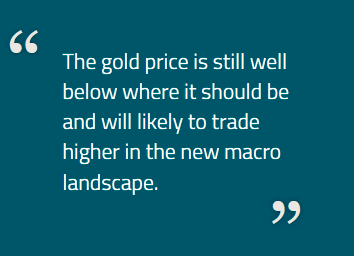
At gold’s previous peak in 2011, the combined balance sheets of the U.S. Federal Reserve (“U.S. Fed”) and the European Central Bank (“ECB”) totaled approximately US$5.5 trillion. Today, that number is more than $11.4 trillion and rapidly moving higher. The USD gold price is still lower than nine years ago. In our view, gold price is still well below where it should be and will likely trade higher in the new macro landscape.

 Figure 2. Pandemic Policy Response Pushes Global Balance Sheets to Record Levels
Source: Bloomberg. Data as of 3/31/2020.

Gold Mining Stocks are Inexpensive

If gold is not correctly priced for what has transpired and what lies ahead, gold mining stocks are even more inappropriately priced. Based on current metal prices, most companies are generating positive earnings and cash flow and in many cases, free cash flow that can be applied to higher dividend payouts. Compared to other sectors of the economy, the gold mining industry stands almost alone in looking forward to strong 2020 earnings and a positive outlook for 2021.

2020 free cash flow yields for large-cap producers range from 3%-7% and 6%-25% for intermediate producers based on conventional sell-side research. The stats are similar or better for 2021 based on spot gold prices. As Figure 3. shows, mining stocks are inexpensive in absolute terms and have never been so cheap relative to the gold price. 

Figure 3. Gold Equities Are Undervalued Relative to Bullion
Ratio of XAU Index to Spot Gold (12/23/1983-3/31/2020)
Data as of 3/31/2020. Source: Bloomberg. 12/23/1983 represents the inception of the XAU.
Since 2008, the relative valuation of gold equities to gold bullion has fallen 75% from the prior 25-year average. The ratio of the XAU Index to spot gold averaged 0.2497x for a quarter century through 2008. As of 3/31/2020, the ratio was 0.0501x.

It is undoubtedly true that the industry will suffer health-related mine shutdowns and other shortfalls this year. Much of the disruption potential has already been broadcast and priced into the market. Some downside news may still have yet to surface. However, most miners are not financially levered and should be able to survive a few quarters of lower or no production. Unlike the airline, leisure, retail and manufacturing sectors, gold not produced today should grow in value and be produced at higher prices and lower costs next year and those beyond. It is not the same story for many other sectors of the economy. Based on fundamentals, gold stocks are inexpensive. By contrast, several other sectors of the economy could face long stretches of poor earnings, bad news flow and financial woes.

The gold mining sector registered a decline of approximately 20% in Q1 (as measured by GDX2) as shares did get battered by indiscriminate liquidations during March. However, as of this writing, two weeks after the close of the quarter, most shares trade near to where they stood at the beginning of the year, and have certainly registered outstanding performance in relative terms. It is remarkable that the largest sector ETF, GDX, suffered outflows of $381 million3 during the quarter at what could be the threshold of an upside breakout. In a favorable cycle for the gold price, mining stocks have historically delivered outperformance 3 to 5 times that of the metal itself.

Gold mining shares continue to be viewed by investors with deep skepticism as reflected by valuation and flows. When we scan Figure 4, it appears to us that the sector is on the verge of an upside breakout from a multi-year base should our assessment of the macroeconomic environment prove correct.

Figure 4. NYSE Arca Gold BUGS Index (HUI4)
Source: Bloomberg. Data as of 4/20/2020.

Monetary and Fiscal Policy Going Ballistic

There is no need to belabor the obvious. However, the consequences of these actions have yet to be priced into the financial markets or gold. The risk parity trade has fallen short, partly because bonds were caught up in the indiscriminate liquidations of Q1. Looking forward, bonds may no longer be able to play the safe haven role they traditionally filled to balance equity risk. The vacuum could be filled in part by increased gold exposure for all classes of investors. Sovereign credit liquidity injections are likely to remain significant and permanent. The bond market has become socialized. Owning Treasury bonds of any duration could become akin to parking Treasury bills, with little upside and considerable risk of impairment through inflation. Gold is the antidote to the fixed-income investor’s dilemma.

Gold is extremely under-owned, under-represented, and poorly thought of in the circles of conventional investment thinking. It is still considered to be a fringe asset. Just ask Goldman Sachs which recently advised its clients:

 “We concluded then (2010) that gold does not have a role as a strategic asset class in clients’ already well-diversified portfolios. We have updated the research and the evidence is even more compelling today than it was then.” (4/5/2020; Goldman Sachs Investment Strategy Group)

We remind the reader that Goldman is the same firm that in December 2019 declared the U.S. economy to be “recession proof” and then in March 2020 cautioned that stocks had substantial further downside:

“Overall, the changes underlying the Great Moderation appear intact, and we see the economy as structurally less recession prone today.” (12/31/2019; Goldman economists Jan Hatzius and David Mericle)

“Goldman Sachs on Friday dramatically cut its U.S. economic forecast, saying it now expects GDP to decline by 25% in the second quarter of 2020 because of the coronavirus panic.” (3/20/2020; Business Insider)

“What is your estimate for the S&P 500 by yearend 2020? David Kostin, “3400.” (1/2020; GS Podcast, David Kostin Goldman, U.S. chief equity strategist and Jake Siewert) 

“Kostin thinks the market goes lower. ‘In the near term, we expect the S&P 500 will fall towards a low of 2000.’” (3/22/2020; Yahoo Finance)

Goldman’s commentary is, in our opinion, a reasonable proxy for conventional wisdom. One could easily find other embarrassing examples of mainstream thinking ignorant of the best-performing asset class (by far) versus equities and bonds since 2000.

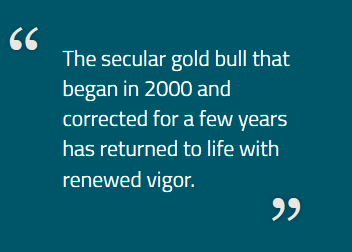
Contrarians and value investors, take note! The secular gold bull that began in 2000 and corrected for a few years has returned to life with renewed vigor. Pullbacks — price declines during this uptrend — should be bought. The setup for gold and gold mining shares ticks every box for highly rewarding investment returns.

Figure 5. Gold Has Outperformed Stocks, Bonds and USD over the Past 20 Years
Returns for Period from 12/31/1999-4/13/2020

Source: Bloomberg. Period from 12/31/1999-4/20/2020. Gold is measured by GOLDS Comdty; US Agg Bond Index is measured by the Bloomberg Barclays US Agg Total Return Value Unhedged USD (LBUSTRUU Index); S&P 500 TR is measured by the SPX; and the U.S. Dollar is measured by DXY Curncy. Past performance is no guarantee of future results.

Figure 6. Gold Provides Portfolio Diversification
Gold provides diversification in a portfolio, and has low correlation with other asset classes. The period measured is April 1, 2015 to April 1, 2020.

* Source: World Gold Council. Period from April 1, 2015 to April 1, 2020, based on monthly returns. Gold is measured by the LBMA Gold Price; stocks by the S&P 500 Index; commodities by the Bloomberg Commodity Index;  Bonds by the BarCap Treasuries and Corporates.

1The S&P 500 or Standard & Poor’s 500 Index is a market-capitalization-weighted index of the 500 largest U.S. publicly traded companies. You cannot invest directly in an index. TR, “Total Return”, represents the index with dividend income reinvested.
2VanEck Vectors Gold Miners ETF (GDX) seeks to replicate the NYSE Arca Gold Miners Index (GDMNTR), which is intended to track the overall performance of companies involved in the gold mining industry.
3Source: ETFtrends.com.
4The NYSE Arca Gold BUGS Index (HUI) is a modified equal dollar weighted index of companies involved in gold mining.

SOURCE: Sprotts Thoughts

https://sprott.com/insights/sprott-gold-report-secular-gold-bull-resumes-with-force/#

MUST WATCH INTERVIEW OF THE YEAR – Empower Clinics $CBDT.ca Closes Up 77% On 25M Shares. This Is Why … And This Is Where It Is Going $WEED.ca $CGC $ACB $APH $CRON.ca $OGI.ca

Posted by AGORACOM-JC at 9:47 PM on Monday, April 27th, 2020

With 165,000 patients, Empower Clinics (CBDT:CSE) (EPWCF:OTCQB) has a database that almost every medical cannabis and CBD company would kill for.  Patient visits increased 800% in February. 590% in March and 480% for Q1. 

More importantly, it is the only small cap company on the continent (that we know of) that is capable of launching COVID-19 Antibody Testing for individuals and businesses nationwide.  Why?  Because its simply not enough to be able to get your hands on some test kits.  The real challenge is having the infrastructure in place to test people in clinics, via drive though and in the workplace.    

It’s pretty much a military precision process that few small cap CEO’s could handle.  

But Empower Clinics CEO, Steven McAuley, is Six Sigma certified under the quality initiative of legendary GE (General Electric) Chairman Jack Welch. We’ve never seen a Six Sigma certified CEO in the Canadian small cap markets. Never …. which explains how McAuley has been able to guide Empower Clinics through the most disruptive retail environment in recent history and turn it into significant growth.  

And now he’s set his sights on Antibody Testing.  He’s not just looking, he’s already started.  

Forget NetFlix Tonight.  Watch this.

VIDEO: Else Nutrition $BABY.ca Has $10M In Cash And A Billion Dollar Shareholder To Launch Plant Based Toddler Foods Around The World $MAT $KMB $BMY $ABT $WYE

Posted by AGORACOM-JC at 6:04 PM on Monday, April 27th, 2020

When the subsidiary of a Billion Dollar, Nutrition Focused company buys 11.5% of your stock, agrees to a voluntary 12-month lock up and holds anti-dilution rights to maintain it’s ownership percentage by buying a proportionate number of shares in any future financing, it is safe to assume you have a strategic investor who believes in the future of your company.    When that same strategic investor wants to then help your company expand into large international markets, it is safe to assume your plant based food capabilities are amongst the most respected in the world.   This is just a glimpse into the strength of Else Nutrition (BABY:TSXV) (BABYF:OTCQB), an Israeli based, award winning plant based food nutrition company that is giving small cap investors an opportunity to participate in the global paradigm shift towards plant-based, clean label foods.   BUT THERE IS MORE

  • Else has a $10,000,000 war chest for a US product launch in Q2 and to start signing international agreements in Q3. 
  • These global plans are supported by patents in 22 countries, with another 44 countries pending.  
  • Else developed the world’s first 100% plant based, non-dairy, non-soy baby formula

Given all of these achievements, it should come as no surprise that Else Nutrition is made up of Executives & Advisors from globally renowned companies and institutions.   If you believe in the future of plant-based, clean label foods or want to discover its possibilities, then watch our first ever interview with Hamutal Yitzhak, the CEO and Co-Founder of Else Nutrition who will tell you about both the Company’s origins and future path.

Mota Ventures $MOTA.ca to Replicate Successful U.S. Business Model for European Expansion of CBD Products, Immune Product Line and CBD Hand Sanitizer $APH.ca $GBLX $PFE $ACG.ca $ACB.ca $WEED.ca $HIP.ca $WMD.ca $CGRW

Posted by AGORACOM at 5:42 PM on Monday, April 27th, 2020
https://s3.amazonaws.com/s3.agoracom.com/public/companies/logos/564664/hub/MOTA_Large.png

VANCOUVER, BC / ACCESSWIRE / April 27, 2020 / Mota Ventures Corp. (CSE:MOTA)(FSE:1WZ1)(OTC:PEMTF) (the “Company“) is pleased to announce that it will be replicating its highly successful business plan and operations in the United States for expansion into the European market with its Sativida brand, acquired on March 26, 2020. Sativida is already one of the top search-ranked online retailers of CBD products in Spain and Mexico, with distribution channels in Spain, Portugal, Austria, Germany, France and the United Kingdom.

SUCCESSFUL USA BUSINESS MODEL EXPECTED TO SIGNIFICANTLY BOOST EUROPEAN OPERATIONS

Year-to-Date in 2020, Mota Ventures has announced the following significant milestones from its U.S. operations:

  • Interim Record Of 14,388 New Customers For April 1 – 23.
  • Record Of 20,959 New Customers For The Month Of March
  • Revenue Of $4,290,000 In March
  • Revenue Of $2,981,000 In February, Representing Growth Of 832% over same period last year

With the Company’s e-commerce capabilities and success in the U.S. market, combined with the current search engine strength and distribution channels of the Sativida brand, management is very confident in its prospects for rapid customer acquisition throughout Europe. This confidence is further supported by the Company’s successful launch of its immune support product line, as well as, the May 1 launch of its CBD based hand sanitizer, both of which will be included in the European expansion.

Much of the Company’s success in the U.S. market has been attributed to its’ strong supply chain, which has continued to operate uninterrupted despite global turmoil in 2020. The Company has been actively sourcing multiple CBD suppliers in Europe to ensure a supply chain that is as strong and consistent as the North America operations. The Company will be announcing further details of the European expansion in the coming weeks as they become available.

“We are excited to announce this European expansion plan. As the world economy begins to awaken, now is the opportune to utilize what we have accomplished in the United States and implement the same strategies in Europe. There are several key market opportunities we have identified in Europe and now is the time to capitalize. I look forward to announcing an official launch date in the coming weeks” stated Ryan Hoggan, CEO of the Company.

About Mota Ventures Corp.

Mota is an established eCommerce, direct to consumer provider of a wide range of CBD products in the United States and Europe. In the United States, the company sells a CBD hemp-oil formulation derived from hemp grown and formulated in the U.S. through its Nature’s Exclusive brands. Within Europe, its Sativida brand of award winning 100% organic CBD oils and cosmetics are sold throughout Spain, Portugal, Austria, Germany, France, and the United Kingdom. Mota Ventures is also seeking to acquire additional revenue producing CBD brands and operations in both Europe and North America, with the goal of establishing an international distribution network for CBD products. Low cost production, coupled with international, direct to customer, sales channels will provide the foundation for the success of Mota Ventures.

About Sativida

Sativida is a producer and online retailer of CBD and branded CBD products in various jurisdictions in Europe, including Spain and the United Kingdom. Sativida currently develops and retails a vast range of organic CBD oils and cosmetics across Europe and is currently expanding its distribution network internationally.

This News Release is available on the company’s CEO Verified Discussion Forum, a moderated social media platform that enables civilized discussion and Q&A between Management and Shareholders.

ON BEHALF OF THE BOARD OF DIRECTORS

MOTA VENTURES CORP.

Ryan Hoggan

Chief Executive Officer

For further information, readers are encouraged to contact Joel Shacker, President at +604.423.4733 or by email at [email protected] or www.motaventuresco.com

How to spot “fake news” and misinformation in the era of #COVID19 – SPONSOR: Datametrex AI Limited $DM.ca

Posted by AGORACOM-JC at 5:06 PM on Monday, April 27th, 2020

SPONSOR: Datametrex AI Limited (TSX-V: DM) A revenue generating small cap A.I. company that NATO and Canadian Defence are using to fight fake news & social media threats. The company is working with US Government agencies on Covid19 and Coronavirus fake news and disinformation. The company also obtained the rights to import and sell COVID-19 test kits from South Korea – Click here for more info.

How to spot “fake news” and misinformation in the era of COVID-19

  • COVID-19’s arrival in Canada has brought many side-effects, including growing concerns about misinformation and deliberately dishonest media dubbed “fake news”.
  • Although automatic-detection systems have been tested, the rise of misinformation appears to be inherently linked to social media.

By: Justin Madu

However, less-than-factual sources generally share a few warning signs.

One of the biggest red flags that something isn’t right is a headline that makes bold or outlandish claims:

“If it seems like clickbait, don’t click on it because chances are it is not going to be legitimate or scientifically-proven information. If it is a sensational blurb, that is probably a good sign not to click on the article and believe everything inside,” explained Wendy Gray, Vista Radio’s National News Director.

Some copycats might even mimic trusted news sources.

“Some stories look like they’re coming from legitimate media outlets but there will be slight alterations to the URL,” said Gray

Similarly, misinformation may be spread through untrustworthy websites claiming to be news outlets. If you’re not familiar with a website, extra skepticism may be required.

Gray added the social climate of a global pandemic can lead to the spread of less-than-scientific data.

Looking at an article’s sources remains important, as medical doctors and public health officials remain the best source for reliable information.

The public should be cautious as many people earn doctorates, alongside the title of “Dr.”, without any medical training.

“You always go with what the medical experts are saying,” Gray stated, adding “politicians are not medical scientists,” in response to headline-grabbing claims made by political figures around the world.

Familiar, reputable news outlets and credible expert-verified sources still remain the best places to find reliable facts.

“If you need information, obviously check your public health website first, but if you’re looking for general information about what’s going on I wouldn’t hesitate to go to your local media sources… Honest, fact-based news is more important than ever,” she concluded.

The B.C. Centre for Disease Control offers valuable COVID-19 information, as does the Provincial Government’s website.

Source: https://www.mybulkleylakesnow.com/41070/how-to-spot-fake-news-and-misinformation-in-the-era-of-covid-19/

#Esports ride crest of a wave as figures rocket during #Covid19 crisis – SPONSOR Esports Entertainment Group $GMBL $TECHF $ATVI $TTWO $GAME $EPY.ca $FDM.ca $TNA.ca

Posted by AGORACOM-JC at 4:23 PM on Monday, April 27th, 2020

SPONSOR: Esports Entertainment Group (GMBL:NASDAQ) – Millions of people from around the world tune in to watch teams of video game players compete with each other. In first quarter 2020, YouTube reported 1.1 billion hours watched, an increase of 13% when compared to fourth quarter 2019. Wagering on Esports is projected to hit $23 BILLION this year although that number will likely be eclipsed due to the recent pandemic. Esports Entertainment Group is the next generation online gambling company designed for the purpose of facilitating as much of this wagering as possible.  LEARN MORE.

Esports ride crest of a wave as figures rocket during Covid-19 crisis

  • The playing of video games is up – Verizon reported that US domestic peak-hour usage was up 75% in the first week of quarantine – but tellingly gaming as a spectator sport is also through the roof.
  • Twitch, one the world’s biggest streaming platforms for gamers, is estimated to have grown its audience by up to a third in March alone

By: Scott Heinrich

Esports have never had it so good. Although competitive video gaming hasn’t proven entirely invulnerable to the coronavirus pandemic, it isn’t doing so bad out of it either. With mainstream sports around the world on hold, people are increasingly turning to gaming to fill the empty hours of lockdown and isolation.

The playing of video games is up – Verizon reported that US domestic peak-hour usage was up 75% in the first week of quarantine – but tellingly gaming as a spectator sport is also through the roof. Twitch, one the world’s biggest streaming platforms for gamers, is estimated to have grown its audience by up to a third in March alone. “With more stay-at-home mandates being issued around the world and the entertainment industry finding new ways to migrate their offerings to livestreaming platforms, we expect to see these numbers rise,” says Doron Nir, the chief executive of StreamElements.

Globally, gaming is also riding the crest of a wave brought about by celebrity endorsement. With sport’s best-known athletes temporarily not doing what they do best, digital pursuits are filling the void. Motor racing has led with way, with Formula 1 hosting virtual Grands Prix in place of its scheduled events. Last weekend, Ferrari driver Charles Leclerc won on debut for the FDA Hublot Esports Team. The race was broadcast live on ESPN2 among 12 hours of esports programming. Nascar and Supercars have also migrated online in this time of hiatus, the latter backed by Jamie Whincup and shown on Kayo and Fox Sports.

Elsewhere in Australia, NRL clubs Canterbury-Bankstown Bulldogs and Wests Tigers met as they were intended to in round three of the premiership season. But instead of competing on the rugby league field, players locked horns on the imaginary battlegrounds of Fortnite. And it was all streamed on Facebook. In Finland, rather than cancel its national hockey league play-offs, the decision was taken to migrate them to the NHL 20 console game and broadcast them on national television. In the UK, the world’s most famous thoroughbred jumps race, the Grand National, was this year digitally simulated, bet on with real money and watched by almost 5m free-to-air viewers.

But if you think esports is immune to the effects of the coronavirus, think again. Although essentially digital events, the big gaming competitions are held in stadiums and attended just like conventional sports. The US$30m 2019 Fortnite World Cup, won by a 16-year-old gamer known as Bugha, drew 2.3m concurrent views across YouTube and Twitch but was also watched live by 19,000 people at New York’s Arthur Ashe Stadium.

For sporting organisations in this country, the disruption to normality might quicken an association with esports that to date has been a toe in the water

Such events have been hit hard by Covid-19. The Overwatch League announced recently it would be playing out its entire 2020 season online, while Play! Pokémon was forced to cancel its North American International Championship and World Championship. Numerous other esports have been impacted by the coronavirus, but where conventional sports have been ground to a halt by containment measures gaming has largely found a way.

The upward trajectory for gaming brought on by the pandemic has accelerated what was already a growth industry, with Australian estimates suggesting demand for esports has at least tripled since the coronavirus outbreak. For sporting organisations in this country, the disruption to normality might also quicken an association with esports that to date has been a toe in the water.

Football Federation Australia inaugurated the E-League in 2017, with each A-League club represented by two gamers on the Fifa video game. Last month, FUTWIZ Marko and FUTWIZ Jamie claimed the 2020 premiership for Sydney FC. Also in 2017, the Adelaide Crows became the first Australian sports club to expand into esports when they acquired the Legacy Esports team.

As well as a vehicle to increase brand awareness, esports can broaden audience and provide new revenue streams. “Most of our traditional streams of revenue are almost tapped out,” Nigel Smart, the Adelaide chief operating officer, said on the Sports Geek podcast last year. “Where does future growth come from? We have a multi-dimensional international strategy and we also have a multicultural strategy. Having an esports team is an extension of both of those. The founding shareholders of Legacy, they’re still involved in the team. They’re on the performance side, they’re on the front end. What we bring as a football club is that back end in terms of content strategy, merchandise models and commercial partnerships.”

With Covid-19 now starving clubs of their usual forms of income, the need to branch out has never been greater. “If they want to engage more of their members, and keep their members as members, they need to evolve that esport team to create tournaments in their club,” Esports Academy director Patrick Chye said recently. “The Crows, for example, should create tournaments for their fans to engage them. Now’s the opportunity. Everyone is at home anyway.”

Mat Jessep, the Esports Games Association Australia chief executive, adds: “There are so many opportunities to integrate competitive gaming into your traditional sports offering. This alone probably would not save a club, or a sport in a position that the NRL is in, but it wouldn’t hurt either. It could really form that incremental income, that come the next rainy day, there’s a bit of savings set aside that a sport can fall back on.”

Source: https://www.theguardian.com/sport/2020/apr/11/esports-ride-crest-of-a-wave-as-figures-rocket-during-covid-19-crisis

CLIENT FEATURE: Loncor Resources $LN.ca 3.6 Million High Grade Gold Ounces in the DRC $ABX.ca $TECK.ca $RSG $NGT.to $GOLD $NEM

Posted by AGORACOM at 12:45 PM on Monday, April 27th, 2020
http://blog.agoracom.com/wp-content/uploads/2019/11/Loncor-Small-Square.png

LN:TSX

3.6 Million High Grade Gold Ounces in the Congo

Imbo Concession: Loncor controls 76.29% of the Imbo Project.

3 Seperate Deposits:

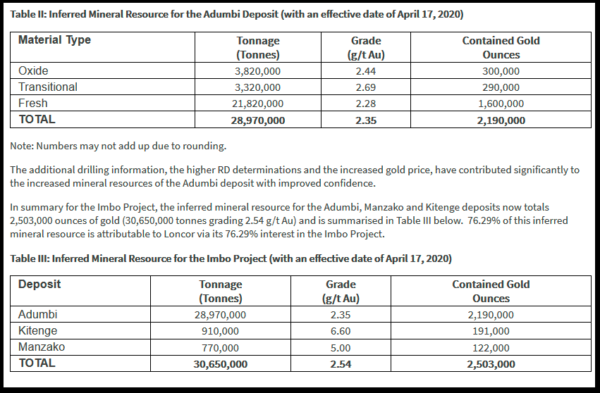
  • Adumbi, Kitenge and Manzako comprise 2.5 million ounces of gold
  • 30.65 million tonnes grading 2.54 g/t Au
  • 76.29% of the gold resource is attributable to Loncor via its 76.29% interest in the Imbo Project.

2020 Exploration Strategy:

  • Increase the mineral resources on the Imbo Project by undertaking additional drilling
  • Initiate Preliminary Economic Assessment on the Adumbi deposit.  
    • Increase and upgrade mineral resources within the open pit
    • Develop underground potential, mineralization remains open at depth

Makapela Project, NGAYU Belt: (100% Loncor Owned)

  • Indicated mineral resource of 614,200 ounces of gold
    • (2.20 million tonnes grading 8.66 g/t Au)
  •  Inferred mineral resource of 549,600 ounces of gold
    • (3.22 million tonnes grading 5.30 g/t Au).

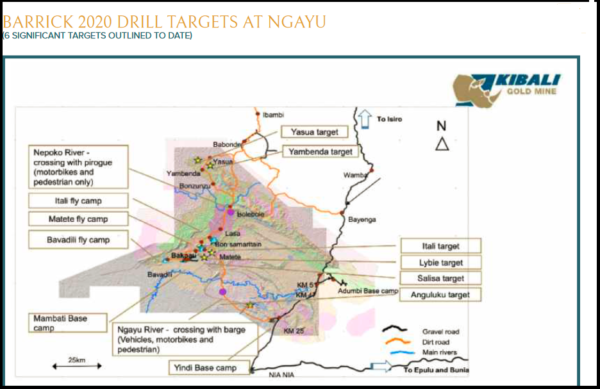
Barrick JV in the NGAYU Belt:

  • Ngayu Belt is 200km southwest of the Kibali gold mine, operated by Barrick Gold
    • Kibali produced 814,000 ounces at “all-in sustaining costs” of US$693/oz 2019 
    • Barrick highlighted the Ngayu Greenstone Belt an area of particular exploration interest
    • Barrick earns 65% of any exploration discovery in 1,894 km2 of Loncor ground in the JV.
  • Barrick manages and funds exploration until the completion of a pre-feasibility study on any gold discovery meeting the investment criteria of Barrick.

Barrick highlighted 6 signifcant drill targets and is moving toward drilling in 2020

Loncor Resources Inc.

Loncor a Canadian gold explorer controlling over 3.6 million high grade ounces outside of a Barrick JV in the DRC. The Ngayu JV property is 200km southwest of the Kibali gold mine, operated by Barrick, which produced 814,000 ounces of gold in 2019. Barrick manages and funds exploration at the Ngayu project until the completion of a pre-feasibility study on any gold discovery meeting their Tier One investment criteria. Newmont $NGT $NEM owns 7.8%, Resolute $RSG owns 27%, Loncor Management owns 29%

Loncor Hub on Agoracom

Mota Ventures $MOTA.ca Reports Interim Record of 14,388 New Nature’s Exclusive Customers for April. Success Supports Launch of CBD Hand Sanitizer $APH.ca $GBLX $PFE $ACG.ca $ACB.ca $WEED.ca $HIP.ca $WMD.ca $CGRW

Posted by AGORACOM at 9:27 AM on Monday, April 27th, 2020
https://s3.amazonaws.com/s3.agoracom.com/public/companies/logos/564664/hub/MOTA_Large.png
  • MOTA VENTURES REPORTS INTERIM RECORD OF 14,388 NEW NATURE’S EXCLUSIVE CUSTOMERS FOR APRIL. SUCCESS SUPPORTS LAUNCH OF CBD HAND SANITIZER

Mota Ventures Corp. had an interim record number of new customer acquisitions for the month of April, for the period April 1 to April 23. Specifically, a total of 14,388 new customers were acquired for the Nature’s Exclusive brand. This interim new customer acquisition record will be updated with the final results for the complete month of April.

In addition to the record customer acquisition number, the Company is pleased to report that each new customer spent an average of $US 151.96. Finally, the record number included 1,748 new customers that purchased products in the immune support category.

SUCCESSFUL ONLINE CUSTOMER ACQUISITION STRATEGY SUPPORTS LAUNCH OF CBD BASED HAND SANITIZER

The interim record results demonstrate the strength and ability of the Company's online acquisition strategy to capitalize on the strong demand for natural health solutions. As a result, the Company will be launching a hand sanitizer product containing CBD through its Nature's Exclusive brand on May 1, 2020. The Nature's Exclusive CBD hand sanitizer will contain 70% ethyl alcohol as its active ingredient, as well as, CBD isolate and Vitamin E, and will initially be offered only to consumers in the United States.

In order to differentiate the Company's hand sanitizer offering within this crowded space, Mota has formulated a product that is specifically designed for its target consumers by combining the antimicrobial properties of ethyl alcohol with the benefits of CBD. This ability to formulate and innovate new products of this caliber is a direct result of the Company's strong supply chain, which has continued to operate uninterrupted despite the recent worldwide turmoil.

"I am very pleased with the continued strength of our new customer acquisition month-to-date as demand remains strong for our CBD and immune products. We anticipate similar demand for our new CBD Hand Sanitizer product due to the limited availability of sanitizer through current retail and eCommerce channels. This product offering will allow us to reach a new client base, while generating significant gross margin and attracting clients to our other product lines" stated Ryan Hoggan, CEO of the Company.

The Company will be hosting an investor conference call at 2:15pm PST on Monday, April 27, 2020 with Mota Ventures management, Ryan Hoggan, CEO and Joel Shacker, President. The Company will be accepting questions from investors at the end of the call.

Conference details:

Canada/USA TF: 1-800-319-4610International Toll: +1-604-638-5340Germany TF: 0800-180-1954Callers should dial in 5 – 10 min prior to the scheduled start time and simply ask to join the call.

Conference replay

Canada/USA TF: 1-800-319-6413International Toll: +1-604-638-9010Replay Access Code: 4481

This News Release is available on the company's CEO Verified Discussion Forum, a moderated social media platform that enables civilized discussion and Q&A between Management and Shareholders.

About Mota Ventures Corp.

Mota is an established eCommerce, direct to consumer provider of a wide range of CBD products in the United States and Europe. In the United States, the company sells a CBD hemp-oil formulation derived from hemp grown and formulated in the US through its Nature's Exclusive brands. Within Europe, its Sativida brand of award winning 100% organic CBD oils and cosmetics are sold throughout Spain, Portugal, Austria, Germany, France, and the United Kingdom. Mota Ventures is also seeking to acquire additional revenue producing CBD brands and operations in both Europe and North America, with the goal of establishing an international distribution network for CBD products. Low cost production, coupled with international, direct to customer, sales channels will provide the foundation for the success of Mota Ventures.

Empower Clinics $CBDT.ca Commences Corona Virus #Covid19 Antibody Testing and Establishes National Rollout Plan and Signs Supply Agreements for Rapid Covid-19 $WEED.ca $CGC $ACB $APH $CRON.ca $OGI.ca

Posted by AGORACOM-JC at 7:18 AM on Monday, April 27th, 2020
  • Empower is utilizing clinic operations and tele-medicine to provide COVID-19 antibody testing to patients and consumers,
  • Establishes a four-phase nationwide rollout of Rapid COVID-19 testing and signs new COVID-19 test supply agreements

VANCOUVER, BC / April 27, 2020 / EMPOWER CLINICS INC. (CSE:CBDT)(OTCQB:EPWCF)(Frankfurt:8EC) (“Empower” or the “Company”), a vertically integrated life sciences company is pleased to announce it has commenced COVID-19 antibody testing in its Sun Valley Health clinics in Phoenix, AZ using a blood draw test by clinic phlebotomists that are sent to an COVID-19 FDA approved laboratory partner. The laboratory submitted its request for FDA approval on March 16, 2020 under the Emergency Use Authorization (EUA).

“The Company has established a four-phase national COVID-19 testing program utilizing Rapid COVID-19 test kits”, said Steven McAuley, Chairman & CEO of Empower.

Phase One Testing in-clinics in Arizona, utilizing a patient blood draw by clinic phlebotomists, then samples are sent to our laboratory test partner for analysis, with test results expected within 48 hours.

Phase Two Offering a Rapid COVID-19 antibody test with results in 1-15 minutes. The service will be offered in-clinics using a drive-up service, conducted by Company clinic staff. In addition, an outbound door-step service, to support a variety of consumer, patient and community needs will be offered using certified mobile technicians. The Company anticipates phase two services will commence in May 2020.

Phase Three Business Employee Testing (BET) programs, offering Rapid COVID-19 testing to businesses on a one-time basis, repeat basis and/or subscription basis, to assist businesses to get back to work safely, will be offered. The Company anticipates phase three services will commence in May 2020.

Phase Four U.S. nationwide roll-out, offering all phases of Company services, that can be accessed online at Company websites and call centers, to purchase Rapid COVID-19 test kits. The Company anticipates phase four services to commence in Q3 2020.

Steven McAuley further states, “Our team are ready to meet the crisis head on, and we have ensured that the test processes and the test kits we use, are approved in the United States under the Emergency Use Authorization (EUA), as defined by the U.S. Food and Drug Administration (FDA).”

The Company has secured test kit supply agreements with two suppliers, NanoID Technologies Pty Ltd., that supply Zhuhai Livzon Diagnostics Inc. Rapid test kits, who made their test kit submission to the FDA on April 16th, 2020, and Emunah Trust, LLC, that supply Hangzhou TestSea Biotechnology Co., Ltd., Rapid test kits, who made their Rapid COVID-19 test kit submission to the FDA on April 16th, 2020.

CNN’s Dr. Sanjay Gupta explains what the science behind that testing means. Source: CNN

https://www.cnn.com/videos/health/2020/04/10/antibody-tests-fauci-week-or-so-gupta-dnt-lead-vpx.cnn

The World Health Organization, Director-General Dr. Tedros Adhanom Ghebreyesus has said, “Make no mistake: we have a long way to go. This virus will be with us for a long time. He has further stated, “We have a simple message for all counties: test, test, test.”

ABOUT EMPOWER

Empower is a vertically integrated health & wellness brand with a network of corporate and franchised health & wellness clinics in the U.S. The Company is building its first hemp-derived CBD extraction facility and produces its proprietary line of cannabidiol (CBD) based products. The company is a leading multi-state operator of a network of physician-staffed wellness clinics, focused on helping patients improve and protect their health, through innovative physician recommended treatment options. The Company has commenced activity on how to connect its significant data, to the potential of the efficacy of alternative treatment options related to hemp-derived cannabidiol (CBD) therapies, psilocybin and other psychedelic plant-based treatment options. The Company now offers COVID-19 testing options and physician- based consultations, to address COVID-19 concerns.

ON BEHALF OF THE BOARD OF DIRECTORS:

Steven McAuley
Chief Executive Officer

CONTACTS:

Investors: Steven McAuley

Chairman & CEO

[email protected]

604-789-2146

Investors: Dustin Klein

SVP, Business Development

720-352-1398

[email protected]

For French inquiries: Remy Scalabrini, Maricom Inc., E: [email protected], T: (888) 585-MARI

DISCLAIMER FOR FORWARD-LOOKING STATEMENTS

This news release contains certain “forward-looking statements” or “forward-looking information” (collectively “forward looking statements”) within the meaning of applicable Canadian securities laws. All statements, other than statements of historical fact, are forward-looking statements and are based on expectations, estimates and projections as at the date of this news release. Forward-looking statements can frequently be identified by words such as “plans”, “continues”, “expects”, “projects”, “intends”, “believes”, “anticipates”, “estimates”, “may”, “will”, “potential”, “proposed” and other similar words, or information that certain events or conditions “may” or “will” occur. Forward-looking statements in this news release include statements regarding; the Company’s intention to create psilocybin and psychedelics divisions, that market research on advancements in psilocybin and psychedelics in North America and globally will create greater shareholder value, the Company’s intention to open a hemp-based CBD extraction facility, the expected benefits to the Company and its shareholders as a result of the proposed acquisitions and partnerships; the effectiveness of the extraction technology; the expected benefits for Empower’s patient base and customers; the benefits of CBD based products; the effect of the approval of the Farm Bill; the growth of the Company’s patient list and that the Company will be positioned to be a market-leading service provider for complex patient requirements in 2019 and beyond; the ability of the Company to complete or execute phases One, Two, Three or Four as noted above, and Psychedelic substances remain illegal in most countries, so please reference your local laws in relation to medical or recreational use. Such statements are only projections, are based on assumptions known to management at this time, and are subject to risks and uncertainties that may cause actual results, performance or developments to differ materially from those contained in the forward-looking statements, including; that the Company may not open a hemp-based CBD extraction facility; that legislative changes may have an adverse effect on the Company’s business and product development; that the Company may not be able to obtain adequate financing to pursue its business plan; general business, economic, competitive, political and social uncertainties; failure to obtain any necessary approvals in connection with the proposed acquisitions and partnerships; and other factors beyond the Company’s control. No assurance can be given that any of the events anticipated by the forward-looking statements will occur or, if they do occur, what benefits the Company will obtain from them. Readers are cautioned not to place undue reliance on the forward-looking statements in this release, which are qualified in their entirety by these cautionary statements. The Company is under no obligation, and expressly disclaims any intention or obligation, to update or revise any forward-looking statements in this release, whether as a result of new information, future events or otherwise, except as expressly required by applicable laws.

Steven J. McAuley
Chief Executive Officer
EMPOWER | www.empowerclinics.com
(604) 789-2146 | @stevenmcauley
[email protected]