Posted by AGORACOM-JC
at 7:40 AM on Tuesday, March 24th, 2020
Announced that following establishment of interoperability between NexaIntelligence tech and Netanomics ORA-pro,
Nexalogy is becoming an affiliate member of the Carnegie Mellon University Center for Informed Democracy and Social Cybersecurity (IDeaS)
TORONTO, March 24, 2020 – Datametrex AI Limited (the “Company†or Datametrexâ€) (TSXV: DM) (FSE: D4G) is pleased to announce that following establishment of interoperability between NexaIntelligence tech and Netanomics ORA-pro, Nexalogy is becoming an affiliate member of the Carnegie Mellon University Center for Informed Democracy and Social Cybersecurity (IDeaS).
Dr. Kathleen Carley, from IDeaS commented “We look forward to working
with Nexalogy. They provide a unique and significant
technology, NexaIntelligence, that will help us understand the spread of
information and disinformation. We are delighted that they will be
affiliates of the Informed Democracy and Social-cybersecurity center
(IDeaS).â€
“Nexalogy is continuing its ‘Land and Expand’ approach to the USA
market and membership in Carnegie Mellon University IDeaS will be a key
component of networking and research collaboration in these efforts,â€
says Marshall Gunter, CEO of the Company.
Datametrex AI Limited is a technology focused company with exposure
to Artificial Intelligence and Machine Learning through its wholly owned
subsidiary, Nexalogy (www.nexalogy.com).
This news release contains “forward-looking information†within
the meaning of applicable securities laws. All statements contained
herein that are not clearly historical in nature may constitute
forward-looking information. In some cases, forward-looking information
can be identified by words or phrases such as “mayâ€, “willâ€, “expectâ€,
“likelyâ€, “shouldâ€, “wouldâ€, “planâ€, “anticipateâ€, “intendâ€,
“potentialâ€, “proposedâ€, “estimateâ€, “believe†or the negative of these
terms, or other similar words, expressions and grammatical variations
thereof, or statements that certain events or conditions “may†or “willâ€
happen, or by discussions of strategy.
Readers are cautioned to consider these and other factors,
uncertainties and potential events carefully and not to put undue
reliance on forward-looking information. The forward-looking information
contained herein is made as of the date of this press release and is
based on the beliefs, estimates, expectations and opinions of management
on the date such forward-looking information is made. The Company
undertakes no obligation to update or revise any forward-looking
information, whether as a result of new information, estimates or
opinions, future events or results or otherwise or to explain any
material difference between subsequent actual events and such
forward-looking information, except as required by applicable law.
Neither the TSX Venture Exchange nor its Regulation Services
Provider (as that term is defined in the policies of the TSX Venture
Exchange) accepts responsibility for the adequacy or accuracy of this
release.
Posted by AGORACOM-JC
at 7:36 AM on Tuesday, March 24th, 2020
In the wake of the COVID-19 pandemic, Hollister is using its essential business standing and facility to source and produce hand sanitizer for its local community.
The CEO of Hollister Biosciences Inc, Carl Saling, shared: “The community of Hollister, CA is near and dear to our hearts, and as the first licensed cannabis company in the city of Hollister, CA, I feel that we must do whatever we can to help.
VANCOUVER, March 24, 2020 –Hollister Biosciences Inc.(CSE: HOLL, FRANKFURT: HOB, OTC: HSTRF) (the “Company” or “Hollister“) – through its Hollister Cannabis Co division, is stepping up to manufacture and distribute a few thousand bottles of hand sanitizer to Hollister, CA.
A statewide “shelter at home” mandate has been issued for California,
putting a halt to non-essential manufacturing and delay in
distribution. Cannabis retailers and manufacturers are considered
essential businesses in California. In the wake of the COVID-19 pandemic, Hollister is using its essential business standing and facility to source and produce hand sanitizer for its local community.
Hollister will be giving its first batch of hand sanitizer to the Hollister food bank. Multiple batches of hand sanitizer are expected to be delivered to community organizations over the next few weeks.
The CEO of Hollister Biosciences Inc, Carl Saling, shared: “The community of Hollister, CA is near and dear to our hearts, and as the first licensed cannabis company in the city of Hollister, CA, I feel that we must do whatever we can to help.
It infuriated me seeing companies price gouging much needed items,
such as hand sanitizer. I am all for making money, but not at the
expense of playing on people’s fears during a time of crisis. We just
had to act.
We are going to focus on donating to the facilities that are often
overlooked: the food bank, nursing homes, rehabilitation centers, and
homeless shelters, where some of the most vulnerable are sheltering in
place.
I am calling all business owners to step up in this time of crisis and do whatever you can to help your local community.”
About Hollister Biosciences Inc.
Hollister Biosciences Inc. is a California based
vertically integrated cannabis company with a vision to be the
sought-after premium brand portfolio of innovative, high-quality California-grown cannabis and hemp products. Hollister
uses a vertically integrated, high margin model, controlling the whole
process from manufacture to sales to distribution or seed to shelf.
Products from Hollister Cannabis Co. include HashBone, the brand’s
premier artisanal hash-infused pre-roll, along with solvent-free bubble
hash, pre-packaged flower, pre-rolls, tinctures, vape products, and
full-spectrum high CBD pet tinctures. Hollister Cannabis Co.
additionally offers white-labeling manufacturing of cannabis products.
Our wholly owned California subsidiary Hollister Cannabis Co is the 1st state and locally licensed cannabis company in the city of Hollister, CA birthplace of the “American Biker.”
Neither the Canadian Securities Exchange nor its Market Regulator
(as that term is defined in the policies of the Canadian Securities
Exchange) accepts responsibility for the adequacy or accuracy of this
release.
Forward-Looking Information: This news release includes certain
statements that may be deemed “forward-looking statements”. The use of
any of the words “anticipate”, “continue”, “estimate”, “expect”, “may”,
“will”, “would”, “project”, “should”, “believe” and similar expressions
are intended to identify forward-looking statements. Although the
Company believes that the expectations and assumptions on which the
forward-looking statements are based are reasonable, undue reliance
should not be placed on the forward-looking statements because the
Company can give no assurance that they will prove to be correct. Since
forward-looking statements address future events and conditions, by
their very nature they involve inherent risks and uncertainties. These
statements speak only as of the date of this News Release. Actual
results could differ materially from those currently anticipated due to a
number of factors and risks including various risk factors discussed in
the Company’s disclosure documents which can be found under the
Company’s profile onwww.sedar.com
Automotive, batteries: Covid-19, possible recession and low oil price — why they don’t matter for the EV revolution
According to Bloomberg, the electric vehicle revolution that by most
accounts was ramping up in 2020, faces one of the biggest threats since
EVs started to go mainstream in the last decade. The outbreak of the
novel Covid-19 (Coronavirus) in late December has paralysed key parts of
the Chinese economy.
By early March, the virus spread further across Europe and into the
US. On 9 March, oil prices crashed. With the markets rattled,
governments from Italy to the USA took increasingly drastic measures,
from locking down entire nations to banning travel and declaring states
of emergency. Although electrification is here to stay, these
developments are bad news for industries that were looking to tip the
scales in favour of electric this year.
Roskill View
While the recent oil price burst and the Covid-19 crisis could
suppress automotive sales worldwide, Roskill’s view on the long-term
demand for electric vehicles remains intact. Those countries adopting
stringent transport emissions regulations that ultimately push EV sales
are major oil importers: Europe, China, Japan, India, and South Korea. A
short-term bump in automotive sales and even long-term low prices won’t
change the view of these countries on oil dependency and the risk to
their economies and health systems.
Talking to Bloomberg,
Jose Lazuen, senior automotive practice analyst at Roskill, said
“Governments in China and in the European Union implemented measures to
accelerate the electrification of transport regardless of oil pricesâ€.
Concerns over pollution in large cities and its impact on citizens’
health have been more prominent, and oil price swings are unlikely to
change that. “Long-term, the vision of these governments is to diminish
exposure to oil markets as much as they can,†Lazuen said. “Whether that
will happen in the next 10 or 50 years, we don’t know.â€
Electric cars cost 50% to 70% more than conventional automobiles, but
prices are forecast to decline in the coming years as lithium-ion
battery technology evolves and manufacturers ramp up production. At the
current pace, Roskill estimates that the cost of electric vehicles will
start to match that of internal combustion engine cars beginning in
2023″.
Roskill’s NEW Lithium-ion Batteries: Outlook to 2029, 4th Edition
report is due to be published in April 2020 and provide detailed
analysis on supply, demand, trade, prices, cost curves and forecasts.
For more information or to subscribe, click here.
Posted by AGORACOM-JC
at 2:25 PM on Monday, March 23rd, 2020
SPONSOR: NORTHBUD (NBUD:CSE)
Sustainable low cost, high quality cannabinoid production and
procurement focusing on both bio-pharmaceutical development and
Cannabinoid Infused Products. The company recently received Canadian
Cultivation Licence for its Quebec Facility. Learn More.
Growing Preference For Edibles Over Smoking Cannabis Projected To Drive Global Cannabis Edibles Market Growth
Rising approval of recreational marijuana has surged the demand for legal cannabis
Thus, cannabis edibles are extensively approved in nations such as Canada, the US, Chile, Spain, Germany, Australia, and Israel
Cannabis edibles can be defined as food products that comprise cannabinoids and its spinoffs. Numerous cannabis edibles entail a considerable amount of cannabinoids that assist in decreasing anxiety and fatigue along with enhancing appetite. Also, cannabis edibles assist in improving relaxation & euphoria and are administered for recreational as well as medicinal reasons. The growing acceptance of cannabis is the key factor likely to drive the growth of the global cannabis edibles market during the forecast period.
Further, these products are deemed to be
effective, safe, and have intoxicating & healing impacts of
cannabis with no exposure to likely threats of cannabis smoking.
Consequently, this is projected to boost the expansion of the global
cannabis edibles market in the upcoming period. In addition, the rising
usage of cannabis edibles in beverages, baked items, chocolates,
candies, lozenges, and gummies are also anticipated to contribute to the
expansion of the global cannabis edibles market.
With the rising recognition of these products in the nations that are
making cannabis legal for medicinal purposes, the cannabis edibles
market is projected to register a substantial rate of growth during the
near future.
Apart from this, the rising approval of
recreational marijuana has surged the demand for legal cannabis. Thus,
cannabis edibles are extensively approved in nations such as Canada, the
US, Chile, Spain, Germany, Australia, and Israel. The cannabis industry
has surfaced in recent times as a productive business domain with a
huge prospect for market expansion and is driving the attention of
several new merchants and giant financiers. This is owing to the rising
social recognition of cannabis-infused edibles and recreational
marijuana products around the world.
Further, this has not only elevated the
revenues and sales of top firms but has also considerably contributed to
the revenue of numerous governments. Also, merchants are observing a
rise in the growth avenues in businesses entailing cannabis edibles like
ice creams, chocolates, and brownies, thereby fueling the global of the
global cannabis edibles market.
Nevertheless, several cannabis extracts
utilized in the making of the cannabis edibles are inclined to confront
judicial scrutiny and regulatory challenges in the coming period that
might obstruct the expansion of the global cannabis edibles market.
Nonetheless, the elevated usage of cannabis edibles to efficiently treat
several conditions such as epilepsy, cancer, chronic pain, anorexia,
arthritis, multiple sclerosis, Alzheimer’s, and nausea is anticipated to
cancel out the impacts of numerous market hindrances.
To cite, as announced on March 18, 2020, Clovr, a Kansas City-located
cannabis manufacturing firm, has collaborated with Wana Brands, a
cannabis edibles giant, to get edible products to the quickly
flourishing and much-awaited Missouri market. Introduced in 2010, the
Colorado brand already serves Oregon, Ohio, California, Illinois,
Michigan, Arizona, Oklahoma, and now Missouri, with intentions to
function in Florida and Maryland. Lately, Wana Brands also set up an
international footmark, getting its items to the Canadian cannabis
market via a licensing pact with Indiva Limited.
Source:
https://cannabisindustrynews24.com/1491/growing-preference-for-edibles-over-smoking-cannabis-projected-to-drive-global-cannabis-edibles-market-growth/
Tags: Cannabis, CBD, CSE, Hemp, Marijuana, stocks Posted in North Bud Farms Inc | Comments Off on NORTHBUD $NBUD.ca – Growing Preference For #Edibles Over Smoking #Cannabis Projected To Drive Global Cannabis Edibles Market Growth $CGC $ACB $APH $CRON.ca $OGI.ca
Posted by AGORACOM-JC
at 2:04 PM on Monday, March 23rd, 2020
Cease trade order has been lifted and as of March 5, 2020 the Company is once again trading on the CSE under the symbol: PRMO
The Company was not subject to any insolvency proceedings
VANCOUVER, British Columbia, March 23, 2020 — PRIMO NUTRACEUTICALS INC. (CSE: PRMO) (OTC: BUGVF) (FSE: 8BV) (DEU: 8BV) (MUN: 8BV) (STU: 8BV) (“Primo” or the “Company”) is pleased to announce that it has satisfied the provisions of the information guidelines of National Policy 12-203, by filing its annual financial statements and MD&A for the year ended July 31, 2019, and therefore its cease trade order has been lifted and as of March 5, 2020 the Company is once again trading on the CSE under the symbol: PRMO. Â The Company was not subject to any insolvency proceedings.
The Company also announces the appointment of Mr. Mark Bechtel as Corporate Secretary.
Mr. Bechtel is a securities lawyer with extensive experience in
Canadian capital markets and exchanges. Presently Mr. Bechtel operates a
law firm located in downtown Vancouver specializing in venture and
emerging markets. As Corporate Secretary of Primo Mr. Bechtel will
ensure that best practices for regulatory compliance are established and
maintained.
The Company has also entered into a consulting agreement with Sheryl
Dhillon to act as their Corporate Governance consultant. Ms. Dhillon
is a highly experienced corporate secretary with over fifteen years of
experience. She has extensive knowledge of corporate governance, as
well as strong management skills and excellent corporate
communications. Ms. Dhillon acts as Corporate Secretary for several
TSXV and CSE listed companies.
“The addition of Mr. Bechtel and Ms. Dhillon is a significant
value-add to the Primo team. Their cumulative experience in various
disciplines will further empower the Company’s growth. It is an
exciting time for our Company.†Comments from Mr. Andy Jagpal, CEO & President.
ON BEHALF OF THE BOARD OF DIRECTORS
“Andy Jagpal”
President and Director
For further information, please contact Zoltan, IR Representative at:
This news release contains certain forward-looking statements
within the meaning of Canadian securities laws. Forward-looking
statements are based on the expectations and opinions of the Company’s
management on the date the statements are made. The assumptions used in
the preparation of such statements, although considered reasonable at
the time of preparation, may prove to be imprecise and, as such, undue
reliance should not be placed on forward-looking statements. The Company
expressly disclaims any intention or obligation to update or revise any
forward-looking statements whether as a result of new information,
future events or otherwise.
No regulatory authority has approved or disapproved the information contained in this news release.
Posted by AGORACOM-JC
at 12:38 PM on Monday, March 23rd, 2020
SPONSOR: Datametrex AI Limited
(TSX-V: DM) A revenue generating small cap A.I. company that NATO and
Canadian Defence are using to fight fake news & social media
threats. The company announced three $1M contacts in Q3-2019. Click here for more info.
You can go to jail for spreading fake news about Covid-19
As the coronavirus (Covid-19) spreads, so does the misinformation
Recently referred to by the WHO as an “infodemic”, the volume of information that is both true and false has been communicated across all platforms globally
Geraint Crwys-Williams, chief business officer, Primedia Group and acting CEO, Primedia Broadcasting says, “Now, more than ever, the role of accountable and credible media has come to the fore. Government officials and healthcare professionals are using trusted broadcast media and digital platforms of established, verified, media outlets to circulate correct information on Covid-19. There has been a particular focus also on debunking the myths and misinformation in circulation, which is an important role of accountable media as a public service.â€
On Wednesday, the Minister for Cooperative Governance and Traditional Affairs, Dr Nkosazana Dlamini-Zuma, set out the Regulations in terms of Section 27 (2) of the Disaster Management Act. According to the Government Gazette, “Any person who publishes any statement, through any medium, including social media, with the intention to deceive any other person about— (a) Covid-19; (b) Covid-19 infection status of any person; or (c) any measure taken by the Government to address Covid-19, commits an offence and is liable on conviction to a fine or imprisonment for a period not exceeding six months, or both such fine and imprisonment.â€
Despite this, hoaxes are still being posted on social media, and are gaining traction. The most recent fake news post is a Facebook account purportedly belonging to President Cyril Ramaphosa that told South Africans to stay indoors at 10am as helicopters would be spraying chemicals across the country against coronavirus. 8,000 social media users spread that news onwards.
Adds Crwys-Williams, “We urge all South Africans to be mindful of the source of information that they receive. Misinformation does not just cause unnecessary panic; it also puts citizens at risk. We have a duty of care to our employees, our communities and our audience to provide accurate, informative communication to ensure we play our part in reducing, not just the spread of the virus, but of unnecessary panic too.â€
He adds that simply sharing misinformation could make someone complicit in the crime, even though this was not the intention.
“We recommend that South Africans go to their trusted news sources such as credible broadcast, print and online media for updates. The South African Government is being vigilant about ensuring that correct information is being disseminated across these channels. They also have a WhatsApp group on 060 012 3456 that offers up-to-date information – simply type ‘hi’ to be included.â€
Posted by AGORACOM
at 12:13 PM on Monday, March 23rd, 2020
Mota Ventures Corp. (CSE:MOTA)(FSE:1WZ:GR)(OTC:PEMTF) (the “Company” or “Mota”) is pleased to announce that since the launch of the Pure Herbal Immunity Blend under the First Class brand on March 14th, 2020, it has had an exceptional reception, acquiring 1,838 new customers.
The
all-natural Immunity Blend is made from 100% pure essential oils,
including cinnamon leaf, lemon, clove bud, lime, eucalyptus globulus,
rosemary, peppermint, spearmint and oregano. Due to customer demand for
pure and efficacious products to support the immune system, the Company
will be launching an Immune CBD oil, along with an Elderberry Gummy
product on Monday, March 23rd. The new Immune CBD product contains CBD,
B3, B12, Vitamin C and Zinc. Based on the success of the launch, First
Class will be increasing marketing efforts throughout the US.
The
Company plans to offer similar immune products in Europe through its
Sativida brand, which currently retails product in various jurisdictions
in Europe, including Spain, Portugal, Austria, Germany, France and the
United Kingdom.
The
Company anticipates the completion of the Sativida transaction in the
next seven days. Further to its January 10, 2020 news release, the
Company will acquire the intellectual property and trade names of
Sativida from VIDA BCN LABS SL (Spain) and Sativida OU (Estonia)
(collectively, “Sativida”).
The Company will license both back to Sativida in exchange for a
royalty associated with the gross revenues generated by Sativida.
“As
our customers around the globe face challenges in their daily lives, we
are working diligently to provide products to help families with
natural health needs. Our supply chain is operating uninterrupted and we
are quickly working to expand our immune support product line. We stand
ready to continue to adapt to market changes and innovate new products
to take advantage of the numerous opportunities ahead”, states Ryan
Hoggan, CEO of the Company.
About Mota Ventures Corp.
Mota
is seeking to become a vertically integrated global CBD brand. Its plan
is to cultivate and extract CBD into high-quality value-added products
from its Latin American operations and distribute it both domestically
and internationally. Its existing operations in Colombia consist of a
2.5-hectare site that has optimal year-round growing conditions and
access to all necessary infrastructure. Mota is looking to establish
sales channels and a distribution network internationally through the
acquisition of the Sativida and First Class CBD brands. Low cost
production, coupled with international, direct to customer sales
channels will provide the foundation for the success of Mota.
About Sativida
Sativida
is a producer and online retailer of CBD and branded CBD products in
various jurisdictions in Europe, including Spain and the United Kingdom.
Sativida currently develops and retails a vast range of organic CBD
oils and cosmetics across Europe and is currently expanding its
distribution network internationally. For more information on Sativida,
readers are encouraged to review their website, www.sativida.es.
ON BEHALF OF THE BOARD OF DIRECTORS
MOTA VENTURES CORP. Ryan Hoggan Chief Executive Officer
For
further information, readers are encouraged to contact the President of
the Company, Joel Shacker, at +604.423.4733 or by email at [email protected]or www.motaventuresco.com
Posted by AGORACOM-JC
at 12:10 PM on Monday, March 23rd, 2020
SPONSOR: BetterU Education Corp.
aims to provide access to quality education from around the world. The
company plans to bridge the prevailing gap in the education and job
industry and enhance the lives of its prospective learners by developing
an integrated ecosystem. Click here for more information.
Lido Learning pulls in 25% new organic users amid Covid-19
Platform has observed 25% new organic users visiting the website daily since the beginning of March as well as a 2x pull in acceptability and adaptability of users
Company has also initiated a new outreach model which will provide additional data in terms of quantifying demand
Delhi: Online tutoring platform Lido Learning is gaining immense traction with students becoming more digitally inclined amid the social distancing period. Catering to the K-12 market for students from Class 5-9, Lido offers classes in Math, Science and English. The platform has observed 25% new organic users visiting the website daily since the beginning of March as well as a 2x pull in acceptability and adaptability of users. The company has also initiated a new outreach model which will provide additional data in terms of quantifying demand.
While schools, workplaces and even recreational centres have been
shut down with immediate effect, EdTech companies have filled the
education gap for students seamlessly. Hence, students as well as
parents are steering towards digital platforms to bridge the learning
gap.
Continuous learning is imperative for a child’s holistic development
and therefore Lido Learning is a no-brainer solution for students to
continue building upon their skills while also staying safe and
practising social distancing.
While individualized attention towards every student is the need of
the hour, Lido Learning has always ensured that the teacher-student
ratio is always 1:6, ensuring that each of their academic progress is
monitored and built upon individually.
With the Government also promoting online education in recent
announcements, Lido Learning aims to deliver the best learning
experience for each student with state-of-the-art technology, engaging
content involving quizzes and games, coupled with highly-qualified
faculty.
Posted by AGORACOM-JC
at 4:17 PM on Friday, March 20th, 2020
Announced the launch of a curated COVID-19 Resource Toolkit to help support individuals, employees, employers and governments in managing this crisis by providing access to relevant, current and critical global information
Over the last several weeks, betterU doubled down their efforts in the development of the COVID-19 Resource Toolkit
OTTAWA, March 20, 2020Â — betterU Education Corp. (TSX VENTURE: BTRU, Frankfurt: 5OGA) (the “Company” or “betterU”) is pleased to announce the launch of a curated COVID-19 Resource Toolkit to help support individuals, employees, employers and governments in managing this crisis by providing access to relevant, current and critical global information.
The speed in which COVID-19 has hit the world, closing businesses,
cities and countries, has created a global panic and confusion that has
only been compounded by the wave of both social media and the
sensationalism of the media. betterU who is focused on education
realized that their recently launched SaaS Mobile Enterprise solution, Ready-To-Go,
could be adapted to help support the world by curating global content
into one source application that could be made available instantly
across the world in up to 20 languages. Please visit https://readytogo.betteru.ca/ to start the process of downloading the app and getting access to your COVID-19 Resource Toolkit.
Over the last several weeks, betterU doubled down their efforts in
the development of the COVID-19 Resource Toolkit. The Company added
modules into Ready-To-Go that comprised of content, links, fact sheets,
PDFs, videos and graphics to support detailed information on the virus,
live updates, risks of infection, symptoms and treatments, how to
prepare, proper hygiene, self-isolation, managing anxiety and stress,
travel advice, information for children, vulnerable populations, myths
and questions and more! The information has been curated only from
reliable sources such as the World Health Organization (WHO), Centre for
Disease and Protection (CDC), the Canadian Government, many medical
professional and leading global experts.
In addition to critical information about the virus, betterU has
reached out to many of their global educators and partners for
assistance in being able to provide their technology and learning
programs that could support a free solution supporting people now
working from home, to help deal with financial management, their home
working environment, support risks and fear management, effective
communication virtually and much more. The goal is to provide a fully
comprehensive resource toolkit that provides an all-in-one solution that
informs, supports and helps advance personal and business successes in a
time of critical need.
“When betterU approached us about working together on this
important issue, we had already been thinking about the how we could
create something similar, so it was a no brainer for us to join
betterU’s efforts. Our customers, their employees and their families are
very important to us and we are working hard to support them all in
this time of need.†Said Dan Belhassen, President of Neovation Learning Solutions – creators of the OttoLearn Agile Microlearning platform (Ottolearn.com)
betterU, Ottolearn and their education partners are providing these
services and content for free to ensure we can help everyone,
everywhere. betterU is continuing its efforts to bring together global
educators, influencers and more to help support the world.
“These times are not easy, and we are all facing our own
challenges. We need to come together as a community, a country and a
world to support each other the best we can. This is what we thought
could help, and while we know it is not enough, we hope it does support
you.†Said Brad Loiselle, President and CEO of betterU.
About betterU Education Corp.
betterU is an education-to-employment technology company offering an
end-to-end solution leveraging business intelligence to automate
skilling, reskilling and upskilling for companies operating on domestic
and global scales.
betterU has integrated into its platform the content, technology and
support for tailored skills assessments, learning pathways and training
modules from 100+ of the world’s leading online education providers.
betterU’s eco-system includes detailed job, skill, employer, and
educational profiles spanning 3,000+ standardized jobs. betterU’s
integrated platform is the most efficient solution to address evolving
skilling challenges for employers and employees through the employment
lifecycle from entry level to executive. We don’t sell content, we help
build better people.
Led by award-winning Winnipeg entrepreneur Dan Belhassen, the
Neovation Learning Solutions team is committed to providing over 500
clients worldwide (representing nearly a million learners) with “best-in
class†L&D services. Clients reap the benefits of Neovation’s
leading-edge software platforms (SmarterU.com and OttoLearn.com) and
content creation services (Flarelearning.com.) Since 2012, Neovation has
built a diverse and growing team of software developers, instructional
and graphic designers, client care specialists and a sales and marketing
team united with one purpose – to make learning magical for
their clients. OttoLearn.com is Neovation’s agile microlearning platform
that delivers knowledge retention and learner engagement to help
companies improve their training KPIs.
Neither TSX Venture Exchange nor its Regulation Services Provider (as that term is defined in policies of the TSX Venture Exchange) accepts responsibility for the adequacy or accuracy of this release.
COVID-19 Resource Toolkit is comprised of content, links, fact
sheets, PDFs, videos and graphics to support detailed information on the
virus, live updates, risks of infection, symptoms and treatments, how
to prepare, proper hygiene, self-isolation, managing anxiety and stress,
travel advice, information for children, vulnerable populations, myths
and questions and courses with more to come.
Posted by AGORACOM
at 11:49 AM on Friday, March 20th, 2020
SPONSOR: American Creek owns a 20% Carried Interest to Production at the Treaty Creek Project in the Golden Triangle. 2019’s first hole averaged of 0.683 g/t Au over 780m in a vertical intercept. The Treaty Creek property is located in the same hydrothermal system as the Pretivm and Seabridge’s KSM deposits. Click Here For More Info
Credit Deflation and Gold
Gold and precious metals mining shares are casualties of panic
selling across all financial markets. The scenario is similar to what
happened in 2008 during the global financial crisis (GFC). When the
general selling exhausted itself in late 2008, gold and mining shares
delivered superior absolute and relative performance for the following
three years. We believe that this pattern is likely to repeat following
this sell-off.
While COVID-19 outbreak is grabbing the headlines, the far bigger
story is the deflation of financial assets that it has triggered and the
resulting loss of investment confidence. Markets that had been priced
for perfection must now reckon with a likely recession, soaring fiscal
deficits and the very real possibility of a sustained bear market.
In our opinion, even though the economy will recover from the
downturn and the health scare will prove to be temporary, financial
asset valuations are unlikely to return to pre-crash manic levels. In
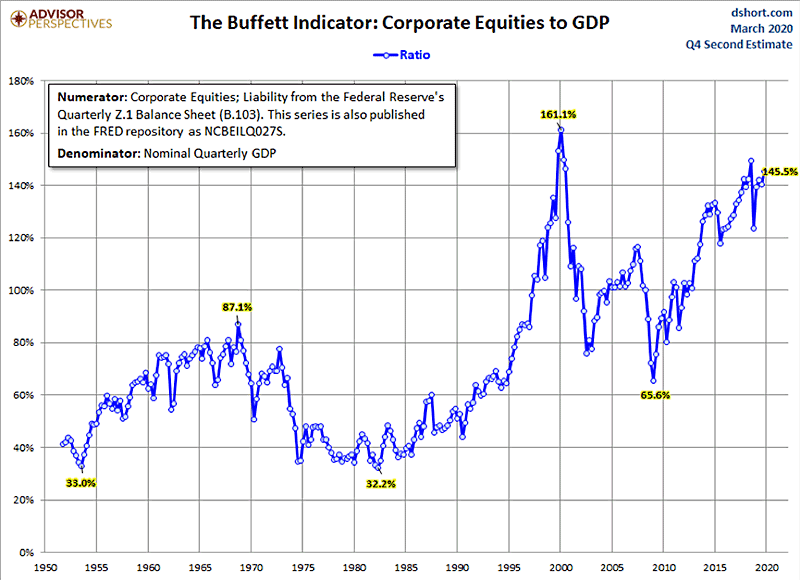
mid-February, the Wilshire 5000 Stock Index1 traded at approximately
145% to gross domestic product (GDP),2 its second highest level since
1950, and only slightly below the 2000 peak (see Figure 1). At this
writing, the ratio has fallen to 114% (as of 3/17/2020), which is still
very expensive by historical standards. Valuations are driven by
investor psychology, leverage and the liquidity necessary to support
leverage. All three may have been critically impaired for the near to
intermediate term.
Figure 1. Total U.S. Corporate Equities and U.S. GDP (1950-2020)
If financial assets struggle, interest in gold is very likely to
widen. Gold may have been caught up in the recent stampede for
liquidity, but it has delivered good relative performance on a
year-to-date basis; gold bullion is up 0.73% as of March 17, compared to
-25.17% for the S&P 500 Index.3 The 12-month figures (as of
3/17/2020) are even more impressive: gold has returned 17.19% vs. -8.54%
for the S&P 500.
On a peak-to-trough basis for the last few weeks, gold has declined
roughly 12%. Other safe haven assets have experienced the same pressure.
For example, the yield on 30-year U.S. Treasury bond rose from less
than 1.0% to 1.5% in only a few days, a drawdown of more than 30%. What
this shows is that quality assets will be sold by portfolio managers
desperate to reduce leverage. Low-grade assets cannot be sold quickly
enough to meet margin calls.
It was leverage that inflated valuations, not fundamental economic
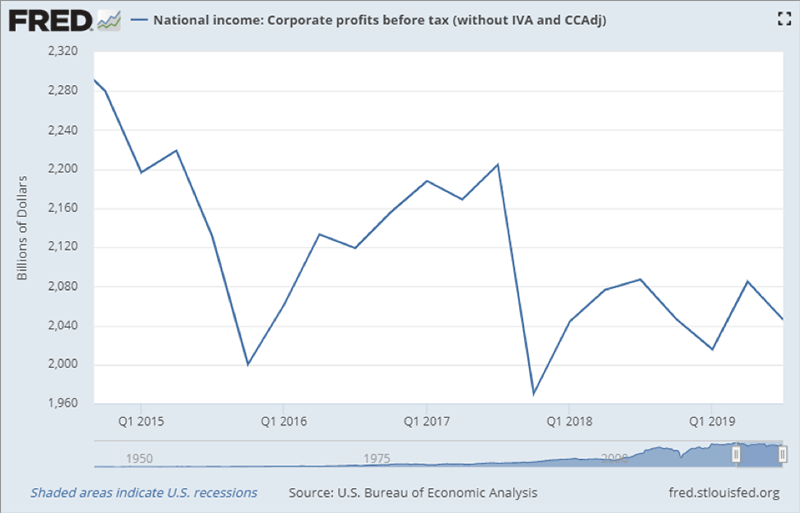
growth and strong year-over-year earnings. In fact, corporate pre-tax
profits have been declining since Q3 2014. Figure 2 shows pretax profits
on a quarterly basis since 2014.
Figure 2. U.S. Corporate Pre-Tax Profits Have Been Declining ($Billions)
The illusion of earnings growth that has captivated investor
psychology was achieved through share buybacks and increased leverage.
Growth of earnings per share, not the same as profit growth, has been
juiced by financial engineering. The same can be said for returns on
financial assets. The amount and location of leverage within the economy
and financial markets is opaque but may well have reached high tide for
many years. A post-recession economic recovery will not necessarily,
and does not have to, translate into strong returns from investing in
financial assets.
Global Debt Has Increased +100% Since 2007
In popular thinking, the current U.S. administration, or the one that
follows it, will pull every trick out of the bag to stimulate the
economy. This belief will likely excite investors from time to time in
anticipation of a rebound. Unfortunately, the financial markets are
experiencing a deflationary bust that could spread to general economic
activity. Public policy has all but exhausted the potential benefits of
resorting to traditional monetary and fiscal solutions. The marginal
benefit to economic growth from heaping on new layers of debt is capped
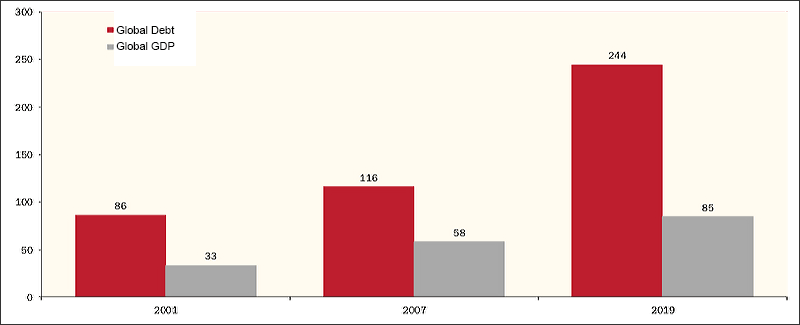
by the law of diminishing returns, as shown by Figure 4 from Rosenberg
Economics. Since 2007, global debt increased 110% vs. 46% for global
GDP:
Figure 3. Global Debt vs. Global GDP ($ Trillions)
Source: Rosenberg Economics. Data as of 12/31/2019.
Central banks have few conventional tools remaining to combat credit
deflation. An impotent response can be expected from new rounds of
monetary stimulus, rate reductions or central bank balance sheet
expansion. Global debt, public and private, measures 287% vs. global GDP
($244 trillion divided by $85 trillion). The debt burden will most
assuredly grow, a post coronavirus rebound notwithstanding. The world’s
debt structure is already incapable of withstanding even a minute rise
in rates. More debt relative to GDP will only make matters worse. All
that remains is currency destruction.
Gold has been rising for the past eighteen months side by side with a
strong stock market and no inflation. Conventional wisdom said that
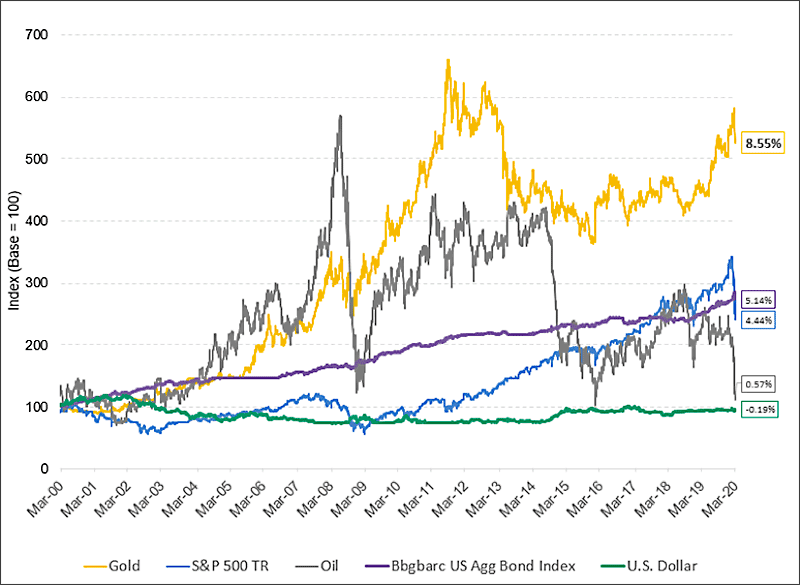
wasn’t supposed to happen. As shown in Figure 4, gold has outperformed
equities and bonds since 2000, the dawn of radical monetary
experimentation by central bankers. We think gold has been sensing the
endgame for Keynesian policy prescriptions, mainstream economic thinking
and hyper-leveraged investment practices.
Figure 4. The Modern Era of Gold Gold Bullion vs. Stocks, Bonds, Oil, USD (2000-2020)
For the period from 12/31/1999 to 3/16/2020, gold has provided posted
an average annual return of 8.55%, compared to 5.44% for U.S. bonds,
4.44% for U.S. stocks, 0.57% for oil and -0.19% for the U.S. dollar.
Source: Bloomberg. Period from 12/31/1999 –3/16/2020.4
Gold Miners are Poised to Perform
During the 1930s credit deflation, gold and gold mining stocks
performed well in relative and absolute terms. When credit deflates, and
counterparties cannot be trusted, gold is the ultimate safe asset. In
the 1930s, the metal price rose, costs of producing gold declined and
the miners generated strong earnings and paid handsome dividends. We
believe that this is a sequence that will repeat.
At the moment, mining company valuations appear extraordinarily
cheap. It is one of the few industries that will report solid
year-over-year earnings gains for the remainder of this year and perhaps
into the next.
Buying low is never easy but now is the time to do it.