Posted by AGORACOM
at 1:33 PM on Tuesday, December 3rd, 2019
Definitive distribution agreement to partner on the sale of Vertical’s wollastonite from its world-class St-Onge Deposit in place.
Supplying the fast growing cannabis and hemp industries.
Vertical’s high quality Wollastonite has been shown to be beneficial to cannabis plants in a variety of ways
In every case the most optimal results occurred with an admixture rate of 10% to 15% wollastonite to the growth medium.
The high-grade St-Onge Wollastonite deposit has pit-constrained mineral resources of: 7,155,000 tonnes Measured@ 36.20% Wollastonite & 6,926,000 tonnes Indicated@ 37.04%
B.C. Buds Testing Confirmed Wollastonite is critical to marijuana growers
Engaged AGRINOVA over the past year to conduct research and testing of Vertical’s St-Onge wollastonite on a range of important agricultural end uses.
WOLLASTONITE
St-Onge-Wollastonite Deposit located approximately 90 kilometres Northwest of the city of Saguenay, in St-Onge township, in the Saguenay-Lac-St-Jean region of Quebec, Canada.
Research and testing in the Phase 1 program for use in cannabis growth was managed and monitored by AGRINOVA, a highly-regarded Center for Research and Innovation in Agriculture in Quebec
Posted by AGORACOM-JC
at 11:33 AM on Tuesday, December 3rd, 2019
SPONSOR: BetterU Education Corp.
aims to provide access to quality education from around the world.
The company plans to bridge the prevailing gap in the education and job
industry and enhance the lives of its prospective learners by developing
an integrated ecosystem. Click here for more information.
Indian Edtech stands to unlock immense growth
Recent research suggests that the global Edtech market is expected to grow to USD 341 bn by 2025.
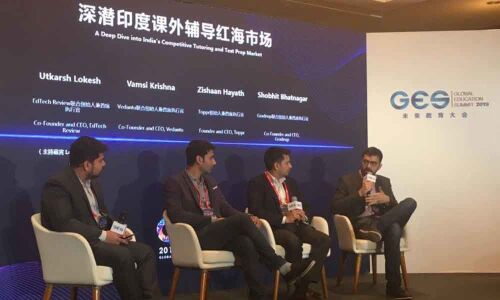
Armed with massive opportunities and ideas, global leaders in the Edtech sector recently came together at the 2019 Global Education Summit (GES) in Beijing.
Hans News Service
New
Delhi: As the global education ecosystem continues to grow and evolve
at a rapid pace, the space has witnessed an increase in the number of
Ed-tech players. Recent research suggests that the global Edtech market
is expected to grow to USD 341 bn by 2025. Armed with massive
opportunities and ideas, global leaders in the Edtech sector recently
came together at the 2019 Global Education Summit (GES) in Beijing. The
summit revolved around exploring effective solutions from diverse
perspectives, centered on the theme “Education for All”.
Representing
India were top Edtech players, Gradeup, Toppr and Vedantu, who shared
key insights on the test preparation and tutoring markets for
competitive exams in the country. Also Read – Rajya Sabha passes bill to
amend SPG Act, Amit Shah rejects charge of political vendetta, Congress
stages walkout China, which is the leader in the Edtech space, has made
significant strides by specifically focusing on student success and
effective tools for measuring learning outcomes.
Chinese
Edtech companies witness tremendous growth every year due to
improvements in sales and recruitment process, teacher’s training and
technological upgrades relevant to their offerings. By the end of 2019,
the Chinese Edtech market is expected to reach 41 billion, growing at a
rate of 20% annually. Also Read – Rajnath warns BJP MPs of Modi’s
dissatisfaction with absenteeism in Parliament.
India,
the Edtech market is expected to reach 1.96 billion by 2021, with test
preparation being the fastest growing category with a CAGR of 64%. The
current numbers are an indication that there is a lot to do and learn
for Indian Edtech players from the Chinese. Sharing his insights, on the
gap in Edtech markets in both countries, Shobhit Bhatnagar,
Co-founder–CEO, Gradeup said, “With a focus on student outcomes, Chinese
Live tutoring players have successfully been able to scale and innovate
over the last 3 years. There is a lot that the Indian Edtech landscape
can learn from this. This exchange has only reinforced Gradeup’s
commitment towards further driving live online classes and strengthening
our technology and product. We also plan to intensify our focus on
Student Success in order to ensure greater efficacy of learning
outcomes.”
The
2019 Global Education Summit saw the participation of over 200
representatives from the education, political and business sectors
sharing their insights on the future-oriented development of education.
The key focus was on facilitating greater inclusivity and equal access
to education.
The
development of the Edtech market in India and the success of existing
players will be largely driven by their focus on Live tutoring, with
student success and learning outcomes at the very core. Shaping and
realigning their delivery of Edtech content in a manner that is
tailor-made and suited to the country’s continuously evolving
educational landscape is the need of the hour. It will propel the growth
of the sector in the future, and further boost the goal of democratized
access to quality education for students pan-India. Gradeup is India’s
largest exam preparation destination. It helps more than 15 million
students prepare for various exams & score better. Established in
2015, it recently received $7 million in Series A funding from Times
Internet and total funding amounts to $10 million.
Posted by AGORACOM-JC
at 8:55 AM on Tuesday, December 3rd, 2019
Karlsruhe, Germany-based start-up ZANA Technologies GmbH entering into a business collaboration where CardioComm
ECG technologies to be tested within ZANA’s remote patient monitoring platform in 2020
Toronto, Ontario–(December 3, 2019) – CardioComm Solutions, Inc. (TSXV: EKG) (“CardioComm” or the “Company” or “CCS“), a global provider of consumer heart monitoring and electrocardiogram (“ECG“) acquisition and management software solutions, and Karlsruhe, Germany-based start-up ZANA Technologies GmbH (“ZANA“) confirm entering into a business collaboration where CardioComm’s GEMS™ ECG reviewing and HeartCheck™ ECG monitoring technologies are being evaluated to support ZANA’s novel, voice-directed, remote patient monitoring and patient management platform.
Through the use of deployable versions of the GEMS™ Mobile
Smartphone, the GUAVA ECG viewer and GEMS™ ECG management software, ZANA
will embed CardioComm’s ECG management technologies into its mobile app
and patient engagement platform. ZANA users will be able to download
one Smartphone app through which ECG recordings and clinical feedback
will be provided using ZANA’s cloud-based patient engagement platform
where CardioComm’s hospital ECG management software technologies will
have been incorporated.
ZANA has decided to partner with CardioComm Solutions and its
HeartCheck™ CardiBeat ECG device and GEMSTM software solutions to be
evaluated by multiple medical centres throughout Europe in ZANA’s bid to
become a preferred vendor for telemedicine solutions for monitoing a
patient’s post-hospital discharge. ZANA’s disruptive patient enagement
platform uses an intelligent, voice-/chat-based assistant with
interactive and learning technologies that permit home-based, continuous
health monitoring, designed to improve the health outcomes of its
patients. As patient ECG monitoring requirements evolve, CardioComm will
provide ZANA support in expanding the user’s access to other ECG
monitoring methodologies that may be requested as part of any
comprehensive physician-directed hospital discharge plan. This will
include the use of 12 lead ECGs and long-term continuous ECG monitoring
devices.
The companies will provide updates on the clinical testing results as
they become available. To learn more about CardioComm’s products and
for further updates regarding HeartCheck™ ECG device integrations,
please visit the Company’s websites at www.cardiocommsolutions.com and www.theheartcheck.com.
About CardioComm Solutions
CardioComm Solutions’ patented and proprietary technology is used in
products for recording, viewing, analyzing and storing
electrocardiograms for diagnosis and management of cardiac patients.
Products are sold worldwide through a combination of an external
distribution network and a North American-based sales team. CardioComm
Solutions has earned the ISO 13485:2016 MDSAP certification, is HIPAA
compliant and holds clearances from the European Union (CE Mark), the
USA (FDA) and Canada (Health Canada).
About ZANA
Zana Technologies GmbH is an award-winning digital health start-up
based in Germany that offers cutting-edge conversational AI and
wearables integration for remote health monitoring. The main product
offering is an intelligent voice assistant that establishes a direct
bridge between patients and doctors. The innovative remote care solution
is designed to improve and lower costs of post-operative and chronic
care. ZANA combines active conversation in natural language with
real-time monitoring through connected devices, all from the comfort of a
patient’s home through a Smartphone or smart home device. ZANA’s
backend collects and presents the monitored patient’s data through an
innovative dashboard system that updates doctors about their patient’s
health continuously and securely.
This release may contain certain forward-looking statements and
forward-looking information with respect to the financial condition,
results of operations and business of CardioComm Solutions and certain
of the plans and objectives of CardioComm Solutions with respect to
these items. Such statements and information reflect management’s
current beliefs and are based on information currently available to
management. By their nature, forward-looking statements and
forward-looking information involve risk and uncertainty because they
relate to events and depend on circumstances that will occur in the
future and there are many factors that could cause actual results and
developments to differ materially from those expressed or implied by
these forward-looking statements and forward-looking information.
In evaluating these statements, readers should not place undue
reliance on forward-looking statements and forward-looking information.
The Company does not assume any obligation to update the forward-looking
statements and forward-looking information contained in this release
other than as required by applicable laws, including without limitation,
Section 5.8(2) of National Instrument 51-102 (Continuous Disclosure Obligations).
Neither TSX Venture Exchange nor its Regulation Services Provider (as
that term is defined in policies of the TSX Venture Exchange) accepts
responsibility for the adequacy or accuracy of this release.
Tags: EKG, mhealth, small cap stocks, stocks, tsx, tsx-v Posted in CardioComm Solutions | Comments Off on CardioComm $EKG.ca Collaborates with ZANA Technologies GmbH to Integrate Mobile #ECG Management and Smartphone App Technologies #Mhealth $TLT.ca $OGI.ca $ACST.ca $IPA.ca
Posted by AGORACOM
at 3:30 PM on Monday, December 2nd, 2019
Sponsor: Affinity Metals (TSX-V: AFF) a Canadian mineral exploration company building a strong portfolio of mineral projects in North America. The Corporation’s flagship property is the Drill ready Regal Property near Revelstoke, BC. Recent sampling encountered bonanza grade silver, zinc, and lead with many samples reaching assay over-limits. Further assaying of over-limits has been initiated, results will be reported once received. Click Here for More Info
Slovakia joins a host of countries seeking to repatriate
Serbia, Poland and Hungary have boosted their bullion reserves
Gold is all that nationalist leaders in Europe’s east can talk about these days.
Just
this week, Poland’s government touted its economic might after
completing the repatriation of 100 tons of the metal. Over in Hungary,
anti-immigrant Prime Minister Viktor Orban has been ramping up holdings
of the safe-haven asset to boost the security of his reserves.
Viktor Orban Photographer: Akos Stiller/Bloomberg
The gold rush mirrors steps by Russia and China to diversify reserves exceeding $3 trillion away from the dollar amid flaring geopolitical tensions with the U.S. Motivations in Europe’s ex-communist wing, however, can vary.
Take the latest example. Former Slovak Premier Robert Fico, who has a shot at returning to power, urges parliament to compel the central bank into bringing home gold stocks stored in the U.K.
The reason? Sometimes your international partners can betray you,
Fico said, citing a 1938 pact by France, Britain, Italy and Germany
allowing Adolf Hitler to annex a chunk what was then Czechoslovakia, and
— more recently — the Bank of England’s refusal to return Venezuela’s gold stock over political differences.
“You can hardly trust even the closest allies after the Munich Agreement,†Fico told reporters. “I guarantee that if something happens, we won’t see a single gram of this gold. Let’s do it as quickly as possible.â€
His comments came despite the U.K. being one of
Slovakia’s closest allies after the Soviet empire crumbled, helping ease
the path to European Union and NATO. Fico said Brexit and the risk of a global economic crisis put Slovak gold stored in Britain in a dangerous situation.
The gold Poland brought back also came from the U.K., though
there was no questioning of Britain’s reliability by central bank
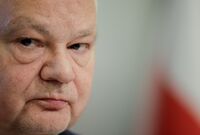
Governor Adam Glapinski.
Adam GlapinskiPhotographer: Piotr Malecki/Bloomberg
Instead, he said he wanted to demonstrate the strength of his nation’s $586 billion
economy — the largest in the EU’s east. Poland has doubled its gold
holdings in the past two years and now has the region’s biggest
stockpile.
Hungary, though, has been an active buyer too. Gold reserves
surged 10-fold last year, setting the clamor for the metal in the
countries around it in motion.
Serbia’s strongman leader
Aleksandar Vucic took note, ordering the central bank to boost reserves
and prompting the purchase of nine tons in October. Vucic said last week
that more should be bought because “we see in which direction the
crisis in the world is moving.â€
The biggest nation to emerge from
the breakup of Yugoslavia still keeps some of its gold abroad, the
central bank said by email. The region is buying more of the metal
because of global uncertainty over trade and politics, Brexit and low
interest rates, it said.
Romania had also sought to relocate some
of its gold reserves from the U.K., but those plans were put on hold
when the government behind them was ousted in October.
For the
no-nonsense leaders that have come to dominate eastern Europe, the main
benefit may be the message to voters that hefty holdings of the precious
metal conveys.
“Gold is a symbol,†said Vuk Vukovic, a political
economist in Zagreb. “When states purchase it, people everywhere see it
as a sign of economic sovereignty.â€
Posted by AGORACOM
at 2:30 PM on Monday, December 2nd, 2019
SPONSOR: Labrador Gold – Two successful gold explorers lead the way in the Labrador gold rush targeting the under-explored gold potential of the province. Exploration has already outlined district scale gold on two projects, including over a 40km strike length of the Florence Lake greenstone belt, one of two greenstone belts covered by the Hopedale Project. Click Here for More Info
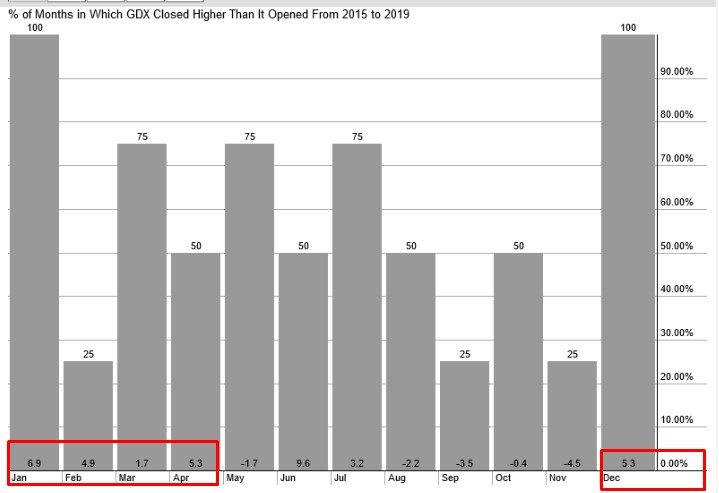
It’s that time of year again, tax selling in North America which
leads into a seasonally strong period there after for mining stocks.
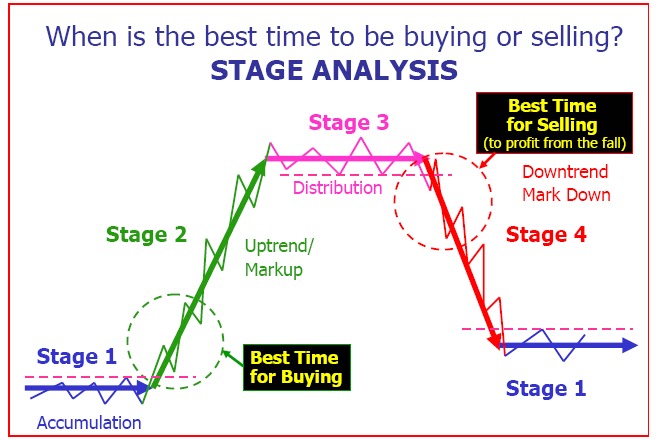
Today i’ll focus on strong potential set ups that are in a stage one
base, looking to move higher. Stage analysis example for those new to
that approach.
Source: Sprott
Historical data supports a strong move higher in Gold / Silver Miners in late Q4 into Q1.
Both $GDX mainly Gold miners and $SILJ both since 2016 bottoms, has lead into strong periods for the months ahead.
Looking at the big picture first in GDX. Built a base since the 2013 break down, which was retest in 2016 and mid 2018.
Current situation GDX in a large bull flag, building energy in a
possible attempt to retest 31usd GDX, and if it can break, not much
above resistance to 40usd GDX.
$SIL Silver Miners ETF Monthly showing similar though lagging price
action. Miners have lead Silver (see below). If 32-33usd is taken out, a
move into the 50usd+ level could come quick.
Gold and Silver
Gold broke out this year of a long term base, whilst Silver has
failed to take out 18.75ish on a weekly close thus far in 2019. Gold
moves has been strong, and after the peak at 1560usd, Gold miners has
continued to act well, indicating the consolidation in Gold and a
possibly upwards move is incoming. Watching to see if Gold will follow
the miners and break a flag to retest 1560usd.
Silver 18.75 weekly close and we will be looking at 20+ Silver. 2020
targets would show 24-26usd very possible thereafter. The way stocks
like $AG $PAAS have acted, could be a leading indicator.
Favourite leading set ups.
In no particular order, charts that are leading the sector, and have
strong bases and look set to push higher. I may miss a few, but these
set ups look solid. The longer the base, the higher in space as they
say.
$CNL #TSX Has broken out on shorter time frames. Up near 180% in 2019. Looking at the big picture in a large multi year base.
$TGZ #TSX Looking like a nice power, ready to break higher.
$AUY #TSX after a near 100% rise in 2019, has been basing despite
Gold pull backs. 3.80$ break out and could be ready to retest $6 2016
high.
$PRU #ASX #TSX Had an excellent 2019, rising from mid 30c to high of
95c AUD. 250k oz pa looking to double production to 500k+ in Africa.
Retesting 2013 levels, a break above 95c and nothing but air to 1.50$.
$KNT #TSX retesting all time highs, has been the best performing
producer, a killer move. Targets from brokers i have seen are up to
4.75$.
$SILV #TSX continues its uptrend and upward trajectory
$WDO #TSX Like Silver Crest, powers higher into new highs..
$SSRM #NYSE Solid numbers and growth. Base nearly complete and price action starts turning higher.
$EGO #TSX up 200% in 2019, building a nice flag here
$CDE #TSX Inverse H&S break out after earnings, pulling in for a
possible retest, completion of the move is 8.8$usd or 50% + circa.
$AG #NYSE Another power base from First Majestic Silver .. If Silver
runs to 24-26usd, perhaps this will outperform. The fact that Silver
peaked at 19.5usd and back to 16.50ish, AG held it’s own. Bullish price
action.
$PAAS #NYSE up 100% YTD, another strong Silver runner, making 52 week
highs and showing excellent relative strength. Cheap on a EPS basis.
$BTO #TSX B2Gold building a power base here too..
$WPM #NYSE Another strong Silver stock larger C+H in play.
Juniors to watch ..
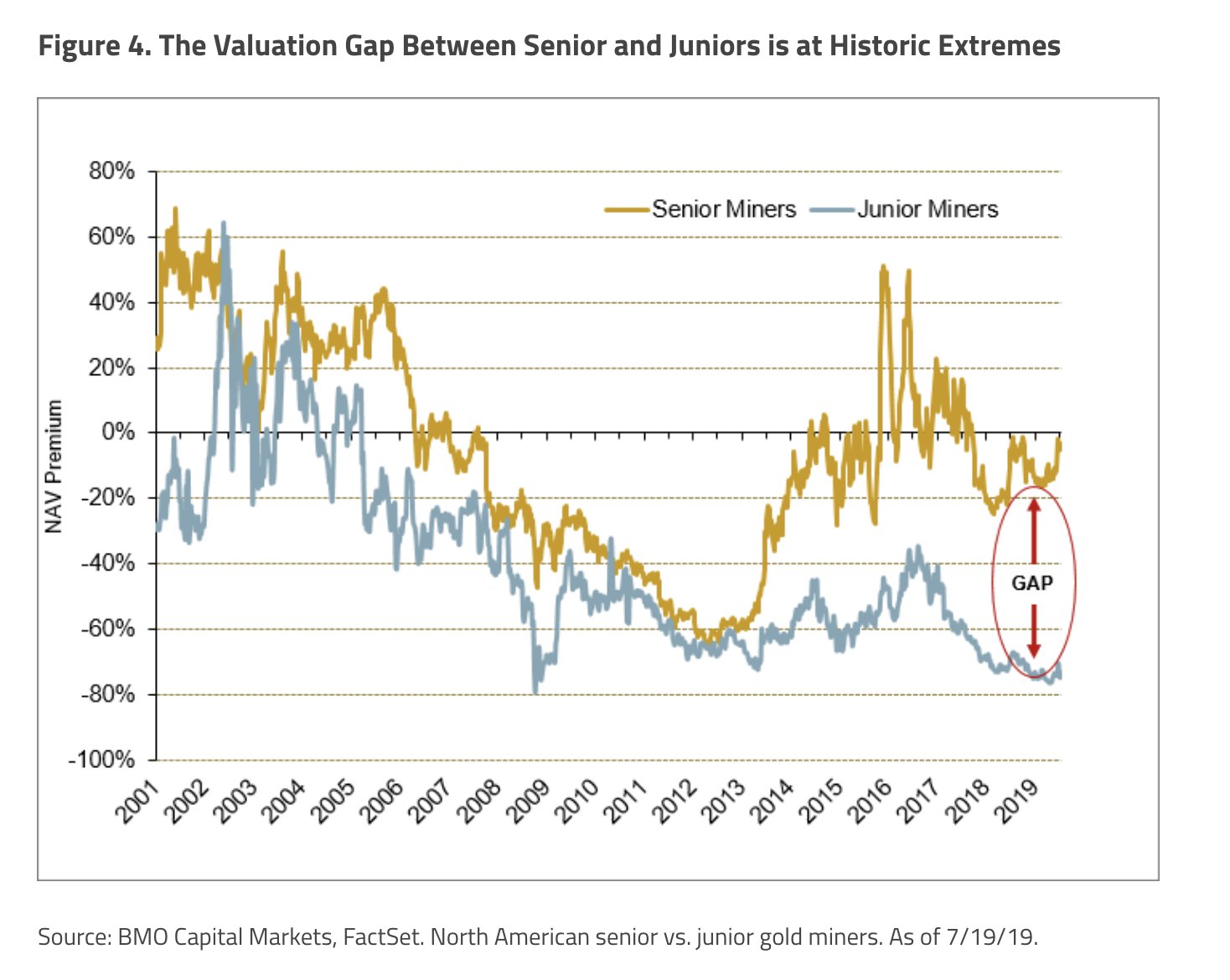
As producers have been the main beneficiary of this rally, i do like
mid cap development plays with solid management teams. The valuation
gap is one of the largest on record.
Source: Sprott
$GDX / $GDXJ ratio which has been in an uptrend for nearly a decade,
favouring large producers, looks to be testing break trend line. A break
down and we could see money moving to the development and exploration
plays that thus far have lagged.
Stocks to add to your watchlist, and ones i like. Charts don’t look pretty on some, but any rotation, and they will rally hard.
$Rio.v Rio2 5moz Chilean development play run by Legendary Alex Black. Potential double bottom.
$MZZ.ax Matador on the ASX is my favourite developer. Down the road
from $MOZ in Canada, trading at near 1/10th of the valuation, will be
producing before MOZ and a profile of 100kpa. Broker targets of 70c,
still in a stage one base.
$PRB Probe run by ex Barrick, with ahigh grade 2moz in Canada.
$AXU #Silver High grade Silver developer
$MAG Silver Tier one Silver Miner, fully funded to development
$NHK Nighthawk Solid LT exploration play, good buying in low 30s
$MKO Mako up 110% YTD, fully funded to production as well as finding and expanding resource with very high grade hits.
$ADT Needs no introduction up 700% since IPO in 2018. One of my
larger holdings, continues it’s solid uptrend, much more left in the
tank.
As you can see, the sector is strong and the set ups moving forward look favorable in this period especially using historical data. Judging on the price action, we continue to move higher into 2020. Have a good Christmas..
Posted by AGORACOM
at 11:25 AM on Monday, December 2nd, 2019
SPONSOR: Advance Gold AAX.v – Advance Gold controls 100% interest in the Tabasquena Silver Mine in Zacatecas, Mexico. A cluster of 30 Epithermal veins have been discovered, with recent emphasis on exploring a large anomaly to drill. Advance also owns 13.5% of the Kakamega JV attached to Barrick Takeover Offer for Acacia Mining. Click Here For More Info
Just 215.5 million ounces has been discovered in 41 discoveries over the past decade, compared with 1.72 billion ounces in 222 discoveries in the preceding 18-year period.
S&P Global Market Intelligence’s annual Gold Discoveries report found that gold exploration budgets peaked in 2012, but remain at historically high levels.
Explorers have allocated US$54.3 billion to gold exploration over the
past decade, 60% higher than the $32.2 billion spent over the preceding
18 years.
Despite the effort, just 215.5 million ounces has been discovered in
41 discoveries over the past decade, compared with 1.72 billion ounces
in 222 discoveries in the preceding 18-year period.
Over half of that amount is contained in just 10 discoveries, with
Zhaojin Mining Industry Co’s 16.4Moz Haiyu deposit in China the largest.
Other deposits in the top 10 including Barrick Gold’s Goldrush, White
Rivers Exploration/Harmony Gold’s JV, SolGold’s Cascabel and Cardinal
Gold’s Namdini.
S&P says that even after adjusting for more recently identified
deposits that might eventually surpass its threshold for a major
discovery, and for major discoveries with potential to expand, it
forecasts that the gold in major discoveries might only increase to
about 363Moz over the next decade.
S&P Metals & Mining senior research analyst Kevin Murphy said
previous research into gold lead times showed that it took about 20
years for an asset to advance from early exploration to production.
“This timeline implies that the reduced discovery rates of the last
decade will limit the pool of projects that could come online in 15 to
20 years,” he said.
“Unless discovery rates begin an upswing in the near future, there
could be a lack of quality assets available for development in the
longer term.
“The declining discovery rate shows the importance of continuing
exploration and funding companies responsible for exploration to
maintain a healthy future pipeline of assets available for development.”
Majors Barrick and Newcrest Mining reported declines in reserves this year.
Barrick’s reserves dropped to 64.4Moz from 86Moz, mainly due to
divestments and reclassification, while Newcrest’s dropped by 3Moz to
62Moz.
Newmont Mining’s remained unchanged at 68.5Moz, though the average grade fell by 5%.
Newmont has increased its 2018 exploration budget to US$350-400
million from $200 million last year, Barrick is boosting its spend to
$185-225 million from $149 million, and Newcrest is spending $70-90
million in FY18, up from $58 million.
Posted by AGORACOM-JC
at 11:25 AM on Monday, December 2nd, 2019
SPONSOR: BetterU Education Corp.
aims to provide access to quality education from around the world.
The company plans to bridge the prevailing gap in the education and job
industry and enhance the lives of its prospective learners by developing
an integrated ecosystem. Click here for more information.
Indian EdTech startup Credenc scores $2.5 million led by Omidyar Network to grow its education loans platform
Commenting on the funding, Mayank Batheja, Co-founder, Credenc, said, “Currently only 5% of the ~$50 billion annual spend on college tuition fee is financed by organised lenders.
We believe this penetration should be at least 15%,†to which Avinash Kumar, Co-founder added, “Our target segment consists of the top 10,000 colleges in India, and we would like to ensure that we are available for the top 10% of students from these colleges.â€
Getting student loans for higher education in developing countries is a daunting task. According to India-based EdTech startup Credenc, 30% of Indian students’ families sell assets to fund their education. 20% borrow from local money lenders at rates as high as 3% a month. Another 30% give up on a college education. Credenc is a new education technology startup on a mission to provide higher education loans to students in India.
The start-up has mapped 70,000 job roles across 50,000 companies in
India and developed a deep understanding of employability in India, to
change the status quo. After providing financial support, Credenc works
with students and helps them with employability services, handholding
applicants as they transition from student to professional life.
Today, Credenc announced it has raised $2.5 million(INR 17.8 crore)
in seed funding to expand operations to 1,000 colleges across 50 cities
over the next 2 years. Credenc also plans to hire across technology,
credit and banking partnerships. The round was led by Omidyar Network
India with participation from EMVC , Better Capital, and IIMK Alumni
Fund. Over the next 5 years, the startup plans to loan up to $0.5
billion.
Founded in 2017 by Avinash Kumar and Mayank Batheja, the Delhi,
India-based Credenc, works as the digital finance desk of 200+
management colleges across 17 Indian cities. To date, the startup has
approved loans of about $15 million (INR 100+ crore). With more than 200
loan requests a day, Credenc undertakes a rigorous evaluation process
using a proprietary AI model which tracks 15 million data points to
predict the future income of students applying for loans. Industry-wide,
approval for education loans can take up to 2 months, vis-a-vis Credenc
which qualifies applications within a fraction of that time.
Commenting on the funding, Mayank Batheja, Co-founder, Credenc, said,
“Currently only 5% of the ~$50 billion annual spend on college tuition
fee is financed by organised lenders. We believe this penetration should
be at least 15%,†to which Avinash Kumar, Co-founder added, “Our target
segment consists of the top 10,000 colleges in India, and we would like
to ensure that we are available for the top 10% of students from these
colleges.â€
The annual spend on college fees in India is US $50 billion or INR
3.5+ lakh crore, of which only 5% is financed by organised lenders. For
the USA, this figure stands at more than 60%. Credenc intends to change
the segment perception and reduce underwriting risk basis its future
employability score, which will help this percentage go up to 15%, as it
partners with more than 3,000 colleges in 100+ cities to build an INR
3,500+ crore loan book in the next 5 years.
“Credenc’ differentiated lending model provides financing to
deserving students, which helps them access post-secondary education and
get meaningful employment. Avinash and Mayank’s solution will help in
creating a level playing field for students from the Next Half Billion
population by making quality education more accessible. We see this
partnership as an opportunity to demonstrate that a highly impactful and
profitable business can be built in the large and untapped higher
education financing space,†said Sarvesh Kanodia, Associate, Omidyar
Network India.
Posted by AGORACOM-JC
at 10:46 AM on Monday, December 2nd, 2019
SPONSOR:ThreeD Capital Inc. (IDK:CSE)
Led by legendary financier, Sheldon Inwentash, ThreeD is a
Canadian-based venture capital firm that only invests in best of breed
small-cap companies which are both defensible and mass scalable. More
than just lip service, Inwentash has financed many of Canada’s biggest
small-cap exits. Click Here For More Information.
Why Germany’s Friendly Crypto Bill Is a Big Deal
In November, Germany became the leader of the free world where government acceptance of cryptocurrency is concerned.
In November, Germany became the leader of the free world where government acceptance of cryptocurrency is concerned.
That’s because last week, a bill was pushed forward by the Bundesrat,
the upper house of Germany’s legislature, that would allow German banks
to directly sell and custody cryptocurrencies for their clients as of
January 1st, 2020.
Next up the country’s 16 states will make a final decision on the
bill, though domestic analysts don’t expect resistance to the
legislation at the national level.
That means the way is paved for the bill to officially come into law,
a development that would mark a watershed moment not only for Germany
but also for cryptocurrencies in general.
Crypto Goes Mainstream in Heart of Europe
Germany is one of the largest economies in the world and the EU’s
most influential state. To that end, the country often sets the tone
economically and politically for many nations in Europe.
With its new crypto bill, Germany’s legislators are signaling to
their constituents and to the international stage that cryptocurrencies
are to be embraced, not rejected. This dynamic will make Germany
attractive to crypto projects around the globe who are interested in
having a base in a very pro-crypto country.
“Germany is well on its way to becoming a crypto heaven,†Sven
Hildebrandt, the lead consultant at major consulting firm DLC, said last
week.
In
extension, other European countries and beyond may follow in Germany’s
stead in passing ensuing waves of pro-crypto legislation. If in one
decade’s time more banks than not directly deal with cryptocurrencies,
German banks will have been the trailblazers.
Moreover, it cannot be overstated just how much Germany’s new
friendly crypto bill does to move in the direction of normalizing and
legitimizing cryptocurrencies as another avenue of mainstream finance.
If digital currencies do go on to become widely adopted global financial
tools, one could look back on Germany’s legislation as one of the
important dominoes that dropped along that way.
The passing of the crypto bill comes on the heels of the German government publishing a national blockchain strategy for the first time back in September. The strategy put the country on course toward becoming a hub for blockchain enterprises.
“Germany should be an attractive location for the development of
blockchain applications and investments in their scaling,†two
government ministries said in a joint announcement at the time.
Germany Is Epicenter for “Digital Euro†Movement
Just like the U.S. Federal Reserve and China’s central bank, Europe’s
top financial officials have taken serious notice of the
Facebook-backed Libra stablecoin project.
In response, some European leaders have called for tougher
restrictions on cryptocurrencies in general, though others yet have
argued the European Union should become a hub for crypto innovation.
In that latter camp is the Association of German Banks, a group of
200 private German banks that serve as finance industry lobbyists in the
EU’s biggest economy. Weeks ago, the association argued that Europe’s
major stakeholders to back the development of a digital euro that had smart contract capabilities, saying they would commit to supporting the effort:
“The German private banks will play their part in establishing a
sustainable and innovative monetary system. For this purpose, a
programmable account and crypto-based digital euro should be created and
its interoperability with book money ensured. The condition for this is
establishing a common pan-European payments platform for the
programmable digital euro.â€
The association’s plea for a digital euro came one month after German
Finance Minister Olaf Scholz should create its own public
cryptocurrency.
“We should not leave the field to China, Russia, the US or any private providers,†Scholz said.
Posted by AGORACOM
at 9:14 AM on Monday, December 2nd, 2019
Lomiko Metals Inc. (the “Companyâ€) (TSX-V: LMR, OTC: LMRMF, FSE: DH8C)
is pleased to announce that on November 29, 2019 it held its Annual
General and Special Meeting of Shareholders (the “Meetingâ€). A total
of 32,423,014 common shares (43.23% of the outstanding common shares)
were represented at the Meeting in person or proxy.
1.Number of Directors
The number of Directors to be set at four (4) was approved by
resolution passed by a vote by ballot with 26,771,300 (98.07%) total
votes cast “FOR†and 527,137 (1.93%) votes cast “AGAINSTâ€.
2. Election of Directors
Each of the following individuals were elected as directors of the
Company as approved by a vote by ballot, for a term expiring at the
conclusion of the next annual meeting of shareholders of the Company or
until their successors are elected or appointed, as follows:
Name
Votes “For†(%)
Votes “Withheld†(%)
A. Paul Gill
26,547,134 (98.07%)
751,297 (2.75%)
Jacqueline Michael
26,963,004 (98.77%)
335,427 (1.23%)
Julius Galik
27,048,046 (99.08%)
250,385 (0.92%)
Gabriel Erdelyi
27,047,530 (99.08%)
250,901 (0.92%)
3. Appointment of Auditor
The appointment of Dale Matheson Carr-Hilton Labonte LLP, Chartered
Professional Accountants, as the auditors of the Company, the
authorization for the directors to fix the remuneration to be paid to
the auditors and the change of auditors from Galloway, Botteselle &
Company, Chartered Professional Accountants, to Dale Matheson
Carr-Hilton Labonte LLP, Chartered Professional Accountants which became
effective February 8, 2018 was approved by a resolution passed by a
vote by ballot, with 32,380,390 (99.88%) total votes cast “FOR†and
39,557 (0.12%) total votes “WITHHELDâ€.
4. 2019 Stock Option Plan
The 2019 Stock Option Incentive Plan was approved by a resolution
passed by a vote by ballot with 26,107,574 (95.64%) total votes cast
“FOR†and 1,190,857 (4.36%) total votes cast “AGAINSTâ€.
5. Sale of Subsidiary
The sale of the Company’s wholly-owned subsidiary in accordance with the Business Corporations Act
(BC) to Promethieus Technologies Inc was approved by a special
resolution passed by a vote by ballot, with 21,079,430 (99.76%) total
votes cast “FOR†and 51,463 (0.24%) total votes cast “AGAINSTâ€. The
resolution was non-arm’s length transaction and 6,167,538 votes were
excluded from voting. Further to the Company’s press release dated
September 30, 2019 and November 25, 2019 shareholder approval has been
obtained to the transaction. The Company has been advised that the
closing of the sale is subject to a financing to be completed by
Promethieus Technologies Inc. of $3,670,750. Promethieus has advised
the Company that closing will be on or before December 31, 2019, subject
to regulatory approval.
6. Other Matters
At the first meeting of the newly constituted Board of Directors
held immediately after the Meeting, A. Paul Gill was elected to serve as
President and Chief Executive Officer and Jacqueline Michael as Chief
Financial Officer until the next annual general meeting of the Company.
The Board also elected Julius Galik, Gabriel Erdelyi and Jacqueline
Michael to serve as the Company’s Audit Committee until the next annual
general meeting of the Company.
For more information on the Company, review the website at www.lomiko.com, contact A. Paul Gill at 604-729-5312 or email: [email protected].
Posted by AGORACOM-JC
at 8:18 AM on Monday, December 2nd, 2019
Named as the Education Partner for the 17th Hindustan Times Leadership Summit taking place in New Delhi, India December 6-7.
betterU will be announcing the launch of its new B2B software-as-a-service (SaaS) Enterprise Skills Platform to an audience of over 800 senior politicians, bureaucrats, diplomats, business executives, thinkers, commentators and analysts
OTTAWA, Dec. 02, 2019 — betterU Education Corp. (TSX VENTURE: BTRU, Frankfurt: 5OGA) (the “Company” or “betterU“) is pleased to announce that it has been named as the Education Partner for the 17th Hindustan Times Leadership Summit taking place in New Delhi, India December 6-7. betterU will be announcing the launch of its new B2B software-as-a-service (SaaS) Enterprise Skills Platform to an audience of over 800 senior politicians, bureaucrats, diplomats, business executives, thinkers, commentators and analysts coming together to hold ‘Conversations for a Better Tomorrow’, which is a foundational theme of this year’s event.
Mr. Loiselle has been asked to share his thoughts on the challenges
and opportunities of continual reskilling and upskilling in corporate
competitiveness, and what emerging technology companies like betterU are
doing to address continual change and disruption. Mr. Loiselle will
demonstrate betterU’s breakthrough B2B SaaS Enterprise Skill Platform, which will be showcased throughout the event.
The Company is also pleased to announce that its B2B SaaS Enterprise Skill Platform
will be a global offering open to enterprise clients in both developed
and developing economies. betterU if offering special promotions to
companies with 50 to 50,000 employees who wish to immediately
participate as beta customers in advance of full commercial launch in
early 2020. betterU greatly appreciates the opportunity to contribute to
the 17th Hindustan Times Leadership Summit and to build awareness for
the Company’s breakthrough B2B SaaS Enterprise Skill Platform.
About betterU Education Corp.
betterU is an education-to-employment technology company offering an
end-to-end skilling solution using artificial intelligence and skill
automation designed for organizations who are seeking to skill, reskill
or upskill their talent.
betterU has curated and collaborated with over 100 global
organizations who has provided access to their content, technology and
support the developed of skills assessments/reassessments, learning
paths, and career development opportunities in betterU’s easy to use
integrated platform. betterU’s eco-system includes full job / skill /
employer / educational profile for essentially every country and every
city with detailed job profiles (automation, skills, employers, etc) for
3,000 standardized jobs. They have also added taxonomy for 30,000+
skills with clustering and hierarchy and 30,000+ educational
institutions and their individual programs mapped across Job / skill /
talent profiles for millions of companies globally. The collaboration
solution is the only way forward to solve mass skilling challenges for
employers and employees globally.
We are helping India build better companies by developing better employees.
CONTACT INFORMATION
On behalf of the Board of Directors, betterU Education Corp. Brad Loiselle, CEO