Posted by AGORACOM-JC
at 9:36 AM on Wednesday, October 23rd, 2019
When the Wall Street Journal calls your Gold Report “The Gold Standard Of Gold Research”, it is safe to say you are a global influencer and expert in all things gold.
This is Ronnie Stoeferle, whose “In Gold We Trust” report has also been downloaded 1.8 million times in English, German and Mandarin in case anyone had any doubt as to his expertise.
Today, Ronnie became the founding member of the Affinity Metals (AFF:TSXV) Advisory Board, which implies that we can expect others to be appointed as well. Why would Ronnie join a company with a market cap under $5,000,000? You’ll have to watch the interview to find out … but here are a couple of hints:
1. Affinity Metals flagship project, the Regal, has reported HISTORICAL reserves of 590,703 tonnes grading 71.6 grams per tonne silver, 2.66 per cent lead, 1.26 per cent zinc, 1.1 per cent copper, 0.13 per cent tin and 0.015 per cent tungsten. These were prepated prior to 43-101 standards and should not be relied upon until they are brought into compliance with 43-101 standards.
2. A Technical Report, which was prepared in 1971 using a silver price of $1.75 per troy ounce, makes a positive recommendation for production, including the establishment of a 500 ton per day concentrator with a 400 ton per day silver, lead and zinc circuit and a 100 ton per day tin, tungsten and copper circuit.
These are just 2 factors that led Ronnie to declare that Affnity Metals is “one of the largest investments in my private portfolio”.
Grab your favourite beverage, kick back and watch this great interview with both Ronnie and Affinity CEO, Rob Edwards.
Posted by AGORACOM
at 4:48 PM on Tuesday, October 22nd, 2019
SPONSOR: Advance Gold AAX.v – Advance Gold controls 100% interest in the Tabasquena Silver Mine in Zacatecas, Mexico. A cluster of 30 Epithermal veins have been discovered, with recent emphasis on exploring a large anomaly to drill. Advance also owns 15% of the Kakamega JV attached to Barrick Takeover Offer for Acacia Mining. Click Here For More Info
Fears of a Trans-Atlantic trade war have increased gold’s safety bid.
U.S. economic data also continues to attract safety seekers to gold.
All signs point to a continuation of the metal’s bull market in Q4.
After a brief respite last month, fear and uncertainty have returned
with a vengeance in October. Recent world events have given investors
plenty of reasons to fear an expansion of the global trade war.
Meanwhile on the domestic front, investors are becoming increasingly
alarmed by soft economic data which some interpret as a harbinger of
recession. Gold’s “fear factor†has thus been resuscitated, bringing
with it the promise of stronger prices in the months ahead. Here we’ll
discuss the growing number of variables which suggest gold is
consolidating its recent gains ahead of the next stage of its long-term
bull market.
One sign of a market controlled by the bulls is the steadfast refusal
of prices, following a correction, to stay down for long. Bull markets
have a tendency to consolidate gains achieved during extended rallies in
the form of a lateral trading range, or sideways drift. That appears to
be the form of gold’s most recent correction in September following a
productive three-month rally.
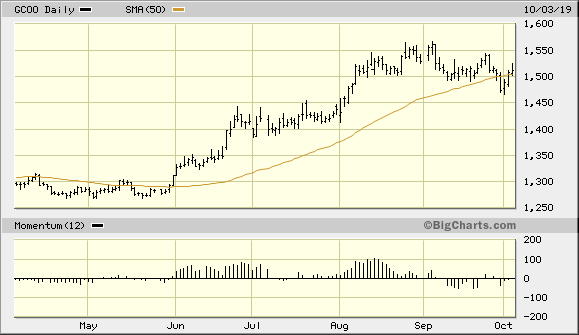
Although gold prices briefly violated a key short-term trend line
earlier this week, the bulls fought back fiercely and pushed prices back
above the widely, followed 50-day moving average within two days of the
violation. It may take several more days for gold to regain enough
strength and build the support necessary to stay above the 50-day MA.
But the signs are plainly evident that the bulls are clawing their way
back to controlling gold’s immediate-term (1-4 week) trend.
And while gold prices haven’t kept pace with its nearest competitor
in the rush to safety – namely U.S. Treasury bonds – it’s instructive
that gold has so far responded favorably to most of the latest negative
economic and political news. For instance, gold jumped nearly 1.5% on
Oct. 2 after the release of the latest ADP National Employment Report.
The report showed that private payroll growth by U.S. employers slowed
in September and wasn’t as strong in August as previously estimated,
according to a Reuters article. Reuters reporter Lucia Mutikani, capturing the sentiment which has overtaken many gold investors, observed:
The longest economic expansion on record, now in its 11th year, is
losing ground with the blame largely put on a 15-month trade war between
the United States and China, which has eroded business confidence.â€
It’s further believed by many investors that the growing signs of a
slowing U.S. economy could influence the Federal Reserve to further
lower its benchmark interest rate this fall. Lower rates are widely
regarded as bullish for gold since it reduces the competition vs.
interest-bearing assets for the non-yielding metal.
Elsewhere on the U.S. economic front, the recent disappointments in
the Purchasing Managers’ Index (PMI) is another reason for the revival
of gold’s fear factor. The PMI has now fallen for seven consecutive
months and is below 50.0, which indicates contraction in the manufacturing sector.
The latest disappointing PMI readings also have weighed heavily on
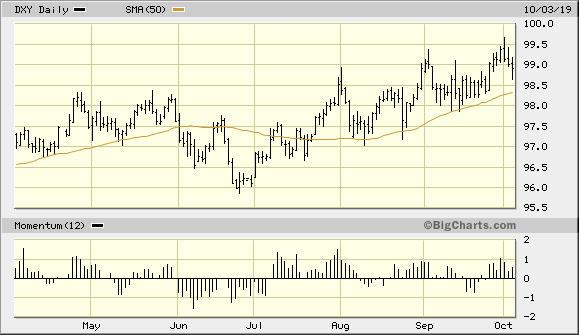
the U.S. dollar index (DXY) of late. The dollar fell to one-week lows
against the euro and yen on Oct. 3. However, the dollar index is still
close to a multi-year high, which means that gold doesn’t yet enjoy
support from its currency component (see chart below). Nonetheless, gold
has proven to be stalwart enough this year under the influence of the
fear factor alone and in spite of a strong dollar. Thus, a weaker dollar
isn’t necessarily a prerequisite for a Q4 gold rally.
Aside from a weakening manufacturing sector, the U.S. service sector
also is showing signs of slowing. The latest ISM survey released on Oct.
3 showed service-sector activity for September fell to its lowest level
in three years. Some analysts blamed the U.S.-China trade dispute for
the slowdown. The latest ISM Non-Manufacturing Index fell to 52.6 last
month as new orders fell more than expected. This disappointed
economists’ expectations of 55.3. This increased gold’s allure as a safe
haven in the eyes of many investors and should provide some underlying
support for the metal going forward.
In yet another development which bolsters gold’s safety bid, the U.S.
won approval on Oct. 2 from the World Trade Organization to levy
tariffs on $7.5 billion worth of European goods. The WTO’s decision
relates to illegal subsided given to Airbus (EASDF) and Boeing (NYSE:BA). Consequently, many investors fear the outbreak of yet another front in the ongoing global trade war.
In view of the above-mentioned factors, gold’s intermediate-term (3-6
month) upward trend looks secure. The only thing standing in the way of
a renewed immediate-term gold buy signal, however, is confirming
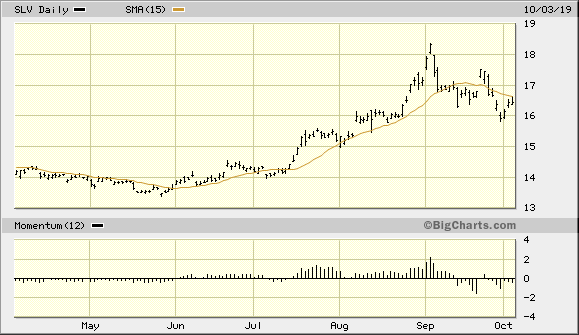
strength in gold’s sister metal. Silver remains below its 15-day moving
average, as can be seen in the iShares Silver Trust (ETF) below. As I
mentioned in a previous report, we need to see silver confirm gold’s
returning strength before we get a confirmed re-entry signal. A lack of
confirmation from silver normally means that gold’s rally will fail due
to the lack of institutional demand. Historically, when market-moving
institutional investors are bullish enough to buy gold, they usually buy
silver as an adjunct.
Another sign that should accompany gold’s next confirmed breakout is a
return to strength in the actively traded U.S. mining shares. Shown
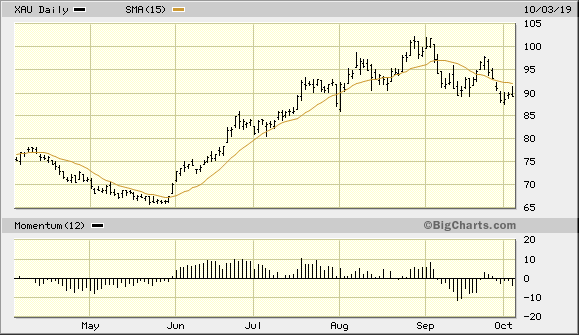
below is the PHLX Gold/Silver Index (XAU), which remains below its
15-day moving average as of Oct. 3. To get a renewed buy signal for gold
stocks in the aggregate, we should see a two-day higher close above the
15-day in the XAU. Moreover, a gold stock rally tends to accompany a
rally in bullion prices due to the leverage factor of the miners, which
attracts precious metals investors.
In summary, a growing number of worries on the U.S. economic and
global trade fronts has provided gold with a renewed safety bid. The
evidence reviewed here suggests that gold prices are consolidating ahead
of another breakout attempt this fall. Confirming strength in the
silver price would increase gold’s bullish prospects in Q4, as would a
breakout in the leading gold mining stocks. With trade war threats on
the rise, however, gold is poised to benefit from safe-haven demand and
keep its bull market intact. Investors are therefore justified in
maintaining longer-term investment positions in the yellow metal.
On a strategic note, I’m waiting for both the gold price and the gold
mining stocks to confirm a breakout before initiating a new trading
position in the VanEck Vectors Gold Miners ETF (GDX), my preferred trading vehicle for the mining stocks. I’m currently in a cash position in my short-term trading portfolio
22 samples collected from the Black Jacket and Allco areas of the Regal property located approximately 35 km northeast of Revelstoke, BC.
The majority contained bonanza grade silver, zinc, and lead with many samples reaching assay over-limits.Â
Further assaying of over-limits has been initiated, results will be reported once received.
Drill Program to be initiated upon final sample results.
Property History & Background
The property hosts numerous mineral occurrences including the following past-producing mines:
Snowflake and Regal Silver (Stannex/Woolsey) Mines
The Snowflake and Regal Silver mines were two former producing mines that operated intermittently during the period 1936-1953. The last significant work on the property took place from 1967-1970, when Stannex Minerals completed 2,450 meters of underground development work and a feasibility study, but did not restart mining operations. In 1982, reported reserves were 590,703 tonnes grading 71.6 grams per tonne silver, 2.66 per cent lead, 1.26 per cent zinc, 1.1 per cent copper, 0.13 per cent tin and 0.015 per cent tungsten (Minfile No. 082N 004 – Prospectus, Gunsteel Resources Inc., April 29, 1986). It should be noted that the above resource and grades, although believed to be reliable, were prepared prior to the adoption of NI43-101 and are not compliant with current standards set out therein for calculating mineral resources or reserves.
ALLCO Silver Mine
The Allco Silver Mine is situated 6.35 Kilometers northwest of the above described Snowflake/Regal Mine(s) and is also part of the Affinity claim group.
The Allco Silver Mine operated from 1936-1937 and produced 213 tonnes of concentrates containing 11 troy ounces of gold (1.55 g/t), 11,211 troy ounces of silver (1,637 g/t) and 173,159 lbs of lead (36.9%).
Airborne Geophysics to Guide Future Exploration
An extensive airborne geophysics survey conducted by Geotech Ltd of Aurora, Ontario, for Northaven Resources Corp. in 2011, identified four well defined high potential linear targets correlating with the same structural orientation as the Allco, Snowflake and Regal Silver mines. Northaven also reported that the mineralogy and structural orientation of the Allco, Snowflake and Regal Silver appeared to be similar to that of Huakan’s J&L gold project located to the north, and on a similar geophysical trend line. The J&L is reportedly now one of western Canada’s largest undeveloped gold mineral resources.
After completing the airborne survey, Northaven failed in financing their company and conducting further exploration on the property and subsequently forfeited the claims without any of the follow up work ever being completed. Affinity Metals is in the fortunate position of benefitting from this significant and promising geophysics data and associated targets.
The aforementioned Northaven airborne geophysical survey conducted at a cost of $319,458.95 in August of 2011 is described in The BC Ministry of Energy, Mines and Petroleum Resources Assessment Report #33054. The results of the survey are competently explained and illustrated by professionals on You Tube at: https://www.youtube.com/watch?v=GX431eBY_t0
FULL DISCLOSURE: Affinity Metals is an advertising client of AGORA Internet Relations Corp
Posted by AGORACOM
at 3:15 PM on Monday, October 21st, 2019
SPONSOR: Labrador Gold – Two successful gold explorers lead the way in the Labrador gold rush targeting the under-explored gold potential of the province. Exploration has already outlined district scale gold on two projects, including over a 40km strike length of the Florence Lake greenstone belt, one of two greenstone belts covered by the Hopedale Project. Click Here for More Info
The UAE is moving ton upon ton of physical gold through the nation, it makes up approximately 20% of all exports outside of oil.
China started something when they opened the Shanghai Gold Exchange where physical gold is traded to a global market. Russia began trading gold futures on the Moscow Exchange which was followed by China and Russia announcing they would open the BRICS Gold Exchange to assist the other members of the BRICS alliance to acquire more gold. This was followed by India stating they would be pursuing a gold spot exchange market and next up is the United Arab Emirates (UAE) announcing they, too, are going to open a physical gold trading platform. WOW! That’s a lot of physical gold changing hands on a daily, weekly, monthly and yearly basis.
This is all pointing towards what seems to be a likely conclusion – a new gold pricing mechanism that is operated by the Shanghai Gold Exchange instead of COMEX in Chicago and New York or the LBMA in London.
It seems that slowly and surely, the major gold producing nations of
Russia, China and other BRICS nations are becoming tired of the
dominance of an international gold price which is determined in a
synthetic trading environment which has very little to do with the
physical gold market.
The Shanghai Gold Exchange’s Shanghai Gold Price Benchmark which was launched in April 2016 is already a move towards physical gold price discovery, and while it does not yet influence prices in the international market, it has the infrastructure in place to do so. Source
Apparently, the UAE is already moving ton upon ton of physical gold through the nation
as it makes up approximately 20% of all their exports outside of oil.
That is an amazing percentage of business, especially, if you take into
account the fact the UAE either doesn’t mine gold at all or is not
mining a significant amount of gold.
The UAE will establish a federal platform for gold trading and the tracking of gold sources, the government has announced.
The move – approved by the UAE Cabinet – is part of a larger policy
to enhance the UAE’s position as a global hub for gold and jewellery
trading.
The policy has three main pillars – governance, sustainability and
innovation – with 10 separate strategic programmes and initiatives, also
including the establishment of a federal platform for gold trading and
tracking, international marketing of the gold sector, and the use of
technology in the production of gold.
Additionally, the policy will develop tools and initiatives that
stimulate growth “in order to facilitate doing business and bring added
value to this vital sectorâ€, according to the UAE’s state-run WAM news
agency.
The gold trade accounts for 20 percent of the UAE’s total non-oil exports. Source
All of this movement in the physical gold market started in
2002 and just a few years later we are seeing a massive network of gold
platforms outside the western world developing. China began
laying the ground work for a central pricing mechanism connected to each
new platform in 2016 when it launched the yuan denominated gold
benchmark for global trade.
What would happen if all these gold markets began connecting one
to the other and while trading gold in multiple currencies? What role
will these markets play, if any, once there is a sovereign gold backed
cryptocurrency announced? Will these other markets follow suit or will
the new sovereign cryptocurrency set the standard?
In my opinion this does not bode well for the COMEX, LMBA and western bullion banking cabal.
Not saying, or suggesting, there is an imminent “collapse†or anything
of the such, what I am suggesting is that we are seeing realistic steps
being made to move away from the global standard Federal Reserve Note,
U.S. dollar based pricing of gold.
Posted in All Recent Posts, Labrador Gold | Comments Off on Labrador Gold $LAB.ca – China, Russia, Brazil, India, And Now UAE: Everybody Wants A Gold Trading Platform $RIO.ca $WHM.ca $SIC.ca $NXS.ca
Posted by AGORACOM-JC
at 5:45 PM on Friday, October 18th, 2019
HPQ Silicon makes its strongest case ever for the lead it has taken in the commercialization of its’
Solar grade silicon;
Silicon wafers for Li-ion batteries
High purity silicon for high value niche applications;
Metallurgical grade silicon at prices the industry has never seen before;
More than just lip service that we have typically come to expect from 98% of small cap companies, the Company’s pilot plant is about to go live and produce test samples of silicon wafers for batteries and is supported by not 1 but 2 (TWO) world class technology partners that validate both the HPQ process and commercialization plan.
This is a powerful presentation that is worthy of your time to watch and learn about the rise of HPQ Silicon.
Posted by AGORACOM-JC
at 4:18 PM on Friday, October 18th, 2019
SPONSOR: Enthusiast Gaming Holdings Inc.
(TSX-V: EGLX) Uniting gaming communities with 85 owned and affiliated
websites, currently reaching over 150 million monthly visitors. The
company exceeded 2018 target with $11.0 million in revenue. Learn More
The Battle for Esports Dominance is on
As esports teams battle out in front of millions of fans online, companies are engaging in similar warfare as they look to lock up sponsorship deals with some of the most prized assets in the industry
This year, esports sponsorship revenue is projected to be the highest revenue stream at US$456.7 million, growing 34.3% from 2018 (NewZoo, 2019)
The race is on! As esports teams battle out in front of
millions of fans online, companies are engaging in similar warfare as
they look to lock up sponsorship deals with some of the most prized
assets in the industry. This year, esports sponsorship revenue is
projected to be the highest revenue stream at US$456.7 million, growing
34.3% from 2018 (NewZoo, 2019). As casual fans continue to tune into
extended amounts of esports content daily, businesses are beginning to
understand the value proposition that esports
presents; an industry that is ubiquitous, interactive and rapidly
growing. In turn, sponsors provide vast amounts of financial resources
that help transcend the nature of esports events, teams and players,
alike.
Top Sponsors in Esports
Intel (NASDAQ: INTC)
From producing CPUs to dabbling in the game, Intel has held the
longest sponsorship in esports with the Electronic Sports League (ESL).
The two companies announced a partnership in which they will invest
US$100 million towards esports initiatives to help the global growth and
expansion of esports. Intel also sponsors many large esports events,
including Intel Extreme Masters, ESL One, Intel Grand Slam,
Counter-Strike: Global Offensive Pro League and the LPL league.
T-Mobile (NASDAQ: TMUS)
T-Mobile is a telecommunications company that started sponsoring some
major teams very early. In 2017, T-Mobile was sponsoring both Cloud 9
and TSM, some of the largest esports teams in North America. Although
they no longer sponsor those teams, T-Mobile continues to make an impact
in the Overwatch League (OWL) by sponsoring the league and two of its
teams, the Houston Outlaws and New York Excelsior.
BMW (ETR: BMW)
BMW is switching gears in 2019 as it begins to watch the esports
landscape closely. The automotive company not only sponsored its first
esports team in 2019 in Cloud 9, but also partnered with Brazil’s paiN
Gaming in the same year.
Nike (NYSE: NKE)
It is hard to imagine a competitive environment in this world that
does not have Nike’s footprint. Nike treats esports the exact same way.
Nike supports esports athletes, such as Jain “Uzi†Zihao (Chinese League
of legends Pro), through endorsement deals and sponsors the Chinese
League of Legends Pro League, supplying the entire 16 team roster with
Nike apparel. Through these synergies, Nike hopes to create sportswear
catered to the esports audience and training programs for gamers to
improve.
SAP (NYSE: SAP)
In a data-driven age, where analytics are helping countless athletes
improve, it is only natural for electronic sports to follow the same
path. In 2018, SAP, a business software company, announced a three-year
sponsorship with Team Liquid to help improve the team’s performance
through innovation in data driven analysis. SAP will use its SAP Huna, a
business analytics platform, along with Team Liquid’s DOTA team’s
collaboration to help pioneer the first wave of deep game analysis. SAP
also sponsors large events, such as ESL and DreamHack, to provides these
live events with data analysis using its cloud platform.
As the arms race heats up for dominance in esports sponsorships, the
companies with established relationships with top tier teams and leagues
will have a strong first to market advantage. However, with the
centrality and fragmentation of the industry, there are still many
untapped pockets for new entrants.
The vast majority of esports companies, be in teams, franchises or
content plays, will be relying on corporate sponsorships to drive
revenue and these companies know, sponsorships are what will continue to
drive their valuations. This market is going to heat up and get way
more interesting.
Posted by AGORACOM-JC
at 2:17 PM on Friday, October 18th, 2019
SPONSOR:ThreeD Capital Inc. (IDK:CSE)
Led by legendary financier, Sheldon Inwentash, ThreeD is a
Canadian-based venture capital firm that only invests in best of breed
small-cap companies which are both defensible and mass scalable. More
than just lip service, Inwentash has financed many of Canada’s biggest
small-cap exits. Click Here For More Information.
IDK: CSE
Crypto Correlations Change As Ethereum Becomes Benchmark, and Bitcoin Analysis Today
An important change from Q2 is a gradual ‘flippening’ of Ethereum and Bitcoin.
As the #1 cryptocurrency began increasing its dominance, Ethereum became the benchmark asset for the rest of the market, with most cryptocurrencies showing higher correlation with it than Bitcoin.Â
The cryptocurrency markets are seeing a small retracement today. Bitcoin continues
its low-volatility trading around the $8,400-8,500 level, while
altcoins are still pulling back from their previous gains.
Notable exceptions are 0x (ZRX), Algorand (ALGO) and Chainlink (LINK), which gained 3%, 10% and 5% over yesterday respectively.
Cryptocurrency price dynamics on October 11, by Coin360
Correlations, correlations everywhere in crypto
A report by Binance Research
analyzed the relative performance of cryptos in Q3. As markets slid
downwards from their yearly high in the summer, large market-cap coins
did so in unison.
“Over the third quarter of 2019, the average correlation between
Bitcoin and most other large cryptoassets ​remained in line with the
previous quarter,†the report notes. “​However, the average
correlation among large cryptoassets increased in Q3 2019 with a
significant positive increase in the correlations of BNB, ChainLink, and
Bitcoin SV with other cryptoassets.
An important change from Q2 is a gradual ‘flippening’ of Ethereum and Bitcoin. As the #1 cryptocurrency began increasing its dominance,
Ethereum became the benchmark asset for the rest of the market, with
most cryptocurrencies showing higher correlation with it than
Bitcoin. But correlation with Ethereum Classic was surprisingly among
the lowest, amounting ‘only’ to 0.69.
The report also highlighted the significant correlation between XRP and Stellar, previously noted by Crypto Briefing.
Lastly, cryptocurrencies appear to be specializing in distinct
branches. Proof-of-Work assets such as Bitcoin, Litecoin and Bitcoin
Cash exhibited higher correlation between each other than median. The
same can be said for privacy coins such as Monero, Zcash and Dash, as
well as programmable blockchains including EOS, NEO and Ethereum.
But while some of these trends have a logical underpinning, the report cautions that the future is unknowable. “Yet,
past empirical results are not representative of the future of this
industry. Hence, it remains to be seen whether some of these findings
will repeat in the fourth quarter of 2019,†analysts conclude.
Daily Bitcoin Commentary With Nathan Batchelor
Bitcoin is under downside pressure as we head into the U.S trading
session, after the BTC/USD pair reversed sharply from just above $8,800
level earlier this morning.
Around $10,000,000,000 was wiped off the total market cap of the
entire cryptocurrency market in just under one-hour. Interestingly, the
total market cap of the cryptocurrency market hit its highest level in
two-weeks before reversing.
No apparent fundamental catalyst has been attributed to the news. The
only real bearish news is that one of the largest payment systems in
China, Alipay, has recently promised to ban all payments related to
Bitcoin.
From a technical perspective, traders will likely continue to fade
rallies until the market cap of the entire cryptocurrency starts to
trade comfortably above its 200-day moving average.
Traders are currently selling advances towards the $230,000,000,000
level, as it represents the 61.8 Fibonacci retracement of the September
monthly trading low to the September 24th swing-high.
As far as Bitcoin is concerned, the cryptocurrency is back under
short-term selling pressure while trading below the $8,500 level, with
its 200-day moving average currently located around the $8,660 level.
According to short-term technical analysis, the BTC/USD pair can
expect to find support from the $8,215 and $8,100 levels if the reversal
continues.
If there is a sustained loss of the $8,100 level, we should expect
short-term bulls to capitulate, leaving the door-open for further
decline towards the $7,715 level.
* ‘The weekly time frame is showing that a bullish falling
wedge is forming. A move away from the $9,780 to $7,500 price range will
trigger the pattern’. *
SENTIMENT
Intraday bullish sentiment for Bitcoin has fallen, to 51.50%,
according to the latest data from TheTIE.io. Long-term sentiment for the
cryptocurrency is unchanged, at 61.50%.
UPSIDE POTENTIAL
Buyers need to move price back above the $8,500 level to stabilize
the BTC/USD pair today. A multi-day price close above its 200-day moving
average is currently needing to encourage a technical test of the
$9,000 level.
The daily RSI indicator is starting to roll over and now trades below
40, while the Choppiness indicator on the mentioned time frame is
showing that the market is still lacking a strong trend.
DOWNSIDE POTENTIAL
The loss of the $8,500 level has encouraged traders to test towards
the $8,300 level. A loss of the $8,300 level later today may lead to a
key test of the BTC/USD pair’s weekly pivot point, at $8,100.
Extended intraday technical support for the BTC/USD pair is currently located at the $7,715 and $7,500 levels.
Posted by AGORACOM-JC
at 11:34 AM on Friday, October 18th, 2019
SPONSOR: Enthusiast Gaming Holdings Inc.
(TSX-V: EGLX) Uniting gaming communities with 85 owned and affiliated
websites, currently reaching over 150 million monthly visitors. The
company exceeded 2018 target with $11.0 million in revenue. Learn More
Visualized: The Esports Journey to Mainstream
Although esports might seem like a relatively new phenomenon, its origins can be traced all the way back to the 1970s.
It was only in the past decade however, that a wave of technological
innovation transformed the entire industry from an underground niche
into a billion-dollar mainstream phenomenon.
Today, the nascent esports industry competes with some of the biggest sports leagues
in the U.S., while global tech giants hastily invest billions of
dollars to make their mark in what many consider to be the future of
sports and entertainment.
How did it evolve into the industry we know today—and more importantly, will it maintain its furious pace of growth?
The History of Esports
Electronic sports (or esports), are organized, multiplayer video game
competitions commonly played by professional gamers. Since its
inception, the industry has continued to exceed expectations and reach
new milestones every decade.
Note: The timeline of events are an abridged version of major achievements in the industry.
1970s: The Birth of Esports
The earliest known video game competition—the Intergalactic Spacewar Olympics—took place in 1972 at Stanford University. The winner of the event received an annual subscription to Rolling Stone magazine.
While it was a modest first prize for the industry, it would set a foundation for future prize pools in the millions of dollars.
1980s: More Gaming Options
The 1980s ushered in better consoles for esports. The Nintendo Entertainment System (NES) took graphics, controls, gameplay, and video game accessibility to the next level.
Five years later, the Sega Genesis console was released in the U.S. and Japan to compete with Nintendo—which held a 95% market monopoly at the time.
1990s: The First Tournaments
Nintendo increased its commitment to esports by hosting the Nintendo World Championships.
After touring 30 cities in the U.S., the finals challenged players to
games like Super Mario Bros. and Tetris, with a 40-inch TV awarded to
the winner.
Developers and gaming entrepreneurs created a flurry of leagues, including QuakeCon in 1996, followed by both the Cyberathlete Professional League (CPL) and the Professional Gamers League (PGL) in 1997.
In just a few years, these competitions helped esports gain significant traction.
2000s: The Explosion of Esports
Esports fully burst into the mainstream with Amazon’s acquisition of Twitch for $970 million
in 2014. The live video game streaming site gave esports a platform to
reach previously unthinkable heights, with popular games like League of Legends (LoL) and Defense of the Ancients 2 (Dota) receiving millions of views.
In 2019, Google followed suit with its Stadia
streaming service. The cloud-based video game platform aims to eliminate
the need for hardware, allowing Google to aggressively compete in the
esports space.
A Snapshot of Esports Today
The increasing involvement of developers and global tech giants has
not only increased the audience size of esports—it has also led to
bigger prize pools, and larger scale competitions across the world.
Demographics: 50% of esports viewership now comes from Asia.
Engagement: 6 billion hours were dedicated to watching esports in 2018, and will continue to grow to 9 billion by 2021.
Buy-in: The price of one of the 12 Overwatch League teams for sale in 2017 was $20 million.
Incentives: The Fortnite competition prize pool for the 2018 season was $100 million—equal to the entire esports prize pool in 2017.
It’s clear that esports continues to attract rapidly growing
audiences at an unprecedented rate. However, there are still significant
barriers inhibiting the industry from reaching its full potential.
The Future of esports
In order to maintain its furious pace of growth, the esports industry must first address five key challenges:
Diversity of game genres: The industry will need to produce more game genres in order to appeal to a wider audience outside of its current player base.
Geographic expansion of leagues: esports will need to
expand to national, regional, and global levels if it wants to tap into
bigger advertising budgets. However, while esports gains attention from
global media, local events are more difficult to organize.
Regulation of competitions: With multimillion-dollar prize pools at stake, new rules and regulations are needed to combat cheating and match fixing.
Ownership of media rights: Content rights have not been a focus for publishers, as fan-generated content has served as free advertising for their games.
Media alignment: Traditional media brands are still
reluctant to associate themselves with esports, as prejudices against
competitive gaming still exist. For example, gaming culture is viewed as
a harmful distraction, rather than a legitimate sport.
In less than 50 years, esports has evolved into a dominant form of entertainment today, eclipsing film and music industries
by a wide margin. With an increasingly mainstream audience, the
industry’s popularity and profitability shows no signs of slowing
down—despite the challenges it faces.
Posted by AGORACOM
at 11:07 AM on Friday, October 18th, 2019
(APPB:OTCQB)
Key Management Appointments:
Raymond W. Urbanski MD, PhD, former business unit Chief
Medical Officer at Pfizer Inc., as Chief Executive Officer provides
extensive industry leading expertise, strategic focus and discipline on
the execution of corporate initiatives
Expanded its Scientific Advisory Board for Applied BioPharma Division with appointment of Patricia Reggio, Ph.D.
Corporate Highlights
Renewed strategy focused on leveraging endocannabinoid system to develop high-value products including
Biopharmaceuticals: goal to develop novel therapeutics to treat serious diseases across a range of therapeutic areas, including metabolic, peripheral neuropathy and progressive lung disease
CBD Products: multiple brands offering high-quality CBD products to the highest regulatory standards;
Bolstered leadership team with highly qualified individuals including Raymond W. Urbanski MD, PhD, as Chief Executive Officer, former business unit Chief Medical Officer at Pfizer Inc. and well-established industry leading expert with over 20 years of experience in clinical development, research and pharmaceutical industry expertise across oncology, cardiology, endocrinology, and immunology;
Appointed Martin Schroeder to the Scientific Advisory Board and as President of Applied BioPharma. Mr. Schroeder has over 30 years of experience in the pharmaceutical and biotech industries and has helped many biotech and pharmaceutical companies conduct search and evaluation of compounds and molecules;
Launched multiple new products and expanded into the Beverage and Health / Wellness category with Remedi Spa and Remedi Beverage and Shot
Commenced discussions regarding proposed scientific trials with two leading Universities specializing in Veterinary Medicine
Announced the acquisition of Trace Analytics with over 65 years of combined experience in the global testing market for Cannabis and Hemp
Partnered with Boxing Heavyweight Champion, Shannon “The Cannon†Briggs to launch Champ Organics, an athlete-focused cannabidiol (“CBDâ€) based health and wellness supplements product line that enhances training and recovery
Launched robust business development initiative to build biopharmaceuticals pipeline.
About Applied BioSciences Corp. Applied BioSciences Corp. (www.appliedbiocorp.com), is a diversified company focused on multiple areas of the medical, bioceutical and pet health industry. As a leading company in the CBD and Pet health space, the company is currently shipping to the majority of US states as well as to 5 International countries. The company is focused on select investment, consumer brands, and partnership opportunities in the recreational, health and wellness, nutraceutical, and media industries.
About Trace Analytics Inc. Trace Analytics Inc.
is a leading cannabis science and technology company with significant
footprints in lab testing, research and development and licensing. Trace
Analytics was started by a group of scientists who specialized in
analytical chemistry, genetics and molecular biology. The focus of the
team is to ensure compliance with public safety standards and end user
safety. Trace Analytics is in the process of expanding throughout the
United States, and globally. With the goal of helping the rest of the
world adopt “best practices†in cannabis and hemp testing, the company
also provides expert consulting services to legislators and regulators
in many countries, states and municipalities around the world. For more
information, please visit: http://traceanalytics.com
Posted by AGORACOM-JC
at 10:26 AM on Friday, October 18th, 2019
SPONSOR: NORTHBUD (NBUD:CSE)
Sustainable low cost, high quality cannabinoid production and
procurement focusing on both bio-pharmaceutical development and
Cannabinoid Infused Products. Learn More.
NBUD: CSE —————————–
‘It is quite amazing’: CBD oil entering the mainstream
Some people are infusing the cannabis extract in cocktails, others
are buying it in the form of dog treats, while many more are using it as
a form of pain relief.
Unlike tetrahydrocannabinol, the psychoactive extract of the cannabis
plant commonly known as THC, cannabidiol doesn’t cause users to get
high.
And it is legal in the UK, assuming it does not contain one part in 10,000 of THC.
“When I first got involved with CBD I wanted to know what it was all
about,†says Richard Butler, part of the management team at CBD Virtue,
between Bridgnorth and Wolverhampton.
“It is still new in the UK.â€
Some of the products
His company uses CBD to make products such as tablets, oils, body creams and balms.
Mr Butler says people are turning to CBD products to alleviate
symptoms from physical ailments like pain and inflammation as well as
mental ones like anxiety and depression.
At present, use of the oil is largely unregulated, and clinical
trials into its usefulness are ongoing, but Mr Butler says he has
witnessed its benefits.
“You learn more from the responses and feedback you get from
customers,†he says. “It helps with pain relief, mental issues,
anxieties.
“It also helps with eczema, psoriasis and acne – it is quite amazing actually.
“A lot of our initial customers were 40 plus and many were buying products for the younger generation.
Dean Burke using a CBD Pod Filler at CBD Virtue
“What has amazed me is the amount of depression and anxiety that exists among teenagers up to people in their late 20s.â€
CBD oil, its proponents say, offers numerous benefits, from pain
relief to reducing anxiety. As an anticonvulsant, it may also help treat
neurological disorders such as epilepsy and multiple sclerosis.
CBD is also one of the biggest buzzwords in food and drink. It has
been hailed the next big thing, with more and more chefs and producers
using the products in their recipes.
After already taking other countries by storm, more businesses in the UK are looking to tap into the market.
Ross Burke viewing the product range at CBD Virtue
Mr Butler insists he has seen some significant success stories of people using the product for remedial purposes.
“I know someone who suffered with Parkinson’s for years who every
time they woke up their whole body would be shaking and during the day
they would shake out of control,†he says.
“I said ‘try this’ and within two weeks they went from their whole
body shaking to feeling a slight twitch in their first finger and thumb.
“I am not allowed to say it cures cancer, but cancer sufferers are
using it. There was someone who had skin cancer and it helped clear up
blisters on their skin.
“My partner was on a lot of medication for various things and after
taking four or five drops a day her stress and anxiety has gone.â€
The product’s relationship to recreational cannabis also means that
some people are reluctant to accept its use, and the medical benefits it
provides have still to be proven beyond doubt.
But Mr Butler insists that the hemp-derived oil should be trusted.
“It is from a natural product that has been around for years,†he
says. “Initially people were sceptical because it relates to cannabis.
Yes, it is derived from cannabis plant, but the ‘high’ has been removed
with the remedial side left behind.
The management team at CBD Virtue: Dean Burke, Richard Butler, Shannon Fyfe and Ross Burke
“We had the over 50s saying ‘ yeah but it’s cannabis, it’s cannabis’,
but once you have explained to them they are willing to try it.
“A big part of my role has been educational. I would spend about two
hours a day on Facebook educating people and answering a lot of
questions.
“Initially it is getting people to try it, then after they see how
effective it is they speak about it to their friends and family – a lot
of it comes down to word of mouth.â€
The plant is grown in Colorado in the USA, and a powdered form of the
product is sent to the UK for the oil to be extracted by Richard’s
team.
CBD Virtue employs 16 people, and is looking to double that by moving to larger premises to cope with demand.
Richard says: “We have a lab which is about 15ft by 20ft where a lot
of our mixing is done. We also have another facility where we do the
bottling up and everything else.
Jean Price packing up an order at CBD Virtue
“We are looking for larger premises due to growing demand and want to
stay local. We employ 16 people and with the way things are going we
are looking to double the workforce.â€
Sales of products containing CBD have skyrocketed by 99 per cent in the UK, according to data.
Analysis by deals firm Wowcher suggests purchases of CBD products
have almost doubled in 2019, with an increasing number of Brits trying
the ingredient.
“The industry is exploding,†Mr Butler says. “Initially as a company
we had a slow start with various issues with banks and online payment
systems, but we have got more and more people on board who know how to
get around these things.









/arc-anglerfish-arc2-prod-expressandstar-mna.s3.amazonaws.com/public/XKKDHKP3URDY3HGQCBZ7IW7VG4.jpg)
/arc-anglerfish-arc2-prod-expressandstar-mna.s3.amazonaws.com/public/FADZEWOJW5EELAWPXPCO5CDF2M.jpg)
/arc-anglerfish-arc2-prod-expressandstar-mna.s3.amazonaws.com/public/CTBXICXT2JAIHGAEBOJAYDBKHI.jpg)
/arc-anglerfish-arc2-prod-expressandstar-mna.s3.amazonaws.com/public/63FXYS7YLRHG5F2TVZ3LUKXRTA.jpg)
/arc-anglerfish-arc2-prod-expressandstar-mna.s3.amazonaws.com/public/7JARTRK4DRHSNIG2D3QSXVQJBE.jpg)