Posted by AGORACOM
at 9:25 AM on Wednesday, September 11th, 2019
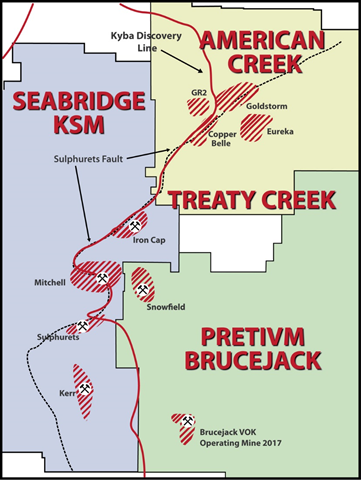
The drilling success at American Creek’s Treaty Creek property in BC’s Golden Triangle is showing the potential to give shareholders the type of return experienced by investors in the neighbouring Seabridge KSM a decade ago. Treaty Creek’s Goldstorm deposit is producing world class results including 563m of 0.98 g/t gold and the most recent hole; a 780 meter intercept of 0.683 g/t gold including a high grade upper portion of 1.095 g/t over 370.5 meters. There are some distinct advantages that the Goldstorm has over the KSM which puts American Creek in a uniquely undervalued position within the area.
3 Critical Factors Highlight Treaty Creek Advantage Over KSM:
Treaty Creek Similarities to KSM:
Part of the same Sulphurets Hydrothermal System that contains a mind boggling 188M oz gold, 1.2B oz silver and 55B lbs of copper (all categories) to date (P&P reserves of 47M oz Au, 214M oz Ag, and 10B lbs Cu)
Same trend – deposits occur about every 2-3 km going north with gold grades increasing as the system extends northward – The Goldstorm zone on Treaty Creek is the most northerly deposit
Same Sulphurets thrust fault which Seabridge states was responsible for the KSM deposits – same type of mineral formation beneath the fault
Same types of world-scale deposits (Porphyry and intrusion related) on both properties
Large deposits are found near the red “discovery line†and the Sulphurets fault
2. Treaty Creek Advantages over KSM:
Better logistics – Treaty Creek is located on “the right side of the mountain†with direct access to power and highway leading to the shipping port
Potentially better grades with initial estimates of 1.25 g/t Au at the Goldstorm / Copper Belle Deposit
Potential open pit design requiring a fraction of the capital cost of KSM with a shorter pay back period
Unlike the KSM which consists of copper deposits with low-grade gold, Goldstorm is a gold deposit and does not rely on the value other metals
At the discovery stage of the mining life-cycle where biggest gains are typically made. AMK offers considerable more shareholder upside with each ounce added compared to KSM.
3. KSM dependence on Treaty Creek:
KSM is dependent on twin 22.8km tunnels (MTT), of which 12.2km lies within the Treaty Creek mineral tenures, to get KSM ore to a proposed processing facility and tailings pond
The proposed route for the MTT runs through Treaty Creek in the same general location as the following:
The Kyba Discovery Line – a major geological marker for large deposits
The Sulphurets thrust fault – a major geological marker for large deposits
Geoclastic sequencing – a major geological marker for large deposits
Magnetotelluric anomalies indicating potential large mineral deposits
Magnetic anomalies indicating potential large mineral deposits
American Creek has already increased close to 300% since spring and yet only the initial results from the Goldstorm have come out. Based on the geology, geophysics, and results so far it looks as though things have just started for the company. A major drill program is presently being conducted at Treaty Creek by JV partner and operator Tudor Gold. There are now two drills working on the Goldstorm zone with the objective of defining a significant maiden gold resource. The last hole reported included a 780 meter intercept of 0.683 g/t gold including a higher grade upper portion of 1.095 g/t over 370.5 meters. The Treaty Creek Project is a Joint Venture with Tudor Gold owning 60% and acting as operator, with American Creek holding a 20% interest in the project. American Creek is fully carried until such time as a Production Notice is issued. Until such time, Tudor is required to fund all exploration and development costs while American Creek has a “free rideâ€.
For further information please contact Kelvin Burton at: Phone: 403 752-4040 or Email: [email protected]. Information relating to the Corporation is available on its website at www.americancreek.com
Hub on Agoracom FULL DISCLOSURE: American Creek is an advertising client of AGORA Internet Relations Corp.
Posted by AGORACOM-JC
at 8:25 AM on Wednesday, September 11th, 2019
Payment made seven months ahead of schedule to acquire 100% economic ownership of largest female online gaming community
Completed, ahead of schedule, the deferred payment obligation related to its previously announced acquisition of the assets of The Sims Resource
The payment satisfied all obligations of the acquisition of TSR from Generatorhallen AB and IBIBI HB, which closed on April 12, 2019.
Toronto, Ontario–(September 11, 2019) – Enthusiast Gaming Holdings Inc. (TSXV: EGLX) (“Enthusiast Gaming” or the “Company“) is pleased to announce that it has completed, ahead of schedule, the deferred payment obligation related to its previously announced acquisition of the assets of The Sims Resource (“TSR“). The payment satisfied all obligations of the acquisition of TSR from Generatorhallen AB and IBIBI HB, which closed on April 12, 2019.
TSR is the world’s largest female online video gaming content and
community destination, offering custom content built around the popular
Sims™ video game franchise, which can be downloaded by users to alter
and/or expand gameplay. TSR fans generated over 2.5 billion page views
last year, while the property earned C$7 million revenue – split between
advertising and recurring monthly paid subscribers – and C$5.25 million
in Adjusted EBITDA. Since Enthusiast Gaming closed the transaction with
TSR in April 2019, the number of monthly subscribers has grown nearly
30%.
Enthusiast Gaming utilized part of the available capital proceeds
from its recent merger with Aquilini GameCo. and Luminosity Gaming to
pay down the deferred payment obligation ahead of schedule and unlock a
number of strategic and economic benefits including:
Increase the number of leading video media and content sites under
full ownership. Full ownership and integration allows Enthusiast Gaming
to implement an optimized advertising and content strategy to increase
revenue and gross margin.
Ability to leverage paid subscription models across the Enthusiast Gaming platform.
Unlocks an additional 70% of the EBITDA that had previously been returned to the Vendors, seven months early.
Highly accretive use of cash proceeds following the completion of merger with Aquilini GameCo.
TSR management and content creators have joined the Enthusiast Gaming team and are excited to manage the next phase of growth.
Menashe Kestenbaum, President of Enthusiast Gaming commented, “Paying
down the deferred payment ahead of schedule to TSR was an extremely
important first step for the new Enthusiast Gaming. Having 100% economic
and strategic control of TSR provides significant upside potential to
increase our revenue/user and value/user – two key metrics for
Enthusiast Gaming moving forward.” He continued, “Two of our
primary growth opportunities include driving revenue through direct
sales and adopting monthly, paid subscriber models across our network of
video game media sites. Since we announced the acquisition of TSR, we
have already seen steady growth of its subscriber base and it will be a
key factor in achieving success across both key metrics.”
About Enthusiast Gaming
Enthusiast Gaming is one of the largest vertically integrated video
game and esports companies in the world. The Company’s digital platform
includes +85 gaming related websites and 900 YouTube channels which
collectively reach 150 million visitors monthly. Enthusiast’s esports
division, Luminosity Gaming, a leading global esports organization
consists of 8 professional esports teams under ownership and management,
including the #1 ranked Overwatch team, the Vancouver Titans and over
50 gaming influencers with a total audience of 60 million followers.
Collectively, the community reaches over 200 million gaming enthusiasts
on a monthly basis. Enthusiast also owns and operates Canada’s largest
gaming expo, Enthusiast Gaming Live Expo, EGLX, (eglx.ca) with approximately 55,000 people attending in 2018. For more information on the Company, visit www.enthusiastgaming.com. For more information on Luminosity Gaming, please visit luminosity.gg
CONTACT INFORMATION:
Investor Relations: Julia Becker Head of Investor Relations & Marketing [email protected] (604) 785.0850
Forward-Looking Information
Certain statements in this release are forward-looking statements.
Forward looking statements consist of statements that are not purely
historical, including any statements regarding beliefs, plans,
expectations or intentions regarding the future. Such statements are
subject to risks and uncertainties that may cause actual results,
performance or developments to differ materially from those contained in
the statements, including risks related to factors beyond the control
of Enthusiast Gaming. The risks include risks that are customary to
transactions of this nature and customary to companies which have their
stock traded on the TSXV. No assurance can be given that any of the
events anticipated by the forward-looking statements will occur or, if
they do occur, what benefits Enthusiast Gaming will obtain from them.
This press release does not constitute an offer to sell or
solicitation of an offer to buy any of the securities in the United
States. The securities have not been and will not be registered under
the United States Securities Act of 1933, as amended (the “U.S.
Securities Act”) or any state securities laws and may not be offered or
sold within the United States or to a U.S. Person unless registered
under the U.S. Securities Act and applicable state securities laws or an
exemption from such registration is available.
Neither TSX Venture Exchange nor its Regulation Services
Provider (as that term is defined in the policies of the TSX Venture
Exchange) accepts responsibility for the adequacy or accuracy of this
release.
Posted by AGORACOM
at 9:45 PM on Tuesday, September 10th, 2019
SPONSOR: Advance Gold AAX.v – Advance Gold controls 100% interest in the Tabasquena Silver Mine in Zacatecas, Mexico. A cluster of 30 Epithermal veins have been discovered, with recent emphasis on exploring a large anomaly to drill. Advance also owns 15% of the Kakamega JV attached to Barrick Takeover Offer for Acacia Mining. Click Here For More Info
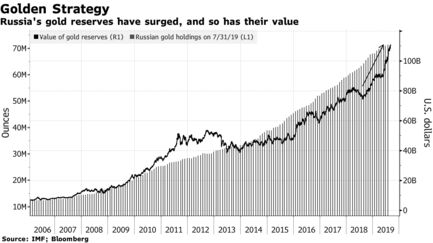
Value of Russia’s gold reserves climbed 42% in the past year
Russia is diversifying from U.S. assets and gold has rallied
Russia’s long-running bet on gold is looking better every month.
The
country quadrupled gold reserves in the past decade as it diversified
away from U.S. assets, a move that has paid off recently as haven demand
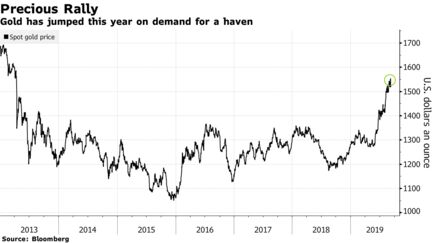
sent prices to a six-year high. In the past year, the value of the
nation’s gold jumped 42% to $109.5 billion and the metal now makes up the biggest share of Russia’s total reserves since 2000.
Russia’s central bank has been the largest buyer of gold in
the past few years as President Vladimir Putin seeks to break reliance
on the U.S. dollar as relations between the countries remain strained.
If Russia did need to tap its gold holding, it would fetch a hefty price
— the metal is heading for the best year since 2010 as the U.S.-China
trade war hurts global growth and central banks ease monetary policy.
“Russia
prefers to cushion its macroeconomic stability through politically
neutral tools,†said Vladimir Miklashevsky, a strategist at Danske Bank
A/S in Helsinki. “There is a massive substitution of U.S. dollar assets
by gold — a strategy which has earned billions of dollars for the Bank
of Russia just within several months.â€
More on Russia’s reserves
Russia’s
gold reserves total more than 2,200 tons, the fifth-biggest hoard by
country, and gold now accounts for 20.7% of overall reserves.The value of Russia’s currency reserves are up 9.5% in the past year, lagging the gains seen in bullion.The
central bank bought about 106 tons so far this year, the latest data
show. That’s down 19% from the same period in 2018 but still more than
any other nation.Last year, Russia’s gold buying exceeded its mine supply for the first time.
Russia
isn’t alone in hoarding gold. China, Kazakhstan and Poland have been
among the biggest buyers in the past couple of years, and global
holdings are expected to increase for a while yet.
Not all of Russia’s moves are paying off. Last year, the central bank shifted
about $100 billion of U.S. holdings into euros, yuan and the yen, and
since then the Chinese currency has dropped. Russia also missed out on
the rally in U.S. Treasuries.
Russia may keep buying gold to compensate for those other
losses in its reserves, said Kirill Tremasov, a former Economics
Ministry official and now director of analysis at Loko-Invest in Moscow.
So far it’s working, with gold up 18% this year to $1,513 an ounce.
For
Russia at least, it’s more about diversification than benefiting from
the price. The central bank started buying gold more than a decade ago
as it rallied toward 2011‘s record, and kept adding when prices dropped
in the following few years.
“The central bank is unlikely to have
pursued the goal of earning in the process of managing gold reserves,â€
Dmitry Dolgin, an economist at ING Bank, said by email. “The buying was
rather about diversification of assets
Posted by AGORACOM-JC
at 4:42 PM on Tuesday, September 10th, 2019
Announced that AlMasria Universal Airlines of Egypt has decided to proceed with the installation of two additional STAR-A.D.S. ® Systems on recently acquired aircraft
In late 2018, AlMasria entered into an agreement with Star to equip their target fleet of 5 aircraft with the STAR-A.D.S. ® System.
The first installation has met all expectations successfully and Star is pleased to report that AlMasria is exercising a provision of the original agreement to install the System on the next two aircraft.
TORONTO, Sept. 10, 2019 — Star Navigation Systems Group Ltd. (CSE: SNA) (OTCQB: SNAVF) (“Star†or the “Companyâ€) is pleased to announce that AlMasria Universal Airlines (“AlMasria”) of Egypt has decided to proceed with the installation of two additional STAR-A.D.S. ® Systems on recently acquired aircraft.
In late 2018, AlMasria entered into an agreement with Star to equip
their target fleet of 5 aircraft with the STAR-A.D.S. ® System. The
first installation has met all expectations successfully and Star is
pleased to report that AlMasria is exercising a provision of the
original agreement to install the System on the next two aircraft.
The STAR-A.D.S. ® System will help AlMasria achieve important
operational cost efficiencies, pursue its growth plans and to
immediately meet the recommendations of the International Civil Aviation
Organization (“ICAOâ€) concerning the Global Aeronautical Distress and
Safety System (“GADSSâ€), in particular dealing with the obligation to
provide autonomous location and tracking of aircraft in distress at
least once every minute.
The STAR–A.D.S. ® System already exceeds compliance
with all of the ICAO GADSS recommendations and evolutions. (See Star
Press release of June 11, 2018 for expanded discussion and details).
Viraf Kapadia, CEO of Star Navigation Systems said:
“We are gratified by this decision from AlMasria, as it is testimony
to the good cooperation and working relationship that has developed
between our two companies. Their two additional B737-400’s will be
equipped with our system in the months to come. Star is eager to
accompany AlMasria on its road to expansion, providing them with
competitive tools and services they need.â€
About Star Navigation:
Star Navigation Systems Group Ltd. owns the exclusive worldwide
license to its proprietary, patented In-flight Safety Monitoring System,
STAR-ISMS®, the heart of the STAR-A.D.S. ® and of the STAR-ISAMM™
Systems. Its real-time capability of tracking performance trends and
predicting incident-occurrence enhances aviation safety and improves
fleet management while reducing costs for the operator.
Stars’ M.M.I. Division designs and manufactures high performance,
mission critical, flight deck flat panel displays for defence and
commercial aviation industries worldwide. These displays are found on
aircraft and simulators, from C-130 aircraft, to Sikorsky and Agusta
Westland helicopters, as examples.
Stars’ subsidiary, Star-Isoneo Inc. is a specialised software firm,
developing complex solutions in engineering, simulation and development
for Canadian customers. Star-Isoneo works closely with Star in the
development of the Company’s MEDEVAC (STAR-ISAMM™ and STAR- LSAMM™)
applications of the patented STAR-A.D.S. ® technology, and on its
current R&D program with Bombardier.
Certain statements contained in this News Release constitute
forward-looking statements. When used in this document, the words “mayâ€,
“wouldâ€, “couldâ€, “willâ€, “expected†and similar expressions, as they
relate to Star or its management are intended to identify
forward-looking statements. Such statements reflect Star’s current views
with respect to future events and are subject to certain risks,
uncertainties and assumptions. Many factors could cause Star’s actual
performance or achievements to vary from those described herein. Should
one or more of these factors or uncertainties materialize, or should
assumptions underlying forward-looking statements prove incorrect,
actual results may vary materially from those described herein as
intended, planned, anticipated, believed, estimated or expected. Star
does not assume any obligation to update these forward-looking
statements, except as required by law.
Neither the Canadian Securities Exchange nor its Market Regulator
(as that term is defined in the policies of the Canadian Securities
Exchange) accepts responsibility for the adequacy or accuracy of the
content of this release.
Posted by AGORACOM
at 3:14 PM on Tuesday, September 10th, 2019
Retained Ms. Patricia Stirbys, J.D., LL.M, to help develop a comprehensive indigenous engagement and community relations program
Ms. Stirbys is a member of Cowessess First Nation and specializes in engaging Indigenous groups
VANCOUVER, British Columbia, Sept. 10, 2019 (GLOBE NEWSWIRE) — Labrador Gold Corp. (TSX-V: LAB) (“Labrador Gold†or the “Companyâ€) is pleased to announce that it has retained Ms. Patricia Stirbys, J.D., LL.M, a member of Cowessess First Nation, to help it develop a comprehensive indigenous engagement and community relations program.
Ms. Stirbys has over 20 years of experience in law, negotiations and
policy, specializing in engagement with Indigenous groups. She has an
excellent understanding of Indigenous peoples, issues and challenges
along with an understanding of the mining sector. Ms. Stirbys has
engaged with Indigenous communities in most provinces, including First
Nations in B.C., Saskatchewan, Ontario, Quebec and
Newfoundland-Labrador. She has successfully negotiated agreements with
Indigenous groups across Northern Ontario, particularly First Nation
communities within the Ring of Fire.
“We are very pleased to have Ms. Stirbys join the Labrador Gold
team,†said Roger Moss, President and Chief Executive Officer of
Labrador Gold. “Her significant experience in indigenous relations will
be a valuable asset as we move forward with engagement and consultation
with the community of Matimekush-Lac John.â€
The Company is committed to maintaining respectful relations with the
community and to understanding their concerns as we find a way to work
in the region to the benefit of all stakeholders.
The Company also announces the grant of 100,000 options to purchase
common shares of the Company to Ms. Stirbys. The options vest 50% on
grant and 50% after six months and are exercisable for a price of $0.25
for a period of five years.
Roger Moss, PhD., P.Geo., is the qualified person responsible for all technical information in this release.
About Labrador Gold:
Labrador Gold is a Canadian based mineral exploration company focused
on the acquisition and exploration of prospective gold projects in the
Americas. In 2017 Labrador Gold signed a Letter of Intent under which
the Company has the option to acquire 100% of the 896 square kilometre
(km2) Ashuanipi property in northwest Labrador and the Hopedale (458
km2) property in eastern Labrador.
The Hopedale property covers much of the Hunt River and Florence Lake
greenstone belts that stretch over 80 km. The belts are typical of
greenstone belts around the world, but have been underexplored by
comparison. Initial work by Labrador Gold during 2017 shows gold
anomalies in soils and lake sediments over a 3-kilometre section of the
northern portion of the Florence Lake greenstone belt in the vicinity of
the known Thurber Dog gold showing where grab samples assayed up to
7.8g/t gold. In addition, anomalous gold in soil and lake sediment
samples occur over approximately 40 kilometres along the southern
section of the greenstone belt (see news release dated January 25th 2018
for more details). Labrador Gold now controls approximately 57km strike
length of the Florence Lake Greenstone Belt.
The Ashuanipi gold project is located just 35 km from the historical
iron ore mining community of Schefferville, which is linked by rail to
the port of Sept-Iles, Quebec in the south. The claim blocks cover large
lake sediment gold anomalies that, with the exception of local
prospecting, have not seen a systematic modern day exploration program.
Results of the 2017 reconnaissance exploration program following up the
lake sediment anomalies show gold anomalies in soils and lake sediments
over a 15 kilometre long by 2 to 6 kilometre wide north-south trend and
over a 14 kilometre long by 2 to 4 kilometre wide east-west trend. The
anomalies appear to be broadly associated with magnetic highs and do not
show any correlation with specific rock types on a regional scale (see
news release dated January 18th 2018). This suggests a possible
structural control on the localization of the gold anomalies. Historical
work 30 km north on the Quebec side led to gold intersections of up to
2.23 grams per tonne (g/t) Au over 19.55 metres (not true width)
(Source: IOS Services Geoscientifiques, 2012, Exploration and geological
reconnaissance work in the Goodwood River Area, Sheffor Project, Summer
Field Season 2011). Gold in both areas appears to be associated with
similar rock types.
The Company has 57,039,022 common shares issued and outstanding and trades on the TSX Venture Exchange under the symbol LAB.
Posted by AGORACOM
at 1:30 PM on Tuesday, September 10th, 2019
SPONSOR: Labrador Gold – Two successful gold explorers lead the way in the Labrador gold rush targeting the under-explored gold potential of the province. Exploration has already outlined district scale gold on two projects, including over a 40km strike length of the Florence Lake greenstone belt, one of two greenstone belts covered by the Hopedale Project. Click Here for More Info
Mark Mobius,
the founding partner of Mobius Capital Partners, recommends that
investors hold 10% of their portfolios in physical gold, and invest the
rest in dividend yielding equities.
In the first half of this
year, central banks bought 374 metric tons of gold, according to the
World Gold Council. That was the largest net increase for the first half
of the year since at least 2000.
China’s central has been
adding to its gold reserves for eight straight months since December,
scooping up another 10 metric tons of the yellow metal in July,
according to data from the People’s Bank of China.
Veteran investor Mark Mobius is bullish on gold as central banks around the world cut interest rates.
“Physical
gold is the way to go, in my view, because of the incredible increase
in money supply,†said Mobius, the founding partner of Mobius Capital
Partners.“All
the central banks are trying to get interest rates down, they are
pumping money into the system. Then, you have all of the
cryptocurrencies coming in, so nobody really knows how much currency is
out there,†he told CNBC’s “Street Signs†on Friday.Amid expectations of slowing global growth, central banks around the world have been lowering interest rates, as they seek to boost money supply in the economy, stoke demand and provide an impetus to growth.
Mobius recommends that investors hold 10% of their
portfolios in physical gold, with the rest invested in dividend
yielding equities. That’s especially if the dollar gets weaker.
In his view, “the U.S. government, the Trump White House, does not want a strong dollar.â€
“They
are certainly going to try to weaken the dollar against other
currencies and of course, it’s a race to the bottom. Because, as soon as
they do that, other currencies will also weaken,†said Mobius.
“People are going to finally realize that you got to have gold, because all the currencies will be losing value,†he added.
Gold can retain its value much better than other forms of currency, and is traditionally a safe haven during market volatility.
A weaker dollar tends to boost the price of gold as global trade in the yellow metal is denominated in U.S. dollars.
“At the end of the day, gold is a means of exchange. It’s a stable currency in some way,†said Mobius.
Central banks are buying gold
Data from the World Gold Council this year point to risingcentral bank demand for the yellow metal amid global macroeconomic uncertainty.
In the first half of this year, central banks bought 374 metric tons of gold, reported the World Gold Council. That was the largest net increase for the first half of the year since at least 2000.
“Deep
down inside, the central bankers do believe in gold, but they don’t
want to say it because … they won’t be able to create new currency,â€
said Mobius.
The 2019 Central Bank Gold Reserve survey,
conducted by the World Gold Council and released in July, also found
there was central bank demand for gold in the short to medium term.
Of
those polled, 11% of emerging market and developing economy central
banks said they intended to increase their gold reserves over the next
12 months.
That was similar to data from 2018 when 12% of such
central banks bought gold, giving rise to 652 metric tons of central
bank gold demand — the highest level on record under the current
international monetary system, noted the World Gold Council.
“The
planned purchases are being driven by higher economic risks in reserve
currencies. In the medium term, central banks see changes in the
international monetary system, with a greater role for the Chinese
renminbi and gold,†said the World Gold Council in their report. The
renminbi is another name for the Chinese yuan.
About 40% of
emerging market and developing economy central banks cited “anticipated
changes in the international monetary system being relevant to their
decision to hold gold,†the World Gold Council said.
China also investing in gold
Spot gold
was trading around $1,509.51 an ounce on Monday morning in Asia after
hitting a six-year high of $1,554.56 in late August amid heightened U.S.–Chinatrade tensions.
China’s
central bank has been adding to its gold reserve for eight straight
months since December, scooping up another 10 metric tons of the yellow
metal in July, according to data from the People’s Bank of China.
“China
is the biggest producer of gold to begin with. And then of course,
they’ve been buying gold, so nobody really knows how much they have in
the vaults,†said Mobius. “I’m sure it’s been increasing at a pretty
good pace.â€
Posted by AGORACOM
at 10:13 AM on Tuesday, September 10th, 2019
SPONSOR: Lomiko Metals LMR:TSX-V – A Canadian exploration-stage company discovered high-grade graphite at its La Loutre Property in Quebec and is working toward a Pre-Economic Assessment (PEA) that will increase its current indicated resource of 4.1 Mt of 6.5% Cg to over 10 Mt of 10%+ Cg through a 21 hole program at the Refractory Zone. Click Here For More Information
The world’s biggest carmaker announced Friday that it had struck a deal with Sweden’s Northvolt to build a giant battery factory in Germany. It also confirmed production dates for two new models key to the group’s success. A. Paul Gill, CEO of Lomiko Metals (TSXV: LMR, OTCQB: LMRMF) noted that the graphite supply from China to Europe and North America has dropped tremendously over the past few years. This market change may be an opportunity for the Company as European and North American battery manufacturers are now looking for stable suppliers. “If we’re going to continue to expand the electric vehicle industry in Europe and  North America, we’re need a secure supply of raw materials.â€,stated Gill. “The shortage of graphite is going to be a real concern in the coming years.â€,he added. The German company said production of lithium-ion batteries would begin in late 2023 or early 2024, a move that will be vital to Volkswagen’s (VLKAF) ability to mount what it calls “the largest electric offensive in the automotive industry worldwide.” The group plans to launch almost 70 new electric models in the next decade, and hopes to build 22 million electric cars over this period. It is investing more than €30 billion ($33 billion) into electrifying its fleet over the next four years, prompted in part by pressure from regulators and the fallout from its diesel emissions scandal. If successful, Volkswagen could overtake rivals such as Tesla (TSLA) and Warren-Buffet-backed BYD in China.
Battery factory big win for Europe
Lithium-ion batteries, the majority of which are currently produced in China, are a critical part of Volkswagen’s electrification strategy. Batteries account for about a third of the cost of electric cars, according to consulting firm Wood Mackenzie. China is home to 70% of global lithium cell manufacturing capacity, with the United States in second place at 12%, said Simone Tagliapietra, a climate and energy fellow at Bruegel, the European economic think tank. Europe lags behind and hosts only about 3% of global production capacity, according to the European Commission. The Volkswagen-Northvolt deal represents a “very significant investment for the future of European battery production,” Tagliapietra told CNN Business. Volkswagen is investing €900 million ($993 million) into the Northvolt joint venture. Some of the money will go into the German factory, the rest will secure Volkswagen a 20% stake in Northvolt and a seat on its supervisory board. Volkswagen also confirmed that production of the new ID.3 electric car series would begin this November, with the first models delivered to customers next year. It has already sold out a limited edition of the ID.3, which is due to make its world debut on September 9 at the Frankfurt Motor Show. Also premiering at the show will be an electric version of the vintage Volkswagen Beetle. The conversion of the Beetle is being done by a specialist partner company, eClassics, and will use of components from the new VW e-up! city car. Porsche, one of Volkswagen’s premium brands, confirmed on Friday that it would start producing its first all-electric sports car — the Taycan — on September 9.
A New Production Plant
Alongside investing in battery production, Volkswagen is pouring €1.2 billion into overhauling its Zwickau vehicle plant, which formerly produced internal combustion engines, so that it can make electric cars. This process began in 2018 and is expected to be completed by 2020. By 2021, the plant is expected to produce 330,000 vehicles per year, making it Europe’s “largest and most efficient electric vehicle plant,” according to Volkswagen. The ID.3 will be the first vehicle to be built on this new modular electric car production platform, or MEB. In the next three years, production of 33 models across the group’s brands is due to start on the MEB.Â
Posted by AGORACOM-JC
at 7:43 AM on Tuesday, September 10th, 2019
Acquired a non-controlling interest in the Vancouver Titans, an esports team which was founded in 2018 and is competing in its first season in the Overwatch League
Overwatch League is an esports competition with 20 teams across six countries and three continents, all centered on the popular first-person shooter game Overwatch
Toronto, Ontario–(September 10, 2019) – Enthusiast Gaming Holdings Inc. (TSXV: EGLX) (“Enthusiast Gaming“), the parent of Luminosity Gaming Inc., announced today that it has acquired a non-controlling interest in the Vancouver Titans, an esports team which was founded in 2018 and is competing in its first season in the Overwatch League. Overwatch League is an esports competition with 20 teams across six countries and three continents, all centered on the popular first-person shooter game Overwatch. Enthusiast Gaming acquired its interest in the Vancouver Titans from the team’s majority owner, the Aquilini Investment Group.
Enthusiast Gaming, through its wholly-owned subsidiary, Luminosity
Gaming Inc., manages the Vancouver Titans through a long-term management
services agreement with the majority owner.
About Enthusiast Gaming
Enthusiast Gaming is one of the largest vertically integrated video
game and esports companies in the world. The Company’s digital platform
includes +85 gaming related websites and 900 YouTube channels which
collectively reach 150 million visitors monthly. Enthusiast’s esports
division, Luminosity Gaming, a leading global esports organization
consists of 8 professional esports teams under management, including the
#1 ranked Overwatch team, the Vancouver Titans and over 50 gaming
influencers with a total audience of 60 million followers. Collectively,
the community reaches over 200 million gaming enthusiasts on a monthly
basis. Enthusiast also owns and operates Canada’s largest gaming expo,
Enthusiast Gaming Live Expo, EGLX, (eglx.ca) with approximately 55,000 people attending in 2018. For more information on the Company, visit www.enthusiastgaming.com. For more information on Luminosity Gaming, please visit luminosity.gg
CONTACT INFORMATION
Investor Relations: Julia Becker Head of Investor Relations & Marketing Telephone: 604-785-0850 Email: [email protected]
Forward-Looking Information
Certain statements in this release are forward-looking
statements. Forward looking statements consist of statements that are
not purely historical, including any statements regarding beliefs,
plans, expectations or intentions regarding the future. Such statements
are subject to risks and uncertainties that may cause actual results,
performance or developments to differ materially from those contained in
the statements, including risks related to factors beyond the control
of Enthusiast Gaming. The risks include risks that are customary to
transactions of this nature and customary to companies which have their
stock traded on the TSXV. No assurance can be given that any of the
events anticipated by the forward-looking statements will occur or, if
they do occur, what benefits Enthusiast Gaming will obtain from them.
This press release does not constitute an offer to sell or
solicitation of an offer to buy any of the securities in the United
States. The securities have not been and will not be registered under
the United States Securities Act of 1933, as amended (the “U.S.
Securities Act”) or any state securities laws and may not be offered or
sold within the United States or to a U.S. Person unless registered
under the U.S. Securities Act and applicable state securities laws or an
exemption from such registration is available.
Neither TSX Venture Exchange nor its Regulation Services
Provider (as that term is defined in the policies of the TSX Venture
Exchange) accepts responsibility for the adequacy or accuracy of this
release.
Posted by AGORACOM-JC
at 4:30 PM on Monday, September 9th, 2019
The gaming ecosystem is approaching a market share comparable to professional sports
Enthusiast Gaming has its eyes set on building the largest
community of authentic gamers to monetize and leverage their
market-leading analytics network
EGLX is the most adept enterprise at increasing fan engagement for its influencers and teams through its massive media portfolio
By: Eva Bieniarz
The gaming industry is colossal — there are more than 2.5 billion
gamers around the world, and the gaming market is set to grow to US$196 billion by 2022
alone! With a CAGR of nine per cent for the period 2018–2022, this
industry has become a legitimate rival to the traditional sports market.
To compare earnings, the global sports market generated US$488.5 billion in 2018,
whereas the global gaming industry hauled in US$135 billion. While both
segments are projected to see significant growth in the short term, the
gap is poised to shrink as gaming solidifies itself at the “heart of
the entertainment business,†according to Newzoo.
The gaming industry is also thriving based on its growing and diverse audience base. For instance, 65 per cent of American adults play video games, and the average gamer is only 34 years old.
Transforming the gaming world one acquisition at a time
Within this massive industry, Enthusiast Gaming (TSX.V: EGLX) is building the largest vertically integrated gaming media and esports company in the world.
As a newly listed public company by way of its merger with Luminosity
Gaming, J55, and Aquilini GameCo, the company is on track to make this
global vision a reality. One of the new conglomerate’s goals will be to
build out a central gamer data source from its three divisions (media,
events, influencers), to facilitate brands and advertisers.
Regarding the company’s merger and acquisition strategy, Menashe
Kestenbaum, president and founder of Enthusiast Gaming, explains,
“Enthusiast has an aggressive growth strategy through accretive
acquisitions, which allows us to scale the business quickly and
effectively.
“Our strategy is to acquire the leading digital communities across
the entire gaming ecosystem, which keeps our platform diversified and
agnostic. It also provides us with significant competitive advantage
against anyone trying to enter the space.â€
The company’s largest acquisition to date, The Sims Resource, is the
leading female gaming website in the world, generating $7 million in
revenue and $5.25 million in EBITDA (2018).
“This acquisition provided us with immediate access to the growing
female gaming demographic and 2.5 billion page views a year. The Sims
Resource also has a unique subscription model, which generates recurring
monthly revenue from over 60,000 subscribers. We see this as an
opportunity to adopt a similar model across our network of 85 websites
to drive future revenue growth,†Kestenbaum notes.
Enthusiast has an aggressive growth strategy through accretive
acquisitions, which allows us to scale the business quickly and
effectively. Our strategy is to acquire leading digital communities
across the gaming ecosystem, which keeps our platform diversified and
agnostic.Menashe Kestenbaum, President, Enthusiast Gaming Holdings Inc.
What Enthusiast’s merger means for esports
Enthusiast’s merger will make the company a leading publicly traded
esports and gaming organization, with $22 million in pro forma revenue
on the closing of the merger backed by $55 million in financing, with a
combined global audience reach of approximately 200 million.
So why is this merger so significant, and why did Enthusiast partner
with Aquilini GameCo? How, exactly, will this benefit the company in the
long run?
Well, since Enthusiast’s successful monetization strategy and wealth
of analytical data covers an abundance of demographics in the broader
gaming industry, the company’s knowledge can be combined with
Luminosity’s influencers and esports properties to create a unique
gaming ecosystem.
Enthusiast’s success in monetizing gaming properties will also allow
the company to monetize Luminosity’s championship esports franchise
through the same data-centric, ad tech approach to engage partnership
and advertising opportunities.
The fact that Enthusiast is merging with Aquilini GameCo gives the
company a huge boost to diversify and expand its presence across more
than merely sports and entertainment, but potentially food and
hospitality, living, and more.
Luminosity Gaming is currently competing in games like Counter
Strike, Fortnite, Call of Duty, Madden and more at the highest
professional level. Supplied
Enthusiast is also party to a long-term services support agreement
with Vancouver Arena Limited Partnership (VALP), pursuant to which VALP
will provide Enthusiast with a broad range of marketing and business
support services, including corporate partnership and selling support,
retail support, brand association and marketing support (to be provided
by Canucks Sports and Entertainment), and more.
Apart from a company perspective, when taking a holistic look at the
esports and gaming industry, it’s clear that sentiment towards gaming is
growing. The industry even has tech giants Amazon and Google wanting in
on the action.
What’s more, esports is also being compared to professional sports —
hockey, baseball, you name it — in terms of garnering millions of fans
around the world.
For instance, in 2017, the League of Legends tournament garnered more viewers than the MLB World Series, the NBA Finals and the NHL Stanley Cup Finals! This would have been unheard of a few years ago.
Kestenbaum explains, “The size and scalability of our ecosystems are a
significant competitive advantage. Enthusiast’s online presence of 150
million visitors, combined with Luminosity’s rich content creation
reaching over 60 million followers, will be invaluable for us moving
forward.â€
Enthusiast’s merger is expected to provide further significant
strategic and financial benefits to the company, including but not
limited to expected margin improvement, involving a combination of the
net funds from the private placement and cash-on-hand that may be used
to repay all or part of the Sims Resource Deferred Payment, as well as
an enhanced capital market profile through the closing of the
transactions.
Growth drivers propelling the company towards success
Enthusiast is also growing its fan base and subsequently its customer base through seven strategies:
Growth in revenue per user goal: Target revenue per user of $0.40
Build out a direct sales team: Increase of 10–20x / CPM compared to
commoditized programmatic advertising rates. Expand to key financial
hubs like Toronto, New York, London, Los Angeles, and San Francisco
Subscription model growth: Offer unique content and player access to
increase subscriptions. Currently, over 60,000 subscribers generating
approximately $2.5 million in recurring revenue
Mergers and acquisitions: Grow the size of Enthusiast’s fan base,
and better engage with them to increase revenue and profitability
Expand the EG Live division: Build on the success in Toronto and
bring similar events to New York, Chicago and the Pacific Northwest
Franchise value appreciation: Increase the value of the franchise
through content creators, influencers, professional esports
professionals and championship esports teams
Non-endemic opportunities: Sell more non-endemic sponsorships and partnerships through direct sales and programmatic advertising
Apart from the company’s strategic growth model, Enthusiast has five
key business segments that enhance the company’s overall expansion
plans. They include:
Content: Enthusiast offers news, reviews, videos,
live streams, blog posts, tips, chats, message boards, and other
video-gaming related content.
Advertising: The company operates an advertising
network for brands targeting the gamer demographic, generating over 30
billion advertisement requests per month.
Events: Enthusiast organizes Canada’s largest gaming
expo, Enthusiast Gaming Live Expo, EGLX, which attracted over 55,000
attendees in 2018, including a Rising Star Series.
Data and ad tech: The company has built a proprietary ad tech platform around a tech-enabled gamer data platform.
Leading esports franchise: Luminosity Gaming is one
of the most popular esports brands, offering a subscription growth model
that leverages content and player access to increase subscriptions.
Add in celebrity endorsement from Canadian recording artist Tory
Lanez, and the top esports athletes and influencers including YELO, and
the company has all the right ingredients to reach success.
A knowledgeable management team leading the way
Enthusiast’s skyrocketing success and popularity is catalyzed by
Menashe Kestenbaum, president of Enthusiast, who began his career in
video games when he was 13 years old, writing for IGN, a large gaming
media site. Kestenbaum launched his first gaming blog, called “Nintendo
Enthusiast,†in 2011, which subsequently became the foundation of
Enthusiast Gaming today.
Adrian Montgomery, CEO of Enthusiast, has also been instrumental in
Luminosity’s new partnership with Enthusiast. As ex-president of Canucks
Sports and Entertainment, Montgomery brings decades of knowledge about
sports and what it means to be a dedicated fan.
Steve Maida, president of esports at Enthusiast, built the popular
esports franchise from the ground up and was responsible for finding
talent like “Ninja,†one of the world’s top Fornite players.
With its merger between Aquilini GameCo and Luminosity completed,
Enthusiast Gaming is on the right path towards dominating the gaming
industry. Through its clear growth objectives, diverse revenue streams,
acquisitions, partnerships and more, the company is building a
world-class gaming company that cannot be replicated.
Investors should look forward to more company updates as Enthusiast continues to scale and add to its roster.
Tags: CSE, EA sports, egaming, esports, Fortnite, LOL, stocks, tsx, tsx-v Posted in Enthusiast Gaming Holdings Inc. | Comments Off on The Gaming Industry is colossal with over a billion gamers worldwide, Enthusiast Gaming $EGLX.ca Aims to Be the largest vertically integrated gaming media and #Esports company in the world $EPY.ca $FDM.ca $WINR $TCEHF $ATVI $TNA.ca
The esports industry is growing at a rapid rate, and along with it is also a new form of gambling called “esports betting.â€
The esports betting industry is expected to continue to grow even more over the next couple of years, becoming a multibillion-dollar industry.
Bear in mind that unlike physical sports, which have a very large
fanbase and following, the esports betting industry has a very limited
audience. As a result, not too many people have an idea of what esports
betting is. Only those who follow the esports industry may have heard of
it.
So, What is Esports Betting?
For those who don’t know, esports is the shortened term for
electronic sports, which usually refer to competitive video gaming.
Playing competitive video games is not an entirely new concept. In fact,
a lot of gamers have been competing with one another ever since the
first gaming consoles have been released. What’s new is what we now call
esports betting, which is starting to attract the attention of many
gamblers from around the world.
Simply put, esports betting is a form of online gambling wherein you
put your money on a team or player that plays competitive video games.
As mentioned earlier, esports betting is a very huge business and it
is expected to become a multibillion-dollar industry soon as esports as a
whole continues to grow. As the world of video gaming can be very
competitive, there are now thousands of professional gamers from
different video games who compete with one another because of the prize.
And, when there is money, there is always gambling. With the rise of
this industry, you can now go to online esports betting sites such as Vulkanbet Esports to place your bets and gamble on-the-go.
How Esports Betting Works
Esports betting is completely different from physical sports
gambling. In esports betting, you are allowed to place a bet on a team
of professional gamers or on individual players who you think will win
the match or tournament.
However, since there are plenty of esports games, the betting system
and options are usually different from one another. Esports betting also
welcomes beginners who are not familiar with esports and offer them
with numerous betting opportunities.
Currently, the simplest betting option is to bet on an overall
winner. You simply place a bet on a team or player who you think will
win the match after you have carefully studied the odds. This is what
makes esports betting really interesting: you are given some betting
odds that will let you have a good idea of the match’s outcome or who
will win. You’ll need to learn how to study these odds before you bet if
you want to earn a lot of money from esports betting.
Types of Esports Betting
It’s challenging to identify the different types of bets on esports since they usually depend on the video game. For example, Counter-Strike: Global Offensive (CS:GO),
which is a fast-paced first-person shooter game, provides exciting
betting opportunities that allow you to place a bet on which team wins
the first round of the game.
On the other hand, DoTA 2,
a real-time strategy multiplayer online battle arena, allows you to
place a bet on which player or team kills Roshan (the most powerful
Neutral Creep in the map who’s considered to be a miniboss) first. These
bets are not dependent on which team wins the entire match, but on the
objectives achieved throughout the match.
Here are the three most common types of esports betting that you are usually offered by many betting sites:
Outrights Betting – These are bets that you are allowed
to place before the tournament or match starts. You bet on which team
will become the overall winner of the tournament, or which players
progress to the next stage of the event. You are also allowed to place
bets on teams or players who you think will be eliminated once the
tournament starts.
Match Winner – This is the most common type of bet in esports. You place a bet on a team or player who you think will win a single match.
Totals – This is the type of bet that is dependent on
stats. Here, you can place your bet on which team or player has the most
number of kills, maps or rounds played, total points, etc.
Conclusion
The future of esports betting looks very promising
as more and more people are getting into the exciting betting action of
video games. Whether you are new to esports or are an avid esports fan,
this is the perfect time for you to join the fun and excitement that
esports betting brings. Aside from that, you can potentially earn a lot
of money from it while enjoying some competitive video games at the same
time.